A Joint Model of Implicit Arguments for Nominal Predicates
Matthew Gerber and Joyce Y. Chai
Department of Computer Science Michigan State University East Lansing, Michigan, USA {gerberm2,jchai}@cse.msu.edu
Robert Bart
Computer Science and Engineering University of Washington Seattle, Washington, USA [email protected]
Abstract
Many prior studies have investigated the re-covery of semantic arguments for nominal predicates. The models in many of these stud-ies have assumed that arguments are indepen-dent of each other. This assumption simpli-fies the computational modeling of semantic arguments, but it ignores the joint nature of natural language. This paper presents a pre-liminary investigation into the joint modeling of implicit arguments for nominal predicates. The joint model uses propositional knowledge extracted from millions of Internet webpages to help guide prediction.
1 Introduction
Much recent work on semantic role labeling has fo-cused on joint models of arguments. This work is motivated by the fact that one argument can either promote or inhibit the presence of another argument. Because most of this work has been done for verbal SRL, nominal SRL has lagged behind somewhat. In particular, the “implicit” nominal SRL model cre-ated by Gerber and Chai (2010) does not address joint argument structures. Implicit arguments are similar to standard SRL arguments, a primary differ-ence being their ability to cross sentdiffer-ence boundaries. In the model created by Gerber and Chai, implicit ar-gument candidates are classified independently and a heuristic post-processing method is applied to de-rive the final structure. This paper presents a prelim-inary joint implicit argument model.
Consider the following sentences:1
1
We will use the notation of Gerber and Chai (2010), where
(1) [c1The president] is currently struggling to
manage [c2the country’s economy].
(2) If he cannot get it under control, [ploss] of [arg1the next election] might result.
In Example 2, we are searching for theiarg0of loss
(the entity that is losing). The sentence in Exam-ple 1 supplies two candidatesc1and c2. If one only
considers the predicate loss, then c1 and c2 would
both be reasonable fillers for theiarg0: presidents
often lose things (e.g., votes and allegiance) and economies often lose things (e.g., jobs and value). However, the sentence in Example 2 supplies addi-tional information. It tells the reader that the next
election is the entity being lost. Given this
infor-mation, one would likely preferc1 over c2 because
economies don’t generally lose elections, whereas presidents often do. This type of inference is com-mon in textual discourses because authors assume a shared knowledge base with their readers. This knowledge base contains information about events and their typical participants (e.g., the fact that pres-idents lose elections but economies do not).
The model presented in this paper relies on a knowledge base constructed by automatically min-ing semantic propositions from Internet webpages. These propositions help to identify likely joint im-plicit argument configurations. In the following sec-tion, we review work on joint inference within se-mantic role labeling. In Sections 4 and 5, we present the joint implicit argument model and its features. Evaluation results for this model are given in
Sec-standard nominal arguments are indicated withargnand im-plicit arguments are indicated withiargn.
tion 6. The joint model contains many simplifying assumptions, which we address in Section 7. We conclude in Section 8.
2 Related work
A number of recent studies have shown that seman-tic arguments are not independent and that system performance can be improved by taking argument dependencies into account. Consider the following examples, due to Toutanova et al. (2008):
(3) [Temporal The day] that [arg0 the ogre]
[Predicate cooked] [arg1the children] is still
remembered.
(4) [arg1 The meal] that [arg0the ogre]
[Predicate cooked] [Beneficiary the children] is still remembered.
These examples demonstrate the importance of inter-argument dependencies. The change from day in Example 3 to meal in Example 4 affects more than just the Temporal label: additionally, thearg1
changes to Beneficiary, even though the underlying text (the children) does not change. To capture this dependency, Toutanova el al. first generate an n -best list of argument labels for a predicate instance. They then re-rank this list using joint features that describe multiple arguments simultaneously. The features help prevent globally invalid argument con-figurations (e.g., ones with multiplearg0labels).
Punyakanok et al. (2008) formulate a variety of constraints on argument configurations. For exam-ple, arguments are not allowed to overlap the predi-cate, nor are they allowed to overlap each other. The authors treat these constraints as binary variables within an integer linear program, which is optimized to produce the final labeling.
Ritter et al. (2010) investigated joint selectional preferences. Traditionally, a selectional preference model provides the strength of association between a predicate-argument position and a specific textual expression. Returning to Examples 1 and 2, one sees that the selectional preference for president and
economy in theiarg0position of loss should be high.
Ritter et al. extended this single-argument model using a joint formulation of Latent Dirichlet Allo-cation (LDA) (Blei et al., 2003). In the generative
version of joint LDA, text for the argument posi-tions is generated from a common hidden variable. This approach reflects the intuition behind Exam-ples 1 and 2 and would help identify president as the
iarg0. Training data for the model was drawn from
a large corpus of two-argument tuples extracted by the TextRunner system, which we describe next.
Both Ritter et al.’s model and the model described in this paper rely heavily on information extracted by the TextRunner system (Banko et al., 2007). The TextRunner system extracts tuples from Inter-net webpages in an unsupervised fashion. One key difference between TextRunner and other informa-tion extracinforma-tion systems is that TextRunner does not use a closed set of relations (compare to the work described by ACE (2008)). Instead, the relation set is left open, leading to the notion of Open Informa-tion ExtracInforma-tion (OIE). Although OIE often has lower precision than traditional information extraction, it is able to extract a wider variety of relations at preci-sion levels that are often useful (Banko and Etzioni, 2008).
3 Using TextRunner to assess joint argument assignments
Returning again to Examples 1 and 2, one can query TextRunner in the following way:
arg0 : ?
Predicate : lose2
arg1 : election
In the TextRunner system, arg0 typically indicates
the Agent and arg1 typically indicates the Theme.
TextRunner provides many tuples in response to this query, two of which are shown below:
(5) Usually, [arg0 the president’s party]
[Predicate loses] [arg1seats in the mid-term
election].
(6) [arg0The president] [Predicate lost] [arg1the
election].
The tuples present in these sentences give strong in-dicators about the type of entity that loses elections.
2
Given all of the returned tuples, only a single one involves economy in thearg0position:
(7) Any president will take credit for [arg0a good
economy] or [Predicate lose] [arg1an
election] over a bad one.
In Example 7, TextRunner has not analyzed the ar-guments correctly (president should be thearg0, not
economy).3 In Section 5, we show how evidence from the tuple lists can be aggregated such that cor-rect analyses (5 and 6) are favored over incorcor-rect analyses (7). The primary contribution of this paper is an exploration of how the aggregated evidence can be used to identify implicit arguments (e.g.,
presi-dent in Example 1).
4 Joint model formulation
To simplify the experimental setting, the model de-scribed in this paper targets the specific situation where a predicate instance p takes an implicitiarg0
and an implicitiarg1.4Whereas the model proposed
by Gerber and Chai (2010) classifies candidates for these positions independently, the model in this pa-per classifies joint structures by evaluating the fol-lowing binary prediction function:
P(+| hp, iarg0, ci, iarg1, cji) (8)
Equation 8 gives the probability of the joint assign-ment ofcitoiarg0andcjtoiarg1. Given a set ofn
candidatesc1, . . . , cn∈C, the best labeling is found
by considering all possible assignments ofciandcj:
arg max
(ci,cj)∈CxCs.t.i6=j
P(+| hp, iarg0, ci, iarg1, cji)
(9)
Consider modified versions of Examples 1 and 2:
(10) [c1The president] is currently struggling to
manage [c2the country’s economy].
(11) If he cannot get it under control before [c3the
next election], a [ploss] might result.
3
Banko and Etzioni (2008) cite a precision score of 88% for their system.
4This simplifying assumption does not hold for real data,
and is addressed further in Section 7.2.
In this case, we are looking for theiarg0 as well as
theiarg1for the loss predicate. Three candidatesc1,
c2, andc3are marked. The joint model would
eval-uate the following probabilities, taking the highest scoring to be the final assignment:
P(+| hloss, iarg0,president, iarg1,economyi)
*P(+| hloss, iarg0,president, iarg1,electioni)
P(+| hloss, iarg0,economy, iarg1,presidenti)
P(+| hloss, iarg0,economy, iarg1,electioni)
P(+| hloss, iarg0,election, iarg1,presidenti)
P(+| hloss, iarg0,election, iarg1,economyi)
Intuitively, only the starred item should have a high probability. In the following section, we describe how these probabilities can be estimated using in-formation extracted by TextRunner.
5 Joint model features
As mentioned in Section 2, the TextRunner system has been extracting massive amounts of knowledge in the form of tuples such as the following:
hpresident,lose,electioni
The database of tuples can be queried by supplying one or more of the tuple arguments. For example, the following is a partial result list for the query
hpresident,lose,?i:
hKenyan president,lose,electioni hpresident’s party,lose seat in,electioni hpresident,lose,allyi
The final position in each of these tuples (e.g.,
election) provides a single answer to the question
“What might a president lose?”. Aggregation begins by generalizing each answer to its WordNet synset (glosses are shown after the arrows):
hKenyan president,lose,electioni →a vote
hpresident’s party,lose seat in,electioni(same)
hpresident,lose,allyi →friendly nation
Having mapped each tuple to its synset, each synset is ranked according to the number of tuples that it covers. For the query hpresident,lose,?i, this produces the following ranked list of WordNet synsets (only the top five are shown, with the number in parentheses indicating how many tuples are covered):
1. election (77)
2. war (51)
3. vote (39)
4. people (34)
5. support (26)
...
The synsets above indicate likely answers to the pre-vious question of “What might a president lose?”.
In a similar manner, one can answer a question such as “What might lose an election?” using tu-ples extracted by TextRunner. The procedure de-scribed above produces the following ranked list of WordNet synsets to answer this question:
...
9. people (62)
10. Republican (51)
11. Republican party (51)
12. Hillary (50)
13. president (49)
...
In this case, the expected answer (president) ranks 13th in the list of answer synsets. It is important to note that lower ranked answers are not necessar-ily incorrect answers. It is a simple fact that a wide variety of entities can lose an election. Items 9-13 are all reasonable answers to the original question of what might lose an election.
The two symmetric questions defined and an-swered above are closely connected to the implicit argument situation discussed in Examples 10 and 11. In Example 11, one is searching for the implicit
iarg0andiarg1 to the loss predicate. Candidatesci
andcj that truly fill these positions should be
com-patible with questions in the following forms:
Question: What didcilose?
Answer:cj
Question: What entity lostcj?
Answer:ci
If either of these question-answer pairs is not satis-fied, then the joint assignment ofci toiarg0 andcj
toiarg1 should be considered unlikely. Using the
first question-answer pair above as an example, sat-isfaction is determined in the following way:
1. Query TextRunner for hci,lose,?i, retrieving
the topntuples.
2. Map the final argument of each tuple to its WordNet synset and rank the synsets by fre-quency, producing the ranked listAof answer synsets.
3. Map cj to its most common WordNet synset synsetcj and determine whether synsetcj
ex-ists inA. If it does, the question-answer pair is satisfied.
Some additional processing is required to determine whethersynsetcj exists inA. This is due to the
hi-erarchical organization of WordNet. For example, suppose thatsynsetcj is the synset containing
“pri-mary election” and Acontains synsets paraphrased as follows:
1. election
2. war
3. vote
...
synsetcj does not appear directly in this list;
how-ever, its existence in the list is implied by the follow-ing hypernymy path within WordNet:
primary election−−→is-a election
Intuitively, if synsetcj is connected to a highly
The evidence is weaker if the path is long, as in the following example:
open primary−−→is-a direct primary
is-a
−−→primary election−−→is-a election
Additionally, a path between more specific synsets (i.e., those lower in the hierarchy) indicates a stronger relationship than a path between more gen-eral synsets (i.e., those higher in the hierarchy). These two situations are depicted in Figure 1. The synset similarity metric defined by Wu and Palmer (1994) combines the path length and synset depth intuitions into a single numeric score that is defined as follows:
2∗depth(lca(synset1, synset2))
depth(synset1) +depth(synset2)
(12)
In Equation 12, lca returns the lowest common an-cestor of the two synsets within the WordNet is-a hierarchy.
To summarize, Equation 12 indicates the strength of association betweensynsetcj(e.g., primary
elec-tion) and a ranked synset synsetafrom Athat
an-swers a question such as “What might a president lose?”. If the association between synsetcj and synsetais small, then the assignment ofcjtoiarg1
is unlikely. The process works similarly for assess-ing ci as the filler of iarg0. In what follows, we
quantify this intuition with features used to repre-sent the conditioning information in Equation 8.
Feature 1: Maximum association strength. Given the conditioning variables in Equation 8, there are two questions that can be asked:
Question: What didcip?
Answer:cj
Question: What entityp cj?
Answer:ci
Each of these questions produces a ranked list of answer synsets using the approach described previ-ously. The synset for each answer string will match zero or more of the answer synsets, and each of these
matches will be associated with a similarity score as defined in Equation 12. Feature 1 considers all such similarity scores and selects the maximum. A high value for this feature indicates that one (or both) of the candidates (ciorcj) is likely to fill its associated
implicit argument position.
Feature 2: Maximum reciprocal rank. Of all the answer matches described for Feature 1, Feature 2 selects the highest ranking and forms the reciprocal rank. Thus, values for Feature 2 are in [0,1] with larger values indicating matches with higher ranked answer synsets.
Feature 3: Number of matches. This feature
records the total number of answer string matches from either of the questions described for Feature 1.
Feature 4: Sum reciprocal rank. Feature 2 consid-ers answer synset matches from either of the posed questions; ideally, each question-answer pair should have some influence on the probability estimate in Equation 8. Feature 4 looks at the answer synset matches from each question individually. The match with highest rank for each question is selected, and the reciprocal rank r 2
1+r2 is computed. The value
of this feature is zero if either of the questions fails to produce a matching answer synset.
Features 5 and 6: Local classification scores. The joint model described in this paper does not replace the local prediction model presented by Gerber and Chai (2010). The latter uses a wide variety of impor-tant features that cannot be ignored. Like previous joint models (e.g., the one described by Toutanova et al. (2008)), the joint model works on top of the lo-cal prediction model, whose scores are incorporated into the joint model as feature-value pairs. Given the local prediction scores for theiarg0andiarg1
posi-tions in Equation 8, the joint model forms two fea-tures: (1) the sum of the scores forci filling iarg0
andcj fillingiarg1, and (2) the product of these two
scores.
6 Evaluation
entity (a)
physical entity (b)
thing
body of water (c)
bay (d)
matter
[image:6.612.214.395.55.227.2]abstract entity
Figure 1: Effect of depth on WordNet synset similarity. All links indicate is-a relationships. Although the link distance from (a) to (b) equals the distance from (c) to (d), the latter are more similar due to their lower depth within the WordNet hierarchy.
argument data created by Gerber and Chai (2010). This dataset contains full-text implicit argument annotations for approximately 1,200 predicate in-stances within the Penn TreeBank. As mentioned in Section 4, all experiments were conducted us-ing predicate instances that take aniarg0andiarg1
in the ground-truth annotations. We used a ten-fold cross-validation setup and the evaluation met-rics proposed by Ruppenhofer et al. (2009), which were also used by Gerber and Chai. For each evalu-ation fold, features were selected using only the cor-responding training data and the greedy selection al-gorithm proposed by Pudil et al. (1994), which starts with an empty feature set and incrementally adds features that provide the highest gains.
For comparison with Gerber and Chai’s model, we also evaluated the local prediction model on the evaluation data. Because this model predicted im-plicit arguments independently, it continued to use the heuristic post-processing algorithm to arrive at the final labeling. However, the prediction threshold
twas eliminated because the system could safely as-sume that a true filler for theiarg0 and iarg1
posi-tions existed.
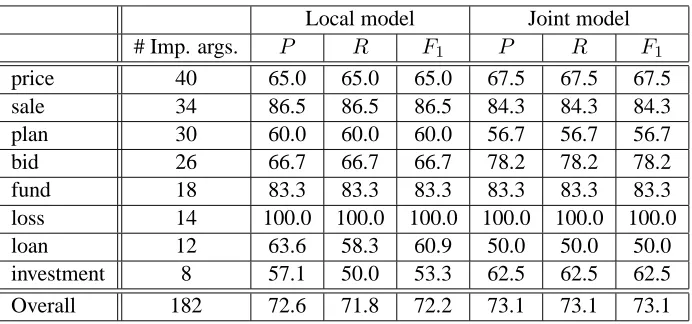
Table 1 presents the evaluation results. The first thing to note is that these results are not comparable to the results presented by Gerber and Chai (2010). In general, performance is much higher because predicate instances reliably take implicit arguments in theiarg0andiarg1positions. The overall
perfor-mance increase versus the local model is relatively small (approximately 1 percentage point); however, the bid predicate in particular showed a substantial increase (greater than 11 percentage points).
7 Discussion
7.1 Example improvement versus local model
The bid and investment predicates showed the largest increase for the joint model versus the local model. Below, we give an example of the investment predicate for which the joint model correctly identi-fied theiarg0 and the local model did not.
(13) [Big investors] can decide to ride out market storms without jettisoning stock.
(14) Most often, [cthey] do just that, because stocks have proved to be the best-performing long-term [Predicate investment], attracting about $1 trillion from pension funds alone.
Both models identified theiarg1 as money from a
prior sentence (not shown). The local model in-correctly predicted $1 trillion in Example 14 as the
iarg0for the investment event. This mistake
demon-strates a fundamental limitation of the local model: it cannot detect simple incompatibilities in the pre-dicted argument structure. It does not know that “money investing money” is a rare or impossible event in the real world.
con-Local model Joint model
# Imp. args. P R F1 P R F1
price 40 65.0 65.0 65.0 67.5 67.5 67.5
sale 34 86.5 86.5 86.5 84.3 84.3 84.3
plan 30 60.0 60.0 60.0 56.7 56.7 56.7
bid 26 66.7 66.7 66.7 78.2 78.2 78.2
fund 18 83.3 83.3 83.3 83.3 83.3 83.3
loss 14 100.0 100.0 100.0 100.0 100.0 100.0
loan 12 63.6 58.3 60.9 50.0 50.0 50.0
investment 8 57.1 50.0 53.3 62.5 62.5 62.5
[image:7.612.134.480.55.217.2]Overall 182 72.6 71.8 72.2 73.1 73.1 73.1
Table 1: Joint implicit argument evaluation results. The second column gives the total number of implicit arguments in the ground-truth annotations.P,R, andF1indicate precision, recall, and f-measure (β = 1) as defined by
Ruppen-hofer et al. (2009).
stituent is resolved to Big investors in the preceding sentence. Thus, the two relevant questions are as follows:
Question: What did big investors invest?
Answer: money
Question: What entity invested money?
Answer: big investors
The first question produces the following ranked list of answer synsets (the number in parentheses indi-cates the number of answer tuples mapped to the synset):
money (71)
amount (38)
million (38)
billion (22)
capital (21)
As shown, the answer string of money matches the top-ranked answer synset. The second question pro-duces the following ranked list of answer synsets:
company (642)
people (460)
government (275)
business (75)
investor (70)
In this case, the answer string Big investors matches the fifth answer synset. The combined evidence of these two question-answer pairs allows the joint system to successfully identify Big investors as the
iarg0of the investment predicate in Example 14.
7.2 Toward a generally applicable joint model
The joint model presented in this paper assumes that all predicate instances take aniarg0andiarg1. This
assumption clearly does not hold for real data (these positions are often not expressed in the text), but re-laxing it will require investigation of the following issues:
1. Explicit arguments should also be considered when determining whether a candidate c fills an implicit argument positioniargn. The
mo-tivation here is similar to that given elsewhere in this paper: arguments (whether implicit or explicit) are not independent. This is demon-strated by Example 2 at the beginning of this paper, where election is an explicit argument to the predicate and affects the implicit argument inference. The model developed in this paper only considers jointly occurring implicit argu-ments.
2. Other implicit argument positions (e.g.,
iarg2, iarg3, etc.) need to be accounted
propositions from TextRunner. Currently, TextRunner only handles tuples of the form
harg0, p, arg1i. Other argument positions are
not directly analyzed by the system; however, because TextRunner also returns the sentence from which a tuple is extracted, these addi-tional argument positions could be extracted in the following way:
(a) For an instance of the sale predicate with an arg0 of company, to find
likely arg2 fillers (the entity
purchas-ing the item), query TextRunner with
hcompany, sell,?i.
(b) Perform standard verbal SRL on the sen-tences for the resulting tuples, identifying anyarg2occurrences.
(c) Cluster and rank thearg2fillers according
to the method described in this paper.
This approach combines Open Information Ex-traction with traditional information exEx-traction (i.e., verbal SRL).
3. Computational complexity and probability estimation is a problem for many joint mod-els. The model presented in this paper quickly becomes computationally intractable when the number of candidates and implicit argument positions becomes moderately large. This is because Equation 9 considers all possible as-signments of candidates to implicit argument positions. With as few as thirty candidates and five argument positions (not uncommon), one must evaluate30!/25! = 17,100,720 possible assignments. Although this particular formula-tion is not tractable, one based on dynamic pro-gramming or heuristic search might give rea-sonable results. Efficient estimation of the joint probability via Gibbs sampling would also be a possible approach (Resnik and Hardisty, 2010).
8 Conclusions
Many prior studies have investigated the recovery of semantic arguments for nominal predicates. The models in many of these studies have assumed that the arguments are independent of each other. This assumption simplifies the computational modeling
of semantic arguments, but it ignores the joint na-ture of natural language. In order to take advantage of the information provided by jointly occurring ar-guments, the independent prediction models must be enhanced.
This paper has presented a preliminary investiga-tion into the joint modeling of implicit arguments for nominal predicates. The model relies heavily on information extracted by the TextRunner extrac-tion system, which pulls proposiextrac-tional tuples from millions of Internet webpages. These tuples encode world knowledge that is necessary for resolving se-mantic arguments in general and implicit arguments in particular. This paper has proposed methods of aggregating tuple knowledge to guide implicit argu-ment resolution. The aggregated knowledge is ap-plied via a re-ranking model that operates on top of the local prediction model described in previous work.
The performance gain across all predicate in-stances is relatively small; however, larger gains are observed for the bid and investment predicates. The improvement in Example 14 shows that the joint model is capable of correcting a bad local predic-tion using informapredic-tion extracted by the TextRunner system. This type of information is not used by the local prediction model.
Although the results in this paper show that some improvement is possible through the use of a joint model of implicit arguments, a significant amount of future work will be required to make the model widely applicable.
References
ACE, 2008. The ACE 2008 Evaluation Plan. NIST, 1.2d edition, August.
Michele Banko and Oren Etzioni. 2008. The tradeoffs between open and traditional relation extraction. In Proceedings of ACL-08: HLT, pages 28–36, Colum-bus, Ohio, June. Association for Computational Lin-guistics.
Michele Banko, Michael J Cafarella, Stephen Soderland, Matt Broadhead, and Oren Etzioni. 2007. Open in-formation extraction from the web. In Proceedings of the 20th International Joint Conference on Artificial Intelligence.
2003. Latent dirichlet allocation. J. Mach. Learn. Res., 3:993–1022.
Matthew Gerber and Joyce Chai. 2010. Beyond Nom-Bank: A study of implicit arguments for nominal pred-icates. In Proceedings of the 48th Annual Meeting of the Association for Computational Linguistics, pages 1583–1592, Uppsala, Sweden, July. Association for Computational Linguistics.
P. Pudil, J. Novovicova, and J. Kittler. 1994. Floating search methods in feature selection. Pattern Recogni-tion Letters, 15:1119–1125.
Vasin Punyakanok, Dan Roth, and Wen-tau Yih. 2008. The importance of syntactic parsing and inference in semantic role labeling. Comput. Linguist., 34(2):257– 287.
Philip Resnik and Eric Hardisty. 2010. Gibbs sampling for the uninitiated. Technical report, University of Maryland, June.
Alan Ritter, Mausam, and Oren Etzioni. 2010. A latent dirichlet allocation method for selectional preferences. In Proceedings of the 48th Annual Meeting of the As-sociation for Computational Linguistics.
Josef Ruppenhofer, Caroline Sporleder, Roser Morante, Collin Baker, and Martha Palmer. 2009. Semeval-2010 task 10: Linking events and their participants in discourse. In Proceedings of the Workshop on Seman-tic Evaluations: Recent Achievements and Future Di-rections (SEW-2009), pages 106–111, Boulder, Col-orado, June. Association for Computational Linguis-tics.
Kristina Toutanova, Aria Haghighi, and Christopher D. Manning. 2008. A global joint model for semantic role labeling. Comput. Linguist., 34(2):161–191. Zhibiao Wu and Martha Palmer. 1994. Verb