The RWTH System Combination System for WMT 2011
Gregor Leusch, Markus Freitag, and Hermann Ney RWTH Aachen University
Aachen, Germany
{leusch,freitag,ney}@cs.rwth-aachen.de
Abstract
RWTH participated in the System Combi-nation task of the Sixth Workshop on Sta-tistical Machine Translation (WMT 2011).
For three language pairs, we combined 6 to 14 systems into a single consen-sus translation. A three-level meta-combination scheme combining six dif-ferent system combination setups with three different engines was applied on the French–English language pair. Depend-ing on the language pair, improvements versus the best single system are in the range of +1.9% and +2.5% abs. on BLEU, and between −1.8% and −2.4%
abs. on TER. Novel techniques compared with RWTH’s submission to WMT 2010 include two additional system combina-tion engines, an addicombina-tional word alignment technique, meta combination, and addi-tional optimization techniques.
1 Introduction
RWTH’s main approach to System Combination (SC) for Machine Translation (MT) is a refined version of the ROVER approach in Automatic Speech Recognition (ASR) (Fiscus, 1997), with additional steps to cope with reordering between different hypotheses, and to use true casing infor-mation from the input hypotheses. The basic con-cept of the approach has been described by Ma-tusov et al. (2006). Several improvements have been added later (Matusov et al., 2008). This ap-proach includes an enhanced alignment and re-ordering framework. In contrast to existing ap-proaches (Jayaraman and Lavie, 2005; Rosti et al., 2007b), the context of the whole corpus rather than a single sentence is considered in this itera-tive, unsupervised procedure, yielding a more reli-able alignment. Majority voting on the generated lattice is performed using prior weights for each system as well as other statistical models such
as a special n-gram language model. True cas-ing is considered a separate step in RWTH’s ap-proach, which also takes the input hypotheses into account. The pipeline, and consequently the de-scription of the main pipeline given in this paper, is based on our pipeline for WMT 2010 (Leusch and Ney, 2010), with extensions as described. When necessary, we denote this pipeline as Align-to-Lattice, orA2L.
For the French–English task, we used two ad-ditional system combination engines for the first time: The first one uses the same alignments as A2L, but generates lattices in the OpenFST frame-work (Allauzen et al., 2007). The OpenFST de-coder (fstshortestpath) is then used to find the best path (consensus translation) in this lattice. Analogously, we call this engineA2FST. The sec-ond additional engine, which we callSCUNC,uses a TER-based alignment, similar to the approach by Rosti et al. (2007b). Instead of a lattice rescor-ing, finding the consensus translation is consid-ered a per-node classification problem: For each slot, which one is the “correct” one (i.e. will give the “best” output)? This approach is inspired by iROVER (Hillard et al., 2007). Consensus trans-lations from different settings of these approaches could then be combined again by an additional ap-plication of system combination – which we refer to asmeta combination(Rosti et al., 2007a). These three approaches are described in more detail in Section 2. In Section 3 we describe how we tuned the parameters and decisions of our system combi-nation approaches for WMT 2011. Section 4 then lists our experimental setup as well as the experi-mental results we obtained on the WMT 2011 sys-tem combination track. We conclude this paper in Section 5.
2 System Combination Algorithm (A2L)
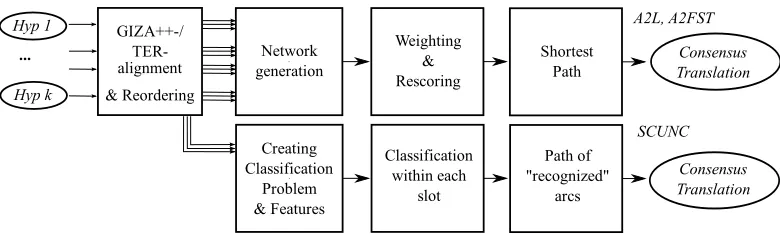
In this section we present the details of our main system combination method, A2L. The upper part of Figure 1 gives an overview of the system combi-nation architecture described in this section. After preprocessing the MT hypotheses, pairwise
ments between the hypotheses are calculated. The hypotheses are then reordered to match the word order of a selectedprimary(skeleton) hypothesis. From this, we create a confusion network (CN) which we then rescore using system prior weights and a language model (LM). The single best path in this CN then constitutes the consensus transla-tion. The consensus translation is then true cased and post processed.
2.1 Word Alignment
The main proposed alignment approach is a statis-tical one. It takes advantage of multiple transla-tions for a whole corpus to compute a consensus translation for each sentence in this corpus. It also takes advantage of the fact that the sentences to be aligned are in the same language.
For each of theK source sentences in the test corpus, we select one of itsN translations from different MT systemsE,m= 1, . . . , N,as the
pri-maryhypothesis. Then we align thesecondary hy-pothesesEn(n= 1, . . . ,;n6=m)withEnto match
the word order inEn. Since it is not clear which
hypothesis should be primary, i. e. has the “best” word order, we let several or all hypothesis play the role of the primary translation, and align all pairs of hypotheses(En, Em); n6=m.
The word alignment is trained in analogy to the alignment training procedure in statistical MT. The difference is that the two sentences that have to be aligned are in the same language. We use the IBM Model 1 (Brown et al., 1993) and the Hid-den Markov Model (HMM, (Vogel et al., 1996)) to estimate the alignment model.
The alignment training corpus is created from a test corpus of effectivelyN·(N−1)·Ksentences translated by the involved MT engines. Model pa-rameters are trained iteratively using the GIZA++ toolkit (Och and Ney, 2003). The training is per-formed in the directionsEm → En andEn → Em. The final alignments are determined using
a cost matrixCfor each sentence pair(Em, En).
Elements of this matrix are the local costsC(j, i)
of aligning a wordem,j fromEm to a worden,i
from En. Following Matusov et al. (2004), we
compute these local costs by interpolating the negated logarithms of the state occupation proba-bilities from the “source-to-target” and “target-to-source” training of the HMM model.
A different approach that has e.g. been pro-posed by Rosti et al. (2007b) is the utilization of a TER alignment (Snover et al., 2006) for this pur-pose. Because the original TER is insensitive to small changes in spellings, synonyms etc., it has been proposed to use more complex variants, e.g.
TERp. For our purposes, we utilized “poor-man’s-stemming”, i.e. shortening each word to its first four characters when calculating the TER align-ment. Since a TER alignment already implies a reordering between the primary and the secondary hypothesis, an explicit reordering step is not nec-essary.
2.2 Word Reordering and Confusion Network Generation
After reordering each secondary hypothesis Em
and the rows of the corresponding alignment cost matrix, we determineN−1monotoneone-to-one
alignments betweenEnas the primary translation
andEm, m = 1, . . . , N;m 6= n. We then
con-struct the confusion network.
We consider words without a correspondence to the primary translation (and vice versa) to have a null alignment with the empty wordε, which will be transformed to an ε-arc in the corresponding confusion network.
TheN−1monotone one-to-one alignments can then be transformed into a confusion network, as described by Matusov et al. (2008).
2.3 Voting in the Confusion Network (A2L, A2FST)
Instead of choosing a fixed sentence to define the word order for the consensus translation, we gen-erate confusion networks forN possible hypothe-ses as primary, and unite them into a single lattice. In our experience, this approach is advantageous in terms of translation quality compared to a min-imum Bayes risk primary (Rosti et al., 2007b).
Weighted majority voting on a single confu-sion network is straightforward and analogous to ROVER (Fiscus, 1997). We sum up the probabil-ities of the arcs which are labeled with the same word and have the same start state and the same end state.
Compared to A2L, our new A2FST engine al-lows for a higher number of features for each arc. Consequently, we add a binary system feature for each system in addition to the logarithm of the sum of system weights, as before. The advantage of these features is that the weights are linear within a log-linear model, as opposed to be part of a loga-rithmic sum. Consequently they can later be opti-mized using techniques designed for linear feature weights, such as MERT, or MIRA.
2.4 Language Models
alignment GIZA++-/
TER- Network generation
Weighting & Rescoring & Reordering
Hyp 1
Hyp k
... Consensus
Translation
Creating Classification
Problem & Features
Classification within each
slot
Consensus Translation A2L, A2FST
SCUNC
Shortest Path
Path of "recognized"
[image:3.612.112.502.63.180.2]arcs
Figure 1: The system combination architecture.
the lattice as a weighted Finite State Transducer (FST), this can be regarded (and implemented) as composition with a LM FST.
In our approach, we train a trigram LM on the outputs of the systems involved in system combi-nation. For LM training, we take the system hy-potheses for the same test corpus for which the consensus translations are to be produced. Using this “adapted” LM for lattice rescoring thus gives bonus to n-grams from the original system hy-potheses, in most cases from the original phrases. Presumably, many of these phrases have a correct word order. Previous experimental results show that using this LM in rescoring together with a word penalty notably improves translation quality. This even results in better translations than using a “classical” LM trained on a monolingual train-ing corpus. We attribute this to the fact that most of the systems we combine already include such general LMs. Nevertheless, one of the SC systems we use for the French–English task (IV in Sec-tion 4.1) uses a filtered fourgram LM trained on GigaWord and other constrained training data sets for this WMT tasks as an additional LM.
2.5 Extracting Consensus Translations
To generate our consensus translation, we ex-tract the single-best path from the rescored lat-tice, using “classical” decoding as in MT. In A2L, this is implemented as shortest-path decoder on a pruned lattice. In A2FST, we use the OpenFST
fstshortestpathdecoder, which does not re-quire a pruning step for lattices of the size and den-sity produced here.
2.6 Classification in the Confusion Network (SCUNC)
Instead of considering the selection of the con-sensus problem as a shortest-path problem in a rescored confusion network, we can treat it instead as a classification problem: For each slot (set of outgoing arcs from one node in a CN), we consider one or more arcs to be “correct”, and train a
clas-sifier to identify these certain arcs. This is the idea of the iROVER approach in ASR (Hillard et al., 2007). We call our implementationSystem Com-bination Using N-gram Classifiers, orSCUNC.
For the WMT evaluation, we used the ICSI-Boost framework (Favre et al., 2007) as classifier (in binary mode, i.e. giving a yes/no-decision for each single arc). We generated 109 features from 8 families: Pairwise equality of words from dif-ferent systems, Number of votes for a word, word that would win a simple majority voting, empty word (also in previous two arcs), position at be-ginning or end of sentence, cross-BLEU-S score of hypothesis, equality of system with system of last slot, and SRILM uni- to trigram scores. As this approach requires strict CN instead of lattices, a union of CNs for different primary hypotheses was no longer possible. We decided to select a fixed single primary system; other approaches would have been to train an additional classifier for this purpose, or to select a minimum-Bayes-risk (MBR) skeleton.
2.7 Consensus True Casing
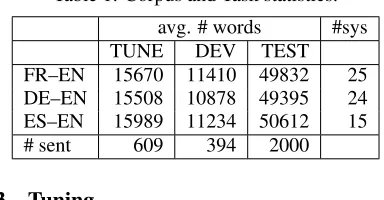
Table 1: Corpus and Task statistics.
avg. # words #sys TUNE DEV TEST FR–EN 15670 11410 49832 25 DE–EN 15508 10878 49395 24 ES–EN 15989 11234 50612 15 # sent 609 394 2000
3 Tuning
3.1 Feature weights
For lattice rescoring, we selected a linear combi-nation of BLEU (Papineni et al., 2002) and TER (Snover et al., 2006) as optimization criterion,
ˆ
Θ := argmaxΘ{BLEU−T ER}for the A2L
engine, based on previous experience (Mauser et al., 2008). To achieve more stable results, we use the case-insensitive variants for both measures, de-spite the explicit use of case information in the pipeline. System weights were tuned to this cri-terion using the Downhill Simplex method.
In the A2FST setup, we were able to generate full lattices, with separate costs for each individual feature on all arcs (Power Semiring). This allowed us to run Lattice MERT (Macherey et al., 2008) on the full lattice, with no need for pruning (and thus additional outer iterations for re-generating lattices). We tried different strategies – random lines vs axis-parallel lines, regularization, random restarts, etc, and selected the most stable results on TUNE and DEV for this engine. Optimization criterion here was BLEU.
3.2 Training a classifier for SCUNC
In MT system combination, even with given refer-ence translations, there is no simple way to iden-tify the “correct” arc in a slot. This renders a classifier-based approach even more difficult than iROVER in ASR. The problem is even aggravated because both the alignment of words, and their or-der, can be incorrect already in the CN. We thus consider an arc to be “correct” within this task ex-actly if it gives us the best possible total BLEU-S score.1 These “correct” arcs, which lie on such an “oracle path” for BLEU-S, were therefore used as reference classes when training the classifier.
3.3 System Selection
With the large numbers of input systems – e.g., 25 for FR–EN – and their large spread in transla-tion quality – e.g. from22.2to31.4%in BLEU – not all systems should participate in the system
1
We are looking at the sentence level, so we use BLEU-S (Lin and Och, 2004) instead of BLEU
combination process. This is especially the case since several of these e.g. 25 systems are often only small variants of each other (contrastive vs. primary submissions), which leads to a low vari-ability of these translations. We considered several variants of the set of input systems, often starting from the top, and either replacing some of the sys-tems very similar to others with syssys-tems further down the list, or not considering those as primary, adding further systems as additional secondaries. Depending on the engine we were using, we se-lected between 6 and 14 different systems as input.
4 Experimental Results
Each language pair in WMT 2011 had its own set of systems, so we selected and tuned separately for each language pair . Due to time constraints, we only participated in tasks with English as the target language. In preliminary experiments, it turned out that System Combination was not able to get a better result than the best single system on the Czech–English task. Consequently, we focused on the language pairs French–English, German– English, and Spanish–English.
We split the available tuning data document-wise into a 609-line TUNE set (for tuning), and a 394-line DEV set (to verify tuning results). More statistics on these sets can be found in Table 1.
Unfortunately, late in the evaluation campaign it turned out that the quality of several reference sentences used in TUNE and DEV was rather low: Many reference sentences contained spelling er-rors, a few dozen lines even contained French phrases or sentences within or after the English text. We corrected many of these errors manually in the references. In total 101 of 690 lines (16.6%) in TUNE and 58 of 394 lines (14.7%) in DEV were affected by this. While it was too late to re-run all of the optimization re-runs, we re-optimized at least a few final systems. All scores within this section were calculated on the corrected reference translations.
4.1 FR–EN
For French–English, we built in total seven differ-ent system combination setups to generate a single consensus translation and two contrastive transla-tions. Figure 2 shows the structure and the data flow of our setup for FR–EN. Table 2 lists more details about the individual engines.
improve-II: A2L III: SCUNC IV: A2FST+ GW V: A2L VI: A2FST
cmu-denkowski cmu-hanneman cu-zeman jhu kit lia-lig limsi lium online-A online-B rwth-huck systran udein rbmt-1 rbmt-2 rbmt-3 rbmt-4 rbmt-5
I: A2L
VII: A2L
primary contrastive 1contrastive 2
[image:5.612.116.504.63.244.2]Bold arrows denote a system that is always considered as skeleton. Note that there are two variants of setupII, see text.
[image:5.612.102.297.339.447.2]Figure 2: System combination pipelines for FR–EN
Table 2: Engines and input systems for FR–EN.
Engine # Input submitted? I A2L 6 RBMT
II A2L I + 6 primary
II’ A2L fix I + 6 for VII
III SCUNC 6
IV A2FST GW, 8
V A2L 10 contrastive-2
VI A2FST 14
VII A2L II’–VI contrastive-1
“GW” means a 4-gram LM trained on GigaWord. IIuses all skeletons,II’usesIas fixed skeleton.
Table 3: Results for FR–EN.
TUNE DEV
BLEU TER BLEU TER
kit 31.56 50.15 30.25 52.88
systran 28.18 53.32 26.50 56.07
I 27.37 54.73 26.72 57.73 II 33.69 48.47 32.45 51.09 II’ 33.39 48.77 31.81 51.57 III 32.74 48.06 31.88 50.87 IV 34.16 48.31 31.95 51.64 V 33.17 48.95 32.60 51.14 VI 33.86 48.69 31.56 52.25 VII 34.41 48.20 32.15 51.49
kitis the best single system.
systranis the best single rule-based system.
All scores are case insensitive, and were calculated on the corrected reference translations.
ments to the latter in a SC setup. Here, though, the number of such systems was too high to sim-ply add them to a reasonable set of SMT systems. Consequently, we first built a SC system (I) com-bining all RBMT/Systran systems, and then a sec-ond SC system (II) which combines the output of I, and 6 SMT systems. As further experi-ments showed, allowing all hypotheses as primary (or skeleton) gave significantly better scores than forcing SC to use the output ofIas primary only. But vice versa, when looking at the meta combi-nation scheme, VII, usingI as primary only (a setup which we will now denote as II’) gave measurable improvements in the overall transla-tion quality. We assume this is due to the similarity of the output ofIIwith that of the other setups.
SetupIIIis a SCUNC setup, that is, we built a single CN for each sentence using poor-man’s-stemming-TER, withrwth-huckas primary hy-pothesis. We then generated a large number of fea-tures for each arc, and trained an ICSIBoost clas-sifier to recognize the arc (or system) that gave the best BLEU-S score. This then gave us the consen-sus translation.
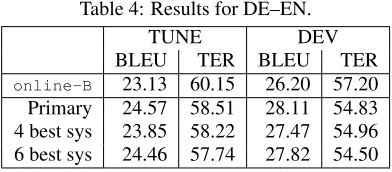
[image:5.612.103.297.503.664.2]Table 4: Results for DE–EN.
TUNE DEV
BLEU TER BLEU TER
online-B 23.13 60.15 26.20 57.20
Primary 24.57 58.51 28.11 54.83 4 best sys 23.85 58.22 27.47 54.96 6 best sys 24.46 57.74 27.82 54.50
online-Bis the best single system.
was also performed using lattice MERT towards BLEU. And finally, setupVIIcombines the out-put ofII’toIVusing the A2L engine again.
All the results of system combination on TUNE and DEV are listed in Table 3. It turns out that with the exception of I, all system combination approaches were able to achieve a significant im-provement of at least+1.8%abs. in BLEU com-pared to the best input system. ForI, we need to keep in mind that all other systems were sev-eral BLEU points worse than the best one – a sce-nario where we can expect system combination, which is based on theconsensustranslation after all, to underperform. We also see that both A2FST and SCUNC, with their large number of features, show a tendency to overfitting – we see large im-provements on TUNE, but significantly smaller improvements on DEV. This tendency is, unfortu-nately, also the case for meta combination: While we see an additional+0.3%abs. in BLEU over the best first-level system combination on TUNE, this improvement does not reflect in the scores on DEV: While we still see a+0.2%abs. improve-ment in BLEU over the setup that performed best on TUNE, there is even a small deterioration of −0.4% in BLEU over the setup that performed best on DEV. Because of this effect, we decided to submit our meta combination output only as first contrastive, and the output that performed well both on TUNE and DEV as our primary submis-sion for WMT. As second contrastive submissubmis-sion, we selected the setup that performed best on DEV.
4.2 DE–EN
[image:6.612.315.518.77.149.2]24 systems were available in the German–English language pair, but incorporating only 7 of them turned out to deliver optimal results on DEV. We ran experiments on several settings of systems, but only in our tried and tested A2L framework. We settled for a combination of seven systems (online-B,cmu-dyer,dfki-xu,limsi, online-A,rwth-wuebker,kit) as primary submission. Table 4 also lists two different set-tings. One setting consists of the four best systems
Table 5: Results for ES–EN.
TUNE DEV
BLEU TER BLEU TER
online-A 30.58 51.69 30.77 51.95
Primary 34.29 48.47 33.41 49.71 Contrastive 34.23 48.27 33.30 49.51
online-Ais the best single system.
(online-B,cmu-dyer,rwth-wuebker, kit) and the other setting contains the six best systems (online-B,cmu-dyer,dfki-xu, rwth-wuebker,online-A,kit). When we added more systems to system combination, we lost performance in both TUNE and DEV.
4.3 ES–EN
For Spanish–English, we tried several settings of systems. We sticked to our tried and tested A2L framework. We settled for a combination of six systems (alacant,koc,online-A, online-B,rbmt-1,systran) as contrastive submission, and a combination of ten systems (+rbmt-2,rbmt-3,rbmt-4,udein) as pri-mary submission. Table 5 lists the results for this task. The difference between our primary setup (10 systems) and our contrastive setup (6 systems) is rather small, less than0.1%abs. in BLEU. Nev-ertheless, we see significant improvements over the best single system of +2.4%abs. in BLEU, and−2.2%in TER.
5 Conclusions
We have shown that our system combination ap-proach leads to significant improvements over sin-gle best MT output where a significant number of comparably good translations is available on a sin-gle language pair. A meta combination can give additional improvement, but can be sensitive to overfitting; so in some cases, using one of its in-put system combination hypothesis may be a bet-ter choice. In any way, both of our new engines have shown that they can compete with our present approach, so we hope to make good use of the new possibilities they may offer.
Acknowledgments
References
C. Allauzen, M. Riley, J. Schalkwyk, W. Skut, and M. Mohri. 2007. OpenFst: A general and efficient weighted finite-state transducer library. InProc. of the Twelfth International Conference on Implemen-tation and Application of Automata (CIAA), volume 4783 ofLecture Notes in Computer Science, pages 11–23. Springer.
P. F. Brown, S. A. Della Pietra, V. J. Della Pietra, and R. L. Mercer. 1993. The mathematics of statistical machine translation: parameter estimation. Compu-tational Linguistics, 19(2):263–311, June.
B. Favre, D. Hakkani-T¨ur, and S. Cuendet. 2007. Icsiboost. http://code.google.come/p/ icsiboost.
J. Fiscus. 1997. A post-processing system to yield re-duced word error rates: Recognizer output voting er-ror reduction (ROVER). InIEEE Workshop on Au-tomatic Speech Recognition and Understanding. D. Hillard, B. Hoffmeister, M. Ostendorf, R. Schl¨uter,
and H. Ney. 2007. iROVER: improving sys-tem combination with classification. In Human Language Technologies 2007: The Conference of the North American Chapter of the Association for Computational Linguistics; Companion Volume, Short Papers, NAACL-Short ’07, pages 65–68. As-sociation for Computational Linguistics.
S. Jayaraman and A. Lavie. 2005. Multi-engine ma-chine translation guided by explicit word matching. InProc. of the 10th Annual Conf. of the European Association for Machine Translation (EAMT), pages 143–152, Budapest, Hungary, May.
G. Leusch and H. Ney. 2010. The rwth system com-bination system for wmt 2010. InACL 2010 Joint Fifth Workshop on Statistical Machine Translation and Metrics MATR, pages 315–320, Uppsala, Swe-den, July.
G. Leusch, E. Matusov, and H. Ney. 2009. The RWTH system combination system for WMT 2009. InFourth Workshop on Statistical Machine Transla-tion, pages 56–60, Athens, Greece, March. Associa-tion for ComputaAssocia-tional Linguistics.
C. Y. Lin and F. J. Och. 2004. Orange: a method for evaluation automatic evaluation metrics for machine translation. InProc. COLING 2004, pages 501–507, Geneva, Switzerland, August.
W. Macherey, F. Och, I. Thayer, and J. Uszkoreit. 2008. Lattice-based minimum error rate training for statistical machine translation. InProc. of the 2008 Conference on Empirical Methods in Natural Lan-guage Processing (EMNLP), pages 725–734. Asso-ciation for Computational Linguistics.
E. Matusov, R. Zens, and H. Ney. 2004. Symmetric word alignments for statistical machine translation.
InCOLING ’04: The 20th Int. Conf. on Computa-tional Linguistics, pages 219–225, Geneva, Switzer-land, August.
E. Matusov, N. Ueffing, and H. Ney. 2006. Computing consensus translation from multiple machine trans-lation systems using enhanced hypotheses align-ment. InConference of the European Chapter of the Association for Computational Linguistics (EACL), pages 33–40, Trento, Italy, April.
E. Matusov, G. Leusch, R. E. Banchs, N. Bertoldi, D. Dechelotte, M. Federico, M. Kolss, Y. S. Lee, J. B. Marino, M. Paulik, S. Roukos, H. Schwenk, and H. Ney. 2008. System combination for machine translation of spoken and written language. IEEE Transactions on Audio, Speech and Language Pro-cessing, 16(7):1222–1237, September.
A. Mauser, S. Hasan, and H. Ney. 2008. Automatic evaluation measures for statistical machine transla-tion system optimizatransla-tion. InInternational Confer-ence on Language Resources and Evaluation, Mar-rakech, Morocco, May.
F. J. Och and H. Ney. 2003. A systematic comparison of various statistical alignment models. Computa-tional Linguistics, 29(1):19–51, March.
K. Papineni, S. Roukos, T. Ward, and W. J. Zhu. 2002. BLEU: a Method for Automatic Evaluation of Ma-chine Translation. InProc. of the 40th Annual Meet-ing of the Association for Computational LMeet-inguistics (ACL), pages 311–318, Philadelphia, PA, July. A. V. Rosti, N. F. Ayan, B. Xiang, S. Matsoukas, R. M.
Schwartz, and B. J. Dorr. 2007a. Combining out-puts from multiple machine translation systems. In HLT-NAACL’07, pages 228–235.
A. V. Rosti, S. Matsoukas, and R. Schwartz. 2007b. Improved word-level system combination for ma-chine translation. InProc. of the 45th Annual Meet-ing of the Association of Computational LMeet-inguis- Linguis-tics (ACL), pages 312–319, Prague, Czech Republic, June.
M. Snover, B. Dorr, R. Schwartz, L. Micciulla, and J. Makhoul. 2006. A Study of Translation Error Rate with Targeted Human Annotation. InProc. of the 7th Conf. of the Association for Machine Trans-lation in the Americas (AMTA), pages 223–231, Boston, MA, August.