Proceedings of the Workshop on Distributional Semantics and Compositionality (DiSCo’2011), pages 1–9,
(Linear) Maps of the Impossible:
Capturing semantic anomalies in distributional space
Eva Maria Vecchi and Marco Baroni and Roberto Zamparelli Center for Mind/Brain Sciences, University of Trento
Rovereto (TN), Italy
{evamaria.vecchi-1,marco.baroni,roberto.zamparelli}@unitn.it
Abstract
In this paper, we present a first attempt to characterize the semantic deviance of com-posite expressions in distributional seman-tics. Specifically, we look for properties of adjective-noun combinations within a vector-based semantic space that might cue their lack of meaning. We evaluate four different com-positionality models shown to have various levels of success in representing the mean-ing of AN pairs: the simple additive and multiplicative models of Mitchell and Lap-ata (2008), and the linear-map-based models of Guevara (2010) and Baroni and Zamparelli (2010). For each model, we generate com-posite vectors for a set of AN combinations unattested in the source corpus and which have been deemed eitheracceptableor seman-tically deviant. We then compute measures that might cue semantic anomaly, and com-pare each model’s results for the two classes of ANs. Our study shows that simple, unsuper-vised cues can indeed significantly tell unat-tested but acceptable ANs apart from impos-sible, or deviant, ANs, and that the simple ad-ditive and multiplicative models are the most effective in this task.
1 Introduction
Statistical approaches to describe, represent and un-derstand natural language have been criticized as failing to account for linguistic ‘creativity’, a prop-erty which has been accredited to the compositional nature of natural language. Specifically, criticisms
against statistical methods were based on the ar-gument that a corpus cannot significantly sample a natural language because natural language is infi-nite (Chomsky, 1957). This cricticism also applies to distributional semantic models that build seman-tic representations of words or phrases in terms of vectors recording their distributional co-occurrence patterns in a corpus (Turney and Pantel, 2010), but have no obvious way to generalize to word combi-nations that have not been observed in the corpus. To address this problem, there have been several re-cent attempts to incorporate into distributional se-mantic models a component that generates vectors for unseen linguistic structures by compositional op-erations in the vector space (Baroni and Zamparelli, 2010; Guevara, 2010; Mitchell and Lapata, 2010).
The ability to work with unattested data leads to the question of why a linguistic expression might not be attested in even an extremely large and well-balanced corpus. Its absence might be motivated by a number of factors: pure chance, the fact that the expression is ungrammatical, uses a rare struc-ture, describes false facts, or, finally, is nonsensi-cal. One criticism from generative linguists is pre-cisely that statistical methods could not distinguish between these various possibilities.
The difficulty of solving this problem can be il-lustrated by the difference in semantics between the adjective-noun pairs in (1a) and (1b):
(1) a. blue rose b. residential steak
Although it may be the case that you have never
tually seen ablue rose, the concept is not inconceiv-able. On the other hand, the concept of a residen-tial steakis rather unimaginable, and intuitively its absence in a corpus is motivated by more than just chance or data sparseness.
The present paper is a first attempt to use com-positionality and distributional measures to distin-guish nonsensical, or semantically deviant, linguis-tic expression from other types of unattested struc-tures. The task of distinguishing between unattested butacceptableand unattested butsemantically de-viantlinguistic expressions is not only a way to ad-dress the criticism about the meaning of ‘unattest-edness’, but also a task that could have a large im-pact on the (computational) linguistic community as a whole (see Section 2.1).
Our specific goal is to automatically detect se-mantic deviance in attributive Adjective-Noun (AN) expressions, using a small number of simple cues in the vectorial representation of an AN as it is gener-ated from the distributional vectors of its component A and N by four compositional models found in the literature. The choice of AN as our testbed is moti-vated by two facts: first of all, ANs are common, small constituents containing no functional mate-rial, and secondly, ANs have already been studied in compositional distributional semantics (Baroni and Zamparelli, 2010; Guevara, 2010; Mitchell and La-pata, 2010).
It is important to note that in this research we talk about ‘semantically deviant’ expressions, but we do not exclude the possibility that such expressions are interpreted as metaphors, via a chain of associations. In fact, distributional measures are desirable models to account for this, since they naturally lead to a gra-dient notion of semantic anomaly.
The rest of this paper is structured as follows. Section 2 discusses relevant earlier work, introduc-ing the literature on semantic deviance as well as compositional methods in distributional semantics. Section 3 presents some hypotheses about cues of semantic deviance in distributional space. Our ex-perimental setup and procedure are detailed in Sec-tion 4, whereas the experiments’ results are pre-sented and analyzed in Section 5. We conclude by summarizing and proposing future directions in Sec-tion 6.
2 Related work
2.1 Semantic deviance
As far as we know, we are the first to try to model semantic deviance using distributional methods, but the issue of when a complex linguistic expression is semantically deviant has been addressed since the 1950’s in various areas of linguistics. In compu-tational linguistics, the possibility of detecting se-mantic deviance has been seen as a prerequisite to access metaphorical/non-literal semantic interpreta-tions (Fass and Wilks, 1983; Zhou et al., 2007). In psycholinguistics, it has been part of a wide debate on the point at which context can make us perceive a ‘literal’ vs. a ‘figurative’ meaning (Giora, 2002). In theoretical generative linguistics, the issue was orig-inally part of a discussion on the boundaries between syntax and semantics. Cases like Chomsky’s clas-sic “Colorless green ideas sleep furiously” can actu-ally be regarded as violations of very fine-grained syntactic selectional restrictions on the arguments of verbs or modifiers, on the model of *much com-puter(arguably a failure ofmuchto combine with a noun +COUNT). By 1977, even Chomsky doubted that speakers could in general have intuitions about whether ill-formedness was syntactic or semantic (Chomsky, 1977, p. 4). The spirit of the selectional approach persists in Asher (2011), who proposes a detailed system of semantic types plus a theory of type coercion, designed to account for the shift in meaning seen in, e.g., (2) (lunch as food or as an event).
(2) Lunch was delicious but took forever.
2.2 Distributional approaches to meaning composition
Although the issue of how to compose meaning has attracted interest since the early days of distribu-tional semantics (Landauer and Dumais, 1997), re-cently a very general framework for modeling com-positionality has been proposed by Mitchell and pata (Mitchell and Lapata, 2008; Mitchell and La-pata, 2009; Mitchell and LaLa-pata, 2010). Given two vectorsuandv, they identify two general classes of composition models, (linear) additive models:
p=Au+Bv (1)
whereAandBare weight matrices, and multiplica-tive models:
p=Cuv
whereC is a weight tensor projecting the uv ten-sor product onto the space ofp. Mitchell and La-pata derive two simplified models from these gen-eral forms: The simplified additive model given by
p = αu+βv, and a simplified multiplicative ap-proach that reduces to component-wise multiplica-tion, where thei-th component of the composed vec-tor is given by: pi = uivi. Mitchell and Lapata
evaluate the simplified models on a wide range of tasks ranging from paraphrasing to statistical lan-guage modeling to predicting similarity intuitions. Both simple models fare quite well across tasks and alternative semantic representations, also when compared to more complex methods derived from the equations above. Given their overall simplic-ity, good performance and the fact that they have also been extensively tested in other studies (Baroni and Zamparelli, 2010; Erk and Pad´o, 2008; Guevara, 2010; Kintsch, 2001; Landauer and Dumais, 1997), we re-implement here both the simplified additive and simplified multiplicative methods (we do not, however, attempt to tune the weights of the additive model, although we do apply a scalar normalization constant to the adjective and noun vectors).
Mitchell and Lapata (as well as earlier re-searchers) do not exploit corpus evidence about thepvectors that result from composition, despite the fact that it is straightforward (at least for short constructions) to extract direct distributional evi-dence about the composite items from the corpus
(just collect co-occurrence information for the com-posite item from windows around the contexts in which it occurs). The main innovation of Guevara (2010), who focuses on adjective-noun combina-tions (AN), is to use the co-occurrence vectors of corpus-observed ANs to train a supervised compo-sition model. Guevara, whose approach we also re-implement here, adopts the full additive composi-tion form from Equacomposi-tion (1) and he estimates the
A and B weights (concatenated into a single ma-trix, that acts as a linear map from the space of con-catenated adjective and noun vectors onto the AN vector space) using partial least squares regression. The training data are pairs of adjective-noun vec-tor concatenations, as input, and corpus-derived AN vectors, as output. Guevara compares his model to the simplified additive and multiplicative models of Mitchell and Lapata. Corpus-observed ANs are nearer, in the space of observed and predicted test set ANs, to the ANs generated by his model than to those from the alternative approaches. The addi-tive model, on the other hand, is best in terms of shared neighbor count between observed and pre-dicted ANs.
See Section 4.3 below for details on our re-implementations. Note that they follow very closely the procedure of Baroni and Zamparelli (2010), in-cluding choices of source corpus and parameter val-ues, so that we expect their results on the quality of the various models in predicting ANs to also hold for our re-implementations.
3 Simple indices of semantic deviance
We consider here a few simple, unsupervised mea-sures to help us distinguish the representation that a distributional composition model generates for a se-mantically anomalous AN from the one it generates for a semantically acceptable AN. In both cases, we assume that the AN is not already part of the model semantic space, just like you can distinguish be-tweenparliamentary tomato(odd) andmarble iPad (OK), although you probably never heard either ex-pression.
We hypothesize that, since the values in the di-mensions of a semantic space are a distributional proxy to the meaning of an expression, a mean-ingless expression should in general have low val-ues across the semantic space dimensions. For ex-ample, a parliamentary tomato, no longer being a vegetable but being an unlikely parliamentary event, might have low values on both dimensions char-acterizing vegetables and dimensions charchar-acterizing events. Thus, our first simple measure of seman-tic anomaly is the length of the model-generated AN. We hypothesize that anomalous AN vectors are shorter than acceptable ANs.
Second, if deviant composition destroys or ran-domizes the meaning of a noun, as a side effect we might expect the resulting AN to be more distant, in the semantic space, from the component noun. Al-though even amarble iPadmight have lost some es-sential properties of iPads (it could for example be an iPad statue you cannot use as a tablet), to the ex-tent that we can make sense of it, it must retain at least some characteristics of iPads (at the very least, it will be shaped like an iPad). On the other hand, we cannot imagine what aparliamentary tomatoshould be, and thus cannot attribute even a subset of the reg-ular tomato properties to it. We thus hypothesize that model-generated vectors of deviant ANs will form a wider angle (equivalently, will have a lower
co-sine) with the corresponding N vectors than accept-able ANs.
Finally, if an AN makes no sense, its model-generated vector should not have many neighbours in the semantic space, since our semantic space is populated by nouns, adjectives and ANs that are commonly encountered in the corpus, and should thus be meaningful. We expect deviant ANs to be “semantically isolated”, a notion that we opera-tionalize in terms of a (neighborhood)density mea-sure, namely the average cosine with the (top 10) nearest neighbours. We hypothesize that model-generated vectors of deviant ANs will have lower density than model-generated acceptable ANs.
4 Experimental setup
4.1 Semantic space
Our initial step was to construct a semantic space for our experiments, consisting of a matrix where each row vector represents an adjective, noun or AN. We first introduce the source corpus, then the vocabulary of words and ANs that we represent in the space, and finally the procedure adopted to build the vec-tors representing the vocabulary items from corpus statistics, in order to obtain the semantic space ma-trix. We work here with a “vanilla” semantic space (essentially, we follow the steps of Baroni and Zam-parelli (2010)), since our focus is on the effect of different composition methods given a common se-mantic space. We leave it to further work to study how choices in semantic space construction affect composition operations.
4.1.1 Source corpus
4.1.2 Semantic space vocabulary
The words/ANs in the semantic space must of course include the items that we need for our exper-iments (adjectives, nouns and ANs used for model training and as input to composition). Moreover, in order to study the behaviour of the test items we are interested in (that is, model-generated AN vectors) within a large and less ad-hoc space, we also include many more adjectives, nouns and ANs in our vocab-ulary not directly relevant to our experimental ma-nipulations.
We populate our semantic space with the 8K most frequent nouns and 4K most frequent adjectives from the corpus (excluding, in both cases, the top 50 most frequent elements). We extended this vo-cabulary to include two sets of ANs (33K ANs cu-mulatively), for a total of 45K vocabulary items in the semantic space.
To create the ANs needed to run and evaluate the experiments described below, we focused on a set of adjectives which are very frequent in the corpus so that they will be in general able to combine with wide classes of nouns, making the unattested cases more interesting, but not so frequent as to have such a general meaning that would permit a free combi-nation with nearly any noun. The ANs were there-fore generated by crossing a selected set of 200 very frequent adjectives (adjectives attested in the corpus at least 47K times, and at most 740K) and the set of the 8K nouns in our semantic space vocabulary, producing a set of 4.92M generated ANs.
The first set of ANs included in the semantic space vocabulary is a randomly sampled set of 30K ANs from the generated set which are attested in the corpus at least 200 times (to avoid noise and fo-cus on ANs for which we can extract reasonably ro-bust distributional data). We also extracted any unat-tested ANs from the set of generated set (about 3.5M unattested ANs), putting them aside to later assem-ble our evaluation material, described in Section 4.2.
To add further variety to the semantic space, we included a less controlled second set of 3K ANs ran-domly picked among those that are attested and are formed by the combination of any of the 4K adjec-tives and 8K nouns in the vocabulary.
4.1.3 Semantic space construction
For each of the items in our vocabulary, we first build 10K-dimensional vectors by recording their sentence-internal co-occurrence with the top 10K most frequent content words (nouns, adjectives or verbs) in the corpus. The raw co-occurrence counts are then transformed into Local Mutual Information scores (Local Mutual Information is an association measure that closely approximates the commonly used Log-Likelihood Ratio while being simpler to compute (Baroni and Lenci, 2010; Evert, 2005)).
Next, we reduce the full co-occurrence matrix applying the Singular Value Decomposition (SVD) operation, like in LSA and related distributional semantic methods (Landauer and Dumais, 1997; Rapp, 2003; Sch¨utze, 1997). The original 45K-by-10K-dimensional matrix is reduced in this way to a 45K-by-300 matrix, where vocabulary items are rep-resented by their coordinates in the space spanned by the first 300 right singular vectors of the SVD solution. This step is motivated by the fact that we will estimate linear models to predict the values of each dimension of an AN from the dimensions of the components. We thus prefer to work in a smaller and denser space. As a sanity check, we verify that we obtain state-of-the-art-range results on various se-mantic tasks using this reduced sese-mantic space (not reported here for space reason).
4.2 Evaluation materials
Our goal is to study what happens when composi-tional methods are used to construct a distribucomposi-tional representation for ANs that are semantically deviant, compared to the AN representations they generate for ANs they have not encountered before, but that are semantically acceptable.
intermediate, acceptable). The rating exercise re-sulted in rather low agreement (Cohen’sκ= 0.32), but we reasoned that those relatively few cases (456 over 3K) where both judges agreed the AN was odd should indeed be odd, and similarly for the even rarer cases in which they agreed an AN was com-pletely acceptable (334 over 3K). We thus used the agreed deviant and acceptable ANs as test data.
Of 30 adjectives, 5 were discarded for either tech-nical reasons or for having less than 5 agreed de-viant or acceptable ANs. This left us with a de-viant AN test setcomprising of 413 ANs, on av-erage 16 for each of the 25 remaining adjectives. Some examples of ANs in this set are: academic bladder,blind pronunciation,parliamentary potato andsharp glue. Theacceptable(but unattested)AN test setcontains 280 ANs, on average 11 for each of the 25 studied adjectives. Examples of ANs in this set include:vulnerable gunman,huge joystick, aca-demic crusadeandblind cook. The evaluation sets can be downloaded fromhttp://www.vecchi. com/eva/resources.html.
There is no significant difference between the length of the vectors of the component nouns in the acceptable vs. deviant AN sets (two-tailed Welch’st test;t=−0.25;p>0.8). This is important, since at least one of the potential cues to deviance we con-sider (AN vector length) is length-dependent, and we do not want a trivial result that can simply be explained by systematic differences in the length of the input vectors.
4.3 Composition methods
As discussed in Section 2.2, the experiment was car-ried out across four compositional methods.
Additive AN vectors (add method) are simply obtained by summing the corresponding adjective and noun vectors after normalizing them. Multi-plicative vectors (mult method) were obtained by component-wise multiplication of the adjective and noun vectors, also after normalization. Confirm-ing the results of Baroni and Zamparelli (2010), non-normalized versions ofaddandmultwere also tested, but did not produce significant results (in the case of multiplication, normalization amounts to multiplying the composite vector by a scalar, so it only affects the length-dependent vector length mea-sure). It is important to note that, as reported in
Baroni and Zamparelli (2010), themultmethod can be expected to perform better in the original, non-reduced semantic space because the SVD dimen-sions can have negative values, leading to counter-intuitive results with component-wise multiplication (multiplying large opposite-sign values results in large negative values instead of being cancelled out). The tests of Section 5, however, are each run in the SVD-reduced space to remain consistent across all models. We leave it to future work to explore the effect on the performance of using the non-reduced space for the models for which this option is com-putationally viable.
In the linear map (lm) approach proposed by Guevara (2010), a composite AN vector is obtained by multiplying a weight matrix by the concatenation of the adjective and noun vectors, so that each di-mension of the generated AN vector is a linear com-bination of dimensions of the corresponding adjec-tive and noun vectors. That is, the 600 weights in each of the 300 rows of the weight matrix are the coefficients of a linear equation predicting the val-ues of a single dimension in the AN vector as a lin-ear combination (weighted sum) of the 300 adjective and 300 noun dimensions. Following Guevara, we estimate the coefficients of the equation using (mul-tivariate) partial least squares regression (PLSR) as implemented in the R pls package (Mevik and Wehrens, 2007), with the latent dimension param-eter of PLSR set to 50, the same value used by Ba-roni and Zamparelli (2010). Coefficient matrix es-timation is performed by feeding the PLSR a set of input-output examples, where the input is given by concatenated adjective and noun vectors, and the output is the vector of the corresponding AN directly extracted from our semantic space (i.e., the AN vec-tors used in training are not model-generated, but directly derived from corpus evidence about their distribution). The matrix is estimated using a ran-dom sample of 2K adjective-noun-AN tuples where the AN belongs to the set of 30K frequently attested ANs in our vocabulary.
Finally, in the adjective-specific linear map
the dimensions of the AN vector as a linear com-bination of the 300 dimensions of the component noun. The linear equation coefficients are estimated separately for each of the 25 tested adjectives from the attested noun-AN pairs containing that adjective (observed adjective vectors are not used), again us-ing PLSR with the same parameter as above. For each adjective, the training N-AN vector pairs cho-sen are those available in the semantic space for each test set adjective, and range from 100 to more than 500 items across the 25 adjectives.
4.4 Experimental procedure
Using each composition method, we generate com-posite vectors for all the ANs in the two (acceptable and deviant) evaluation sets (see Section 4.2 above). We then compute the measures that might cue se-mantic deviance discussed in Section 3 above, and compare their values between the two AN sets. In order to smooth out adjective-specific effects, wez -normalize the values of each measure across all the ANs sharing an adjective before computing global statistics (i.e., the values for all ANs sharing an ad-jective from the two sets are transformed by sub-tracting their mean and dividing by their variance). We then compare the two sets, for each composition method and deviance cue, by means of two-tailed Welch’s t tests. We report the estimated t score, that is, the standardized difference between the mean acceptable and deviant AN values, with the corre-sponding significance level. For all our cues, we predictt to be significantly larger than 0: Accept-able AN vectors should belongerthan deviant ones, they should benearer– that is, have a higher cosine with – the component N vectors and their neighbour-hood should bedenser– that is, the average cosines with their top neighbours should be higher than the ones of deviant ANs with their top neighbours.
5 Results
The results of our experiments are summarized in Table 1. We see thatadd and multprovide signif-icant results in the expected direction for 2 over 3 cues, only failing the cosine test. With thelmmodel, acceptable and deviant ANs are indistinguishable across the board, whereasalm captures the distinc-tion in terms of density.
LENGTH COSINE DENSITY method t sig. t sig. t sig.
add 7.89 * 0.31 2.63 *
mult 3.16 * -0.56 2.68 *
lm 0.16 0.55 -0.23
[image:7.612.314.535.57.138.2]alm 0.48 1.37 3.12 *
Table 1: t scores for difference between acceptable and deviant ANs with respect to 3 cues of deviance: length
of the AN vector,cosineof the AN vector with the com-ponent noun vector anddensity, measured as the average cosine of an AN vector with its nearest 10 neighbours in semantic space. For all significant results,p<0.01.
The high scores in the vector length analyses of both the addition and the multiplication models are an indication that semantically acceptable ANs tend to be composed ofsimilaradjectives and nouns, i.e., those which occur in similar contexts and we can as-sume are likely to belong to the same domain, which sounds plausible.
In Baroni and Zamparelli (2010), thealm model performed far better thanadd andmult in approxi-mating the correct vectors for unseen ANs, while on this (in a sense, more metalinguistic) taskadd and multwork better, whilealmis successful only in the more sophisticated measure of neighbor density.
The lack of significant results for the cosine mea-sure is disappointing, but not entirely surprising. A large angle between N and AN might be a feature of impossible ANs common to various types of pos-sible ANs: idioms (a red herring is probably far fromherringin semantic space), non-subsective ad-jectives (stone lion vs. lion; fake butterfly vs. but-terfly), plus some metaphorical constructions (aca-demic crusade vs. crusade—one of several ANs judged acceptable in our study, which can only be taken as metaphors). Recall, finally, that the vector for the base N collapses together all the meanings of an ambiguous N. The adjective might have a dis-ambiguating effect which would increase the cosine distance.
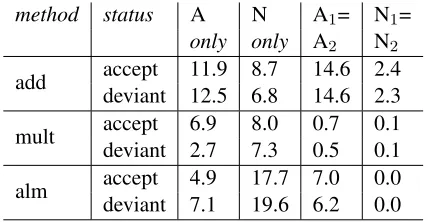
each of the ANs, we looked at the top 10 semantic-space neighbors generated by each of the three mod-els, focusing on two aspects: whether the neighbor was a single A or N, rather than AN, and whether the neighbor contained the same A or N as the AN is was the neighbor of (as in blind regatta / blind athleteorbiological derivative / partial derivative). The results are summarized in Table 2.
method status A N A1= N1= only only A2 N2
add accept 11.9 8.7 14.6 2.4 deviant 12.5 6.8 14.6 2.3
mult accept 6.9 8.0 0.7 0.1 deviant 2.7 7.3 0.5 0.1
[image:8.612.80.294.173.284.2]alm accept 4.9 17.7 7.0 0.0 deviant 7.1 19.6 6.2 0.0
Table 2: Percentage distributions of various properties of the top 10 neighbours of ANs in the acceptable (2800) and deviant (4130) sets foradd,mult andalm. The last two columns express whether the neighbor contains the same Adjective or Noun as the target AN.
In terms of the properties we measured, neighbor distributions are quite similar across acceptable and deviant ANs. One interesting finding is that the sys-tem is quite ‘adjective-driven’: particularly for the additive model (where we can imagine that some Ns with low dimensional values do not shift much the adjective position in the multidimensional space), less so in thealmmethod, and not at all formult. To put the third and forth columns in context, the subset of the semantic space used to generate the SVD from which the neighbors are drawn contained 2.69% ad-jectives, 5.24% nouns and 92.07% ANs. With re-spect to the last two columns, it is interesting to ob-serve that matching As are frequent for deviant ANs even inalm, a model which has never seen A-vectors during training. Further qualitative evaluations show that in many deviant AN cases the similarity is be-tween the A in the target AN and the N of the neigh-bor (e.g. academic bladder / honorary lectureship), while the opposite effect seems to be much harder to find.
6 Conclusion and future work
The main aim of this paper was to propose a new challenge to the computational distributional
seman-tics community, namely that of characterizing what happens, distributionally, when composition leads to semantically anomalous composite expressions. The hope is, on the one hand, to bring further sup-port to the distributional approach by showing that it can be both productive and constrained; and on the other, to provide a more general characterization of the somewhat elusive notion of semantic deviance – a notion that the field of formal semantics acknowl-edges but might lack the right tools to model.
Our results are very preliminary, but also very en-couraging, suggesting that simple unsupervised cues can significantly tell unattested but acceptable ANs apart from impossible, or at least deviant, ones. Al-though, somewhat disappointingly, the model that has been shown in a previous study (Baroni and Zamparelli, 2010) to be the best at capturing the se-mantics of well-formed ANs turns out to be worse than simple addition and multiplication.
Future avenues of research must include, first of all, an exploration on the effect on each model when tested in the non-reduced space where computation-ally possible, or using different dimensionality re-duction methods. A preliminary study demonstrates an enhanced performance of themultmethod in the full space.
Second, we hope to provide a larger benchmark of acceptable and deviant ANs, beyond the few hun-dreds we used here, and sampling a larger typology of ANs across frequency ranges and adjective and noun classes. To this extent, we are implementing a crowd-sourcing study to collect human judgments from a large pool of speakers on a much larger set of ANs unattested in the corpus. Averaging over mul-tiple judgments, we will also be able to characterize semantic deviance as a gradient property, probably more accurately.
Next, the range of cues we used was quite limited, and we intend to extend the range to include more sophisticated methods such as 1) combining multi-ple cues in a single score; 2) training a supervised classifier from labeled acceptable and deviant ANs, and studying the most distinctive features discov-ered by the classifier; 3) trying more complex unsu-pervised techniques, such as using graph-theoretical methods to characterize the semantic neighborhood of ANs beyond our simple density measure.
typol-ogy of deviant ANs. We do not distinguish cases such asparliamentary tomato, where the adjective does not apply to the conceptual semantic type of the noun (or at least, where it is completely undeter-mined which relation could bridge the two objects), from oxymorons such as dry water, or vacuously redundant ANs (liquid water) and so on. We real-ize that, at a more advanced stage of the analysis, some of these categories might need to be explicitly distinguished (for example,liquid wateris odd but perfectly meaningful), leading to a multi-way task. Similarly, among acceptable ANs, there are spe-cial classes of expressions, such as idiomatic con-structions, metaphors or other rhetorical figures, that might be particularly difficult to distinguish from deviant ANs. Again, more cogent tasks involving such well-formed but non-literal constructions (be-yond the examples that ended up by chance in our acceptable set) are left to future work.
Acknowledgments
We thank Raffaella Bernardi, Gemma Boleda, Louise McNally and the anonymous reviewers for their advice and comments.
References
Nicholas Asher. 2011. Lexical Meaning in Context: A Web of Words. Cambridge University Press.
Marco Baroni and Alessandro Lenci. 2010. Dis-tributional Memory: A general framework for corpus-based semantics. Computational Linguistics, 36(4):673–721.
Marco Baroni and Roberto Zamparelli. 2010. Nouns are vectors, adjectives are matrices: Representing adjective-noun constructions in semantic space. In
Proceedings of EMNLP, pages 1183–1193, Boston, MA.
Noam Chomsky. 1957.Syntactic Structures. Mouton. Noam Chomsky. 1977. Essays on Form and
Interpreta-tion. North Holland, New York.
Katrin Erk and Sebastian Pad´o. 2008. A structured vec-tor space model for word meaning in context. In Pro-ceedings of EMNLP, pages 897–906, Honolulu, HI, USA.
Stefan Evert. 2005. The Statistics of Word Cooccur-rences. Dissertation, Stuttgart University.
Dan Fass and Yorick Wilks. 1983. Preference seman-tics, ill-formedness, and metaphor. Computational Linguistics, 9:178–187.
Rachel Giora. 2002. Literal vs. figurative language: Dif-ferent or equal? Journal of Pragmatics, 34:487–506. Emiliano Guevara. 2010. A regression model of
adjective-noun compositionality in distributional se-mantics. InProceedings of the ACL GEMS Workshop, pages 33–37, Uppsala, Sweden.
Walter Kintsch. 2001. Predication. Cognitive Science, 25(2):173–202.
Thomas Landauer and Susan Dumais. 1997. A solu-tion to Plato’s problem: The latent semantic analysis theory of acquisition, induction, and representation of knowledge.Psychological Review, 104(2):211–240. Bj¨orn-Helge Mevik and Ron Wehrens. 2007. The
pls package: Principal component and partial least squares regression in R. Journal of Statistical Soft-ware, 18(2). Published online: http://www. jstatsoft.org/v18/i02/.
Jeff Mitchell and Mirella Lapata. 2008. Vector-based models of semantic composition. InProceedings of ACL, pages 236–244, Columbus, OH, USA.
Jeff Mitchell and Mirella Lapata. 2009. Language mod-els based on semantic composition. InProceedings of EMNLP, pages 430–439, Singapore.
Jeff Mitchell and Mirella Lapata. 2010. Composition in distributional models of semantics.Cognitive Science. Reinhard Rapp. 2003. Word sense discovery based on sense descriptor dissimilarity. InProceedings of the 9th MT Summit, pages 315–322, New Orleans, LA, USA.
Helmut Schmid. 1995. Improvements in part-of-speech tagging with an application to German. In Proceed-ings of the EACL-SIGDAT Workshop, Dublin, Ireland. Hinrich Sch¨utze. 1997. Ambiguity Resolution in Natural
Language Learning. CSLI, Stanford, CA.
Richmond H Thomason, editor. 1974. Formal Philoso-phy: Selected Papers of Richard Montague. Yale Uni-versity Press, New York.
Peter Turney and Patrick Pantel. 2010. From frequency to meaning: Vector space models of semantics. Jour-nal of Artificial Intelligence Research, 37:141–188. Chang-Le Zhou, Yun Yang, and Xiao-Xi Huang. 2007.