A Framework and Tool for
Collaborative Extraction of Reliable Information
Graham Neubig1, Shinsuke Mori2, Masahiro Mizukami1
1Graduate School of Information Science, Nara Institute of Science and Technology
8916-5 Takayama-cho, Ikoma-shi, Nara, Japan
2Academic Center for Computing and Media Studies, Kyoto University
Yoshida Honmachi, Sakyo-ku, Kyoto, Japan
Abstract
This research proposes a framework for ef-ficient information extraction and filtering in situations where 1) extreme reliability is important, 2) the amount of information to be combed through is massive, and 3) we can expect a relatively large number of human workers to be available. In particu-lar, we are motivated by needs in times of crisis, and assume that in order to ensure the high level of reliability required, it will be necessary to have at least one human worker confirm all extracted information. Given this setting, we propose a method to improve the efficiency of manual veri-fication by deciding which information to present to workers using machine learn-ing techniques. Even given this efficient search framework, the amount of informa-tion on the internet is still too much for one user to handle, so we additionally create a web-based framework that allows for col-laborative work, and an algorithm that al-lows for this framework to work on large data in real-time. We perform an eval-uation using data from Twitter after the Great East Japan Earthquake, and com-pare efficiency using both traditional key-word search and the proposed learning-based method.
1 Introduction
In times of crisis, internet sites, and particularly social networks such as Twitter,1overflow with in-formation, with some reports noting an increase of activity by as much as 20 fold (Miyabe et al., 2012a). This information spans all genres, from questions or comments about the state of affairs, statements of opinion, emotional pleas, or even the
1http://twitter.com/retrieved on 2013-4-9.
spread of false rumors (Qu et al., 2009; Mendoza et al., 2010). Perhaps the information of the most interest is that which helps either crisis-responders or evacuees get a better grasp of situation (Vieweg et al., 2010), and this is particularly true when the information is provided directly by people in the disaster-affected areas (Starbird et al., 2012).
However, distinguishing useful information (e.g. “there is water at the evacuation cen-ter in Sendai high school”) from unreliable or non-actionable information (e.g. “just arrived at the evacuation center, so tired...”) takes a large amount of human effort. Luckily, however, the effort of good-willed internet users is one thing that is often plentiful in times of crisis. There have been many success stories where volunteers have banded together to turn natural language data into machine-readable format (Starbird and Stam-berger, 2010), translate crisis-related information (Munro, 2010), gather survivor lists from evacu-ation sites and enter them into a central database (Google Japan, 2011), or even annotate data for the creation of specialized information extraction systems (Neubig et al., 2011). Given the large amount of work required in thesecollaborative ef-forts, it is common for as many as hundreds of vol-unteers to be involved in any single task.
On the other hand, examinations of the types of information provided on social networks after crises have shown that the number of possible in-formation extraction tasks is large (20-30 by Cor-vey et al. (2012)’s classification). Information re-quirements also vary greatly from situation to sit-uation, with the direction of the wind being impor-tant during the Oklahoma wildfires, and radiation measurements being important after the nuclear meltdown following the Great East Japan Earth-quake (Vieweg et al., 2010; Doan et al., 2012). While a large number of volunteers may be mo-bilized for a single task, scaling this approach to tens or hundreds of disparate tasks has not proven
possible given in a timely fashion. However, by increasing the efficiency of each volunteer, it is possible to reduce the overall number of volun-teers needed, thus increasing the potential to tackle a much larger number of tasks in the short time-frame allowed after a disaster.
As a result, there have been a number of works that attempt to remove the requirement for man-ual labor by automating the information extrac-tion process. For example, it has been noted that it may be possible to automatically identify in-formation that contributes to situational awareness in general (Verma et al., 2011), or for more pin-point tasks such as identifying information about safety of evacuees (Neubig et al., 2011), evacu-ation routes (Ishino et al., 2012), or informevacu-ation providers in disaster affected areas (Starbird et al., 2012). While these systems are quite promising, taking human workers out of the loop completely raises questions regarding thereliabilityof the in-formation provided.
Given this background, in this work we examine a framework that enables teams of volunteers to identify useful information in a fashion that is effi-cient,collaborative, and highlyreliable. In partic-ular, to ensure reliability, we assume that all infor-mation provided must be checked by at least one volunteer. However, we increase the efficiency of this manual verification by learning a classifier to decide which pieces of information are likely to be relevant and should be presented to volunteers. Each time a new piece of information is labeled as either relevant or irrelevant to the task at hand, the classifier is updated to be more accurate at the task. Finally, to take advantage of collaborative work, we implement the proposed framework in a web interface that can be used collaboratively by many workers simultaneously.
Overall, while each of the individual compo-nents described below are not novel (quite stan-dard, in fact), our work makes four major contri-butions: 1) combining these techniques into one over-spanning framework for efficient information extraction (Section 2), 2) proposal and evaluation of the information extraction framework in a col-laborative setting, something that has not covered extensively in previous work (Section 3), 3) a rel-atively extensive manual evaluation of the frame-work on real large-scale data in times of crisis (Section 4), and 4) an open-source implementation
of the proposed framework.2
2 Information Filtering/Extraction Framework
As mentioned in the previous section, the over-all goal of this paper is to efficiently extract reli-able information from the internet. To formalize this notion, we define the target of the information extraction system as a collection of documents
D = {D1, . . . , DI}. From a given document Di we would like to gather all pieces of infor-mationTi = {ti,1, . . . ,ti,J}relevant to our given task. Each piece of information is vector contain-ingK slots to be filled ti,j = {ti,j,1, . . . , ti,j,K}. In addition, we define U = {u1, . . . , uI} where eachuicorresponds to documentDiand indicates whether there is at least one piece of useful infor-mation in the documentui := (|Ti|>0).
To give a concrete example, let us assume that the information we are interested in is evacua-tion areas after a crisis, and the target that we are extracting from is Twitter posts. In this case, each document Di would be a Twitter post, and ui would be a binary variable indicating whether there is any useful information in the post. ti,j would be a set of entries about a particular evacu-ation site, where each column may indicate traits of the evacuation site such as “city,” “address,” and “current status.”
In the following two sections, we describe the proposed framework for finding this information in two steps: filtering, where we estimate the usefulness ui of each document, and extraction, where we extract the information Ti from docu-ments that pass the filtering process. In particu-lar we focus on filtering useful documents from a large document collection, and use a simple man-ual extraction process.
2.1 Information Filtering
We first describe two approaches to information filtering: a baseline of keyword search, and our improved method based on relevance feedback.
2.1.1 Keyword Search
Almost any attempt to find information in a large document collection will start with keyword search, where documents are retrieved according to a user queryQ. In the terminology that we in-troduced above, this means thatui will be true
ther when all of the keywords match
ui := (|Di∩Q|=|Q|) (1)
or when at least one of the keywords matches
ui:= (|Di∩Q|>0). (2)
While this technique is extremely simple, it has also proven useful in actual rescue efforts that monitor social networks for information in times of crisis (Aida et al., 2012).
2.1.2 Information Filtering using Classifiers
However, keyword search is clearly not sophis-ticated enough to adequately make the decision whether a particular document contains informa-tion useful to a particular task, with the “and” search in Equation (1) filtering out too many docu-ments, and the “or” search in Equation (2) picking up too much noise. As a solution to this problem, it is common to use machine learning to create more sophisticated classifiers (Sebastiani, 2002).
Here, we overview classifiers in the case of bi-nary classification between ui = 1 (true) and ui = 0(false). In this case, we define N feature functions ϕn(Di) that express various character-istics of the documentDi. Each feature function is assigned a weightλn and the weighted sum of feature functions is the document’s scores(Di)
s(Di) = N
∑
n=1
λnϕn(Di). (3)
In the case of s(Di) ≥ 0, Di is classified as a positive example, and in the case of s(Di) < 0, Diis classified as a negative example.
In order to learn the weights λ = (λ1, λ2, . . . , λK), a corpus of documents D is annotated with labelsU∗, and a classifier such as support vector machines (SVMs) or naive Bayes classifiers is used to train the weight values (Joachims, 1998). In this research, we use naive Bayes classifiers as they are extremely fast to learn and perform reasonably well on document classification tasks (Dumais et al., 1998). In naive Bayes classifiers, we calculate the conditional probability of labelugiven the featureϕn
P(u= 1|ϕn) =c(ϕn, u∗= 1)/c(ϕn)
where we slightly abuse notation for clarity by defining c(ϕn) to be the sum of all values of
ϕn(Di)for labeled documents andc(ϕn, u∗ = 1) to be the same sum for documents labeled with
u∗ = 1. The probability of a label given the docu-ment is the product of the feature probabilities
P(ui= 1|Di) =
∏
n
P(u= 1|ϕn)ϕn(Di)/Z
whereZis normalizes the probabilities to add to 1
Z =P(ui= 1|Di) +P(ui = 0|Di).
We can define score s(Di) as the log odds of P(ui = 1|Di)
s(Di) = logP(ui = 1|Di)−logP(ui = 0|Di)
which allows us to define each weightλnas
λn= logc(ϕn, u∗ = 1)
−logc(ϕn, u∗ = 0).
However, zero counts for either positive or nega-tive labels will cause the log odds to be neganega-tive or positive infinity, so in many cases, the counts are augmented with a pseudo-count α for smoothing (Mackay and Petoy, 1995):
λn= log(c(ϕn, u∗ = 1) +α)
−log(c(ϕn, u∗= 0) +α). (4)
It should also be noted that while standard clas-sifiers are trained using the document labelsU, it is also possible to directly label the features ϕn (Melville et al., 2009; Settles, 2011). In this case, letl(ϕn, u∗ = 1)be a function that is 1 if feature ϕn is labeled positive, and 0 otherwise. We fur-ther augment Equation (4) with a pseudo-countβ
in the case of labeled features
λn= log(c(ϕn, u∗ = 1) +α+βl(ϕn, u∗= 1))
−log(c(ϕn, u∗= 0) +α+βl(ϕn, u∗ = 0)). (5)
In other words, if a positively labeled feature ex-ists in a particular document Di, that document will have a higher chance of being labeled posi-tive. This is useful in our situation, as any clas-sifier we build will likely be combined with key-word search as described in the previous section, and the features corresponding to these keywords can automatically be labeled as positive.
which takes a significant amount of time and ef-fort. Fortunately, there has been some movement for disaster preparation to create labeled corpora in the crisis-related domain (Verma et al., 2011; Neu-big et al., 2011; Corvey et al., 2012). However, as all pre-constructed resources, these will be neces-sarily limited to tasks forseen before an actual dis-aster occurs, and also limited by the language of the resources (i.e. English or Japanese).
2.1.3 On-the-fly Information Filtering with Relevance Feedback
In the framework in this paper, we propose using a different approach that requires no prior creation of labelsU∗ (and thus no foresight into the infor-mation that may be necessary in any particular sit-uation), but also can take advantage of machine learning techniques to improve the accuracy of in-formation filtering. In order to do so, we start with no labels and simple keyword search, but utilize the framework of relevance feedback (Zhou and Huang, 2003) to iteratively improve the classifier. The iterative process is as follows:
Search: From all unlabeled documents inDwith at least one matching keyword, the system selectsM documents with the highest score
s(Di)and displays them to the user.
Extraction/Feedback: The user extracts infor-mation Ti from each document Di (as de-scribed in the following section), and notes through the interface whether the document had any useful information (u∗i = 1) or did not (u∗i = 0).
Learning: Once the user finishes extracting infor-mation from theM documents, the new la-bels are submitted to the learning algorithm, weights are updated, and we return to step 1.
This process is extremely simple, but also satis-fies a number of desiderata for our system. First, before any examples are labeled, it is possible to use simple keyword search as a starting point, so users can start search immediately without any prior labeling of data.3 However, we still have the potential to greatly improve efficiency by learn-ing a classifier that can reduce the number of false
3It is also theoretically possible, and likely useful to up-date the keywords during the annotation process. This is sported by the interface, but we decided to avoid keyword up-dating in our experiments to reduce the number of factors influencing results.
examples (u∗i = 0) that the user has to view. Second, the labeling criterion is extremely intu-itive: if useful information that can be added to the database is found, the label is positive, and if useful information is not found the label is neg-ative. Thus, users can essentially perform search exactly as they would normally, but the accuracy of the search results improves after each set ofM
documents is viewed and labeled.
2.2 Information Extraction
The final part of the framework is the process of extracting informationTifrom each documentDi. This is an interesting problem in its own right, with large amounts of work on automated meth-ods (Sarawagi, 2008). There are also some works on the extraction of highly reliable information by including a human in the extraction practice by either writing regular expressions (Caruana et al., 2000), or by correcting mistakes made by au-tomatic extraction methods (Kristjansson et al., 2004; Culotta and McCallum, 2005). While these works are relevant to our current task, our evalua-tion experiments are run on very short documents, for which the relevant information can manually be read, copied, and pasted into a spreadsheet with relatively high speed. Thus, in this work, the ex-traction of information from relevant documents is performed entirely by hand, and we leave expan-sion to more sophisticated methods to future work.
3 Collaborative Interface
While the method described in the previous sec-tion allows for efficient and reliable informasec-tion filtering for a single worker over small-scale data, it cannot be trivially applied to larger data. The reason for this is two-fold. First, to implement the method described in the previous section, every example must be re-scored every time the classi-fier weights change, which results in a wait time between each example that linearly increases with the size of data at hand. Second, the previously de-scribed method assumes that there is only a single worker, but there are physical limits on the amount of data that a single worker can handle.
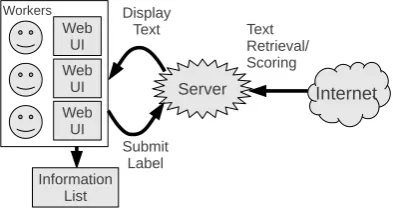
re-Figure 1: Overview of the proposed framework
Figure 2: Example of the annotation interface
scoring of only candidates to be presented to work-ers and keeping a limited number of top-scoring candidates in a memory cache. The framework is collaborative as it is implemented through a multi-user web interface that communicates with the scoring and aggregation server running in the background. An overview of the framework is shown in Figure 1.
We also show an example of the annotation in-terface in Figure 2. On the task page, there is a place to view and enter the keywords for the cur-rent task, and several (in this case, five) examples to be viewed and labeled by the worker. Once the worker has viewed all instances, and clicked either “+” for positive or “-” for negative, the labels can be submitted to the server to update the weights.
3.1 Work Flow from the User Side
We assume a use case where we have a small group of users, and one of the users is designated as the leader of the group.
Before the users commence the information fil-tering process, the group decides the type of
in-formation they want to extract (e.g. “informa-tion about evacua“informa-tion areas within Miyagi prefec-ture”). Next, the users choose one or more key-words related to this information (e.g. “miyagi”, “evacuation”). The group leader then creates a lo-cation where all of the users can aggregate infor-mation to the specified topic using an online docu-ment managedocu-ment service such as Google Docs,4 or a special-purpose web site. Every user in the group then accesses the annotation interface, la-bels instances, and inputs the useful information found in positive instances into the location where the information is being aggregated. To ensure that multiple users are not viewing the same in-formation, each document is only displayed to a single user.
3.2 Work Flow from the Server Side
When the group leader specifies the first keywords to be used in the task, the computation server starts to acquire examples from a web information source such as Twitter. There is a certain amount of overhead required to run even a simple classi-fier such as that described in Section 2.1.2, so to increase the efficiency of information retrieval we first perform a simple keyword filtering step that removes all documents that do not contain at least one instance of one of the specified keywords.
Given the keyword-filtered document stream, the server then calculates the features and current scores for each of the incoming documents. These documents are inserted into a cache ordered in de-scending order of score. In cases where it is neces-sary to save memory, the cache size can be limited appropriately, with low scoring candidates being omitted from the cache and permanently removed from consideration.
Similarly to the previous section, when the user labels an example, this label is fed back to the sys-tem and weights are retrained appropriately. How-ever, re-scoring every document in the cache each time the weights are updated will result in a large time lag at each update. In order to reduce this lag, we propose a method for approximately dis-covering the highest scoring example in the cache without re-scoring every example.
Specifically, we would like to display high-scoring examples to the user, but unless we re-calculate scores for the entire cache on every model update there is a possibility that some of
[image:5.595.74.287.212.402.2]the scores in the cache will be calculated by an older version of the model. In order to solve this problem in an efficient manner, we note that even though the scores may change somewhat, in most cases the order of the scores will remain more-or-less the same as it was before the update. We fur-ther take advantage of this by greedily searching for the highest scoring example according to the following process:
1. According to the (potentially old) scores in the cache, find the highest scoring example
d1and second-highest scoring exampled2.
2. Re-calculated1’s score according to the cur-rent version of the model.
3. Compare the score ofd1 to the score of the exampled2according to theoldmodel.5
4. If d1’s new score is higher than d2’s old score, returnd1as the highest-scoring exam-ple. Otherwise, re-insert d1 into the cache and return to step 1.
It should be noted that this search is greedy, and thus may make mistakes whend1’s score is larger than d2, but not larger than examples that occur farther down in the cache.
4 Experimental Evaluation
To evaluate the effectiveness of our proposed framework and tool for extraction of highly reli-able information, we perform a series of experi-mental evaluations. As extraction of highly reli-able information is particularly important in times of crisis, we used data provided as part of the Great East Japan Earthquake Big Data Workshop6 in-cluding all actual Japanese tweets from Twitter for one week after the earthquake starting at March 11th, 2011, 14:45, a total of 179 million tweets.
We specify three information extraction tasks as shown in Table 1, and use these as the targets for
5
We used2’s old model score because the cache order will
change the most when the user labels an example as negative. In these cases, if bothd1andd2are similar to the negatively
labeled example, both will see a large reduction in score, so wed1’s new score will be much smaller thand2’s old score,
but not necessarily smaller thand2’s new score. To ensure
that we continue penalizing high-scoring instances that are similar to the negatively labeled instance, we continue updat-ing the cache until we find an example that both had a high score according to the old model (and thus a high position in the cache), and a high score according to the new model.
[image:6.595.320.511.67.343.2]6https://sites.google.com/site/prj311/
Figure 3: Results for three tasks with regards to pieces of information extracted and the 5-minute rolling average percentage of presented tweets that contained useful information. The horizontal axis is time in minutes.
our experiments. The first task consists of find-ing information about evacuation areas or rescue supplies that may be useful to those in disaster-affected areas, and the other two tasks are related to finding posts either requesting or providing in-formation about the safety of evacuees.
Given our goal of efficient and reliable identi-fication and extraction of information as stated in Section 1, we use as our evaluation measure the number of tweets able to be verified by workers in 30 minutes. In addition, to more closely simu-late the actual situation of the tool being used in a crisis-response setting, all workers were asked to fill in a web form indicating information such as “location,” “situation,” or “name” in accordance to the information that would likely be useful for each of the tasks.
Type Keywords
Evacuation/Rescue Supplies 避難所(evacuation area),給水(water supplies),炊き出し(food supplies) Safety Info. Request 連絡(contact),取れない(cannot),待って(waiting)
[image:7.595.324.506.171.299.2]Safety Info. Provision 連絡(contact),無事(safe)
Table 1: Filtered information and corresponding keywords
4.1 Evaluation of Learning-based Information Filtering
First, we perform an evaluation of the information filtering interface described in Section 2.1.3. As features, we use character 1-to-5-grams,7 and a naive Bayes classifier, as it is extremely efficient to both classify and update. In Equation (5), we setα = 1 andβ = 5. As a baseline system, we use simple keyword search. All results were pro-vided by a single user who had time to practice using the interface before results were recorded.
We show the results for the three tasks in Fig-ure 3. From the results indicating the number of pieces of useful information extracted on the left side of the graph, we can see that the proposed learning capability improves the efficiency, with increases ranging from 35%-159%. This increase can be largely attributed to an increase in the infor-mation filtering accuracy, or the number of docu-ments displayed to the user that have at least one piece of useful information. The rolling average of accuracy is shown on the right side of Figure 3. We can see that there is a significant differ-ence in the information filtering accuracy be-tween tasks, and this affects the gain afforded by the learning capability. Specifically, “Safety Info. Provision” has lower accuracy than the other tasks, largely because it is difficult to distin-guish between provision of information (“I heard that XXX is safe”) and requests for information (“I wonder if XXX is safe”), while the latter is much more common in the corpus (approximately five times according to Murakami and Hagiwara (2012)’s estimate). Thus, for more difficult tasks improving the accuracy of the classifiers could lead to further improvements in the gains provided by the proposed technique.
4.2 Evaluation of the Collaborative Interface
In addition, to evaluate the collaborative web inter-face described in Section 3, we performed
exper-7Character n-grams remove the effect of analysis mis-takes that occur when performing Japanese tokenization on non-standard text such Twitter.
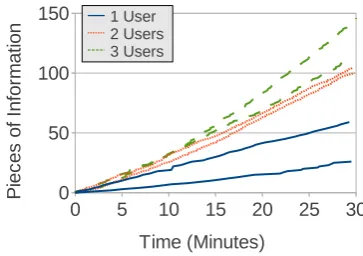
Figure 4: Information verified by 1, 2, or 3 users
iments in which multiple annotators worked col-laboratively on an information filtering task. The experimental setup is identical to that described in the previous section, but we focus only on the Evacuation/Rescue Supplies task. As a compari-son, we compare results for when 1, 2, or 3 users work collaboratively on a single information fil-tering task, performing two experiments for each number of users.
The result of this experiment is shown in Fig-ure 4. After 30 minutes of work, a single user had extracted an average of 43 pieces, two users had extracted 103 pieces, and three users had ex-tracted 129 pieces of useful information and added them to the shared aggregation site. Thus, we can see that increasing the number of users results in an approximately linear increase in the amount of information extracted, confirming the effective-ness of allowing multiple users to work on a single task, and share the results of labeling with a single classifier. As each worker works largely indepen-dently, we hypothesize that this trend will continue for even larger numbers of users.
Figure 5: Average pieces of information added by one user in each time frame
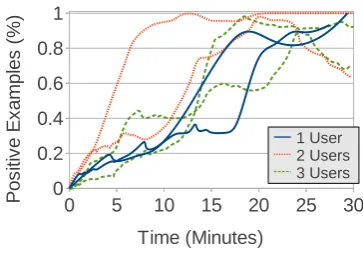
Figure 6: The percentage of examples labeled as positive in each trial run
the percentage of positive examples labeled in-creases drastically over time, with accuracy near 100% achieved in four out of six trials, and all tri-als achieving accuracy over 60%. However, com-pared to this large increase in the accuracy of the examples presented to users, the increase in the amount of information extracted is small. This is because even after positive information has been identified, there is a small but fixed amount of work required to enter the useful information into the information aggregation site. As a result, we can expect that further improvements in informa-tion extracinforma-tion efficiency can be achieved by auto-matically extracting candidates to fill in each col-umn of information to be extracted, and make it possible for a human to simply press a button to verify the information if it happens to be correct.
5 Conclusion/Future Work
In this paper, we presented a framework to effi-ciently, reliably, and collaboratively filter and
ex-tract useful information from the large and noisy web, with a focus of information extraction from Twitter during crisis situations. As a result, we found that the proposed framework led to an in-crease in efficiency of 35%-159% over simple keyword search, with further gains possible when more than one user participates in the information extraction process.
As future work, we can think of expansions to multi-class information extraction problems. In this paper, we limited our experiments to situa-tions where each classifier is trained to identify a single type of information, so identifying three types of information will require three separate rounds of classifier training. While this is a sim-ple setup for users to understand, it is inefficient in the case of a large number of classes, so it is worth examining the possibilities of extracting multiple types of information in a single process.
Another interesting line of work is the provision of extracted information in an easy-to-consume form for people in disaster areas through a QA sys-tem that can be accessed through telephone when other communication tools such as the internet are not available (Kazama et al., 2012).
Assessing the reliability of information on the web is an important challenge, particularly in times of crisis (Mendoza et al., 2010). Work to automatically assess the reliability of information may focus on classifiers assessing the text, user, topic, and dispersal patterns of the said informa-tion (Castillo et al., 2011) or comments on so-cial networks casting doubt on said information’s veracity (Miyabe et al., 2012b). These methods could be combined with our information extrac-tion method to further ensure the reliability of the extracted information.
[image:8.595.90.272.277.405.2]Acknowledgments
The authors sincerely thank Shingo Murakami for his assistance in developing the web interface dur-ing the Great East Japan Earthquake Big Data Workshop. We would also like to thank all of the subjects who lent their time to participate in man-ual annotation experiments, and the oranizers of the Great East Japan Earthquake Big Data Work-shop and Twitter for providing the data that made the experiments possible.
References
Shin Aida, Yasutaka Shindoh, and Masao Utiyama. 2012. Regarding the creation of the “Great East Japan Earthquake rescue request information extrac-tion site” and rescue activities (in Japanese). In
Proc. 18th NLP.
Rich Caruana, Paul G. Hodor, and John Rosenberg. 2000. High precision information extraction. In
Proc. of the KDD-2000 Workshop on Text Mining.
Carlos Castillo, Marcelo Mendoza, and Barbara Poblete. 2011. Information credibility on Twitter. InProc. WWW, pages 675–684.
William J Corvey, Sudha Verma, Sarah Vieweg, Martha Palmer, and James H Martin. 2012. Foundations of a multilayer annotation framework for Twitter com-munications during crisis events. In Proc. LREC, pages 21–27.
Aron Culotta and Andrew McCallum. 2005. Reduc-ing labelReduc-ing effort for structured prediction tasks. In
Proc. AAAI.
Son Doan, Bao-Khanh Ho Vo, and Nigel Collier. 2012. An analysis of Twitter messages in the 2011 Tohoku earthquake. InElectronic Healthcare, pages 58–66.
Susan Dumais, John Platt, David Heckerman, and Mehran Sahami. 1998. Inductive learning algo-rithms and representations for text categorization. In
Proc. CIKM, pages 148–155.
Google Japan. 2011. Requesting your help to register shared survivor lists to Person Finder (in Japanese).
http://googlejapan.blogspot.com/
2011/03/blog-post_17.html.
Aya Ishino, Shuhei Odawara, Hidetsugu Nanba, and Toshiyuki Takezawa. 2012. Extracting transporta-tion informatransporta-tion and traffic problems from tweets during a disaster. InProc. IMMM, pages 91–96.
Thorsten Joachims. 1998. Text categorization with support vector machines: Learning with many rel-evant features. InECML-98.
Jun’ichi Kazama, Stijn De Saeger, Kentaro Torisawa, Jun Goto, and Istvan Varga. 2012. An attempt to apply a QA system to information in times of crisis (in Japanese). InProc. 18th NLP.
Trausti Kristjansson, Aron Culotta, Paul Viola, and An-drew McCallum. 2004. Interactive information ex-traction with constrained conditional random fields. InProc. AAAI.
David J.C. Mackay and Linda C. Bauman Petoy. 1995. A hierarchical Dirichlet language model. Natural Language Engineering, 1.
Prem Melville, Wojciech Gryc, and Richard D. Lawrence. 2009. Sentiment analysis of blogs by combining lexical knowledge with text classifica-tion. InProc. KDD.
Marcelo Mendoza, Barbara Poblete, and Carlos Castillo. 2010. Twitter under crisis: can we trust what we RT? InProceedings of the First Workshop on Social Media Analytics (SOMA), pages 71–79.
Mai Miyabe, Asako Miura, and Eiji Aramaki. 2012a. Use trend analysis of Twitter after the Great East Japan Earthquake. InProc. CSCW, pages 175–178.
Mai Miyabe, Ayana Umeshima, Akiyo Nadamoto, and Eiji Aramaki. 2012b. Rumor cloud: Gathering rumors by extracting correction information men-tioned by humans (in Japanese). InProc. 18th NLP.
Robert Munro. 2010. Crowdsourced translation for emergency response in Haiti: the global collabora-tion of local knowledge. InProc. AMTA Workshop on Collaborative Crowdsourcing for Translation.
Koji Murakami and Masato Hagiwara. 2012. A de-tailed analysis of a safety information Tweet corpus and observations about its annotation (in Japanese). InProc. 18th NLP.
Graham Neubig, Yuichiroh Matsubayashi, Masato Hagiwara, and Koji Murakami. 2011. Safety in-formation mining - what can NLP do in a disaster -. In Proc. IJCNLP, pages 965–973, Chiang Mai, Thailand, November.
Yan Qu, Philip Fei Wu, and Xiaoqing Wang. 2009. Online community response to major disaster: A study of Tianya forum in the 2008 Sichuan earth-quake. InProc. HICSS, pages 1–11. IEEE.
Sunita Sarawagi. 2008. Information extraction. Foun-dations and trends in databases, 1(3):261–377.
Bernhard Sch¨olkopf, John C. Platt, John Shawe-Taylor, Alex J. Smola, and Robert C. Williamson. 2001. Estimating the support of a high-dimensional distri-bution.Neural computation, 13(7):1443–1471.
Burr Settles. 2011. Closing the loop: Fast, interactive semi-supervised annotation with queries on features and instances. InProc. EMNLP.
Kate Starbird and Jeannie Stamberger. 2010. Tweak the tweet: Leveraging microblogging proliferation with a prescriptive syntax to support citizen report-ing. InProc. ISCRAM.
Kate Starbird, Grace Muzny, and Leysia Palen. 2012. Learning from the crowd: Collaborative filtering techniques for identifying on-the-ground Twitterers during mass disruptions. InProc. ISCRAM.
Sudha Verma, Sarah Vieweg, William J Corvey, Leysia Palen, James H Martin, Martha Palmer, Aaron Schram, and Kenneth M Anderson. 2011. Nat-ural language processing to the rescue?: Extract-ing’situational awareness’ tweets during mass emer-gency. Proc. ICWSM.
Sarah Vieweg, Amanda L Hughes, Kate Starbird, and Leysia Palen. 2010. Microblogging during two nat-ural hazards events: what Twitter may contribute to situational awareness. In Proc. CHI, pages 1079– 1088.