Munich Personal RePEc Archive
The Long-Term Effects of Protestant
Activities in China
Chen, Yuyu and Wang, Hui and Yan, Se
Guanghua School of Management, Peking University, Guanghua
School of Management, Peking University, Guanghua School of
Management, Peking University
29 January 2014
The Long-Term Effects of Protestant Activities in China
*Yuyu Chen Hui Wang
Guanghua School of Management Guanghua School of Management
Peking University Peking University
[email protected] [email protected]
Se Yan
Guanghua School of Management Peking University
January 2014
Does culture, and in particular religion, exert an independent causal effect on long-term economic growth, or do culture and religion merely reflect the latter? We explore this issue by studying the case of Protestantism in China during the late nineteenth and early twentieth centuries. Combining county-level data on Protestant presence in 1920 and socioeconomic indicators in 2000, we find that the spread of Protestantism has generated significant positive effects in long-term economic growth, educational development, and health care outcomes. To better understand whether the relationship is causal, we exploit the fact that missionaries purposefully undertook disaster relief work to gain the trust of the local people. Thus, we use the frequency of historical disasters as an instrument for Protestant distribution. Our IV results confirm and enhance our OLS results. When we further investigate the transmission channels over the long historical period between 1920 and 2000, we find that although improvements in education and health care outcomes account for a sizable portion of the total effects of missionaries’ past activities on today’s economic outcomes, Protestant activities may have also contributed to long-term economic growth through other channels, such as through transformed social values. If so, then a significant amount of China’s growth since 1978 is the result not just of sudden institutional changes but of human capital and social values acquired over a longer historical period.
Keywords: Protestantism, Economic Growth, Education, Health Care, China
JEL Classification Numbers: I25, N15, N35, O11, O43, Z12
*
The missionaries . . . have been among the pioneers of civilization.
—William McKinley, 19001
1. Introduction
One of the most contentious issues with respect to the effects of religion on economic
growth is the role of Protestantism. Much of the debate has focused on whether the rise of
Protestantism has had any causal effect on long-term economic growth in predominantly
Christian nations. In The Protestant Ethic and the Spirit of Capitalism, Max Weber (2001)
suggested that Reformed Protestantism, by promoting stronger societal preferences for hard work
and thrift, has led to greater economic prosperity in Western societies. Recent empirical studies
of the role of Protestantism in the economic growth of the Western world have found mixed
results. Cantoni (2013) argues that Protestantism had no effect on economic growth for 272 cities
in the Holy Roman Empire during the period between 1300 and 1900. Meanwhile, other studies
find significant positive effects and have identified a few mechanisms through which religion
may have contributed to economic growth. Some of these studies echo Weber’s and suggest that
religious beliefs may have fostered certain moral codes or social values that are conducive to
economic growth (Stulz and Williamson, 2003; Barro and McCleary, 2003; McCleary and Barro,
2006a, 2006b; Arruñada, 2010). But other studies emphasize that it is not religious practices per
se but rather by-products that accompanied these practices (e.g., the accumulation of human
capital that may result from reading the Bible) that have contributed to economic growth
(Glaeser and Sacerdote, 2008; Becker and Woessmann, 2009).
An equally interesting question revolves around how the expansion of Protestantism has
affected economic growth in peripheral nations and, more specifically, in non-Christian societies.
Throughout their history, Christian missionaries have attempted to transplant Protestantism—
together with Western science, technology, culture, and institutions—into peripheral nations,
many of which have had long-established indigenous religions, cultures, and institutions of their
own. Despite countless clashes and compromises, Protestantism has deeply transformed some of
these societies and generated persistent, significant impacts to their economic growth.
1
Yet the prospect of conducting an empirical examination of the effects of Protestantism on
long-term economic growth in peripheral nations can be daunting because of the scarcity of
within-country data on nations that are suitable for such study.2 Consequently, scholars conduct
cross-country studies to examine the effects of religion on economic growth in both Western and
peripheral nations. These cross-country studies are illuminating. They are also fraught with
questions of causality, however, as the effects of religion are often inextricably related to other
factors that have been shown to contribute to economic prosperity, such as geography and the
establishment of formal and informal institutions, which vary from one country to another.
Identifying the internal mechanisms of the correlations between religion and economic growth in
these studies thus remains a somewhat murky proposition.
Even when within-country data are available, establishing causality between Protestantism
and long-term economic growth is difficult because of the issue of endogeneity. It is possible, for
example, that more developed regions attracted more Protestant activity in the past, and that they
continue to perform better in the present. A few existing studies use the instrumental variable
method to tackle this problem. In their study of nineteenth-century Prussia, Becker and
Woessmann (2009) use distance to Wittenberg—the city in which the Reformation originated—
as an exogenous predictor of Protestantism.3 However, this identification strategy is hard to
adapt for use in peripheral nations. Protestantism was transplanted to these countries, usually
through easily accessible places such as seaports. The locations at which Protestantism initially
emerged frequently coincide with economic centers, thus making the distances to these locations
invalid instruments for studying the causal effects of Protestantism on long-term economic
growth. Therefore, the issue remains an enigma, and resolving it is important for, as we shall see,
its resolution helps explain China’s rapid growth since 1978 and the enormous variation in
contemporary income levels across China.
In this study, we assemble historical and contemporary data to investigate whether the
spread of Protestantism in the late nineteenth and early twentieth centuries had a persistent
impact on China’s recent economic growth, educational development, and health care outcomes
and, if it did, what mechanisms were involved. To our knowledge, this paper provides the first
empirical evidence for the long-term effects of religious activities on socioeconomic outcomes in
2
Bai and Kung (2012) explore the within-China variations to examine the effects of Christianity’s spread on educational development in different Chinese counties in the early twentieth century.
China today.
Studying the long-term effects of Protestantism in China is valuable for two reasons. First,
China provides an ideal setting for studying within-country variations in religious activities and
socioeconomic development. Throughout its history, China has been a large country with a
relatively homogeneous culture and a uniform political system, yet its socioeconomic
development has been quite heterogeneous. The Chinese setting thus provides variations large
enough to conduct clean empirical tests and thereby examine the role of religion on long-term
socioeconomic development. Second, the transplantation of Protestantism to a vast peripheral
nation such as China has been, to some extent, a quasi-natural experiment. Chinese culture was
dominated by Confucianism for thousands of years. Christianity was prohibited until late in the
nineteenth century, when China was defeated by Western powers and forced to open its doors to
foreign trade and influences. Thereafter, foreign missionaries self-selected to go to different
Chinese counties and evangelize Chinese people. Yet missionary activities turn out to have
constituted a largely external and exogenous intervention, both in China’s economy and in its
society. This feature allows us to examine the long-lasting effects of a sudden and exogenous
historical event on socioeconomic development eighty years later. In this regard, our research
contributes to a large body of literature on the effects of historical events on current economic
developments that includes the works of Acemoglu, Johnson, and Robinson (2001, 2005), Nunn
(2008), and Dell (2010).
In this paper, we marshal county-level data on the numbers of Protestant converts,
missionaries, and churches in 1920 from original historical survey materials, and then match
these data with county-level data on developments in the economy, education, and health care
outcomes in 2000. Our OLS results show that diverse socioeconomic developments across
counties in 2000 are positively correlated with the intensity of Protestant presence 80 years ago.
By themselves, however, these correlations do not prove that Protestantism caused China’s
subsequent socioeconomic development; they may simply reflect it. It might be possible that
more developed counties attracted more Protestant activities in the past, and that they continue to
perform better at present. We tackle the endogeneity issue in three ways. First, we investigate the
historical record, which suggests missionaries were usually more inclined to go to less developed
revenues of Chinese counties, and we find no positive correlation between historical economic
prosperity and Protestant presence. Third, in light of the fact that missionaries purposefully
undertook disaster relief work to gain the trust of Chinese people, we use the frequency of severe
droughts and floods in the early twentieth century as the instrument for the intensity of Protestant
presence across counties. Our IV coefficients are positive and significant, suggesting that more
Protestant activities in 1920 produced better economic, educational, and health care outcomes in
2000.
We then investigate the precise channels through which the impacts of Protestant activities
in 1920 have survived China’s political turbulence and managed to persist into the present. Our
investigations of historical facts and our empirical tests suggest that a greater Protestant presence
results in better education and health care outcomes in 1920, and that these effects persisted into
the present and contributed to economic growth in 2000. While proselytizing in remote inland
counties, missionaries also worked to help local people build modern educational and health
systems and to diffuse Western science and technologies. Such efforts accelerated modernization
in many Chinese counties, contributed to the accumulation of human capital, and reshaped the
social values of local people. The transformation of Chinese society was permanent. Although
missionary work was suppressed during the Cultural Revolution in the 1960s and 1970s,
Protestantism rapidly resurged at the end of the 1970s when China began to open up and reform.
In this market-oriented environment, the human capital and social values that had been
transformed by historical Protestant activities began to contribute substantially to improvements
in education and health care outcomes. Our further empirical tests corroborate that while
education and health care outcomes have accounted for a significant part of the effects of
Protestantism on economic development in 2000, missionaries’ undertakings have also affected
economic outcomes through other channels. This finding is not surprising. Historical Protestant
activities have affected Chinese society in very complex ways. Many of those effects are difficult
to quantify, but they might have played an indispensable role in enhancing long-term economic
growth, such as by transforming social values and work ethics.
If we are correct, our conclusions have important implications for understanding China’s
spurt of economic growth since 1978. This growth, the so-called Chinese miracle, is usually
attributed entirely to the Reform and Open-up, a series of radical institutional changes that began
a continuation of a modernization movement that started in the mid-nineteenth century but was
disrupted by wars and political turbulence, and (2) Protestant missionaries pioneered that
modernization movement by introducing Western-style education, health care, science,
technology, and social values to China. Missionaries disseminated Western science, technology,
and social values to even the most remote parts of China, and they fostered the accumulation of
certain types of human capital that have been conducive to modern economic growth. The
historical legacies of human capital and social values that were acquired from missionaries’
undertakings almost a century ago continue to promote radical institutional changes and rapid
economic growth at the present time. Therefore, we concur with Brandt, Ma, and Rawski (2013)
when they attribute “China’s recent economic success to a combination of beneficial historic
legacies, recent accumulations of capital, skill, and policy expertise, and important economic and
political changes that facilitated the realization of old and new potentials.”
In the next section, we provide some historical background on the spread of Protestantism
during the late nineteenth and early twentieth centuries. Section 3 describes the data we use to
study the long-term effects of Protestantism. Section 4 establishes the causal relationship
between historical Protestantism and contemporary economic development. Section 5 explores
the causal effects of Protestantism on educational development, both historically and currently.
Section 6 explores the causal effects of Protestantism on medical development, both historically
and at present. Section 7 examines the channels through which historical Protestantism has
contributed to contemporary economic growth, such as through improved education and health
care outcomes or through transformed social values and work ethics. The final section discusses
the implications of our findings.
2. Historical Background
Christianity has never been a major religion in China, a Confucianism-dominated country. It
began to spread in China as early as in the seventeenth century. In 1704, Pope Clement XI
forbade Chinese Christians to engage in Confucius-related activities. This outraged Emperor
Kangxi, who consequently banned all Christian practices in 1720. This ban was upheld by
successive emperors. In the early nineteenth century, trade between Europe and China reached a
historically high record, and Christian missionaries renewed their efforts to penetrate China. As
remained negligible until the 1840s.
China was forced to open its doors to Western powers when in 1842 it was defeated by
Britain in the First Opium War. As a result, missionaries and other foreigners were allowed to
take residence in China. After the Second Opium War and another defeat in 1860, the Qing
government signed the Convention of Peking, which granted freedom of religion in China and
allowed missionaries to own land and build churches. This led to a rapid expansion of
Protestantism throughout China. In 1860 there were 198 foreign Protestant missionaries and
2,000 converts; those numbers increased to 473 and 13,035 respectively by 1876. By the end of
the nineteenth century, there were 1,500 missionaries and more than 80,000 Protestant converts
(Wang, 1991). The first two decades of the twentieth century witnessed the fastest expansion of
Christianity in Chinese history. In 1905 3,445 foreign Protestant missionaries arrived in China,
more than double the number that had arrived in 1900. This number climbed to 8,000 in 1927.
There were 130,000 Protestant converts in 1904, and this number soared to 402,539 in 1922. By
1920 there were more than 120 Protestant denominations in China, and church activities had
penetrated nearly 70% of Chinese counties (Wang, 1991). Roman Catholicism also enjoyed a
rapid expansion during the same period.
Christianity’s expansion throughout China was a far from smooth process. On the contrary, it
generated a great deal of mistrust and hostility between foreign missionaries and local Chinese
residents. Mistrust and hostility led to frequent—and increasingly violent—confrontations,
culminating in the Boxer Rebellion in 1900. More than 20,000 Christians were killed and
three-quarters of churches were destroyed in this tragic xenophobic conflict.
Frequent and serious conflicts that accompanied the diffusion of Christianity compelled
missionaries to reflect on the deep reasons behind these conflicts. Learning from the conflicts of
the late nineteenth century, in particular the Boxer Rebellion, many Christian organizations came
to realize that the hostility with which many Chinese regarded Christianity was a response to
condescending missionaries who all too often refused to respect local cultures. For example,
missionaries forbade ancestor worship among their Chinese converts, and missionaries’
egalitarian beliefs clashed with Chinese society’s entrenched hierarchical traditions. As a result, a
growing number of missionaries began to seek new strategies for building trust and promoting
China is a nation that is frequently afflicted by natural disasters. Over its long history of
coping with disasters, the Chinese government developed a set of sophisticated relief
mechanisms. However, when the central empire began to collapse in the late nineteenth century,
those mechanisms gradually fell into disarray. Noticing the absence of government support,
many missionaries actively engaged in disaster relief work and purposefully sought to build trust
and diffuse Christianity through those efforts. Timothy Richard, for example, explicitly stated
that disaster relief was “an ideal way to reduce prejudices and prepare the ways for the Chinese
to accept Christianity” (Gu, 2010), and “the Chinese might not receive written evidences of the
truth of Christianity, but help rendered to them in distress would afford unanswerable evidence of
the motives of religion” (Richard, 1916, p125). While engaged in relief work in 1877,
Presbyterian missionary Arthur Smith reported to his superiors, “It seems to me the grandest
opportunity in all the history of China to demonstrate the spirit of our religion. We can show that
Christianity teaches us to love our neighbors as ourselves and to recognize all men as brethren”
(Eshrick, 1987, p78). Another American missionary, John L. Nevius, concurred: “The people in
the famine region were very appreciative and grateful, and I believe this work will have a strong
influence in removing prejudices and preparing the way for the reception of Christianity”
(Nevius, 1895, p329).
Protestant missionaries’ organized disaster relief efforts began in the late 1870s, in the wake
of the most severe famine in modern Chinese history. Between 1876 and 1879, a catastrophic
drought hit Shandong and five other provinces in North China, and the resulting famine killed
over ten million people. Missionaries who had been stationed all over China responded,
gathering in disaster-stricken areas to help people in need. In 1877 Protestant missionaries set up
an aid agency, the Shandong Disaster Relief Commission, to coordinate their relief work. By
1879 the commission had raised over 200,000 silver taels (US$300,000) and had eased the
suffering of millions of Chinese people (Gu, 2004, p289). Since then, missionaries have provided
emergency humanitarian responses to almost all of China’s large disasters. When another severe
drought hit Shandong Province in 1888, the English Baptist Mission and the American
Presbyterian Church worked together to raise over 300,000 silver taels (US$450,000) and help
over 300,000 drought-affected people (North China Famine Relief Committee, 1889, p25).
Missionaries became even more active and organized during the disasters of the early twentieth
Zhejiang drought. When North China was struck by severe drought yet again in 1920,
missionaries established the China International Famine Relief Commission, a nationwide
organization that coordinated international disaster relief efforts and raised over 20 million U.S.
dollars (Gu, 2004, p294).
Lacking both modern medical knowledge and a functioning public health system, thousands
of people were decimated by cholera, plague, and other epidemics that accompanied China’s
natural disasters. Missionaries responded by trying to control disease and save life, putting forth
great efforts to establish hospitals and public health systems in the afflicted regions. As Christian
missionaries became more deeply engaged in local communities and in their disaster relief work,
they reported that while many government officials and gentry elites were experts in Confucian
classics, they were largely ignorant of modern science and technology. This institutional
ignorance impeded effective disaster relief efforts. As a result, the missionaries worked even
harder to persuade the Chinese government to improve its educational system. Moreover, many
missionaries put into practice the idea of education reform and established elementary schools,
middle schools, and even universities throughout China. Many of these Christian schools soon
became exemplary models that secular schools learned from. These educational achievements
increased the human capital of the local people and may also have changed their social values,
such as their work ethic and their attitudes toward Western culture.
Christianity reverted to its previous, unwelcome status when the People’s Republic of China
was established in 1949. The central government regarded missionaries as a form of “Western
imperialism.”4 Consequently, it established a set of state-endorsed religious organizations and
severed all connections with foreign denominations. By 1952, all foreign missionaries had been
ordered to leave China. During the Cultural Revolution (1966–1976) all religious activities,
including those of the government-regulated churches, were prohibited. Christian schools and
hospitals were taken over by the government. Yet many of these schools continued to function
much as they had under missionary control, training large numbers of students and persistently
contributing to local economic development. Similarly, most of the formerly Christian hospitals
continued to benefit local communities as they had in the past. Furthermore, the missionaries’
endeavors before 1949 had so thoroughly promoted consciousness of education and public health
among Chinese people that they permanently transformed Chinese society. Such effects were
suppressed but not exterminated during the Cultural Revolution. When Christianity was legalized
in China during the Reform and Open-up in 1978, the suppressed effects of Protestantism
revived rapidly and began to persistently contribute to improvements in economic growth,
education, and health care outcomes. These improvements, coupled with other complex
long-lasting effects of Protestantism such as changed social values and work ethics, generated a
significant boost to economic growth—particularly in counties with a history of more intense
Protestant activity.
3. Data
To examine the impact of Protestant activities on long-term socioeconomic development, we
assemble three county-level data sets: Protestant activities and socioeconomic conditions in 1920,
socioeconomic conditions in 2000, and the geophysical conditions of all counties in our data set.
Our examination is complicated, however, by the geopolitical reality that many of those counties’
borders have changed over time. Therefore, we address the issue of changing borders by using
GIS methods to match historical data with contemporary data. This section explains those details.
3.1 Historical Data
Our data of Protestant activities in China in 1920 are obtained from a statistical report that
was compiled and published by the China Continuation Committee, the central organization of
Protestant churches in China at the time. One of the committee’s main tasks was to coordinate
and promote more effective evangelization in China. For that purpose, beginning in 1918, the
China Continuation Committee conducted a three-year county-level survey on the status of
Protestant activities in China. The committee published its results in a statistical report entitled
The Christian Occupation of China: A General Survey of the Numerical Strength and
Geographical Distribution of the Christian Forces in China (COC). The COC reports on various
measures of Protestant activities such as numbers of Protestant missionaries, converts, churches,
schools, and hospitals in Chinese counties. It also collects and publishes other important
socioeconomic information, such as political orientation, population, and educational attainment,
obtained from county gazetteers and various local government surveys. The China Continuation
descriptions of the extent of Protestant influence in Chinese counties. Therefore, the COC is
generally accepted as a good source of information for studying the socioeconomic conditions in
Chinese counties in the early twentieth century.
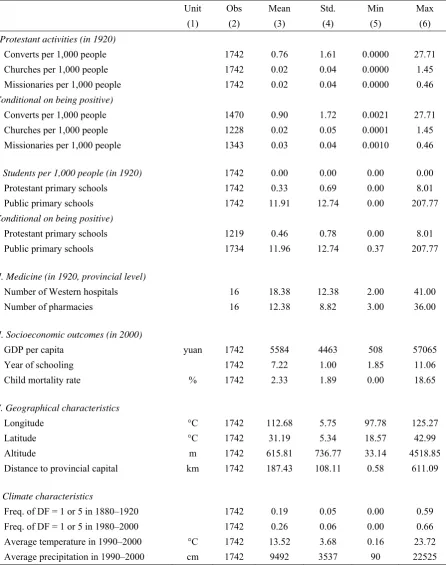
[Table 1 about here]
In this paper, we measure the intensity of Protestant activities in each county by three
indicators: the numbers of Protestant converts, churches, and missionaries for every 1,000 people.
The summary statistics are reported in Table 1. On average there were 0.74 converts, 0.016
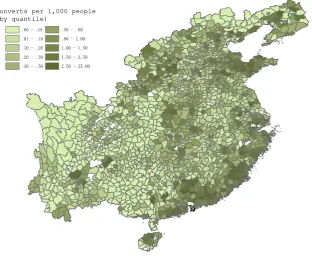
churches, and 0.024 missionaries per 1,000 people in each Chinese county in 1920. Figure 1
shows the density of Protestant converts across counties in our sample. Darker shading indicates
counties with higher densities of Protestant converts. Although many coastal counties had a high
density of Protestant converts, the figure also depicts an active Protestant presence in a number
of inland counties. Therefore, our data suggest that the different intensity levels of Protestant
activities were not simply driven by the distances of these counties to the coastline.
[Figure 1 about here]
3.2 Contemporary Data
To study the long-term impacts of Protestant activities, we assemble contemporary
socioeconomic indicators of Chinese counties. We obtained county-level data on economic
development and local government budgets in 2000, including aggregate GDP, GDP by sector,
infrastructure expenditures, and government subsidies, from the Statistical Materials of Public
Finance of Cities and Counties; maps of and information on primary and secondary highways in
2000 from the China Data Center at the University of Michigan; and data on population,
mortality rates, and years of schooling from the Fifth National Population Census (2000). Our
main dependent variable is GDP per capita in 2000, with a mean of 5,584 yuan (about 800 U.S.
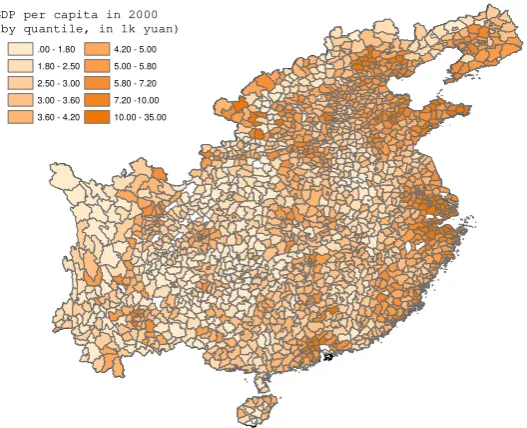
dollars). Figure 2 reports the GDP per capita of all the counties in our data set, and each region
on the map represents a county; the darker the shading, the higher the county’s GDP per capita.
Similar to Figure 1, it is evident that not all rich counties are coastal ones. Quite a number of
inland counties also have high GDP per capita.
3.3 Climate Data
Our historical climate data are drawn from the Distribution Gallery of Droughts and Floods
in the Past Five Hundred Years of China, which was compiled by the Institute of Synoptic
Meteorology and Climatology under the administration of the China Meteorological
Administration (CMA). The original sources of historical climate data are county gazetteers and
official archives. Combining historical and contemporary climate data, this gallery allows us to
build a data set of droughts and floods for 120 meteorological stations from 1470 to 2000. For
each year, the gallery uses a five-point scale to assign a Drought/Flood Index (DF-index) number
that categorizes the local disaster status at each station: 1, severe flood; 2, light flood; 3,
moderate conditions; 4, light drought; and 5, severe drought.5 The CMA’s data set has been
widely used in previous studies, and its consistency and reliability have been carefully examined
and confirmed by a number of meteorologists (e.g., Yao, 1982; Ronberg and Wang, 1987, Zhang
and Crowley, 1989).
In our study, we count the frequency of serious droughts and floods (DF-index=1 or 5) over
our sample periods and use this totalas a measure of disaster frequency. To convert station-level
information into county-level variables, we use a conventional approach called the
inverse-distance-weighted (IDW) method. The IDW method assumes that a county’s climate is an
average of the climates at all nearby stations, weighted by the distances between the county and
the nearby stations (see the Appendix for further details on how the climate data were calculated).
For one of the periods on which our paper focuses, 1880–1920, the frequency of serious droughts
and floods among our sampled counties is 0.19 per year on average.
3.4 Geophysical Data
Our study makes use of county GIS data in 2000 (including longitudes, latitudes, and
surface areas) obtained from the Australian Consortium for the Asian Spatial Information and
Analysis Network Data Center at Griffith University in Brisbane, Australia, and SRTM 90m
digital elevation data on average county altitudes obtained from the CGIAR Consortium for
Spatial Information (Jarvis et al., 2008). We calculate distances between the coordinates of
different locations by using the haversine formula, which takes into account the curvature of the
earth.6
In our multivariate analyses, we also control for county-level geophysical characteristics by
drawing from the Surface Meteorological Database, which was constructed by the CMA. The
database contains annual precipitation and average temperatures for 754 meteorological stations
between 1990 and 2000. As with our climate data, we use the IDW method to convert
station-level variables to the county station-level.
3.5 County Matching
One of the challenges our study faced was the long historical period over which political
regimes changed and the territorial borders of many counties shifted. We address this challenge
by first comparing the GIS data for both 1920 and 2000 and then converting county-level
variables in 1920 to those in 2000 using overlapping area as weights. To achieve those ends, we
obtain historical GIS data from the China Historical Geographic Information System (CHGIS)
project.7 Then we construct a data set that combines historical Christian intensity data, historical
and contemporary climate data, contemporary socioeconomic data, and geophysical data for
1,743 counties in China proper.
4. The Long-term Economic Effects of Protestantism
In this section we study the long-term economic effects of Protestant activities that took
place in 1920. We use county-level GDP per capita in 2000 as the indicator of contemporary
economic development. We begin our study with a correlation analysis. Then we use both
historical evidence and the instrumental variable method to establish the causal effects of
Protestantism on long-term economic development. We also scrutinize our results with
instrument validity tests and robustness checks.
6
The haversine formula is used to calculate the spherical distance between any two points (Sinnott, 1984):
where pi=π/180 and Xlong and Xlat stand for longitude and latitude of point X, respectively.
7 The historical county-level GIS data can be downloaded at http://www.fas.harvard.edu/~chgis/.
2 2
6371.004 2 sin 0.5 cos( ) cos( ) sin 0.5
A B long long long long lat lat
4.1 Baseline Correlations
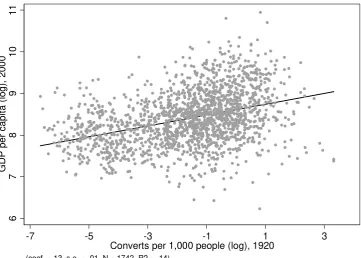
Figure 3 shows the correlation between log of converts per 1,000 people in 19208 and log
per capita GDP in 2000 for all these counties. It is evident that the two variables have a strong
positive correlation.
[Figure 3 about here]
We further examine this relationship with OLS regressions controlling for other
county-level characteristics. The baseline specification is given by
ln(pcGDPi) = α + β‧ln(Converts/Pop1920i) + Xi
'‧γ
+ εi, (1)
where ln(pcGDPi) is the natural log of GDP per capita in county i in 2000; ln(Converts/Pop1920i)
is the natural log of Protestant converts per 1,000 people in 1920; Xi is a vector of control
variables including county locations, climates, and other geophysical characteristics; and εi is the
error term.
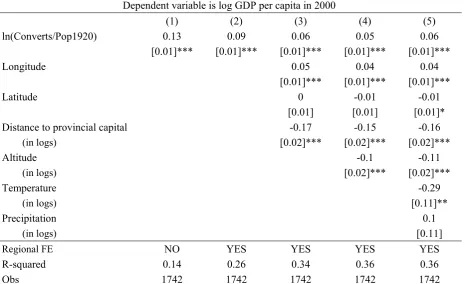
Table 2 reports the results. Column 1 reports the estimate of β without control variable Xi.
This result reflects the relationship shown in Figure 3. Column 2 includes a set of regional fixed
effects.9 While the magnitude of the marginal effect is reduced, the coefficient of Protestant
convert density remains positive and significant at the 1% level. We further control for a set of
county geophysical variables, including longitudes, latitudes, and distances to provincial capitals
(column 3), altitudes (column 4), and a set of climate variables such as precipitation and
temperature (column 5). Table 2 shows that the coefficients of the convert densities remain
significantly positive.
[Table 2 about here]
8 For counties with zero converts (272 such counties in our data), natural logs are not defined. For these counties, we use ln(1/Pop1920i), pretending that they each had one convert. We also use alternative methods for dealing with the logarithmic transformation of the zeros, including (1) assuming Converts/Pop1920i = 0.001 for zero-convert counties (choosing 0.001 because it is the lowest value for Converts/Pop1920i among the non-zero sample), and (2) excluding the zero-convert counties from our analyses. The main results remain robust.
9
4.2 Establishing Causality: Instrumental Variables Results
The positive correlation between the density of Protestant converts in 1920 and
contemporary economic outcomes in 2000 reported in Table 2 does not guarantee a causal
relationship. One major concern for causality is that selection of counties for evangelization in
1920 was not random. It is possible that missionaries preferred to serve in richer counties in 1920,
and that these counties remain more affluent today. In this subsection we study the location
choices of Protestant evangelization prior to 1920 from a few different perspectives.
First, historical records indicate that a large number of missionaries actively worked in the
less developed inland regions of China, and that many of them actually preferred to work in
those regions. The British missionary Hudson Taylor believed that people in poor and remote
regions were more likely to respond to God’s call during times of hardship (Wang, 1997). Taylor
founded the China Inland Mission (CIM) in 1865 and aimed to serve all of China’s provinces.
For that purpose, the CIM sent many groups of missionaries to serve in less developed regions
such as Shanxi (since 1876), Sichuan (since 1877), Guizhou (since 1877), and Yunnan (since
1877) (Broomhall, 1901).As other missionaries came to share similar views and volunteered to
work in poor and isolated counties, the CIM became China’s largest Protestant denomination by
the early twentieth century. More than 1,000 missionaries joined the CIM and spread the Gospel
to remote villages. Other denominations followed the CIM’s lead, and together they left a lasting
influence on almost every part of this big country.
An empirical examination of whether missionaries were more active in less developed
counties (and, conversely, less active in more developed counties) requires the economic
indicators of those counties in 1920. Because direct measures of county-level economic
development in 1920 are unavailable, we use two proxies for historical economic conditions:
population density and per capita land tax revenue. Population density is a commonly used (if
arguably crude) proxy for historical economic prosperity.10 Per capita land tax revenue can also
largely reflect local economic conditions.11 Since both of these measures are relatively crude, we
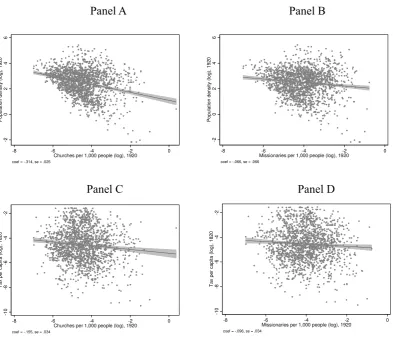
should consider the results here merely suggestive. Figure 4 plots these two measures against the
10
See Acemoglu, Johnson, and Robinson (2002) for example. The data on county-level population density are also obtained from the COC.
11
numbers of churches and missionaries per 1,000 people for Chinese counties in 1920.12 All of the
panels show significant negative correlations, suggesting higher Protestant presence in less
developed regions. Given this evidence, it is unlikely that the observed positive relationship
between Protestant densities and current economic growth is completely driven by selection. In
fact, selection tends to bias the OLS results toward zero.
[Figure 4 about here]
In order to rigorously establish the causality between historical Protestant activities and
contemporary economic growth, we use the instrumental variable method. As described in
Section II, starting in the late 1870s, Protestant organizations purposefully undertook disaster
relief work to gain the trust of Chinese people. In light of this fact, we construct the county-level
frequency of severe droughts and floods between 1880 and 1920 (DF index = 1 or 5) and use it
as the instrument for Protestant densities. The results are reported in Table 3.
[Table 3 about here]
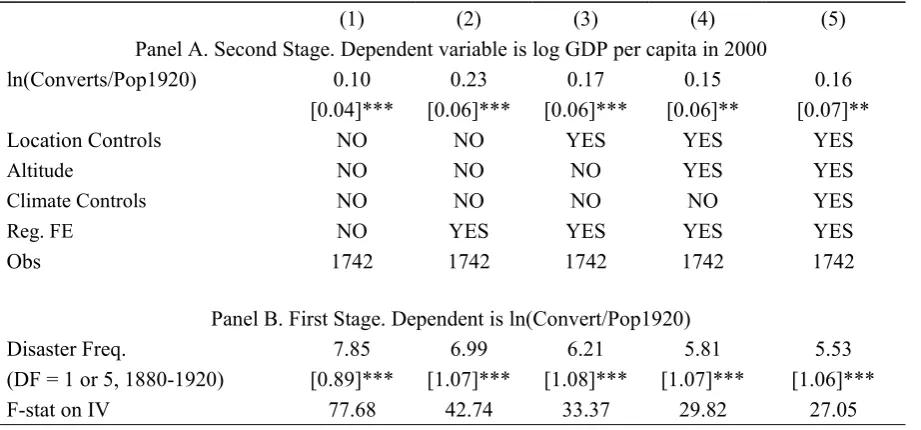
Panel B of Table 3 presents the first-stage results. It includes the same set of specifications
as in Table 2. The coefficients on disaster frequencies are significantly positive, indicating higher
densities of Protestant activities in the counties that experienced the most disasters. The
F-statistics of the instrumental variable, which are higher than the critical value suggested by Stock
and Yogo (2005), rule out weak instrument concern.
We report our second-stage regression results in Panel A. Instrumented by disaster
frequencies from 1880 to1920, the coefficients on ln(Converts/Pop1920) remain significantly
positive for all columns and vary around 0.15. These results are significant not only statistically
but also economically. Take column 5 with the full set of controls as an example. The coefficient
reveals that a 1 standard deviation increase in convert density leads to a 0.42 standard deviation
increase in GDP per capita, or 1,892 yuan. This amounts to a 34% increase in income per person
for our sampled counties. Moreover, the 2SLS estimates of β in Table 3 are significantly higher
than the OLS estimates in Table 2, which confirms the underestimation of impacts of historical
Protestant activities in our OLS regressions.13
12
Here we use the number of missionaries and the number of churches in each county to capture missionaries’ location choices before 1920. As a robustness check, we also use the number of converts and find similar results.
4.3 Validity of the Instrument
The validity of our 2SLS results in Table 3 rests on the assumption that historical disasters
only affect current economic growth through the channel of past Protestant missionary activities.
In this subsection we further substantiate this assumption by directly controlling for other factors
that could plausibly be correlated with both historical missionary activities and current economic
outcomes. We consider five such factors and report the results in Table 4. Column 1 of Table 4
reports the results without additional controls, which are copied from Column 5 of Table 3.
Other columns in Table 4 report the results of various validity checks. It is evident that these
results are quite robust.
[Table 4 about here]
First, we consider the possibility of China’s climate exhibiting persistent regional patterns
(Man, 2009). If past and present disasters were correlated, historical disasters would adversely
affect today’s economic outcomes directly and would, in turn, jeopardize the validity of our IV
results. We find this channel unlikely. The correlations between disasters in different periods are
weak in our data set when the two periods are reasonably far apart. In particular, the correlation
coefficient of severe disasters between 1880–1920 and 1980–2000 is only 0.06. Therefore, as
reported in column 2 of Table 4, the effect of historical Protestant activities remains almost
unchanged when we control for recent disaster frequencies.14
Second, we consider whether a county’s proximity to waterways could jeopardize the
exclusivity of our instrumental variable. Although counties with major waterways within their
borders are more likely to experience flooding, access to navigable waterways provides decided
advantages in developing industry and commerce and contributing to economic growth. To
address this concern, we create a variable indicating whether a county has a major river passing
through it.15 As shown in column 3, counties with rivers passing through them are 10% richer
than other counties. Nevertheless, controlling this river dummy does not affect our estimate of
the coefficient on Protestant densities at all.
different periods simultaneously, including 1840–1880, 1880–1920, 1920–1940, and 1980–2000. Only the coefficient on period
1880–1920 appears to be positively significant. Coefficients on the other periods are both small in magnitude and insignificant. 14
We should also keep in mind that, different from 100 years ago, the Chinese economy today relies more on manufacturing and is thus less vulnerable to weather shocks. In addition, with new technologies in communication, transportation, and weather forecasting, the impacts of extreme weather on economic outcome today are much smaller.
Third, we consider infrastructure. Frequent disasters may induce local societies to put more
emphasis on infrastructure construction, which may benefit long-term economic growth. We use
two variables to proxy local infrastructure conditions: road density in column 4 and local
government expenditures on infrastructure in column 5. Once again, our estimates remain robust
even after we control for local infrastructure conditions.
Fourth, we consider whether disaster-prone regions might shift toward industrially oriented
development strategies and away from agriculture. In order to test this hypothesis, in column 6
we add in the share of agricultural sector in each country’s GDP in 2000. Again, the result barely
changes.
Fifth, we consider the possibility that the central government provides more subsidies to
disaster-prone regions. This might be another reason frequent drought- and flood-prone counties
can enjoy certain advantages in economic development. To rule out this possibility, we include
subsidies (normalized by population) obtained by each county in column 7, and again we find the
estimate unaffected.
In column 8, we simultaneously control all the additional variables from columns 2 through
7. We find that our results remain robust.
As another check of our instrumental variable, we separate our disaster instrument into two
measures, severe flood (DF index = 1) and severe drought (DF index = 5). One advantage of this
specification is that we now have more instruments than the endogenous variable so that the
over-identification test is feasible. Column 8 shows that the result is unchanged. Based on the
p-value of the Sargan statistics reported in Panel A, our specification passes the over-identification
restriction at conventional statistical levels.
4.4 Robustness Checks
In Table 5 we conduct a number of robustness checks for our estimates. Column 1 of Table
5 shows the result of our baseline specification in column 5 of Table 3.
[Table 5 about here]
historical economic heterogeneities across counties.16 The effect of Protestant activities becomes
slightly larger than the result in the main specification in column 1. This increase is reasonable,
given the selection bias we discussed in Subsection 4.2.
Before 1920, China’s coastal counties were more easily accessible than its inland counties.
Today, those coastal regions may enjoy more preferred economic policies. Therefore, one might
wonder whether the observed long-term effects of Protestant activities are driven by coastal
factors. In our study, we partially address this issue by controlling county longitudes. In column
3 we consolidate the results by adding an indicator of whether a county is in a coastal province.
As expected, the coefficient of the coastal dummy is positive, large, and significant.17 However,
including this control reduces the coefficient of Protestant activities by only 0.02.
One might also worry that our results are merely driven by urban-rural differences. Like
coastal regions, cities are easier to access and may enjoy preferable economic policies. Therefore,
we have to consider whether urbanization could be positively correlated with both past Protestant
activities and present economic growth. In column 4 we add a control variable indicating
whether a county is urban. Our estimations are barely changed.
Catholic missionaries were also quite active in China during the period we study. However,
reliable and detailed data on Catholic activities are simply unavailable. As a result, we focus on
the effects of Protestantism instead of Catholicism in this paper. Nevertheless, as a robustness
check, we include the number of prefecture-level Catholics mission stations per 1,000 people as
a control variable to rule out the possible effects of Catholic activities.18 The results are reported
in column 5 of Table 5. The coefficient on the Protestant converts is reduced but remains
positively significant.
In columns 6 through 8 of Table 5, we estimate equation (1) with alternative measures of
economic growth and Protestant activities. In column 6 we switch the dependent variable from
GDP per capita in 2000 to that in 2005. The effect becomes even more pronounced. In the main
16
Using population density in 1920 as a proxy for economic development yields similar results. 17
The coefficient on the coastal province dummy is not significant in the first stage when controlling for a county’s longitude. However, it becomes positively significant once the longitude variable is excluded from the regression.
18
specification we use the number of converts to measure the density of Protestant presence in
each county. We do so because the number of converts captures the effectiveness of Protestant
evangelization, whereas the numbers of churches and missionaries captures the inputs. As
robustness checks, in columns 7 and 8 of Table 5 we report the 2SLS results using numbers of
churches and missionaries respectively, and we find the results unaffected.
5. The Long-term Effects of Protestantism on Education
As we explain in Section 2, missionaries made tremendous efforts to promote education and
health care while diffusing Protestantism in China throughout the late nineteenth and early
twentieth centuries. Such efforts generated persistent effects in educational and health care
development that have played an important role in long-term economic growth in the past
century. In this section, we empirically examine the causal relationship between Protestantism
and educational development both historically and at present.
5.1 Causality between Historical Protestantism and Contemporary Education
Similar to the GDP analysis in the previous section, we first run an OLS regression of
educational development in 2000 on the density of Protestantism in 1920. Then, using the
frequency of severe droughts and floods (DF index = 1 or 5) as our instrumental variable, we run
a 2SLS regression. The indicator of educational development in 2000, which is the dependent
variable in our OLS and 2SLS regressions, is the log of years of schooling. We report the results
in columns 1 through 4 of Table 6. The 2SLS estimates are reported in Panel A, and
corresponding OLS estimates without the instrument are reported in Panel B.19
[Table 6 about here]
In column 1 of Table 6, we control for the basic set of geographical and climate controls as
in column 5 of Table 3. The 2SLS estimate of the coefficient on convert density is 0.03, which
confirms that past Protestant activities generated significant positive effects on long-term
educational outcomes. When evaluated at the sample mean, a 1 standard deviation increase in
converts per 1,000 people in 1920 leads to a 0.46 standard deviation increase in average years of
schooling in 2000, which is equivalent to 0.46 years or a 6.4% increase relative to the mean
19
value. OLS delivers a coefficient that is positive and significant as well, but its magnitude is
much smaller than that of the 2SLS. This confirms the downward bias of OLS estimates caused
by the selection issues in Protestant activities.
To evaluate the validity of our instrument in the education regression, we control for the
same set of variables as in Table 4. The results are reported in column 2 of Table 6. The
coefficient on convert density is unchanged. In column 3, we also examine the robustness of our
estimates by adding in the same variables as in Table 5. And in column 4, we add in all variables
from columns 2 and 3 simultaneously. Our results are remarkably robust in all specifications.
5.2 Protestant Missionaries’ Efforts to Promote Education
The causal effects of historical Protestantism on contemporary educational achievement that
we observe in Table 6 are the result of missionaries’ painstaking efforts to promote education in
China during the late nineteenth and early twentieth centuries. As John K. Fairbank noted, “in
the end the Christian influence was probably strongest in education” (Fairbank, 1974, p13).
China completely rebuilt its educational system in the early twentieth century, and
missionaries played a critical role in this radical transformation. Protestant missionaries
gradually realized the fundamental flaw of traditional Confucian education after they arrived in
China in the early nineteenth century.20 During their disaster relief efforts, missionaries found
that a major obstacle to their work was a lack of understanding of modern science and
technology among many Chinese people, including among some elites. The main cause was
believed to be traditional Confucian education. Therefore, building a modern educational system
became imperative. For instance, when missionary Timothy Richard wrote a proposal to the
governor of Shanxi Province while he was overseeing disaster relief efforts in 1884, he
emphasized the importance of reforming China’s educational system. He said, “Education is the
first priority for China. As the Western countries keep developing their education day-to-day,
China will lose her chance to overtake them in ten years. In conclusion, education is the most
significant and urgent thing for China” (Richard, 1889).
Protestant missionaries were determined to build new school systems in China for the
purpose of not only educating Chinese people, but also converting them. Overwhelmingly,
20
missionaries were convinced that Western education was crucial to dissipating Chinese people’s
mistrust of and hostility toward Christianity. Alvin Pierson Parker, chairman of the Educational
Association of China, explicitly expressed this opinion in 1896: “as a Christian educators’
association, we should play a dominating role in China’s education reform and satisfy the
interests of Christianity” (Educational Association of China, 1896).
Driven by the twin motives of educating and converting the Chinese, missionaries made
great achievements in revamping China’s educational system. The number of Protestant schools
rose sharply from 347 in 1877 to 7,382 in 1922, almost tripling every twenty years (Gregg, 1946,
p.16–17). Among these Christian schools, 6,599 (86%) were elementary schools, 291 (7%) were
middle schools, 16 (0.2%) were colleges, and 75 (1%) were vocational schools (China
Educational Commission, 1922, p. 416).21
Primary schools form the foundation of modern mass education. To empirically test the
effects of Protestant activities on the development of modern primary schools, we regress, at the
county level, the number of Protestant primary school students per 1,000 people on the density of
Protestant converts.22 We report the results in column 1 of Table 7. Because our dependent
variable is censored at zero, our estimate uses a Tobit model instead of OLS.23 The coefficient
shows a statistically and economically significant relationship between Protestant activities and
Protestant primary school enrollment rates: when evaluated at the sample mean, a 1 standard
deviation increase in convert per 1,000 people is associated with a 1.4 standard deviation
increase in the enrollment rate of Protestant primary schools.
[Table 7 is about here]
Protestant missionaries built not only more schools but, critically, different schools. They
introduced new curricula that emphasized both the natural sciences, such as mathematics,
physics, and chemistry, and the social sciences, such as law and business. Protestant schools also
offered practical subjects, such as foreign language studies and engineering. For example, 58%
of students had taken English by the 4th or 5th grade (Stauffer, 1922, p. 1075). Class lectures
were combined with practicums and laboratory experiments. Such teaching methods were vastly
21
The rest are special institutions, including orphanages and schools for the blind or deaf. 22
different from traditional education, which typically featured rote learning of Confucian classics.
As a result, Protestant schools enjoyed a decided advantage over traditional schools in training
students who would be qualified to work in China’s booming industrial and commercial sectors.
Another big advantage of Protestant schools was funding. According to one report on the
status of Protestant schools in China, over half of the funding for Protestant schools came from
foreign Protestant organizations (Stauffer, 1922, p. 1094). Such funding was usually quite stable
and sufficient. In sharp contrast, because of frequent civil wars and political turbulence, public
schools often lacked sufficient financial support from the government. In 1911, for example,
education accounted for merely 1.5% of total government spending (Stauffer, 1922, p.1068).24
The Chinese government’s chronic underfunding of public education even extended to educators’
salaries. In the early twentieth century, wage arrears frequently provoked protests among
teachers, administrators, and even Ministry of Education staff members (China Educational
Commission, 1922, p.22).
Better schools educate tend to produce better students. Take student promotion rates as an
example. In 1920, 21% of the students in Protestant junior elementary schools entered senior
elementary schools (as opposed to 10% of public school students), and 10% of the students in
Protestant senior elementary schools entered middle schools (as opposed to 3.4% of public
school students) (Stauffer, 1922, p. 404). Moreover, Protestant schools educated a large number
of professionals whose skills were urgently needed by society. According to a survey published
in the COC, among 5,500 high school graduates in 1918, 30% continued their studies and went
on to college; 30% worked for churches; 20% became teachers; and 20% went into business or
other professions such as medicine and law (Stauffer, 1922, p. 409). In contrast, 70% of public
middle school graduates had difficulty finding jobs (China Educational Commission, 1922, p.
19).
5.3 Spillover Effects of Protestant Education
As Protestant schools became demonstrably successful, they became exemplars for Chinese
public schools. Wang (1997) documents three spillover effects of Protestant schools in China’s
educational system. First, the missionaries so effectively customized their textbooks to suit the
needs of Chinese students that those textbooks—and the teachings therein—were widely adopted
in the public schools, as well (Wang, 1997, p223. See also Elman, 2006, p103 and p116). Second,
a large number of graduates from Protestant schools went on to become public school teachers
and to teach subjects that were in demand at those schools.25 Third, both the teaching and the
organizational methods of Protestant schools greatly influenced Chinese officials and educators,
who would later put similar models into practice.26 A missionary education association expressed
this point explicitly in one of its documents: “by perfecting and strengthening this arm of the
service [Protestant schools], we increase the probability that the future governmental educational
system of China will be largely influenced and molded by such superior examples” (Silby, 1902,
p 621).
Empirically, we corroborate the spillover effects of Protestant schools in China with two
pieces of statistical evidence. First we investigate whether more intensive Protestant activities in
a given county were associated withhigher enrollment rates in that county’s public elementary
schools. The results in column 2 of Table 7 support this hypothesis. When evaluated at the
sample mean, our Tobit coefficient implies that a 1 standard deviation increase in convert density
increases the public elementary school enrollment rate by a standard deviation of 0.24. This is
the equivalent of a 0.18% increase in the enrollment rate, the mean value of which is 1.19%.
Next we examine, across counties, whether the public elementary school enrollment rate in
one county was influenced by the Protestant activities in nearby counties. Specifically, we
consider the following specification,
ln(Students/Pop1920i)=α+β1ln(Converts/Popi)+β2ln(Converts/Pop_contiguousi)+ Xi
'γ
+εi, (2)
where the public elementary school enrollment rate in county i (Students/Pop1920i) is regressed
on both the Protestant activities within county i (Converts/Popi) and the Protestant activities in
neighboring counties (Converts/Pop_contiguousi), all in logarithm. The latter variable is
constructed by averaging the convert densities in all counties contiguous to county i, weighted by
the distance of each of these counties to county i. The instrument for this variable, which is the
average frequency of severe droughts and floods in nearby counties, can be constructed in a
25
For example, graduates from Tengchow College, a school established by the American missionary Calvin Mateer to train teachers, were highly sought by Chinese schools(Wang, 1997, p224).
26
similar fashion.
Column 3 of Table 7 reports our estimations of β1 and β2. Both are positively significant,
and the fact that β1 is greater than β2 is as expected: the within-county effects of Protestant
activities on the development of modern primary education are more pronounced than the
cross-county effects of Protestant activities. We further investigate this geographic spillover effect in
column 4 by focusing on a subsample in which there are no converts. The results suggest that
more intense Protestant activities in neighboring counties positively affected a county’s public
elementary school enrollment rate, even when that county had no Protestant converts.
6. The Long-term Effects of Protestantism on Health Care Outcomes
As discussed in previous sections, missionaries actively promoted the establishment of
Western medical and public health systems, particularly in poorer and less developed counties.
Their efforts benefited a large population and might have generated persistent effects on health
outcomes. In this section, we investigate the causal effects and transmission channels through
which historical Protestant activities affect current health care outcomes.
6.1 Causality between Historical Protestantism and Contemporary Health
In this subsection, we investigate whether historical Protestant activities have generated
long-term impacts on current health care outcomes. The results are reported in columns 5
through 8 of Table 6. These columns are organized much as are columns 1 through 4, with one
difference: the dependent variable is the child mortality rate in 2000.
Column 5 of Table 6 reports the results of our estimates with the same set of control
variables as in our baseline specification, column 5 of Table 3. The coefficient on convert
density is -0.44, once instrumented by historical disaster frequency (DF index = 1 or 5). This
estimate is highly significant with a standard error of 0.16. It is in fact larger in magnitude than
the corresponding OLS estimate reported in Panel B. To interpret this result, we find that a 1
standard deviation increase in converts per 1,000 people decreases the child mortality rate by
0.17 standard deviations, which amounts to a 36% decrease in the child mortality rate relative to
the sample mean.
restriction of our instrument is not likely to be violated in the child mortality rate regression.
Columns 7 and 8 introduce another series of controls and further demonstrate the robustness of
our results. In summary, our results confirm that historical Protestant activities have generated
long-term effects on improving local health care outcomes.
6.2 Hospitals and Clinics
As John K. Fairbank, a renowned Chinese historian, observed, “Modern Western medicine
in China was to an important degree a consequence of missionary demonstration and instruction”
(1983). Herbal therapy was the predominant form of medical treatment in China until Western
medicine was introduced during the nineteenth century. Christian missionaries played a critical
role in introducing Western medicine to China. Peter Parker, an American missionary, founded
China’s first Western hospital in 1837. More than 2,000 patients received treatment in its first
year of operation (Bush, 1879). Thereafter, Western medicine came to flourish throughout China.
By 1889, 61 Protestant hospitals and 44 clinics were operating in China (General Conference of
the Protestant Missionaries of China, 1890). These numbers increased during the first two
decades of the twentieth century, reaching 326 and 244 respectively (Stauffer, 1922, p96).
Annual numbers of patients treated soared to nearly 150,000 inpatients and over one million
outpatients (Stauffer, 1922, p623). By 1937, over 300 Christian hospitals had been established in
China, providing more than 20,000 beds. Endowed with strong support from Protestant
organizations, Protestant hospitals were generally well financed and technologically advanced.
Dr. Harold Balme, the dean of the School of Medicine at Shandong Christian University,
surveyed conditions at 165 Protestant hospitals in 1919 and found that most housed medical
laboratories, 75 were able to perform laparotomies, and 24 were equipped with X-ray machines
(Balme and Stauffer, 1920). These hospitals were located not only in coastal provinces but also,
notably, in remote inland regions. Moreover, many hospitals offered free medical services to the
needy.
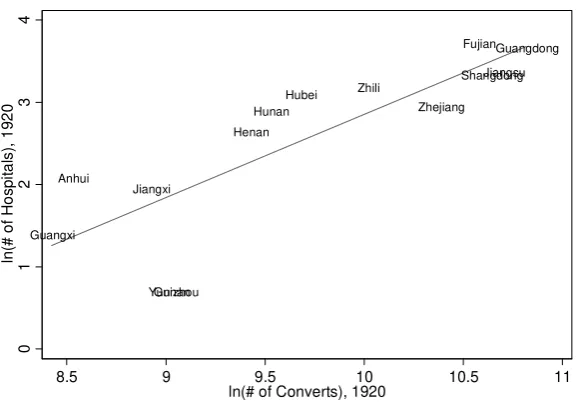
Figure 5 presents the correlation between Protestant activities and numbers of hospitals and
pharmacies at the province level.27 The positive correlations are very strong: a 1% increase in the
number of converts is associated with a 1% increase in the number of modern hospitals as well
as a 0.4% increase in the number of modern pharmacies.
[Figure 5 about here]
6.3 Public Health
Missionaries brought with them not only the Western hospital system but, more importantly,
the Western idea of public health. Whenever outbreaks of disease occurred in disaster-stricken
areas, missionaries were usually at the forefront in organizing effective remedial and preventive
measures. Over the course of their periodic disaster relief and disease control efforts, Protestant
missionaries found that a general lack of public health knowledge led to epidemic outbreaks that
exacerbated the situation and contributed to the large death tolls that typically came in the
aftermath of disasters. Disseminating knowledge of infection control thus became a priority
during disaster relief efforts. Such knowledge included preventive measures such as sterilizing
medical instruments, sanitizing food and drinking water, controlling flies and mosquitoes, and,
critically, quarantining disaster-stricken areas to control the spread of communicable diseases.
According to one study in the early twentieth century, 69 Protestant hospitals (42% of the total)
were equipped with quarantine facilities (Balme and Stauffer, 1920). Such measures, when taken
by missionaries, were very effective in controlling outbreaks of disease. A good example is
control of leprosy. Wherever the disease emerged, local governments and missionaries
collaborated to enforce quarantines. As a result, the number of leprosy cases in China declined
drastically in the early twentieth century (Stauffer, 1922, p437–438).
Missionaries also focused on improving the health of women and children. Female
missionaries, in particular, played a vital role in disseminating knowledge of obstetrics and
gynecology among Chinese women. Among the services they offered, they paid regular visits to
pregnant women and provided medical treatment in cases of necessity.28 These female
missionaries also trained obstetricians, midwives, and nurses throughout China. Their
tremendous efforts produced significant declines in mortality rates for women and infants in the
early twentieth century.
6.4 Medical Education
Missionaries were also pioneers in promoting modern medical education in China. They
28
believed that “scientific medicine in China must not continue indefinitely to be a ‘foreign
doctrine’” and “the medical profession of China must become national if it is to be universally
accepted” (Mac Alister, 1921). Holding firmly to this belief, Protestant organizations established
116 medical education institutions by 1920. Among these institutions were 10 medical colleges,
which accounted for one-third of all medical colleges in China at the time (Stauffer, 1922, p.425).
Today most of these colleges remain operational and continue to train a large number of
excellent doctors. The other 106 medical education institutions were schools of nursing (China
Educational Commission, 1922, p. 416). These Protestant medical schools, which were usually
larger and better equipped than public medical schools, offered an advanced model of medical
education that public schools could only try to follow.
Setting up schools was not the sole means by which missionaries promoted medical
education. They also published medical textbooks and translated a large number of Western
works into Chinese. John Glasgow Kerr, a Presbyterian medical missionary, published China’s
first journal of medicine in 1868.29 A few years after that, in 1888, the Medical Missionary
Association of China published its own journal with a focus on transmitting Western medical
information to the Chinese. In 1908 missionaries published the first Chinese pharmaceutical
dictionaries and in so doing standardized Chinese drug terminology (China Mission Year Book,
1912, pp. 267–268).
7. Possible Channels of Causality
What are the mechanisms behind the long-term effects of Protestantism? In this section we
empirically examine whether there are any other channels, aside from education and health care
outcomes, through which their undertakings have persistently affected today’s economic
outcomes. When we control for current education and health care outcomes in our GDP
regression and examine whether the effects of Protestant activities persist, we would like to be
able to estimate the following model:
2 2 2000 2
2000 2
1920 2
2
2000) ln( / )
ln(pcGDP
Converts Pop
Edu
Health X
(3)
29