A cognitive study of subjectivity extraction in sentiment annotation
Abhijit Mishra1 Aditya Joshi1,2,3 Pushpak Bhattacharyya1 1IIT Bombay, India
2Monash University, Australia 3IITB-Monash Research Academy, India {abhijitmishra, adityaj, pb}@cse.iitb.ac.in
Abstract
Existing sentiment analysers are weak AI systems: they try to capture the function-alityof human sentiment detection faculty, without worrying about how such faculty is realized in thehardwareof the human. These analysers are agnostic of the actual cognitive processes involved. This, how-ever, does not deliver when applications demand order of magnitude facelift in ac-curacy, as well as insight into characteris-tics of sentiment detection process. In this paper, we present a cognitive study of sentiment detection from the perspec-tive of strong AI. We study the sentiment detection process of a set of human “sen-timent readers”. Using eye-tracking, we show that on the way to sentiment de-tection, humans first extract subjectivity. They focus attention on a subset of sen-tences before arriving at the overall senti-ment. This they do either through ”antici-pation” where sentences are skipped dur-ing the first pass of readdur-ing, or through ”homing” where a subset of the sentences are read over multiple passes, or through both. ”Homing” behaviour is also ob-served at the sub-sentence level in com-plex sentiment phenomena like sarcasm.
1 Introduction
Over the years, supervised approaches using polarity-annotated datasets have shown promise for SA (Pang and Lee, 2008). However, an al-ternate line of thought has co-existed. Pang and Lee (2004) showed that for SA, instead of a doc-ument in its entirety, an extract of the subjec-tive sentences alone can be used. This process of generating a subjective extract is referred to as subjectivity extraction. Mukherjee and
Bhat-tacharyya (2012) show that for sentiment predic-tion of movie reviews, subjectivity extracpredic-tion may be used to discard the sentences describing movie plots since they do not contribute towards the speaker’s view of the movie.
While subjectivity extraction helps sentiment classification, the reason has not been sufficiently examined from the perspective of strong AI. The classical definition of strong AI suggests that a machine must be perform sentiment analysis in a manner and accuracy similar to human beings. Our paper takes a step in this direction. We study the cognitive processes underlying sentiment an-notation using eye-fixation data of the participants. Our work is novel in two ways:
• We view documents as a set of sentences through which sentiment changes. We show that the nature of these polarity oscillations leads to changes in the reading behavior.
• To the best of our knowledge, the idea of us-ing eye-trackus-ing to validate assumptions is novel in case of sentiment analysis and many NLP applications.
2 Sentiment oscillations & subjectivity extraction
We categorize subjective documents aslinearand
oscillating. A linear subjective document is the one where all or most sentences have the same po-larity. On the other hand, anoscillatingsubjective document contains sentences of contrasting polar-ity (viz. positive and negative). Our discussions on two forms of subjectivity extraction use the concepts of linear and oscillating subjective doc-uments.
Consider a situation where a human reader needs to annotate two documents with sentiment. Assume that the first document is linear subjec-tive - with ten sentences, all of them posisubjec-tive. In
case of this document, when he/she reads a cou-ple of sentences with the same polarity, he/she be-gins to assume that the next sentence will have the same sentiment and hence, skips through it. We refer to this behavior asanticipation. Now, let the second document be an oscillating subjective doc-ument with ten sentences, the first three positive, the next four negative and the last three positive. In this case, when a human annotator reads this document and sees the sentiment flip early on, the annotator begins to carefully read the document. After completing a first pass of reading, the anno-tator moves back to read certain crucial sentences. We refer to this behavior ashoming.
The following sections describe our observa-tions in detail. Based on our experiments, we ob-serve these two kinds of subjectivity extraction in our participants: subjectivity extraction as a result ofanticipationand subjectivity extraction as a re-sult of homing - for linear and oscillating docu-ments respectively.
3 Experiment Setup
This section describes the framework used for our eye-tracking experiment. A participant is given the task of annotating documents with one out of the following labels: positive, negative and ob-jective. While she reads the document, her eye-fixations are recorded.
To log eye-fixation data, we use Tobii T120 remote eye-tracker with Translog(Carl, 2012). Translog is a freeware for recording eye move-ments and keystrokes during translation. We con-figure Translog for reading with the goal of senti-ment.
3.1 Document description
We choose three movie reviews in English from IMDB (http://www.imdb.com) and indicate them as D0, D1 and D2. The lengths of D0, D1 and D2 are 10, 9 and 13 sentences respectively. Using the gold-standard rating given by the writer, we derive the polarity of D0, D1 and D2 as positive, negative and positive respectively. The three doc-uments represent three different styles of reviews: D0 is positive throughout (linear subjective), D1 contains sarcastic statements (linear subjective but may be perceived as oscillating due to linguistic difficulty) while D2 consists of manyflipsin sen-timent (oscillating subjective).
It may seem that the data set is small and
may not lead to significant findings. However, we wished to capture the most natural form of sentiment-oriented reading. A larger data set would have weakened the experiment because: (i) Sentiment patterns (linear v/s subjective) begin to become predictable to a participant if she reads many documents one after the other. (ii) There is a possibility that fatigue introduces unexpected error. To ensure that our observations were signif-icant despite the limited size of the data set, we increased the number of our participants to 12.
3.2 Participant description
Our participants are 24-30 year-old graduate stu-dents with English as the primary language of aca-demic instruction. We represent them as P0, P1 and so on. The polarity for the documents as re-ported by the participants are shown in Table 1. All participants correctly identified the polarity of document D0. Participant P9 reported that D1 is confusing. 4 out of 12 participants were unable to detect correct opinion in D2.
3.3 Experiment Description
We obtain two kinds of annotation from our an-notators: (a) sentiment (positive, negative and ob-jective), (b) movement as recorded by an eye-tracker. They are given a set of instructions before-hand and can seek clarifications. This experiment is conducted as follows:
1. A complete document is displayed on the screen. The font size and line separation are set to 17pt and 1.5 cm respectively to ensure clear visibility and minimize recording error. 2. The annotator verbally states the sentiment of this sentence, before (s)he can proceed to the next.
Document Orig P0 P1 P2 P3 P4 P5 P6 P7 P8 P9 P10 P11
D0 +ve +ve +ve +ve +ve +ve +ve +ve +ve +ve +ve +ve +ve D1 -ve -ve +ve -ve -ve -ve -ve -ve -ve -ve Neu/-ve -ve -ve D2 +ve +ve +ve -ve +ve +ve Neu +ve Neu Neu +ve +ve +ve
Table 1: Polarity of documents as perceived by the writer (original) and the participants+ve,-ve and
[image:3.595.82.479.172.454.2]Neurepresent positive, negative and neutral polarities respectively.
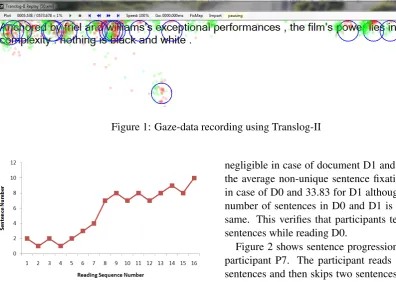
Figure 1: Gaze-data recording using Translog-II
Figure 2: Sentence progression graph for partici-pant P7 document D0
4 Observations: Subjectivity extraction through anticipation
In this section, we describe a case in which partic-ipants skip sentences. We show that anticipation of sentiment is linked with subjectivity extraction. Table 2 shows the number of unique and non-unique sentences that participants read for each document. The numbers in the last column in-dicate average values. The table can be read as: participant P1 reads 8 unique sentences of docu-ment D0 (thus skipping two sentences) and includ-ing repetitions, reads 26 sentences. Participant P0 skips as many as six sentences in case of document D1.
The number of unique sentences read is lower than sentence count for four out of twelve partic-ipants in case of document D0. This skipping is
negligible in case of document D1 and D2. Also, the average non-unique sentence fixations are 21 in case of D0 and 33.83 for D1 although the total number of sentences in D0 and D1 is almost the same. This verifies that participants tend to skip sentences while reading D0.
Figure 2 shows sentence progression graph for participant P7. The participant reads a series of sentences and then skips two sentences. This im-plies that anticipation behaviour was triggered af-ter reading sentences of the same polarity. Sim-ilar traits are observed in other participants who skipped sentences while reading document D0.
5 Observations: Subjectivity extraction through homing
This section presents a contrasting case of sub-jectivity extraction. We refer to a reading pattern ashoming1 when a participant reads a document
completely and returns to read a selected subset of sentences. We believe that during sentiment an-notation, this subset is the subjective extract that the user has created in her mind. We observe this phenomenon in reading patterns of documents D1 and D2. The former contains sarcasm because of which parts of sentences may appear to be of con-trasting polarity while the latter is an oscillating subjective document.
1The word is derived from missile guidance systems. The
definition2 of homing is “the process of determining the
Document P0 P1 P2 P3 P4 P5 P6 P7 P8 P9 P10 P11 Avg.
D0 Non-uniqueUnique 98 26 23 17 18 18 35 16 33 198 10 10 10 10 10 8 10 8 1510 2310 21
D1 Non-uniqueUnique 53 23 46 13 15 44 35 26 56 579 9 9 9 9 8 9 9 9 409 469 33.83
[image:4.595.72.269.207.416.2]D2 Non-unique 36 29 67 21 23 51 64 48 54 59Unique 13 13 13 13 13 13 13 13 13 13 7313 8013 50.42
Table 2: Number of unique and non-unique sentences read by each participant
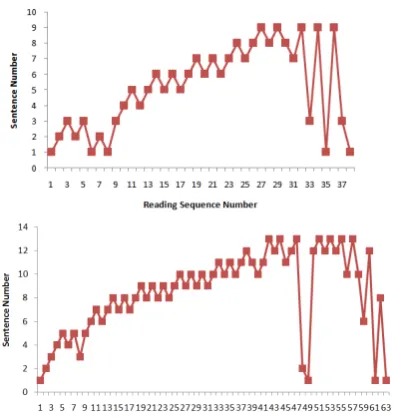
Figure 3: Sentence progression graph of partici-pant P2 for document D1 (left) and document D2 (right)
Figure 3 shows sentence progression graphs of participant P2 for documents D1 and D2. For doc-ument D1, the participant performs one pass of reading until sequence number 30. A certain sub-set of sentences are re-visited in the second pass. On analyzing sentences in the second pass of read-ing, we observe a considerable overlap in case of our participants. We also confirm that all of these sentences are subjective. This means that the sen-tences that are read after sequence number 30 form the subjective extract of document D1.
Similar behaviour is observed in case of docu-ment D2. The difference in this case is that there is less overlap of sentences read in the second pass among participants. This implies , for oscillat-ing subjective documents, the subjective extract is user/document-specific.
It may be argued that fixations corresponding
Participant TFD-SE PTFD TFC-SE
(secs) (%)
P5 7.3 8 21
P7 3.1 5 11
P9 51.94 10 26
P11 116.6 16 56
Table 3: Reading statistics for second pass reading for document D1; TFD: Total fixation duration for subjective extract; PTFD: Proportion of total fix-ation durfix-ation = (TFD)/(Total durfix-ation); TFC-SE: Total fixation count for subjective extract
to second pass reading are stray fixations and not subjective extracts. Hence, for the second pass reading of document D1, we tabulate fixation du-ration, fixation count and proportion of total dura-tion in Table 3. The fixadura-tion duradura-tion and fixadura-tion count are both recorded by the eye-tracker. The fixation counts are substantial and the participants spend around 5-15% of the total reading time in the second pass reading. We also confirm that all of these sentences are subjective. This means that these portions indeed correspond to subjective ex-tracts as a result of homing.
6 A note on linguistic challenges
Our claim is that regression after reading an en-tire document corresponds to the beginning of a subjective extract. However, we observe that some regressions may also happen due to senti-ment changes at the sub-sentence level. Some of these are as follows.
1. Sarcasm: Sarcasm involves an implicit flip
there you have it; I would call it a complete waste of time, but in some sense it is so bad it is almost worth seeing.’ This sentence has some positive words but is negative towards the movie. Hence, the participant reads this portion back and forth.
2. Thwarted expectations: Thwarted
expecta-tions are expressions with a sentiment rever-sal within a sentence/snippet. Homing is ob-served in this case as well. Document D2 has a case of thwarted expectations from sen-tences 10-12 where there is an unexpected flip of sentiment. In case of some partici-pants, we observe regression on these sen-tences multiple times.
7 Related Work
The work closest to ours is by Scott et al. (2011) who study the role of emotion words in read-ing usread-ing trackread-ing. They show that the eye-fixation duration for emotion words is consistently less than neutral words with the exception of high-frequency negative words. Eye-tracking3
technol-ogy has also been used to study the cognitive as-pects of language processing tasks liketranslation
and sense disambiguation. Dragsted (2010) ob-serve co-ordination between reading and writing during human translation. Similarly, Joshi et al. (2011) use eye-tracking to correlate fixation dura-tion with polysemy of words during word sense disambiguation.
8 Conclusion & Future work
We studied sentiment annotation in the context of subjectivity extraction using eye-tracking. Based on how sentiment changes through a document, humans may perform subjectivity extraction as a result of either: (a) anticipation or (b) homing. These observations are in tandem with the past work that shows benefit of subjectivity extraction for automatic sentiment classification.
Our study is beneficial in three perspectives: (i) Sentiment classifiers may use interaction between sentiment of sentences. Specifically, this can be modeled using features like sentiment run length (i.e. maximal span of sentences bearing same
3Related Terms:
Eye-fixation: Long stay of visual gaze on a single location Regression: Revisiting a previously read segment
Sentence Progression Graph: Graph showing reading se-quence of sentences
sentiment) or sentiment flips (i.e. instances where consecutive sentences bear opposite polarity), (ii) Crowd-sourced sentiment annotation can devise variable pricing models based on our study. Based on anticipation and homing information about documents, documents can be grouped into difficulty categories and priced accordingly.
Acknowledgment
We thank Tobii Corporation for lending us their eye-tracker for this study, and our annotators from CFILT, IIT Bombay. Aditya is funded by the TCS Research Fellowship Program.
References
Bo Pang and Lillian Lee. 2004. A Sentimental Educa-tion: Sentiment Analysis Using Subjectivity Sum-marization Based on Minimum Cuts In Proceedings of theACL, 271-278.
Bo Pang and Lillian Lee. 2008. Opinion Mining and Sentiment Analysis Foundations and Trends in In-formation Retrieval, 2008, vol. 2, nos.121135. B Dragsted. 2010. Co-ordination of reading and
writ-ing processes in translation. Contribution to Trans-lation and Cognition. Shreve, G. and Angelone, E.(eds.)Cognitive Science Society.
Michael Carl. 2012. Translog-II: A Program for Recording User Activity Data for Empirical Reading and Writing Research. In Proceedings of the Eight International Conference on Language Resources and Evaluation, European Language Resources As-sociation.
Scott G. , ODonnell P and Sereno S. 2012. Emotion Words Affect Eye Fixations During Reading. Jour-nal of Experimental Psychology:Learning, Memory, and Cognition 2012, Vol. 38, No. 3, 783792. Salil Joshi, Diptesh Kanojia and Pushpak
Bhat-tacharyya. 2013. More than meets the eye: Study of Human Cognition in Sense Annotation. NAACL HLT 2013, Atlanta, USA.