Lexical Access, a Search-Problem
Michael Zock (1), Didier Schwab (2) and Nirina Rakotonanahary (2)
(1) LIF-CNRS, TALEP, 163, Avenue de Luminy
(2) LIG-GETALP, University of Grenoble
[email protected], [email protected], [email protected]
Abstract
Our work is confined to word access, that is, we present here our ideas of how to improve electronic dictionaries in order to help language producers (speaker/writer) to find the word they are looking for. Our approach is based on psychological find-ings(representation, storage and access of information in the human mind), observed search strategiesand typicalnavigational behavior.
If one agrees with the idea that lex-ical access (word finding) is baslex-ically a search problem, then one may still want to find out where and how to search. While the space, i.e. the semantic map in which search takes place is aresource problem,— any of the following could be used: dictionary, corpus, thesauraus, etc. or a mix of them,— its exploration is typ-ically a search problem. Important as it may be, the building of a high quality re-source is not the focus of this work, we rely on an existing one, and while we are concerned with its quality, we will be mostly concerned here with search meth-ods, in order to determine the best.
1 Problem: find the needle in a haystack
One of the most vexing problems in speaking or writing is that one knows a given word, yet one fails to access it when needed. This kind of search failure, often referred to asdysnomiaorTip of the Tongue-problem, occurs not only in communica-tion, but also in other activities of everyday life.Being basically a search problem it is likely to oc-cur whenever we look for something that exists in real world (objects) or our mind: dates, phone numbers, past events, peoples’ names, or you just name it.
As one can see, we are concerned here with the problem of words, or rather, how to find them in the place where they are stored: the human brain, or an external resource, a dictionary. Our work being confined to lexical access, we would like to develp asemantic mapand acompassto help language producers to find the word they are look-ing for. More precisely, we try to build an index and a navigational tool allowing people to access words no matter how incomplete their conceptual input may be. Our approach is based on psy-chological findings concerning themental lexicon (Aitchison, 2003; Levelt et al., 1999), i.e.storage andaccessof information in the human mind, ob-servedsearch strategiesand typical navigational behavior.
2 Consider the following elements before
attempting an engineering solution
Before conceiving a roadmap leading to an en-gineering solution it may be useful to consider certain points. The list here below is by no means complete, neither is the following discus-sion. Nevertheless we believe that the following points are worth consideration: features of the mental lexicon, how to build and use the resource, searching, ranking and weights, interface prob-lems. For reasons of space constraints we will touch briefly only upon some of these points.quickly and intuitively the word they are looking. To achieve this target we take inspiration in the findings concerning the human brain (structure, process) when it tries access words in the mental lexicon.
2.1 Themental lexicon, asmall-world network?
Whileforms(lemma) andmeanings(lexical con-cepts, definitions) are stored side by side in pa-per dictionaries (holistic presentation), the hu-man brain stores them differently. The informa-tion concerning meaning, forms and sound is dis-tributed across various layers. Lexical fragmen-tation or information distribution is supported by many empirical findings,1 and while this fact is arguably the reason accounting for word access problems, it is probably also the explanation of the power and the flexibility of the human mind which generally manages to find in no time the right term after having searched for it in a huge store of words.
While it is still not entirely clear what is stored, or whether anything is stored at all2coming close to the kind of information generally found in dic-tionaries, it does seem clear though that the struc-ture of mental lexicon is a multidimensional net-work in which the user navigates. ”Entries in the lexicon are not islands; the lexicon has an inter-nal structure. Items are connected or related in various ways...There are item relationswithinand betweenentries.” (Levelt, 1989). While the for-mer relate meanings and forms: syntactic (part of speech), morphological, phonological informa-tion, the latter connect lexical entries.3 In sum,
1Speech errors(Fromkin, 1980), studies onaphasia(Dell et al., 1997; Blanken et al., 2004) orresponse times i.e. chronometric studies (Levelt et al., 1999), neuroimaging (Shafto et al., 2007; Kikyo et al., 2001), eye movements, (Roelofs, 2004), experiments onpriming (Schvaneveldt et al., 1976) or thetip of the tongue problem(TOT) (Brown and McNeill, 1996).
2An important feature of the mental lexicon lies in the fact that the entries are notaccessedbutactivated (Marslen-Wilson, 1990; Altmann, 1997). Of course, such a detail can have far reaching consequences concerning knowledge rep-resentation and use, i.e. structure and process.
3These are typically the kind of relations we can find in WordNet (Fellbaum, 1998), which happens to be quite rich in this respect, but relatively poor with regard to intrinsic, i.e. intralexical information.
lexical networks store or encode the information people typically have with regard to words, and finding the needed information, amounts to enter the graph at some point,– in the case of writing or speaking, usually a node dedicated to meaning,– and to follow the links until one has reached the goal (target word). While computer scientists call this kind of search ’navigation’, psychologists prefer the term ’activation spreading. While not being exactly the same, functionally speaking they are equivalent though.
As every day language experience shows, things may go wrong, we lack information, hence we get blocked. Yet when trying to complete the puzzle we do not start from scratch, we rely on existing information, which, in terms of the net-work metaphor means that we start from (infor-mation underlying) a word being close to the tar-get word.4
It is interesting to note, that our lexical graphs seem to have similar characteristics as small-world networks. These latter are a type of graph in which most nodes, eventhough not being direct neighbors, can be reached via a small number of clicks, about 6, regardless of the starting point. This property of networks, where objects, or the nodes standing for them, are highly connected has first been described by Frigyes Karinthy (1929) a Hungarian writer, to be tested then many years later by a social psychologist (Milgram, 1961). Nodes can be anything, people, words, etc. If they represent people, than edges specify their relation-ship, i.e. the very fact that they know each other, that they are friends, etc. Given this high connec-tivity, anything seems to be at the distance of a few mouse clicks. Hence, it is easy to connect peo-ple or to find out who entertains with whom what kind of relationship. Obviously, there is a strik-ing similarity to our lexical graphs, and the small-world feature has been tested by mathematicians, who concluded that the distance for words is even smaller than in the original Milgram experiments, namely 4 rather than 6. Indeed, (Motter et al., 2002) and colleagues could show that more than
99 percent of the word pairs of their corpus could be connected in 4 steps at the most.
2.2 Building the resource
There are two elements we need to get a clearer picture of: the nature of the resource (semantic map), and thesearch methodi.e. the way to ex-plore it. Concerning the resource, there are many possible sources (dictionary, thesaurus, corpora, or a mix of all this) and many ways of build-ing it. Since our main goal is the buildbuild-ing of an index based on the notion of word relations (triples composed of two terms and a link), the two prime candidates are of course corporaand association lists like the ones collected by psy-chologists. While the former are raw data, con-taining the information in a more or less hidden form, the latter (often) contain the data explicitely, but they are scarce, subject to change, and some of the links are questionable.5
Corpora: Concerning the resource the follow-ing points deserve consideration:size, representa-tivityandtopic sensitivity.
• Size or coverage: While size or coverage are critical variables, they should not be overem-phasized though, trading quantity against quality. We need to define the meaning of quality here, and whether, when or how lack of quality can be (partially) compensated by quantity. In other words, we need to define thresholds. In the absence of clear guidelines it is probably wise to strive for a good bal-ance between the two, which again assumes that we know what quality means.
• Representativity: Obviously, the system we have in mind is only as good as the data we use, i.e. the purity/accuracy and represen-tativity of the word/feature-association lists. 5This flaw is due to the experimental protocol. Subjects are asked to give the first word coming to their mind right after a stimulas. Not having been asked to specify the link it is the experimenter who does so. Yet, many word pairs,– say, cat and dog,– allow for various links (love, tease, chase, etc.), and it is not obvious at all which is the one intended by the user. This problem could have been avoided to a large extent if the instruction had been, ”build asentencecontaining the following word”. Another potential problem may be due to the distance between the source and the target word: the link may be mediated.
No single set of data (dictionary, corpus, the-saurus) will ever suffice to capture the knowl-edge people have. While it would be unreal-istic to try to model the semantic map of ev-eryone, it is not unreasonable to try to reach an average user, say someone who has been to school and is a computer literate. If we want to capture the world-knowledge of this kind of user (target), than we must beware that it is contained in the material we use, since our resource will be based on this data. Hence, taking as corpus only the newspapers read by an elite (say,Le Monde, in France), will surely not suffice to capture the informa-tion we need, as it will not relate informainforma-tion ordinary citizens, say sport fans, are famil-iar with or interested in. In sum, we need to take a wide variety of sources to extract then the needed information. While there is short-age of some document types needed, there are nevertheless quite a few sources one may consider to begin with: Wikipedia, domain taxonomies, topic signatures, (Lin and Hovy, 2000), a database like (http://openrdf.org), etc.
• Topic sensitivity
Weights are important, but they tend to change dynamically with time and the topic. Think of the word ’piano’ uttered in the con-texts of a ’concert’ or ’household moving’. It is only in this latter case that this term evokes ideas like size or weight. The dynamic re-compution of weights as a function of topic changes requires that the system be able to recognize the topic changes, as otherwise it might mislead the user by providing of in-adequate weights. For some initial work see (Ferret and Zock, 2006).
Association lists: Psychologists have built such lists already decades ago (Deese, 1965; Schvan-eveldt, 1989). Similar lists are nowadays freely available on the web. For example, for English there is the Edinburgh Associative Thesaurus 6 and the compilation done by Nelson and his col-leagues in Florida 7. There are also some
re-6http://www.eat.rl.ac.uk/
sources for German (see 8 or 9), for Japanese,10 and probably many other languages.
While association lists are generally built man-ually, one can also try to do so automatically or with the help of people (see section 5 in (Zock and Bilac, 2004)). JeuxdeMot (JdM), a collec-tively built resource focusing on French being an example in case.11
2.3 Searching
The goal of searching is more complex than one might think. Of course, ultimately one should find the object one is looking for,12 but the very pro-cess should also be carried out quickly and natu-rally. In addition we want to allow for recovery in case of having taken the wrong turn, and we want to avoid looping, that is, walking in circles, with-out ever getting closer to the goal. Last, but not least we want to make sure that stored informa-tion can also be accessed.
That this is less obvious than it might seem at first sight has been shown by (Zock and Schwab, 2008). Taking two resources (WN and Wikipedia) that contain both a given target word, we wanted to see whether we could access it or not. The target word was vintage. In order to find it we provided two access keys, i.e. trigger words: wineandharvest. Combining the two produced a list of 6 items in the case of WN and 45 in the case of Wikipedia, yet, while the latter displayed the target word, it was absent from the list pro-duced by WN. This example illustrates the fact that our claim concerning storage and acess is well founded. Having stored something does by no means guarantee its access.
In the next sections we will present a small ex-periment concerning search.
3 System architecture
To allow for word access, we need at least two components: an index, i.e. a resource, repre-senting or encoding the way words are connected
8http://www.schulteimwalde.de/resource.html 9http://www.coli.uni-saarland.de/projects/nag/ 10http://www.valdes.titech.ac.jp/ terry/jwad.html 11http://www.lirmm.fr/jeuxdemots/rezo.php
12This poses special requirements concerning the organi-zation, indexing and ranking of the data, i.e. words. We will not get into these issues here.
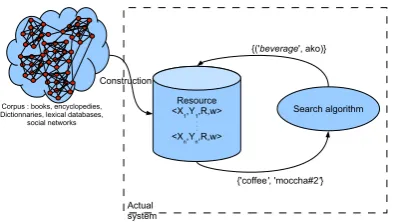
(database or semantic network encoding associa-tive relations between words) and an efficient search algorithm to find the needed information, in our case, words.
In other words, since search requires a map or a resource in which to search and a good algorithm to perform the search, we are keen in finding out how different resources (for example, Wikipedia, WordNet or JeuxdeMots) and various search al-gorithms might affect efficiency of word access. While there is a link between (the quality of) the resource and the searching, we will separate the two, focusing here mainly on the search algo-rithms and possible ways to evaluate them.
!"
#
$%&&'(
[image:4.595.307.504.305.416.2]$&))&*+(
Figure 1: Overall architecture of the system: the resource(association matrix) and a set ofsearch algorithms
4 Corpora and resources
Resources are built from corpora which can be of various kinds: news, books, social media, ency-clopedias, lexical databases,... They can be gen-eral or specific, representing a particular domain. ’Text genre’ may of course have an impact on what we can expect to retrieve. Obviously, one will not take a database of stock exchange news if one is looking for words referring to tennis- or fishing equipment.
To build our resource, we relied on Word-Net (WN).13 The resource can be seen in vari-ous ways: as a semantic network, an association
matrix, or as a list or database of 4-tuples com-posed of terms, links and weights. These ele-ments can be represented in the following way, < X,Y,RZ,w>, where X and Y are terms or
ar-guments of a given link, whose name expresses the type of relationship holding between them [RZ (synonyme, antonyme, hyperonyme,
colloca-tion,...)]. Links and terms have a certain weightw which can be crucial for navigation and informa-tion display (interface). Words may be grouped into clusters,14and the clusters as well as their el-ements may be presented in the descending order of the weight: frequent terms being shown on top of the list.
Weights can be calculated in various ways: mu-tual information, co-occurences, etc. For exam-ple, for corpora, they can be seen as the number of times two items co-occur in a given window (sentence, phrase, paragraph, n words before or after, . . . ). Unfortunately, this kind of information is not always available in current resources. For example, WN relates terms (or senses), but does not assign them any particular weight. Yet, this information is very important and might be added via some learning method.
5 Search Algorithms
5.1 DefinitionsInformally, a search algorithm is a method allow-ing to retrieve a list of terms (candidate target words presented in a given order) from a list of pairs containing the cue- or trigger words and their relations. For example figure 1 shows that the pair (beverage, ako) allows the retrieval of {coffee andmoccha#2}, two potential target words. More formally, let’s define
f({(t1, R1),(t2, R2), . . . ,(tm, Rm)})
={(T1, w1),(T2, w2), . . . ,(Tm, wm)}
(1)
wheret1,t2,. . . ,tmare keys, cue- ortrigger-words,
R1,R2,. . . ,Rm the type of relation, T1,T2,. . . ,Tm
candidatetarget-wordsandw1,w2,. . . ,wm, the
as-sociatedweights. The curley brackets{}represent the fact that we have an ordered set.
14All words having the same link will be stored and pre-sented together. For example, ’cat’ and ’dog’ are likely to fall in the category ’animal’, while ’hammer’ and ’screwdriver’ will fall in the category ’tools’.
Indeed, the ’trigger word-relation’ pairs are or-dered, that is, they parallel the order in which these terms were given as input at query time. The candidate target words are ordered in terms of confidence, ranking which may vary with respect to a given search algorithm. In this paper, confi-dence is based on the weights in the resource. Of course, one could imagine other ways to define or compute it.
Note that we can haveR1 =R2, provided that
we do not have at the same time t1 = t2. For
instance, while it is possible to have{(island, in-stance), (island, ako)}, one cannot have at the same time{(island, instance), (island, instance)} We present in the next sections various ways to use the resource and various search algorithms. In these experiments, we tried to use directand indirect links(mediated associations) contained in the tuples and to establish linearly the weight as a function of the position of the word in the list of the trigger words.
5.2 General algorithm
In the general algorithm, we consider that our can-didatetarget words are at the intersection of the sets corresponding to the pairs of trigger words and theirrelations.
f({(t1, Ra),(t2, Rb)}) =
f({(t1, Ra)} ∩f({t2, Rb}))
(2)
We will now show, step by step, howf({(t, R)}) is affected by various uses (direct vs. indirect use) and orderings. This will yield 4 kinds of search algorithms.
5.3 The use of the tuples
To illustrate our algorithms, let us consider the fol-lowing resource:
< mouse,rodent,ako,3>;< rodent,animal,ako,4>; < rat,rodent,ako,1>;< rat,animal,ako,2>;
5.3.1 Direct use
In this case, we rely only on the direct links < t,T,R,w>of the resourceRes:
that is, in the case of direct use, the search algo-rithm fed with the trigger wordtand the relation-shipRfound all target wordsT contained in the tuple< t,T,R,w>of the resourceRes. The com-putation of the weight W is defined in 5.4. For example,mouse, would yieldrodent, whilerat, would triggeranimalandrodent.
5.3.2 Indirect use
In order to boost recall this algorithm takes also indirect links into account.
f({(t, R)}) ={(T, W)|< t,T,R,w>∈Res} ∪ {(T, W)|< t,X,R,w1>∈Res
and< X,T,R,w2>∈Res}
(4) Hence, we consider neighbor words of the neigh-bors of the trigger words.15Again, formouse, we getrodentandanimal, while forrat, we continue to getanimalandrodent.
5.4 Weighting
5.4.1 Basic Weighting
Forf({(t1, R1)},{(t2, R2)}, . . . ,{(tn, Rn)}),
W = Σti,T,Ri,wjwj
(5) In our example and for direct use, if our trigger word list is {mouse, rat} then the weight (W) will be 4 (3 + 1) for rodent and 6 (4 + 2) for animal. In the case ofindirect use, the weight will be 4 (3 + 1) forrodentand 10 (3 + 4 + 1 + 2) for animal.
5.4.2 Weighting based on the cue-word’s positionand itsrelationto other words Let us suppose that the user gave in this or-der the following cue words A,B, C. In this case we assume thatAis more important thanB, which is more important thanC in order to find the target word. Following this line of reasoning, we may consider the following cases:
Forf({(t1, R1)},{(t2, R2)}, . . . ,{(tn, Rn)}),
W = Σti,T,Ri,wj(n−i+ 1)×wj
(6) 15Please note, we consider here only one intermediate word (two links), as this is, computationally speaking, al-ready quite expensive.
In our example of direct use, if our trigger word list is{mouse,rat}, W will be 7 (2×3 + 1×1) forrodentwhile W = 10 (2×4+1×2) foranimal. For indirect use, W is 4 (2 + 1×1) forrodentand 17 (2×(3 + 4) + 1×(1 + 2)) foranimal. 5.5 Proposed Search Algorithms
Crossing the characteristics of weight (direct vs. indirect) and use (direct vs. indirect), we get 4 possible search methods : direct use with basic weighting (A1) orlinearweighting (A2); and in-direct use with basic weighting (A3) or linear weighting (A4).
6 Evaluation
6.1 The problem of evaluation.
The classical in vivo / vitro approaches do not seem to fit here. While the former tests the system for a given application, the latter tests the system independently. Given the fact that our system has several components, we can evaluate each one of them separately. More precisely, we can evaluate the quality of the resource and/or the quality of the search algorithm. We will focus here on the search method.
6.2 Procedure
The basic idea is to provide each algorithm with an ordered set of trigger words and to see how many of them are generally needed in order to re-veal thetarget word.
Another way to evaluate the quality of the search mechanism is to check at each step the po-sition of the target word in the list generated by the algorithms (output).
6.3 Building the test corpus
Psychologists have studied the differences of monolingual and bilingual speakers experienc-ing the ’tip-of-the-tongue’ problem (Pyers et al., 2009). Their experiments were based on 52 pictures corresponding to low-frequency names. Starting from this list we were looking for asso-ciated words. In order to build this list we used as resource the results produced by ’Jeux de Mots’ (Lafourcade, 2007).16
The-6.3.1 JeuxdeMots (JdM)
JeuxdeMots, meaning in English ’word games’ or ’playing with words’, is an attempt to build collaboratively, i.e. via a game, a lexical re-source. The goal is to find out which words peo-ple typically associate with each other and to build then the corresponding resource, that is, a lexical-semantic network. What counts as atypical as-sociationis established empirically. Given some input from the system –(term and link, let us say ’Americans’ and ’elect as president’)– the user produces the associated word –(second term, let us say ’Obama’),– answering this way the ques-tion, what term x is related to y in this specific way. Once the network is built, terms should be accessible by entering the network at any point (via some input) and by following the links un-til one reaches the target word. This is at least the theory. Unfortunately, in practice things do not always work so well.
Actually, JdM has several flaws, especially with respect to acces or search. The shortcomings are probably rooted in too heavy reliance on the no-tion of weight and in excessive filtering of the output, i.e. premature elimination of the can-didates presented to the user, list of elements among which the user is meant to choose. In-deed, JdM presents only the highest ranked candi-date. Hence, words may never make it to the crit-ical level to be included in the set from which the user will choose the target word. Also, weights do not necessarily correlate with users’ interests. This problem can be solved in interactive search, provided that the output contains a critical mass of candidates (possibly organized according to some point of view), but the problem is most likely re-main if one presents only one candidate (the high-est ranked term), as this latter is not necessarily the target, neither is it always a term from which one would like to continue search.
There is also a problem with the link names,
saurus (http://www.eat.rl.ac.uk/) as it contains authentic word associations collected from people. This point is well taken and we will consider this resource in the future as its coverage is better than our current one and it also avoids possible problems due to the translation. Though be-ing generic, JeuxdeMots has mainly data on French, yet our tests were run on English.
i.e. (metalanguage),17though, to be fair, one must admit that identifying and naming links is a very difficult problem. Last, but not least, though more related to the quality of the resource than to the problem of search, there is a chance of user-bias. Indeed, it is not entirely clear whether people re-ally give the first association coming to their mind, or the one fitting them best to continue the game and win more points.
Despite these shortcomings, we will use JdM as a resource as it exists not only for various lan-guages, but is also quite rich, at least for French. Unfortunately, the English version is very poor compared to the French part.18This is why we’ve decided to use the French version for the test cor-pus.
6.3.2 Building the test corpus
Starting from Pyer’s list, we translated each term into French and inspected then JDM in order to find the 10 most frequently connected words ac-cording to this resource. Next, we translated these terms into English, producing the list shown in the appendix.
As we will see later, in our experiment we do not havetyped relationsbetween the words. Actu-ally we took from JDM what they call ”associated ideas”.
Nevertheless, when building the list we did have some problems. Some words do not have any, only one, or simply very few associated ideas. This is particularly true for low frequency words. This being so, we deleted them (in our case 7) from the list.
6.4 Description of the tool
Our tool is implemented in Java. To allow for on-line access 19 we use Google’s Web Toolkits20. The interface is very simple, akin to Google’s search engine. At the top of the page the user is invited to provide the input, i.e. thetrigger words,
17The termtypical associationis underspecified to say the least.
18For example, while for English JdM has by today (july 9, 2010) only 654 relations, the French part contained 1.011.632 the very same day, and 994.889 a month ago.
19http://getalp.imag.fr/homepages/
schwab
a checkbox allows to chooserelationsand at the bottom are shown the candidatetarget words.
6.5 Description of the resource for the experiment
In this experiment, we use the English version of Wikipedia to build our resource. Due to corpus characteristics, only one relation is used:neighbor (ngh). We consider ”words occuring in the same paragraph” as neighbours. After having deleted ’stop words’ (articles, conjunction, . . . ) we lem-matize ’plain words’ by using DELA?21
For example, a corpus containing the follow-ing two sentences ”The cat eats the mouse\The mouse eats some cheese” would yield the follow-ing resource :
< cat,mouse,ngh,1>; < cat,eat,ngh,1>; < eat,cat,ngh,1>; < eat,mouse,ngh,2>; < mouse,cat,ngh,1>; < mouse,eat,ngh,2>; < mouse,cheese,ngh,1>;< eat,cheese,ngh,1>; < cheese,mouse,ngh,1>;< cheese,eat,ngh,1> It should be noted that in this experiment, links are symmetrical.
<X,Y,ngh,w>→<Y,X,ngh,w> (7)
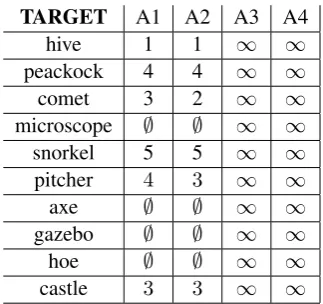
6.6 Comparison and evaluation of results Due to time contraints, we decided to use only a small sample of words, 10 to be precise. Con-cerning search we have tested two parameters: the scope(direct vs. indirect links, i.e. associations, A1 vs. A3) and theweight(presence or absence, A2 vs. A4).
The results are shown in table 1, where∅means that the algorithm did not find any solution, while ∞implies that the trigger word list has been fully exhausted without being able to produce the target word among the top ten candidates. Indeed, in order to be considered as a hit, the found target word has to be among the top ten.
As one can see our algorithms with indirect use (A3 and A4) never manages to find the tar-get word. Actually, it does not fail totally. It is just that the candidate term appears very late in the list, too late to be considered. The algorithms with direct use (A1 and A2) do find the elusive word or produce a ’list’ of zero candidates.
21http://infolingu.univ-mlv.fr/DonneesLinguistiques/ Dic-tionnaires/telechargement.html
TARGET A1 A2 A3 A4
hive 1 1 ∞ ∞
peackock 4 4 ∞ ∞
comet 3 2 ∞ ∞
microscope ∅ ∅ ∞ ∞
snorkel 5 5 ∞ ∞
pitcher 4 3 ∞ ∞
axe ∅ ∅ ∞ ∞
gazebo ∅ ∅ ∞ ∞
hoe ∅ ∅ ∞ ∞
[image:8.595.323.485.69.221.2]castle 3 3 ∞ ∞
Table 1: Comparison of the number of steps needed by each search algorithm to find the target word ie. to put it in the list of the top ten.∅signals the fact that the algorithm does not find any solu-tion, while∞implies that eventhough thetrigger word listhas been totally used, it did not manage to come up with the target word among the top ten candidates.
target 1 2 3 4 5 6
A1 115 112 325 ∅ ∅ ∅
A2 118 98 273 ∅ ∅ ∅
[image:8.595.306.505.342.414.2]A3 256 288 254 189 114 59 A4 234 267 262 156 115 54
Table 2: Comparison of the position of the target word at each step of the algorithm formicroscope
Table 2 illustrates this last point by showing the position of thetarget wordwith respect to one of the sixtrigger words.
While the target word always appears in A3-A4, A1 and A2 never produce any results beyond the 4thtrigger word. The two experiments also show that linear weighting has hardly any effect on the results.
7 Conclusions and Future Work
Next to search algorithms, we presented some methods for evaluating them. While our results are clearly preliminary and on a very small scale, we believe that the questions we have raised are of the right sort. Of course, a lot more work is needed in order to answer our questions with more authority.
8 Appendix
hive (tw): bee; honey; queen; cell; royal jelly;
pollen; wax; group; frame; nest; (aws)
peacock: bird; feather; animal; spread; shout; blue; tail; disdainful; arrogant; despise;
comet: star; space; shooting star; astronomy; sky; galaxy; night; universe; apparition;
microscope: small; observe; enlarging; mi-croscopic; observation; ocular; optical; twin; eyeglass;glasses; sea; diving; breath; ocean; mask; flipper;
pitcher: jug; jar; carafe; dishes; vase; ewer; container;
axe: cut; kill; split; fell; murder; saw; agriculture; arboriculture;
gazebo: pavilion; platform; viewpoint; ter-race;view; architecture; house; pavillon; es-planade
hoe (tool): farming; tool; shovel; pick; tech-nique;spade;
castle: tower; king; dungeon; fort; queen; draw-bridge; prince; princess; embrasure;
eclipse: moon; sun; astronomie; disappearance; darkness;
bolted joint: door; lock; padlock; key; close; button; metal; box; house; portal; bolt;
megaphone: sound; loudspeaker; manta ray: fish; sea; wing;
wheelbarrow: wheel; carry; garden; shovel; gardener; fill; push;
dynamite: bomb; explosion; explosive; weapon;wick; chemistry; plastic;
compass: direction; navigation; navy; windrose; chisels: cut; scissor; prune; pair; hairdresser; paper; school; chisel;
ostrich: egg; bird; Australia; cassowary; emu; grater: woodwork; tool; poverty; polished; dishes;
braille: blind; alphabet; writing; water well: dig; drill; pierce;
guillotine: scaffold; widow; death penalty; head; reaper; decapitation; execution; torture;
weathervane: rooster; direction; wind; rooftop; rotation; east; south; north; west;
churning (butter): container; oil; milk; bottle; container; cuve; jerrycan; tank;
carousel: fun fair; amusement park; children; entertainment;
canteen(place): meal; school; eat; dessert; dish; tableland; entrance; restaurant; food; refectory; supervisor; glass; wood; tail; tooth; trapper; trunk;
goggles: sight; glasses; myopia; eyes; rim; twin-lens; optician; sun; vision; see; rectifica-tion; improvement; astigmatic; ophthalmologist; farsighted; longsighted; blind; binoculars; nose; optical; pair; telescope; protection;
boomerang: Australia; object; flying; throw; come back;
easel: painting; drawing; support; tripod;
propeller: boat; ship; plane; propulsion; curve; rotation; rolling;
walnut: fruit; hazelnut; almond; tree; cashew; nutcracker; oil; salad; woodwork;
catapult: ejection; old weapon; throw; stone; aircraft carrier; crossbow; ballista; sling;
udder: milk; cow; chest; nipple tit;
gyroscope: direction; rotation; instruments; gyrostat;
mummy: pharaoh; Egypt; pyramid; strip; dead; embalm; sarcophagus; fruits; funeral;
hinge: junction; woodwork; middle; locksmiths; assemblage;
harmonica: music; instrument; breath; flute; musical instruments;
metronome: musical, tempo, musical instru-ments;
noose: hang; boat; attach; bind; cord;
harp: musical instruments; zither; lute; lyre; psaltery;
slingshot: weapon; attack; projectile weapon; catapult;
eiffel tower: Paris; steel; monument; metal; syringe: drug; injection; sting; nurse; sick; ill; bodycare; drug addiction;
antlers, plunger, cleftchin, handcuffs.
References
Aitchison, J. 2003. Words in the Mind: an Introduc-tion to the Mental Lexicon (3d ediIntroduc-tion). Blackwell, Oxford.
Altmann, G. T. M., 1997. The ascent of Babel: An exploration of language, mind, and understanding, chapter Accessing the Mental Lexicon: Words, and how we (eventually) find them. Oxford University Press.
Blanken, G., F. Kulke, T. Bormann, B. Biedermann, J. Dittmann, and C.W. Wallesch. 2004. The dis-solution of word production in aphasia: Implica-tions for normal funcImplica-tions. In Pechmann, T. and C. Habel, editors,Multidisciplinary Approaches to Language Production, pages 303–338. Mouton de Gruyter, Berlin.
Brown, R. and D. McNeill. 1996. The tip of the tounge phenomenon. Journal of Verbal Learning and Verbal Behaviour, 5:325–337.
Deese, J. 1965. The structure of associations in lan-guage and thought. Johns Hopkins Press.
Dell, G.S., M.F. Schwartz, N. Martin, E.M. Saffran, and D.A Gagnon. 1997. Lexical access in apha-sic and nonaphaapha-sic speakers.Psychological Review, 104(4):801–838.
Fellbaum, C., editor. 1998. WordNet: An Elec-tronic Lexical Database and some of its Applica-tions. MIT Press.
Ferret, O. and M. Zock. 2006. Enhancing electronic dictionaries with an index based on associations. InACL ’06: Proceedings of the 21st International Conference on Computational Linguistics and the 44th annual meeting of the ACL, pages 281–288. Fromkin, V. 1980. Errors in linguistic performance:
Slips of the tongue, ear, pen and hand.
Kikyo, H., K. Ohki, and K. Sekihara. 2001. Temporal characterization of memory retrieval processes: an fMRI study of the tip of the tongue phenomenon. European Journal of Neuroscience, 14(5):887–92. Lafourcade, M. 2007. Making people play for
Lexi-cal Acquisition with the JeuxDeMots prototype. In 7th International Symposium on Natural Language Processing, page 7, Pattaya, Chonburi, Thailand. Levelt, W., A. Roelofs, and A. Meyer. 1999. A theory
of lexical access in speech production. Behavioral and Brain Sciences, 22(1):1–75.
Levelt, W. 1989.Speaking : From Intention to Articu-lation. MIT Press, Cambridge, MA.
Lin, C-Y and E. H. Hovy. 2000. The automated acqui-sition of topic signatures for text summarization. In COLING, pages 495–501. M. Kaufmann.
Marslen-Wilson, W.D. 1990. Activation, competi-tion, and frequency in lexical access. In Altmann, G.T.M., editor, Cognitive Models of Speech Pro-cessing: Psycholinguistics and Computational Per-spectives, pages 148–172. MIT Press, Cambridge, MA.
Milgram, S. 1961. The small world problem. Psy-chology Today, 1(1):61–67.
Motter, A. E., A. P. S. de Moura, Y.-C. Lai, and P. Das-gupta. 2002. Topology of the conceptual network of language.Physical Review E, 65(6).
Pyers, J. E., T. H. Gollan, and K. Emmorey. 2009. Bimodal bilinguals reveal the source of tip-of-the-tongue states.Cognition, 112(2):323 – 329. Roelofs, A. 2004. The seduced speaker: Modeling of
cognitive control. In Belz, A., R. Evans, and P. Pi-wek, editors,INLG, volume 3123 ofLecture Notes in Computer Science, pages 1–10. Springer.
Schvaneveldt, R., D. Meyer, and C. Becker. 1976. Lexical ambiguity, semantic context and visual word recognition. Journal of Experimental Psy-chology/ Human Perception and Performance, 2(2):243–256.
Schvaneveldt, R., editor. 1989. Pathfinder Associa-tive Networks: studies in knowledge organization. Ablex, Norwood, New Jersey, US.
Shafto, M. A., D. M. Burke, E. A. Stamatakis, P. P. Tam, and L. K. Tyler. 2007. On the tip-of-the-tongue: Neural correlates of increased word-finding failures in normal aging.J. Cognitive Neuroscience, 19(12):2060–2070.
Zock, M. and S. Bilac. 2004. Word lookup on the ba-sis of associations : from an idea to a roadmap. In Workshop on ’Enhancing and using electronic dic-tionaries’, pages 29–35, Geneva. COLING.