Accepted Manuscript
Taking the heat or taking the temperature? A qualitative study of a large-scale exercise in seeking to measure for improvement, not blame
Natalie Armstrong, Liz Brewster, Carolyn Tarrant, Ruth Dixon, Janet Willars, Maxine Power, Mary Dixon-Woods
PII: S0277-9536(17)30777-3
DOI: 10.1016/j.socscimed.2017.12.033 Reference: SSM 11564
To appear in: Social Science & Medicine
Received Date: 23 April 2017 Revised Date: 13 December 2017 Accepted Date: 28 December 2017
Please cite this article as: Armstrong, N., Brewster, L., Tarrant, C., Dixon, R., Willars, J., Power, M., Dixon-Woods, M., Taking the heat or taking the temperature? A qualitative study of a large-scale exercise in seeking to measure for improvement, not blame, Social Science & Medicine (2018), doi: 10.1016/j.socscimed.2017.12.033.
M
AN
US
CR
IP
T
AC
CE
PT
ED
ACCEPTED MANUSCRIPT
Taking the heat or taking the temperature? A qualitative study of
a large-scale exercise in seeking to measure for improvement, not
blame
Authors: Natalie Armstrong,1 Liz Brewster,2 Carolyn Tarrant,1 Ruth Dixon,3,4 Janet Willars,1 Maxine Power,5 Mary Dixon-Woods 6
Affiliations: 1 Department of Health Sciences, University of Leicester, Leicester, UK 2 Lancaster Medical School, Lancaster University, Lancaster, UK 3 Blavatnik School of Government, University of Oxford, Oxford, UK 4 Department of Politics and International Relations, University of Oxford, Oxford, UK 5 Haelo, Salford, UK 6 Cambridge Centre for Health Services Research, University of Cambridge, Cambridge, UK
Author contributions:
NA, MDW, CT and MP designed the study NA managed the study day-to-day
NA, LB, CT and JW conducted observations and interviews
LB, NA, CT, JW, RD and MDW participated in coding, analysis, and interpretation NA, MDW, CT and RD led drafting of the manuscript and LB, JW and MP revised it critically for important intellectual content
All authors approved the final manuscript
Acknowledgements: We thank Merrilee Briggs, Liz Shaw and Sophie Wilson for their help with data collection and/or coding, Lisa Hallam and Veronica Heney for administrative support, and Graham Martin for helpful comments on an earlier draft. We are grateful to those who participated in this research.
M
AN
US
CR
IP
T
AC
CE
PT
ED
ACCEPTED MANUSCRIPT
1
Taking the heat or taking the temperature? A qualitative study of a
large-scale exercise in seeking to measure for improvement, not
M
AN
US
CR
IP
T
AC
CE
PT
ED
ACCEPTED MANUSCRIPT
2
Abstract
Measurement of quality and safety has an important role in improving healthcare, but is susceptible
to unintended consequences. One frequently made argument is that optimising the benefits from
measurement requires controlling the risks of blame, but whether it is possible to do this remains
unclear. We examined responses to a programme known as the NHS Safety Thermometer (NHS-ST).
Measuring four common patient harms in diverse care settings with the goal of supporting local
improvement, the programme explicitly eschews a role for blame.
The study design was ethnographic. We conducted 115 hours of observation across 19 care
organisations and conducted 126 interviews with frontline staff, senior national leaders, experts in
the four harms, and the NHS-ST programme leadership and development team. We also collected
and analysed relevant documents.
The programme theory of the NHS-ST was based in a logic of measurement for improvement: the
designers of the programme sought to avoid the appropriation of the data for any purpose other
than supporting improvement. However, organisational participants - both at frontline and senior
levels – were concerned that the NHS-ST functioned latently as a blame allocation device. These
perceptions were influenced, first, by field-level logics of accountability and managerialism and,
second, by specific features of the programme, including public reporting, financial incentives and
ambiguities about definitions that amplified the concerns. In consequence, organisational
participants, while they identified some merits of the programme, tended to identify and categorise
it as another example of performance management, rich in potential for blame.
These findings indicate that the search to optimise the benefits of measurement by controlling the
M
AN
US
CR
IP
T
AC
CE
PT
ED
ACCEPTED MANUSCRIPT
3
while necessary, may not be sufficient for achieving goals for improvement in healthcare systems
dominated by institutional logics that run counter to the programme theory.
Keywords: United Kingdom, patient safety, measurement, quality, improvement, qualitative
M
AN
US
CR
IP
T
AC
CE
PT
ED
ACCEPTED MANUSCRIPT
4
Introduction
Quality measurement that focuses on important processes and outcomes, including clinical care and
patient experience, is often seen as an essential feature of well-functioning healthcare systems
(Conway et al., 2013). Prominent uses of measurement include identifying variations in care
between different organisations or practitioners, surfacing the factors associated with high
performance, and supporting replication and scaling of apparently successful approaches (Bradley et
al., 2012). Measurement is a defining characteristic of many quality improvement efforts, where
techniques such a statistical process control and audit and feedback are routinely deployed to help
practitioners monitor their local system performance and the responses of that system to
improvement interventions (Portela et al., 2015, Ivers et al., 2012). Increasingly, measurement is
also deployed in the context of performance management regimes and as an element of
pay-for-performance schemes to address the demand for accountability and transparency that has become
one of the central tropes of current thinking on governance and regulation in modern healthcare
(Mukamel et al., 2014, Brewster et al., 2016). These differing goals of measurement embody a
number of tensions, including those relating to the balance between stimulating improvement and
provoking unintended consequences – such as gaming (manipulation of data to look good), effort
substitution (focus on the things being measured to the exclusion of other important activities)
(Kelman and Friedman, 2009), shrinkage of professional responsibility (narrow focus on the things
being measured) and excessive bureaucratic burden associated with data collection and reporting
(Chassin et al., 2010, Meyer et al., 2012). The question of whether it is possible to capture the
M
AN
US
CR
IP
T
AC
CE
PT
ED
ACCEPTED MANUSCRIPT
5
One frequently made argument is that optimising the yield from measurement (and, conversely,
averting its unwanted effects) requires controlling the risks of blame. Solberg et al’s much-cited
article (Solberg et al., 1997) distinguishes measurement for improvement from measurement for
accountability, proposing that the appropriation of locally collected data for external accountability
purposes may thwart the goal of improvement. These authors argue that only when fear and blame
are “out of the equation”, can everyone “concentrate on improvement rather than defensiveness”
(p.138). Yet cultures of blame are pervasive in healthcare (Dekker and Hugh, 2014), resulting, Don
Berwick argues, in measurement fostering fear and defensiveness rather than improved quality and
safety:
Any good foreman knows how clever a frightened work force can be. In fact, practically
no system of measurement - at least none that measures people's performance - is
robust enough to survive the fear of those who are measured [...] The inspector says, "I
will find you out if you are deficient." The subject replies, "I will therefore prove I am not
deficient" - and seeks not understanding, but escape. (Berwick, 1989:53)
It remains unclear, however, whether it is possible to design and operate measurement systems for
improving healthcare quality that evade the apparently negative effects of blame: field studies of
measurement of quality and safety have remained rare (Dixon-Woods et al., 2012).
We suggest one useful way of gaining clarity and analytic purchase is to understand “data for
accountability” and “data for improvement” as two different logics. We propose, as a more general
principle, that quality improvement (QI) efforts founded in a particular logic may be overwhelmed by
institutional logics operating at the field level. We provide empirical support for this analysis using
M
AN
US
CR
IP
T
AC
CE
PT
ED
ACCEPTED MANUSCRIPT
6
Safety Thermometer, the programme is of particular interest for our purposes because it explicitly
embraced a principle of “data for improvement” that eschewed a role for blame.
Blame
It is useful to begin by acknowledging that, though blame is widely discussed in the healthcare
literature and at policy level, for example in relation to patient safety (Wachter and Pronovost,
2009), its definition tends to be somewhat vernacular. Political science, by contrast, has developed
an extensive literature on blame that offers some helpful pointers to a more formal approach.
Christopher Hood, for example, defines blame as the act of attributing something bad or wrong to
some person or entity (Hood, 2011:6); it involves some (actual or perceived) harm or loss, as well as,
crucially, an attribution of agency. Though he emphasises that blame is not always bad, Hood
explains that, faced with external demands for accountability, blame avoidance may become a
dominant preoccupation for organisations and institutions.
Many political science analyses offer a fairly muscular view of blame avoidance and blame
engineering, describing a range of techniques and strategies that are purposefully chosen and
implemented with specific (albeit often undeclared) intentions of deflecting or evading blame. We
propose that, though much of the scrutiny has focused on the deliberate or purposeful creation of
blame engineering schemes, it is possible for a system to function latently as a blame distribution
and attribution system even when not designed with that goal in mind – or indeed, even, as we shall
show using the example of the NHS Safety Thermometer, when it seeks explicitly to disavow a role in
M
AN
US
CR
IP
T
AC
CE
PT
ED
ACCEPTED MANUSCRIPT
7
The NHS Safety Thermometer
The declared aim of England’s NHS Safety Thermometer (NHS-ST) programme is to “provide a quick
and simple method for surveying patient harms and analysing results so that you can measure and
monitor local improvement and harm-free care over time” (NHS Digital, 2017). The four harms
measured by the NHS-ST tool – pressure ulcers, harm from falls, urinary infection in patients with
catheters, and venous thromboembolism (VTE) – account for a large proportion of avoidable injury
in healthcare settings, and incur high human and economic costs (Power et al., 2016). Patients who
incur none of these harms are deemed “harm-free”.
The programme requires that staff caring for NHS patients England-wide in hospitals or community
nursing settings (e.g. patients’ homes) record the presence and severity of the four harms on a
pre-specified day each month. The NHS-ST thus creates a monthly census amounting to approximately
200,000 patients. Data collection is the responsibility of frontline teams, who are asked to record
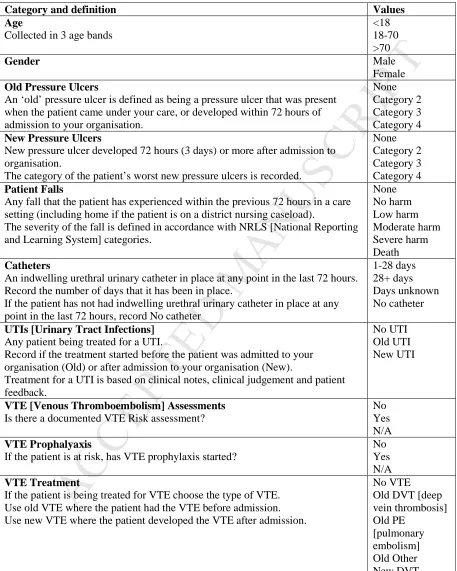
information according to the definitions in Table 1. The resulting data, which are entered into
spreadsheets and aggregated at organisational, regional, and national levels, are publicly available
online along with national benchmarking data. Following a 2011 pilot, the NHS-ST was introduced
across England (Power et al., 2016). Since 2012/13 use of the NHS-ST has attracted financial
incentives. A Commissioning for Quality and Innovation (CQUIN) payment was introduced in
2012/13 in which a financial reward was linked to data collection, with the aim of establishing a
baseline. Other incentives were introduced over time; since 2015 the NHS Standard Contract has
required the collection of data on a monthly basis using the NHS-ST or another local collection
method.
M
AN
US
CR
IP
T
AC
CE
PT
ED
ACCEPTED MANUSCRIPT
8
Programme theories and institutional logics
The NHS-ST and its associated policy framework can be understood as a quality improvement (QI)
programme (Portela et al., 2015). Recent years have seen growing recognition of the importance of
explicating the theories or models that underlie such programmes (Davidoff et al., 2015), including
elaboration of the causal assumptions – what is sometimes known as a programme’s “logic”. Even
when QI programmes appear to have a sound underpinning theory and logic, success is often
evasive (Dixon-Woods and Martin, 2016). Many reasons for such failures can be identified, but one
that has remained little examined, despite its rich explanatory potential, lies in the relationship
between programme theories and institutional logics.
First proposed as a feature of institutional theory more than 25 years ago (Friedland and Alford,
1991), the literature on institutional logics has expanded greatly over the last quarter century, and
now accommodates several different definitions. Broadly, however, it proposes that large-scale
supraorganisational social structures tend to be characterised by distinctive sets of assumptions,
values, beliefs, practices and symbolic constructions (Friedland and Alford, 1991), offering
repertoires to social actors that constrain - though do not fully determine - their choices, behaviours,
and understandings. Friedland and Alford’s original work focused on the central institutions of the
contemporary West, such as professions, markets, and bureaucracies, but later theorists identified a
hierarchical character to logics, such that “organizational fields and industries are viewed as having
their own logics nested within societal level institutional orders” (Goodrick and Reay, 2011:375).
Though institutional logics contribute to the relatively stable nature of institutions over time, to the
extent that they provide the organising principles for patterned behaviours, practices and symbols,
M
AN
US
CR
IP
T
AC
CE
PT
ED
ACCEPTED MANUSCRIPT
9
responses to the multiple other logics that may co-exist and potentially conflict or become more or
less dominant over time (Greenwood et al., 2010); other change is linked to the agentic behaviour of
individuals and organisations. However, empirically informed understanding of under what
conditions a particular logic may appear most compelling and/or most directive of practice has
remained limited (Martin et al., 2016). Even more poorly understood is the fate of a programme
theory when introduced in an institutional field where a particular logic is especially influential.
In this article, we report a study of responses to the NHS-ST programme from multiple levels of the
healthcare system. We explore the dissonances between the theory of change underlying the
programme and an institutional logic of performance measurement, and in so doing show how the
institutional logic displaced the programme’s theory’s effort to eradicate blame and promote the
benefits of measurement.
Methods
Study setting
Our study involved 19 NHS organisations in England (anonymised as sites A-S) that were
participating in NHS-ST data collection and reporting. We used purposive sampling to ensure
diversity of type and size as well as different levels of reported harm. Organisations were grouped
into categories according to their type; we randomly selected within these. The sample included ten
acute hospitals, two specialist hospitals, five community healthcare organisations and two
integrated healthcare organisations (providers of both acute and community services). Sample size
was kept under review as the study progressed; 19 organisations was enough to ensure sufficient
M
AN
US
CR
IP
T
AC
CE
PT
ED
ACCEPTED MANUSCRIPT
10
Data collection
The study design was ethnographic, involving observations, interviews and documentary analysis.
(Dixon-Woods and Bosk, 2010). Our model for data collection was the same in all organisations:
observation of NHS-ST data collection and reporting by frontline staff on one monthly data collection
day; interviews with frontline and senior staff; and collection of relevant local documentation. There
were two instances in which this model could not be followed in full: at one site only NHS-ST data
input and not collection was observed due to practical constraints; and at another site we did
interviews only and no observation at the site’s request. In total we completed ~115 hours of
observations, averaging 6.4 hours per site. Researchers were blinded to the reported rates in
organisations they visited. Observers, all of whom were non-clinical researchers, took written
fieldnotes and produced accounts of their visits that were transcribed in full. Two team debriefing
sessions including reflection of the impact of the researchers on the data were also conducted.
As well as the ethnographic observations, we undertook interviews in the same sites with 38 senior
staff with strategic responsibility for NHS-ST activity (mostly with director-level responsibility for
nursing, patient safety, or QI) and 52 frontline staff (mostly ward nurses and community nurses).
These interviews sought to interrogate further the approaches to data collection we had observed,
and gather staff’s perceptions of and attitudes towards the NHS-ST. We further interviewed four
regional and national NHS leaders and 27 content experts in the four harms (content experts),
comprising six with specialist expertise in VTE, five in pressure ulcers, eight in UTIs, seven in falls and
one with an overview of all four harms. We also interviewed five individuals from the NHS-ST
leadership and development team, all of whom had been involved in the NHS-ST’s design and/or
M
AN
US
CR
IP
T
AC
CE
PT
ED
ACCEPTED MANUSCRIPT
11
The 126 interviews and all observation accounts and debriefs were audio-recorded and
professionally transcribed verbatim, with transcriptions checked for accuracy against recordings. We
also collected relevant national NHS-ST documentation (e.g. guidance and forms publicly available
on the NHS-ST website) and local documentation (e.g. customised forms, local briefing material) at
10 sites.
Data analysis
A systematic and iterative approach based on the constant comparative method was used to analyse
the data (Charmaz, 2006). A subset of data was initially open-coded, allowing identification of
provisional thematic categories. This was followed by repeated close readings of the data to
generate a thematic framework that was then tested and refined concurrently with data collection
before being applied to the full dataset. Individual transcripts were compared and contrasted, and
deviant cases identified and explored, in order to ensure a detailed understanding of how the
NHS-ST tool was being used in different contexts. NVivo 10 software was used to support the coding,
management and retrieval of data.
This project was deemed to constitute service evaluation using the criteria specified in the UK’s
National Research Ethics Service Guidance (Health Research Authority, 2013) and thus did not fall
under the definition of research. In order to assure the ethical standing of this study, we nonetheless
gained approval from a University of Leicester Committee for Research Ethics Concerning Human
Subjects. Informed consent was obtained from all interview participants, and verbal permission was
obtained for observations. We also followed site-specific procedures for registering service
M
AN
US
CR
IP
T
AC
CE
PT
ED
ACCEPTED MANUSCRIPT
12
Findings
We organise our findings below to show how the NHS-ST was underpinned by a programme theory
that emphasised how the tool was intended to facilitate local improvement through objective,
trustworthy measurement, free of the corrosive effects of blame. We show also that the
organisational participants charged with using the NHS-ST tool painted a different picture: these
participants saw the NHS-ST primarily as a blame allocation device, informed by their previous
experiences of performance management and accountability and by institutional features of the
organisation of the NHS-ST programme. Ambiguities of measurement and widespread concerns
about the tool’s role in allocating responsibility for harm led to concerns about fairness. As a result,
participants largely saw the NHS-ST as a way not of taking the temperature of their organisations
and using it to improve care, but as a way of distributing heat – the potential for blame. The reasons
for this, we propose, lay in the influence of an institutional logic of accountability which displaced or
overwhelmed the programme logic.
NHS Safety Thermometer programme theory
Interviews with the NHS-ST leadership and development team (hereafter “NHS-ST team”) about the
principles underlying its development, together with analysis of official documentation and
published literature, suggested that the NHS-ST could be said to have what Carol Weiss terms an
articulated programme theory (Weiss, 1997). The goal of the programme was clear: it was to
facilitate local improvement through standardised measurement across different healthcare
contexts and settings in order to make visible, prioritisable and actionable harms to patients that
were otherwise obscured. The harm-free care concept – absence of all four harms -- was designed to
M
AN
US
CR
IP
T
AC
CE
PT
ED
ACCEPTED MANUSCRIPT
13
individual patient level. The NHS-ST would achieve its aims, its developers proposed, by providing
the means to produce practical, straightforward, unambiguous, and locally valuable data to enable
front-line teams to monitor their performance with a minimum of difficulty and to identify
opportunities for improvement, free of the need to worry about attribution of blame.
[It’s about] thinking more of it as a tool within the kind of continuous improvement
work that everybody wants to, to undertake and drive forward. […] So very much a kind
of utilising data for improvement ethos. (NHS-ST Team Member 5)
The NHS ST is designed to focus on the patient and not on attribution (whose fault is it)
or avoid-ability of harm. It accepts that not all harm is avoidable but works on the
premise that a significant amount is and that users are working towards a goal of
‘defining the possible’ in their system. Attribution is used only as a key to system
learning. The NHS ST is an attempt to shift our focus from blame to learning. (Durkin et
al., 2015)
In both interviews with the NHS-ST team and in programme documentation, achievement of the
programme’s goals was seen as relying on making available a neutral and trusted form of
instrumentation that could “take the temperature”. The NHS-ST team described specifically seeking
to avoid the issues that had challenged other NHS performance metrics, such as onerous
microbiological or diagnostic criteria and complex weighting of indicators. They emphasised that
they had sought to produce definitions that would be straightforward, clear and practical to use in
multiple care settings and that would maximise the value and immediacy of the information for
clinical teams. These considerations meant that pragmatism tended to prevail in the formulation of
M
AN
US
CR
IP
T
AC
CE
PT
ED
ACCEPTED MANUSCRIPT
14
We wanted an instrument that we could do in ten minutes per patient... If each of the
harm areas [meaning content experts within them] wanted more done and more detail,
we had to constantly come back to that principle. (NHS-ST Team Member 1)
Though the tool had the potential to be used to provide comparative insights at the level of health
economies, organisations and teams, the NHS-ST team was insistent that that was not the intent:
instead, it was to support organisations in monitoring the effectiveness of their own improvement
initiatives using robust and meaningful local data, consistent with the principle that the data should
not be used for blame.
One of the things that we, and still do now, is to make clear that this isn’t about
comparing organisations, it’s about using the information within your organisation to
do quality improvement - to understand how good you are, and then to track your
progress as you make changes that you hypothesise will improve the outcomes for
patients, that’s what it’s useful for. (NHS-ST Team Member 4)
Many of these basic goals and assumptions of the NHS-ST programme theory were understood and
accepted by some participants in our study, including NHS leaders, senior staff in organisations that
collected NHS-ST data, content experts, and a few frontline staff. As proposed by the programme
theory, these individuals saw measurement through the NHS-ST as enabling problems that were
previously occluded to become visible, thus facilitating assessment of size and scope of quality
issues, and enabling identification of targets for action and monitoring of change.
For me, it creates awareness for us all, how [the] patient is doing… and then also it
M
AN
US
CR
IP
T
AC
CE
PT
ED
ACCEPTED MANUSCRIPT
15
I liked it, because it was a blunt instrument that helps staff recognise that they were
harming patients and to do something about it... Putting focus on those four harms
made people think about what they were doing on a day-to-day basis. (NHS Senior
Leader 3)
Institutional logics and the NHS Safety Thermometer as a blame allocation device
Positive views of the NHS-ST were not shared by everyone, nor was there universal acceptance of
the basics of the programme theory. Identifying dissonances between the programme theory of the
NHS-ST as a blame-neutral, locally-owned instrument, many organisational participants rejected a
view of the tool as a straightforward, objective means of taking the temperature of safety in their
organisations to support local improvement. Few frontline staff reported using the data in practice,
instead interpreting the purpose of the data collection primarily as one of external reporting; the
NHS-ST programme was thus seen as a form of performance management regime.
It feels certainly that what’s coming down from above is more of a ‘this is your
benchmarking tool, you’re not performing against other organisations in this way, what
are you doing about it?’ and it’s turned almost into a bit of a beast which no one can
ever really sort of manage. The pressure is so great to hit all these targets, when
actually the original goal of this project was to be a local improvement tool. (Site K,
Senior Staff 1)
In consequence, organisational participants characterised the NHS-ST as functioning primarily as
what we term a blame allocation device, one that latently distributed heat – blame, shame and
M
AN
US
CR
IP
T
AC
CE
PT
ED
ACCEPTED MANUSCRIPT
16
My biggest bugbear about it is [despite] the very clear statements […] that it shouldn’t
be used to measure organisations or to compare organisations and that is exactly what
it has done. (Site R, Senior Staff 1)
In offering these accounts, organisational participants were interpreting the NHS-ST within an
institutional, field-level logic of accountability, which they struggled to reconcile with the logic of
improvement promoted by the instrument’s own programme theory. This understanding was not
irrational: participants drew on their experiences of previous programmes, features of the NHS-ST
programme itself, and perceptions of incongruities between the espoused programme theory and
what they saw as the reality of its operation in practice.
One feature of the NHS-ST that reinforced the view that it was a blame allocation device was its link
to financial incentives. Though not part of the original programme theory of the developers,
incentives were introduced at policy level and were accepted by the NHS-ST team as necessary to
move the NHS-ST beyond the pilot phase and to scale across the NHS. In order to receive full
payments linked to the NHS-ST, organisations were required to establish a baseline, identify goals
for improvement and put changes into place to facilitate harm reduction, and then demonstrate
“special cause variation” in the rate of the four harms that would be indicative of a change in the
system over time. The use of financial incentives for QI as part of the NHS-ST meant that it tended to
be understood by staff as part of a genre of performance management that they saw as oppressive
and punitive.
We had to have something like a 15% reduction in pressure ulcers, a 15% reduction in
[catheter-associated] UTIs and falls and if you were over that then you would get red
M
AN
US
CR
IP
T
AC
CE
PT
ED
ACCEPTED MANUSCRIPT
17
A second feature that suggested to organisational participants that the NHS-ST was based in a logic
of accountability rather than improvement was that the data were required to be reported publicly.
Collation of data potentially allowed appropriation, assembly and re-assembly of data, potentially
including the ranking and ordering of organisations. Though in practice the data were not compiled
into “league tables”, participants in reporting organisations were highly sensitised to the possibility
that they might be compared with others – to the extent that some talked about the NHS-ST as
though it did engage in ranking. Senior staff in the reporting organisations thus repeatedly voiced
concerns that the data could be used to make unhelpful and inaccurate comparisons between
organisations, such as between community healthcare and acute hospital care, or between specialist
and more general hospitals, or between particular wards. The possible use of the data by the media
was seen as particularly threatening – no-one wanted their organisation to be “named and shamed.”
We saw it as a comparison table with us and other trusts and hospitals, because it was
a tool to measure against, as opposed to turning that right the way around and saying
how are we failing and how can we make it better? (Site C, Frontline Staff 1)
Ambiguities of measurement and ownership
The fear that the NHS-ST functioned as a blame allocation device had many of its origins in field-level
logics, but as we note above, specific features of the programme itself amplified participants’
perceptions. These included how the programme selected, defined, interpreted and operationalised
the four harms that it aimed to measure (see Table 1). The compromises the tool’s developers had
made to produce operational definitions for each of the four harms had the unintended
consequence of undermining participants’ faith in the neutrality and objectivity of the tool, and
M
AN
US
CR
IP
T
AC
CE
PT
ED
ACCEPTED MANUSCRIPT
18
claims of objectivity and scientific neutrality were challenged by the scientific community: in
interviews, the content experts praised the principle of measurement of harm-free care, but they
also argued that the individual definitions of the four harms, as deployed in the NHS-ST, did not
always demonstrate clarity, completeness, and specificity. This meant that the measures did not
enjoy full scientific legitimacy either among experts or among those charged with using it.
If we’re going to use those four harms we need to be absolutely clear and be completely
consistent with the definition that needs to be used in the community. At the moment
it is open to interpretation in my view…. So you know that would be my plea, that the
definitions are really clear and that the tool was relevant to that particular setting as
well. (Site K, Senior Staff 1)
In the sites themselves, observations showed that data collectors (usually, but not always, nurses)
often lacked confidence and certainty in applying the definitions. Despite extensive guidance
provided on the NHS-ST website and elsewhere, substantial variability in the interpretation and
application of the definitions was evident. For example, data collectors were sometimes unclear as
to whether they should enter data on all urinary tract infections (UTIs), only those when a catheter
was present, or only those UTIs definitively confirmed as being catheter-associated. One
community-based site, contrary to guidance, only recorded falls as occurring at the patient’s home if
the fall happened while staff were physically present to see it: unobserved falls were not recorded.
Grading the severity of pressure ulcers, which depended on the skills and experience of the data
collector, was also seen as involving substantial uncertainties that were exacerbated by the linking of
M
AN
US
CR
IP
T
AC
CE
PT
ED
ACCEPTED MANUSCRIPT
19
Our [senior nurses] could be out there arguing the toss all the time, about is it a [grade]
two or is it a [grade] three. (Site S, Senior Staff 2)
…you've also got the quality of the dataset it returns. People are always going to...
especially if there's any form of financial penalty attached to it, people tend to start
gaming to try and look as good as they can anyway. So, for instance, one of the things
with pressure ulcers is that people try and reclassify them as things called moisture
lesions. (VTE Content Expert 1)
A particular focus of disquiet centred on recording recency of harms, because whether a harm was
counted as “new” or “old” was critical to taking ownership of the harm and responsibility for
improvement. Thus, for example, “old” pressure ulcers were defined by the guidance as those that
were present on admission or that developed within 72 hours of admission, while falls were similarly
defined as occurring when there was evidence of a fall in a care setting (including at home, for
district nursing caseloads) in the last 72 hours. Our observations and interviews showed that the
definitions were not always applied or interpreted consistently between or even within sites, in part
because of reluctance to own the harms: though the programme documentation disavowed a role of
“attribution” of harms, new harms were effectively ascribed to the reporting organisation for the
purposes of improvement.
[Interviewer: Do you record old pressure ulcers or falls if they happened in another care
setting?] No. (Site S, Frontline Staff 1)
[Interviewer: So do you record all the pressure ulcers or falls that happened in another
M
AN
US
CR
IP
T
AC
CE
PT
ED
ACCEPTED MANUSCRIPT
20
Fairness
Participants emphasised that fairness should inform the collection and use of data. Here, fairness
describes the perceptions of frontline and senior staff in organisations of how far they believed that
they were responsible for the harms they were being asked to record, not being blamed for the
failings of others, and not being compared unjustly with others. Participants argued they should only
be held accountable for harms over which there was some reasonable prospect that they might
exercise agency. But they expressed substantial concerns about the fairness of the data collected by
the programme and whether any comparisons that might be made across organisations would
reflect individual clinical contexts. One concern was that other organisations might “game” the
system in some way, leaving those who played by the rules exposed to unwarranted blame.
We didn’t want to dob anybody in it for a better word but we felt aggrieved that
actually other trusts weren’t doing it in the same way. This was when we found out
some trusts did it over three days. Some Trusts did it after they made sure all the
patients went home in the morning. None of this intelligence ever comes out when you
have one of these little national conferences. (Site R, Senior Staff 1)
A more frequent concern, however, was that the distinctive patient populations served by particular
organisations made it difficult to compare them fairly with others, meaning that efforts at
commensurability (transforming different qualities into a common metric) and comparability across
different settings were seen as fraught with the potential for heat.
I think sometimes it's hard to benchmark yourself against other trusts, sometimes you
M
AN
US
CR
IP
T
AC
CE
PT
ED
ACCEPTED MANUSCRIPT
21
don't think nationally, so you can be trying to compare yourself to somebody who is
measuring something completely different. (Site G, Senior Staff 1)
For a local population, sometimes these things can have a negative impact in that
people will say “ooh why is our hospital so bad” but are we comparing like with like? So
for example [another local hospital] or a specialist hospital that doesn’t have an A&E
will have a very different profile and yet they're all in this together. (Site H, Senior Staff
2)
A further important source of disquiet among participants in the sites centred on disputes about
which organisation was responsible for reporting particular harms. Many questioned to what extent
the tool, and the data derived from it, could meaningfully be used for improvement given
ambiguities around where and with whom responsibility for any harm lay, and to what extent any
harm was ultimately preventable. The equivocations that participants identified in determining
what counted as a particular instance of a harm, its severity and its recency could not be reported in
the data themselves, which appeared tabulated in spreadsheet form devoid of contextual
information. Those in the sites were concerned that these data then became available for scrutiny,
judgement, and blame, without any evidence remaining of the underlying local (and social) practices
involved in producing them.
So they could come out of hospital and we [district nursing team] are not seeing them,
and then we go in at 72 and a half hours and that's [deemed to be a new pressure ulcer]
developed in our care. If we saw them at 71 hours that would be deemed out of our
care [as an old pressure ulcer], because...[district nurse interrupts:] It would have come
M
AN
US
CR
IP
T
AC
CE
PT
ED
ACCEPTED MANUSCRIPT
22
Though intended to allow an assessment of the number of harms occurring at the level of the entire
health economy, these ambiguities of attribution were deeply resented by organisational
participants, who felt that they were having to taking the heat for harms that they saw as arising
elsewhere or over which they had very limited control.
I think that’s what’s kind of turned me off a little bit - if it’s happened here, it’s
happened here and we should take accountability, but how can we take accountability
for things that haven’t happened here? (Site H, Senior Staff 1)
If we don’t know if it was on our watch, do we class it as on our watch or not on our
watch? So therefore do we class it as avoidable or unavoidable? (Pressure Ulcer
Content Expert 4)
Accordingly, the assumptions made by some organisational participants were substantially at odds
with the logic promoted by the NHS-ST: rather than revealing areas for improvement and enabling
action, participants saw the tool as constructing apparent failings so that they could be unfairly
blamed.
[The matron] said, “My ward is being judged by that [recorded harm]. And it's just not
fair because this happened on somebody else's patch, it's just that they [the patient]
happened to be on my ward at the time [of measurement]”. (Site H, observations)
Discussion
Measurement is foundational to a safe, high quality healthcare system, but the tension between
blame and accountability has proved difficult to resolve (Wachter and Pronovost, 2009, Aveling et
M
AN
US
CR
IP
T
AC
CE
PT
ED
ACCEPTED MANUSCRIPT
23
encourage healthcare workers to see measurement as more facilitative of local change. This study
explored a QI programme - the NHS Safety Thermometer - that sought to engage in a distinctive
form of blame engineering (Hood, 2011): protecting local staff from blame in order to support local
improvement to reduce patient harm. The NHS-ST was founded explicitly in a logic of measurement
for improvement, and eschewed a role for blame. However, the context of its introduction was one
where a dominant institutional logic is that of accountability. Influenced by the so-called New Public
Management (Martin et al., 2016), with its emphasis on performance management and often harsh
discipline (Bevan and Hood, 2006), it was this logic of accountability, rather than the programme
theory of blame-free improvement-oriented measurement, that most strongly influenced
perceptions of the NHS-ST. Frontline staff who were the target of the programme largely regarded
the NHS-ST not as providing neutral, objective instrumentation that would take the temperature of
safety in their organisations and support improvement, but as a latent means of exposing them to
the heat of blame. Their perceptions that the NHS-ST functioned as a blame allocation device were
powerfully influenced by their experiences of how the institutional logics operated in relation to
other large-scale quality improvement programmes (Brewster et al., 2016). Their inferences were
not irrational: while it may contain parallel and sometimes conflicting professional, patient and
political narratives, the field-level logic of accountability and discipline supplied frames of reference,
ways of thinking, and strongly patterned beliefs that led organisational participants to understand
the programme in highly determined ways. Specific features of the programme itself, including
public reporting, financial incentives and ambiguities about definitions, appeared to embody
dissonances with the programme theory and amplify the tendency for organisational participants to
identify the NHS-ST as conforming to the template of performance management, rich in the
M
AN
US
CR
IP
T
AC
CE
PT
ED
ACCEPTED MANUSCRIPT
24
Thus, though the NHS-ST has been associated with improvements in care (Buckley et al., 2014), the
mechanism through which the improvement has happened is unlikely to be that of blame-free
learning.
These findings have important implications for those seeking to design and implement QI
programmes. In a constellation of logics (Goodrick and Reay, 2011), those underpinning a
programme theory may be at risk of being outshone by others that are more established and
pervasive, particularly when the programme theory is substantially misaligned with the field-level
logic. This suggests that those designing QI programmes should be attentive to institutional logics,
since, as Healy puts it:
Institutions carry the criteria which people use to assess a policy’s success, or the
procedures for assessing alternatives to it, or the methods for implementing decisions
that flow from it. Any of these may become so taken–for–granted that they appear to
be the only rational way of doing things. This in turn affects the range of alternatives
that may be presented as ‘realistic’ possibilities. (Healy, 1998:63)
This may be an especially important lesson in the context of measurement in healthcare, where, in
practice and policy, the arc of measurement has persistently bent towards use of data for
accountability: regulators, funders, and others operate performance management systems that
depend crucially on reporting of quantified data and reward (or more typically punish) accordingly.
New schemes of measurement, whatever the intentions of their developers, may find it difficult to
escape being categorised as more of the same. They may be especially challenged when, as in the
case of the NHS-ST, features of the programme itself increase the resemblance to performance
M
AN
US
CR
IP
T
AC
CE
PT
ED
ACCEPTED MANUSCRIPT
25
suggesting that a programme theory may become distorted by the interpenetration of those logics
with its own logics. Thus, for example, the NHS-ST team promoted openness in the sharing and use
of data but the vehicle used for this, public reporting, is a performance instrument and was
therefore misaligned with the programme theory. The potency of the public reporting mechanism
may have contributed to the undermining of the claim, in the eyes of organisational participants,
that the data were not for accountability. A second reason that the NHS-ST assumed the features of
a performance management regime in the eyes of organisational participants was the linking of
financial incentives to the establishment of robust data collection systems and to improved
outcomes. The NHS-ST represents the largest data collection of its kind in the world, having collected
data on around 14 million patients. It is not clear how well the NHS-ST would have succeeded in
promoting a blame-free approach had it not been for these compromises in the programme theory,
and this will be an important focus in the study of future QI programmes.
This study further suggests that programme designers and developers need to be highly attentive to
local understandings of whether responsibility and agency are correctly and fairly attributed
(Poteete, 2010) by methods of measurement (Mannion et al., 2005, Dixon-Woods et al., 2014,
Mannion et al., 2004). Highly relevant to staff perceptions of the NHS-ST as a blame allocation device
were the ambiguities introduced by principles intended to make the NHS-ST easy to use in multiple
care settings. For many frontline workers, the data did not accomplish the objectivity, neutrality and
assurances of fairness necessary to secure their confidence that unwarranted blame would be
evaded. Local data collection procedures varied, sometimes significantly, and staff at all levels had
reservations about the accuracy and comparability of the data. The potential for the four harm
definitions of the NHS-ST to be interpreted or applied differently in different settings led to
M
AN
US
CR
IP
T
AC
CE
PT
ED
ACCEPTED MANUSCRIPT
26
clarity about who “owned” responsibility for a particular harm, the extent to which it was avoidable,
and lack of clarity about how local improvement might be driven without causal attribution of any
harm recorded. In the absence of such clarity, many expressed concerns that they or their
organisation might be held accountable – blamed – for harms that were unavoidable or caused
elsewhere, or that inappropriate comparison with other organisations might make theirs look worse
than it really was, as has also been found in other studies – for example in relation to infection
control (Brewster et al., 2016) and national audit (Taylor et al., 2016).
Future efforts to design improvement programmes that reduce the risk of blame should seek to
design approaches that minimise features of performance management. It may be difficult to design
measurement schemes that achieve the twin goals of low burden of collection and high validity and
reliability, but the risks associated with pragmatic definitions need to be managed. Further, it is clear
that a sound, well-reasoned programme theory, while necessary, may not be sufficient for achieving
goals for improvement in healthcare systems dominated by institutional logics that run counter to
that theory. Other strategies may be helpful, for example institutional entrepreneurs, social
movements, large-scale policy change, or ground-level changes in the ecology of practice (Berman,
2012). Though the NHS-ST programme did draw on some of these, maintaining the integrity of
messages about a focus on ‘data for improvement’ remained challenging to achieve.
Strengths and limitations
This qualitative evaluation combines data from multiple sources. Our interviews with the NHS-ST
developers were carried out after the programme was well into implementation and it is therefore
possible they represent a rationalised account of the programme theory articulated with the benefit
M
AN
US
CR
IP
T
AC
CE
PT
ED
ACCEPTED MANUSCRIPT
27
underpinning the programme have been articulated: we also drew on programme documentation
from past years and reports of the NHS-ST’s development (Power et al., 2012, Power et al., 2016).
We were able to undertake observations and interviews in a large and diverse sample of
organisations, although we of course could not visit all wards or teams within these. It also proved
difficult to recruit NHS senior leaders. Combining interviews with observations during site visits
allowed us to both explore people’s views and opinions as well as see what they actually did in
practice. We were unable to assess the impact of our presence on what we observed. While only
one researcher visited each organisation, we de-briefed our visits as a team – sharing observations,
reflections and insights in a bid to develop a sophisticated and nuanced understanding of what we
were seeing.
Conclusions
This study has lessons for those designing and implementing healthcare improvement interventions,
especially in cases where the principles underpinning these run counter to, or actively seek to
disrupt, established logics: it may be difficult to design interventions, measurement systems or
programmes that buck wider organisational and institutional contexts. However sound a programme
theory in its goals and proposed mechanisms, wider organisational and institutional conditions may
frustrate its achievements. Promotion of a logic of measurement for improvement may remain
M
AN
US
CR
IP
T
AC
CE
PT
ED
ACCEPTED MANUSCRIPT
28References
AVELING, E. L., PARKER, M. & DXON-WOODS, M. 2016. What is the role of individual accountability in patient safety? A multi-site ethnographic study. Sociology of Health & Illness, 38, 216-232. BERMAN, E. P. 2012. Explaining the move toward the market in US academic science: how
institutional logics can change without institutional entrepreneurs. Theory & Society, 41,
261-299.
BERWICK, D. M. 1989. Continuous improvement as an ideal in health care. The New England Journal of Medicine, 320, 53-56.
BEVAN, G. & HOOD, C. 2006. What’s measured is what matters: targets and gaming in the English public health care system. Public Administration, 84, 517-538.
BRADLEY, E. H., CURRY, L. A., SPATZ, E. S., HERRIN, J., CHERLIN, E. J., CURTIS, J. P., THOMPSON, J. W., TING, H. H., WANG, Y. & KRUMHOLZ, H. M. 2012. Hospital strategies for reducing risk-standardized mortality rates in acute myocardial infarction. Annals of Internal Medicine, 156,
618-626.
BREWSTER, L., TARRANT, C. & DIXON-WOODS, M. 2016. A qualitative study of views and experiences of performance management for healthcare-associated infections. Journal of Hospital Infection, 94, 41-47.
BUCKLEY, C., COONEY, K., SILLS, E. & SULLIVAN, E. 2014. Implementing the Safety Thermometer tool in one NHS trust. British Journal of Nursing, 23, 268-272.
CHARMAZ, K. 2006. Constructing Grounded Theory: A Practical Guide Through Qualitative Analysis,
London, Sage.
CHASSIN, M. R., LOEB, J. M., SCHMALTZ, S. P. & WACHTER, R. M. 2010. Accountability measures— using measurement to promote quality improvement. New England Journal of Medicine,
363, 683-688.
CONWAY, P. H., MOSTASHARI, F. & CLANCY, C. 2013. The future of quality measurement for improvement and accountability. JAMA, 309, 2215-2216.
DAVIDOFF, F., DIXON-WOODS, M., LEVITON, L. & MICHIE, S. 2015. Demystifying theory and its use in improvement. BMJ Quality & Safety, 24, 228-238.
DEKKER, S. W. A. & HUGH, T. B. 2014. A just culture after mid Staffordshire. BMJ Quality & Safety,
23, 356-358.
DIXON-WOODS, M., BAKER, R., CHARLES, K., DAWSON, J., JERZEMBEK, G., MARTIN, G., MCCARTHY, I., MCKEE, L., MINION, J., OZIERANSKI, P., WILLARS, J., WILKIE, P. & WEST, M. 2014. Culture and behaviour in the English National Health Service: Overview of lessons from a large multimethod study. BMJ Quality & Safety, 23, 106-115.
DIXON-WOODS, M. & BOSK, C. 2010. Learning through observation: the role of ethnography in improving critical care. Current Opinion in Critical Care, 16, 639-642.
DIXON-WOODS, M., LESLIE, M., BION, J. & TARRANT, C. 2012. What counts? An ethnographic study of infection data reported to a patient safety program. Milbank Quarterly. 90, 3, 548–591. DIXON-WOODS, M. & MARTIN, G. P. 2016. Does quality improvement improve quality? Future
Hospital Journal, 3, 191-194.
M
AN
US
CR
IP
T
AC
CE
PT
ED
ACCEPTED MANUSCRIPT
29FRIEDLAND, R. & ALFORD, R. R. 1991. Bringing society back in: symbols, society and institutional contradictions. In: POWELL, W. W. & DIMAGGIO, P. J. (eds.) The New Institutionalism in Organizational Analysis. Chicago: University of Chicago Press.
GOODRICK, E. & REAY, T. 2011. Constellations of institutional logics. Work & Occupations, 38, 372-416.
GREENWOOD, R., DÍAZ, A. M., LI, S. X. & LORENTE, J. C. 2010. The multiplicity of institutional logics and the heterogeneity of organizational responses. Organization Science, 21, 521-539. HEALTH RESEARCH AUTHORITY. 2013. Defining Research. London: Health Research Authority. HEALY, K. 1998. The new institutionalism and Irish social policy. In: HEALY, S. & Reynolds, B. (eds.)
Social Policy in Ireland: Principals, Practices and Problems. Oaktree Press: Dublin. HOOD, C. 2011. The Blame Game: Spin, Bureaucracy, and Self-preservation in Government.
Princeton, N.J.: Princeton University Press.
IVERS, N., JAMTVEDT, G., FLOTTORP, S., YOUNG, J. M., ODGAARD-JENSEN, J., FRENCH, S. D., O'BRIEN, M. A., JOHANSEN, M., GRIMSHAW, J. & OXMAN, A. D. 2012. Audit and feedback: effects on professional practice and healthcare outcomes. Cochrane Database Syst Rev, 6, CD000259. KELMAN, S. & FRIEDMAN, J. N. 2009. Performance improvement and performance dysfunction: An empirical examination of distortionary impacts of the emergency room wait-time target in the English National Health Service. Journal of Public Administration Research and Theory,
19, 917-946.
MANNION, R., DAVIES, H. & MARSHALL, M. 2004. Cultures for Performance in Health Care.
Buckingham: Open University Press.
MANNION, R., DAVIES, H. & MARSHALL, M. 2005. Impact of star performance ratings in English acute hospital trusts. Journal of Health Services Research & Policy, 10, 18-24.
MARTIN, G., CURRIE, G., WEAVER, S., FINN, R. & MCDONALD, R. 2016. Institutional complexity and individual responses: delineating the boundaries of partial autonomy. Organization Studies,
38, 103-127.
MEYER, G. S., NELSON, E. C., PRYOR, D. B., JAMES, B., SWENSEN, S. J., KAPLAN, G. S., WEISSBERG, J. I., BISOGNANO, M., YATES, G. R. & HUNT, G. C. 2012. More quality measures versus measuring what matters: a call for balance and parsimony. BMJ Quality & Safety, 21, 964-968.
MUKAMEL, D. B., HAEDER, S. F. & WEIMER, D. L. 2014. Top-down and bottom-up approaches to health care quality: the impacts of regulation and report cards. Annual Review of Public Health, 35, 477-497.
NHS DIGITAL. 2017. NHS Safety Thermometer. http://content.digital.nhs.uk/thermometer. Accessed 31/3/2017.
PORTELA, M. C., PRONOVOST, P. J., WOODCOCK, T., CARTER, P. & DIXON-WOODS, M. 2015. How to study improvement interventions: a brief overview of possible study types. BMJ Quality & Safety, 24, 325-36.
POTEETE, A. R. 2010. Working Together: Collective Action, the Commons, and Multiple Methods in Practice. Princeton, N.J.: Princeton University Press.
POWER, M., BREWSTER, L., PARRY, G., BROTHERTON, A., MINION, J., OZIERANSKI, P., MCNICOL, S., HARRISON, A. & DIXON-WOODS, M. 2016. Multimethod study of a large-scale programme to improve patient safety using a harm-free care approach. BMJ Open, 6.
M
AN
US
CR
IP
T
AC
CE
PT
ED
ACCEPTED MANUSCRIPT
30
SOLBERG, L., MOSSER, G. & MCDONALD, S. 1997. The three faces of performance measurement: improvement, accountability, and research. Joint Commission Journal on Quality
Improvement, 23, 135-147.
TAYLOR, A., NEUBURGER, J., WALKER, K., CROMWELL, D. & GROENE, O. 2016. How is feedback from national clinical audits used? Views from English National Health Service trust audit leads.
Journal of Health Services Research & Policy, 21, 91.
WACHTER, R. M. & PRONOVOST, P. J. 2009. Balancing "no blame" with accountability in patient safety. New England Journal of Medicine, 361, 1401-1406.
WEISS, C. 1997. How can theory-based evaluation make greater headway? Evaluation Review, 21,
M
AN
US
CR
IP
T
AC
CE
PT
ED
ACCEPTED MANUSCRIPT
31Table 1: Official Guidance and Definitions for use of the NHS Safety Thermometer.
Category and definition Values
Age
Collected in 3 age bands
<18 18-70 >70
Gender Male
Female
Old Pressure Ulcers
An ‘old’ pressure ulcer is defined as being a pressure ulcer that was present when the patient came under your care, or developed within 72 hours of admission to your organisation.
None Category 2 Category 3 Category 4
New Pressure Ulcers
New pressure ulcer developed 72 hours (3 days) or more after admission to organisation.
The category of the patient’s worst new pressure ulcers is recorded.
None Category 2 Category 3 Category 4
Patient Falls
Any fall that the patient has experienced within the previous 72 hours in a care setting (including home if the patient is on a district nursing caseload).
The severity of the fall is defined in accordance with NRLS [National Reporting and Learning System] categories.
None No harm Low harm Moderate harm Severe harm Death Catheters
An indwelling urethral urinary catheter in place at any point in the last 72 hours. Record the number of days that it has been in place.
If the patient has not had indwelling urethral urinary catheter in place at any point in the last 72 hours, record No catheter
1-28 days 28+ days Days unknown No catheter
UTIs [Urinary Tract Infections]
Any patient being treated for a UTI.
Record if the treatment started before the patient was admitted to your organisation (Old) or after admission to your organisation (New).
Treatment for a UTI is based on clinical notes, clinical judgement and patient feedback.
No UTI Old UTI New UTI
VTE [Venous Thromboembolism] Assessments
Is there a documented VTE Risk assessment?
No Yes N/A
VTE Prophalyaxis
If the patient is at risk, has VTE prophylaxis started?
No Yes N/A
VTE Treatment
If the patient is being treated for VTE choose the type of VTE. Use old VTE where the patient had the VTE before admission. Use new VTE where the patient developed the VTE after admission.
M
AN
US
CR
IP
T
AC
CE
PT
ED
ACCEPTED MANUSCRIPT
32
M
AN
US
CR
IP
T
AC
CE
PT
ED
ACCEPTED MANUSCRIPT
Highlights
• Measurement for healthcare improvement is susceptible to unintended consequences
• The NHS Safety Thermometer sought to optimise the benefits by disavowing blame
• We examined responses to the NHS Safety Thermometer using ethnographic methods
• Fear of blame often limited use of the tool as a way to measure for improvement