Solid state fermentation of pomegranate seed for lovastatin
production: A bioprocessing approach
Azza S. Naik, Smita S. Lele*
Food Engineering and Technology Department, Institute of Chemical Technology, Mumbai, India Email: *[email protected]
Received 20 June 2012; revised 28 July 2012; accepted 16 August 2012
ABSTRACT
This study reports lovastatin production by solid state fermentation using pomegranate seeds as a substrate. Six different fungal strains and several agro-industrial wastes were selected and screened. Various physico- chemical parameters were optimized to improve lovas- tatin productivity. Moreover, chemical mutation was system-atically employed to enhance lovastatin yield on selected strains. Productivity of 3 ± 0.06 mg lovas-tatin/gm dfm was obtained prior to optimization. One factor a time followed by Response Surface Method-ology (RSM) gave 4.2 ± 0.10 mg lovastatin/gm dfm yield in an optimized setup with pomegranate seed powder (5 gms), KH2PO4 (0.1% w/v), glucose (5%
w/v), moisture (60% w/w), pH 5 in a 15 days fermen-tation cycle. The production was further increased to 6.5 ± 0.08 mg lovastatin/gm dfm through chemical mutation of the strain. This process is simple and re- producible for the production of lovastatin using pomegranate seed as an agro-industrial waste.
Keywords:Lovastatin, Pomegranate Seeds; Solid Substrate Fermentation; Aspergillus terreus
1. INTRODUCTION
Pomegranate (Punica granatum) is a tropical fruit com- monly grown in Indian subcontinent. Recently, the fruit gained public interest due to its remarkable antioxidant properties [1]. A number of pomegranate processing in- dustries have been set up in India for last few years. This has led to a boost in the number of processed products like jams, jellies, juices, carbonated beverages, syrups, liqueurs and as osmotically dehydrated bits in fruit bars [2]. The edible part of pomegranate represents 52% of total fruit weight, comprising of 78% juice and 22% seeds [3]. Processing of this fruit is such that the peels and seeds get automatically separated resulting in tons of eas- ily utilisable segregated fruit waste. In spite of high pro-
duction of fruits in general and pomegranate in particular, India like other developing countries lacks adequate post harvest facilities. Inadvertently, an agro-industrial project faces economic inviability. Fruit waste utilisation by fer- mentation for value added products instead of conven- tional applications such as cattle fodder or compost gen- eration can positively change the current scenario.
Lovastatin, a fungal secondary metabolite acts as a competitive inhibitor of HMG-CoA reductase enzyme that catalyzes the rate limiting step of cholesterol bio- synthesis [4]. This is due to the structural similarity of its acid form with HMG-CoA (the natural substrate of re- ductase), thus finding an application as a potent hyper- cholesterolemia drug [5]. Although many fungal genera like Penicillium, Monascus, Trichoderma, Pleurotus, Do- ratomyces have been reported to produce lovastatin; As-
pergillus is the most commonly used one for its robust
nature [6]. Several papers have also reported the effect of major nutrients like carbon and nitrogen on productivity of this biomolecule from the aforementioned fungus. However, most of these studies have been performed under submerged conditions utilising complex media [7-9]. Solid Substrate fermentation on the contrary in- volves solid support with little or no water. It is termed as the “low-technology” system; ideal for production of high cost-low bulk pharmaceuticals [10]. Here we report solid substrate fermentation of pomegranate seeds using
Aspergillus terreus IFO 7078 strain, as an alternative
process strategy to increase the productivity, simplify the downstream processing and utilize the waste as well.
2. MATERIALS AND METHODS
2.1. Chemicals
All media components were purchased from Himedia, Mumbai, India unless and otherwise mentioned. High performance liquid chromatography (HPLC) grade ace- tonitrile was obtained from SD-Fine chemicals along with other chemicals like Ammonium carbonate, Ammo- nium sulphate, Ammonium chloride, Ammonium nitrate, Magnesium sulphate (MgSO4), Sodium nitrate (NaNO3), *
and Potassium dihydrogen phosphate (KH2PO4). Stan- dard sample of lovastatin was gifted by Biocon Ltd. Pomegranate seeds & Mango peel powder were obtained from Jain Irrigation Ltd., India while other substrates were obtained from a local market.
2.2. Screening Studies
The Six fungal strains(IFO7078, IFO 4520, Isolate 3A,
NRRL 680, NRRL 1841 & NRRL 1596) were screened for lovastatin production under submerged condition using media previously reported in literature (Table 1). IFO7078 strain of A. terreus was selected for further studies. Once organism was selected, screening of vari- ous substrates like Mango peel powder, Ashgourd peel powder, Pomegranate peel powder and Passion fruit peel powder was done. Thereafter, the best results were com- pared with the substrate of interest i.e. Pomegranate seed powder. In addition, proximate analysis of the substrate was done. Comparative study on the effect of defatted and non-defatted substrate was also carried out.
2.3. Culture Maintenance and Inoculum Development
IFO7078 strain of A. terreus was maintained on Potato dextrose agar slants. It was periodically subcultured every 15 days. Inoculum preparation was done by suspending spores in a sterile solution of 0.1% (v/v) tween 80. This solution was centrifuged and spores were re-suspended
in saline. O.D of the spores was adjusted to 3 × 10⁸
sporesper ml. This spore suspension was then used to
[image:2.595.58.286.509.693.2]inoculate pre-autoclaved medium.
Table 1. Screening of strains for lovastatin production under submerged conditions.
Strain Organism Media Lovastatin
yield mg/L
IFO 7078 A. terreus SF1 Gyorgy Szakacs
et al. (1998) 200
IFO 4520 M. pilosus GGP Tsuyoshi
Miyake et al. (2006) 150
Isolate 3A A. terreus SF1 Gyorgy
Szakacs et al. (1998) -
NRRL 680 A. terrues SF1 Gyorgy
Szakacs et al. (1998) -
NRRL 1841 P. citrinum Malt, glucose
and peptone. -
NRRL 1596 M. purpureus Dextrose containing media
Sadik Sayyad et al. (2007) 90
Based on the reported literature appropriate media was used for respective strain. Uniform condition maintained during screening of different strains. Temperature was 28˚C and the experiment was carried out under shake flask condition.
2.4. Substrate Preparation
Pomegranate seeds were oven dried at 50˚C for 24 h or till a constant weight was achieved. Seeds were then ground to a uniform particle size and passed through a sieve to separate coarse particles.
2.5. Substrate Defatting
Defatting of pomegranate seeds was achieved by Soxlet apparatus using petroleum ether as the preferred solvent for fat extraction.
2.6. Fermentation Optimisation
5 gms of dried pomegranate seed powder having particle size in the range of 250 - 800 microns was autoclaved at 121˚C for 20 min in a 250 ml flask. Separately auto- claved solutions of carbon, nitrogen and salt supplements were used to wet the substrate, adjusting the moisture content at appropriate levels. Several physic-chemical parameters were optimised using one factor at a time method (Figure 1).
Moisture was adjusted to levels 50%, 60%, 70%, 80% and 90% (w/w). Optimisation studies for temperature as a parameter were carried out at 22˚C, 25˚C, 28˚C, and 30˚C. Production profile was made on the basis of lovas- tatin content every 3 days for 18 days. Carbon sources such as Glucose, Fructose, Sucrose, Lactose, Maltose, Galactose, and Glycerol were screened. Various nitrogen sources were screened (at 1% w/v) as supplements like (organic sources) Tryptone, Urea, Malt extract, Beef ex- tract, Yeast extract, Soyabean meal, Peptone and (inor- ganic sources); Ammonium carbonate, Ammonium Sul- phate, Ammonium chloride, Ammonium nitrate. Miner- als like Mg, Na and K were used as MgSO4, NaNO3, and KH2PO4,for optimisation studies.
[image:2.595.311.538.533.704.2]2.7. Extraction
A mixture containing Acetonitrile:Water (1:1 v/v) was added to the flask containing fermented matter and was sonicated for 5 min. The flask was then placed on Rotary shaker for 12 hrs. The broth was centrifuged at 10,000 rpm for 10 min followed by filtering it through 0.22 mi- cron filter. The extracted sample was then subjected to HPLC analysis.
2.8. Analytical Method
Lovastatin was quantitatively analysed using HPLC
(JASCO, India) with Hemilton C18 column (250 × 4.6
mm I.D) and solvent system of HPLC Grade acetonitrile containing 0.1% orthophosphoric acid (60:40 v/v) as the mobile phase (1 ml/min). Peaks were detected at 238 nm using U.V detector (Figure 2).
2.9. Response Surface Methodology
Response surface methodology (RSM) by central com- posite design using DESIGN EXPERT 7.0 was imple- mented to batch cultures of A. terreus, for identifying the
effects of three independent process parameters i.e
KH2PO4,glucose and pH of medium on production of
lovastatin. Each factor was varied at three levels. The experimental design consisted of 20 runs with six repli- cates of the central point to determine the experimental error. Regression analysis was performed on the data obtained from the design experiments.
2.10. Strain Improvement Studies
[image:3.595.57.286.552.716.2]Ethyl methyl sulphonate (EMS), an alkylating agent was used at concentrations of 0.15 M, 0.3 M and 0.5 M re- spectively and each concentration was incubated with spores for time periods of 30, 60, 90 and 120 minutes. The procedure involved treating loopful of spores with the above concentrations of EMS for respective time
Figure 2. Flask level SSF batch on pomegranate seed powder.
duration and subsequently curbing the reaction by addi- tion of stopping agent sodium thiosulphate. The spores were then serially diluted and inoculated onto PDA plates. Random colonies were picked, about 10 colonies per plate and subcultured. The resultant colonies were checked for lovastatin production.
3. RESULTS AND DISCUSSION
In this study we report utilization of pomegranate seeds for the production of lovastatin by solid state fermenta- tion. Preliminary experiment was conducted on standard reported media under submerged condition to select suitable fungal strain. Of the six strains screened; A. ter-
reus IFO7078 was found to give maximum yield of
lovastatin (Table 1). Hence this strain was selected for further studies.
3.1. Defatted versus Non-Defatted Substrate
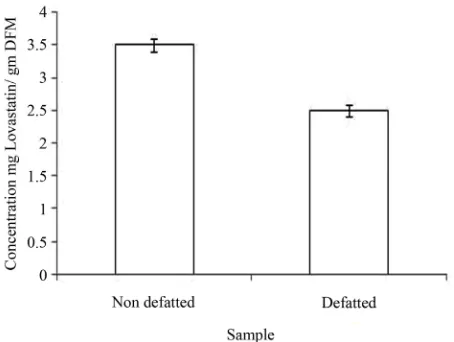
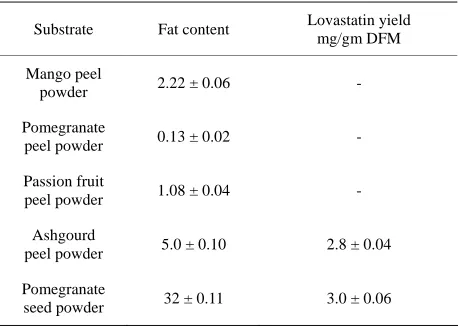
The use of defatted substrate has been reported to give better productivity of statins by filamentous fungi [5]. Proximate analysis showed that pomegranate seed is rich in fat content (Table 2). Hence we carried out a com- parative study on defatted and non-defatted substrate. Defatted substrate was less suitable compared to non- defatted for lovastatin productivity which is in agreement with previous report on soya bean substrate [4]. Com- parative profile of lovastatin production on defatted and non defatted pomegranate seed substrate is shown in
[image:3.595.309.538.567.730.2]Figure 1. Absence of lovastatin production on pome- granate peels, mango peels and passion fruit peels might be due to lesser amount of fats (Table 2) and consider- able amount of phenolics (data not shown) which pre- vents the growth of micro-organisms[11]. Thus it can be concluded that Pomegranate seeds are favourable choice for lovastatin production.
Table 2. Fat content of substrate and corresponding lovastatin yield on it.
Substrate Fat content Lovastatin yield
mg/gm DFM
Mango peel
powder 2.22 ± 0.06 -
Pomegranate
peel powder 0.13 ± 0.02 -
Passion fruit
peel powder 1.08 ± 0.04 -
Ashgourd
peel powder 5.0 ± 0.10 2.8 ± 0.04
Pomegranate
3.2. Optimisation of Lovastatin Yield
Different physical and chemical parameters were consid- ered in our study. Primary batches of SSF proved that thorough mixing of substrate after inoculation and mois- ture addition was crucial for enhanced mycelial devel- opment (Figure 2) and eventual lovastatin production. Maximum productivity (3.42 mg/gm dfm) was obtained at 60% moisture level. Incubationtemperature (25˚C) and pH 5 was found to be optimum for lovastatin production (3.60 mg/gm dfm). From the growth curve the maximum yield of 3.68 mg/gm dfm was obtained on 15th day (Fig- ure 3). Hence, physical factors did not affect lovastatin production to great extent, indicating the robustness of SSF as compared to submerged fermentation which is known to be highly sensitive to such parameters. The various chemical parameters considered in our study were carbon, nitrogen and mineral sources. Contrary to popular belief about glucose repression, the present study found it to be the best carbon source (at 5% w/v) to give highest productivity of lovastatin (3.72 mg/gm dfm). This could be attributed to the fact that pomegranate seeds have a high content of slow metabolising sugars and in combination with glucose supplement (fast metabolising) would result in better productivity[12]. Nitrogen repres- sion of lovastatin productivity is an established pheno- menon [8] and was further backed by our results wherein highest productivity was seen in control batches having no added nitrogen content. Thus supplementation with nitrogen sources was seen to repress lovastatin produc- tion in our study. Minerals were seen to play a crucial role in enhancing productivity and this could be due to the trace element requirement of specific strain. Of the minerals screened KH2PO4 gave a definite increase in the yield (3.90 mg/gm dfm).
[image:4.595.308.539.422.714.2]Though RSM was performed not much increase in productivity was seen after one factor at a time optimisa- tion. Maximum production of lovastatin obtained using optimized medium was 4.2 ± 0.03 (mg/g of dfm) post RSM.
Figure 3. Production profile along with biomass concentration.
3.3. Mutation Studies
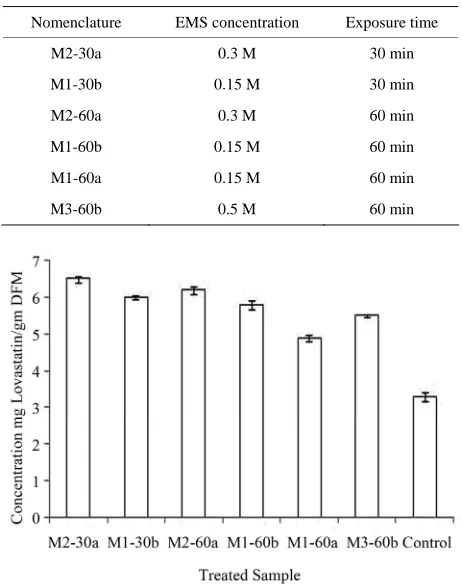
Beyond a certain point lovastatin yield failed to increase and this was observed after RSM application to our sys- tem. Thus further increase would need changes at the genetic level. Hence mutation studies were carried out to further increase lovastatin yields (Table 3). Of the sev- eral colonies picked after exposure to EMS (Ethyl Methyl Sulphonate), about 6 colonies showed lovastatin yield (highest 6.5 ± 0.07 mg/gm dfm) higher than the
control/untreated colonies (Figure 4). These colonies
were subcultured for three generations on PDA and checked for lovastatin yield under both solid state fer- mentation and submerged conditions. High lovastatin productivity obtained consistently for three generations indicated positive effect of mutagen treatment. Enhanced productivity could be a result of alteration in the related metabolic pathway with the probable result of yet again relieving feedback inhibition commonly seen in lovas-tatin producing cultures [13]. Yield of lovaslovas-tatin by dif- ferent wild and mutant strains on varied solid substrates in our study is shown in Table 4.
4. CONCLUSION
[image:4.595.308.539.423.710.2]Various fruit-vegetable peels and seeds were tried as substrates for lovastatin production by fungal cultures.
Table 3. Methodology for Mutant clones with increased yield.
Nomenclature EMS concentration Exposure time
M2-30a 0.3 M 30 min
M1-30b 0.15 M 30 min
M2-60a 0.3 M 60 min
M1-60b 0.15 M 60 min
M1-60a 0.15 M 60 min
M3-60b 0.5 M 60 min
[image:4.595.61.274.575.713.2]Table 4. Lovastatin yield of IFO 7078 compared with other strains.
Strain Productivity mg/gm dfm Substrate Reference
A. terreus
IFO 7078
6.50 ± 0.08 (mutant)
4.20 ± 0.10 (wild) Pomegranate seed Present work
A. terreus UV 1718 3.72 (mutant) Wheat bran Pansuriya and Singhal, 2010 [14]
A. terreus ATCC 20542 2.90 Rice or wheat bran Wei, 2007
A. terreus TUB F-514 1.50 Extracted sweet sorghum pulp
supplemented with cheese whey Szakács et al., 1998
Monascus purpureus MTCC 369 3.42 Rice based solid medium Sayyad, S. A., et al., 2009 [15]
M. pilosus M12-69 2.52 Red fermented rice Chen and Hu, 2005 [16]
[7] Szakács, G., Morovján, G. and Tengerdy, R.P. (1998) Production of lovastatin by a wild strain of Aspergillus
terreus. Biotechnology Letters, 20, 411-415.
doi:10.1023/A:1005391716830 Pomegranate seeds were found to be the best substrate
and with 0.1% w/v Potassium dihydrogen phosphate
(KH2PO4), 5% w/v glucose, 60% w/w moisture, pH 5
with 15 days fermentation cycle under optimized solid state fermentation conditions, 4.2 ± 0.03 mg lovasta- tin/gm dfm was produced. Suitability of substrate was found to depend on presence of fats in the substrate. Further increase in productivity was obtained by muta- tion studies using Ethyl Methyl Suplphonate (EMS) to give a maximum lovastatin yield of 6.5 ± 0.07 mg/gm dfm. Thus a SSF process for pomegranate seeds utiliza- tion was developed with the aim to make pomegranate processing industry a truly profitable venture.
[8] Jia, Z., Zhang, X., Zhao, Y. and Cao, X. (2010) En- hancement of lovastatin production by supplementing polyketide antibiotics to the submerged culture of Asper-
gillus terreus. Applied Biochemistry and Biotechnology,
160, 2014-2025. doi:10.1007/s12010-009-8762-1 [9] Kim, H., Moon, J.Y., Kim, H., Lee, D.S., Cho, M., Choi,
H.K., Kim, Y.S., Mosaddik, A. and Cho, S.K. (2010) An- tioxidant and antiproliferative activities of mango (Mangif-
era indica L.) flesh and peel. Food Chemistry, 121, 429-
436. doi:10.1016/j.foodchem.2009.12.060
[10] Pandey, A. (2003) Solid-state fermentation. Biochemical
Engineering Journal, 13, 81-84.
doi:10.1016/S1369-703X(02)00121-3
5. ACKNOWLEDGEMENTS
The authors of this study would like to express their gratitude to DBT, India for sponsoring the above study through allotment of contingency and fellowship.
[11] Wei, P., Xu, Z. and Cen, P. (2007) Lovastatin production
by Aspergillus terreus in solid state fermentation. Journal
of Zhejiang, 8, 1521-1526. doi:10.1631/jzus.2007.A1521
[12] Vilches Ferron, M.A., Casas Lopez, J.L., Sanchez Perez, J.A., Fernandez Sevilla, J.M. and Chisti, Y. (2005) Rapid screening of Aspergillus terreus mutants for overproduc- tion of lovastatin. World Journal of Microbiology & Bio-
technology, 21, 123-125. doi:10.1007/s11274-004-3045-z
REFERENCES
[1] Jurenka, J. (2008) Therapeutic applications of pomegra nate (Punica granatum L.): A review. Alternative Medi-
cine Review, 13, 128-144. [13] Valera, H.R., Gomes, J., Lakshmi, S., Gururaja, R., Sury-
anarayan, S. and Kumar, D. (2005) Lovastatin production by solid state fermentation using Aspergillus flavipes.
Enzyme and Microbial Technology, 37, 521-526.
doi:10.1016/j.enzmictec.2005.03.009
[2] Aghsaghali, A.M. (2011) Evaluating potential nutritive value of pomegranate processing by-products for rumi- nants using in vitro gas production technique. ARPN Jour-
nal of Agricultural and Biological Science, 6, 45-51.
[14] Chen, F. and Hu, X. (2005) Study on red fermented rice with high concentration of monacolin K and low concen- tration of citrinin. International Journal of Food Micro-
biology, 103, 331-337.
doi:10.1016/j.ijfoodmicro.2005.03.002
[3] EL-Nemr, S.E., Ismail, I.A. and Raga, M. (1990) Chemi- cal composition of juice and seeds of pomegranate fruit.
Die Nahrung, 34, 601-606.
doi:10.1002/food.19900340706
[4] Xu, B., Wang, Q., Jia, X. and Sung, C. (2005) Enhanced lovastatin production by solid substrate fermentation of Monascus rubber. Biotechnology and Bioprocess Engi-
neering, 10, 78-84.
[15] Pansuriya, R.C. and Singhal, R.S. (2010) Response sur- face methodology for optimisation of production of lovas- tatin by solid state fermentation. Brazilian Journal of Mi-
crobiology, 41, 164-172.
doi:10.1590/S1517-83822010000100024
[5] Manzoni, M., Bergomi, S., Rollini, M. and Cavazzoni, V. (1999) Production of statins by filamentous fungi. Bio-
technology Letters, 21, 253-257.
doi:10.1023/A:1005495714248
[16] Sayyad, S.A., Panda, B.P., Javed, S. and Ali, M. (2007) Optimization of nutrient parameters for lovastatin pro- duction by Monascus purpureus MTCC 369 under sub- merged fermentation using response surface methodology.
Applied Microbiology and Biotechnology, 73, 1054-1058.
doi:10.1007/s00253-006-0577-1
[6] Samiee, S.M., Moazami, N., Haghighi, S., Mohseni, F.A., Mirdamadi, S. and Bakhtiari, M.R. (2003) Screening of lovastatin production by filamentous fungi. Iranian Bio-