Simulation and Prediction for Groundwater Dynamics
Based on RBF Neural Network
Zhonghua Fei1, Dinggui Luo2, Bo Li1
1
School of Mathematics and Physics, Changzhou University, Changzhou, China 2
School of Environmental Science and Engineering, Guangzhou University, Guangzhou, China Email: [email protected]
Received March 5, 2012, revised April 7, 2012; accepted May 9,2012
ABSTRACT
Based on MATLAB, a new model-BRF network model is founded to be used in groundwater dynamic simulation and prediction. It is systematically studied about the training sample set, testing sample set, the pretreatment of the original data, neural network construction, training, testing and evaluating the entire process. A favorable result is achieved by applying the model to simulate and predict groundwater dynamics, which shows this new method is precise and scien-tific.
Keywords: Dynamic Simulation and Forecast; Groundwater; BP Network; RBF Networks
1. Introduction
That the factors (such as water level, water quantity, wa- ter chemical composition, water temperature, etc.) in the aquifer system changing with time under interaction in the surrounding environment, is called groundwater dy- namics. Groundwater dynamics is caused by the imbal-ances of water, heat, energy and salt.The studies on this is of great significance to find out the variation of groundwater resources and the characteristic of reentry and outflow, toguide water intake and drainage project and reasonable exploitation and utilization of groundwa- ter resources, and to solve environmental problems such as ground subsidence, water quality deterioration, salt- water intrusion etc.Therefore, the mathematical model of groundwater dynamics can be divided into deterministic mathematical model and uncertainty mathematical model including numerical method, the fuzzy mathematics me- thod, grey system methods, statistical analysis, Kriging valuations, regression analysis, time series analysis, spe- ctrum analysis (Fourier analysis, wavelet analysis, etc.), and artificial neural network (ANN) method etc.
Compared with the traditional statistical analysis mo- del, neural network model has better durability and time- lier forecast and can be used to solve the prediction pro- blem of groundwater system with multiple arguments and multiple dependent variables.
In the present, most researches on neural network ap- ply BP (Back Propagation) network. Although BP algo- rithm is based on solid theory basis and can be used widely, there are some unsolved problems on it. By in troducing the principles of RBF (Radial Basis Function)
network, this paper points out that RBF network has ad- vantageous properties such as independence of the output on initial weight value and adaptation for determining the construction. Using MATLAB as the platform, we apply the network for simulation and prediction of ground- water dynamics and get a good achievement in constru-
ction of training set and checking set, pretreatment of
original data, and establishment, training, inspection and
result evaluation of the neural network.
2. The Principle of Radial Basis Network
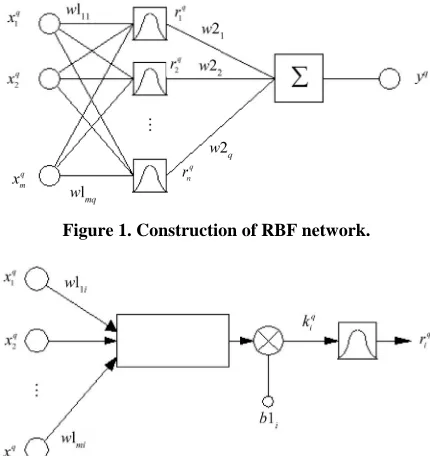
We will introduce RBF basic principle [1-3], training and its realization methods. The radial basis network is a three-layer feedforward network composed of input layer, hidden and output layer, see Figure 1 (with a single out- put neurons as an example) where hidden neurons use radial basis function as activation function, usually with Gaussian function as radial basis function.
Each neuron of the hidden layer inputs the product of the distance between the vectors W1i and the vector
q
X multiplied by its own offset value i. The vector
i is the connected weight value between neuron of
hidden layer and of input layer and also known as the ith hidden layer neuron function (RBF) center. The vector
1
b
1
W
q
X represents the qth input vector denoted by
, , , , ,
q q q q q
1 2 j m
X x x x x
q i
k
. From the Figure 2, we can see that the ith neuron input for the hidden layer is :
2 1 1
q q
i ji j i
j
Figure 1. Construction of RBF network.
Figure 2. Sketch map for input and output about the hidden nerve unit in RBF network.
and the ith output is q:
i
r
21i q 1i
W X b
e
2 2
2 1ji qj 1i
q j i b w x k q i
r e e
.
By Gaussian transformation, the ith output from the ith neuron input of the hidden layer is
21i q 1i
W X b
e
1 b 1 b C 2 2
2 1ji qj 1i
q j i b w x k q i
r e e
Although the value of can adjust the sensitivity of the function, in practice we commonly used another pa-rameter C (called expansion constant). There are all kinds of methods to define the function about and
. In MATLAB neural network toolbox, it sets 1i 0.8326 i
b C .
And then the hidden layer neurons output is changed to: 2 2 2 1 0.8326 q i i i W X C q
1 q 0.8326
i
W X
C q
i
r e e
.
The values of C reflects response width of output for input. The bigger C takes, the better smoothness between two neurons we will get, caused by the response range of the hidden neurons to input vector expand with it.
The output is weighted summation of each hidden layer neurons output, excitation function using pure lin- ear function. Then the neuron output y is
1
2
q q
i i
i
y r w
1 W 2 nRBF network training is divided into two steps, the
first step for the supervised learning training the weights between input layers and hidden layer, the second step for supervised learning training the weights W between hidden layer and the output layer. Network training needs to provide input vector (X), correspond- ing target vector (T) and expansion constants of the ra- dial basis function (C). The purpose of the training is to get the weights , , and the offset value , . (when the number of hidden units equals the number of input vector, we will take ).
1
W W2 b1 b2
2 0
b
1
W
In RBF networks training, one of the key problems is to decide the number of neurons in hidden layer. In the past, we often make it equal with the number of the input vector. Apparently, for many input vector, too much hi- dden units is difficult to acceptable. Therefore we will improve the method. The basic principle is: 0 as a neuron started training, by checking the output error to make the network automatically increase neurons, after the training sample looping once, using the training sample which make the network produce have the maximum error as the weight vector i to generate a new hidden neuron,
then recalculating, checking the error of the new net-work, repeating this process until it reaches the required error or maximum number of hidden neurons, which we can see that RBF network has properties such as adap-tation for determining the network construction and independence of initial weight value.
3. Application of the Radial Basis Network
3.1. Preparations for Neural Network
1) Training samples and test samples
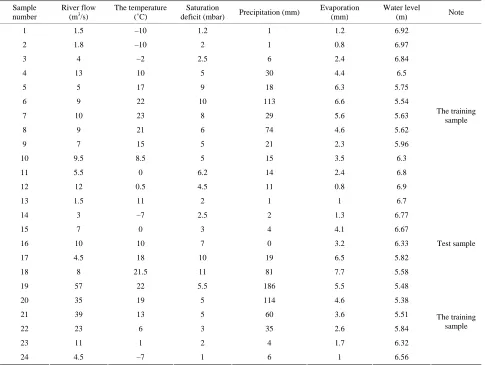
We choose randomly five samples from No. 14 to No. 18 as test samples and others as the training samples. The sample are listed in Table 1.
2) The original data preprocessing
There are three kinds of pretreatment plans. The first is to normalize original data to between –1 and 1 by use of PRENMX function; the second is to normalize the origi- nal data to the expectation as 0 by Prestd function and the last one, the original data not being preprocessed.
3.2. Radial Basis Net Constructions, Training and Testing
1) Radial basis network construction
Table 1. Monitored data on underground water level and impact factors.
Sample number
River flow (m3/s)
The temperature (˚C)
Saturation
deficit (mbar) Precipitation (mm)
Evaporation (mm)
Water level
(m) Note
1 1.5 –10 1.2 1 1.2 6.92
2 1.8 –10 2 1 0.8 6.97
3 4 –2 2.5 6 2.4 6.84
4 13 10 5 30 4.4 6.5
5 5 17 9 18 6.3 5.75
6 9 22 10 113 6.6 5.54
7 10 23 8 29 5.6 5.63
8 9 21 6 74 4.6 5.62
9 7 15 5 21 2.3 5.96
10 9.5 8.5 5 15 3.5 6.3
11 5.5 0 6.2 14 2.4 6.8
12 12 0.5 4.5 11 0.8 6.9
13 1.5 11 2 1 1 6.7
The training sample
14 3 –7 2.5 2 1.3 6.77
15 7 0 3 4 4.1 6.67
16 10 10 7 0 3.2 6.33
17 4.5 18 10 19 6.5 5.82
18 8 21.5 11 81 7.7 5.58
Test sample
19 57 22 5.5 186 5.5 5.48
20 35 19 5 114 4.6 5.38
21 39 13 5 60 3.6 5.51
22 23 6 3 35 2.6 5.84
23 11 1 2 4 1.7 6.32
24 4.5 –7 1 6 1 6.56
The training sample
rons is pure linear function PURELIN, the weighted function DOTPROD, and the input functions NETSUM [4,5].
2) Network training and testing
The level of the network training is related with the control error. It is listed in Table 2 that the fitting error of network for the training samples and the generalize- tion error for the test samples change with the mean square error. It is clear that the network is the best when the control mean-square error called goal equals 0.003. At this point, the maximum fitting error (relative error) of the network for 19 training samples is 1.6948%, and the generalization error (relative error) for 5 test samples is 3.7686%. Namely, applying the network to forecast, the error is expected to control within 4% which satisfies actual requirements.
3) The effect of the data pretreatment on RBF network It is presented in Table 3 that three methods of the original data preprocessing effect on network. By a large number of experiments, the method 1, 2, 3 get the best respectively when the goal is 0.003, 0.01 and 1. Then we
compare the effects of three networks. Consideration of the fitting and generalization error, method 3 gets worse obviously, methods 1 and 2 are similar, but method1 is better than method 2 overall.
3.3. Application Effect of the BP Network
Compared with radial basis network, we construct BP network to solve the problem. The process is as follows:
1) BP network construction
Taking three-layer network, the number of the input and output layer neurons is determined as 5 and 1 respec- tively. There has not been a uniform method how to de- termine the number of the hidden units. Here we follow the reference as 11.
Table 2. Relationship among fitting error, generalization error and mean squares error in RBF network.
Generalization error (%) (to the test sample)
Fitting error (%) (to the training sample) The mean square
error (goal)
Number of training (epochs)
14 15 16 17 18 The maximum The maximum
0.1 4 2.4059 4.0485 0.3597 1.8798 0.8519 6.9383
0.01 12 4.5999 1.2495 1.9865 2.0323 0.6184 4.5999 2.067
0.005 13 4.0541 1.2349 2.7511 1.9714 0.6984 4.0541 1.8873
0.003 14 3.7686 1.9938 2.5896 2.667 0.8093 3.7686 1.6948
0.002 15 4.3711 0.59738 4.6132 2.9475 0.4611 4.6132 1.446
0.001 17 4.5395 2.4582 5.862 4.0232 0.9883 5.862 0.5531
[image:4.595.58.542.266.346.2]Note: original data normalization to between –1 and 1.
Table 3. Effect for data pretreatment method to results of the network.
Generalization error (%) (to the test sample) Fitting error (%)
(to the training sample) Data pretreatment
method
The mean square error (goal)
14 15 16 17 18 The maximum The maximum
1 0.003 3.7686 1.9938 2.5896 2.667 0.8093 3.7686 1.6948
2 0.01 3.3457 3.6511 1.6802 0.30445 3.1201 3.6511 2.2332
3 1 10.573 9.2367 4.3616 4.0191 8.493 10.573 12.526
1: Normalization between (–1,1); 2: (0 mean, Unit variance); 3: Not normalized.
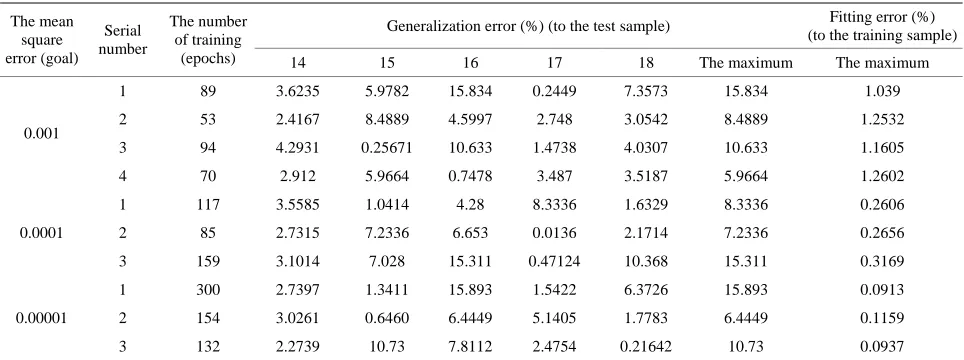
Table 4. Experimental results for the dependence of BP net network on initial weight value.
Generalization error (%) (to the test sample) Fitting error (%)
(to the training sample) The mean
square error (goal)
Serial number
The number of training
(epochs) 14 15 16 17 18 The maximum The maximum
1 89 3.6235 5.9782 15.834 0.2449 7.3573 15.834 1.039
2 53 2.4167 8.4889 4.5997 2.748 3.0542 8.4889 1.2532
3 94 4.2931 0.25671 10.633 1.4738 4.0307 10.633 1.1605
0.001
4 70 2.912 5.9664 0.7478 3.487 3.5187 5.9664 1.2602
1 117 3.5585 1.0414 4.28 8.3336 1.6329 8.3336 0.2606
2 85 2.7315 7.2336 6.653 0.0136 2.1714 7.2336 0.2656
0.0001
3 159 3.1014 7.028 15.311 0.47124 10.368 15.311 0.3169
1 300 2.7397 1.3411 15.893 1.5422 6.3726 15.893 0.0913
2 154 3.0261 0.6460 6.4449 5.1405 1.7783 6.4449 0.1159
0.00001
3 132 2.2739 10.73 7.8112 2.4754 0.21642 10.73 0.0937
parameter is not adjusted along with the steepest descent direction (negative gradient direction) of the error surface, but is conjugate gradient direction, which has advantages of fast convergence and small footprint.
2) The effect analysis on BP network
In Table 4, it gives the results of three or four con-
secutive trainings and tests based on BP network when mean-square error goal equals 0.001, 0.0001 and 0.00001 respectively. It can be seen that firstly under the same mean-square error, results of training have great diffe- rences including the number of training, fitting error, ge- neralization error which shows the initial weights of the BP network have a significant impact on the network
effect; secondly compared with the result of RBF net- work in Table 2, BP network effect is clearly not as good as RBF network effect; and thirdly, the number of the training on BP network is much larger than on RBR network which shows the training speed of BP network is slower.
4. Conclusions
[image:4.595.57.539.384.564.2]shows that special attention is paid to the pretreatment of the original data in order to have an efficient network when we simulate and predict for groundwater dynamics based on RBF network.
At the same time, drawbacks on BP network such as artificiality for determining the construction, inferiority to RBF net on accuracy and speed of training and ran- dom of initial weight value to the outcome are all mani- fested after comparing RBF net and BP net. In addition, the BP network has many defects such aseasiness to get the local minimum when learning and volatile, and re- dundant network connection or nodes. Many attempts have been done to improve it, but rarely desirable result is gotten. So we think that it should be very careful to select the BP network to simulate and forecast ground- water dynamics.
REFERENCES
[1] S. Cong, “The Function Analysis and Application Study
of Radial Basics Function Network,” Computer Engi-neering and Applications, Vol. 38, No. 3, 2002, pp. 85- 87.
[2] H. Demuth and M. Beale, “Neural Network Toolbox User’s Guide,” The MathWorks Inc., Natick, 1997, pp. 420-467.
[3] P. D. Wasserman, “Advanced Methods in Neural Com-puting,” Van Norstrand Reinhold, New York, 1993, pp. 334-366.
[4] S.-Y. Zheng, Z.-B. Li and X.-A. Li, “Artificial Neural Network Method for Forecast of Underground Water Level,” Northwest Water Lou Shuntian, Shi Yang, Sys-tems Analysis and Design Based on MATLAB-Artificial Neural Network, XiDian University Publishing Company, Xi’an, 1998, pp. 210-256.