ISSN Online: 2160-0422 ISSN Print: 2160-0414
DOI: 10.4236/acs.2018.82016 Apr. 30, 2018 248 Atmospheric and Climate Sciences
A Parallelization Research for FY Satellite
Rainfall Estimate Day Knock off Product
Algorithm
Weixia Lin, Xiangang Zhao, Cunqun Fan
*, Manyun Lin, Lizi Xie
National Satellite Meteorological Center, Beijing, China
Abstract
With the development of satellite remote sensing technology, more and more requirements are put forward on the timeliness and stability of the satellite weather service system. The FY satellite rainfall estimate day knock off prod-uct algorithm runs longer, about 20 minutes, which affects the estimated rainfall product generated timeliness. Research and development of parallel optimization algorithms based on the needs of satellite meteorological services and their effectiveness in practical applications are necessary ways to enhance the high-performance and high-availability capabilities of satellite meteoro-logical services. So aiming at this problem, we started the parallel algorithm research based on the analysis of precipitation estimation algorithm. Firstly, we explained the steps of precipitation estimated date knock off product algo-rithm; secondly, we analyzed the four main calculation module calculating the amount of algorithms; thirdly, multithreaded parallel algorithm and MPI pa-rallelization was designed. Finally, the multithreaded parallel and MPI paral-lelization were realized. Experimental results show that the multithreaded pa-rallel and MPI papa-rallelization algorithm could greatly improve the overall de-gree of computational efficiency. And, MPI parallelization mode has a higher operating efficiency. The performance of parallel processing is closely related to the architecture of the computer. From the perspective of service schedul-ing and product algorithms, the MPI parallelization approach is adopted to achieve the purpose of improving service quality.
Keywords
Rainfall Estimate, Parallelization, Multithreading, MPI
1. Introduction
Fengyun meteorological satellites are mainly used in China’s weather forecast,
How to cite this paper: Lin, W.X., Zhao, X.G., Fan, C.Q., Lin, M.Y. and Xie, L.Z. (2018) A Parallelization Research for FY Satellite Rainfall Estimate Day Knock off Product Algorithm. Atmospheric and Cli-mate Sciences, 8, 248-261.
https://doi.org/10.4236/acs.2018.82016
Received: July 14, 2017 Accepted: April 27, 2018 Published: April 30, 2018
Copyright © 2018 by authors and Scientific Research Publishing Inc. This work is licensed under the Creative Commons Attribution International License (CC BY 4.0).
http://creativecommons.org/licenses/by/4.0/
DOI: 10.4236/acs.2018.82016 249 Atmospheric and Climate Sciences climate prediction and environmental monitoring and other aspects [1]. Meteo-rological satellite precipitation is estimated that the algorithm is a computation-ally intensive application, after the product is generated through the meteoro-logical satellite product distribution system in a timely manner for all types of users to provide services. The current meteorological satellite precipitation algo-rithm in the IBM P780 high-end small machine running time is about 20 mi-nutes, running longer [2]. Among them, the numerical prediction product data preprocessing, surface emissivity calculation, radiative transmission forward modeling and clear sky atmospheric precipitation inversion four calculation modules are computationally intensive and need to spend more computation time. This paper aims to study the parallelization method of data reconciliation algorithm for meteorological satellite precipitation, so as to improve the genera-tion efficiency of precipitagenera-tion products and improve the service level of preci-pitation products.
At present, there are many achievements in the parallelization of algorithms. In paper [3], it is pointed out that the parallel multithreaded architecture pro-cessor is composed of a plurality of logical processing machines. A large number of pipeline control parts are shared by all logical processors [4]. In each cycle, the processor fetches multiple instruction schedules from multiple threads. Lai Guoming et al. [5] detailed analysis of fast multi-pole algorithm FMM (Fast Multipole Method) the basic principles. He gives a description of the serial FMM algorithm. And the parallel analysis and processing of the FMM algorithm were carried out [6]. Su Shengqu and Liang Shizhen [7] pointed out that parallel computing as a modern computer is an important calculation method. This greatly optimizes the calculation process of the ant colony algorithm. Ant colony algorithm itself implies a certain degree of parallelism [8]. In essence, the ant colony algorithm is characterized by parallel cooperative optimization method, and the optimal solution is obtained by using parallel computation [9]. Guo Shen et al. [10] pointed out that the parallel compiler technology is the primary problem in the program can be found parallel. The parallelism of the program is characterized by the execution time of the program, the loop part of the pro-gram, the data dependency analysis and the execution time and the cycle times ratiop [11], and the parallel point mining in the program is carried out accord-ing to the above characteristics. Xu Jinxiu et al. [12] proceeded from the numer-ical simulation program of the Boltzmann model equation for solving the three-dimensional flow problem, and the MPI parallelization and high perfor-mance calculation and debugging of the numerical simulation program were carried out by studying the regional decomposition and parallel computing strategy [13]. A large-scale MPI parallel computing test was carried out to study the stability of the developed MPI parallelized region decomposition strategy and program optimization method [14].
pre-DOI: 10.4236/acs.2018.82016 250 Atmospheric and Climate Sciences cipitation, we introduce multi-thread parallelization method and MPI (Message Passing Interface) parallelization method. And the parallel estimation and com-parison of the precipitation estimation algorithm are based on these two me-thods in order to improve the calculation efficiency of the precipitation estima-tion algorithm.
2. Analysis of Estimation of Precipitation
2.1. Algorithm Steps
The calculation method of atmospheric precipitation inversion algorithm is as follows: 1) Read the required day VIRR L1 data including reflectance, radiation value, solar elevation angle, satellite observation angle information; 2) read into the numerical forecast product data, 3) read the MODIS land use type data (static), from the USGS, the temperature, the surface temperature, the surface pressure, For the five-minute product synthesis; 4) read the day of cloud detec-tion data; 5) surface emissivity calculadetec-tion processing package calculadetec-tion ac-cording to VIRR5 minutes LIB data, cloud detection data, land surface cover classification data, early surface emissivity data calculation surface emission Rate; 6) numerical prediction data preprocessing package to interpolate the nu-merical prediction product data and convert the relative humidity of atmos-pheric observation into water vapor mixing ratio; 7) radiation transmission for-ward calculation According to the surface emissivity and the data after interpo-lation, the water vapor mixing ratio, Start the radiation transmission forward calculation, get the clear sky air precipitation inversion of the required mathe-matical parameters; 8) clear sky atmosphere Precipitation process packets start to clear sky atmospheric precipitation, the resulting data being submitted to public services like projection projected latitude and longitude.
2.2. Analysis of Algorithm Parallel Computation Module
VPWO algorithm mainly includes four processing modules, namely: 1) Numer-ical prediction of product data pretreatment; 2) Surface emissivity calculation; 3) Radiation transmission forward calculation; 4) Clear sky Atmospheric precipita-tion inversion. The following mainly gives the calculaprecipita-tion of the four processing modules.
a) Preprocessing of numerical forecast product data
DOI: 10.4236/acs.2018.82016 251 Atmospheric and Climate Sciences Horizontal interpolation: 640 321× →1800 2000× , inserted 14 + 17 layers; vertical interpolation: 1800 2000× points, 17 layers → 43 layers, 14 layers
→ 43 layers.
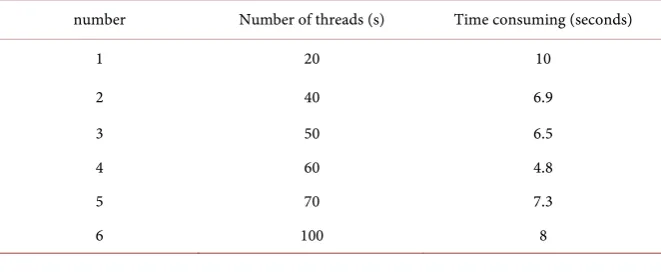
This section deals with the time in the business environment: Horizontal in-terpolation requires 40 threads. Processing time: 30 s. Vertical inin-terpolation re-quires 20 threads. Processing time: 12 s. The vertical interpolation of the test on the simulation machine as follows Table 1:
b) Surface emissivity calculation
The surface emissivity calculation is statistically about 10 s, and the processing module is mainly time consuming to read data and interpolate.
c) Radiation transmission forward calculation The input and output of the processing module are:
Input: including satellite azimuth, surface emissivity, temperature and humid-ity profile, surface temperature, surface pressure, ozone profile (after pretreat-ment);
Output: 43 layers of atmospheric atmospheric transmittance, in addition to the need to calculate the atmosphere of the K atmosphere relative to the atmos-phere in order to calculate the radiation difference, the use of temperature dif-ference, the process is more complex.
d) Clearance of airborne weather
According to the results of radiative forward calculation, the radiation differ-ence and bright temperature differdiffer-ence of the two channels are calculated re-spectively. According to the difference of radiation difference, bright tempera-ture difference, clear sky precipitation and surface emissivity, the atmospheric precipitation data can be calculated and output. The calculation is relatively small.
Radiation transmission forward calculation and clear sky atmospheric preci-pitation inversion two parts processing requires the use of 30 threads, processing time total 170 s.
2.3. Algorithm Process Parallel Relevance
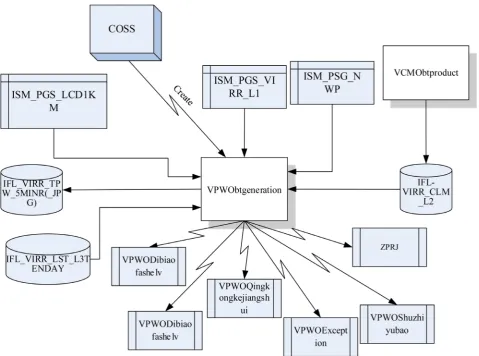
[image:4.595.207.538.597.735.2]Figure 2 shows the process: VPWObtgeneration (clear sky can be precipitation inversion process), VPWDayproduct (clear sky can be precipitation of water),
Table 1. Vertical interpolation test on the simulation machine.
number Number of threads (s) Time consuming (seconds)
1 20 10
2 40 6.9
3 50 6.5
4 60 4.8
5 70 7.3
DOI: 10.4236/acs.2018.82016 252 Atmospheric and Climate Sciences the process of the parallel operation of the algorithm shown in Figure 1, the fig-ure marked as follows: 1) Create (process of the creation of orders) 2) Process: VPWObtgeneration (VPWDayproduct), VCMObtproduct (VIRR segmentation cloud detection process); 3) Input interface: IFL_VIRR_LST_L3TENDAY (early VIRR4/5 channel surface emissivity product data), ISM_PGS_VIRR_L1 VIRR 5-minute segmented cloud detection data), VIRR_TPW_NWP (numerical pre-diction products, including temperature profile, humidity profile, surface tem-perature, surface pressure), ISM_PGS_LCD1KM (IGBP surface coverage classi-fication data); 4) Output interface: IFL-VIRR_TPW_5MINR (VPWODibiaofa-shelv, VPWOSibzhiuubao, VPWOFushechuanshu, VPWOQingkongkejiang-shui, and can be used to reduce the temperature of the water vapor Inversion processing package); 5) Public service: ZPRJ ( Projection Transformation Utility Service Group), VPWOException (exception handling operation package).
3. Algorithm Parallelization
[image:5.595.61.541.350.706.2]Multithreading parallelization and MPI parallelization are the most important means of algorithm parallelization. Multithreading is the process of dividing a program into several concurrent tasks. Each task works in parallel according to
DOI: 10.4236/acs.2018.82016 253 Atmospheric and Climate Sciences different execution routes and performs its functions independently and does not interfere with each other. Multi-threading technology to achieve multi-processor hardware performance by accelerating program response, improving system throughput and resource utilization, and improving communication efficiency among multitasking. It can optimize the performance of the entire application system through multi-threading technology.
MPI is the messaging function library standard. It is a new library description. The library has a total of hundreds of function call interface. These functions can be called directly in Fortran and C languages. MPI as a messaging programming model. It implements data exchange between processors by explicitly sending and receiving messages. Each parallel process has its own independent address space, the process can not be directly accessible to each other, through the expli-cit message to achieve, the way for large-scale parallel processor (MPP) and cluster (Cluster). MPI is based on distributed memory, a distributed memory system consisting of a set of network-connected pairs of network connections. The memory associated with the kernel can only be accessed by the core. The process (or processor) has its own local memory. Different processes often need to interact with other processes to obtain and send data.
Based on the analysis of the precipitation estimation algorithm, this paper in-troduces the multi-thread parallel computing method [15] [16] and the MPI pa-rallelization method [17] [18] to the parallel design of the algorithm. Therefore, two parallel architectures of precipitation estimation algorithm are proposed.
3.1. Multi-Threaded Parallelization
3.1.1. Multi-Threaded Parallelization Principle
Multi-thread parallelization mainly deals with multi-thread parallelization of four parallel modules in the precipitation estimation algorithm. The data is rec-orded by the main program VPWObtgeneration IFL_VIRR_LST_L3TENDAY, ISM_PGS_VIRR_L1, IFL_VIRR_CLM_L2, VIRR_TPW_NWP, ISM_PGS_LCD1KM. When the data is read, the sub-tasks are divided into several numerical predic-tive product data preprocessing, surface emissivity calculation, radiapredic-tive trans-mission forward calculation and clear sky precipitation. The number of sub-tasks set according to the actual needs of the specific needs. In the experi-mental section we give a detailed analysis. Different sub-tasks assign a task thread to perform related task calculation processing. The calculated results are aggregated and merged at the output first. And finally output the data after the fusion. Figure 2 is a block diagram of the algorithm multi-threaded paralleliza-tion.
3.1.2. Pthreads Parallelization of the Algorithm
DOI: 10.4236/acs.2018.82016 254 Atmospheric and Climate Sciences
Figure 2. Schematic diagram of multi-threaded parallelization of precipitation estimation
algorithm (Figure 2 shows the thread, j is the thread identity, j∈[1, ]n , Rij is sub-task,
where i is 4 parallelizable algorithm module identification, i∈[1, 4], j is the subtask iden-tification, j∈[1, ]n .)
process is as follows:
for(int i = 0; i < 576 ; i++)//The input data is complete source data {
VpwdPrjProcess() {
Thread_Count=strtol(argv[1],MULL,10);//Get the number of threads for(thread=0;thread<Thread_Count;thread++)
{
//Create a thread, the inversion calculation into Thread_Count sub-tasks, by Thread_Count threads in parallel
pthread_create(VpwdProcess); }
for(thread=0;thread<Thread_Count;thread++)
{
//Blocking the call thread, until all the implementation of the end of the sub-thread, the main thread to perform the remaining operations.
pthread_join(thread_handles[thread]); }
……Other non-parallel operations }
}
DOI: 10.4236/acs.2018.82016 255 Atmospheric and Climate Sciences
3.2. MPI Parallelization
3.2.1. MPI Parallelization Principle
[image:8.595.196.539.261.647.2]MPI parallelism is achieved through data parallelism. The data files IFL_VIRR_LST_L3TENDAY, ISM_PGS_VIRR_L1, IFL_VIRR_CLM_L2, VIRR_TPW_NWP, ISM_PGS_LCD1KM and the projection lookup table are di-vided into n-sized modules. These modules are read by n compute nodes, re-spectively. And the numerical data of these data modules are preprocessed ac-cording to the computing power of each node, the calculation of surface emis-sivity, the calculation of radiative transmission and the calculation of the preci-pitation of airborne air. And the results of each node are aggregated to the mas-ter node, and the result is calculated by the fusion of the masmas-ter node. Figure 3 is a block diagram of the algorithm MPI parallelization.
Figure 3. Precipitation estimation algorithm MPI parallelization block diagram (Figure 3
shows the data block, j is the data module identification,j∈[1, ]n , Nj said the calculation node, j is the calculation node identification,j∈[1, ]n , Cij is the data module on the node
j
N parallelization calculation, where i is the 4 parallelizable algorithm module
DOI: 10.4236/acs.2018.82016 256 Atmospheric and Climate Sciences 3.2.1. MPI Parallelization of the Algorithm
Based on the data parallel, the input data track inversion file and the projection lookup table are divided into n equal sizes. And sent to the n nodes to perform the same projection processing and related computing operations. Parallel pro-gram using master-slave mode, the process number myid = 0 as the main process of the process. It receives the local processing result sent by MPI_Send by other processes via MPI_Recv call. Finally, the main process merges the local results to produce precipitation products. The operation configuration operation is as follows:
1) Edit the file ~/mpd.hosts. Fill in all machine names that allow access to this machine for parallel computing.
2) Generate the file ~/.mpd.conf,.mpd.conf file content: secretword = 123456, of which 123456 to identify the password.
3) generate ~/machinefile. 4) Start the mpd daemon.
5) Check whether each node is ready to run the mpi job. 6) Run the mpi parallel program.
The pseudo-code of the entire MPI parallelization process is as follows:
//MPIInitialize, the program starts in parallel
MPI_Init(&argc,&argv); //MPI is initialized and the program starts in parallel MPI_Comm_size(MPI_COMM_WORLD,&group_size);//Get the current process ID
MPI_Comm_rank(MPI_COMM_WORLD,&my_rank);//Gets the total number of running processes
//Each process enters data for the 1 / group_size block of source data for(int i = 0; i < 576 /group_size; i++)
{
//Inverse function of the product, 5 minutes of data read and projection, etc., to get local results
VpwdPrjProcess(); }
if(my_rank!=0)//Non-master process {
MPI_Send(tempResult); //The non-master process sends the local projection calculation processing result to the main process }
else //Main process {
MPI_Recv( tempResult);//The main process receives the local processing results from each child process
WriteFile();//The main process generates precipitation products VpwdDelete();//Release memory
}
MPI_Finalize();// MPI parallelization ends
4. Experimental Results and Analysis
4.1. Experimental Configuration
DOI: 10.4236/acs.2018.82016 257 Atmospheric and Climate Sciences blade servers (housed in a C7000 10U blade chassis); two HP SL390s G7 (four in the C7000 10U blade chassis); four HP BL680G7 high-performance blade servers High-density servers (placed in a set of HP SL6500 4U chassis); landing and management nodes for the four HP DL380 G7 2U rack server, its configuration: CPU x86_64; memory 110G.
In this experiment, the input data of the precipitation day is 576 (day and night data each 288) block 5 minutes inversion file. In the MPI parallelization experiment, 576 files were divided. And send it to each node in parallel to per-form the calculation. All the calculations in this experiment are based on hp-compute-27, and the results of other nodes are calculated.
4.2. Parallelization Comparison
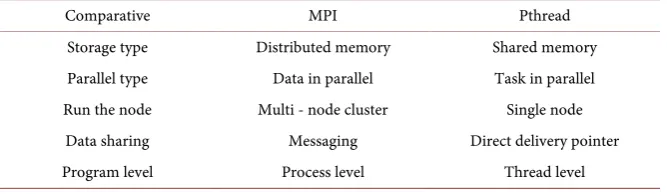
The multi-thread parallelization of the precipitation estimation algorithm is re-lated to the MPI parallelization function and the parallel mode as shown in Ta-ble 2.
4.3. Experimental Results and Analysis
In this paper, the parallelization algorithm based on multi-thread and the paral-lelization algorithm based on MPI are proposed for the paralparal-lelization of FY-3 satellite precipitation estimation. In order to verify the validity of the paralleliza-tion algorithm and compare it on the basis of this, we have realized the two pa-rallelization methods respectively, and then the experimental results and the correlation analysis are given.
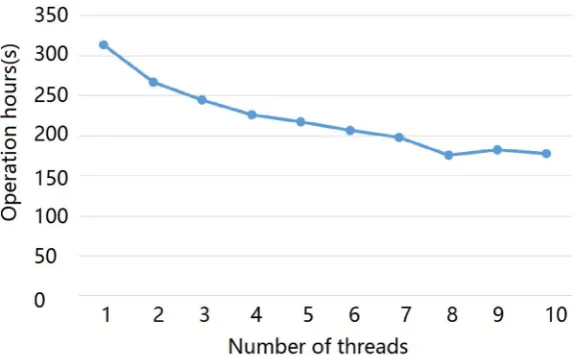
[image:10.595.208.542.622.719.2]Figure 4 shows the results of the 10-day run of the precipitation estimation algorithm without parallelization. Running for about 15 minutes. Figure 5 shows the run-time results for multi-threaded parallelization algorithms with different numbers of threads. It can be seen that when the number of threads is gradually increased, the overall run time of the algorithm is gradually reduced. When the number of threads increased to 8, the increase in the number of threads does not make the overall run time has a more significant decline. The multi-thread parallelization method can stabilize the computation time of the whole algorithm in 180 s or so. Compared with the original algorithm for about 15 minutes of computing time cost, multi-threaded parallelization algorithm greatly improves the overall computational efficiency of the algorithm.
Table 2. Parallelization comparison.
Comparative MPI Pthread
Storage type Distributed memory Shared memory Parallel type Data in parallel Task in parallel Run the node Multi - node cluster Single node
DOI: 10.4236/acs.2018.82016 258 Atmospheric and Climate Sciences
Figure 4. Precipitation estimation algorithm operation results.
Figure 5. Multi-threaded parallel operation results.
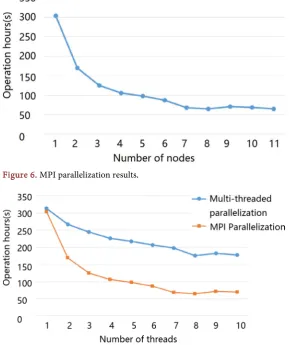
Figure 6 shows the run-time results of the MPI parallelization algorithm at different processing nodes. It can be seen from the figure that when the compu-tational node is changed from 1 to 2, the computation time of the algorithm is obviously reduced. When the number of nodes is increased step by step, The time cost is gradually reduced, when the number of processing nodes is 7, with the increase in the number of processing nodes, the overall operation time of the algorithm does not appear more obvious changes. In other words, the overall operation time of the algorithm is stable at around 70 s. The MPI parallelization method can further reduce the overall run time of the algorithm on the basis of the multi-thread parallelization method, compared with about 180 seconds when the algorithm is running for about 15 minutes and the multi-thread parallelization method. In order to further improve the parallelization of MPI and multi-thread parallelization of the algorithm to improve the effect of Figure 7 shows the same node and thread in the case of two parallelization method of operating efficiency comparison.
[image:11.595.230.519.273.451.2]DOI: 10.4236/acs.2018.82016 259 Atmospheric and Climate Sciences
[image:12.595.229.519.78.424.2]Figure 6. MPI parallelization results.
Figure 7. Parallelization run comparison.
zation algorithm in the same thread and node case, MPI parallel operation effi-ciency has a greater advantage.
In summary, the proposed multi-thread parallelization and MPI-based paral-lelization method can greatly improve the operational efficiency of the FY-3 sa-tellite precipitation estimation algorithm. And MPI parallelization method has higher algorithm operation efficiency.
5. Conclusions
DOI: 10.4236/acs.2018.82016 260 Atmospheric and Climate Sciences as follows:
1) The processing efficiency of MPI parallelization method is Higher than the multi-threaded parallelization method. The parallelization research work is of great significance for the parallelization of other meteorological satellite data processing [13].
2) Parallel processing performance and computer architecture are closely re-lated, not only depends on the CPU, but also with the system architecture, in-struction structure, memory access speed and other factors [19].
3) Faced with large-scale mass data and high-dimensional data types, the tra-ditional computing model has been difficult to provide the required processing power. The emergence of MPI parallel computing platform provides a new way for data processing [20].
Acknowledgements
The work presented in this study is supported by National High-tech R&D Pro-gram (2011AA12A104).
References
[1] Xu, J.M., Yang, J., Zhang, Z.X., et al. (2010) The Development and Application of Meteorological Satellites in China. Meteorology, 36, 94-100.
[2] Celeux, G., Forbes, F. and Peyrard, N. (2001) Em Procedures Using Mean Field-Like Approximations for Markov Model-Based Image Segmentation. Pattern Recognition, 36, 131-144. https://doi.org/10.1016/S0031-3203(02)00027-4
[3] Zhao, Q.M. (2005) Analysis of Parallel Multi-Thread Processor Architecture. Mi-croelectronics and Computer, 5, 185-187.
[4] Fernández-Pascual, R., Ros, A. and Acacio, M.E. (2016) Are Distributed Sharing Codes a Solution to the Scalability Problem of Coherence Directories in Many Cores? An Evaluation Study. Journal of Supercomputing, 72, 1-27.
https://doi.org/10.1007/s11227-015-1596-4
[5] Lai, G.M., Yang, S.Y. and Yuan, D.H. (2007) Parallelization of FMM Algorithm. Journal of Computer Applications and Software, 24, 176-178.
[6] Kang, H.C., Kim, S.S., and Lee, C.H. (2015) Parallel Processing with the Subsystem Synthesis Method for Efficient Vehicle Analysis. Journal of Mechanical Science & Technology, 29, 2663-2669. https://doi.org/10.1007/s12206-015-0512-4
[7] Su, S.Q. and Liang, S.Z. (2009) Parallelism of Ant Colony Algorithm. Computer & Modern, 10, 18-20.
[8] Cecilia, J.M., Llanes, A., Abellán, J.L., Gómez-Luna, J., Chang, L.W., and Hwu, W.M.W. (2018) High-Throughput Ant Colony Optimization on Graphics Processing Units. Journal of Parallel & Distributed Computing, 113, 261-274. https://doi.org/10.1016/j.jpdc.2017.12.002
[9] Kang, Y. and Tang, D. (2016) An Optimization Method for Meta-Functional Chain Design Solution Based on Computational Matrix and Ant Colony Algorithm. Jour-nal of Mechanical Engineering, 52, 25. https://doi.org/10.3901/JME.2016.23.025 [10] Guo, S., Li, P.F. and Zhu, Q.M. (2011) A Feature-Based Parallel Point Discovery
Method. Journal of Computer Applications and Software, 28, 24-26.
DOI: 10.4236/acs.2018.82016 261 Atmospheric and Climate Sciences for an Application in a Heterogeneous System. Human Reproduction, 19, 2738-2741.
[12] Xu, J.-X., Li, Z.-H. and Yin, W.-W. (2012) Application of MPI Parallel Debugging and Optimization Strategy in Numerical Simulation of Three-Dimensional Gas Flow Theory. Computer Science, 39, 300-303.
[13] Afzal, A., Ansari, Z., Faizabadi, A.R. and Ramis, M.K. (2017) Parallelization Strate-gies for Computational Fluid Dynamics Software: State of the Art Review. Archives of Computational Methods in Engineering, 24, 337-363.
https://doi.org/10.1007/s11831-016-9165-4
[14] Volzer, T. and Eberhard, P. (2016) Model Order Reduction of Large-Scale Finite Element Systems in an mpi Parallelized Environment for Usage in Multibody Si-mulation. Archive of Mechanical Engineering, 63, 475-494.
https://doi.org/10.1515/meceng-2016-0027
[15] Xu, J.L., Jiang, L.H., Dong, W.Y., et al. (2011) Study on Multi-Thread Parallel Op-timization of Dynamic Binary Translation. Computer Engineering and Design, 32, 2370-2372.
[16] Mahafzah, B.A. (2013) Performance Assessment of Multithreaded Quicksort Algo-rithm on Simultaneous Multithreaded Architecture. The Journal of Supercomput-ing, 66, 339-363.https://doi.org/10.1007/s11227-013-0910-2
[17] Dobosz, R., Hurley, R. and Mcconnell, S. (2015) A Hybrid Open MP-MPI Paralleli-zation of Structure Software. International Journal of Computer Applications, 118,
1-9.https://doi.org/10.5120/20786-3434
[18] Chenm, G., Sunm, G. and Xum, Y. (2008) Parallel Algorithm Research Method. Journal of Computers, 31, 1493-1502.
[19] Nishiura, D., Furuichi, M. and Sakaguchi, H. (2015) Computational Performance of a Smoothed Particle Hydrodynamics Simulation for Shared-Memory Parallel Computing. Computer Physics Communications,194, 18-32.
https://doi.org/10.1016/j.cpc.2015.04.006
[20] Minervini, M., Rusu, C., Damiano, M., Tucci, V., Bifone, A., and Gozzi, A., et al. (2015) Large-Scale Analysis of Neuroimaging Data on Commercial Clouds with Content-Aware Resource Allocation Strategies. International Journal of High Per-formance Computing Applications, 29, 473-488.
![Figure 2. Schematic diagram of multi-threaded parallelization of precipitation estimation tification, where i is 4 parallelizable algorithm module identification, algorithm (Figure 2 shows the thread, j is the thread identity, j∈[1, ]n, Rij is sub-task, i ∈[1,4], j is the subtask iden-j∈[1, ]n.)](https://thumb-us.123doks.com/thumbv2/123dok_us/9294185.426408/7.595.232.515.68.383/schematic-parallelization-precipitation-estimation-tification-parallelizable-identification-algorithm.webp)
![Figure 3. Precipitation estimation algorithm MPI parallelization block diagram (tion, Figure 3 shows the data block, j is the data module identification,j∈[1, ]n, N said the calculation jnode, j is the calculation node identification,j∈[1, ]n, Cij is the](https://thumb-us.123doks.com/thumbv2/123dok_us/9294185.426408/8.595.196.539.261.647/precipitation-estimation-algorithm-parallelization-identification-calculation-calculation-identification.webp)