Study on Varieties Combination Suitable for Mutual
Pollination of Yan Mountain Chestnut
*
Qian Wang, Shuchai Su#, Di Zhao, Yanru Kou
Key Laboratory for Silviculture and Conservation, Ministry of Education, Beijing Forestry University, Beijing, China. Email: #[email protected], [email protected]
Received February 29th, 2012; revised March 25th, 2012; accepted April 8th, 2012
ABSTRACT
In order to improve the yield and quality of new varieties Castanea mollissima cv.“Zipo”, Castanea mollissima cv.
“Zunyu” and traditional Yan Mountain cultivars Castanea mollissima cv. “Duanci”, Castanea mollissima cv. “Yanhong”, Castanea mollissima cv.“Donglingmingzhu”, an experiment was carried out to study varieties combination that was suitable for their pollination. Fruiting rate and seed-setting rate were used to decide which the most suitable
configuration was. The result indicated that: Castanea mollissima cv. “Zunyu” was the best pollination tree for
Castanea mollissima cv. “Yanhong”, Castanea mollissima cv.“Zipo” and Castanea mollissima cv. “Duanci”; Castanea mollissima cv.“Duanci” was regarded as the best pollination tree for Castanea mollissima cv. “Zunyu”; the best variety to
comply with Castanea mollissima cv. “Donglingmingzhu”was Castanea mollissima “Zunyu”and Castanea mollissima cv.
“Duanci”; Castanea mollissima cv. “Zunyu” and Castanea mollissima cv. “Duanci” complied with each other best. Appropriate configuration of pollination varieties turned out to be one of the key measures to improve the yield and quality of chestnut, while irrational combination may even bring the reduction of output.
Keywords: Castanea Mollissimabl; Configuration; Fruiting Rate; Seed-Setting Rate
1. Introduction
Chestnut (Castanea mollissima) was considered as one of
Chinese endemic species and the nutrient-rich nuts have unique flavor, with great economic value [1]. Yan Moun- tain chestnuts mainly grow in Qianxi, Zunhua, Xinglong, Kuancheng, Qinglong counties, Hebei province and Huairou, Miyun, Pinggu and Changping in Beijing. All of the chestnuts here have exquisite shape, delicate meat with high sugar content. The nuts are famous for fried with the trade name “Tianjin Sweet Chestnut” or “Jing- Dong Chestnuts.” The varieties mainly cultivated in Yan Mountain region are Yanghong, YanChang, YanMing, Timazhenzhu, Zipo, Zunyu, Huai Huang, Huaijiu, Zun-
huaduanci and so on. Castanea mollissima is a typical kind
of cross-pollination plants and its self-pollination seed- setting rate is very low which reached only 10% to 40% [2].
A number of related studies had been done by many scholars. Such as Mokay, he has already proven that the phenomenon self-infertility on some chestnut seedling trees was due to incompatibility between male gametes
and female gametes [3]. In addition, the stigma of pistil has strong selectivity on pollen, as a result, affinity among pollination combinations of different species are different. The test cross experiments on combinations of pollination varieties conducted by Wenbang Fan and other experts showed that fruiting rate was low when self-pollination and became high when cross-pollination [4].
Seedlings occupied the majority in all original chestnut parks. Therefore, each tree differs from others genoty- pically and they can be interactive with each other when pollination. However, with improvement of commercial value of chestnut, the fine varieties are vigorously promot- ed and all breeding varieties became almost the same genotype. Due to large-scale cultivation involving the exclusive use of the same species, high empty shell rate and low seed-setting rate increasingly appeared. Cross- pollination should be fully considered and pollination varieties should be well arranged in chestnut cultivation, otherwise production will be greatly reduced [5]. There- fore, to make clear of pollination and fruiting characteris- tics and appropriate combination of pollination varieties is one of the key measures to improve the yield and qua- lity of chestnut. Although some research about cross- pollination effect on fruiting rate has been done, they have not been applied to production. And almost no study
*The study was funded by “Public Welfare Project of Forestry Industry
(201204401)” and “National Science and Technology Supported Pro-gram (2006BAD01A1703-1)”.
on combination of pollination trees about chestnuts has been reported till now.
In this experiment, new varieties Castanea mollissima
cv.“Zipo”, Castanea mollissima cv. “Zunyu” which were bred during “The Eleventh Five-year Plan” in China and
the traditional Yan Mountain cultivars Castanea mollis-
sima cv.“Duanci”, Castanea mollissima cv. “Yanhong”,
Castanea mollissima cv.“Donglingmingzhu”were chosen as materials for the study of varieties combination which is suitable for their pollination. In addition, fruiting rate and seed-setting rate of female parents were used to decide which the most suitable configuration was. The last purpose of this paper is to provide a theoretical basis for scientific combination of the pollination varieties for new chestnut orchard.
2. Materials and Methods
2.1. Varieties Selection and Combinations
According to research objectives, new varieties Castanea
mollissima cv. “Zipo”, Castanea mollissima cv. “Zunyu”, which were bred during “The Eleventh Five-Year Plan” in
China and the traditional Yan Mountain cultivars Casta-
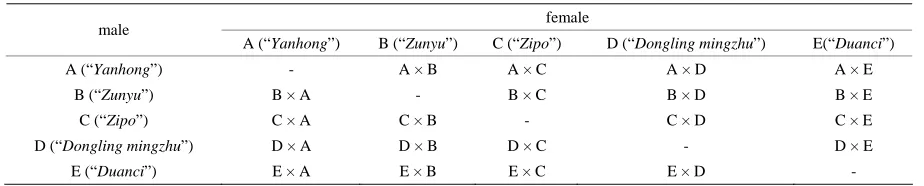
[image:2.595.68.530.643.736.2]nea mollissima cv. “Duanci”, Castanea mollissima cv. “Yanhong”, Castanea mollissima cv.“Donglingmingzhu” were selected for mutual pollination on the basis of germplasm resources survey. Pollens of all 5 varieties were respectively collected for reciprocal pollination. Each variety was pollinated with the other four varieties and there were totally 20 combinations. Varieties selection and pollination combinations design are as followed in
Table 1.
2.2. Test Site
The pollination experiment was carried out in the chestnut breeding base in Zunhua City, Hebei Province which is located at 40˚11'50"N latitude and 117˚58'30"E longi- tude. It is in the north of Tangshan City and belongs to warm temperate semi-humid monsoon climate and has four distinct seasons. The annual average sunshine hours is 2608.2 hours, annual average temperature is 10.9˚C, and lowest temperature is –25.7˚C. Frost-free period reaches 182 days and its precipitation is 724.7 millimeters. This
chestnut breeding base was selected as the test site was because Zunhua is one of the main chestnut production bases in north China.
Zunhua Chestnut mainly distributed in northern and western mountains areas along the Great Wall which is rich in gneiss. Weathered gneiss soils which contains large number of iron, managanese, sulfur, boron and other inorganic nutrients, coupled with low temperatures, large temperature difference and abundant rainfall here, make it suitable for growth of chestnut.
2.3. Test Method and Process
The research materials were healthy chestnut trees which were 20-year-old, non-pest, well-managed and in similar
growth situations. 15 trees of Castanea mollissima cv.
“Yanhong”, “Zunyu”, “Zipo”, “Donglingmingzhu” and “Duanci” were respectively and randomly selected as female parents. 7 - 8 similar female flowers in the east, west, north and south of each tree (totally 30) were picked out for pollination.
Chestnut flowers follow the leaves, appearing in mid- dle of May and reached its full flowering stage onto late May. As a consequence, the pollination experiment was carried out during May and the follow-up testing was respectively conducted in June when all the male flowers withered and September when chestnut matured.
May 8, 2010-May 13, 2010: Ziplock bags were applied to bag the female flowers before their stigmas’s appearing. May 15, 2010-May 24, 2010: It was the most appropriate season for pollination when the angle between stigma and stigma became 30˚ - 45˚ and most anther of male inflo- rescence turned yellow from green at this time. Ziplock bags were removed before pollens of inflorescence were directly applied to female stigmas. Then they were put on to the female flowers again immediately after the pollination. The job was repeated 3 days later.
June 15, 2010: All male flowers have withered and bags were taken off from the female flowers. Tags were hanged to branches to indicate male parents and fruiting rates were calculated.
September 17, 2010-September 27, 2010: Gather chest- nut and investigate their empty shell rate, seed-setting rate after the chestnut was harvested.
Table 1. Pollination combinations design.
female male
A (“Yanhong”) B (“Zunyu”) C (“Zipo”) D (“Dongling mingzhu”) E(“Duanci”)
A (“Yanhong”) - A × B A × C A × D A × E
B (“Zunyu”) B × A - B × C B × D B × E
C (“Zipo”) C × A C × B - C × D C × E
D (“Dongling mingzhu”) D × A D × B D × C - D × E
2.4. Statistics
The numbers of female inflorescence was recorded when pollinating. The fruiting condition was written down while ziplock bags were removed after all male flowers had withered and the numbers of empty shell were re- corded when chestnuts were collected.
The experimental data, in which self-pollination com- binations were considered as the CK, were analyzed by average method and One-way ANOVA, applying mean square error test method by spss17.0 statistical software.
3. Result
3.1. Affect from Different Combinations on Fruiting Rate and Seed-Setting Rate
Empty shell of chestnut, commonly known as no fruit, means nuts in shells did not develop or just leave the seed coat [6-8]. It is considered as no empty shell even when there is only one seed in it. To some extent, the level of seed-setting rate can be used as indicator for strength of pollinator affinity. That is, the higher the seed-setting rate is, the stronger the affinity will be and it could be consid- ered as a good combination [9].
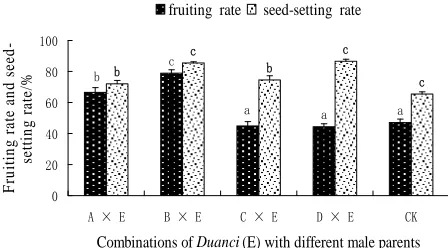
The fruiting rate and seed-setting rate of 5 varieties
Castanea mollissima cv.“Yanhong” (A), Castanea mollis- sima cv.“Zunyu” (B), Castanea mollissima cv.“Zipo” (C),
Castanea mollissima cv.“Donglingmingzhu” (D), Castanea mollissima cv.“Duanci” (E) are followed as Figures 1-5.
It can be seen from Figure 1 that: Seed-setting rate of
E × A, which reached 94.59%, was the highest in 4 com- binations, but its fruiting rate was low, only 47.52%, in- dicating that fruiting rate and seed-setting rate is not so consistent with each other. In contrast, both fruiting rate (84.95%) and seed-setting rate (79.43%) of B × A were very high. Seed-setting rate of D × A was 90.00%, while fruiting rate which was 72.37% was lower than that of B
c
a
b
a a
a a b
b a 40 60 80 100 120 g r ate a n d s ee d -ttin g r at e/% 0 20 B F ru
× A C × A D × A E × A CK
Combina erent male parents
iti
n se
tions of Yanhong(A) with diff fruiting rate seed-setting rate
differences in 5% level. Letters in bold de-ed differences among sede-ed-setting rate and those letters
[image:3.595.313.532.88.197.2]not in bold showed ting rate.)
Figure 1. Fruiting conditions of Yanhong (A) under differ-ent pollinations. (a: From Figures 1-5 small letters on the
ost indicate p
scrib
differences among frui
b
c
a
e
d
a b b
80 100 ed -a a 60 rate a g rate /% 0
A × B C × B D × B E × B CK
Combinations of Zunyu(B) with different male parents
F r 20 40 u itin g settin n d se
[image:3.595.314.531.245.371.2]fruiting rate seed-setting rate
Figure 2. Fruiting conditions of Zunyu (B) under different pollinations. b d c e a a ab ab b ab 0 20 40 60 80 100
A × C
F ru itin g r ate a n d s ee d -se ttin g r ate /%
B × C D × C E × C CK
[image:3.595.311.534.411.542.2]Combinations of Zipo(C) with different male parents fruiting rate seed-setting rate
Figure 3. Fruiting conditions of Zipo (C) under different pollinations. c d a d b ab a c bc a 40 60 80 100 tin g ra te a n d se ed -et tin g ra te /% 0 20
A × D B × D C × D E ×D CK
Combinations of Donglingmingzhu(D) with different male parents
F
r
s
fruiting rate seed-setting rate
u
i
Figure 4. Fruiting conditions of Donglingmingzhu (D) under different pollinations. a a a c b c c b c b 60 80 100 at e and s ee ra te /% 0 20 40
A × E B × E C × E D × E CK
Combinations of Duanci(E) with different male parents
Fr
ui
ti
ng r settin
g
fruiting rate seed-setting rate
[image:3.595.59.283.548.664.2] [image:3.595.310.534.583.707.2]× A. Fruiting rate and seed-setting rate of Castanea mollissima cv.“Yanhong” (A) who had been under natu-
ral pollination were 53.45% and 77.78%. As a result, Cas-
tanea mollissima cv.“Zunyu” (B)was the best pollination
A e 2: Fruiting rate of E × B,
a mollissima cv. to be the best pollination tree for cv.“Duanci” (E).
nd g Conditions
What’s more, fruiting conditions of cross combination fferent
with re
anci” (E) was Cas-
ing rate and 6%. Conse-
eties. Conse- qu
tree for Castanea mollissima cv.“Yanhong” (A).
s we can see from Figur
which reached 83.33%, was significantly higher than that of the other 3 combinations. Seed-setting rate of E × B was 81.60%, although lower than combination D × B, whose seed-setting rate was 90.54%, significantly higher
than its fruiting rate 38.95%. Fruiting rate of Castanea
mollissima cv.“Zunyu” (B), who had been in natural pol- lination, was only 71.27%, far below fruiting rate of E ×
B. Thus, Castanea mollissima cv. “Duanci”(E) was re-
garded as the best pollination tree for Castanea mollissima
cv.“Zunyu”(B).
It can be seen from Figure 3 that fruiting rate and
seed-setting rate of combination B × C were 86.61% and 87.33%, both of which were significantly higher than that of other 3 combinations. Fruiting rate and seed-set-
ting rate of Castanea mollissima cv. “zipo” (C) were
51.34% and 80.65% in natural pollination, and they re- spectively increased significantly by 35.27% and 7.08%
after pollinated by Castanea mollissima cv.“zunyu” (B).
So the result presented here indicated that the best variety
to comply with Castanea mollissima cv. “zipo” (C) is Cas-
tanea mollissima cv.“zunyu” (B).
It can be observed from Figure 4 that seed-setting rate
of C × D is significantly higher than that of other 3 com- binations, who reached 87.21%, but fruiting rate was low, only 57.33%. Both fruiting rate and seed-setting rate of A × D became lower than that of B × D. In contrast, fruit- ing conditions of B × D and E × D showed significant
advantages than that of Castanea mollissima cv.“Dong-
lingmingzhu” (D) under natural pollination for fruiting rate and seed-setting rate of B × D achieved 80.86% and 86.96%, and E × D reached 83.15%, 81.65%. Thus, the
best variety to comply with Castanea mollissima cv.
“Dong-lingmingzhu” (D) were Castanea mollissima cv. “Zunyu”(B) and Castanea mollissima cv.“Duanci” (E).
Figure 5 showed that fruiting condition of B × E was obviously better than that of A × E, C × E and D × E, whose fruiting rate got to 79.00% and seed-setting rate reached 89.45%. Though seed-setting rate of D × E be- came the highest of the 4 combinations, its fruiting rate was very low, only 44.50%, significantly lower than that of Castanea mollissima cv.“Donglingmingzhu” (D) under
natural pollination. As a result, Castane
“Zunyu” (B) turned out
Castanea mollissima
3.2. Relationship between Cross-Pollination a Fruitin
Fruiting conditions of 20 hybrid combinations and 5 fe-
male parents pollinated under natural conditions were analyzed through variance analysis, applying Duncan comparison test method, and the data come to the top of each post. The data presented above indicate that sig- nificant differences were brought into fruiting rate and seed-setting rate between hybrid combinations and female parent. Moreover, much variation appeared in fruiting rate and seed-setting rate between different hybrids. From
Figure 1 we can see that fruiting condition of chestnut has been greatly affected by cross-pollination. However, be- cause affinity among different pollination combinations vary widely, fruiting conditions of cross-pollination trees may become worse than the trees pollinated under natu- ral conditions. Such as fruiting rates of combinations A × B, D × B, C × D even became significantly lower than the female parent pollinated under natural condition. So, appropriate configuration of pollination varieties would become one of the key measures to improve the yield and quality of chestnut, while irrational configuration may even bring the reduction of output.
and inverse cross combination were significantly di each other. Such as fruiting rate of D × B, C × E we 38.91% and 45.02%, while B × D, E × C became 80.87% and 75.33%; seed-setting rate of E × A was 94.56%, but A × E only turned out to be 72.24%. Different varieties could comply with each other well when both fruiting conditions of cross combination and inverse cross com-
bination go very high. From the second group of Figure 1
we can see Castanea mollissima cv.“Duanci” (E) was re-
garded as the best pollination tree for Castanea mollissima
cv. “Zunyu” (B) with fruiting rate and seed-setting rate respectively coming to 84.33% and 81.76%; moreover, the
last group of Figure 1 showed the best variety to comply
with Castanea mollissima cv. “Du
tanea mollissima cv. “Zunyu” (B) with fruit seed-setting rate getting to 79.07% and 85.4
quently, Castanea mollissima cv.“Duanci”(E) and Cas-
tanea mollissima cv. “Zunyu” (B) could comply with each other quite well for configuration.
4. Discussion
4.1. The Best Configurations for Pollination Trees
The artificial pollination experiment which has been done by Renxue Xia and other experts on chestnut tree indicated that: empty shell rate of self-pollination tree was higher than that of cross-pollination tree and the number of nut decreased by 0.74 per shell [10]. Female flower has strong selectivity on pollen of different vari
Castanea mollissima cv.“Zunyu” (B)was
the best pollination tree for Castanea mollissima cv.
llissima cv.“Zipo” (C)
” (E) complied with each other best.
4.2. Assessment on Relationship between
ntly different between hybrid
combina-ral conditions. So, ppropriate configuration of pollination varieties would ecome one of the key measures to improve the yield and quality of chestnut, while irrational combination may even bring the reduction of output.
4.3. Actual Significance of the Results
One of the main reasons of low yield and low economic benefit of chestnut has been poor fruiting rate and seed- setting rate. Hence, more attention should be paid to pol- lination tree assignment. However, disadvantages such as no pollination trees, mess of mixed species and low yield per unit area are standing problems in Zunhua chestnut. What is more, no study on chestnuts pollination trees has been done in this region. Therefore, the best configure- tions above could help local planters avoid low fruiting rate and seed-setting rate problems. Meanwhile, assess- ment on relationship between cross-pollination and fruit- ing conditions highlighted irrational cross-pollination should be avoided, which corrected the long-terms errors that all the cross-pollination are beneficial.
All in all, it resolved the pollination tree problem which would increasingly improve chestnut yield in
Zunhua District
r her painstaking support, encouragement, su-
ience,
Vol. 41, No. 7, 1942, pp. 156-160.
[4] B. W. Fan and S. J. Luo, “A Study on the Percentages of Fertile Fruit of Different Cross Combinations of Chestnut Varieties,” Journal of Jiangxi Agricultural University, Vol. 15, No. 4, 1993, pp. 371-375.
[5] Z. F. Xie, S. C. Zeng and Z. S. Xie, “Study on Selection of Paternal Cultivars for Nongda No. 1 Chestnut,”
Jour-nal of Nanjing Forestry University (Natural Sciences
Edi-tion), Vol. 29, No. 5, 2005, pp. 94-96.
[6] C. C. Zhao, “Empty Shell Causes and the Prevention Tech-niques of Chestnut,” Hebei Fruits, Vol. 18, No. 4, 2008, p. 52.
[7] M. Y. Yao, “Empty Shell Causes and the Control Measures of Chestnut,” China Forestry, Vol. 54, No. 9, 2008, p. 62.
[8] W. P. Zhu, “Empty Shell Causes and the Countermea- sures of Chestnut,” Modern Agricultural Science and
Technology, Vol. 30, No. 17, 2009, p. 119.
[9] Z. F. Xie and J. X. Chen, “Chestnut Cultivation for Early Fruiting and Fertility,” Guangdong Science and Tech- nology Press, Guangzhou, 2000.
[10] R. X. Xia and M. T. Ma, “Study on the Forming of Chestnut Empty-Shell: Factor of the Effect to Empty Shell from Fertilization,” Journal of Huazhong Agricul-
tural University, Vol. 8, No. 3, 1989, pp. 242-247.
The cross-pollination experiment on 5 chestnut varieties indicated that:
fut
“Yanhong” (A), Castanea mo and
5. Acknowledgements
This study was supported by Silviculture and Conserva- tion, Ministry of Education and Hebei
Castanea mollissima cv.“Duanci” (E); Castanea mollis- sima cv.“Duanci” (E)was regarded as the best pollina-
tion tree for Castanea mollissima cv.“Zunyu” (B); the best
variety to comply with Castanea mollissima cv.“Dong-
lingmingzhu” (D)was Castanea mollissima cv. “Zunyu”
(B) and Castanea mollissima cv.“Duanci” (E); Castanea
mollissima cv.“Zunyu” (B)and Castanea mollissima cv. “Duanci
Cross-Pollination and Fruiting Conditions
The results presented here indicated that fruiting condi- tions were significa
[1]
tions and parents. What is more, fruiting rate, seed-setting also differ obviously among different hybrids. There- rate
fore cross-pollination influenced fruiting rate, seed-set- ting rate a lot. What’s more, fruiting conditions may be-
ome worse than that of under natu c
a b
ure in this area, as well as provided a theoretical basis for scientific pollination tree assignment for new chestnut orchard here.
Chestnut Experimental Station. Wang Qian, Zhao Di and Kou Yanru would like to express profound gratitude to advisor fo
pervision, and useful suggestions throughout this re- search.
REFERENCES
Y. H. Zhang, L. Liu and W. J. Liang, “The Fruit Index of China (Vol. Chestnut, Hazelnut),” China Forestry Press, Beijing, 2005.
[2] G. G. Jiang, “Early-Yield Cultivation Techniques of Chestnut,” China Forestry Press, Beijing, 1995.
[3] J. W. MoKay, “Self-Sterility in the Chinese Chestnut,”