STAR: Spatio-Temporal Taxonomy-Aware Tag Recommendation
for Citizen Complaints
∗
Jingyue Gao, Yuanduo He
† {gaojingyue1997,ydhe}@pku.edu.cnPeking University
Yasha Wang
‡[email protected] Peking University
Xiting Wang
[email protected] Microsoft Research AsiaJiangtao Wang
[email protected]Lancaster University
Guangju Peng, Xu Chu
{pgj.pku12,chu_xu}@pku.edu.cnPeking University
ABSTRACT
In modern cities, complaining has become an important way for citizens to report emerging urban issues to governments for quick response. For ease of retrieval and handling, government officials usually organize citizen complaints by manually assigning tags to them, which is inefficient and cannot always guarantee the qual-ity of assigned tags. This work attempts to solve this problem by recommending tags for citizen complaints. Although there exist many studies on tag recommendation for textual content, few of them consider two characteristics of citizen complaints, i.e., the spatio-temporal correlations and the taxonomy of candidate tags. In this paper, we propose a novelSpatio-TemporalTaxonomy-Aware
Recommendation model (STAR), to recommend tags for citizen complaints by jointly incorporating spatio-temporal information of complaints and the taxonomy of candidate tags. Specifically, STAR first exploits two parallel channels to learn representations for textual and spatio-temporal information. To effectively lever-age the taxonomy of tags, we design chained neural networks that gradually refine the representations and perform hierarchical rec-ommendation under a novel taxonomy constraint. A fusion module is further proposed to adaptively integrate contributions of tex-tual and spatio-temporal information in a tag-specific manner. We conduct extensive experiments on a real-world dataset and demon-strate that STAR significantly performs better than state-of-the-art methods. The effectiveness of key components in our model is also verified through ablation studies.
∗Jingyue Gao, Yuanduo He, Yasha Wang, Guangju Peng and Xu Chu are with Key
Laboratory of High Confidence Software Technologies, Ministry of Education, Beijing, China. Yuanduo He and Yasha Wang are also with National Engineering Research Center of Software Engineering, Peking University, Beijing, China.
†Jingyue Gao and Yuanduo He contributed equally to this work. ‡Yasha Wang is the corresponding author.
Permission to make digital or hard copies of all or part of this work for personal or classroom use is granted without fee provided that copies are not made or distributed for profit or commercial advantage and that copies bear this notice and the full citation on the first page. Copyrights for components of this work owned by others than ACM must be honored. Abstracting with credit is permitted. To copy otherwise, or republish, to post on servers or to redistribute to lists, requires prior specific permission and/or a fee. Request permissions from [email protected].
CIKM ’19, November 3–7, 2019, Beijing, China © 2019 Association for Computing Machinery. ACM ISBN 978-1-4503-6976-3/19/11. . . $15.00 https://doi.org/10.1145/3357384.3357894
CCS CONCEPTS
•Information systems→Data mining;Recommender sys-tems; •Computing methodologies→Machine learning;
KEYWORDS
tag recommendation; mining citizen complaints; spatio-temporal; taxonomy-aware
ACM Reference format:
Jingyue Gao, Yuanduo He, Yasha Wang, Xiting Wang, Jiangtao Wang, and Guangju Peng, Xu Chu. 2019. STAR: Spatio-Temporal Taxonomy-Aware Tag Recommendation for Citizen Complaints. InProceedings of The 28th ACM International Conference on Information and Knowledge Management, Beijing, China, November 3–7, 2019 (CIKM ’19),10 pages.
https://doi.org/10.1145/3357384.3357894
1
INTRODUCTION
[image:1.612.326.551.529.583.2]With the rapid progress of urbanization, citizens are increasingly concerned with emerging environmental and societal issues within cities, such as noise pollution [47] and traffic congestion [20], many of which are related to unsatisfying public services or lack of effec-tive governance [46]. Thus governments need to be well informed of these problems so that they can quickly respond and conduct flexible governance. To this end, a number of platforms have been developed and deployed in many cities to collect and response to citizen complaints [4, 28, 47].
Figure 1: A typical citizen complaint platform.
Figure 2: Temporal distributions of complaints tagged with
bus service(red) andnoise pollution(blue), respectively.
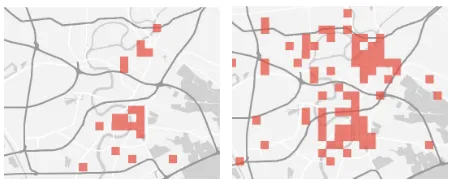
Figure 3: Spatial distributions of complaints tagged withtaxi
(left) andgarbage(right), respectively.
policy-making [14, 47]. However, it is often painstaking to manu-ally tag citizen complaints, especimanu-ally when officials are uncertain about the suitable tags among hundreds of candidates. Therefore, automatic tag recommendation for complaints is essential as it not only improves the tagging efficiency but also guarantees the quality of assigned tags, which becomes an indispensable component of intelligent city management.
Prior efforts on tag recommendation for textual content are mainly based on topic models [19, 24, 27, 39]. Some recent studies try to adopt deep neural networks since they have shown promising results in many language processing tasks [16, 29]. For example, Gong and Zhang [9] propose a two-way CNN architecture that consists of local and global channels. Li et al. [21] incorporate topic modeling into LSTM through an attention mechanism and Tang et al. [31] apply a novel seq2seq model. These methods have achieved encouraging performance due to their ability to learn good representations for textual content. However, merely modeling the content of complaints is not enough. We identify the following two key characteristics of tag recommendation for citizen complaints, which offer new opportunities for further improvement.
C1. Spatio-Temporal Correlations.In addition to textual con-tent, citizen complaints often contain timestamps and locations that indicate when and where the concerned issues happen. We ob-serve that many tags of complaints are highly correlated with their spatio-temporal information. As shown in Figure 2, complaints1 tagged withnoise pollutionhappen most around midnight, while those tagged withbus servicemainly occur during the running time of public buses. Similarly, in Figure 3, complaints with tagtaxi
usually happen at places next to roads, while those tagged with
garbagescatter more randomly in the whole city. Spatio-Temporal correlations can be viewed as prior knowledge that suggests which tags are suitable for a complaint even without its textual content. Thus, we are inspired to harness spatio-temporal information to enhance tag recommendation for complaints.
[image:2.612.57.289.86.151.2]1Detailed description of the citizen complaints dataset is in Section 4.1.1
Figure 4: Taxonomy of candidate tags for citizen complaints.
C2. Taxonomy of Candidate Tags.Similar to E-commerce websites which provide item taxonomies [44], citizen compliant platforms usually set up a taxonomy of candidate tags for ease of management. As shown in Figure 4 , the taxonomy is essentially a tree-like structure where parents represent more abstract meanings than their children (e.g.,noise pollutionandair pollutionbelong to the general category ofpollution). Since the taxonomy captures se-mantic tag correlations, we are motivated to leverage this structured knowledge to improve the tag recommendation performance.
However, there exist several challenges in integrating above observationsC1andC2for tag recommendation. First, it is im-proper to trivially combine textual content and spatio-temporal information together since they are of different modalities and de-scribe complaints from different views. Thus they are supposed to be elaborately encoded and represented. Second, spatio-temporal information is of different importance to different tags. It may com-plement textual content well when recommending some tags but could be useless or even noise for other tags, making it difficult to fuse textual and spatio-temporal information effectively. Third, it is challenging to further consider the taxonomy of tags given above concerns. Some pioneering studies [3, 8] propose to learn node em-beddings for a taxonomy, which fails to fully capture its structured knowledge. How to explicitly incorporate the tag taxonomy into our recommendation task still remains unexplored.
To tackle the aforementioned challenges, we propose a novel
Spatio-TemporalTaxonomy-AwareRecommendation model (STAR) to recommend tags for citizen complaints, which jointly incorpo-rates spatio-temporal information and the taxonomy of candidate tags. Specifically, STAR includes two parallel channels, a textual channel to encode the textual content of a complaint, and a spatio-temporal channel to encode its spatio-spatio-temporal information. With textual and spatio-temporal representations respectively, we design chained neural networks that predict which tags should be rec-ommended at each level of the taxonomy from general to specific. Predictions that violate parent-children relationships are further penalized. In this way, the obedience of the hierarchical structure is explicitly encouraged and the representations are gradually re-fined from coarse to fine. Thereafter, to effectively combine results based on textual and spatio-temporal information, we propose a fusion module that adaptively discriminates contributions of these two counterparts in a tag-specific manner. We conduct extensive experiments on a real-world dataset of citizen complaints to verify the rationality and effectiveness of our model.
To summarize, this work makes the following key contributions:
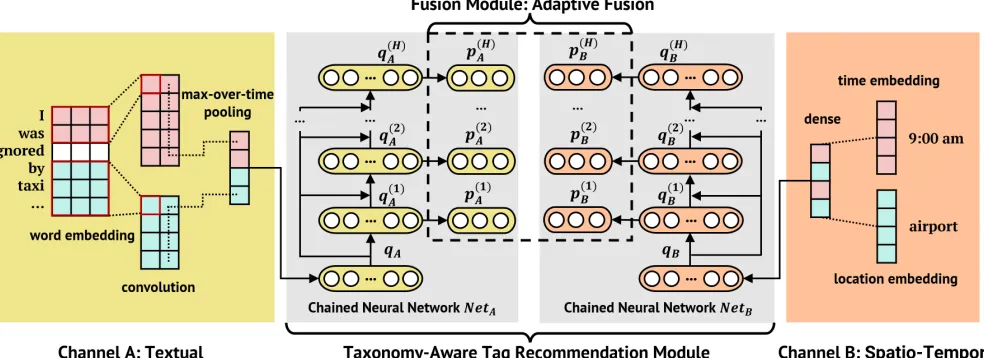
[image:2.612.61.288.183.276.2]Figure 5: The framework of STAR.
•We propose to explicitly take into consideration the informa-tion of tag taxonomy for tag recommendainforma-tion. Particularly, we incorporate the taxonomy of tags by employing chained neural networks for hierarchical recommendation with a novel taxonomy constraint.
•Experimental results on a real-world dataset show that STAR significantly outperforms state-of-the-art methods. Impor-tant components of our model are verified through abla-tion studies. We further demonstrate its robustness via thor-ough parameter sensitivity analysis. Case studies are also conducted to show that STAR can fuse textual and spatio-temporal information reasonably.
2
PROBLEM FORMULATION
We define the problem of tag recommendation for citizen com-plaints as follows.
Input.The input data of our model consists of a citizen com-plaintCand a given taxonomyϒof tags.
Definition 1. Thecitizen complaintC is a three-tuple, i.e.,
(Cw,Ct ime,Cl oc), whereCw is a sentence of words describing the
complaint content,Ct imeis the timestamp indicating when the
con-cerned issue happens, andCl ocis the corresponding location.
Definition 2. Thetag taxonomyϒis a tree that expresses the hierarchy of tags via a parent-child relationship. As shown in Figure 4, a child node (e.g.,air pollution) is a sub-tag of its parent (e.g., pollu-tion). We denote the set of nodes inϒasT, whereT ={t1,t2, ...,tL}
andLrepresents the total number of nodes inϒ. The set of all leaves inϒis denoted asTleafand that of inner nodes is denoted asTinner.
Definition 3. Thehierarchical levelhloftlis recursively
de-fined based on its parent:hl =hpar ent(l)+1, wheretpar ent(l)is the
parent oftl. Iftlis the root of ϒ,hl is set to 0. Note that hierarchical
levels of all leaves may not be the same. We useHto denote the largest hierarchical level of nodes.
Output.Given a citizen complaintCand a tag taxonomyϒ, for each leaf tagtl ∈ Tleaf, our model outputs the probabilitypl ∈ [0,1]
thattl is suitable for this complaint.
3
THE PROPOSED MODEL
In this section, we first introduce the model overview. Then, we describe the design of major components in STAR and illustrate how the components can be jointly optimized.
3.1
Model Overview
The overview of the STAR framework is illustrated in Figure 5. It mainly consists of the following components.
Textual and Spatio-Temporal Channels.Since textual con-tent and spatio-temporal information are of different modalities and describe complaints from different views, we apply the textual channel A and the spatio-temporal channel B to process the com-plaintCrespectively. In particular, channel A takesCw as input
and obtain the textual representationqAthat capture semantics of C. GivenCt imeandCl oc, channel B obtains the representationqB
that captures spatio-temporal features ofC, where we also consider the spatial and temporal smoothness.
Taxonomy-Aware Tag Recommendation Module.In this module, we recommend tags based onqAandqB. To explicitly
incorporate the tag taxonomyϒto guide the recommendation pro-cess, we design two symmetricchained neural networks(NetA
andNetB) which operate onqAandqBrespectively. Under the taxonomy constraint, the chained neural networks perform tag recommendation at different hierarchical levels ofϒand the initial representationqA/qBis gradually refined from coarse to fine, thus leading to better performance.
Fusion Module.The recommendation results (i.e,pA,l,pB,lfor
eachtl ∈ T) based onqAandqBare integrated in the fusion
3.2
Textual Channel
GivenCw =[w1,w2,· · ·,wn]withnwords, we aim to obtain
tex-tual representation ofCthat captures its semantics. Here we choose the Kim CNN [16] architecture, which has been widely used for sentence representation learning [2, 33] due to its ability to simul-taneously preserve word orders and enable efficient computation.
Specifically,Cw is first encoded intoW1:n =[e1,e2,· · ·,en] ∈
Rdw×nthrough a word embedding layer, wheredwis the
embed-ding size. Then a convolution operation with filterf ∈Rdw×s is
applied toW1:n, wheres(s≤n) is the window size of the filter. A
featurecfi is computed from the sub-matrixWi:i+s−1as:
cf
i =σ(f∗Wi:i+s−1+b), (1)
where∗is the convolution operation,σis an activation function, andb ∈ Ris the bias. By applying the filter to every possible position ofW1:nand performing max-over-time pooling, we select
the most significant feature:
ˆ
cf =max({cf
1,c
f
2,· · ·,c
f
n−s+1}) ∈R. (2) Finally, all features ˆcf from multiple filters (with varying windows sizes) are concatenated together as the final representation:
qA=[cˆf1,cˆf2,· · ·,cˆfdA] ∈RdA, (3)
wheredAis the total number of filters.
3.3
Spatio-Temporal Channel
In this channel, we aim to processCt ime andCl oc to obtain the
representation that captures spatio-temporal features ofC. Specifically, we equally partition a day intoNt imeslots and
dis-cretizeCt imeby the slot it falls into. Similarly, we partition the city
into a grid map ofNl occells for the discretization ofCl oc. Therefore,
Ct imeandCl ocare coded as two one-hot vectors. Then, we leverage
two embedding matrices,Et imeandEl oc, to embedCt imeandCl oc
aset ime∈Rdt ime,el oc∈Rdl ocrespectively, wheredt ime,d
l ocare
embedding sizes andEt ime ∈RNt ime×dt ime,Et ime ∈RNl oc×dl oc are parameters to learn.
We further concatenateet ime,el octogether and pass it through
a dense layer, i.e. fully connected network, to obtain the joint rep-resentation of spatio-temporal information by:
qB=σ(WB(et ime⊕el oc)+bB) ∈RdB, (4)
wheredBis the size for spatio-temporal representation,⊕is the
concatenation operator,WB ∈ RdB×(dt ime+dl oc),bB ∈ RdB are parameters to learn.
To better instruct the learning ofEt imeandEl oc, we additionally
consider their temporal and spatial smoothness. Intuitively, two adjacent time slots (e.g., 1-2 a.m. and 2-3 a.m.) tend to show similar temporal characteristics and thus their corresponding embeddings are expected to be similar. The above observation also applies to locations. To incorporate such smoothness prior, we introduce the following loss termLsmoonEt imeandEl oc:
Lsmo=∥Mt imeEt ime∥F2+∥Ml ocEl oc∥F2, (5)
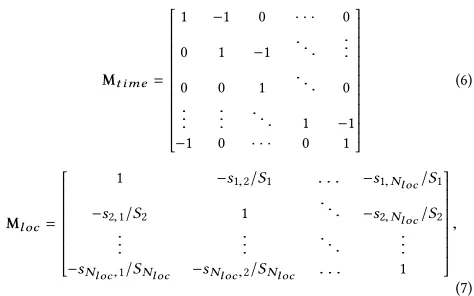
where∥ · ∥F is the Frobenius norm. Inspired by [34], we define Mt ime ∈RNt ime×Nt imedescribing correlations between time slots
andMl oc∈RNl oc×Nl ocdescribing correlations between cells by:
Mt ime=
1 −1 0 · · · 0
0 1 −1 . . . ...
0 0 1 . . . 0 ..
. ... . . . 1 −1
−1 0 · · · 0 1 (6)
Ml oc=
1 −s1,2/S1 . . . −s1,Nl oc/S1
−s2,1/S2 1 . . . −s2,Nl oc/S2
..
. ... . . . ...
−sNl oc,1/SNl oc −sNl oc,2/SNl oc . . . 1
, (7) wheresi,j =d1i,
j anddi,j is the euclidean distance between the
centers of celliandjandSi =Íj,isi,j is for scaling.
3.4
Taxonomy-Aware Tag Recommendation
In this module, we perform tag recommendation based onqAand
qB. To leverage the tag taxonomy in guiding the recommendation
process, we hierarchically make predictions for tags at different levels ofϒfrom general to specific, and impose the taxonomy constraint that encourages obedience of this hierarchical structure. SinceqAandqBdescribe the complaint from different views,
[image:4.612.322.559.98.246.2]two independent sets of recommendation results based on them can be obtained and further integrated (see Section 3.5), which is a common paradigm of multi-view learning [40]. As shown in Figure 5, two parallel chained neural networksNetAandNetBare
employed to operate on them respectively. In the following, since NetAandNetBonly differ in their inputs, we focus on illustrating
the process forNetAwithout loss of generality.
3.4.1 Hierarchical Recommendation.We model the taxonomy of tags inNetAby jointly predictingplfortlat different levels. Our
method is based on the chained neural network [36, 37] which is effective in generating multiple outputs in a hierarchical structure. Since tags at different levels describe a complaint at different levels of abstractness, hierarchical recommendation overϒrequires representations of different granularities. InNetA, the initial textual
representationqAsequentially flows throughH chained layers,
each layer corresponding to one level ofϒ. In this way,qAcan be
gradually refined from coarse-grained to fine-grained. Specifically, the representationq(1)A of the first level is calculated as follows:
q(1)A =σ(W(1)AqA+b(1)A) ∈Rd1, (8)
whereW(1)A ∈ Rd1×dA,b(1)
A ∈ R
d1 are parameters to learn. The
representationq(Ah+1)of levelh+1 is based on that of levelh:
q(Ah+1)=σ(WA(h+1)(q(Ah)⊕qA)+b
(h+1)
A ) ∈R
dh+1, (9)
whereW(Ah+1)∈Rdh+1×(dA+dh),b(h+1)
A ∈R
dh+1are parameters to
learn. Here we add a residual connection forqAto avoid the loss
of raw information during propagation through multiple layers. LetLhdenote the number of tags at levelh. Withq
(h)
A , we aim
probabilitiespA,l ∈ [0,1]for alltlat levelh:
p(Ah)=[· · ·,pA,l,· · · ]=sigmoid(MLP(q(Ah))), (10)
where MLP(·) is a multi-layer perceptron that consists of one hidden layer for feature transformation and another layer for output.
3.4.2 Taxonomy Constraint.We further model the parent-child relationship between tags. Intuitively,if tagtlis suitable for
com-plaintC, at least one child oftl is also suitable and vice versa. The
taxonomy constrains that the predicted probability for an inner node should be close to the maximal value of its children. To pe-nalize violation of this structural constraint, as illustrated in Figure 6 (a), we propose to perform max pooling over children of inner nodes and compute the following loss term:
Ltax= Õ
tl∈ Ti nne r
∥pA,l − max
i∈childr en(l)pA,i
∥2, (11)
wherepA,lis the predicted probability fortlby (10), andchildren(l)
is the index set of all children oftl. By consideringLtaxin final optimization, we explicitly encourage obedience of the hierarchical structure inϒ. To help clarify this, the example in Figure 6 (d) is preferred to that in (b) and (c).
3.4.3 Summary.We apply binary cross entropy to calculate the prediction loss fortl ∈ T. Since onlytl ∈ Tleafwill be recommended in practice, we particularly divide the loss of all tags into two groups:
Linner=− Õ
tl∈Tinner
(1−yl)log(1−pA,l)+yllogpA,l,
Lleaf=− Õ
tl∈Tleaf
(1−yl)log(1−pA,l)+yllogpA,l, (12)
whereyl ∈ {0,1}is the ground truth of whethertlis assigned toC.
yl fortl ∈ Tinnercan be recursively inferred:yl = max i∈childr en(l)yi. Then, the total loss forNetAis defined as:
LA=Lleaf+λinnerLinner+λtaxLtax, (13)
whereλinner,λtax>0 are hyper-parameters. The lossLBforNetB
[image:5.612.68.275.522.680.2]is defined in the same way.
Figure 6: Illustration of our taxonomy constraint.
3.5
Fusion Module
For eachtl ∈ T, the recommendation module outputs two
predic-tionspA,landpB,lbased onqAandqBrespectively. In this module,
we aim to fuse them for the final predictionpl.
Instead of using a constant fusion weight, we propose to adap-tively combinepA,landpB,lin a tag-specific manner, i.e, different
fusion weights are used for different tags. The reason is that the rela-tive importance of textual content and spatio-temporal information in the recommendation task varies with tags. For example, some tags are highly correlated with spatio-temporal information while others may be weakly correlated. Spatio-Temporal information is more important in the former case than the latter. To this end, we introduce a fusion vectorw∈ [0,1]Lto learn, wherewlrepresents
the weight in combiningpA,l andpB,l:
pl =wlpA,l+(1−wl)pB,l. (14)
Here the largerwl is, the more textual information contributes to
the final recommendation. Givenpl for eachtl ∈ T, we compute
the fusion lossLfusionsimilar to that forNetAandNetBin (13).
3.6
Joint Learning
Composed of channel A, channel B, recommendation module, and fusion module, our STAR model can be jointly optimized in an end-to-end manner. We minimize the following objective function:
L=Lfusion+λALA+λBLB+λsmoLsmo, (15)
whereλA,λB,λsmo>0 are weights for corresponding loss terms. We use the Adam optimizer [17] because it can automatically adjust the learning rate during the training phase.
4
EXPERIMENTS
In this section, we conduct experiments to evaluate our proposed model2. We aim to answer the following research questions:
• RQ1:Compared with state-of-the-art tag recommendation models, how does STAR perform?
• RQ2:What is the influence of various components in the architecture of STAR?
• RQ3:How do different hyper-parameter settings (e.g., the size of training data, weights of loss terms and the size of word embedding) affect the performance of STAR? • RQ4:Can the fusion module reasonably integrate results
based on textual and spatio-temporal information?
4.1
Experimental Settings
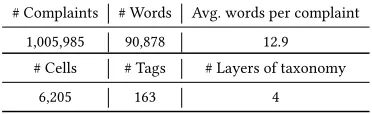
4.1.1 Dataset Description.Our dataset comes from the records of a citizen complaint platform in Tianjin. With the resident popu-lation around 16 million, Tianjin is one of the four municipalities in China. Each record in our dataset contains the id, text description, timestamp, location and assigned tags of a complaint. We collect the complaints from June 1, 2016 to July 30, 2018. For privacy concerns, we have completely anonymized the dataset before data mining.
Following [31], we preprocess texts of complaints by removing all the punctuation marks from the text and splitting the remaining string into individual words. Common stop words are also discarded. For temporal information, we convert timestamp of each complaint
Table 1: Basic statistics of the complaints dataset.
# Complaints # Words Avg. words per complaint
1,005,985 90,878 12.9
# Cells # Tags # Layers of taxonomy
6,205 163 4
into a 24-dim one-hot vector indicating which hour it belongs to. For spatial information, we partition the city into a grid map and map location of each complaint to the cell it belongs to. The side length of each cell is set to 1 kilometer following [12]. The basic statistics of the dataset are shown in Table 1.
4.1.2 Baselines.To demonstrate the effectiveness of our pro-posed STAR, we select seven competitive methods for comparison: • LDA[19] recommends tags for textual content based on Latent
Dirichlet Allocation (LDA).
• Maxide[41] is a traditional multi-label learning method for tag recommendation, which makes predictions based on speedup matrix completion with side information.
• Kim CNN[16] is first proposed for sentence classification. Here it can be used to learn representations for complaints with CNN and then recommend tags.
• LSTMis a widely-used variant of RNN. Similar to [21], we perform an average pooling operation on the hidden vectors at each position of LSTM as the representation of complaints.
• TLSTM[21] is a novel attention-based LSTM model which incor-porates topic modeling into the LSTM architecture through an attention-mechanism.
• ABC[9] adopts an attention-based CNN architecture for tag recom-mendation, which models the textual content with a local attention channel and a global channel.
• iTag[31] is an integrated model which jointly considers sequential text modeling, tag correlation and content-tag overlapping in a coherent encoder-decoder framework.
4.1.3 Evaluation Metrics.To evaluate the performance of mod-els, we adopt the widely-usedF1(the threshold is set to 0.5) and Precision-RecallAUCthat jointly consider precision and accuracy. A higher F1 or AUC indicates a better performance.
4.1.4 Implementation Details.Our STAR model is implemented in Pytorch3. We randomly split the dataset into training (70%), vali-dation (15%) and test (15%) sets. We tune hyper-parameters on the validation set and report the performance on the test set. For all methods, we use the Adam optimizer [17] with an initial learning rate of 0.001. The co-efficient ofL2norm regularization is fixed to 0.001 and the batch size is fixed to 256. The word embedding size dwis fixed to 128. The above settings are for fair consideration. For
other hyper-parameters of baselines, we directly reuse them if re-ported by their authors. Otherwise, we tune them on the validation set. After parameter tuning, we set the number of topics in LDA and TLSTM to 60. The filter sizes in Kim CNN and STAR are set to {1,2,3,4,5}, each size with 80 filters.λA,λB,λinner,λtaxandλsmo
of STAR are set to 1.0, 1.0, 1.5, 0.1, and 0.01 respectively. We use ReLU [23] for activation functions in STAR as it performs best on the validation set. Each experiment is repeated twenty times and we report the average and standard deviation as the result.
[image:6.612.322.555.128.231.2]3https://pytorch.org/
Table 2: Comparison among different models. Best results are highlighted in bold.p-value is the probability of no sig-nificant difference with STAR on both F1 and AUC byt-test.
Models F1 (%) Impv. AUC (%) Impv. p-value
STAR 81.6±0.1 - 89.3±0.1 - -LDA 37.4±0.1 +118.2% 62.4±0.1 +43.1% < 10−3
Maxide 57.5±0.1 +41.9% 70.6±0.0 +26.5% < 10−3
Kim CNN 77.6±0.3 +5.2% 86.4±0.1 +3.4% < 10−3
LSTM 77.0±0.5 +6.0% 85.6±0.3 +4.3% < 10−3
TLSTM 79.8±0.3 +2.3% 87.9±0.2 +1.6% < 10−3
ABC 79.0±0.2 +3.3% 87.5±0.1 +2.1% < 10−3
iTag 67.8±1.0 +20.4% - - < 10−3
4.2
Performance Comparison (RQ1)
We report the performance of all models in Table 2. The improve-ments of STAR compared with baselines are also listed. Note that iTag does not output probability for each candidate tag, which pre-vents us from calculating its AUC. After analyzing the results, we have the following observations.
First, methods based on deep learning (Kim CNN, LSTM, TLSTM, ABC, iTag, and Ours) significantly outperform those traditional methods (LDA and Maxide). The improvement on average is 62.6% on F1 and 31.3% on AUC. This is because deep neural networks can better capture the semantics of complaints than bag-of-words or topic modeling used by traditional methods. It also demonstrates the necessity of adopting neural networks in our textual channel which effectively encodes textual content of complaints.
Second, TLSTM and ABC perform better than Kim CNN and LSTM by 2.7% on F1 and 2.0% on AUC. We attribute it to the fact that the attention mechanism applied by ABC and TLSTM allows them to focus on words that are more important in recommending suitable tags. We notice that iTag performs worse than LSTM. It makes sense since iTag overemphasizes the sequential order of tags which does not matter in this task. It also focuses on mod-eling content-tag overlapping phenomenon [31] which is rare in citizen complaints. These improper assumptions of iTag hurt its performance.
Third, our proposed STAR achieves the best performance among all models, outperforming the second best one by 2.3% on F1 and 1.6% on AUC. Its improvements over baselines are all statistically significant. Sharing the same textual channel with Kim CNN, STAR outperforms it by 5.2% on F1 and 3.4% on AUC. We attribute the superiority of STAR to its two properties. First, STAR recommends tags in a taxonomy-aware way so that coarse-grained representa-tion of complaints can be gradually refined in different levels from general to specific. Second, STAR exploits correlations between tags and spatio-temporal information of complaints, which makes it more comprehensive and robust than models totally based on textual content and yields better performance consequently.
4.3
Ablation Study (RQ2)
We analyze impacts of key components in STAR via ablation studies. The default model is compared with following variants.
Table 3: Comparison among variants of STAR. Best results are highlighted in bold.p-value is the probability of no sig-nificant difference with STAR on both F1 and AUC byt-test.
Variants F1 (%) AUC (%) p-value
STAR 81.6±0.1 89.3±0.1 -STAR without taxonomy 77.6±0.2 86.5±0.1 < 10−3
STAR with channel A only 81.1±0.1 89.2±0.0 < 10−3
STAR with channel B only 14.2±0.4 25.7±0.2 < 10−3
STAR without fusion 81.1±0.1 89.2±0.1 < 5×10⁻²
STAR with constant fusion 81.0±0.1 89.0±0.1 < 10−3
• STAR with channel A only (V2)removes the spatio-temporal channel and is solely based on the textual content.
• STAR with channel B only (V3)removes the textual channel and is totally based on spatio-temporal information.
• STAR without fusion (V4)feeds the concatenation of textual and spatio-temporal representations into the recommendation module. Thus it does not require a fusion module.
• STAR with constant fusion (V5)fuses results based on two chan-nels with a fixed weightw. Herewis empirically set to 0.9 so that more attention can be paid to textual content.
Comparison results are listed in Table 3, from which we make the following conclusions.
Effectiveness of being taxonomy-aware.Compared with V1, STAR achieves 5.2% higher F1 and 3.2% higher AUC. It demonstrates the effectiveness of incorporating the tag taxonomy. Such hierarchi-cal knowledge allows our model to capture semantic correlations between tags and refine the representation of complaints in differ-ent levels, thus enabling better tag recommendation.
Effectiveness of spatio-temporal information.The improve-ment of STAR over V2 shows that spatio-temporal information can act as a useful complement to textual content. However, the poor performance of V3 suggests that merely modeling spatio-temporal information of complaints is far from enough. It is reasonable since complaints may happen at the same location and same time slot but describe totally different issues. Overall, comparison with V2 and V3 demonstrates the necessity of jointly modeling textual content and spatio-temporal information via two parallel channels in STAR.
Effectiveness of adaptive fusion.The superiority of STAR over V4 shows that the effects of textual content and spatio-temporal information on recommendation should be modeled independently and then fused together. Simply concatenating and feeding them into the recommendation module will worsen the performance. We also observe that STAR outperforms V5 which uses a fixed weight in the fusion module. It is because the importance of spatio-temporal correlations for tags may vary from one to another and constant weighting fails to handle this problem properly. It further verifies our design of dynamic fusion that adaptively discriminates contributions of textual content and spatio-temporal information.
4.4
Parameter Sensitivity Analysis (RQ3)
We start by exploring how the performance of STAR changes with the varying amounts of training data. We then analyze the impact of word embedding sizedw. Moreover, we study how the weights
[image:7.612.321.553.214.309.2]of different loss terms affect performance. When conducting param-eter sensitivity analysis, we set other hyper-paramparam-eters to values described in Section 4.1.4.
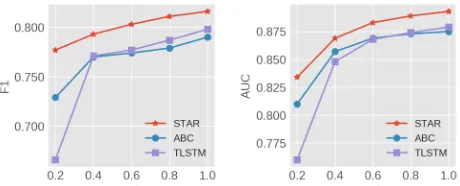
Figure 7: Performance of STAR w.r.t different ratios of train-ing data (compared with two competitive baselines).
Figure 8: Performance of STAR w.r.t different word embed-ding sizes (compared with two competitive baselines).
4.4.1 Varying the amount of training data.We take 20%, 40% , 60% and 80% of the complete training data as four new training datasets. Two competitive baselines (TLSTM and ABC) are used for comparison. The results are shown in Figure 7. We can see that STAR consistently achieves the best performance with varying amount of training data, outperforming TLSTM by 16.7% on F1 when the ratio is set as 20%. It demonstrates the robustness of STAR against data insufficiency. We owe it to the incorporation of the tag taxonomy which contains semantic correlations of tags. Such prior knowledge is especially useful when the low incidence of some tags in the training data provides little learning opportunity to complex models. We also notice that the performance of TLSTM drops significantly when encountering data insufficiency, which may be caused by the smooth nature of LSTM [11].
4.4.2 Varying the word embedding sizedw.In our model, an
embedding layer is applied to encoding textual content of citizen complaints. To see the effect of embedding size on the performance, we vary it in the set{16,32,64,128,256}. ABC and TLSTM are also chosen for comparison. As shown in Figure 8, STAR constantly outperforms baselines with varyingdw, which further demonstrates
the robustness of our approach. We also observe that increasing dwof models does not necessarily improve the performance of tag
recommendation because too many parameters in the embedding layer may lead to overfitting.
4.4.3 Varying the weightλinner ofLinner.Although we only
Figure 9: Performance of STAR w.r.t weights ofLinner.
Figure 10: Performance of STAR w.r.t weights ofLtax.
Figure 11: Performance of STAR w.r.t weights ofLsmo.
λinnermay make one of them dominate the learning process and yield unsatisfying model performance.
4.4.4 Varying the weightλtaxofLtax. We penalize the
misalign-ment between predictions on parents and children by further con-sideringLtaxin (13). We vary its weightλtaxin{0,0.01,0.1,1,10} and show results in Figure 10. It can be seen that the best F1 and AUC are achieved whenλtax= 0.1 and 1.0 respectively. The perfor-mance degrades whenλtax= 0. This demonstrates the importance of involving alignment between parents and children. Such design allows STAR to predict in a way that is coherent with hierarchical knowledge in the taxonomy of tags.
4.4.5 Varying the weightλsmoofLsmo.Timestamps and
[image:8.612.58.287.86.181.2]loca-tions of complaints are encoded via two embedding matrices in the spatio-temporal channel. We further encourage the smoothness of embedding matrices by imposingLsmoon model learning. To study its influence, we vary its weightλsmoin{0,0.01,0.1,1,10}. As shown in Figure 11, the best performance of STAR is achieved whenλsmo= 0.01. Both F1 and AUC degenerate whenλsmo=0, i.e., not consideringLsmoat all. Thus we conclude that it is necessary to consider the smoothness prior, which helps STAR learn better embedding matrices for spatio-temporal information. We also note that too largeλsmoworsens the performance. It makes sense since
Figure 12: Histogram of learned fusion weights for both in-ner tags (blue) and leaf tags (red).
too much emphasis onLsmoenforces the embeddings of time slots and cells to be identical and thus the entire spatio-temporal channel becomes meaningless.
4.5
Study on the Fusion Module (RQ4)
In (14) of Section 3.5, we combine predictions based on textual and spatio-temporal information in a tag-specific manner, wherewl ∈
[0,1]is the fusion weight learned for tagtl. The largerwl is, the
more textual information contributes to the final recommendation oftl and vice versa. In this section, we first give an overview of
the distribution ofwl for all tags. Then we conduct case studies to
illustrate that STAR is able to reasonably determinewl.
4.5.1 Overview of all weights.The distribution ofwl fortl ∈ T
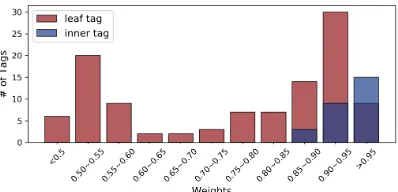
is illustrated as a histogram in Figure 12. We observe thatwlmainly
distributes between 0.50 and 1.0, showing that textual information consistently plays an important role in tag recommendation. It is reasonable sinceCwof an complaint often describes the concerned
issue in details and is indispensable for tag recommendation, which corresponds with the bad performance of V3 in Section 4.3. We also notice that allwl of inner tags are larger than 0.80, which makes
sense since spatio-temporal correlations for inner tags (coarse-grained) are often weaker than leaf tags (fine-(coarse-grained). Thus spatio-temporal information contributes less to prediction for inner tags. Another interesting observation is that there are two dense re-gions ofwlfor leaf tags, the one around 0.55 and the one around
0.90, corresponding to tags that are highly correlated and weakly correlated with spatio-temporal information. In the following, we further study examples of tags with large or smallwl.
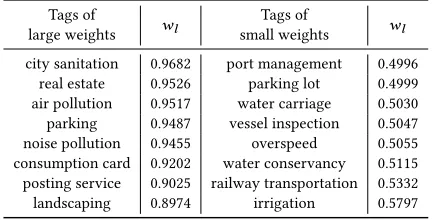
4.5.2 Case studies of weights.In Table 4, we list several tags of interest, i.e. with either large (∼0.90) or small (∼0.50) fusion weightswl. Basically, tags that are highly correlated with certain
locations usually have smallwl. For example, complaints about
vessel inspection,port managementmostly take place in the area of harbor and thus spatial information is of great significance in recommending these tags. On the contrary, when complaints may happen in a rather large area, e.g.,air pollution,posting service, etc, recommendation relies relatively more on the textual information. Among the listed tags, we notice two intriguing examples. First,
noise pollution, which is closely correlated with temporal informa-tion (often happens at midnight), has a fusion weight of 0.9455, indicating that recommendation of this tag largely depends on textual information. After checking raw complaints tagged with
[image:8.612.58.287.328.430.2]Table 4: Examples of tags of large or small fusion weights.
Tags of
large weights wl
Tags of
small weights wl
city sanitation 0.9682 port management 0.4996 real estate 0.9526 parking lot 0.4999 air pollution 0.9517 water carriage 0.5030 parking 0.9487 vessel inspection 0.5047 noise pollution 0.9455 overspeed 0.5055 consumption card 0.9202 water conservancy 0.5115 posting service 0.9025 railway transportation 0.5332 landscaping 0.8974 irrigation 0.5797
writes like“...a large noise outside ...”, making merely textual in-formation effective enough for precise tag recommendation and dominate the task. The second is a comparison made between the two “parking” related tags. For“parking lot”which refers to a par-ticular type of location, the tag recommendation is largely affected by spatio-temporal information withwl ∼0.50. On the other hand,
for“parking”which describes an event which may happen at many places (e.g., parking lots or roadside anywhere), the recommenda-tion mainly depends on the complaint text withwl ∼0.95 as it is
weakly correlated with spatio-temporal information.
The above study verifies that tags are not equally correlated with spatio-temporal information and thus it is necessary to adaptively determine fusion weights in a tag-specific manner. It also shows that STAR learns reasonable weights in the fusion module.
5
RELATED WORK
In this section, we review the studies related to our work.
5.1
Mining Citizen Complaints
In recent years, a number of citizen complaint platforms have been deployed to facilitate communication between citizens and govern-ments [4, 14, 28]. Since such complaints reveal underlying problems within cities, there is now a significant research interest in mining citizen complaints to obtain valuable insights. For example, Zheng et al. [47] propose to diagnose the noise pollution of a city based on the complaints data. Zheng et al. [48] also attempt to detect collective anomalies with the aid of citizen complaints. Besides, Zhao et al. [46] propose to predict crimes by integrating citizen complaints with other data sources such as human mobility and point of interests. However, all of these studies require citizen com-plaints to be correctly organized into fine-grained categories or given suitable tags describing their content. In fact, it is painstaking to manually tag citizen complaints and the tagging quality cannot be guaranteed under many circumstances. Thus we aim to automat-ically recommend suitable tags for citizen complaints, which can benefit above downstream applications and is of great importance especially under the context of intelligent city management.
5.2
Tag Recommendation
Existing work on tag recommendation can be divided into collabo-rative filtering methods and content-based methods [31, 39].
Collaborative filtering methods.Methods in this class aim to employ users’ tagging histories (i.e., user-item-tag tuples) and
recommend tags to users in a personalized manner. Typically, Syme-onidis et al. [30] construct user-item-tag tensors and model per-sonalized tag recommendation as a tensor factorization problem. Rendle et al. [26] further incorporate pairwise rankings into tensor factorization. Fang et al. [5] exploit Gaussian radial basis function to increase the capacity of Canonical Decomposition. It is also modeled as a link prediction problem in a heterogeneous graph by [6, 45]. However, collaborative filtering methods only consider a fixed set of items and fail to recommend tags for new content. Thus, we focus on content-based methods when recommending tags for citizen complaints which cannot be determined beforehand.
Content-based methods.Content-based methods try to rec-ommend suitable tags by directly modeling the content. There exist studies towards various types of content, e.g., videos [32], audios [7], images [25, 43], and text [24]. We mainly pay attention to those for textual content since citizen complaints are often in this format. Ramage et al. [24] and Krestel et al. [19] propose to recommend tags based on topic models. Wu et al. [38, 39] further consider the tag-content relevance phenomenon. Many recent studies apply neu-ral networks to learn representations for the textual content, which have achieved encouraging results. Gong and Zhang [9] adopt a novel attention-based CNN architecture that consists of global and local channels. Li et al. [21] propose topical attention-based LSTM that incorporates topic distributions into sequential modeling of the content. Tang et al. [31] propose a seq2seq method that jointly models tag correlation and content-tag overlapping.
To improve the recommendation performance, some studies at-tempt to combine the content information with other types of data. For example, Gong et al. [10] additionally model types of tags as a hidden variable into their DPMM (Dirichlet Process Mixture Mod-els). Besides, Ma et al. [22] and Zhang et al. [42] propose to introduce temporal information for improvement. However, the taxonomy of tags utilized in our approach is ignored by existing studies on tag recommendation, though it exists widely in real-world systems and is easy to obtain [13, 15]. Based on the spatio-temporal characteris-tic of citizen complaints, we further incorporate spatio-temporal information into our proposed model.
5.3
Taxonomy-Aware Recommendation
6
CONCLUSION
In this paper, we propose a novel spatio-temporal taxonomy-aware recommendation model STAR to recommend tags for citizen com-plaints, which jointly incorporates spatio-temporal information and the taxonomy of candidate tags. Specifically, STAR employs two parallel channels to learn textual and spatio-temporal repre-sentations of complaints, and then feed them into chained neural networks that perform hierarchical recommendation under the tax-onomy constraint. An adaptive fusion module is further proposed to integrate results in a tag-specific manner. Extensive experiments on a real-world dataset demonstrate that STAR outperforms state-of-the-art methods significantly. The effectiveness of key components in STAR is also verified through ablation studies.
ACKNOWLEDGMENTS
This work is supported by the National Natural Science Foundation of China (No.61772045).
REFERENCES
[1] Fabiano M Belém, Jussara M Almeida, and Marcos A Gonçalves. 2017. A survey on tag recommendation methods. Journal of the Association for Information Science and Technology68, 4 (2017), 830–844.
[2] Chong Chen, Min Zhang, Yiqun Liu, and Shaoping Ma. 2018. Neural attentional rating regression with review-level explanations. InWWW. 1583–1592. [3] Edward Choi, Mohammad Taha Bahadori, Le Song, Walter F Stewart, and Jimeng
Sun. 2017. GRAM: graph-based attention model for healthcare representation learning. InSIGKDD. ACM, 787–795.
[4] Kevin C Desouza and Akshay Bhagwatwar. 2012. Citizen apps to solve complex urban problems.Journal of Urban Technology19, 3 (2012), 107–136.
[5] Xiaomin Fang, Rong Pan, Guoxiang Cao, Xiuqiang He, and Wenyuan Dai. 2015. Personalized tag recommendation through nonlinear tensor factorization using gaussian kernel. InAAAI.
[6] Wei Feng and Jianyong Wang. 2012. Incorporating Heterogeneous Information for Personalized Tag Recommendation in Social Tagging Systems. InSIGKDD. ACM, 1276–1284.
[7] Frederic Font, Joan Serrí, and Xavier Serra. 2014. Class-based Tag Recommenda-tion and User-based EvaluaRecommenda-tion in Online Audio Clip Sharing.Knowledge-Based Systems67 (2014), 131–142.
[8] Jingyue Gao, Xiting Wang, Yasha Wang, and Xing Xie. 2019. Explainable Recom-mendation Through Attentive Multi-View Learning. InAAAI.
[9] Yuyun Gong and Qi Zhang. 2016. Hashtag Recommendation Using Attention-Based Convolutional Neural Network.. InIJCAI. 2782–2788.
[10] Yeyun Gong, Qi Zhang, and Xuanjing Huang. 2015. Hashtag recommendation using dirichlet process mixture models incorporating types of hashtags. InEMNLP. 401–410.
[11] Chaoyu Guan, Xiting Wang, Quanshi Zhang, Runjin Chen, Di He, and Xing Xie. 2019. Towards A Deep and Unified Understanding of Deep Neural Models in NLP. InICML.
[12] Hsun-Ping Hsieh, Shou-De Lin, and Yu Zheng. 2015. Inferring Air Quality for Station Location Recommendation Based on Urban Big Data. SIGKDD. [13] Jin Huang, Zhaochun Ren, Wayne Xin Zhao, Gaole He, Ji-Rong Wen, and Daxiang
Dong. 2019. Taxonomy-Aware Multi-Hop Reasoning Networks for Sequential Recommendation. InWSDM. ACM, 573–581.
[14] Rocío B Hubert, Ana G Maguitman, Carlos I Chesñevar, and Marcos A Malamud. 2017. CitymisVis: a Tool for the Visual Analysis and Exploration of Citizen Requests and Complaints. InProceedings of the 10th International Conference on Theory and Practice of Electronic Governance. ACM, 22–25.
[15] Bhargav Kanagal, Amr Ahmed, Sandeep Pandey, Vanja Josifovski, Jeff Yuan, and Lluis Garcia-Pueyo. 2012. Supercharging Recommender Systems Using Taxonomies for Learning User Purchase Behavior.PVLDB5, 10 (2012), 956–967. [16] Yoon Kim. 2014. Convolutional neural networks for sentence classification.arXiv
preprint arXiv:1408.5882(2014).
[17] Diederik P Kingma and Jimmy Ba. 2014. Adam: A method for stochastic opti-mization.arXiv preprint arXiv:1412.6980(2014).
[18] Noam Koenigstein, Gideon Dror, and Yehuda Koren. 2011. Yahoo! music recom-mendations: modeling music ratings with temporal dynamics and item taxonomy. InRecsys. 165–172.
[19] Ralf Krestel, Peter Fankhauser, and Wolfgang Nejdl. 2009. Latent dirichlet alloca-tion for tag recommendaalloca-tion. InRecsys. 61–68.
[20] Agus Trisnajaya Kwee, Meng-Fen Chiang, Philips Kokoh Prasetyo, and Ee-Peng Lim. 2018. Traffic-cascade: Mining and visualizing lifecycles of traffic congestion events using public bus trajectories. InCIKM. ACM, 1955–1958.
[21] Yang Li, Ting Liu, Jing Jiang, and Liang Zhang. 2016. Hashtag recommendation with topical attention-based LSTM. COLING.
[22] Zongyang Ma, Aixin Sun, Quan Yuan, and Gao Cong. 2014. Tagging your tweets: A probabilistic modeling of hashtag annotation in twitter. InCIKM. ACM, 999– 1008.
[23] Vinod Nair and Geoffrey E Hinton. 2010. Rectified Linear Units Improve Restricted Boltzmann Machines. (2010), 807–814.
[24] Daniel Ramage, David Hall, Ramesh Nallapati, and Christopher D Manning. 2009. Labeled LDA: A supervised topic model for credit attribution in multi-labeled corpora. InEMNLP. 248–256.
[25] Yogesh Singh Rawat and Mohan S Kankanhalli. 2016. ConTagNet: Exploiting User Context for Image Tag Recommendation. (2016), 1102–1106.
[26] Steffen Rendle, Leandro Balby Marinho, Alexandros Nanopoulos, and Lars Schmidt-Thieme. 2009. Learning optimal ranking with tensor factorization for tag recommendation. InSIGKDD. 727–736.
[27] Paul Seitlinger, Dominik Kowald, Christoph Trattner, and Tobias Ley. 2013. Rec-ommending tags with a model of human categorization. InCIKM. ACM, 2381– 2386.
[28] Po-Ling Sun, Cheng-Yuan Ku, and Dong-Her Shih. 2015. An implementation framework for E-Government 2.0.Telematics and Informatics32, 3 (2015), 504– 520.
[29] Ilya Sutskever, Oriol Vinyals, and Quoc V Le. 2014. Sequence to sequence learning with neural networks. InNIPS. 3104–3112.
[30] Panagiotis Symeonidis, Alexandros Nanopoulos, and Yannis Manolopoulos. 2008. Tag recommendations based on tensor dimensionality reduction. InRecsys. 43– 50.
[31] Shijie Tang, Yuan Yao, Suwei Zhang, Feng Xu, Tianxiao Gu, Hanghang Tong Tong, Yan Xiaohui, and Jian Lu. 2019. An Integral Tag Recommendation Model for Textual Content. InAAAI.
[32] G. Toderici, H. Aradhye, M. PasÃğa, L. Sbaiz, and J. Yagnik. 2010. Finding meaning on YouTube: Tag recommendation and category discovery. InCVPR. 3447–3454. [33] Hongwei Wang, Fuzheng Zhang, Xing Xie, and Minyi Guo. 2018. DKN: Deep knowledge-aware network for news recommendation. InWWW. 1835–1844. [34] Leye Wang, Daqing Zhang, Animesh Pathak, Chao Chen, Haoyi Xiong, Dingqi
Yang, and Yasha Wang. 2015. CCS-TA: Quality-guaranteed Online Task Allocation in Compressive Crowdsensing. InUbicomp. ACM.
[35] Xiang Wang, Xiangnan He, Fuli Feng, Liqiang Nie, and Tat-Seng Chua. 2018. TEM: Tree-enhanced Embedding Model for Explainable Recommendation. In WWW. 1543–1552.
[36] Jônatas Wehrmann, Rodrigo C Barros, Silvia N das Dôres, and Ricardo Cerri. 2017. Hierarchical multi-label classification with chained neural networks. In Proceedings of the Symposium on Applied Computing. ACM, 790–795. [37] Jonatas Wehrmann, Ricardo Cerri, and Rodrigo Barros. 2018. Hierarchical
multi-label classification networks. InICML. 5225–5234.
[38] Yong Wu, Shengqu Xi, Yuan Yao, Feng Xu, Hanghang Tong, and Jian Lu. 2018. Guiding supervised topic modeling for content based tag recommendation. Neu-rocomputing314 (2018), 479–489.
[39] Yong Wu, Yuan Yao, Feng Xu, Hanghang Tong, and Jian Lu. 2016. Tag2word: Using tags to generate words for content based tag recommendation. InCIKM. ACM, 2287–2292.
[40] Chang Xu, Dacheng Tao, and Chao Xu. 2013. A survey on multi-view learning. arXiv preprint arXiv:1304.5634(2013).
[41] Miao Xu, Rong Jin, and Zhi-Hua Zhou. 2013. Speedup Matrix Completion with Side Information: Application to Multi-label Learning. InNIPS. 2301–2309. [42] Qi Zhang, Yeyun Gong, Xuyang Sun, and Xuanjing Huang. 2014. Time-aware
personalized hashtag recommendation on social media. InCOLING. 203–212. [43] Qi Zhang, Jiawen Wang, Haoran Huang, Xuanjing Huang, and Yeyun Gong.
2017. Hashtag Recommendation for Multimodal Microblog Using Co-attention Network. InIJCAI. 3420–3426.
[44] Yuchen Zhang, Amr Ahmed, Vanja Josifovski, and Alexander Smola. 2014. Tax-onomy discovery for personalized recommendation. InWSDM. ACM, 243–252. [45] Wei Zhao, Ziyu Guan, and Zheng Liu. 2015. Ranking on heterogeneous manifolds
for tag recommendation in social tagging services.Neurocomputing148 (2015), 521–534.
[46] Xiangyu Zhao and Jiliang Tang. 2017. Modeling Temporal-Spatial Correlations for Crime Prediction. InCIKM. ACM, 497–506.
[47] Yu Zheng, Tong Liu, Yilun Wang, Yanmin Zhu, Yanchi Liu, and Eric Chang. 2014. Diagnosing New York city’s noises with ubiquitous data. InUbicomp. ACM, 715–725.