ECC-Net Air Passenger Rights Report 2015
Do consumers get the compensation they are entitled to
and at what cost?
Table of content
Executive summary
4
Abbrevations
6
1. Introduction
7
1.1 The ECC-Net
8
2. The 2015 ECC-Net air passenger rights report
11
2.1 Objective of the report
11
2.2 Scope
12
2.3 Research methodology
12
3. Legal framework
13
3.1 Regulation (EC) 261/2004
14
3.2 Clarification by the Court of Justice of the European Union
16
3.3 Clarification from the European Commission
19
3.4 The Montreal Convention
19
4. ECC-Net case handling data
21
4.1 Total volume of cases handled by the ECC-Net
23
4.2 Volume of air transport cases
24
4.2.1 Importance of air travel complaints 28
4.2.2 Complaints by air passenger country 29
4.2.3 Complaints by air carrier country 2014 and 2015 31
4.2.4 Rate of cases resolved amicably 33
5. Redress mechanisms for consumers
34
5.1 Dealing directly with airlines
34
5.2 Alternative Dispute Resolution schemes regarding Air Passenger Rights
35
5.3 Collaboration with National Enforcement Bodies (NEBs)
36
5.4 Legal action
39
5.4.1 European Small Claims Procedure (ESCP) in Air Passenger Rights cases 40
6. Private claims companies and organisations helping consumers
to seek redress
44
6.1 Private claims companies
44
6.1.1 Specific problems regarding private claims companies 55
6.2 Consumer body initiatives helping consumers to make sure their rights are respected
57
6.3 Industry initiatives facilitating complaint handling in the APR sector
58
7. Main areas of complaint. Results from the general
ECC-NET questionnaire
59
7.1 Flight Delays and Cancellations
59
7.1.1 Strikes as an extraordinary circumstance 61
7.2 Denial of boarding
62
7.3 Claims for Consequential Damages
63
7.4 Other air-related queries
63
7.4.1 Airport taxes and fees 63
7.4.2 Extra charges on payments by credit or debit card 64
7.5 Return/one way flights
66
7.6 Booking intermediaries
66
7.6.1 Booking directly with the airline 72
8. Conclusion and Recommendations
75
Appendis 1. Draft questionnaire for ECCs
78
List of the ECCs. Contact details
88
Design: Linnea Persson, ECC Sweden. December 2015
Number of people travelling grow every year and air passenger rights (APR) have come to be seen as one of the most important set of consumer rights.
A Eurobarometer survey carried out in September 2014 shows1 that 22%, of passengers had faced disruption in the previous 12 months when travelling by air. The most common forms of disruption were long delays (69%), baggage-related disruptions such as delayed, damaged or lost baggage (21%), or cancellation (15%). Of those respondents who had experienced disruption, 57% were dissatisfied with how this was handled, whether in terms of the general information received about the disruption, assistance (48%) or financial compensation (55%). In Europe, extensive information campaigns and apps have been launched regarding APR, many passengers are aware that they have rights, but are not necessarily sure what those rights are2 and the network of European Consumer Centres (ECC-Net) continues to receive a large number of complaints. It is in the interest of the air transport sector to investigate how the existing legislation is functioning at pan-European level and the main sources of complaints so as to better understand the problems in the market and provide adequate remedies. In 2014, the ECC-Net handled 37 609 complaints in total, of which 6 834 related to APR. Of those, 46% were resolved in an amicable manner compared to 40.6% in 2010, an increase of 13.3%. ECCs cite a lack of response from air carriers as an important reason why some cases could not be resolved. Of the cases handled in 2014, 24% were transferred to another organisation or agency including Alternative Dispute Resolution(ADR) schemes or National Enforcement Bodies (NEB). The outcome of the majority of these cases, is unknown to the ECCs.
1 Special Eurobarometer 420, PASSENGER RIGHTS REPORT, December 2014. Page 48-49. This survey was carried out by TNS Opinion & Social network in the
28 Member States of the European Union between 13 and 22 September 2014. Some 28,050 respondents from different social and demographic groups were interviewed face-to-face at home in their mother tongue on behalf of the Directorate-General for Mobility and Transport: http://ec.europa.eu/ public_opinion/archives/ebs/ebs_420_en.pdf.
Methods of communication vary from airline to airline and consumers must often go to the airline´s website to see which forms of communication are accepted by customer service. If a consumer uses the ’wrong’ method of communication, he/she is unlikely to receive a response.
Particularly problematic is the fact that some airlines do not provide an e-mail address and still only offer customer service over the phone or via a web-based portal, making it difficult for consumers to keep a written record of their complaint. In many cases, consumers report having to wait for long periods before getting a reply or getting a standardised response which does not address their concerns. Consumers often contact airlines several times before receiving a response. ECCs continuously strives to encourage and enhance communication and co-operation with air carriers.
In addition to ECC-Net, several other types of organisation offer free assistance to consumers seeking redress from airlines, including NEBs, consumer agencies and ombudsmen. ADRs and courts may have to be called upon when no amicable solution can be reached. In recent years, private claims companies have also been offering consumers assistance for a fee, usually a share of the compensation they obtain from airlines. However, the business model of these companies is not always very transparent and consumers have to pay attention to their terms and conditions. This report aims to provide a picture of how all of these organisations and companies operate and help passengers to ensure that their rights are respected. To this end, it will analyse the specific problems experienced by passengers regarding flight delays, cancellations, lost/damaged or delayed luggage, difficulties in modifying bookings, unclear pricing, denial of boarding, as well as issues with the reimbursement of taxes and charges.
Examination of complaints shows that the existing mechanisms to ensure that consumers receive the necessary compensation as foreseen by the Air Passenger Rights Regulation3 or by the Montreal Convention4 could still be improved, especially through more vigorous action on the part of NEBs.
The aim of EU law in this area is to provide standardised and immediate compensatory measures. This distinguishes it from any tort law, be it national or conventional. When no immediate compensation can be obtained, there is high demand from air passengers for quick and efficient handling of their claims. This could be satisfied by a well-functioning passenger assistance system based on better cooperation between the relevant consumer bodies. Such a system would mean that consumers would no longer have to turn to expensive private consultancies.
ECC Sweden has led this project in close cooperation with the ECCs in Denmark, France, Ireland and Norway, who formed a working group.
The views and interpretations reflected in this report are solely those of the working group members based on their assessment of the data and questionnaire answers submitted to them by all project participants.
ECC France ECC Norway ECC Denmark ECC Ireland ECC Sweden
This report is part of the action ECC-Net FPA which has received funding under a grant for an ECC action from the European Union’s Consumer Programme (2014-2020). The content of this report represents the views of the working group only; it cannot be considered to reflect the views of the European Commission and/or the Consumers, Health, Agriculture and Food Executive Agency or any other body of the European Union. This Agency does not accept any responsibility for use that may be made of the information it contains.
3 Regulation (EC) No 261/2004 of the European Parliament and of the Council of 11 February 2004 establishing common rules on compensation and assistance to passengers in the event of denied boarding and of cancellation or long delay of flights, and repealing Regulation (EEC) No 295/91 http://eur-lex.europa.eu/legal-content/EN/TXT/HTML/?uri=CELEX:32004R0261&from=SV.
4 Convention for the Unification of Certain Rules for International Carriage by Air, done at Montreal on 28 May 1999: http://www.icao.int/icao/en/leb/mtl99.
ADR Alternative Dispute Resolution
APR Air passenger rights
CJEU Court of Justice of the European Union. Since the Lisbon Treaty, the
name has officially been changed to Court of Justice of the European Union and this abbreviation will be used throughout the report instead of the former name European Court of Justice (ECJ).
CPC Consumer Protection Cooperation
ECC European Consumer Centre
ELFAA European Low Fares Airline Association
ESCP European Small Claims Procedure
FAQ Frequently Asked Questions
IATA International Air Transport Association
ICAO International Civil Aviation Organization
NEB National Enforcement Body
PIR Property Irregularity Report
Q&A Questions and answers
SDR Special Drawing Rights. The currency value of the SDR is determined by
summing the values in U.S. dollars (USD), based on market exchange rates, of a basket of major currencies (the U.S. dollar USD, Euro EUR, Japanese yen JPY, and pound sterling GPD). The SDR currency value is calculated daily.
About 870 million passengers travelled by air in 2014 in the EU5, which makes air travel a very important sector for consumers.
It is therefore in everyone’s interest to investigate how APR legislation is respected by airlines and whether there are problems in the market. The main legislation protecting passengers is as follows:
• Regulation (EC) 261/2004 applies in cases where a flight is cancelled or delayed, or when a passenger is denied boarding;
• The Montreal Convention6 establishes that it is the airline’s responsibility when a consumer suffers economic
loss or damage due to a flight delay or when their baggage is lost, damaged or delayed;
• Regulation (EC) No 2027/97 of the European Parliament and of the Council on air carrier liability in the event of accidents as modified by Regulation (EC) No 889/2002.
This report focuses on the specific problems experienced and reported by passengers including: • a lack of information regarding their rights;
• a lack of assistance:
• a lack of respect for their rights to compensation in cases of delay and cancellation.
Between 19.3.2015 and 10.6.2015, the European Commission carried out a public consultation on the ’Aviation package for improving the competitiveness of the EU aviation sector’. Aviation is a key driver of economic growth, jobs and trade with a major impact on the EU’s economy and the life and mobility of its citizens.7
5 The Association of European Airlines: http://www.aea.be/statistics.html.
6 Convention for the Unification of Certain Rules for International Carriage by Air, done at Montreal on 28 May 1999: http://www.icao.int/icao/en/leb/mtl99.
pdf.
7 Public consultation on the ‘Aviation package for improving the competitiveness of the EU Aviation sector’ Report on the contributions received: http:// ec.europa.eu/transport/modes/air/consultations/doc/2015-aviation-package/synopsis-report.pdf, Page1.
1.1 The ECC-Net
The European Consumer Centres Network (ECC-Net) consists of 30 centres (one in each European Union (EU) Member State, Iceland and Norway).8 It is co-financed by the European Commission Directorate-General for Justice and Consumers and by each of the participating states.
The aim of the Network is to increase consumer confidence in the EU internal market by providing consumers with information on their rights under European consumer legislation, and by giving them advice on, and assistance with the resolution of cross-border complaints. As the ECC-Net deals with cross-border consumer complaints and disputes, it is in a unique position to document issues that consumers face when travelling to another country by air.
ECC-Net is regularly contacted by consumers seeking advice on how to contact airlines or the difficulties they are experiencing in notifying airlines of problems they have experienced. Many passengers tend to purchase tickets directly from airline companies, which are often licensed in another Member State. Online booking portals registered in other Member States also account for a growing part of the market. For these reasons, air transport problems remain one of the main issues about which consumers contact the ECC-Net for assistance with cross-border complaints.
In keeping with the ECC-Net’s tradition of analysing and reporting complaints received from air passengers throughout Europe, this report seeks to investigate how developments have progressed.
In 2014, at least 3.5 million visits were registered on ECC-Net members’ websites9, while the network also carries out information campaigns and publishes information and publicity material. The centres give presentations to interested parties and work on joint reports and surveys with other ECCs.
ECC-Net provides important feedback and statistics to national consumer agencies, national authorities, the European Commission and other stakeholders on potential problem areas which may require enforcement. From dealing with problems in the air travel market on a daily basis, ECC-Net has seen an increase in cases related to this area over time. Figures from the network and the experiences detailed in this report give some indication to enforcement bodies and legislators regarding where more work is needed in order for the market to function more effectively. Revision of this Regulation is ongoing and the ECC-Net has issued recommendations for this based on its case handling experience.
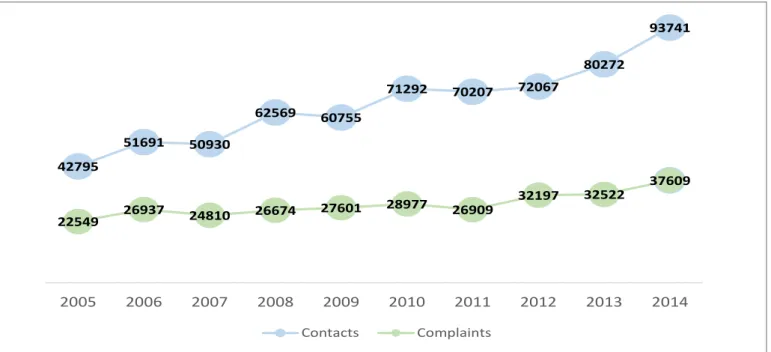
Table 1.1 Between 2005 and 2014, the ECCs had direct contact with consumers on over 650 000 occasions.10
8 http://ec.europa.eu/consumers/ecc/index_en.htm. 42795 51691 50930 62569 60755 71292 70207 72067 80272 93741 22549 26937 24810 26674 27601 28977 26909 32197 32522 37609 2005 2006 2007 2008 2009 2010 2011 2012 2013 2014 Contacts Complaints
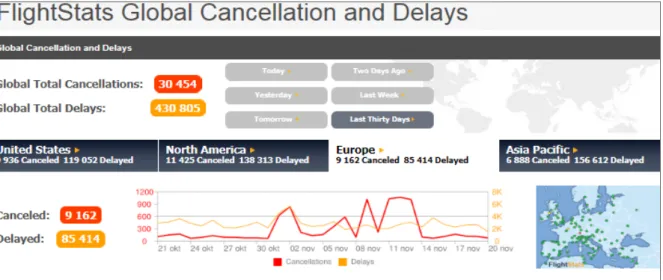
In 2014, 37 609 complaints were handled by ECC-Net and of these, 6 834 related to APR compared to 5 863 in 201311, an increase of 16 %. The cases handled by the ECCs are cross-border cases in which trader and consumer are based in different Member States, Iceland or Norway. As such, the statistics in this chapter account for only a small proportion of complaints from air passengers in Europe. They should be considered as the tip of the iceberg considering that cancellations and delays in Europe over a given 30-day period numbered 30 454 and 430 805 respectively.12
Table 1.2 Statistics for cancelled and delayed flights in Europe the laste 30 days (22.10.2015 - 20.11.2015).13
However, a European Commission study14 found that airline data indicates that only between 5 and 10% of passengers entitled to compensation actually claim it. This low “claim rate” can be explained by two factors. • Low awareness of passengers about their rights; and a perceived failure of airlines to fully inform them about
their entitlements.
• Inadequate airline complaint handling procedures discourage many passengers from pursuing claims. Similar shortcomings were reported with regard to NEBs whose role consumers often found confusing.15
More recent analysis by mode of transport points to an increase in numbers of complaints, revealing that respondents are more likely to complain when they experience air travel disruption (41 %) than for any other mode of transport; ship or ferry (36 %), train (32 %) and long-distance coach (31 %).16
11 See chapter 5, section 5.2 page 35.
12 Which? The analysis of Civil Aviation Authority (CAA) data found that 9,000 flights, carrying an estimated 900,000 people, were delayed by more than 3 hours between June 2014 and May 2015, potentially entitling passengers on those flights to claim compensation. Research by consumer group Which? found that fewer than 4 in 10 of its members who suffered a delay had claimed. The survey indicates that as many as 558 000 people may have neglected to submit claims and could be owed money. Delayed air passengers could claim millions, see: http://www.which.co.uk/news/2015/08/ delayed-air-passengers-could-claim-millions-411688/.
13 Flightstats, http://www.flightstats.com/go/Media/stats.do;jsessionid=F3C5D88F54ED5E00D44A9616E182E239. web3:8009?region=europe&queryDate=last30Days.
14 Commission working document SWD (2013) 62 final, COMMISSION STAFF WORKING DOCUMENT IMPACT ASSESSMENT, Accompanying the document Proposal for a regulation of the European Parliament and of the Council amending Regulation (EC) No 261/2004 establishing common rules on
compensation and assistance to passengers in the event of denied boarding and of cancellation or long delays of flights and Regulation (EC) No 2027/97 on air carrier liability in respect of the carriage of passengers and their baggage by air, page 16. http://eur-lex.europa.eu/LexUriServ/LexUriServ.do?uri=SWD:2 013:0062:FIN:EN:PDF.
15 Ibid.
16 Special Eurobarometer 420, PASSENGER RIGHTS REPORT, December 2014. Page 56. This survey was carried out by TNS Opinion & Social network in the
28 Member States of the European Union between 13 and 22 September 2014. Some 28,050 respondents from different social and demographic groups were interviewed face-to-face at home in their mother tongue on behalf of the Directorate-General for Mobility and Transport. http://ec.europa.eu/ public_opinion/archives/ebs/ebs_420_en.pdfA.
Of the respondents, 52 % mentioned that the main reason for not complaining was that they considered it pointless, 22 % thought that the amount involved was too small, 19 % said that the complaint process was too cumbersome and 9 % did not know how or where to complain.17
Analysis of complaints received by ECC-Net relating to air travel should also take account of the wider context as other parties including NEBs who verify that transport operators respect passengers’ rights, consumer agencies and ombudsmen who are responsible for the enforcement of a wide range of consumer legislation, ADRs whose role is to resolve legal disputes without the need to go to court, courts and private legal consultancies are involved in helping consumers to assert their rights.
2.1 Objective of the report
This report is a follow up to the previous APR report from 201118 and focuses on whether or not consumers really
get the compensation they are entitled to and at what cost.
The aim of this report is to check whether passengers receive the compensation which they are due in cases of delay, cancellation, denial of boarding, etc., to investigate what hampers payment of compensation and to recommend measures in order to facilitate the compensation process. The report highlights existing problems based on cases reported to the ECC-Net from 2014 to June 2015.
The aim of EU law in this area is to provide for standardised and immediate compensatory measures. Claiming compensation to which a consumer is entitled in accordance with Regulation (EC) 261/2004 should be free of charge and airlines should not request fees for processing of such claims. However, the emergence of private legal consultancies offering consumers assistance with obtaining compensation for a fee, shows that procedures are often not straightforward.
Regulation (EC) 261/2004 provides for set remedies in clear cut cases. Passengers in such situations should not be obliged to pay in order to have their consumer rights respected, but the ECC-Net is concerned that this is the reality for many air passengers who either need to go to court individually or seek redress through private claims companies in return for a fee which is typically deducted from any compensation the consumer receives. This project looks at the private companies active in this area.
The information provided should contribute to improving airline practices for the benefit of consumers travelling by air to, from and within the EU, Iceland and Norway.
18 ECC-Net Air Passenger Rights Report 2011 – in the aftermath of the ’Volcanic Ash Crisis’, published in October 2011: http://www.konsumenteuropa.se/ globalassets/rapporter/ecc_net_air_passenger_report_2011.pdf.
2. The 2015 ECC-Net
2.2 Scope
The scope of this report is:
• Regulation (EC) 261/2004 which applies in cases where a flight is cancelled or delayed, or when a passenger is denied boarding;
• The Montreal Convention19 which establishes the airline’s responsibility when a consumer suffers economic
loss or damage due to a flight delay or when their baggage is lost, damaged or delayed;
• Regulation (EC) 2027/97 of the European Parliament and of the Council on air carrier liability in the event of accidents as modified by Regulation (EC) 889/2002;
• ADR complaints;
• Information from the ECC-Net (30 countries) and from NEBs from 2014 until June 2015.
2.3 Research methodology
All statistical data, statements and conclusions contained in this report are based on data gathered by the local ECC offices and provided to the working group in response to the questionnaires circulated. The questionnaires used in the process can be found in Appendix 1 to this report.
The working group sought information about the main areas of complaints, booking intermediaries, NEBs, ADRs and private claims companies.
Most of the quantitative data was collected from the IT system provided by the European Commission for use by ECCs in logging complaints and information requests received.
The data from the questionnaires was analysed in this report to help identify relevant issues or concerns.
Questionnaires were sent out in May 2015 and the analysis and drafting of this report took place from August to November 2015.
Air passenger rights are mainly20 governed by two pieces of legislation: Regulation (EC) 261/2004 and the Montreal Convention.21 Horizontal consumer protection legislation also applies but falls outside of the scope of this report.
The governing council of the International Civil Aviation Organization (ICAO) has established new global core consumer protection principles for air transport. The principles cover three phases of a customer’s experience: before, during and after travel, and will now be considered by ICAO’s 191 member states when they develop or review their applicable national regimes.22
• Prior to travelling, passengers should benefit from sufficient levels of advance information and customer guidance, given the wide variety of air transport products on the market and associated legal and other protection which may apply. Product and price transparency is also recommended as a basic customer right.
• During travel,passengers should be given regular updates on any special circumstances or service disruptions which arise, as well as due attention in cases of disruption. This could include rerouting, refund, care, and/or compensation. The core principles also call on airlines and other stakeholders to have plans in place to deal major disruptions characterised by multiple flight cancellations, and reiterate the fundamental right to fair access for persons with disabilities.
• After travelling, the principles stipulate that efficient complaint handling procedures be established and clearly communicated to customers.
20 Other legislation includes EC Regulations 1107/2006, which deals with rights for passengers with reduced mobility, and 1008/2008 regarding common rules for the operation of air services. In the latter, mainly art. 21 is of interest to passengers as it sets out rules for discrimination.
21 Regulation (EC) No 2027/97 on air carrier liability in the event of accidents as modified by Regulation (EC) No 889/2002 is also worthy of note. This Regulation lays down the obligations of Community air carriers in relation to liability for death or wounding of passengers if the accident which caused the damage took place on board an aircraft or in the course of any of the operations of embarking or disembarking.
22 ICAO Council adopts core principles on consumer protection and new long-term vision for air transport liberalization:http://www.icao.int/Newsroom/ NewsDoc2015/COM.25.15.EN.pdf.
3.1 Regulation (EC) 261/2004
Regulation (EC) 261/2004 came into force in February 2005 and governs air passengers’ rights when flights are either cancelled or delayed or when passengers are denied boarding. It applies to all flights departing from European Economic Area (EEA) Member State23 airports and all flights arriving in these countries if the airline has a licence issued by an authority in an EEA Member State.
The Regulation states that if a flight is cancelled or a passenger is denied boarding, airlines must offer passengers a choice between being rerouted/rebooked or reimbursement. If passengers choose to be reimbursed, the airline no longer owes them a duty of care and they must make other travel arrangements themselves. If they choose rebooking, the airline must take care of them until they reach their final destination. This includes providing meals, refreshments and communication facilities in reasonable proportion to waiting time. In cases where a rebooking cannot be made for the same day, the airline must provide hotel accommodation and transportation to the hotel. When a flight is delayed beyond a certain length of time (depending on the length of the flight), the air carrier is also obliged to provide the level of care and assistance described above. If a flight is delayed and arrives at the final destination 3 hours later than planned, passengers are entitled to financial compensation, unless the delay is caused by extraordinary circumstances beyond the air carrier’s control. The amount of compensation depends on the distance of the flight, and is as follows:
• EUR 250 for up to 1 500 km;
• EUR 400 for between 1 500 and 3 500 km; • EUR 600 for over 3 500 km.
When the delay is at least 5 hours, the airline must reimburse the full cost of the ticket within 7 days for the part or parts of the journey which were not completed, and for the part or parts which were if they no longer served any purpose in relation to the passenger’s original travel plan, together with, when relevant, a return flight to the initial point of departure at the earliest opportunity.24
It is important to note, that there are no exemptions from the right to care, regardless of the reason for the disruption.25
If a flight is cancelled less than 14 days prior to the scheduled departure and no suitable alternative26 is offered, or if a passenger is denied boarding, the passenger is entitled to claim compensation. However, if the air carrier can prove that the cancellation was due to extraordinary circumstances, they can be relieved of the obligation to pay. The aim is to compensate the passenger for the inconvenience suffered as a result of the disruption. As the amount of compensation is determined by the length of the flight, it has no connection to the actual economic loss suffered by the passenger. The consumer does not need to prove anything.
The air carrier is obliged to inform passengers of their rights at the check-in desk via a clearly legible and visible notice. In addition, the Regulation requires that the air carrier provide each passenger with a written notice setting out the rules for compensation and assistance in the event of a cancellation, denial of boarding or a delay of at least 2 hours.
The Regulation obliges Member States to nominate or create NEBs, which are responsible for enforcing the
Regulation in their territory. Passengers who believe they have not been treated correctly should contact the NEB in the country where the incident took place.
23 All EU Member States plus Iceland, Liechtenstein and Norway. It also applies to Switzerland under a bilateral agreement.
24 Article 6 and Article 8(1)(a).
In March 2013, the European Commission published a proposal for an amendment to Regulation (EC) 261/2004 and Regulation (EC) 2027/97.27 The proposal ’Air transport: enforcement of passenger rights; air carrier liability limits 2013/0072(COD)’ was adopted by the European Parliament in February 2014 and a decision from the Council is currently pending.28
One of the aims of the passenger rights revision is to clarify areas in which the current rules are unclear and problematic for both passengers and airlines. The proposal includes a clear definition of the term ’extraordinary circumstances’ as ’circumstances which, by their nature or origin, are not inherent in the normal exercise of the activity of the air carrier concerned and are beyond its actual control’. The new definition, which is in line with EU case law (C-549/07 Wallentin-Hermann), confirms that while natural disasters or air traffic control strikes would continue to be considered as ’extraordinary’, some technical problems – such as those identified during routine aircraft maintenance – would not.29
The new rules also take into account the financial implications of passenger rights for the air transport sector. The objective of the revision is to ensure that European air carriers operate under harmonised conditions in a liberalised market.30
The proposed Regulation would clarify the rules for access to compensation, including:31
• an increase in the time threshold after which compensation is payable in the event of a delay from 3 to 5 hours for all journeys within the EU (for journeys outside the EU, the threshold would depend on the length of the flight);
• the introduction of a single time threshold of 2 hours after which care and assistance, such as refreshments, must be provided for all delayed flights;
• clear rules for connecting flights and when passengers have the right to care and/or compensation;
• a requirement for airlines to reroute passengers on other carriers or means of transport if they cannot do so on their own service within 12 hours;
• clarification of rights for passengers whose flights are rescheduled less than 2 weeks before departure; • a clear explanation of passenger rights during tarmac delays and the requirement for passengers to be told
about flight disruption as soon as information is available.
The changes would also create more effective complaint handling procedures and strengthen enforcement,
monitoring and sanctioning policies. In particular, airlines would have to provide clear complaint procedures (web form, email address) and reply to passengers within specific deadlines.
The draft proposal strengthens passenger rights in the event of baggage handling problems, and includes: • specific new rules for mobility equipment and musical instruments;
• transparency for passengers on baggage allowances and any additional charges for baggage; • the requirement for airlines to provide forms for baggage handling complaints at the airport.
Under the pending revision of Regulation 261/2004, the right to compensation in the event of delays will be incorporated into the legislation, whereas it is currently based on the Court of Justice of the European Union (CJEU) rulings on the Sturgeon and Nelson cases. Another proposed change is a limitation of assistance to 3 days and EUR 100 per person per night for hotel accommodation.
27 Proposal for a Regulation of the European Parliament and of the Council amending Regulation (EC) No 261/2004 establishing common rules on compensation and assistance to passengers in the event of denied boarding and of cancellation or long delay of flights and Regulation (EC) No 2027/97 on air carrier liability in respect of the carriage of passengers and their baggage by air: http://eur-lex.europa.eu/legal-content/EN/TXT/ PDF/?uri=CELEX:52013PC0130&from=EN.
28 Remaining legislative demands of the European Parliament’s 7th legislative term, August 2014, page 38-39. http://www.europarl.europa.eu/the-secretary-general/resource/static/files/Documents/2014september-Remaining_Legislative_Demands.pdf.
29 http://eur-lex.europa.eu/legal-content/EN/TXT/HTML/?uri=CELEX:52013PC0130&from=EN.
30 Outcome of the Council meeting, 3394th Council meeting, Luxembourg, 11 and 12 June 2015:http://www.consilium.europa.eu/en/policies/ air-passenger-rights/.
3.2 Clarification by the Court of Justice of the European Union
Since the Regulation came into force, the CJEU has received several preliminary questions from national courts in the Member States and so has had several opportunities to interpret its content.
In 2008, the CJEU was presented with a case where the airline refused to pay compensation on the grounds of extraordinary circumstances32. The Court found that a technical error is not necessarily an extraordinary circumstance unless ’the problem stems from events which, by their nature or origin, are not inherent in the
normal exercise of the activity of the air carrier concerned and are beyond its actual control.’ The Court dismissed arguments that the frequency of the technical problems experienced by an air carrier is a deciding factor, and also rejected the argument that an air carrier’s compliance with minimum maintenance rules could in itself suffice to establish that that carrier had taken ‘all reasonable measures’. Moreover, the Court noted that when defining an extraordinary circumstance the similar, but not identical, term in the Montreal Convention is not conclusive. Finally, the Court also made it clear that the burden of proof rests upon the air carrier who claims extraordinary circumstances and that terms which have not previously been defined in EU law must only be interpreted when they appear as an exception to a main rule. This is especially the case when it concerns consumer protection. In 2014, the CJEU interpreted the term ’extraordinary circumstances’ in relation to technical issues.33 In that case, the CJEU came to the conclusion that a technical problem which occurred unexpectedly and was neither attributable to poor maintenance, nor detected during routine maintenance checks, did not constitute ’extraordinary circumstances’.
In 2010,34 the Court ruled that the definition of ‘a flight’ is to be understood as only concerning either the outward or homeward journey, not the two combined, even if both are booked at the same time. In practice, this meant that an incident in a country outside the EU was not covered by the Regulation35 because the air carrier was not licensed in the EU.
In 2012, the CJEU provided a further definition of ’denied boarding’.36 The court decided that the concept must be interpreted as relating not only to cases where boarding is denied because of overbooking but also to those where boarding is denied on other grounds, such as operational reasons. In the same ruling, the Court stated that ’denied boarding’ must be interpreted as meaning that ’extraordinary circumstances’ resulting in an air carrier rescheduling flights after those circumstances arose cannot give grounds for denying boarding on later flights or for exempting a carrier from its obligation to compensate a passenger to whom it denies boarding on such a flight. The CJEU stated in 201237 that there are no common time limits for bringing actions for compensation under Articles 5-7 of the Regulation. Time limits are therefore to be determined in accordance with the rules of each Member State on the limitation of actions.
In May 201138, the Court ruled that in cases of delay, the airline should make sure that necessary resources are available, so that when the reason for the delay passes, operations may be resumed as soon as possible. However, it is not possible to set a fixed timeframe, as each situation must be taken on a case-by-case basis.
The most noteworthy interpretation came in 2009 in the so-called Sturgeon case.39 Here, the Court stated that, under Articles 5-7 of Regulation 261/2004, if a delay causes passengers to arrive at their final destination more than 3 hours behind schedule, the passengers may be entitled to compensation. This ruling has been widely discussed because the Articles in the Regulation only mention compensation with regard to cancellations and denial of boarding. The High Court of the United Kingdom challenged it, asking the CJEU to reconsider40 and the UK NEB suspended application of the Sturgeon decision to complaints regarding delays of this nature pending final determination of the matter by the CJEU.
32 C-549/07 (Friederike Wallentin-Hermann vs. Alitalia Linee Aeree Italiane SpA).
33 C-257/14 (Corina van der Lans vs. KLM).
34 C-173/07 (Emirates Airlines vs. Schenkel).
35 An accident such as a delay at arrival or a missed connecting flight on the territory of a third country when the operating air carrier is a non-EU carrier still falls under the Regulation if the journey started on EU territory.
36 C-22/11 (Finnair Oyj vs. Timy Lassooy). 37 C-139/11 (Joan Cuadrench Moré vs. KLM).
The Grand Chamber of the CJEU again decided on compensation for delayed flights in the joined cases Nelson and TUI Travel.41 The judgment confirms the 2009 ruling in Sturgeon, in which the Court held that under Articles 5-7 of Regulation 261/2004 passengers not only have the right to standardised monetary compensation in case of denied boarding or cancellation, but also in case of long delay (long being three hours or more). This interpretation of Articles 5-7 had raised some questions because neither Article 7 nor any other provision of the Regulation expressly provides the right to compensation in case of delay. The ruling in Sturgeon has been questioned by airlines since 2009. The arguments the airlines have made is for example that Sturgeon is invalid because it is inconsistent with both the 2006 IATA ruling and the Montreal Convention for the Unification of Certain Rules for International Carriage by Air (ratified by the EC).
The questions put to the Court essentially sought to ascertain whether any of the objections raised by the airlines had merit. The Court ruled that they did not.
On the compatibility with the Montreal Convention:
49 (…) it should be made clear that, like the inconveniences referred to in IATA and the European Low Fares Airline Association (ELFAA), a loss of time cannot be categorised as ‘damage occasioned by delay’ within the meaning of Article 19 of the Montreal Convention, and, for that reason, it falls outside the scope of Article 29 of that convention.
50 Article 19 of the Montreal Convention implies, in particular, that the damage arises as a result of a delay, that there is a causal link between the delay and the damage and that the damage is individual to passengers depending on the various losses sustained by them.
54 The specific obligation to pay compensation, imposed by Regulation (EC) 261/2004, does not arise from each actual delay, but only from a delay which entails a loss of time equal to or in excess of three hours in relation to the time of arrival originally scheduled. In addition, whereas the extent of the delay is normally a factor increasing the likelihood of greater damage, the fixed compensation awarded under that regulation remains unchanged in that regard, since the duration of the actual delay in excess of three hours is not taken into account in calculating the amount of compensation payable under Article 7 of Regulation (EC) 261/2004.42
As to the principle of legal certainty:
67 (…) having regard to the requirements arising from the principle of equal treatment, air carriers cannot rely on the principle of legal certainty and claim that the obligation imposed on them by Regulation (EC) 261/2004 to compensate passengers, in the event of delay to a flight, up to the amounts laid down therein infringes the latter principle.
68 In addition, as the Advocate General observed in point 46 of his Opinion, once the judgement in Sturgeon and Others was delivered, both air passengers whose flights were delayed and air carriers were able to know unequivocally the point from which those passengers may claim payment of compensation and the carriers will be required to pay that compensation, respectively, since the introduction of a clear timelimit also serves to prevent national courts from making different assessments of what constitutes a long delay which would, in some cases, give rise to legal uncertainty.
41 Joined Cases C-581/10 Nelson and Others v Deutsche Lufthansa AG and C-629/10 Tui Travel, British Airways, EasyJet, IATA vs. Civil Aviation Authority.
42 The U.K’s High Court of Justice referred the case to the CJEU for reconsideration of whether Reg. 261/2004 should be interpreted as requiring airlines to pay compensation to passengers whose flights are subject to delays in excess of 3 hours and, if so, whether such interpretation is in accordance with the Montreal Convention and principles of proportionality, legal certainty and equal treatment. 55 In those circumstances, the loss of time inherent in a flight delay, which constitutes an inconvenience within the meaning of Regulation No 261/2004 and cannot be categorised as ‘damage occasioned by delay’ within the meaning of Article 19 of the Montreal Convention, cannot come within the scope of Article 29 of that convention. 56 Consequently, the obligation under Regulation No 261/2004 intended to compensate passengers whose flights are subject to a long delay is compatible with Article 29 of the Montreal Convention.
As to the principle of proportionality:
77 First of all, the obligation to pay compensation which stems from Article 7 of Regulation (EC) 261/2004 does not concern every delay, but only long delays.
78 Next, the amount of compensation, fixed at EUR 250, EUR 400 and EUR 600 depending on the distance of the flights concerned may still be reduced by 50 % in accordance with Article 7(2)(c) of Regulation (EC) 261/2004, where the delay is – in the case of a flight not falling under subparagraphs (a) or (b) of Article 7(2) – less than four hours (Sturgeon and Others, paragraph 63).
79 In addition, air carriers are not obliged to pay compensation if they can prove that the cancellation or long delay is caused by extraordinary circumstances which could not have been avoided even if all reasonable measures had been taken, that is, circumstances which are beyond the air carrier’s actual control (see Sturgeon and Others, paragraph 67).
80 Moreover, the discharge of obligations pursuant to Regulation (EC) 261/2004 is without prejudice to air carriers’ rights to seek compensation from any person who caused the delay, including third parties, as Article 13 of that regulation provides. Such compensation may accordingly reduce or even remove the financial burden borne by carriers in consequence of those obligations. Nor does it appear unreasonable for those obligations initially to be borne, subject to the abovementioned right to compensation, by the air carriers with which the passengers concerned have a contract of carriage that entitles them to a flight that should be neither cancelled nor delayed (IATA and ELFAA, paragraph 90, and Sturgeon and others, paragraph 68).
The Court concluded:
1. Articles 5 to 7 of Regulation (EC) 261/2004 establishing common rules on compensation and assistance to passengers in the event of denied boarding and of cancellation or long delay of flights, and repealing
Regulation (EEC) 295/91, must be interpreted as meaning that passengers whose flights are delayed are entitled to compensation under that regulation where they suffer, on account of such flights, a loss of time equal to or in excess of three hours, that is, where they reach their final destination three hours or more after the arrival time originally scheduled by the air carrier. Such a delay does not, however, entitle passengers to compensation if the air carrier can prove that the long delay is caused by extraordinary circumstances which could not have been avoided even if all reasonable measures had been taken, namely circumstances beyond the actual control of the air carrier.
2. Consideration of the questions referred for a preliminary ruling has disclosed no factor of such a kind as to affect the validity of Articles 5 to 7 of Regulation (EC) 261/2004.
The decision confirmed that passengers have the right to fixed monetary compensation under Article 7 of the Regulation in cases of a delay of 3 hours or more. Compensation is only not due in case of ‘extraordinary circumstances’.43 Several judgements have already been made on the question of what exactly constitutes ‘extraordinary circumstances’.44
In 2013, the CJEU provided another ruling on the right to compensation when it comes to delayed flights.45 The court ruled that Article 7 of the Regulation must be interpreted as meaning that compensation is payable, on the basis of that Article, to passengers on directly connecting flights who have been delayed at departure for a period below the limits specified in Article 6 of that Regulation, but have arrived at the final destination at least 3 hours later than the scheduled arrival time, given that the compensation in question is not conditional upon there having been a delay at departure and, thus, upon the conditions set out in Article 6 having been met
43 In the CJEU decision of C 549/07 Wallentin-Hermann v Alitalia it was held that for an event to be characterised as ’extraordinary’ it must be one which ’is not inherent in the normal exercise of the activity of the air carrier concerned and is beyond the actual control of that carrier on account of its nature or origin.’ In considering this definition of extraordinary, the CJEU ruled that as aircraft regularly experience technical problems, it followed that the resolution of technical problems which came to light during maintenance of the aircraft or as a result of a failure to carry out maintenance could not amount to an ’extraordinary circumstance’. However, the court went on to state that not only must ’extraordinary circumstances’ be present, but that the airline must
3.3 Clarification from the European Commission
46The European Commission has various means to ensure consistent and seamless application of the Regulation and the relevant case law. For example, it holds regular meetings with NEBs, maintains regular contact by e-mail/phone, opens infringement procedures, etc.
Since the Regulation’s introduction, the Commission has issued two interpretative documents47 in order to facilitate its homogeneous application.
One important issue was the right to rerouting. The question arose as to whether other means of transport were included under this right, as many airlines were not prepared to offer such options. The Commission emphasised that rerouting could also be by train, bus and presumably car. In a Communication to the Parliament and Council from April 2011, the Commission definitively stated, that rerouting could be via another mode of transport. Furthermore, rerouting can also be via another airline, and not, as many airlines believe, only through their own flights.
To limit liability for air carriers in special situations like the ash cloud incident in 2010, it must be noted that many delays and cancellations experienced during heavy snow fall were caused by airports not being sufficiently prepared or equipped to handle such situations. In these instances, it would be appropriate to advise air carriers to avail themselves of the option offered under Article 13 of the Regulation, which states that the air carrier can seek redress from contractual parties.48
3.4 The Montreal Convention
Since 1999, the Montreal Convention, ratified by around 130 countries including all EU Member States, has regulated both delays to passengers and delay or damage to, or loss of their luggage. The Convention is applicable to international flights in instances where both the country of departure and the country of arrival have ratified it. It is therefore applicable to all flights within the EU, both domestic and international.49
The main rule set out in the Convention is that the air carrier is liable for losses suffered by passengers unless the air carrier can prove that ’it or its servants and agents took all measures that could reasonably be required to avoid the damage or that it was impossible for them to take such measures’. Liability may be avoided if it can be shown that the air carrier took all reasonable measures to avoid the loss suffered by the passenger. Thus the exception pertains to the actual loss suffered, not the incident causing the loss. The Convention limits the potential liability of an air carrier to 1 131 Special Drawing Rights (SDR) in respect of passengers whose luggage is delayed, damaged or lost, and to SDR 4 694 in respect of passengers suffering loss due to a delay.50
As a general rule when dealing with claims for damages, the claimant must try to mitigate their loss and should limit their expenses to reasonable necessities.
46 It is important to note that only the CJEU can interpret EU legislation and that statements from the Commission are not legally binding, but indications of the Commission’s view.
47 Q&A, February 17th 2008,Memo/10/143 of April 20th 2010 and COM/2011/0174 final Communication from the Commission to the European Parliament and the Council on the application of Regulation 261/2004 establishing common rules on compensation and assistance to passengers in the event of denied boarding and of cancellation or long delay of flights: http://eur-lex.europa.eu/legal-content/EN/TXT/HTML/?uri=CELEX:52011DC0174&from=EN. 48 The main third parties who could be responsible for disruption are principally airports, air navigation service providers (ANSPs) and ground handlers. In practice it is very difficult to claim against these bodies in view of legal obstacles in contract or national law (e.g. airport conditions of use generally only allow claims in very exceptional cases which are difficult to prove; airports and ANSPs are usually government bodies and may have state immunity from claims; ground handlers are protected by the IATA Standard Ground Handling Agreement, which means that in most circumstances airlines cannot claim
costs from them).
49 EU Acquis, The acquis is the body of common rights and obligations that is binding on all EU Member States: http://ec.europa.eu/enlargement/policy/ conditions-membership/chapters-of-the-acquis/index_en.htm.
50 An SDR is a currency unit used by the IMF and its exchange rate to the euro is around 1.2 as of August 2015: https://www.imf.org/external/np/fin/data/ rms_five.aspx.
There are set time restrictions outlined in the Convention and these specify the timeframe within which passengers must make their claim. For damaged baggage this is 7 days from the moment of delivery. For delayed baggage the claim must be made within 21 days of the passenger getting the baggage back. Even if the carrier does not admit responsibility for the loss of the baggage, the passenger is entitled to make a claim for his/her loss if the baggage does not arrive by 21 days after its scheduled arrival.
Under Article 35 of the Convention, an action has to be brought to the Court within 2 years of the arrival or scheduled arrival of the baggage. Passengers need to be aware of these timeframes and respect them when contacting the airlines.
In 2012, in a case regarding the right to compensation when a passenger had belongings in another passenger’s checked in luggage,51 the CJEU ruled that Article 22(2) read in conjunction with Article 3(3) in the Montreal Convention must be interpreted as meaning that the right to compensation and the limits to a carrier’s liability in the event of loss of baggage also apply to a passenger who claims that compensation by virtue of the loss of luggage checked in in another passenger’s name, provided that the lost baggage did in fact contain the first passenger’s items.
In 2009, the CJEU established that the concept of ’damage’ under the Convention pertained to both material and non-material damage. This means that the maximum amount set out in the Convention – SDR 1 131 – must comprise both types of damage.52
This chapter provides an overview of air passenger complaints reported to the ECC-Net, based on data from two sources. The quantitative data comes from the IT system provided by the European Commission to be used by the ECCs for recording all cases received and for sharing complaints which need to be handled by two ECCs, the ECC in the country of the consumer and the ECC in the country of the trader. In addition, data was also gathered from a questionnaire sent to each ECC, of which a copy can be found in appendix 1.
The cases handled by the ECCs concern only reported cross-border cases, where the trader and the consumer are based in different Member States, Iceland or Norway. As such, the statistics in this chapter account for only a small proportion of the overall number of complaints from air passengers in Europe.
According to the Association of European Airlines, 869 795 000 passengers were transported in 2014 compared with 769 079 000 in 2010.53 The number of cases handled by the Network regarding problems for air passengers in Europe must be viewed against the overall number of passengers transported.
A Eurobarometer survey carried out in September 2014 shows that 22 % of air transport users had faced disruption in the previous 12 months. The most common forms of disruption were long delays (69 %), baggage-related disruptions, i.e. delayed, damaged or lost baggage (21 %) and cancellation (15 %). Of those respondents who had experienced disruptions, 57 % were dissatisfied with how this was handled, whether in terms of general information received about the disruption, assistance (48 %) or financial compensation (55%).54
53 The Association of European Airlines: http://www.aea.be/statistics.html.
54 Special Eurobarometer 420, PASSENGER RIGHTS REPORT, December 2014. Page 48-49. This survey was carried out by TNS Opinion & Social network in the
28 Member States of the European Union between 13 and 22 September 2014. Some 28,050 respondents from different social and demographic groups were interviewed face-to-face at home in their mother tongue on behalf of the Directorate-General for Mobility and Transport. http://ec.europa.eu/ public_opinion/archives/ebs/ebs_420_en.pdfA.
4. ECC-Net
Even though complaints relating to air travel received by the ECC-Net represent only a small segment of problems experienced by air passengers, the number of cases handled by the Network is large enough to enable it to gain an insight into the type of problems air passengers in Europe face.55
The main problem is that some airlines do not apply the law as they do not agree with it. It is surprising to encounter an industry where several traders openly decide to not apply the law or case law from the CJEU.56
Examples57 include airlines not complying with ADR decisions, as mentioned on the blacklist58 in the Swedish consumer magazine Råd & Rön and the website of the Air Passenger Complaint Handling Body in Norway59 which deals with cases where air passengers’ rights have not been respected by airlines.
A report from the UK Civil Aviation Authority (CAA) shows ‘that it appears a small number of airlines are letting their passengers down by failing to consistently pay compensation and also applying a two year limit to claims.’60 The CAA is now starting the legal phase of its enforcement process, stating: ‘With the law clear, passengers rightly expect airlines to abide by it and expect the CAA to enforce it.’61
These difficulties may be related to the average level of ticket prices compared to the compensation rates, even though, when taken on overall business turnover, this should be part of the costing strategy of an airline. Also, as some airlines still do not inform consumers about their rights, and many consumers do not request the compensation to which they are entitled, communication from airlines should be improved, as stated in the section on dealing directly with airlines.62
55 From 1 January to 30 October 2015, ECCs registered 7 381 complaints regarding air passenger rights, 835 about luggage, 6 546 on passenger transport and
1 604 about delays.
56 CAA launches legal action: regulator acts against three major airlines to protect UK passengers. The UK Civil Aviation Authority (CAA) has announced enforcement action against three major airlines, as the regulator steps in to safeguard the rights of millions of passengers. The action follows the CAA’s comprehensive six-month review of airline policies in relation to supporting passengers during disruption, including their approaches to paying flight delay compensation and the provision of information about their rights. This review has already resulted in a number of airlines changing their policies, resulting in millions of passengers benefiting from improved support during disruption. http://www.caa.co.uk/application.aspx?appid=7&mode=detail&nid=2437. 57 In Denmark, the NEB, according to information received from them, reports the matter to the prosecutor every time an airline does not pay a consumer in
accordance with an NEB decision. The airline can be fined for not abiding by an NEB decision.
Ryanair clearly informed in their case ref: 802022/DEBKHF “I acknowledge receipt of your online claim dated 04/12/2015. Ryanair are now in receipt of the AESA’s recommendation for the above claim. I regret that on this occasion, Ryanair cannot comply with the board’s recommendation, as we believe that their decision is outside the scope of the EU Regulation 261/2004.” (Spanish NEB AESA ref.number 007063-15: http://www.seguridadaerea.gob.es/ LANG_EN/home.aspx ).
58 Blacklist 2015 Råd & Rön: http://www.radron.se/svarta-listan/?ind=10. The current blacklist is based on cases from the second half of 2014 handled by the Swedish National Board for Consumer Disputes (ARN) in which the consumer has still not received redress. Råd & Rön goes through ARN’s decisions and contacts both the consumer and the company to hear what has happened. Sometimes the companies then pay, rather than going on the blacklist. Some airlines carry a warning triangle which means that they have also been on the blacklist before during the previous 2 years. Air Baltic (delayed flight), Air China (delayed flight), Air Mediterranée (delayed flight), British Airways (cancelled flight, rebooked on a flight departing 23 hours later), Norwegian (20 cases with a total of 56 travellers regarding delayed flights. Some travellers were partially compensated before or after ARN’s decision, some hired solicitors. One case was taken to the district court where Norwegian agreed to pay.), Primera Air (delayed flights), Pullmantur Air S.A (delayed flights), Qatar Airways (cancelled flight, four passengers rescheduled for the following day. The airline owed EUR 2 400 in compensation for the delay and SEK 3 306 for hotels and phone calls but only paid the SEK 3 306.), Tailwind Airlines (delayed flight), Wizz Air (7 cases with a total of 13 travellers regarding delayed flights), Vueling Airlines S.A. (delayed flights).
59 In Norway, the NEB regularly publishes the names of the companies that do not comply with their decisions on their website: https://fly. transportklagenemnda.no/Forside/Foelger-ikke-vedtak (Only in Norwegian).
60 Financial compensation, technical faults and time limitations, Compliance report, Civil Aviation Authority UK 2015, page 2: https://www.caa.co.uk/ docs/33/CAP%201275%20Compliance%20Report%20230315.pdf. Andrew Haines, chief executive of the CAA, said: ’Airlines are well aware of the support they must provide when there is disruption and passengers have every right to be disappointed that a small number of airlines are not complying with the Court of Appeal rulings and continue to let people down in this way.’… ’We have been active to ensure airlines are applying consumer law appropriately and I warmly welcome the response of those airlines that have changed their policies as a result of this work. Our job is not done until all airlines can demonstrate they are providing care, assistance and compensation as required by law.’ ’While we have no power to secure redress for individual consumers, we are determined to stand up for passengers and are taking this action to safeguard their rights, making sure all airlines consistently provide their passengers with the support and compensation they are legally entitled to.’
61 Ibid. page 3. See also article ’UK airline regulator to force Ryanair to pay flight delay compensation’: http://www.theguardian.com/business/2015/sep/17/ european-court-ruling-boosts-flight-delay-compensation-claims. Ryanair denies breaching consumer law. ’The CAA claims Ryanair is still failing to comply with rules over flight delay compensation, despite pressure from the airline body and binding court decisions. While it has managed to force three other
4.1 Total volume of cases handled by the ECC-Net
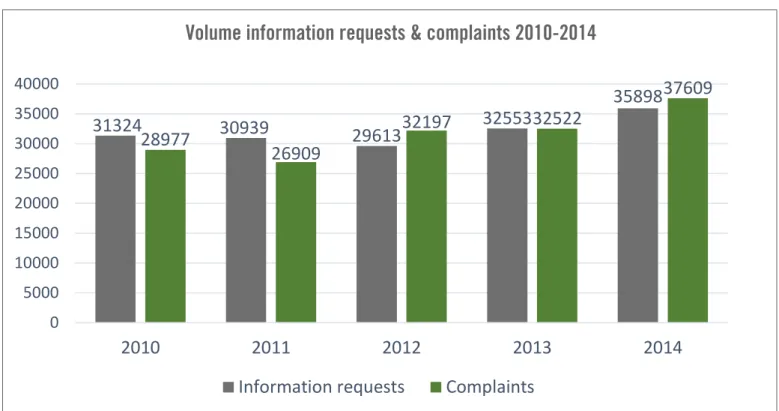
During the period 2012-2014, the volume of contacts63 handled by the ECC-Net has increased by 30 %, from 72 067 in 2012 to 93 741 in 2014 (see table 1). One explanation for this could be that the ECCs are better known than they were in 2012, when a survey showed that 22 % of respondents had heard of them.64 In addition, there is a consistent increase in the number of consumers engaging in cross-border shopping. In 2012, 11 % of consumers made at least one cross-border purchase, whilst by 2014, this had increased to 19 %.65
Table 4.1 Information requests and complaints, statistics from DG Justice and Consumers E.5. Data: ECC Database.
63 A contact can be an information request or a complaint. A complaint is defined as a statement of dissatisfaction by a consumer concerning a cross-border transaction with a seller or a supplier. Where information is given to consumers but no further follow up is required, the matter is classed as an information request. The ECC-Net registers every contact in the ECC-Net Case Handling IT tool which is used to collect and handle the necessary data. The tool is operated by the European Commission. The cases are classified using the COICOP-classification system, which is implemented in the IT-tool registration function. This system is a reference classification published by the United Nations Statistics Division.
64 Flash Eurobarometer 358, June 2013: http://ec.europa.eu/public_opinion/flash/fl_358_en.pdf.
65 Flash Eurobarometer 397, Consumer attitudes towards cross-border trade and consumer protection, September 2015, page 4: http://ec.europa.eu/ COMMFrontOffice/PublicOpinion/index.cfm/Survey/getSurveyDetail/instruments/FLASH/surveyKy/2031. Consumer Conditions Scoreboard, page 4, 9th edition, July 2013 http://ec.europa.eu/consumers/consumer_evidence/consumer_scoreboards/9_edition/index_en.htmGrowth forecast of cross-border
online sales in Western Europe, http://e-commercefacts.com/research/2015/06/growth-forecast-of-cross-border-online-sales-in-western-europ/index.xml.
31324
30939
29613
32553
35898
28977
26909
32197
32522
37609
0 5000 10000 15000 20000 25000 30000 35000 400002010
2011
2012
2013
2014
Information requests
Complaints
4.2 Volume of air transport cases
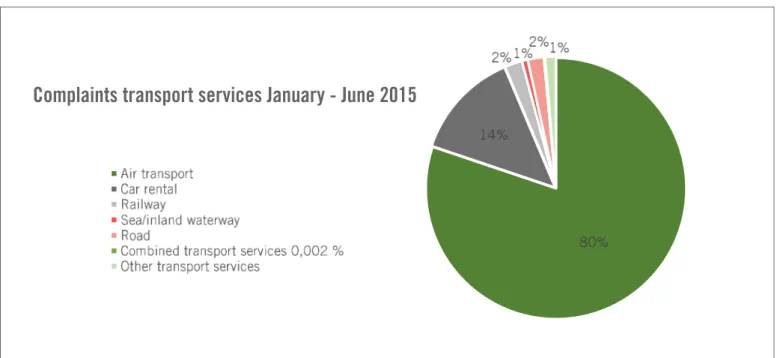
Looking at the volume of information requests and complaints from air passengers, we see an increase in the number of complaints in 2014. The ECC-Net handled 37 609 complaints and of these, 18% concerned air transport services.
Table 4.2 Complaints transport services 2014, statistics from DG Justice and Consumers E.5. Data: ECC Database.
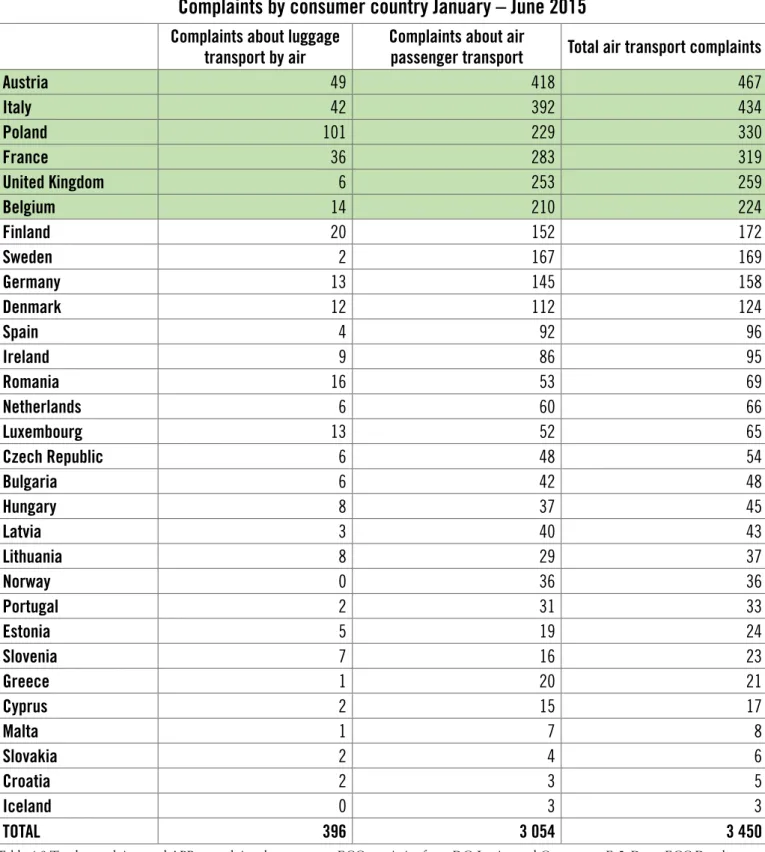
Table 4.3 Complaints transport services January–June 2015, statistics from DG Justice and Consumers E.5. Data: ECC Database.
Complaints transport services January - June 2015
73%19%
2%1%3% 2%
Complaints transport services 2014
Air transport Car rental Railway
Sea/inland waterway Road
Combined transport services 0,001 % Other transport services
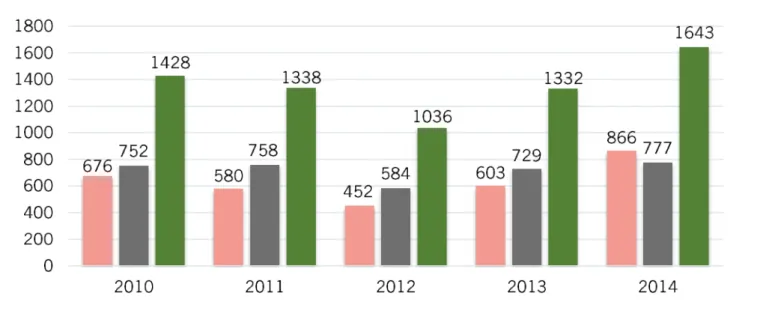
Table 4.4 Information requests and complaints regarding air passenger rights 2010-2014. Total number of contacts is the sum of these two items.
The ECC-Net saw a substantial increase in air transport complaints in 2010 due to the eruption of the Eyjafjallajökull volcano on 14 April which affected a large number of travellers.66
In 2011, the numbers returned to the levels of 2007-2009, but in 2012 there was an increase of 29.5 %. A decrease of 14.8 % was seen in 2013 and this turned into a 16.7 % increase in 2014.
Table 4.5 Increases in complaints concerning air passenger transport and transport of luggage by air received by the ECC-Net (2006-2010).67
66 ECC-Net Air Passenger Rights Report 2011 – in the aftermath of the ‘Volcanic Ash Crisis’, October 2011: http://ec.europa.eu/consumers/ecc/docs/ecc_net_
air_passenger_report_2011.pdf.
67 Ibid. page 22.
Volume information requests & complaints air passengers rights 2010 - 2014
Table 4.6 Information requests and complaints regarding luggage issues 2010–2014, statistics from DG Justice and Consumers E.5. Data: ECC Database.
While consumers frequently seek information or have complaints about their rights as air passengers, fewer have questions or complaints about the transport of their luggage. In 2013 and 2012, the percentages of information requests and complaints received pertaining to luggage were 12 % and 10 % respectively. These difficulties can mainly be categorised as damaged, delayed or lost luggage.
Under the Montreal Convention, consumers are entitled to compensation of up to SDR 1 131 when luggage is damaged, delayed or lost. This is the maximum amount that a consumer can claim and it is important to note that compensation is not awarded automatically. Rather, consumers have to prove the extent of their loss. The attempted resolution of baggage complaints involves two components:
• Property Irregularity Report
If luggage is damaged, delayed or lost, the first step is to report the matter to a representative of the airline or a handling agent whose desks are normally located at the baggage pick up point and complete a Property Irregularity Report (PIR). Upon completion of the report, the consumer should be given a copy of it. Airlines may request a copy upon receiving the complaint, however this is not a legal requirement and failure to produce a PIR alone should not prove fatal to a consumer´s claim though it may cause evidential difficulties particularly in cases of damaged luggage.
• Written Complaint
Few consumers realise that a follow up letter is required and that it is vital that this letter be sent to the airline within the time limits set out under the Montreal Convention. Time limits are as follows:
1. for damaged luggage and items which are missing from bags, 7 days; 2. for delayed luggage, 21 days from the date of delivery of the bag;
3. for lost luggage, no set time limit but the advice is to write as soon as possible after 21 days.
Failure to observe these time limits often results in consumers losing their right to claim from the air carrier. This can be particularly harsh for consumers who complain at the airport but fail to follow up their complaint in writing because they believe that their initial complaint is sufficient or for those whose luggage is delayed, damaged or lost on the outward journey of an extended trip and who intend complaining in writing upon their return home.
Quantifying the value of the claim can be a problem since there are no detailed rules on how to calculate
appropriate compensation. When luggage is damaged, airlines generally request proof of purchase for the luggage itself. This may present obstacles to getting compensation as the older the luggage is, the less likely it is that consumers will have the requisite proof, such as a receipt or credit card statement.
When baggage is delayed, consumers incur expense as a result of the absence of their belongings. In these situations, some airlines offer immediate one-off cash payments of a set amount to cover emergency purchases to see the passenger through until the delayed bag is delivered. Others will pay a set amount per day, up to a maximum number of days. Other airlines do not make immediate cash payments, but prefer to reimburse passengers’ expenditure on essential purchases, and will often insist on seeing receipts.
Where luggage is lost, most air carriers will request receipts for all items contained therein. Even where receipts are provided, airlines usually apply a depreciation rate when calculating compensation, the rationale being that as the consumer had use of the item for a certain period of time, they are not entitled to its full value68In the event of any
items going missing from luggage, it can be very difficult to get any compensation, primarily because it is almost impossible to prove that the items were in the baggage in the first place. It is important that consumers receive information about the possibility of making a special declaration of interest at check-in.
Most airlines advise consumers in their terms and conditions not to put items such as money, jewellery, keys, cameras, spectacles, etc. in their checked in luggage. Should these items be in the checked in luggage, the airlines will accept no responsibility for their damage or loss. Airlines also have different luggage weight restrictions and different ticket categories, even for connecting flights.
Particularly problematic are those instances where luggage is damaged, delayed or lost in what is known as a successive carriage contract (where two or more airlines work together to fulfil contractual obligations). Often in these cases, both airlines will refuse to accept responsibility for the loss incurred.
The Montreal Convention provides for joint and several liability of successive carriers, therefore the consumer can claim against either party.
68 Airlines should inform consumers about the relevant depreciation rules and on what grounds they are applied but complaints reported to ECC-Net suggest