Vertical Current Density Structure of Saturn’s Equatorial
1
Current Sheet
2
C. J. Martin1, C. S. Arridge1, N. A. Case1, L. C. Ray1
3
1Physics Department, Lancaster University, Bailrigg, Lancaster, LA1 4YB, United Kingdom.
4
Key Points:
5
• Aperiodic waves on Saturn’s current sheet are utilised to estimate the current density
6
profile.
7
• The average full time derivative of the component of magnetic field in the exterior
8
field direction is used to infer the current density.
9
• 10% of the time we sample Saturn’s magnetospheric current sheet it is bifurcated,
10
which is lower than the occurrence rate at Earth.
11
Abstract
12
Routine spacecraft encounters with the Saturn current sheet due to the passage of aperiodic
13
waves provide the opportunity to analyse the current sheet structure. The current density is
14
expected to peak where the field strength reaches a minima if approximated as a Harris
cur-15
rent sheet. However, in Earth’s magnetotail that this is not always the case as the sheet is
16
sometimes bifurcated (having two or more maxima in the current density). We utilise
mea-17
surements of Saturn’s magnetic field to estimate the current density during crossings of the
18
current sheet by time differentiating theBacomponent of the field in a current sheet
coordi-19
nate system, whereBais perpendicular to both the current and current sheet normal. This is
20
then averaged and organised by the magnitude ofBa. Using this method, we can identify a
21
classical Harris-style or bifurcated current sheet as a peak at the centre or two distinct
max-22
ima on either side ofBa =0, respectively. We find that around 10% of current sheet profiles
23
exhibit a bifurcated current sheet signature, which is substantially lower than a∼25%
occur-24
rence rate at Earth.
25
1 Introduction
26
The equatorial current sheet at Saturn is a result of a rotationally dominated system
27
[Southwood & Kivelson, 2001] with internal plasma sources such as Enceladus and the other
28
moons, the rings and even the planet itself [e.g.Pontius et al., 2006;Tokar et al., 2005;Jurac
29
et al., 2002;Felici et al., 2016]. The internal plasma and fast rotation result in centrifugal
30
stresses [Arridge et al., 2007] that cause the planet’s magnetic field to stretch outwards at
31
the equator. This ballooning forms a washer shaped current sheet (much like Earth’s cross
32
tail current sheet). Unlike Earth, however, Saturn’s current sheet can be found in all local
33
time sectors, except near noon during compressions due to solar wind dynamic pressure [
Ar-34
ridge et al., 2008b]. The a thin current sheet extends outward from∼15RS(Saturn Radii =
35
58,232 km) where pressure gradients and the magnetic tension force become dominated by
36
centrifugal stresses [Arridge et al., 2007].
37
Sergis et al.[2017] mapped the equatorial current density in Saturn’s inner
magneto-38
sphere from 5-16RS, showing that the particle pressure is dominated by hot plasma pressure
39
(hot ions) outside of 12RSwith a number of local time effects.Kellett et al.[2011] detailed
40
the local time and temporal variability of the current density using Cassini’s equatorial orbits
41
between 2005 and 2006. The current is strongest from dusk to midnight and can vary
tempo-42
rally by a factor of 2-3. In the middle to outer magnetosphere, the current density increases
from pre-midnight to pre-noon and forms a region-2-like current system [Martin & Arridge,
44
2018].
45
A number of studies have shown that the current sheet exhibits predictable quasi-static
46
features, such as flapping at the rotation rate of the planet [e.g.Provan et al., 2012;Arridge
47
et al., 2011]. The current sheet also forms a seasonal bowl shape [Arridge et al., 2008a] and
48
also displays random movements associated with single waveforms travelling along the sheet
49
[Martin & Arridge, 2017]. These waves are solitary movements which kink the sheet as they
50
travel. Some local time dependence of the thickness of the current sheet can be attributed to
51
the magnetic field being more dipolar through noon or due to ambipolar magnetic fields [e.g.
52
Krupp et al., 1999;Kellett et al., 2009;Arridge et al., 2015;Martin & Arridge, 2017].
53
The current sheet is also thought to vary in thickness due to oscillations near the
plan-54
etary rotation rate [Thomsen et al., 2016]. However, it is commonly assumed that the current
55
density peaks at the centre of the current sheet and that the current sheet magnetic field
ex-56
hibits Harris-like behaviour where the magnetic field increases as a hyperbolic tangent
func-57
tion away from the centre, and the current density decreases exponentially away from the
58
centre. Whilst this assumption is necessary for a number of analysis techniques, it might fail.
59
In this study we will test whether the assumption of a Harris-like current sheet at Saturn is a
60
discriminative or restrictive assumption to make. Throughout, we refer to ’Harris-like’
cur-61
rent sheets, this refers to a current sheet in which the current density peaks where the
mag-62
netic field passes through one minimum and is not necessarily a strictly Harris current profile
63
[Harris, 1962].
64
Bifurcation, or splitting of the current into two maxima of current that do not lie at
65
the expected current sheet centre, is a common occurrence in Earth’s magnetotail. First
ob-66
served byHoshino et al.[1996] using single spacecraft measurements and byRunov et al.
67
[2003a] using the Cluster mission. Around 25% of all current sheets encounters exhibit
bi-68
furcated behaviour [Thompson et al., 2006]. A dependance on the magnitude ofVx(velocity
69
along Earth-Sun line) in the tail is found byAsano et al.[2005], where up to 50% of ‘fast’
70
events, and around 10% of ‘not-fast’ events show bifurcations. A number of authors show,
71
with spacecraft data and models of the current sheet, that bifurcation in the tail current sheet
72
is a precursor to, or a result of reconnection occurring [e.g.Hoshino et al., 1996;Nakamura
73
et al., 2002;Thompson et al., 2006;Birn & Hesse, 2014]. More recently, bifurcation of the
current sheet has been linked to substorm onset and an increase in current density in the tail
75
current sheet [Saito, 2015].
76
Models have shown that a bifurcated current sheet can be caused by a number of
in-77
stabilities [Ricci et al., 2004;Camporeale & Lapenta, 2005;Génot et al., 2005;Matsui &
78
Daughton, 2008;Zelenyi et al., 2002, 2003;Delcourt et al., 2006] such as the lower hybrid
79
drift instability, and KelvHelmholtz instabilities. These instabilities may be related to
in-80
creased reconnection [Runov et al., 2003b;Mok et al., 2006] and flapping motions of the
81
current sheet [Sitnov et al., 2004;Runov et al., 2003a].
82
Perpendicular anisotropies in the ion temperature have been shown to form bifurcated
83
current sheets in models and in Cluster observations of the terrestrial magnetic field and
84
plasma [Sitnov et al., 2003, 2004;Israelevich & Ershkovich, 2008].Dalena et al.[2010]
85
specifically focused on the role of oxygen ions in these anisotropies that may also cause
in-86
stabilities and hence, bifurcation. Simulations have shown that bifurcations can be formed
87
by perturbations in the dipole field [Sitnov & Merkin, 2016]. Altogether, we can assume that
88
the bifurcation of the current sheet at Earth is linked to an unstable current sheet caused by a
89
number of the above described processes.
90
At Earth, most studies make use of Cluster 4-point measurements to determine current
91
density, however, at Jupiter and Saturn single space craft measurements and other methods
92
must be used. Bifurcated current sheets at Jupiter have previously been investigated using the
93
full time derivative of the magnetic field component perpendicular to both the direction of
94
current flow and the current sheet normal [Hoshino et al., 1996;Israelevich & Ershkovich,
95
2006]. Several examples of bifurcated sheets were found using Voyager-2 and Galileo
mag-96
netometer data [Israelevich & Ershkovich, 2008]. The authors concluded that the bifurcation
97
is due to an ion pressure anisotropy perpendicular to the magnetic field. The total number of
98
bifurcated sheets detected is very small compared to the total number of current sheet
cross-99
ings, suggesting that this is a very rare phenomenon at Jupiter. The difference in the
bifur-100
cated and non-bifurcated ratio between Earth’s tail current sheet and Jupiter’s current sheet
101
is likely caused by the different ion distribution functions, initially due to the differing
pro-102
cesses of plasma transport that create the plasma sheet [Israelevich & Ershkovich, 2008].
103
To investigate the proportion of bifurcated sheets at Saturn, we utilise the aperiodic
104
wave structures [Martin & Arridge, 2017] that cause Cassini to encounter the current sheet.
105
The overall flapping motion of Jupiter’s magnetosphere, due to the offset of the magnetic
axis from the rotational axis, allows for periodic sampling of the current sheet at Jupiter.
107
This process does not occur at Saturn due to a near alignment of the magnetic and rotational
108
axes[Acuña & Ness, 1980;Smith et al., 1980;Dougherty et al., 2018], and so we do not get
109
constant periodic sampling of the current sheet. We note that the planetary period
oscilla-110
tions allow for current sheet flapping [Arridge et al., 2011;Provan et al., 2012], however this
111
does not frequently result in the sampling of both lobes but acts instead to move the current
112
sheet towards and away from Cassini without a direct encounter.
113
The aperiodic waves are detected using Cassini magnetometer data [Dougherty et al.,
114
2004], and appear as a traversal from one lobe to the other and back again to the original
115
lobe. We consider waves that have a period of less than the global flapping waves (most
116
waves have time periods of from 1-30 minutes), are non-repeating (solitary) and have a
de-117
flection in the radial magnetic field of over 1 nT. The waves kink the field as they travel in
118
a predominantly outward radial direction. All events occur planet-ward inside of the
mag-119
netopause boundary, which is found by manual examination of the magnetic field data. The
120
magnetic field magnitude and direction describe the regime in which Cassini resides, and
121
hence a boundary between two regimes can be established by examining the changes in these
122
parameters, i.e. the magnetosheath generally has a smaller magnitude than the current sheet
123
and lobes. The direction of lobe magnetic field is mainly radial, whereas the current sheet
124
has a predominantly north-south component. Between January 2005 to December 2012,
125
1461 events fit these criteria from the equatorial revolutions of Cassini. For further
analy-126
sis of aperiodic wave properties and applications, the authors direct the reader toMartin &
127
Arridge[2017, 2018].
128
2 Method
129
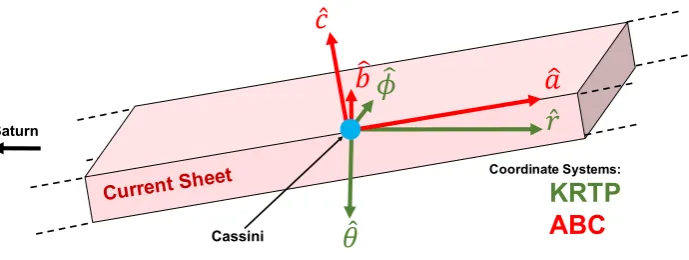
Firstly, we must rotate the magnetic field into a current sheet coordinate system (A,B,C)
135
where ˆaaaˆˆis positive in the direction of largest change in magnetic field (roughly in the
posi-136
tive radial direction), ˆcccˆˆis normal to the current sheet and ˆbbbˆˆcompletes the right handed
sys-137
tem and is in the direction of the current density vector. A representation of the two
coordi-138
nate systems can be found in figure 1. To rotate the original coordinates we must first find
139
the normal to the current sheet which is done using a number of methods. We first find a
nor-140
mal using minimum variance analysis (MVA), where we can use single spacecraft data to
141
estimate the direction of minimum variance which is the normal to an approximately
one-142
dimensional current layer [Sonnerup & Cahill, 1967].
However, if the variance ellipsoid (a 3-dimensional representation of the variance of
144
the data in space) is degenerate such that we cannot separate the minimum and intermediate
145
eigenvectors, then the uncertainty of the normal placement is high. In such cases, we then
146
use a second method of finding the normal to reduce the uncertainty in the normal
direc-147
tion. This second method, the coplanarity method, calculates the difference in northern and
148
southern lobe fields (∆BBB) and the cross product of the northern lobe magnetic field and the
149
southern lobe magnetic field, (BBBNNN×BBBSSS). As both of these vector products are in the plane of
150
the current sheet, the cross product∆BBB×(BBBNNN ×BBBSSS)will be in the normal direction of the
151
current sheet.
152
We initially use MVA to determine the normal direction as the uncertainties
ascer-153
tained using a bootstrapping method are on average much smaller than the uncertainties
154
found when using the coplanarity method, under the assumption that the minimum and
inter-155
mediate variance directions are not degenerate. Uncertainties in the coplanarity method are
156
determined using the standard deviation of the mean values ofBBBNNN andBBBSSS, which are then
157
propagated to give an uncertainty on the variance directions. In the computational algorithm,
158
we use coplanarity when we find that the MVA uncertainties are larger than the coplanarity
159
uncertainties and/or the MVA analysis is degenerate. An additional feature of MVA is that
160
the maximum variance direction is equivalent to the direction of∆BBB, which can be used as
161
a check for both methods as the maximum variance is often the least degenerate and most
162
accurately calculated variance direction. In examples where both methods of finding the
co-163
ordinate system give acceptable uncertainties, the results are in agreement.
164
Once we have the normal direction, we can establish the angles needed to rotate the
165
magnetic field into the new (A,B,C) co-ordinate system described above. These angles (α, β, γ)
166
give the angles in three planes of the normal from the radial direction forαand β, and from
167
theφdirection forγ. Hence, we now have our new co-ordinate system ordered by the current
168
sheet of Saturn.
169
We focus now on the magnetic field in ˆaaaˆˆ, orBa.Bais not only time dependent but also
170
dependent on the position of the current sheetBa(t)≈Ba(c(t))and hence the full derivative
171
is:
172
dBa dt =
∂Ba ∂c
dc
dt, (1)
For an aperiodic wave we find thatdc dt
will equal zero over the course of one wave,
assum-173
ing the current sheet returns to its original position and the spacecraft does not move during
this time. Hence,dBa dt
≈
0. Through Ampère’s law, we know that ∂Ba
∂c is proportional to
175
the current density in the sheet and so organising|dBa dt |
versusB
awill show the peak in
176
current density as Cassini measures the centre of the current sheet (assuming a Harris-like
177
current sheet). A Harris-like current sheet will show a peak in|dBa dt |
atBa =0 whereas a
178
bifurcated current sheet will show two peaks either side ofBa=0. Additionally, we note that
179
these may be shifted from the zero line due to global motion of the current sheet that
can-180
not be accounted for in this analysi, i.e.dBa dt
, 0. Most aperiodic waves occur on small
181
timescales, and thus we can neglect global motion effect on a zero shift.
182
At Jupiter,Israelevich & Ershkovich[2006] calculated the differential value using a
183
number of crossings and the assumptiondc
dt
=
0 is held for regular flapping motion since
184
Galileo was an equatorial orbiter. However, at Saturn, Cassini covers a large range of
lati-185
tudes and we cannot assume that the periodic oscillations will result indc dt
=
0. Using
186
aperiodic waves allows for this assumption to be satisfied as the aperiodic waves sample both
187
lobes, and the time series of magnetometer data for a single aperiodic wave can be restricted
188
so that there is equivalent sampling of both magnetic lobes of Saturn.
189
dBa
dt is calculated numerically by [Ba(t+∆t)−Ba(t−∆t)]/2∆t, where in this study
190
∆t =1 second. We bin the differential intoBabins of size 0.1 - 0.25 nT to allow for at least
191
reasonable number of data points (N > 10) in each bin for each aperiodic wave. Hence we
192
can now relate a proxy for current density with a proxy for the distance from the centre of the
193
current sheet (Ba).
194
To test whether we find a bifurcated, Harris-like or unclassified current density profile,
195
we used a model made up of three Gaussian distributions. The first Gaussian is centred on a
196
‘centre’ value (C) or close toBa =0, the second and third Gaussians are centred on an
‘off-197
set’ from the centre (ω), on either side (C -ωand C +ω). All distributions share the same
198
’spread’ (σ), the central Gaussian has an independent amplitude (AH arr is) to the peripheral
199
Gaussians (ABi f ur cated). Hence, if we find a Harris-like current sheet, we expect the
cen-200
tral Gaussian to have a considerably larger amplitude than the peripheral Gaussians, and vice
201
versa for a bifurcated signature.
202
This model is fitted to|dBa dt |
vsBaas described above using Bayesian regression
203
analysis, where prior knowledge of the probable outcome is used to give a probability
dis-204
tribution of the final result. We find that the use of Bayesian regression analysis allows for
205
a much more in-depth analysis of the uncertainties of the fitting of the model, this method
of fitting easily shows any covariance between the variables. Each unknown (C,ω,σ,AH arr is
207
andABi f ur cated) is given a prior distribution, which forCpr ioris a normal distribution around
208
Ba = 0,ωpr iorandσpr iorare positive only distributions with decreasing probability with
209
larger offsets and spreads. Both amplitude priors are given as a positive only normal
distri-210
bution around the median value of|dBa dt |
. These prior distributions are then multiplied by
211
a likelihood distribution based on finding the lowestχ2value when comparing the data to
212
100,000 randomly distributed samples taken from the prior distributions. The output for this
213
method is hence a ‘posterior’ distribution of each fitted parameter which peaks at the most
214
likely value and shows a spread (and hence uncertainty) in that value.
215
To algorithmically determine whether the profile is Harris-like or bifurcated, we
imple-216
ment a number of criteria. To be bifurcated the distribution must have anABi f ur catedof at
217
least 1.5 times anAH arr is. Additionally, the offset (ω) must be more than twice the spread
218
(σ) and the absolute centre value (C) must be less than the offset (ω) value. To be considered
219
a Harris-like sheet the criteria are as follows: anAH arr isof at least 1.5 times anAbi f ur cated;
220
σmust be less than twice the offset (ω); and the absolute centre value (C) must be less than
221
the offset (ω). Distributions that do not comply with either criterions are considered
unclas-222
sified and are visually inspected. Distributions that are borderline on either classification are
223
also visually inspected as a secondary check.
224
This method of fitting variables is useful to find the interconnectivity of the variable
225
themselves. We may find a dependence of one variable on another, and if this is found then
226
the model must be updated or revised to remove this dependance. In this study, the majority
227
of events lead to the conclusion that the variables fitted are independent of each other, and
228
any case of strong dependence is removed from further analysis.
229
3 Results
230
The normal vector can be found using either MVA or coplanarity in 1018 out of 1461
231
aperiodic wave events, of these events 807 sample an adequate amount of both lobes to build
232
up an acceptable picture of the current density profile. We find 79 bifurcated signatures and
233
632 Harris-like signatures. From the total, 96 events give a striated, unclassified or
ambigu-234
ous signature. Thus we find that 10% of current sheet profiles at Saturn are bifurcated, 78%
235
of profiles show a Harris-like current sheet and 12% of current sheets show a unclassified
236
signature.
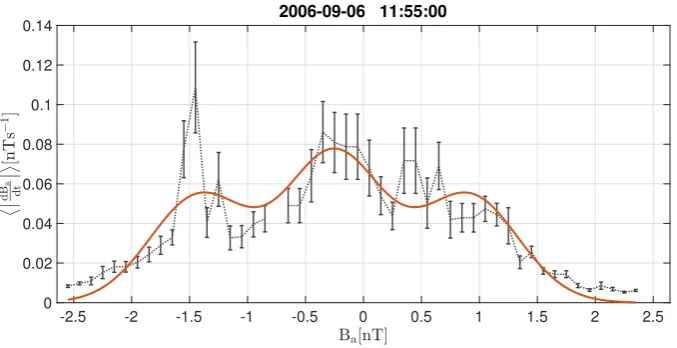
Figure 2 shows an example of a Harris-like current sheet signature for Saturn’s
equa-238
torial current sheet. The dotted line shows the mean value of|dBa dt |
and the error bars give
239
the standard deviation in eachBabin. An orange solid line shows the most likely fitted
dis-240
tribution from the Bayesian inference algorithm described in the previous section. Figure 3
241
shows an example of a bifurcated current sheet. Figure 4 shows an example of an
unclassi-242
fied/ambiguous profile.
243
Figure 5 shows the distribution of bifurcated and Harris-like current sheets around
Sat-265
urn, with nominal magnetopause positions, Titan’s orbit at 20RSand Rhea’s orbit at 9RS.
266
Figure 5 a) shows the total number of aperiodic wave events in the magnetosphere, we see an
267
asymmetry in dawn and dusk where a larger number are found along the dusk flank. Overall,
268
we can assume that the number of events in each area of the magnetosphere scale with the
269
time spent there by Cassini. 5 b) shows the number of bifurcated current sheets normalised
270
by the total number of aperiodic wave events (and hence takes into account Cassini’s
trajec-271
tory bias). We see a large asymmetry between dawn and dusk where no bifurcated signatures
272
are seen in the dawn sector outside of Titan’s orbit.
273
In comparison, figure 5c), shows the number of Harris-like current sheets normalised
274
to the total number of aperiodic waves. To compare, we divide the number of bifurcated
275
sheets by the number of like current sheets to find the ratio of Bifurcated and
Harris-276
like sheets (5 d) where 1 is like dominated, and -1 is bifurcated dominated. As
Harris-277
like sheets are dominant, the plot shows mainly red values (+1). However, we also see the
278
asymmetry shown in 5 a) with no bifurcation in the dawn section, and around double the
279
number of Harris-like sheets than bifurcated sheets in the dusk sector. We show the number
280
of striated and NaN (undefined number) and NED (not enough data) current sheets for
com-281
pleteness in 5e and f, both are normalised to the total number of events.
282
Spatially, we find no strong correlation with radial distance or Saturn local time when
283
normalised to the distributions of the entire catalogue of events for the Harris-like or
un-284
classified. The only deviation from the distribution of all events is a lack of any bifurcated
285
signatures outside of 20RSin the dawn flank, which may be linked to a more stable and on
286
average thinner current sheet in this area [e.g.Kellett et al.[2009],Kidder et al.[2009] &
287
Giampieri et al. [2004]].
4 Discussion
289
The vertical structure of current density in Saturn’s equatorial current sheet is explored
290
using Cassini magnetometer measurements during aperiodic wave events. The structure is
291
inferred from calculating the full time derivative of the magnetic field in theadirection in a
292
current sheet coordinate system. Harris-like, bifurcated and unclassified sheets are found to
293
be in proportions of 78%, 10% and 12%, respectively. These proportions are insensitive to
294
changes in the criteria of classification.
295
At Earth, approximately 25% of current sheets examined are bifurcated [Thompson
296
et al., 2006], howeverAsano et al.[2005] showed that a dependence on velocity along the
297
Earth-sun line was a factor in the number of bifurcated current sheets found. At high
ve-298
locities (>500 km/s), bifurcated and Harris-like were proportioned at 50% / 50% whereas
299
at lower velocities (<300 km/s) the distribution of Harris-like sheets to bifurcated sheets is
300
much lower at 90% /10% - a ratio nearer to the values found in this study.
301
A general consensus on bifurcated current sheets at Earth is that they are caused by a
302
perturbation or instability of the current sheet. One example is tail reconnection occurring
303
during substorms at Earth, where the reconnection is constrained in local time to near
mid-304
night. At Saturn, the equatorial current sheet is present in all local times (given solar wind
305
conditions) and hence reconnection can occur in all local times [Guo et al., 2018]. As
bifur-306
cation happens at Saturn in most local time sectors, reconnection and associated phenomena
307
could be the causes of the splitting of the current density. We find a small increase in
bifur-308
cation occurrence in the post-midnight sector, where we expect the x-line from reconnection
309
in the Vasyliunas cycle to be situated, hence giving additional credence to this theory.
310
Delamere et al.[2015] suggest that a ‘patchy network of reconnection sites’ along the
311
magnetopause may be responsible for small-scale losses of plasma in the noon sector through
312
to the dusk sector of Saturn’s magnetosphere. This area is also where an increased number of
313
bifurcated current sheets are found, and as such plasma instabilities caused by the patchy
314
reconnection my be attributed to the larger number of bifurcated current sheet detected.
315
Pressure anisotropies are also found in the nightside current sheet at Jupiter, showing that
316
the pressure parallel to the field was greater than the pressure perpendicular during the
Voy-317
ager 1 and 2 flybys [Paranicas et al., 1991]. However, at present, the plasma instabilities and
318
anisotropies are not fully understood at the outer planets and as such, a definitive conclusion
319
for the sources for the bifurcation cannot be made.
5 Summary
321
In this study the vertical structure of Saturn’s equatorial current sheet is explored
us-322
ing the single-spacecraft method fromIsraelevich & Ershkovich[2006] combined with a
323
Bayesian regression analysis. Due to the lack of an appreciable dipole tilt, current sheet
en-324
counters during the passage of aperiodic waves [Martin & Arridge, 2017] are used to obtain
325
the profile of the magnetic field through the current sheet. Through each current sheet
en-326
counter the full time derivative of theBacomponent of the field was binned as a function of
327
Ba. A simple model based on the sum of Gaussians is used to identify profiles with a
cur-328
rent density peak near the centre of the current sheet (Harris-like) or with off-centre peaks.
329
Model parameters were obtained via Bayesian inference. We find that 78% of the current
330
sheet profiles show a Harris-like structure, 10% are bifurcated, and 12% are unclassified.
331
This compares with 25% in Earth’s magnetotail.
332
Phenomenologically, at Earth bifurcated current sheets are more often found during
333
fast flow events and are associated with substorms [Saito, 2015], thus related to magnetic
re-334
connection. Theory and simulations have explored the role of instabilities or plasma anisotropy
335
that can give-rise to bifurcations. We must also discuss the possibility of the aperiodic waves
336
themselves affecting or being affected by the bifurcation or source of bifurcation. Fast flows
337
in the current sheet sheet may inhibit the kinking of the current sheet during the passage of
338
a wave, and so would limit the amplitude of the wave. Additionally, passage of an aperiodic
339
wave may modify the current sheet to encourage or inhibit reconnection through changes in
340
the stress balance. We have insufficient information of the role of these processes at Saturn to
341
definitively identify the process and its impact on both aperiodic waves and bifurcation.
342
Future observational work should focus on attempting to identify correlations of
bi-343
furcated current sheets with faster flows/reconnection events at Saturn, and studying the
344
plasma/energetic particle differences between Harris-like and bifurcated current sheets.
345
More detailed surveys of the jovian system should also be carried out to statistically
deter-346
mine the prevalence of bifurcated current sheets at Jupiter. There is also theoretical and
sim-347
ulation work that can be done to examine the generation of bifurcations for conditions
com-348
patible with Saturn and Jupiter.
Acknowledgments
350
C.J.M. was funded by a Faculty of Science and Technology studentship from Lancaster
Uni-351
versity. C.S.A. was funded by a Royal Society Research Fellowship and STFC grant number
352
ST/R000816/1. L.C.R & N.A.C. were supported during this study by STFC grant number
353
ST/R000816/1. Cassini MAG data used in this study may be obtained from the Planetary
354
Data System (http://pds.nasa.gov/).
355
References
356
Acuña, M.H. and Ness, N.F., (1980). The magnetic field of Saturn: Pioneer 11 observations.
357
Science,207(4429), 444-446. doi:10.1126/science.207.4429.444
358
Arridge, C. S., Russell, C. T., Khurana, K. K., Achilleos, N., Andre, N., Rymer, A. M.,
359
Dougherty, M. K., Coates, A. J., (2007). Mass of Saturn’s magnetodisc: Cassini
obser-360
vations,Geophysical Research Letters,34(A11), 8779–8789, doi:10.1029/2006GL028921
361
Arridge, C.S., Khurana, K.K., Russell, C.T., Southwood, D.J., Achilleos, N., Dougherty,
362
M.K., Coates, A.J. and Leinweber, H.K., (2008a). Warping of Saturn’s magnetospheric
363
and magnetotail current sheets,Journal of Geophysical Research: Space Physics,
364
113(A8), 2156–2202, doi:10.1029/2007JA012963
365
Arridge, C.S., Russell, C.T., Khurana, K.K., Achilleos, N., Cowley, S.W.H., Dougherty,
366
M.K., Southwood, D.J. and Bunce, E.J., (2008b). Saturn’s magnetodisc current sheet.
367
Journal of Geophysical Research: Space Physics,113(A4), doi:10.1029/2007JA012540
368
Arridge, C. S., André, N., Khurana, K. K., Russell, C. T., Cowley, S. W. H., Provan, G.,
An-369
drews, D. J., Jackman, C. M., Coates, A. J., Sittler, E. C., Dougherty, M. K., Young, D.
370
T. (2011) Periodic motion of Saturn’s nightside plasma sheetJournal of Geophysical
Re-371
search,116, doi:10.1029/2011JA016827
372
Arridge, C. S., Kane, M. , Sergis, N., Khurana, K. K., Jackman, C. J., (2015) Sources
373
of local time asymmetries in magnetodiscsSpace Science Reviews,187, 301–333,
374
doi:10.1007/s11214-015-0145
375
Asano, Y., Nakamura, R., Baumjohann, W., Runov, A., Vörös, Z., Volwerk, M., Zhang, T.L.,
376
Balogh, A., Klecker, B. and Reme, H., (2005). How typical are atypical current sheets?.
377
Geophysical Research Letters,32(3), doi:10.1029/2004GL021834
378
Birn, J. and Hesse, M., 2014. Forced reconnection in the near magnetotail: Onset and
en-379
ergy conversion in PIC and MHD simulations.Journal of Geophysical Research: Space
380
Physics,119(1), pp.290-309, doi:10.1002/2013JA019354
Camporeale, E. and Lapenta, G., (2005). Model of bifurcated current sheets in the Earth’s
382
magnetotail: Equilibrium and stability.Journal of Geophysical Research: Space Physics,
383
110(A7), doi:10.1029/2004JA010779
384
Dalena, S., Greco, A., Zimbardo, G. and Veltri, P., (2010). Role of oxygen ions in the
for-385
mation of a bifurcated current sheet in the magnetotail.Journal of Geophysical Research:
386
Space Physics,115(A3), doi:10.1029/2009JA014710
387
Delamere, P.A., Otto, A., Ma, X., Bagenal, F. and Wilson, R.J., (2015). Magnetic flux
circu-388
lation in the rotationally driven giant magnetospheres.Journal of Geophysical Research:
389
Space Physics,120(6), pp.4229-4245. doi:10.1002/2015JA021036
390
Delcourt, D.C., Malova, H.V. and Zelenyi, L.M., (2006). Quasi adiabaticity in bifurcated
391
current sheets.Geophysical Research Letters,33(6), doi:10.1029/2005GL025463
392
Dougherty, M.K., Kellock, S., Southwood, D.J., Balogh, A., Smith, E.J., Tsurutani, B.T.,
393
Gerlach, B., Glassmeier, K.H., Gleim, F., Russell, C.T. and Erdos, G., Neubauer F. M.,
394
Cowley S. W. H., (2004), The Cassini Magnetic Field Investigation,Space Science
Re-395
views,114(1), 331–383, doi:10.1007/978-1-4020-2774-1
396
Dougherty, M.K., Cao, H., Khurana, K.K., Hunt, G.J., Provan, G., Kellock, S., Burton,
397
M.E., Burk, T.A., Bunce, E.J., Cowley, S.W. and Kivelson, M.G., (2018). Saturn?s
mag-398
netic field revealed by the Cassini Grand Finale.Science, 362(6410). doi:
10.1126/sci-399
ence.aat5434
400
Felici, M., Arridge, C.S., Coates, A.J., Badman, S.V., Dougherty, M.K., Jackman, C.M.,
401
Kurth, W.S., Melin, H., Mitchell, D.G., Reisenfeld, D.B. and Sergis, N., (2016). Cassini
402
observations of ionospheric plasma in Saturn’s magnetotail lobes.Journal of Geophysical
403
Research: Space Physics,121(1), 338-357, doi:10.1002/2015JA021648
404
Génot, V., Mottez, F., Fruit, G., Louarn, P., Sauvaud, J.A. and Balogh, A., (2005). Bifurcated
405
current sheet: Model and Cluster observations.Planetary and Space Science,53(1-3),
406
pp.229-235, doi:10.1016/j.pss.2004.09.048
407
Giampieri, G. and Dougherty, M.K., (2004). Modelling of the ring current in Saturn’s
mag-408
netosphere.Annales Geophysicæ 22(2) 653-659, doi:10.5194/angeo-22-653-2004
409
Guo, R.L., Yao, Z.H., Wei, Y., Ray, L.C., Rae, I.J., Arridge, C.S., Coates, A.J., Delamere,
410
P.A., Sergis, N., Kollmann, P. and Grodent, D., (2018). Rotationally driven magnetic
re-411
connection in Saturn’s dayside.Nature Astronomy2, 640-645,
doi:10.1038/s41550-018-412
0461-9
Harris, E. G., (1962). On a plasma sheath separating regions of oppositely directed magnetic
414
field,Il Nuovo Cimento (1955-1965),23(1), 115–121, doi:10.1007/BF02733547
415
Hoshino, M., Nishida, A., Mukai, T., Saito, Y., Yamamoto, T. and Kokubun, S., 1996.
Struc-416
ture of plasma sheet in magnetotail: Double peaked electric current sheet.Journal of
Geo-417
physical Research: Space Physics,101(A11), pp.24775-24786, doi:10.1029/96JA02313
418
Israelevich, P.L. and Ershkovich, A.I., (2006). Bifurcation of Jovian magnetotail current
419
sheet.Annales Geophysicae 246, 1479-1481, doi:10.5194/angeo-24-1479-2006
420
Israelevich, P.L., Ershkovich, A.I. and Oran, R., (2007). Bifurcation of the tail current
421
sheet in Jovian magnetosphere. Planetary and Space Science, 55(15), pp.2261-2266,
422
doi:10.1016/j.pss.2007.05.006
423
Israelevich, P.L. and Ershkovich, A.I., (2008). Bifurcation of the tail current sheet and ion
424
temperature anisotropy.Annales geophysicae: atmospheres, hydrospheres and space
sci-425
encesVol. 26, No. 7, p. 1759, doi:10.5194/angeo-26-1759-2008
426
Jurac, S., McGrath, M.A., Johnson, R.E., Richardson, J.D., Vasyliunas, V.M. and Eviatar, A.,
427
2002. Saturn: Search for a missing water source.Geophysical Research Letters,29(24),
428
doi:10.1029/2002GL015855
429
Kellett, S., Bunce, E. J., Coates, A. J., Cowley, S. W. H., (2009). Thickness of Saturn’s ring
430
current determined from north-south Cassini passes through the current layer,Journal of
431
Geophysical Research,114(A4), doi:10.1029/2008JA013942
432
Kellett, S., Arridge, C.S., Bunce, E.J., Coates, A.J., Cowley, S.W.H., Dougherty, M.K.,
Per-433
soon, A.M., Sergis, N. and Wilson, R.J., (2011). Saturn’s ring current: Local time
de-434
pendence and temporal variability.Journal of Geophysical Research: Space Physics,
435
116(A5),doi:10.1029/2010JA016216
436
Khurana, K.K., Kivelson, M.G.,(1989). On Jovian Plasma Sheet Structure,Journal of
Geo-437
physical Research,94(A9), 11,791–11,803, doi:10.1029/JA094iA09p11791
438
Khurana, K.K. (2001). Influence of solar wind on Jupiter’s magnetosphere deduced from
cur-439
rents in the equatorial plane.Journal of Geophysical Research: Space Physics,106(A11),
440
25999-26016, doi:10.1029/2000JA000352
441
Kidder, A., Winglee, R.M. and Harnett, E.M., (2009). Regulation of the centrifugal
inter-442
change cycle in Saturn’s inner magnetosphere.Journal of Geophysical Research: Space
443
Physics,114(A2), doi:10.1029/2008JA013100
444
Krupp, N., Dougherty, M. K., Woch, J., Seidel, R., Keppler, E., (1999). Energetic particles in
445
the duskside Jovian magnetosphere,Geophysical Research Letters,34(A11), 8779–8789,
doi:10.1029/1999JA900156
447
Martin, C. J. and Arridge, C. S., (2017). Cassini observations of aperiodic waves on Saturn’s
448
equatorial current sheet.Journal of Geophysical Research: Space Physics,122(8)
8063-449
8077,doi:10.1002/2017JA024293
450
Martin, C. J. and Arridge, C. S., (2018). Current Density in Saturn’s equatorial current sheet:
451
Cassini magnetometer observations.Journal of Geophysical Research: Space Physics 124
452
279-292 doi:10.1029/2018JA025970
453
Matsui, T. and Daughton, W., 2008. Kinetic theory and simulation of collisionless tearing in
454
bifurcated current sheets.Physics of Plasmas,15(1), p.012901, doi:10.1063/1.2832679
455
Mok, C., Ryu, C.M., Yoon, P.H. and Lui, A.T., 2006. Global two fluid stability of
bi-456
furcated current sheets.Journal of Geophysical Research: Space Physics,111(A3),
457
doi:10.1029/2005JA011424
458
Nakamura, R., Baumjohann, W., Runov, A., Volwerk, M., Zhang, T.L., Klecker, B.,
Bog-459
danova, Y., Roux, A., Balogh, A., Reme, H. and Sauvaud, J.A., (2002). Fast flow during
460
current sheet thinning.Geophysical Research Letters,29(23), doi:10.1029/2002GL016200
461
Paranicas, C.P., Mauk, B.H. and Krimigis, S.M., 1991. Pressure anisotropy and radial stress
462
balance in the Jovian neutral sheet.Journal of Geophysical Research: Space Physics,
463
96(A12), pp.21135-21140. doi:10.1029/91JA01647
464
Pontius, D. H., and T. W. Hill., (2006) Enceladus: A significant plasma source for
Sat-465
urn’s magnetosphere.Journal of Geophysical Research: Space Physics,111(A9),
466
doi:10.1029/2006JA011674
467
Provan, G., Andrews, D. J., Arridge, C. S., Coates, A. J., Cowley, S. W. H., Cox, G.,
468
Dougherty, M. K., Jackman, C. M. (2012). Dual periodicities in planetary-period
mag-469
netic field oscillations in Saturn’s tail.Journal of Geophysical Research,117A1,
470
doi:10.1029/2011JA017104
471
Ricci, P., Lapenta, G. and Brackbill, J.U., (2004). Structure of the magnetotail current:
Ki-472
netic simulation and comparison with satellite observations.Geophysical Research
Let-473
ters,31(6), doi:10.1029/2003GL019207
474
Runov, A., Nakamura, R., Baumjohann, W., Zhang, T.L., Volwerk, M., Eichelberger, H.U.
475
and Balogh, A., (2003). Cluster observation of a bifurcated current sheet.Geophysical
476
Research Letters,30(2), doi:10.1029/2002GL016136
477
Runov, A., Nakamura, R., Baumjohann, W., Treumann, R.A., Zhang, T.L., Volwerk, M.,
478
Vörös, Z., Balogh, A., Glaßmeier, K.H., Klecker, B. and Reme, H., 2003. Current sheet
structure near magnetic X-line observed by Cluster.Geophysical Research Letters,30(11),
480
doi:10.1029/2002GL016730
481
Saito, M., 2015. THEMIS two point measurements of the cross tail current density: A thick
482
bifurcated current sheet in the near Earth plasma sheet.Journal of Geophysical Research:
483
Space Physics,120(8), pp.6258-6275, doi:10.1002/2015JA021142
484
Sergis, N., Jackman, C.M., Thomsen, M.F., Krimigis, S.M., Mitchell, D.G., Hamilton, D.C.,
485
Dougherty, M.K., Krupp, N., Wilson, RJ. (2017). Radial and local time structure of the
486
Saturnian ring current, revealed by Cassini,Journal of Geophysical Research: Space
487
Physics,122(2) 1803-1815, doi:10.1002/2016JA023742
488
Sitnov, M.I., Guzdar, P.N. and Swisdak, M., (2003). A model of the bifurcated current sheet.
489
Geophysical Research Letters,30(13), doi:10.1029/2003GL017218
490
Sitnov, M.I., Swisdak, M., Drake, J.F., Guzdar, P.N. and Rogers, B.N., (2004). A model of
491
the bifurcated current sheet: 2. Flapping motions.Geophysical Research Letters,31(9)
492
doi:10.1029/2004GL019473
493
Sitnov, M.I. and Merkin, V.G., 2016. Generalized magnetotail equilibria: Effects of the
494
dipole field, thin current sheets, and magnetic flux accumulation.Journal of Geophysical
495
Research: Space Physics,121(8), 7664-7683, doi:10.1002/2016JA023001
496
Smith, E.J., Davis, L., Jones, D.E., Coleman, P.J., Colburn, D.S., Dyal, P. and Sonett,
497
C.P., 1980. Saturn’s magnetic field and magnetosphere.Science,207(4429), 407-410.
498
doi:10.1126/science.207.4429.407
499
Sonnerup, B.Ö. and Cahill Jr, L.J., (1967). Magnetopause structure and attitude
500
from Explorer 12 observations.Journal of Geophysical Research,72(1), 171-183,
501
doi:10.1029/JZ072i001p00171
502
Southwood, D.J., Kivelson, M. G., (2001). A new perspective concerning the influence of the
503
solar wind on the Jovian magnetosphereJournal of Geophysical Research: Space Physics,
504
106(A4), doi:10.1029/2000JA000236
505
Thompson, S.M., Kivelson, M.G., El Alaoui, M., Balogh, A., Reme, H. and Kistler, L.M.,
506
(2006). Bifurcated current sheets: Statistics from Cluster magnetometer measurements.
507
Journal of Geophysical Research: Space Physics,111(A3), doi:10.1029/2005JA011009
508
Thomsen, M. F., Jackman, C. M., Cowley, S. W. H., Jia, X., Kivelson, M. G. and Provan,
509
G., (2016). Evidence for Periodic Variations in the Thickness of Saturn’s Nightside
510
Plasma Sheet,Journal of Geophysical Research: Space Physics,122(1), 280-292,
511
doi:10.1002/2016JA023368
Tokar, R.L., Johnson, R.E., Thomsen, M.F., Delapp, D.M., Baragiola, R.A., Francis, M.F.,
513
Reisenfeld, D.B., Fish, B.A., Young, D.T., Crary, F.J. and Coates, A.J., 2005. Cassini
ob-514
servations of the thermal plasma in the vicinity of Saturn’s main rings and the F and G
515
rings.Geophysical Research Letters,32(14), doi:10.1029/2005GL022690
516
Zelenyi, L.M., Delcourt, D.C., Malova, H.V. and Sharma, A.S., (2002). ‘Aging’
517
of the magnetotail thin current sheets.Geophysical Research Letters,29(12),
518
doi:10.1029/2001GL013789
519
Zelenyi, L.M., Malova, H.V. and Popov, V.Y., (2003). Splitting of thin current sheets in the
520
Earth’s magnetosphere.Journal of Experimental and Theoretical Physics Letters,78(5),
521
pp.296-299, doi:10.1134/1.1625728
𝑟̂
𝜙$
𝜃&
𝑎(
𝑏$
𝑐̂
Coordinate Systems:
KRTP
ABC
Saturn
[image:18.595.122.467.106.236.2]Cassini
Figure 1. Cartoon of the relation between the current sheet coordinate system (ABC) and the KRTP
(Kro-nian Radial, Theta, Phi) coordinates with respect to the current sheet and Saturn. KRTP is used here, however
the method is independent of original co-ordinate system. KRTP is a spherical system with Saturn at the
cen-tre. The radial component is positive radially outwards from the planet,θis positive southwards at the equator
andφis positive in the corotation direction.
130
131
132
133
134
-1.5 -1 -0.5 0 0.5 1 1.5 0
0.01 0.02 0.03 0.04
[image:18.595.122.462.426.592.2]2011-11-26 19:20:00
Figure 2. Proxies for the distance from the current sheet versus current sheet density for a Harris-like
profile. The dotted line shows the mean of current density as a function of distance from the centre of the
current sheet, with standard deviation shown by the error bars. The solid orange line is the fitted model of
three Gaussians, where the central Gaussian is dominant and hence the example is a Harris-like current sheet.
This example is found at 25.3RSand 13.5 SLT.
244
245
246
247
-2 -1.5 -1 -0.5 0 0.5 1 1.5 2 0
0.005 0.01 0.015 0.02 0.025 0.03 0.035
[image:19.595.113.460.91.267.2]2009-11-24 19:17:30
Figure 3. Proxies for the distance from the current sheet versus current sheet density for a bifurcated
pro-file. The dotted line shows the mean of current density as a function of distance from the centre of the current
sheet, with standard deviation shown by the error bars. The solid orange line is the fitted model of three
Gaus-sians, where the peripheral Gaussians are dominant and hence the example is a bifurcated current sheet. This
example is found at 30.5RSand 17.9 SLT.
249
250
251
252
253
-2.5 -2 -1.5 -1 -0.5 0 0.5 1 1.5 2 2.5 0
0.02 0.04 0.06 0.08 0.1 0.12 0.14
2006-09-06 11:55:00
Figure 4. Proxies for the distance from the current sheet versus current sheet density for a
unclassi-fied/ambiguous profile. The dotted line shows the mean of current density as a function of distance from
the centre of the current sheet, with standard deviation shown by the error bars. The solid orange line is the
fitted model of three Gaussians, where the peripheral Gaussians are dominant and hence the example is a
bifurcated current sheet. This example is found at 29.2RSand 1.6 SLT.
254
255
256
257
[image:19.595.120.459.428.602.2]Figure 5. Distribution of total number of aperiodic wave events (a), number of bifurcated sheets normalised
by total number of events (b) and number of Harris-like normalised by total number of events(c). d) shows the
ratio of bifurcated to Harris-like current sheets. e) shows the number of unclassified or striated current sheets
normalised by total number of events and the number of NaN and NED events normalised by total number of
events is shown in f). Nominal magnetopause positions guide the eye in black, along with Titan’s orbit at 20
RSand Rhea’s orbit at 9RS.
259
260
261
262
263