quantum Monte Carlo calculations
D. M. Thomas,∗ R. J. Hunt, N. D. Drummond, and M. Hayne
Department of Physics, Lancaster University, Lancaster LA1 4YB, United Kingdom
(Dated: February 22, 2019)
Excitonic complexes in type-II quantum-ring heterostructures may be considered as artificial atoms due to the confinement of only one charge-carrier type in an artificial nucleus. Binding energies of excitons, trions, and biexcitons in these nanostructures are then effectively ionization energies of these artificial atoms. The binding energies reported here are calculated within the effective-mass approximation using the diffusion quantum Monte Carlo method and realistic geometries for gallium antimonide rings in gallium arsenide. The electrons form a halo outside the ring, with very little charge density inside the central cavity of the ring. The de-excitonization and binding energies of the complexes are relatively independent of the precise shape of the ring.
PACS numbers: 71.35.-y, 71.35.Pq, 81.07.Ta, 81.05.Ea, 02.70.Ss
I. INTRODUCTION
Quantum-dot and quantum-ring heterostructures have long been hailed as “artificial atoms” [1–4] due to their ability to confine charge carriers in all three spatial di-mensions. Material combinations exhibiting type-I band alignment produce nanostructures in which both elec-trons and holes are confined to the same spatial region, and such nanostructures have been studied extensively over the last two decades [5–7]. In type-II nanostruc-tures, on the other hand, only holes but not electrons (or vice versa) are confined, presenting a rich variety of new physics [8–10]. For example, GaSb quantum dots or quantum rings in GaAs provide very deep confining potentials for holes [11], while strain in the GaSb raises the conduction-band minimum, expelling the electrons [12]. Excitonic complexes in type-II nanostructures are in fact very much more like artificial atoms than is the case for type-I nanostructures, because the electrons are bound to the holes in the “artificial nuclei” purely by the Coulomb interaction, rather than being confined them-selves. Type-II quantum rings are an intriguingly distinct type of artificial atom with no natural analog due to the radical difference between the ring-shaped “artificial nu-cleus” and the pointlike nucleus of a real atom.
Excitons in type-II quantum dots have been exten-sively studied both experimentally [13–16] and theo-retically [11, 17, 18]; however, while there has been some experimental work on carrier complexes in type-II quantum-ring nanostructures [19–22], there has been little theoretical work to date. The spatial separation of charge carriers allows for a variety of interesting op-toelectronic properties [19, 23], including extended re-combination times, making type-II quantum rings ideal candidates for applications such as memory devices [24] and solar cells [16]. Binding energies of excitonic com-plexes reported here are effectively ionization energies of
these artificial atoms. GaSb quantum rings in GaAs may be produced by molecular beam epitaxy [20, 22, 23, 25] and can form with a variety of different cross-sections ranging from triangular, to semicircular [20], and even trapezoidal [23]. These quantum rings exhibit type-II behavior, with the holes strongly confined to the rings. Scanning tunneling microscopy (STM) has been used to investigate the shape and size of the GaSb rings, and their optical properties have been studied in photolumi-nescence experiments [19–22].
In this work we solve an effective-mass model of exci-tons (X), positive and negative trions (X+ and X−), and biexcitons (XX) in type-II quantum-ring heterostruc-tures, focusing on GaSb rings in GaAs. The holes are confined to the ring, which is modeled as an infinite po-tential well, while the electrons are excluded from the ring but bound to the holes by an isotropically screened Coulomb interaction. The kinetic energy of the tightly confined holes is the dominant contribution to the total energy of each complex; however, the electron-hole at-traction is non-negligible, as is the hole-hole repulsion. The ring was chosen to have a rectangular cross-section for computational convenience. The ring is centered on the origin, orientated so that the axis of rotation is the z-axis and the midpoint in thezdirection is thex-yplane. The three parameters defining the ring geometry are the half height of the ring Rz, the inner radius of the ring
ri, and the outer radius ro. In our model the electron and hole densities do not overlap, so we cannot estimate recombination rates; however our model is reasonable for calculating binding energies.
Energies are given in units of the exciton Rydberg R∗y=µe4/[2(4π)2
~2] and lengths in units of the exciton Bohr radius a∗0 = 4π~2/(µe2), where is the permit-tivity of the medium, ~ is the Dirac constant, and e is the magnitude of the electron charge. The electron-hole reduced mass isµ = m∗em∗h/(m∗e +m∗h), where m∗e and m∗hare the effective masses of an electron and a hole, re-spectively. Within the effective-mass approximation the
Hamiltonian for a biexciton is ˆ
H 2R∗
y =−(a
∗
0)2µ
2m∗ e
∇2e1+∇
2
e2
−(a
∗
0)2µ
2m∗h ∇ 2
h1+∇
2 h2 + a ∗ 0 re1e2
+ a
∗ 0 rh1h2
− a
∗ 0 re1h1
− a
∗ 0 re1h2
− a
∗ 0 re2h1
− a
∗ 0 re2h2
+X
i
Vi
r
i
a∗0
(1)
in excitonic units, where rij = |ri −rj| and Vi is the
confining potential, which is infinite inside the ring and zero outside for electrons, andvice versa for holes. This is an inhomogeneous four-body problem, but the diffu-sion quantum Monte Carlo (DMC) method [26, 27] can be used to calculate the exact ground-state energy for each complex, and hence the de-excitonization and bind-ing energies. The trion and biexciton de-excitonization energiesEXD± and EDXX are EDX− =EX−EX−, EDX+ = EX+Eh+
−EX+
, andEXX
D = 2E
X−EXX, whereEi is
the ground-state total energy for complex i. These are the energies at which trion and biexciton peaks are ex-pected to appear relative to the exciton peak in the pho-toluminescence spectrum of a quantum ring [21]. The sign is such that for a free trion or biexciton ED > 0. The binding energies—the energy difference between a complex and its most energetically favorable daughter products, bearing in mind that the holes are confined to the ring—are EX
b =EX−Eh
+
, EX−
b = EX
−
−EX, EbX+ = EX+ −E2h+, and EXXb = EXX−EX+, where E2h+
is the energy of two holes confined to the same ring. The binding energy determines the temperature at which a complex becomes unstable against dissociation into smaller complexes.
II. COMPUTATIONAL METHODOLOGY
Thecasino code [28] was used to perform DMC cal-culations of the ground-state energies of excitons, trions, and biexcitons in quantum-ring heterostructures. DMC is a stochastic projection method that finds the ground-state component of a trial wave function. In this work the trial wave function was optimized using the variational Monte Carlo (VMC) method, in which many-body expec-tation values are evaluated using Monte Carlo integra-tion. The trial wave function ΨT was of Slater-Jastrow form; e.g., for the biexciton:
ΨT(R) = exp[J(R)]φe(re1)φe(re2)φh(rh1)φh(rh2), (2)
where R = (re1,re2,rh1,rh2). The hole orbital φh
was taken to be the exact ground-state solution to the Schr¨odinger equation for a single hole confined to the ring:
φh(r) =
−J0(βr)Y0(βri)
J0(βri) +Y0(βr) cos πz 2Rz , (3)
whereJ0 andY0are Bessel functions of the first and sec-ond kind, respectively. The constantβ is determined by imposing the boundary conditionφh(ro) = 0 numerically for each ring size using the Newton-Raphson method; the other boundary conditions are already satisfied by Eq. (3). The electronic behavior is dominated by Coulomb attraction to the positively charged ring together with hard-wall repulsion from the boundary of the ring. At short range the electron orbitalφe linearly decreases to zero on the ring boundary, while at long range the elec-tron orbital decays exponentially to keep the elecelec-trons localized to the ring; i.e., the behavior is hydrogenic at long range. The electron orbitalφe enforces the correct long- and short-range behavior, with the mid-range be-havior determined by the Jastrow factor and variational freedom in the electron orbital. The electron orbital was formed piecewise in eight regions about the ring, with the functions in each region being matched at the bound-aries to ensure the value and gradient were smooth ev-erywhere and the orbital was zero inside the ring. See the Supplemental Material for the full form of the or-bital. The Jastrow exponent J(R) included a pairwise sum of terms of the form uij(r) = ±µijr/(1 +cijr) for
each pair of particles i and j separated by distance r with reduced mass µij. The + sign was used for
par-ticles with the same charge and − for particles with opposite charge. cij is a variational parameter, which
was different for each particle-pair type. This form en-sured the Kato cusp conditions were satisfied [29]. Other one-, two-, and three-body polynomial terms were also included in the Jastrow exponent; these were smoothly truncated at finite range [30, 31]. VMC energy minimiza-tion was used to optimize the trial wave funcminimiza-tions [32]. The fixed-node DMC algorithm is exact for the ground-state energy of an exciton, trion, or biexciton, because of the distinguishability of the particles, which leads to a nodeless wave function. Pairs of DMC calculations were performed with time steps in a 1 : 4 ratio and target configuration populations in a 4 : 1 ratio and the results were extrapolated linearly to zero time step and infinite population. Charge densities were obtained by binning the radial and axial coordinates of each of the particles sampled during VMC and DMC calculations, cylindri-cally averaging, and then calculating the extrapolated estimate. The errors in the VMC and DMC estimates of the charge density (ρVMC andρDMC) are linear in the error in the trial wave function; however, the error in the extrapolated estimate 2ρDMC−ρVMCis quadratic in the error in the trial wave function [27].
III. RESULTS AND DISCUSSION
GaAs and the latter is the mass of a heavy hole in bulk GaSb [33]. The permittivity is taken to be = 12.9 0, where 0 is the permittivity of free space. This is the permittivity of bulk GaAs [33]. Data from Ref. 20 were used to obtain experimentally relevant values for the ring size; these values wereRz= 2.5 nm = 0.199a∗0,ri= 6 nm = 0.479 a∗0, andro = 10 nm = 0.799 a∗0. This geometry was used as the starting point for our calculations; the aspect ratio 2Rz/(ro −ri) of the ring was then varied subject to the constraints that the volume of the ring 2πRz(ro2−ri2) was constant and the center of the ring in the radial direction (ri+ro)/2 was fixed. A ring with aspect ratio much less than 1 is akin to a thin disc with a hole in the center, while a ring with aspect ratio much greater than 1 resembles a pipe.
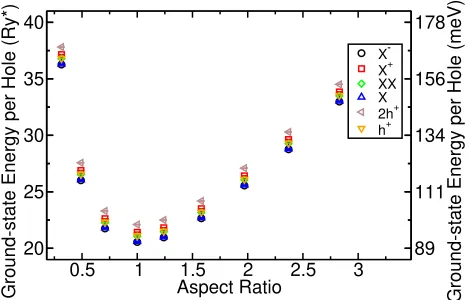
The analytically evaluated variation in the hole energy against aspect ratio is shown in Fig. 1. The minimum energy occurs when the cross-section is square; away from the minimum, the energy goes roughly as 1/L2, where L = min{2Rz, ro−ri}. Also shown in Fig. 1
are DMC ground-state total energies per hole for 2h+, X, X−, X+, and XX, all of which are bound. These confirm that the ground-state energies of the single-hole complexes (X and X−) are very close to the energy of a single hole, while the ground-state energies of the two-hole complexes (X+ and XX) are comparable with the energy of two confined holes. The ground-state energies for single- and two-hole complexes vary slightly differ-ently as a function of aspect ratio due to the interac-tion between the holes. The capacitive charging energy ECC=E2h
+
−2Eh+ for the experimentally relevant ring geometry [20] isECC= 8.8546(8) meV; this compares to an experimentally measured value [34] of ECC = 24(2) meV. STM images of quantum rings [20, 21] suggest that the GaSb/GaAs interface is not clean in practice. This disorder could lead to trapping of holes, strongly affect-ing capacitive chargaffect-ing energies while havaffect-ing relatively little effect on binding energies.
The de-excitonization energies for the trions and biex-citon in the geometry modeling the quantum rings scribed in Ref. [20] can be found in Table I. The de-excitonization energy is positive for X−, but negative for X+ and XX. The negative de-excitonization energy is a result of the large energy penalty when two holes are con-fined to the same ring; e.g., two excitons on two separate quantum rings would be the energetically preferred four-particle state rather than a biexciton on a single ring. The expected positions of these peaks in a photolumines-cence spectrum are shown in Fig. 2. The X−peak is very close to the X peak, while the peaks for X+ and XX are separated from the X peak by a few meV. The heights of the peaks indicate the relative stability of the complexes, using binding energy data from Table I. Experimental work has not yet progressed to the point where excitonic complex peak positions have been identified. The only published work showing sharp lines in the photolumines-cence spectra of GaSb/GaAs quantum rings is Ref. [21]; however the spectra in this work would likely contain
0.5 1 1.5 2 2.5 3 Aspect Ratio
20 25 30 35 40
Ground-state Energy per Hole (Ry*)
89 111 134 156 178
Ground-state Energy per Hole (meV)
[image:3.612.323.558.52.202.2]X --X+ XX X 2h+ h+
FIG. 1. Ground-state total energies per hole of a single hole (h+), two holes (2h+), an exciton (X), a negative trion (X−), a positive trion (X+), and a biexciton (XX) in a quantum
ring plotted against the aspect ratio 2Rz/(ro−ri) of the ring’s
cross section. The mean radius and ring volume are appropri-ate for the GaSb/GaAs quantum rings reported in Ref. [20]. Error bars are smaller than the size of the symbols. The exci-ton RydbergRy∗is 4.45 meV for the experimentally relevant
[image:3.612.328.554.368.427.2]geometry.
TABLE I. De-excitonizationED and bindingEb energies for
excitonic complexes in the quantum-ring geometry modeling the samples described in Ref. [20].
Complex ED/R∗y Eb/R∗y ED(meV) Eb(meV)
X 0 −0.5004(6) 0 −2.226(3) X− +0.0446(4) −0.0446(4) +0.199(2) −0.199(2) X+ −1.111(2) −1.379(2) −4.944(7) −6.137(7)
XX −0.911(2) −0.701(2) −4.052(8) −3.11(1)
peaks from many, highly positively charged rings, making a direct comparison with theoretical values difficult. The de-excitonization energy is plotted against the aspect ra-tio of the cross-secra-tion of the ring for X−, X+, and XX in Fig. 3(a). For each complex it can be seen that there is some slight change in the de-excitonization energy as a function of aspect ratio. The de-excitonization energies are largely independent of the aspect ratio, and hence exact shape of the ring, somewhat justifying the use of a ring with a rectangular cross-section in our model. Fur-thermore, the energetic effects of the slight interpenetra-tion of the electron and hole orbitals are likely to be well described by a slight renormalization of the cross-section of the ring; however the effects of such small changes in the cross-section appear to be small.
en-0
1
2
3
4
5
h
_ω
(meV)
X+
XX X
X
--FIG. 2. Expected peak positions for the excitonic complexes in a photoluminescence spectrum relative to the exciton peak, for a model of the quantum rings reported in Ref. [20]. The peak heights represent the relative stability of the complexes.
0.5 1 1.5 2 2.5 Aspect Ratio -6
-5 -4 -3 -2 -1 0 1
De-excitonization Energy (meV)
0.5 1 1.5 2 2.5 Aspect Ratio
-6 -5 -4 -3 -2 -1 0 1
Binding Energy (meV)
X --X+ XX X (a) (b)
FIG. 3. (a) De-excitonization energies and (b) binding ener-gies against the aspect ratio 2Rz/(ro−ri) of a quantum ring’s
cross-section for different charge-carrier complexes. The mean radius and ring volume are appropriate for the GaSb/GaAs quantum rings reported in Ref. [20]. Error bars are smaller than the size of the symbols. The dashed lines shows the experimentally relevant aspect ratio [20].
ergies the temperatures up to which the complexes are stable are 26, 2.3, 71, and 36 K for X, X−, X+, and XX, respectively. As with the de-excitonization energies, the binding energy depends weakly on the aspect ratio of the ring’s cross-section, but again these differences are much smaller than the differences in binding energy between complexes: see Fig. 3(b). Therefore, the binding energy appears to be largely independent of the exact shape of the cross-section of the ring for a given ring volume and mean radius.
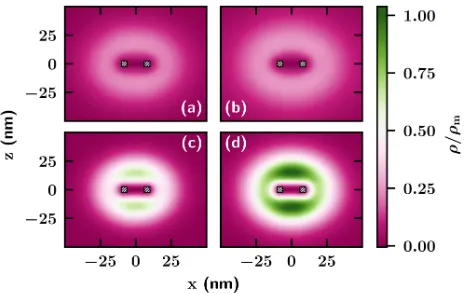
[image:4.612.59.294.54.154.2]Plots of the electronic charge density for each complex in the experimentally relevant geometry are shown in Fig. 4. The electrons form a diffuse halo around the ring, with negligible charge density in the ring’s central cavity. The kinetic-energy cost of localizing in the ring’s cavity signif-icantly exceeds the gain in electrostatic potential energy. Correlation effects further reduce the probability of find-ing multiple electrons inside the rfind-ing’s cavity. XX and X+are the most localized complexes, as reflected in their relatively large binding energies shown in Table I. These two-hole complexes have slightly higher electronic charge
TABLE II. Sensitivity of the biexciton binding energy to the electron and hole effective masses me and mh, the relative
permittivity, the ring volumeV, and the mean radius of the ringrm.
.
∂EXX
b /∂me ∂EbXX/∂mh ∂EbXX/∂ ∂EXXb /∂V ∂EbXX/∂rm
(meV/me) (meV/me) (meV) (meV/nm3) (meV/nm) −7.4(3) −0.20(4) 0.39(1) 0.0004(2) 0.07(2)
densities in the regions directly above and below the cen-ter of the ring compared to the regions to the left and right of the ring. STM images of the electronic density of states in Ref. [20] suggest the electrons are localized to the ring’s cavity, which does not agree with the re-sults presented here. However, in the STM experiments the sample is cleaved in the x-z plane. This is a dras-tic modification to the system, which is not described by our model. It is plausible that the reduced screening and hence smaller free exciton Bohr radius in the cleaved sys-tem allows electrons to localize within, rather than above or below, the quantum ring.
The sensitivity of the XX binding energy to various pa-rameters is presented in Table II. The XX binding energy depends most strongly on the electron effective mass, and is relatively insensitive to the hole effective mass, relative permittivity, ring volume, and mean ring radius. Our conclusions are robust against reasonable uncertainties in model parameters.
Kehiliet al. [35] have recently investigated excitons in GaSb rings in GaAs quantum wells using the effective-mass approximation, modeling the ring with a finite potential, and including strain effects due to lattice-constant mismatch. In their work the interaction be-tween charge carriers is described by a Hartree mean-field approximation, in contrast to the complete treatment of
FIG. 4. Electronic charge density ρ for (a) an exciton, (b) a negative trion, (c) a positive trion, and (d) a biexciton in the experimentally relevant quantum-ring geometry [20]. The shaded regions represent the ring and ρm is the maximum density across all four plots. The free exciton Bohr radius is
[image:4.612.59.295.222.373.2] [image:4.612.324.556.498.645.2]correlation effects used here. Nevertheless, their elec-tronic charge density is qualitatively consistent with our results. Their X binding is slightly larger than our value reported in Table II, however, partly due to their use of slightly different effective masses and mean ring radii. A DMC calculation of the X binding energy using the same ring geometry and effective masses as Kehiliet al. givesEX
b = 2.695(2) meV, which is comparable with the binding energy of about 2.6 meV that they report for a GaAs well of width of 40 nm (the largest well width they consider). The X binding energies reported by Kehili et al.do not appear to have converged with respect to well width at this point, however, and it looks as if they will be significantly smaller than the DMC exciton binding energy in the limit of large well width. This is consistent with the fact that, by the variational principle, Hartree theory underestimates the magnitude of the X binding energy.
IV. CONCLUSION
In conclusion, total energies of excitonic complexes in type-II quantum-ring heterostructures are dominated by the confinement energy of the holes in each complex. The de-excitonization energy is positive for X− as would be the case for a free trion; however, for X+and XX this
en-ergy is negative due to the enen-ergy penalty associated with confining two holes in the same ring. X− is the least sta-ble of the complexes studied; it is predicted to be stasta-ble only at temperatures below 2.3 K, while the most sta-ble complex, X+, endures up to 71 K. De-excitonization and binding energies were shown to be largely indepen-dent of the aspect ratio at fixed ring volume and mean radius, suggesting these energies may also be fairly inde-pendent of the precise shape of the cross-section of the ring. The electrons form a halo around the outside of the ring, with a low density in the central cavity. This reflects the fact that the ring size is comparable with the free exciton Bohr radius. Furthermore, X+ and XX are the most tightly bound complexes, with a preference for the electrons to position themselves above and below the ring. For X−, the electronic charge density is much more diffuse, consistent with its very small binding energy.
ACKNOWLEDGMENTS
D.M.T. and R.J.H. are fully funded by the Graphene NOWNANO CDT (EPSRC Grant No. EP/L01548X/1). Computer resources were provided by Lancaster Univer-sity’s High End Computing Cluster. We acknowledge useful discussions with B. Garikipati.
[1] R. C. Ashoori, Nature379, 413 (1996). [2] D. Gammon, Nature405, 899 (2000).
[3] R. J. Warburton, C. Sch¨aflein, D. Haft, F. Bickel, A. Lorke, K. Karrai, J. M. Garcia, W. Schoenfeld, and P. M. Petroff, Nature405, 926 (2000).
[4] M. Bayer, O. Stern, P. Hawrylak, S. Fafard, and A. Forchel, Nature405, 923 (2000).
[5] U. Banin, Y. W. Cao, D. Katz, and O. Millo, Nature 400, 542 (1999).
[6] A. Fuhrer, S. L¨uscher, T. Ihn, T. Heinzel, K. Ensslin, W. Wegscheider, and M. Bichler, Nature 413, 822 (2001).
[7] F. Nagasawa, D. Frustaglia, H. Saarikoski, K. Richter, and J. Nitta, Nat. Commun.4, 2526 (2013).
[8] B. Bansal, M. Hayne, M. Geller, D. Bimberg, and V. V. Moshchalkov, Phys. Rev. B77, 241304 (2008).
[9] B. Bansal, S. Godefroo, M. Hayne, G. Medeiros-Ribeiro, and V. V. Moshchalkov, Phys. Rev. B80, 205317 (2009). [10] M. Kroutvar, Y. Ducommun, D. Heiss, M. Bichler, D. Schuh, G. Abstreiter, and J. J. Finley, Nature 432, 81 (2004).
[11] T. Nowozin, A. Marent, L. Bonato, A. Schliwa, D. Bim-berg, E. P. Smakman, J. K. Garleff, P. M. Koenraad, R. J. Young, and M. Hayne, Phys. Rev. B 86, 035305 (2012).
[12] M. Hayne, J. Maes, S. Bersier, V. V. Moshchalkov, A. Schliwa, L. M¨uller-Kirsch, C. Kapteyn, R. Heitz, and D. Bimberg, Appl. Phys. Lett.82, 4355 (2003).
[13] K. Suzuki, R. A. Hogg, and Y. Arakawa, J. Appl. Phys. 85, 8349 (1999).
[14] F. Hatami, M. Grundmann, N. N. Ledentsov, F. Hein-richsdorff, R. Heitz, J. B¨ohrer, D. Bimberg, S. S. Ruvi-mov, P. Werner, V. M. Ustinov, P. S. Kopev, and Z. I. Alferov, Phys. Rev. B57, 4635 (1998).
[15] M. Geller, C. Kapteyn, L. M¨uller-Kirsch, R. Heitz, and D. Bimberg, Appl. Phys. Lett.82, 2706 (2003).
[16] R. B. Laghumavarapu, A. Moscho, A. Khoshakhlagh, M. El-Emawy, L. F. Lester, and D. L. Huffaker, Appl. Phys. Lett.90, 173125 (2007).
[17] A. J. Williamson, L. W. Wang, and A. Zunger, Phys. Rev. B62, 12963 (2000).
[18] A. D. Andreev and E. P. O’Reilly, Phys. Rev. B62, 15851 (2000).
[19] P. J. Carrington, R. J. Young, P. D. Hodgson, A. M. Sanchez, M. Hayne, and A. Krier, Cryst. Growth and Des.13, 1226 (2013).
[20] R. J. Young, E. P. Smakman, A. M. Sanchez, P. Hodgson, P. M. Koenraad, and M. Hayne, Appl. Phys. Lett.100, 082104 (2012).
[21] M. P. Young, C. S. Woodhead, J. Roberts, Y. J. Noori, M. T. Noble, A. Krier, E. P. Smakman, P. M. Koenraad, M. Hayne, and R. J. Young, AIP Adv.4, 117127 (2014). [22] P. D. Hodgson, M. Hayne, A. J. Robson, Q. D. Zhuang,
and L. Danos, J. Appl. Phys.119, 044305 (2016). [23] R. Timm, H. Eisele, A. Lenz, L. Ivanova, V. Vosseb¨urger,
T. Warming, D. Bimberg, I. Farrer, D. A. Ritchie, and M. D¨ahne, Nano Lett.10, 3972 (2010).
Phys. D: Appl. Phys.46, 264001 (2013).
[25] S. Kobayashi, C. Jiang, T. Kawazu, and H. Sakaki, Jpn. J. Appl. Phys.43, L662 (2004).
[26] D. M. Ceperley and B. J. Alder, Phys. Rev. Lett.45, 566 (1980).
[27] W. M. C. Foulkes, L. Mitas, R. J. Needs, and G. Ra-jagopal, Rev. Mod. Phys.73, 33 (2001).
[28] R. J. Needs, M. D. Towler, N. D. Drummond, and P. L´opez R´ıos, J. Phys. Condens. Matter 22, 023201 (2010).
[29] T. Kato, Commun. Pure Appl. Math.10, 151 (1957).
[30] N. D. Drummond, M. D. Towler, and R. J. Needs, Phys. Rev. B70, 235119 (2004).
[31] P. L´opez R´ıos, P. Seth, N. D. Drummond, and R. J. Needs, Phys. Rev. E86, 036703 (2012).
[32] C. J. Umrigar, J. Toulouse, C. Filippi, S. Sorella, and R. G. Hennig, Phys. Rev. Lett.98, 110201 (2007). [33] M. E. Levinshten, S. L. Rumyantsev, and M. Shur,1,
Vol. 1 (World Scientific, 1996).
[34] P. D. Hodgson, R. J. Young, M. Ahmad Kamarudin, P. J. Carrington, A. Krier, Q. D. Zhuang, E. P. Smakman, P. M. Koenraad, and M. Hayne, J. Appl. Phys.114, 073519 (2013).