© 2019, IRJET | Impact Factor value: 7.34 | ISO 9001:2008 Certified Journal | Page 1579
Performance Analysis of a DC Microgrid Integrated Dynamic Voltage
Restorer with Model Predictive Control Strategy
Ms. Varsharani D. Avhad
1, Prof. Somnath S. Hadpe
21
PG Student, Electrical Engg. Dept., MCOERC College, Maharashtra, India
2
Assistant Professor, Electrical Engg. Dept., MCOERC College, Maharashtra, India
---***---Abstract -
The dynamic voltage restorer is a device which isused to compensate grid voltage sag and swell which is occurs in the power system. Dynamic voltage restorer is controlled by various control strategy. This paper focused on DVR which is supported by a DC microgrid and controlled by a model predictive control strategy. A DC microgrid contains PV array and hybrid energy storage consisting of lithium-ion battery and a super capacitor. A conventional DVR which is supported by a pure energy storage unit is less efficient compared with this proposed system. The DC microgrid will prolong the operating time of DVR because PV array supply the DVR and also charge the HESS occasionally. In order to analyse the performance of a DC microgrid supported DVR system with MPC controlling method simulation study is included with sag and swell scenarios.
Key Words: Dynamic voltage restorer (DVR), Model
predictive control (MPC), DC microgrid, Hybrid energy storage system (HESS), PV array.
1. INTRODUCTION
During last some years, the DC microgrids have take a researchers attention. In DC microgrids, it consist of renewable energy sources i.e., PV array, wind turbines, Batteries, super capacitors [1]. Generally the DC microgrid works in two basic modes first one is isolated mode and second one is grid connected mode. In this a grid interfacing power quality compensator shunt and series voltage inverters are connected to the microgrid to improve the power quality of the line currents in the system [2]. Generally the dynamic voltage restorer shows different topologies [3]. There are many control strategies of DVR for the proper working of the dynamic voltage restorer [4][5][7].
The conventional DVR which supported by a dc link capacitor[6] has some disadvantages which is overcome by the proposed system. A DVR is also used with a renewable energy sources like PV array system. In this system PV array generates DC energy which is used as a DC storage unit [8][12][13][15].But due to discontinuity of a PV array power generation it may have some disadvantages so this also overcome by the proposed system. The dynamic voltage restorer is also used with battery energy storage system only or supported with supercapacitor only [11][14][17] as a storage devices which after connected with the VSI system.
DVR is worked efficiently when it works with the better, fast and effective control system which is explained[10]. In a proposed system DVR is controlled with the help of model predictive control strategy. This control scheme is better than the others. This controller is more advanced than the other controllers. A model predictive control is used for gate pulses generation purpose to control voltage source inverter for the UPS applications [9] with output LC filter.
In a proposed system integrated DC microgrid is used to supply DC energy for DVR working. A DC microgrid consist of a PV array, hybrid energy storage unit which consist of lithium ion battery and super capacitor system. DVR controlled by MPC control method. A PV array and HESS both are parallel connected to each other and it supplies the DC power to the DVR system for sag/swell mitigation purpose[16]. This paper presents a performance analysis of DC microgrid integrated DVR with model predictive control. Compared to the conventional system this proposed system extended operating time of DVR because renewable energy source and hybrid energy storage unit is used combinely. The performance of the proposed system is validated through the MATLAB 2016a simulation results.
2. PROPOSED DC MICROGRID INTEGRATED DVR
SYSTEM
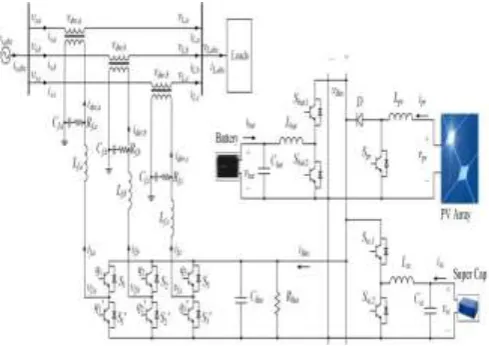
The system architecture of the DC microgrid integrated DVR is shown in Fig. 1. For the DVR side, there is an injection transformer, a VSI and a LC filter with a damping resistor. , , and denote the grid voltage, grid current, load voltage and load current respectively. , , and are the input voltage and input current, output voltage and output current of the filter.
© 2019, IRJET | Impact Factor value: 7.34 | ISO 9001:2008 Certified Journal | Page 1580 switch and diode respectively. The lithium-ion battery and
super capacitor are assigned with the bidirectional buck/boost converter to conduct the charge/discharging operation. The corresponding voltage, current, switches and capacitors are , , , , , , , , and .
Fig -1: Proposed DC microgrid integrated DVR system
Model Predictive Control for DVR
The switches states of the VSI are determined based on the corresponding signals as follows:
………. (1)
Hence, can be obtained
………(2) is expressed as after the αβ-transformation as follows:
………..(3)
Similarly, , and are expressed as
, and with the αβ-transformation. Hence, the equationsdescribing the LC filter are shown as follows:
………(4)
………….(5)
Where as the constant value with a high sampling frequency. By substituting (4) into (5) and, it can be obtained as follows:
………..(6) The discretization of (6) can be obtained using forward- Euler method with a preset time step of TS, as shown below:
……….(7) The reference of is defined as which is expressed as follows:
………….(8) where is the RMS value of nominal amplitude of
and the synchronization angle ωt can be obtained using and phase-locked loop. A cost function is defined in (9), and it determines the optimal control action which can minimize (9).
………(9) There are eight possible values of the vector based (1). By setting prediction horizon and control horizon set as 1, the number of the predicted values of is also eight, so that the enumeration of (9) can be conducted to determine the optimal value of
and the computational burden is low considering the limited number of enumeration.
[image:2.595.40.285.188.361.2]© 2019, IRJET | Impact Factor value: 7.34 | ISO 9001:2008 Certified Journal | Page 1581
3. SIMULATION MODEL AND RESULTS
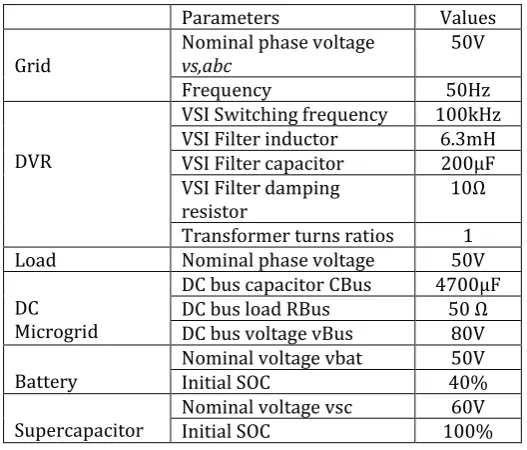
[image:3.595.310.579.102.301.2]A series of study cases are simulated in the MATLAB/Simulink to validate the performance of the proposed DC microgrid integrated DVR system. Two simulation study cases including voltage sag scenario and voltage swell scenario. The setting parameters of the proposed system are listed in Table I, including the setting of grid, DVR, load, DC microgrid, battery and supercapacitor. Simulation setting parameters for the proposed system is as follows:
Table -1: Simulation model parameters
Parameters Values
Grid Nominal phase voltage vs,abc 50V
Frequency 50Hz
DVR
VSI Switching frequency 100kHz VSI Filter inductor 6.3mH VSI Filter capacitor 200μF VSI Filter damping
resistor 10Ω
Transformer turns ratios 1
Load Nominal phase voltage 50V
DC Microgrid
DC bus capacitor CBus 4700μF
DC bus load RBus 50 Ω
DC bus voltage vBus 80V
Battery Nominal voltage vbat Initial SOC 40% 50V
Supercapacitor Nominal voltage vsc Initial SOC 100% 60V
In a fig.3 shows a simulation model for the DC microgrid integrated DVR with model predictive control. Here three phase voltage source is used which is supplied 50 V to the load of 50 V. In a MATLAB model Fault block is inserted for the sag/swell occurrence purpose. In this system DC microgrid contains PV array which is shown in fig.4 and lithium ion battery of 50 V with initial state of charge 40% and it is parallel to the super capacitor of 60V with initial state of charge 100%. the battery and super capacitor model in which buck/boost converter for the charging and discharging purpose. Vbattery=50V and Initial SOC=40%, Vsupercapacitor=60V and Initial SOC=100% for this system.
Fig -3: Simulation model for DC microgrid integrated DVR with MPC block
Fig -4: Simulation model for battery and super capacitor model
[image:3.595.30.294.252.477.2] [image:3.595.310.555.339.529.2] [image:3.595.318.549.572.734.2]© 2019, IRJET | Impact Factor value: 7.34 | ISO 9001:2008 Certified Journal | Page 1582 A study cases are simulated in the
MATLAB/Simulink to analyse the performance of the proposed DC microgrid integrated DVR system, and the corresponding simulation results are discussed here. Two simulation cases study includes voltage sag scenario and voltage swell scenario.
A. Voltage Sag Scenario
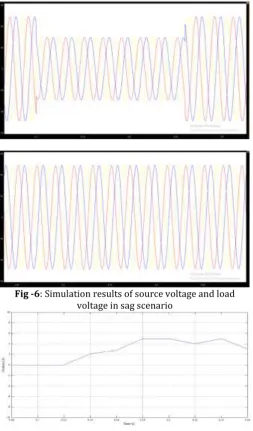
Fig.6 and 7 shows the simulation results of source voltage with sag and compensated load voltage. In voltage sag scenario it can be seen that the source voltage have a sudden sag from the nominal phase voltage value 50V to 30V when t=0.1 s as shown in fig. powered by the DC microgrid , the MPC controlled DVR can inject the compensation voltage. Hence, load voltage can be maintained at a nominal phase value 50Vduring the voltage sag period 0.1 sec to 0.26 sec.
Fig -6: Simulation results of source voltage and load voltage in sag scenario
Fig -7: Simulation results of a DC microgrid in sag scenario
Fig.7 shows the waveforms of the DC microgrid during the voltage sag slot. It can be observed that the battery is charged by the PV array via DC bus at a normal condition when sag is not occurs. When sag happens at t= 0.1 sec I bus varies dramatically due to the voltage sag compensation. Hence battery and super capacitor are discharged at sag condition at t=0.1 to 0.6 s to maintain DC bus voltage constant upto 75V to 85V which is nearly equals to 80V. 5 to 10% tolerance is negligible.
B. Voltage Swell Scenario
[image:4.595.319.553.83.500.2] [image:4.595.36.290.304.736.2]© 2019, IRJET | Impact Factor value: 7.34 | ISO 9001:2008 Certified Journal | Page 1583
Fig -8: Simulation results of source voltage and load voltage in swell scenario
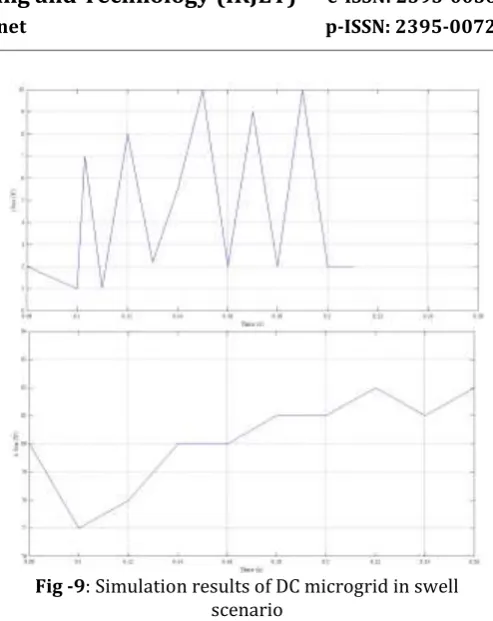
Fig -9: Simulation results of DC microgrid in swell scenario
Fig.9 shows the simulation results of a DC microgrid when swell occurs in the grid voltage. It can be observed that the battery is charged by the PV array via DC bus at a normal condition when swell is not occurs. When swell happens at t= 0.1 sec I bus varies dramatically due to the voltage swell compensation. Hence battery and super capacitor are discharged at swell condition at t=0.1 to 0.6 s to maintain DC bus voltage constant upto 77V to 82V which is nearly equals to 80V. 5% to 10% difference in bus voltage is to be considered.
4. CONCLUSION
From the simulation results it is conclude that at the both sag and swell condition it is important to maintain the DC bus voltage at the constant bus voltage upto 80V. For that purpose we are using the DC grid of PV array and battery and super capacitor. Hence proposed DVR system is able to achieve compensation of sag/swell with the maintaining stable DC bus voltage.
REFERENCES
[1] Tomislav Dragičević,Xiaonan Lu, Juan C. Vasquez and Josep M. Guerrero, “ DC Microgrids–Part I: A Review of control strategies and stabilization techniques”, IEEE Transactions on Power Electronics,2015.
[image:5.595.50.499.53.755.2] [image:5.595.310.557.58.369.2]© 2019, IRJET | Impact Factor value: 7.34 | ISO 9001:2008 Certified Journal | Page 1584 [3] John Godsk Nielsen and Frede Blaabjerg, “A Detailed
Comparison of System Topologies for Dynamic Voltage Restorers”, IEEE Transaction on Industry Applications, Vol.41, No.5, Sept. 2005.
[4] S. S. Choi, J. D. Li and D. Mahinda Vilathgamuwa, “ A Generalized Voltage Compensation Strategy for Mitigating the Impacts of Voltage Sags/Swells” IEEE Transactions on Power Delivery, Vol. 20, No. 3, July 2005.
[5] Paisan Boonchiam and Nadarajah Mithulananthan “Understanding of Dynamic Voltage Restorers Through MATLAB Simulation” , Thammasat Int. J. Sc. Tech., Vol.11, No. 3, Jul 2006.
[6] Arindam Ghosh, Amit Kumar Jindaland Avinash Joshi “Design of a Capacitor-Supported Dynamic Voltage Restorer (DVR) for Unbalanced and Distorted Loads”, IEEE Transaction on Power Delivery, Vol.19, No.1, Jan 2004.
[7] Yun Wei Li, D. Mahinda Vilathgamuwa, Frede Blaabjerg and Poh Chiang Loh, “A Robust Control Scheme for Medium-Voltage-Level DVR Implementation”, IEEE Transactions on Industrial Electronics ,Vol.54, No.4, pp.2249-2261, August 2007.
[8] Ali O Al-Mathnani, Azah Mohamed and Mohd Alauddin Mohd Ali, “Photovoltaic Based Dynamic Voltage Restorer For Voltage Sag Mitigation”, IEEE The 5th Student Conference on Research and Development –SCOReD 2007 11-12 December 2007, Malaysia.
[9] Patricio Cortés, Gabriel Ortiz, Juan I. Yuz, José Rodríguez, Sergio Vazque and Leopoldo G. Franquelo, “Model Predictive Control of an Inverter With Output LC Filter for UPS Applications”, IEEE Transactions on Industrial Electronics, Vol. 56, No.6, June 2009
[10] Firouz Badrkhani Ajaei, Saeed Afsharnia, Alireza Kahrobaeian, and Shahrokh Farhangi, “A Fast and Effective Control Scheme for the Dynamic Voltage Restorer”, IEEE Transaction on Power Delivery, Vol. 26, No. 4, Oct. 2011.
[11] P. Jayaprakash, Bhim Singh, D. P. Kothari, Ambrish Chandra and Kamal-Al-Haddad, “Control of Reduced Rating Dynamic Voltage Restorer with Battery Energy Storage System”, IEEE, 2013.
[12] M. Ramasamy and S. Thangavel, “Experimental verification of PV based Dynamic Voltage Restorer (PV-DVR) with significant energy conservation, Electrical Power and Energy Systems 49 (2013) 296–307. [13] Abdul Mannan Rauf and Vinod Khadkikar, “Integrated
Photovoltaic and Dynamic Voltage Restorer System Configuration, IEEE Transactions on Sustainable Energy, 2015.
[14] Kalyani Sahu, Prof. Devendra Sahu, Prof. Md. Khwaja Mohiddin, “Simulink Modelling of Integrated Dynamic Voltage Restorer-Supercapacitor, for Power Quality Enhancement Using Neural Network Control System”, International Journal of Advanced Research in Electrical,
Electronics and Instrumentation Engineering (IJAREEIE), Vol.5, Issue 5, May 2016.
[15] S.Srinivasa Rao, P.Siva Rama Krishna, Dr.Sai Babu, “Mitigation of voltage sag, swell and THD using Dynamic Voltage Restorer with Photovoltaic System”, IEEE, 2017. [16] Benfei Wang, Jian Ye, Ujjal Manandhar, Abhisek Ukil, and Hoay Beng Gooi “A DC Microgrid Integrated Dynamic Voltage Restorer with Model Predictive Control”, IEEE, 2017.