Learning to Classify Email into "Speech Acts"
William W. Cohen1 Vitor R. Carvalho2 Tom M. Mitchell1,2
1
Center for Automated Learning & Discovery Carnegie Mellon University
Pittsburgh, PA 15213
2
Language Technology Institute Carnegie Mellon University
Pittsburgh, PA 15213
Abstract
It is often useful to classify email accord-ing to the intent of the sender (e.g., "pro-pose a meeting", "deliver information"). We present experimental results in learn-ing to classify email in this fashion, where each class corresponds to a verb-noun pair taken from a predefined ontol-ogy describing typical “email speech acts”. We demonstrate that, although this categorization problem is quite dif-ferent from “topical” text classification, certain categories of messages can none-theless be detected with high precision (above 80%) and reasonable recall (above 50%) using existing text-classification learning methods. This result suggests that useful task-tracking tools could be constructed based on automatic classifi-cation into this taxonomy.
1 Introduction
In this paper we discuss using machine learn-ing methods to classify email accordlearn-ing to the intent of the sender. In particular, we classify emails according to an ontology of verbs (e.g., propose, commit, deliver) and nouns (e.g., infor-mation, meeting, task), which jointly describe the “email speech act” intended by the email sender. A method for accurate classification of email into such categories would have many potential benefits. For instance, it could be used to help an email user track the status of ongoing joint activi-ties. Delegation and coordination of joint tasks is a time-consuming and error-prone activity, and the cost of errors is high: it is not uncommon that commitments are forgotten, deadlines are missed, and opportunities are wasted because of a failure to properly track, delegate, and prioritize sub-tasks. The classification methods we consider
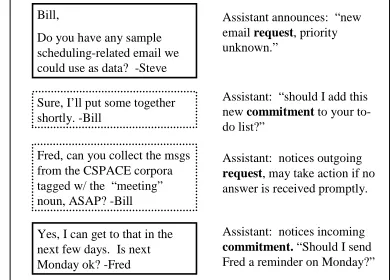
methods which could be used to partially auto-mate this sort of activity tracking. A hypothetical example of an email assistant that works along these lines is shown in Figure 1.
Bill,
Do you have any sample scheduling-related email we could use as data? -Steve
Assistant announces: “new email request, priority unknown.”
Sure, I’ll put some together shortly. -Bill
Assistant: “should I add this new commitment to your to-do list?”
Fred, can you collect the msgs from the CSPACE corpora tagged w/ the “meeting” noun, ASAP? -Bill
Assistant: notices outgoing
request, may take action if no
answer is received promptly.
Yes, I can get to that in the next few days. Is next Monday ok? -Fred
Assistant: notices incoming
commitment. “Should I send
Fred a reminder on Monday?”
Figure 1 - Dialog with a hypothetical email assistant that automatically detects email speech acts. Dashed boxes indicate outgoing messages. (Messages have been edited for space and anonymity.)
2 Related Work
Our research builds on earlier work defining il-locutionary points of speech acts (Searle, 1975), and relating such speech acts to email and work-flow tracking (Winograd, 1987, Flores & Lud-low, 1980, Weigant et al, 2003). Winograd suggested that research explicating the speech-act based “language-action perspective” on human communication could be used to build more use-ful tools for coordinating joint activities. The Coordinator (Winograd, 1987) was one such sys-tem, in which users augmented email messages with additional annotations indicating intent.
[image:1.612.346.541.237.377.2]these difficulties are avoided if messages can be automatically annotated by intent, rather than soliciting a statement of intent from the user.
Murakoshi et al. (1999) proposed an email an-notation scheme broadly similar to ours, called a “deliberation tree”, and an algorithm for con-structing deliberation trees automatically, but their approach was not quantitatively evaluated. The approach is based on recognizing a set of hand-coded linguistic “clues”. A limitation of their approach is that these hand-coded linguistic “clues” are language-specific (and in fact limited to Japanese text.)
Prior research on machine learning for text classification has primarily considered classifica-tion of documents by topic (Lewis, 1992; Yang, 1999), but also has addressed sentiment detection (Pang et al., 2002; Weibe et al., 2001) and au-thorship attribution (e.g., Argamon et al, 2003). There has been some previous use of machine learning to classify email messages (Cohen 1996; Sahami et al., 1998; Rennie, 2000; Segal & Kephart, 2000). However, to our knowledge, none of these systems has investigated learning methods for assigning email speech acts. Instead, email is generally classified into folders (i.e., ac-cording to topic) or acac-cording to whether or not it is “spam”. Learning systems have been previ-ously used to automatically detect acts in conversational speech (e.g. Finke et al., 1998).
3 An Ontology of Email Acts
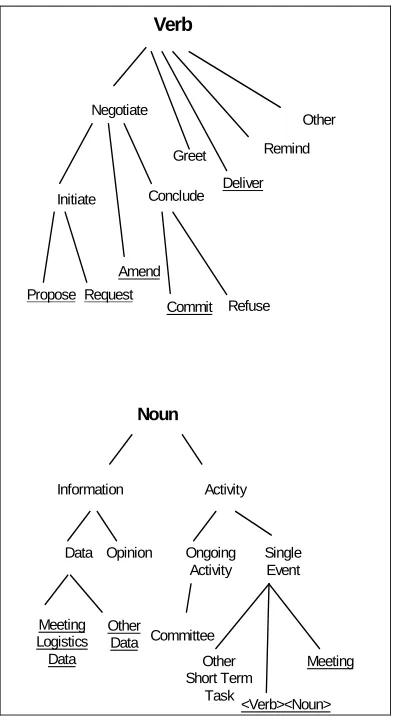
Our ontology of nouns and verbs covering some of the possible speech acts associated with emails is summarized in Figure 2. We assume that a single email message may contain multiple acts, and that each act is described by a verb-noun pair drawn from this ontology (e.g., "deliver data"). The underlined nodes in the figure indicate the nouns and verbs for which we have trained clas-sifiers (as discussed in subsequent sections).
To define the noun and verb ontology of Figure 2, we first examined email from several corpora (including our own inboxes) to find regu-larities, and then performed a more detailed analysis of one corpus. The ontology was further refined in the process of labeling the corpora de-scribed below.
In refining this ontology, we adopted several principles. First, we believe that it is more
impor-tant for the ontology to reflect observed linguistic behavior than to reflect any abstract view of the space of possible speech acts. As a consequence, the taxonomy of verbs contains concepts that are atomic linguistically, but combine several illocu-tionary points. (For example, the linguistic unit "let's do lunch" is both directive, as it requests the receiver, and commissive, as it implicitly com-mits the sender. In our taxonomy this is a single 'propose' act.) Also, acts which are abstractly possible but not observed in our data are not rep-resented (for instance, declarations).
Noun
Activity Information
Meeting Logistics
Data
Opinion Ongoing Activity
Data Single
Event
Meeting Other
Short Term Task Other
Data Committee
<Verb><Noun>
Verb
Remind
Propose
Deliver
Commit Request
Amend
Refuse Greet
Other Negotiate
[image:2.612.287.484.241.601.2]Initiate Conclude
Figure 2 – Taxonomy
Second, we believe that the taxonomy must re-flect common non-linguistic uses of email, such as the use of email as a mechanism to deliver files. We have grouped this with the linguistically similar speech act of delivering information.
A request asks (or orders) the recipient to per-form some activity. A question is also considered a request (for delivery of information).
A propose message proposes a joint activity, i.e., asks the recipient to perform some activity and commits the sender as well, provided the re-cipient agrees to the request. A typical example is an email suggesting a joint meeting.
An amend message amends an earlier proposal. Like a proposal, the message involves both a commitment and a request. However, while a proposal is associated with a new task, an amendment is a suggested modification of an already-proposed task.
A commit message commits the sender to some future course of action, or confirms the senders' intent to comply with some previously described course of action.
A deliver message delivers something, e.g., some information, a PowerPoint presentation, the URL of a website, the answer to a question, a message sent "FYI”, or an opinion.
The refuse, greet, and remind verbs occurred very infrequently in our data, and hence we did not attempt to learn classifiers for them (in this initial study). The primary reason for restricting ourselves in this way was our expectation that human annotators would be slower and less reli-able if given a more complex taxonomy.
The nouns in Figure 2 constitute possible ob-jects for the email speech act verbs. The nouns fall into two broad categories.
Information nouns are associated with email speech acts described by the verbs Deliver, Re-mind and Amend, in which the email explicitly contains information. We also associate informa-tion nouns with the verb Request, where the email contains instead a description of the needed information (e.g., "Please send your birthdate." versus "My birthdate is …". The request act is actually for a 'deliver information' activity). In-formation includes data believed to be fact as well as opinions, and also attached data files.
Activity nouns are generally associated with email speech acts described by the verbs Pro-pose, Request, Commit, and Refuse. Activities include meetings, as well as longer term activities such as committee memberships.
Notice every email speech act is itself an ac-tivity. The <verb><noun> node in Figure 1 indi-cates that any email speech act can also serve as
the noun associated with some other email speech act. For example, just as (deliver infor-mation) is a legitimate speech act, so is (commit (deliver information)). Automatically construct-ing such nested speech acts is an interestconstruct-ing and difficult topic; however, in the current paper we consider only the problem of determining top-level the verb for such compositional speech acts. For instance, for a message containing a (commit (deliver information)) our goal would be to automatically detect the commit verb but not the inner (deliver information) compound noun.
4 Categorization Results
4.1 Corpora
Although email is ubiquitous, large and realis-tic email corpora are rarely available for research purposes. The limited availability is largely due to privacy issues: for instance, in most US aca-demic institutions, a users’ email can only be dis-tributed to researchers if all senders of the email also provided explicit written consent.
The email corpora used in our experiments consist of four different email datasets collected from working groups who signed agreements to make their email accessible to researchers. The first three datasets, N01F3, N02F2, and N03F2 are annotated subsets of a larger corpus, the CSpace email corpus, which contains approxi-mately 15,000 email messages collected from a management course at Carnegie Mellon Univer-sity. In this course, 277 MBA students, organized in approximately 50 teams of four to six mem-bers, ran simulated companies in different market scenarios over a 14-week period (Kraut et al.). N02F2, N01F3 and N03F2 are collections of all email messages written by participants from three different teams, and contain 351, 341 and 443 different email messages respectively.
These email corpora are all task-related, and associated with a small working group, so it is not surprising that they contain many instances of the email acts described above—for instance, the CSpace corpora contain an average of about 1.3 email verbs per message. Informal analysis of other personal inboxes suggests that this sort of email is common for many university users. We believe that negotiation of shared tasks is a cen-tral use of email in many work environments.
All messages were preprocessed by removing quoted material, attachments, and non-subject header information. This preprocessing was per-formed manually, but was limited to operations which can be reliably automated. The most diffi-cult step is removal of quoted material, which we address elsewhere (Carvalho & Cohen, 2004).
4.2 Inter-Annotator Agreement
Each message may be annotated with several labels, as it may contain several speech acts. To evaluate inter-annotator agreement, we double-labeled N03F2 for the verbs Deliver, Commit, Request, Amend, and Propose, and the noun, Meeting, and computed the kappa statistic (Car-letta, 1996) for each of these, defined as
R
R
A
−
−
=
1
κ
where A is the empirical probability of agreement on a category, and R is the probability of agree-ment for two annotators that label docuagree-ments at random (with the empirically observed frequency of each label). Hence kappa ranges from -1 to +1. The results in Table 1 show that agreement is good, but not perfect.
Email Act Kappa
Meeting 0.82
Deliver 0.75
Commit 0.72
Request 0.81
Amend 0.83
[image:4.612.291.489.371.504.2]Propose 0.72
Table 1 - Inter-Annotator Agreement on N03F2. We also took doubly-annotated messages which had only a single verb label and con-structed the 5-class confusion matrix for the two annotators shown in Table 2. Note kappa values
are somewhat higher for the shorter one-act mes-sages.
Req Prop Amd Cmt Dlv kappa
Req 55 0 0 0 0 0.97
Prop 1 11 0 0 1 0.77
Amd 0 1 15 0 0 0.87
Cmt 1 3 1 24 4 0.78
Dlv 1 0 2 3 135 0.91
Table 2 - Inter-annotator agreement on documents with only one category.
4.3 Learnability of Categories
Representation of documents. To assess the
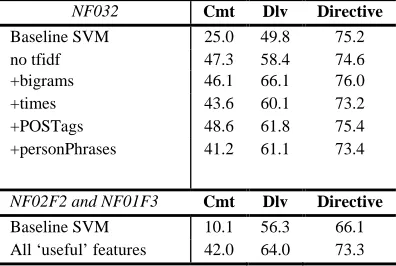
types of message features that are most important for prediction, we adopted Support Vector Ma-chines (Joachims, 2001) as our baseline learning method, and a TFIDF-weighted bag-of-words as a baseline representation for messages. We then conducted a series of experiments with the N03F2 corpus only to explore the effect of dif-ferent representations.
NF032 Cmt Dlv Directive
Baseline SVM 25.0 49.8 75.2
no tfidf 47.3 58.4 74.6
+bigrams 46.1 66.1 76.0
+times 43.6 60.1 73.2
+POSTags 48.6 61.8 75.4
+personPhrases 41.2 61.1 73.4
NF02F2 and NF01F3 Cmt Dlv Directive
Baseline SVM 10.1 56.3 66.1
All ‘useful’ features 42.0 64.0 73.3
Table 3 – F1 for different feature sets.
[image:4.612.119.223.526.619.2]ma-jority classifier in the row marked “default”; all numbers are F1 measures on 10-fold cross-validation.) Examination of messages suggested other possible improvements. Since much nego-tiation involves timing, we ran a hand-coded ex-tractor for time and date expressions on the data, and extracted as features the number of time ex-pressions in a message, and the words that oc-curred near a time (for instance, one such feature is “the word ‘before’ appears near a time”). These results appear in the row marked “times”. Similarly, we ran a part of speech (POS) tagger and added features for words appearing near a pronoun or proper noun (“personPhrases” in the table), and also added POS counts.
To derive a final representation for each cate-gory, we pooled all features that improved per-formance over “no tfidf” for that category. We then compared performance of these document representations to the original TFIDF bag of words baseline on the (unexamined) N02F2 and N01F3 corpora. As Table 3 shows, substantial improvement with respect to F1 and kappa was obtained by adding these additional features over the baseline representation. This result contrasts with previous experiments with bigrams for topi-cal text classification (Scott & Matwin, 1999) and sentiment detection (Pang et al., 2002). The difference is probably that in this task, more in-formative words are potentially ambiguous: for instance, “will you” and “I will” are correlated with requests and commitments, respectively, but the individual words in these bigrams are less predictive.
Learning methods. In another experiment,
we fixed the document representation to be un-weighted word frequency counts and varied the learning algorithm. In these experiments, we pooled all the data from the four corpora, a total of 9602 features in the 1357 messages, and since the nouns and verbs are not mutually exclusive, we formulated the task as a set of several binary classification problems, one for each verb.
The following learners were used from the Based on the MinorThird toolkit (Cohen, 2004). VP is an implementation of the voted perceptron algorithm (Freund & Schapire, 1999). DT is a simple decision tree learning system, which learns trees of depth at most five, and chooses
splits to maximize the function
(
1 1 0 0)
2 W+W− + W+W− suggested by Schapire and
Singer (1999) as an appropriate objective for “weak learners”. AB is an implementation of the confidence-rated boosting method described by Singer and Schapire (1999), used to boost the DT algorithm 10 times. SVM is a support vector ma-chine with a linear kernel (as used above).
Act VP AB SVM DT
Request (450/907) Error F1 0.25 0.58 0.22 0.65 0.23 0.64 0.20 0.69 Proposal (140/1217) Error F1 0.11 0.19 0.12 0.26 0.12 0.44 0.10 0.13 Delivery (873/484) Error F1 0.26 0.80 0.28 0.78 0.27 0.78 0.30 0.76 Commit-ment (208/1149) Error F1 0.15 0.21 0.14 0.44 0.17 0.47 0.15 0.11 Directive (605/752) Error F1 0.25 0.72 0.23 0.73 0.23 0.73 0.19 0.78 Commis-sive (993/364) Error F1 0.23 0.84 0.23 0.84 0.24 0.83 0.22 0.85 Meet (345/1012) Error F1 0.187 0.573 0.17 0.62 0.14 0.72 0.18 0.60
Table 4 – Learning on the entire corpus.
Table 4 reports the results on the most common verbs, using 5-fold cross-validation to assess ac-curacy. One surprise was that DT (which we had intended merely as a base learner for AB) works surprisingly well for several verbs, while AB sel-dom improves much over DT. We conjecture that the bias towards large-margin classifiers that is followed by SVM, AB, and VP (and which has been so successful in topic-oriented text classifi-cation) may be less appropriate for this task, per-haps because positive and negative classes are not clearly separated (as suggested by substantial
inter-annotator disagreement).
Class: Commisive
(Total: 1357 msgs)
0.4 0.6 0.8 1
0 0.2 0.4 0.6 0.8 1 Recall P re c is io
n Voted Perceptron AdaBoost SVM Decision Tree
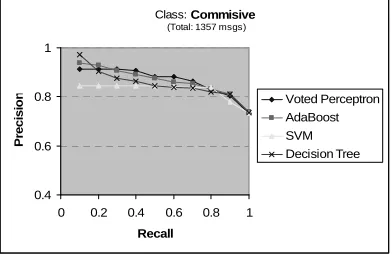
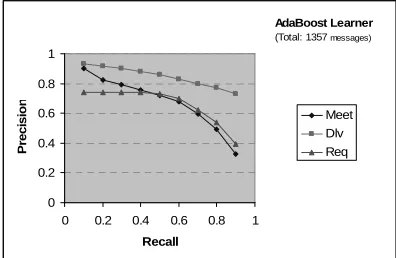
[image:5.612.342.538.503.630.2]corresponds to the precision of random guessing. These graphs indicate that high-precision predic-tions can be made for the top-level of the verb hierarchy, as well as verbs Request and Deliver, if one is willing to slightly reduce recall.
Class: Directive
(Total: 1357 msgs)
0.2 0.4 0.6 0.8 1
0 0.2 0.4 0.6 0.8 1 Recall
P
re
c
is
io
n VotedPerceptron
[image:6.612.295.484.122.262.2]AdaBoost SVM DecisionTree
Figure 4 - Precision/Recall for Directive act
0 0.2 0.4 0.6 0.8 1
0 0.2 0.4 0.6 0.8 1 Recall
P
re
c
is
io
n
Meet Dlv Req AdaBoost Learner
(Total: 1357messages)
Figure 5 - Precision/Recall of 3 different classes using AdaBoost
Transferability. One important question
in-volves the generality of these classifiers: to what range of corpora can they be accurately applied? Is it possible to train a single set of email-act classifiers that work for many users, or is it nec-essary to train individual classifiers for each user? To explore this issue we trained a DT clas-sifier for Directive emails on the NF01F3 corpus, and tested it on the NF02F2 corpus; trained the same classifier on NF02F2 and tested it on NF01F3; and also performed a 5-fold cross-validation experiment within each corpus. (NF02F2 and NF01F3 are for disjoint sets of us-ers, but are approximately the same size.) We then performed the same experiment with VP for Deliver verbs and SVM for Commit verbs (in
each case picking the top-performing learner with respect to F1). The results are shown in Table 5.
Test Data
DT/Directive 1f3 2f2
Train Data Error F1 Error F1
1f3 25.1 71.6 16.4 72.8
2f2 20.1 68.8 18.8 71.2
VP/Deliver
1f3 30.1 55.1 21.1 56.1
2f2 35.0 25.4 21.1 35.7
SVM/Commit
1f3 23.4 39.7 15.2 31.6
[image:6.612.68.267.150.275.2]2f2 31.9 27.3 16.4 15.1
Table 5 - Transferability of classifiers
If learned classifiers were highly specific to a particular set of users, one would expect that the diagonal entries of these tables (the ones based on cross-validation within a corpus) would ex-hibit much better performance than the off-diagonal entries. In fact, no such pattern is shown. For Directive verbs, performance is simi-lar across all table entries, and for Deliver and Commit, it seems to be somewhat better to train on NF01F3 regardless of the test set.
4.4 Future Directions
None of the algorithms or representations dis-cussed above take into account the context of an email message, which intuitively is important in detecting implicit speech acts. A plausible notion of context is simply the preceding message in an email thread.
Exploiting this context is non-trivial for sev-eral reasons. Detecting threads is difficult; al-though email headers contain a “reply-to” field, users often use the “reply” mechanism to start what is intuitively a new thread. Also, since email is asynchronous, two or more users may reply simultaneously to a message, leading to a thread structure which is a tree, rather than a se-quence. Finally, most sequential learning models assume a single category is assigned to each in-stance—e.g., (Ratnaparkhi, 1999)—whereas our scheme allows multiple categories.
[image:6.612.67.265.313.442.2](email speech acts) are factored into two features (verbs and nouns) which jointly determine this class. A variety of real-world text classification problems can be naturally expressed as factored problems, and from a theoretical viewpoint, the additional structure may allow construction of new, more effective algorithms.
For example, the factored classes provide a more elaborate structure for generative probabil-istic models, such as those assumed by Naïve Bayes. For instance, in learning email acts, one might assume words were drawn from a mixture distribution with one mixture component pro-duces words conditioned on the verb class factor, and a second mixture component generates words conditioned on the noun (see Blei et al (2003) for a related mixture model). Alternatively, models of the dependencies between the different factors (nouns and verbs) might also be used to improve classification accuracy, for instance by building into a classifier the knowledge that some nouns and verbs are incompatible.
The fact that an email can contain multiple email speech acts almost certainly makes learn-ing more difficult: in fact, disagreement between human annotators is generally higher for longer messages. This problem could be addressed by more detailed annotation: rather than annotating each message with all the acts it contains, human annotators could label smaller message segments (say, sentences or paragraphs). An alternative to more detailed (and expensive) annotation would be to use learning algorithms that implicitly seg-ment a message. As an example, another mixture model formulation might be used, in which each mixture component corresponds to a single verb category.
5 Concluding Remarks
We have presented an ontology of “email speech acts” that is designed to capture some im-portant properties of a central use of email: nego-tiating and coordinating joint activities. Unlike previous attempts to combine speech act theory with email (Winograd, 1987; Flores and Ludlow, 1980), we propose a system which passively ob-serves email and automatically classifies it by intention. This reduces the burden on the users of the system, and avoids sacrificing the flexibility
and socially desirable aspects of informal, natural language communication.
This problem also raises a number of interest-ing research issues. We showed that entity ex-traction and part of speech tagging improves classifier performance, but leave open the ques-tion of whether other types of linguistic analysis would be useful. Predicting speech acts requires context, which makes classification an inherently sequential task, and the labels assigned to mes-sages have non-trivial structure; we also leave open the question of whether these properties can be effectively exploited.
Our experiments show that many categories of messages can be detected, with high precision and moderate recall, using existing text-classification learning methods. This suggests that useful task-tracking tools could be con-structed based on automatic classifiers—a poten-tially important practical application.
References
S. Argamon, M. Šariç and S. S. Stein. (2003). Style
mining of electronic messages for multiple authorship discrimination: first results. Proceedings of the 9th ACM SIGKDD, Washington, D.C.
V. Bellotti, N. Ducheneaut, M. Howard and I. Smith. (2003). Taking email to task: the design and evalua-tion of a task management centered email tool. Pro-ceedings of the Conference on Human Factors in Computing Systems, Ft. Lauderdale, Florida.
D. Blei, T. Griffiths, M. Jordan, and J. Tenenbaum. (2003). Hierarchical topic models and the nested Chi-nese restaurant process. Advances in Neural Informa-tion Processing Systems, 16, MIT Press.
B. M. Camino, A. E. Millewski, D. R. Millen and T. M. Smith. (1998). Replying to email with structured responses. International Journal of Human-Computer Studies. Vol. 48, Issue 6, pp 763 – 776.
J. Carletta. (1996). Assessing Agreement on Classifi-cation Tasks: The Kappa Statistic. Computational Linguistics, Vol. 22, No. 2, pp 249-254.
V. R. Carvalho & W. W. Cohen (2004). Learning to Extract Signature and Reply Lines from Email. To appear in Proc. of the 2004 Conference on Email and Anti-Spam. Mountain View, California.
Sympo-sium on Machine Learning and Information Access, Palo Alto, California.
W. W. Cohen. (2004). Minorthird: Methods for Identi-fying Names and Ontological Relations in Text using Heuristics for Inducing Regularities from Data,
http://minorthird.sourceforge.net.
M. Finke, M. Lapata, A. Lavie, L. Levin, L. May-fieldTomokiyo, T. Polzin, K. Ries, A. Waibel and K. Zechner. (1998). CLARITY: Inferring Discourse Structure from Speech. In Applying Machine Learn-ing to Discourse ProcessLearn-ing, AAAI'98.
F. Flores, and J.J. Ludlow. (1980). Doing and Speak-ing in the Office. In: G. Fick, H. Spraque Jr. (Eds.). Decision Support Systems: Issues and Challenges, Pergamon Press, New York, pp. 95-118.
Y. Freund and R. Schapire. (1999). Large Margin Classification using the Perceptron Algorithm.
Ma-chine Learning 37(3), 277—296.
T. Joachims. (2001). A Statistical Learning Model of Text Classification with Support Vector Machines. Proc. of the Conference on Research and Develop-ment in Information Retrieval (SIGIR), ACM, 2001.
R. E. Kraut, S. R. Fussell, F. J. Lerch, and J. A. Espinosa. (under review). Coordination in teams: evi-dence from a simulated management game. To appear in the Journal of Organizational Behavior.
D. D. Lewis. (1992). Representation and Learning in Information Retrieval. PhD Thesis, No. 91-93, Com-puter Science Dept., Univ of Mass at Amherst
A. McCallum, D. Freitag and F. Pereira. (2000). Maximum Entropy Markov Models for Information Extraction and Segmentation. Proc. of the 17th Int’l Conf. on Machine Learning, Nashville, TN.
B. Pang, L. Lee and S. Vaithyanathan. (2002). Thumbs up? Sentiment Classification using Machine Learning Techniques. Proc. of the 2002 Conference on Empirical Methods in Natural Language Process-ing (EMNLP), pp 79-86.
A. E. Milewski and T. M. Smith. (1997). An Experi-mental System For Transactional Messaging. Proc. of the international ACM SIGGROUP conference on Supporting group work: the integration challenge, pp. 325-330.
H. Murakoshi, A. Shimazu and K. Ochimizu. (1999). Construction of Deliberation Structure in Email Communication,. Pacific Association for Computa-tional Linguistics, pp. 16-28, Waterloo, Canada.
A. Ratnaparkhi. (1999). Learning to Parse Natural Language with Maximum Entropy Models. Machine Learning, Vol. 34, pp. 151-175.
J. D. M. Rennie. (2000). Ifile: An Application of Ma-chine Learning to Mail Filtering. Proc. of the KDD-2000 Workshop on Text Mining, Boston, MA.
M. Sahami, S. Dumais, D. Heckerman and E. Horvitz. (1998). A Bayesian Approach to Filtering Junk E-Mail. AAAI'98 Workshop on Learning for Text Cate-gorization. Madison, WI.
M. Schoop. (2001). An introduction to the language-action perspective. SIGGROUP Bulletin, Vol. 22, No. 2, pp 3-8.
S. Scott and S. Matwin. (1999). Feature engineering for text classification. Proc. of 16th International Con-ference on Machine Learning, Bled, Slovenia.
J. R. Searle. (1975). A taxonomy of illocutionary acts. In K. Gunderson (Ed.), Language, Mind and Knowl-edge, pp. 344-369. Minneapolis: University of Min-nesota Press.
R. B. Segal and J. O. Kephart. (2000). Swiftfile: An intelligent assistant for organizing e-mail. In AAAI 2000 Spring Symposium on Adaptive User Interfaces, Stanford, CA.
Y. Yang. (1999). An Evaluation of Statistical Ap-proaches to Text Categorization. Information Re-trieval, Vol. 1, Numbers 1-2, pp 69-90.
S. Wermter and M. Löchel. (1996). Learning dialog act processing. Proc. of the International Conference on Computational Linguistics, Kopenhagen, Denmark.
R. E. Schapire and Y. Singer. (1998). Improved boost-ing algorithms usboost-ing confidence-rated predictions. The 11th Annual Conference on Computational Learning Theory, Madison, WI.
H. Wiegend, G. Goldkuhl, and A. de Moor. (2003). Proc. of the Eighth Annual Working Conference on Language-Action Perspective on Communication Modelling (LAP 2003), Tilburg, The Netherlands.
J. Wiebe, R. Bruce, M. Bell, M. Martin and T. Wilson. (2001). A Corpus Study of Evaluative and Speculative Language. Proceedings of the 2nd ACL SIGdial Workshop on Discourse and Dialogue. Aalborg, Denmark.
T. Winograd. 1987. A Language/Action Perspective on the Design of Cooperative Work. Human-Computer Interactions, 3:1, pp. 3-30.