A Comparative Study of the Application of Different
Learning Techniques to Natural Language Interfaces
Werner Winiwarter and
Yahiko Kambayashi
Dept. of Information Science
Kyoto University
Sakyo, Kyoto 606-01, Japan
{ww I
yahiko}©kuis, kyoto-u, ac. jp
Abstract
In this paper we present first results from a comparative study. Its aim is to test the feasibility of different inductive learn- ing techniques to perform the automatic acquisition of linguistic knowledge within a natural language database interface. In our interface architecture the machine learn- ing module replaces an elaborate semantic analysis component. The learning module learns the correct mapping of a user's input to the corresponding database command based on a collection of past input data. We use an existing interface to a produc- tion planning and control system as evalu- ation and compare the results achieved by different instance-based and model-based learning algorithms.
1
Introduction
One of the main obstacles to the efficient use of nat- ural language interfaces is the often required high amount of manual knowledge engineering (see (An- droutsopoulos et al., 1995) for a recent survey). This time-consuming and tedious process is often referred to as "knowledge acquisition bottleneck". It may re- quire extensive efforts by experts highly experienced in linguistics as well as in the domain and the task (Riloff and Lehnert, 1994). Therefore, natural lan- guage interfaces represent a domain that is very well suited for the application of machine learning algo- rithms to automate the acquisition process of lin- guistic knowledge.
So far, inductive learning has already been ap- plied successfully to a large variety of natural Jan- guage tasks. This includes basic linguistic problems such as morphological analysis (van den Bosch et al., 1996), parsing (Zelle and Mooney, 1996), word sense disambiguation (Mooney, 1996), and anaphora
resolution (Aone and Bennett, 1996). Besides this, there also exists some research on applications, e.g. machine translation (Yamazaki et al., 1996), text categorization (Moulinier and Ganaseia, 1996), or information extraction (Soderland et al., 1996).
The learning task in natural language interfaces is to select the correct command class based on seman- tic features extracted from the user input. There- fore, it can be modeled as classification problem, i.e. the machine learning algorithms construct a theory from the training data that is used for classifying unseen test data (Quinlan, 1996). So far, we con- sider only supervised learning so that each training case has to be labeled with the correct class.
We apply different existing instance-based and model-based algorithms to this problem and com- pare the achieved results. In addition, we have also developed several new algorithms, which we present briefly in this paper. We have implemented all algorithms by means of the deductive object- oriented database system ROCK ~ ROLL (Barja et al., 1994).
It solves the problem of updates in deductive databases in that it separates the declarative logic query language ROLL from the imperative data ma- nipulation language ROCK within the context of a common object-oriented data model. Besides this, ROCK ~ ROLL makes a clean distinction between
type declarations, which describe the structural char- acteristics of a set of instance objects and the meth- ods that can be applied to them, and class defini- tions, which specify the implementation of the meth- ods associated with a type.
The use of the available powerful logic and object- oriented programming language enables an efficient implementation of the different approaches to ma- chine learning. It also gives us a convenient in- tegrated tool that assists in applying the machine learning algorithms to the data collection stored in the same database.
Winiwarter ~ Kambayashi 125 Learning and NL Interfaces
Werner Winiwarter and Yahiko Kambayashi (1997) A C o m p a r a t i v e S t u d y o f t h e A p p l i c a t i o n o f D i f f e r e n t Learning Techniques to N a t u r a l Language Interfaces. In T.M. Ellison (ed.) CoNLL97: Computational Natural Language Learning, ACL pp 125-135.
User input
and lexical analysis and lexical analysis ~ I.o. d l exical analysi____,_ _ s
UVL analysis .!
ML classifier
I Database command generation
Database command
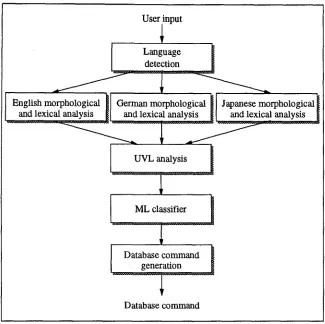
Figure 1: System architecture of natural language interface
As comparative evaluation of the implemented algorithms, we applied them to an extensive case study: a natural language interface for a production planning and control system. The system is used in a multilingual environment, which includes the languages English, German, and Japanese. There- fore, an important issue of the evaluation was to check whether the learned knowledge is language- independent, i.e. if it really operates based on se- mantic deep forms so that it abstracts from linguistic surface phenomena.
The rest of the paper is organized as follows. First, we briefly introduce the learning task before we present the applied machine learning algorithms in more detail. Finally, we explain the set-up of the case study and discuss the achieved results from evaluation.
2 L e a r n i n g T a s k
Our interface architecture is displayed in Fig. 1. It represents a multilingual database interface for the languages English, German, and Japanese. First, the
language
of the user input isdetected
and the input is transferred to the corresponding language-specific
morphological and lexical analyzer.
Morphological and lexical analysis performs the
tokenization
of the input, i.e. the segmentation into individual words or tokens. This task is not always trivial as in the case of Japanese, which uses no spaces for separating words. As next step the input is transformed into adeep form list (DFL),
which indicates for each token its surface form, category, and semantic deep form.For database interfaces, unknown values con- tained in the input possess particular importance for the meaning of a command. Therefore, we t r e a t those unknown values separately in the
unknown
value list (UVL) analyzer.
This module checks the data type of unknown values and looks them up in the database to find out whether they represent iden- tifiers of existing entities. In such a case, the entity type is indicated in the resulting UVL, otherwise we use the data type instead.DFL and UVL represent the input to the
machine
learning (ML) classifier.
It assigns a ranked list of command classes to the input sentence accord- ing to the learned classification rules. As last step the classifications are used forgenerating
appropri- [image:2.596.144.469.101.425.2]Input
D F L
UVL
New purchase price St 37 H kostet nun S t 3 7 H g ) l l ~ . X d ' ~ r of St 37 H is 1,7. 1.7 Schining 1, 7 [ : . ~ ~_ ?.e ~ k ~,
new purchase price of be
1 material 1 real
cost now schilling
1 material
1 real
purchase price change
1 material 1 real
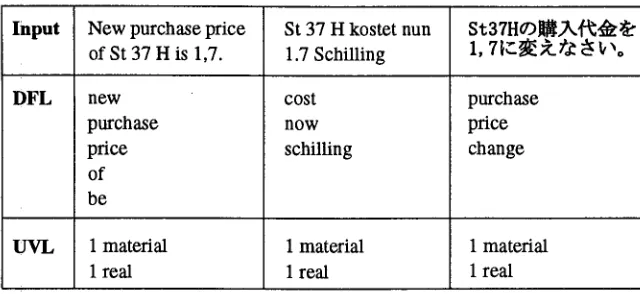
Figure 2: Example of feature encoding
ate database commands.
For the encoding :of the training d a t a we only make use of the semantic deep forms contained in the DFL. We use English concepts as deep forms and map them to binary features, i.e. a certain feature equals I if the deep form is a member of the DFL, otherwise it equals 0. For the elements of the UVL we apply a more detailed encoding, which maps the number and the type to binary features. Figure 2 shows an example of the features derived from English, Ger- man, and Japanese input sentences for the update of the purchase price for a material.
Thus, the learning task replaces an elaborate se- mantic analysis of the user input. The development of the corresponding underlying rule base might re- quire several man-months. T h e learning task rep- resents a realistic real-life application, which differs from m a n y other problems studied in machine learn- ing research in t h a t it consists of a large number of features and classes. Furthermore, the c o m m a n d classes are often very similar and even for human experts very difficult to distinguish.
3 L e a r n i n g A l g o r i t h m s I n s t a n c e - b a s e d L e a r n i n g
Instance-based approaches represent the learned knowledge simply as collection of training cases or instances. For that purpose they use the same lan- guage as for the description of the training d a t a (Quinlan, 1993a). A new case is then classified by finding the instance with the highest similarity and using its class as prediction. Therefore, instance- based algorithms are characterized by a very low training effort. On the other hand, this leads to a high storage requirement because the algorithm has to keep all training cases in memory. Besides this, one has to compare new cases with all existing in- stances, which results in a high computation cost for
classification.
Different instance-based algorithms Vary in how they assess the similarity (or distance) between two instances. Two very commonly used methods are IB1 (Aha et al., 1991) and I B I - I G (Daelemans and van den Bosch, 1992). Whereas IB1 applies the sim- ple approach of treating all features as equally im- portant, IBI-IG uses the information gain (Quinlan, 1986) of the features as weighting function.
We have developed an algorithm called B I N - C A T for binary features with class-dependent weighting and asymmetric t r e a t m e n t of the feature values. T h e similarity between a new case X and a training case Y is calculated according to the following for- mula:
S I M x , y = n
E p (D,, C y ) . w, . o" (x,, Yi) - i----1
n
E p (D,, C y ) " w, . 5y (x,, y,) - i = 1
n
i = l
(1)
In this formula, n indicates the number of fea- tures, Di the number of instances t h a t have value 1 for feature i, and C y the class of the training case Y. T h e term p(Di, Cy) then denotes the proportion of instances in Di t h a t belong to class C y . o'(xl,yi), ~Y(a~i, yi), and 5 x ( z i , yi) are determined as follows:
1 i f x i = 1 A y i = 1 o" (xi, Yi) = 0 otherwise
1 i f x i = O A y i = l
•Y (xi,Yi)
= 0 otherwise [image:3.596.124.444.102.249.2]1 i f z ~ = l A y i = O
5x(~i,yi)
= 0 otherwise (2)so t h a t the second sum in (1) is rated higher for a larger number of occurrences of the ith feature for class
Cy
whereas the third sum is rated lower. This means t h a t if the training case Y contains a certain feature and the new case X does not, then we rate this difference the stronger the more often the feature occurs for classCy.
On the other hand, for features appearing in the new case X but not in Y, the opposite is true.Finally, wi represents the weight of feature i. It is calculated by making use of the following formula:
c
1 E 1
4.p(Di j)
[1p(Di,j)]
(3)W i ~ - - . _ , • C
j = l
T h e t e r m under the s u m m a t i o n symbol represents the selectivity of feature i for class j. It equals 1 if either all or none of the cases have value 1 for this feature. In other words, all instances for class j then either possess or do not possess this feature, which makes it a very discriminative characteristic. T h e Other extreme is t h a t
p(Di,j)
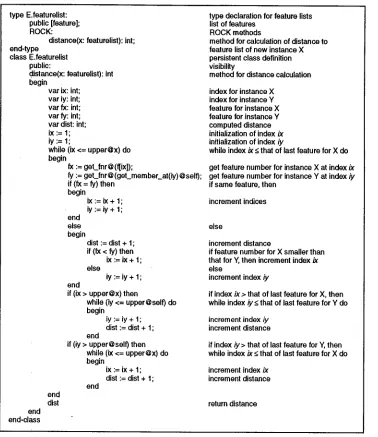
equals 50%. In t h a t case, this feature allows for no prediction of the class and the t e r m under the summation symbol becomes 0.We have implemented all above-mentioned algo- rithms for binary features in ROCK & ROLL in t h a t we store the instances as objects and assign to t h e m the features as ordered lists sorted by the feature numbers. The calculation of the similarity between two cases is then realized as m e t h o d invo- cation on the feature list. For example, Fig. 3 shows the R O C K m e t h o d to compute the distance between two feature lists according to IS1.
Besides pure instance-based learning we have also developed an algorithm
BIN-PRO,
which creates aprototype
for each class. Those prototypes are then used for the comparison with new cases. This has the big advantage t h a t one does not have to store all the training instances and t h a t the number of required comparisons for classification is reduced to the number of existing classes. As similarity func- tion between a new case X and a certain class C we use the following formula:S I M x , c
IDcl.p (D:, C) .w! -
rex
E p ( D y , C I ' w !
•
rex
Winiwarter 8J Kambayashi
In this formula, we give more emphasis to fea- tures f t h a t are present in X in t h a t we multiply them by
lOci,
the number of instances for class C. However, the second sum takes also i m p o r t a n t fea- tures for class C into account t h a t are missing in the new case X. As weighting functionwl
we use again (3). T h e implementation in ROCK ~ ROLL is performed by creating an object for each p r o t o t y p e and by invoking the associated m e t h o d for comput- ing the similarity to a new test case.M o d e l - b a s e d L e a r n i n g
In contrast to instance-based learning, model-based approaches represent the learned knowledge in a the- ory language t h a t is richer t h a n the language used for the description of the training d a t a (Quinlan, 1986). Such learning methods construct explicit gen- eralizations of training cases resulting in a large re- duction of the size of the stored knowledge base and the cost of testing new test cases.
In our research we consider the subtypes of deci- sion trees and rule-based learning as well as hybrid approaches between them. T h e main difference be- tween the various methods for constructing
decision
trees
is the selection of the feature for splitting a node. T h e following two main categories are distin- guished:• static splitting:
selects the best feature for split- ting always on the basis of the complete collec- tion of instances,• dynamic splitting:
re-evaluates the best feature for splitting for each node based on the current local set of instances.(4)
Static splitting requires less c o m p u t a t i o n a l effort because it performs the feature ranking only once for the construction process. However, it entails overhead to keep track of already used features and to eliminate features t h a t provide no proper split- ting of the set of instances. Besides t h a t , d y n a m i c splitting methods produce much more compact trees with fewer nodes, leaves, and levels. This results in a sharp reduction of the storage requirement as well as the number of comparisons during classification.
We have implemented decision trees for static
(BS-tree)
and dynamic splitting(SO-tree)
by us- ing the weighting function (3) as ranking scheme for the splitting criterion. In addition, we have also implemented theIGTree
algorithm (Daelemans et al., 1997), which uses the information gain as static splitting criterion, andC~.5
(Quinlan, 1993b), which applies the information gain to d y n a m i c splitting. The decision trees are implemented intype E,featurelist: public [feature]; ROCK:
distance(x: featurelist): int; end-type
class E.featurelist public:
distance(x: featurelist): int begin
var ix: int;
v a r iy: int; var fx: int;
v a r fy: int; var dist: int; ix := 1;
iy := 1;
while (ix <= upper@x) do begin
fx := get_fnr@(l[ix]);
fy := get_fnr@(get_member at(iy) @self); if (fx = fy) then
begin
i x : = i x + 1; i y : = i y + 1; end
else begin
dist := dist + 1; if (fx < fy) then ix := ix + 1;
else
i y : = i y + 1; end
if (ix > upper@x) then
while (iy <= upper@self) do begin
iy := iy + 1; dist := dist + 1;
end
if (iy > upper@self) then while (ix <= upper@x) do begin
i x : = i x + 1; dist := dist + 1;
end end
dist end end-class
type declaration for feature lists list of features
ROCK methods
method for calculation of distance to feature list of new instance X persistent class definition visibility
method for distance calculation
index for instance X index for instance Y feature for instance X feature for instance Y computed distance initialization of index ix initialization of index iy
while index/xS that of last feature for X do
get feature number for instance X at index ix get feature number for instance Y at index iy if same feature, then
increment indices
else
increment distance
if feature number for X smaller than that for Y, then increment index/x else
increment index iy
if index ix> that of last feature for X, then while index iy~ that of last feature for Y do
increment index iy increment distance
if index iy> that of last feature for Y, then while i n d e x / x ~ that of last feature for X do
increment index ix increment distance
return distance
Figure 3: R O C K & ROLL code segment for IB1 distance calculation
R O C K & ROLL b y creating an object for each node and by linking the nodes according to the tree struc- ture. T h e classification of a new case is then simply performed as top-down traversal of the tree starting from the root. Besides this exact search we have also i m p l e m e n t e d an a p p r o x i m a t e search method, which allows one incorrect edge along the traversal to find a larger n u m b e r of similar cases.
Rule-based learning represents a second large cat- egory of model-based techniques. It aims at deriving a set of rules f r o m the instances of the training set. A rule is here defined as a conjunction of literals, which, if satisfied, assigns a class to a new case. For the case of binary features, the literals correspond
to feature tests with positive or negative sign. This means t h a t they check whether a new case possesses a certain feature (for positive tests) or not (for neg- ative tests).
T h e m e t h o d s for deriving the rules originate f r o m the field of inductive logic programming (Muggleton, 1992). One of the m o s t p r o m i n e n t algorithms for rule-based learning is FOIL (Quinlan and C a m e r o n - Jones, 1995), which learns for each class a set of rules by applying a separate-and-conquer strategy. T h e algorithm takes the instances of a certain class as target relation. It iteratively learns a rule and re- moves those instances from the target relation t h a t are covered by the rule. This is repeated until no in-
[image:5.596.103.481.100.537.2]type E.literal: properties:
public:
lift: feature, sign: bool;
ROLL:
differ(featurelist); end-type
class E.literal public:
differ(featurelist) begin
differ(Flist) :-
S == geLsign@self, S == true,
F == get_lift@self,
-is_in(F) @ Flist; differ(Flist) :-
S == get_sign @ self,
S == false,
F == geLlift@self,
is_in(F) @ Flist;
end end-class type E.rule:
properties: public:
rulenr: int, ruleclass: int; public [literal];
ROLL:
differ(featurelist); end-type
class E.rule public:
differ(featurelist) begin
differ(Flist) :- is in(L)@self, differ(Flist) @ L; end
end-class
type declaration for literals attributes
visibility feature
sign of feature test
ROLL methods
method for performing feature test
persistent class definition visibility
method for performing feature test
retums true if test is not satisfied, otherwise false
test for positive sign get sign of feature test test if sign is positive get feature
test if feature is not member of feature list
test for negative sign
get sign of feature test test if sign is negative get feature
test if feature is member of feature list
type declaration for rule attributes
visibility rule number class of rule
list of literals
ROLL methods
method for performing test of rule
persistent class definition
visibility
method for performing test of rule
returns true if test is not satisfied, otherwise false
get individual literals invoke method for all literals
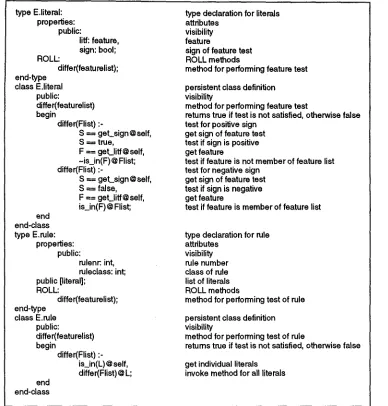
Figure 4: ROCK & ROLL code segment for test of rules
stances are left in the target relation. A rule is grown by repeated specialization, adding literals until the rule does not cover any instances of other classes. In other words, the algorithm tries to find rules t h a t possess some positive bindings, i.e. instances t h a t be- long to the target relation, but no negative bindings
for instances of other classes. Therefore, the reason for adding a literal is to increase the relative propor- tion of positive bindings.
As weighting function for selecting the next literal, FOIL uses the information gain. We have imple- mented FOIL, and besides this, we also use the algo- r i t h m BIN-rules with the following weighting func- tion:
w 1 , , , c = b ] . (b- - b T ) . • (5)
In this formula, s indicates the sign of the feature test. T h e number of positive (negative) bindings after adding the literal for the test of feature f is written as b~" (57). Finally, b- indicates the n u m b e r of negative bindings before adding the literal so t h a t b- - b~ calculates the reduction of negative bindings achieved by adding the literal. T h e weights w1,~,c
are calculated as class-dependent weights for class C by making use of the feature weights w! from (3):
wy . p ( D / , C) if s positive
w / , , , c = w I • [1 - p(D1, C)] otherwise . (6) We have implemented the test of rules as deduc- tive ROLL m e t h o d as shown in Fig. 4. T h e invoca- tion of the m e t h o d is a query with the p a r a m e t e r f l for the feature list of the new case. T h e test returns
[image:6.596.120.508.101.507.2]f a l s e for those rules t h a t are satisfied by the new case. The result of the query can then be assigned to the set of satisfied rules r s by using the command: r s := [ { l : t } l , - ~ d i f f o r ( ! f l ) ~ l ~ ] ;. As in the case of decision trees, we have developed an approximate test, which tolerates one divergent literal.
As last group of:model-based algorithms we look at hybrid approaches between decision trees and rule- based learning. There exist two ways in principle to combine the advantages of the two paradigms. T h e first one is to extract rules from a decision tree whereas the second one follows the opposite direc- tion by constructing a decision tree from a rule base. As example of the first type of approach we have implemented C~. 5-R ULES (Quinlan, 1993b), which extracts rules from the decision tree built by C4.5. Rules are computed as paths along the traversal from the root to all'leaves. In a second run, rules are pruned by removing redundant literals and rules.
Regarding the second type of approach, we start from the rule base:produced by BIN-rules and use it for building an SE-tree (Rymon, 1993). SE-trees are a generalization of decision trees in t h a t they allow not only one but several feature tests at one node. Therefore, a much flatter and more compact tree structure is achieved. For the construction of the tree we sort the feature tests of the rules first. Starting from a root node, we then construct paths according to the literals of the individual rules. For this process we make use of existing paths as far as possible before creating new branches.
4 E v a l u a t i o n
As case study for investigating the feasibility of the implemented machine learning algorithms, we use a multilinguM n a t u r a ! language interface to a produc- tion planning and control system (PPC). The P P C performs the mean-term scheduling of products and resources involved in the manufacturing processes, i.e. material, machines, and labor. The resulting master production schedule forms the basis of the coordination of related business services such as en- gineering, manufacturing, and finance. The modeled enterprise makes precision tools by using job order production and serial manufacture as basic strate- gies. The efficient realization of the high demands of the application exceeds the power of relational database technology. Therefore, it represents an excellent choice for deriving full advantage of the extended functionality of deductive object-oriented database systems, i Furthermore, the sophisticated functionality justifies the effective use of a natural language interface.
During previous research (Winiwarter, 1994) we
developed a German natural language interface based on 1000 input sentences t h a t had been col- lected from users by means of questionnaires. T h e input sentences were then m a p p e d to 100 c o m m a n d classes (10 for each class). T h e mapping was per- formed by elaborate semantic analysis; for the devel- opment of the underlying rule base we spent several man-months.
Therefore, we were eager to see if we could replace this extensive effort by a machine learning compo- nent that learns the same linguistic knowledge auto- matically. For this purpose we divided the 1000 sen- tences into 900 training cases and 100 test cases. In addition, we collected 100 Japanese and 100 English test sentences to check whether the learned knowl- edge really operates at a semantic level independent from language-specific phenomena.
As result of the encoding of the training set (see Sect. 2), we obtained the large number of 316 fea- tures, 289 for the DFL and 27 for the UVL. For the evaluation of the different machine learning algo- rithms we used as performance measures the success rate, i.e. the proportion of correctly classified test cases, and the top-3 rate. T h e latter indicates the proportion of cases where the correct classification is among the first three predicted classes. For the case of model-based approaches we had to produce additional candidates for classes. This was achieved by applying approximate methods t h a t allow one in- correct edge along the traversal of decision trees or one divergent literal for the test of rules (see Sect. 3). Our first experiment was the comparison of the four instance-based algorithms IB1, I B i - I G , BIN- CAT, and BIN-PRO. As can be seen from the results in Table 1, BIN-CAT clearly outperforms IB1 and IBi-IG. Concerning the m e t h o d BIN-PRO, which uses prototypes of classes, we achieved results at the same quality level as for BIN-CAT. This is remark- able if one considers the much more condensed rep- resentation of the learned knowledge.
The comparison between the results for the indi- vidual languages shows t h a t there is no advantage for the German test sentences. On the contrary, the test results for G e r m a n are inferior to t h a t for English or Japanese. This m a y be partly due to a greater deviation of the G e r m a n expressions and phrases used in the test set from the ones used in the training set. Besides this, the restriction of ex- tracted features during encoding the test set to those learned from the training set certainly performs an important filtering function. It removes language- specific syntactic particles t h a t do not contribute to the meaning Of the input. This is especially true for the case of Japanese sentences, which possess a
IB1 I B I - I G BIN-CAT BIN-PRO
IGTree BS-tree C4.5 BD-tree
SE-tree
GERMAN Success rate I 'lbp-3 rate
82% I 94%
84 % 98 %
94 % 100 %
95 % 100 %
ENGLISH Success rate 'lbp-3 rate
98 % 99 %
97 % 100 %
99 % 100 %
97 % 100 %
J A PAN ES E Success rate 'lbp-3 rate
94 % 98 %
90 % 99 %
99 % 100 %
97 % 100 %
Table 1: Test results for instance-based learning
G E R M A N Success rate Top-3 rate
80% 94%
86 % 97 %
94 % 100 %
93 % 99 %
94 % 97 %
ENGLISH Success rate rlbp-3 rate
92 % I00 %
95 % 100 %
94 % 100 %
94 % 99 %
96 % 97 %
J A P A N E S E Success rate Top-3 rate
86 % 97 %
90 % 96 %
89 % 100 %
91% 99 %
91% 95 %
Table 2: Test results for decision trees
completely different syntactic structure in compari- son with English or G e r m a n including m a n y parti- cles with no equivalent words in the other two lan- guages.
T h e second part of the evaluation was the com- parison of the four algorithms for building decision trees: IGTree, BS-tree, C4.5, and BD-tree. Besides this, we also included the SE-tree constructed by a hybrid approach (see Sect. 3). T h e test results in Ta- ble 2 indicate t h a t the trees with dynamic splitting are superior to those with static splitting and t h a t C4.5, BD-tree, and SE-tree produce results of simi- lar quality. Table 3 compares the number of nodes, leaves, and levels for the individual trees. T h e two trees with d y n a m i c splitting are much more compact than those with static splitting, with C4.5 clearly outperforming BD-tree. Finally, the hybrid SE-tree is much flatter t h a n C4.5 but possesses a larger num- ber of nodes and leaves.
Nodes Leaves Levels
IGTree 865 433 33
BS-tree 719 360 86
C4.5 339 170 26
BD-tree 451 226 52
SE-tree 559 209 8
Table 3: Characteristics for decision trees
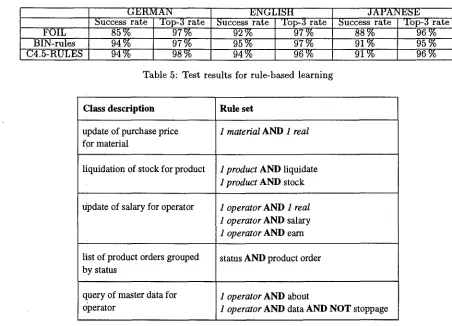
As last part of our comparative study we tested the rule-based techniques FOIL, BIN-rules, and the hybrid approach C4.5-RULES. As Table 4 shows, FOIL produces the most compact representation of learned knowledge, followed by C4.5-RULES and BIN-rules. However, according to Table 5 both BIN- rules and C4.5-RULES outperform FOIL with al- most identical results.
Rules Literals Max. length
FOIL 215 534 5
BIN-rules 209 726 7
C4.5-1~U LES 167 677 24
Table 4: Characteristics for rule-based learning
An advantage of rule-based learning in compari- son with other methods is t h a t the learned knowl- edge can be easily presented to the user in a clear and understandable form. T h e derived rules allow a transparent knowledge representation t h a t one can use for explaining decisions of the system to the user. Figure 5 gives some examples of rule sets learned by BIN-rules for several c o m m a n d classes.
If we take a final look at Table 1, Table 2, and Table 5, we can see t h a t independent from the ap- plied machine learning paradigm the achieved results reached satisfactory quality for all three groups. By considering the three best representatives BIN-CAT, C4.5, and BIN-rules, we obtain an average success rate for all three languages of 94.3 % and a top-3 rate of 98.8 %. This result is surprisingly high if one con- siders the complexity of the task at hand. Unfortu- nately, we had no possibility of a direct comparison with the results of the hand-engineered interface be- cause the previous interface had been developed only for G e r m a n based on the complete collection of 1000 sentences by using a different software. In any case, we could show t h a t machine learning represents a sound alternative to manual knowledge acquisition for the application in natural language interfaces.
[image:8.596.91.532.98.295.2] [image:8.596.322.537.319.362.2] [image:8.596.98.271.556.620.2]FOIL BIN-rules C4.5-RULES
GERMAN Success rate 'lbp-3 rate
85 % 97 %
94% 97%
94 % 98 %
ENGLISH Success rate i 'lbp-3 rate
92 % 97 %
95 % 97 %
94 % 96 %
J A PAN ES E Success rate 'lbp-3 rate
88 % 96 %
91% 95 %
91% 96 %
Table 5: Test results for rule-based learning
Class description
update of purchase price for material
liquidation of stock for product
Update of salary for operator
list of product orders grouped by status
query of master data for
operator
Rule set
1 material AND 1 real
i product AND liquidate 1 product AND stock
I operator AND 1 real I operator AND salary 1 operator AND earn
status AND product order
1 operator AND about
I operator AND data AND NOT stoppage
Figure 5: Examples of learned rules
5
C o n c l u s i o n
In this paper we have presented first results from a comparative study of applying different inductive learning techniques to natural language interfaces. We have implemented a representative selection of instance-based and model-based algorithms by mak- ing use of deductive object-oriented database func- tionality. The extensive case study for an inter- face to a production planning and control system shows the feasibility of the approach in that linguis- tic knowledge is learned the acquisition of which nor- mally takes a large effort of human experts.
Future work will concentrate on the important point of increasing: the reliability of test results in that we apply cross-validation trials and statistical tests for the significance of performance differences between two algorithms. Furthermore, we also want to generate learning functions that plot success rates as function of the size of the training collection. Be- sides this, we plan to test our learning algorithms on standard benchmark machine learning datasets and other typical natural language learning datasets.
Finally, we intend to extend the implemented al- gorithms to include also unsupervised methods as
well as connectionist and evolutionary techniques. In addition, we will implement incremental learning techniques, which continue the learning process dur- ing the test phase, and adaptive boosting methods, which apply several classifiers instead of just one. We believe that our study is a first promising step towards the challenging task of carrying out compar- ative evaluations of the performance of different ma- chine learning algorithms for specific linguistic prob- lems.
R e f e r e n c e s
David W. Aha, Dennis Kibler, and Marc Albert. 1991. Instance-based learning algorithms. Ma- chine Learning, 7:37-66.
Ioannis Androutsopoulos, Graeme D. Ritchie, and Peter Thanisch. 1995. Natural language inter- faces to databases - - an introduction. Journal of Natural Language Engineering, 1(1) :29-81.
Chinatsu Aone and Scott W. Bennett. 1996. Apply- ing machine learning to anaphora resolution. In S. Wermter, E. Riloff, and G. Scheler, ed- itors, Connectionist, Statistical, and Symbolic
[image:9.596.47.499.95.421.2]Approaches to Learning for Natural Language Processing, pages 302-314. Springer-Verlag, Berlin, Germany.
Maria L. Barja, Norman W. Paton, Alvaro A.A. Fernandes, M. Howard Williams, and Andrew Dinn. 1994. An effective deductive object- oriented database through language integra- tion. In Proceedings of the 20th International Conference on Very Large Data Bases, pages 463-474, Athens, Greece. Morgan Kaufmann, San Mateo, California.
Walter Daelemans and Antal van den Bosch. 1992. Generalisation performance of backpropaga- tion learning on a syllabification task. In M. Drossaers and A. Nijholt, editors, TWLT3: Connectionism and Natural Language Process- ing, pages 27-37. Twente University Press, En- schede, Netherlands.
Walter Daelemans, Antal van den Bosch, and Ton Weijters. 1997. IGTree: Using trees for com- pression and classification in lazy learning al- gorithms. Artificial Intelligence Review. To appear.
Raymond J. Mooney. 1996. Comparative experi- ments on disambiguating word senses: An il- lustration of the role of bias in machine learn- ing. In Proceedings of the Conference on Em- pirical Methods in Natural Language Process- ing, pages 82-91, Philadelphia, Pennsylvania, May.
Isabelle Moulinier and Jean-Gabriel Ganascia. 1996. Applying an existing machine learning algo- rithm to text categorization. In S. Wermter, E. Riloff, and G. Scheler, editors, Connec- tionist, Statistical, and Symbolic Approaches to Learning for Natural Language Processing,
pages 343-354. Springer-Verlag, Berlin, Ger- many.
Stephen Muggleton, editor. 1992. Inductive Logic Programming. Academic Press, London, Eng- land.
J. Ross Quinlan. 1986. Induction of decision trees.
Machine Learning, 1:81-206.
J. Ross Quinlan. 1993a. Combining instance- based and model-based learning. In Proceed- ings of the lOth International Conference on Machine Learning, pages 236-243, Amherst, Massachusetts. Morgan Kaufmann, San Ma- teo, California.
J. Ross Quinlan. 1993b. C4.5: Programs for Ma- chine Learning. Morgan Kaufmann, San Ma- teo, California.
J. Ross Quinlan and R. Michael Cameron-Jones. 1995. Induction of logic programs: FOIL and related systems. New Generation Computing,
13:287-312.
J. Ross Quinlan. 1996. Learning first-order defini- tions of functions. Journal of Artificial Intel- ligence Research, 5:139-161.
Ellen Riloff and Wendy Lehnert. 1994. Information extraction as a basis for high-precision text classification. A CM Transactions on Informa- tion Systems, 12(3):296-333.
Ron Rymon. 1993. An SE-tree-based characteri- zation of the induction problem. In Proceed- ings of the lOth International Conference on Machine Learning, pages 268-275, Amherst, Massachusetts. Morgan Kaufmann, San Ma- teo, California.
Stephen Soderland, David Fisher, Jonathan Asel- tine, and Wendy Lehnert. 1996. Issues in inductive learning of domain-specific text ex- traction rules. In S. Wermter, E. Riloff, and G. Scheler, editors, Connectionist, Statisti- cal, and Symbolic Approaches to Learning for Natural Language Processing, pages 290-301. Springer-Verlag, Berlin, Germany.
Antal van den Bosch, Walter Daelemans, and Ton Weijters. 1996. Morphological analysis as clas- sification: An inductive-learning approach. In
Proceedings of the Second International Con- ference on New Methods in Language Process-
ing, Ankara, Turkey, September.
Werner Winiwarter. 1994. The Integrated Deductive Approach to Natural Language Interfaces. PhD thesis, University of Vienna, Austria.
Takefumi Yamazaki, Michael J. Pazzani, and Christopher Merz. 1996. Acquiring and updat- ing hierarchical knowledge for machine trans- lation based on a clustering technique. In S. Wermter, E. Riloff, and G. Scheler, edi- tors, Connectionist, Statistical, and Symbolic Approaches to Learning for Natural Language Processing, pages 329-342. Springer-Verlag, Berlin, Germany.
John M. Zelle and Raymond J. Mooney. 1996. Com- parative results on using inductive logic pro- gramming for corpus-based parser construc- tion. In S. Wermter, E. Riloff, and G. Scheler, editors, Connectionist, Statistical, and Sym- bolic Approaches to Learning for Natural Lan- guage Processing, pages 355-369. Springer- Verlag, Berlin, Germany.