Distributional Phrase Structure Induction
Dan Klein and Christopher D. Manning
Computer Science Department Stanford University Stanford, CA 94305-9040
klein, manning @cs.stanford.edu
Abstract
Unsupervised grammar induction systems commonly judge potential constituents on the basis of their effects on the likelihood of the data. Linguistic justifications of constituency, on the other hand, rely on notions such as substitutability and vary-ing external contexts. We describe two systems for distributional grammar induc-tion which operate on such principles, us-ing part-of-speech tags as the contextual features. The advantages and disadvan-tages of these systems are examined, in-cluding precision/recall trade-offs, error analysis, and extensibility.
1 Overview
While early work showed that small, artificial context-free grammars could be induced with the EM algorithm (Lari and Young, 1990) or with chunk-merge systems (Stolcke and Omohundro, 1994), studies with large natural language gram-mars have shown that these methods of completely unsupervised acquisition are generally ineffective. For instance, Charniak (1993) describes experi-ments running the EM algorithm from random start-ing points, which produced widely varystart-ing gram-mars of extremely poor quality. Because of these kinds of results, the vast majority of statistical pars-ing work has focused on parspars-ing as a supervised learning problem (Collins, 1997; Charniak, 2000). It remains an open problem whether an entirely un-supervised method can either produce linguistically sensible grammars or accurately parse free text.
However, there are compelling motivations for unsupervised grammar induction. Building super-vised training data requires considerable resources, including time and linguistic expertise. Further-more, investigating unsupervised methods can shed
light on linguistic phenomena which are implic-itly captured within a supervised parser’s supervi-sory information, and, therefore, often not explicitly modeled in such systems. For example, our system and others have difficulty correctly attaching sub-jects to verbs above obsub-jects. For a supervised CFG parser, this ordering is implicit in the given structure ofVP and S constituents, however, it seems likely that to learn attachment order reliably, an unsuper-vised system will have to model it explicitly.
Our goal in this work is the induction of high-quality, linguistically sensible grammars, not pars-ing accuracy. We present two systems, one which does not do disambiguation well and one which does not do it at all. Both take tagged but unparsed Penn treebank sentences as input.1 To whatever de-gree our systems parse well, it can be taken as evi-dence that their grammars are sensible, but no effort was taken to improve parsing accuracy directly.
There is no claim that human language acquisi-tion is in any way modeled by the systems described here. However, any success of these methods is evi-dence of substantial cues present in the data, which could potentially be exploited by humans as well. Furthermore, mistakes made by these systems could indicate points where human acquisition is likely not being driven by these kinds of statistics.
2 Approach
At the heart of any iterative grammar induction sys-tem is a method, implicit or explicit, for deciding how to update the grammar. Two linguistic criteria for constituency in natural language grammars form the basis of this work (Radford, 1988):
1. External distribution: A constituent is a se-quence of words which appears in various structural positions within larger constituents.
1The Penn tag and category sets used in examples in this
2. Substitutability: A constituent is a sequence of words with (simple) variants which can be sub-stituted for that sequence.
To make use of these intuitions, we use a distribu-tional notion of context. Let be a part-of-speech
tag sequence. Every occurence of will be in some
context , where and are the adjacent tags or
sentence boundaries. The distribution over contexts in which occurs is called its signature, which we
denote by .
Criterion 1 regards constituency itself. Consider the tag sequencesIN DT NNandIN DT. The former is a canonical example of a constituent (of category PP), while the later, though strictly more common, is, in general, not a constituent. Frequency alone does not distinguish these two sequences, but Crite-rion 1 points to a distributional fact which does. In particular, IN DT NN occurs in many environments. It can follow a verb, begin a sentence, end a sen-tence, and so on. On the other hand,IN DTis gener-ally followed by some kind of a noun or adjective.
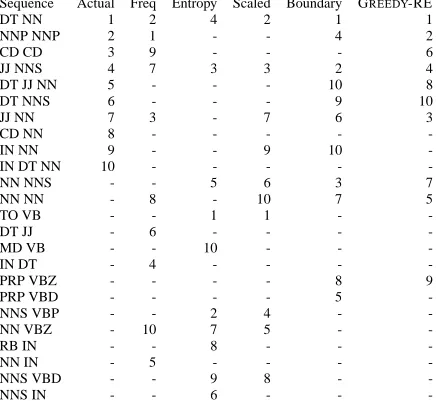
This example suggests that a sequence’s con-stituency might be roughly indicated by the entropy of its signature, . This turns out to be somewhat true, given a few qualifications. Figure 1 shows the actual most frequent constituents along with their rankings by several other measures. Tag entropy by itself gives a list that is not particularly impressive. There are two primary causes for this. One is that uncommon but possible contexts have little impact on the tag entropy value. Given the skewed distribution of short sentences in the tree-bank, this is somewhat of a problem. To correct for this, let be the uniform distribution over the
observed contexts for . Using would
have the obvious effect of boosting rare contexts, and the more subtle effect of biasing the rankings slightly towards more common sequences. How-ever, while presumably converges to some sensible limit given infinite data, will
not, as noise eventually makes all or most counts non-zero. Let be the uniform distribution over all
contexts. The scaled entropy
!"#$&%
turned out to be a useful quantity in practice. Multi-plying entropies is not theoretically meaningful, but this quantity does converge to given infi-nite (noisy) data. The list for scaled entropy still has notable flaws, mainly relatively low ranks for common NPs, which does not hurt system
perfor-Sequence Actual Freq Entropy Scaled Boundary GREEDY-RE
DT NN 1 2 4 2 1 1
NNP NNP 2 1 - - 4 2
CD CD 3 9 - - - 6
JJ NNS 4 7 3 3 2 4
DT JJ NN 5 - - - 10 8
DT NNS 6 - - - 9 10
JJ NN 7 3 - 7 6 3
CD NN 8 - - - -
-IN NN 9 - - 9 10
-IN DT NN 10 - - - -
-NN -NNS - - 5 6 3 7
NN NN - 8 - 10 7 5
TO VB - - 1 1 -
-DT JJ - 6 - - -
-MD VB - - 10 - -
-IN DT - 4 - - -
-PRP VBZ - - - - 8 9
PRP VBD - - - - 5
-NNS VBP - - 2 4 -
-NN VBZ - 10 7 5 -
-RB IN - - 8 - -
-NN IN - 5 - - -
-NNS VBD - - 9 8 -
-NNS IN - - 6 - -
-Figure 1: Top non-trivial sequences by actual constituent counts, raw frequency, raw entropy, scaled entropy, boundary scaled entropy, and according to GREEDY-RE (see section 4.2).
mance, and overly high ranks for short subject-verb sequences, which does.
The other fundamental problem with these entropy-based rankings stems from the context fea-tures themselves. The entropy values will change dramatically if, for example, all noun tags are col-lapsed, or if functional tags are split. This depen-dence on the tagset for constituent identification is very undesirable. One appealing way to remove this dependence is to distinguish only two tags: one for the sentence boundary (#) and another for words. Scaling entropies by the entropy of this reduced sig-nature produces the improved list labeled “Bound-ary.” This quantity was not used in practice because, although it is an excellent indicator of NP, PP, and intransitive Sconstituents, it gives too strong a bias against other constituents. However, neither system is driven exclusively by the entropy measure used, and duplicating the above rankings more accurately did not always lead to better end results.
[image:2.612.318.536.24.229.2]behavior. For example,DT JJ NN andDT NN have extremely similar signatures, and both are common NPs. Also, NN IN andNN NN INhave very similar signatures, and both are primarily non-constituents. For our experiments, the metric of similarity be-tween sequences was the Jensen-Shannon diver-gence of the sequences’ signatures:
'
JS)(*+,
(
,
'
KL$("-#."/10 .32
,
"4
'
KL,5-#."/60 .32
,
&%
Where'
KL is the Kullback-Leibler divergence be-tween probability distributions. Of course, just as various notions of context are possible, so are vari-ous metrics between signatures. The issues of tagset dependence and data skew did not seem to matter for the similarity measure, and unaltered Jensen-Shannon divergence was used.
Given these ideas, section 4.1 discusses a sys-tem whose grammar induction steps are guided by sequence entropy and interchangeability, and sec-tion 4.2 discusses a maximum likelihood system where the objective being maximized is the quality of the constituent/non-constituent distinction, rather than the likelihood of the sentences.
2.1 Problems with ML/MDL
Viewing grammar induction as a search problem, there are three principal ways in which one can in-duce a “bad” grammar:
7
Optimize the wrong objective function.
7
Choose bad initial conditions.
7
Be too sensitive to initial conditions.
Our current systems primarily attempt to address the first two points. Common objective functions include maximum likelihood (ML) which asserts that a good grammar is one which best encodes or compresses the given data. This is potentially undesirable for two reasons. First, it is strongly data-dependent. The grammar8 which maximizes
9
'
-:8; depends on the corpus
'
, which, in some sense, the core of a given language’s phrase struc-ture should not. Second, and more importantly, in an ML approach, there is pressure for the symbols and rules in a PCFG to align in ways which maxi-mize the truth of the conditional independence as-sumptions embodied by that PCFG. The symbols and rules of a natural language grammar, on the other hand, represent syntactically and semantically coherent units, for which a host of linguistic ar-guments have been made (Radford, 1988). None of these arguments have anything to do with ditional independence; traditional linguistic
con-stituency reflects only grammatical possibilty of ex-pansion. Indeed, there are expected to be strong connections across phrases (such as are captured by argument dependencies). For example, in the tree-bank data used,CD CDis a common object of a verb, but a very rare subject. However, a linguist would take this as a selectional characteristic of the data set, not an indication thatCD CD is not an NP. Of course, it could be that the ML and linguistic crite-ria align, but in practice they do not always seem to, and one should not expect that, by maximizing the former, one will also maximize the latter.
Another common objective function is minimum description length (MDL), which asserts that a good analysis is a short one, in that the joint encoding of the grammar and the data is compact. The “com-pact grammar” aspect of MDL is perhaps closer to some traditional linguistic argumentation which at times has argued for minimal grammars on grounds of analytical (Harris, 1951) or cognitive (Chomsky and Halle, 1968) economy. However, some CFGs which might possibly be seen as the acquisition goal are anything but compact; take the Penn treebank covering grammar for an extreme example. Another serious issue with MDL is that the target grammar is presumably bounded in size, while adding more and more data will on average cause MDL methods to choose ever larger grammars.
In addition to optimizing questionable objective functions, many systems begin their search pro-cedure from an extremely unfavorable region of the grammar space. For example, the randomly weighted grammars in Carroll and Charniak (1992) rarely converged to remotely sensible grammars. As they point out, and quite independently of whether ML is a good objective function, the EM algorithm is only locally optimal, and it seems that the space of PCFGs is riddled with numerous local maxima. Of course, the issue of initialization is somewhat tricky in terms of the bias given to the system; for example, Brill (1994) begins with a uniformly right-branching structure. For English, right-right-branching structure happens to be astonishingly good both as an initial point for grammar learning and even as a baseline parsing model. However, it would be un-likely to perform nearly as well for a VOS language like Malagasy or VSO languages like Hebrew.
3 Search vs. Clustering
per-spective, and the two views are certainly not mutu-ally exclusive. The search view focuses on the re-cursive relationships between the non-terminals in the grammar. The clustering view, which is per-haps more applicable to the present work, focuses on membership of (terminal) sequences to classes represented by the non-terminals. For example, the non-terminal symbolNPcan be thought of as a clus-ter of (clus-terminal) sequences which can be generated starting fromNP. This clustering is then inherently soft clustering, since sequences can be ambiguous.
Unlike standard clustering tasks, though, a se-quence token in a given sentence need not be a con-stituent at all. For example,DT NN is an extremely commonNP, and when it occurs, it is a constituent around 82% of the time in the data. However, when it occurs as a subsequence ofDT NN NNit is usually not a constituent. In fact, the difficult decisions for a supervised parser, such as attachment level or coor-dination scope, are decisions as to which sequences are constituents, not what their tags would be if they were. For example,DT NN IN DT NNis virtually al-ways anNPwhen it is a constituent, but it is only a constituent 66% of the time, mostly because thePP, IN DT NN, is attached elsewhere.
One way to deal with this issue is to have an ex-plicit class for “not a constituent” (see section 4.2). There are difficulties in modeling such a class, mainly stemming from the differences between this class and the constituent classes. In particular, this class will not be distributionally cohesive. Also, for example, DT NN and DT JJ NN being generally of categoryNPseems to be a highly distributional fact, while DT NNnot being a constituent in the context DT NN NN seems more properly modeled by the competing productions of the grammar.
Another approach is to model the non-constituents either implicitly or independently of the clustering model (see section 4.1). The draw-back to insufficiently modeling non-constituency is that for acquisition systems which essentially work bottom-up, non-constituent chunks such as NN IN orIN DTare hard to rule out locally.
4 Systems
We present two systems. The first, GREEDY -MERGE, learns symbolic CFGs for partial parsing. The rules it learns are of high quality (see figures 3 and 4), but parsing coverage is relatively shallow. The second, CONSTITUENCY-PARSER, learns dis-tributions over sequences representing the
probabil-TOP # z1
DT NN
VBZ RB #
Figure 2: The possible contexts of a sequence.
ity that a constituent is realized as that sequence (see figure 1). It produces full binary parses.
4.1 GREEDY-MERGE
GREEDY-MERGE is a precision-oriented system which, to a first approximation, can be seen as an agglomerative clustering process over sequences. For each pair of sequences, a normalized divergence is calculated as follows:
<
*=> ?@BADC
.
CFE5GH
.
CFIJGKG LNM
C
.
CFE5GKG
0
LOM
C
.
CPIQGRG
The pair with the least divergence is merged.2 Merging two sequences involves the creation of a single new non-terminal category which rewrites as either sequence. Once there are non-terminal cate-gories, the definitions of sequences and contexts be-come slightly more complex. The input sentences are parsed with the previous grammar state, using a shallow parser which ties all parentless nodes to-gether under aTOP root node. Sequences are then the ordered sets of adjacent sisters in this parse, and the context of a sequence can either be the pre-ceding and following tags or a higher node in the tree. To illustrate, in figure 2, the sequenceVBZ RB could either be considered to be in context [Z1. . . #]
or [NN. . . #]. Taking the highest potential context ([Z1. . . #] in this case) performed slightly better.3
Merging a sequence and a single non-terminal re-sults in a rule which rewrites the non-terminal as the sequence (i.e., that sequence is added to that non-terminal’s class), and merging two non-terminals in-volves collapsing the two symbols in the grammar (i.e., those classes are merged). After the merge, re-analysis of the grammar rule RHSs is necessary.
An important point about GREEDY-MERGE is that stopping the system at the correct point is crit-ical. Since our greedy criterion is not a measure over entire grammar states, we have no way to de-tect the optimal point beyond heuristics (the same
2We required that the candidates be among the 250 most
frequent sequences. The exact threshold was not important, but without some threshold, long singleton sequences with zero divergence are always chosen. This suggests that we need a greater bias towards quantity of evidence in our basic method.
3
category appears in several merges in a row, for ex-ample) or by using a small supervision set to detect a parse performance drop. The figures shown are from stopping the system manually just before the first significant drop in parsing accuracy.
The grammar rules produced by the system are a strict subset of general CFG rules in several ways. First, no unary rewriting is learned. Second, no non-terminals which have only a single rewrite are ever proposed, though this situation can occur as a result of later merges. The effect of these restrictions is discussed below.
4.2 CONSTITUENCY-PARSER
The second system, CONSTITUENCY-PARSER, is recall-oriented. Unlike GREEDY-MERGE, this sys-tem always produces a full, binary parse of each in-put sentence. However, its parsing behavior is sec-ondary. It is primarily a clustering system which views the data as the entire set of (sequence, con-text) pairs *$ that occurred in the sentences.
Each pair token comes from some specific sentence and is classified with a binary judgementS of that
to-ken’s constituency in that sentence. We assume that these pairs are generated by the following model:
9
*$UTWVYXQZ1[ H\^]
9
_-S3
9
#`-S3
9
S3
We use EM to maximize the likelihood of these pairs given the hidden judgements S , subject to the
constraints that the judgements for the pairs from a given sentence must form a valid binary parse.
Initialization was either done by giving initial seeds for the probabilities above or by forcing a cer-tain set of parses on the first round. To do the re-estimation, we must have some method of deciding which binary bracketing to prefer. The chance of a pair *$ being a constituent is
9
S5- *$
9
SQ-
9
S5- !
9
Sa
and we score a treeb by the likelihood product of
its judgementsSQ*Ybc. The best tree is then
dJegfhd"ikj ml
CnEoHpG
X
9
SQ*Ybca-*
As we are considering each pair independently from the rest of the parse, this model does not correspond to a generative model of the kind standardly associ-ated with PCFGs, but can be seen as a random field over the possible parses, with the features being the sequences and contexts (see (Abney, 1997)). How-ever, note that we were primarily interested in the clustering behavior, not the parsing behavior, and
that the random field parameters have not been fit to any distribution over trees. The parsing model is very crude, primarily serving to eliminate systemat-ically mutually incompatible analyses.
4.2.1 Sparsity
Since this system does not postulate any non-terminal symbols, but works directly with non-terminal sequences, sparsity will be extremely severe for any reasonably long sequences. Substantial smoothing was done to all terms; for the9
SQ- estimates we
interpolated the previous counts equally with a uni-form9
S3, otherwise most sequences would remain
locked in their initial behaviors. This heavy smooth-ing made rare sequences behave primarily accord-ing to their contexts, removed the initial invariance problem, and, after a few rounds of re-estimation, had little effect on parser performance.
4.2.2 Parameters
CONSTITUENCY-PARSER’s behavior is determined by the initialization it is given, either by initial pa-rameter estimates, or fixed first-round parses. We used four methods: RANDOM, ENTROPY, RIGHT -BRANCH, and GREEDY.
For RANDOM, we initially parsed randomly. For ENTROPY, we weighted 9
S5- proportionally to 3 . For RIGHTBRANCH, we forced
right-branching structures (thereby introducing a bias to-wards English structure). Finally, GREEDYused the output from GREEDY-MERGE (using the grammar state in figure 3) to parse initially.
5 Results
Two kinds of results are presented. First, we discuss the grammars learned by GREEDY -MERGEand the constituent distributions learned by CONSTITUENCY-PARSER. Then we apply both sys-tems to parsing free text from the WSJ section of the Penn treebank.
5.1 Grammars learned by GREEDY-MERGE
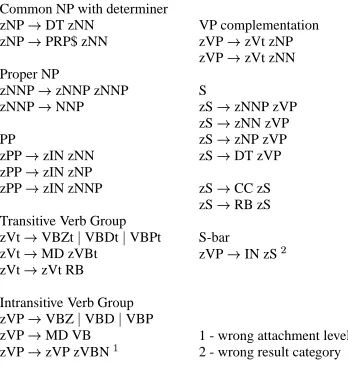
Figure 3 shows a grammar learned at one stage of a run of GREEDY-MERGE on the sentences in the WSJ section of up to 10 words after the removal of punctuation (q 7500 sentences). The non-terminal
categories proposed by the systems are internally given arbitrary designations, but we have relabeled them to indicate the best recall match for each.
N-bar or zero determiner NP zNNr NNsNNS
zNNr JJ zNN
zNNr zNN zNN
NP with determiner zNPr DT zNN
zNPr PRP$ zNN
Proper NP
zNNPr NNPsNNPS
zNNPr zNNP zNNP
PP
zPPr zIN zNN
zPPr zIN zNP
zPPr zIN zNNP
verb groups / intransitive VPs zVr VBZsVBDsVBP
zVr MD VB
zVr MD RB VB
zVr zV zRB
zVr zV zVBG
Transitive VPs (complementation) zVPr zV JJ
zVPr zV zNP
zVPr zV zNN
zVPr zV zPP
Transitive VPs (adjunction) zVPr zRB zVP
ZVPr zVP zPP
Intransitive S zSr PRP zV
zSr zNP zV
zSr zNNP zV
Transitive S zStr zNNP zVP
zStr zNN zVP
[image:6.612.340.514.62.245.2]zStr PRP zVP
Figure 3: A learned grammar.
kinds of commonNPs, and so on).4 Provided one is willing to accept a verb-group analysis, this gram-mar seems sensible, though quite a few construc-tions, such as relative clauses, are missing entirely.
Figure 4 shows a grammar learned at one stage of a run when verbs were split by transitivity. This grammar is similar, but includes analyses of sen-tencial coordination and adverbials, and subordinate clauses. The only rule in this grammar which seems overly suspect isZVPt INZSwhich analyzes
com-plementized subordinate clauses asVPs.
In general, the major mistakes the GREEDY -MERGEsystem makes are of three sorts:
7
Mistakes of omission. Even though the gram-mar shown has correct, recursive analyses of many categories, no rule can non-trivially in-corporate a number (CD). There is also no analysis for many common constructions.
7
Alternate analyses. The system almost invari-ably forms verb groups, merging MD VB se-quences with single main verbs to form verb group constituents (argued for at times by some linguists (Halliday, 1994)). Also,PPs are sometimes attached toNPs below determiners (which is in fact a standard linguistic analysis (Abney, 1987)). It is not always clear whether these analyses should be considered mistakes.
7
Over-merging. These errors are the most se-rious. Since at every step two sequences are merged, the process will eventually learn the
4Splits often occur because unary rewrites are not learned
in the current system.
N-bar or zero-determiner NP zNNr NNsNNS
zNNr zNN zNN
zNNr JJ zNN
Common NP with determiner zNPr DT zNN
zNPr PRP$ zNN
Proper NP
zNNPr zNNP zNNP
zNNPr NNP
PP
zPPr zIN zNN
zPPr zIN zNP
zPPr zIN zNNP
Transitive Verb Group zVtr VBZtsVBDtsVBPt
zVtr MD zVBt
zVtr zVt RB
Intransitive Verb Group zVPr VBZsVBDsVBP
zVPr MD VB
zVPr zVP zVBNu
VP adjunction zVPr RB zVP
zVPr zVP RB
zVPr zVP zPP
zVPr zVP zJJ
VP complementation zVPr zVt zNP
zVPr zVt zNN
S
zSr zNNP zVP
zSr zNN zVP
zSr zNP zVP
zSr DT zVP
zSr CC zS
zSr RB zS
S-bar zVPr IN zSv
1 - wrong attachment level 2 - wrong result category
Figure 4: A learned grammar (with verbs split).
grammar where X t X X andX t (any
ter-minal). However, very incorrect merges are sometimes made relatively early on (such as merging VPs with PPs, or merging the se-quencesIN NNP INandIN.
5.2 CONSTITUENCY-PARSER’s Distributions
The CONSTITUENCY-PARSER’s state is not a sym-bolic grammar, but estimates of constituency for ter-minal sequences. These distributions, while less compelling a representation for syntactic knowl-edge than CFGs, clearly have significant facts about language embedded in them, and accurately learn-ing them can be seen as a kind of acquisiton.
Figure 5 shows the sequences whose constituency counts are most incorrect for the GREEDY-RE set-ting. An interesting analysis given by the system is the constituency ofNNP POS NNsequences asNNP (POS NN) which is standard in linguistic analyses (Radford, 1988), as opposed to the treebank’s sys-tematic (NNP POS) NN. Other common errors, like the overcount of JJ NN orJJ NNS are partially due to parsing inside NPs which are flat in the treebank (see section 5.3).
sys-0 0.1 0.2 0.3 0.4 0.5 0.6 0.7 0.8 0.9 1
Random Entropy
RightBranchRandom-REEntropy-RE
Greedy Greedy-RE
UL Precision
NCB Precision
0 0.1 0.2 0.3 0.4 0.5 0.6 0.7 0.8 0.9 1
Random Entropy
RightBranchRandom-REEntropy-RE
Greedy Greedy-RE
UL Recall
NP Recall
[image:7.612.87.532.19.135.2]VP Recall
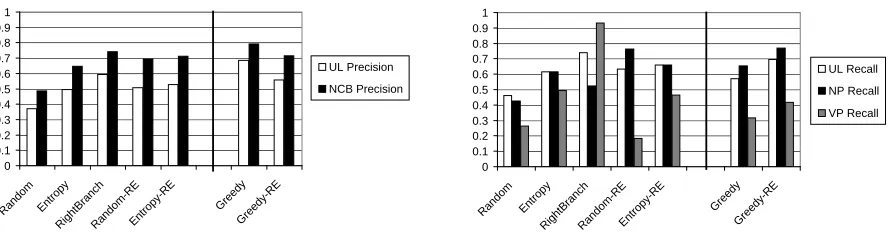
Figure 6: Unlabeled precision (left) and recall (right) values for various settings.
[image:7.612.98.271.160.356.2]Sequence Overcount Estimated True Total JJ NN 736 1099 363 1385 NN NN 504 663 159 805 NNP NNP 434 1419 985 2261 PRP VBZ 420 453 33 488 PRP VBD 392 415 23 452 PRP VBP 388 405 17 440 TO VB 324 443 119 538 MD VB 318 355 37 455 NN NNS 283 579 296 618 JJ NNS 283 799 516 836 Sequence Undercount Estimated True Total NNP POS 127 33 160 224 VBD RB VBN 59 6 65 83 VB DT NN 53 10 63 137 NNP NNP POS 42 8 50 58 VB VBN 42 3 45 141 VB RB 39 6 45 100 VBD VBN 36 17 53 202 VBZ RB JJ 33 18 51 72 RB CD 30 26 56 117 VB DT JJ NN 29 3 32 51
Figure 5: Sequences most commonly over- and under-identified as constituents by CONSTITUENCY-PARSERusing GREEDY-RE (ENTROPY-RE is similar). “Total” is the fre-quency of the sequence in the flat data. “True” is the frefre-quency as a constituent in the treebank’s parses. “Estimated” is the frequency as a constituent in the system’s parses.
tem had learned the standard subject-verb-object at-tachment order, though this has disappeared, as can be seen in the undercounts of VPsequences. Since many VPs did not fit the conservative VPgrammar in figure 3, subjects and verbs were often grouped together frequently even on the initial parses, and the CONSTITUENCY-PARSER has a further bias to-wards over-identifying frequent constituents.
5.3 Parsing results
Some issues impact the way the results of parsing treebank sentences should be interpreted. Both sys-tems, but especially the CONSTITUENCY-PARSER, tend to form verb groups and often attach the sub-ject below the obsub-ject for transitive verbs. Because of this, certainVPs are systematically incorrect andVP accuracy suffers dramatically, substantially pulling
down the overall figures.5 Secondly, the treebank’s grammar is an imperfect standard for an unsuper-vised learner. For example, transitive sentences are bracketed [subject [verb object]] (“The presi-dent [executed the law]”) while nominalizations are bracketed [[possessive noun] complement] (“[The president’s execution] of the law”), an arbitrary in-consistency which is unlikely to be learned automat-ically. The treebank is also, somewhat purposefully, very flat. For example, there is no analysis of the inside of many short noun phrases. The GREEDY -MERGE grammars above, however, give a (correct) analysis of the insides of NPs like DT JJ NN NN for which it will be penalized in terms of unlabeled precision (though not crossing brackets) when com-pared to the treebank.
An issue with GREEDY-MERGE is that the gram-mar learned is symbolic, not probabilistic. Any dis-ambiguation is done arbitrarily. Therefore, even adding a linguistically valid rule can degrade nu-merical performance (sometimes dramatically) by introducing ambiguity to a greater degree than it im-proves coverage.
In figure 6, we report summary results for each system on the w 10-word sentences of the
WSJ section. GREEDY is the above snapshot of the GREEDY-MERGE system. RANDOM, EN -TROPY, and RIGHTBRANCH are the behaviors of the random-parse baseline, the right-branching baseline, and the entropy-scored initialization for CONSTITUENCY-PARSER. The -RE settings are the result of context-based re-estimation from the respective baselines using CONSTITUENCY -PARSER.6 NCB precision is the percentage of
pro-5
The RIGHTBRANCHbaseline is in the opposite situation. Its high overall figures are in a large part due to extremely high
VPaccuracy, whileNPandPPaccuracy (which is more impor-tant for tasks such as information extraction) is very low.
6R
posed brackets which do not cross a correct bracket. Recall is also shown separately forVPs andNPs to illustrate theVPeffect noted above.
The general results are encouraging. GREEDY is, as expected, higher precision than the other set-tings. Re-estimation from that initial point improves recall at the expense of precision. In general, re-estimation improves parse accuracy, despite the in-direct relationship between the criterion being max-imized (constituency cluster fit) and parse quality.
6 Limitations of this study
This study presents preliminary investigations and has several significant limitations.
6.1 Tagged Data
A possible criticism of this work is that it relies on part-of-speech tagged data as input. In particular, while there has been work on acquiring parts-of-speech distributionally (Finch et al., 1995; Sch¨utze, 1995), it is clear that manually constructed tag sets and taggings embody linguistic facts which are not generally detected by a distributional learner. For example, transitive and intransitive verbs are identi-cally tagged yet distributionally dissimilar.
In principle, an acquisition system could be de-signed to exploit non-distributionality in the tags. For example, verb subcategorization or selection could be induced from the ways in which a given lexical verb’s distribution differs from the average, as in (Resnik, 1993). However, rather than being ex-ploited by the systems here, the distributional non-unity of these tags appears to actually degrade per-formance. As an example, the systems more reli-ably group verbs and their objects together (rather than verbs and their subjects) when transitive and intransitive verbs are given separate tags.
Future experiments will investigate the impact of distributional tagging, but, despite the degradation in tag quality that one would expect, it is also possi-ble that some current mistakes will be corrected.
6.2 Individual system limitations
For GREEDY-MERGE, the primary limitations are that there is no clear halting condition, there is no ability to un-merge or to stop merging existing classes while still increasing coverage, and the sys-tem is potentially very sensitive to the tagset used. For CONSTITUENCY-PARSER, the primary limita-tions are that no labels or recursive grammars are learned, and that the behavior is highly dependent on initialization.
7 Conclusion
We present two unsupervised grammar induction systems, one of which is capable of producing declarative, linguistically plausible grammars and another which is capable of reliably identifying fre-quent constituents. Both parse free text with ac-curacy rivaling that of weakly supervised systems. Ongoing work includes lexicalization, incorporat-ing unary rules, enrichincorporat-ing the models learned, and addressing the limitations of the systems.
References
Stephen P. Abney. 1987. The English Noun Phrase in its Sen-tential Aspect. Ph.D. thesis, MIT.
Steven P. Abney. 1997. Stochastic attribute-value grammars. Computational Linguistics, 23(4):597–618.
E. Brill. 1994. Automatic grammar induction and parsing free text: A transformation-based approach. In Proc. ARPA Hu-man Language Technology Workshop ’93, pages 237–242, Princeton, NJ.
Glenn Carroll and Eugene Charniak. 1992. Two experiments on learning probabilistic dependency grammars from cor-pora. In Carl Weir, Stephen Abney, Ralph Grishman, and Ralph Weischedel, editors, Working Notes of the Workshop Statistically-Based NLP Techniques, pages 1–13. AAAI Press, Menlo Park, CA.
Eugene Charniak. 1993. Statistical Language Learning. MIT Press, Cambridge, MA.
Eugene Charniak. 2000. A maximum-entropy-inspired parser. In NAACL 1, pages 132–139.
Noam Chomsky and Morris Halle. 1968. The Sound Pattern of English. Harper & Row, New York.
Michael John Collins. 1997. Three generative, lexicalised mod-els for statistical parsing. In ACL 35/EACL 8, pages 16–23. Steven P. Finch, Nick Chater, and Martin Redington. 1995. Ac-quiring syntactic information from distributional statistics. In J. Levy, D. Bairaktaris, J. A. Bullinaria, and P. Cairns, ed-itors, Connectionist models of memory and language, pages 229–242. UCL Press, London.
M. A. K. Halliday. 1994. An introduction to functional gram-mar. Edward Arnold, London, 2nd edition.
Zellig Harris. 1951. Methods in Structural Linguistics. Uni-versity of Chicago Press, Chicago.
K. Lari and S. J. Young. 1990. The estimation of stochastic context-free grammars using the inside-outside algorithm. Computer Speech and Language, 4:35–56.
Christopher D. Manning and Hinrich Sch¨utze. 1999. Foun-dations of Statistical Natural Language Processing. MIT Press, Boston, MA.
Andrew Radford. 1988. Transformational Grammar. Cam-bridge University Press, CamCam-bridge.
Philip Stuart Resnik. 1993. Selection and Information: A Class-Based Approach to Lexical Relationships. Ph.D. the-sis, University of Pennsylvania.
Hinrich Sch¨utze. 1995. Distributional part-of-speech tagging. In EACL 7, pages 141–148.