IARM: Inter-Aspect Relation Modeling with
Memory Networks in Aspect-Based Sentiment Analysis
Navonil Majumder†, Soujanya Poria‡, Alexander Gelbukh†, Md. Shad AkhtarΦ, Erik Cambria‡, Asif EkbalΦ
†Centro de Investigaci´on en Computaci´on, Instituto Polit´ecnico Nacional, Mexico ‡School of Computer Science and Engineering, Nanyang Technological Univerisity, Singapore
ΦComputer Science and Engineering, Indian Institute of Technology, Patna, India
[email protected],[email protected],[email protected],
[email protected],[email protected],[email protected]
Abstract
Sentiment analysis has immense implications in modern businesses through user-feedback mining. Large product-based enterprises like Samsung and Apple make crucial business de-cisions based on the large quantity of user re-views and suggestions available in different e-commerce websites and social media plat-forms like Amazon and Facebook. Sentiment analysis caters to these needs by summariz-ing user sentiment behind a particular object. In this paper, we present a novel approach of incorporating the neighboring aspects related information into the sentiment classification of the target aspect using memory networks. Our method outperforms the state of the art by 1.6%on average in two distinct domains.
1 Introduction
Sentiment analysis plays a huge role in user-feedback extraction from different popular e-commerce websites like Amazon, eBay, etc. Large enterprises are not only interested in the overall user sentiment about a given product, but the sen-timent behind the finer aspects of a product is also very important to them. Companies allocate their resources to research, development, and marketing based on these factors. Aspect-based sentiment analysis (ABSA) caters to these needs.
Users tend to express their opinion on differ-ent aspects of a given product. For example, the sentence “Everything is so easy to use, Mac ware is just so much simpler than Microsoft soft-ware.” expresses sentiment behind three aspects: “use”, “Mac software”, and “Microsoft software” to be positive, positive, and negative respectively. This leads to two tasks to be solved: aspect extrac-tion (Shu et al.,2017) and aspect sentiment polar-ity detection (Wang et al.,2016). In this paper, we
tackle the latter problem by modeling the relation among different aspects in a sentence.
Recent works on ABSA does not consider the neighboring aspects in a sentence during classifi-cation. For instance, in the sentence “The menu is very limited - I think we counted 4 or 5 entries.”, the sub-sentence “I think ... entries” does not re-flect the true sentiment behind containing aspect “entries”, unless the other aspect “menu” is con-sidered. Here, the negative sentiment of “menu” induces “entries” to have the same sentiment. We hypothesize that our architecture iteratively mod-els the influence from the other aspects to generate accurate target aspect representation.
In sentences containing multiple aspects, the main challenge an Aspect-Based-Sentiment-Analysis (ABSA) classifier faces is to correctly connect an aspect to the corresponding sentiment-bearing phrase (typically adjective). Let us consider this sentence “Coffee is a better deal than overpriced cosi sandwiches”. Here, we find two aspects: “coffee”and“cosi sandwiches”. It is clear in this sentence that the sentiment of “cof-fee” is expressed by the sentimentally charged word “better”; on the other hand, “overpriced” carries the sentiment of“cosi sandwiches”. The aim of the ABSA classifier is to learn these con-nections between the aspects and their sentiment bearing phrases.
to share their sentiments. In the sentence“Food is usually very good, though I wonder about fresh-ness of raw vegetables”, the aspect“raw vegeta-bles” does not have any trivial sentiment marker linked to it. However, the positive sentiment of “food”, due to the word “”good”, and presence of conjunction “though” determines the sentiment of “raw vegetables” to be negative. Thus, aspects when arranged as a sequence, reveal high correla-tion and interplay of sentiments.
To model these scenarios, firstly, following Wang et al. (2016), we independently generate aspect-aware sentence representations for all the aspects using gated recurrent unit (GRU) (Chung et al., 2014) and attention mechanism (Luong et al., 2015). Then, we employ memory net-works (Sukhbaatar et al., 2015) to repeatedly match the target aspect representation with the other aspects to generate more accurate represen-tation of the target aspect. This refined repre-sentation is fed to a softmax classifier for final classification. We empirically show below that our method outperforms the current state of the art (Ma et al., 2017) by 1.6%on average in two distinct domains: restaurant and laptop.
The rest of the paper structured as follows: Sec-tion2discusses previous works; Section3delves into the method we present; Section 4 mentions the dataset, baselines, and experimental settings; Section5presents and analyzes the results; finally, Section6concludes this paper.
2 Related Works
Sentiment analysis is becoming increasingly im-portant due to the rise of the need to process textual data in wikis, micro-blogs, and other so-cial media platforms. Sentiment analysis requires solving several related NLP problems, like aspect extraction (Poria et al.,2016). Aspect based sen-timent analysis (ABSA) is a key task of sensen-timent analysis which focuses on classifying sentiment of each aspect in the sentences.
In this paper, we focus on ABSA, which is a key task of sentiment analysis that aims to classify sen-timent of each aspect individually in a sentence. In recent days, thanks to the increasing progress of deep neural network research (Young et al.,2018), novel frameworks have been proposed, achieving notable performance improvement in aspect-based sentiment analysis.
The common way of doing ABSA is feeding the
aspect-aware sentence representation to the neural network for classification. This was first proposed by Wang et al. (2016) where they appended as-pect embeddings with the each word embeddings of the sentence to generate aspect-aware sentence representation. This representation was further fed to an attention layer followed by softmax for final classification.
More recently, Ma et al. (2017) proposed a model where both context and aspect representa-tions interact with each other’s attention mecha-nism to generate the overall representation. Tay et al. (2017) proposed word-aspect associations using circular correlation as an improvement over Wang et al.(2016)’s work. Also,Li et al. (2018) used transformer networks for target-oriented sen-timent classification.
ABSA has also been researched from a question-answering perspective where deep mem-ory networks have played a major role (Tang et al., 2016b;Li et al.,2017). However, unlike our pro-posed method, none of these methods have tried to model the inter-aspect relations.
3 Method
In this section, we formalize the task and present our method.
3.1 Problem Definition
Input We are given a sentence S = [w1, w2, . . . , wL], where wi are the words andL is the maximum number of words in a sentence. Also, the given aspect-terms for sentence S are
A1, A2, . . . , AM, where Ai = [wk, . . . , wk+m−1], 1 ≤ k ≤ L, 0 < m ≤ L−k+1, and M is the maximum number of aspects in a sentence.
Output Sentiment polarity (1 for positive, 0 for negative, and 2 for neutral) for each aspect-term
Ai.
3.2 Model
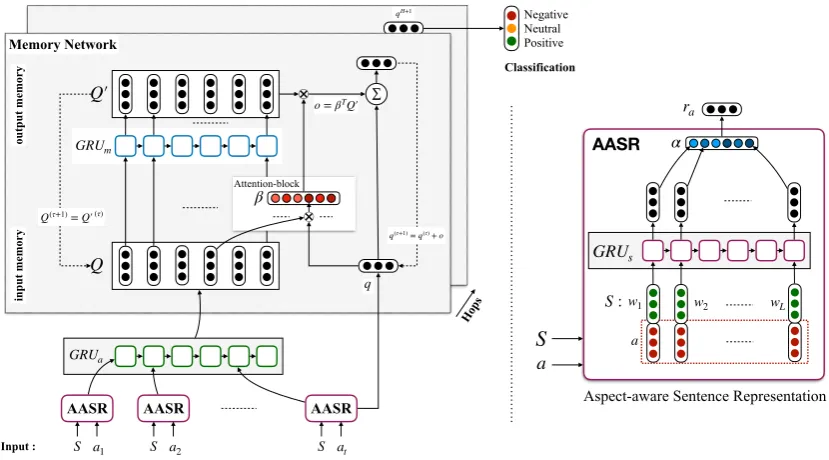
The primary distinction between our model and the literature is the consideration of the neighbor-ing aspects in a sentence with the target aspect. We assume that our inter-aspect relation modeling (IARM) architecture1models the relation between the target aspect and surrounding aspects, while filtering out irrelevant information. Fig.1depicts our model.
1
3.2.1 Overview
Our IARM model can be summarized with the fol-lowing steps:
Input Representation We replace the words in the input sentences and aspect-terms with pre-trained Glove word embeddings (Pennington et al., 2014). For multi-worded aspect-terms, we take the mean of constituent word embeddings as aspect representation.
Aspect-Aware Sentence Representation Fol-lowingWang et al.(2016), all the words in a sen-tence are concatenated with the given aspect repre-sentation. These modified sequence of words are fed to a gated recurrent unit (GRU)2 for context propagation, followed by an attention layer to ob-tain the aspect-aware sentence representation; we obtain for all the aspects in a sentence.
Inter-Aspect Dependency Modeling We em-ploy memory network (Sukhbaatar et al., 2015) to model the dependency of the target aspect with the other aspects in the sentence. This is achieved through matching target-aspect-aware sentence representation with aspect-aware sen-tence representation of the other aspects. After a certain number of iterations of the memory net-work, we obtain a refined representation of the sentence that is relevant to the sentiment classifi-cation of the target aspect. Further, this represen-tation is passed to a softmax layer for final classi-fication. The following subsections discuss these steps in details.
3.2.2 Input Representation
The words (wi) in the sentences are represented
with 300 (D) dimensional Glove word embed-dings (Pennington et al.,2014), resulting sentence
S∈RL×D.
Similarly, aspect terms are represented with word embeddings. Multi-worded aspect terms are averaged over the constituent words. This results aspect representationai ∈RD forithaspect term.
3.2.3 Aspect-Aware Sentence Representation
It would be fair to assume that not all the words in a sentence carry sentimental information of a par-ticular aspect (e.g., stop words have no impact). This warrants a sentence representation that re-flects the sentiment of the given aspect. To achieve
2
LSTM (Hochreiter and Schmidhuber,1997) yields simi-lar performance, but requires training more parameters
this, we first concatenate aspectaito all the words
in the sentenceS:
Sai= [w1⊕ai, w2⊕ai, . . . , wL⊕ai] ∈R
L×2D
.
(1)
In order to propagate the context information within the sentence, we feedSaito a Gated Recur-rent Unit (GRU) with output sizeDs(kindly refer
to Table1for the value). We denote this GRU as
GRUs.GRU.is described as follows:
z=σ(xtU.z+st−1W
z
.), (2)
r=σ(xtU.r+st−1W
r
.), (3)
ht=tanh(xtU.h+ (st−1∗r)W
h
. ), (4)
st= (1−z) ∗ht+z∗st−1, (5)
where ht and st are the hidden outputs and the
cell states respectively at timet. We obtainRai =
GRUs(Sai), whereRai ∈ RL×Ds and theGRUs has the following parameters: Usz ∈ R2D×Ds,
Wsz ∈ RDs×Ds, Usr ∈ R2D×Ds, Wsr ∈ RDs×Ds,
Ush∈R2D×Ds,Wsh∈RDs×Ds.
To amplify the sentimentally relevant words to aspectai, we employ an attention layer to obtain
the aspect-aware sentence representation (it is ef-fectively a refined aspect representation)rai:
z=RaiWs+bs, (6)
α=softmax(z), (7)
rai=α
TR
ai, (8)
where z = [z1, z2, . . . , zL] ∈ RL×1, softmax(x) = [ex1/ ∑jexj, ex2/ ∑jexj, . . .],
α = [α1, α2, . . . , αL] ∈ RL×1, rai ∈ RDs,
Ws∈RDs×1, andbsis a scalar.
3.2.4 Inter-Aspect Dependency Modeling
We feed R = [ra1, ra2, . . . , raM] ∈ RM×Ds to a GRU (GRUa) of sizeDo (kindly refer to Table1
for the value) to propagate aspect information among the aspect-aware sentence representations and obtain Q = GRUa(R), where Q ∈ RM×Do and GRUa has the following parameters: Uaz ∈
RDs×Do, Waz ∈ RDo
×Do, Ur
a ∈ RDs
×Do, Wr
a ∈
RDo×Do,Uah ∈RDs×Do,Wah ∈RDo×Do. This
par-tially helps to model the dependency among as-pects in a sentence.
AASR
S a1
AASR
S a2
∑
GRUm
GRUa Q Q′
Q(τ+1)=Q′(τ)
q(τ+1)=q(τ)+o
Classification
Negative Neutral Positive
Hop s Memory Network
in
p
u
t me
mor
y
AASR
S at o=βTQ′
qH+1
q
ou
tp
u
t me
mor
y
Input :
GRUs
w1
a
w2
S: wL
α ra
AASR
S a
Aspect-aware Sentence Representation
Attention-block
[image:4.595.96.511.82.312.2]β
Figure 1: The proposed IARM architecture; AASR stands forAspect-Aware Sentence Representation.
ratis transformed into internal query state (q) with a fully connected layer as
q=tanh(ratWT +bT), (9)
whereq∈RDo,WT ∈RDs×Do, andbT ∈RDo.
Input Memory Representation All the aspects in the sentence are stored in memory. Each aspect is represented by their corresponding aspect-aware sentence representation inQ. An attention mecha-nism is used to read these memories fromQ (We-ston et al.,2014). We compute the match between the queryq and the memory slots inQwith inner product:
z=qQT, (10)
β=softmax(z), (11)
where z = [z1, z2, . . . , zM] ∈ RM×1, β = [β1, β2, . . . , βM] ∈RM×1. Here,βiis the measure of relatedness between target aspect and aspect i
i.e., the attention score.
Output Memory Representation We choose the output memory vectors (Q′) to be a refined ver-sion of the input memory vectors (Q), obtained by applying a GRU of sizeDo(namedGRUm) onQ.
Hence,
Q′
=GRUm(Q), (12)
whereGRUmhas the following parameters:Umz ∈
RDo×Do, Wmz ∈ RDo
×Do, Ur
m ∈ RDo
×Do, Wr
m ∈
RDo×Do,Umh ∈RDo×Do,Wmh ∈RDo×Do.
The response vector ois obtained by summing output vectors inQ′, weighted by the relatedness measures inβ:
o=βTQ′, (13)
whereo∈RDo.
Final Classification (Single Hop) In the case of single hop, target aspect representationqis added with memory output o to generate refined target aspect representative. This sum is passed to a soft-max classifier of sizeC (C =3due to the classes of sentiment polarity):
P =softmax((q+o)Wsmax+bsmax), (14) ˆ
y=argmax
i
(P [i]), (15)
whereWsmax∈RDo×C,bsmax∈RC, andyˆis the estimated sentiment polarity (0 for negative, 1 for positive, and 2 for neutral).
• Query (q) at the end of hopτ is updated as
q(τ+1)
=q(τ)+o. (16)
• Output memory vectors of hop τ, Q′(τ), is updated as the input memory vectors of hop
τ+1:
Q(τ+1)
=Q′(τ). (17)
AfterH hops,q(H)
becomes the target-aspect-aware sentence representation vector for the final classification:
P =softmax(q(H+1)Wsmax+bsmax), (18) ˆ
y=argmax
i
(P [i]), (19)
whereWsmax ∈RDo×C,bsmax∈RC, andyˆis the estimated sentiment polarity (0 for negative, 1 for positive, and 2 for neutral). The whole algorithm is summarized in Algorithm1.
3.3 Training
We train the network for 30 epochs using categori-cal cross entropy with L2-regularizer as loss func-tion (L):
L= − 1
N
N
∑
i=1
C−1 ∑
k=0
yiklogP [k] +λ∥θ∥2, (20)
whereN is the number of samples,iis the sample index,kis the class value,λis the regularization weight (we set it to10−4),
yik= ⎧ ⎪ ⎪ ⎨ ⎪ ⎪ ⎩
1, if expected class value of sampleiisk,
0, otherwise,
(21)
andθis the set of parameters to be trained, where
θ= {Uz
{s,a,m}, W
z
{s,a,m}, U
r
{s,a,m}, W
r
{s,a,m},
U{hs,a,m}, W{hs,a,m}, Ws, bs, WT, bT, Wsmax,
bsmax}.
As optimization algorithm, Stochastic Gradient Descent (SGD)-based ADAM algorithm (Kingma and Ba,2014) is used with learning-rate0.001due to its parameter-wise adaptive learning scheme.
Hyper-Parameters We employed grid-search to obtain the best hyper-parameter values. Table1 shows the best choice of these values.
Algorithm 1IARM algorithm
1: procedure TRAINANDTESTMODEL(U, V) ▷U = train set,V = test set
2: Aspect-aware sentence representation extrac-tion:
3: fori:[1,M]do▷generate for all the aspects in
the sentence
4: rai←AspectAwareSentRep(S, ai)
5: Query generation:
6: q←F CLayer(rat) ▷Transform the target-aspect-aware sentence representation to the query of memory network
7: Memory networks:
8: Q←GRUa([ra1, ra2, . . . , raM]) ▷initial input memory
9: Q′
←GRUm(Q) ▷initial output memory
10: fori:[1,H]do ▷memory network hops
11: z←qQT ▷match with target aspect
12: β←sof tmax(z)
13: o←βTQ′ ▷response vector
14: Q←Q′ ▷input memory for the next hop
15: q←q+o ▷update target-aspect-aware
sentence representation (query)
16: Classification:
17: yˆ=argmax j
(sof tmax(q)[j]) ▷softmax
classification 18: T estM odel(V)
19: procedureASPECTAWARESENTREP(S,a) ▷
generation of aspect-aware sentence representation 20: Ra←GRUs([w1⊕a, w2⊕a, . . . , wL⊕a]) ▷
S= [w1, w2, . . . , wL]
21: z←F CLayer(Ra)
22: α←sof tmax(z)
23: ra←αTRa
24: returnra
25: procedureTESTMODEL(V)
26: Similar to the training phase,V is passed through the learnt models to get the classification outputs. Sec-tion3.3mentions the trainable parameters (θ).
4 Experiments
In this section, we discuss the dataset used and dif-ferent experimental settings devised for the evalu-ation of our model.
4.1 Dataset Details
We evaluate our model with SemEval-2014 ABSA dataset3. It contains samples from two different domains: Restaurant and Laptop. Table2 shows the distribution of these samples by class labels. Also, Table3shows the count of the samples with single aspect sentence and multi-aspect sentence.
3
4.2 Baseline Methods
We compare our method against the following baseline methods:
LSTM Following Wang et al. (2016), the sen-tence is fed to a long short-term memory (LSTM) network to propagate context among the con-stituent words. The mean of all the hidden out-puts from the LSTM is taken as the sentence rep-resentation, which is fed to a softmax classifier. Aspect-terms have no participation in the classifi-cation process.
TD-LSTM Following Tang et al. (2016a), se-quence of words preceding (left context) and suc-ceeding (right context) target aspect term are fed to two different LSTMs. Mean of the hidden outputs of the LSTMs are concatenated and fed to softmax classifier.
AE-LSTM Following Wang et al. (2016), the sentence is fed to an LSTM for context propaga-tion. Then, the hidden outputs are concatenated with target-aspect representation, from which at-tention scores are calculated. Hidden outputs are pooled based on the attention scores to generate intermediate aspect representation. Final repre-sentation is generated as the sum of the affine transformations of intermediate representation and final LSTM hidden output. This representation is fed to softmax classifier.
ATAE-LSTM Following Wang et al. (2016), ATAE-LSTM is identical to AE-LSTM, except the LSTM is fed with the concatenation of aspect-term representation and word representation.
IAN Following Ma et al. (2017), target-aspect and its context are sent to two distinct LSTMs and the means of the hidden outputs are taken as inter-mediate aspect representation and context repre-sentation respectively. Attention scores are gen-erated from the hidden outputs of both LSTMs which is used to generate final aspect and con-text representation. The concatenation of these two vectors are sent to a softmax classifier for final classification.
Hyper-Parameter Restaurant Laptop
Ds 300 400
Do 350 400
[image:6.595.312.524.62.103.2]Hop Count 3 10
Table 1: Hyper-parameter choices.
Domain Positive Negative Neutral
Train Test Train Test Train Test
Restaurant 2164 728 805 196 633 196
[image:6.595.334.498.671.713.2]Laptop 987 341 866 128 460 169
Table 2: Distribution of the samples by class labels in SemEval 2014 dataset.
4.3 Experimental Settings
In order to draw a comprehensive comparison be-tween our IARM model and the baseline methods, we performed the following experiments:
Overall Comparison IARM is compared with the baseline methods for both of the domains.
Single Aspect and Multi Aspect Scenarios In this setup, samples with single aspect and multi aspect sentences are tested independently on the trained model. For IAN, we ran our own experi-ments for this scenario.
Cross-Domain Evaluation Here, the model trained for restaurant domain is tested with the test set for laptop domain and vice versa. For IAN, we ran our own experiments for this scenario.
5 Results and Discussion
We discuss the results of different experiments be-low:
Overall Comparison We present the overall performance of our model against the baseline methods in Table4.
It is evident from the results that our IARM model outperforms all the baseline models, in-cluding the state of the art, in both of the do-mains. We obtained bigger improvement in lap-top domain, of1.7%, compared to restaurant do-main, of1.4%. This shows that the inclusion of the neighboring aspect information and memory net-work has an overall positive impact on the classi-fication process.
Single Aspect and Multi-Aspect Scenarios
Following Table 5, our IARM model beats the
Domain Train Test SA MA SA MA Restaurant 1007 2595 285 835 Laptop 917 1396 259 379
[image:6.595.99.264.686.728.2]Model Domain Restaurant Laptop Majority Voting 53.4 65.0
[image:7.595.102.262.61.156.2]LSTM 74.3 66.5 TD-LSTM 75.6 68.1 AE-LSTM 76.2 68.9 ATAE-LSTM 77.2 68.7 IAN (SoA) 78.6 72.1 IARM 80.0 73.8
Table 4: Domain-wise accuracy (%) of the dis-cussed models. Best accuracy for each domain is marked with bold font.
state of the art in both single aspect and multi-aspect scenarios in both of the domains. It is in-teresting that both model perform better in multi-aspect scenario for restaurant domain. However, for laptop domain IAN performs better in sin-gle aspect scenario, even though there are more multi-aspect samples than single aspect samples (shown in Table 3). This indicates the failure of IAN model to learn multi-aspect scenario, where IARM model performs significantly better.
Model Restaurant Laptop
SA MA SA MA
IAN (SoA) 75.4 77.7 72.5 71.6
[image:7.595.97.266.374.417.2]IARM 78.6 80.48 73.4 74.1
Table 5: Accuracy of the models for single as-pect and multi asas-pect scenario; SA: Single Asas-pect, MA: Multi Aspect.
Cross-Domain Evaluation Following Table 6, IARM outperforms the state of the art IAN by 2%in both cross-domain scenarios. This indicates the ability of IARM in learning general domain-independent semantic structures from the training data.
Model Rest→Lap Lap→Rest
IAN (SoA) 64.6 72.0
IARM 66.7 74.0
Table 6: Accuracy for cross-domain evaluation; Rest: Restaurant domain, Lap: Laptop domain; A →B signifies train-set is the train-set of domain A
and test-set is the test-set of domain B.
5.1 Case Study
We analyze and compare IARM and IAN with sin-gle aspect and multi-aspect samples from the Se-mEval 2014 dataset.
Single Aspect Case It is evident from Table5, that IARM outperforms IAN in single-aspect sce-nario. For example, the sentence “I recommend any of their salmon dishes...” having aspect “salmon dishes”, with positive sentiment, fails to be correctly classified by IAN as the attention net-work focuses on the incorrect word “salmon”, as shown in Fig.2a. Since, “salmon” does not carry any sentimental charge, the network generates a ineffective aspect-aware sentiment representation, which leads to misclassification.
On the other hand, IARM succeeds in this case, because the word-level attention network gener-ates correct attention value asαin Eq. (7). αfor this case is depicted in Fig.2b, where it is clear that the network emphasizes the correct sentiment-bearing word “recommended”. This leads to effec-tive aspect-aware sentence representation by the network, making correct final classification.
Multi-Aspect Case IARM also outperforms IAN in multi-aspect scenario, which can be ob-served in Table5. We suspect that the presence of multiple aspects in sentence makes IAN network perplexed as to the connection between aspect and the corresponding sentiment-bearing word in the sentence. For example, the sentence “Coffee is a better deal than overpriced cosi sandwiches” con-tains two aspects: “coffee” and “better”. Clearly, the sentiment behind aspect “coffee” comes from the word “better” and the same for aspect “cosi sandwiches” comes from “overpriced”. However, IAN fails to make this association for the as-pect “cosi sandwiches”, evident from the attention weights of IAN shown in Fig.3awhere the empha-sis is on “better”. This leads to imperfect aspect-aware sentence representation generation, result-ing misclassification of the target aspect to be pos-itive.
However, IARM resolves this issue with the combination of word-level aspect aware attention (α) and the memory network. Since, the memory network compares the target-aspect-aware sen-tence representation with the sensen-tence represen-tations for the other aspects repeatedly, eventu-ally the correct representation for the target aspect emerges from the memory network.
[image:7.595.101.260.583.614.2]sand-(a) Attention weight for aspect “salmon dishes” for IAN.
[image:8.595.132.477.64.159.2](b) Attention weight for aspect “salmon dishes” for IARM.
Figure 2: Attention weights for IAN and IARM for “I recommend any of their salmon dishes”.
(a) Attention weights for aspect “cosi sandwiches” for IAN.
(b) Attention weights for aspect “cosi sandwiches” for IARM.
[image:8.595.127.480.193.349.2](c) Attention weights for aspect “coffee”for IARM.
Figure 3: Attention weights for IAN and IARM for the sentence “Coffee is a better deal than overpriced cosi sandwiches”.
wiches”, shown in Fig. 3b and Fig. 3c respec-tively, where the network emphasizes the correct sentiment-bearing words for each aspect, “better” and “overpriced”, respectively. Again, the mem-ory network compares the target aspect-aware sen-tence representation for “cosi sandwiches” with the same for “coffee” and incorporates relevant in-formation into the target-aspect representationqin Eq. (16) along several hops.
This phenomenon is indicated in Fig.4a, where the degree of incorporation of the aspect terms is measured by the attention weights β in Eq. (11). Here, the network is incorporating information from aspect “coffee” into aspect “cosi sandwiches” over three hops. We surmise that this information is related to the sentiment-bearing word “better” of the aspect “coffee”, because a comparison using the word “better” implies the presence of a good (“coffee”) and a bad (“cosi sandwiches”) object. However, this semantics is misconstrued by IAN, which leads to aspect misclassification.
IARM performs considerably well when con-junction plays a vital role in understanding the sentence structure and meaning for sentiment analysis. For example, “my favs here are the tacos pastor and the tostada de tinga” where the aspects
“tacos pastor” and “tostada de tinga” are con-nected using conjunction“and”and both rely on the sentiment bearing word favs. Such complex relation between the aspects and the correspond-ing sentiment-bearcorrespond-ing word is grasped by IARM as shown in Fig.4b. Another example where the inter-aspect relation is necessary for the correct classification is shown in Fig.5, where the aspects “atmosphere”and“service”both rely on the sen-timent bearing word“good”, due to the conjunc-tion“and”.
(a) Memory network atten-tion weights for the sen-tence “Coffee is a better deal than overpriced cosi sand-wiches.”.
(b) Memory network atten-tion weights for the sentence “my favs here are the tacos pastor and the tostada de tinga.”.
[image:8.595.308.526.569.734.2]Figure 5: Memory network attention weights for IARM for the sentence “service was good and so was the atmosphere.” The word importance heatmap is for the aspect“atmosphere”.
Figure 6: Hop-Accuracy plot for both domains.
5.2 Error Analysis
IARM also fails to correctly classify in some cases, e.g., in the sentence “They bring a sauce cart up to your table and offer you 7 or 8 choices of sauces for your steak (I tried them ALL).”, the aspect “choices of sauces” is misclassified by our network as neutral. This happened due to the IARM’s inability to correctly interpret the positive sentiment behind “7 or 8 choices of sauces” .
Again, the IARM could not correctly classify aspect the “breads” to be positive in the sentence “Try the homemade breads.”. This happened, be-cause the word “try” itself is not sentimentally charged, but can carry sentimental meaning given the right context. This context was not recognized by IARM, which led to misclassification.
5.3 Hop-Performance Relation
In our experiments, we tried different hop counts of the memory network. We observed that the net-work performs best with three hops for restaurant domain and ten hops for laptop domain, which is shown in the hop count - performance plot in Fig-ure Fig. 6. It can be observed that the plot for restaurant domain is smoother than the plot for laptop domain. We assume that this is due to the restaurant domain having higher number of sam-ples than laptop domain, as shown in Table2.
Also, the plot for restaurant domain shows a downward trend over the increasing number of hops, with spikes in hop 3, hop 10. This sug-gests a irregular cyclic nature of the memory net-work where those certain hop counts yields higher quality representations than their neighbor. The same cannot be said for laptop domain as the plot presents a zig-zag pattern.
6 Conclusion
In this paper, we presented a new framework, termed IARM, for aspect-based sentiment analy-sis. IARM leverages recurrent memory networks with multihop attention mechanism. We empiri-cally illustrate that an aspect in a sentence is influ-enced by its neighboring aspects. We exploit this property to obtain state-of-the-art performance in aspect-based sentiment analysis in two distinct do-mains: restaurant and laptop. However, there remains plenty of room for improvement in the memory network, e.g., for generation of better aspect-aware representations.
References
Junyoung Chung, C¸ aglar G¨ulc¸ehre, KyungHyun Cho, and Yoshua Bengio. 2014. Empirical Evaluation of Gated Recurrent Neural Networks on Sequence Modeling. CoRR, abs/1412.3555.
Sepp Hochreiter and J¨urgen Schmidhuber. 1997. Long short-term memory. Neural computation, 9(8):1735–1780.
Diederik P. Kingma and Jimmy Ba. 2014. Adam: A Method for Stochastic Optimization. CoRR, abs/1412.6980.
[image:9.595.93.267.229.487.2]Xin Li, Lidong Bing, Wai Lam, and Bei Shi. 2018. Transformation networks for target-oriented senti-ment classification. InProceedings of the 56th An-nual Meeting of the Association for Computational Linguistics (Volume 1: Long Papers), pages 946– 956, Melbourne, Australia. Association for Compu-tational Linguistics.
Thang Luong, Hieu Pham, and Christopher D. Man-ning. 2015. Effective Approaches to Attention-based Neural Machine Translation. In Proceed-ings of the 2015 Conference on Empirical Meth-ods in Natural Language Processing, pages 1412– 1421, Lisbon, Portugal. Association for Computa-tional Linguistics.
Dehong Ma, Sujian Li, Xiaodong Zhang, and Houfeng Wang. 2017. Interactive Attention Networks for Aspect-Level Sentiment Classification. In Proceed-ings of the Twenty-Sixth International Joint Con-ference on Artificial Intelligence, IJCAI-17, pages 4068–4074.
Jeffrey Pennington, Richard Socher, and Christopher Manning. 2014. Glove: Global vectors for word representation. InProceedings of the 2014 confer-ence on empirical methods in natural language pro-cessing (EMNLP), pages 1532–1543.
Soujanya Poria, Erik Cambria, and Alexander Gel-bukh. 2016. Aspect extraction for opinion min-ing with a deep convolutional neural network.
Knowledge-Based Systems, 108:42–49.
Lei Shu, Hu Xu, and Bing Liu. 2017. Lifelong learning crf for supervised aspect extraction. arXiv preprint arXiv:1705.00251.
Sainbayar Sukhbaatar, Arthur Szlam, Jason Weston, and Rob Fergus. 2015. End-to-end Memory Net-works. In Proceedings of the 28th International Conference on Neural Information Processing Sys-tems - Volume 2, NIPS’15, pages 2440–2448, Cam-bridge, MA, USA. MIT Press.
Duyu Tang, Bing Qin, Xiaocheng Feng, and Ting Liu. 2016a. Effective LSTMs for Target-Dependent Sen-timent Classification. In Proceedings of COLING 2016, the 26th International Conference on Compu-tational Linguistics: Technical Papers, pages 3298– 3307, Osaka, Japan. The COLING 2016 Organizing Committee.
Duyu Tang, Bing Qin, and Ting Liu. 2016b. Aspect level sentiment classification with deep memory net-work. arXiv preprint arXiv:1605.08900.
Yi Tay, Anh Tuan Luu, and Siu Cheung Hui. 2017. Learning to attend via word-aspect associative fu-sion for aspect-based sentiment analysis. arXiv preprint arXiv:1712.05403.
Yequan Wang, Minlie Huang, xiaoyan zhu, and Li Zhao. 2016. Attention-based lstm for aspect-level sentiment classification. InProceedings of the 2016
Conference on Empirical Methods in Natural Lan-guage Processing, pages 606–615, Austin, Texas. Association for Computational Linguistics.
Jason Weston, Sumit Chopra, and Antoine Bor-des. 2014. Memory networks. arXiv preprint arXiv:1410.3916.