110
YNU-junyi in BioNLP-OST 2019: Using CNN-LSTM Model with
Embeddings for SeeDev Binary Event Extraction
Junyi Li, Xiaobing Zhou∗, Yuhang Wu, Bin Wang School of Information Science and Engineering
Yunnan University, Yunnan, P.R. China ∗
Corresponding author,[email protected]
Abstract
We participated in the BioNLP 2019 Open Shared Tasks: binary relation extraction of SeeDev task. The model was constructed us-ing convolutional neural networks (CNN) and long short term memory networks (LSTM). The full text information and context informa-tion were collected using the advantages of C-NN and LSTM. The model consisted of two main modules: distributed semantic represen-tation construction, such as word embedding, distance embedding and entity type embed-ding; and CNN-LSTM model. The F1 value of our participated task on the test data set of all types was 0.342. We achieved the second highest in the task. The results showed that our proposed method performed effectively in the binary relation extraction.
1 Introduction
The goal of Information Extraction (IE) (Finkel et al.,2005) is to transform textual information in-to structured information, and in-to focus on quick-ly locating and finding useful information in large amounts of data. Information Extraction (IE) (Fader et al.,2011) is also capable of mining use-ful data and hiding knowledge from a large num-ber of corpus texts, which has led to some new research methods in many disciplines. For exam-ple, with the growing demand for key issues relat-ed to life and biology, many biological problems have fallen into the bottleneck due to inadequate methods. Biological information extraction (Bio-IE) emerges in time and attracts more and more researchers to solve problems. For instance, in the identification of named entities, the classification of relationships between proteins and the extrac-tion of links between drugs. In addiextrac-tion, informa-tion extracinforma-tion in the field of biology, especially event extraction, has entered people’s views. This will be a far-reaching task and a major biological
challenge for information extraction tasks. The BioNLP Shared Task Series is a represen-tative of biomolecular event extraction and has been held four times. This year is the fifth time that BioNLP has shared tasks. The topics in this series include fine-grained extraction, generaliza-tion to knowledge base construcgeneraliza-tion. In addigeneraliza-tion, the scope of this task has become more exten-sive in each time. For instance, the BioNLP 2016 Shared Task(N´edellec et al.,2016) contained three separate parts, the Bacteria Biotope subtask (B-B3), the Seed Development subtask (SeeDev) and the Genia Event subtask (GE4). However, the BioNLP 2019 Open Shared Task contains seven separate parts, the Integrated structure, semantic-s and coreference semantic-subtasemantic-sk (CRAFT), the Pharma-CoNER task, the Active Gene Annotation Corpus subtask (AGAC), the BB3, the SeeDev and the Re-search Domain Criteria subtask(RDoc).
We mainly participated in the binary relation extraction task, which is part of the SeeDev task. The SeeDev task (N´edellec et al., 2013)(Chaix et al., 2016) aims to promote complex event ex-traction on regulations in plants from scientific articles. It focuses on events describing genetic and molecular mechanisms involved in seed devel-opment of the model plant, Arabidopsis thaliana. It involves n-ary and binary relation extraction. Meanwhile, the SeeDev task was proposed for the first time at BioNLP Shared Task 2016(N´edellec et al.,2016) (Mehryary et al., 2016). This 2019 edition is a rerun of the task, with an evaluation methodology more focused on the biological con-tribution.
neu-ral network(Li et al.,2016). Motivated by the pre-vious study, based on CNN, we have integrated L-STM(Hochreiter and Schmidhuber,1997) to solve the defect that convolutional neural networks can not obtain context information. After improving the method, we got good results.
The rest of our paper is structured as follows. Section 2 introduces models. Section 3 describes results and discussion. Conclusions are described in Section 4.
2 Model
The SeeDev-binary task can be thought of as a binary relationship extraction, which specifies whether there is interaction between the two en-tities. In relation extraction, the semantic and syn-tactic information of a sentence plays an impor-tant role. Traditional methods often require the design and extraction of complex features based on domain-specific knowledge (such as tree ker-nels and graphics kerker-nels) to construct the model. As a result, this results in a much lower corpus-dependent generation capability. Therefore, we use CNN to replace complex manual design fea-ture engineering, and learn the advanced function automation by modeling the word embedding and fully connected neural networks from the original input through convolution and pooling operations. Besides, we capture relative distance information and entity types as complementary features of the sentence. After that, we input the data processed by the CNN into the LSTM. Because CNN do not get good context information, and sometimes the connection between text contexts can help us do relation extraction more accurately. So, LSTM can get text context information, which allows us to get a better result in the end.
As shown in Figure 1, the model consists of two modules: distributed semantic representation con-struction, such as embedded characters, distance embedding and entity type embedding, and CNN-LSTM module. In the next section, we will intro-duce more details.
2.1 Data preprocessing
When doing data preprocessing, first we use the Stanford CoreNLP(Manning et al., 2014) tool to process the task’s data. The text is divided into sentences and tokenized. Parts-of-speech and lem-mas are identified and a dependency parse is gen-erated for each sentence. Then, we further process
the preprocessed data.
2.2 Embedding
We use the context of two entities to predict the type of relationship. In our task, the context is rep-resented by words between two entities in a sen-tence. Then, by analyzing the data, we observe that different entities with different types have dif-ferent mutual interaction probabilities if the entity types satisfy the relationship constraints. There-fore, the entity type of the two entities is the im-portant factor of the predicted relationship type. In our model, entity types are seen as a complement to word embedding. In addition, we find that dis-tance information usually plays an important role. The distance can capture the relative position be-tween two entities. So, we concatenate the word embedding(Levy and Goldberg, 2014), type em-bedding(Su and Wang, 2011), and distance em-bedding(Cormode,2003). We use the pre-trained word embedding.1
Then, we would introduce some formulas about word embedding, entity type embedding and dis-tance embedding.
LTW(S) =
[< W >E1, < W >W1, ..., < W >Wn, < W >E2]
LTW,WT(S) =
[< W >E1, ..., < W >E2, < W
T >
type(E1)]
LTWd(S) =
[< Wd>d(E1,E1), ..., < W
d>
d(E2,E1),0,0]
where S stands for the sentences. E1 andE2
are the type 1 and type 2 respectively. W1 stands
for the first word. W is the word embedding ta-ble. WT is type embedding table andWdstands for the distance embedding table. LTW(S) is the
representation of word embedding. LTW,WT (S) is the representation type embedding. LTWd(S) is the distance embedding. In the distance embed-ding, zero vector(0) is used to pad the sentence.
Figure 1: Our proposed CNN-LSTM based model
model dropout batch epoch F1
CNN 0.5 64 120 0.52
CNN-LSTM 0.5 64 120 0.60
Table 1: The F1 score of CNN and CNN-LSTM on the dev data set for SeeDev-binary task
2.3 Model training
We run our model 5 times and use the maximum as the final result of the model. In all model runs, the dropout(Srivastava et al., 2014) is set to 0.5. We found that our loss function tends to stabilize when the epoch reaches around 120. So, we think that our model can converge at this time, so set epoch = 120. The batch size is set to 64. And, we use a pooling approach that combines average pooling and max pooling.
In this task, we choose the CNN-LSTM mod-el to compare with a single CNN modmod-el. We find that the CNN-LSTM model works better than a s-ingle CNN model on development data set. So, we choose the CNN-LSTM model in the final submis-sion.
3 Results and discussion
The SeeDev-binary task data sets consist of three parts which are the training set, the development set, and the test set. There are a total of 87 sections from 20 complete articles on Arabidopsis seed
de-Cluster F1 Recall Precision
Comparison 0.5 0.6 0.43
Function 0.25 0.19 0.35
Regulation 0.34 0.47 0.27
Genic Regulation 0.23 0.24 0.22
Composition 0.35 0.57 0.25
[image:3.595.316.516.499.568.2]Interaction 0.22 0.16 0.33
Table 2: The F1, recall and precision of cluster on the test data set for SeeDev-binary task
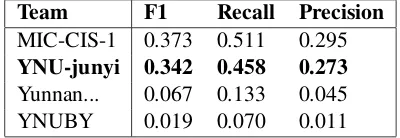
Team F1 Recall Precision
MIC-CIS-1 0.373 0.511 0.295
YNU-junyi 0.342 0.458 0.273
Yunnan... 0.067 0.133 0.045
[image:3.595.316.516.620.691.2]YNUBY 0.019 0.070 0.011
Table 3: The result of all types on the test data set for SeeDev-binary task
Team F1 Recall Precision
MIC-CIS-1 0.443 0.606 0.349
YNU-junyi 0.394 0.528 0.314
Yunnan... 0.135 0.267 0.090
YNUBY 0.074 0.274 0.043
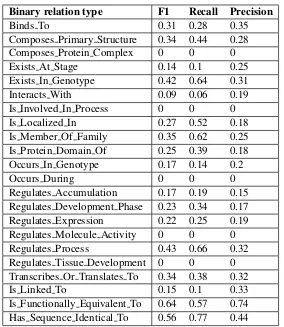
Binary relation type F1 Recall Precision
Binds To 0.31 0.28 0.35
Composes Primary Structure 0.34 0.44 0.28
Composes Protein Complex 0 0 0
Exists At Stage 0.14 0.1 0.25
Exists In Genotype 0.42 0.64 0.31
Interacts With 0.09 0.06 0.19
Is Involved In Process 0 0 0
Is Localized In 0.27 0.52 0.18
Is Member Of Family 0.35 0.62 0.25
Is Protein Domain Of 0.25 0.39 0.18
Occurs In Genotype 0.17 0.14 0.2
Occurs During 0 0 0
Regulates Accumulation 0.17 0.19 0.15
Regulates Development Phase 0.23 0.34 0.17
Regulates Expression 0.22 0.25 0.19
Regulates Molecule Activity 0 0 0
Regulates Process 0.43 0.66 0.32
Regulates Tissue Development 0 0 0
Transcribes Or Translates To 0.34 0.38 0.32
Is Linked To 0.15 0.1 0.33
[image:4.595.158.442.58.385.2]Is Functionally Equivalent To 0.64 0.57 0.74 Has Sequence Identical To 0.56 0.77 0.44
Table 5: Detailed results of our method on the test data set for SeeDev-binary task
velopment. This task defines 16 different types of entities and 22 different types of binary relation-ships.
Our method obtained F1 scores of 0.342 for al-l types and 0.394 for ignoring real-lation types and direction on the test set. In this task, the orga-nizer gives the results of the evaluation obtained from three different evaluation conditions. Com-pared with 2016 BioNLP Shared Task, the orga-nizer has added two more evaluations in order to have better biological contributions. These evalua-tion condievalua-tions are global results, relaevalua-tions by type cluster, and ignoring relation types and direction, respectively. We obtained a good score compared to the official results from different systems, and we ranked the second among all teams. It proves that our proposed method has good performance in binary relation extraction.
Table 2 shows the F1, recall and precision of cluster on the test data sets, and Table 3 shows the result of all types on the test data sets. Table 4 shows the result of ignoring types on the test da-ta sets and Table 5 shows deda-tailed results of our method on the test data set.
4 Conclusions
We use distributed semantic representation and CNN-LSTM model to extract the binary relation-ship between entities, then build a word embed-ding with rich semantic knowledge, distance em-bedding and entity type emem-bedding to feed it into the CNN and learn the intrinsic relationship be-tween the candidate entities. In the task, our F1-score of all types is 0.342, which indicates that our proposed method works efficiently in extraction of binary relations.
However, using only the original words embed-ded in CNN-LSTM may not be sufficient to un-derstand the hidden information between words. Using our model to get this score does not mean that the model works well in other tasks.
References
Estelle Chaix, Bertrand Dubreucq, Abdelhak Fatihi, Dialekti Valsamou, Robert Bossy, Mouhamadou Ba, Louise Del´eger, Pierre Zweigenbaum, Philippe Bessi`eres, Lo¨ıc Lepiniec, and Claire Nedellec. 2016.
Overview of the regulatory network of plant seed de-velopment (seedev) task at the bionlp shared task 2016. In Proceedings of the 4th BioNLP Shared Task Workshop, BioNLP 2016, Berlin, Germany, Au-gust 13, 2016, pages 1–11.
Graham Cormode. 2003. Sequence distance embed-dings. Ph.D. thesis, University of Warwick.
Anthony Fader, Stephen Soderland, and Oren Etzioni. 2011. Identifying relations for open information ex-traction. InProceedings of the conference on empir-ical methods in natural language processing, pages 1535–1545. Association for Computational Linguis-tics.
Jenny Rose Finkel, Trond Grenager, and Christopher Manning. 2005. Incorporating non-local informa-tion into informainforma-tion extracinforma-tion systems by gibb-s gibb-sampling. In Proceedings of the 43rd annual meeting on association for computational linguis-tics, pages 363–370. Association for Computational Linguistics.
Xinyu He, Lishuang Li, Jieqiong Zheng, and Meiyue Qin. 2016. Extracting biomedical event using fea-ture selection and word representation. In Proceed-ings of the 4th BioNLP Shared Task Workshop, page 101, Berlin, Germany. Association for Computation-al Linguistics.
Sepp Hochreiter and Jrgen Schmidhuber. 1997. Long short-term memory. Neural Computation, 9(8):1735–1780.
Jake Lever and Steven JM Jones. 2016. VERSE: Event and relation extraction in the BioNLP 2016 shared task. InProceedings of the 4th BioNLP Shared Task Workshop, pages 42–49, Berlin, Germany. Associa-tion for ComputaAssocia-tional Linguistics.
Omer Levy and Yoav Goldberg. 2014. Neural word embedding as implicit matrix factorization. In Ad-vances in neural information processing systems, pages 2177–2185.
Honglei Li, Jianhai Zhang, Jian Wang, Hongfei Lin, and Zhihao Yang. 2016. DUTIR in BioNLP-ST 2016: Utilizing convolutional network and distribut-ed representation to extract complicate relations. In
Proceedings of the 4th BioNLP Shared Task Work-shop, pages 93–100, Berlin, Germany. Association for Computational Linguistics.
Christopher Manning, Mihai Surdeanu, John Bauer, Jenny Finkel, Steven Bethard, and David McClosky. 2014. The stanford corenlp natural language pro-cessing toolkit. In Proceedings of 52nd annual meeting of the association for computational lin-guistics: system demonstrations, pages 55–60.
Farrokh Mehryary, Jari Bj¨orne, Sampo Pyysalo, Tapi-o SalakTapi-oski, and Filip Ginter. 2016. Deep learn-ing with minimal trainlearn-ing data: TurkuNLP entry in
the BioNLP shared task 2016. In Proceedings of
the 4th BioNLP Shared Task Workshop, pages 73– 81, Berlin, Germany. Association for Computational Linguistics.
Claire N´edellec, Robert Bossy, and Jin-Dong Kim. 2016. Proceedings of the 4th bionlp shared task workshop. InProceedings of the 4th BioNLP Shared Task Workshop.
Claire N´edellec, Robert Bossy, Jin-Dong Kim, Jung-Jae Kim, Tomoko Ohta, Sampo Pyysalo, and Pierre Zweigenbaum. 2013. Overview of bionlp shared task 2013. In Proceedings of the BioNLP Shared Task 2013 Workshop, pages 1–7.
Nitish Srivastava, Geoffrey Hinton, Alex Krizhevsky, Ilya Sutskever, and Ruslan Salakhutdinov. 2014. Dropout: a simple way to prevent neural networks from overfitting. The Journal of Machine Learning Research, 15(1):1929–1958.