151
Multilingual, Multi-scale and Multi-layer Visualization of
Sequence-based Intermediate Representations
Carlos Escolano∗, Marta R. Costa-juss`a∗, Elora Lacroux and Pere-Pau V´azquez? ∗TALP Research Center,Universitat Polit`ecnica de Catalunya, Barcelona
?ViRVIG Group
{carlos.escolano,marta.ruiz}@upc.edu
[email protected],[email protected]
Abstract
The main alternatives nowadays to deal with sequences are Recurrent Neural Net-works (RNN), Convolutional Neural NetNet-works (CNN) architectures and the Transformer. In this context, RNN’s, CNN’s and Transformer have most commonly been used as an encoder-decoder architecture with multiple layers in each module. Far beyond this, these architec-tures are the basis for the contextual word em-beddings which are revolutionizing most natu-ral language downstream applications.
However, intermediate layer representations in sequence-based architectures can be difficult to interpret. To make each layer representation within these architectures more accessible and meaningful, we introduce a web-based tool that visualizes them both at the sentence and token level. We present three use cases. The first analyses gender issues in contextual word embeddings. The second and third are show-ing multilshow-ingual intermediate representations for sentences and tokens and the evolution of these intermediate representations along the multiple layers of the decoder and in the con-text of multilingual machine translation.
1 Introduction
The Transformer (Vaswani et al.,2017) is a pow-erful architecture that was initially proposed to train neural machine translation. This architec-ture deals with variable sequences by concate-nating feed-forward networks and attention-based mechanisms. While the composed modules of the Transformer may not be complex by themselves, it is the composition of several layers of these mod-ules that make the architecture less interpretable.
We are aiming at providing a tool to give in-sights to the sentences and token representation from each layer in the Transformer. Far beyond the Transfomer interpretation which has become
by de-facto the state-of-the-art in machine transla-tion, our tool is able to represent intermediate rep-resentations of other sequence-based architectures such as RNNs (Bahdanau et al.,2014) or ConvS2S (Gehring et al.,2017) as well. Note that sequence-based architectures are having impact in many multimodal applications such as image captioning and speech recognition (Kaiser et al.,2017;Chan et al.,2016).
The uses of our visualization tool are quite a few varying from social bias, multilingual or linguis-tic analysis. In parlinguis-ticular, we focus in analysing the gender inequalities in contextual word embed-dings and the common language representation in a multilingual machine translation system.
2 Visualization tool
In this section we present a scale and multi-layer visualization tool for the sequence-based ar-chitectures, available as tool1and as a demo2. The tool is implemented in Python using the Bokeh li-brary for data visualization and the Flask lili-brary as web microfamework to embed the Bokeh dash-boards on the webpage.
The tool consists in using as input fixed-representations, being a matrix of dimensions the embedding size per sentence length (in tokens). Therefore, the input data required are the sen-tences to be represented (txt), the sentence rep-resentations (json) and optionally the tokens em-beddings (json). Then, a UMAP (McInnes et al.,
2018) dimensionality reduction is performed to plot the representation of this multidimensional data in two dimensions. This dimensionality re-duction is performed for the fixed-representations at the sentence and token level. The tool com-prises two views: multi-scale intermediate
repre-1
https://github.com/elorala/interlingua-visualization
sentation for one layer and multi-layer sentence representation. These three views can be either monolingual or multilingual. The main page of the tool comprises these three views for the user to choose.
We describe these three views on different use cases. For the first view, we show the use cases of detection of gender bias in contextual word em-beddings and common representation in multilin-gual machine translation. For the second view, the use case builds on layer interpretation of multi-way parallel sentences in a translation decoder and showing which layer carries out higher semantic meaning.
2.1 Multi-scale Intermediate representation
This visualization consists of two coordinated views, that encode different information through scatterplots. The one on the left shows the M sen-tence intermediate representations. Each dot in the sentence graph corresponds to one sentence, by hovering on a point we visualize the sentence as well as the arrows to the corresponding translation sentences, in case we are working with multilin-gual data. There is an option to visualize a partic-ular sentence by writing it in the search bar. The search bar has an autocomplete feature (activated when typing two characters) and then, the user can click on the right suggestion.
The right view shows the tokens. Initially, when no sentence from the previous view is selected, this plot shows all vocabulary tokens. By brushing over one or more sentences (in left view), the right view filters out the tokensnot belongingto the se-lected sentence (and the tokens that compose the parallel sentences in the other languages). Once the user selects a sentence by clicking or search-ing, only the words from this sentence (and its translations) remain on the chart. By hovering on a point, the user can see the text of the word, anal-ogously to the sentences view.
Sentences and tokens can be simultaneously vi-sualized for all languages that we are studying and we can interpret the intermediate representation in terms of both granularity levels. See Figures4and
5 which are as well examples of the second use case (explained as follows).
Use case 1: Gender bias in Contextual Word Embeddings. The objective of this use case is to visualize the contextual word representations on a set of occupational vocabulary. We use the
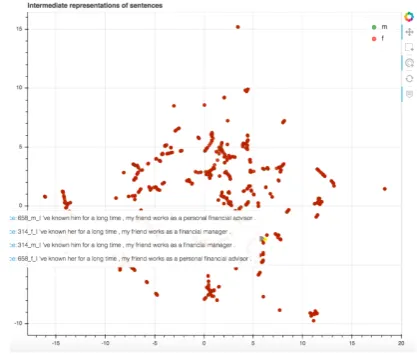
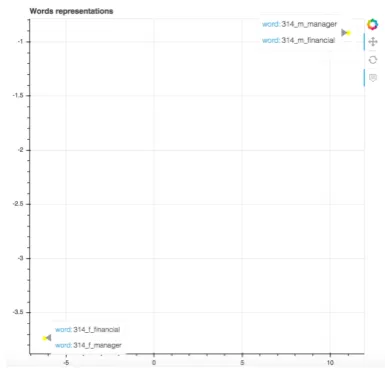
ELMO implementation (Peters et al.,2018), based on RNNs and as data, we use 1019 sentences from previous work (Font and Costa-juss`a,2019) that follow the next template I’ve known him/her for a long time, my friend works as a occupa-tion. Examples of occupations include: account-ing clerk, nurse midwife or biological scientist. Since we have two sets: one for female templates and another for male templates, we use the two sets as if they were different languages. We vi-sualize 2-dimensional representations of sentences and words. For sentences (see Figure1), we see that sentences with similar professions (i.e. finan-cial manager, personal financial advisor) tend to be close in the space for both female and male versions. However, when visualizing words, in the case of financial manager, words for female and male representation are placed in very distant points in the space as seen in Figure 2. On the contrary, words for female and male representa-tion in the case ofpersonal financial advisor are represented together as seen in Figure 3. So, we conclude that financial in a male/female context is differently represented if attached to manager
but the same financialis similarly represented in male/female context if attached to personal and
[image:2.595.310.519.494.671.2]advisor. Our tool allows to visualize that contex-tual word embeddings encode gender biases and this conclusion is coherent with previous literature experiments (Basta et al.,2019).
Figure 2: Contextual word embedding representation at the token levelfinancial manager.
Figure 3: Contextual word embedding representation at the token levelpersonal financial advisor.
Use case 2: Multilingual common representa-tion in translarepresenta-tion. Nowadays, there are two main architectures for multilingual neural machine translation which are a universal shared encoder and decoder and independent multiple encoders and decoders. In both cases, there is an inter-mediate representation where sentences that have similar meanings should be represented close in the space. For our second and third use case, we use the intermediate representations of the multi-lingual Transformer-based architecture presented in (Escolano et al., 2019). Basically, the archi-tecture consists in independent encoders and de-coders with a forced-interlingua space. This sys-tem is trained on data extracted from the UN (Ziemski et al.,2016) and EPPS datasets (Koehn,
2005) that provide 15 million parallel sentences
between English and Spanish and French. new-stest2012and newstest2013were used as valida-tion and test sets, respectively. These sets provide parallel data between the 3 languages.
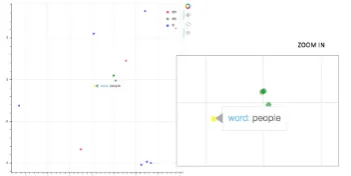
Figure 4 shows 130 sentences extracted from the test set, in the 3 languages at hand and in the common space (at the output of the encoder). When we select a particular sentence (e.g. peo-ple accept orders .), for each token in the sentence selected, the user can select to visualize the token representations (e.g. people) as shown in Figure
5. From this visualization we conclude that the model is not able to group together sentences with the same meaning across languages.
2.2 Multi-layer sentence representation
This visualization shows T layers simultaneously for single or multiple languages in a small multi-ples design. This facilitates the analysis of sen-tence representation evolution across all the layers of the Transformer at once. See Figure6.
On each view, we can display the sentence by hovering. In order to emphasize the distances be-tween the translations and to have a better insight of the evolution, the link between the most dissim-ilar are displayed on the plots. By hovering on the lines, the user can obtain the cosine distance value computed on SciPy. On the views, only the dis-tances superior to 1 are displayed. Even if the di-mensionality reduction of UMAP does show inter-pretable distances (McInnes et al.,2018), showing consecutive layers of the Transformer, and seeing the evolution of the representations allows us to draw hints about the layer roles as we will see in the third use case.
Finally, the tool allows for analysis in multiple layers and languages. This means that initially, the multiple layers represented on the dashboard are in one particular language. However, the user can switch to the multiple layers from another lan-guage by using the selection tool at the top of the page. Since all views are synchronized, upon changing the language set, all of them change ac-cordingly.
[image:3.595.80.280.302.470.2]Figure 4: Multilingual common representation at the sentence level (sentencepeople accept orders .). English in red, Spanish in green and French in blue.
Figure 5: Multilingual common representation at the token level (tokenpeople).
us hints of different linguistic roles for the layers when compared between them.
In the current example, we are representing the same set and architecture as in use case 2, but for the 6 decoder layers. Figure6shows the plot for these layers and Figure 7 shows how it performs hovering on a point (e.g. showing sentences, un-expected consequences., right) and hovering on a line (e.g. showing distance measure, left). Since we show sentences with the same meaning in dif-ferent languages, we interpret that the layer that tends to better cluster sentences compared to con-tiguous layers is the one with higher semantic im-plications. From Figure6, we conclude that higher layers in the decoder (specially 4 and 5) better group sentences (see axes values).
3 Adaptability
In this paper, we have discussed three use cases. However, our tool is highly flexible and adaptable,
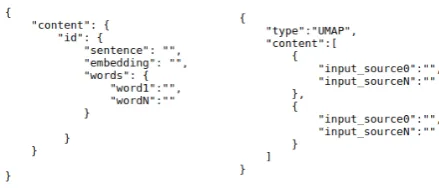
and it allows for a large variety of tasks. The sys-tem only requires data to be formatted as aJSON
file following the structures defined in Figure8. The structure from use cases 1 and 2 defines the relation between sentence and token repre-sentations. For each token and embedding a 2-dimensional is defined, showing its coordinates in the final plots.
On the other side, the structure from use case 3 contains the representations of the layers to be plotted and it is described as an array containing the coordinates for each sentence.
This implementation allows our tool to be ag-nostic to factors such as vocabulary sizes and di-mensionality reductions techniques, as they are applied beforeJSONcreation.
4 Related Work
Given the versatility of the sequence architectures, the current tool feeds from vast research areas in-cluding contextual word embeddings, multilingual models, visualization and interpretability of se-quence models, zero-shot learning. However, we just refer here to the closest and recent works.
[image:4.595.90.266.334.422.2]Figure 6: Decoder layer multilingual sentence representation.
Figure 7: Decoder layer multilingual sentence representation: distance and sentences.
Figure 8: Required JSON structures: (Left) use cases 1 and 2 and (Right) use case 3
Multilinguality analysis. It is quite a common practice to visualize intermediate representations of sequence-to-sequence models (Johnson et al.,
2017;Escolano et al.,2019). Our tool is not lim-ited to this sentence representation of the interme-diate representation, but it also includes the token-level representation. By simultaneously provid-ing this two-granularity level representation we are aiming at a deeper analysis for monolingual,
cross-lingual and multilingual natural language processing downstream applications in general.
Linguistic insights. (Raganato and Tiedemann,
2018) show interesting findings about syntactic and semantic behavior across Transformer layers. Following this research line, our tool can further analyse how similar sentences in multiple lan-guages evolve in their intermediate layer repre-sentations as well as monolingual sentences with same syntactic or morphological patterns.
[image:5.595.73.293.486.580.2]5 Conclusions
We have presented an extremely flexible and adaptable visualization tool for multilingual inter-mediate representations of text both at the sen-tence and token’s level. Together with our tool we have presented three use cases in the context of gender bias analysis in contextual word embed-dings and for multilingual intermediate represen-tations of machine translation.
Acknowledgements
Authors want to thank Christine Raouf Basta for sharing her expertise in contextual word embeddings. This work is supported by a Google Faculty Research Award. This work is also supported by the Spanish Ministerio de Econom´ıa y Competitividad, the European Regional Development Fund and the Agen-cia Estatal de Investigaci´on, through the post-doctoral senior grant Ram´on y Cajal, con-tracts TEC2015-69266-P and TIN2017-88515-C2-1-R(GEN3DLIVE) (MINECO/FEDER,EU), and contract PCIN-2017-079 (AEI/MINECO).
References
Dzmitry Bahdanau, Kyunghyun Cho, and Yoshua Ben-gio. 2014. Neural machine translation by jointly learning to align and translate. arXiv preprint arXiv:1409.0473.
Christine Basta, Marta R. Costa-juss`a, and Noe Casas. 2019. Evaluating the underlying gender bias in con-textualized word embeddings. In Proc. of the 1st ACL Workshop on Gender Bias for Natural Lan-guage Processing.
William Chan, Navdeep Jaitly, Quoc V. Le, and Oriol Vinyals. 2016. Listen, attend and spell: A neural network for large vocabulary conversational speech recognition. InICASSP.
Carlos Escolano, Marta R. Costa-juss`a, and Jos A. R. Fonollosa. 2019. From bilingual to multilingual neural machine translation by incremental training. InProc. of the ACL Student Research Workshop.
Joel Escud´e Font and Marta R. Costa-juss`a. 2019. Equalizing gender biases in neural machine transla-tion with word embeddings techniques. InProc. of the 1st ACL Workshop on Gender Bias for Natural
Language Processing.
Jonas Gehring, Michael Auli, David Grangier, De-nis Yarats, and Yann N. Dauphin. 2017. Convolu-tional sequence to sequence learning. In
Proceed-ings of the 34th ICML - Volume 70, pages 1243–
1252. JMLR.org.
Melvin Johnson, Mike Schuster, Quoc V Le, Maxim Krikun, Yonghui Wu, Zhifeng Chen, Nikhil Thorat, Fernanda Vi´egas, Martin Wattenberg, Greg Corrado, et al. 2017. Googles multilingual neural machine translation system: Enabling zero-shot translation.
Transactions of the Association for Computational Linguistics, 5:339–351.
Lukasz Kaiser, Aidan N Gomez, Noam Shazeer, Ashish Vaswani, Niki Parmar, Llion Jones, and Jakob Uszkoreit. 2017. One model to learn them all.arXiv preprint arXiv:1706.05137.
Philipp Koehn. 2005. Europarl: A parallel corpus for statistical machine translation. InMT summit, vol-ume 5, pages 79–86.
Jiwei Li, Xinlei Chen, Eduard Hovy, and Dan Jurafsky. 2016. Visualizing and understanding neural models in NLP. InProceedings of the 2016 Conference of the North American Chapter of the Association for Computational Linguistics: Human Language Tech-nologies, pages 681–691, San Diego, California. As-sociation for Computational Linguistics.
Leland McInnes, John Healy, Nathaniel Saul, and Lukas Grossberger. 2018. Umap: Uniform mani-fold approximation and projection. The Journal of
Open Source Software, 3(29):861.
Matthew Peters, Mark Neumann, Mohit Iyyer, Matt Gardner, Christopher Clark, Kenton Lee, and Luke Zettlemoyer. 2018. Deep contextualized word rep-resentations. InProceedings of the 2018 Conference
of the NAACL, pages 2227–2237, New Orleans.
Alessandro Raganato and J¨org Tiedemann. 2018. An analysis of encoder representations in transformer-based machine translation. In Proceedings of the 2018 EMNLP Workshop BlackboxNLP: Analyzing
and Interpreting Neural Networks for NLP, pages
287–297, Brussels, Belgium.
Ashish Vaswani, Noam Shazeer, Niki Parmar, Jakob Uszkoreit, Llion Jones, Aidan N Gomez, Łukasz Kaiser, and Illia Polosukhin. 2017. Attention is all you need. InAdvances in Neural Information Pro-cessing Systems, pages 5998–6008.
Jesse Vig. 2019. A multiscale visualization of atten-tion in the transformer model. InProc. of the ACL
System Demonstrations.
Jieyu Zhao, Tianlu Wang, Mark Yatskar, Ryan Cot-terell, Vicente Ordonez, and Kai-Wei Chang. 2019.
Gender bias in contextualized word embeddings. In
Proceedings of the 2019 Conference of the NAACL,
pages 629–634, Minneapolis, Minnesota.