Automatic Food Categorization from Large Unlabeled Corpora and Its
Impact on Relation Extraction
Michael Wiegand and Benjamin Roth and Dietrich Klakow
Spoken Language Systems Saarland University D-66123 Saarbr¨ucken, Germany
{Michael.Wiegand|Benjamin.Roth|Dietrich.Klakow}@lsv.uni-saarland.de
Abstract
We present a weakly-supervised induc-tion method to assign semantic informa-tion to food items. We consider two tasks of categorizations being food-type classi-fication and the distinction of whether a food item is composite or not. The cate-gorizations are induced by a graph-based algorithm applied on a large unlabeled domain-specific corpus. We show that the usage of a domain-specific corpus is vi-tal. We do not only outperform a manually designed open-domain ontology but also prove the usefulness of these categoriza-tions in relation extraction, outperforming state-of-the-art features that include syn-tactic information and Brown clustering.
1 Introduction
In view of the large interest in food in many parts of the population and the ever increasing amount of new dishes/food items, there is a need of au-tomatic knowledge acquisition. We approach this task with the help of natural language processing.
We investigate different methods to assign cate-gories to food items. We focus on two categoriza-tions, being a classification of food items to cat-egories of the Food Guide Pyramid (U.S. Depart-ment of Agriculture, 1992) and a categorization of whether a food item is composite or not.
We present a semi-supervised graph-based ap-proach to induce these food categorizations from an unlabeled domain-specific text corpus crawled from the Web. The method only requires mini-mal manual guidance for the initialization of the algorithm with seed terms. It depends, however, on an automatically constructed high-quality sim-ilarity graph. For that we choose a pattern-based representation that outperforms a distributional-based representation. For initialization, we ex-amine some manually compiled seed words and
a very few simple surface patterns to automati-cally induce such expressions. As a hard baseline, we compare the effectiveness of using a general-purpose ontology for the same types of categoriza-tions. Apart from an intrinsic evaluation, we also examine the categories in relation extraction.
The contributions of this paper are a method re-quiring minimal supervision for a comprehensive classification of food items and a proof of con-cept that the knowledge that can thus be gained is beneficial for relation extraction. Even though we focus on a specific domain, the induction method can be easily translated to other domains. In par-ticular, other life-style domains, such as fashion, cosmetics or home & gardening, show parallels since comparable textual web data are available and similar relation types (e.g. that two items fit together or can be substituted by each other) exist. Our experiments are carried out on German data but our findings should carry over to other lan-guages since the issues we address are (mostly) language universal. For general accessibility, all examples are given as English translations.
2 Data & Annotation
2.1 Domain-Specific Text Corpus
In order to generate a dataset for our experiments, we used a crawl of chefkoch.de1 (Wiegand et al., 2012b) consisting of 418,558 webpages of food-related forum entries. chefkoch.de is the largest German web portal for food-related issues.
2.2 Food Categorization
As a food vocabulary, we employ a list of 1888 food items: 1104 items were directly extracted from GermaNet (Hamp and Feldweg, 1997), the German version of WordNet (Miller et al., 1990). The items were identified by extracting all hy-ponyms of the synset Nahrung (English: food). By
1www.chefkoch.de
Class Description Size Perc.
MEAT meat and fish (products) 394 20.87
BEVERAGE beverages (incl. alcoholic drinks) 298 15.78 VEGE vegetables (incl. salads) 231 12.24 SWEET sweets, pastries and snack mixes 228 12.08
SPICE spices and sauces 216 11.44
STARCH starch-based side dishes 185 9.80
MILK milk products 104 5.51
FRUIT fruits 94 4.98
GRAIN grains, nuts and seeds 77 4.08
FAT fat 41 2.18
[image:2.595.77.288.60.186.2]EGG eggs 20 1.06
Table 1: The different food types (gold standard).
consulting the relation tuples from Wiegand et al. (2012c) a further784items were added. We man-ually annotated this vocabulary w.r.t. two tasks:
2.2.1 Task I: Food Types
The food type categories we chose are mainly in-spired by the Food Guide Pyramid (U.S. Depart-ment of Agriculture, 1992) that divides food items into categories with similar nutritional properties. This categorization scheme not only divides the set of food items in many intuitive homogeneous classes but it is also the scheme that is most com-monly agreed upon. Table 1 lists the specific cat-egories we use. For category assignment of com-plex dishes comprising different food items we ap-plied a heuristics: we always assign the category that dominates the dish. A meat sauce, for exam-ple, would thus be assigned MEAT (even though there may be other ingredients than meat).
2.2.2 Task II: Dishes vs. Atomic Food Items
In addition to Task I, we include another catego-rization that divides food items into dishes and atomic food items (Table 2). By dish, we mainly understand food items that are composite food items made of other (atomic) food items. This categorization is orthogonal to the previous clas-sification of food items. We refrained from adding dishes as a further category of food types in §2.2.1, as we would have ended up with a very heteroge-neous class in the set of homogeheteroge-neous food type categories. Thus, dishes that differ greatly in nu-trient content, such as Waldorf salad and chocolate cake, would have been subsumed by one class.
3 Method
3.1 Graph-based Induction
We propose a semi-supervised graph-based ap-proach to label food items with their respective
Class Description Examples Perc.
DISH composite food items cake, falafel, meat loaf 32.10 ATOM non-composite food items apple, steak, potato 67.90
Table 2: Distribution of dishes and atomic food items among the food vocabulary (gold standard).
food categories. The underlying data structure is a similarity graph connecting different food items. Food items that belong to the same category should be connected by highly weighted edges. In order to infer the labels for each respective food item, one first needs to specify a small set of seeds for each category and then apply a graph-based clustering method that divides the graph into clus-ters that represent distinct food categories. Our method is a low-resource approach that can also be easily adapted to other domains. The only domain-specific information required are an unla-beled corpus and a set of seeds.
3.1.1 Construction of the Similarity Graph
To enable a graph-based induction, we generate a similarity graph that connects similar food items. For that purpose, a list of domain-independent similarity-patterns was compiled. Each pattern is a lexical sequence that connects the mention of two food items (Table 3). Each pair of food items ob-served with any of those patterns is connected via a weighted edge (the different patterns are treated equally). The weight is the total frequency of all patterns co-occurring with a particular food pair.
[image:2.595.314.519.62.95.2]Patterns food item1(or|or rather|instead of|“(”) food item2
[image:3.595.308.523.63.114.2]Example {apple: pineapple, pear, fruit, strawberry, kiwi} {steak: schnitzel, sausage, roast, meat loaf, cutlet}
Table 3: Domain-independent patterns for build-ing the similarity graph.
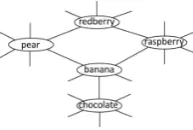
Figure 1: Illustration of the similarity graph.
linked to many other food items not being fruits.)
3.1.2 Semi-Supervised Graph Optimization
Our semi-supervised graph optimization (Belkin and Niyogi, 2004) is a robust algorithm that was primarily chosen since it only contains few free parameters to adjust. It is based on two principles: First, similar data points should be assigned simi-lar labels, as expressed by a simisimi-larity graph of la-beled and unlala-beled data. Second, for lala-beled data points the prediction of the learnt classifier should be consistent with the (actual) gold labels.
We construct a weighted transition matrix W of the graph by normalization of the matrix with co-occurrence countsCwhich we obtain from the similarity graph (§3.1.1). We use the common normalization by a power of the degree function di = PjCij: it defines Wij = dCλij
idλj if i 6= j,
and Wii = 0. The normalization weight λis the first of two parameters used in our experiments for semi-supervised graph optimization. For learning the semi-supervised classifier, we use the method of Zhou et al. (2004) to find a classifying function which is sufficiently smooth with respect to both the structure of unlabeled and labeled points.
Given a set of data points X = {x1, . . . , xn} and label setL={1, . . . , c}, withxi:1≤i≤llabeled asyi ∈ Land xi:l+1≤i≤nunlabeled. For predic-tion, a vectorial functionF :X →Rcis estimated assigning a vector Fi of label scores to every xi. The predicted labeling follows from these scores asyˆi = arg maxj≤cFij. Conversely, the gold la-beling matrixY is an×cmatrix withYij = 1if xiis labeled asyi=jandYij = 0otherwise.
Minimizing the cost functionQaims at a trade-off between information from neighbours and ini-tial labeling information, controlled by parameter
Patterns Categorization Examples
patthearst Food Types food item is some food type, food type such as food item,. . .
[image:3.595.132.229.145.210.2]pattdishes Dishes recipe for food item pattatom Atomic Food Items made of|contains food item
Table 4: List of patterns to extract seeds.
µ(the second parameter used in our experiments):
Q=1
2 Pni,j=1Wij
1 √
δiFi−q1 δjFj
+µPn
i=1kFi−Yik !
whereδiis the degree function ofW.
The first term inQis the smoothness constraint, its minimization leads to adjacent edges having similar labels. The second term is the fitting con-straint, its minimization leads to consistency of the functionFwith the labeling of the data. The solu-tion to the above cost funcsolu-tion is found by solving a system of linear equations (Zhou et al., 2004).
As we do not possess development data for this work, we set the two free parametersλ= 0.5and µ = 0.01. This setting is used for both induction tasks and all configurations. It is a setting that pro-vided reasonable results without any notable bias for any particular configuration we examine.
3.1.3 Manually vs. Automatically Extracted Seeds
We explore two types of seed initializations: (a) a manually compiled list of seed food items and (b) a small set of patterns (Table 4) by the help of which such seeds are automatically extracted.
In order to extract seeds for Task I with the pattern-based approach, we apply the patterns from Hearst (1992). These patterns have been de-signed for the acquisition of hyponyms. Task I can also be regarded as some type of hyponym extrac-tion. The food types (fruit, meat, sweets) repre-sent the hypernyms for which we extract seed hy-ponyms (banana, beef, chocolate).
In order to extract seeds for Task II, we apply two domain-specific sets of patterns (pattdish and pattatom). We rank the food items according to the frequency of occurring with the respective pattern set. Since food items may occur in both rankings, we merge the two rankings in the following way:
score(food item) = #pattdish(food it.)−#pattatom(food it.)
The top end of this ranking represents dishes while the bottom end represents atoms.
3.2 Using a General-Purpose Ontology
types of food categorization schemes can be ap-proximated with the hypernymy graph in that on-tology: We manually identify nodes that resemble our food categories (e.g. fruit, meat or dish) and label any food item that is an immediate or a me-diate hyponym of these nodes (e.g. apple for fruit) with the respective category label. The downside of this method is that a large amount of food items is missing from the GermaNet-database (§2.2).
3.3 Other Baselines & Post-Processing
In addition to the previous methods we imple-ment a heuristic baseline (HEUR) that rests on the observation that German food items of the same food category often share the same suffix, e.g. Schokoladenkuchen (English: chocolate cake) and Apfelkuchen (English: apple pie). For HEUR, we manually compiled a set of few typical suffixes for each food type/dish category (ranging from3to8 suffixes per category). For classification of a food item, we assign the food item the category label whose suffix matched with the food item.2
We also examine an unsupervised baseline (UNSUP) that applies spectral clustering on the similarity graph following von Luxburg (2007):
• Input: a similarity matrixWand the number of categories to detectk. • The laplacianLis constructed fromW. It is the symmetric laplacian
L=I−D1/2W D1/2, whereDis a diagonal degree matrix.3 • A matrixU∈Rn×kis constructed that contains as columns the first
keigenvectorsu1, . . . , ukofL.
• The rows ofUare interpreted as the new data points. The final cluster-ing is obtained byk-means clustering of the rows ofU.
UNSUP (which is completely parameter-free) gives some indication about the intrinsic expres-siveness of the similarity graph as it lacks any guidance towards the categories to be predicted.
In graph-based food categorization, one can only make predictions for food items that are con-nected (be it directly or indirectly) to seed food items within the similarity graph. To expand labels to unconnected food items, we apply some post-processing (POSTP). Similarly to HEUR, it ex-ploits the suffix-similarity of food items. It assigns each unconnected food item the label of the food item (that could be labeled by the graph optimiza-tion) that shares the longest suffix. Due to their similar nature, we refrain from applying POSTP on HEUR as it would produce no changes.
2Unlike German food items, English food items are
of-ten multi-word expressions. Therefore, we assume that for English, instead of analyzing suffixes the usage of the head of a multiword expression (i.e. chocolate cake) would be an appropriate basis for a similar heuristic.
3That is,D
iiequals to the sum of theith row.
PLAIN +POSTP
Configuration graph Acc Prec Rec F1 Acc Prec Rec F1
UNSUP X 46.2 43.1 35.7 36.0 56.1 41.0 42.5 38.4
HEUR (plain) 25.5 87.9 32.2 42.9 N/A N/A N/A N/A
HEUR X 56.4 73.6 52.1 54.7 68.7 72.3 64.3 60.7
PAT-Top1 X 52.4 60.2 51.2 52.5 64.5 58.2 62.9 57.4 PAT-Top5 X 61.1 70.7 61.9 64.4 74.5 67.9 76.0 69.7 PAT-Top10 X 60.2 69.6 60.5 62.2 73.4 66.7 74.2 67.3
1-PROTO X 58.0 68.0 58.0 59.5 70.2 64.1 71.0 63.8 5-PROTO X 64.5 76.6 63.7 68.6 78.6 73.8 78.5 75.2 10-PROTO X 65.8 79.0 65.5 71.0 80.2 75.9 80.6 77.7
[image:4.595.309.524.61.201.2]GermaNet (plain) 52.1 94.0 52.0 65.7 75.4 73.2 75.0 72.4 GermaNet X 68.3 84.7 63.4 71.6 82.7 81.8 77.7 79.1
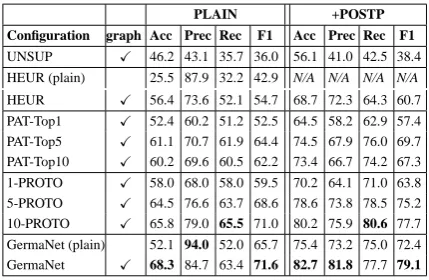
Table 5: Comparison of different food-type classi-fiers (graph indicates graph-based optimization).
4 Experiments
We report precision, recall and F-score and accu-racy.4 For precision, recall and F-score, we list the macro-averaged score.
4.1 Evaluation of Food Categorization
4.1.1 Detection of Food Types
Table 5 compares different classifiers and configu-rations for the prediction of food types (against the gold standard from Table 1). Apart from the pre-viously described baselines, we consider n man-ually selected prototypes (n-PROTO) and the top n food items produced by Hearst-patterns
(PAT-Topn) as seeds for graph-based optimization. The
table shows that the semi-supervised graph-based approach with these seeds outperforms the base-lines UNSUP and HEUR. Only as few as 5 prototypical seeds (per category) are required to obtain performance that is even better than us-ing plain GermaNet. The table also shows that post-processing (with our suffix-heuristics) con-sistently improves performance. Manually choos-ing prototypes is more effective than instantiatchoos-ing seeds via Hearst-patterns. The quality of the out-put of Hearst-patterns degrades from top 10 on-wards. However, considering that PAT-Topn does not include any manual intervention, it already produces decent results. Finally, even GermaNet can be effectively used as seeds.
4.1.2 Detection of Dishes
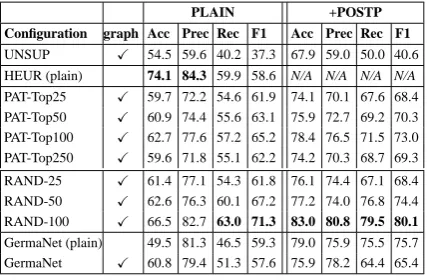
Table 6 compares different classifiers for the de-tection of dishes (against the gold standard from Table 2). Dishes and atomic food items are very
4All manually labeled resources are available at:
PLAIN +POSTP Configuration graph Acc Prec Rec F1 Acc Prec Rec F1
UNSUP X 54.5 59.6 40.2 37.3 67.9 59.0 50.0 40.6
HEUR (plain) 74.1 84.3 59.9 58.6 N/A N/A N/A N/A PAT-Top25 X 59.7 72.2 54.6 61.9 74.1 70.1 67.6 68.4 PAT-Top50 X 60.9 74.4 55.6 63.1 75.9 72.7 69.2 70.3 PAT-Top100 X 62.7 77.6 57.2 65.2 78.4 76.5 71.5 73.0 PAT-Top250 X 59.6 71.8 55.1 62.2 74.2 70.3 68.7 69.3
RAND-25 X 61.4 77.1 54.3 61.8 76.1 74.4 67.1 68.4 RAND-50 X 62.6 76.3 60.1 67.2 77.2 74.0 76.8 74.4 RAND-100 X 66.5 82.7 63.0 71.3 83.0 80.8 79.5 80.1
[image:5.595.75.289.62.202.2]GermaNet (plain) 49.5 81.3 46.5 59.3 79.0 75.9 75.5 75.7 GermaNet X 60.8 79.4 51.3 57.6 75.9 78.2 64.4 65.4
Table 6: Comparison of different classifiers dis-tinguishing between dishes and atomic food items (graph indicates graph-based optimization).
PLAIN +POSTP
Configuration graph Acc Prec Rec F1 Acc Prec Rec F1
PAT-Top100 (plain) 9.5 89.5 10.5 18.6 63.6 61.5 63.5 61.3
PAT-Top100 X 62.7 77.6 57.2 65.2 78.4 76.5 71.5 73.0
RAND-100 (plain) 10.6 100.0 12.2 21.4 70.2 69.7 69.0 69.0 RAND-100 X 66.5 82.7 63.0 71.3 83.0 80.8 79.5 80.1
Table 7: Impact of graph-based optimization (graph) for the detection of dishes.
heterogeneous classes which is why more seeds are required for initialization. This means that we cannot look for prototypes. For simplicity, we resorted to randomly sample seeds from our gold standard (RAND-n). For HEUR, we could not find a small and intuitive set of suffixes that are shared by many atomic food types, therefore we considered all food types from our vocabulary whose suffix did not match a typical dish suffix as atomic. As this leaves no unspecified food items in our vocabulary, we cannot use the output of HEUR as seeds for graph-based optimization.
In contrast to the previous experiment, HEUR is a more robust baseline. But again, post-processing mostly improves performance, and patterns are not as good as manual (random) seeds yet the former are notably better than HEUR w.r.t. F-Score. Un-like in the food-type classification, graph-based optimization applied on GermaNet does not result in some improvement. We assume that the preci-sion of plain GermaNet with81.3%is too low.5
Since GermaNet cannot effectively be used as seeds for the graph-based optimization and post-processing has already a strong positive effect, we may wonder how effective the actual graph-based
5For other seeds for which it worked, we usually
mea-sured a precision of90%or higher.
optimization is for this classification task. Af-ter all, significantly more seeds are required for this classification task than for the previous task, so we need to show that it is not the mere seeds (+post-processing) that are required for a reason-able categorization. Table 7 examines two key configurations with and without graph-based op-timization. It shows that also for this classification task, graph-based optimization produces a catego-rization superior to the mere seeds. Moreover, the suffix-based post-processing is complementary to the improvement by the graph-based optimization.
[image:5.595.74.293.267.332.2]4.1.3 Comparison of Initialization Methods
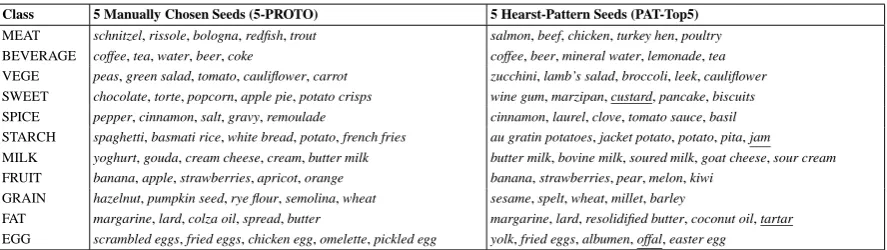
Table 8 compares for each food type 5 manually selected prototypical seeds (i.e. 5-PROTO) and the 5 food items most frequently been observed with patthearst(Table 4). While the manually cho-sen seeds reprecho-sent the spectrum of food items within each particular class (e.g. for STARCH, some type of pasta, rice and potato was chosen), it is not possible to enforce such diversity with the automatically extracted seeds. However, most food items are correct. Table 9 displays the 10 most highly ranked dishes and atomic food items extracted with pattdishand pattatom(Table 4). Un-like the previous task (Table 8), we obtain more heterogeneous seeds within the same class.
4.1.4 Distributional Similarity
al-Class 5 Manually Chosen Seeds (5-PROTO) 5 Hearst-Pattern Seeds (PAT-Top5)
MEAT schnitzel, rissole, bologna, redfish, trout salmon, beef, chicken, turkey hen, poultry BEVERAGE coffee, tea, water, beer, coke coffee, beer, mineral water, lemonade, tea VEGE peas, green salad, tomato, cauliflower, carrot zucchini, lamb’s salad, broccoli, leek, cauliflower SWEET chocolate, torte, popcorn, apple pie, potato crisps wine gum, marzipan, custard, pancake, biscuits SPICE pepper, cinnamon, salt, gravy, remoulade cinnamon, laurel, clove, tomato sauce, basil STARCH spaghetti, basmati rice, white bread, potato, french fries au gratin potatoes, jacket potato, potato, pita, jam MILK yoghurt, gouda, cream cheese, cream, butter milk butter milk, bovine milk, soured milk, goat cheese, sour cream FRUIT banana, apple, strawberries, apricot, orange banana, strawberries, pear, melon, kiwi
GRAIN hazelnut, pumpkin seed, rye flour, semolina, wheat sesame, spelt, wheat, millet, barley
[image:6.595.78.522.61.186.2]FAT margarine, lard, colza oil, spread, butter margarine, lard, resolidified butter, coconut oil, tartar EGG scrambled eggs, fried eggs, chicken egg, omelette, pickled egg yolk, fried eggs, albumen, offal, easter egg
Table 8: Comparison of different seed initializations for the food type categorization task (underlined food items represent erroneously extracted food items).
[image:6.595.312.520.343.418.2]lows us to compare any arbitrary pair of food items directly, we also employ a second classifier (for comparison) based on the nearest neighbour prin-ciple. We assign each food item the label of the most similar seed food item.
Table 10 compares these two classifiers with the best previous result. It shows that the pattern-based representation consistently outperforms the distributional representation. The former may be sparse but it produces high-precision similarity links.6 The vector representation, on the other hand, may not be sparse but it contains a high degree of noise. The major problem is that not only vectors of similar food items, such as chips (fries), potatoes and rice, are similar to each other, but also vectors of different food items that are typically consumed with each other (e.g. fish and chips). This is because of their frequent co-occurrence (as in collocations like fish & chips). Unfortunately, these pairs belong to different food types. For the dish classification, however, the vector representation is less of a problem.7
The distributional representation works better with the simple nearest neighbour classifier. We assume that graph-based optimization adds further noise to the classification since, unlike the nearest neighbour which only calculates the direct similar-ity between two vectors, it also incorporates indi-rect relationships (which may be more error-prone than the direct relationships) between food items.
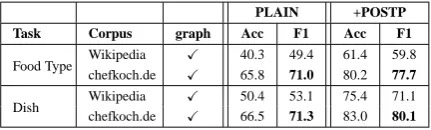
4.1.5 Do we need a domain-specific corpus?
In this section, we want to provide evidence that apart from the similarity graph and seeds the tex-tual source for the graph, i.e. our domain-specific
6By the label propagation within the graph-based
opti-mization, the sparsity problem is also mitigated.
7Fish and chips are both atoms, so in the dish
classifica-tion, it is no mistake to consider them similar food items.
Class 10 Seeds Extracted with Patterns (PAT-Top10)
DISH cookies, cake, praline, bread dumpling, jam, biscuit, cheese cake, black-and-whites, onion tart, pasta salad
ATOM marzipan, flour, potato, olive oil, water, sugar, cream, choco-late, milk, tomato
Table 9: Illustration of seed initialization for the distinction between dishes and atomic food items.
Task Similarity Classifier Acc F1
Food Type distributional nearest neighbour 53.4 51.1 distributional graph 25.6 25.6 pattern-based graph 80.2 77.7
Dish distributional nearest neighbour 76.8 75.2
distributional graph 71.5 71.2 pattern-based graph 83.0 80.1
Table 10: Impact of the similarity representation.
corpus (chefkoch.de), is also important. For that purpose, we compare our current corpus against an open-domain corpus. We consider the German version of Wikipedia since this resource also con-tains encyclopedic knowledge about food items. Table 11 compares the graph-based induction. As in the previous section, we only consider the best previous configuration. The table clearly shows that our domain-specific text corpus is a more ef-fective resource for our purpose than Wikipedia.
4.2 Evaluation for Relation Extraction
know which items can be used together (SuitsTo), be it two food items that can be used as a meal or two fashion items that can be worn together. Substitutes are also relevant for situations in which item A is out of stock but item B can be offered as an alternative. Therefore, insights from this work should carry over to other domains.
We randomly extracted 1500 sentences from our text corpus (§2.1) in which (at least) two food items co-occur. Each food pair mention was man-ually assigned one label. In addition to the three relation types from above, we introduce the la-bel Other for cases in which either another rela-tion between the target food items is expressed or the co-occurrence is co-incidental. On a subset of
200 sentences, we measured a substantial inter-annotation agreement of Cohen’s κ = 0.67 (Lan-dis and Koch, 1977).
We train a supervised classifier and incorporate the knowledge induced from our domain-specific corpus as features. We chose Support Vector Ma-chines with 5-fold cross-validation using SVMlight -multi-class (Joachims, 1999).
Table 13 displays all features that we examine for supervised classification. Most features are widely used throughout different NLP tasks. One special feature brown takes into consideration the output of Brown clustering (Brown et al., 1992) which like our graph-based optimization produces a corpus-driven categorization of words. Simi-lar to UNSUP, this method is unsupervised but it considers the entire vocabulary of our text corpus rather than only food items. Therefore, this in-formation can be considered as a generalization of all contextual words. Such type of informa-tion has been shown to be useful for named-entity recognition (Turian et al., 2010) and relation ex-traction (Plank and Moschitti, 2013).
For syntactic parsing, Stanford Parser (Rafferty and Manning, 2008) was used. For Brown cluster-ing, the SRILM-toolkit (Stolcke, 2002) was used. Following Turian et al. (2010), we induced 1000 clusters (from our domain-specific corpus §2.1).
4.2.1 Why should food categories be helpful for relation extraction?
All relation types we consider comprise pairs of two food items which makes these relation types likely to be confused. Contextual information may be used for disambiguation but there may also be frequent contexts that are not sufficiently informa-tive. For example, 25% of the instances of
Ingre-PLAIN +POSTP Task Corpus graph Acc F1 Acc F1
Food Type Wikipedia X 40.3 49.4 61.4 59.8 chefkoch.de X 65.8 71.0 80.2 77.7
[image:7.595.309.525.62.127.2]Dish Wikipedia X 50.4 53.1 75.4 71.1 chefkoch.de X 66.5 71.3 83.0 80.1
Table 11: Comparison of Wikipedia and domain-specific corpus as a source for the similarity graph.
dientOf follow the lexical pattern food item1 with food item2 (1). However, the same pattern also covers15% of the instances of SuitsTo (2).
(1) We had a stew with red lentils. (Relation: IngredientOf) (2) We had salmon with broccoli. (Relation: SuitsTo)
The food type information we learned from our text corpus might tell us which of the food items are dishes. Only in (1), there is a dish, i.e. stew. So, one may infer that the presence of dishes is indicative of IngredientOf rather than SuitsTo.
food item1 and food item2 is another ambigu-ous context. It cannot only be observed with the relation SuitsTo, as in (3) (66% of all instantia-tions of that pattern), but also SubstitutedBy (20% of all mentions of that relation match that pattern), as in (4). For SuitsTo, two food items that belong to two different classes (e.g. MEAT and STARCH or MEAT and VEGE) are quite characteristic. For SubstitutedBy, the two food items are very often of the same category of the Food Guide Pyramid.
(3) I very often eat fish and chips. (Relation: SuitsTo)
(4) For these types of dishes you can offer both Burgundy wine and Champagne. (Relation: SubstitutedBy)
Since the second ambiguous context involves the two general relation types SuitsTo and Substi-tutedBy, resolving this ambiguity with automati-cally induced type information has some signifi-cance for other domains. In particular, for other life-style domains, domain-specific type informa-tion could be obtained following our method from §3.1. The disambiguation rule that two entities of the same type imply SubstitutedBy otherwise they imply SuitsTo should also be widely applicable.
4.2.2 Results
Relation Description Example Freq. Perc.
SuitsTo food items that are typically consumed together My kids love the simple combination of fish fingers with mashed potatoes.
633 42.20
SubstitutedBy similar food items commonly consumed in the same situations We usually buy margarine instead of butter. 336 22.40 IngredientOf ingredient of a particular dish Falafel is made of chickpeas. 246 16.40
[image:8.595.75.527.63.124.2]Other other relation or co-occurrence of food items are co-incidental On my shopping list, I’ve got bread, cauliflower, ... 285 19.00
Table 12: The different relation types and their respective frequency on our dataset.
Features Description
patt lexical surface patterns used in Wiegand et al. (2012b)
word bag-of-words features: all words within the sentence brown features using Brown clustering: all features from word but
words are replaced by induced clusters
pos part-of-speech sequence between target food items and tags of the words immediately preceding and following them synt path from syntactic parse tree from first target food item to
second target food item
conj conjunctive features: patt with brown classes of target food items; pos sequence with brown classes of target food items; synt with brown classes of target food items
[image:8.595.310.524.166.330.2]graph semantic food information induced by graph optimization (config.: 10-PROTO(+POSTP) and RAND-100(+POSTP)) germanet semantic food information derived from (plain) GermaNet
Table 13: Description of the feature set.
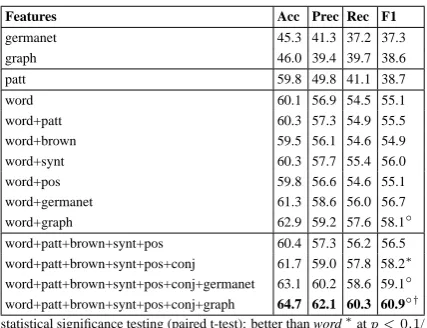
designed for a particular relation type, one can read off from the matching pattern which class is predicted). word is slightly better but, unlike patt, it is dependent on supervised learning.
The only feature that individually manages to significantly outperform word is graph. The tra-ditional features (i.e. pos, synt and brown) only produce some mild improvement when added jointly to word along some conjunctive fea-tures. When graph is added to this feature set (i.e. word+patt+pos+synt+brown+conj), we ob-tain another significant improvement. In con-clusion, the information we induced from our domain-specific corpus cannot be obtained by other NLP-features, including other state-of-the-art induction methods such as Brown clustering.
5 Related Work
While many of the previous works on noun catego-rization also address the task of hypernym classifi-cation (Hearst, 1992; Caraballo, 1999; Widdows, 2003; Kozareva et al., 2008; Huang and Riloff, 2010; Lenci and Benotto, 2012) and some include examples involving food items (Widdows and Dorow, 2002; Cederberg and Widdows, 2003), only van Hage et al. (2005) and van Hage et al. (2006) specifically focus on the classification of food items. van Hage et al. (2005) deal with on-tology mapping whereas van Hage et al. (2006) explore part-whole relations.
Features Acc Prec Rec F1
germanet 45.3 41.3 37.2 37.3
graph 46.0 39.4 39.7 38.6
patt 59.8 49.8 41.1 38.7
word 60.1 56.9 54.5 55.1
word+patt 60.3 57.3 54.9 55.5
word+brown 59.5 56.1 54.6 54.9
word+synt 60.3 57.7 55.4 56.0
word+pos 59.8 56.6 54.6 55.1
word+germanet 61.3 58.6 56.0 56.7
word+graph 62.9 59.2 57.6 58.1◦
word+patt+brown+synt+pos 60.4 57.3 56.2 56.5 word+patt+brown+synt+pos+conj 61.7 59.0 57.8 58.2∗ word+patt+brown+synt+pos+conj+germanet 63.1 60.2 58.6 59.1◦ word+patt+brown+synt+pos+conj+graph 64.7 62.1 60.3 60.9◦†
statistical significance testing (paired t-test): better than word∗atp <0.1/
◦atp <0.05;†better than word+patt+brown+synt+pos+conj atp <0.05
Table 14: Comparison of various features (Ta-ble 13) for (unrestricted) relation extraction.
The task of data-driven lexicon expansion has also been explored before (Kanayama and Na-sukawa, 2006; Das and Smith, 2012), however, our paper presents the first attempt to carry out a comprehensive categorization for the food do-main. For the first time, we also show that type information can effectively improve the extraction of very common relations. For the twitter domain, the usage of type information based on cluster-ing has already been found effective for supervised learning (Bergsma et al., 2013).
6 Conclusion
[image:8.595.73.289.167.310.2]Acknowledgements
This work was performed in the context of the
Software-Cluster project SINNODIUM. Michael Wiegand was funded by the German Federal Ministry of Education and Research (BMBF) under grant no. 01IC12SO1X. Benjamin Roth is
a recipient of the Google Europe Fellowship in Natural Lan-guage Processing, and this research is supported in part by this Google Fellowship. The authors would like to thank
Stephanie K¨oser for annotating the dataset presented in this paper.
References
Mikhail Belkin and Partha Niyogi. 2004. Semi-supervised learning on Riemannian manifolds.
Ma-chine Learning, 56(1-3):209–239.
Shane Bergsma, Mark Dredze, Benjamin Van
Durme, Theresa Wilson, and David Yarowsky. 2013. Broadly Improving User Classification via Communication-Based Name and Location Clustering on Twitter. In Proceedings of the Human
Language Technology Conference of the North American Chapter of the ACL (HLT/NAACL), pages
1010–1019, Atlanta, GA, USA.
Peter F. Brown, Peter V. deSouza, Robert L. Mer-cer, Vincent J. Della Pietra, and Jenifer C. Lai. 1992. Class-based n-gram models of natural lan-guage. Computational Linguistics, 18:467–479.
Sharon A. Caraballo. 1999. Automatic construction of a hypernym-labeled noun hierarchy from text. In
Proceedings of the Annual Meeting of the Associ-ation for ComputAssoci-ational Linguistics (ACL), pages
120–126, College Park, MD, USA.
Scott Cederberg and Dominic Widdows. 2003. Us-ing LSA and Noun Coordination Information to Im-prove the Precision and Recall of Automatic Hy-ponymy Extraction. In Proceedings of the
Confer-ence on Computational Natural Language Learn-ing (CoNLL), pages 111–118, Edmonton, Alberta,
Canada.
Dipanjan Das and Noah A. Smith. 2012. Graph-Based Lexicon Expansion with Sparsity-Inducing Penalties. In Proceedings of the Human
Lan-guage Technology Conference of the North Ameri-can Chapter of the ACL (HLT/NAACL), pages 677–
687, Montr´eal, Quebec, Canada.
Birgit Hamp and Helmut Feldweg. 1997. GermaNet -a Lexic-al-Sem-antic Net for Germ-an. In Proceedings
of ACL workshop Automatic Information Extraction and Building of Lexical Semantic Resources for NLP Applications, pages 9–15, Madrid, Spain.
Marti A. Hearst. 1992. Automatic Acquisition of Hyponyms from Large Text Corpora. In
Pro-ceedings of the International Conference on
Com-putational Linguistics (COLING), pages 539–545,
Nantes, France.
Ruihong Huang and Ellen Riloff. 2010. Inducing Domain-specific Semantic Class Taggers from (al-most) Nothing. In Proceedings of the Annual
Meet-ing of the Association for Computational LMeet-inguistics (ACL), pages 275–285, Uppsala, Sweden.
Thorsten Joachims. 1999. Making Large-Scale SVM Learning Practical. In B. Sch ¨olkopf, C. Burges, and A. Smola, editors, Advances in Kernel
Meth-ods - Support Vector Learning, pages 169–184. MIT
Press.
Hiroshi Kanayama and Tetsuya Nasukawa. 2006. Fully Automatic Lexicon Expansion for Domain-oriented Sentiment Analysis. In Proceedings of the
Conference on Empirical Methods in Natural Lan-guage Processing (EMNLP), pages 355–363,
Syd-ney, Australia.
Zornitsa Kozareva, Ellen Riloff, and Eduard Hovy. 2008. Semantic Class Learning from the Web with Hyponym Pattern Linkage Graphs. In
Pro-ceedings of the Annual Meeting of the Association for Computational Linguistics (ACL), pages 1048–
1056, Columbus, OH, USA.
J. Richard Landis and Gary G. Koch. 1977. The Measurement of Observer Agreement for Categor-ical Data. Biometrics, 33(1):159–174.
Alessandro Lenci and Guilia Benotto. 2012. Identi-fying hypernyms in distributional semantic spaces. In Proceedings of the Joint Conference on Lexical
and Computational Semantics (*SEM), pages 75–
79, Montr´eal, Quebec, Canada.
Dekang Lin. 1998. Automatic Retrieval and Cluster-ing of Similar Words. In ProceedCluster-ings of the Annual
Meeting of the Association for Computational Lin-guistics and International Conference on Computa-tional Linguistics (ACL/COLING), pages 768–774,
Montreal, Quebec, Canada.
George Miller, Richard Beckwith, Christiane Fell-baum, Derek Gross, and Katherine Miller. 1990. Introduction to WordNet: An On-line Lexical Database. International Journal of Lexicography, 3:235–244.
Barbara Plank and Alessandro Moschitti. 2013. Em-bedding Semantic Similarity in Tree Kernels for Do-main Adapation of Relation Extraction. In
Pro-ceedings of the Annual Meeting of the Association for Computational Linguistics (ACL), pages 1498–
1507, Sofia, Bulgaria.
Anna Rafferty and Christopher D. Manning. 2008. Parsing Three German Treebanks: Lexicalized and Unlexicalized Baselines. In Proceedings of the ACL
Workshop on Parsing German (PaGe), pages 40–46,
Ellen Riloff and Jessica Shepherd. 1997. A Corpus-Based Approach for Building Semantic Lexicons. In Proceedings of the Conference on
Empirical Methods in Natural Language Processing (EMNLP), pages 117–124, Providence, RI, USA.
Rion Snow, Daniel Jurafsky, and Andrew Y. Ng. 2004. Learning Syntactic Patterns for Automatic Hyper-nym Discovery. In Advances in Neural
Informa-tion Processing Systems (NIPS), Vancouver, British
Columbia, Canada.
Andreas Stolcke. 2002. SRILM - An Extensible Lan-guage Modeling Toolkit. In Proceedings of the
In-ternational Conference on Spoken Language Pro-cessing (ICSLP), pages 901–904, Denver, CO, USA.
Joseph Turian, Lev Ratinov, and Yoshua Bengio. 2010. Word Representations: A Simple and General Method for Semi-supervised Learning. In
Proceed-ings of the Annual Meeting of the Association for Computational Linguistics (ACL), pages 384–394,
Uppsala, Sweden.
Human Nutrition Information Service U.S. Depart-ment of Agriculture. 1992. The Food Guide Pyra-mid. Home and Garden Bulletin 252, Washington, D.C., USA.
Willem Robert van Hage, Sophia Katrenko, and Guus Schreiber. 2005. A Method to Combine Linguis-tic Ontology-Mapping Techniques. In Proceedings
of International Semantic Web Conference (ISWC),
pages 732 – 744, Galway, Ireland. Springer.
Willem Robert van Hage, Hap Kolb, and Guus Schreiber. 2006. A Method for Learning Part-Whole Relations. In Proceedings of International
Semantic Web Conference (ISWC), pages 723 – 735,
Athens, GA, USA. Springer.
Ulrike von Luxburg. 2007. A Tutorial on Spectral Clustering. Statistics and Computing, 17:395–416.
Julie Weeds, David Weir, and Diana McCarthy. 2004. Characterising Measures of Lexical Distributional Similarity. In Proceedings of the International
Con-ference on Computational Linguistics (COLING),
pages 1015–1021, Geneva, Switzerland.
Dominic Widdows and Beate Dorow. 2002. A
Graph Model for Unsupervised Lexical Acquisition. In Proceedings of the International Conference on
Computational Linguistics (COLING), pages 1093–
1099, Taipei, Taiwan.
Dominic Widdows. 2003. Unsupervised methods for developing taxonomies by combining syntactic and statistical information. In Proceedings of the
Hu-man Language Technology Conference of the North American Chapter of the ACL (HLT/NAACL), pages
197–204, Edmonton, Alberta, Canada.
Michael Wiegand, Benjamin Roth, and Dietrich Klakow. 2012a. Knowledge Acquisition with Nat-ural Language Processing in the Food Domain: Po-tential and Challenges. In Proceedings of the
ECAI-Workshop on Cooking with Computers (CWC),
pages 46–51, Montpellier, France.
Michael Wiegand, Benjamin Roth, and Dietrich Klakow. 2012b. Web-based Relation Extraction for the Food Domain. In Proceedings of the
In-ternational Conference on Applications of Natu-ral Language Processing to Information Systems (NLDB), pages 222–227, Groningen, the
Nether-lands. Springer.
Michael Wiegand, Benjamin Roth, Eva Lasarcyk, Stephanie K¨oser, and Dietrich Klakow. 2012c. A Gold Standard for Relation Extraction in the Food Domain. In Proceedings of the Conference on
Language Resources and Evaluation (LREC), pages
507–514, Istanbul, Turkey.
Ichiro Yamada, Kentaro Torisawa, Jun’ichi Kazama, Kow Kuroda, Masaki Murata, Stijn De Saeger, Fran-cis Bond, and Asuka Sumida. 2009. Hypernym Dis-covery Based on Distributional Similarity and Hi-erarchical Structures. In Proceedings of the
Con-ference on Empirical Methods in Natural Language Processing (EMNLP), pages 929–927, Singapore.
Dengyong Zhou, Olivier Bousquet, Thomas Navin Lal, Jason Weston, and Bernhard Sch ¨olkopf. 2004. Learning with Local and Global Consistency. In
Advances in Neural Information Processing Systems (NIPS), Vancouver and Whistler, British Columbia,