Using crowdsourcing to get representations based on regular expressions
Anders Søgaard and Hector Martinez and Jakob Elming and Anders Johannsen
Center for Language Technology University of Copenhagen
DK-2300 Copenhagen S
{soegaard|alonso|zmk867|ajohannsen}@hum.ku.dk
Abstract
Often the bottleneck in document classifica-tion is finding good representaclassifica-tions that zoom in on the most important aspects of the doc-uments. Most research uses n-gram repre-sentations, but relevant features often occur discontinuously, e.g.,not. . .goodin sentiment analysis. In this paper we present experi-ments getting experts to provide regular ex-pressions, as well as crowdsourced annota-tion tasks from which regular expressions can be derived. Somewhat surprisingly, it turns out that these crowdsourced feature tions outperform automatic feature combina-tion methods, as well as expert features, by a very large margin and reduce error by 24-41% overn-gram representations.
1 Introduction
Finding good representations of classification prob-lems is often glossed over in the literature. Sev-eral authors have emphasized the need to pay more attention to finding such representations (Wagstaff, 2012; Domingos, 2012), but in document classifica-tion most research still usesn-gram representations. This paper considers two document classification problems where such representations seem inade-quate. The problems are answer scoring (Burstein et al., 1998), on data from stackoverflow.com, and multi-attribute sentiment analysis (McAuley et al., 2012). We argue that in order to adequately repre-sent such problems we needdiscontinuousfeatures, i.e., regular expressions.
The problem with using regular expressions as features is of course that even with a finite
vocab-ulary we can generate infinitely many regular ex-pressions that match our documents. We suggest to use expert knowledge or crowdsourcing in the loop. In particular we present experiments where standard representations are augmented with features from a few hours of manual work, by machine learning ex-perts or by turkers.
Somewhat surprisingly, we find that features de-rived from crowdsourced annotation tasks lead to the best results across the three datasets. While crowd-sourcing of annotation tasks has become increasing popular in NLP, this is, to the best of our knowledge, the first attempt to crowdsource the problem of find-ing good representations.
1.1 Related work
Musat et al. (2012) design a collaborative two-player game for sentiment annotation and collecting a sen-timent lexicon. One player guesses the sensen-timent of a text and picks a word from it that is representative of its sentiment. The other player also provides a guess observing only this word. If the two guesses agree, both players get a point. The idea of gam-ifying the problem of finding good representations goes beyond crowdsourcing, but is not considered here. Boyd-Graber et al. (2012) crowdsource the feature weighting problem, but using standard rep-resentations. The work most similar to ours is prob-ably Tamuz et al. (2011), who learn a ’crowd kernel’ by asking annotators to rate examples by similarity, providing an embedding that promotes feature com-binations deemed relative when measuring similar-ity.
BoW Exp AMT
n P(1) m µx m µx m µx
STACKOVERFLOW 97,519 0.5013 30,716 0.00131 1,156 0.1380 172,691 0.00331
[image:2.612.74.529.53.124.2]TASTE 152,390 0.5003 38,227 0.00095 666 0.10631 114,588 0.00285 APPEARANCE 152,331 0.5009 37,901 0.00097 650 0.14629 102,734 0.00289
Table 1: Characteristics of then×mdata sets
2 Experiments
Data The three datasets used in our experi-ments come from two sources, namely stackover-flow.com and ratebeer.com. The two beer review datasets (TASTE and APPEARANCE) are described in McAuley et al. (2012) and available for down-load.1 Each input example is an unstructured review text, and the associated label is the score assigned to taste or appearance by the reviewer. We randomly sample about 152k data points, as well as 500 exam-ples for experiments with experts and turks.
We extracted the STACKOVERFLOWdataset from a publicly available data dump,2, and we briefly de-scribe our sampling process here. We select pairs of answers, where one is ranked higher than the other by stackoverflow.com users. Obviously the answers submitted first have a better chance of being ranked highly, so we also require that the highest ranked answer was submitted last. From this set of answer pairs, we randomly sample 97,519 pairs, as well as 500 examples for our experiments with experts and turks.
Our experiments are classification experiments using the same learning algorithm in all experi-ments, namely L1-regularized logistic regression.
We don’t set any parameters The only differences between our systems are in the feature sets. Results are from 5-fold cross-validation. The four feature sets are described below:BoW,HI,ExpandAMT.
For motivating using regular expressions, con-sider the following sentence from a review of John Harvard’s Grand Cru:
(1) Could have been more flavorful.
The only word carrying direct sentiment in this sentence isflavorful, which is positive, but the sen-tence is a negative evaluation of the Grand Cru’s
1
http://snap.stanford.edu/data/web-RateBeer.html 2http://www.clearbits.net/torrents/2076-aug-2012
taste. The trigram been more flavorfulseems neg-ative at first, but in the context of negation or in a comparative, it can become positive again. How-ever, note that this trigram may occur discontinu-ously, e.g., in been less watery and more flavorful. In order to match such occurrences, we need simple regular expressions, e.g.,:
been.*more.*flavorful
This is exactly the kind of regular expressions we asked experts to submit, and that we derived from the crowdsourced annotation tasks. Note that the sentence says nothing about the beer’s appearance, so this feature is only relevant in TASTE, not in APPEARANCE.
BoW and BoW+HI Our most simple baseline
ap-proach is a bag-of-words model of unigram features (BoW). We lower-case our data, but leave in stop words. We also introduce a semantically enriched unigram model (BoW)+HI, where in addition to representing what words occur in a text, we also represent what Harvard Inquirer (HI)3word classes occur in it. The HI classes are used to generate features from the crowdsourced annotation tasks, so the semantically enriched unigram model is an important baseline in our experiments below.
BoW+Exp In order to collect regular expressions
from experts, we set up a web interface for query-ing held-out portions of the datasets with regular ex-pressions that reports how occurrences of the sub-mitted regular expressions correlate with class. We used the Pythonre syntax for regular expressions after augmenting word forms with POS and seman-tic classes from the HI. Few of the experts made use of the POS tags, but many regular expressions in-cluded references to HI classes.
Regular expressions submitted by participants were visible to other participants during the exper-iment, and participants were allowed to work to-gether. Participants had 15 minutes to familiarize themselves with the syntax used in the experiments. Each query was executed in 2-30 seconds.
Seven researchers and graduate students spent five effective hours querying the datasets with regular expressions. In particular, they spent three hours on the Stack Exchange dataset, and one hour on each of the two RateBeer datasets. One had to leave an hour early. So, in total, we spent 20 person hours on Stack Exchange, and seven person hours on each of the RateBeer datasets. In the five hours, we collected 1,156 regular expressions for the STACKOVERFLOW dataset, and about 650 regular expressions for each of the two RateBeer datasets.
Exp refers to these sets of regular expressions. In our experiments below we concatenate these with theBoWfeatures to formBoW+Exp.
BoW+AMTFor each dataset, we also had 500
held-out examples annotated by three turkers each, using Amazon Mechanical Turk,4 obtaining 1,500 HITs for each dataset. The annotators were presented with each text, a review or an answer, twice: once as run-ning text, once word-by-word with bullets to tick off words. The annotators were instructed to tick off words or phrases that they found predictive of the text’s sentiment or answer quality. They were not in-formed about the class of the text. We chose this an-notation task, because it is relatively easy for annota-tors to mark spans of text with a particular attribute. This set-up has been used in other applications, in-cluding NER (Finin et al., 2010) and error detection (Dahlmeier et al., 2013). The annotators were con-strained to tick off at least three words, including one closed class item (closed class items were col-ored differently). Finally, we only used annotators with a track record of providing high-quality anno-tations in previous tasks. It was clear from the aver-age time spent by annotators that annotating STACK -OVERFLOW was harder than annotating the beer datasets. The average time spent on a Rate-beer HIT was 44s, while for STACKOVERFLOW it was 3m:8s. The mean number of words ticked off
4www.mturk.com
BoW HI Exp AMT
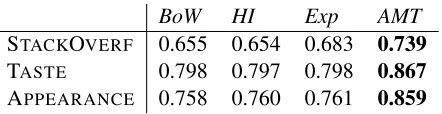
STACKOVERF 0.655 0.654 0.683 0.739
TASTE 0.798 0.797 0.798 0.867
[image:3.612.316.537.53.110.2]APPEARANCE 0.758 0.760 0.761 0.859
Table 2: Results using all features
was between 5.6 and 7, with more words ticked off in STACKOVERFLOW. The maximum number of words ticked off by an annotator was 41. We spent $292.5 on the annotations, including a trial round. This was supposed to match, roughly, the cost of the experts consulted forBoW+Exp.
The features generated from the annotations were constructed as follows: We use a sliding window of size 3 to extract trigrams over the possibly discon-tinuous words ticked off by the annotators. These trigrams were converted into regular expressions by placing Kleene stars between the words. This gives us a manually selected subset of skip trigrams. For each skip trigram, we add copies with one or more words replaced by one of their HI classes.
Feature combinations This subsection introduces some harder baselines for our experiments, consid-ered in Experiment #2. The simplest possible way of combining unigram features is by consideringn -gram models. Ann-gram extracts features from a sliding window (of sizen) over the text. We call this model BoW(N = n). Our BoW(N = 1) model takes word forms as features, and there are obvi-ously more advanced ways of automatically combin-ing such features.
Kernel representationsWe experimented with
ap-plying an approximate feature map for the addi-tive χ2-kernel. We used two sample steps, result-ing in4N + 1features. See Vedaldi and Zimmer-man (2011) for details.
Deep features We also ran denoising
autoen-coders (Pascal et al., 2008), previously applied to a wide range of NLP tasks (Ranganath et al., 2009; Socher et al., 2011; Chen et al., 2012), with
2N nodes in the middle layer to obtain a deep representation of our datasets from χ2-BoW input. The network was trained for 15 epochs. We set the drop-out rate to 0.0 and 0.3.
102 103 N 60 62 64 66 68 70 72 74 Ac cu ra cy StackOverflow
χ2−BoW χ2−BoW +HI
χ2−BoW +Exp χ2−BoW +AMT
102 103
N 70 75 80 85 90 Ac cu ra cy Taste
χ2−BoW χ2−BoW +HI
χ2−BoW +Exp χ2−BoW +AMT
102 103
N 70 75 80 85 90 Ac cu ra cy Appearance
χ2−BoW χ2−BoW +HI
[image:4.612.91.496.59.164.2]χ2−BoW +Exp χ2−BoW +AMT
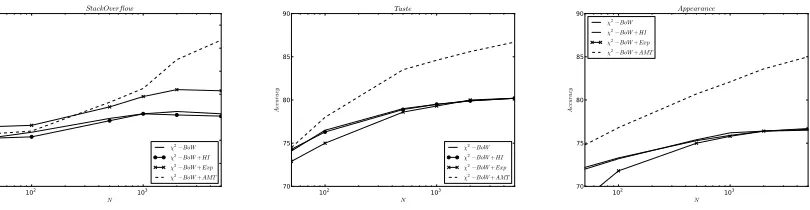
Figure 1: Results selectingN features usingχ2(left to right): STACKOVERFLOW, TASTE, and APPEARANCE. The
x-axis is logarithmic scale.
102 103
N 60 62 64 66 68 70 72 74 Ac cu ra cy
χ2−BoW(N =1) χ2−BoW(N =2) χ2−kernel χ2−dauto χ2−BoW +AMT
102 103
N 70 75 80 85 90 Ac cu ra cy
χ2−BoW(N =1) χ2−BoW(N =2) χ2−kernel χ2−dauto χ2−BoW +AMT
102 103
N 70 72 74 76 78 80 82 84 Ac cu ra cy
[image:4.612.96.496.218.320.2]χ2−BoW(N =1) χ2−BoW(N =2) χ2−kernel χ2−dauto χ2−BoW +AMT
Figure 2: Results using different feature combination techniques (left to right): STACKOVERFLOW, TASTE, and APPEARANCE. Thex-axis is logarithmic scale.
ExpandAMT– are very different. Their character-istics are presented in Table 1.P(1)is the class dis-tribution, e.g., the prior probability of positive class.
n is the number of data points, m the number of features. Finally, µx is the average density of data
points. One observation is of course that the expert feature setExpis much smaller thanBoWandAMT, but note also that the expert features fire about 150 times more often on average than the BoW features.
HIis only a small set of additional features.
3 Results
Experiment #1:BoWvs.ExpandAMTWe present results using all features, as well as results obtained after selectingkfeatures as ranked by a simple χ2
test. The results using all collected features are pre-sented in Table 2. The error reduction on STACK -OVERFLOW when adding crowdsourced features to our baseline model (BoW+AMT), is 24.3%. On TASTE, it is 34.2%. On APPEARANCE, it is 41.0%.
TheBoW+AMTfeature set is bigger than those of
the other models. We therefore report results using the top-k features as ranked by a simple χ2 test. The result curves are presented in the three plots in
Fig. 1. With +500 features,BoW+AMToutperforms the other models by a large margin.
Experiment #2: AMT vs. more baselines The
BoW baseline uses a standard representation that, while widely used, is usually thought of as a weak baseline.BoW+HITdid not provide a stronger base-line. We also show that bigram features, kernel-based decomposition and deep features do not pro-vide much stronger baselines either. The result curves are presented in the three plots in Fig. 2.
BoW+AMTis still significantly better than all other
models with +500 features. Since autoencoders are consistently worse than denoising autoencoders (drop-out 0.3), we only plot denoising autoencoders.
4 Conclusion
References
Jordan Boyd-Graber, Brianna Satinoff, He He, and Hal Daume. 2012. Besting the quiz master: Crowdsourc-ing incremental classification games. InNAACL. Jill Burstein, Karen Kukich, Susanne Wolff, Chi Lu,
Martin Chodorow, Lisa Braden-Harder, and Mary Dee Harris. 1998. Automated scoring using a hybrid fea-ture identification technique. InACL.
Minmin Chen, Zhixiang Xu, Kilian Weinberger, and Fei Sha. 2012. Marginalized denoising autoencoders for domain adaptation. InICML.
Daniel Dahlmeier, Hwee Tou Ng, and Siew Mei Wu. 2013. Building a large annotated corpus of learner English. InWorkshop on Innovative Use of NLP for Building Educational Applications, NAACL.
Pedro Domingos. 2012. A few useful things to know about machine learning. InCACM.
Tim Finin, Will Murnane, Anand Karandikar, Nicholas Keller, Justin Martineau, and Mark Dredze. 2010. Annotating named entities in Twitter data with crowd-sourcing. In NAACL Workshop on Creating Speech and Language Data with Amazon’s Mechanical Turk. Julian McAuley, Jure Leskovec, and Dan Jurafsky. 2012.
Learning attitudes and attributes from multi-aspect re-views. InICDM.
Claudiu-Christian Musat, Alireza Ghasemi, and Boi Falt-ings. 2012. Sentiment analysis using a novel human computation game. InWorkshop on the People’s Web Meets NLP, ACL.
Vincent Pascal, Hugo Larochelle, Yoshua Bengio, and Pierre-Antoine Manzagol. 2008. Extracting and com-posing robust features with denoising autoencoders. In ICML.
Rajesh Ranganath, Dan Jurafsky, and Dan McFarland. 2009. It’s not you, it’s me: detecting flirting and its misperception in speed-dates. InNAACL.
Richard Socher, Eric Huan, Jeffrey Pennington, Andrew Ng, and Christopher Manning. 2011. Dynamic pool-ing and unfoldpool-ing recursive autoencoders for para-phrase detection. InNIPS.
Omer Tamuz, Ce Liu, Serge Belongie, Ohad Shamir, and Adam Tauman Kalai. 2011. Adaptively learning the crowd kernel. InICML.
Andrea Vedaldi and Andrew Zisserman. 2011. Efficient additive kernels via explicit feature maps. InCVPR. Kiri Wagstaff. 2012. Machine learning that matters. In