Combining String and Context Similarity
for Bilingual Term Alignment from Comparable Corpora
Georgios Kontonatsios1,2 Ioannis Korkontzelos1,2 Jun’ichi Tsujii3 Sophia Ananiadou1,2 National Centre for Text Mining, University of Manchester, Manchester, UK1
School of Computer Science, University of Manchester, Manchester, UK2 Microsoft Research Asia, Beijing, China3
{gkontonatsios,ikorkontzelos,sananiadou}@cs.man.ac.uk
Abstract
Automatically compiling bilingual dictio-naries of technical terms from comparable corpora is a challenging problem, yet with many potential applications. In this paper, we exploit two independent observations about term translations: (a) terms are of-ten formed by corresponding sub-lexical units across languages and (b) a term and its translation tend to appear in similar lex-ical context. Based on the first observa-tion, we develop a new character n-gram compositional method, a logistic regres-sion classifier, for learning a string similar-ity measure of term translations. Accord-ing to the second observation, we use an existing context-based approach. For eval-uation, we investigate the performance of compositional and context-based methods on: (a) similar and unrelated languages, (b) corpora of different degree of compa-rability and (c) the translation of frequent and rare terms. Finally, we combine the two translation clues, namely string and contextual similarity, in a linear model and we show substantial improvements over the two translation signals.
1 Introduction
Bilingual dictionaries of technical terms are re-sources useful for various tasks, such as computer-aided human translation (Dagan and Church,
1994; Fung and McKeown, 1997),Statistical
Ma-chine Translation(Och and Ney, 2003) and Cross-Language Information Retrieval (Ballesteros and Croft, 1997). In the last two decades, researchers have focused on automatically compiling bilingual term dictionaries either from parallel(Smadja et al., 1996; Van der Eijk, 1993) orcomparable cor-pora (Rapp, 1999; Fung and Yee, 1998). While
parallel corpora contain the same sentences in two languages, comparable corpora consist of bilin-gual pieces of text that share some features, only, such as topic, domain, or time period. Comparable corpora can be constructed more easily than paral-lel corpora. Freely available, up-to-date, on-line resources (e.g., Wikipedia) can be employed.
In this paper, we exploit two different sources of information to extract bilingual terminology
from comparable corpora: thecompositionaland
the contextual clue. The compositional clue is the hypothesis that the representations of a term in any pair of languages tend to consist of cor-responding lexical or sub-lexical units, e.g., pre-fixes, suffices and morphemes. In order to cap-ture associations of textual units across languages, we investigate three different character n-gram ap-proaches, namely aRandom Forest(RF) classifier (Kontonatsios et al., 2014), Support Vector Ma-chineswith an RBF kernel (SVM-RBF) and a Lo-gistic Regression(LogReg) classifier. Whilst the previous approaches take as an input monolingual features and then try to find cross-lingual map-pings, our proposed method (LogReg classifier) considers multilingual features, i.e., tuples of co-occurring n-grams.
The contextual clue is the hypothesis that mu-tual translations of a term tend to occur in similar lexical context. Context-based approaches are un-supervised methods that compare the context dis-tributions of a source and a target term. A bilin-gual seed dictionary is used to map context vec-tor dimensions of two languages. Li and Gaussier (2010) suggested that the seed dictionary can be used to estimate the degree of comparability of a bilingual corpus. Given a seed dictionary, the cor-pus comparabilityis the expectation of finding for each word of the source corpus, its translation in the target part of the corpus. The performance of context-based methods has been shown to depend on the frequency of terms to be translated and the
corpus comparability. In this work, we use an ex-isting distributional semantics approach to locate term translations.
Furthermore, we hypothesise that the compo-sitional and contextual clue are orthogonal, since the former considers the internal structure of terms while the latter exploits the surrounding lexical context. Based on the above hypothesis, we com-bine the two translation clues in a linear model.
For experimentation, we construct compara-ble corpora for four language pairs (English-Spanish, English-French, English-Greek and English-Japanese) of the biomedical domain.
We choose this domain because a large propor-tion of the medical terms tends to composipropor-tion- composition-ally translate across languages (Lovis et al., 1997; Namer and Baud, 2007). Additionally, given the vast amount of newly introduced terms (neolo-gisms) in the medical domain (Pustejovsky et al., 2001), term alignment methods are needed in or-der to automatically update existing resources.
We investigate the following aspects of term alignment: (a) the performance of compositional methods on closely related and on distant lan-guages, (b) the performance of context vectors and compositional methods when translating frequent or rare terms, (c) the degree to which the corpus comparability affects the performance of context-based and compositional methods (d) the improve-ments that we can achieve when we combine the compositional and context clue.
Our experiments show that the performance of compositional methods largely depends on the dis-tance between the two languages. The perfor-mance of the context-based approach is greatly affected by corpus-specific parameters (the fre-quency of occurrence of the terms to be translated and the degree of corpora comparability). It is also shown that the combination of compositional and contextual methods performs better than each of the clues, separately. Combined systems can be deployed in application environments with differ-ent language pairs, comparable corpora and seeds dictionaries.
The LogReg, dictionary extraction method de-scribed in this paper is freely available1.
1http://personalpages.manchester. ac.uk/postgrad/georgios.kontonatsios/ Software/LogReg-TermAlign.tar.gz
2 Related Work
Context-based methods (Fung and Yee, 1998; Rapp, 1999) adapt the Distributional Hypothesis
(Harris, 1954), i.e., words that occur in similar lexical context tend to have the same meaning, in a multilingual environment. They represent the context of each term t as a context vector, usu-ally following thebag-of-words model. Each di-mension of the vector corresponds to a context word occurring within a predefined window, while the corresponding value is computed by a corre-lation metric, e.g., Log-Likelihood Ratio (Morin et al., 2007; Chiao and Zweigenbaum, 2002) or Point-wise Mutual Information (Andrade et al., 2010). A general bilingual dictionary is then used to translate/project the target context vectors into the source language. As a result, the source and target context vectors become directly compara-ble. In a final step, candidate translations are being ranked according to a distance metric, e.g., cosine similarity (Tamura et al., 2012) or Jaccard index (Zanzotto et al., 2010; Apidianaki et al., 2012).
Whilst context-based methods have become a common practise for bilingual dictionary extrac-tion from comparable corpora, nonetheless, their performance is subject to various factors, one of which is the quality of the comparable corpus. Li and Gaussier (2010) introduced the corpus com-parability metric and showed that it is related to the performance of context vectors. The higher the corpus comparability is, the higher the perfor-mance of context vectors is. Furthermore, context vector approaches are sensitive to the frequency of terms. For frequent terms, distributional seman-tics methods exhibit robust performance since the corresponding context is more informative. Chiao and Zweigenbaum (2002) reported an accuracy of 91% for the top 20 candidates when translating terms that occur 100 times or more. However, the performance of context vectors drastically de-creases for lower frequency terms (Kontonatsios et al., 2014; Morin and Daille, 2010).
Tanaka, 2002) and sub-lexical (Delpech et al., 2012) compositional algorithms are knowledge-rich approaches that proceed in two steps, namely generation and selection. In the generation step, an input source term is segmented into basic trans-lation units: words (lexical compositional meth-ods) or morphemes (sub-lexical methmeth-ods). Then a pre-compiled, seed dictionary of words or mor-phemes is used to translate the components of the source term. Finally, a permutation function gen-erates candidate translations using the list of the translated segments. In the selection step, candi-date translations are ranked according to their fre-quency (Morin and Daille, 2010; Robitaille et al., 2006) or their context similarity with the source term (Tanaka, 2002). The performance of the compositional translation algorithms is bound to the coverage of the seed dictionary (Daille, 2012). Delpech et al. (2012) noted that 30% of untrans-lated terms were due to the low coverage of the seed dictionary.
Kontonatsios et al. (2014) introduced a Random Forest (RF) classifier that learns correspondences of character n-grams between a source and target language. Unlike lexical and sub-lexical compo-sitional methods, a RF classifier does not require a bilingual dictionary of translation units. The model is able to automatically build correlation paths between source and target sub-lexical seg-ments that best discriminate translation from non-translation pairs. However, being a supervised method, it still requires a seed bilingual dictio-nary of technical terms for training. The RF classi-fier was previously applied on an English-Spanish comparable corpus and it was shown to signifi-cantly outperform context-based approaches.
3 Methods
In this section we describe the character n-gram models, the context vector method and the hybrid system. The lexicon induction task is formalised as a two-class classification problem. Given a pair of terms in a source and a target language, the out-put is a prediction of whether the terms are mutual translations are not. Furthermore, each term align-ment method implealign-ments a ranking function that calculates a similarity score between a source and a target term. The methods rank target terms ac-cording to the similarity score and select the topN
ranked terms as candidate translations. The rank-ing functions will be discussed in the followrank-ing
subsections.
3.1 Character n-gram models
Lets be a source term containing p character n-grams (s={s1, s2, ..., sp} si ∈ S, ∀i ∈ [1, p])
andta target term ofq n-grams (t={t1, t2, ..., tq}
ti ∈ T, ∀i ∈ [1, q]). We extract
charac-ter n-grams by considering any contiguous, non-linguistically motivated sequence of characters that occurs within a window size of[2−5]2) for
English, French and Greek. For Japanese,
uni-grams are included (window size of [1−5]
be-cause Japanese terms often contain Kanji (Chi-nese) characters.
Given the two lists of source and target n-grams, our objective is to find an underlying relationship
between S and T that best discriminates
trans-lation from non-transtrans-lation pairs. The RF clas-sifier was previously shown to exhibit such be-haviour (Kontonatsios et al., 2014). An RF clas-sifier (Breiman, 2001) is a collection of decision trees voting for the most popular class. For a pair of source and target terms hs, ti, the RF method creates feature vectors of a fixed size2r, i.e.,first order feature space. The first r features are ex-tracted from the source term, while the lastr fea-tures from the target term. Each feature has a boolean value (0 or 1) that designates the pres-ence/absence of the corresponding n-gram in the input instance.
The ability of the RF to detect latent associa-tions betweenSandTrelies on the decision trees. The internal nodes of a decision tree represent the n-gram features that are linked together in the tree-hierarchy. Each leaf node of the trees is labelled as
translationornon-translation indicating whether the parent path of n-gram features is positively or negatively associated. The classification margin that we use to rank the candidate translations is given by a margin function (Breiman, 2001):
mg(X, Y) =av(I(x) = 1)−av(I(x)) = 0) (1)
wherexis an instancehs, ti,y ∈ Y = {0,1}the class label,I(·) : (s, t)−→ {0,1}is the indicator function of a decision tree andav(I(·))the aver-age number of trees voting for the same class la-bel. In our experiments, we used the same settings as the ones reported in Kontonatsios et al. (2014).
2we have experiments with larger and narrower window
We used 140 decision trees andlog2|2q|+ 1 ran-dom features. For training an RF model, we used the WEKA platform (Hall et al., 2009).
The second class of machine learning algo-rithms that we investigate is Support Vector Ma-chines (SVMs). The simplest version of SVMs is a linear classifier (linear-SVM) that tries to place a hyperplane, a decision boundary, that sepa-rates translation from non-translation instances. A linear-SVM is a feature agnostic method since the model only exploits the position of the vectors in the hyperspace to achieve class separation (Hastie et al., 2009).
The first order feature representation used with the RF classifier does not model associations be-tween S and T. Hence, intuitively, a first or-der feature space is not linearly separable, i.e., there exists no decision boundary that divides the data points into translations and non-translations.
3. To solve non-linear classification problems,
SVMs employ non-linear kernels. A kernel func-tion projects input instances into a higher dimen-sional space to discover non-linear associations between the initial features. In this new, projected feature space, the SVM attempts to define a sep-arating plane. For training an non-linear SVM on the first order feature space, we used the LIBSVM package (Chang and Lin, 2011) with aradial ba-sis function(RBF) kernel. For ranking candidate translations, we used the decision value given by LIBSVM which represents the distance between an instance and the hyperplane. To translate a source term, the method ranks candidate transla-tions by decision value and suggests as best trans-lation the candidate with the maximum distance (maximum margin).
While the first order models try to find cross-lingual mappings between monocross-lingual features, our proposed method follows a different approach. It models cross-lingual links between the source and target character n-grams and uses them as
second order features to train a linear classifier. A second order feature is a tuple of n-grams in
S and T, respectively, that co-occur in a train-ing, translation instance. Second order feature 3We applied a linear-SVM with the first order feature
representation on the four comparable corpora for French, Spanish, Greek and English-Japanese. In all cases, the best accuracies achieved were close to zero. Additionally, the ranked list of candidate translations was the same for all source terms. Hence, we can empiri-cally suggest that the linear-SVM cannot exploit a first order feature space.
values are boolean. Given a translation instance hs, ti ofp source andq target n-grams, there are
p×qsecond order features. For dimensionality re-duction, we consider as second order features the most frequent out of all possible first order feature combinations, only. Experiments indicate that a large number of features needs to be considered to achieve robust performance. To cope with the high dimensional second order space, we use LI-BLINEAR (Fan et al., 2008), which is designed to solve large-scale, linear classifications prob-lems. LIBLINEAR implements two linear clas-sification algorithms: LogReg and linear-SVM. Both models solve the same optimisation problem, i.e., determine the optimal separating plane, but they adopt different loss functions. Since LIBLIN-EAR does not support decision value estimations for the linear-SVM, we only experimented with LogReg. Similarly to SVM-RBF, LogReg ranks candidate translations by classification margin.
3.2 Context vectors
We follow a standard approach to calculate context similarity of source and target terms (Rapp, 1999; Morin and Daille, 2010; Morin and Prochasson, 2011a; Delpech et al., 2012). Context vectors of candidate terms in the source and target lan-guage are populated after normalising each bilin-gual corpus, separately. Normalisation consists of stop-word filtering, tokenisation, lemmatisa-tion and Part-of-Speech (PoS) tagging. For En-glish, Spanish and French we used the TreeTagger (Schmid, 1994) while for Greek we used the ILSP toolkit (Papageorgiou et al., 2000). The Japanese corpus was segmented and PoS-tagged using Ju-man (Kurohashi and Kawahara, 2005).
Training corpus
Test corpus character n-gram
model context vectors
hybrid model Annotate Annotate
Train Project
seed term
[image:5.595.80.284.56.320.2]dictionary seed worddictionary
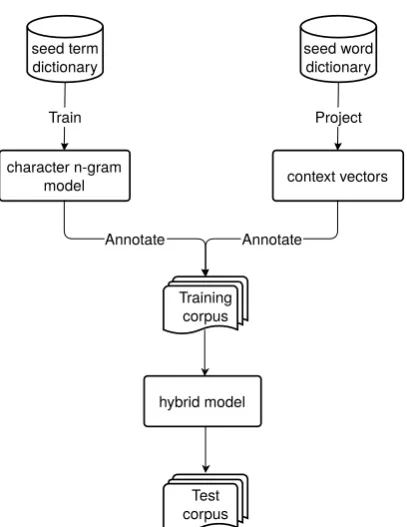
Figure 1: Architecture of the hybrid term align-ment system.
vector.
3.3 Hybrid term alignment system
Figure 1 illustrates a block diagram of our term alignment system. We use two bilingual seed dic-tionaries: (a) a dictionary of term translation pairs to train the n-gram models and (b) a dictionary of word-to-word correspondences to translate target context vectors. The n-gram and context vector methods are used separately to score term pairs. The n-gram model computes the value of the com-positional cluewhile the context vector estimates the score of thecontextual clue. The hybrid model combines both methods by using the correspond-ing scores as features to train a linear classifier. For this, we used a linear-SVM of the LIBSVM package with default values for all parameters.
4 Data
Following previous research (Prochasson and Fung, 2011; Irvine and Callison-Burch, 2013; Klementiev et al., 2012), we construct compara-ble biomedical corpora using Wikipedia as a freely available resource.
Starting with a list of 4K biomedical English terms (query-terms), we collected 4K English Wikipedia articles, by matching query-terms to the topic signatures of articles. Then, we followed
the Wikipedia interlingual links to retrieve the-matically related articles in each target language. Since not all English articles contain links for all four target languages (Spanish, French, Greek and Japanese), we used a different list of query-terms for each language pair. Corpora were randomly divided into training and testing parts. For train-ing we used 3K documents and for testtrain-ing the re-maining 1K. Table 1 shows the size of corpora in terms of numbers of source (SW) and target words (TW).
4.1 Seed dictionaries
As shown in Figure 1, the term alignment methods require two seed bilingual dictionaries: a term and a word dictionary. The character n-gram models rely on a bilingual term dictionary to learn asso-ciations of n-grams that appear often in technical terms. The dictionary may contain both single-word and multi-single-word terms. For English-Spanish and English-French we used UMLS (Bodenreider, 2004) while for English-Japanese we used an elec-tronic dictionary of medical terms (Denshika and Kenkyukai, 1991).
An English-Greek biomedical dictionary was not available at the time of conducting these ex-periments, thus we automatically compiled a dic-tionary from a parallel corpus. For this, we trained a standard Statistical Machine Translation system (Koehn et al., 2007) onEMEA(Tiedemann, 2009), a biomedical parallel corpus containing sentence-aligned documents from the European Medicines Agency. Then, we extracted all English-Greek pairs for which: (a) the English sequence was listed in UMLS and (b) the translation probability was equal or higher to0.7.
The sizes of the seed term dictionaries vary sig-nificantly, e.g., 500K entries for English-French but only 20K entries for English-Greek. How-ever, the character n-gram models require a rela-tively small portion of the corresponding dictio-nary to converge. In the reported experiments, we used 10K translation pairs as positive, train-ing instances. In addition, we generated an equal number ofpseudo-negativeinstances by randomly matching non-translation terms.
sep-Training corpus Test Corpus
# SW # TW # SW # TW
en-fr 4.8M 2.2M 1.9M 1.1M
en-es 4.9M 2.5M 1.8M 0.9M
en-el 10.2M 2.4M 3.3M 1.3M
en-jpn 5.3M 2.4M 2.3M 1.2M
Table 1: Statistics of the English-French fr), Engish-Spanish es), English-Greek (en-el) and English-Japanese (en-jpn) Wikipedia com-parable corpora. SW: source words, TW: target words
Corpus Seed words
Comparability in dictionary
en-fr 0.71 66K
en-es 0.75 40K
en-el 0.68 22K
[image:6.595.81.284.62.145.2]en-jpn 0.49 57K
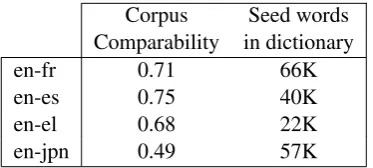
Table 2: Corpus comparability and number of fea-tures of the seed word dictionaries
arately. In a mixed dictionary, lexical units are either single-word technical terms, such as “dis-ease” and “patient”, or general language words, such as “occur” and “high”. Note that we have already compiled a seed term dictionary for each pair of languages. Following the suggestion of Morin and Prochasson (2011b), we attempt to en-rich the seed term dictionaries with general lan-guage entries. For this, we extracted bilingual word dictionaries for Spanish, English-French and English-Greek by applying GIZA++ (Och and Ney, 2003) on the EMEA corpus. We then concatenated the word with the term dictio-naries to obtain enhanced seeds for the three lan-guage pairs. For English-Japanese, we only used the term dictionary to translate the target context vectors.
Once the word dictionaries have been compiled, we compute thecorpus comparabilitymeasure. Li and Gaussier (2010) define corpus comparability as the percentage of words that can be translated bi-directionally, given a seed dictionary.
Table 2 shows corpus comparability scores of the four corpora accompanied with the number of English, single words in the seed dictionar-ies. It can be observed that seed dictionary sizes are not necessarily proportional to the correspond-ing corpus comparability scores. As expected, for
English-Japanese, corpus comparability is low be-cause the dictionary contains single-word terms, only. The English-Spanish dictionary is smaller than the English-French but achieved higher cor-pus comparability, i.e., a higher percentage of words can be bi-directionally translated using the corresponding seed dictionary. A possible ex-planation is that the comparable corpora were constructed using different lists of query-terms. Hence, the query-terms used for English-Spanish retrieved a more coherent corpus. The resulting values of corpus comparability indicate that the context vectors will perform the best for English-Spanish while for English-Japanese the perfor-mance is expected to be substantially lower.
4.2 Training and evaluation datasets
For evaluation, we construct a test dataset of single-word terms, in particular nouns or adjec-tives. The dataset contains 1K terms that occur
more frequently than 20 but not more than 200
times and are listed in the English part of the UMLS. In order to extract candidate translations, we considered all nouns or adjectives that occur at least 5 times in the target part of the corpus. Furthermore, we do not constraint the evaluation datasets only to those terms whose corresponding translation occurs in the corpus.
The hybrid model that combines the composi-tional and context clue, is based on a two-feature model. Therefore, the model converges using only a few hundred instances. For training a hybrid model, we used1K translation instances that oc-curred in the training comparable corpora. Sim-ilarly, to the character n-gram models, pseudo-negative instances were generated by randomly coupling non-translation terms. The ratio of posi-tive to negaposi-tive instances is1 : 1.
5 Experiments
In this section, we present three experiments
con-ducted to evaluate the character n-gram,
[image:6.595.89.276.238.322.2]we compare the character n-gram methods against context vectors when translating frequent or rare terms and on comparable corpora of similar lan-guage pairs (English-French, English-Spanish) but of different corpus comparability scores. Thirdly, we evaluate the hybrid method on all four com-parable corpora and investigate the improvement margin of combining thecontextualwith the com-positionalclue.
As evaluation metrics, we adopt the top-N
translation accuracy, following most previous ap-proaches (Rapp, 1999; Chiao and Zweigenbaum, 2002; Morin et al., 2007; Tamura et al., 2012). The top-N translation accuracy is defined as the per-centage of source terms for which a given method has output the correct translation among the top N candidate translations.
5.1 Character n-gram models
In the first experiment, we investigate the perfor-mance of the character n-gram models consider-ing an increasconsider-ing number of features. The features were sorted in order of decreasing frequency of oc-currence. Starting from the top of the list, more features were incrementally added and translation accuracy was recorded.
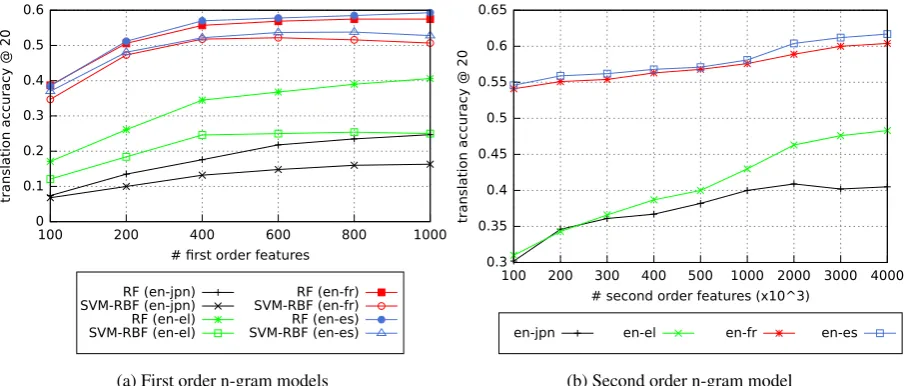
Figure 2 shows the top-20 translation accu-racy of single-word terms on an increasing num-ber of first and second order features. With re-gards to the first order models (Subfigure 2a), the Random Forest (RF) classifier outperforms our baseline method (SVM-RBF) for all four lan-guage pairs. The largest margin between RF and SVM-RBF can be observed for the English-Greek dataset while for closely related language pairs, i.e., English-French and English-Spanish, the mar-gin is smaller. Furthermore, it can be noted that using only a small number of first order features,
1K features (500 for the source and 500for the target language, both n-gram models reach a sta-ble performance.
In contrast to the first order models, the Lo-gReg classifier requires a large number of sec-ond order features to achieve a robust performance (Subfigure 2b). Starting from100K features, the translation accuracy continuously increases. The best performance is observed for a total number
of 4M second order features when considering
the French, Spanish and English-Greek datasets. For English-Japanese, the best performance is achieved for2M features. Beyond
this point, translation accuracy decreases slightly. After feature selection is performed, we directly compare all the character n-gram models. Table 3 summarises performance achieved by the LogReg, RF and SVM-RBF models. It can be noted that LogReg and RF performed similarly for closely related languages (no statistically significant dif-ferences were observed) while both methods out-performed the SVM-RBF. However, for English-Greek and English-Japanese, LogReg achieved a statistically significant improvement over the translation accuracy of RF and SVM-RBF.
Lo-gReg outperformed RF by7%for English-Greek,
while for English-Japanese the improvement was
10%and17%percent for top-1 and top-20
accu-racy, respectively. Finally, it can be observed that the more distant the language pair is, the lower the performance.
5.2 N-gram methods and context vectors
In this experiment, we compare the n-gram meth-ods against context vectors with regards to two pa-rameters: (a) the frequency of source terms to be translated and (b) corpus comparability. English-French and English-Spanish are similar language pairs but the corresponding corpora are of dif-ferent corpus comparability scores. To investi-gate how performance is affected by term occur-rence frequency, we compiled an additional test dataset of1K rare English terms in the frequency range [10,20]. Our intuition is, that character n-gram methods will perform similarly for all set-tings since character n-grams are corpus indepen-dent features.
We compare (a) the character n-gram models (LogReg, RF and SVM-RBF) with (b) the con-text vector method (concon-text) and (c) an upper bound. The latter represents the percentage of source terms for which a reference translation ac-tually occurs in the target corpus. Hence, the up-per bound is the maximum up-performance achiev-able according to the reference evaluation.
Figure 3a shows the top-20 translation accu-racy for high and medium frequency terms, within the frequency range [20,200]. Context vectors
achieved a robust performance of 52% and45%
English-0 0.1 0.2 0.3 0.4 0.5 0.6
100 200 400 600 800 1000
tran
slation ac
cur
acy @ 2
0
# first order features
RF (en-jpn) SVM-RBF (en-jpn) RF (en-el) SVM-RBF (en-el)
RF (en-fr) SVM-RBF (en-fr) RF (en-es) SVM-RBF (en-es)
(a) First order n-gram models
0.3 0.35 0.4 0.45 0.5 0.55 0.6 0.65
100 200 300 400 500 1000 2000 3000 4000
tran
slation ac
cur
acy @ 2
0
# second order features (x10^3)
en-jpn en-el en-fr en-es
[image:8.595.74.527.64.257.2](b) Second order n-gram model
Figure 2: Top-20 translation accuracy of models trained on (a) first and (b) second order features
English-French English-Spanish English-Greek English-Japanese
acc@1 acc@20 acc@1 acc@20 acc@1 acc@20 acc@1 acc@20
LogReg 0.45 0.61 0.42 0.62 0.3 0.48 0.25 0.41
RF 0.47 0.58 0.43 0.59 0.23 0.41 0.15 0.24
[image:8.595.78.520.405.551.2]SVM-RBF 0.38 0.51 0.33 0.53 0.1 0.25 0.06 0.16
Table 3: Top-1 (acc@1) and top-20 (acc@20) translation accuracy of LogReg, RF and SVM-RBF
0.1 0.2 0.3 0.4 0.5 0.6 0.7 0.8 0.9
en-fr en-es
% top-20
translation
accuracy
LogReg RF SVM-RBF
Context upper bound
(a) Test terms with frequency[20,200]
0.1 0.2 0.3 0.4 0.5 0.6 0.7 0.8 0.9
en-fr en-es
% top-20
translation
accuracy
LogReg RF SVM-RBF
Context upper bound
(b) Test terms with frequency[10,20]
Figure 3: Top-20 translation accuracy of terms in the frequency range of[10,200]and[10,20]
French are0.75and0.71, respectively. In contrast to context vectors, the character n-gram methods performed comparably.
A second factor that affects the performance of context vectors, is the frequency of the terms to be translated. The translation of rare terms has been shown to be a challenging case for context vectors. For example, Morin and Daille (2010) reported low accuracy (21% for the top-20 can-didates) of context vectors for terms occurring20
times or less. In our experiments, Figure 3b illus-trates accuracies achieved for less frequent terms
([10,20]). The performance of context vectors is significantly lower, 26%for English-Spanish and
21%for English-French. Furthermore, the trans-lation accuracy of the n-gram methods decreases
slightly (∼ 5% to 8%). This can be explained
by the decrease of the upper bound for lower fre-quency terms (∼3%to6%).
5.3 Combining internal and contextual similarity
We have hypothesised that thecompositionaland
0.1 0.2 0.3 0.4 0.5 0.6 0.7 0.8 0.9
en-fr en-es en-el en-jpn
% top-1 tr
anslation ac
curacy
LogReg LogReg+Context RF RF+Context
SVM-RBF SVM-RBF+Context Context upper bound
(a) Top-20 accuracy (acc@20)
0.1 0.2 0.3 0.4 0.5 0.6 0.7 0.8 0.9
en-fr en-es en-el en-jpn
% top-1 tr
anslation ac
curacy
LogReg LogReg+Context RF RF+Context
SVM-RBF SVM-RBF+Context Context upper bound
[image:9.595.77.520.65.206.2](b) Top-1 accuracy (acc@1)
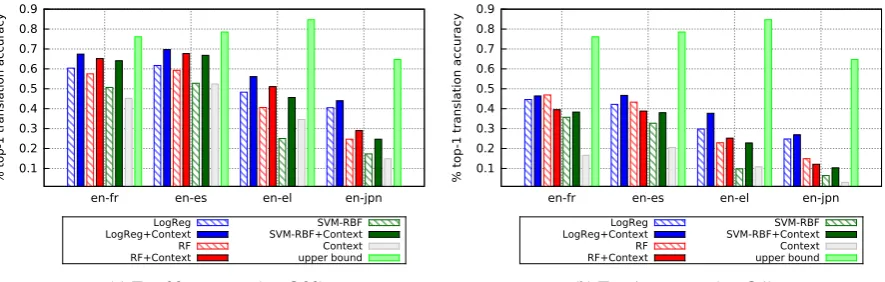
Figure 4: Overall performance. Top-20 and top-1 translation accuracy
different and possibly complimentary information. To investigate this intuition, we evaluate the hybrid model on all four comparable corpora, for term oc-currence frequencies in[20,200].
Figure 4a illustrates top-20 translation accu-racy scores for (a) the character n-gram models, (b) the context vector method and (c) the hy-brid models, i.e., LogReg+Context, RF+Context, SVM-RBF+Context. We observe that the com-bination of thecompositionalandcontextualclue improved the performance of all methods. The hy-brid model largely improved the performance of
the SVM-RBF (∼ 14% to 20%). With regards
to the combined signals the translation accuracy
of LogReg and RF increased by ∼ 4% for the
English-Japanese corpus and∼ 8% for all other
corpora.
For the top 1 candidate translation, we observe in Figure 4 smaller improvements achieved by the hybrid model in comparison to the top-20 accu-racy. Interestingly, the RF classifier performed slightly better on its own for English-French, English-Spanish and English-Japanese. This in-dicates that the hybrid method ranks more correct translations in the top 20 candidates but it does not always assign the best score to the correct answer.
6 Discusion and Future work
In this paper, we investigated a compositional and a context-based approach useful for compil-ing bilcompil-ingual dictionaries of terms automatically from comparable corpora. Compositional transla-tion methods exploit the internal structure of terms across languages while context-based approaches investigate the surrounding lexical context.
We proposed a character n-gram composi-tional method, i.e., a Logistic Regression
clas-sifier, which uses a multilingual representation, i.e., source and target terms. Experimental evi-dence showed that the LogReg classifier signifi-cantly outperformed the baseline methods on dis-tant languages. For closely related languages, Lo-gReg performed comparably to an existing n-gram method based on aRandom Forestclassifier.
Furthermore, we compared the n-gram models against a context-based approach under different corpus-specific parameters: (a) corpus compara-bility, which is relevant to the seed dictionary, and (b) the occurrence frequency of the terms to be translated. It was shown that the performance of n-gram methods was not affected by different pa-rameter settings. Only small fluctuations were ob-served, since the n-gram methods are based on corpus-independent features, only. In contrast, the context-based method was affected by corpus comparability scores. The corresponding transla-tion accuracy declined significantly for rare terms. Finally, we hypothesised that the n-gram and context-based methods provide complimentary in-formation. To test this hypothesis, we developed a hybrid method that combines compositional and contextual similarity scores as features in a lin-ear classifier. The hybrid model achieved signif-icantly better top-20 translation accuracy than the two methods separately but minor improvements were observed in terms of top-1 accuracy.
As future work, we plan to improve the qual-ity of the extracted dictionary further by exploiting additional translation signals. For example, previ-ous works (Schafer and Yarowsky, 2002; Klemen-tiev et al., 2012) have reported that thetemporal
experimental parameters, e.g., domain, distance of languages, types of comparable corpora.
Acknowledgements
The authors would like to thank Dr. Danushka Bollegala for providing feedback on this paper and the three anonymous reviewers for their useful comments and suggestions. This work was funded by the European Community’s Seventh Frame-work Program (FP7/2007-2013) [grant number 318736 (OSSMETER)].
References
Daniel Andrade, Tetsuya Nasukawa, and Jun’ichi Tsu-jii. 2010. Robust measurement and comparison of context similarity for finding translation pairs. In
Proceedings of the 23rd International Conference on Computational Linguistics, pages 19–27. Asso-ciation for Computational Linguistics.
Marianna Apidianaki, Nikola Ljubeˇsic, and Darja Fiˇser. 2012. Disambiguating vectors for bilin-gual lexicon extraction from comparable corpora. InEighth Language Technologies Conference, pages 10–15.
Lisa Ballesteros and W.Bruce Croft. 1997. Phrasal translation and query expansion techniques for cross-language information retrieval. InACM SIGIR Forum, volume 31, pages 84–91. ACM.
Olivier Bodenreider. 2004. The unified medical lan-guage system (umls): integrating biomedical termi-nology. Nucleic acids research, 32(suppl 1):D267– D270.
Leo Breiman. 2001. Random Forests. Machine Learn-ing, 45:5–32.
Chih-Chung Chang and Chih-Jen Lin. 2011. Lib-svm: a library for support vector machines. ACM Transactions on Intelligent Systems and Technology (TIST), 2(3):27.
Yun-Chuang Chiao and Pierre Zweigenbaum. 2002. Looking for Candidate Translational Equivalents in Specialized, Comparable Corpora. InInternational Conference on Computational Linguistics.
Ido Dagan and Ken Church. 1994. Termight: Identi-fying and translating technical terminology. In Pro-ceedings of the fourth conference on Applied natural language processing, pages 34–40. Association for Computational Linguistics.
Emmanuel Morin B¯ıeatrice Daille. 2012. Revising the compositional method for terminology acquisition from comparable corpora.COLING 2012, 1810.
Estelle Delpech, B´eatrice Daille, Emmanuel Morin, and Claire Lemaire. 2012. Extraction of domain-specific bilingual lexicon from comparable corpora: Compositional translation and ranking. InCOLING, pages 745–762.
Igakuyo Denshika and Jisho Kenkyukai. 1991. 250,000 medical term dictionary (in japanese). Nichigai Associates, Inc.
Ted Dunning. 1993. Accurate methods for the statis-tics of surprise and coincidence.Computational lin-guistics, 19(1):61–74.
Rong-En Fan, Kai-Wei Chang, Cho-Jui Hsieh, Xiang-Rui Wang, and Chih-Jen Lin. 2008. Liblinear: A library for large linear classification. The Journal of Machine Learning Research, 9:1871–1874.
Pascale Fung and Kathleen McKeown. 1997. A technical word-and term-translation aid using noisy parallel corpora across language groups. Machine Translation, 12(1-2):53–87.
Pascale Fung and Lo Yuen Yee. 1998. An ir approach for translating new words from nonparallel, compa-rable texts. InProceedings of the 17th international conference on Computational linguistics-Volume 1, pages 414–420. Association for Computational Lin-guistics.
M. Hall, E. Frank, G. Holmes, B. Pfahringer, P. Reute-mann, and I.H. Witten. 2009. The weka data mining software: an update. ACM SIGKDD Explorations Newsletter, 11(1):10–18.
Z.S. Harris. 1954. Distributional structure.Word. Trevor Hastie, Robert Tibshirani, Jerome Friedman,
T Hastie, J Friedman, and R Tibshirani. 2009. The elements of statistical learning, volume 2. Springer. Ann Irvine and Chris Callison-Burch. 2013. Su-pervised bilingual lexicon induction with multiple monolingual signals. In Proceedings of NAACL-HLT, pages 518–523.
Edward L Keenan and Leonard M Faltz. 1985.
Boolean semantics for natural language, volume 23. Springer.
Alexandre Klementiev, Ann Irvine, Chris Callison-Burch, and David Yarowsky. 2012. Toward statisti-cal machine translation without parallel corpora. In
Proceedings of the 13th Conference of the European Chapter of the Association for Computational Lin-guistics, pages 130–140. Association for Computa-tional Linguistics.
pages 177–180. Association for Computational Lin-guistics.
G. Kontonatsios, I. Korkontzelos, J. Tsujii, and S. Ana-niadou. 2014. Using a random forest classifier to compile bilingual dictionaries of technical terms from comparable corpora. In Proceedings of the 14th Conference of the European Chapter of the As-sociation for Computational Linguistics, volume 2: Short Papers, pages 111–116. Association for Com-putational Linguistics.
Sadao Kurohashi and Daisuke Kawahara. 2005. Japanese morphological analysis system juman ver-sion 5.1 manual.
Bo Li and Eric Gaussier. 2010. Improving corpus comparability for bilingual lexicon extraction from comparable corpora. InProceedings of the 23rd In-ternational Conference on Computational Linguis-tics, pages 644–652. Association for Computational Linguistics.
Christian Lovis, R Baud, PA Michel, JR Scherrer, and AM Rassinoux. 1997. Building medical dictionar-ies for patient encoding systems: A methodology. In
Artificial Intelligence in Medicine, pages 373–380. Springer.
Emmanuel Morin and B´eatrice Daille. 2010. Com-positionality and lexical alignment of multi-word terms. Language Resources and Evaluation, 44(1-2):79–95.
Emmanuel Morin and Emmanuel Prochasson. 2011a. Bilingual lexicon extraction from comparable cor-pora enhanced with parallel corcor-pora. InProceedings of the 4th Workshop on Building and Using Compa-rable Corpora: CompaCompa-rable Corpora and the Web, pages 27–34. Association for Computational Lin-guistics.
Emmanuel Morin and Emmanuel Prochasson. 2011b. Bilingual lexicon extraction from comparable cor-pora enhanced with parallel corcor-pora. InProceedings of the 4th Workshop on Building and Using Compa-rable Corpora: CompaCompa-rable Corpora and the Web, pages 27–34, Portland, Oregon, June. Association for Computational Linguistics.
Emmanuel Morin, B´eatrice Daille, Koichi Takeuchi, and Kyo Kageura. 2007. Bilingual terminology mining - using brain, not brawn comparable corpora. InProceedings of the 45th Annual Meeting of the As-sociation of Computational Linguistics, pages 664– 671, Prague, Czech Republic, June. Association for Computational Linguistics.
Fiammetta Namer and Robert Baud. 2007. Defin-ing and relatDefin-ing biomedical terms: towards a cross-language morphosemantics-based system. Interna-tional Journal of Medical Informatics, 76(2):226– 233.
Franz Josef Och and Hermann Ney. 2003. A sys-tematic comparison of various statistical alignment models. Computational linguistics, 29(1):19–51.
Harris Papageorgiou, Prokopis Prokopidis, Voula Giouli, and Stelios Piperidis. 2000. A unified pos tagging architecture and its application to greek. In
Proceedings of the 2nd Language Resources and Evaluation Conference, pages 1455–1462, Athens, June. European Language Resources Association. Emmanuel Prochasson and Pascale Fung. 2011. Rare
word translation extraction from aligned compara-ble documents. In Proceedings of the 49th An-nual Meeting of the Association for Computational Linguistics: Human Language Technologies-Volume 1, pages 1327–1335. Association for Computational Linguistics.
James Pustejovsky, Jose Castano, Brent Cochran, Ma-ciej Kotecki, and Michael Morrell. 2001. Au-tomatic extraction of acronym-meaning pairs from medline databases. Studies in health technology and informatics, (1):371–375.
Reinhard Rapp. 1999. Automatic identification of word translations from unrelated english and german corpora. InProceedings of the 37th annual meeting of the Association for Computational Linguistics on Computational Linguistics, pages 519–526. Associ-ation for ComputAssoci-ational Linguistics.
Xavier Robitaille, Yasuhiro Sasaki, Masatsugu Tonoike, Satoshi Sato, and Takehito Utsuro. 2006. Compiling french-japanese terminologies from the web. InEACL.
Charles Schafer and David Yarowsky. 2002. Inducing translation lexicons via diverse similarity measures and bridge languages. Inproceedings of the 6th con-ference on Natural language learning-Volume 20, pages 1–7. Association for Computational Linguis-tics.
Helmut Schmid. 1994. Probabilistic part-of-speech tagging using decision trees. InProceedings of the International Conference on New Methods in Lan-guage Processing, volume 12, pages 44–49. Manch-ester, UK.
Frank Smadja, Kathleen R McKeown, and Vasileios Hatzivassiloglou. 1996. Translating collocations for bilingual lexicons: A statistical approach. Compu-tational linguistics, 22(1):1–38.
Akihiro Tamura, Taro Watanabe, and Eiichiro Sumita. 2012. Bilingual lexicon extraction from compara-ble corpora using label propagation. InProceedings of the 2012 Joint Conference on Empirical Methods in Natural Language Processing and Computational Natural Language Learning, pages 24–36. Associa-tion for ComputaAssocia-tional Linguistics.
J¨org Tiedemann. 2009. News from opus-a collection of multilingual parallel corpora with tools and in-terfaces. In Recent Advances in Natural Language Processing, volume 5, pages 237–248.
Pim Van der Eijk. 1993. Automating the acquisition of bilingual terminology. In Proceedings of the sixth conference on European chapter of the Association for Computational Linguistics, pages 113–119. As-sociation for Computational Linguistics.