Modeling Localness for Self-Attention Networks
Baosong Yang University of Macau
Zhaopeng Tu∗ Tencent AI Lab [email protected]
Derek F. Wong∗ University of Macau [email protected]
Fandong Meng Tencent AI Lab
Lidia S. Chao University of Macau [email protected]
Tong Zhang Tencent AI Lab
Abstract
Self-attention networks have proven to be of profound value for its strength of capturing global dependencies. In this work, we propose to model localness for self-attention networks, which enhances the ability of capturing use-ful local context. We cast localness modeling as a learnable Gaussian bias, which indicates the central and scope of the local region to be paid more attention. The bias is then incorpo-rated into the original attention distribution to form a revised distribution. To maintain the strength of capturing long distance dependen-cies and enhance the ability of capturing short-range dependencies, we only apply localness modeling to lower layers of self-attention net-works. Quantitative and qualitative analyses on Chinese⇒English and English⇒German translation tasks demonstrate the effectiveness and universality of the proposed approach.
1 Introduction
Recently, a new simple architecture, the TRANS
-FORMER(Vaswani et al.,2017), that based solely on attention mechanisms has attracted increas-ing attention in machine translation community. Instead of using complex recurrent or convolu-tional neural networks, TRANSFORMER
imple-ments encoder and decoder as self-attention net-works to draw global dependencies between input and output. By further parallel performing (multi-head) and stacking (multi-layer) attentive func-tions, TRANSFORMER has achieved state-of-the-art performance on various translation tasks (Shaw et al.,2018;Hassan et al.,2018).
One strong point of self-attention networks is the strength of capturing long-range dependencies by explicitly attending to all the signals. In this
∗
Zhaopeng Tu and Derek F. Wong are the co-corresponding authors of the paper. This work was conducted when Baosong Yang was interning at Tencent AI Lab.
way, a representation is allowed to build a direct relation with another long-distance representation. Accordingly, it can serve as the role of RNN and CNN to capture both the short- and long-range re-lations among the representations.
Self-attention networks fully take into account all the signals with a weighted averaging opera-tion. We argue that such operation disperses the distribution of attention, which results in over-looking the relation of neighboring signals. Re-cent works have shown that self-attention net-works benefit from locality modeling. For ex-ample, Shaw et al. (2018) introduced relative position encoding to consider the relative dis-tances between sequence elements, which pro-duces substantial improvements on the translation task. Sperber et al.(2018) modeled the local in-formation by restricting self-attention model to neighboring representations, which boosts perfor-mance on long-sequence acoustic modeling. Al-though not for self-attention,Luong et al. (2015) proposed a local attention model for translation task, which looks at only a subset of source words at a time. Inspired by these studies, we propose more flexible strategies for modeling localness for self-attention networks in this work.
Specifically, we cast the localness modeling as a learnable Gaussian bias, in which a central po-sition (i.e. mean of the popo-sition) and a dynamic window (i.e. deviation of the distribution) are pre-dicted with the intermediate representations in the self-attention network. Intuitively, the central po-sition and the window respectively denote the cen-ter and the scope of the locality to be paid more attention. The learned Gaussian bias is then in-corporated into the original attention distribution to form a revised distribution, which considers the expected local context.
leanings toward local context, which weakens its strength of capturing long-range dependencies. Our extensive analyses can dispel such doubt by showing that the potential problem is compen-sated by multi-layer multi-head self-attention net-works. First, multi-head attention attends to lo-cal regions centered at different positions, which can constitute the complete information of an in-put sequence. Second, we found that self-attention models tend to capture short-range dependencies among neighboring words in lower layers, while capture long-range dependencies beyond phrase boundaries in higher layers. Accordingly, we only apply localness modeling to lower layers.
We conducted experiments on two widely-used WMT14 English⇒German and WMT17 Chinese⇒English translation tasks. The proposed approach consistently improves translation perfor-mance over the strong TRANSFORMER baseline, demonstrating its effectiveness and universality. In addition, our approach is complementary to the relative position encoding (Shaw et al.,2018), and combining them can further improve translation performance.
2 Background
Attention model has recently been a basic module of most deep learning models. The mechanism al-lows to dynamically select related representations as needed. In particular, it is very useful for gen-eration models such as machine translation ( Bah-danau et al.,2015;Luong et al.,2015;Yang et al.,
2017) and image captioning (Xu et al.,2015).
2.1 Self-Attention Model
Recently, self-attention networks (Vaswani et al.,
2017;Shaw et al.,2018;Shen et al.,2018a) have attracted increasing attention due to their flexibil-ity in parallel computation and dependency mod-eling. Self-attention networks calculate attention weights between each pair of tokens in a single sequence, thus can capture long-range dependency more directly than their RNN counterpart.
Formally, given an input sequence x = {x1, . . . , xI}, each hidden state in the l-th layer
is constructed by attending to the states in the
(l−1)-th layer.1 Specifically, the(l−1)-th layer
Hl−1 ∈RI×dis first transformed into the queries Q ∈ RI×d, the keys K ∈
RI×d, and the values V ∈ RI×d with three separate weight matrices.
1The first layer is the word embedding layer.
Thel-th layer is calculated as:
Hl = ATT(Q, K)V , (1)
where ATT(·)is a dot-product attention model, de-fined as:
ATT(Q, K) = sof tmax(energy) (2)
energy = QK
T √
d , (3)
where √dis the scaling factor with d being the dimensionality of layer states.
2.2 Motivation
The self-attention network models the global de-pendencies without regard to their distances, by directly attending to all the positions in an input sequence (i.e. Equation 3). We argue that self-attention can be further improved by taking into account the local context. However, since the con-ventional self-attention models consider all of the words in a sequence, the weighted averaging in-hibits the relation among the neighboring words.
From a linguistic intuition, when a word xi is
aligned to another wordxj, we also expectxi to
align mainly to the neighboring words of xj, so
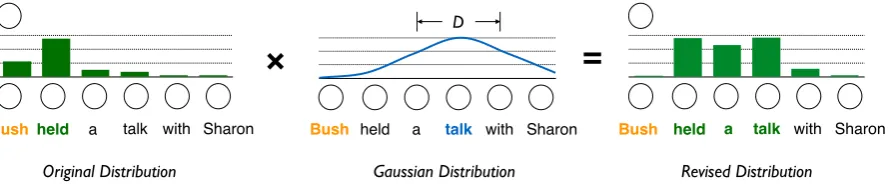
as to capture the phrasal patterns that contain use-ful local context information. Take Figure1as an example, if “Bush” is aligned to “held” with high probability, we expect the self-attention model to pay more attention to the neighboring words “a talk”. Consequently, the model is guided to cap-ture the phrase “held a talk”.
3 Localness Modeling
Figure1shows an example. We first learn a Gaus-sian bias, which is centered around the word “talk” (it is not necessary to be consistent with the orig-inal attention distribution), with a window size being 2 (in practice, it is a float number in our model). The distribution of attention is then regu-larized with the learned Gaussian bias to produce the final distribution, which pays more attention to the local context around the word “talk”.
3.1 Localness Modeling as a Gaussian Bias
Specifically, a Gaussian biasGis placed to mask the logit similarityenergyin Equation2, namely:
ATT(Q, K) = sof tmax(energy+G).(4)
Bush held a talk with Sharon
Bush held a talk with Sharon
Bush held a talk with Sharon
×
=
Bush held a talk with Sharon
Original Distribution Gaussian Distribution Revised Distribution
[image:3.595.80.525.65.157.2]D
Figure 1: Illustration of the proposed approach. In this example, window size of 2 is used (D= 2).
position matrix (I denotes the sequence length). The elementGi,j ∈ [0,−∞) measures the
tight-ness between the wordxjand the predicted central
positionPi:
Gi,j=−
(j−Pi)2 2σi2
, (5)
whereσi denotes the standard deviation which is
empirically set as σi = D2i, andDi is a window
size. Note that, due to the exponential operation in sof tmaxfunction, adding the logit similarity
energy with a bias ∈ [0,−∞) approximates to multiplying the attention distribution by a weight
∈ [1,0). The position and window size can be calculated as:
Pi Di
=I·sigmoid(
pi zi
). (6)
The scalar factor I is used to regulate Pi andDi
to real value numbers between0and the length of input sequence. The predictions are conditioned on two scalarpi andzirespectively.
3.2 Central Position Prediction
Since the prediction of each central position de-pends on its corresponding query vector,2we sim-ply apsim-ply a feed-forward network to transform
Qi into a positional hidden state, which is then
mapped into the scalar pi by a linear projection Up ∈Rd, namely:
pi=UpTtanh(WpQi), (7)
whereWp∈Rd×dis the model parameter.
3.3 Window Size Prediction
Several alternative strategies are proposed to se-lect the window size. Except a non-parametric ap-proach, the other two define parametric windows.
2For the input of feed-forward network, we also tried an
additive term to consider the weighted context Oi
(Equa-tion1), namely: tanh(WpQi+WoOi). Our experimental
results showed that there is no progressive improvement.
Among the parametric methods, the first strategy assigns a unified window size to all the hidden states in a layer, so as to consider the context of the sequence, while the second one calculates a distinct window size for each hidden state.
Fixed-Window A simple choice is to use a pre-defined window sizeD, which is a constant num-ber throughout the whole training and testing pro-cess. In this study, following the common practice (Luong et al.,2015),Dis set to 10.
Layer-Specific Window Furthermore, an inter-pretable way to select the window size is to ac-count for the context of the sequence by summa-rizing the information from all the representations in a layer. In this study, we assign the mean of keysKto represent the semantic context. Thus, the unified scalarzof a layer is defined as:
z=UdT tanh(WdK), (8)
where Wd ∈ Rd×d and Ud ∈ Rd are learnable
parameters.
Query-Specific Window The last strategy pro-vides a more flexible manner to differentiate the scope by conditioning on each query. Similar to the prediction of the central position (Equation7), the query-specific window can be formally ex-pressed as:
zi =UdT tanh(WpQi). (9)
Here, Ud ∈ Rd is a trainable linear projection.
Note that, Equations 7 and9 share same param-eter Wp but use different Up and Ud. The
intu-ition behind this design is that the central posintu-ition and window size interdependently locate the local scope, hence condition on the same hidden state. The distinct linear projectionsUpandUdare
3.4 Incorporating into TRANSFORMER
We evaluate our model on the advanced TRANS
-FORMER model (Vaswani et al., 2017), which builds an encoder-decoder framework merely us-ing attention networks. Both the encoder and de-coder are composed of a stack of L = 6layers, each of which has two sub-layers. The first is a multi-head self-attention layer, and the second is a position-wise fully connected feed-forward layer. In this section, we describe how to apply our ap-proach to TRANSFORMER by adapting to multi-headandmulti-layerself-attention networks.
Adapting to Multi-Head Self-Attention In-stead of performing a single attention function, the multi-head mechanism employsMseparate atten-tion models with distinct parameters to jointly at-tend to the information from different representa-tion subspaces at different posirepresenta-tions. Accordingly, we assign a distinct Gaussian bias to each attention head, and rewrite Equation6as:
Pim Dim
=I·sigmoid(
pmi zim
), (10)
wherepmi andzmi are trained with distinct parame-ters to predict the central position and window size for them-th attention head.
We argue that multi-head self-attention may benefit more from localness modeling. Multi-head attention captures different features by attending to different positions, which complements the lo-calness modeling that may potentially ignore the global information. Experimental results in Ta-ble5 confirm our hypothesis by showing that lo-calness modeling achieves more significant im-provement when working with multi-head atten-tion than its single-head counterpart.
Adapting to Multi-Layer Self-Attention Re-cent work shows that different layers capture dif-ferent types of features. Anastasopoulos and Chiang (2018) indicated that higher-level layers are more representative than lower-level layers, whilePeters et al.(2018) showed that higher-level layers capture context-dependent aspects of word meaning while lower-level layers model aspects of syntax. One question naturally arises: is it neces-sary to model localness for all layers?
In this work, we investigate which levels of lay-ers benefit most from the localness modeling. In addition, we visualize the Gaussian biases across layers, to better understand the behaviors of differ-ent attdiffer-entive layers.
4 Experiments
4.1 Setup
To compare with the results reported by previ-ous work (Gehring et al., 2017; Vaswani et al.,
2017;Hassan et al., 2018), we conducted exper-iments on both Chinese⇒English (Zh⇒En) and English⇒German (En⇒De) translation tasks. For the Zh⇒En task, the models were trained using all of the available parallel corpus from WMT17 dataset with maximum length limited to 50, con-sisting of about20.62million sentence pairs. We used newsdev2017 as the development set and newstest2017 as the test set. For the En⇒De task, we trained on the widely-used WMT14 dataset consisting of about 4.56 million sentence pairs. The models were validated on newstest2013 and examined on newstest2014. The Chinese sen-tences were segmented by the word segmentation toolkitJieba,3 and the English and German sen-tences were tokenized using the scripts provided in Moses. Then, all tokenized sentences were pro-cessed by byte-pair encoding (BPE) to alleviate the Out-of-Vocabulary problem (Sennrich et al.,
2016) with 32K merge operations for both lan-guage pairs. The 4-gram NIST BLEU score ( Pap-ineni et al.,2002) is used as the evaluation metric. We evaluated the proposed approaches on ad-vanced TRANSFORMER model (Vaswani et al.,
2017), and implemented on top of an open-source toolkit – THUMT4 (Zhang et al.,2017). We fol-lowed Vaswani et al. (2017) to set the configu-rations and reproduced their reported results on the En⇒De task. We tested both the Base and Big models, which differ at the layer size (512 vs. 1024) and the number of attention heads (8 vs. 16). All the models were trained on eight NVIDIA P40 GPUs, each of which is allocated a batch of 4096 tokens. In consideration of the computation cost, we studied the variations of theBasemodel on Zh⇒En task, and evaluated the overall perfor-mance with the Big model on both Zh⇒En and En⇒De translation tasks.
4.2 Ablation Study
In the first series of experiments, we evaluated the impact of different components on the Zh⇒En validation set using the TRANSFORMER-BASE. First, we investigated the effect of different strate-gies to predict the localness window. Then, we
3
Model Speed Dev 4
Baseline 1.20 22.59
-Fixed 1.14 23.07 + 0.48 Layer-Spec. 1.07 23.13 + 0.54
[image:5.595.323.509.62.161.2]Query-Spec. 1.11 23.13 + 0.54
Table 1: Evaluation of various window predic-tion strategies for localness modeling, which is only applied to encoder-side self-attention net-work. “Speed” denotes training speed measured in steps per second.
examined whether it is necessary to apply local-ness modeling to all the layers. Finally, given that TRANSFORMER consists of encoder and decoder side self-attention as well as encoder-decoder tention networks, we checked which types of at-tention networks benefit most from the localness modeling. To eliminate the influence of control variables, we conducted the first two ablation stud-ies on encoder-side self-attention networks only.
Window Prediction Strategies As shown in Table 1, all the proposed window prediction strategies consistently improve the model perfor-mance over the baseline, validating the impor-tance of localness modeling in self-attention net-works. Among them, layer-specific and query-specific window outperform5 their fixed counter-part, showing the benefit that flexible mechanism is able to capture varying local context accord-ing to layer and query information. Moreover, the flexible strategy does not reply on the hand-crafted parameters (e.g. the pre-defined window size), which makes model robustly applicable to other language pairs and NLP tasks. Considering the training speed, we use the query-specific pre-diction mechanism as the default setting in subse-quent experiments.
Layers to be Applied In this experiment, we investigated the question of which layers should be applied with the localness modeling. Recent works show that different layers tend to capture different features, thus there may have different needs for the local context. We applied localness
5
Although the differences are not always significant, the flexible strategy consistently outperforms its fixed counter-part across language pairs. For example, the query-specific strategy improves performance over the fixed-window model by +0.07 and +0.23 BLEU points on Zh-En and En-De vali-dation sets, respectively.
# Layers Speed Dev 4
1 [1-6] 1.11 23.13 -2 [1-1] 1.18 23.20 + 0.07 3 [1-2] 1.17 23.23 + 0.10 4 [1-3] 1.15 23.29 + 0.16 5 [1-4] 1.14 23.26 + 0.13 6 [4-6] 1.15 23.22 + 0.09
Table 2: Evaluation of different layers in the en-coder, which are implemented as self-attention with query-specific localness modeling.
Enc Dec Enc-Dec Speed Dev
X × × 1.15 23.29
X X × 1.10 23.27
X × X 1.08 23.33
[image:5.595.91.274.62.146.2]X X X 1.02 23.19
Table 3: Effect of localness modeling on dif-ferent types of attention networks. “Enc” and “Dec” denote the encoder and decoder side self-attention networks respectively, while “Enc-Dec” represents the encoder-decoder attention network.
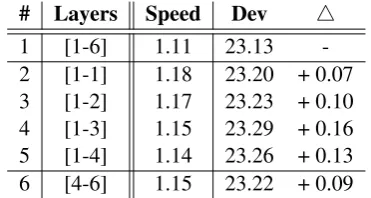
modeling to different combinations of layers, as shown in Table2. Clearly, modeling the localness for part of the layers consistently outperforms all layers in terms of the training speed and transla-tion quality, which again validates our claim.
Interestingly, the performance generally goes up with the increase of layers from bottom to top (Rows 2-4), while the trend does not hold when reaching the 4th-layer (Row 5). In addition, the lower three layers benefit more from the local-ness modeling than that of the higher three layers (Rows 4 and 6). These results reveal that lower-level layers benefit more from the local context. Accordingly, we only model the localness in the lower three layers in the following experiments.
Attention Networks to be Applied Table 3
[image:5.595.307.526.224.295.2]System Architecture Zh⇒En En⇒De # Para. BLEU # Para. BLEU Existing NMT systems
(Wu et al.,2016) GNMT n/a n/a n/a 26.30
(Gehring et al.,2017) CONVS2S n/a n/a n/a 26.36
(Vaswani et al.,2017) TRANSFORMER-BASE n/a n/a 65M 27.3
TRANSFORMER-BIG n/a n/a 213M 28.4
(Hassan et al.,2018) TRANSFORMER-BIG n/a 24.2 n/a n/a
Our NMT systems
this work
TRANSFORMER-BASE 107.9M 24.13 88.0M 27.64
+ Rel Pos (Shaw et al.,2018) 108.0M 24.53 88.1M 27.94 + Localness 108.7M 24.77⇑ 88.8M 28.11↑ + Localness + Rel Pos 108.8M 24.96⇑ 88.9M 28.54⇑
TRANSFORMER-BIG 303.9M 24.56 264.1M 28.58
[image:6.595.80.519.62.286.2]+ Localness 307.2M 25.03↑ 267.4M 28.89 + Localness + Rel Pos 307.3M 25.28⇑ 267.5M 29.18⇑
Table 4: Comparing with the existing NMT systems on WMT17 Zh⇒En and WMT14 En⇒De test sets. “# Para.” denotes the trainable parameter size of each model (M = million). “↑/⇑”: significant over the conventional self-attention counterpart (p <0.05/0.01), tested by bootstrap resampling (Koehn,2004).
that it tends to only focus on its nearby repre-sentation, which poses difficulties to modeling lo-calness on the decoder side. In the main experi-ments, we only applied localness modeling to the lower three layers of the encoder, which employs a query-specific window prediction strategy.
4.3 Main Results
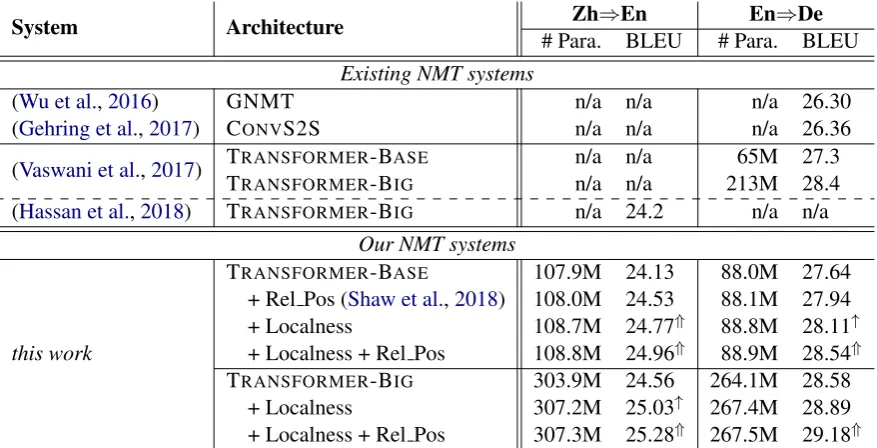
In this section, we evaluated the proposed ap-proach on both WMT17 Zh⇒En and WMT14 En⇒De translation tasks, as listed in Table4. Our baseline models, both TRANSFORMER-BASEand TRANSFORMER-BIG, outperform the reported re-sults on the same data, which we believe make the evaluation convincing. As seen, modeling local-ness (“Locallocal-ness”) consistently achieves improve-ment across language pairs and model variations, demonstrating the efficiency and universality of the proposed approach.
We also re-implemented the relative posi-tion encoding (“Rel Pos”) that recently proposed by Shaw et al. (2018), which considers the rela-tive distances between sequence elements. Both
Shaw et al.(2018) and our work have shown that explicitly modeling locality for self-attention net-works can improve the model performance. This indicates that it is necessary to enhance the locality modeling for Transformer. Besides, our approach is complementary to theirs, and combining them is able to further improve the translation
perfor-mance. We attribute this to the fact that the two models modeling localness from two different as-pects: First, the position embeddings are the same across different positions (if the absolute positions or relative positions are the same) and training ex-amples, our model assigns a distinct localness bias to each position from layer to layer. Second, con-trast to position encoding which learns the locality through the positional information in embeddings, our model directly revises the attention distribu-tion to focus on a local space.
5 Analysis
We conducted extensive analyses to better under-stand our model in terms of its compatibility with multi-head and multi-layer attention networks, as well as building the ability of capturing phrasal patterns. All the results are reported on Zh⇒En development set with TRANSFORMER-BASE, un-less otherwise stated.
5.1 Compatibility with Multi-Head Attention
Model 1-Head 8-Head
Dev 4 Dev 4
[image:7.595.85.280.63.119.2]BASE 22.05 - 22.59 -OURS 22.18 + 0.13 23.29 + 0.70
Table 5: Evaluation of localness modeling on top of single and multiple attention heads.
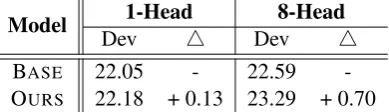
Multi-Head vs. Single-Head The single-head attention and multi-head attention differ at: the former uses a single 512-dimension attention head while the latter uses eight 64-dimension heads. The results in Table 5 confirm our claim by showing that multi-head attention indeed benefits more from our model than the single-head model (+0.70 vs. +0.13). It should be noted that our model marginally improves the performance un-der single-head setting. One possible reason is that our model focuses more on local context thus may ignore global information, which cannot be com-plemented by the single-head attention.
10 20 30 40 50
Window Size 1
2 3 4 5 6
La
ye
[image:7.595.77.280.370.465.2]r
Figure 2: Instructions of the learned window size by head-specific parametric model, where colors distinguish the heads.
Can Multi-Head Separate Locality? To sim-plistically visualize how heads cooperate in mod-eling localness, we propose an additional paramet-ric model which is assigned a learnable but unified window size for each head, namelyhead-specific. As a result, the window sizeDmof them-th head is calculated as:
Dm =N ·sigmoid(zm), (11)
where the scalarzmis a trainable parameter,N = 50denotes a pre-defined constant number.
Figure 2 visualizes the distribution of the learned window size of each head, verifying that multi-head attention is able to capture diverse in-formation by selecting suitable window sizes for different heads. For example, in the middle-level
layers, heads are assigned to consider both the global and local information by regulating the dif-ferent window sizes. One interesting finding is that the distributions of window size are not ex-actly same in different layers, which is explored in more details in the next section.
5.2 Analysis on Multi-Layer Attention
In this section, we try to answer how does each layer learn the localness. We first investigated how the window size varies across layers. Then we checked the specific behavior of the first word em-bedding layer, which is inconsistent with the trend of other layers.
The Higher Layer, The Larger Scope Shi et al.
(2016) andVaswani et al.(2017) have shown that different layers have the abilities to distinguish and capture diverse syntactic context (e.g. the depen-dents between words). Figure 3 shows the dis-tribution of local scopes predicted by each layer. Except the first layer, the higher layers are more likely to pay attention to larger scopes, indicating that self-attention models tend to capture short-term dependencies among neighboring words in lower layers, while capture long-range dependen-cies beyond phrase boundaries in higher layers.
The Special First Layer Inconsistent with the intuition which the lower layers may focus on lo-cal information, in common, the first layer is as-signed with large scopes of local context. The same phenomenon has also occurred for head-specific model (Figure 2). Since the first layer represents word embeddings that are deficient in context, we argue that the self-attention model at first layer has to encode the representations with global context. In addition, experimental results in Table2(Row 2) show that despite its large lo-cal size, modeling lolo-calness at the first layer is still valid.
5.3 Analysis on Phrasal Pattern
0 20 40
Po
si
ti
on
a) Layer 1 b) Layer 2 c) Layer 3 d) Layer 4 e) Layer 5 f) Layer 6
10 25 40 0
5 10 15
Fr
eq
ue
nc
y
(k
)
10 25 40 10 25 40
Window Size
[image:8.595.85.509.63.249.2]10 25 40 10 25 40 10 25 40
Figure 3: Distribution of the local scopes learned by each attentive layer. The upper figures illustrate the distribution of the predicted pairs of central position (Y-axis) and its correspond window size (X-axis) in each layer, the samples are randomly selected from the development set. The lower figures show the distribution of the window size in each layer. Blue color represents the layer-specific parametric
approach, while thequery-specific parametricmethod is indicated in red.
1 2 3 4 5 6 7 8
N-gram −0.4
−0.2 0.0 0.2 0.4
G
ap
o
f
B
LE
U
c
or
e
Query-Spec. Layer-Spec. Baseline
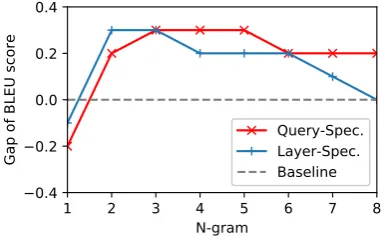
Figure 4: Performance improvement according to N-gram. Y-axis denotes the gap of BLEU score between our model and baseline.
self-attention model on capturing the phrasal in-formation. Concerning the two variations, query-specific localness modeling surpasses its layer-specific counterpart on large phrases (i.g. 4-grams to 8-grams). We attribute this to the more model-ing flexibility of query-specific strategy to differ-entiate the scope by conditioning on each query.
6 Related Work
A successful extension of neural language model is attention mechanism, which can directly capture long-distance dependencies by attending to previ-ously generated words.Daniluk et al.(2017) pro-posed akey-value-predictattention to separate the key addressing, value reading, and word
predict-ing functions explicitly. Im and Cho(2017) and
Sperber et al. (2018) adopted self-attention net-works for acoustic modeling and natural language inference tasks, respectively.
Vaswani et al. (2017) applied the idea of self-attention to neural machine translation.Shen et al.
(2018a) and Shen et al.(2018b) proposed to im-prove the self-attention model with directional masks and multi-dimensional features. Although the standard self-attention model can give more bias toward localness,6 several studies show that explicitly modeling localness for self-attention model can further improve performance. For example, Sperber et al. (2018) showed that re-stricting the self-attention model on the neigh-boring representations performs better for longer sequences in acoustic modeling and natural lan-guage inference tasks. Closely related to this work,Shaw et al. (2018) introduced relative po-sition encoding to consider the relative distances between sequence elements. While they modeled localness fromstatic position embedding, we im-prove locality modeling fromdynamically revising attention distribution. Experimental results show
6
[image:8.595.81.275.355.474.2]that the two models are complementary to each other, and combining them can further improve performance.
Several researches have shown that explicitly modeling phrases is useful for neural machine translation (Wang et al.,2017;Huang et al.,2018). Our results confirm these findings. Concerning attention models, Luong et al. (2015) proposed a modification to look at only a subset of input words at a time. This can be regarded as a “hard” variation of our fixed-window strategy. In this study, we propose more flexible strategies for plac-ing and zoomplac-ing the local scope, which yield bet-ter results than the fixed scope.
7 Conclusion
In this work, we enhanced the ability of captur-ing local context for self-attention networks with a learnable Gaussian bias. We proposed several strategies to learn the scope of the local con-text, and found that a query-specific mechanism yielded the best result due to its more modeling flexibility. Experimental results on widely-used English⇒German and Chinese⇒English transla-tion tasks demonstrate the effectiveness and uni-versality of the proposed approach. By visualiz-ing the scopes of the learned Gaussian biases, we found that the higher the layer, the larger scope the bias, which is consistent with the findings in pre-vious work (Shi et al.,2016;Peters et al.,2018).
As our approach is not limited to specific tasks, it is interesting to validate our model in other tasks, such as reading comprehension, language infer-ence, and stance classification (Xu et al., 2018). Another promising direction is to design more powerful localness modeling techniques, such as incorporating linguistic knowledge (e.g. phrases and syntactic categories). It is also interesting to combine with other techniques (Shaw et al.,
2018; Shen et al., 2018a; Dou et al., 2018; Li et al., 2018) to further improve the performance of Transformer.
Acknowledgments
This work was supported in part by the Na-tional Natural Science Foundation of China (Grant No. 61672555), the Joint Project of Macao Sci-ence and Technology Development Fund and Na-tional Natural Science Foundation of China (Grant No. 045/2017/AFJ) and the Multiyear Research Grant from the University of Macau (Grant No.
MYRG2017-00087-FST). We thank the anony-mous reviewers for their insightful comments.
References
Antonios Anastasopoulos and David Chiang. 2018. Tied Multitask Learning for Neural Speech Trans-lation. InNAACL.
Dzmitry Bahdanau, Kyunghyun Cho, and Yoshua Ben-gio. 2015. Neural Machine Translation by Jointly Learning to Align and Translate. InICLR.
Michał Daniluk, Tim Rockt¨aschel, Johannes Welbl, and Sebastian Riedel. 2017. Frustratingly short at-tention spans in neural language modeling. InICLR.
Ziyi Dou, Zhaopeng Tu, Xing Wang, Shuming Shi, and Tong Zhang. 2018. Exploiting Deep Representa-tions for Neural Machine Translation. InEMNLP.
Jonas Gehring, Michael Auli, David Grangier, Denis Yarats, and Yann N. Dauphin. 2017. Convolutional Sequence to Sequence Learning. InICML.
Hany Hassan, Anthony Aue, Chang Chen, Vishal Chowdhary, Jonathan Clark, Christian Feder-mann, Xuedong Huang, Marcin Junczys-Dowmunt, William Lewis, Mu Li, et al. 2018. Achieving Hu-man Parity on Automatic Chinese to English News Translation. arXiv:1803.05567.
Po Sen Huang, Chong Wang, Sitao Huang, Dengyong Zhou, and Li Deng. 2018. Towards Neural Phrase-based Machine Translation. InICLR.
Jinbae Im and Sungzoon Cho. 2017. Distance-based Self-Attention Network for Natural Language Infer-ence. arXiv:1712.02047.
Philipp Koehn. 2004. Statistical Significance Tests for Machine Translation Evaluation. InEMNLP.
Jian Li, Zhaopeng Tu, Baosong Yang, Michael R. Lyu, and Tong Zhang. 2018. Multi-Head Attention with Disagreement Regularization. InEMNLP.
Thang Luong, Hieu Pham, and Christopher D. Man-ning. 2015. Effective Approaches to Attention-based Neural Machine Translation. InEMNLP.
Kishore Papineni, Salim Roukos, Todd Ward, and Wei-Jing Zhu. 2002. BLEU: A Method for Automatic Evaluation of Machine Translation. InACL.
Matthew E. Peters, Mark Neumann, Mohit Iyyer, Matt Gardner, Christopher Clark, Kenton Lee, and Luke Zettlemoyer. 2018. Deep Contextualized Word Rep-resentations. InNAACL.
Peter Shaw, Jakob Uszkoreit, and Ashish Vaswani. 2018. Self-Attention with Relative Position Repre-sentations. InNAACL.
Tao Shen, Tianyi Zhou, Guodong Long, Jing Jiang, Shirui Pan, and Chengqi Zhang. 2018a. DiSAN: Directional Self-Attention Network for RNN/CNN-Free Language Understanding. InAAAI.
Tao Shen, Tianyi Zhou, Guodong Long, Jing Jiang, and Chengqi Zhang. 2018b. Bi-Directional Block Self-Attention for Fast and Memory-Efficient Sequence Modeling. InICLR.
Xing Shi, Inkit Padhi, and Kevin Knight. 2016. Does String-based Neural MT Learn Source Syntax? In EMNLP.
Matthias Sperber, Jan Niehues, Graham Neubig, Se-bastian St¨uker, and Alex Waibel. 2018. Self-Attentional Acoustic Models. InInterspeech.
Ashish Vaswani, Noam Shazeer, Niki Parmar, Jakob Uszkoreit, Llion Jones, Aidan N Gomez, Łukasz Kaiser, and Illia Polosukhin. 2017. Attention is All You Need. InNIPS.
Xing Wang, Zhaopeng Tu, Deyi Xiong, and Min Zhang. 2017. Translating Phrases in Neural Ma-chine Translation. InEMNLP.
Yonghui Wu, Mike Schuster, Zhifeng Chen, Quoc V Le, Mohammad Norouzi, Wolfgang Macherey, Maxim Krikun, Yuan Cao, Qin Gao, Klaus Macherey, et al. 2016. Google’s Neural Machine Translation System: Bridging the Gap Between Hu-man and Machine Translation. arXiv:1609.08144.
Chang Xu, Cecile Paris, Surya Nepal, and Ross Sparks. 2018. Cross-Target Stance Classification with Self-Attention Networks. InACL.
Kelvin Xu, Jimmy Ba, Ryan Kiros, Kyunghyun Cho, Aaron C Courville, Ruslan Salakhutdinov, Richard S Zemel, and Yoshua Bengio. 2015. Show, Attend and Tell: Neural Image Caption Generation with Visual Attention. InICML.
Baosong Yang, Derek F. Wong, Tong Xiao, Lidia S. Chao, and Jingbo Zhu. 2017. Towards Bidirec-tional Hierarchical Representations for Attention-based Neural Machine Translation. InEMNLP.
Biao Zhang, Deyi Xiong, and Jinsong Su. 2018. Ac-celerating Neural Transformer via an Average At-tention Network. InACL.