Script Induction as Language Modeling
Rachel Rudinger1, Pushpendre Rastogi1, Francis Ferraro1, and Benjamin Van Durme1,2
1Center for Language and Speech Processing 2Human Language Technology Center of Excellence
Johns Hopkins University
Abstract
Thenarrative cloze is an evaluation met-ric commonly used for work on automatic script induction. While prior work in this area has focused on count-based meth-ods from distributional semantics, such as pointwise mutual information, we argue that the narrative cloze can be productively reframed as a language modeling task. By training a discriminative language model for this task, we attain improvements of up to 27 percent over prior methods on stan-dard narrative cloze metrics.
1 Introduction
Although the concept ofscriptsin artificial intelli-gence dates back to the 1970s (Schank and Abel-son, 1977), interest in this topic has renewed with recent efforts to automatically induce scripts from text on a large scale. One particularly influential work in this area, Chambers and Jurafsky (2008), treats the problem of script induction as one of learningnarrative chains, which they accomplish using simple textual co-occurrence statistics. For the novel task of learning narrative chains, they introduce a new evaluation metric, the narrative cloze test, which involves predicting a missing event from a chain of events drawn from text. Several follow-up works (Chambers and Jurafsky, 2009; Jans et al., 2012; Pichotta and Mooney, 2014; Rudinger et al., 2015) employ and ex-tend Chambers and Jurafsky (2008)’s methods for learning narrative chains, each using the narrative cloze to evaluate their work.1
In this paper, we take the position that the nar-rative cloze test, which has been treated predom-1A number of related works on script induction use alter-native task formulations and evaluations. (Chambers, 2013; Cheung et al., 2013; Cheung and Penn, 2013; Frermann et al., 2014; Manshadi et al., 2008; Modi and Titov, 2014; Reg-neri et al., 2010)
inantly as a method for evaluating script knowl-edge, is more productively thought of simply as a language modeling task.2 To support this claim, we demonstrate a marked improvement over pre-vious methods on this task using a powerful dis-criminative language model – the Log-Bilinear model (LBL). Based on this finding, we believe one of the following conclusions must follow: ei-ther discriminative language models are a more effective technique for script induction than pre-vious methods, or the narrative cloze test is not a suitable evaluation for this task.3
2 Task Definition
Following the definitions of Chambers and Juraf-sky (2008), a narrative chain is “a partially or-dered set of narrative events that share a common actor,” where anarrative event is “a tuple of an event (most simply a verb) and its participants, represented astyped dependencies.” (De Marneffe et al., 2006) Formally, e := (v, d), where eis a narrative event, v is a verb lemma, and d is the syntactic dependency (nsubj or dobj) between v
and the protagonist. As an example, consider the following narrative:
John studied for the exam and aced it. His teacher congratulated him.
With John as protagonist, we have a se-quence of three narrative events: (study, nsubj),
(ace, nsubj), and(congratulate, dobj).
In the narrative clozetest, a sequence of nar-rative events (like the example provided here) is extracted automatically from a document, and one 2Manshadi et al. (2008) also take a language modeling approach to event prediction, although their experiments are not directly comparable.
3We note that, whether the narrative cloze was originally intended as a rigorous evaluation of script induction tech-niques or merely a preliminary metric, we are motivated by the observation that this evaluation has nonetheless become a standard metric for this task.
narrative event is removed; the task is to predict the missing event.
Data Each of the models discussed in the fol-lowing section are trained and tested on chains of narrative events extracted from stories in the New York Times portion of the Gigaword corpus (Graff et al., 2003) with Concrete annotations (Ferraro et al., 2014). Training is on the entirety of the 1994– 2006 portion (16,688,422 chains with 58,515,838 narrative events); development is a subset of the 2007–2008 portion (10,000 chains with 35,109 events); and test is a subset of the 2009–2010 por-tion (5,000 chains with 17,836 events). All ex-tracted chains are of length two or greater.
Chain Extraction To extract chains of narra-tive events for training and testing, we rely on the (automatically-generated) coreference chains present in Concretely Annotated Gigaword. Each narrative event in an extracted chain is derived from a single mention in the corresponding coref-erence chain, i.e., it consists of the verb and syn-tactic dependency (nsubj or dobj) that governs the head of the mention, if such a dependency ex-ists. Overlapping mentions within a coreference chain are collapsed to a single mention to avoid redundant extractions.
3 Models
In this section we present each of the models we train for the narrative cloze evaluation. In a sin-gle narrative cloze test, a sequence of narrative events, (e1,· · ·, eL), with an insertion point, k, for the missing event is provided. Given a fixed vocabulary of narrative events,V, a candidate se-quence is generated for each vocabulary item by inserting that item into the sequence at index k. Each model generates a score for the candidate se-quences, yielding a ranking over the vocabulary items. The rank assigned to the actual missing vo-cabulary item is the score the model receives on that cloze test. In this case, we set V to include all narrative events,e, that occur at least ten times in training, yielding a vocabulary size of 12,452. All out-of-vocabulary events are converted to (and scored as) the symbolUNK.
3.1 Count-based Methods
Unigram Baseline (UNI) A simple but strong baseline introduced by Pichotta and Mooney (2014) for this task is the unigram model:
can-didates are ranked by their observed frequency in training, without regard to context.
Unordered PMI (UOP) The original model for this task, proposed by Chambers and Jurafsky (2008), is based on the pointwise mutual informa-tion (PMI) between events.
pmi(e1, e2)∝ logC(eC(e1, e2)
1,∗)C(∗, e2) (1)
Here,C(e1, e2) is the number of timese1 ande2 occur in the same narrative event sequence, i.e., the number of times they “had a coreferring entity filling the values of [their] dependencies,” and the ordering of e1 and e2 is not considered. In our implementation, individual counts are defined as follows:
C(e,∗) := X
e0∈V
C(e, e0) (2)
This model selects the best candidate event in a given cloze test according to the following score:
ˆ
e= arg max
e∈V L
X
i=1
pmi(e, ei) (3)
We tune this model with an option to apply a mod-ified version of discounting for PMI from Pantel and Ravichandran (2004).
Ordered PMI (OP) This model is a slight vari-ation on Unordered PMI introduced by Jans et al. (2012). The only distinction is that C(e1, e2) is treated as an asymmetric count, sensitive to the or-der in whiche1 ande2occur within a chain.
Bigram Probability (BG) Another variant intro-duced by Jans et al. (2012), the “bigram proba-bility” model uses conditional probabilities rather than PMI to compute scores. In a cloze test, this model selects the following event:
ˆ
e= arg max
e∈V k
Y
i=1
p(e|ei) L
Y
i=k+1
p(ei|e) (4)
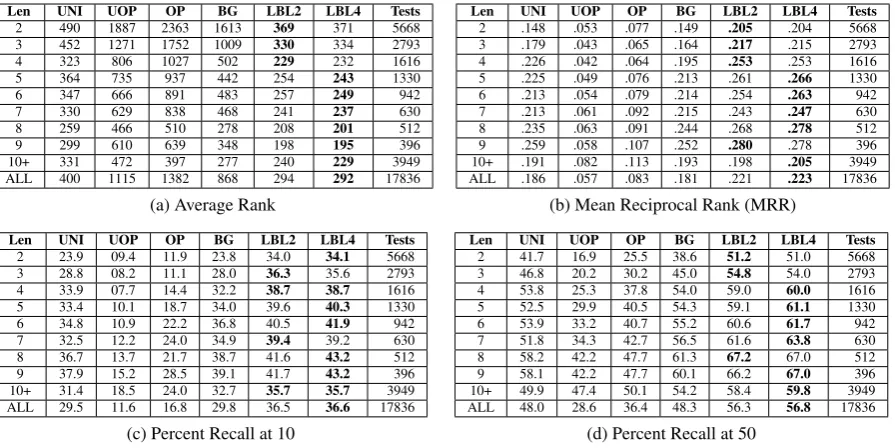
Len UNI UOP OP BG LBL2 LBL4 Tests
2 490 1887 2363 1613 369 371 5668 3 452 1271 1752 1009 330 334 2793 4 323 806 1027 502 229 232 1616 5 364 735 937 442 254 243 1330 6 347 666 891 483 257 249 942 7 330 629 838 468 241 237 630 8 259 466 510 278 208 201 512 9 299 610 639 348 198 195 396 10+ 331 472 397 277 240 229 3949 ALL 400 1115 1382 868 294 292 17836
(a) Average Rank
Len UNI UOP OP BG LBL2 LBL4 Tests
2 .148 .053 .077 .149 .205 .204 5668 3 .179 .043 .065 .164 .217 .215 2793 4 .226 .042 .064 .195 .253 .253 1616 5 .225 .049 .076 .213 .261 .266 1330 6 .213 .054 .079 .214 .254 .263 942 7 .213 .061 .092 .215 .243 .247 630 8 .235 .063 .091 .244 .268 .278 512 9 .259 .058 .107 .252 .280 .278 396 10+ .191 .082 .113 .193 .198 .205 3949 ALL .186 .057 .083 .181 .221 .223 17836
(b) Mean Reciprocal Rank (MRR) Len UNI UOP OP BG LBL2 LBL4 Tests
2 23.9 09.4 11.9 23.8 34.0 34.1 5668 3 28.8 08.2 11.1 28.0 36.3 35.6 2793 4 33.9 07.7 14.4 32.2 38.7 38.7 1616 5 33.4 10.1 18.7 34.0 39.6 40.3 1330 6 34.8 10.9 22.2 36.8 40.5 41.9 942 7 32.5 12.2 24.0 34.9 39.4 39.2 630 8 36.7 13.7 21.7 38.7 41.6 43.2 512 9 37.9 15.2 28.5 39.1 41.7 43.2 396 10+ 31.4 18.5 24.0 32.7 35.7 35.7 3949 ALL 29.5 11.6 16.8 29.8 36.5 36.6 17836
(c) Percent Recall at 10
Len UNI UOP OP BG LBL2 LBL4 Tests
2 41.7 16.9 25.5 38.6 51.2 51.0 5668 3 46.8 20.2 30.2 45.0 54.8 54.0 2793 4 53.8 25.3 37.8 54.0 59.0 60.0 1616 5 52.5 29.9 40.5 54.3 59.1 61.1 1330 6 53.9 33.2 40.7 55.2 60.6 61.7 942 7 51.8 34.3 42.7 56.5 61.6 63.8 630 8 58.2 42.2 47.7 61.3 67.2 67.0 512 9 58.1 42.2 47.7 60.1 66.2 67.0 396 10+ 49.9 47.4 50.1 54.2 58.4 59.8 3949 ALL 48.0 28.6 36.4 48.3 56.3 56.8 17836
[image:3.595.78.526.61.285.2](d) Percent Recall at 50
Table 1: Narrative cloze results bucketed by chain length for each model and scoring metric with best results in bold. The models are Unigram Model (UNI), Unordered PMI (UOP), Ordered PMI (OP), Bigram Probability Model (BG), Log-Bilinear Model N=2 (LBL2), Log-Bilinear Model N=4 (LBL4)
Skip N-gram We tune the previous three models (UOP, OP, and BG) with the skip n-gram counting methods introduced by Jans et al. (2012) for this task, varying the ways in which the counts, C(e1, e2), are collected. Using skip-n counting, C(e1, e2) is incremented every timee1 ande2 co-occur within a window of size n. We experiment withskip-0(consecutive events only), skip-3(window size 3), andskip-all(entire chain length) settings.
For each of the four narrative cloze scoring metrics we report on (average rank, mean re-ciprocal rank, recall at 10, and recall at 50), we tune the Unordered PMI, Ordered PMI, and Bigram Probability models over the following parameter space: {skip-0,skip-3,skip-all} × {discount,no-discount} × {T=4,T=10,T=20}, whereTis a pairwise count threshold.
3.2 A Discriminative Method
Log-Bilinear Language Model (LBL) The Log-Bilinear language model is a language model that was introduced by Mnih and Hinton (2007). Like other language models, the LBL produces a probability distribution over the next possible word given a sequence ofN previously observed words.Nis a hyper-parameter that determines the size of the context used for computing the prob-abilities. While many variants of the LBL have been proposed since its introduction, we use the
simple variant described below.
Formally, we associate one context vectorce∈
Rd, one bias parameter be ∈ R, and one tar-get vector te ∈ Rd to each narrative event
e ∈ V ∪ {UNK,BOS,EOS}. V is the vocab-ulary of events and BOS, EOS, and UNK are the beginning-of-sequence, end-of-sequence, and out-of-vocabulary symbols, respectively. The proba-bility of an evente that appears after a sequence
s = [s1, s2, . . . , sN] of context words is defined as:
p(e|s) = Pexp(te|ˆts+be)
e0∈V∪{UNK,EOS}exp(t
|
e0ˆts+be0)
whereˆts= N
X
j=1
mjcsj
Theoperator performs element-wise multiplica-tion of two vectors. The parameters that are opti-mized during training aremj ∀j∈[1, . . . , N]and ce,te ∀e ∈ V ∪ {UNK,BOS,EOS}. To calcu-late the log-probability of a sequence of narrative eventsE = (e1, . . . , eL)we compute:
l(S) = Xn
i=1
log(p(ei|fE(ei)))
!
+ log(p(EOS|fE(EOS))) (5)
se-0 500 1000
UNI UOP OP BG LBL2LBL4
model
a
vgr
nk
0 10 20 30
UNI UOP OP BG LBL2 LBL4
model
rec10
0.00 0.05 0.10 0.15 0.20
UNI UOP OP BG LBL2LBL4
model
mrr
0 20 40
UNI UOP OP BG LBL2 LBL4
model
[image:4.595.86.487.78.343.2]rec50
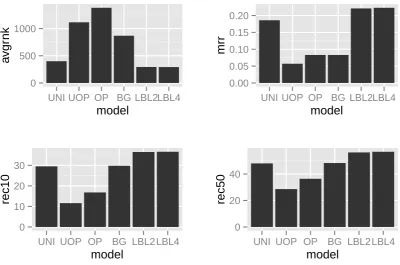
Figure 1: Narrative cloze results over all chain lengths. Unigram Model (UNI), Unordered PMI Model (UOP), Ordered PMI Model (OP), Bigram Probability Model (BG), Log-Bilinear Model with context size 2 or 4 (LBL2, LBL4). Average Rank (avgrnk), Mean Reciprocal Rank (mrr), % Recall at 10 (rec10), % Recall at 50 (rec50).
quenceE0made by prependingN BOStokens and appending a singleEOStoken toE.
The LBL models are trained by minimizing the objective described in Equation 5 for all the sequences in the training corpus. We used the OxLM toolkit (Paul et al., 2014) which internally uses Noise-Contrastive Estimation (NCE) (Gut-mann and Hyv¨arinen, 2010) and processor paral-lelization for speeding up the training. For this task, we train LBL models with N = 2(LBL2) andN = 4(LBL4). In our experiments, increas-ing context size to N = 6 did not significantly improve (or degrade) performance.
4 Experimental Results
Table 1 shows the results of 17,836 narrative cloze tests (derived from 5,000 held-out test chains), with results bucketed by chain length. Perfor-mance is reported on four metrics: average rank, mean reciprocal rank, recall at 10, and recall at 50. For each of the four metrics, the best overall performance is achieved by one of the two LBL models (context size 2 or 4); the LBL models also achieve the best performance on every chain length. Not only are the gains achieved by the discriminative LBL consistent across metrics and
chain length, they are large. For average rank, the LBL achieves a 27.0% relative improvement over the best non-discriminative model; for mean re-ciprocal rank, a 19.9% improvement; for recall at 10, a 22.8% improvement; and for recall at 50, a 17.6% improvement. (See Figure 1.) Further-more, note that both PMI models and the Bigram model have been individually tuned for each met-ric, while the LBL models have not. (The two LBL models are tuned only for overall perplexity on the development set.)
All models trend toward improved performance on longer chains. Because the unigram model also improves with chain length, it appears that longer chains contain more frequent events and are thus easier to predict. However, LBL performance is also likely improving on longer chains because of additional contextual information, as is evident from LBL4’s slight relative gains over LBL2 on longer chains.
5 Conclusion
Tur-ney and Pantel, 2010), so it is natural that these techniques have also been applied to the task of script induction. Qualitatively, PMI often identifies intuitively compelling matches; among the top 15 events to share a high PMI with
(eat, nsubj)under the Unordered PMI model, for example, we find events such as(overeat, nsubj),
(taste, nsubj), (smell, nsubj), (cook, nsubj), and(serve, dobj). When evaluated by the narra-tive cloze test, however, these count-based meth-ods are overshadowed by the performance of a general-purpose discriminative language model.
Our decision to attempt this task with the Log-Bilinear model was motivated by the simple ob-servation that the narrative cloze test is, in reality, a language modeling task. Does the LBL’s suc-cess on this task mean that work in script induc-tion should abandon tradiinduc-tional count-based meth-ods for discriminative language modeling tech-niques? Or does it mean that an alternative eval-uation metric is required to measure script knowl-edge? While we believe our results are sufficient to conclude that one of these alternatives is the case, we leave the task of determining which to future research.
Acknowledgments
This work was supported by the Paul Allen In-stitute for Artificial Intelligence (Acquisition and Use of Paraphrases in a Knowledge-Rich Setting), a National Science Foundation Graduate Research Fellowship (Grant No. DGE-1232825), the Johns Hopkins HLTCOE, and DARPA DEFT (FA8750-13-2-001, Large Scale Paraphrasing for Natural Language Understanding). We would also like to thank three anonymous reviewers for their feed-back. Any opinions expressed in this work are those of the authors.
References
Nathanael Chambers and Dan Jurafsky. 2008. Unsu-pervised learning of narrative event chains. In Pro-ceedings of ACL-08: HLT, pages 789–797, Colum-bus, Ohio. Association for Computational Linguis-tics.
Nathanael Chambers and Dan Jurafsky. 2009. Unsu-pervised learning of narrative schemas and their par-ticipants. InProceedings of the Joint Conference of the 47th Annual Meeting of the ACL and the 4th In-ternational Joint Conference on Natural Language Processing of the AFNLP, pages 602–610, Suntec,
Singapore. Association for Computational Linguis-tics.
Nathanael Chambers. 2013. Event schema induction with a probabilistic entity-driven model. InEMNLP, volume 13, pages 1797–1807.
Jackie Chi Kit Cheung and Gerald Penn. 2013. Prob-abilistic domain modelling with contextualized dis-tributional semantic vectors. InProceedings of the 51st Annual Meeting of the Association for Compu-tational Linguistics, pages 392–401. Association for Computational Linguistics.
Jackie Chi Kit Cheung, Hoifung Poon, and Lucy Van-derwende. 2013. Probabilistic frame induction. In
Proceedings of the 2013 Conference of the North American Chapter of the Association for Computa-tional Linguistics: Human Language Technologies, pages 837–846, Atlanta, Georgia, June. Association for Computational Linguistics.
Kenneth Ward Church and Patrick Hanks. 1990. Word association norms, mutual information, and lexicog-raphy.Computational linguistics, 16(1):22–29.
Marie-Catherine De Marneffe, Bill MacCartney, Christopher D Manning, et al. 2006. Generat-ing typed dependency parses from phrase structure parses. InProceedings of LREC, volume 6, pages 449–454.
Francis Ferraro, Max Thomas, Matthew R. Gormley, Travis Wolfe, Craig Harman, and Benjamin Van Durme. 2014. Concretely Annotated Corpora. In
4th Workshop on Automated Knowledge Base Con-struction (AKBC).
Lea Frermann, Ivan Titov, and Manfred Pinkal. 2014. A hierarchical bayesian model for unsupervised in-duction of script knowledge.EACL 2014, page 49.
David Graff, Junbo Kong, Ke Chen, and Kazuaki Maeda. 2003. English gigaword. Linguistic Data Consortium, Philadelphia.
Michael Gutmann and Aapo Hyv¨arinen. 2010. Noise-contrastive estimation: A new estimation princi-ple for unnormalized statistical models. In Inter-national Conference on Artificial Intelligence and Statistics, pages 297–304.
Bram Jans, Steven Bethard, Ivan Vuli´c, and Marie-Francine Moens. 2012. Skip n-grams and ranking functions for predicting script events. In Proceed-ings of the 13th Conference of the European Chap-ter of the Association for Computational Linguis-tics, pages 336–344, Avignon, France. Association for Computational Linguistics.
Mehdi Manshadi, Reid Swanson, and Andrew S Gor-don. 2008. Learning a probabilistic model of event sequences from internet weblog stories. InFLAIRS Conference, pages 159–164.
Andriy Mnih and Geoffrey Hinton. 2007. Three new graphical models for statistical language modelling. InProceedings of the 24th international conference on Machine learning, pages 641–648. ACM. Ashutosh Modi and Ivan Titov. 2014. Inducing neural
models of script knowledge. CoNLL-2014, page 49. Patrick Pantel and Deepak Ravichandran. 2004. Automatically labeling semantic classes. In Daniel Marcu Susan Dumais and Salim Roukos, ed-itors, HLT-NAACL 2004: Main Proceedings, pages 321–328, Boston, Massachusetts, USA. Association for Computational Linguistics.
Baltescu Paul, Blunsom Phil, and Hoang Hieu. 2014. Oxlm: A neural language modelling framework for machine translation. The Prague Bulletin of Mathe-matical Linguistics, 102(1):81–92.
Karl Pichotta and Raymond Mooney. 2014. Statisti-cal script learning with multi-argument events. In
Proceedings of the 14th Conference of the European Chapter of the Association for Computational Lin-guistics, pages 220–229, Gothenburg, Sweden. As-sociation for Computational Linguistics.
Michaela Regneri, Alexander Koller, and Manfred Pinkal. 2010. Learning script knowledge with web experiments. In Proceedings of the 48th Annual Meeting of the Association for Computational Lin-guistics, pages 979–988. Association for Computa-tional Linguistics.
Rachel Rudinger, Vera Demberg, Ashutosh Modi, Ben-jamin Van Durme, and Manfred Pinkal. 2015. Learning to predict script events from domain-specific text. Lexical and Computational Semantics (* SEM 2015), page 205.
Roger Schank and Robert Abelson. 1977. Scripts, plans, goals and understanding: An inquiry into hu-man knowledge structures. Lawrence Erlbaum As-sociates, Hillsdale, NJ.