Homomorphic image orders on combinatorial structures
Sophie Huczynska and Nik Ruˇskuc∗
AMS classification: Primary 06A06 Secondary 05C60, 06A07, 05C20, 05C05, 05A05.
Abstract
Combinatorial structures have been considered under various orders, including substruc-ture order and homomorphism order. In this paper, we investigate the homomorphic image order, corresponding to the existence of a surjective homomorphism between two structures. We distinguish between strong and induced forms of the order and explore how they be-have in the context of different common combinatorial structures. We focus on three aspects: antichains and partial well-order, the joint preimage property and the dual amalgamation property. The two latter properties are natural analogues of the well-known joint embedding property and amalgamation property, and are investigated here for the first time.
1 Introduction
Between any two relational structuresSandT, the notion of a structure-preserving map is cap-tured by a homomorphism. Many concepts in combinatorics may fruitfully be viewed in terms of the existence (or non-existence) of certain types of homomorphisms. For example, anr-colouring of a graph Gis simply a homomorphism fromGinto the complete graphKr, and other
graph-theoretic notions such as independence number, clique number and connectivity of a graph also possess characterizations via homomorphisms. One may also define classes of combinatorial objects by means of homomorphisms (from or into the objects). More details on this viewpoint are given in [11].
Combinatorial objects have been considered under various different orderings: two well-studied examples are substructure order (for which we may make a further distinction between weak and induced, see [4], Section 4) and homomorphism order (see for example [6], Chapter 3). Two structures are related under the substructure order if there exists an injective homo-morphism between them; a “standard” homohomo-morphism in the case of weak substructure, and a strong homomorphism in the case of induced substructure.
By way of analogy, it is natural to consider the partial order corresponding to the existence of a surjective homomorphism between two structures; we may call this thehomomorphic image order. As with the substructure order, we may distinguish between weak and induced forms. Somewhat surprisingly, this order has received very little attention in the literature. In compar-ison, the homomorphism order, corresponding to the existence ofanyhomomorphism between two structures, is much-studied ([5], [10]), as are various related concepts such as the core of a graph ([3]).
∗School of Mathematics and Statistics, University of St Andrews, Fife, KY16 9SS, UK, Email:
In this paper, we will investigate three forms of the homomorphic image order, focussing on three aspects: antichains and partial well order, thejoint preimage property(the dual of the joint embedding property) and thedual amalgamation property (corresponding to the amalgamation property). To the best of our knowledge, the two latter properties are investigated here for the first time.
2 Homomorphisms, orders, properties
2.1 Background and notation
Let L = (Ri)i∈I be a relational signature, and let C be a class of structures of signature L. We
consider structures up to isomorphism and in general we assume our structures are finite. For a structureS = (S,RSi (i∈ I))and a mappingφ:S→ T, we let
φ(RiS) ={(φ(s1), . . . ,φ(sk)):(s1, . . . ,sk)∈ RSi }.
We take the following definitions:
Definition 2.1. Let S = (S,RSi (i ∈ I)) andT = (T,RTi (i ∈ I))be two L-structures, and let φ:S→T. We say thatφis:
(i) ahomomorphismif(s1, . . . ,sk)∈ RSi ⇒(φ(s1), . . . ,φ(sk))∈ RTi , i.e. ifφ(RiS)⊆ RTi |φ(S);
(ii) astrong homomorphismifφis a homomorphism andφ(RSi ) =RTi |φ(S);
(iii) anM-strong homomorphismifφis a homomorphism such that(s1, . . . ,sk)∈ RiS ⇔(φ(s1), . . . ,φ(sk))∈
RTi , i.e.φ(RiS) =RTi |φ(S)andφ(RSi ) =RTi |φ(S).
The “M” in the final definition refers to the model theoretic definition of a strong embedding (see, for example, [8], Chapter 1). Our definition of strong homomorphism requires that every relatedk-tuple inφ(S)must be the image of at least one relatedk-tuple in Sbut, in contrast to the model theoretic definition, it does not require thateverypreimage of a relatedk-tuple inφ(S)
must be a relatedk-tuple inS.
We make the following further definitions:
Definition 2.2. A homomorphism is anembeddingif it is injective, and is anepimorphismif it is onto. Like any other homomorphisms, embeddings and epimorphisms may be strong or M-strong. Anisomorphismis an M-strong bijection.
It is clear that every M-strong homomorphism is strong. Moreover, an embeddingφ:S→ T is M-strong if and only if it is strong. Considering the three strengths of homomorphisms for injections and surjections leads to six partial orders on finite structures, of which only five are distinct by the previous observation. In addition to the customary notation appropriately subscripted, we will also find it convenient to have a letter notation for parts of the text where we treat the order as a set.
Definition 2.3. (i) Substructure orderSorOS: AS Bif there exists an embeddingφ: A→
B;
(ii) induced substructure orderISorOIS: AIS Bif there exists a strong embeddingφ: A→
(iii) homomorphic image orderHorOH: AHBif there exists an epimorphismB→ A;
(iv) induced homomorphic image orderIH orOIH: A IH Bif there exists a strong
epimor-phismB→ A;
(v) M-induced homomorphic image orderMHorOMH: AMH Bif there exists an M-strong
epimorphismB→ A.
Note that in all these definitions the direction of homomorphisms is chosen so as to ensure thatA Bimplies|A| ≤ |B|.
Lemma 2.4. LetCbe a collection of finite relational structures of the same signature.
(i) All of OS, OIS, OH, OIHand OMHare partial orders onC;
(ii) OIS ⊆OSand OMH ⊆OIH ⊆OH.
The inclusions (ii) follow immediately from Definition 2.3. Reflexivity and transitivity for each of the relations is straightforward, while antisymmetry relies on the finiteness assumption. Without this assumption, the above relations are only quasiorders. Note thatOSandOISare the
usual substructure and induced substructure orderings; the remaining three will be the focus of the present article.
2.2 Types of structures
Our aim is to investigate how the above orders behave in the context of different common com-binatorial structures; in this subsection, we introduce the structures which will be considered.
Adigraphis simply a setDwith a binary relationE(D). A related pair(x,y)∈ E(D)is called a(directed) edge. A digraph homomorphismφ : D1 → D2maps edges to edges;φis strong if it
mapsE(D1)onto E(D2)and is M-strong if it also maps non-edges to non-edges.
In combinatorics there are numerous graph-like specializations of digraphs. In this paper we will consider the following.
Agraphis a digraphGin which the edge relationE(G)is symmetric. Furthermore, we will in-sist thatE(G)is either irreflexive or reflexive. This choice affects the notion of homomorphisms: in the irreflexive representation a homomorphism may not “collapse” an edge to a single point, while in the reflexive representation both edges and non-edges may be collapsed.
A tree is a connected graph with no cycles. Again, we will consider trees in two different representations, reflexive and irreflexive. At times, we will also considerrooted trees, where ho-momorphisms are required to map root to root.
A tournamentis a digraph T in which for any two distinct x,y ∈ T, precisely one of (x,y)
or(y,x)is an edge. Again, we consider reflexive and irreflexive tournaments. In the irreflexive case, since a homomorphism may not collapse an edge, every homomorphism is injective.
Anequivalence relationis a digraphXwith a reflexive, symmetric and transitive edge setE(X). A mapping φ : X1 → X2 is a homomorphism precisely if it maps the equivalence classes of
E(X1)into equivalence classes ofE(X2). A homomorphismφis strong if every pair of elements in imφ which lie in the same equivalence class of E(X2) possesses a pair of preimages which
lie in the same equivalence class ofE(X1). Finally, a homomorphism is M-strong if at most one
equivalence class ofE(X1)is mapped into each equivalence class ofE(X2).
A linear orderis a partial order L in which for any two distinct x,y ∈ L we have x ≤ y or
y ≤ x. A mapping φ : L1 → L2 between two linear orders is a homomorphism if and only
if all preimagesφ−1(y)(y ∈ L2) are contiguous subsets of L1 and if y1 < y2 (y1,y2 ∈ L2) and
xi ∈ φ−1(yi)implyx1 < x2. It is straightforward to see that every homomorphism is strong, but
that only the injective ones are M-strong.
Awordover alphabetAis a relational structure(W,≤, fa(a ∈ A))where≤is a linear order
and fa (a ∈ A) are unary relations such that for each w ∈ W, w ∈ fa is true for precisely one
a ∈ A. Given such a structure, ifW = {w1, . . . ,wk}withw1 < · · · < wk we writeW = a1. . .ak
where wi ∈ fai, a sequence of letters from the alphabet. A mapping φ : W1 → W2 between
two such relational structures is a homomorphism if the preimages φ−1(y)of points inW2 are
appropriately ordered contiguous segments ofW, as in the linear orders case and, in addition, all x ∈ φ−1(y) belong to the same fa. Thus, if W1 = a1. . .ak and W2 = a′1. . .a′l are written
as sequences, φ can be thought of as a “process” which identifies contiguous occurrences of the same letter inW1 and yields a subsequence (subword) ofW2. As with linear orders, every
homomorphism is strong but only the injective ones are M-strong.
Apermutationis a relational structure(P,≤1,≤2)where≤1,≤2are linear orders. A mapping
f : P1 → P2 between two permutations is a homomorphism if the preimages of points in P2
are contiguous under both ≤1 and≤2. Such sets are known as intervals, see [1]. Yet again, all
homomorphisms are strong and only the injective ones are M-strong. All these assertions follow from their counterparts above.
2.3 Relationships between orders
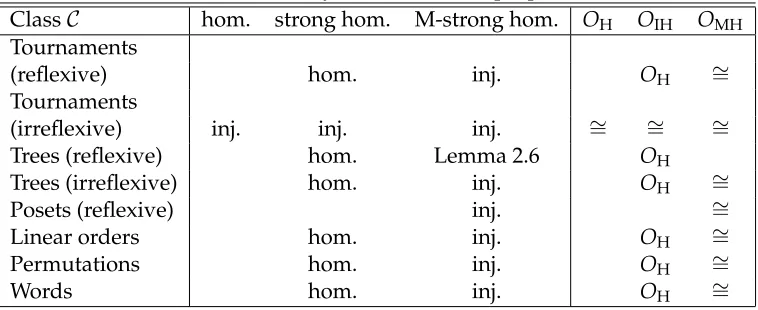
In general, the three orders are distinct, withOMH ⊆OIH ⊆OH. For certain classes of
[image:4.595.114.493.466.621.2]combinato-rial structures, some of the orders may coincide, or reduce to isomorphism. Table 1 summarizes this by indicating when all homomorphisms are strong or M-strong (entries “hom.”) and when some types of homomorphism are necessarily injective (entries “inj.”).
Table 1: Summary of certain order properties
ClassC hom. strong hom. M-strong hom. OH OIH OMH
Tournaments
(reflexive) hom. inj. OH ∼=
Tournaments
(irreflexive) inj. inj. inj. ∼= ∼= ∼=
Trees (reflexive) hom. Lemma 2.6 OH
Trees (irreflexive) hom. inj. OH ∼=
Posets (reflexive) inj. ∼=
Linear orders hom. inj. OH ∼=
Permutations hom. inj. OH ∼=
Words hom. inj. OH ∼=
We justify the claim in the table concerning trees.
Lemma 2.5. For the class of trees (reflexive or irreflexive), every homomorphism is strong and hence OH =OIH.
considering the image of this path under φ, take the shortest subpath connecting u andv; let this beφ(wi),φ(wi+1), . . . ,φ(wj)whereφ(wi) = u andφ(wj) = v. Note that φ(ws) 6= u,vfor
i < s < j. We cannot have j > i+1, since then φ(wi), . . . ,φ(wj),uwould be a cycle. Hence
j=i+1 and(wi,wi+1)is an edge inSwhich is mapped onto(u,v)inT.
Furthermore, we observe that M-strong epimorphisms of reflexive trees are “almost” isomor-phisms.
Lemma 2.6. A mappingφ: T →U is an M-strong epimorphism of reflexive trees if and only ifφis an isomorphism or U is trivial and|T|=2.
Proof. Suppose φis not an isomorphism and letx,y ∈ T be such thatφ(x) = φ(y) = u ∈ U. Suppose |U| > 1, and let v ∈ U be any vertex adjacent to u. Let z ∈ T be any preimage of
v. Then{x,y,z}form a triangle, a contradiction. On the other hand, if U is trivial, then T is complete, and hence a tree only if|T| ≤2.
2.4 PWO and join properties
As described in the Introduction, for each of the three homomorphic image orders, our investi-gations will focus on three aspects, reflecting some fundamental structural properties of posets.
The first such is the property of beingpartially well ordered(see [7], [9] and [4]). A poset(X,)
has this property if it has no infinite antichains and no infinite descending chains. In our context there can never be infinite descending chains, because of size considerations, and we are left to investigate the existence or otherwise of infinite antichains.
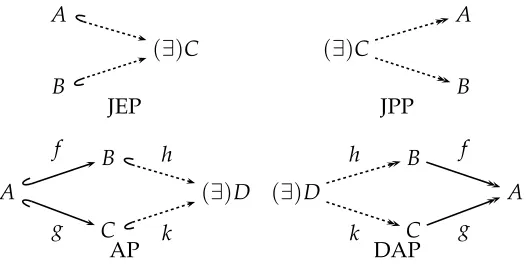
A poset (X,) is said to have the join property if for any two x,y ∈ X there exists z ∈ X such thatx zandy z. When applied to the orderIS this notion becomes the well known
joint embedding property (JEP): a classC has JEP if for any two A,B ∈ C there existsC ∈ C into which both AandBstrongly embed. Paralleling this, each of our homomorphic image orders gives rise to a join-type property. We say thatC has thejoint preimage property(JPP) if for any A,B ∈ Cthere existsC∈ Cwhich has bothAandBas homomorphic images. By strengthening homomorphisms to strong- or M-strong homomorphisms we obtain the strong- and M-strong JPP.
A property related to the JEP is theamalgamation property(AP), which stipulates that for any A,B,C ∈ C, with strong embeddings f : A → B and g : A → C, there exist D ∈ C and strong embeddingsh : B → Dandk : C → Dsuch thath f = kg. We will term the analogue in our context thedual amalgamation property (DAP); it requires that for any A,B,C ∈ C, with epimorphisms f : B → Aandg : C → A, there existD ∈ C and epimorphismsh : D→ Band k :D→Csuch that f h=gk. Again, we also have the strong and M-strong variants of DAP.
The customary diagrams illustrating the definitions of JEP, JPP, AP and DAP are shown in Figure 1
We present our material by proceeding property by property; however, to facilitate compari-son of the main results on an order-by-order basis, three tables (one corresponding to each order) are provided at the end of the paper.
3 Antichains and partial well order
A
(∃)C
B
A
(∃)C
B
JEP JPP
B
A (∃)D
C f
g
h
k
B
(∃)D A
C f
g h
k
[image:6.595.172.435.70.208.2]AP DAP
Figure 1: JEP, JPP, AP and DAP.
equivalence relations in theOIHandOHcases. For a negative answer to the PWO question, it of
course suffices to exhibit the antichain corresponding to the weakest such order, though we will also discuss antichains which differentiate between the three orders.
3.1 Digraphs
We begin by considering digraphs.
Theorem 3.1. LetCbe the class of digraphs.
(i) Let P= {Pn:n(≥4)∈ N}, where digraph Pnhas vertices{1, . . . ,n}and edges
{(i,i+1): 1≤i≤n−1} ∪ {(i,i): 1≤i≤n}
(a directed path). Then P is an antichain with respect to OMH but not with respect to OIH.
(ii) Let G={Gn :n(≥4)∈N}, where Gnhas vertices{1, . . . ,n}and edges
{(i,i+1): 1≤i≤ n−1} ∪ {(n−2,n),(n,n)}
(see Figure 2). Then G is an antichain with respect to OIHbut not with respect to OH.
(iii) Let K={Kn :n(≥2)∈N}, where Knhas vertices{1, . . . ,n}and edges{(i,j): 1≤i< j≤n}
(a linear tournament). Then K is an antichain w.r.t. OH.
Proof. (i) For every pair of distinct vertices {x,y} in Pn, there is some vertex z connected to
precisely one of{x,y}, and soxandycannot be mapped by an M-strong homomorphism to the same image point. HencePnis a minimal element underOMH. Consider the mapping fromPnto
Pn−1given byi7→ ifor 1≤i≤n−1 andn7→ n−1: it is a strong epimorphism. To see that it is
not M-strong, observe that non-edge(n−2,n)and edge(n−2,n−1)are both mapped to edge
(n−2,n−1).
(ii) We first establish that the mappingφ:Gn→Gm(n>m) given by
φ(x) = (
x, x ≤m
m, x >m
1 2 3 4 5 6
Figure 2: DigraphG6from the proof of Theorem 3.1
(n,n)is mapped to(m,m)and edge(n−2,n)is mapped to(m−1,m)ifn= m+1 and(m,m)
otherwise. It is clear thatφis onto; however, since edge(m−2,m)inGm is not the image of an
edge inGn,φis not strong.
We now show that φis the unique onto homomorphism from Gn to Gm. Letθ : Gn → Gm
(n > m) be an onto homomorphism. We claim that θ(1) = 1. Suppose θ(1) = k 6= 1. Let
j ∈ Gn be arbitrary. Since there is a directed path in Gn from 1 to j, in Gm we must have a
directed path fromθ(1) = ktoθ(j). Hence θ(j) 6= 1, and soθ is not onto. Fori = 1, . . . ,m−3 there is a unique edge, namely(i,i+1), coming out ofiin bothGm andGn. Henceθ(i) = ifor
i=1, 2, . . . ,m−2. InGn, there is only one edge coming out ofm−2, namely(m−2,m−1). In
Gm, there are two:(m−2,m−1)and(m−2,m). Henceθ(m−1)∈ {m−1,m}. Ifθ(m−1) =m
thenθ(m) = θ(m+1) = · · · =θ(n) = mbecause of edges(m−1,m),(m,m+1), . . . ,(n−1,n). But thenθ(x)6= m−1, a contradiction. Henceθ(m−1) = m−1 and thenθ(m) = m. Thusθis the mappingφdefined above. Sinceφis not strong, it follows thatGis an antichain underOIH.
(iii) Supposeφ:Km →Kn(m>n) is any mapping. Then there arei,j∈[m](i< j) such that
φ(i) = φ(j) = k. But then the edge(i,j)inKm is mapped to a non-edge(k,k)inKn. Henceφis
not a homomorphism, proving that{Kn:n∈N}is an antichain.
3.2 Graphs
Note that, in the irreflexive case, every complete graph is minimal.
Theorem 3.2. The class of irreflexive graphs has infinitely many minimal elements with respect to OH,
and hence is not PWO.
In the reflexive case, by contrast, the trivial graph is the unique minimal element. Nonethe-less, we have:
Theorem 3.3. The class of reflexive graphs is not PWO with respect to OH.
Proof. Let Gn be the graph on 2n vertices {1, . . . , 2n} such that (2i−1, 2i)is a non-edge (i =
1, . . . ,n) and all other pairs of vertices are edges; see Figure 3. Letφ:Gk →Gl (k >l) be an onto
mapping. For somerinGl,r= φ(p) =φ(q)for distinctp,qinGk (without loss, we assume that
r =1). Recall that(1, 2)is a non-edge inGland consider a preimagesof 2. At least one of(p,s), (q,s)must be an edge, henceφis not a homomorphism.
Remark3.4. Some common families of graphs are antichains with respect toMH, but not with
1 2
3
4 5
[image:8.595.256.363.66.137.2]6
Figure 3: GraphG3from the proof of Theorem 3.3
3 2
1
1 2
3
4 5
Figure 4: T3andT5of Proposition 3.5
setting). Infinite families of graphs which are antichains with respect toOIHbut not with respect
toOHdo not arise so naturally.
3.3 Tournaments
Recall that, for irreflexive tournaments, all homomorphism are injective (see Table 1).
Proposition 3.5. Let n∈ Nbe odd. The tournament Tnon n vertices{1, . . . ,n}given by the rule: for
1≤i<j≤n,
i→j if i 6≡j (mod 2)
j→i if i≡ j (mod 2)
(see Figure 4) has no proper non-trivial homomorphic image within the class of reflexive or irreflexive tournaments.
Proof. It is immediate that a directed triangle (T3) has no non-trivial homomorphic image. We
show that every edge ofTnis in some directed triangle. To see this, consideri,j∈[n]withi< j.
Ifiandjare of the same parity, then j → i. Take anykof opposite parity from both, such that i < k < j; then i → k andk → j. If iand jare of opposite parity, then i → j. If j < n then
{i,j,j+1}form a triangle, while ifj = nthen{1,i,j}form a triangle. Since it is not possible to collapse a directed triangle, the result follows.
Theorem 3.6. The class of reflexive (or irreflexive) tournaments is not PWO with respect to OH.
Proof. The reflexive case is a consequence of Proposition 3.5, while the irreflexive case follows from the non-existence of proper epimorphisms.
3.4 Posets
[image:8.595.206.425.193.287.2]1 2
3 4
5 6
[image:9.595.268.336.66.166.2]7 8
Figure 5: PosetB4from the proof of Theorem 3.8
Theorem 3.7. The class of irreflexive posets has infinitely many minimal elements with respect to OH
and hence is not PWO.
For the reflexive case we have:
Theorem 3.8. The class of reflexive posets is not PWO with respect to OH.
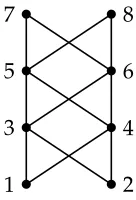
Proof. Let Bnbe the poset on 2nvertices{1, . . . , 2n}such that, for eachi =2, . . . ,n−1: vertices
2i−1 and 2iare incomparable; each covers 2i−2 and 2i−3; and each is covered by 2i+1 and 2i+2; see Figure 5. Letφ:Bk →Bl(k>l) be an onto mapping. For somerinBl,r =φ(p) =φ(q)
for distinct p,qinBk. There is a unique elementsinBl, incomparable tor. Letube a preimage
ofs. At least one ofp,qis comparable tou, say this isp. Thenφmaps the comparable pair(p,u)
to an incomparable pair(r,s), and soφis not a homomorphism.
As with graphs, it is easy to find families of posets which form antichains with respect to the strongest order but not with respect to the two weaker orders. For example, letF ={F1,F2, . . .}
where Fnis the poset on 2nvertices{1, . . . , 2n}such that 2i−1 covers 2i(i = 1, . . . ,n) and all
other pairs of elements are incomparable. Then (in both the reflexive and irreflexive setting)F is an antichain with respect toOMHbut not with respect toOIH. Again, examples distinguishing
betweenOIHandOHdo not arise so naturally.
3.5 Trees
We now consider a class of structure which provides a positive answer to our PWO question, namely trees. We will prove our result for irreflexive trees; the case of reflexive trees then follows. Our strategy involves proceeding via rooted trees. Recall that a rooted treeTmay conveniently be decomposed intolevels; L0is the root, and Li+1 is the set of vertices fromT\ {L0∪. . .∪Li}
adjacent to elements inLi. Thedepthis the largestdsuch thatLd 6=∅.
LetT be the class of irreflexive trees, and letT•be the class of irreflexive rooted trees.
Lemma 3.9. Let T∈ T•be a rooted tree of depth d with root r, and let P be a path with vertices p0, . . . ,pe
and edges(pi,pi+1), i=0, . . . ,e−1. If d≥e then there is an epimorphismφ:T →P withφ(r) = p0.
Proof. LetL0={r},L1, . . . ,Ldbe the levels ofT. The mappingφ:T→ Pdefined by
φ(v) =
pi, ifv∈ Li, 0≤i≤e
pe, ifv∈ Li, e <i≤ dandi≡e (mod 2)
pe−1, ifv∈ Li, e <i≤ dandi≡e+1 (mod 2)
V1
y1
V2
y2
Vl
yl
xk+1 Uk
xk U
2
x2
U1
[image:10.595.214.384.71.190.2]x1
Figure 6: The construction ofτ(P). HereP= (U1, . . . ,Uk;V1, . . . ,Vl), whereU1, . . . ,Uk,V1, . . . ,Vl
are trees rooted atx1, . . . ,xk,y1, . . . ,ylrespectively.
Lemma 3.10. LetC′be the class of irreflexive rooted trees. For every non-trivial S∈ C′, the setAv(S) =
{T ∈ C′ :S6
H T}is PWO.
Proof. Induction on|S|, the case|S|= 2 being trivial by Lemma 3.9. Suppose|S| >2. Letv0be
the root ofS, letd=depth(S)and letv0,v1, . . . ,vd be any path inSof lengthd(notevdmust be
a leaf). LetS′be the treeSwithvdremoved. By induction, Av(S′)is PWO.
Consider an arbitraryT ∈Av(S), with rootr. Letc1, . . . ,ctbe the children ofr. LetTibe the
subtree ofTrooted inci (i= 1, . . . ,t); call these the principal subtrees. We claim that one of the
following holds:
(i) allTi are in Av(S′); or
(ii) if, for somei,S′ HTi, then removingTifromTyields a tree in Av(S′).
For, suppose not, so that (say) each of T1 andT\T1 hasS′ as a homomorphic image. Let
φ : T\T1 → S′ be an epimorphism. Note that depth(T1) ≥ depth(S′) ≥ d−1 because we
are dealing with homomorphisms of rooted trees. By Lemma 3.9, there is a homomorphism ψ:T1→Swithψ(T1) ={v1, . . . ,vd}andψ(c1) =v1. Defineπ :T→Sas follows:
π(v) = (
ψ(v), v ∈T1
φ(v), v 6∈T1.
This is a homomorphism becauseφandψare, andπ(r) =φ(r) =v0,π(c1) =ψ(c1) =v1and
v0,v1are adjacent inS. It is also onto becauseπ(T) =φ(T\T1)∪ψ(T1) =S′∪ {v1, . . . ,vd}=S.
This contradictsT∈Av(S).
By a repeated application of this claim, we see that to every T ∈ Av(S), we can associate a pair of sequences(U1, . . . ,Uk;V1, . . . ,Vl)of members of Av(S′). Starting withT, and supposing
(ii) holds, we let U1 = T\Ti ∈ Av(S′) and T(1) = Ti. We repeat this process, constructing
U1, . . . ,Uk ∈ Av(S′) and T(1), . . . ,T(k) having S′ as a homomorphic image, until all principal
subtreesV1, . . . ,Vl of T(k) lie in Av(S′), at which stage we append them toU1, . . . ,Uk and stop
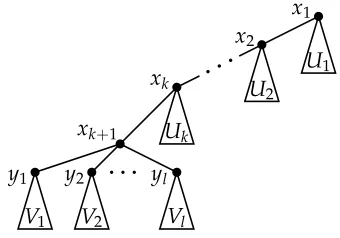
the process. Conversely, every pair of sequences P = (U1, . . . ,Uk;V1, . . . ,Vl)defines a unique
treeτ(P), obtained by connecting the treesU1, . . . ,Uk,V1, . . . ,Vl as indicated in Figure 6.
Denote byP the set of all such pairs of sequences. We define the following ordering onP:
(U1, . . . ,Uk;V1, . . . ,Vl)≤ (U1′, . . . ,U′m;V1′, . . . ,Vn′)
V1′ y′1
Vj′1 y′j1
Vj′l y′jl
Vn′
y′n
xm′ +1 Um′
xm′ U′
ik
x′ik U′
i1 xi′1
[image:11.595.96.462.63.257.2]U1′ x1′
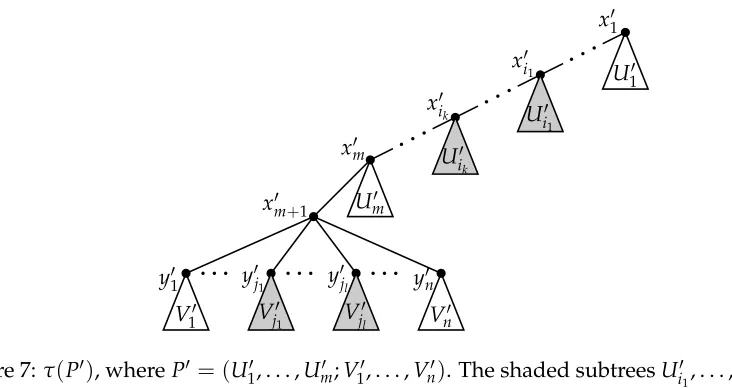
Figure 7:τ(P′), whereP′ = (U1′, . . . ,Um′ ;V1′, . . . ,Vn′). The shaded subtreesUi′1, . . . ,Ui′k,Vj′1, . . . ,Vj′l are mapped ontoU1, . . . ,Uk,V1, . . . ,Vl respectively viaζ.
• k≡ m (mod 2)
and there exist 1≤i1<. . .<ik ≤mand 1≤ j1 <. . .< jl ≤nsuch that
• UsHUi′s, s =1, . . . ,k;
• Vs HVj′s, s=1, . . . ,l;
• is≡s (mod 2).
Since this ordering is derived from the usual subsequence ordering by imposing a couple of finitary restrictions, a standard multiple application of Higman’s Theorem ([7]) yields thatP is PWO.
Next, we prove thatτpreserves ordering. Let
P= (U1, . . . ,Uk;V1, . . . ,Vl)≤ P′ = (U1′, . . . ,Um′ ;V1′, . . . ,Vn′)
withτ(P)andτ(P′)as shown in Figures 6 and 7. By definition, there exist epimorphismsµs :
Ui′s → Us (s = 1, . . . ,k) and νs : Vj′s → Vs (s = 1, . . . ,l). We shall exhibit an epimorphism ζ
sendingτ(P′)toτ(P). The essential idea ofζ is that it maps eachUi′s ontoUsand eachVj′s onto
Vs, while every otherUi′ andVi′ is collapsed to a suitable two-element path. It is to ensure that
the desired connection may be made between eachUi′s and its “natural” imageUs, that parity
conditions feature in the order definition. We defineζ(x′i)fori=1, . . . ,mas follows:
• foris−1<i≤is(settingi0=0),
x′i 7→ (
xs, if(i−is−1)is even
xs+1, if(i−is−1)is odd;
• fori>ik,
x′i 7→ (
xk, if(i−ik)is even
xk+1, if(i−ik)is odd.
• forjs−1< j≤js(settingj0 =0),y′j7→ ys;
• forj> jl,y′ j 7→ yl.
Finally, we defineζonUi′ (i=1, . . . ,m) and onVj′ (j=1, . . . ,n):
• ifi=is,Ui′ is mapped ontoUsviaµs;
• otherwise,Ui′is mapped onto an edge emanating fromζ(x′i), as guaranteed by Lemma 3.9;
• ifj= js,Vj′ is mapped ontoVsviaνs;
• otherwise,Vj′is mapped onto an edge emanating fromζ(y′j), as guaranteed by Lemma 3.9.
A routine check shows thatζis an epimorphism.
Since τis order-preserving and P is PWO, it follows thatτ(P)is PWO, and we have seen thatτ(P)contains Av(S), proving the lemma.
We can now proceed to stating and proving the main results of this section:
Theorem 3.11. LetT•be the class of all irreflexive rooted trees. ThenT•is PWO with respect to O
H.
Proof. Suppose T1,T2, . . . forms an infinite antichain of irreflexive rooted trees. Without loss,
assume that T1is non-trivial. ThenT2,T3, . . . is an infinite antichain in Av(T1), in contradiction
to Lemma 3.10.
Corollary 3.12. LetC be the class of irreflexive trees. ThenCis PWO with respect to OH.
Proof. LetT1,T2, . . . be an infinite collection of irreflexive trees. In eachTi, pick an arbitrary vertex
ri. Denote byTi∗the rooted tree obtained fromTiby designatingri as the root. By Theorem 3.11,
for somei6= jthere exists an epimorphism of irreflexive rooted treesφ: Ti∗ → Tj∗. Thusφmaps edges ofTi to edges ofTj and mapsritorj. In particular,φis also an epimorphism of non-rooted
trees,Ti →Tj, and the corollary follows.
Corollary 3.13. LetC be the class of reflexive trees. ThenCis PWO with respect to OH.
Proof. Let T1,T2, . . . be an infinite collection of reflexive trees. Let Ti′ be the irreflexive tree
ob-tained by removing the loops at each vertex fromTi. By Corollary 3.12, there is an epimorphism
φ:Ti′ → Tj′ for somei6= j. Thusφmaps non-loop edges ofTi to non-loop edges ofTj and, since
φtrivially maps loops ofTito loops ofTj, it follows thatφis also an epimorphismTi →Tj.
3.6 Equivalence relations
Let A = (A,R) and B = (B,S) be equivalence relations. Let A1, . . . ,Ak be the equivalence
classes ofR, andB1, . . . ,Bl be the equivalence classes ofS. As we have seen in Subsection 2.2, a
mappingφ:A→ Bis
• a homomorphism if(∀i)(∃j)(φ(Ai)⊆ Bj);
• a strong homomorphism if it is a homomorphism and for anyy1,y2∈ Bj∩imφwe have
• an M-strong homomorphism if it is a homomorphism and
φ(Ai1),φ(Ai2)⊆Bj ⇒i1 =i2.
From the above definitions, we have the following descriptions ofOH,OIHandOMH:
(E1) A H B ⇔ ∃φ: A→ Bsuch that everyBjis a union of someφ(Ai);
(E2) A IH B ⇔ ∃φ: A→ Bsuch that for anyy1,y2∈ Bj,∃i:y1,y2∈ φ(Ai);
(E3) A MH B ⇔k=land there is a permutation j1, . . . ,jk of 1, . . . ,ksuch thatφ(Ai) =Bji.
We prove that the class of equivalence relations is PWO underOIH, which implies that it is
PWO underOH.
Lemma 3.14. LetA = (A,R)andB = (B,S)be two equivalence relations. If R has k non-singleton equivalence classes,|B|=n and k≥n2thenB
IHA.
Proof. Let A1, . . . ,Akbe the non-singleton equivalence classes ofR. Since
k≥n2=|B|2 ≥ |S|
there exists a surjection f : {A1, . . . ,Ak} → S. Since|Ai| ≥2, there exists a surjectionφi : Ai →
{b′,b′′}where f(A
i) = (b′,b′′) ∈ S. Let φ′ : A\(Ski=1Ai) → B be arbitrary. The mapping
φ= (Sk
i=1φi)∪φ′is an epimorphism, and indeed strong by (E2).
Theorem 3.15. The class of equivalence relations is PWO with respect to OIH(and hence also with respect
to OH).
Proof. LetAs = (As,Rs)(s = 1, 2, . . .) be an infinite collection of equivalence relations. Letcsbe
the number of non-singleton equivalence classes ofRs. We distinguish two cases.
Case 1: {cs : s ∈ N}is unbounded. Lets ∈ Nbe such thatcs ≥ |A1|2. By Lemma 3.14, we have
A1 IHAs.
Case 2: {cs :s ∈N}is bounded. Without loss we may assume thatc1 = c2= · · · =c. So, eachRs
has preciselycnon-singleton classes, sayAs,1,As,2. . . ,As,c, and, say,tssingleton ones. Consider
the collection of(c+1)-tuples
{(|As,1|, . . . ,|As,c|,ts):s=1, 2, . . .}.
By Higman’s Theorem ([7]), this is PWO with respect to tuple ordering. Hence there are distinct u,v∈Nsuch that
(|Au,1|, . . . ,|Au,c|,tu)≤(|Av,1|, . . . ,|Av,c|,tv).
Hence there are onto mappingsφd : Av,d → Au,dandφ′ : Av\(Sdc=1Av,d)→ Au\(Scd=1Au,d).
Their unionφ:(Sc
d=1φd)∪φ′ is an epimorphism, which is strong by (E2).
Theorem 3.16. LetCbe the class of equivalence relations. ThenCis not PWO with respect to OMH.
Proof. LetAn = (An,Rn)whereRnhas preciselynequivalence classes. Then(A1,A2, . . .)is an
3.7 Linear orders, words and permutations
Proposition 3.17. The class of linear orders is PWO with respect to OHand OIH, but not with respect to
OMH.
Proof. A chain may be mapped onto any shorter chain underOH; the other cases follow from
Table 1.
Proposition 3.18. Neither of the following classes is PWO with respect to OH:
• the class of words over a non-singleton alphabet;
• the class of permutations.
Proof. In the word case, an infinite antichain is given by any infinite collection of words with no consecutive occurrences of any letter, for example(ab)n, n ∈ N. Likewise, in the
permuta-tion case, any infinite set of permutapermuta-tions without non-trivial intervals (also known as simple permutations) would suffice; there are many such examples in the literature (see [1] and [2]).
4 Joint Preimage Property
Here, we address the question: for a given class C under a given homomorphic image order, does C possess the joint preimage property (JPP)?Unlike in the previous section, there is no single consis-tent division in behaviour between M-strong order and the other two; the orders are “grouped” differently as we move between different classes of structures. From the tables, the following patterns are observable: the answer to the JPP question is negative in all cases for the M-strong homomorphic image order, approximately half-and-half for the strong homomorphic image or-der, and largely positive for the homomorphic image order.
We first consider classes of structure which do not possess the JPP property under any of the three orders; in each case, it is sufficient to prove the assertion forOH.
Theorem 4.1. The class of irreflexive trees does not possess the JPP under any of the homomorphic image orderings.
Proof. This follows from the fact that the single-vertex tree is not the homomorphic image of any tree other than itself.
We observe that the class ofnon-trivialirreflexive trees would possess JPP, via a proof similar to that for reflexive trees (Theorem 4.5).
Theorem 4.2. The class of tournaments (irreflexive or reflexive) does not possess the JPP under any of the homomorphic image orderings.
Proof. The irreflexive case is trivial, since irreflexive tournaments are minimal. We consider the reflexive case. Let A = T3 and B = T5 from Proposition 3.5. So A is the directed triangle
a →b→c→a, and neither ofAnorBhas proper non-trivial homomorphic image.
Suppose AandB have a joint preimageC, say withφ : C → Aandψ : C → B. For every x ∈ A, pick a preimagex′ ∈ Cunderφ. Then A′ = {a′,b′,c′}is a tournament isomorphic to A. Likewise, there exists a tournamentB′ ={x′ : x∈ B}insideCwhich is isomorphically mapped
ontoBunderψ.
SinceBhas no proper non-trivial homomorphic image and|B|>|A|, it follows thatφ(B′)is
Theorem 4.3. Neither of the following possesses the JPP under any of the homomorphic image orderings: (i) the class of words over a non-singleton alphabet, (ii) permutations.
Proof. In the word case, a counterexample is given by taking any two distinct letters from the alphabet, and in the permutation case by taking 12 and 21.
Next, we consider those classes which possess the JPP under OH, but not under the two
stronger orders.
Theorem 4.4. The following classes possess the JPP under OHbut not under OIHor OMH: (i) digraphs,
(ii) irreflexive graphs, (iii) irreflexive posets.
Proof. To prove that digraphs possess the JPP under OH, it is sufficient to note that an empty
graph has any other smaller digraph as a homomorphic image. On the other hand, any preimage of an empty digraph is empty, while any strong preimage of a non-empty digraph is non-empty. Hence, such a pair of graphs cannot join. To complete the proof, note that empty digraphs belong to all three listed classes.
Finally, we consider those classes which possess JPP underOIH(and henceOH) but not under
OMH.
Theorem 4.5. The following classes possess the JPP under OH and OIH, but not OMH: (i) reflexive
graphs, (ii) reflexive trees, (iii) reflexive posets, (iv) equivalence relations, (v) linear orders.
Proof. LetCbe any of the above classes, and letA,B∈ C. TakeCto be:
• the disjoint union ofAandBin cases (i), (iii), (iv);
• a union ofAandBwith a single-vertex intersection in case (ii);
• the order sum ofAandBin case (v).
Note thatC∈ Cin each case. Furthermore, bothAandBare strong homomorphic images ofC. For instance, we can map a copy of AinsideCbijectively onto A, and map the copy of Bto an appropriate single point ofA. HenceChas the JPP underOIH.
We now prove thatC does not possess the JPP underOMH. In cases (ii), (iii), (v) this is due
to minimality; see Table 1. For cases (i), (iv) note that every M-strong preimage of a complete digraph is necessarily complete, while an M-strong preimage of the (reflexive) empty digraph is a disjoint union of complete digraphs. Hence two such digraphs do not join.
5 Dual amalgamation property
We now move on to our final question: for a given classC under a given homomorphic image order,
does C possess the dual amalgamation property (DAP)? In this context, the arguments necessary
for each of the three types of order are rather different in nature. This is due to the fact that epimorphisms feature under the assumptions for this property, and therefore, say, DAP for the M-induced order is not a specialisation of DAP for the induced order. Despite this, it transpires that the answer to the DAP question is positive for most classes and orders.
We begin with the following lemma:
Proof. LetA,B,Cbe sets and let f : B→ A,g:C→ Abe surjections. We will prove the existence of a set Dand epimorphismsh : D → Bandk : D → C such that f h = gk. For each a ∈ A, consider the sets f−1(a) ⊆ Bandg−1(a) ⊆ C; both are non-empty. LetD
a be pairwise disjoint
sets such that |Da| ≥ max(|f−1(a)|,|g−1(a)|). Letha : Da → f−1(a)andka : Da → g−1(a)be
arbitrary surjections. Let D = S
a∈ADa, h = Sa∈Aha andk = Sa∈Aka. Since im(ha) = f−1(a)
andS
a∈A f−1(a) =B, we have thathis onto. Analogously,kis onto. Letd∈ D, sayd∈ Da. Then
h(d) =ha(d)∈ f−1(a)andk(d) =ka(d)∈g−1(a). Hence f h(d) =a =gk(d), as required.
Theorem 5.2. The following classes possess the DAP with respect to OH: (i) digraphs, (ii) reflexive
graphs, (iii) irreflexive graphs, (iv) reflexive posets, (v) irreflexive posets, (vi) irreflexive tournaments, (vii) equivalence relations, (viii) linear orders, (ix) words.
Proof. Case (vi) is immediate becauseOMHreduces to isomorphism (see Table 1).
For cases (i), (ii), (iii), (iv), (v), (vii) and (viii), we apply Lemma 5.1. For example, given digraphs A, B, Cand epimorphisms f : B → A, g : C → A, apply the process in the proof of Lemma 5.1 to the vertices ofA,BandCto obtain the vertices ofD=S
a∈ADa, and takeDto be
the empty digraph on these vertices. This construction may then be appropriately adapted, with “empty digraph” replaced by the appropriate analogous structure: reflexive/irreflexive empty graph in cases (ii) and (iii), reflexive/irreflexive antichain in cases (iv) and (v), the diagonal relation in case (vii) and the order-sum of chainsDain case (viii).
For case (ix), let A,B,Cbe words and f : B → A, g : C → Abe epimorphisms. Suppose A = xα1
1 x α2
2 . . .x αk
k wherex1, . . . ,xk ∈ Xandxi 6= xi+1. The existence of homomorphisms f and
gimplies that BandChave the same “form” asAbut with different exponents; more precisely B=xβ1
1 . . .x βk
k andC =x γ1
1 . . .x γk
k whereβi,γi ≥ αi. ThenD=x δ1
1 . . .x δk
k whereδi =max(βi,γi),
with the obvious mappingsh:D→ B,k :D→C, satisfies the definition of DAP.
Theorem 5.3. The following classes do not possess the DAP with respect to OH: (i) reflexive trees, (ii)
irreflexive trees, (iii) reflexive tournaments, (iv) permutations.
Proof. Cases (iii) and (iv) follow since, for each class, the JPP does not hold and the trivial struc-ture is a homomorphic image of each member.
For cases (i) and (ii), let Abe a star with four vertices{1, 2, 3, 4}and edges(1, 2), (1, 3)and
(1, 4). Let B = {b1, . . . ,b11}andC = {c1, . . . ,c11}be paths of length 11, and let f : B → Aand
g:C→ Abe the epimorphisms given by:
f =
b1 b2 b3 b4 b5 b6 b7 b8 b9 b10 b11
1 4 1 3 1 2 1 3 1 4 1
g =
c1 c2 c3 c4 c5 c6 c7 c8 c9 c10 c11
1 3 1 4 1 2 1 4 1 3 1
.
Suppose there exists a treeDand epimorphismsh : D → Bandk : D → Csuch that f h = gk. Let p,q ∈ Dbe such that h(p) = b4, h(q) = b6 and the unique path p = d1,d2, . . . ,dk = qis
shortest possible. Then of courseh(di)∈ {p,/ q}fori6=1,k. It then follows that in facth(di) =b5
fori= 2, . . . ,k−1. Hence we have f h({d1, . . . ,dk}) = {3, 1, 2}. (In the irreflexive case we must
havek = 3.) Consider now the image of the pathd1, . . . ,dk inC. Its vertices form a contiguous
segmentcl, . . . ,cm. From the definition ofgwe see that no such contiguous segment is mapped
preciselyonto the set{3, 1, 2}. Hence f h6=gk.
Theorem 5.4. The following classes possess the DAP with respect to OIH: (i) digraphs, (ii) reflexive
graphs, (iii) irreflexive graphs, (iv) reflexive posets, (v) irreflexive posets, (vi) irreflexive tournaments, (vii) equivalence relations, (viii) linear orders, (ix) words.
Proof. For case (i), letA,B,Cbe digraphs and let f : B→A,g:C→ Abe strong epimorphisms. We will prove the existence of a digraphDand epimorphismsh : D → Bandk : D → Csuch that f h= gk.
For every edgeα= (a1,a2)inE(A), there are edges
(F(α,a1),F(α,a2))∈ E(B)and(G(α,a1),G(α,a2))∈E(C)
such that
f(F(α,a1)) =a1,f(F(α,a2)) =a2,g(G(α,a1)) =a1,g(G(α,a2)) =a2.
We construct D as follows. For every edge β = (b1,b2) ∈ E(B), let DB,β = {d1,β,d2,β},
and for every edge γ = (c1,c2) ∈ E(C), let DC,γ = {d1,γ,d2,γ}. Now let D = DB∪DC where
DB =Sβ∈E(B)DB,βandDC = S
γ∈E(C)DC,γ, and let the edges be
E(D) ={(d1,β,d2,β): β∈ E(B)} ∪ {(d1,γ,d2,γ):γ∈ E(C)}.
We now define homomorphismsh : D → Bandk : D → Cas follows. Forx = di,β ∈ DB,β,
withβ= (b1,b2), we leta1 = f(b1),a2= f(b2), note thatα= (a1,a2)∈ E(A), and define
h(x) =bi, k(x) =G(α,ai).
Analogously, for x = di,γ ∈ DC,γ with γ = (c1,c2), we let a1 = g(c1), a2 = g(c2), note that
α= (a1,a2)∈E(A), and define
h(x) =F(α,ai), k(x) =ci.
From this definition it is clear that h maps edges of D onto the edges of B, and does so bijectively when restricted toDB. Henceh, and duallyk, are strong epimorphisms.
We claim that f h = gk. Indeed, let x ∈ D, and without loss, assume x = d1,β. With the
notation as above
f h(x) = f h(d1,β) = f(b1) =a1 =g(G(α,a1)) =gk(d1,β) =gk(x),
as required.
We may adapt this proof for cases (ii), (iii), (iv), (v) and (vii); for irreflexive graphs and posets the argument follows the digraph proof precisely. For reflexive graphs and posets and for equiv-alence relations, loops at every vertex must be added in the construction.
Cases (vi), (viii) and (ix) all follow from Theorem 5.2 and the fact that all homomorphisms are strong (see Table 1).
Theorem 5.5. The following classes do not possess the DAP with respect to OIH: (i) reflexive trees, (ii)
irreflexive trees, (iii) reflexive tournaments, (iv) permutations.
In the M-strong case, it turns out that the dual amalgamation property holds for all-but-one of the types of structure under consideration, but for reasons that are rather different to those we have seen so far. Essentially, in order for A, BandCto possess surjective homomorphisms f : B → A and g : C → A under the M-strong definition, the situation is already very constrained, with the structure ofBandCbeing tightly controlled by that ofA. This allows the construction of a suitableD, also determined byA. It is worth recalling that the Joint Preimage Property does not hold for any of the classes underOMH.
Theorem 5.6. All the following classes possess DAP with respect to OMH: (i) digraphs, (ii) reflexive
graphs, (iii) irreflexive graphs, (iv) reflexive trees, (v) reflexive posets, (vi) irreflexive posets, (vii) reflexive tournaments, (viii) irreflexive tournaments, (ix) equivalence relations, (x) linear orders, (xi) permutations, (xii) words.
Proof. For case (i), let A, B,C be digraphs and let f : B → A, g : C → Abe M-strong
epimor-phisms. We will prove the existence of a digraphDand M-strong epimorphismsh: D→Band k :D→Csuch that f h=gk.
For each a ∈ A, define B(a) = f−1(a)andC(a) = g−1(a). Since f andgare onto, we have
B = S
a∈AB(a)andC = S
a∈AC(a). LetD(a)(a ∈ A) be pairwise disjoint sets with |D(a)| ≥
max(|B(a)|,|C(a)|). Letha : D(a) → B(a)andka : D(a) → C(a) be arbitrary surjections. Let
D= S
a∈AD(a),h= S
a∈Ahaandk= Sa∈Aka.
Define a digraph structure onDas follows: ford1,d2 ∈Dwithdi ∈ D(ai)(a1,a2 ∈ A), we let
(d1,d2)∈E(D)⇔(a1,a2)∈E(A). (1)
SinceD=S
a∈AD(a),B= S
a∈AB(a)andha :D(a)→B(a)is onto, it follows thath: D→B
is onto. For arbitraryd1,d2 ∈D, withdi ∈D(ai), letbi =h(di)∈ B(ai), and then
(d1,d2)∈E(D)⇔(a1,a2)∈E(A) (by (1))
⇔(f(b1),f(b2))∈ E(A) (sinceBi = f−1(ai))
⇔(b1,b2)∈ E(B) (since f is M-strong)
⇔(h(d1),h(d2))∈ E(B) (sincebi =h(di))
Hencehis an M-strong homomorphism, and so iskby an analogous argument.
Finally, we check that f h = gk. Letd ∈ D, sayd ∈ D(a). Thenh(d) = ha(d)∈ B(a)and so
f h(d) =a. By symmetry,gk(d) =aand hence f h= gk.
The digraph construction may also be used to establish the result in cases (ii), (iii), (vi) and (ix). Cases (v), (vii), (viii), (x), (xi) and (xii) are trivial, sinceOMH reduces to isomorphism; see
Table 1. Case (iv) follows similarly from Lemma 2.6.
Theorem 5.7. The class of irreflexive trees does not possess DAP with respect to OMH.
Proof. Let A,BandCbe the paths 1−2, 3−4−5 and 6−7−8 respectively. Let f :B→ Aand g:C→ Abe M-strong homomomorphisms defined by
f =
3 4 5 2 1 2
, g=
6 7 8 1 2 1
.
2 are connected in A, and f h = gkis an M-strong homomorphism, it follows that every vertex fromD1is connected to every vertex fromD2. Furthermore
D1= (gk)−1(1) =k−1g−1(1) =k−1{6, 8},
implying that|D1| ≥ 2 and, likewise,|D2| ≥ 2. But then the edges between D1 and D2 must
form cycles, contradictingDbeing a tree.
6 Concluding remarks
In this paper we have begun an investigation into the homomorphic image order, structured around the three topics of partial well-order, joint preimage property and dual amalgamation property. There are of course many avenues open for future investigation. The antichain results presented here give a fairly uniform picture; this undoubtedly changes in the presence of avoid-ance restrictions. So one possible research direction is: in each of our contexts, classify partially well-ordered classes defined by a small number of small obstructions. In the setting of substruc-ture order, the Joint Embedding Property and the Amalgamation Property lead to the notions of atomic and homogeneous structures. It is natural to ask whether our ordersOH,OIHandOMH
admit of a similar treatment, and whether this would lead to interesting combinatorial objects with universal properties.
Acknowledgement. The authors are grateful to an anonymous referee for a careful reading of the paper and helpful comments.
References
[1] M. Albert and M. Atkinson, Simple permutations and pattern restricted permutations, Dis-crete Math. 300 (2005), 1–15.
[2] R. Brignall, A survey of simple permutations, Permutation patterns, 41–65, London Math. Soc. Lecture Note Ser. 376, Cambridge Univ. Press, Cambridge, 2010.
[3] P.J. Cameron and P.A. Kazanidis, Cores of symmetric graphs, J. Austral. Math. Soc. 85 (2008), 145–154.
[4] G. Cherlin, Forbidden substructures and combinatorial dichotomies: WQO and universal-ity, Discrete Math. 311 (2011), 1543–1584.
[5] J. Foniok, J. Neˇsetˇril and C. Tardif, Generalised dualities and maximal finite antichains in the homomorphism order of relational structures, Europ. J. Combinat. 29 (2008), 881–899.
[6] P. Hell and J. Neˇsetˇril, Graphs and Homomorphisms, Oxford Lecture Series in Mathematics and its applications 28, Oxford University Press, Oxford, 2004.
[7] G. Higman, Ordering by divisibility in abstract algebras,Proc. London Math. Soc. 2 (1952), 326–336.
[8] W. Hodges, Model theory, Cambridge University Press, 1993.
[10] L. Kwuida and E. Lehtonen, On the homomorphism order of labeled posets, Order 28 (2011), 251–265.
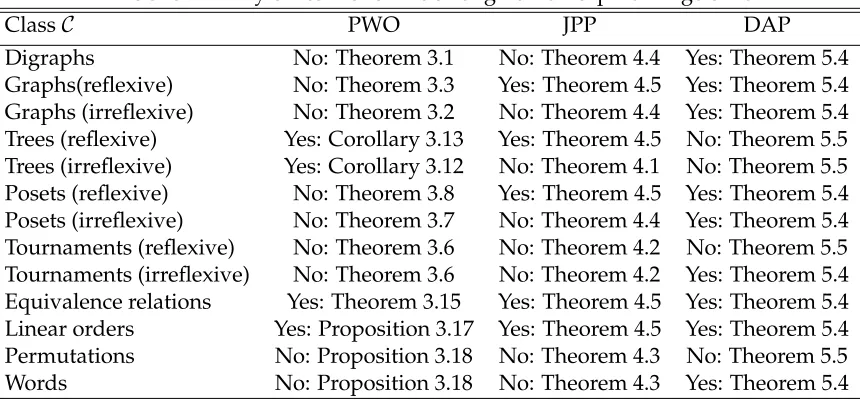
Table 2: Summary of results for the homomorphic image order
ClassC PWO JPP DAP
Digraphs No: Theorem 3.1 Yes: Theorem 4.4 Yes: Theorem 5.2
Graphs(reflexive) No: Theorem 3.3 Yes: Theorem 4.5 Yes: Theorem 5.2 Graphs (irreflexive) No: Theorem 3.2 Yes: Theorem 4.4 Yes: Theorem 5.2 Trees (reflexive) Yes: Corollary 3.13 Yes: Theorem 4.5 No: Theorem 5.3 Trees (irreflexive) Yes: Corollary 3.12 No: Theorem 4.1 No: Theorem 5.3 Posets (reflexive) No: Theorem 3.8 Yes: Theorem 4.5 Yes: Theorem 5.2 Posets (irreflexive) No: Theorem 3.7 Yes: Theorem 4.4 Yes: Theorem 5.2 Tournaments (reflexive) No: Theorem 3.6 No: Theorem 4.2 No: Theorem 5.3 Tournaments (irreflexive) No: Theorem 3.6 No: Theorem 4.2 Yes: Theorem 5.2 Equivalence relations Yes: Theorem 3.15 Yes: Theorem 4.5 Yes: Theorem 5.2 Linear orders Yes: Proposition 3.17 Yes: Theorem 4.5 Yes: Theorem 5.2 Permutations No: Proposition 3.18 No: Theorem 4.3 No: Theorem 5.3
Words No: Proposition 3.18 No: Theorem 4.3 Yes: Theorem 5.2
Table 3: Summary of results for the strong homomorphic image order
ClassC PWO JPP DAP
Digraphs No: Theorem 3.1 No: Theorem 4.4 Yes: Theorem 5.4
Graphs(reflexive) No: Theorem 3.3 Yes: Theorem 4.5 Yes: Theorem 5.4 Graphs (irreflexive) No: Theorem 3.2 No: Theorem 4.4 Yes: Theorem 5.4 Trees (reflexive) Yes: Corollary 3.13 Yes: Theorem 4.5 No: Theorem 5.5 Trees (irreflexive) Yes: Corollary 3.12 No: Theorem 4.1 No: Theorem 5.5 Posets (reflexive) No: Theorem 3.8 Yes: Theorem 4.5 Yes: Theorem 5.4 Posets (irreflexive) No: Theorem 3.7 No: Theorem 4.4 Yes: Theorem 5.4 Tournaments (reflexive) No: Theorem 3.6 No: Theorem 4.2 No: Theorem 5.5 Tournaments (irreflexive) No: Theorem 3.6 No: Theorem 4.2 Yes: Theorem 5.4 Equivalence relations Yes: Theorem 3.15 Yes: Theorem 4.5 Yes: Theorem 5.4 Linear orders Yes: Proposition 3.17 Yes: Theorem 4.5 Yes: Theorem 5.4 Permutations No: Proposition 3.18 No: Theorem 4.3 No: Theorem 5.5
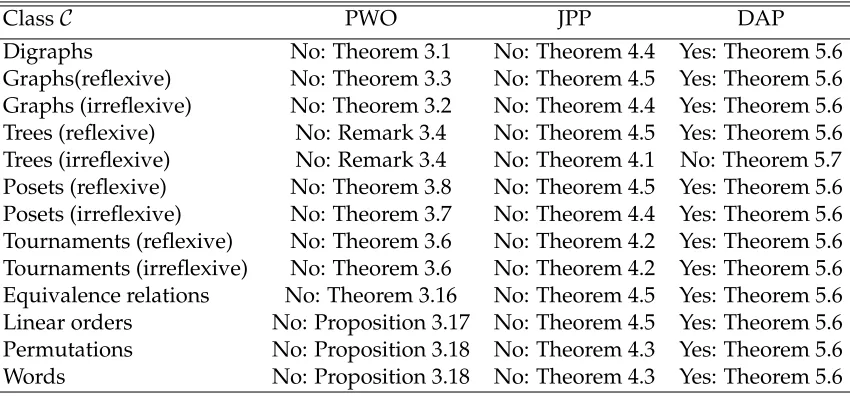
[image:21.595.89.519.464.665.2]Table 4: Summary of results for the M-strong homomorphic image order
ClassC PWO JPP DAP
Digraphs No: Theorem 3.1 No: Theorem 4.4 Yes: Theorem 5.6
Graphs(reflexive) No: Theorem 3.3 No: Theorem 4.5 Yes: Theorem 5.6 Graphs (irreflexive) No: Theorem 3.2 No: Theorem 4.4 Yes: Theorem 5.6 Trees (reflexive) No: Remark 3.4 No: Theorem 4.5 Yes: Theorem 5.6 Trees (irreflexive) No: Remark 3.4 No: Theorem 4.1 No: Theorem 5.7 Posets (reflexive) No: Theorem 3.8 No: Theorem 4.5 Yes: Theorem 5.6 Posets (irreflexive) No: Theorem 3.7 No: Theorem 4.4 Yes: Theorem 5.6 Tournaments (reflexive) No: Theorem 3.6 No: Theorem 4.2 Yes: Theorem 5.6 Tournaments (irreflexive) No: Theorem 3.6 No: Theorem 4.2 Yes: Theorem 5.6 Equivalence relations No: Theorem 3.16 No: Theorem 4.5 Yes: Theorem 5.6 Linear orders No: Proposition 3.17 No: Theorem 4.5 Yes: Theorem 5.6 Permutations No: Proposition 3.18 No: Theorem 4.3 Yes: Theorem 5.6