On the functional group tolerance of ester hydrogenation
and polyester depolymerisation catalysed by ruthenium
complexes of tridentate amino-phosphine ligands.
José A. Fuentes,
[a]Samuel M. Smith,
[a]M. Theresa Scharbert,
[a]Ian Carpenter,
[a]David B.
Cordes,
[a]Alexandra M. Z. Slawin,
[a]and Matthew L Clarke*
[a]School of Chemistry, University of St Andrews EaStCHEM, St. Andrews, Fife, KY16 9ST (UK) Fax: (+44)1334-463808
E-mail: [email protected]
Abstract: The synthesis of a range of diamine, amino-alcohol, and
phosphine-amino-amide ligands and their ruthenium(II) complexes are reported. Five of these were characterised
by X-ray crystallography. The activity of this collection of catalysts was initially compared for the
hydrogenation of two model ester hydrogenations. Turnover frequencies up to 2400 h
-1were observed
at 85
oC. The catalysts turnover, albeit slowly at near ambient temperatures. Using a phosphine
diamine Ru(II) complex that was identified as the most active catalyst, a range of aromatic esters were
reduced in high yield. The hydrogenation of alkene-, diene-, and alkyne functionalised esters was also
studied. Substrates with a remote, but reactive terminal alkene substitutent could be reduced
chemoselectively in the presence of 4-dimethylaminopyridine (DMAP) co-catalyst. The
chemoselective reduction of the ester function in conjugated dienoate ethyl sorbate could deliver
(2
E
,4
E
)-hexa-2,4-dien-1-ol, a precursor to leaf alcohol. The mono-unsaturated alcohol (
E
)-hex-4-en-1-ol was produced with reasonable selectivity, but complete chemoselectivity of C=O over the diene is
elusive. High chemoselectivity for the reduction of an ester over an alkyne group was observed in the
hydrogenation of an alkynoate for the first time. The catalysts were also active in the depolymerisation
reduction of samples of waste PET to produce benzene dimethanol. These depolymerisations were
found to be poisoned by the ethylene glycol side product, although good yields could still be achieved.
The catalytic reduction of esters to alcohols using molecular hydrogen can be considered an attractive method relative to the use of stoichiometric reducing agents. Improved atom economy, reduced cost, and safer, easier product isolation are key advantages. Heterogeneous metal surface catalysts can accomplish this task rather well, but generally at high
pressures.[1] Moreover, many useful functional groups such as alkene, halide, ketone, benzyl, and sometimes even
phenyl groups are hydrogenated under typical ester hydrogenation conditions. Homogeneous catalytic ester hydrogenation has been put forward as a potentially valuable reaction that could be chemoselective and operate under
mild conditions.[2,4] For a long time and until quite recently, this was just a possibility,[4] but in recent years ester
hydrogenation has come of age.[5] A variety of catalysts have now given encouraging results. Our interest in this reaction
started around ten years ago with a study of the chiral phosphine-diamine catalyst 1. However, fairly moderate results
were observed for ester hydrogenation using procedures that we had optimised for enantioselective ketone reduction
using this catalyst.[6(a)] More recently, noticing the tendency for more modern ester hydrogenation catalysts to need
rather large base/catalysts ratios, we communicated the use of achiral catalyst 4, which can reduce aromatic esters at
near ambient temperatures, providing base:catalyst ratios of 30 to 50 are employed.[7] Here we give a full account of this
[image:2.595.73.268.261.435.2]work, including comparisons to other related ligand systems. We also now address the unresolved question of the relative rates of reduction of esters, alkene, diene and alkyne functional groups, and study the depolymerisation of a polyester.
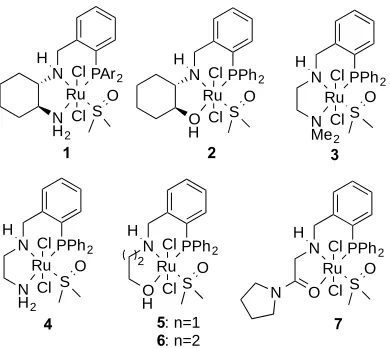
Figure 1. Ruthenium complexes of phosphine-diamine, phosphine-amino-alcohol and phosphine-amino-amide ligands used in this study.
Results and Discussion
The chiral ketone hydrogenation catalysts 1, 2 and achiral 3 were prepared as described before;[6] an optimised
synthesis of 2 and 4 at multi-gram scale is archived in the experimental section (E.S.I). The synthesis of new Ru
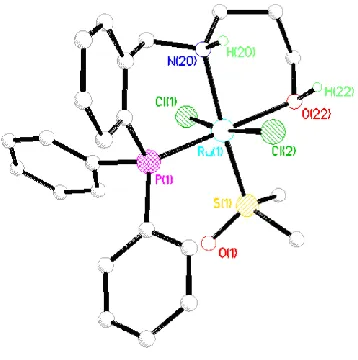
complexes 5-7 is also described. The crystal structure of 2 has now been solved and is shown in Fig. 2. While the
formula has always been clear from the NMR, MS and microanalytical data, this structure confirms several aspects that
were not known. The structure shows the meridional coordination of the P,N,O ligand. The DMSO ligand is coordinating
through sulfur, rather than oxygen, and the chlorides adopt mutually trans orientations. The phosphine amino-alcohol is
in a neutral coordination mode with the nitrogen atom becoming chiral at N on coordination to Ru. In many ways this
structure is similar to the structure of 1 that we previously reported.[6(a)]
N PPh2
N H2 Ru S Cl Cl H O N PAr2
N H2 Ru S Cl Cl H O
N PPh2
N Me2 3 Ru S Cl Cl H O N PPh2
O H 2 Ru S Cl Cl H O 4
N PPh2
O H Ru S Cl Cl H O
5: n=1
6: n=2
2 N PPh2
Figure 2. X-ray structure of complex 2. Two acetonitrile molecules and hydrogen atoms (except NH and OH) are omitted for clarity. Selected bond lengths (Å) and bond angles (deg): Ru–P(1) = 2.256(1), Ru–N(20) = 2.151(5), Ru–O(21) = 2.205(3), O(21)–Ru–P(1) = 171.31(9), N(20)–Ru–P(1) = 92.3(1), N(20)–Ru–O(21) = 79.2(1).
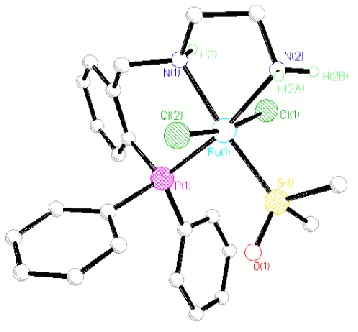
Figure 3. X-ray structure of complex 4. One molecule of acetonitrile and hydrogen atoms (except NH and NH2) are omitted for clarity. Selected
[image:3.595.81.260.340.506.2]Figure 4. X-ray structure of complex 7. Hydrogen atoms (except NH) are omitted for clarity. Selected bond lengths (Å) and bond angles (deg): Ru–P(1) = 2.254(1), Ru–N(20) = 2.152(4), Ru–O(2) = 2.156(3), O(2)–Ru–P(1) = 170.66(9), N(20)–Ru–P(1) = 93.4(1), N(20)–Ru–O(2) = 77.2(1).
Figure 5. X-ray structure of complex 6. Hydrogen atoms (except NH and OH) are omitted for clarity. Selected bond lengths (Å) and bond angles (deg): Ru–P(1) = 2.254(1), Ru–N(20) = 2.200(4), Ru–O(22) = 2.188(3), O(22)–Ru–P(1) = 175.5(1), N(20)–Ru–P(1) = 92.1(1), N(20)–Ru–O(22) = 87.2(1).
The synthesis of the achiral ethylene diamine derived catalyst 4 is described in the experimental section (E.S.I) and
works well providing the optimised procedure is followed. This was characterised by X-ray crystallography (Fig. 3). This
complex has a rather similar structure to the phosphine amino-alcohol complex 2; a similar meridional neutral
coordination mode, sulfur bound DMSO ligand, trans chloride ligands are all observed. Ru(II) complex 7 and its ligand
precursor, are, to the best of our knowledge, new species and can also be synthesised conveniently at multigram scale (E.S.I). This ligand was explored since it has a very low steric demand around the amide oxygen, but this terminus also cannot be readily deprotonated or form hydrogen bonds under the reaction conditions. The Ru(II) complex was also structurally characterised (Fig. 4.). As expected this is a PNO donor ligand that prefers a meridional coordination. The relative orientation and coordination mode of the chloride and DMSO ligands is as discussed above. The nitrogen of the
amide is, as expected, planar as clearly indicated by the short Csp2–Nsp2 bond length of 1.326(7) Å and the N–C–O
angle (120.6(4) deg.). With this series of complexes and the previously published structure of 1,[6(a)]it can be seen that
the longer Ru–P bond lengths across the series correspond to PNN complexes 1 and 4, 2.2912 (13) and 2.2806(7) Å
respectively. The PN-alcohol complexes 2 and 6 and PN-amido complex 7 all have shorter Ru–P bonds due to the fact
[image:4.595.85.264.376.556.2]Ru–O bond is shorter, 2.156(3) Å, in comparison to complexes 2 and 6, 2.205(3) and 2.188(3) Å respectively. Geometry
around the metal centre exerts an important effect in catalysis. The PNN and PNO ligands used in complexes 1-5 and 7
are chelating the Ru centre via a P atom and the N or the O atoms, thus forming one 6-membered and one 5-membered chelate ring. Complex 6,with two 6-membered chelate rings,was prepared in order to study the effect of increasing the size of the chelate ring of the pre-catalyst in the ester hydrogenation reaction. Ru complex 6 and its ligand precursor are, to the best of our knowledge, new species (full details in the E.S.I.). N–Ru–O angle on complex 6 was, as expected, the
largest, 87.2(1) deg., followed by PNO complex 2 (79.2(1) deg.) and amido complex 7 with an angle of 77.2(1) deg. The
N–Ru–N angle in PNN complex 4 (79.89(7) deg)was very similar to the N–Ru–O angle in 2 (79.2(1)).
With a range of pre-catalysts in hand, it was felt that some useful information on catalyst design could be obtained from testing this family in the catalytic hydrogenation of esters. Our initial screening methodology used a simple aromatic
ester, para-fluorobenzoic acid methyl ester 8 as substrate (Table 1). In order to compare the performance of catalysts
under similar conditions, several small reactor vials were placed inside larger pressure vessels. It can be seen that each of these stirs to the same extent and will be under the same pressure and heat. These conditions are suited to comparing a single variable, keeping other conditions constant, and have been used in many other studies in our group. These are not necessarily optimised conditions in terms of turnover or minimising pressures; gas mixing relative to a large vessel with direct stirring will not be as effective, hence the use of 50 bar pressure to minimise mass transport
problems. Catalysts 1-7 were initially examinedat 65 ºC for just 2 hours using base: catalyst ratios of 50:1 (entries 1-7).
Table 1. Hydrogenation of para-fluorobenzoic acid methyl ester using [RuCl2(P^N^X)(DMSO)] complexes as pre-catalysts.
Entry[a] Cat [mol%] tBuOK: Cat Time (h) T (ºC) Product
[b]
(%)
1 1, [0.5] 40:1 2 65 37
2 2, [0.5] 40:1 2 65 97
3 3, [0.5] 50:1 16 100 43
4 4, [0.5] 40:1 2 65 94
5 5, [0.5] 40:1 2 65 84
6 6, [0.5] 40:1 2 65 25
7 7, [0.5] 40:1 2 65 23
8 4, [0.5] 50:1 2 100 97
9 4, [0.5] 30:1 16 50 93
10 4, [0.2] 50:1 16 50 >99 11[c] 4, [0.5] 50:1 16 50 0
12 4, [0.5] 50:1 64 30 69
13 4, [0.5] 50:1 100 30 >99
[a] Unless otherwise stated, the reactions were carried out using 0.5 mol% [RuCl2(P^N^X)(DMSO)], tBuOK as base (50:1, base:catalyst) at 100 ºC at an
initial pressure of 50 bar using 0.4 mmol of para-fluorobenzoic acid methyl ester in 3 ml of Me-THF. [b] Conversion determined by 19
F NMR. [c] Use of KOH or MeONa as base gives no conversion.
Catalyst 3 was tested at 100 ºC initially and not tested further due to its low activity (entry 3). The new catalysts 5-7 were
then benchmarked in the ester hydrogenation reaction (entries 5 to 7). PNO Complex 7 proved to be a poor catalyst
under the reaction conditions employed (entry 7), but the achiral PNO complex 5, structurally similar to complex 4,
achieved good levels of activity (entry 5). Increasing the size of the chelate ring as in complex 6 proved to be detrimental
to the activity of the complex in the ester hydrogenation reaction (entry 6 versus entry 5). This type of reactivity has been
observed in transfer hydrogenation.[8] Complexes 2 and 4 showed the highest level of activity, achieving near full
conversion within 2 hours. Reaction conditions were next studied using relatively cheap achiral catalyst 4 (entries 8-13).
Catalyst loadings down to 0.2 mol% (entry 10) and base : catalyst ratios down to 30:1 (entry 9) could be used allowing
F
OMe O
F
OH Cat, tBuOK,
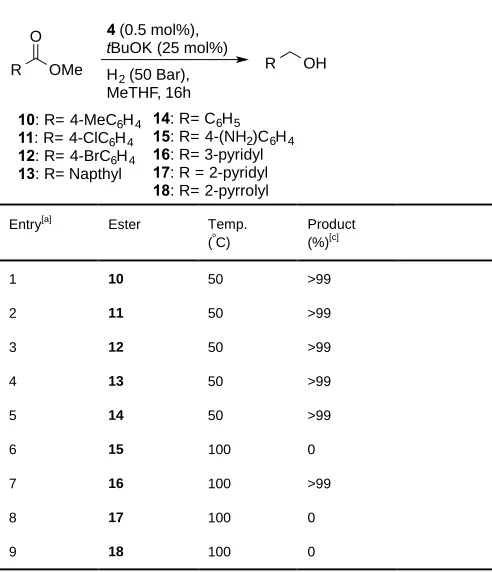
[image:5.595.67.321.335.616.2]the reduction of aryl esters at temperatures from 100 ºC to as low as 30 ºC (entry 14). Catalyst 4 was used in the hydrogenation of other aromatic esters with different electronic properties (Table 2). Noteworthy is the fact that 3-pyridyl
ester 16 could be successfully hydrogenated but not 2-pyridyl, and 2-pyrrolyl esters (entries 8 and 9). A possible
explanation for this fact is the ability of both ester and alcohol of the corresponding compounds to function as a bidentate
N,O ligand for Ru and inhibiting catalysis.Two reactions were set up in which the hydrogenation of ester 8 was carried
out (50 ºC, 50 bar H2, 0.5 mol% cat, 25% base) in the presence of 20 mol% of either ester 17 or 2-pyridyl-CH2OH. The
[image:6.595.67.313.202.488.2]reactions only gave 23 and 9% conversions respectively compared to full conversion without these additives. This is therefore consistent with substrate and especially the product acting as an inhibitor.
Table 2. Hydrogenation of various methyl esters using catalyst 6
Entry[a] Ester Temp. (ºC)
Product (%)[c]
1 10 50 >99
2 11 50 >99
3 12 50 >99
4 13 50 >99
5 14 50 >99
6 15 100 0
7 16 100 >99
8 17 100 0
9 18 100 0
[a] Unless otherwise stated, the reactions were carried out using 0.5 mol% of cat, tBuOK as base 25 mol%, (50:1, base:catalyst) at an initial pressure of 50 bar using 0.4 mmol of ester in 3 ml of Me-THF. [b] Conversion determined by 1
H NMR.
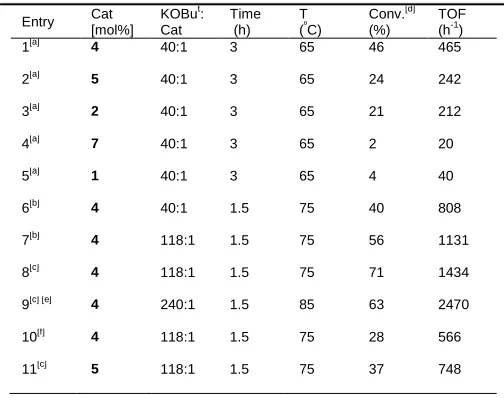
Next we examined the catalytic activity of the PNN and PNO Ru complexes for the hydrogenation of ethyl acetate (Table 3). Initially, and in order to compare performance of catalysts under the same conditions, several small reactor vials were placed inside larger pressure vessels (Table 3, entries 1-5). Under 50 bar of hydrogen at 65 ºC for 3 h with a 0.033 mol% of catalyst loading and in Me-THF as solvent, less than 5% conversion was achieved with phosphine diamine
complex 1 and phosphine amino-amide complex 7 (entries 4 and 5).On the other hand,bothphosphine amino-alcohol
based complexes, 5 and 2, displayed similar performance achieving the conversion of ethyl acetate to ethanol with
average TOF numbers of 242 and 212 respectively (entries 2 and 3).
R OMe O
R OH
4 (0.5 mol%),
tBuOK (25 mol%) H2 (50 Bar),
MeTHF, 16h
10: R= 4-MeC6H4 11: R= 4-ClC6H4 12: R= 4-BrC6H4 13: R= Napthyl
14: R= C6H5 15: R= 4-(NH2)C6H4 16: R= 3-pyridyl
17: R = 2-pyridyl
Table 3. Optimisation studies using Ru pre-catalysts for hydrogenation of ethyl acetate
Entry Cat [mol%]
KOBut: Cat
Time (h)
T (º
C)
Conv.[d] (%)
TOF (h-1
)
1[a] 4 40:1 3 65 46 465
2[a] 5 40:1 3 65 24 242
3[a]
2 40:1 3 65 21 212
4[a]
7 40:1 3 65 2 20
5[a] 1 40:1 3 65 4 40
6[b] 4 40:1 1.5 75 40 808
7[b] 4 118:1 1.5 75 56 1131 8[c] 4 118:1 1.5 75 71 1434
9[c] [e] 4 240:1 1.5 85 63 2470
10[f]
4 118:1 1.5 75 28 566
11[c] 5 118:1 1.5 75 37 748
[a] The reactions were carried out using 0.033 mol% Ru catalyst and 1.3 mol% of tBuOK, at an initial pressure of 50 bar using 7.7 mmol of ethyl acetate in 3 ml of Me-THF (general method A, ESI). [b] The reactions were carried out using 0.033 mol% Ru precatalyst, at an initial pressure of 50 bar using 30.7 mmol of ethyl acetate (3 mL) in 3 ml of Me-THF (general method B, ESI).[c] Reactions were carried out in neat ethyl acetate, otherwise using conditions as in “[b]”. [d] Ethanol produced determined by 1
H-NMR using 1-methylnaphthalene as internal standard. [e] 0.017 mol% of catalyst and 3.9 mol% of tBuOK used. [f] Reaction carried out at constant pressure of 15 bar H2, otherwise as in “[b]”.
Under the same mild conditions, the best performance was achieved by ruthenium PNN complex 4 (entry 1) with a
conversion of 46% and an average TOF number of 465 h-1. We further investigated the activity of complex 4 using a 50
mL stainless steel glass lined autoclave. Using this vessel and increasing the temperature 10 ºC to 75 ºC doubles the conversion (entry 6). Increasing the base loading from 1.3 mol% to 3.9 mol% (base: catalyst ratio of 118) enhanced the
performance of complex 4 producing ethanol with an average TOF number of 1131 h-1 (entry 7). The ester
hydrogenation reaction can also be run in neat ethyl acetate without solvent, increasing further the reaction rate (entry 8).
Complex 4 is also active at a lower catalyst loadings at 85 ºC (entry 9) giving a TOF of 2470 h-1 using an ester to catalyst
loading of 0.017 mol% with 3.9 mol% of base. Lower pressures (15 bar) could be used in the hydrogenation of ethyl acetate although the TOF is reduced somewhat.
3-(Z)-Hexen-1-ol (leaf alcohol) occurs in the green parts of many plants and gives them the characteristic “green smell”
odour. This molecule and other structural analogues are used in the perfumery industry to give a green note to fragances. This naturally occurring homoallylic alcohol is also frequently used in the flavors industry in minty, fruity and
green herbal tea aromas.[9] The reduction of the conjugated dienoate ethyl sorbate could be part of a very direct route to
the fragrance molecule leaf alcohol involving a stereospecific 1,4-cis-hydrogenation of sorbic alcohol using
[(Cp*)Ru(COD)][BF4] type complexes to produce the mono-unsaturated alcohol with high selectivity.[9(a), 9(c)] However, the
chemoselective ester hydrogenation of sorbate esters to unsaturated alcohols, has to our knowledge, never been
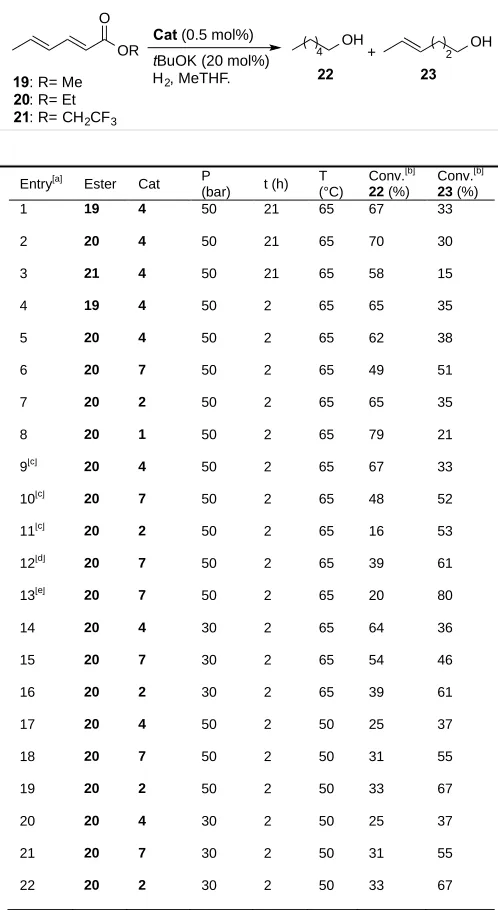
[image:7.595.66.318.91.290.2]Table 4. Optimisation studies using Ru pre-catalyst and sorbate esters.
Entry[a]
Ester Cat P
(bar) t (h) T (°C)
Conv.[b]
22 (%)
Conv.[b]
23 (%)
1 19 4 50 21 65 67 33
2 20 4 50 21 65 70 30
3 21 4 50 21 65 58 15
4 19 4 50 2 65 65 35
5 20 4 50 2 65 62 38
6 20 7 50 2 65 49 51
7 20 2 50 2 65 65 35
8 20 1 50 2 65 79 21
9[c]
20 4 50 2 65 67 33 10[c]
20 7 50 2 65 48 52 11[c]
20 2 50 2 65 16 53 12[d] 20 7 50 2 65 39 61 13[e] 20 7 50 2 65 20 80
14 20 4 30 2 65 64 36
15 20 7 30 2 65 54 46
16 20 2 30 2 65 39 61
17 20 4 50 2 50 25 37
18 20 7 50 2 50 31 55
19 20 2 50 2 50 33 67
20 20 4 30 2 50 25 37
21 20 7 30 2 50 31 55
22 20 2 30 2 50 33 67
[a] Unless otherwise stated, the reactions were carried out using 0.5 mol% of cat, tBuOK as base 20 mol% at an initial pressure of 50 bar using 1.0 mmol of ester in 3 ml of Me-THF. [b] Conversion determined by 1
H NMR using 1-methylnaphthalene as internal standard. [c] DMAP (1.5 mol%) used as co-catalyst. [d] DBU (1.5 mol%) used as co-co-catalyst. [e] PPh3 (1.5 mol%) used as
co-catalyst.
We attempted the hydrogenation of different sorbate esters in order to achieve a chemoselective reduction of the ester to produce sorbic alcohol (Table 4), but unfortunately sorbic alcohol was not observed under the reaction conditions
used in this study. On the other hand, the monounsaturated alcohol 23, possibly interesting since other isomers of leaf
alcohol also possess a similar type of odour,[9(b)] could be obtained with moderate chemoselectivity. We first examined
the influence of the ester moiety in the sorbate ester reduction using Ru catalyst 4 (entries 1-5). The reaction using
commercially available ethyl sorbate 20 afforded the highest amount of (E)-hex-4-en-1-ol 23 with a 38% conversion
(entry 5). Next, we examined the performance of some of the most active catalysts (entries 6-8).
Phosphine-amino-amide catalyst 7 showed the higher selectivity towards 23 with a 51:49 selectivity (entry 6). The use of additives (entries
9-13) produced different results. Catalyst 7, in the presence of 1.5 mol% of DMAP as co-catalyst (entry 7) gave virtually
no change in the the selectivity of the process, but the use of PPh3 as additive afforded compound 23 with a high 80%
selectivity (entry 13). We also examined the effect of reducing pressure and temperature on the selectivity of the reaction. Reducing the pressure to 30 bar (entries 14-16), reducing the T to 50 ºC (entries 17-19) or both (entries 20-22)
OR O
19: R= Me
20: R= Et
21: R= CH2CF3
tBuOK (20 mol%) H2, MeTHF.
Cat (0.5 mol%) OH OH
4 + 2
had a different effect depending on the catalyst used in the reaction. In the case of complex 7, the selectivity in the reaction was similar to that initially achieved under the initial reaction conditions (50 bar and 65 ºC).
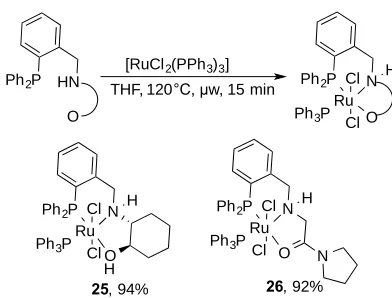
Scheme 1. DMSO substitution in Ru complex 2. 95% conversion to product was obtained with 64% isolated yield of pure complex 24
The positive effect of adding a coordinating additive to the hydrogenation has been shown to improve chemoselectivity in some cases (Table 4, entries 6 and 13). It was thought that a variation of these catalysts, where the labile DMSO is replaced by a phosphine or DMAP, could lead to more chemoselective catalysts. We were not able to isolate any DMAP containing complex but we succeeded in the synthesis and isolation of the phosphine containing counterparts. The
substitution of DMSO proved to be more energetically demanding than initially expected.[11] The reaction of complex 2
with PPh3 even using forcing conditions (150 ºC) (see E.S.I), was very sluggish, affording the substitution complex only
with 40% conversion. Next we examined the substitution of DMSO with PPhMe2. The smaller cone angle of this
phosphine should facilitate the reaction. That was the case and the complex was prepared under the conditions shown
in Scheme 1. The 31P{1H} NMR spectrum of 24 shows two characteristic groups of doublets at δ= 62.4 and 21.0 with JPP
= 38.1 Hz corresponding to the two different phosphorus atoms. To determine unambiguously the structure of complex
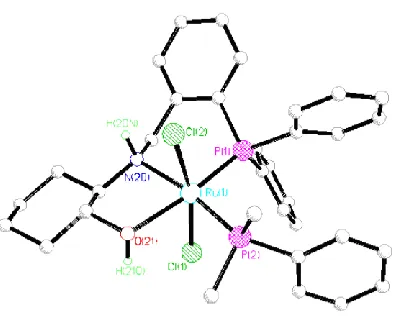
24, an X-ray diffraction study was carried out. The X-ray structure of the complex is shown in Figure 6. The structure
confirms that the DMSO ligand has in fact been replaced by PPhMe2. The coordination mode around the ruthenium
atoms remains broadly the same than in complex 2, an octahedral ruthenium complex with the tridentate neutral PNO
ligand and the two chlorine atoms in apical positions. When compared with its precursor 2, complex 24 has slightly
longer Ru–N and Ru–O bond lengths (Figures 2 and 6), on the other hand the Ru–P(1) bond is shorter, 2.239(1) vs
2.256(1) Å in complex 2. Both complexes also show similar N–Ru–O angles, 78.8(1) deg. vs 79.2(1) in complex 2.
Figure 6. X-ray structure of complex 24. THF and hydrogen atoms (except NH and OH) are omitted for clarity. Selected bond lengths (Å) and bond angles (deg): Ru–P(1) = 2.239(1), Ru–P(2) = 2.278(1), Ru–N(20) = 2.187(4), Ru–O(21) = 2.236(4), O(21)–Ru–P(1) = 170.3(1), N(20)–Ru– P(1) = 92.0(1), O(21)–Ru–P(2) = 90.5(1), P(2)–Ru–P(1) = 98.89(4), N(20)–Ru–O(21) = 78.8(1).
Ph2P N
O H Ru
H
S O
Cl
Cl
PMePh2, THF Ph2P N
O H Ru
H
Me2PhP
2 24
140°C, µw, 70 min
Cl
[image:9.595.79.281.450.617.2]Scheme 2. Direct synthesis of complexes 25 and 26.
A direct synthesis involving the use of ligands (Scheme 2) and [RuCl2(PPh3)3] was also performed. Complexes 25 and
26 were prepared in 94% and 92% yield respectively. The 31P{1H} NMR spectrum of 25 and 26 shows the two
characteristic groups of doublets corresponding to the two different phosphorus atoms in a similar way to those of
[image:10.595.70.266.61.210.2]complex 24 (see E.S.I.). These complexes were compared in a selection of ester hydrogenation reactions.
Table 5. Chemoselective reduction of esters in the presence of alkynes
Ent.[a] Cat t(h) % 27
[b]
% 28 [b] % 29 [b] % 30 [b]
1[c] 4 17 99 61 6 30
2[c] 4 5 97 71 4 4
3[d] 4 5 99 72 2 5
4[e] 4 5 99 78 9 2
5 4 5 98 70 [53] 6 2
6[c]
2 17 93 42 14 5 7[f]
24 5 63 9 3 0
8[g] 25 5 66 17 4 1
9[c] 7 17 87 16 10 3
10[h] 26 5 66 9 3 0
[a] Reactions were carried out using 0.5 mol% Ru precatalyst, at an initial pressure of 50 bar at 50ºC using 0.5 mmol of alkyne in 1.5 ml of Me-THF (general method A, ESI). [b] Determined by 1
H-NMR using 1-methylnaphthalene as internal standard, [isolated yield of pure 28]. [c] PPh3
was used as additive (1 mol%). [d] PPh3 was used as additive (2 mol%). [e]
DMAP was used as additive (1 mol%). [f] Methyl (Z)-4-styrylbenzoate (21%), methyl 4-phenethylbenzoate (4%). [g] Methyl (Z)-4-styrylbenzoate (21%), methyl 4-phenethylbenzoate (8%). [h] Methyl (Z)-4-styrylbenzoate (22%), methyl 4-phenethylbenzoate (13%).
Ph2P HN Ph2P N
Ru H
Ph3P
Cl
Cl THF, 120°C, µw, 15 min
[RuCl2(PPh3)3]
O O
Ph2P N
O H Ru
H
Ph3P
Cl
Cl
Ph2P N
O Ru
H
Ph3P
Cl
Cl N
25, 94% 26, 92%
O OMe
Ph
OH
Ph
OH
Ph OH
+ +
28 29 30
27
Cat (0.5 mol%)
tBuOK (20 mol%) H2 (50 bar), 50oC
MeTHF
The chemoselective reduction of esters in the presence of alkynes is a challenging process with several possible products being formed in the reaction and to the best of our knowledge, no literature precedent. The main products
obtained in these reductions, using methyl 4-(phenylethynyl)benzoate 27 as model substrate, are shown in Table 5.
Other possible products such as methyl (Z)-4-styrylbenzoate and methyl 4-phenethylbenzoate would be detectable but
were not observed in most cases. Compounds 28-30 are well known literature compounds and their formation can be
detected by 1H NMR. We decided to study the performance of the most active and selective catalysts in the presence of
coordinating additives and the new phosphine containing Ru complexes 24-26 in the chemoselective reduction of
compound 27. We initiated our study with complex 4 in the presence of 1 mol% of PPh3 hoping that the presence of this
phosphine could compete with the alkyne in the coordination with the metal and thus avoid the reduction of the latter (Table 5, entry 1). The reaction afforded a positive result; the alkyne formed from the selective reduction of the ester
functionality (28) being the main product in the reaction (61% conversion after 17 h). The reaction also afforded a
relative large amount of the fully reduced product (30). PNO Complexes 2 and 7 were also tested (entries 6 and 9) but
their selectivity towards 28 was inferior. With all 3 pre-catalysts small amounts of alkene 29 (6-14%) were detected.
Reducing the reaction time to 5 h increased the selectivity towards alkyne 28 (71%) with a small amount of the fully
reduced product being formed (4%) (entry 2). Increasing the amount of PPh3 did not afford any noticeable effect in the
reaction (entry 3). The use of DMAP as additive afforded similar results to those using PPh3 (entry 4). Remarkably, using
complex 4 with no PPh3 present in the reaction media offered very similar chemoselectivity in the reaction (entry 5). We
also tested pre-catalysts 24-26 incorporating an extra phosphine ligand, in the reduction of 27.The reaction proved to be
very unselective towards the reduction of the ester moiety. These catalysts produced noticeable amounts of other
products that were not observed before, like methyl (Z)-4-styrylbenzoate, the alkene obtained from the selective cis
-reduction of 27, and methyl 4-phenethylbenzoate, the product obtained from the full reduction of the alkyne moiety.
Attempts to use complexes 24-26 in a cis-selective semihydrogenation of the alkyne led to significant amounts of the
[image:11.595.65.320.371.545.2]fully reduced alkane methyl 4-phenethylbenzoate so was not pursued further.
Table 6. Ru catalysed reduction of methyl hex-5-enoate
Entry[a] Solv. Conv 31[b] % 22[b] % 32[b]
1 THF >99 11 78
2[c]
THF >99 10 82
3[d]
THF >99 20 72
4 MeTHF >99 12 77
5[c]
MeTHF >99 13 76
[a] Unless otherwise stated, reactions were carried out using 0.5 mol% of cat,
tBuOK as base 20 mol%, at an initial pressure of 50 bar using 0.5 mmol of ester in 1.5 ml of MeTHF. [b] Conversion determined by 1
H NMR using 1-methylnaphthalene as internal standard. Remaining balance is traces of isomerised internal alkene ester/alcohol. [c] DMAP was used as additive (1.5 mol%). [d] PPh3 was used as additive (1.5 mol%).
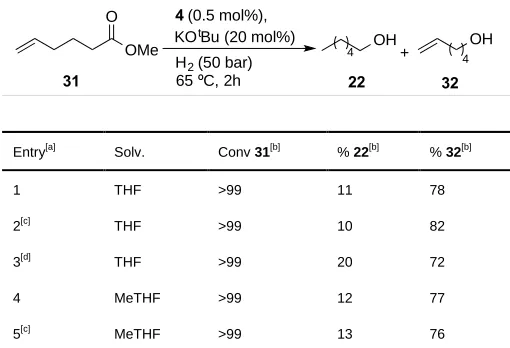
We also studied the reduction of an ester with a non-conjugated monosubstituted alkene moiety, methyl hex-5-enoate
31 (Table 6) using our best performing catalyst, complex 4. Terminal alkene functionalised esters are more challenging
substrates when compared with esters containing internal or more substituted alkenes, but less of a challenge than
dienoates or α, β unsaturated esters.[3(e)]
The reduction proceeded with full conversion in all cases under the reaction
conditions shown in Table 6, affording a mixture of both the saturated and unsaturated alcohols. Catalyst 4 gave the
unsaturated alcohol as major product in all cases. The introduction of DMAP as co-catalyst had a small beneficial effect
in the chemoselectivity of the ester reduction with 4 affording unsaturated alcohol 25 with good chemoselectivity (82%,
entry 2).
Complexes 25-26 were also tested in the reduction of methyl hex-5-enoate 31. These complexes did not promote a
selective reduction of the ester and in all cases, hex-5-en-1-ol 32 was not observed. The hydrogenations afforded
mixtures of the product obtained from the reduction of the terminal alkene, methyl hexanoate and the fully reduced
hexanol 22, suggesting that the alkene reduction was actually promoted relative to the ester functionality under these
reaction conditions.
OMe O
H2 (50 bar)
65 ºC, 2h
4 (0.5 mol%),
KOtBu (20 mol%) OH
OH
4 +
4
22 32
We also considered some other related applications for our catalysts. Recently, the fundamental reactivity of ester
hydrogenation catalysts has been applied towards some interesting ideas for harnessing renewable feedstocks.[12] We
were attracted by the possibility of depolymerisation of oligomers and polymers. An exciting proof of concept paper[12(d)]
recently appeared in which the polyester polymer PET was depolymerised by hydrogenation to give 1,4-benzene dimethanol and ethylene glycol. This raises the possibility of a different mode of recycling: instead of melting PET and making off-white recycled polyesters, it could be recycled into chemicals that are otherwise derived from petrochemical resources. There is also a lot of PET that is currently not recycled, so this could be a good renewable feedstock. Only two examples using Milstein’s catalysts are discussed in this initial work; the reactions were carried out at 160 ºC and using 2 mol% of catalyst relative to repeat unit (or 1 mol% relative to each ester). The publication of these results , that show that a step-change in reactivity would be needed prior to implementation, focused our studies on PET depolymerisation.
In order to identify the best catalyst and most suitable conditions and to study the effect of ethylene glycol production on
the catalyst, we chose to study two model diesters first, 33a and 33b. The results are shown in Table 7. It can be seen
that once again, catalysts 4 emerges as the best catalyst for this transformation. More forcing conditions are required
even for these soluble and simple substrates relative to the conditions used in the hydrogenation of other esters in this
paper. In order to probe this, we carried out the hydrogenation of ester 8, but with varying amounts of ethylene glycol.
[image:12.595.65.321.319.633.2]The results (Scheme 3) show that ethylene glycol has a negative effect on the rate of this hydrogenation, at least at moderate temperatures.
Table 7. Ru catalysed reduction of diesters derived from ethylene glycol
Ent. Sub. Cat (mol%) T (°C) tBuO K:Cat Conv.[b] (%) %[b],[f] 10 or 34b[b]
1[a] 33 a 4, [1.0] 70 20:1 >99 76 [f]
2[a]
33 a 5, [1.0] 70 20:1 >99 65 [f]
3[a]
33 a 2, [1.0] 70 20:1 >99 60 [f]
4[a][e] 33 a 7, [1.0] 70 20:1 >99 60 [f] 5[a] 33 a 4, [0.5] 70 40:1 >99 >99 6[d] 33 a 4, [1.0] 110 20:1 >99 >99 [96] 7[a][c] 33 b 4, [2.0] 100 10:1 82 73 [f] 8[a][c]
33 b 5, [2.0] 100 10:1 37 8 [f]
9[a][c]
33 b 2, [2.0] 100 10:1 41 26 [f]
10[a][c]
33 b 7, [2.0] 100 10:1 32 15 [f]
11[a][e] 33 b 4, [1.0] 100 40:1 55 19 [f] 12[d] 33 b 4. [2.0] 110 10:1 88 74[f] [71]
[a] Reactions were carried out at an initial pressure of 50 bar using 0.50 mmol of dimer in 3.0 ml of THF for 18 h.[b] Determined by 1H-NMRusing 1-methylnaphthalene as internal standard, [isolated yield]. [c] Reaction carried out for 21 h. [d] Reaction carried out for 23 h. [e] 40:1 base to catalyst. [f] Remaining mass balance corresponds to partially reduced esters shown in the equation above. R O O O 2 Cat tBuOK H2 (50 bar)
THF
OH
R +
33 a: R= Me
33 b: R= CO2Me
10: R= Me
34 b: R= CH2OH
R O
O
R= CH3
CH2OH
CO2CH3
Scheme 3. Hydrogenation of ester 8 in the presence of ethylene glycol 35.
With 4 identified as the best catalyst, we studied the depolymerisation-hydrogenation of real samples of waste PET. In
the hydrogenation of PET flakes (Table 8), we were pleased to find that at 110 ºC, very significant conversion to
[image:13.595.76.317.69.161.2]benzene dimethanol was obtained using 1 mol% catalyst relative to each ester unit (entry 1). The reaction can be performed in toluene (entry 6), but the presence of anisole as co-solvent, as was used in ref 12(d), is needed in order to increase polymer solubility (entry 5). In common with almost every report on the use of catalysis on renewable substrates, the amount of catalyst used is likely to be significantly greater than the amounts that would be needed for research leading to implementation. The issue is such processes are generally producing relatively low value products, so catalyst (metal and ligand) cost is critical. Further studies on new catalysts to increase the productivity beyond this new benchmark are needed.
Table 8. Depolymerisation of poly(ethylene terephthalate) (PET)
Entry[a] Cat [mol%] tBuOK: Cat Time (h)
T
(°C) % 34 b[b]
1 4, [2.0] 20:1 48 110 73 [53] 2 4, [2.0] 20:1 24 110 41 3 4, [1.0] 20:1 24 120 4 4 4, [1.0] 40:1 24 110 26 5[c]
4, [2.0] 20:1 24 110 49 6[d]
4, [2.0] 20:1 24 110 17
[a] Reactions were carried out at an initial pressure of 50 bar in a 50-50 % mixture of THF/Anisole. [b] Conversion determined by 1
H-NMRusing 1-methylnaphthalene as internal standard, [isolated yield]. [c] Reaction run in a 50-50 % mixture of toluene/anisole. [d] Reaction run in toluene.
Conclusions
Ten different Ru complexes of phosphine-diamine, phosphine-amino-alcohol and phosphine-amino-amide ligands have
been prepared and examined in the hydrogenation of a range of esters. The simple ethylene-diamine derived complex 4,
emerges as significantly more active than the other catalysts. Complexes, 2 and 5, which are especially easy to prepare
at significant scale, also give encouraging catalytic activity. The main focus here has been to establish how catalyst
structure and substrate structure impact on the chemoselectivity of these ester hydrogenations; On this basis, complex 4
again outperforms other catalysts. In addition, the hydrogenation of ethyl acetate, carried out at larger scale, allow several conclusions to be made. The average turnover frequencies observed in neat ethyl acetate are rather high relative to some of the more complex substrates. This is promising in terms of future developments with this catalysts system towards commercially viable catalyst loadings for other hydrogenation. The extra high reactivity with this simple substrate ethyl acetate is partly that this is an easy, sterically unencumbered and very pure substrate, but also might
relate to the high substrate concentrations used, since ketone hydrogenation using catalysts 4 was first order in
+ HO
OH
H2 (50 bar) 4 (0.5 mol%)
tBuOK (20 mol%) MeTHF
OH
F OMe
F
O
(x eq.)
8 35 9
55°C, 2 h, 35 (0 eq.) 79 % 55°C, 2 h, 35 (0.25 eq.) 5 % 90°C, 5.5 h, 35 (0 eq.) 91 % 90°C, 5.5 h, 35 (0.25 eq.) 85 %
H2 (50 bar)
4, tBuOK
OH
HO
34 b
+ HO
OH
35
O O
O n
36
substrate, and that is likely to be the case here. There is also strong pressure dependence. It is possible lower pressures could be used with a very efficiently stirred pressure vessel, but we have never been successful in carrying out ester hydrogenations at or near atmospheric pressure using these catalysts. Table 3, entries 7 and 10 show a significant
increase in productivity when hydrogen pressure is increased from 15 to 50 bar pressure.
The effect of base co-catalyst certainly merits discussion. Previous studies showed us that this type of catalyst was nearly inactive at these quite low temperatures if base: catalyst ratios of 2:1 are used. Some activity was observed at 140 ºC. A base-catalyst ratio of around 2:1 is actually optimum for highly enantioselective ketone hydrogenation using
catalyst 1.[6] In both the hydrogenation of para-fluorobenzoic acid methyl ester 8 and ethyl acetate, it can be seen that
activity increases significantly when base: catalyst ratio is increased. This should perhaps be more formally when base concentration is increased, although we note experimentally that quite high concentrations were needed to observe any
conversion under mild conditions for the benzoate 8 (table 1, entries 9 and 11), whereas in ethyl acetate hydrogenation,
the absolute concentration of base [0.017 mol% Ru cat, 3.9 mol% base] is quite low even when average TOF are above
2000 h-1. Clearly there will be differences based on solvating medium, trace impurities in the substrate and the identity of
the substrate. Recently, a revised mechanism has been put forward for the enantioselective hydrogenation of ketones
using Noyori catalysts.[13] We have previously found our catalysts to have some mechanistic similarities to Noyori
catalysts,[6(c)] so it seems reasonable that some of these insights might apply here. In particular, the revised mechanism
postulates that the secondary alkoxide, produced after hydride transfer to a ketone, hydrogen- bonds to an NH function while deprotonating a dihydrogen ligand coordinated to Ru. In ester hydrogenation, the initial product is a deprotonated hemi-acetal. Hemi-acetal anions are far less basic than simple alkoxides, so it may be the case that a higher concentration of base is needed either to facilitate the product deprotonating dihydrogen, or to directly deprotonate dihydrogen itself. An alternative or addition role that also requires more base than in ketone hydrogenation could be to
assist the removal of bound hemi-acetal anion from ruthenium, or to assist catalyst stability.[14] Catalyst 4 can be
operated at relatively low amounts of base when catalyst loadings are low, but significant amounts do seem to be needed for high productivity. This also seems to be the case for other catalysts. The effect of DMAP is somewhat mysterious, since it does not seem to be in sufficient concentration to be simply acting as more base. It was designed to act as a co-ligand for Ru that would prevent C=C bond coordination and subsequent reduction. However, we have not found it possible to make a DMAP complex in earlier studies and here we show that exchange of DMSO with phosphines is a difficult process, at least from the dichloride pre-catalysts. Moreover the phosphine-ligated Ru
complexes 24-26 are actually not just poorly active catalysts but tend to reduce the C=C bonds to a greater extent. Ru /
BINAP/ DPEN catalysts have also been reported to fully reduce the C=C bonds of cinnamate esters. Whether there is some outer sphere mechanism possible for C=C reduction, or that unexpected and less saturated species form during
hydrogenation is not clear. In any case, the use of catalyst 4 enables the ester hydrogenation in the presence of isolated
double and triple bonds with good chemoselectivity. Catalyst 4 is therefore a useful ester hydrogenation catalyst and we
have identified some structural features and experimental protocols that appear to be beneficial for chemo-selective and productive ester hydrogenation catalysis.
Experimental Section
Synthesis of ligands and catalysts along with their characterisation data can be found in the electronic supporting information.
Hydrogenation of ethyl acetate using Ru catalysts
Reactions were carried out using a Parr 50 mL stainless steel autoclave equipped with a pressure gage, gas inlet, safety valve and injection port equipped with rubber septum. A glass lined autoclave containing a magnetic stirring bar (crosshead) was charged with the appropriate amount of catalyst (0.033 mol%), purged with three vacuum/argon cycles and left under argon atmosphere. Ethyl acetate (30.7 mmol, 3.0 mL), MeTHF (3 mL) and 1-methylnaphthalene (0.2 mL) as internal standard were added to the autoclave via the injection port using a syringe. Finally, potassium tert-butoxide (3.9 mol%) (1 M solution in 2-methyl-2-propanol) (1.2 mmol, 1.2 mL) was added. The autoclave was then purged three times with H2, pressurised to 50 bar and immersed into an oil bath preheated to the desired
temperature. After the desired reaction time, the autoclave was cooled down to room temperature, the pressure slowly released and opened. A small sample was taken, diluted with CDCl3 and analysed by 1H NMR spectroscopy to calculate the conversion.
Hydrogenation of methyl 4-(phenylethynyl)benzoate (27) using Ru catalysts
A Biotage 5 ml microwave vial containing a stirring bar was charged with catalyst 4 (0.5 mol%). The vial was sealed with a crimp cap, purged with three vacuum/argon cycles and left under argon atmosphere. The corresponding ester (1.0 mmol, 236 mg) was added using a syringe from a stock solution in Me-THF containing 1-methylnaphthalene as internal standard (3.0 mL). Finally, potassium tert-butoxide (20 mol%) (1 M solution in 2-methyl-2-propanol) (0.2 mmol, 0.2 mL) was added, then two needles were pierced into the vial and this was introduced into an autoclave, which had been previously purged with three vacuum/argon cycles. The autoclave was then purged three times with H2, pressurised to 50 bar and immersed into an oil bath preheated to the desired temperature. After the desired reaction time,
the autoclave was cooled down to room temperature, the pressure slowly released and opened. A small sample was taken, diluted with CDCl3 and analysed by 1H NMR spectroscopy to calculate the conversion. Purification by column chromatography on silica gel using
Depolymerisation of PET (36) using Ru catalyst 4
A glass insert was charged with the appropriate amount of catalyst (1-2 mol %) and substrate (1 mmol) and was introduced into an autoclave, which had been previously purged with three vacuum/argon cycles. A round bottom flask was charged with 1-methyl naphthalene (approx. 0.08 g) and quickly purged with three vacuum/argon cycles and left under argon atmosphere. THF (3 mL), anisole (3 mL) and potassium tert-butoxide (20 mol %) (1 M solution in 2-methyl-2-propanol) (0.4 mmol, 0.4 mL) were added to the round bottom flask. The solution was then added to the autoclave and the autoclave was then purged three times with H2, pressurised to 50 bar and
immersed into an oil bath preheated to the desired temperature. After the desired reaction time, the autoclave was cooled down to room temperature, the pressure slowly released and opened. A small sample was taken, diluted with CDCl3 and analysed by 1H NMR
spectroscopy to calculate the conversion. Purification by column chromatography on silica gel using EtOAc as eluent afforded 1,4-benzene dimethanol 34 b as a white solid (73 mg, 0.53 mmol, 53%).
Single-crystal X-ray structural determination
CCDC-1049167 (2), -1049168 (4), -1049169 (6), -1049170 (7), and -1049171 (24) contain the supplementary crystallographic data for this paper. These data can be obtained free of charge from The Cambridge Crystallographic Data Centre via www.ccdc.cam.ac.uk/data%5Frequest/cif.
Acknowledgements
The authors would like to thank the EPSRC National Mass Spectrometry Service, the EPSRC Impact Acceleration scheme for partial funding (with Johnson Matthey). Miss Katy Scott (University of St Andrews) is thanked for assistance with alkyne synthesis. Dr Mick O’Neill from Polymer Extrusion Technologies (UK) Ltd is thanked for kindly donating PET samples, and all the technical staff in the School of Chemistry are acknowledged for their assistance.
[1] (a) S. Nishimura in Handbook of Heterogeneous Catalytic Hydrogenation for Organic Synthesis, John Wiley and sons, New York, 2001, p 392. (b) A. B. Hungria, R. Raja, R. D. adams, B. Captain, J. Meurig Thomas, P. A. Midgley, V. Golovko, B. F. G. Johnson, Angew. Chem. Int. Ed.2006, 45, 4782-4785; Angew. Chem.2006, 118, 4900-4903 and refs therein.
[2] (a) H. T. Teunissen, C. J. Elsevier, Chem. Commun.1998, 1367-1368. (b) H. T. Teunissen, C. J. Elsevier, Chem. Commun. 1997, 667-668. [3] (a) S. Takebayashi, S. H. Bergens, Organometallics2009, 28, 2349-2351. (b) J. Zhang, G. Leitus, Y. Ben-David, D. Milstein, Angew. Chem. Int. Ed, 2006, 45, 1113-1115; Angew. Chem.2006, 118, 1131-1133. (c) E. Fogler, E. Balaraman, Y. Ben-David, G. Leitus, L. J. W. Shimon, D. Milstein, Organometallics2011, 30, 3826-3833. (d) E. Balaraman, E. Fogler, D. Milstein, Chem. Commun, 2012, 48, 1111-1113. (e) L. A. Saudan, C. M. Saudan, C. Debieux, P. Wyss, Angew. Chem. Int. Ed.2007, 46, 7473-7476; Angew. Chem.2007, 119, 7617-7620. (f) Y. S. Sun, C. Koehler, R. Y. Tan, V. T. Annibale, D. T. Song, Chem. Commun, 2011, 47, 8349-8351. (g) W. Kuriyama, Y. Ino, O. Ogata, N. Sayo and T. Saito, Adv. Synth. Catal., 2010, 352, 92-96. (h) W. Kuriyama, T. Matsumoto, O. Ogata, Y. Ino, K. Aoki, S. Tanaka, K. Ishida, T. Kobayashi, N. Sayo, T. Saito, Org. Proc. Res. Dev.2012, 16, 166-171. (j) W. W. N. O, A. J. Lough and R. H. Morris, Chem. Commun, 2010,
46, 8240-8242. (k) B. Boardman, M. J. Hanton, H. van Rensburg, R. P. Tooze, Chem. Commun., 2006, 2289-2291. (l) M. J. Hanton, S. Tin, B. Boardman, P. Miller, J. Mol. Catal. A-Chem.2011, 346, 70-78. (m) S. Hitoshi, T. Kazunari, K. Haruhiko, (Mitsubishi Chem Ind.), 1996,
US Pat.5580991. (n) D. V. Tyers, M. Kilner, S. P. Crabtree, M. A. Wood, (Davy Process and Technology Ltd.), WO0309308. (o) C. Saudan, L. Saudan (Firmenich SA), 2010 (WO2010/061350. (p) L. Saudan, P. Dupau, J-J. Riedhauser, P. Wyss (Firmenich SA), 2010, US2010/0125144. (q) C. Saudan (Firmenich SA) WO2010/038209. (r) M. Ito, A. Sakaguchi, C. Kobayashi, T. Ikariya, J. Am. Chem. Soc.
2007, 129, 290-291. (s) S. Chakraborty, H. Dai, P. Bhattacharya, N. T. Fairweather, M. S. Gibson, J. A. Krause, H. Guan, J. Am. Chem. Soc.2014, 136, 7869-7872. (t) D. Spasyuk, S. Smith, D. Gusev, Angew. Chem. Int. Ed.2012, 51, 2772-2775; Angew. Chem.2012, 124, 2826-2829. (u) D. Spasyuk, D. G. Gusev, Organometallics201231, 5239-5242. (v) D. Spasyuk, S. Smith, D. Gusev, Angew. Chem. Int. Ed.
2013, 52, 2538-2542; Angew. Chem.2013, 125, 2598-2602. (x) E. Fogler, J. A. Garg, P. Hu, G. Leitus, L. J. W. Shimon, D. Milstein, Chem. Eur. J.2014, 20, 15727-15731. (y) T. Zell, Y. Ben-David, D. Milstein, Angew. Chem. Int. Ed.2014, 53, 4685-4689. (z) F. A. Westerhaus, B. Wendt, A. Dumrath, G. Wienhofer, K. Junge, M. Beller, ChemSusChem2013, 6, 1001-1005.
[4] M. L. Clarke, G. J. Roff in Handbook of Homogeneous Hydrogenation (Chap. 15), Ed. J. G. De Vries and C. J. Elsevier, Wiley-VCH, Weinheim, 2007, pp. 413-454.
[5] (a) S. Werkmeister, K. Junge, M. Beller, Org. Process Res. Dev. 2014, 18, 289-302. (b) M. L. Clarke, Synlett2014, 25, 1371-1380. (c) M. L. Clarke, Catal. Sci. Technol. 2012, 2, 2418-2423. (d) L. A. Saudan in Sustainable Catalysis: Challenges and Practices for the Pharmaceutical and Fine Chemical Industries (Chapter 2), John Wiley and sons, New York, 2013, pp. 37-61. (e) P. A. Dub, T. Ikarija, ACS Catal. 2012, 2, 1718-1741.
[6] (a) M. L. Clarke, M. B. Diaz-Valenzuela, A. M. Z. Slawin, Organometallics2007,26, 16-19. (b) M. B. Diaz-Valenzuela, S. D. Phillips, M. B. France, M. E. Gunn, M. L. Clarke, Chem-Eur J, 2009, 15, 1227-1232. (c) S. D. Phillips, J. A. Fuentes, M. L. Clarke, Chem-Eur J. 2010, 16, 8002-8005. (d) S. D. Phillips, K. H. O. Andersson, N. Kann, M. T. Kuntz, M. B. France, P. Wawrzyniak, M. L. Clarke, Catal. Sci. Technol.,
2011, 1, 1336-1339.
[7] I. Carpenter, S. C. Eckelmann, M. T. Kuntz, J. A. Fuentes, M. B. France, M. L Clarke, Dalton Trans. 2012, 41, 10136-10140. [8] W. Baratta M. Ballico. A. del Zotto, K. Siega, S. Magnolia, P. Rigo, Chem. Eur. J. 2008, 14, 2557-2663.
[9] (a) P. Dupao, Top Organomet. Chem.2012, 42, 47-64. (b) A. A. Vasiliev, G. V. Cherkaev, M. A. Nikitina, Chemistry and Computational Simulation. Butlerov Communications. 2003, 4, 33-43. C. (c) Fehr, I. Magpantay, M. Vuagnoux, P. Dupau, Chem. Eur. J.2011, 17, 1257-1260.
[10] D. Spasyuk, C. Vivent, D. G. Gusev, J. Am. Chem. Soc. 2015, 3743-3746.
[11] P. Crochet, J. Gimeno, S. García-Granda, J. Borge, Organometallics2001, 20, 4369-4377.
Dauphinais, S. P. Mc Llath, A. A. Fischer, M. J. Carney, D. J. Hudson, N. J. Robertson, Chem. Commun. 2014, 50, 4884-4887. (e) Z. Han, L. Rong, J. Wu, L. Zhang, Z. Wang, K. Ding, Angew chem. Int. Ed. 2012, 51, 13041-13045; Angew chem. 2012, 124, 13218-13222. [13] P. A. Dub, N. J. Henson, R. L. Martin, J. C. Gordon, J. Am. Chem . Soc.2014, 136, 3505-3521.
Figure 1. Ruthenium complexes of phosphine-diamine, phosphine-amino-alcohol and phosphine-amino-amide ligands used in this study.
Figure 2. X-ray structure of complex 2. Two acetonitrile molecules and hydrogen atoms (except NH and OH) are omitted for clarity. Selected bond lengths (Å) and bond angles (deg): Ru–P(1) = 2.256(1), Ru–N(20) = 2.151(5), Ru–O(21) = 2.205(3), O(21)–Ru–P(1) = 171.31(9), N(20)–Ru–P(1) = 92.3(1), N(20)–Ru–O(21) = 79.2(1).
Figure 3. X-ray structure of complex 4. One molecule of acetonitrile and hydrogen atoms (except NH and NH2) are omitted for clarity. Selected
bond lengths (Å) and bond angles (deg): Ru–P(1) = 2.2806(7), Ru–N(1) = 2.130(2), Ru–N(2) = 2.164(2), N(2)–Ru–P(1) = 170.84(6), N(1)–Ru–P(1) = 91.10(5), N(1)–Ru–N(2) = 79.89(7).
Figure 4. X-ray structure of complex 7. Hydrogen atoms (except NH) are omitted for clarity. Selected bond lengths (Å) and bond angles (deg): Ru–P(1) = 2.254(1), Ru–N(20) = 2.152(4), Ru–O(2) = 2.156(3), O(2)–Ru–P(1) = 170.66(9), N(20)–Ru–P(1) = 93.4(1), N(20)–Ru–O(2) = 77.2(1).
Figure 5. X-ray structure of complex 6. Hydrogen atoms (except NH and OH) are omitted for clarity. Selected bond lengths (Å) and bond angles (deg): Ru–P(1) = 2.254(1), Ru–N(20) = 2.200(4), Ru–O(22) = 2.188(3), O(22)–Ru–P(1) = 175.5(1), N(20)–Ru–P(1) = 92.1(1), N(20)–Ru–O(22) = 87.2(1).
Scheme 1. DMSO substitution in Ru complex 2. 95% conversion to product was obtained with 64% isolated yield of pure complex 24
Figure 6. X-ray structure of complex 24. THF and hydrogen atoms (except NH and OH) are omitted for clarity. Selected bond lengths (Å) and bond angles (deg): Ru–P(1) = 2.239(1), Ru–P(2) = 2.278(1), Ru–N(20) = 2.187(4), Ru–O(21) = 2.236(4), O(21)–Ru–P(1) = 170.3(1), N(20)–Ru– P(1) = 92.0(1), O(21)–Ru–P(2) = 90.5(1), P(2)–Ru–P(1) = 98.89(4), N(20)–Ru–O(21) = 78.8(1).
Scheme 2. Direct synthesis of complexes 25 and 26.
Layout 1:
FULL PAPER
A simple catalyst for some difficult reductions: Ruthenium complexes of P,N,N and P,N,O ligands catalyse the reduction of esters with high activities. The Ru complex of the phosphine-diamine shown in the scheme has been found to be a good catalysts for reducing alkene-, diene-, and alkyne functionalised esters, displaying good activity and chemoselectivity. This catalyst was also active in the hydrogenation of waste PET.
José A. Fuentes, Samuel M. Smith,M. Theresa Scharbert,Ian Carpenter,David B. Cordes, Alexandra M. Z. Slawin,and Matthew L Clarke*
Page No. – Page No.
On the functional group tolerance of ester hydrogenation and polyester depolymerisation catalysed by ruthenium complexes of phosphine-diamine, phosphine-amino-alcohol and phosphine-amino-amide ligands.
Keywords: ruthenium •hydrogenation • depolymerisation • tridentate ligand • bifunctional catalysis
O OEt
up to 2400 h-1 TOF
EtOH
Ph
OMe
O
Ph
OH
4 3
O
OMe
OEt O
OH
2
OH HO
O O
O n
O
OH
H
2PET
N PPh2
N H2
Ru S Cl
Cl H
![Table 1. Hydrogenation of para-fluorobenzoic acid methyl ester using [RuCl2(P^N^X)(DMSO)] complexes as pre-catalysts](https://thumb-us.123doks.com/thumbv2/123dok_us/8929228.391888/5.595.67.321.335.616/table-hydrogenation-fluorobenzoic-methyl-ester-using-complexes-catalysts.webp)