A New Numerical Method for Solving the Stokes Problem
Using Quadratic Programming
M. Baymani, A. Kerayechian
Department of Mathematics, Ferdowsi University of Mashhad, Mashhad, Iran E-mail: [email protected], [email protected]
Received December 24, 2009; revised January 28, 2010; accepted March 1, 2010
Abstract
In this paper we present a new method for solving the Stokes problem which is a constrained optimization method. The new method is simpler and requires less computation than the existing methods. In this method we transform the Stokes problem into a quadratic programming problem and by solving it, the velocity and the pressure are obtained.
Keywords:Galerkin Method, Neural Network Model, Quadratic Programming Problem, Stokes Problem
1. Introduction
Developing solutions to the Stokes equations has at-tracted many researchers because of its practical impor-tance in the field of fluid mechanics. However, due to the nonlinear nature of Stokes equations the main stream of the solutions procedures are in fact numerical methods, which have been developed considerably in recent years because of the amazing advances in computing power and speed. However, very limited information is avail-able in the form of analytical functions as the Stokes solutions especially, when the nonlinear terms remain in the governing equations.
Numerical approximation of incompressible flows pre-sents a major difficulty, namely, the need to satisfy a compatibility condition between the discrete velocity and pressure spaces [1–3]. This condition which has been well known since the work of Babuska and Brezzi pre-vents, in particular, the use of equal order interpolation spaces for the two variables, which is the most attractive choice from a computational point of view.
To overcome this difficulty, stabilized finite element methods that circumvent the restrictive inf_sup condition have been developed for Stokes-like problems (see [4–6]). These residual-based methods represent one class of stabilized methods. They consist in modifying the stan-dard Galerkin formulation by adding mesh-dependent terms, which are weighted residuals of the original differential equations. Although for properly chosen stabilization parameters these methods are well posed for all velocity and pressure pairs, numerical results reported by several researchers seem to indicate that these methods are
sen-sitive to the choice of the stabilization parameters. The local stabilization suggested in [6] has some advantages in this regard. Another class of stabilized methods has been derived using Galerkin methods enriched with bub-ble functions (see [7,8]). Alternative stabilization tech-niques based on a continuous penalty method have been proposed and analyzed in [9,10]. Nafa and Wathen ana-lyzed pressure stabilized finite element methods for the solution of the generalized Stokes problem and investi-gated their stability and convergence properties. An im-portant feature of the method is that the pressure gradient unknowns can be eliminated locally thus leading to a decoupled system of equations [11].
This paper is devoted to the Stokes system of differen-tial equations. The Stokes problem describes the motion of an incompressible viscous fluid in a 2-dimensional domain:
0 0
u p f in
div u in
u on
(1)
here 2 is the velocity field and 1 2
( , ) : u u u R
R :
p
1 2 ( , )
is the pressure. The first equation is the (lin-earized) momentum equation, while the second equation expresses the incompressibility constraint. Since we are assuming that the fluid is incompressible, no sources or sinks are present. The given external force field
f f f
[ ( u C
causes an acceleration of the flow. The
M. BAYMANI ET AL. 200
2
}.
then we call and a classical solution of the Stokes problem. Note that (1) only determines the pres-sure up to an additive constant, which is usually fixed by enforcing the normalization [1].
u : ( V H 0 Q L ) v
( , ) v ( ,p )
p
2
1 ))2
{ V:
, )p
. u p . p
2. Mathematical Formulation an Analysis
We assume that f( ( ))L , and set 0(
2( ) q L2( ) : qdx 0
0
div
V w div w
which are Hilbert spaces.
From the first equation of (1) and Green's formulae we obtain
( , ( ,
a u b v f v V (2)
where
a u
v dx)
b w
div w dx and ( ,f v f v
dx
R V a u b u .) : a V ( 0 b v V
Thus we have the variational form of the problem (1) as: find ( ,u p ) Q such that
( , ) , ) , ( , )
v p f v V
q q Q
(3)
In the following we state some conditions and theorems about the stability and convergence of the problem.
Definition: The bilinear forms
(., R b, (.,.) :V Q
are called continuous if they satisfy
( , ) ,
( , ) , , ,
V V
V Q
a w v v
b w q q w v V q Q
w w
(4)
Also a(.,.) is coercive if there exists a constant 0 such that
2
( , ) V
a v v v v V We let
: : ( , ) 0,
Z v V b v q for each q Q
Theorem 1. (Existence and uniqueness) Assume that the bilinear form satisfies (4) and coercive on Z, moreover, satisfy (4) and that the following
compatibility (inf_sup) condition holds i.e., there exists
(.,.) a (.,.) b
0
such that
, 0: ( , ) V
q Q v V v b v q v q
Q
2
(5)
Then for each there exists a unique solu-tion
2 ( ( )) f L
Q ( , )u p V and
0
0 1
1(1 )
V Q u f p f (6)
For the proof of the above theorem see [12].
3. Discrete Mixed Formulation
We introduce two families of finite dimensional subspaces and depending on h. Then, we approxi-mate (3) by the discrete problem: find
h
V V Qh Q
( ,u ph h) Vh Qh
such that
( , ) ( , ) ( , ) ( , ) 0
h h h h h h h
h h h h
a u v b v p f v v V
b u q q Q
(7)
Similar to Z we let
: : ( , ) 0,
h h h h h h h
Z v V b v q for each q Q This is the space of discretely divergence-free functions associated with finite dimensional spaces.
Theorem 2. (Existence and uniqueness) Assume that bilinear forms a(.,.) and b(.,.)
a(
are continuous. The existence and uniqueness of solution to the problem (3) follows from the coercivity of on V and from discrete inf-sup condition. These two conditions are de-fined as follows:
.,.)
There exists a constant h, h 0 such that
2
( , )h h h h V h h
a v v v v Z (8) , 0
( , )
h h h h h
h h h h V h Q
q Q v V v
b v q v q
: 2 (9)
Then for each , there exists a unique solu-tion
2 ( ( )) f L
h h
V Q
( ,u ph h) to (7) which satisfies
0 0 1 1 (1 ) h V h h Q h h u f p f
or even worse, (5) doesn't hold, the approximation (7) is said to be unstable.
Theorem 3. (Convergence) Let the assumptions of Theorems (3) and (4) be satisfied. Then the solutions and to (3) and (7), respectively, satisfy the following error estimates
( , )u p ( ,u ph h)
*
* *
* (1 ) inf inf
(1 ) inf
(1 ) inf
h h h h
h h
h h
h V v Z h V q Q
h h
h V v Z h V
h h
h Q q Q
h h h
u u u v p q
p p u v
p q
h Q
(10)
Moreover, the following estimate holds
*
*
inf (1 ) inf
h h
h h h V v V V
v Z
h
u v u u
h (11)
From (10) and (11) it follows that the convergence is optimal, provided that (8) and (9) hold with constants independent of h [12,13].
Using basis functions for and , the problem (7) leads to the following system of linear equations:
h
V Qh
0 0
T
A B U F
P B
(12)
where A is a symmetric positive definite matrix. It can be shown that the discrete inf-sup condition is satisfied or this system has a unique solution if and only if
[1,12,13]. If 0
KerB KerB0, then the coefficient matrix in (12) is singular, and the system has infinitely many solutions. In this case, for solving the system (12), we can use one of the iterative methods or the penalty method.
In this paper, we assume . We introduce the quadratic programming method for solving the Stokes problem.
0 KerB
4. Illustration of the Method
In this section we present an optimization method for solving the problem (3).
Consider the following problem:
2 2
( )
( , ) ( , ) ( , ), 0
L
Minimize div u subject to
a u v b v p f v v V pdx
(13)
The following theorem shows the relation of the solu-tions of (3) and (13).
Theorem 4. The optimal solution of the optimization system (13) is the unique solution of the problem (3).
Proof: The optimal solution of (13) is ( , )u p V Q such that div u0, then
(div u q) 0 or b u q( , ) 0, q Q
So, the optimal solution of (13) is the solution of (3). In the Galerkin method, for solving (7) using finite element approximation requires a lot of computations to construct the space of basis functions ( . But, here we choose the space of basis func-tions easily such that the boundary condifunc-tions are satis-fied and . The new method leads to the solution
, )
h h
V Q 2 ) 1 0 ( ( )
n
V H
2( )
m
M L
2 0( )
m
p L . We approximate the problem (13) by the discrete problem:
find ( ,u pn m) Vn Q such that:
2 2
( )
( , ) ( , ) ( , ), 0
n L
n n n m n n n
m
Minimize div u subject to
a u v b v p f v v V p dx
(14)
Similarity, we can show that the optimal solution of the problem (14) is the solution of discrete form of the prob-lem (9).
We choose v in the form
( , ) : 1, 2,3,...,
n i
V span B x y i n
where i are independent and is a known function such that is equal to zero on the boundary. Thus we take the approximation solution in the form
( , ) B x y ( , ) i
B x y
n
u
1 ( , ) n
n i
i
u B x y c
i
Also, we write the approximation solution as a lin-ear combination of independent functions
m
p
j
1
m
m j
j
p d
j
By substituting and in (14), the optimization problem is transformed into the following quadratic pro-gramming:
n
u pm
1 2
t
Minimize C HC subject to
AC b
M. BAYMANI ET AL. 202
m
where , H is a
symmetric semi definite matrix, A
is a matrix.
1 2 2 1 2
[ , ,..., n, , ,..., ]
C c c c d d d
(2n m)
1) (2 ) n n m (2n m)
(2
5. Solving QP Problem
Consider the following QP problem: 1 2
t
Minimize x Hx subject to
Ax b
(16)
where H is an m m symmetric positive semide- finite matrix, A is an n m matrix and . The Karush-Kuhn- Tucker conditions of the problem (16) are:
m
( ) , n, , Rank A m b R x a R
, 0
t
Ax b A y Hx
(17)
For solving the system (17), we use the following neural network model
( ) (
( ),
t
dx dx dy
H x k A y k
dt dt dt
dy dx
b A x k
dt dt
)
(18)
The details are given in [14].
6. Numerical Results
Example: We consider the problem (1) with the unit square and with the following smooth exact solution
(0,1) (0,1)
2 2 2
1
2 2
2
2 2
u 10 (1 ) (1 3 2 ) u 10 (1 ) (1 3 2
20 . 3
x y x y y
y x y x x
p x y x y xy
2)
We solve this problem by the method described in pre-vious section and use (polynomials of de-gree ) and (polynomials of degree
2( )
i P
( ) 2
i Q2 2
in each of the variables). This means that n9 and . Also, we compare our results with least-square
finite element ([15]) with 5
m
1 64
h . The numerical results have been shown in Table 1 for different viscosities.
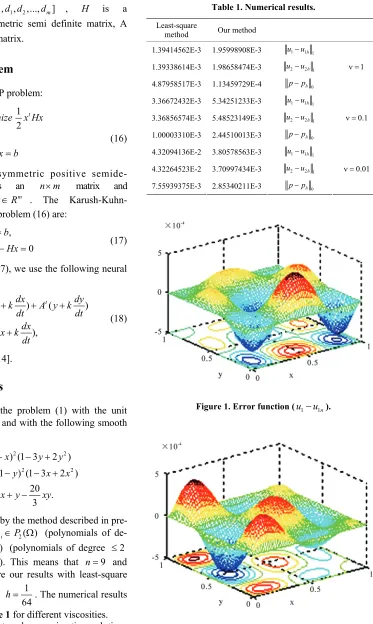
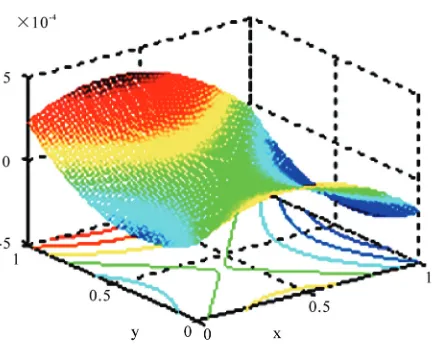
[image:4.595.160.533.77.701.2]The errors of the exact and approximation solutions for 1 are depicted in Figures 1-3.
Table 1. Numerical results.
Least-square
method Our method
1.39414562E-3 1.95998908E-3 u1u1h1
1.39338614E-3 1.98658474E-3 u2u2h1
4.87958517E-3 1.13459729E-4 p p h 0
1
3.36672432E-3 5.34251233E-3 u1u1h1
3.36856574E-3 5.48523149E-3 u2u2h1
1.00003310E-3 2.44510013E-3 p p h 0
0.1
4.32094136E-2 3.80578563E-3 u1u1h1
4.32264523E-2 3.70997434E-3 u2u2h1
7.55939375E-3 2.85340211E-3 p p h 0
0.01
Figure 1. Error function (u1u1n).
[4] T. Barth, P. Bochev, M. Gunzburger, and J. Shahid, “A taxomony of consistently stabilized finite element meth-ods for stokes problem,” SIAM Journal on Scientific Computing, Vol. 25, pp. 1585–1607, 2004.
[5] L. P. Franca, T. J. R. Hughes, and R. Stenberg, “Stabi-lised finite element methods,” in: Incompressible Com-putational Fluid Dynamics Trends and Advances, Cam-bridge University, pp. 87–107, 1993.
[6] N. Kechkar and D. Silvester, “Analysis of locally stabi-lized mixed finite element methods for Stokes problem,” Mathematics of Computation, Vol. 58, pp. 1–10, 1992. [7] R. Araya, G. R. Barrenechea, and F. Valentin, “Stabilized
finite element methods based on multiscale enrichment for the Stokes problem,” SIAM journal on Numerical Analysis, Vol. 44, No. 1, pp. 322–348, 2006.
[image:5.595.61.279.80.255.2][8] G. R. Barrenechea and F. Valentin, “Relationship be-tween multiscale enrichment and stabilized finite element methods for the generalized Stokes problem I,” CR Aca-demic Science, Vol. 341, pp. 635–640, 2005.
Figure 3. Error function (p p m).
7. Conclusions
[9] E. Burman, M. Fernandez, and P. Hansbo, “Continuous interior penalty finite element method for Oseen’s equa-tions,” SIAM Journal on Numerical Analysis, Vol. 44, No. 6, pp. 1248–1274, 2006.In this paper we transformed the Stokes problem into a quadratic programming problem, and by solving it, we obtained the velocity and pressure as a linear combina-tion of independent funccombina-tions. The advantages of this method over the usual finite element method are the diff- erentiallity of the approximation solution, and computa-tional work which is less than usual finite element. The performance of the scheme and the accuracy of the re-sults are evaluated by compared with the reliable nu-merical in literature. The preliminary results presented in this paper show a promising future for the method. Yet more elaborations are required for identifying a system-atic way of defining the solution function, which remains for future studies.
[10] E. Burman and P. Hansbo, “Edge stabilization for the generalized Stokes problem: A continuous interior pen-alty method,” Computer Methods on Applied Mechanics and Engneering. Vol. 195, pp. 2393–2410, 2006.
[11] K. Nafa, and A. J. Wathen, “Local projection stabilized Galerkin approximations for the generalized Stokes problem,” Computer Methods on Applied Mechanics and Engneering, Vol. 198, pp. 877–883, 2009.
[12] B. Borre and N. Lukkassen, “Application of homogeniza-tion theory related to Stokes flow in porous media,” Ap-plications of Mathematics, Vol. 44, No. 4, pp. 309–319, 1999.
[13] A. Quarteroni and A. Valli, “Numerical approximation of partial differential equations,” ISBN 3–540–57111–6, Springer-Verlag, Berlin Heidelberg, New York, 1997.
8. References
[14] S. Effati and M. Baymani, “A new nonlinear neural net-work for solving quadratic programming problems,” Ap-plied Mathematics and Computational, Vol. 165, pp. 719–729, 2005.
[1] F. Brezzi and M. Fortin, “Mixed and hybrid finite ele-ment methods,” Springer-Verlag, New York, 1991. [2] H. Elman, D. Silvester, and A. Wathen, “Finite elements
and fast iterative solvers with applications in incom-pressible fluid dynamics,” Oxford University Press, Ox-ford 2005.
[15] C. C. Tsai and S. Y. Yang, “On the velocity-vorticity- pressure least–squares finite element method for the sta-tionary incompressible Oseen problem,” Journal of Com- putational and Applied Mathematics, Vol. 182, pp. 211–232, 2005.