26.11.2018
Bachelor Thesis:
The Challenges for Maritime Spatial Planning in Sweden: Results
from the compliance process with Directive 2014/89/EU on
developing and implementing MSP
Till Odde Heitmann
Public Governance across Borders
University of Twente, Enschede
Abstract
Table of Content
Glossary ... 1
1. Introduction ... 2
1.2 Research Question ...4
1.3 Disposition ...4
2. Theory ... 4
2.1 Literature review on compliance theory ...4
I. Institutional and administrative issues for successful compliance ...4
II. Issues connected to the obligations of the MSP Directive ...6
3. Operationalization of the main concepts ... 7
3.1 European Policy implementation in the context of Europeanization ...7
3.2 European policy implementation defined through principal-agent theory ...8
3.2.1 Conceptualizing compliance and non-compliance ...8
3.3 Introducing MSP as parts of European Maritime Governance ...9
4. Methodology ... 10
4.1. Introduction to the research design ... 10
4.2 Case Selection: Why Sweden? ... 12
5. Analysis ... 13
5.1 Obligations of the MSP Directive ... 13
5.2 The changes in Swedish law under the MSP Directive ... 15
Summary of changes in law ... 17
5.3 Changes in administration and institutional authority ... 17
Summary of changes in administration and institutional authority ... 18
5.4 Sweden’s MSP policies ... 18
I. The status report of 2014 ... 18
II. The national Proposals for Maritime Spatial Plans ... 19
III. Further policy of interest ... 20
Summary of changes in policy ... 21
5.5 Interviews ... 21
6. Discussion of cumulative Findings ... 24
6.1 Policy and Institutional Misfit ... 24
6.2 Change in national legislation ... 24
6.3 Changes in administration and institutional authority ... 25
6.4 Changes in Policy ... 26
6.5 Challenges that Sweden is facing within the compliance process ... 26
7. Conclusion... 28
8. List of references... 30
8. Annex ... 34
Tables ... 34
Interviews ... 37
Interview 1 ... 37
1
Glossary
EU – European Union
EPA – Swedish Environmental Protection Agency
IMP – Integrated Maritime Policy
MPA- Maritime Protected Area
MSP – Maritime Spatial Planning
MSP Directive – Directive 2014/89/EU on establishing a framework for Maritime Spatial
Planning
PBL – Swedish Planning and Building Act
SEC – Swedish Environmental Code
2
1. Introduction
Marine governance is a major concern of coastal states in Europe and elsewhere as marine ecosystems are exposed to ongoing pressures, including overfishing, pollution, new industries and other users competing for marine space (e.g. off-shore oil and gas exploration, marine aquaculture, wind farms, and shipping). Indeed, these multiple uses and their complex relationships and interaction create problems (Rittel and Webber 1973) with no easy technical solutions for marine governance (Chuenpagdee and Jentoft 2009). Recentefforts to amend the problems take various forms that are generally more comprehensive and integrative than previous attempts. Among them are place-adjusted instruments such as marine protected areas (MPAs), and most recently marine spatial planning (MSP) (Chuenpagdee and Jentoft 2015). MSP is the consequential approach to solve the lack of coordination, enforcement and integration of single sector management which usually misses profound approaches to the scope and geographic coverage of sea areas and the environmental conditions in which
monitoring and enforcement have to operate, hence reducing the effect of enforcement of regulations dealing with sea bases (Douvere and Ehler 2009). Instead, MSP is a multi-sector approach. It can be defined as a public process of allocating and analyzing the temporal and spatial distribution of human activities in marine areas to achieve economic, social and ecological goals and objectives that are usually specified through a political process. MSP is characterized by multiple sector integration, participatory stakeholder involvement, and strategic and future-oriented alignment. Furthermore, it is area- and ecosystem-based (Douvere and Ehler 2009).
On a European level, MSP was first introduced as a policy guideline in the EU integrated maritime policy (IMP) in 2007 (European Commission 2007) with enhancing Member States to administer the various sectoral policies having an effect on maritime space (Zervaki 2015). Although MSP was initially limited to policy guidelines, it soon became the prioritized approach to cope with managing European sea areas and maritime spaces more coherently in order to give answers to increasing human activities at sea. The regulation of MSP took a shift from soft law to legally binding rules, when the European Council and Parliament adopted a directive to create a common framework for Maritime Spatial Planning in Europe (Directive 2014/89/EU). The Directive on establishing a framework for maritime spatial planning (in the following referred to as the MSP Directive) was published in July 2014 and came into force the same year, when it was released within the official Journal of the European Union (European Council and Parliament 2014. O.J. L. 257/135).
The directive obligates Member States to designate the competent authorities for MSP implementation and transpose the directive into their national legal order (bringing into force laws, regulations and administrative provisions) by 2016 and sets a legal requirement for Member States to develop and implement MSPs ultimately by 2021 (Zerfaki 2015, O.J. L. 257/135).The process of its
implementation is monitored and supported by the European Commission with the European MSP platform (European Commission 2016), where knowledge and expertise in regard of MSPs in Europe is made available. The outcomes of European Union (EU) policy are essentially shaped by processes of transposition and enforcement at Member State level. Great attention has been given to
3
expressing concerns about financing as well as about administrative burdens to implement the directive (Zerfaki 2015). According to the timeframe set by the MSP Directive, Member States shall designate the competent authorities for MSP implementation and transpose the Directive into their national legal order by September 2016, and have fully developed maritime spatial plans in force by 2021 (O.J. L. 257/135, Art. 15).
The success of the implementation process is dependent on a number of parameters.
First of all, some Member States already had relevant legislation and MSP practices in place before the MSP Directive came into force in 2014. For others MSP is a totally new approach for planning human activities at maritime areas (Zerfaki 2015; European MSP Platform 2018). Taking into account the fact that the construction of the required institutional, legal and political requisites for MSP is a complex and pedestrian multilevel process (Zerfaki 2015), it could be a problem for certain Member States to timely comply with the MSP Directive.
Secondly, the MSP Directive provides an orientation regarding options in relation to the subjects that national MSP shall incorporate (O.J. L. 257/135).However, for Member States that do not have any experience with MSP, compliance with the Directive requires for specifications and adjustments to the framework provided with the MSP Directive and bringing it in accordance to the individual Member State’s maritime operational objectives and strategies. This requires a comprehensive approach that involves various authorities with sharing competences and different levels of the governmental administration. In this sense, there is a risk for time consuming consensus finding in decision-making and for administrative burdens(Zerfaki 2015).
Another challenge for MSP implementation is the vast list of activities, uses and interests to be considered and integrated into national spatial plans according to the MSP directive.
In parts of that, cross-border cooperation raises many issues in terms of its applicability in different European maritime regions. The variety of established institutional, administrational and legal mechanisms can make cross-border cooperation more difficult (Zerfaki 2015; Baeza 2011).This problem is emphasized by the fact that most of the European sea areas are under increasing pressure of intensified human activities (European MSP Platform 2018).
Some Member States are more advanced in spatially planning their coastal and offshore waters, like Belgium, Germany, the UK or the Netherlands, while others have developed new legislation to advance MSP and did not have relevant legislation or structures for MSP in force before the MSP directive came into force. One of such countries is Sweden, which in this regard could face
challenging issues for a sound implementation of the MSP Directive (European MSP Platform 2018). As Sweden is one of the Northern European Countries that has only little experience with spatial planning of maritime areas, this thesis will deal with how successful the country is in complying with the MSP Directive and to which extent the Directive has led to change in institutional processes and national law. Furthermore, it will be analysed how Sweden meets the requirements of effective maritime spatial planning. The fact that European Seas are exposed to a large variety of human activities makes conducting research on the introduction of the MSP approach to maritime policing in Sweden highly significant to society.
4
1.2 Research Question
The overall research question of this thesis is:
How successful is Sweden in implementing directive 2014/89/EU?
Successfulness refers to the effectiveness of the implementation of the directive, which is compliance with the directive’s provisions.
In order to be effective at least three requirements must be met:
1. An adequate implementation of the Directive’s provisions into national legislation, 2. A change or adaptation in the national administration for maritime governance,
3. Developing and realizing planning tools for maritime areas in line with the obligations of the MSP Directive.
1.3 Disposition
The overall research approach of this thesis is a single-case study of Swedish compliance with the MSP Directive.
The country could face certain problems in this process, due to the fact that MSP constitutes a completely new planning approach for it.
In Chapter 2 of this thesis, possible obstacles to successful compliance are determined drawing on existing theory.
Chapter 3 deals with operationalizing the main concepts this thesis deals with, which are European policy implementation, and Maritime Spatial Planning as parts of European maritime governance. Chapter 4 is designated to the overall methodology. Here, the research design is introduced and elaborated. Furthermore, a discussion is given on why Sweden makes up an accurate case of observation.
Chapter 5 includes the analysis, whose outcomes are presented and discussed in the form of findings in Chapter 6. Finally, Chapter 7 consists the conclusion of this thesis.
2. Theory
2.1 Literature review on compliance theory
The first step is to find and develop theoretical and conceptual frameworks for examining differences in conduct and implementation of European legislation at domestic levels. Literature dealing with compliance in Europe is vast and multiple authors indicate that compliance problems cannot be explained through a single approach, as different directives and other EU policies deal with different policy-fields (Zhelyazkova et al. 2016, Steunenberg 2006, Thomson 2010, Blom-Hansen 1997, Kassim and Menon 2003).
MSP is a relatively new planning tool that Sweden has little experience with. This gives incentives to think about a number of possible compliance problems and reasons for it, which can be found within the large body of literature dealing with compliance in Europe.
First of all, it can be assumed that Sweden had a maritime governance system in place, which did not or only to a little extent facilitate MSP before the MSP Directive came into force in 2014. Hence, successful compliance requires a change or adaption in the national legislation, policies and regarding the overall institutional structures and organizing of maritime governance.
I. Institutional and administrative issues for successful compliance
5
of policy-making and that the Member States must follow EU law according to the European treaties (Börzel and Risse 2000)A certain level of misfit or “the incompatibility between European-level processes, policies and institutions” and their domestic-level counterparts (Börzel and Risse 2003 p.1) is a necessity of domestic change or adaption to happen. This relation is summarized by the authors with stating that “the lower the compatibility between European and domestic processes, policies and institutions, the higher the adaptional pressure” (Börzel and Risse 2003 p.5). Thus, if the political views and interest at a European level are not correspondent with those at national levels, successful compliance is more unlikely.
The authors distinguish between two types of misfit.
First, European policies might cause a policy misfit between domestic circumstances on the one hand, and European rules and regulations on the other. In this case, misfit equals compliance problems. European policies can challenge domestic regulatory standards as well as policy goals and the techniques or instruments used to achieve them (Börzel and Risse 2003). According to the authors, such policy misfit can also wield adaptational pressure on planning-involved institutions (Börzel and Risse 2003). Thus, policy misfit can lead to adaptational necessities at national levels of Member States.
The second one is referred to as institutional misfit, which challenges domestic procedures and rules as well as the collective understandings attached to them.
According to Börzel and Risse, European rules and procedures give national governments privileged decision powers in comparison to other domestic actors. This poses a challenge for highly
decentralized member states which endow their domestic institutions with autonomous decision power.
One of the mediating factors that has an influence on the capacities of a decentralized Member State to adapt to this challenge is the existence of multiple veto points within its institutional structure. The more actors have a say in political decision-making and the more power is distributed across the political system, the more difficult it is to come upon a consensus necessary to introduce changes in response pressures of new European policy. Hence, the number of institutional and administrative veto players influences the capacity of Member States to achieve policy changes.
According to Börzel and Risse, Europeanization can cause three different degrees of domestic change: 1. Absorption, where Member States are able to include European policies with readjusting their national institutions without substantially having to modify existing policies, institutions and processes attached to them. In this case, the degree of domestic change is low.
2. Accommodation, where existing processes, policies and processes have to be adjusted in order to meet the obligations of European policies. One way of doing this is “by patching up new policies and institutions onto existing ones without changing the latter” (Börzel and Risse 2003 p, 34). Here, the degree of domestic change is modest.
3. Transformation, where member states have to replace existing institutions, policies and processes by extensively different ones, or alter existing ones to such an extent that their “essential features and/or the underlying collective understandings are fundamentally changed” (Börzel and Risse 2003, p.34). Here, the degree of domestic change is high.
According to Zhelyazkova et al, compliance requires the involvement of different political and administrative actors. Hence, the willingness and ability of political actors to control implementation activities at all process-involved domestic levels certainly could play a role for successful compliance with the MSP Directive (Zhelyazkova et al. 2016).
6
of substantive parts of the transposing texts when adopting European law into national legislation, which in turn can lead to problems aligning the respective legal act and to an ignoring of the actual extent of changes required in national law for compliance (Dimitrakopoulos 2001). Thus, problems can emerge when aligning the respective European legal act with existing legislation.
II. Issues connected to the obligations of the MSP Directive
One of the challenges for compliance found in literature is the technical dimension of certain subjects of European directives and related complexities. According to Gilek and Karlsson, governing and regulating maritime environments is a highly complex and challenging activity (Gilek and Karlsson 2016). Certain complexities result of ecological and social conflicts of usage, knowledge gaps, as well as other issues that come with governing maritime areas. (Boström et al., 2016). As MSP constitutes a holistic approach of governing maritime areas, this requires a comprehensive look at all dimensions of environmental issues, possible conflicts and all other aspects and effects of human usage of sea-based resources and areas (Douvere and Ehler 2009). Hence,it can be assumed that the Directive on
establishing a framework for maritime spatial planning brings certain complexities and compromises certain technically challenging aspects. This could lead to compliance problems, certainly in Member States that do not use spatial planning approaches for their sea areas yet. In relation to these issues, it could be possible that Swedish authorities involved in MSP-making are perplexed regarding the choice of policy and legal options to comply with the MSP Directive.
Assuming that the directive gives room for Member States to realize its obligations in a manner that is adoptable to domestic circumstances, vagueness could play a role for compliance problems. According to Dimitrakopoulos, the content of directives is frequently vague as a result of political compromises that occur in formulation.Vagueness is a problem, since it leads to uncertainty under which national authorities must make far reaching decisions about how to implement EU law into national legislation, moreover it may contribute to inability of national decision-makers to realize an efficient policy change (Dimitrakopoulos 2001).
The obligations for planning maritime areas under the spatial approach of the MSP Directive have the goal to minimize maritime challenges at European seas and to organize the human usage of these maritime areas sustainably with a holistic planning approach. Besides reducing conflicts of different sectoral activities, sustainability is a main goal of MSP, which aims at balancing economic growth and environmental impacts (European Commission 2017).
The ecosystem-based approach is viewed as a core principle of MSP. It is commonly known as assuring the ecological dimension to MSP (Santos et al. 2014, Douvere 2008) and as a facilitator to stimulate conservation and sustainable use of natural resources (Soma et al. 20015, Scott et al. 2013). Applying the ecosystem-based approach presupposes a holistic perspective, continual development of knowledge regarding the seas and their usage, application of the precautionary principle. In a MSP context one of the main challenges is the evaluation of cumulative effects that may result from the combination of different projects and activities and the potential lack of a continuous series of data and related assessment tools. This aspect is linked to the need for evaluation and monitoring of conflicts among uses in order to detect how these conflicts evolve in the course of implementing MSP plans (European MSP Platform 2018).
It has been noted however that the ecosystem-based approach of the MSP Directive is not always followed by Member States, depending on where they position their focus in planning. Olsen et al. (2011) refer to this as “path dependency” and point out that the previous use of the marine
environment are possibly primary objectives of future use (Olsen, Olsen and Schaefer 2011: 318). This view is shared by Jones et al. (2016) with it is possible that the set of priorities that exist are brought into the initiating process of MSP resulting in a strategic sectoral planning (Jones,
Lieberknecht & Qui 2016). The direction of the approach could therefore be determined by the main sectors operating within the maritime areas of a Member State. Either focus is put to achieving a good environmental status or on achieving blue growth.
7
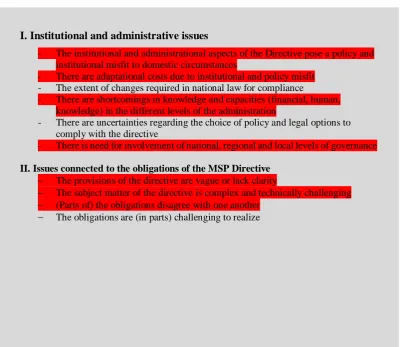
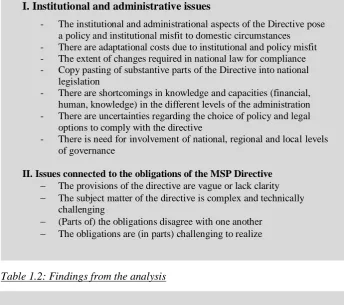
the same time could turn out to be contradicting in the process of implementing the MSP Directive and it will be analysed on which of these two aspects Sweden’s current MSP-development is aligned to. After having determined possible reasons for compliance problems with the MSP Directive, the next step is to compile them in a structured framework. The challenges for compliance were categorized into I. Institutional and administrative issues, and II. Issues connected to the obligations of the MSP Directive. They are presented in Table 1.
Table 1: possible reasons for compliance problems
3. Operationalization of the main concepts
3.1 European Policy implementation in the context of Europeanization
As this thesis is dealing with the change processes in the policy field of MSP triggered by the
implementation of an EU Directive, first of all the concept of policy implementation in the context of Europeanization is going to be elaborated. The other concept that this Thesis is dealing with is Maritime Spatial Planning as a means within the overarching framework of maritime policy, which will be elaborated in a following step.
Defining the concept of policy implementation in the context of Europeanization is important as to find a basis of explaining the functioning of European directive-implementation and subsequently using the concepts and framework of chapter 3.1 for analysing implementation performance and applying these to the case of Sweden.
Policy implementation refers to a complex change process where decisions are transformed into procedures, practices and regulations between hierarchies in a vertical matter (DeGroff and Cargo 2009). In sum, Europeanization on one hand can be seen as the process whereby national systems adapt to EU policies and European integration, and on the other hand how Member Sates themselves are shaping the European Union (Laffan and Stubb 2012). Hence, Europeanization can be
conceptualized as a top-down or a bottom-up approach. Whereas the bottom-up approach looks at I. Institutional and administrative issues
- The institutional and administrational aspects of the Directive pose a policy and institutional misfit to domestic circumstances - Adaptational costs due to institutional and policy misfit - The extent of changes required in national law for compliance - Copy pasting of substantive parts of the Directive into national
legislation
- There are shortcomings in knowledge and capacities (financial, human, knowledge) in the different levels of the administration - There are uncertainties regarding the choice of policy and legal
options to comply with the directive
- There is need for involvement of national, regional and local levels of governance
II. Issues connected to the obligations of the MSP Directive The provisions of the directive are vague or lack clarity
The subject matter of the directive is complex and technically challenging
(Parts of) the obligations disagree with one another
8
Europeanization as the Member States influence and shape on EU policies and influencing the institutional setting of the EU in their favour, the top-down approach focuses on the impact of Europeanization on domestic political processes (Börzel and Risse 2009).
The concept of ‘Europeanization’ is rather broadly elaborated in existing political science literature. Two of these definitions were selected, as they have regard to the overall research objective of this thesis.
First, the term can refer to the development of policies at the EU-level. (Risse et al. 2001).
Secondly, it is used to describe the reactions of domestic systems to top-down influences caused by European policies (Ladrech 1994; Radaelli 2000).
Ladrech implies a top-down approach for Europeanization with defining it as an “incremental process reorienting the direction and shape of politics to the degree that [European] political and economic dynamics become part of the organizational logic of national […] policy-making” (Ladrech 1994 p. 69) and hence treating it as the European Union’s impact onto member state policy.
For the purpose of this thesis, the top-down perspective shall be applied with conceptualizing European policy implementation through the principal-agent model.
3.2 European policy implementation defined through principal-agent theory
Looking at European policy implementation through the principle-agent model, a top-down approach is applied with defining policy implementation as a process where sets of tasks are delegated in a vertical matter from the European Union level to national levels where Member States are obligated to realize these sets of tasks through policy implementation.
The principal-agent model has been applied to analyse European policy implementation by various researchers (Egan 1998; Franchino 2001; Garrett 1992; Garrett and Weingast 1993; Menon 2003; Pierson 1996; Stetter 2000). The model is explicitly concerned with complex inter-institutional interactions while allowing to put the overall process of European policy implementation into a simplified order with offering a way of grasping the institutional complexity of the European Union. The model cuts through the inherent complexity of organizational relationships by identifying distinct aspects of individuals and their environments that are most worthy of investigation, and it integrates these elements into a logically coherent order (Kassim and Menon 2003).
The European Union as the legislator and producer of European directives and other law-constructs can be defined as the principal delegating the Member States who act as agents for carrying out the accurate implementation of functions and sets of tasks, namely European policy (Kassim and Menon, 2003). It is assumed that the EU as legislator strives for an implementation as close as possible to its own agenda, in contrast the Member States as implementers strive for an outcome as close as possible to their individual political views and interest. This situation might lead to problems, since the
priorities of enforcing agents and decision-making principals differ often (Pressman and Wildavsky, 1973) and the resulting conflict of interest (between principal and agent) is a necessary condition for non-compliance (Zhelyazkova and Torenvlied 2009). Translating this to the case of implementing the MSP Directive in Sweden, it could be considered that both policy and institutional misfit are persistent to a certain degree between Sweden and the EU in accordance with the assumptions of Börzel and Risse (Börzel and Risse 2003).
3.2.1 Conceptualizing compliance and non-compliance
Correct compliance with European policy consists of both legal and practical implantation phases that require the involvement of a multitude of actors engaged at the various levels and stages of a European directive’s life cycle. While legal compliance refers to Member States’ incorporating European policy into national law, practical compliance relates to the actual domestic fulfilment of European policy and its application at national levels. According to Zhelyazkova et al, legal compliance is not
automatically followed by practical implementation. This fact is describes as “decoupling”, and “reflects the extent to which practical implementation lags behind the legal implementation of EU rules” (Zhelyazkova et al. 2016 p. 828).
9
The multitude of actors involved at the various levels and stages of an EU Directive’s life cycle offer numerous possibilities for shortcomings in implementation and application. Two main forms of non-compliance can be distinguished. The first one can be defined as non-transposition or delayed
transposition, contrary to correct legal implementation of the MSP Directive’s provisions. The second form consists of non-application, referring to the failure of realizing the MSP Directive and
establishing Maritime Spatial Plans in Swedish Sea territories. 3.3 Introducing MSP as parts of European Maritime Governance
After having defined the concept of policy implementation and compliance in the context of principal-agent theory and Europeanization, the next step is to localize Marine Spatial Planning in the European framework of maritime governance. Maritime governance in the context of Europeanization has increasingly become a field of interest for researchers to study policy and institutional transformation processes (Gilek and Kern, 2015; Söderström, Kern and Hassler, 2015). For most coastal states in Europe, it is of major concern as related marine ecosystems are exposed to ongoing pressures which include overfishing, maritime pollution, the production of green energy as well as offshore oil and gas exploration, shipping, and marine aquacultures amongst other challenges (Jetoft and Chuenpadgee 2009).
Despite the EU holding the exclusive competence only in the field of fisheries and having shared competences over many other maritime areas (Koivurova 2009) and although regional governance systems differ considerably among the carious regional sea areas (depending on individual
environmental problems and the regional institutions), the European Union is arguably the most relevant political actor in Europe’s regional sea areas (Kern and Gilek 2015). As of today, European maritime governance is dealt with and regulated within the EU’s integrated maritime policy (IMP) which came into force in 2007 when it was proposed in the blue book of the European Commission (Kern and Gilek 2015). The IMP serves as a governance framework and provides tools of integrated, inter-sectoral, and multidisciplinary character in respect to the reality of maritime challenges while aiming at the sustainable management of actions on coasts, seas and oceans.
The introduction of Maritime Spatial Planning (MSP) as a tool for dealing with the various challenges of regulating maritime space in Europe is based on the European IMP, which recognizes a need for development of the former in order to give response to increasing human activity in the coastal waters around the EU and within Exclusive Economic Zones (EZZs). This need is furthermore recognized given the fact that no systematic spatial planning systems existed at most member states at the time of IMP coming into force (Kern and Gilek 2015). Moreover, MSP was admitted as a key instrument for IMP with the EC’s roadmap for MSP of 2008 (Kern and Gilek 2015).Finally, The European
Parliament and the Council put out the directive on establishing a framework for maritime spatial planning in 2014 (OJ L257), which is the subject of this thesis.
Maritime spatial planning is a tool for area-based management of human activities at seas and oceans. The eco-system approach of it implies sustainable development and use of all activities at previously defined areas. The place-based character of ecosystems, the temporal and spatial development of ocean resource uses and conflicts among them together with the need to develop human uses in places that minimize their impacts on ecologically or economically important places in the marine ecosystem all draw attention to the need to look at the system from a spatial perspective.
Maritime spatial planning provides a tool to deal with these issues, with administering an analytical basis for identifying and evaluating these measures in coastal and maritime environments for subsequent regulation of human activities in designated areas. In addition to applying an ecosystem based approach, MSP provides an integrated, strategic and future-orientated framework for all possible uses of sea areas in order to achieve sustainable economic development with incorporating
10
In sum, maritime spatial planning can be defined as a means of analyzing and allocating parts of three-dimensional spaces to specific uses or non-use based on rational decision-making, in order to achieve ecological, social and economic objectives that are usually specified through a political process (Douvere and Ehler 2009). According to Douvere and Ehler, the goals of MSP can be accomplished with accurately delineating the boundaries of the ecosystem to be managed, defining certain spaces of ecological or biological value and spaces of economic value and potential, to allocate sea areas where the effects of human activities interact negatively or positively with ecological functions and
processes, and where conflicts possibly occur or do not occur (Douvere and Ehler 2009). Hence, a correct spatial planning of maritime areas should be knowledge based.
4. Methodology
4.1. Introduction to the research design
“Research on Europeanisation […] targets a broad and complex phenomenon since all parts of the domestic political system may be affected” (Falkner et al. 2005 p.11).
My thesis is analysing the status of compliance with the MSP Directive in Sweden and aims to examine how Sweden’s maritime planning regime is changing under the process of compliance. In order to answer the research questions, a single-case study will be conducted whereby a focus is put on the process of legal implementation and domestic application of the MSP Directive’s provisions. A case study is chosen as the research approach, as it helps to explain both the process and outcome of a phenomenon through complete observation, reconstruction and analysis of the case under
investigation (Tellis 1997).
The case study serves as an ideal methodology when an in-depth, holistic investigation of a certain phenomenon or process is needed (Feagin, Orum and Sjoberg 1991). Choosing the case study method enables insights into the nature of a contemporary phenomenon through detailed contextual analysis of a limited number of events and their relationships (Hossieni et al. 2012). The method can be used to identify whether particular policy programs are working and whether the goals of particular policies are reached in observed cases (Zainal 2007).
As this thesis is focusing on only one country, a single-case design is used in order to give an overview on the status of compliance with the MSP Directive in Sweden and to show and explain change processes triggered by the directive.
This is done both descriptively, with an aim to show the status of compliance with the directive Sweden is located at the moment and reveal characteristics of the Swedish Maritime planning regime and possibly compliance problems, and explanatory in terms of targeting reasons for such compliance problems.
According to Tellis, descriptive cases require a descriptive theory to be developed before starting the analysis (Tellis 1997). Generally said, the analysis should rely on theoretical propositions that led to the case study. If theoretical propositions are not present or fit the case under investigation only to a limited scope, a descriptive framework around which the case study is organized could be developed by the researcher (Tellis 1997, Yin 1994). This thesis relies on existing compliance theory and renders it in order to make it fit for the analysis of the case of the Swedish compliance process with the MSP directive. If certain compliance problems with the MSP Directive turn out to be persistent, the
elaborated parts of existing compliance theory are consulted for theory testing in order to determine if existing theory can serve as a mean to explain compliance problems.
Explanatory case studies are fit to be used for causal investigations and rely on the in-depth analysis of gathered information in order to detect and explain cause-effect relationships (Tellis 1997, Zainal 2007). Hence, explanatory case studies aim to explain a phenomenon in deep level and should be based on a first formed theory which is tried to be tested in a following step.
In this sense, the thesis selects a qualitative research method approach with describing, understanding and explaining (Tellis 1997) the complex issue of the Swedish compliance process with the MSP Directive.
As in all research, consideration must be given to construct validity, internal validity, external validity, and reliability (Tellis 1997).
Construct validity, which is especially challenging in case study research, deals with concept
11 or in order to make it measurable through empirical observations (Tellis 1997).
According to Yin (1994), there are strategies for improving construct validity including maintaining a chain of evidence and including the use of multiple sources (Yin 1994). Employing multiple sources of evidence can contribute to construct validity by providing multiple measures of the same
phenomenon. Designing the case study so that the chain of evidence is maintained should allow reviewers to trace from conclusions back to the initial research questions (Yin 1994).
In this thesis, the main concepts are Maritime Spatial Planning and Policy implementation. Both are elaborated and discussed in Chapter 3. Furthermore, construct validity is supported by using multiple sources of evidence, with reviewing the Swedish maritime policy and change processes triggered by the directive through the analyzation of hard data including legislative and policy documents as well as soft data with using information gathered through a conducted interview with a MSP responsible person from SwAM.
While construct validity mostly deals with the correct collection and use of data and information, external validity is about the data and information analysis. External validity deals with the problem of knowing whether the findings are generalizable to other cases. Yin (1994) provided the assertion that external validity could be achieved from theoretical relationships and from these generalizations could be made.
Here it is important to have a reasonable research design that is comprehensible to the reader. A clear operationalization in chapter 3, the theory framework of chapter 2 and the analysis conducted in chapter 5 could be used in similar manner for other cases of Member States’ compliance with the MSP directive. Nevertheless, it is hard to create theoretical assumptions on compliance and implementation that are generally applicable for other cases reaching over policy fields other than maritime policy, as MSP is a relatively new planning approach of unique character. Furthermore, many Member States had MSP related policies and laws in practice before the MSP directive came into force in 2014, while others did not. Therefore, it could be assumed that the research approach this thesis is choosing cannot so easily be applied in other cases as the preconditions for effective MSP are differing amongst Member States.
Internal validity is concerned with the justification of causal relationships and hence is of great importance for the explanatory part of a case study. It can be achieved by following a clear and reasonable case study design, with a specification of the unit of analysis, developing of theory, followed by data collection and theory testing in parts of the analysis.
In order to create internal validity, this thesis aims to fulfil all of these mentioned conditions on which the operationalization in chapter 3, the theory framework of chapter 2 and the analysis of chapter 5 are based on. Moreover, the units of analysis are elaborated in this chapter in parts of the case selection.
Reliability deals with demonstrating that same results can be obtained by repeating the data collection procedure. In other words, other investigators should in principle be able to follow the same
procedures and arrive at the same results (Yin 1994, Tellis 1997).
The data base including the fully transcripted interviews and other sources of information are given in the annex of this thesis. In doing this, the thesis aims to make the conducted research understandable and to give a clear overview on how own data was collected and used.
In order to answer the complex research questions outlined in Chapter 1, a thorough analysis covering the Swedish transposition process of the MSP Directive both in terms of implementing the Directive’s obligations into national legislation and regarding practical application will be conducted. This is especially necessary to analyse if the MSP Directive led to change in institutional structures and national law as well as to detect possible problems with implementation and application, and to detect how the Swedish authorities are treating possible problems within the process of complying with the MSP Directive.
In order to explain such possible problems, existing compliance theories have been collected in a theory framework, adapted to the special character of maritime governance.
In a second step, the actual outcomes of the Swedish MSPs are being judged in terms of meeting the requirements of the MSP Directive.
The main instrument in order to answer the research questions will be an analysis of the MSP Directive and national legislative documents and further information provided by the Swedish
12
As MSP is a relatively new planning approach and existing literature on its application in a European context is limited, the case-study approach is promising to give more insights to the functioning of MSP in Sweden as well as to possible problems and challenges its application faces at domestic levels. In this matter, the findings of the case study conducted in this thesis could also give incentives for further research in the field.
4.2 Case Selection: Why Sweden?
The directive on establishing a framework for maritime spatial planning ultimately applies to maritime waters of Member States (Directive 2014/89/EU). Hence, it counts for all Member States that have access to sea- and ocean-territories. In the following, it is elaborated why Sweden makes up an interesting and significant case for observation on compliance with the MSP Directive.
In order to be suitable for a scientific analysis, a case has to afford enough available data to address the question of interest. If sources are scarce, unreliable, or inaccessible, the case is of little value
(Seawright and Gerring 2008)Furthermore, a choice of cases shall be based on criteria of indicators for significance and appropriateness (Seawright and Gerring 2008)For appropriateness a fit to both the phenomenon under investigation and the purpose of research needs to be demonstrated (Seawright and Gerring 2008). This is discussed in terms of the availability of data and information as well as the significance of the respective case.
I. Availability of data and information
Sweden’s well-developed public data records and the accessibility of legal texts as well as the responsiveness of national planning authorities are the basis of information this thesis is built upon. In a first step, information was gathered drawn on information from the websites of the European MSP Platform, where summaries on existing or planned MSPs in every Member State affected by the MSP Directive as well as country profiles and overviews on respective States are presented in the form of country profiles, including legislation and administrative distributions of competences.
Furthermore, the European MSP Platform provides hyperlinks leading to significant websites from national authorities. These respective institutions involved in the planning processes of maritime areas in Sweden where searched for further information using multiple key words (MSP, marine/maritime spatial planning).
In this respect, significant information helping to answer the research question was highly accessible. Not only provide the websites information on the overall working together of the Swedish maritime governance system, but also give access to legislative documents handling with the legal foundation of MSP in English language. This made the analysis of policy and law documents possible.
In order to support the findings from the analysis of legal and policy documents and to solve
remaining questions, two interviews with a representative person from SwAM were conducted in order to get first-hand information that could not be gathered with other research methods.
II. Significance
The significance of Sweden for the research approach of this thesis follows from the issues addressed by the MSP Directive and the ones the country itself is facing as well as from the country’s specific role in the Scandinavian and Baltic area.
First of all, Sweden did not have any national MSPs in force before the MSP Directive came into force in 2014. Hence, unlike for other Member States, this particular approach is a rather new thing and experience with comprehensive planning of maritime areas incorporating a variety of issues happening at the same time is very limited.
With a total size of approximately 70.000km2 Swedish sea territories are the largest amongst all Baltic Sea bordering states. The country has both access to the Baltic and the North Sea. On the country’s Baltic Sea side, coastlines extends all the way from the northernmost part of the Bothnian Bay to the Skagerrak, a distance of more than 1,500 kilometres.
13 enormously important for summer recreation and outdoor life.
In Sweden, MPAs have a status of high precedence and an intact maritime environment is seen as vital for the functioning of all sectoral activities connected to sea spaces and areas.
Coastal sites of cultural heritage have been adversely affected by human activities and there is a growing need to find means of resolving conflicts of interest. The sector of fishing is of great importance in both the Swedish North Sea and the Baltic, not only for the municipalities and coastal communities but also as a sector sustaining to the overall Swedish economy.
Sweden’s largest port of Gothenburg is localized at the North Sea side of the country, other small ports are furthermore of great importance for the sectors of shipping and fisheries. In addition to this, the Skagerrak and Kattegat regions are relatively small and used in various ways by multiple nations and international companies (European MSP Platform 2018).
All of these issues are making Sweden a significant case of observation for analysing how the country is dealing with implementing the obligations of the MSP Directive.
Considering the availability of vast and detailed information and the importance its North Sea situated regions have for the country, as well as the fact that Sweden had, in contrast to other Member States, no MSPs in force before the MSP Directive and the multi-use and possible conflict aspects of the country’s multiple sea regions connected to Sweden’s level of consultation with its neighbours, makes Sweden an interesting case of observation. Therefore, the country fits to the purpose of the research conducted in this thesis and proves as an object of investigation of compliance with the MSP Directive.
The unit of analysis is a critical factor in the case study. It is typically a system of action rather than an individual or group of individuals. Case studies tend to be selective, focusing on one or two issues that are fundamental to understanding the system being examined (Tellis 1997).
Selecting the appropriate units of analysis should be based on accurately specifying the primary research questions (Yin 1994).
Correct compliance with the MSP Directive consist of adequately implanting the Directive’s provisions into national legislation, a change or adaption in the national administration for maritime governance, and developing and realizing planning tools for maritime areas in line with the obligations of the MSP Directive.
In this thesis, the units of analysis therefore include the national legal basis that MSP builds upon, the country’s administrational system for maritime governance and MSPs under development. These three units combine to the overall MSP-making process that Sweden is currently going through.
5. Analysis
5.1 Obligations of the MSP Directive
In order to determine whether or not Sweden’s MSP system and designated policies match with the requirements and obligations of the MSP Directive, an overview on the latter will be given in the following section.
In the next step, a look will be given at change in law, regulations and legal mechanisms necessary to comply with the MSP Directive, followed by analysing which administrative provisions have been established and which national authorities have been designated. After that, a focus is put on the new planning policies that have been established under the MSP Directive.
The MSP Directive obligates Member States to bring into force the regulations, administrative provisions and laws necessary for compliance by September 2016 (O.J. L. 257/135, Art. 15 [1]). Furthermore, the competent authorities shall be designated by the same time (O.J. L. 257/135, Art. 15 [2]). In addition to the obligation of legal compliance, Member States have to establish maritime spatial plans ultimately by 2021 (O.J. L. 257/135.Art. 15 [3]).
14
First of all, plans shall consider social, environmental and economic aspects to support sustainable development and growth in the maritime, with applying an ecosystem-based approach and to promote the coexistence of relevant activities and uses. All relevant activities shall be organized on the basis of sustainability. With introducing MSP, a framework shall be established for consistent, sustainable and evidence-based decision making (O.J. L. 257/135, Provision 9). Although the Directive is without prejudice to the competence of Member States to determine how these different objectives are weighted and reflected in their maritime spatial plans and there are no obligations regarding the concrete choices of Member States about how to pursue sectoral policies aiming at realizing the Directive’s goals, there are some minimum requirements for MSP (O.J. L. 257/135, Art.4; Provision 9). The Member States are responsible and competent for determining and designing the format and content of maritime spatial plans, setting up the necessary institutional arrangements and appointing maritime space to different activities and uses, if necessary (O.J. L. 257/135, Provision 10).
The minimum requirements for MSP are taking into account land-sea interactions, environmental, social, and economic as well as safety aspects, promoting coherence of the plans with other relevant processes, ensuring the involvement of stakeholders, base the plans on the use of best available data and knowledge, ensuring trans-boundary cooperation with Member States affected by the national planning and promoting cooperation with third countries. Furthermore, the plans shall be reviewed at least every ten years in order to adjust them to maritime developments (O.J. L. 257/135, Art. 4-6). When establishing MSP, Member States shall have due regard to the particularities of the maritime space, relevant existing and future activities and uses and their impacts on the environment, as well as to natural resources. Thereby, they shall include or build on existing national policies, mechanisms and regulations, that have been established before the MSP Directive came into force, to the greatest extend possible as long as these are in conformity with the requirements of it (O.J. L. 257/135, Art. 4 6; Provision 12).
The overall process of MSP-making shall cover the full policy circle of “problem identification, information collection, decision-making, implementation, revision or updating, and the monitoring of implementation” (O.J. L. 257/135, Provision 18).
The Directive gives special regards to the organizing and addressing of land-sea interactions, public participation, data use and sharing as well as cooperation among Member States and with third countries.
Regarding land sea-interactions, the Directive obligates Member States to either handle it as parts of their MSP or through other formal or informal processes, such as integrated coastal management, and to reflect the outcomes of these processes in their maritime spatial plans (O.J. L. 257/135, Art. 7). According to provision 16, MSP can be a useful tool in determining orientations related to the preservation of the living environment, sustainable and integrated management of human activities at sea, as well as the fragility of coastal ecosystems. Therefore, MSP should aim to integrate the
maritime dimension of coastal activities and uses and related impacts (O.J. L. 257/135, Provision 16). In terms of public participation, Member States shall establish means of realizing this by informing all interested parties and by consulting relevant stakeholders and authorities and the public concerned at an early and appropriate stage in the MSP-development. In addition to that, open access to the plans shall be given to relevant authorities and stakeholders as well as the public concerned once the plans are finalised (O.J. L. 257/135, Art. 9, Provision 21).
For using the best available data, Member States shall include environmental, economic and social information collected in accordance with relevant activities within the areas designated for MSP, as well as physical data about maritime waters. For that, Member States shall use relevant and effective instruments and tools (O.J. L. 257/135, Art. 10). In order to gather the up-to-date and best available data and information, Member States shall encourage the relevant stakeholders to share information (O.J. L. 257/135, Provision 24).
In regard to cooperation with Member States and third countries, cooperation shall happen with the aim of ensuring that plans are coherent and coordinated across the maritime regions concerned with taking into account issues of transnational nature. Cooperation shall be pursued through networks or structures of Member State’s competent authorities and/or through existing regional institutional cooperation structures (O.J. L. 257/135, Art. 12, Provision 20).
15
kept within levels compatible with a good environmental status and the capacity of the maritime environment to respond to human-induced changes is not compromised. An ecosystem-based
approach shall be applied in a way that is adapted to the specific environmental circumstances of such maritime areas, which are object of MSP (O.J. L. 257/135, Provisions 13-14).
In sum, successful compliance with the MSP Directive is established, if Sweden meets the
requirements of legal implementation, designating competent authorities and realizes national MSP policy, which meets the Directive’s provisions and minimum requirements.
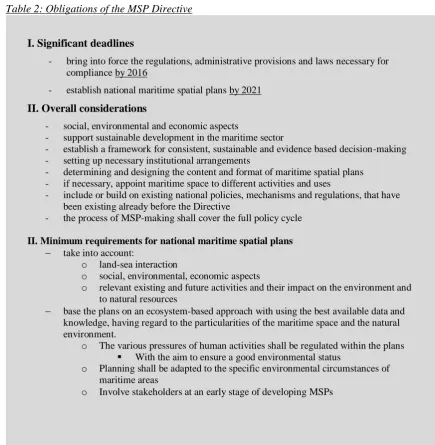
A summary of the obligations found with analysing the MSP Directive is provided in Table 2. Table 2: Obligations of the MSP Directive
5.2 The changes in Swedish law under the MSP Directive
The Swedish planning system is mainly found on the basis of the Planning and Building act (PBL) and the associated Planning and Building Ordinance (PBF), which include provisions related to comprehensive municipal and regional planning, area regulations as well as provisions regarding plan development and implementation (SFS 2010:900) Another foundational law is the Swedish
Environmental Code (SEC), which constitutes environmental legislation aimed at promoting I. Significant deadlines
- bring into force the regulations, administrative provisions and laws necessary for compliance by 2016
- establish national maritime spatial plans by 2021
II. Overall considerations
- social, environmental and economic aspects
- support sustainable development in the maritime sector
- establish a framework for consistent, sustainable and evidence based decision-making - setting up necessary institutional arrangements
- determining and designing the content and format of maritime spatial plans - if necessary, appoint maritime space to different activities and uses
- include or build on existing national policies, mechanisms and regulations, that have been existing already before the Directive
- the process of MSP-making shall cover the full policy cycle II. Minimum requirements for national maritime spatial plans
take into account:
o land-sea interaction
o social, environmental, economic aspects
o relevant existing and future activities and their impact on the environment and to natural resources
base the plans on an ecosystem-based approach with using the best available data and knowledge, having regard to the particularities of the maritime space and the natural environment.
o The various pressures of human activities shall be regulated within the plans
With the aim to ensure a good environmental status
o Planning shall be adapted to the specific environmental circumstances of maritime areas
16
sustainable development and serves as the key tool in Sweden for developing environmental policy (Swedish EPA 2018).
The PBL explicitly designates the planning of the use of all Swedish land and water areas to the responsibility of municipalities (SFS 2010:900). Chapter three of the PBL obligates the municipalities to establish comprehensive plans covering the entire respective areas under their authority, including sea areas. Although comprehensive plans are not legally binding, they must indicate orientation for the long-term development of the physical environment and include guidance for decisions on the use of land and water areas. While comprehensive plans are not legally binding, detailed plans or area regulations are indeed. These type of plans concern the use of particular land and sea areas within the municipalities. While comprehensive planning shall be used for developing long-term strategies for broader areas, detailed plans or area regulations shall serve the purpose of outlining and realizing certain projects, which can be related to building infrastructure, environmental protection measures and others (SFS 2010:900, Chapter 4 Section 1, 2, 6-17).
The PBL stipulates that both comprehensive plans and detailed plans or area regulations shall be based upon and include national interest, with regards to streamlining planning with national and regional goals, plans and programmes of significance for sustainable development (SFS 2010:900, chapter 3 sections 2-5, Chapter 4 section 42, Chapter 5 Section 14). National interest is defined in chapter 4 of the SEC and includes a wide variety of areas such as military interests, protected areas including MPAs, environmental protection, fishery, harbours and cultural important areas (SFS 2018:1427, Chapter 4 Section 1-7).
It falls on the municipalities to interpret and demonstrate how the various national interests are to be accommodated into their comprehensive and detailed plans or area regulations (PBL 2016, chapter 3 section 5, chapter 4). In case of prioritizing conflicts, national interest must always take precedence over all other interest including the municipal ones and priority shall be given to the purpose that is most likely to promote sustainable development of the physical environment (SEC Chapter 3 Section 10). Regarding sustainability and environmental standards for planning, all acting shall be based on the provisions of Chapter 5 of the SEC (SFS 2018:1427, Chapter 2 section 10).
Chapter 5 of the SEC designates that the government may issue rules with respect to the country as a whole or to certain geographical areas concerning the quality of the general environment in order to provide for lasting environmental protection and the well-being of human health. Furthermore, “the government may instruct a public authority to issue environmental quality standards arising out of Sweden’s membership to the EU” (SFS 2018:1427, chapter 5 section 1). The same counts for adopting action programmes and plans arising from the EU membership (SFS 2018:1427, Chapter 5 section 5, 8). In addition to that, such action programmes shall be established if there is a necessity for
compliance with an environmental quality standard. Action programmes may be include human activities that affect the levels of pollution or disturbance, and have regard to the measures to be taken to reach compliance with environmental quality standards.( SFS 2018:1427, Chapter 5 section 6). Section 2 of chapter 5 defines environmental quality standards with specifying “the levels of pollution or disturbance to which the population [or the environment] may be exposed”. The levels specified in environmental quality standards shall indicate the maximum and minimum occurrence of chemical products and organisms that can serve as indicators of the state of the environment in water, air and ground as well as maximum levels for noise, light, radiation or other such impacts. (SFS 2018:1427, chapter 5 section 2). Any planning shall be based on environmental impact assessments, if the government decides that a planned activity is likely to have an impact (SFS 2018:1427, Chapter 6 section 1).
While the PBL gives no special regard to MSP and was not updated in parts to meet the requirements of the MSP Directive yet, it still serves as the foundation of organizing and designating the authority for planning Sweden’s maritime areas (European MSP Platform 2018).
17
baseline seawards that do not constitute private property. The marine spatial plan shall provide guidance to public authorities and municipalities in the planning and review of claims for the use of the areas covered by the plans. The SEC furtherly states that each of the three plans shall contribute to sustainable development. (SFS 2018:1427, chapter 4 section 10; European MSP Platform 2018). As MSP was not on the agenda before the MSP Directive came into force in 2014, Sweden not only had to adapt existing legislation, but also to create new one in order to meet the requirements for compliance. This was realized in 2015 with the Maritime Spatial Planning Ordinance (in the
following referred to as “the Ordinance”). The Ordinance regulates the process of developing national MSPs for the three areas that are defined in chapter 4 of the SEC and contains provisions on
geographical boundaries for these planning regions (SFS 2015:400, section 2). Moreover, the
regulation contains provisions for the content of maritime spatial plans. In this sense, a spatial plan for maritime areas shall present the basics for the human use of a specific sea area, possible collisions of national interest and how incompatible or conflicting purposes of human use should be solved as well as clearly state the meaning and consequences of the sea-usage as planned (SFS 2015:400, Section 3-4).
Additionally, spatial plans shall be designed in ways that integrate economic, social and environmental goals and serve to achieving a good environmental status of the maritime environment with
sustainably using the maritime resources, while at the same time promoting coexistence between different sectoral activities and the environment. Thereby, plans have to comply with chapter 3-4 of the SEC.
The Ordinance furtherly designates the responsibility for preparation, consultation and cooperation in the proposal processes as well as monitoring and review of the plans to the Swedish Agency for Marine and Water Management (SwAM). While developing proposals for maritime spatial plans, SwAM shall draw from the support and input from national authorities, which have to provide supporting data for MSP.
The municipalities that may be affected by national MSPs must be given the possibility to participate in the proposal processes in order to include local and regional conditions and needs. In addition to that, SwAM shall promote cooperation with neighbouring countries and shall coordinate the Swedish MSPs with those of other states which may be affected by these plans (SFS 2015:400, Section 5-12) In fulfilling all these tasks, SwAM shall rely on the help and expertise of significant national authorities, if necessary (SFS 2015:400, Section 14-16). The Ordinance regulates the coordination of the MSP-making process in detail and designates the tasks to all relevant state actors of the Swedish maritime governance system, which will be presented in the next section of this chapter.
Summary of changes in law
Summarizing the changes in Swedish law and jurisdiction under the MSP Directive, it turned out that the changes required to adapt the legal system in order to comply with the directive where different from law to law.
The PBL was not object to change regarding MSP. Although the law was adopted over the years, no regards to spatial planning can be found in the text and no change was made to the overall
organization of planning maritime areas. Hence, the municipalities are still in a powerful position and their authority for planning land and maritime areas within their individual spheres of influence was not touched by change processes following the MSP Directive.
One amendment was added to the SEC in 2015. Chapter 4 of it got additional section provisions, which designate the establishment of maritime spatial plans for three areas in the Gulf of Bothnia, the Baltic and the North Sea.
Last but not least, the MSP Ordinance was adopted in 2015. This regulation designates how the contents of maritime spatial plans shall be organized, which Swedish authorities have to be involved in the process of MSP related policy making and how this should happen.
5.3 Changes in administration and institutional authority
18
are directly connected to MSP, there is a number of Swedish authorities involved in MSP besides SwAM. These authorities have a national sectoral planning responsibility, including in maritime areas. The legal mandates of these institutions are mostly related to identifying areas of national interest in different fields and to capacities for knowledge-based decision making (SwAM 2018).
SwAM gives an overview on its website regarding the overall level of involvement in MSP of each of these authorities.
The Swedish national Board of Housing, Building and Planning (Boverket) is responsible for the oversight of national interests and is designated as the managing authority for matters concerning the built environment and its management according to the PBL. Within the MSP process, Boverket is responsible for guiding municipalities in their efforts with spatial planning that may coincide with the national plans for Sweden’s EEZs.
The Swedish Environmental Protection Agency (EPA) has overarching responsibilities regarding Sweden’s environmental quality objectives and identifies areas of national interest with respect to outdoor recreation and conservation. In addition to this, EPA also funds maritime environmental research. Within the MSP process, EPA provides assistance for environmental impact assessment and takes part in communication of MSP related issues with the competent authorities abroad in affected Member States.
Other institutions supporting SwAM with knowledge on maritime issues regarding the environment and sectoral activities. These institutions are the Geological Survey of Sweden (SGU), the Swedish Institute for the Maritime Environment, the Swedish Meteorological and Hydrological Institute (SMHI), Statistics Sweden (SCB) and the Swedish Marine Administration (SMA).
In addition to these supporting institutions, there is a number of authorities that either are aligned with competences or have to be consulted in parts of the MSP-making process. The Swedish National Heritage Board identifies areas of national interest related to the historic environment. The Board is consulted in matters of such environments that may be affected by renewable energy production, cabling and wiring as well as fishing. The Swedish Energy Agency on the other hand works for the use of renewable energy, improving technologies and the mitigation of climate change. This is connected to developing a sustainable energy system and identifying areas of national interest for energy
production and distribution, including off-shore wind energy production and wave energy. In terms of sea traffic, the Swedish Transport Administration is tasked with developing long-term plans for transport systems and with identifying claims to areas of national interest for shipping.
Last but not least, the Swedish Armed Forces hold a number of interests in maritime areas based on the purpose of upholding Sweden’s territorial integrity and defending the country against future threats. (SwAM 2018).
Summary of changes in administration and institutional authority
The policy-analysis of changes in administration and institutional authority could not fully determine such changes, as no information was found on the significant circumstances before the MSP Directive came into force. Nevertheless it was found that as of today, the process of national MSP-making involves a large number of national governmental institutions besides SwAM, that have different roles and distinctive levels of competences within this process.
5.4 Sweden’s MSP policies I. The status report of 2014
19
aspects and issues of maritime planning are suitable to be dealt with under the approach of MSP and which problems could emerge with introducing this new planning policy. Furthermore, the report gives an overview on the use of the sea and the current status of MSP of all states within closer range to Sweden. These include Denmark, Estonia, Finland, Latvia, Lithuania, Norway, Poland, Russia and Germany.
The report takes an ecosystem-based approach with identifying existing environmental issues that are persistent in all of the three planning areas, as well as analysing possible threats to the environment that could result from increasing human activities in Sweden’s maritime areas. This is done on the basis of the best available data, which is presented throughout the whole report. The conclusions of the report can be analysed as seeing MSP mainly as a tool to contribute to the prevention of negative effects on the maritime environment, safeguarding the ecosystem and carefully choosing the instruments under which human activity could be increased, as some maritime activities can have negative effects on environmental goals. The report furtherly identifies that securing economic and social as well as ecological sustainability is a fundamental issue of MSP.
Furthermore, potential spatial conflicts are recognized for the activities of fishing, aquaculture and energy production as these interest cannot share the same space within the Swedish waters and could come into conflict with the natural values existing within all sea areas. Furthermore, the report recognizes that land-sea interaction is difficult to be handled within MSP regarding the reduction of environmental problems found in maritime areas caused by activities on land, which proves to be an issue that cannot be resolved through MSP.
In addition to environmental issues and usage conflicts, there is a special regard to potential conflicts rising from the intersecting areas of national and municipal planning. Figures 1 and 2 show maps taken from the report, in which the overlap of municipal and national planning areas is presented. The figures can be found in the Annex of this thesis. The overall average intersecting area of areas under the planning monopoly of the municipalities and the areas under national planning is 12 nautical miles. According to the report, this demands for increased coordination and a sharing of knowledge.
While the report does not present actual solutions to the various problems and challenges that are identified within it, it can be categorized as a policy of “problem identification” and “information collection” in the overall MSP-policy making process in line with provision 18 of the MSP Directive. It includes the discussion of all aspects and minimum requirements of the Directive for future national maritime spatial plans.
II. The national Proposals for Maritime Spatial Plans
All of the three MSPs under development are identical in their structure. First of all, the national legal basis for their establishment is presented with regards to the MSP Ordinance and the Environmental Code. The Proposals have regard to the goals for sustainable development which shall be achieved through MSP, in accordance with the obligations of both national laws. Furtherly, there is a regard to the overall structure that maritime spatial plans shall take. These include maps and plan descriptions. The Maps and plan description presented in the proposals present the main outlines for the use of the maritime areas, the areas of national interest in accordance with chapter three of the Environmental Code as well as other public interests of material significance.