This paper is made available online in accordance with publisher policies. Please scroll down to view the document itself. Please refer to the repository record for this item and our policy information available from the repository home page for further information.
To see the final version of this paper please visit the publisher’s website. Access to the published version may require a subscription.
Author(s): Rowley, M.G. and Robinson, E.J.
Article Title: Understanding the truth about subjectivity Year of publication: 2007
Link to published version:
Running Head: UNDERSTANDING SUBJECTIVITY
Understanding the Truth about Subjectivity
Martin Rowley
School of Psychology
University of Keele, UK.
Elizabeth J. Robinson
Department of Psychology
Warwick University, UK.
Social Development, in press
Correspondence address:
Abstract
Results of two experiments show children’s understanding of diversity in personal
preference is incomplete. Despite acknowledging diversity, in Experiment 1(N=108),
6-and 8-year-old children were less likely than adults to see preference as a legitimate basis
for personal tastes and more likely to say a single truth could be found about a matter of
taste. In Experiment 2 (N=96), 7- and 9-year-olds were less likely than 11- and
13-year-olds to say a dispute about a matter of preference might not be resolved. These data
suggest that acceptance of the possibility of diversity does not indicate an adult-like
understanding of subjectivity. An understanding of the relative emphasis placed on
objective and subjective factors in different contexts continues to develop into
adolescence.
Understanding the truth about subjectivity.
Many of the most interesting and challenging problems people face in their
everyday lives involve reconciling different viewpoints. Sometimes differences might be
settled by uncovering an agreed truth of the matter, but on other occasions a single true
answer will be unavailable or inappropriate. For issues such as this, successful resolution
can depend upon interested parties acknowledging the possibility and legitimacy of
different perspectives and recognising how subjective factors such as personal beliefs,
motivations, or preferences influence people’s judgments about what is true or correct.
Kuhn (2000) proposed that individuals’ ability to deal constructively with this kind
of ill-defined problem rests upon the extent to which they understand and coordinate the
relationship between objective and subjective aspects of the knowing process. Initially,
research carried out to look at epistemological development suggested that: i)the
emphasis someone places on objective or subjective factors is determined by their
underlying understanding of the nature of knowledge;ii)this understanding will
influence the individual’s judgments across all knowledge domains, and;iii)individuals’
thinking about the nature of knowledge progresses through a series of age-related stages.
Typically, understanding develops from emphasising objectivity in early childhood,
where all differences in belief are expected to be reconciled by reference to a true state of
affairs (an ‘absolutist’ epistemic stance), to a later emphasis upon subjectivity, where
differences are treated as equally valid opinions (a ‘relativist’ or ‘multiplist’ stance).
‘evaluativist’ or ‘rationalist’ stance in which different beliefs are assessed in relation to
the context in which they arise (see reviews by Hofer & Pintrich, 1997; Pintrich, 2002).
More recently, these assumptions have been challenged by research highlighting
domain specificity in epistemic thinking (Estes, Chandler, Horvath, & Backus, 2003;
Hofer, 2000; Paulsen & Wells, 1998) and suggesting that the ‘objective to subjective’
shift occurs earlier in some knowledge domains than in others (Kuhn, Cheney, &
Weinstock, 2000). One implication of domain specificity in epistemic thinking, is that
individuals need to be aware of the appropriate emphasis to place on objective or
subjective factors in different contexts. Currently there is uncertainty about when and to
what extent children begin to discriminate in their approach to different types of issues.
In the two experiments presented here we examine children’s judgments about the
relative importance of personal preference and factual information in different contexts.
We also probe their understanding of the nature of subjectivity, at least as it is construed
in Western society. In recent years a body of research has emerged to suggest that people
from East and South Asian cultures are more likely to explain behaviours in terms of
situational variables, especially when situational constraints are salient (Choi, Nisbett, &
Norenzayan, 1999). In contrast, in the West there is a tendency to refer to enduring
personal dispositions (Ross & Nisbett, 1991). Here we are interested in how children’s
understanding compares with that we would expect to see in Western adults, and how this
understanding develops during middle and late childhood. Even in the West, however, the
border between what counts as an objective or subjective matter is disputed territory. In
order to examine children’s understanding of subjectivity we focus upon issues and
position taken by a number of philosophers (e.g. Searle, 1992), that something qualifies
as being (epistemologically) subjective if the most important evidence for determining
the truth-value of statements relating to it is derived from (metaphysically subjective)
personal experience (e.g. how something tastesto mebut not necessarily anyone else). By
concentrating on subjectivity in terms of simple matters of preference or taste we also
aim to present our child participants with issues that give them every chance of
demonstrating their ability to discriminate in their judgments from matters of fact.
Even before assessing the merits of different beliefs, however, children first need to
acknowledge that it can be legitimate for diverse views to be held. Again, an important
distinction can be made between children’s understanding of differences in beliefs
originating externally in the current situation and those occurring as a result of
pre-existing individual differences, such as personal preferences or tastes (Miller, 2000). For
example, even 3-year-olds are more ready to accept diversity for matters of taste than for
matters of fact. Flavell, Flavell, Green, and Moses (1990) report that 3-year-olds were
ready to acknowledge, for example, that “Ellie doesn’t think this is a yummie-tasting
cookie” when they themselves thought it was. At the same time, the children were
unwilling to acknowledge “Ellie doesn’t think there’s candy inside the box” when they
themselves thought otherwise.
By around the age of 4 to 5 years many children are willing to acknowledge false
beliefs (Wellman, Cross, & Watson, 2001). Importantly, however, in the case of false
belief the protagonist lacks crucial information which is available to the child participant,
in this example the content of the candy box. In contrast, in the case of the cookie, the
same experience. It is not until around the age of 7 years or even older that children
acknowledge diversity of views when both parties have the same (limited) access to
information about a matter of fact. For example, Carpendale and Chandler (1996)
compared children's acceptance of and explanations for diverse views about matters of
personal taste and about the interpretation of limited information. They told children aged
5-6 and 7-8 years about two protagonists who disagreed about whether a bowl of soup
tasted good or bad. Children also heard an ambiguous message about where a coin was
hidden, and were told that two protagonists made different interpretations of the message.
Children were invited to explain why the protagonists had different views, and were
asked whether they could predict what another person would think. Carpendale and
Chandler’s (1996) results suggested that children’s understanding of matters of taste is
well in advance of their understanding about alternative interpretations of ambiguous
input, and these authors argue that understanding about pre-existing differences in
personal taste should be viewed separately from an understanding about interpretation.
Kuhn, Cheney, and Weinstock (2000) also concluded that children aged 7 and 8
years have no difficulty understanding diversity of views for matters of taste. In two
studies, participants ranging in age from 7 years to ‘mature adults’ were asked to judge
the legitimacy of competing viewpoints in the contexts of personal taste, aesthetics,
values, and social and physical truth. For matters of taste, nearly all participants at all
ages judged that both views ‘could have some rightness’ and that one was ‘not more right
than the other’. Kuhn et al. interpret these responses amongst their 7- and 8-year-olds as
Wainryb, Shaw, Langley, Cottam, and Lewis (2004) also compared children's
judgments about diversity for matters of taste and factual matters involving limited
information. These researchers examined the extent to which 5- to 9-year-olds accepted a
viewpoint different from their own (tolerance) and acknowledged the possibility of
equally legitimate alternative beliefs (relativism). For judgments about matters of
morality (whether it is all right to kick someone) and physical facts (whether a pencil will
fall up or down if dropped), children were much more likely to judge that only one belief
could be right. On the other hand, for matters of taste and ambiguous fact acceptance of
diversity (relativism judgments) increased with age. This fits with the finding that 7 and 8
year olds distinguish between taste and matters of physical truth (Kuhn et al., 2000) and
draws attention to the fact that children’s judgments about the possibility of diversity may
be informed by their awareness of how truth impinges upon the matter in question.
However, acknowledging thecurrentlegitimacy of diverse tastes does not
necessarily imply accepting that there is no single truth to be discovered. Diversity in
matters of taste might be treated like diversity in interpretation of limited information
about an aspect of the physical world: With more information, everybody would be
expected to agree on the truth of the matter. Wainryb et al. (2004) report that 5-year-olds
gave reasons that suggested they were more likely to see truth as being relevant to matters
of taste than did older children. In line with this suggestion, Clinchy and Mansfield
(1985) report a “large minority” of 7-year-olds who acknowledged that disputes about
matters of taste are caused by internal subjective factors but who still believed a single
true solution to the problem could be found. This kind of response suggests a very
While philosophers of mind have disputed whether it is possible for two people to
disagree without either being at fault (‘faultless disagreement,’ e.g. Kolbel, 2003), we
suggest that in Western society most adults see personal tastes as being true of the
individual rather than true or false in an absolute sense.
It seems clear from the published literature that by the age of 7 or 8 years, if not
well before, many children acknowledge that people with the same experience can hold
different views both about matters of personal taste, and about matters of fact when
information is currently limited. It remains unclear, however, what lies behind such
acceptance in terms of assumptions about the role of objective and subjective factors in
producing and maintaining diverse views. This question is the focus of our attention in
the Experiments reported below. In Experiment 1 we checked on the validity of our
intuitions about adults' views about the balance of objective and subjective factors in the
construction of factual beliefs and preferences, and the extent to which they believed a
true conclusion could be reached. We compared adults’ responses with those of 6- and
8-year-olds. In Experiment 2, we examined the views of 7-, 9-, 11- and 13-8-year-olds.
Experiment 1
We presented two stories in which protagonists held diverse beliefs about a matter
of fact or a matter of personal taste. Sometimes the reasons for the beliefs held by both
disputing parties were relevant to the context of the dispute (‘pure’ disputes). In other
versions of the stories one protagonist held a belief on the basis of reasons that were less
relevant. For example, for a matter of fact one protagonist’s belief was based on personal
preference (‘contaminated’ disputes). For each story type, we assessed the relative weight
checked whether they thought it was legitimate for diverse views to be held, and whether
the truth of the matter could be found. For the two simple issues presented we expected
adults would agree that for matters of fact:i)It is most appropriate for beliefs to be based
upon the most recent available factual information;ii)diverse beliefs can be legitimate
when available information is insufficient to expose the truth, and;iii)a single truth can
at least in principle be found. For matters of preference we expected adults would agree
that:i)It is more appropriate for beliefs to be based upon personal preference and that an
individual’s personal preference is valid for themselves but not necessarily for anyone
else;ii)diverse beliefs are legitimate because people have different internal tastes and
preferences and;iii)no single external truth may exist. We used the views given by a
group of adult participants as a benchmark against which we compared the judgments of
6- and 8-year-old children.
Method
Participants.The final sample consisted of 103 participants. The adult group
(Mean age 29;2: Range 19-44) comprised 24 females and 12 males enrolled on a course
'Returning to Education' at a College of Further Education in Staffordshire, UK. This
course was for adults without post-16 academic qualifications. Children were from a state
funded junior school in Stafford, UK. In the older group there were 24 females, 10 males
(Mean 8;00: Range 7;9-8;8) and in the younger group 17 females and 16 males (Mean
6;5: Range 5;11-6;9). All participants spoke English as their first language and parental
agreement was sought prior to the children’s participation. The responses of five further
participants (three 6-year-olds and two 8-year-olds) were omitted from all analyses
Procedure. Participants were presented with two stories, Mouse (fact-based) and
Biscuit (preference-based) with order of presentation counterbalanced between
participants. In the Mouse story, at a pet shop a mouse had been put into either a red or
blue box but its true location was unknown. In the Biscuit story, a new biscuit was being
sold in the shops. Child participants were tested individually and oral presentation of the
story was supported with colour drawings showing the protagonists either in the pet shop
or with a poster advertising the new biscuit. The adults received the same stories and test
questions in the format of a written questionnaire.
In each story a first protagonist was introduced as holding a specific belief about
the event presented in the story. The reason for this protagonist's belief was either fact- or
preference-based, as follows: Mouse: “He thinks the mouse is in the red box because…”
either, “He saw the mouse being put in the red box” (fact-based), or “He likes the colour
red” (preference-based). Biscuit: “He thinks the biscuit is horrible because…” either “He
doesn’t like the taste of those biscuits” (preference-based), or “He heard on the news that
this year fewer of those biscuits have been sold than any other biscuit” (fact-based). A
second protagonist was then introduced, who always held the opposite belief to the first,
either “The mouse is in the blue box” or “The biscuit is nice.” Protagonist 2 told the first
protagonist the reason for this belief. The reason was either fact- or preference-based, as
follows: Mouse: “He thinks the mouse is in the blue box because…” either, “He saw the
mouse being moved to the blue box” (fact-based), or “He likes the colour blue”
(preference-based). Biscuit: “He thinks the biscuit is nice because…” either “He likes the
taste of those biscuits” (preference-based), or “He heard on the news that this year more
beliefs held by the two protagonists were varied between participants so that for each
story three different combinations of reasons were presented to an equal number of
participants. One combination represented a ‘pure’ dispute, in which both disputants’
beliefs were based upon context-appropriate reasons: Mouse: based then new
fact-based; Biscuit: preference-based then new preference-based. The two other disputes were
‘contaminated’ by one of the disputants holding a belief based upon reasons that were
less appropriate to the context: Mouse: fact-based then preference based; or
preference-based then fact-preference-based: Biscuit: preference-preference-based then fact-preference-based; fact-preference-based then
preference based.
To assess the relative weight participants placed on the beliefs held in each dispute
they were asked two questions. After hearing the reasons for the first protagonist’s belief
participants were asked the Validity question. For children a pointer was used: “Use the
pointer to show me how good this reason is for thinking (the mouse is in the red box)”.
They were asked to select between six possible responses (0 = Not sure, 1 = Very bad
reason, 2 = Bad, 3 = Not very good, 4 = Good, 5 = Very good). After hearing the second
protagonist explain the reasons for his belief, children were asked the Change question
(“Now (the initial protagonist) has heard that, will he change his mind about (whether the
mouse is in the red box)? To tell me whether (the initial protagonist) will change his mind
you can use this pointer”). Again there were six possible responses (0 = Not sure, 1 =
Definitely not change, 2 = Probably not, 3 = Might, 4 = Probably change, 5 = Definitely
change).
Participants were then asked: “At this moment in time, is it okay for (the two
justify their answer. Finally participants were asked the Truth question: “I want you to
use the pointer to show me whether we can find out the truth about (where the mouse
is.)”, and to select from the six possible responses (0 = Not sure, 1 = Definitely not find
out, 2 = Probably not, 3 = Might find out, 4 = Probably find out, 5 = Definitely find out).
Participants were asked to justify their response and any who said the truth could be
found were asked, “How could we find out?” Child participants who said the truth about
the biscuit could be found by trying it or through consensus were asked whether this
would really lead to a true answer, for example “And if Dan liked it and Steve liked it,
would that mean the truth is that the biscuit really is nice?”
Instead of using a pointer adults ticked the appropriate box on their questionnaire.
To check that children understood how to use the pointer, prior to taking part in the
experiment all the 6-year-old children took part in two warm-up tasks. In the first,
children rated the reasons for a protagonist’s belief. In the second, they rated the
likelihood that a protagonist would perform an action that was inconsistent with her
beliefs. As the 6-year-olds proved adept at using the pointer, the warm-up task was not
used with the 8-year olds.
Results
Reliability of coding was checked by having a second person independently code
a random sample of 21 transcripts, 7 from each age group (20% of transcripts overall).
Out of 97 codings there was agreement in 95% of cases. All of the 5 disagreements were
resolved by discussion (Cohen’s Kappa:K= 0.92).
Belief weightings.The relative weight placed on fact- and preference-based beliefs
questions. For the ‘pure’ Mouse story it was expected that adults would see both
fact-based beliefs as appropriate and therefore the belief weighting was calculated as the mean
of Validity and Change ratings combined. For the ‘pure’ Biscuit story we expected adults
to see an individual’s own preference as being of personal importance to them and
unlikely to change in the face of someone else’s different preference. To reflect this, the
belief weighting was calculated by subtracting the Change rating from the Validity rating.
For the ‘contaminated’ disputes the rating awarded for the context-inappropriate belief
was subtracted from the rating for the context-appropriate belief. For example, for the
‘contaminated’ Mouse story, when the initial belief was based on preference and the
second on fact, the Validity rating was subtracted from the Change rating. When the
initial belief was based on fact and the second on preference, the Change rating was
subtracted from the Validity rating. The overall weighting awarded for fact-based beliefs
for the ‘contaminated’ Mouse stories was then calculated for each age group. In the same
way an overall weighting for preference-based beliefs was calculated for the
‘contaminated’ Biscuit stories. Participants who responded to either the Validity or
Change question by saying “Not Sure” were omitted from the following analyses.
Belief weightings provided by the three age groups for the two ‘pure’ disputes were
analyzed using separate one-way ANOVAs. For the Mouse story no age difference was
found in weightings for the fact-based belief (6 yrs,M= 3.31, [SD= 1.31],n= 8; 8 yrs,
3.73, [0.65],n= 11; adults, 4.13, [0.83],n= 12). For the Biscuit story the adults (2.42,
[1.08], n= 12) weighted the preference-based belief higher than the 8-year-olds (0.63,
Children were more likely to say someone would change their own preference after
hearing about someone else’s.
Belief weightings for the two ‘contaminated’ disputes were analyzed using separate
univariate ANOVAs, with age and order (appropriate reason for initial or second belief)
as between-subjects factors. For the Mouse story, weightings for the fact-based belief
increased with age (6 yrs,M= 1.06, [SD= 1.70],n= 18; 8 yrs, 1.11, [1.20],n= 19;
adults, 1.88, [1.12],n= 24):F(2,55) = 3.57,p< .05.2 = .12. Planned pairwise
comparisons showed differences between adults’ and children’s ratings did not reach
significance (p’s > .05). There was also a significant order effect, with weightings higher
for the fact-based belief when it was presented first:F(1,55) = 26.22,p< .001.2 = .32.
For the ‘contaminated’ Biscuit story, there was a significant main effect of age,F(2,58) =
6.09,p< .01.2 = .17; with the adults (1.78, [1.38],n= 23) weighting the
preference-based belief higher than the children (8 yrs, 0.39 [1.56],n= 23; 6 yrs, 0.33, [2.20],n=
18), bothp’s < .0166 (adjusted for three comparisons). There was also a significant
interaction between age and order (F[2,58] = 4.83,p< .05.2 = .14) with adults
weighting the preference-based belief higher when presented first but 6-year-olds
weighting it higher when presented second.
Diversity question. As expected on the basis of the previous literature, for both
stories most of the participants in all age groups said at this moment in time it was okay
for diverse viewpoints to be held (Biscuit: 6 yrs, 82% [27/33]; 8 yrs, 92% [31/34]; adults,
94% [34/36]. Mouse: 6 yrs, 85% [28/33]; 8 yrs, 88% [30/34]; adults, 69% [25/36]). The
proportion of participants accepting diversity did not differ between ‘pure’ and
ns.). For the Mouse story, 10 adults said it wasn’t okay for the protagonists to hold
different beliefs. Six of these responses occurred in ‘contaminated’ disputes where a
protagonist had judged the location of the mouse on the basis of colour preference, which
these adults saw as being invalid (although none of the children said this). Three other
adults said it wasn’t okay for different views to be held because the protagonists would
need to know the truth to be sure their belief was correct.
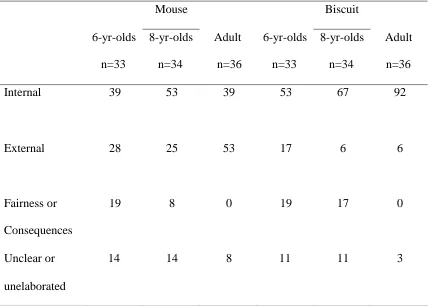
Justifications for diversity were categorised as referring to:i)internal factors such
as individual differences in personal preference, choice, or taste;ii)external factors such
as available information or truth;iii)fairness or the possible consequences of
disagreement and,iv)unclear or unelaborated responses. For each story we checked there
was no difference in the justifications given for the ‘pure’ and the ‘contaminated’
disputes by comparing the frequency of external justifications given for the Mouse story
(X2[1,N= 103] = 0.03,ns.) and internal justifications for the Biscuit story (X2[1,N= 103]
= 1.69,ns.). Justifications for ‘pure’ and ‘contaminated’ stories were then combined and
their distribution is shown in Table 1. To compare the proportion of appropriate
justifications given by each age group, the frequency of external responses (Mouse story)
and internal responses (Biscuit story) were compared with other categories of response
combined. For both stories, the proportion of appropriate responses increased with age:
MouseX2(2,N= 103) = 6.10,p< .05.w= .24; Biscuit,X2(2,N= 103) = 12.43,p< .01.
w= .35. To check whether participants within each age group differentiated between the
Mouse and Biscuit stories, the frequency of internal and external justifications for
tests. Amongst the 6-year-olds there was no difference in the frequency of internal or
external justifications for the two stories but the 8-year-olds (X2[1,N= 53] = 4.16,
p< .05.w= .28) and adults (X2[1,N= 68] = 21.40,p< .001.w = .56) tended to give
internal justifications for the biscuit story and external justifications for the mouse story.
Hence, although participants at all ages accepted the legitimacy of diversity for
both stories, adults and 8-year-olds acknowledged that the reasons for diverse views
differed between the stories, whereas the 6-year-olds did not. Although adults’
justifications for diversity clearly discriminated between the stories, for the Mouse story
39% (14/36) of the adults unexpectedly gave internal rather than external justifications
such as “different people can think different things.”
Truth question. There was no difference in overall Truth ratings for ‘pure’ and
‘contaminated’ stories: Mouse (t[94] = .86,ns.); Biscuit (t[92] = .18,ns.). ‘Pure’ and
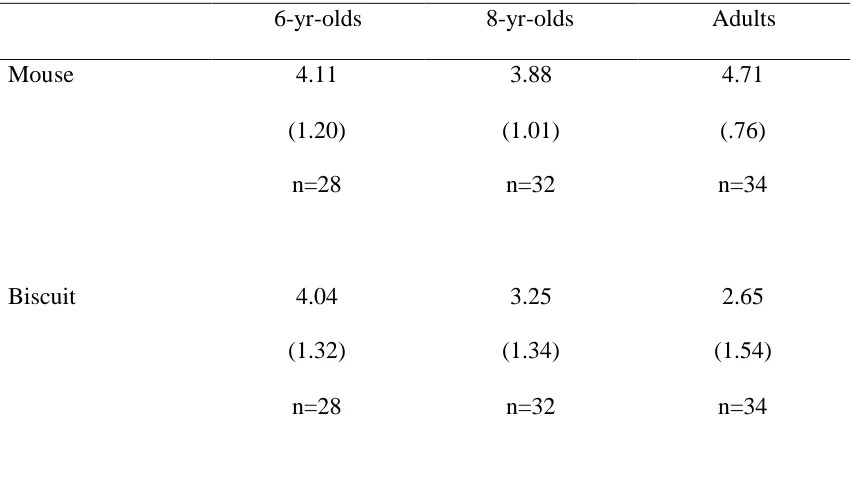
‘contaminated’ ratings were then combined and Table 2 shows the mean Truth ratings for
each story. Responses were analyzed using a mixed ANOVA with age, order and gender
as between-subjects factors and story (Mouse x Biscuit) as a repeated measure. Nine
participants were omitted (five 6-year-olds, two 8-year-olds and two adults) because they
did not provide ratings for both stories. No main effects of gender or order were found
and there were no significant interactions involving these variables so they were omitted
from subsequent analyses. There was a significant main effect of story,F(1, 82) = 24.16,
p< .001.2 = .23; and age,F(2, 82) = 4.42, p < .05.2 = .10; and a significant
interaction between story and age, F(2, 82) = 12.03, p< .001.2 = .23. Within age group
comparisons of Truth ratings for the Mouse and Biscuit stories were carried out using
year-olds discriminated between the two stories in the extent to which truth could be
found, but the adults saw truth as being more likely to be found for the Mouse story than
the Biscuit story,t(33) = 7.19,p< .01.d= 1.70.
For the Biscuit story there was a marked difference in how adults and children
justified their Truth ratings. 67% of the 6-year-olds (19 out of 28) and 47% of 8-year olds
(15/32), but only 18% of the adults (6/34) said a true answer could be found about
whether the biscuit was nice or horrible, with almost all of these saying this could be
done by tasting the biscuit. In a follow up question these children confirmed that this
would reveal the truth. There was no such follow up question on the adults’
questionnaire so we do not know whether the few adults who judged that the truth could
be found would have given this final confirmation. Only 7% of the 6-year-olds (2/28) and
28% of the 8-year-olds (9/32) said the Biscuit issue was a matter of personal preference
compared with 67% of adults (23/34). This contrasted with justifications for the Mouse
story where participants of all ages were confident that the truth could be found about the
mouse by discovering the content of the boxes (6 yrs, 75% [21/28]; 8 yrs, 72% [23/32];
adults, 88% [30/34]).
Discussion
In general the adults responded as expected for both stories, seeing objective
external information as important for the fact-based issue and emphasizing internal
subjective factors for the matter of preference. This was true for both ‘pure’ and
‘contaminated’ stories. Fewer adults than expected referred to external factors for the
fact-based issue, and instead some mentioned individual differences and personal
have expressed a superficial acceptance of diversity as a phenomenon without any
explanatory intent.
In line with previous work, most of the children acknowledged the possibility of
diversity for fact- and preference-based stories. However, unlike the adults, the
6-year-olds often gave explanations for diversity that might be appropriate in other domains,
talking about the consequences of disagreement or fairness. The difference between
children and adults was most pronounced for the matter of preference. For the ‘pure’ and
‘contaminated’ Biscuit story children were less confident than adults in personal
preference as a good basis upon which to hold a belief. For the ‘pure’ dispute the children
appeared to see personal preference as more transient and open to change than did the
adults. For the ‘contaminated’ story the 6-year-olds only appeared to recognize the
relevance of the preference-based belief after first hearing the ‘inappropriate’ belief.
Furthermore, in their answers to the Truth question neither the 6- nor the 8-year-olds
discriminated between the Mouse and Biscuit stories and the 6-year-olds said the truth
could probably be found about both. Taken together these responses indicate that the
6-year-olds, and to a lesser extent the 8-6-year-olds, did not attribute the same degree of
legitimacy as adults did to subjective factors in the construction of beliefs. In Experiment
2 we included older children and young people to examine their explanations for diversity
of beliefs and preferences and their views about its resolution.
Experiment 2
In Experiment 2 we extended the age range of children tested to include four age
groups: 7-, 9-, 11-, and 13-year-olds, with the aim of identifying the age at which children
participants responded similarly to the Diversity and Truth questions for the ‘pure’ and
‘contaminated’ disputes. Here, therefore, we focused our attention on children’s
judgments for ‘pure’ disputes only. We again used stories involving a hidden object (this
time a coin) and personal preference, and we added two new stories involving an
unknown cause. One of the new stories was about whether a fault in a video player or a
television set was responsible for a teacher's inability to play a video to her class. The
other was about the origin of a disease that affected two different kinds of animal. Like
the hidden object stories, these described an issue about which people might hold
different beliefs but about which an agreed upon truth could in principle be found. In
contrast with the hidden object stories, however, the way of finding the truth was not
obvious. In Experiment 1 children may have given adult-like responses to the fact-based
story because they could easily identify how to find out the truth: The protagonists only
had to open the boxes to locate the mouse. When the route to resolution was less clear,
even though in principle there was a true answer, participants may have to draw upon a
more abstract understanding of domains of knowledge, and there might be age-related
differences which did not appear with the hidden object stories.
As in Experiment 1, we were interested in whether or not children assumed an
objective truth could be identified for matters of taste, and in the extent to which they
differentiated matters of taste from matters involving limited factual information.
Method
Participants.A total of 96 children took part, 24 from each of 4 age groups (7-, 9-, 11-,
and 13-year-olds). The 7-year-old group consisted of 11 males and 13 females (mean age
females (mean age 9 years 4 months; range 8;10 to 9;9). There was an equal number of
males and females in the 11-year-old group (mean age 11 years 4 months; range 10;10 to
11;9), and in the 13-year-old group there were 13 males and 11 females (mean age 13
years 5 months; range 12;11 to 13;9). The children were from 3 state-funded schools in a
town in North Shropshire, UK. The children were drawn from a range of social
backgrounds and all had English as their first language.
Materials.We used two sets of stories, A and B. Each set comprised one of the
three types of story, personal preference, hidden object and unknown cause. The personal
preference issues concerned a disagreement between two friends over whether a
particular picture (set A) or a new kind of biscuit (set B) was nice or horrible. The hidden
object issues were based on Carpendale and Chandler's (1996) ambiguous referential
communication task in which the protagonists were in disagreement about where, out of
two equally likely locations, a hidden coin might be found. Participants were presented
with three cards representing a large red block, a large blue block and a small red block
and heard protagonists receive an ambiguous message saying the coin was hidden under
the large block (set A) or the red block (set B). The unknown cause story in set A
described a situation at school in which the teacher wished to play a video tape to her
pupils but found that this is not possible due to a fault in the equipment. The protagonists
were two pupils who disagreed about whether the problem was caused by a faulty TV or
video player. In the set B story protagonists disagreed about whether badgers or cows
were the source of a disease that affected both animals.
Procedure.Half the children in each age group were assigned to receive the set A
systematically so that within each age group and for each set of materials no one order
was used more than twice. Each child, tested individually, was presented with a picture
illustrating the story or was shown the relevant materials, and was told about the
disagreement. Participants were then asked the Diversity questions followed by the
Resolution questions. In what follows we give the wording for the personal preference
stories. The question wording for the hidden object and unknown cause stories was
similar.
The Diversity question was asked in two stages. First participants were asked, for
example, “What might cause Bill to think the biscuits are nice and Peter to think they’re
horrible?” then, “Does it make sense for Bill to think the biscuits are nice and for Peter to
think they’re horrible? Is that okay?” Then, “Why?” Or “Why not?” Participants were
then asked the Resolution question, “Can we decide whether Bill is right or Peter is right
about the biscuits?” and asked to justify their response: “How can we decide who is
right?” or “Why not?” For the personal preference stories only, when participants
suggested the issue could be decided one way or the other, for example by consensus, by
consulting a higher authority, or by finding out more about the issue, a final question was
asked to probe whether they really did believe the truth could be found: “If we have a
vote (consensus) and most people say the biscuits are nice, would that mean they really
are nice?” or “If the teacher (higher authority) said the biscuits were nice, would that
mean they really are nice?” or “If we (find out more) and we think the biscuits are nice,
would that mean they really are nice?”
Scoring the Diversity question.Children passed the Diversity question (scoring
appropriate internal explanation for the disagreement, for example “People have different
tastes about different kinds of art work." For the hidden object stories participants were
scored as passing the Diversity question if they gave an appropriate external explanation,
for example “You said the coin was under a red block and there are two red blocks...”, or
if they said neither party was justified in holding to their views with any certainty as they
couldn't possibly know the truth.
Scoring the Resolution question.For the Resolution question a score of one was
awarded to participants who said the personal preference issue was a matter of (internal)
taste, opinion, or individual choice. For the hidden object and unknown cause stories
participants scored one by making appropriate references to external truth, saying the
truth could be found, saying the matter could be decided by gathering more information
or by reference to someone in authority, or saying the issue could not be resolved because
not enough information was currently available.
Results
Reliability of coding was checked by having a second person independently code
a random sample of 18 transcripts, 3 from the youngest and oldest age groups and 6 from
each of the two middle groups (19% of transcripts). Out of 144 codings there was
agreement in 94% of cases. All of the 10 disagreements were resolved by discussion
(Cohen’s Kappa: Explanation question,K= 0.92, Resolution question,K= 0.90).
To examine children’s responses by age and story type, each participant was
given three scores of between 0 and 2 according to the number of questions (Diversity,
Resolution) answered appropriately for each of the three story types. There was no
the set A and set B stories were combined, and gender ignored, for subsequent analyses.
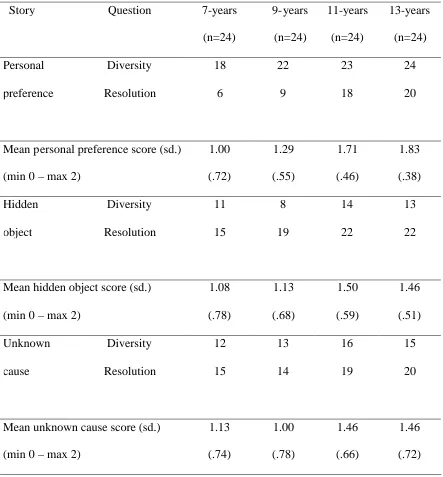
Frequency of pass responses and mean scores for the three story types for each age group
are shown in Table 3.
Scores were compared for the three story types using a mixed ANOVA with age
as the between subjects variable and story (personal preference; hidden object; unknown
cause) as the repeated measure. There were significant main effects of age,
F(3, 92) = 8.67,p< .001.2= .22; and story,F(2, 184) = 3.43,p< .05.2= .04 but no
significant interaction. Post hoc tests using Tukey’s HSD showed there was no difference
in the scores of the 7- and 9-year-olds for any of the story types, nor those of the 11- and
13-year-olds. Appropriate responses to the preference stories increased with age; one-way
F(3, 92) = 11.91,p< .001.2= .28. This was mainly due to a sharp increase in internal
responses given to the Resolution question by the older children (7yrs, 25% [6 out of 24];
9yrs, 37% [9/24] compared with 11 year olds 75% [18/24]; 13 yrs, 88% [20/24]). The
extra probe for the Resolution question was asked of eight children in the 7-year-old
group who said the truth could be found. Of these, six said “Yes” (the matter could be
decided one way or the other) confirming their failure on the Resolution question. Two of
the 9-year-olds, and one of the 11-year-olds also said the truth could be found. For the
two fact-based stories the more remote possibility of resolution for the unknown cause
story did not influence children’s justifications. Although appropriate external
justifications increased with age (F[3, 92] = 3.89,p< .05.2= .11) there was no
difference in responses to the hidden object and unknown cause stories and no
interaction. A surprising number of the older children did not give an appropriate external
42% [10/24]; year-olds, 45% [11/24]; unknown cause 11-year-olds, 33% [8/24];
13-year-olds, 38% [9/24]). Most of the 13-year-olds who failed this question gave internal
justifications for diversity. For the hidden object and unknown cause stories combined,
70% of the13-year-olds’ fail responses to the Diversity question [14/20] involved talking
about individual differences and opinions (7 yrs, 20% [5/25]; 9 yrs, 37% [10/27]; 11 yrs,
33% [6/18]) rather than giving irrelevant responses, or simply saying they didn’t know.
Discussion
As in Experiment 1, the younger children construed personal preference issues
differently from the older participants. As before, even the youngest children
acknowledged the possibility of diverse preferences, and with deeper probing here the
7-and 9-year-olds usually located the source of diversity internally within the protagonists.
However, in line with the findings of Experiment 1 they were less likely than the older
children to state that these issues might not be resolvable. In the youngest group some
children said that further information would be sufficient to resolve the disputes or
confirmed that if a consensus view were achieved this really would be the true view. In
contrast the 11- and 13-year-olds were more likely to judge the personal preference issues
as unresolvable. The older participants, but not the young ones, appeared willing to
accept that beliefs based upon personal likes and dislikes, can legitimately be held by
individuals independently of any external truth. This indicates that an awareness of how
subjective processes influence the construction of knowledge and beliefs continues to
develop over this period.
Even though the older children were more confident about whether or not the issues
could be resolved, like the adults in Experiment 1, many failed to mention external
the personal opinions of the protagonists rather than the limitations in the input when
asked to account for different interpretations. Perhaps they tried to explain why the
protagonists held one belief rather than another in the absence of any rational reason to do
so. Presumably the participants themselves accepted the validity of both possible
interpretations of the limited information, and they might assume that any rational
protagonist would do the same rather than opt for one interpretation. Another possibility
is that in early adolescence people become particularly aware of the mark individual
minds can make when interpreting input, and pay special attention to idiosyncracies of
belief (see, for example, Chandler, Boyes, & Ball, 1990; Chandler, Hallet, & Sokol,
2002).
General Discussion and Conclusions
We examined the nature of young children’s understanding of the role played by
subjective processes in the construction of beliefs. Our findings go against the assumption
of precocious understanding of subjectivity (Carpendale & Chandler, 1996; Flavell,
Flavell, Green, & Moses, 1990), and add to the evidence that understanding of
subjectivity demonstrated by 6- to 9-year-olds is rather shallow and qualitatively different
from that of the adolescents and adults (Clinchy & Mansfield, 1985; Mansfield &
Clinchy, 2002; Wainryb et al., 2004)).
Our results also fit with the results of studies which identify a key shift in
children’s thinking as they move to adolescence, when they come to accept the
contribution of internal subjective factors in the construction of knowledge and beliefs
(e.g. Chandler, Boyes, & Ball, 1990; Mansfield & Clinchy, 1997; Schwanenflugel,
can like different things they were less likely than adults to accept personal preference as
a legitimate reason for holding a belief about a matter of taste. For the ‘contaminated’
disputes in Experiment 1, 6- to 8-year-old children did not discriminate in the same way
as adults to identify appropriate reasons for beliefs, particularly in the domain of personal
taste. In Experiment 2 some children, mainly 7-year-olds, said it was possible to
determine whose preference was correct. Most 11- and 13-year-olds, on the other hand,
treated external truth as irrelevant to disputes about personal taste. In contrast to the
age-related differences seen for the preference-based stories, in both Experiments 1 and 2,
there was much more similarity across the age range in responses about the fact-based
stories.
In Experiment 1 when asked to justify their answer to the diversity question, in
both domains the younger participants often imported ideas more appropriate for
discussing issues of morality or friendship. One possibility was that 6-year-olds in
particular found the justification tasks too linguistically demanding, and that we therefore
gained a misleading impression of their level of understanding about subjectivity. We
think this unlikely since, as Carpendale and Chandler (1996) point out, for matters of
preference the acceptable adult response is usually a very simple one which amounts to
saying that it’s okay for different views to be held because people are different or because
people like different things (e.g. Mansfield & Clinchy, 2002). It would have been much
easier for the youngest children to produce this kind of response than the often
convoluted explanations seen here.
On the other hand the accepted justification could be given without reflection on
given for protagonists’ different views, it may have been particularly easy to say ‘People
are different’ or ‘They have different minds’, and most 7-year-olds did so. In Experiment
1 in contrast, participants were told the reasons for each protagonist’s belief (e.g. “The
reason Dan thinks the biscuit is horrible is that he doesn’t like the taste of those
biscuits.”). This might have led participants to reflect on the nature of the disagreements
and, having done so, the responses given by the younger participants could have been
more revealing of their uncertainty about using subjectivity as an acceptable explanation
for diversity.
Acknowledgement of diversity is only the starting point for diagnosing
understanding of the balance of objective and subjective in different domains of
knowledge. In Western cultures, adults judge that for matters of preference there may be
no externally validated truth, whereas for matters involving ambiguous information in
principle at least the truth can be identified. More generally, adults judge that external
information plays a more important role in the formation of beliefs about matters of fact
than about matters involving personal preference. The results presented here suggest it is
invalid to interpret children’s acceptance of diversity (“Both views can be right”) as
indicating adult-like understanding of subjectivity. Here we asked about a very limited
range of issues about which we were reasonably confident adults would agree on the
extent to which subjective and objective factors were important. In future, however, it is
necessary to probe more deeply into participants’ understanding of the different reasons
for diversity in a wider range of domains.
When acknowledgement of diversity is taken as the sole indication of
relativist position for matters of taste (Kuhn et al., 2000) and for matters of taste and
ambiguous fact (Wainryb et al., 2004). In other knowledge domains, relativistic thinking
has usually only been identified in older age groups. This has led to the suggestion that
epistemological development is recursive, particularly in the development of an
understanding of how subjective processes are involved in the construction of beliefs
(Chandler, Hallett, & Sokol, 2002). According to this explanation, an adult-like
understanding of subjectivity is likely to be demonstrated first on a case-by-case basis for
single issues such as matters of preference. Chandler et al. (2002) propose that, as a
natural off-shoot of the development of formal-operational thinking during adolescence,
the individual comes to realise that all knowledge is inherently subjective in nature. As a
result the relativistic approach to beliefs taken initially only for matters of preference will
now be revisited and re-applied in a wider range of knowledge domains. The findings
presented here do not fit with the notion of recursion, however, as even in the domain of
personal preferences the understanding of subjectivity demonstrated by many of the 6- to
9-year-olds was limited in comparison to that of the young adolescents and adults. The
age-related difference in responses seen here is better characterised as representing the
difference between shallow and deep knowledge about subjectivity. Although most
children were aware that people can have different preferences, we suggest it is only
when individuals come to a deeper understanding of the relationship between subjectivity
and truth that they can be said to be taking a relativist position or to be fully aware of the
constructive nature of the knowing process.
The differences in performance seen here in children and adults could be
thinking. Kitchener’s account is based upon Fischer’s (1980) notion of functional and
optimal skill levels, where functional refers to the individual’s typical level of thinking.
Optimal level depends upon neurological development, and represents the highest level
of reflection of which the individual is capable. The individual’s level of performance on
any task is construed as situated on a continuum, falling somewhere between functional
and optimal depending upon factors such as their domain specific knowledge, practice,
and available support. According to this explanation we might expect children’s
performance to be limited in comparison to adolescents’ and adults’ at both the optimal
level, in terms of underlying cognitive abilities that develop with age, and at the
functional level due to experiential factors. We would also expect to see individual
differences in the responses of adults, particularly where there are differences in their
experience of reflecting upon and reasoning about knowledge and beliefs.
This fits with the findings of studies linking the experience of higher education to
the presence of higher level epistemological thinking (e.g. Kuhn, 1991; Kuhn &
Weinstock, 2002; Perry, 1970). The adults who took part in the current study had
returned to college after a break from compulsory education and they had no experience
of higher education. Such adults, with little or no experience of post-compulsory
education, are comparatively under-researched in the literature. The finding that a small
number of them said the truth could be found about a matter of preference, cautions
against making untested assumptions about how ordinary adults construe knowledge. It
would be interesting to examine the relative weight given to subjective factors for more
To summarize the implications of our findings: The claim that children as young
as 3 or 4 years old understand about personal preference, ignores the extent to which an
understanding of subjectivity may remain to be worked out during later childhood and
possibly beyond. Central to this understanding is the ability to assess the relationship
between subjectivity and truth. When asked about simple matters of fact, young children
responded in a similar way to adolescents and adults. For matters of preference, in
contrast, children were less likely to acknowledge subjective factors as a legitimate basis
for belief and more likely to say a single truth could be found. Although for the simple
matters of preference presented here most of our adolescents responded like adults,
explaining diversity by referring to internal factors and saying the truth could not be
found, we suggest that mastery of this domain represents only one staging point on in the
ongoing process of learning to balance the relationship between subjectivity and truth
References
Carpendale, J. M., & Chandler, M. (1996). On the distinction between false belief
understanding and subscribing to an interpretive theory of mind.Child
Development, 67, 1686-1709.
Chandler, M., Boyes, M., & Ball, L. (1990). Relativism and stations of epistemic doubt.
Journal of Experimental Child Psychology, 50, 370-395.
Chandler, M. J., Hallet, D., & Sokol, B. W. (2002). Competing claims about competing
knowledge claims. In B. K. Hofer & P. R. Pintrich (Eds.),Personal epistemology:
The psychology of beliefs about knowledge and knowing(pp.145-168). Mahwah,
NJ: Erlbaum.
Choi, I., Nisbett, R. E., & Norenzayan, A. (1999). Causal attribution across cultures:
Variation and universality. Psychological Bulletin, 125, 47-63.
Clinchy, B. McV., & Mansfield, A. F. (1985, March). Justifications offered by children to
support positions on issues of “fact” and “opinion”. Paper presented at the annual
meeting of the Eastern Psychological Association, Boston, MA.
Estes, D., Chandler, M., Horvath, K. J., & Backus, D. W. (2003). American and British
college students’ epistemological beliefs about research on psychological and
biological development.Applied Developmental Psychology, 23, 625-642.
Fischer, K. W. (1980). A theory of cognitive development: The control and construction
of hierarchies of skills.Psychological Review, 87,477-531.
Flavell, J. H., Flavell, E. R., Green, F. L., & Moses, L. J. (1990). Young children’s
understanding of fact beliefs versus value beliefs.Child Development, 61,
Hofer, B. K. (2000). Dimensionality and disciplinary differences in personal
epistemology.Contemporary Educational Psychology, 25, 378-405.
Hofer, B. K., & Pintrich, P. R. (1997). The development of epistemological theories:
Beliefs about knowledge and knowing and their relation to learning. Review of
Educational Research, 67, 88-140.
Kitchener, K. S. (2002). Skills, tasks, and definitions: Discrepancies in the understanding
and data on the development of folk epistemology.New Ideas in Psychology, 20,
309-328.
Kolbel, M. (2003). Faultless Disagreement.Proceedings of the Aristotelian Society, 104,
53-73.
Kuhn, D. (1991). The skills of argument.Cambridge. Cambridge University Press.
Kuhn, D. (2000). Theory of mind, metacognition, and reasoning: A life-span perspective.
In P Mitchell, & K. J. Riggs (Eds.), Children’s reasoning and the mind(pp.
301-326). Hove, UK: Psychology Press.
Kuhn, D., Cheney, R., & Weinstock, M. (2000). The development of epistemological
understanding.Cognitive Development, 15, 309-328.
Kuhn, D., & Weinstock, M. (2002). What is epistemological thinking and why does it
matter? In B. K. Hofer & P. R. Pintrich (Eds.),Personal Epistemology: the
psychology of beliefs about knowledge and knowing(pp.121-144). Mahwah, NJ.
Erlbaum.
Mansfield, A. F., & Clinchy, B. McV. (1997, April). Toward the integration of
between the ages of 9 and 13. Paper presented at the biennial meeting of the
Society for Research in Child Development, Washington D.C.
Mansfield, A. F., & Clinchy, B. McV. (2002). Toward the integration of objectivity and
subjectivity: Epistemological development from 10 to 16.New Ideas in
Psychology, 20, 225-262.
Miller, S. A. (2000). Children’s understanding of pre-existing differences in knowledge
and belief.Developmental Review, 20, 227-282.
Paulsen, M. B., & Wells, C. T. (1998). Domain differences in the epistemological beliefs
of college students.Research in Higher Education, 39,365-384.
Perry, W. G. (1970).Forms of intellectual and ethical development in the college years.
New York: Holt, Rinehart & Winston.
Pintrich, P. R. (2002). Future challenges and directions for theory and research on
personal epistemology. In B. K. Hofer & P. R. Pintrich (Eds.),Personal
epistemology: the psychology of beliefs about knowledge and knowing
(pp.389-414). Mahwah, NJ. Erlbaum.
Ross, L., & Nisbett, R. E. (1991).The person and the situation: Perspectives of social
psychology.New York. McGraw-Hill.
Schwanenflugel, P. J., Fabricius, W. V., & Noyes, C. R. (1996). Developing organization
of mental verbs: Evidence for the development of a constructivist theory of mind
in middle childhood.Cognitive Development, 11, 265-294.
Wainryb, C., Shaw, L. A., Langley, M., Cottam, K., & Lewis, R. (2004). Children’s
thinking about diversity of belief in the early school years: Judgments of
relativism, tolerance, and disagreeing persons. Child Development, 75, 687-703.
Wellman, H. M., Cross, D., & Watson, J. (2001). Meta-analysis of theory of mind
Table 1.
Justifications for diversity judgments for the Mouse and Biscuit stories by age
(percentages).
Mouse Biscuit
6-yr-olds
n=33
8-yr-olds
n=34
Adult
n=36
6-yr-olds
n=33
8-yr-olds
n=34
Adult
n=36
Internal 39 53 39 53 67 92
External 28 25 53 17 6 6
Fairness or
Consequences
19 8 0 19 17 0
Unclear or
unelaborated
14 14 8 11 11 3
Table 2.
Mean (SD) ratings for likelihood of finding out the truth about the Mouse and Biscuit
issues (1 = definitely not find out, 2 = probably not, 3 = might, 4 = probably find out,
5 = definitely find out).
6-yr-olds 8-yr-olds Adults
Mouse 4.11
(1.20)
n=28
3.88
(1.01)
n=32
4.71
(.76)
n=34
Biscuit 4.04
(1.32)
n=28
3.25
(1.34)
n=32
2.65
(1.54)
Table 3.
Frequency of pass responses for the Diversity and Resolution questions and total mean
scores (SD) for each age group by story type in Experiment 2.
Story Question 7-years
(n=24) 9-years (n=24) 11-years (n=24) 13-years (n=24) Personal preference Diversity Resolution 18 6 22 9 23 18 24 20
Mean personal preference score (sd.)
(min 0 – max 2)
1.00 (.72) 1.29 (.55) 1.71 (.46) 1.83 (.38) Hidden object Diversity Resolution 11 15 8 19 14 22 13 22
Mean hidden object score (sd.)
(min 0 – max 2)
1.08 (.78) 1.13 (.68) 1.50 (.59) 1.46 (.51) Unknown cause Diversity Resolution 12 15 13 14 16 19 15 20
Mean unknown cause score (sd.)
(min 0 – max 2)