Philip Trostel and Ian Walker*
Department of Economics University of Warwick
Coventry, CV4 7AL
March 2000
Abstract
This paper examines the linkage between the incentives to work and
to invest in human capital through education. These incentives are
shown to be mutually reinforcing in a simple stylized model. This
theoretical prediction is investigated empirically using three large
micro datasets covering a broad set of countries. As one might
expect, education and work are strongly (positively) correlated.
This correlation has important implications for models of fiscal
policy and economic growth. It also has important implications for
the estimation of labor supply and the rate of return to education.
JEL Codes: J22,I20
*We are grateful to the European Union Targetted Socio-Economic
1A partial list of these studies is Lucas (1988, 1993), Lord
(1989), Becker et al. (1990), King and Rebelo (1990), Davies and Whalley (1991), Tamura (1991), Ehrlich and Lui (1991), Jones and Manuelli (1992), Glomm and Ravikumar (1992, 1997), Nerlove et al. (1993), Mulligan and Sala-i-Martin (1993), Caballé and Santos (1993), Barro and Sala-i-Martin (1995), De Gregorio (1996), Mino (1996), Dupor et al. (1996), Kaplow (1996), Steurle (1996), Agell and Lommerud (1997), Perroni (1997), Kim (1998), Lin (1998), and Lord and Rangazas (1998).
This paper examines the linkage between the level of education
and subsequent time spent working. A s o n e m i g h t e x p e c t , a
mutually-reinforcing correlation is found both theoretically and
empirically. In addition to being interesting in its own right
because of its implications for education and employment policies,
the finding that education and work decisions are mutually
reinforcing has at least three important implications.
First, it casts doubt on the applicability of the
"wealth-maximizing" models of human capital accumulation. Economic models
which incorporate human capital creation have become increasingly
common over the past decade. Most of these models have been
simplified by assuming that leisure time is fixed.1 By ignoring the
choice between work and leisure these wealth-maximizing (as opposed
to utility-maximizing) models focus exclusively on the choice between
work and education. The results in this paper, however, decisively
reject the notion that the work/training choice is independent of the
work/leisure choice. Moreover, recent research has shown that the
interdependency between the work/training and work/leisure choices
may be important in some analyses. Trostel (1993) found that the
interdependency between human capital investment and subsequent work
is crucial in the debate over the extent that taxation affects human
2This is also found in Jones et al. (1993), Mendoza et al.
(1997), and Milesi-Ferretti and Roubini (1998).
3See Blundell and MaCurdy (forthcoming) for a recent survey of
this literature. See also Killingsworth (1983), Killingsworth and Heckman (1986), and Pencavel (1986).
4This point applies not just to structural models of labor
supply, such as Mroz (1987), but also to difference-in-differences models, such as Blundell et al. (1998).
5Shaw (1996) makes an analogous argument concerning the effect
of on-the-job training on estimates of labor supply.
6Our very preliminary investigation has indeed found that the
estimated labor supply elasticity is understated when education is taken as exogenous, although not by a large amount.
7See Ashenfelter et al. (2000), Card (1995), and Psacharopoulos
(1994) for recent surveys of this literature.
this interdependency may be crucial in the debate over the extent
that taxation affects economic growth.2 These earlier results
coupled with the findings in this paper show that the frequent
simplifying assumption of constant leisure can be an important
restriction in human capital models.
Second, empirical research on labor supply3 has ignored the
interaction between the work/education and work/leisure choices. The
level of education is treated as an exogenous variable in the
estimation of labour supply elasticities (either explicitly or
implicitly by splitting the sample by education level). In other
words, education is implicitly assumed to affect the rate of pay, but
not hours of work.4 In a full life-cycle perspective, however,
education is endogenously determined along with hours of work.
Therefore, estimates of labour supply elasticities may be biased
and/or inefficient.5 To be specific, it is likely that estimates of
the wage elasticity are understated.6
8This sample-selection bias is related to, but distinct from,
censoring or "composition" bias, which appears to be very small [see, e.g., Dearden (1999)].
9These issues have been addressed to a small extent in the
rate-of-return literature. For example, Ashenfelter and Ham (1979) and Nickell (1979) estimate the risk-adjusted rate of return to education by accounting for unemployment. Some studies, e.g., Mincer (1974), have included weeks of work (assumed exogenous) in their earnings equations. But it does not appear that these issues have been fully appreciated. Our very preliminary examination of this issue suggests that it causes a non-trivial downward bias in the estimated of rate of return to education.
may also be biased and/or inefficient because it fails to account for
the endogenous interaction between education and hours worked. In
particular, studies which use the wage rate as the dependent variable
typically do not account for the endogeniety of participation and may
therefore be subject to sample-selection bias.8 The potential for
sample-selection bias is smaller in studies which use annual earnings
as the dependent variable, but in this case endogenous variation in
conditional hours of work is not accounted for.9
This paper uses a simple two-period model to show that
education and work choices are mutually reinforcing under likely
circumstances. This prediction is then supported empirically using
individual-level data from the U.S. Current Population Survey, the
British Family Resources Survey, and the International Social Survey
Programme. This conclusion is robust to including the wage rate
directly into the hours equation.
Specifically, these datasets show that, for working-age men,
one additional year of education is associated with roughly an
additional 0.9 to 1.3 hours of work per week. Not surprisingly, the
correlation is even stronger for women. Working-age women work
10See also Ghez and Becker (1975), Heckman (1976), Ryder et al.
(1976), Weiss and Gronau (1981), Killingsworth (1983), and Killingsworth and Heckman (1986).
of schooling. Most, but not all, of this correlation occurs on the
extensive margin, that is, through differences in the probability of
working. For men (women), the probability of working increases by
roughly 1.6 to 2.6 (3.4 to 3.8) percentage points per year of
education. A significant negative correlation between education and
unemployment is an important part of the story; but most of the
correlation between education and employment comes from the negative
correlation between education and labor-force participation. For
working-age men (women), an additional year of education is
associated with a 0.8 to 1.5 (3.1 to 3.5) percentage point lower
probability of being out of the labor force. Moreover, owing to the
large sample sizes, these effects are very precisely estimated. And,
although there is a fair amount of variation in these correlations
across 27 countries in the International Social Survey Programme, the
same general pattern is found in practically every country.
Before proceeding to the analysis it should be acknowledged
that many of the findings of this study are implicit in many earlier
studies. The idea that education and work choices are mutually
interdependent ex ante is clearly demonstrated in Blinder and Weiss
(1976).10 The original contribution of the theory presented in the
next section is that the interdependence between education and work
choices is examined explicitly and in depth. Moreover, the
specification of human capital is more general in an important
dimension than those used in previous theoretical work. A positive
11See, e.g., Mincer (1974), Ghez and Becker (1975), Pencavel
(1986), Killingsworth and Heckman (1986), Eckstein and Wolpin (1989), Becker (1993), Ríos-Rull (1993), Card (1994), Phelps and Zoega (1997), and Blau (1998).
12The important restriction imposed in a two-period framework is
that it does not capture potential intertemporal substitution of leisure within each period. As will become apparent below, except for in a special case, the opportunity cost of leisure changes over time as the human capital stock evolves, which creates an incentive to substitute leisure intertemporally. This possibility reinforces the mutual reinforcement of human capital and work decisions shown below.
13It is not even clear that investment in human capital is
risky. There is considerable evidence that investment in education reduces income risk by reducing the probability of unemployment.
This evidence is surveyed in Trostel, Perroni, and Walker (1998). previously.11 The previous empirical work, however, did not
explicitly explore the interaction between schooling and labour
supply (this interaction was not the primary focus in the earlier
work). In other words, although the interaction between years of
education and subsequent hours of work has been indicated in previous
theoretical and empirical work, this is the first study to explore
it, and its implications, in depth.
2 Theory
2.1 The Model
The basic intuition can be shown most easily in a two-period
model with no uncertainty. A two-period framework simplifies the
analysis considerably, but it is sufficient to model the essence of
the decisions to work and to invest in human capital from
education.12 Ignoring uncertainty also simplifies the analysis,
particularly because it is not clear how investment in human capital
14Non-time inputs in the production of human capital are not
important in this context and for simplicity are ignored. education because of the lack of data on on-the-job training.
Moreover, education is likely to be the most important type of human
capital for most workers.
Individuals are assumed to be endowed with one unit of time per
period, t, which is allocated among three alternatives: working, l,
schooling, s, and leisure,
R
. Thus the time constraint is(1) 1
/
lt + st +R
t, t = 1,2.As mentioned earlier, more often than not, models with human capital
accumulation have been simplified by assuming
R
is constant.Time allocated to schooling in the first period produces human
capital, H, which increases earnings from working in the second
period.14 Thus the wage rate, w, in the second period is
(2) w2 = H(s1)w1, H(0)
/
1.Human capital production is assumed to be governed by a simple
isoelastic function:
(3) H(s) =
N
sF, 1 >F
> 0,where
N
reflects learning ability, andF
measures the returns toscale in producing human capital. To produce an interior solution
(i.e., l1, s1 > 0), diminishing returns in human capital production
is assumed.
It is worth emphasizing that the first period in this model is
not just the schooling age, but is the entire first half of economic
with the fact that most young people initially specialize completely
in producing human capital. Full-time schooling ends long before
middle age. Similarly, the second period in this model is not just
the working age. The second period also includes retirement age, and
variation in the age of retirement is one of the ways that work can
vary in the second period.
A frictionless financial market is assumed which allows
individuals to save or borrow at rate r in the first period. An
initial financial endowment, e, is assumed. Bequests are ignored (or
e can be interpreted as the initial endowment less the present value
of the future bequest). Thus the budget constraint is
(4) (1+r)e + (1+r)w1l1 + w2l2 = (1+r)c1 - c2,
where c is consumption per period.
Utility, U, is a function of consumption and leisure in each
period. Human capital produced in the first period is assumed to
increase the productivity of leisure, v, in the second period. Thus
the utility function is
(5) U = U(c1,c2,
R
1,v(H)R
2)(1+D
)1-t, v(1)/
1,where
D
is the rate of pure time preference. v(H) is assumed to bea simple isoelastic function:
(6) v(H) = H", 1
$
"
$
0."
measures the leisure-productivity returns to human capital.Most modelling of human capital ignores its potential impact on
the productivity of leisure time (i.e.,
"
= 0 and v(H)/
1), but15More recently, Killingsworth and Heckman (1986), Rebelo
(1991), Stokey and Rebelo (1995), Mendoza et al. (1997), Ortigueira and Santos (1997), and Milesi-Ferretti and Roubini (1998) have used this specification.
16Becker (1965) makes a this argument in a similar context.
(1976),15 human capital has sometimes been assumed to affect the
productivity of leisure in the same proportion that it affects the
productivity of work (i.e.,
"
= 1 and v(H)/
H). This "neutral"specification of human capital, however, may be no less restrictive
than the usual specification. In other words, neither of the special
cases used in the literature appears particularly likely. It does
seem likely that human capital will affect the productivity of
leisure time to some extent. Indeed, Michael (1972) provides some
empirical evidence that education affects the productivity of
leisure. But it seems unlikely that human capital affects the
productivity of work and leisure in the same proportion. Because
there is much less scope for specialization, limits on leisure
productivity seem much more likely than limits on work
productivity.16 Moreover, the extent that human capital affects the
productivity of leisure is crucial for the interaction between human
capital and hours of work. Thus a general specification is assumed.
2.2 The Equilibrium Relationship between Education and Work
The equilibrium relationship between investment in education
and expected future hours of work can be easily deduced from the
first-order conditions of the individual's optimization problem
(assuming, of course, that the budget constraint is continuous).
Specifically, maximizing (5) by the choices of c1, c2, s1, l1, and l2
-(4) and (6) yields the following first-order conditions:
(7.1)
M
U/M
c1 -8
(1+r) = 0,(7.2) (1+
D
)-1M
U/M
c2 -
8
= 0,(7.3) -
M
U/MR
1 + (1+D
)-1"FN
"s"F-1R
2M
U/MR
2 +8FN
sF-1wl2 = 0,(7.4) -
M
U/MR
1 +8
(1+r)w = 0,(7.5) - (1+
D
)-1vM
U/MR
2 +
8
wH = 0,(7.6) (1+r)e + (1+r)wl1 + wHl2 - (1+r)c1 - c2 = 0,
where
8
is the shadow value of wealth, and the time subscripts havebeen left off of s and w and are understood to be their first-period
values.
Combining first-order conditions (7.3) - (7.5) shows the
equilibrium relationship between education and work:
(8) s = [
FN
(l2(1-"
)+"
)/(1+r)]1/(1-F).This equation reveals that the relationship between education and
future work is weakly positive. Unless human capital from education
affects the productivity of leisure time and the productivity of work
time proportionately (i.e.,
"
= 1), there is a positive relationshipbetween education and work. Moreover, this relationship is
independent of preferences about work, consumption, and discounting.
Equation (8) shows a no-arbitrage condition rather than a preference
relationship.
The intuition for this result is straightforward. First
conditions (7.3) and (7.4) shows that the marginal return on
investment in education is equated to the rate of return on financial
assets:
(9)
FN
sF-1l2 = 1+r.This equation shows that l2 affects the rate of return on investment
in human capital. Expected future hours of work is the utilization
rate of human capital. Thus l2 directly affects the rate of return
on investment in human capital and the incentive to invest in
education.
When the productivity of leisure is affected by human capital,
however, increases in work increase the market utilization of human
capital while decreasing its nonmarket utilization. In the neutral
specification (
"
= 1) where human capital is utilized in bothsectors proportionately, the overall utilization of human capital is
unaffected by future work, thus s and l2 are independent. This
independence property makes the neutral special case much easier to
analyze than the general case. Thus it is a somewhat common simple
alternative to wealth-maximizing specification.
2.3 The Effect of Education on Subsequent Work
At first glance it might seem that the effect of education on
subsequent labor supply is ambiguous. Investment in human capital
increases the wage rate, and increases in the wage rate produce
opposing income and substitution effects on hours of work. The
higher wage rate, however, is only part of the story of how
investment in education affects later labor supply.
is treated as an exogenous parameter in this section. The analysis
in this section is simplified considerably by imposing the
simplifying assumptions that human capital does not affect the
productivity of leisure (i.e., the typical specification where
"
=0), and that utility is separable in its four arguments (i.e., uij =
0
œ
i…
j).The labor supply response to education, dl2/ds, is derived by
totally differentiating the first-order conditions of the
individual's optimization problem with s treated as exogenous.
Totally differentiating (7.1) - (7.2) and (7.4) - (7.6), applying
Cramer's Rule, and simplifying yields
dl2
8FN
sF-1wUcc[(1+D
+(1+r)2)URR + (1+r)2w2Ucc](10) = +
ds (1+
D
)*
J*
Hw2U2
ccURR[
FN
sF-1l2 - (1+r)] ,(1+
D
)*
J*
where
*
J*
is the determinant of the bordered Hessian matrixassociated with the maximization problem. If s is at its optimal
value, then the second expression in (10) is zero (see FOC (7.3) and
(7.4)). The second-order condition requires that
*
J*
> 0, thusdl2/ds > 0.
The labor-supply responses to the wage rate and income (i.e.,
dl2/dw and dl2/de) can be derived in an analogous manner. Comparing
the terms in these equations to the terms in equation (10) reveals
that s affects l2 in four ways. In fact, equation (10) can be
rewritten as
%dl2
8F
Hw3(1+r)2U2cc
0
I(F
Hl2 - (1+r)s)(11) =
0
*F
+ +17This can be shown by comparing dl
2/ds to dl2/d
T
*, where dT
*/
d(w2/w1)|dU=ds=0. In fact, dl2/ds and dl2/d
T
* are very similar. Theyboth induce static substitution effects, offsetting static income effects, and an intertemporal substitution effect. In other words, the effect of education on work is conceptually similar to an intertemporal substitution of life-cycle labor supply (note that this is intertemporal substitution is over, say, 25 year periods and not annual periods as emphasized in the real business cycle literature). where
0
* > 0 is the compensated static wage elasticity of laborsupply, and
0
I < 0 is the income elasticity of labor supply. Thefour terms in (11) correspond to the four terms in (10).
Equation (11) reveals that the way education affects labor
supply is not simply that it causes opposing income and substitution
effects from a higher wage rate. The higher wage rate in the second
period does cause the usual static substitution and income effects
(these are the first and third terms). Education also causes two
additional effects. First, schooling reduces earnings in the first
period. Thus there is a negative income effect in the first period
(this is the fourth term). When s is optimally chosen the two income
effects exactly offset each other (because the marginal return equals
the marginal cost). Second, the higher wage in the second period
relative to the first period also induces an intertemporal
substitution effect toward more work in the second period (this is
the second term).17 Thus, equation (11) shows that when s is at its
optimal level, s induces two unambiguous substitution effects on l2
(assuming, of course, that human capital affects the productivity of
leisure less than it affects the productivity of work).
3 Evidence
The previous section demonstrated that education and work
18The FRS is a large continuous survey of British households
administered by the (U.K.) Department of Social Security and is designed for tax and social security analysis. It contains high-quality data on all sources of income. See Department of Social Security (1997).
if this result and its potential implications discussed in the
Introduction are economically important. Thus, the economic
importance of this theoretical result is investigated below.
3.1 The Data
We use three large micro datasets: the 1991 merged outgoing
rotation group file of the U.S. Current Population Survey, CPS (1991
was the last year that education was measured as years of schooling
as opposed to a credential-based measure); the pooled 1994-98 British
Family Resources Survey, FRS;18 and the pooled 1989-95 International
Social Survey Programme, ISSP. The ISSP is a continuing annual set
of cross-national surveys covering various social research topics.
It contains comparable data from 33 countries (27 of these have
complete labor-market data) over the period 1985 through 1995,
although many of the countries participated only in a few of the
later years. Data from the years prior to 1989 were not used because
they lacked complete information on labor force participation.
All samples are restricted to those aged 25 to 64 inclusive,
not in school, not self-employed, with less than 21 years of
education, and without missing information on education or labor
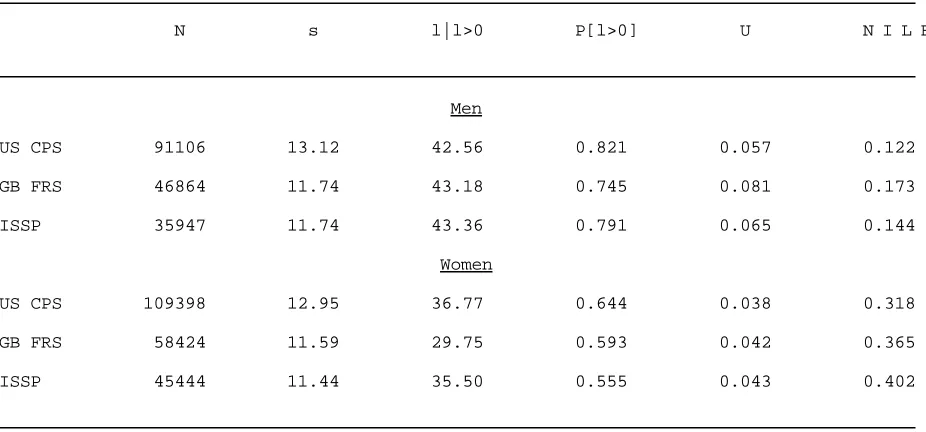
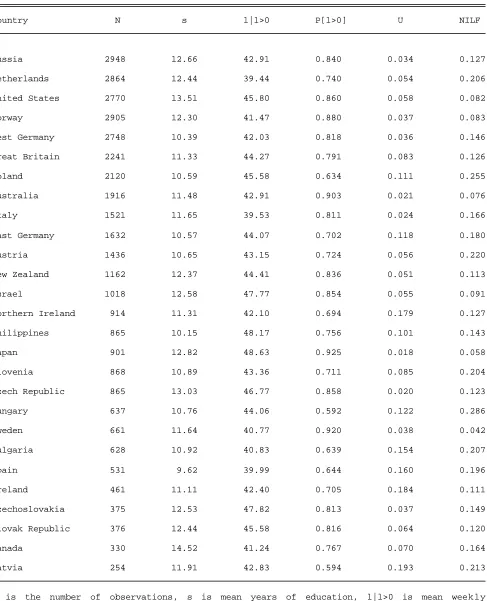
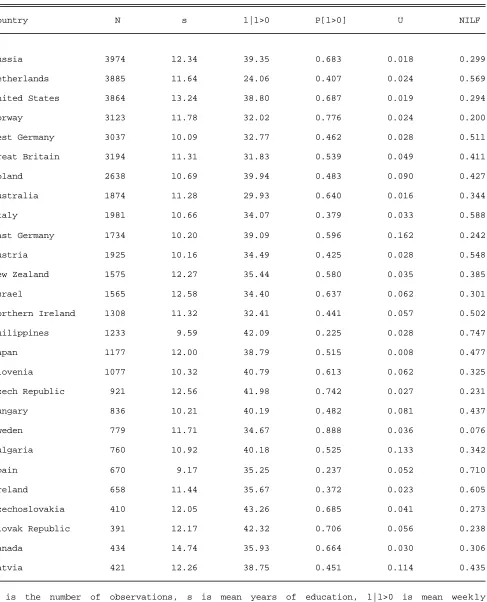
force status. Table 1 gives the most relevant summary statistics for
the three datasets. Tables 2 and 3 give the summary statistics for
the individual countries in the ISSP.
19We would have preferred to use a Heckman two-stage approach,
but we have been unable to find exogenous variables in our datasets to separately identify the selection equation.
20In all the regressions in Table 4 there are unreported
controls for a fourth-order age polynomial and for: race and interview month in the CPS, each of the 51 interview months in the FRS, and each year in each country in the ISSP.
datasets are collapsed by the level of education. Figures 1 and 2
show the raw correlation between (unconditional) weekly hours of work
and education for men and women. Figures 3 and 4 illustrate the raw
relationship between schooling and weekly hours of work conditional
on being employed. And Figures 5 and 6 show the raw correlation
between working rates and years of schooling for men and women.
These figures reveal a positive raw correlation between education and
labor supply. That is, the idea that education and work are mutually
reinforcing is found in the unconditioned data. This idea is now
formally tested on the micro data.
3.2 The Correlation Between Education and Work
Hours of work are truncated at zero, thus OLS residuals are
non-normal and the coefficient estimates can be biased and
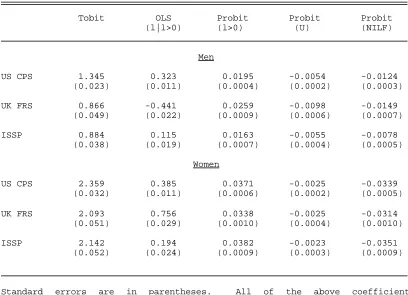
inconsistent. Thus a tobit procedure is used.19 Tobit estimates of
the correlation between education and weekly hours of work are
reported at the left of Table 4.20 The results confirm the
theoretical prediction and the impression shown in Figures 1 and 2.
They reveal a precisely-estimated positive correlation between
education and work. The largest correlations in the three datasets
are found in the U.S. CPS. For men (women), each year of education
is associated with an additional 1.35 (2.36) hours of work per week.
21There are unreported controls for a fourth-order age
polynomial and for each year.
education is associated with an additional 0.87 (2.09) hours of work
per week. The correlations in the pooled ISSP are closer to that in
Britain. In addition to being highly statistically significant,
these correlations are economically huge. These coefficients are
between 2.6% to 3.8% of the sample means for men, and between 10% to
11.9% of the sample means for women. That is, one additional year
of education is associated with about 3% (11%) more work for men
(women).
Tobit estimates of the correlation between education and weekly
hours of work for the separate countries in the ISSP are reported in
Table 5.21 Although there is a fair amount of variation in the
coefficients across the countries, they show the same general
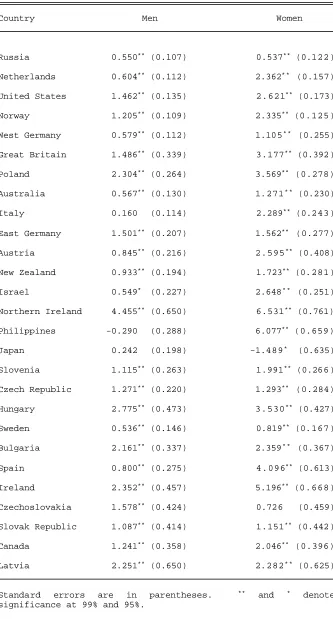
pattern. The estimated coefficient on education is positive and
statistically significant at the 99% level in 23 of the 27 countries
for men, and in 25 countries for women. Japan is the only country
which does not display a statistically-significant positive
correlation for either men or women. This table reveals that
positive correlation between education and work emerges despite wide
variation in the degree of economic development, culture, labor
market policies, etc.
It must be emphasized, however, that the estimated coefficient
of schooling on work should not be interpreted as a causal effect.
The level of education is predetermined when work decisions are
observed (except for perhaps an extremely small proportion of
observations). But, as stressed earlier, the level of education is
22We also have run seemingly-unrelated regressions of education
and work. These regressions perform well and show a very strong positive correlation between their residuals (indicating that schooling and work affect each other). These results do not add any additional insight, however, and are not reported. To isolate the causal effect of education would require a two-stage instrumental-v ariable approach, but it is difficult to conceiinstrumental-ve of instrumental-val i d instruments in this context.
23A negative correlation on the conditional-hours margin is not
necessarily inconsistent with the theory and the other empirical correlations. It is possible, perhaps even likely, that those which are subject to higher unemployment risk and/or more likely to retire early (i.e., those with less education) will work longer hours when employed. In other words, intertemporal substitution is likely to reduce the correlation on the condition hours margin, possibly enough to make it negative. On intertemporal substitution of work, see, for example, Altonji (1986), Ham (1986), and Card (1994).
work are likely to be very closely correlated with anticipated levels
of work, and anticipated work should affect the chosen level of
education. Thus the coefficient should be interpreted as estimate
of the equilibrium relationship, and not the causal effect.22
3.3 The Intensive Margin
Table 4 also reports OLS estimates of the correlation between
conditional weekly hours of work and education. Not surprisingly,
the correlation is much smaller. In other words, as stressed in
Heckman's (1993) survey of empirical labor research, most of the
action occurs on the extensive rather than the intensive margin.
Conditional on being employed, each year of education is associated
with an additional 0.32 (0.39) hours of work for men (women) in the
CPS. The corresponding numbers in the pooled ISSP are smaller, 0.012
(0.19). Paradoxically, the corresponding numbers in the FRS are both
much smaller and much larger. For British men, the relationship is
reversed; there is a large and statistically-significant negative
24There are unreported controls for a fourth-order age
polynomial and for each year.
British women, there is an even larger positive correlation between
education and conditional hours.
OLS estimates of the correlation between education and
conditional weekly hours of work for the separate countries in the
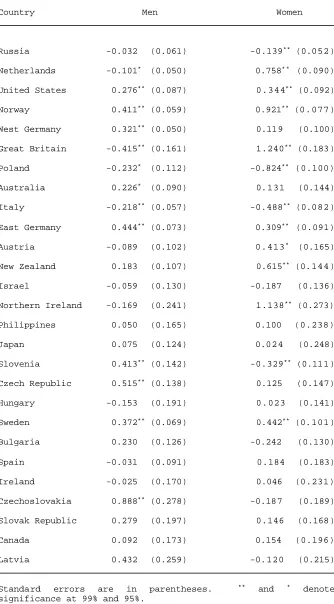
ISSP are given in Table 6.24 Again, the results for the individual
countries are consistent with those found in the large datasets. The
conditional correlations between work hours and schooling are much
weaker than the unconditional correlations. In fact, in many cases
[11 (7) of the 27 for men (women)] there is a negative correlation
in the conditional-hours dimension. There is a positive and
statically-significant correlation in only 9 (10) of the 27 countries
for men (women). There are also a few statistically-significant
negative correlations (4 for men, and 3 for women). Overall,
however, there is more evidence for a positive correlation. There
are negative correlations for both men and women in only 3 countries
(compared to 12 countries that have positive correlations for both
men and women). Table 6 also confirms that Britain is indeed unusual
in this dimension. Both the largest negative coefficient for men and
largest positive coefficient for women occur in Britain.
3.4 The Extensive Margin
Probit estimates of the correlation between employment and
education are also presented in Table 4. There is an
economically-huge correlation between employment and education. For American men,
one additional year of education is associated with a 2.0 percentage
25See, e.g., Mincer (1974, 1993), Ashenfelter and Ham (1979),
Nickell (1979), Becker (1993), Nickell and Bell (1996), and Phelps and Zoega (1997).
corresponding number is 2.6 percentage points. And in the pooled
ISSP, the figure is 1.6 percentage points. For women, one additional
year of education is associated with a higher probability of
employment of 3.7 percentage points in the CPS, 3.4 percentage points
in the FRS, and 3.8 percentage points in the pooled ISSP.
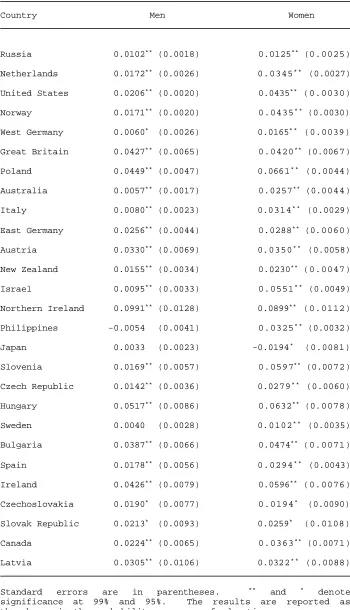
Probit estimates for the individual countries in the ISSP are
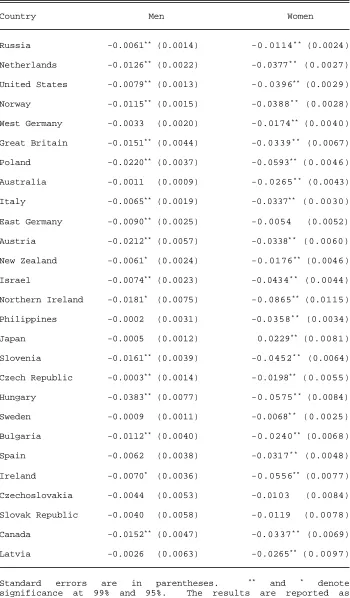
reported in Table 7. They reveal a similar picture. For men
(women), there is a significant positive correlation between
employment and education in 24 (26) of the 27 countries. Moreover,
for men (women), an extra year of education is associated with at
least a one percentage point higher probability of employment in 20
(26) countries.
The last two columns in Table 4 report the correlations between
unemployment and education and between not-in-the-labor-force and
education. These cases show that most of the correlation between
employment and schooling comes from the correlation between
labor-force participation and schooling, especially for women.
As shown in numerous previous studies,25 there is a
statistically-significant negative correlation between unemployment
and education. For men, an extra year of education is associated
with about a half percentage point reduction in the probability of
unemployment in the CPS and pooled ISSP, and a one percentage point
reduction in the FRS. For women, each year of education associated
with about a quarter percentage point reduction in the probability
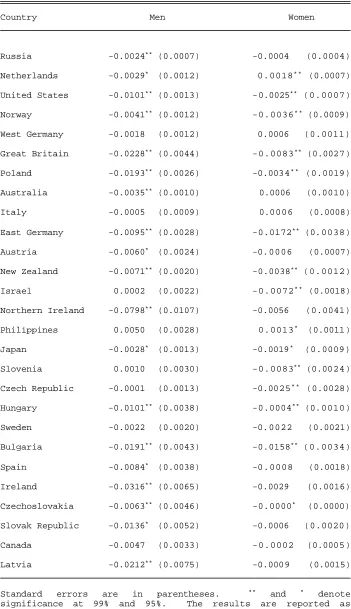
There is much more variation in the unemployment-schooling
coefficient in the separate ISSP country probits shown in Table 8.
But the general pattern is consistent with that found in the large
datasets. In particular, the coefficient is negative in 24 of the
27 countries for men (and significant in 19), and in 22 countries for
women (and significant in 13 of these). The Philippines is the only
country where the correlation is positive for both men and women.
Table 8 also confirms that in unemployment dimension, unlike in all
the other dimensions, the correlations are generally stronger for men
than women. The men have a larger negative correlation in 21 of the
27 countries.
The strongest correlation between education and work occurs in
the not-in-the-labor-force dimension, particularly, and not
surprisingly, for women. Each year of schooling is associated with
a 1.2, 1.5, and 0.8 percentage point reduction in the probability of
being out of the labor force in the CPS, FRS, and pooled ISSP,
respectively. For women, the negative correlations are between 3.1
and 3.4 percentage points per year of schooling.
Table 9 reports the correlations between not-in-the-labor-force
and education for the separate countries in the ISSP. For men, there
is a negative correlation in every country (and statistically
significant in 18 of the 27 countries). For women, the correlation
is negative in 26 of the 27 countries (and significant in 23 of
those). The negative correlation is larger for women than men in 25
countries.
3.5 Some Sensitivity Analysis
26See, e.g., Gustman and Steinmeier (2000).
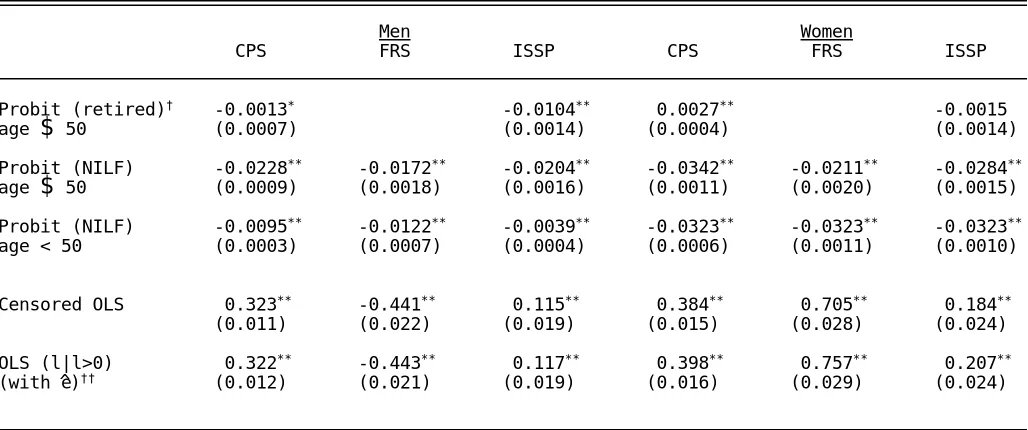
Three additional probits are reported to demonstrate that the
positive link between education and work also operates on the
retirement dimension. The not-in-the-labor-force probits reported
previously included those classified as retired. Part of the reason
for counting retired as not-in-the-labor-force is dictated by the
data. The FRS does not have a separate retired category. The CPS
measure of retired is not consistent with the measures that we use
for weekly hours and not-in-the-labor-force. There are also some
anomalies in the ISSP measure of retired. But more importantly, the
classification of retirement is arbitrary.26 For instance, most
older women not in the labor force are not counted as retired
obviously because they have not worked recently.
The top row of Table 10 reports the probits of retirement on
schooling. The coefficient estimates are negative and significant
for men, negative and insignificant for women in the ISSP, but
positive and significant for women in the CPS. As mentioned above,
however, we do have much faith in the retirement measures, especially
for women. Thus, in the second row of Table 10 we report
not-in-the-labor-force probits for those aged 50 and above. Presumably this
removes the arbitrary retirement distinction. For comparison
purposes not-in-the-labor-force probits for those under the age of
50 are presented in the third row. These probits show that the
correlation between schooling and labor force participation is higher
for men above the age of 50, confirming that the positive link
between education and work occurs through early retirement as well
somewhat weaker for those over 50 in the FRS and pooled ISSP, and
essentially the same for those in the CPS. This obviously suggests
that women's education has a large effect on labor force
participation through child rearing.
Table 10 also presents two different OLS estimates of the
correlation between education and conditional weekly hours of work.
The fourth row reports the correlation which is corrected for
potential censoring at the lower end of the hours distribution. For
men, the results are identical to those in Table 4 (where there is
no adjustment for possible censoring). For women, the results,
although not identical, are essentially unchanged.
The fifth row of Table 10 reports the correlation between
education and conditional hours of work when controlling for
variation in the (log) hourly wage rate which is not explained by
education or age. That is, this regression includes the residuals
from a (log) wage equation on schooling and other controls. Although
the (unreported) coefficient on unexplained variation in the (log)
wage rate is highly significant, including this variable has no
appreciable impact on the coefficient on education.
In summary, the correlations reported in Tables 4 - 10 provide
overwhelming evidence that is consistent with the theoretical
proposition that education and work decisions are strongly mutually
reinforcing.
4 Conclusion
The presumption that education and work decisions are
independent, ceteris paribus, is important: in the labor supply
education affects labor supply only via its effect on wages; in the
literature on the return to education it allows unbiased estimates
to be obtained from selected samples; and it substantially reduces
the extent to which income taxation discourages human capital
accumulation, and hence the extent to which taxation retards
transitional and/or endogenous growth.
This paper used a very simple, but compelling, model (i.e., the
conclusion is not due to the simplicity of the model) to demonstrate
that education and work decisions are likely to be mutually
dependent. That is, optimizing behavior implies that individuals are
likely to have positive correlations between investment in human
capital and work. Moreover, simple statistical modelling across
extensive micro datasets strongly supports the theory, and indicates
that it is an empirically important phenomenon. To illustrate the
order of magnitude involved, the male correlation in the U.S.
suggests that a college degree relative to a high-school diploma has
roughly the same correlation with hours of work as being male
References
Agell, Jonas and Kjell Erik Lommerud, "Minimum Wages and the Incentives for Skill Formation" Journal of Public Economics, April 1997, 64(1), 25-40.
Ashenfelter, Orley and John Ham, "Education, Unemployment, and Earnings" Journal of Political Economy, October 1979, 87(5), S99-116.
, Colm Harmon, and Hessel Oosterbeek, "A Review of the Schooling/Earnings Relationship with Tests for Publication Bias" NBER Working Paper 7457, 2000.
Altonji, Joseph G, "Intertemporal Substitution in Labor Supply: Evidence from Micro Data" Journal of Political Economy, June 1986, 94(3), S176-215.
Barro, Robert J and Xavier Sala-i-Martin, Economic Growth, New York: McGraw-Hill, 1995.
Becker, Gary S, "A Theory of the Allocation of Time" Economic
Journal, September 1965, 75(2), 493-517.
, Human Capital, 3rd ed, Chicago: University of Chicago
Press, 1993.
, Kevin M Murphy, and Robert Tamura, "Human Capital, Fertility, and Economic Growth" Journal of Political Economy, October 1990, 98(5), S12-37.
Blau, Francine D, "Trends in the Well-Being of American Women, 1970-1995" Journal of Economic Literature, 36(1), March 1998, 112-65.
Blinder, Alan S and Yoram Weiss, "Human Capital and Labor Supply: A Synthesis" Journal of Political Economy, June 1976, 84(3), 449-72.
Blundell, Richard, Alan Duncan, and Costas Meghir, "Estimating Labor Supply Responses Using Tax Reforms" Econometrica, July 1998, 66(4), 827-61.
and Thomas MaCurdy, "Labour Supply: A Review of Alternative Approaches" in Orley Ashenfelter and David Card (eds), Handbook of Labor Economics, Vol 3A, Amsterdam: North-Holland, forthcoming.
Card, David, "Intertemporal Labour Supply: An Assessment" in Christopher A Sims (ed), Advances in Econometrics, Cambridge: Cambridge University Press, 1994.
, "Earnings, Schooling, and Ability Revisited" Research
in Labor Economics, 1995, 14(1), 23-48.
Davies, James and John Whalley, "Taxes and Capital Formation: How Important is Human Capital?" in B Douglas Bernheim and John B Shoven (eds), National Saving and Economic Performance, Chicago: University of Chicago Press, 1991.
Dearden, Lorraine, "Qualifications and Earnings in Britain: How Reliable are Conventional OLS Estimates of the Returns to Education?" IFS Working Paper W99/7, 1999.
De Gregorio, José, "Borrowing Constraints, Human Capital Accumulation, and Growth" Journal of Monetary Economics, February 1996, 37(1), 49-71.
Department of Social Security, Income-Related Benefits: Estimates of
Take-Up in 1995-96, London: HMSO, 1997.
Dupor, Bill, Lance Lochner, Christopher Taber, and Mary Beth Wittekind, "Some Effects of Taxes on Schooling and Training"
American Economic Review, May 1996, 86(2), 340-46.
Eckstein, Zvi and Kenneth I Wolpin, "Dynamic Labour Force Participation of Married Women and Endogenous Work Experience"
Review of Economic Studies, July 1989, 56(3), 375-90.
Ehrlich, Isaac and Francis T Lui, "Intergenerational Trade, Longevity, and Economic Growth" Journal of Political Economy, October 1991, 99(5), 1029-59.
Ghez, Gilbert R and Gary S Becker, The Allocation of Time and Goods
Over the Life Cycle, New York: Columbia University Press, 1975.
Glomm, Gerhard and B Ravikumar, "Public versus Private Investment in Human Capital: Endogenous Growth and Income Inequality" Journal
of Political Economy, August 1992, 100(4), 813-34.
and , "Productive Government Expenditures and Long-Run Growth" Journal of Economic Dynamics and Control, January 1997, 21(1), 183-204.
Gustman, Alan L and Thomas L Steinmeier, "Retirement Outcomes in the Health and Retirement Study" NBER Working Paper 7588, 2000.
Heckman, James J, "A Life-Cycle Model of Earnings, Learning, and Consumption" Journal of Political Economy, August 1976, 84(4), S11-44.
, "What Has Been Learned About Labor Supply in the Past Twenty Years?" American Economic Review, May 1993, 83(2), 116-21.
Jones, Larry E and Rodolfo E Manuelli, "Finite Lifetimes and Growth"
Journal of Economic Theory, December 1992, 58(2), 171-97.
, , and Peter E. Rossi, "Optimal Taxation in Models of Endogenous Growth," Journal of Political Economy, June 1993, 101(3), 486-517.
Kaplow, Louis, "On the Divergence Between 'Ideal' and Conventional Income-Tax Treatment of Human Capital" American Economic
Review, May 1996, 86(2), 347-52.
Killingsworth, Mark R, Labor Supply, Cambridge: Cambridge University Press, 1993.
and James J Heckman, "Female Labor Supply: A Survey," in Orley Ashenfelter and Richard Layard (eds), Handbook of Labor
Economics, Vol 1, Amsterdam: North-Holland, 1986.
Kim, Se-Jik, "Growth Effect of Taxes in an Endogenous Growth Model: To What Extent Do Taxes Affect Economic Growth?" Journal of
Economic Dynamics & Control, October 1998, 23(1), 125-58.
King, Robert G and Sergio Rebelo, "Public Policy and Economic Growth: Developing Neoclassical Implications" Journal of
Political Economy, October 1990, 98(5), S126-50.
Lin, Shuanglin, "Labor Income Taxation and Human Capital Accumulation" Journal of Public Economics, May 1998, 68(2), 291-302.
Lord, William, "The Transition from Payroll to Consumption Receipts with Endogenous Human Capital" Journal of Public Economics, February 1989, 38(1), 53-73.
and Peter Rangazas, "Capital Accumulation in a General Equilibrium Model with Risky Human Capital" Journal of
Macroeconomics, Summer 1998, 20(3), 509-31.
Lucas, Robert E, Jr, "On the Mechanics of Economic Development"
Journal of Monetary Economics, July 1988, 22(1), 3-42.
, "Making a Miracle" Econometrica, March 1993, 61(2), 251-72.
Michael, Robert T, The Effect of Education on Efficiency in
Mendoza, Enrique G, Gian Maria Milesi-Ferretti, and Patrick Asea, "On the Ineffectiveness of Tax Policy in Altering Long-Run Growth: Harberger's Superneutrality Conjecture" Journal of
Public Economics, October 1997, 66(1), 99-126.
Milesi-Ferretti, Gian Maria and Nouriel Roubini, "On the Taxation of Human and Physical Capital in Models of Endogenous Growth"
Journal of Public Economics, November 1998, 70(2), 237-54.
Mincer, Jacob, Schooling, Experience, and Earnings, New York: Columbia University Press, 1974.
Mino, Kazuo, "Analysis of a Two-Sector Model of Endogenous Growth with Capital Income Taxation" International Economic Review, February 1996, 37(1), 227-51.
Mroz, Thomas A, "The Sensitivity of an Empirical Model of Married Women's Hours of Work to Economic and Statistical Assumptions"
Econometrica, July 1987, 55(4), 765-800.
Mulligan, Casey B and Xavier Sala-i-Martin, "Transitional Dynamics in Two-Sector Models of Endogenous Growth" Quarterly Journal of
Economics, August 1993, 108(3), 739-73.
Nerlove, Marc, Assaf Razin, Efraim Sadka, and Robert K von Weizsacker, "Comprehensive Income Taxation, Investments in Human and Physical Capital, and Productivity" Journal of Public
Economics, March 1993, 50(3), 397-406.
Nickell, Stephen, "Education and Lifetime Patterns of Unemployment"
Journal of Political Economy, October 1979, 87(5), S117-31.
and Brian Bell, "Changes in the Distribution of Wages and Unemployment in OECD Countries" American Economic Review, May 1996, 82(2), 302-08.
Ortigueira, Salvador and Manuel S Santos, "On the Speed of Convergence in Endogenous Growth Models" American Economic
Review, June 1997, 87(3), 383-99.
Pencavel, John, "Labor Supply of Men: A Survey," in Orley Ashenfelter and Richard Layard (eds), Handbook of Labor
Economics, Vol 1, Amsterdam: North-Holland, 1986.
Perroni, Carlo, "Joint Production of Goods and Knowledge: Implications for Tax Reform" International Tax and Public
Finance, May 1997, 4(2), 149-65.
Psacharopoulos, George, "Returns to Investment in Education: A Global Update" World Development, September 1994, 22(9), 1325-43.
Rebelo, Sergio, "Long-Run Policy Analysis and Long-Run Growth"
Journal of Political Economy, June 1991, 99(3), 500-21.
Ríos-Rull, José-Víctor, "Working in the Market, Working at Home, and the Acquisition of Skills: A General Equilibrium Approach"
American Economic Review, September 1993, 83(4), 893-907.
Ryder, Harl E, Frank P Stafford, and Paula E Stephan, "Labor, Leisure and Training over the Life Cycle" International
Economic Review, October 1976, 17(3), 651-74.
Shaw, Kathryn L, "An Empirical Analysis of Risk Aversion and Income Growth" Journal of Labor Economics, October 1996, 14(4), 626-53.
Stokey, Nancy L and Sergio Rebelo, "Growth Effects of Flat-Rate Taxes" Journal of Political Economy, June 1995, 103(3), 519-50.
Stuerle, C. Eugene, "How Should Government Allocate Subsidies for Human Capital?" American Economic Review, May 1996, 86(2), 353-57.
Tamura, Robert, "Income Convergence in an Endogenous Growth Model"
Journal of Political Economy, June 1991, 99(3), 522-40.
Trostel, Philip A, "The Effect of Taxation on Human Capital" Journal
of Political Economy, April 1993, 101(2), 327-50.
, Carlo Perroni, and Ian Walker, "Are Investments in Human Capital Risky?" grant proposal, 1998.
N s l|l>0 P[l>0] U N I L F
Men
US CPS 91106 13.12 42.56 0.821 0.057 0.122
GB FRS 46864 11.74 43.18 0.745 0.081 0.173
ISSP 35947 11.74 43.36 0.791 0.065 0.144
Women
US CPS 109398 12.95 36.77 0.644 0.038 0.318
GB FRS 58424 11.59 29.75 0.593 0.042 0.365
ISSP 45444 11.44 35.50 0.555 0.043 0.402
[image:29.596.65.528.99.315.2]
Country N s l|l>0 P[l>0] U NILF
Russia 2948 12.66 42.91 0.840 0.034 0.127
Netherlands 2864 12.44 39.44 0.740 0.054 0.206
United States 2770 13.51 45.80 0.860 0.058 0.082
Norway 2905 12.30 41.47 0.880 0.037 0.083
West Germany 2748 10.39 42.03 0.818 0.036 0.146
Great Britain 2241 11.33 44.27 0.791 0.083 0.126
Poland 2120 10.59 45.58 0.634 0.111 0.255
Australia 1916 11.48 42.91 0.903 0.021 0.076
Italy 1521 11.65 39.53 0.811 0.024 0.166
East Germany 1632 10.57 44.07 0.702 0.118 0.180
Austria 1436 10.65 43.15 0.724 0.056 0.220
New Zealand 1162 12.37 44.41 0.836 0.051 0.113
Israel 1018 12.58 47.77 0.854 0.055 0.091
Northern Ireland 914 11.31 42.10 0.694 0.179 0.127
Philippines 865 10.15 48.17 0.756 0.101 0.143
Japan 901 12.82 48.63 0.925 0.018 0.058
Slovenia 868 10.89 43.36 0.711 0.085 0.204
Czech Republic 865 13.03 46.77 0.858 0.020 0.123
Hungary 637 10.76 44.06 0.592 0.122 0.286
Sweden 661 11.64 40.77 0.920 0.038 0.042
Bulgaria 628 10.92 40.83 0.639 0.154 0.207
Spain 531 9.62 39.99 0.644 0.160 0.196
Ireland 461 11.11 42.40 0.705 0.184 0.111
Czechoslovakia 375 12.53 47.82 0.813 0.037 0.149
Slovak Republic 376 12.44 45.58 0.816 0.064 0.120
Canada 330 14.52 41.24 0.767 0.070 0.164
Latvia 254 11.91 42.83 0.594 0.193 0.213
N is the number of observations, s is mean years of education, l|l>0 is mean weekly
hours of those working, P[l>0] is the proportion working, U is the proportion
[image:30.596.59.546.94.695.2]
Country N s l|l>0 P[l>0] U NILF
Russia 3974 12.34 39.35 0.683 0.018 0.299
Netherlands 3885 11.64 24.06 0.407 0.024 0.569
United States 3864 13.24 38.80 0.687 0.019 0.294
Norway 3123 11.78 32.02 0.776 0.024 0.200
West Germany 3037 10.09 32.77 0.462 0.028 0.511
Great Britain 3194 11.31 31.83 0.539 0.049 0.411
Poland 2638 10.69 39.94 0.483 0.090 0.427
Australia 1874 11.28 29.93 0.640 0.016 0.344
Italy 1981 10.66 34.07 0.379 0.033 0.588
East Germany 1734 10.20 39.09 0.596 0.162 0.242
Austria 1925 10.16 34.49 0.425 0.028 0.548
New Zealand 1575 12.27 35.44 0.580 0.035 0.385
Israel 1565 12.58 34.40 0.637 0.062 0.301
Northern Ireland 1308 11.32 32.41 0.441 0.057 0.502
Philippines 1233 9.59 42.09 0.225 0.028 0.747
Japan 1177 12.00 38.79 0.515 0.008 0.477
Slovenia 1077 10.32 40.79 0.613 0.062 0.325
Czech Republic 921 12.56 41.98 0.742 0.027 0.231
Hungary 836 10.21 40.19 0.482 0.081 0.437
Sweden 779 11.71 34.67 0.888 0.036 0.076
Bulgaria 760 10.92 40.18 0.525 0.133 0.342
Spain 670 9.17 35.25 0.237 0.052 0.710
Ireland 658 11.44 35.67 0.372 0.023 0.605
Czechoslovakia 410 12.05 43.26 0.685 0.041 0.273
Slovak Republic 391 12.17 42.32 0.706 0.056 0.238
Canada 434 14.74 35.93 0.664 0.030 0.306
Latvia 421 12.26 38.75 0.451 0.114 0.435
N is the number of observations, s is mean years of education, l|l>0 is mean weekly
hours of those working, P[l>0] is the proportion working, U is the proportion
[image:31.596.59.546.94.696.2]Hours of Work and Education
[image:32.596.92.500.106.401.2]
Tobit OLS Probit Probit Probit
(l|l>0) (l>0) (U) (NILF)
Men
US CPS 1.345 0.323 0.0195 -0.0054 -0.0124
(0.023) (0.011) (0.0004) (0.0002) (0.0003)
UK FRS 0.866 -0.441 0.0259 -0.0098 -0.0149
(0.049) (0.022) (0.0009) (0.0006) (0.0007)
ISSP 0.884 0.115 0.0163 -0.0055 -0.0078
(0.038) (0.019) (0.0007) (0.0004) (0.0005)
Women
US CPS 2.359 0.385 0.0371 -0.0025 -0.0339
(0.032) (0.011) (0.0006) (0.0002) (0.0005)
UK FRS 2.093 0.756 0.0338 -0.0025 -0.0314
(0.051) (0.029) (0.0010) (0.0004) (0.0010)
ISSP 2.142 0.194 0.0382 -0.0023 -0.0351
(0.052) (0.024) (0.0009) (0.0003) (0.0009)
Country Men Women
Russia 0.550** (0.107) 0.537** (0.122)
Netherlands 0.604** (0.112) 2.362* * (0.157)
United States 1.462** (0.135) 2.621** (0.173)
Norway 1.205** (0.109) 2.335** (0.125)
West Germany 0.579** (0.112) 1.105* * (0.255)
Great Britain 1.486** (0.339) 3.177** (0.392)
Poland 2.304** (0.264) 3.569** (0.278)
Australia 0.567** (0.130) 1.271* * (0.230)
Italy 0.160 (0.114) 2.289** (0.243)
East Germany 1.501** (0.207) 1.562** (0.277)
Austria 0.845** (0.216) 2.595** (0.408)
New Zealand 0.933** (0.194) 1.723** (0.281)
Israel 0.549* (0.227) 2.648* * (0.251)
Northern Ireland 4.455** (0.650) 6.531** (0.761)
Philippines -0.290 (0.288) 6.077** (0.659)
Japan 0.242 (0.198) -1.489* (0.635)
Slovenia 1.115** (0.263) 1.991** (0.266)
Czech Republic 1.271** (0.220) 1.293** (0.284)
Hungary 2.775** (0.473) 3.530** (0.427)
Sweden 0.536** (0.146) 0.819** (0.167)
Bulgaria 2.161** (0.337) 2.359* * (0.367)
Spain 0.800** (0.275) 4.096** (0.613)
Ireland 2.352** (0.457) 5.196** (0.668)
Czechoslovakia 1.578** (0.424) 0.726 (0.459)
Slovak Republic 1.087** (0.414) 1.151** (0.442)
Canada 1.241** (0.358) 2.046** (0.396)
Latvia 2.251** (0.650) 2.282* * (0.625)
Standard errors are in parentheses. ** and * denote
[image:33.596.131.464.96.715.2]
Country Men Women
Russia -0.032 (0.061) -0.139** (0.052)
Netherlands -0.101* (0.050) 0.758* * (0.090)
United States 0.276** (0.087) 0.344** (0.092)
Norway 0.411** (0.059) 0.921** (0.077)
West Germany 0.321** (0.050) 0.119 (0.100)
Great Britain -0.415** (0.161) 1.240** (0.183)
Poland -0.232* (0.112) -0.824** (0.100)
Australia 0.226* (0.090) 0.131 (0.144)
Italy -0.218** (0.057) -0.488** (0.082)
East Germany 0.444** (0.073) 0.309** (0.091)
Austria -0.089 (0.102) 0.413* (0.165)
New Zealand 0.183 (0.107) 0.615** (0.144)
Israel -0.059 (0.130) -0.187 (0.136)
Northern Ireland -0.169 (0.241) 1.138** (0.273)
Philippines 0.050 (0.165) 0.100 (0.238)
Japan 0.075 (0.124) 0.024 (0.248)
Slovenia 0.413** (0.142) -0.329** (0.111)
Czech Republic 0.515** (0.138) 0.125 (0.147)
Hungary -0.153 (0.191) 0.023 (0.141)
Sweden 0.372** (0.069) 0.442** (0.101)
Bulgaria 0.230 (0.126) -0.242 (0.130)
Spain -0.031 (0.091) 0.184 (0.183)
Ireland -0.025 (0.170) 0.046 (0.231)
Czechoslovakia 0.888** (0.278) -0.187 (0.189)
Slovak Republic 0.279 (0.197) 0.146 (0.168)
Canada 0.092 (0.173) 0.154 (0.196)
Latvia 0.432 (0.259) -0.120 (0.215)
Standard errors are in parentheses. ** and * denote
[image:34.596.131.465.102.706.2]
Country Men Women
Russia 0.0102** (0.0018) 0.0125** (0.0025)
Netherlands 0.0172** (0.0026) 0.0345* * (0.0027)
United States 0.0206** (0.0020) 0.0435** (0.0030)
Norway 0.0171** (0.0020) 0.0435* * (0.0030)
West Germany 0.0060* (0.0026) 0.0165* * (0.0039)
Great Britain 0.0427** (0.0065) 0.0420** (0.0067)
Poland 0.0449** (0.0047) 0.0661* * (0.0044)
Australia 0.0057** (0.0017) 0.0257** (0.0044)
Italy 0.0080** (0.0023) 0.0314* * (0.0029)
East Germany 0.0256** (0.0044) 0.0288** (0.0060)
Austria 0.0330** (0.0069) 0.0350* * (0.0058)
New Zealand 0.0155** (0.0034) 0.0230** (0.0047)
Israel 0.0095** (0.0033) 0.0551* * (0.0049)
Northern Ireland 0.0991** (0.0128) 0.0899** (0.0112)
Philippines -0.0054 (0.0041) 0.0325* * (0.0032)
Japan 0.0033 (0.0023) -0.0194* (0.0081)
Slovenia 0.0169** (0.0057) 0.0597** (0.0072)
Czech Republic 0.0142** (0.0036) 0.0279* * (0.0060)
Hungary 0.0517** (0.0086) 0.0632** (0.0078)
Sweden 0.0040 (0.0028) 0.0102* * (0.0035)
Bulgaria 0.0387** (0.0066) 0.0474** (0.0071)
Spain 0.0178** (0.0056) 0.0294* * (0.0043)
Ireland 0.0426** (0.0079) 0.0596** (0.0076)
Czechoslovakia 0.0190* (0.0077) 0.0194* (0.0090)
Slovak Republic 0.0213* (0.0093) 0.0259* (0.0108)
Canada 0.0224** (0.0065) 0.0363** (0.0071)
Latvia 0.0305** (0.0106) 0.0322* * (0.0088)
Standard errors are in parentheses. ** and * denote
[image:35.596.122.472.99.709.2]
Country Men Women
Russia -0.0024** (0.0007) -0.0004 (0.0004)
Netherlands -0.0029* (0.0012) 0.0018* * (0.0007)
United States -0.0101** (0.0013) -0.0025** (0.0007)
Norway -0.0041** (0.0012) -0.0036* * (0.0009)
West Germany -0.0018 (0.0012) 0.0006 (0.0011)
Great Britain -0.0228** (0.0044) -0.0083** (0.0027)
Poland -0.0193** (0.0026) -0.0034* * (0.0019)
Australia -0.0035** (0.0010) 0.0006 (0.0010)
Italy -0.0005 (0.0009) 0.0006 (0.0008)
East Germany -0.0095** (0.0028) -0.0172** (0.0038)
Austria -0.0060* (0.0024) -0.0006 (0.0007)
New Zealand -0.0071** (0.0020) -0.0038** (0.0012)
Israel 0.0002 (0.0022) -0.0072* * (0.0018)
Northern Ireland -0.0798** (0.0107) -0.0056 (0.0041)
Philippines 0.0050 (0.0028) 0.0013* (0.0011)
Japan -0.0028* (0.0013) -0.0019* (0.0009)
Slovenia 0.0010 (0.0030) -0.0083** (0.0024)
Czech Republic -0.0001 (0.0013) -0.0025* * (0.0028)
Hungary -0.0101** (0.0038) -0.0004** (0.0010)
Sweden -0.0022 (0.0020) -0.0022 (0.0021)
Bulgaria -0.0191** (0.0043) -0.0158** (0.0034)
Spain -0.0084* (0.0038) -0.0008 (0.0018)
Ireland -0.0316** (0.0065) -0.0029 (0.0016)
Czechoslovakia -0.0063** (0.0046) -0.0000* (0.0000)
Slovak Republic -0.0136* (0.0052) -0.0006 (0.0020)
Canada -0.0047 (0.0033) -0.0002 (0.0005)
Latvia -0.0212** (0.0075) -0.0009 (0.0015)
Standard errors are in parentheses. ** and * denote
[image:36.596.122.473.97.706.2]
Country Men Women
Russia -0.0061** (0.0014) -0.0114* * (0.0024)
Netherlands -0.0126** (0.0022) -0.0377* * (0.0027)
United States -0.0079** (0.0013) -0.0396** (0.0029)
Norway -0.0115** (0.0015) -0.0388* * (0.0028)
West Germany -0.0033 (0.0020) -0.0174** (0.0040)
Great Britain -0.0151** (0.0044) -0.0339* * (0.0067)
Poland -0.0220** (0.0037) -0.0593** (0.0046)
Australia -0.0011 (0.0009) -0.0265* * (0.0043)
Italy -0.0065** (0.0019) -0.0337** (0.0030)
East Germany -0.0090** (0.0025) -0.0054 (0.0052)
Austria -0.0212** (0.0057) -0.0338* * (0.0060)
New Zealand -0.0061* (0.0024) -0.0176** (0.0046)
Israel -0.0074** (0.0023) -0.0434* * (0.0044)
Northern Ireland -0.0181* (0.0075) -0.0865** (0.0115)
Philippines -0.0002 (0.0031) -0.0358* * (0.0034)
Japan -0.0005 (0.0012) 0.0229** (0.0081)
Slovenia -0.0161** (0.0039) -0.0452* * (0.0064)
Czech Republic -0.0003** (0.0014) -0.0198** (0.0055)
Hungary -0.0383** (0.0077) -0.0575* * (0.0084)
Sweden -0.0009 (0.0011) -0.0068* * (0.0025)
Bulgaria -0.0112** (0.0040) -0.0240** (0.0068)
Spain -0.0062 (0.0038) -0.0317* * (0.0048)
Ireland -0.0070* (0.0036) -0.0556** (0.0077)
Czechoslovakia -0.0044 (0.0053) -0.0103 (0.0084)
Slovak Republic -0.0040 (0.0058) -0.0119 (0.0078)
Canada -0.0152** (0.0047) -0.0337* * (0.0069)
Latvia -0.0026 (0.0063) -0.0265** (0.0097)
Standard errors are in parentheses. ** and * denote
[image:37.596.123.473.98.696.2]
Men Women
CPS FRS ISSP CPS FRS ISSP
Probit (retired)† -0.0013* -0.0104** 0.0027** -0.0015
age $ 50 (0.0007) (0.0014) (0.0004) (0.0014)
Probit (NILF) -0.0228** -0.0172** -0.0204** -0.0342** -0.0211** -0.0284**
age $ 50 (0.0009) (0.0018) (0.0016) (0.0011) (0.0020) (0.0015)
Probit (NILF) -0.0095** -0.0122** -0.0039** -0.0323** -0.0323** -0.0323**
age < 50 (0.0003) (0.0007) (0.0004) (0.0006) (0.0011) (0.0010)
Censored OLS 0.323** -0.441** 0.115** 0.384** 0.705** 0.184**
(0.011) (0.022) (0.019) (0.015) (0.028) (0.024)
OLS (l|l>0) 0.322** -0.443** 0.117** 0.398** 0.757** 0.207**
(with e^)†† (0.012) (0.021) (0.019) (0.016) (0.029) (0.024)
Standard errors are in parentheses. ** denotes significance at the 99% level. The probit
results are reported as the change in the probability per year of education. †The CPS
measure of retired is not consistent with its measures of l and NILF, thus the these
should be interpreted cautiously. ††The OLS regression with e^ includes the residual from
[image:38.596.37.551.98.313.2]