http://go.warwick.ac.uk/lib-publications
Original citation:
Wonnacott, Elizabeth. (2011) Balancing generalization and lexical conservatism : an
artificial language study with child learners. Journal of Memory and Language, Vol.65
(No.1). pp. 1-14. ISSN 0749-596X
Permanent WRAP url:
http://wrap.warwick.ac.uk/51389/
Copyright and reuse:
The Warwick Research Archive Portal (WRAP) makes this work by researchers of the
University of Warwick available open access under the following conditions.
This article is made available under the Creative Commons Attribution 3.0 Unported (CC
BY 3.0) license and may be reused according to the conditions of the license. For more
details see:
http://creativecommons.org/licenses/by/3.0/
A note on versions:
The version presented in WRAP is the published version, or, version of record, and may
be cited as it appears here.
Balancing generalization and lexical conservatism: An artificial
language study with child learners
Elizabeth Wonnacott
⇑The University of Oxford, UK
a r t i c l e
i n f o
Article history:
Received 17 September 2010 revision received 22 February 2011 Available online 1 April 2011
Keywords:
Language acquisition Statistical learning Artificial language learning Over-generalization Baker’s Paradox
a b s t r a c t
Successful language acquisition involves generalization, but learners must balance this against the acquisition of lexical constraints. Such learning has been considered problem-atic for theories of acquisition: if learners generalize abstract patterns to new words, how do they learn lexically-based exceptions? One approach claims that learners use distribu-tional statistics to make inferences about when generalization is appropriate, a hypothesis which has recently received support from Artificial Language Learning experiments with adult learners (Wonnacott, Newport, & Tanenhaus, 2008). Since adult and child language learning may be different (Hudson Kam & Newport, 2005), it is essential to extend these results to child learners. In the current work, four groups of children (6 years) were each exposed to one of four semi-artificial languages. The results demonstrate that children are sensitive to linguistic distributions at and above the level of particular lexical items, and that these statistics influence the balance between generalization and lexical conser-vatism. The data are in line with an approach which models generalization as rational inference and in particular with the predictions of the domain general hierarchical Bayesian model developed in Kemp, Perfors & Tenenbaum, 2006. This suggests that such models have relevance for theories of language acquisition.
Ó2011 Elsevier Inc. All rights reserved.
Introduction
Successful language acquisition requires an ability to generalize, but learners must balance this against the acqui-sition of exceptions. For example, English native speakers regularly combine adjectives and nouns in novel ways, yet there are some arbitrary restrictions on usage:strong winds
may behigh winds, butstrong breezesare not?high breezes.
These preferences do not arise from any obvious semantic constraints – rather they appear to rely on knowledge that is arbitrary and lexically-based. Another example is verb sub-categorization preferences. For example, a number of English verbs can occur in both of two near synonymous da-tive structures: the prepositional-dada-tive, e.g.I told the story to Ben, and the double-object-dative, e.g.I told Ben the story,
yet others are restricted to occur only the prepositional-dative, as inI explained the story to him,I explained him the story. Again, these lexical exceptions are not obviously explained by semantic constraints.
Children (at least from age 3, seeTomasello, 2000) are able to generalize and use words in new ways, as seen both in overgeneralization errors (Don’t say me that!) and the usage of nonce words in new constructions in experiments (e.g.Gropen, Pinker, Hollander, Goldberg, & Wilson, 1989). How then do they learn that certain usages are impermis-sible? This quandary, known as Baker’s Paradox (Baker, 1979), has been considered central to theories of language acquisition. One solution attempts to show that apparent exceptions actually arise from more general regularities based on the semantic or phonological properties of words (Pinker, 1989). However, although such factors influence generalization in adults and older children (e.g. Gropen et al., 1989), young children may not be sensitive to the requisite conditioning criteria (Brooks & Tomasello, 1999;
0749-596X/$ - see front matterÓ2011 Elsevier Inc. All rights reserved. doi:10.1016/j.jml.2011.03.001
⇑Address: Department of Experimental Psychology, South Parks Road, Oxford OX1 3UD, UK. Fax: +44 (0) 1865 310447.
E-mail address:[email protected]
Contents lists available atScienceDirect
Journal of Memory and Language
Ambridge, Pine, Rowland, & Young, 2008). Their role in development is thus unclear. Moreover, various research-ers have disputed the claim that these cues can fully deter-mine verb-syntax (e.g.Braine & Brooks, 1995), suggesting that learners must be capable of learning arbitrary, lexically-specified exceptions.
An alternative approach, originating withBraine (1971), suggests that learners are sensitive to lexically based distri-butional statistics and use this information to make infer-ences about when generalization is and is not appropriate. This concurs with approaches to language acquisition that emphasize the role of statistical learning processes (Elman, 1990; Rumelhart & McClelland, 1986; Saffran, Aslin & Newport, 1996). There is evidence that children and adults are more likely to allow novel generalizations with low fre-quency lexical items. For example, children are more likely to over-generalize with low frequency than high-frequency verbs, judging ‘‘He came me to school’’to be worse than ‘‘He arrived me to school’’ (Ambridge et al., 2007; Brooks, Tomasello, Dodson, & Lewis, 1999; Theakston, 2004). This has been explained in terms of Entrenchment (Braine & Brooks, 1995) orStatistical Pre-emption(Goldberg, 2005)1:
frequently encountering verbs with alternative constructions leads to reluctance to generalize to a new construction.
In addition to the frequency of lexical items, higher-level statistics may also affect generalization.Goldberg (2005) ar-gued that high-frequency verb argument structures such as the transitive are more likely to be generalized to new verbs. Corroborating evidence comes from the sentence process-ing literature. When readprocess-ing or listenprocess-ing to language, we make predictions about upcoming sentence structure which concur with the verb’s distributional history (e.g.Trueswell, Tanenhaus, & Kello, 1993), but may also be influenced by ‘‘higher-level’’ biases – for example to interpret post-verbal nouns as direct objects even for intransitive verbs (Mitchell, 1987). This latter effect may be due to the greater frequency of the transitive structure across the language (Juliano & Tanenhaus, 1994). Such findings about languageprocessing
suggest that languagelearninginvolves accumulating statis-tics at both a lexically specific and more generalized level.
A recent study by Wonnacott et al. (2008) provided direct evidence that adult learners can use both lexically specific and higher-level statistics in constraining general-ization. In order to establish that effects were driven by distributional patterns at and above the lexical level, rather than semantic or phonological motivations, an Artificial Language Learning methodology was used, i.e. participants were exposed to experimenter-created miniature languages and tested to see when they generalized. Specif-ically, the miniature languages incorporated two compet-ing transitive structures; generalization occurred when a participant used a verb with a structure with which it did not occur in the input. In addition to individual verb frequency, two ‘higher-level’ statistical factors were found
to influence the usage of a verb in a novel construction (a) the frequency of the structure across the language: more generalization with a higher frequency structure (b) the distribution of verb types across the language: if most
verbs across their input language had occurred in both of the two structures (so called alternating verbs), learners were more likely to generalize verbs from one construction to the other. These effects were particularly clear with what Wonnacott et al. called minimal-exposure verbs. These were verbs which occurred in only one of the two structures and with very few exposures (four). Impor-tantly, they were presented to learners only after they had been previously exposed to a large amount of language input involving other verbs. Wonnacott et al. asked whether learners would restrict their usage of these verbs to the structure in which it had been encountered (lexical conservatism), or extend it to the other structure (general-ization). From the perspective of individual lexical fre-quency, four exposures is a very small sample, learners might therefore be expected to ignore this verb-specific in-put and generalize. In fact, learners’ treatment of these verbs depended upon the input to which they had been previously exposed: participants previously exposed to a language where all verbs occurred in just one structure (dubbed the Lexicalist language), showed strong conserva-tism and little generalization; in contrast, learners exposed to a language where all verbs occurred in both structures (dubbed the Generalist language), generalized those verbs to both structures, particularly generalizing the structure that was of higher frequency across the language.
Wonnacott et al. argued that their learners were taking a
rationalapproach to determining when to generalize from minimal evidence, drawing on a theoretical framework pro-vided by Bayesian approaches to cognition. This was formal-ized byPerfors, Tenenbaum, and Wonnacott (2010)who demonstrated that the data are in line with the predictions of a hierarchical Bayesian model (henceforth HBM). This do-main general model had been developed by Kemp, Perfors, and Tenenbaum (2007), who applied it to a distinct set of cognitive learning problems (for example, the problem of acquiring the ‘‘shape bias’’ in word learning), yet it could predict the behavior of the adult artificial language learners. Critically, the model is characterized by an ability to track statistical distributions at multiple levels of abstraction, and to make inferences about the extent to which these lev-els provide a good indicator of future behavior. This is achieved via the formation of ‘‘over-hypotheses’’ about a particular data set. For example, when it was trained on the Lexicalist language fromWonnacott et al. (2008), the model formed an ‘‘over-hypothesis’’ to the effect that the usage of constructions was highly consistent for particular verbs, whereas in the Generalist language it formed the over-hypothesis that verb identify and construction usage were unrelated. These over-hypotheses led to the model showing the same difference in the learning of minimal-exposure verbs as human learners, i.e. more learning of the lexical constraints in the Lexicalist than Generalist lan-guages. The model also mimicked human learners in show-ing greater generalization with the more frequent of the two constructions, due to the fact that it tracked their distribu-tion across the whole language.
1
What is the relevance of such higher-level learning for theories of language acquisition? One difficulty in inter-preting the findings ofWonnacott et al. (2008)is that all participants were adults. Although there are similarities in adult and child language learning, there are also impor-tant differences (Newport, 1990). One possibility is that the rational usage of both lexically-based and higher-level statistics might result from access to deliberate learning strategies which would be unavailable to children. Thus to establish the relevance of this type of learning for theo-ries of acquisition, it is important to extend the results to children. This is the central purpose of the current study.
Although artificial language learning has a long history with adults (e.g. Braine, 1963) and there are also several studies with infants (e.g. Gerken, 2006; Gomez, 2002; Saffran, Newport, & Aslin, 1996), studies with older (verbal) children are relatively few, and none have explored the balance between generalization and lexical restrictions (though seeBrooks, Braine, Catalano, Brody, & Sudhalter, 1993). Most relevant is a set of statistical learning experi-ments which looked at the process ofregularization,2where
learners create a systematic linguistic system out of unsys-tematic input (Austin, Newport, & Wonnacott, 2006; Hudson Kam & Newport, 2005; Hudson Kam & Newport, 2009). Spe-cifically, these experiments explored how children (5–6 year olds) and adults learned artificial languages where nouns were followed by words referred to as ‘‘determiners’’, although they were generally meaningless. The general find-ing was that, given languages where the usage of particular determiners was variable and probabilistic, children would
regularize– for example, consistently using a single particle across productions, or making particle usage dependent on sentence position. In contrast, given the same input, adults tended to reproduce the probabilistic usage in their input. In line with this finding, Wonnacott et al. (2008)found that when adults were exposed to the Generalist language de-scribed above – i.e. a language where the verbs in the input oc-curred probabilistically with each of the two transitive structures – they continued to use the structures probabilisti-cally, matching their probabilities of occurrence in the input. The current experiments explored how children balance lexically-based learning and generalization using an artifi-cial language paradigm similar to that used by Hudson Kam and Newport. As a secondary consideration, where appropriate, the data were also examined for evidence of regularization. Experiment 1 explored whether children show the same sensitivity to higher-level statistics as the adults inWonnacott et al. (2008). Experiment 2 explored whether lexically-based learning was affected by lexical frequency.
Experiment 1
Two artificial languages were created, where the critical relationships were between nouns and meaningless words
which are here called ‘‘particles’’. In order to focus on children’s learning of the syntactic relationships, the lan-guages involved a mixture of familiar English nouns and novel function words. FollowingWonnacott et al. (2008), the languages were dubbed the Lexicalist and Generalist languages. Although the critical relationships were between nouns and particles, rather than verbs and constructions, these languages encompassed the critical properties of the equivalent languages in Wonnacott et al. (2008). In the Lexicalist language each of the nouns occurred consistently with just one particle (particle1-only
andparticle2-onlynouns). In the Generalist language, each noun occurred with both of the two particles (alternating
nouns). In addition, in both of the languages, one of the particles was more frequent. Particle usage was tested in a production test following exposure. As in Wonnacott et al. (2008), most critical were minimal-exposure test items. These involved two nouns which were not in the ini-tial input but were each presented in four sentences during the testing session, and always with the same particle (i.e. one noun four times with particle1: minimal-exposure-particle1-onlynoun; one noun four times with particle2:
minimal-exposure-particle2-only noun). The prediction was that we would see greater learning of the association between these nouns and particles (i.e. fewer productions with the unattested particle) after exposure to the Lexical-ist language than after exposure to the GeneralLexical-ist lan-guage, since only the Lexicalist input provides evidence that particle usage is lexically-conditioned. A second pre-diction was that, when generalization did occur, we would see greater extension of the more frequent particle1.
FollowingWonnacott et al. (2008), we also elicited pro-ductions with familiar nouns (from the exposure sets) and entirely-novel nouns (occurring only in testing). The pre-diction for familiar nouns was that particle productions would reflect the patterns of usage in the input (although
Hudson Kam & Newport, 2005suggests the possibility of regularization in the Generalist language). The prediction for entirely-novel nouns was that when children general-ized particle usage to these nouns there would be more generalization of the more frequent particle1.
Method
Participants
Forty two children (5;3–7;1 years) were recruited from Year 1 classrooms from schools in Oxfordshire. 21 were ex-posed to the Generalist language and 21 to the Lexicalist language (mean age 6;0 in each condition). All were mono-lingual native English speakers. Each child was tested indi-vidually in two separate sessions of approximately 20 min held on two consecutive days.
Language conditions
Children were exposed to a different set of sentences depending upon their assigned language condition. Each set consisted of 16 sentences that were repeated three times across the two experimental sessions. Every sen-tence described a picture of two cartoon animals and was three words long. The form of the sentence was moop NOUN PARTICLE, where moop is a novel verb meaning
2Note that ‘‘regularization’’ is distinct from ‘‘generalization’’ which in
‘‘THERE-ARE-TWO’’, NOUN is the relevant English label for the animal (e.g. ‘‘pig’’), and PARTICLE was either particle1 or particle2, specifically the new wordsdowandtay(with assignment as particle1 and particle2 counterbalanced across participants) and carried no semantics. Four nouns were used in the input in each of the two language condi-tions: in the Lexicalist condition there were three particle1-onlynouns and oneparticle2-onlynoun; in the Generalist condition there were fouralternating nouns. These nouns were drawn from the following set: giraffe, pig, rabbit,
cow,cat,dog,mouse,crocodile(the remaining four nouns were reserved for use as minimal-exposure and entirely-novel nouns in testing). Half of the participants in each condition received a fixed assignment of particular nouns to noun types, and for the remaining half the assignment was randomized on a participant to participant basis.3In
both conditions, each of the four nouns was equally fre-quent in the input set. For the Lexicalist condition one exposure set comprised: four sentences with each of the threeparticle1-onlynouns (always followed by particle1), four sentences with the singleparticle2-onlynoun (always followed by particle2). For the Generalist condition one exposure set comprised: four sentences with each of four
alternatingnouns (each noun followed by particle1 in three sentences and particle2 in one sentence). The exposure for each of the different noun types in each condition is sum-marized inTable 1.
Note that in both languages, particle1 is three times more frequent than particle2, and the frequency of the par-ticles is matched across the two languages.
Procedure
A two day procedure was used, with tests at the end of the second session.
Day 1
Introduction and noun practice. Children were told that they were going to meet some animals who ‘‘say things dif-ferently from us’’ and that they would learn how to say some things the way the animals did. They then viewed
pictures of the eight animals which would occur in training and testing, and practiced their ‘‘names’’ (e.g. pig/rabbit). Where children used alternative names for the animals than those in the training set (e.g. ‘‘bunny’’ for rabbit) we would encourage usage of the correct name (‘‘he likes to be called rabbit – can you say rabbit?’’).
Sentence exposure. Children were presented with the set of 16 sentences in their language condition twice through, taking a short break in the middle. Sentences were pre-sented in random order. Each trial consisted of viewing a picture of two identical cartoon animals, hearing a sen-tence and copying it aloud (e.g. seeing TWO-PIGS, and hearing and repeatingmoop pig tay).If they made errors in copying the sentences (e.g. saying the wrong animal name) they were asked to listen and repeat again.
Day 2
Noun review. Children viewed each picture again and named the animal aloud.
Sentence exposure.Children were again exposed to the 16 sentences in their language condition, exactly as on Day1.
Familiar nouns test. Children were presented with each of the pictures used in exposure and asked to provide their own sentences. To get them started, they were given the first word (i.e. ‘‘moop. . .’’). There were eight test trials (four nounstwo trials each) presented in random order. If the child produced the wrong noun (e.g. pig instead ofcow) he/she was encouraged to have another attempt (‘‘is that pig?’’ ‘‘can you try again?’’). The children would then generally correct themselves, though these items were excluded from data analysis.4Children’s productions were transcribed by the experimenter and recorded for later reference.
[image:5.544.38.517.74.160.2]Exposure and testing of minimal-exposure nouns. Using the same procedure as before, children were presented with a set of eight sentences involving new nouns not in their exposure set. There were two nouns, minimal-exposure-particle1-only and minimal-exposure-particle2-only, which each occurred four times and always with the same
Table 1
Noun types and their exposure in the Lexicalist and Generalist conditions.
Noun type Number of nouns
of this type
Number of times each noun encountered with particle 1
Number of times each noun encountered with particle2
Lexicalist-language exposure Particle1-only 3 12 0
Particle 2-only 1 0 12
Generalist-language exposure Alternating 4 9 3
Additional nouns presenting in testing (both language conditions)
Minimal-exposure particle1 1 4 0
Minimal-exposure particle 2 1 0 4
3
Whether participants received the fixed versus random vocabulary assignment was initially included as a factor in all analyses in order to ensure that the original ‘‘fixed’’ vocabulary assignment did not accidentally aid (or hinder) learning. It is excluded from the reported results since, as expected, there were no significant main effects or interactions for this factor.
4
particle. For example, if minimal-exposure-particle1-only
wasdogandminimal-exposure-particle2-onlywascat, chil-dren would encounter moop dog tay(TWO-DOGS)four andmoop cat dow(TWO-CATS)four. Immediately after-wards, they were asked to provide their own sentences for these nouns, using the same procedure as previously, with four test items for each of the two nouns.
Entirely-novel nouns test.Children were asked to provide sentences for two new nouns using the same procedure as in the previous test. The pictures were of animals seen in noun practice but not occurring in the input or as min-imal-exposure nouns.
Results
Data for familiar, minimal-exposure, and entirely-novel nouns are analyzed separately. In each case, since we are interested in children’s choice of particle usage, trials were excluded in which children did not produce a ‘‘correct’’ (moop)NOUN PARTICLE(irrespective of sub-categorization) restrictions). (Errors included using an incorrect noun – even if subsequently self-corrected; producing English or random utterances (e.g. ‘‘moop carrots’’); producingmoop NOUN and something incorrect in place of the particle (e.g. ‘‘moop cat rumarama’’, ‘‘moop crocodile snapping’’, ‘‘moop cat forgotten’’); not producing any particle5; refusing
to respond). Children were not penalized for omitting to re-peat the initial ‘‘moop’’). The percentage of included sen-tences provides a baseline measure of learning and is reported in each case.
Familiar nouns
Baseline
87% of productions in the Generalist condition and 97% of productions in the Lexicalist condition had the correct (moop) NOUN PARTICLE form. An independent t-test revealed these figures to be significantly different (t(24.681)=2.24,p= .034,dfadjusted due to unequal vari-ances; allt-tests two-tailed), indicating that children find the Generalist language somewhat harder to learn.
Choice of particle
The proportion of (moop) NOUN PARTICLEproductions with each of the two particles for each noun type is shown in Fig. 1. In the Lexicalist condition, children show little generalization to the unattested particles: they produced 98% particle1 with theparticle1-onlynouns (2% particle2), 81% particle2 (19% particle1) with theparticle2-onlynoun. This shows strong learning of the lexically-based patterns. A pairedt-test confirmed that particle1 was used signifi-cantly more often with theparticle1-onlynouns than parti-cle2-onlynouns (t(20) = 10.524, p< .01). In the Generalist condition, both particles are used with the alternating nouns but, as in the input, particle1 is used approximately
three times more often with particle1 (72% particle1 usage). A one samplet-test showed this to be significantly different from chance (i.e. 50%) usage of each particle (t(21) = 4.672,p< .01).
Given the results ofHudson Kam and Newport (2005)I also looked forregularizationin the Generalist condition – i.e. are individual children using particles systematically? A child was categorized as a ‘‘regularizer’’ if, for every noun where they produced two (moop) NOUN PARTICLE sen-tences, they produced the same particle in both sentences. Note that this captures both regularization where the child uses the same particle across all nouns, and regularization on a noun by noun basis. According to this definition, seven children regularized (six of these used the higher fre-quency particle2 across all nouns and one regularized noun-by-noun – see Appendix A for the full pattern of pro-ductions for each child). What is the probability of seeing this number of ‘‘regularizers’’ by chance? If a child was ran-domly producing the two particles with a 75:25 parti-cle1:particle2 ratio, the probability of producing the same particle across the two productions with a given noun is 0.625. In order to work out the probability that (at least) a given number of children will regularize, it is necessary to first group them according to the number of nouns for which they produced multiple (i.e. two) (moop) NOUN PAR-TICLE productions, since this affects their probability of ‘‘chance’’ regularization. First, nine children produced two (moop) NOUN PARTICLEutterances for all four nouns and thus each had ap= .153 probability of regularizing (either across nouns or on a noun by noun basis). Three of these children actually regularized, and the probability of seeing (at least) this number regularizing by chance was calcu-lated to bep= .146 (all calculations use the Binomial Equa-tion – details are given in Appendix B). Second, eight children produced two (moop) NOUN PARTICLEutterances for exactly three nouns and thus each had ap= .244 prob-ability of regularizing. Three of these children actually reg-ularized, and the probability of seeing (at least) this number regularizing by chance was calculated to be
p= .307. Third, three children produced two (moop) NOUN PARTICLEutterances for exactly two nouns and thus had a
p= .391 probability of regularizing. One of these children regularized, and the probability of seeing (at least) this number regularizing by chance was calculated to be
p= .773. (The remaining child did not produce two (moop)
NOUN PARTICLEutterances for any noun and so had no opportunity to show regularization). The combined probability of seeing at least the number of regularizers we did in each group is p= .035, suggesting above chance regularization (see Appendix B for full details of calculations).
Minimal-exposure nouns
Baseline
90% of productions in the Generalist condition and 98% of productions in the Lexicalist condition had the correct (moop) NOUN PARTICLE form. These means are signifi-cantly different (t(24.373) = 2.689, p= .013; df adjusted for inequality of variance), again indicating that children have more difficulty in the Generalist condition.
5
Choice of particle
Fig. 2shows children’s particle usage. As predicted, there is evidence that children have learned the associations be-tween the two nouns and their attested particles in both conditions (i.e. more particle1 productions with the mini-mal-exposure-particle1-onlynoun, more particle2 produc-tions with theminimal-exposure-particle2-onlynoun), but the difference is greater in the Lexicalist condition (despite the fact that exposure to the relevant noun–particle bigrams was matched across conditions). These effects were shown to be significant in an ANOVA with Percentage-Particle1-Productions as the dependent measure, Noun-Type as a within-subject factor with two levels ( minimal-exposure-particle1-only and minimal-exposure-particle2-only) and
Languageas a between-subjects factor with two levels (Lex-icalist vs. Generalist). There was no main effect ofLanguage
(F(1, 40) = 1.197, p= .28), but a main effect ofNoun-Type
(F(1, 40) = 43.101,p< .001) and a significant interaction be-tweenNoun-TypeandLanguage(F(1, 40) = 7.709,p= .008).
[image:7.544.89.457.54.250.2]Is generalization more common with particle1 (which was three times more frequent in both languages)? One indicator of this is the total particle1 usage for (moop)NOUN PARTICLE productions with the two minimal-exposure nouns. If the particles were equally generalized this should approximate 50%. In fact, in the Generalist condition, 59% of these productions used particle1. This is significantly greater than 50% usage (t(20) = 2.426,p= .025), indicating more generalization with the more frequent particle. In the Lexicalist condition there was 52% usage of particle1, which was not significantly greater than 50% (t(20) = 0.382,p= .707). This suggests that the statistical prevalence of particle1 in the input influences the treatment of mini-mal-exposure nouns for learners of the Generalist language but not for learners of the Lexicalist language.
[image:7.544.95.453.491.667.2]Fig. 1.Experiment 1: familiar nouns in the Lexicalist and Generalist conditions. (Note: as all correct sentences have the form (moop)NOUN PARTICLE, 0% particle1 productions indicates 100% particle2 productions.)
Entirely-novel nouns
Baseline
85% of productions in the Generalist condition and 83% of productions in the Lexicalist condition had the correct (moop)NOUN PARTICLEform. These means are not signifi-cantly different (t(40) = 0.178,p= .860). Note that all such productions are generalizations, since the nouns have not previously been encountered with either particle. Since these baseline scores are numerically lower than for familiar nouns,I also ran an ANOVA withPercentage-Correctas the dependent measure,Noun-Typea between-subjects condi-tion with two levels (familiar versus novel) andLanguagea within-subjects condition with two levels (Lexicalist versus Generalist). There were no significant effects (main effect
Noun-Type: F(1, 40) = 2.250, p= .141; Language: F(1, 40) = 0.58, p= .449; interaction F(1, 40) = 1.148, p= .290). This suggests that children are not finding it significantly harder to produce correct sentences with novel nouns than they did with familiar nouns.
Choice of particle
The percentage of (moop)NOUN PARTICLEproductions with each of the two particles is shown inFig. 3. (Note that 2/21 children in the Generalist condition and 2/21 children in the Lexicalist condition produced no correct productions with these nouns and thus do not contribute towards these data). In both conditions, we see that particle1 usage is greater than particle2 usage (Lexicalist condition: 75% par-ticle1 usage, significantly greater than chance (i.e. 50%),
t(18) = 3.479,p= .003; Generalist condition 60% particle1 usage, marginally greater than chance (i.e. 50%), t(18) = 1.817,p= .086). A pairedt-test did not reveal a significant difference between the two conditions (t(36) = 1.665,
p= .105). This suggests that children are influenced by the fact that, in both conditions, particle1 is more frequent across the nouns of the input.
Although previous work with children has not explored regularization with novel nouns (though seeWonnacott & Newport, 2005), I also looked for evidence of regularization
here. Again regularization was defined as consistently using one particle per noun – either the same particle across both nouns or a different one with each. In the Gen-eralist condition 5/19 possible children regularized (three produced particle1 across all productions, two produced 100% particle1 with one noun and 100% particle2 with the other). In the Lexicalist condition 13/18 possible chil-dren regularized (8 produced particle1 across all produc-tions, 1 produced particle2 across all producproduc-tions, 4 produced 100% particle1 on one noun and 100% particle2 on the other; note that children had to produce multiple (moop)NOUN PARTICLEsentences with at least one noun in order to have any opportunity to show regularization, the full pattern of productions is given in Appendix A). The probability of seeing this number of children regular-ize by chance probability matching was calculated in a similar manner as for familiar nouns in the Generalist lan-guage (see Appendix B for details). The results were: Gen-eralist condition p= .021, Lexicalist condition p< .000. In addition, a Chi-Square test was used to compare the num-ber of children regularizing in each condition. I restricted this comparison to include only children who produced two (moop) NOUN PARTICLEsentences for all four nouns (although including all children yields equivalent results). There were 14 such children in the Generalist condition, and 3 of them regularized, and 11 such children in the Lex-icalist condition, and nine of them regularized. The com-parison (i.e. 3/14 versus 9/11) revealed a significant difference (Chi-squared= 6.744,df= 1,p= .009), indicating greater regularization in the Lexicalist condition.
Discussion
[image:8.544.82.463.495.666.2]In Experiment 1 two groups of 6 year olds were each ex-posed to an artificial language in which nouns occurring within sentences were obligatorily followed by one of two meaningless particles. They were then tested to see whether and how they produced particles when producing their own sentences with various noun types. The central question was how children would balance the usage of
lexically-based information (i.e. using nouns with the par-ticles with which they occurred in the input) against gen-eralization (using unattested noun–particle combinations). The general hypothesis was that children would show evidence of both lexically-based learning and generalization, but that the balance between the two would be influenced by the overall statistical properties of their input language. Children’s ability to replicate lexi-cally-based patterns is first seen with familiar noun test items.As predicted, children’s productions indicated that they had learned how particles should be used with the nouns in their input: learners of the Lexicalist language showed almost perfect learning, virtually never using the familiar particle1-only and particle2-onlynouns with the unattested particles. Meanwhile learners of the Generalist language closely mimicked the production probabilities of two particles for the biased alternating nouns in their in-put. Thus children showed an ability to learn lexically-based patterns of usage which are both absolute and prob-abilistic (although, interestingly, children produced more ‘‘incorrect’’ productions in the Generalist condition, sug-gesting that unconditioned probabilistic patterns of usage may be harder to learn than absolute constraints).
Lexically-based learning is also seen with the minimal-exposure nouns. Although these nouns had only been encountered four times, children in both language condi-tions continued to primarily use those nouns with the at-tested particle. However we also saw evidence of generalization– i.e. productions with the unattested parti-cle – and, critically, there was significantly more of this after exposure to the Generalist language. The exposure for these specific noun–particle bigrams was matched across the two conditions, as was the frequency of each the two particles across the nouns in the input. Thus the difference in children’s productions indicates that they are influenced by their past experience of the relationships between nouns and particles: they are much more likely to use a new noun with a particle it did not occur with if their previous experience suggests that particle usage is not lex-ically restricted (i.e. after exposure to the Generalist lan-guage). This result mirrors the findings with minimal-exposure verbs in Wonnacott et al. (2008), and accords with the predictions of the HBM fromKemp et al., 2007
andPerfors et al., 2010. (I return to discuss how this model accounts for the data in the General Discussion).
In the Generalist condition, the minimal-exposure nouns also demonstrate the effects of another higher-level statisti-cal factor: the noun-independent frequency of the particle across the language, i.e. we see more generalization with particle1 than particle2. Interestingly, although the fre-quency of the two particles was matched in the Generalist and Lexicalist conditions, this statistic plays no role in the treatment of the same minimal-exposure nouns in the Lex-icalist condition. This is explained by the children’s much stronger reliance on lexical patterns in that language. In other words, when they generalize children are influenced by the frequency of the two particles across the language, but generalization is balanced against the past behavior of the specific nouns and this wins out in the Lexicalist Condi-tion. The treatment of entirely-novel nouns is also in line with this explanation. Recall that here children have no
experience with the specific nouns in question. Still, in both conditions, children produce correct (moop)NOUN PARTICLE
productions the majority of the time (and not significantly less than with familiar nouns) – showing a clear ability to generalize. Critically, in both languages, they are more likely to use particle1 than particle2, showing an influence of the language-wide prevalence of the two particles.
A secondary question was whether there was any evidence of regularization in these experiments, as has been witnessed in previous artificial language learning experiments with child learners. We first looked at the familiar nouns in the Generalist condition – the learning condition most similar to previous experiments. We found that more children regularized than would be predicted if each child was randomly probability matching their usage of particles in (moop)NOUN PARTICLEsentences. This fits with the results of previous studies with children, although the amount of regularization was less than previous exper-iments might lead us to expect – a point to which I return in the final discussion. We also looked at entirely-novel nouns in both conditions. In each condition more children regularized than would be predicted by chance, however we saw significantly more regularizers in the Lexicalist condition than in the Generalist condition. Since there are no other differences between the conditions, this dif-ference must derive from the different expectations chil-dren have formed with regards to the consistency of particle usage in the input languages, i.e. that in the Lexi-calist language particle usage should not vary for individ-ual nouns. Note that this bias could lead either to regularization of the same particle across both nouns, or regularization of a different particle per noun since both patterns are lexically consistent (though if children have also learned thatparticle1-onlynouns are three times more frequent they should be most likely to regularize that par-ticle across both nouns – which is indeed the most fre-quent pattern). Note also that if previous exposure to lexically conditioned particle usage affects regularization, the fact that entirely-novel nouns are tested after the
minimal-exposurenouns exposure, might possibly explain why these nouns show as much regularization as they do in the Generalist condition, i.e. if that exposure leads to a weak bias for lexical consistency. Regardless, the difference in the extent of regularization in the two conditions pro-vides further evidence that children have learned some-thing about the higher-level relationships between nouns and particles in the input languages. This concurs with the findings with minimal-exposure nouns, and is also in line with the HBM presented in Perfors et al. (2010), a point to which I again return in the General Discussion.
usage of some linguistic structures but others are re-stricted to just one structure (e.g.give/send/throwcan occur with both the prepositional and double object dative, whilst donate/transport are restricted to occur only with one). If encountering alternating lexical items encourages generalization, can learners nevertheless show sufficient learning of lexical restrictions?
Wonnacott et al. (2008) found that adults learning ‘‘mixed’’ languages, which included both alternating and restricted verbs,couldlearn the restrictions on non-alter-nating verbs, but this factor was modulated by the fre-quency of the verb. This is also predicted by the Entrenchment and Statistical Pre-emption hypotheses and the HBM. Experiment 2 used the noun–particle para-digm to explore whether children can also learn lexical restrictions in ‘‘mixed’’ languages, and whether such learn-ing is greater when the relevant nouns (and hence noun– particle bigrams) are of higher frequency.
Experiment 2
Two new semi-artificial languages were created, dubbed MixedLow and MixedHigh. Both contained one particle1-only noun, one particle2-only noun and two alternating
nouns. The input sets for the two conditions were identical except that the sentences withparticle1-onlyand particle2-onlynouns were three times more frequent in MixedHigh. The prediction was that we would see learning of the lexical patterns in both conditions, but stronger learning of the lex-ical restrictions - i.e. less usage ofparticle1-onlyand parti-cle2-only nouns with the unattested particle – in the MixedHigh condition.
Method
Participants
29 children (5:4 to 7:0 years) were recruited from Year 1 classrooms from schools in Oxfordshire. All were mono-lingual native English speakers. Fifteen were assigned to the MixedLow condition (mean age 6;2) and 14 to Mixed-High (mean age 6:1).
Language conditions
There were two language conditions, MixedHigh and MixedLow.In MixedLow the exposure set consisted of 16 sentences: four with aparticle1-onlynoun, four with a par-ticle2-onlynoun, four with each of two alternating nouns (two per particle). In MixedHigh the exposure set consisted of 32 sentences: 12 with aparticle1-onlynoun, 12 with a
particle2-onlynoun and four with each of two alternating nouns (two with each particle). The exposure for each of the different noun types in each condition is summarized inTable 2.
Procedure
The procedure was identical to that used in Experiment 1 except that the experiment ended at the end of the famil-iar nouns test.
Results
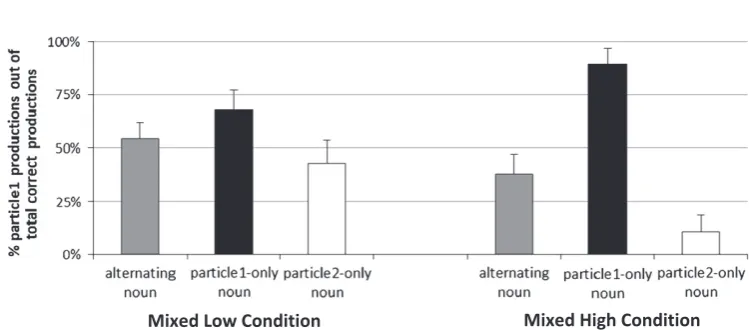
Baseline.89.0% of productions in MixedLow and 88.1% in MixedHigh had the correct (moop) NOUN PARTICLEform. An independent t-test revealed that these figures were not significantly different (t(27)=0.141,p= .889), suggest-ing equal learnsuggest-ing of the basic word order pattern in the two languages.
Choice of particle.We then examined children’s choice of particle usage for (moop) NOUN particleproductions. The relevant data are shown inFig. 4.
We first considered children’s usage of the particles with the twoalternatingnouns. If children’s usage of parti-cles matches the input, they should use each particle around 50% of the time. We saw 54% particle1 usage in MixedLow and 38% particle1 usage in MixedHigh. One sample t-tests suggested that neither mean differed from 50% usage (MixedLow:t(14) = 0.562,p= .582; MixedHigh:
t(13) = 1.319,p= .210). The two means also did not signif-icantly differ from each other (t(27) = 1.370,p= .182),
Most critical are productions with theparticle1-onlyand
particle2-onlynouns. As can be seen inFig. 4, in both con-ditions, children produce particle1 more often with the
particle1-onlynoun and particle2 more often with the par-ticle2-only noun, however this difference is more pro-nounced in the MixedHigh condition. An ANOVA was run with Percentage-Particle1-Productions as the dependent measure, Noun-Typeas a within-subject factor with two levels (particle1-only versus particle2-only) andLanguage
as a between-subjects factor with two levels (MixedLow versus MixedHigh6). This revealed no main effect of Lan-guage(F(1, 25) = 0.184,p= .672), but a significant main ef-fect of Noun-Type (F(1, 25) = 30.404, p< .001), and a significant interaction between Noun-Type and Language
(F(1, 25) = 5.811,p= .024).
Although our main question in this experiment con-cerned the frequency manipulation, it is also interesting to compare the learning ofparticle1-onlyandparticle2-only
nouns in the MixedLow condition with their counterparts in the Lexicalist condition from Experiment 1. These nouns (and thus the relevant noun–particle bigrams) were matched in frequency across the two conditions, so any difference in how they were learned must reflect other higher-level properties of the language. In the Lexicalist condition, 98% of correct productions withparticle1-only
nouns used particle1, and 19% of correct productions with
particle2-onlynouns used particle1 (seeFig. 1) – a 79% dif-ference, compared with 29% in the current MixedLow con-dition. To compare these differences, an ANOVA was conducted with Percentage-Particle1-Productions as the dependent measure,Noun-Typeas a within-subject factor with two levels (particle1-only versus particle2-only) and
Languageas a between subjects factor with two levels (Lex-icalist versus MixedLow). This showed no significant main effect ofLanguage(F(1, 33) = 0.356,p= .555), but a main ef-fect ofNoun-Type(F(1, 33) = 46.469,p= .000) and a signif-icant interaction (F(1, 33) = 8.882,p= .005). This indicates
6
significant learning of the lexical patterns in both condi-tions, but greater learning in the Lexicalist language, de-spite the fact that the relevant noun–particle bigrams were matched in frequency across the conditions.
Discussion
The central aim of Experiment 2 was to see whether children could learn that some nouns were restricted to oc-cur with just one of two particles if other nouns alternated between the two, and whether this learning was affected by noun frequency. Two languages were compared which differed only in the frequency of the particle1-only and
particle2-only nouns (and the relevant noun–particle bigrams). The languages were equally well learned in terms of the overall production of (moop)NOUN PARTICLE
sentences, and there was evidence of learning of the restrictions on particle usage in both languages. However frequency did have an effect: there was less generalization with particle1-only and particle2-only nouns in the lan-guage where they were more frequent. This result is in line with the Entrenchment (Braine & Brooks, 1995) and re-lated Statistical Pre-emption (Goldberg, 2005) hypotheses, which suggest that the usage of a lexical item with a particular linguistic structure becomes increasingly unlikely as it is repeatedly encountered in an alternative structure. Here, the usage of a particle1-onlynoun with particle2 is less likely the more that noun has been encountered with particle2 (and vice versa).
In addition to addressing the role of noun frequency, I also compared learning ofparticle1-onlyandparticle2-only
nouns in the MixedLow condition (where some nouns alter-nate) with learning of the same nouns in the Lexicalist con-dition from Experiment 1 (where no nouns alternate). The relevant noun–particle bigrams are matched in frequency, yet learning was significantly stronger in the Lexicalist con-dition. One possibility is that, as with theminimal-exposure
[image:11.544.37.509.73.156.2]nouns in Experiment 1, children are showing their sensitiv-ity to higher-level relationships between nouns and parti-cles – i.e. they are more likely to learn that particular nouns are associated with particular particles when there is greater evidence across the whole language that particle usage is lexically restricted. However, caution must be taken in drawing this conclusion since there is another difference between the two languages: in the MixedLow language the two particles were of equal frequency, whereas in the Lexi-calist language particle1 is more frequent than particle2.It may be that this factor also affects learning in some way – for example it might turn out to be easier to learn lexical restrictions in a skewed language. Note, however, that this couldnotexplain the results with minimal-exposure nouns in Experiment 1, since the frequency of the particles was matched across the Lexicalist and Generalist input. More-over, regardless of whether the difference in learning was due to skewed particle frequency, higher level lexical con-sistency, or some combination of the two, the fact that the relevant bigrams were frequency matched yet differently learned again indicates that children are sensitive to
Table 2
Noun types and their exposure in the MixedLow and MixedHigh conditions.
Noun type Number of nouns
of this type
Number of times each noun encountered with particle1
Number of times encountered with particle2
Mixed language low Particle1-only(low frequency) 1 12 0
Particle2-only(low frequency) 1 0 12
Alternating 2 6 6
Mixed language high Particle1-only(high frequency) 1 36 0
Particle2-only(high frequency) 1 0 36
Alternating 2 6 6
[image:11.544.83.458.171.336.2]distributional patterns above the level of individual nouns. To this extent, the result corroborates the general findings of Experiment 1.
General discussion
The current study used an artificial language learning paradigm to explore the balance between lexically-based learning and generalization in child language learning. Across two experiments, four groups of 6 year olds were each exposed to one of four semi-artificial languages in which nouns were obligatorily followed by one of two post-nominal particles, but the relationship between spe-cific nouns and particles was manipulated across the lan-guages. In a production test, we looked at which of the two particles children chose to use with different noun types in the different language conditions. Overall, children proved able to produce new noun particle combinations (generalization) but also showed evidence of lexically-based learning – i.e. preferring to produce a noun with the particle with which it had been encountered in the in-put. Critically, the tendency to replicate lexically-based patterns versus generalize depended on the statistical structure of the input. In Experiment 1 we saw an influence of two ‘‘higher-level’’ statistics: the relative frequency of the particles across the nouns of the input, and extent to which particle usage was lexically conditioned. In Experi-ment 2 we saw that generalization could also be affected by the frequency of the noun/noun–particle bigram in question. These results demonstrate that, though children are sensitive to item level frequency, aiding the learning of languages where different items behave differently, they are also sensitive to statistical information operating above the lexical level, i.e. above the level of particular nouns or noun–particle bigrams. This corroborates the results with adult learners inWonnacott et al. (2008), and suggests that this type of learning has relevance for theories of language acquisition.
Wonnacott et al., 2008suggested that this pattern of learning is consistent with an account where learners (a) track the usage of linguistic structures (here particles) at multiple levels i.e. both for specific nouns and across nouns, and (b) make inferences about the reliability of these different distributions as indicators of future usage. In such an account ‘‘lexical conservatism’’ occurs when the sample of observations for a particular lexical item is deemed a reliable indicator of its continued behavior. This may be formalized in a model which represents degree of belief in a ‘‘hypothesis’’ about particle usage (e.g. in the continued reliability of a distribution) as a probability and uses the mathematics of probability theory to conduct Bayesian inference.
The effect of frequency (seen in Experiment 2) falls nat-urally out of Bayesian inference since there is a trade-off between the prior bias for a hypothesis and the amount of data that hypothesis captures. The larger the sample of a specific nouns behavior, the more data is captured by a hypothesis based on its past behavior. Note that this is a common property of any model which construes linguistic generalization as rational inference, and thus various Bayesian models capture the effect of linguistic frequency
in constraining generalization (see Dowman, 2000 and
Chater & Vitanyi, 2007for related models). Such models may also be considered as formal instantiations of the Entrenchment/Statistical Pre-emption hypotheses.
The results of Experiment 1 suggest that learning can also lead to changes in higher level expectations, so that the probability that particle usage is dependent on the spe-cific noun is deemed greater after exposure to the Lexical-ist input (where particle usage was perfectly conditioned on the noun) than after exposure to the Generalist input (where particle usage and noun identity were unrelated). Thus the same noun-specific sample can be treated differ-ently in each case (the trade-off is different). This type of higher-level learning is captured by a specific instance of a Bayesian model – the HBM (hierarchical Bayesian model) which was independently developed byKemp et al. (2007)
and applied to the Wonnacott et al. data byPerfors et al. (2010). Although the precise details of the model are be-yond the scope of this paper, a critical feature is that it learns the value of two higher level parameters – ‘‘alpha’’ and ‘‘beta’’ – which constitute expectations about struc-ture/particle usage. The value of ‘‘beta’’ is simply the distri-bution of the particles across the nouns in the data set (e.g. 0.75 particle1 usage). The value of ‘‘alpha’’ instantiates an ‘‘over-hypothesis’’ about the uniformity of particle usage for particular nouns. If nouns tend to occur consistently with one particle, the value of alpha will be high and lexi-cal distributions will be deemed highly reliable (more lex-ical conservatism). If particle usage is unrelated to noun identity, the value will be low and lexical distributions will be deemed unreliable (more generalization). In this latter case, the general distribution of particles (beta) may be a more reliable indicator of particle usage. This model (cor-rectly) predicts that children in the Lexicalist condition should tend to produce minimal-exposure nouns with the particles with which they had occurred, while children in the Generalist condition should be more influenced by the language-wide distribution of the particles – i.e. pro-duce both, but particle1 more frequently. It also explains the treatment of entirely-novel nouns: since there isno
sample for these specific nouns, the language distribution of particles (beta) should influence productions in both conditions, and it did (i.e. children showed greater parti-cle1 than particle2 usage in each case). Learning about higher-level variability (alpha) is also seen in the different degrees ofregularizationwith novel nouns across the two conditions: children were more likely to use one particle per novel noun (either the same particle or a different one for each noun) in the Lexicalist condition. This behav-ior again indicates that children have formed higher level expectations about the relationships between nouns and particles in their input.
the class of connectionist learning models, which have played an important role in the psycholinguistic literature (e.g.Elman, 1990; Rumelhart & McClelland, 1986; Plunkett & Marchman, 1991). The relative merits of the connection-ist and rational inference approaches to cognition is the to-pic of much ongoing debate (e.g. see Griffiths, Chater, Kemp, Perfors, & Tenenbaum, 2010andMcClelland et al., 2010). Most relevant here is the question of level of repre-sentation. The HBM provides a solution at Marr’s computa-tion level: it describes the problem that needs to be solved, and shows us how that problem can be solved if the learner is able to make particular types abstract inferences.
In contrast a connectionist model may provide an ac-count of learning in terms of lower level learning mecha-nisms. For example, the HBM model assigns values to ‘‘alpha’’ and ‘‘beta’’ by searching the space of all possible pairs of values and determining the candidate which max-imize posterior probability – there is no claim our human learners have conducted this type of exhaustive search. In contrast, connectionist models may be trained using methods which are more psychologically plausible. For example, they might learn by predicting upcoming words in each of the exposure sentences (Elman, 1990), allowing them to incrementally update their weights on a trial by trial basis in response to whether their prediction was cor-rect. Like the HBM, connectionist models are able to bal-ance statistical patterns at multiple levels. If a connectionist model were trained on the current lan-guages, it seems likely that it would learn both the associ-ations between particular nouns and particles, and the relative frequencies of each particle across all nouns. Such a model would also be sensitive to sample size (item fre-quency), and thus capture Entrenchment/Statistical Pre-emption, since connectionist learning implicitly incorpo-rates a trade-off between the degree of fit with the data and ‘‘prior’’ probability of generalization. (However the lat-ter arises from choices about network architecture, num-ber of training epochs and other network choices, rather than being specified as a prior.) It is currently unclear whether a connectionist model could learn whether parti-cle usage is lexically consistent at a higher level – i.e. the type of learning which accounts for the differing treatment of minimal-exposure nouns across conditions in the Bayes-ian approach (captured in ‘‘alpha’’ in the HBM). Still, it re-mains possible that a connectionist, or other more ‘‘bottom up’’ statistical learning model, could capture the data. If so, would its learning approximate the higher level algorithm described by the HBM? This is an interesting challenge for future research. For now, the question of how the relevant computations could be implemented in lower level psy-chological mechanisms remains open. Nevertheless, the data suggest that the ability to generalize yet avoid inap-propriate over-generalization rests on an ability to evalu-ate the past relevance of lexically-based distributions, i.e. based on sample size and the importance of such informa-tion across the language. Note that this provides a soluinforma-tion to Baker’s Paradox which does notrely onsemantic or pho-nological cues, contrary to the predictions of certain theo-ries (Pinker, 1989) (this does not suggest that these cues do not play a role in natural language learning. I return to this point below).
One potential criticism of the current data is that it de-pends on production probabilities as opposed to judg-ments of grammaticality. If resolving Baker’s Paradox requires learners to demonstrate their understanding that a form is impermissible in an absolute sense, arguably, this can only be done in a judgment task. Such a test was not included in the current work following pilot work which revealed that in this paradigm many children had difficulty understanding the task (even ‘‘child friendly’’ versions as in Ambridge et al., 2007). HoweverWonnacott et al. (2008)
did include a judgment task as well as a production task, and found that the results of the two were highly corre-lated. Importantly, like production data, judgment data were also graded, reflecting statistical factors such as fre-quency and higher-level variability in much the same man-ner as production probabilities. Wonnacott et al. argued that graded judgment data are in line with the fact that grammaticality judgments in natural languages may also be graded, with more over-generalization with low fre-quency items, even for adult native speakers (see e.g.
Theakston, 2004). The greater overgeneralization in the experimental data was attributed to learners’ (far) lesser experience with the artificial language than with a natural language. Similarly, in the current data, there is a good deal of over-generalization, both with minimal-exposure and with theparticle1-onlyandparticle2-onlynouns – the point is that the over-generalization is modulated by the statisti-cal properties of the input. The hypothesis is that there would be increasingly less overgeneralization with parti-cle1-onlyandparticle2-onlynouns with increased exposure (even given a language with lots of alternation - although the process would be slower in that case) and that eventu-ally the alterative form would become extremely rare or absent in production, and would also have an increasingly high likelihood of being judged as unacceptable if an appropriate test was included. Another way of thinking about this is that the ‘‘Paradox’’ results from the require-ment that learners must absolutely knowthat some non-occurring form is actually ungrammatical, when, logically, it could merely be accidentally absent from the sample of language heard thus far. The current perspective is that whilst it islogicallytrue that learners can never be abso-lutely sure that non-occurring forms may not occur in the future, they can become extremely certainthat those forms are systematically absent, based on the evidence available in the input. Nevertheless, the questions of how grammaticality judgments and production probabilities are related is important, and future work will continue to explore methods of obtaining such data from children with artificial language stimuli. Ultimately, an important ques-tion will be how much evidence is necessary to obtain the extremely consistent judgment data seen with native speakers of natural languages.
children have the opportunity to show regularization on the basis ofnoevidence is with familiar nouns in the Gen-eralist condition (recall that entirely-novel nouns are tested after the exposure with minimal-exposure nouns, which also provide some lexically consistent input). At first glance the pattern of particle production with these nouns appears in line with probability matching rather than reg-ularization, a phenomenon previously only reported with adults. That is, children use both particles, and with prob-abilities matching those of the input. However, considering the behavior of individual children, we saw that 33% of children (7/21) produced responses that were regularized in some way. Taking into account the number of produc-tions made by individual children, this was calculated to be significantly more than chance probability matching would predict. Nevertheless, the extent of regularization seems to be less than in previous experiments. For exam-ple, given similar language input, Hudson Kam and Newport (2005)found that around 70% of children created some systematic pattern of particle usage, andAustin et al. (2006) found almost 100% of productions used the more frequent particle. One important way in which the current experiments differ from these earlier studies is in the use of a semi-artificial language, with nouns borrowed from English. A recent study by Hudson Kam and Chang (2009) suggests that ease of lexical access may increase the tendency to probability match rather than regularize. In that study, adult learners were exposed to an artificial language which they had previously been shown to regu-larize (Hudson Kam & Newport, 2009) but with tasks which aided lexical retrieval (relevant vocabulary was pro-vided in various ways during the test). They found that with these modified tasks participants showed more prob-ability matching and less regularization than with the standard task. This suggests the possibility that the use of familiar English nouns lead to less regularization than in previous experiments. However there are various other differences between the languages used in the current studies and previous studies, and the different studies use slightly different criteria to establish regularization. Ongoing research is exploring which factors are critical, and also compares children and adults learning the same languages.
Although the central finding of this work is that chil-dren’s learning is very similar to that of the adult learners inWonnacott et al. (2008), it would also be interesting if there were differences in the learning of child and adult learners, given the evidence for maturational differences in natural language learning (Johnson & Newport, 1989; Newport, 1990). Unfortunately, differences in the learning paradigms in this study andWonnacott et al. (2008) (dif-ferent linguistic structures, numbers of lexical items, etc.) make direct comparison impossible. For example, we have seen that generalization in child and adult learner is af-fected by the same sorts of statistical considerations, but we cannot say from the current data whether children are any more or less likely to generalize. This question is of some interest given claims in the literature that, at least very young children, tend to be conservative in the early stages of learning (Tomasello, 2000). Other learning stud-ies have found that, though their generalization continues
to be evidence-based, children may actually be more con-servative than adults given precisely the same input (Boyd & Goldberg, in press; Wonnacott, Boyd, Thomson & Goldberg, 2010). However the language structures used in these studies, and the type of generalization explored, were rather different to the current work, and future work will compare the extent of generalization in adults and children using the current paradigm.
Finally, these results demonstrate that, provided they reliably evidenced in the input, lexically-based patterns of usage are learned even in the absence of any other cues. However in natural language acquisition, syntactic distri-bution is generally correlated with other lexical properties. Indeed, even where the usage of a form appears to be arbi-trary and lexically specified, it often proves possible to identify broader generalizations. For example, subtle func-tional motivations – semantic or pragmatic – may make the usage of a structure more natural with some lexical items (e.g., Ambridge, Pine, Rowland, & Young 2008; Grimshaw, 1990; Pinker, 1989; Goldberg, 1995); sub-groups of lexical items which do/do not occur with a struc-ture may also share some phonological properties (Gropen et al., 1989). Such cues were deliberately excluded from the current languages (and those of Wonnacott et al., 2008) in order to isolatedistributional learning at and above the lexical level. Note that most researchers have concluded that at least some arbitrary lexical specification is necessary to describe natural languages (Braine & Brooks, 1995; Lakoff, 1970; Goldberg, 1995; Boyd, in press); and the current results help to explain the persis-tence of such idiosyncrasy across generations. On the other hand, it is also clear that adults and older children are sensitive to semantic and phonological regularities, and a full model of learning must explain the interaction of these different sources of information. To that end, future work will explore the learning of new artificial languages which are like those in the current study but where the usage of the two particles is partially correlated with the phonolog-ical and semantic properties of the nouns. One possibility is that when the learning paradigm is augmented in this manner, this new learning situation may reveal critical age differences. For example, learners of different ages may differ in how they attend to different sources of information at different stages of learning. Ultimately, the critical question will be whether and how such differences could help to explain the greater success of children at acquiring natural languages.
Acknowledgments