Ha Manh Tran and J¨urgen Sch¨onw¨alder Computer Science, Jacobs University Bremen, Germany
{h.tran,j.schoenwaelder}@jacobs-university.de
Abstract. Our research aims to assist operators in finding solutions for faults using distributed case-based reasoning. One key operation of the distributed case-based reasoning system is to retrieve similar faults and solutions from various online knowledge sources. In this paper, we pro-pose a multi-vector representation method which employs various seman-tic andfeature vectors to exploit the characteristics of faults described in semi-structured data. Experiments show that this method performs well in fault retrieval.
Key words: Case-based Reasoning (CBR), Fault Retrieval, Fault Man-agement, Semantic Search.
1
Introduction
Fault management involves detecting, reporting and solving faults in order to keep the communication networks and distributed systems operating effectively. Managing faults in small and homogeneous networks requires not much effort. However, this task becomes a challenge as networks grow in size and heterogene-ity. Proposing solutions for faults not only costs much time and effort but also degrades related network services. Artificial intelligence methods introduce some promising techniques for fault resolution.
The Case-based Reasoning (CBR) [1] approach seeks to find solutions for similar problems by exploiting experience. A CBR system draws inferences about a new problem by comparing the problem to similar problems solved previously. The system either classifies a given problem into a group of already known and already solved problems or proposes new solutions by adapting solutions for related problems to the new circumstance of the problem. Existing CBR systems for fault management usually cooperate with trouble ticket systems to take advantage of the trouble ticket database as the case database. These systems only function on the local case database, and thus limit the capability of exploring fault-solving knowledge present at other sites. Using shared knowledge sources, however, not only provides better opportunities to find solutions but also propagates updates in case databases that otherwise frequently become obsolete in environments where software components and offered services change very dynamically.
Search engines like Google [2] today furnish information search with global data sources and powerful search techniques. It has become common practice for
people to “google” for a piece of information. Operators are unexceptional; they use fault messages or keywords to search for fault resolution in indexed public archives. Observations have shown that “googling” takes quite some time to find suitable solutions for a given fault. Furthermore, these solutions are typically found in indexed discussion forums, bug tracking and trouble ticket systems, or vendor provided knowledge bases. While some of these data sources maintain some structured information (e.g., bug tracking and trouble ticket systems), this information cannot be exploited due to the usage of a generic search engine which does not understand the meta information readily available.
To deal with this problem, we have proposed
Reasoning Solution space space Problem Similar problems New problem solution Proposed
Fig. 1. Case-based reasoning a distributed case-based reasoning system [3]
which first exploits various fault knowledge sources in a distributed environment to discover similar faults, and then reasons on the retrieved solu-tions to provide new solusolu-tions adapting to the circumstances of new faults. In this paper, we focus on a multi-vector representation method to describe faults as cases in an expressive for-mat, thus allowing the CBR system to retrieve more relevant cases. Intuitively, similar faults can probably be found if they are represented in comparable formats. The paper is organized
as follows: in Section 2, we provide some background information about CBR sys-tems and semantics-based search mechanisms. Section 3 explains a novel method to represent faults for case retrieval in the CBR system. The evaluation of this method is presented in Section 4. The related work describes the existing systems in Section 5 before the paper concludes with future work in Section 6.
2
Background
This section provides an overview of the CBR system and the semantics-based search mechanisms (also known as semantic search). A CBR system basically contains four processes:case retrieval to obtain similar cases,case reuse to infer solutions, case revision to confirm solutions and case retaining to update new cases. The first process concerns case representation and similarity evaluation; whereas the remaining processes are more related to case reasoning and main-tenance. The main focus here is on case representation, similarity functions and semantic search.
2.1 Case Representation and Similarity Functions
A case representation method expresses a case in a formal format to reveal hid-den properties and to facilitate case evaluation. Moreover, the representation method also has an influence on the performance of case retrieval. Research in CBR has proposed several representation methods for various domains. The bag
of words (BOW) used for law cases tokenizes a text into single words; i.e., a form of term vectors. The XML-based case representation language (CBML) used for travel markets describes cases in XML format. A review of these methods has been reported in [4]. In addition, other proposals [5, 6] in fault management have explored field-value pairs to present faults; i.e., a form of feature vectors. Note that the terms “feature vectors” and “field-value vectors” are used interchange-ably throughout this paper.
The structure of trouble tickets [5, 6] has been used to represent cases in CBR systems. An example ticket encompasses fields such as “Device name”, “Device type”, “IP address”, “Trouble”, “Additional data”, “Resolution” plus other fields used for management purposes (e.g., “Owner”, “Status”, “Time”). Cases are represented as {field:value} pairs, where value is either numeric or symbolic. Case similarity is measured by the number of pairs matched.
Knowledge management systems [7, 8] and practical CBR applications [6, 9] express cases infeaturevectors<f1:v1,. . . ,fn:vn>, wherenis number of features;
fiis a domain-specific feature pre-defined in knowledge sources;vi is a value of the respective feature, which avoids using natural language. This representation not only supports semantic search, but can also be used to represent cases in CBR systems.
Case similarity is calculated by various methods. Theglobal similaritymethod [9, 7] takes the significance of features into account:
sim(q, c) = n i=1
wisim(qi, ci) (1)
nis the number of features;qi andci are features of casesq andcrespectively;
sim(qi, ci) is the distance betweenqi and ci, which are expressed in binary, nu-meric or symbolic values;wiis a weight of theithfeature such that
n
i=1wi= 1 withwi ∈[0,1]∀i. A weight is a user-defined value which exhibits the significance of a certain feature.
Thelogical match method [8] uses a logical model to express a case in a set ofpredicates <f1=v1,. . . ,fn=vn>, where each predicate{fi=vi} is a field-value pair. A caseCimatches a caseCj, denotedCi⊆Cj, ifCj holds for all predicates in Ci:
∀k{fk =vk} ∈Ci,{fk=vk} ∈Cj =⇒Ci ⊆Cj (2)
This method supports apartial match for the heterogeneous cases that contain different numbers of features.
The word similarity method [10, 11] compares cases using the hierarchical word structure, namely the taxonomy tree.
simT opic(q, c) =
e−αl eβh−e−βh
eβh+e−βh ifq=c
1 otherwise (3)
lis the length of the shortest path between the topics ofqandcin the taxonomy tree,his the depth level of subsumer in the taxonomy tree, andα≥0 andβ >0 are parameters scaling the contribution of shortest path length l and depth h, respectively.
2.2 Semantic Search
Resources and queries in semantic search are expressed in formal formats se-mantically understandable to search engines. Knowledge management systems describe resources in feature or semantic vectors and evaluate the similarity between vectors using similarity functions. Existing systems have employed dif-ferent methods including the schema-based method [11, 12] for resources related to structured, domain-specific data, and the Latent Semantic Indexing method (LSI) [13] for resources described textually.
Fulltext-based Search The LSI method brings the essential abstract concepts of a document or query to a semantic vector. To generate this vector, a docu-ment or a query is first represented in a term vector. The Vector Space Model (VSM) [14] weights each term, denoted byw(t), in the term vector by calculat-ing the appearance frequency of this term in the document and the appearance frequency of this term in other documents, as follows:
w(t) =nt∈d
Nd
log N
nd⊃t
(4)
nt∈d is number of termt in documentd;Nd is number of terms in documentd;
N is number of documents;nd⊃tis number of documents containing termt. A high frequency of a term indicates the significance of the term in the document, but its significance is compensated if the term also appears in many other docu-ments. LSI deals with noise and synonyms in a document by transforming a term vector into a semantic vector. To carry out the transformation, LSI represents all documents and terms in the documents in at×dmatrixA, where each element
aij computed by Eq. 4 denotes the significance of termiin documentj. Using singular value decomposition (SVD) [14], Ais decomposed into the product of three matrices:A=U ΣVT, whereΣ=diag(σ1, . . . , σ
r) is anr×rdiagonal ma-trix,ris the rank ofAandσiis the singular value ofAwithσ1≥σ2≥. . .≥σr. LSI eliminates noise and synonyms by picking up the s largest singular values resulting in reducing the rank ofA; e.g.,As=UsΣsVsT. The optimal value ofs is chosen depending onr; e.g., between 50 and 350. Semantic vectors of docu-ments inAare indexed by the rows ofVs. Semantic vectors of new documents or queries are computed by usingUs,Σs[14]. The similarity between two vectors is measured by the cosine of the angle between these vectors. Formally, given two vectors q= (q1, q2, . . . , qs) and c = (c1, c2, ..., cs) normalized withq = 1 and
c= 1, the similarity betweenqandc is computed by the following equation:
cos(q, c) = s i=1
qici (5)
Schema-based Search The schema-based method (also known as
metadata-based or ontology-metadata-based search) maps the properties of resources in a pre-defined schema into feature vectors. A schema here denotes the structure of data; e.g.,
a schema of a digital document consists of title, author, abstract, etc. A query is also expressed in a feature vector using a schema. Fig. 2 plots the process of the schema-based search. This method works based on knowledge sources that globally define concepts and their relationships related to some domain of interest. These concepts are employed to specify the structured data of resources or queries in schemas. The similarity evaluation of feature vectors has been discussed in 2.1.
2.3 Case Reasoning
While case retrieval is only responsible for
pro-Processing
Resources Queries
Searching Schemas
Fig. 2.Schema-based search ducing similar cases, case reasoning deduces from
the retrieved cases relevant solutions for the prob-lem, see Fig.1. The deductive capability of case reasoning lies upon an intelligent process named
case adaptation. This process basically carries out two tasks: the first task distinguishes a re-trieved case from the problem to clarify key dif-ferences, then the second task modifies the re-trieved case following the differences.
Instruc-tions from operators take vital roles in these tasks, thus improving the self-adapting capability is the major challenge of case reasoning. Furthermore, case reasoning also undertakes the process ofcase retaining that submits the changes of the adapted cases to the case base after processing case adaptation. It is essential that the process of case learning verifies the results of applying the adapted solutions to a real system before case databases are updated. However, this process is difficult to be performed because real test systems are sometimes unavailable in decentralized environments.
3
Fault Retrieval
This section proposes a multi-vector representation method to represent faults. Evaluating the similarity between faults involves several functions corresponding to the represented vectors and an aggregation function to calculate the final similarity value.
3.1 Multi-vector Representation
The heterogeneity of describing cases leads to difficulties in representing cases resulting in vectors with various dimensions and features. The comparison of these vectors thus becomes troublesome and imprecise. A feature vector is either limited by the pre-defined features or composed of the unpredictable user-defined features. It is also difficult to use this vector to explore the properties of the textual cases. On the other hand, a semantic vector exploits the textual cases, but neglects the importance of the case features. This vector only works with
the local case database; e.g., two cases retrieved from two different case bases by comparing their vectors are possibly semantically different.
The proposed multi-vector representation method describes cases using a set of vectors instead of a single vector. This method deals with the above problems by breaking a case into various semantic and feature vectors resulting in both expressing cases more effectively and facilitating the comparison of these vectors. In addition, this method is suitable for faults which usually contain hierarchical fields, parameters, textual symptoms. The set of vectors takes advantage of these factors to discover the properties of cases. Nevertheless, introducing several vec-tors requires an aggregation function to evaluate the similarity between vecvec-tors. A network fault is anatomized by the following concerns:
– Field-value pairs classify a fault into the smaller groups of network faults. As described in [6], these groups are related to connectivity, communica-tion performance, authenticacommunica-tion service, hardware and software configu-ration. A case contains several pre-defined field-value pairs such as prob-lem type and area, hardware, platform, and other user-defined field-value pairs. To representnpairs, we employ the field-value vector:vf =<f1:v1,. . . ,
fk:vk,. . . ,fn:vn>, wherekis the fixed number of pre-defined pairs.
– Other field-value pairs specify symptoms and typical parameters such as port number, cache buffer, packet loss, error messages depicted in domain-specific terminology. These pairs are represented by another field-value vec-torvp =<p1:v1,. . . ,pm:vm>, wheremis number of symptoms and parame-ters. Symptoms are either binary, numeric or symbolic values. This vector is useful for faults with diagnosis information.
– Textual descriptions including effects, symptoms, debugging message and additional information are represented by the semantic vectorvs using LSI. This high-dimension vector exhumes the properties of a case hidden in the natural language, thus distinguishing the case from other cases. Indexing fault cases and generating query vectors only work with local case databases. A case, in fact, contains problem and solution parts. A set of vectors {vf, vp,
vs}can be used to represent the problem part (of a network fault). It is natural to extend the set of vectors to the solution part resulting in more vectors added to the set; the similarity between cases possibly becomes more precise. However, to make the proposed method simple and feasible, we only insist on using the vector set of the problem part for retrieving similar faults; the extended vector set of the solution part related to reasoning the retrieved cases and providing the best case is not discussed in this paper. The following example is a fault extracted from a networking forum [15]:
Problem: Hub connectivity not functioning
Description: The WinXP network contains many machines obtaining an address from a DHCP server. The network is extended to 3 more machines by unplugging the LAN cable from one of the machine’s and plugging it to a hub with the intention to add the 3 new machines. From the hub, none of the machines successfully obtains an IP address from the DHCP server; an error message shows “low or no network connectivity”.
To make this fault case understandable and comparable to CBR engines, vector
vf contains<problem type: connectivity, problem area: hardware configuration, hardware: PC, platform: WinXP>. Vector vp comprises<network: LAN, error-message: low or no network connectivity, ip-address: false, DHCP: true>. Using LSI, several terms are considered to build the vectorvs.
3.2 Similarity Evaluation
A similarity evaluation function measures the essential properties of cases to conclude the degree of similarity between cases. This function usually depends on the representation method, and therefore has an impact on the performance of case retrieval. For the proposed representation method, the field-value vectors
vf andvp are evaluated by Ordered Weighted Averaging (OWA) [16, 9], which is an aggregation function for multi-criteria decision making, see Eq. 6. This function is suitable for a scenario where the information of the importance of features is unknown, but the order of the importance of features is possibly exploited. It means that the pre-defined features are considered more important than user-defined features, thus receiving higher weight values.
sim(q, c) = n i=1
wisimσ(i)(qi, ci) (6)
where n, qi and ci are already discussed in Eq. 1; simσ(i)(qi,ci) is a distance between qi and ci expressed in binary, numerical or symbolic values. σ(i) is a permutation of 1,...,n such that simσ(i)(qi, ci) ≥ simσ(i+1)(qi+1, ci+1) ∀i = 1, . . . , n−1. We compute a weight valuewi using the following function:
wi= 2 n+2i ifi < n2 1 2i ifi≥ n2 (7) This monotonic function decreases from n+22 to 21n, corresponding to the im-portance of features, as i increase 1 to n; besides, the function guarantees n
i=1wi ≈ 1. The similarity between semantic vectors vs is evaluated by the inner product of vectors, see Eq. 5. In summary, given a case c, a query q and the similarity values simvf(q, c), simvp(q, c), cosvs(q, c) for the corresponding
vectorsvf, fp, vs, the similarityS betweenc andqis measured by the aggrega-tion funcaggrega-tion Eq. 1:
S(q, c) =αsimvf(q, c) +βsimvp(q, c) +γcosvs(q, c) (8)
Parametersα,β andγ specify the significance of vectors provided by users; for instance:α= 0.4,β = 0.2 andγ= 0.4.
4
Evaluation of Multi-vector Representation
The goal of this evaluation is to show the performance of the multi-vector rep-resentation method in terms of retrieving relevant documents. We focus on two
methods: (1) the LSI method using the single semantic vector (lsi for short), and (2) the combined method using the two semantic and field-value vectors (lsi+fvv
for short). We have used the CISI and MED bibliographic datasets [17] with 1460 and 1033 titles and abstracts (documentsfor short) respectively. These datasets provides the textual queries and the corresponding numbers of relevant docu-ments for evaluating document retrieval; besides, the keyword-based queries are also included, as the following example:
A textual query: How can actually pertinent data, as opposed to refer-ences or entire articles themselves, be retrieved automatically in response to information requests?
A keyword-based query: and (or (“data”, “information”), or (“perti-nent”, “retrieved”, “requests”, “automatically”, “response”,not(or (“ar-ticles”, “references”))));
These two queries are the same, but the keyword-based query specifies main keywords and their importance using operators: and, or, not. Therefore, the query could be employed as a field-value vector by assigning different weight values to keywords. Each term possesses a weight value of ηθ1, whereηis number of or groups,θ is number of terms in the group containing the term. Terms in
not groups receive negative values. For the above example, “data”, “pertinent” and “articles” possesses weight values of 0.25, 0.08 and -0.04 respectively. Sum of weight values for a query is 1 except for queries withnot operators.
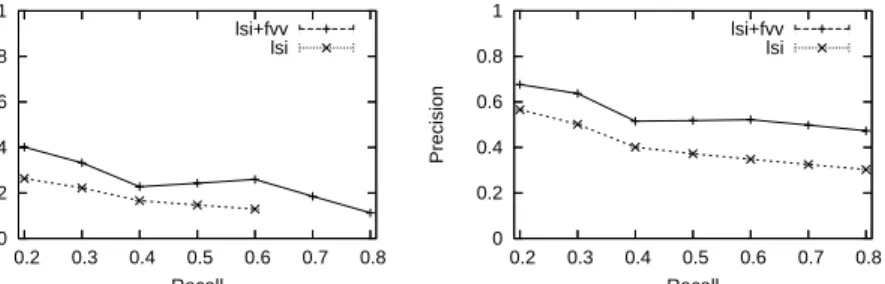
0 0.2 0.4 0.6 0.8 1 0.2 0.3 0.4 0.5 0.6 0.7 0.8 Precision Recall CISI lsi+fvv lsi 0 0.2 0.4 0.6 0.8 1 0.2 0.3 0.4 0.5 0.6 0.7 0.8 Precision Recall MED lsi+fvv lsi
Fig. 3.Precision by various recall rates for the CISI and MED datasets
The core component oflsi is to compute SVD for the large term-document matrix built on the dataset. We have implemented the Jacobi algorithm [18] for computing SVD. The advantage of this algorithm is high accuracy, which is very crucial for resolving this large, sparse matrix with small elements. The issue of
lsi+fvv is to determine the importance of specific keywords similar to features in field-value vectors; we simply use the same method as Eq. 4 for documents and the additional operators:and,or,not for queries. We experimentally choose
function Eq. 8; i.e., given a query, the similarity value for each document is aggregated by cosine and global similarity values.
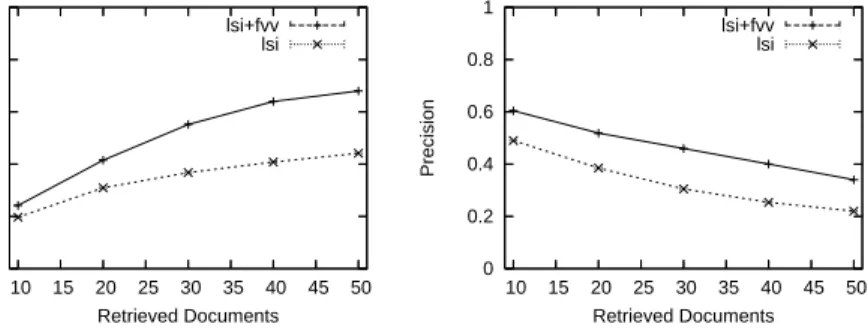
0 0.2 0.4 0.6 0.8 1 10 15 20 25 30 35 40 45 50 Recall Retrieved Documents lsi+fvv lsi 0 0.2 0.4 0.6 0.8 1 10 15 20 25 30 35 40 45 50 Precision Retrieved Documents lsi+fvv lsi
Fig. 4.Recall and precision by various numbers of retrieved documents for the MED dataset
We have considered two popular metrics to evaluate the performance of doc-ument retrieval in the experiments:recall rate (rc) and precision rate (rp) [13]. The recall rate is the ratio of the number of relevant documents retrieved to the pre-defined number of relevant documents. The precision rate is the ratio of the number of relevant documents retrieved to the total number of documents retrieved (Rd). Intuitively, the former only concerns the capability of obtain-ing many relevant documents regardlessRd; whereas, the later involves the ca-pability of achieving relevant documents in the limited number of documents retrieved. These two rates are usually opposed asRd increases.
We have used 40 queries for CISI and 30 queries for MED. The first experi-ment evaluates the precision oflsi+fvv andlsi over the recall rate; i.e., we keep retrieving documents until recall rates are reached, then count the number of documents retrieved and compute precision rates. Fig. 3 shows thatrpdecreases as rc (and also Rd) increases. In the CISI plot, both methods perform poorly for CISI; lsi cannot go over the recall rate of 0.6 because the similarity values of retrieved documents go down below 0; lsi+fvv performs slightly better. We found the same performance oflsi for CISI in [13]. According to this paper, the homogeneous distribution of CISI and the vague description of queries cause the unreliable judgment of the evaluation function. In the MED plot, both methods perform better for MED;lsi+fvv slowly reduces the precision rate and remains 0.48 as the recall rate reaches 0.8; whereas,lsi acquires 0.3 at the recall rate of 0.8, which is relatively low compared to the precision oflsi+fvv. An observation shows that choosing the size of semantic vectors influences the precision of lsi; i.e., the reduced rank of the matrix, and choosing theαandβ values affects the precision oflsi+fvv.
Since the MED dataset provides more reliable results, the second experiment uses this dataset to calculate the accumulative recall and precision rates for
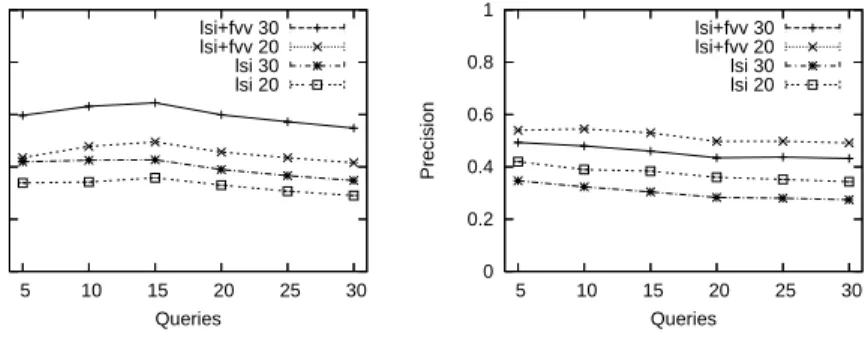
0 0.2 0.4 0.6 0.8 1 5 10 15 20 25 30 Recall Queries lsi+fvv 30 lsi+fvv 20 lsi 30 lsi 20 0 0.2 0.4 0.6 0.8 1 5 10 15 20 25 30 Precision Queries lsi+fvv 30 lsi+fvv 20 lsi 30 lsi 20
Fig. 5.Recall and precision by various numbers of queries for 20 and 30 documents of the MED dataset
different numbers of retrieved documents; i.e., 10, 20, . . ., 50. Fig. 4 indicates that lsi+fvv outperforms lsi in both recall and precision. An observation shows that several relevant documents could be obtained bylsi+fvv, while they possess low similarity values inlsi; thus, the field-value vector plays a vital role inlsi+fvv. Another observation is thatlsi tends to be misled by queries withnot operators, whilelsi+fvv tends to perform well for queries with distinguished keywords. The precision rate quickly reduces because some queries possess the small number of relevant documents compared to 40 or 50 retrieved documents; for example, a query with 20 relevant documents acquires 16 relevant documents for 40 retrieved documents and 17 relevant documents for 50 retrieved documents, its precision reduces from 0.4 (16/40) to 0.34 (17/50).
To further investigate these methods, we choose 20 and 30 retrieved docu-ments to observe how they perform since the average number of relevant doc-uments per a query is 23.3. Fig. 5 also displays the accumulative recall and precision rates for different numbers of queries; i.e., 5, 10, . . . , 30. These rates are relatively stable, thus all queries acquire the similar ratios of relevant docu-ments to the number of retrieved docudocu-ments (precision) and to the pre-defined number of relevant documents (recall).
5
Related Work
So far several attempts have been given to CBR in fault management. Most of the existing approaches focus on using trouble tickets to represent cases. The work in [5] improves fault management by extending the trouble ticket sys-tem (TTS) to CBR. The proposed syssys-tem can learn from previous experience and offer solutions to novel faults. This work employs trouble tickets as cases for CBR. Likewise, the DUMBO system [6] takes advantage of the knowledge hoarded in TTS to propose solutions for problems. The system not only con-tains six types of features to express cases but also provides both similarity and reliability measurements for evaluating features between cases. However, these
systems are relatively limited by two aspects: (1) the representation of trouble tickets is only suitable for simple feature matching mechanisms, thus restrict-ing the exploitation of features; (2) the knowledge source is limited by usrestrict-ing local case databases. Another interesting work [9] uses sets of pre-defined case attributes and preferences of users to improve case representation in recommen-dation systems. This paper involves using the multi-vector representation and the advanced similarity evaluation to improve fault retrieval, which is the core component of the proposed distributed CBR system.
Other research activities have concentrated on knowledge management sys-tems working on both multiple case databases and semantic search on peer-to-peer (P2P). Shlomo et al. [7] proposes an approach to retrieving cases on a structured P2P network with the hypercube topology. The approach employs the schema-based method, namely unspecified ontology, to maintain the case base on P2P environment. Case retrieval is based on the approximated search algorithm for feature vectors only, and the focal domain is e-commerce adver-tisement. The Bibster or SWAP system [11] supports bibliographic data storage and ontology-based search on a super-peer network. The Piazza system [8] deals with the problem of sharing semantically heterogeneous data on a P2P network. These two systems also use the schema-based method to define shared data and retrieve data by evaluating the similarity between feature vectors. The proposed distributed CBR system associates the semantics-based search mechanism with CBR to support not only fault retrieval but also fault-solving capability.
6
Conclusion
Our research aims at building a distributed CBR system to assist operators in finding solutions for faults. The system is more relevant than general search engines because it enables not only searching for similar faults described in semi-structured data but also producing new solutions for new faults. In this paper, we address the problem of retrieving similar faults in the CBR system. By studying the description of fault cases, we propose a multi-vector representation method which uses several feature and semantic vectors to express faults. These vectors not only exploit better the characteristics of faults described in semi-structured data but also provide facilities for evaluating the similarity between faults, thus ameliorating fault retrieval.
We have tested the performance of the proposed method using the CISI and MED bibliographic datasets whose documents contain semi-structured data. The evaluation results show that the combination of semantic and feature vectors outperforms the use of single semantic vectors in terms of document retrieval. Future work will focus on using real fault datasets whose diversity may demand various vectors instead of two vectors. In addition, the proposed method will be extended to case reasoning, which infers the best case from the vector sets of the retrieved cases.
Acknowledgement
The work reported in this paper is supported by the EC IST-EMANICS Network of Excellence (#26854).
References
1. A. Aamodt and E. Plaza. Case-based reasoning: foundational issues, methodolog-ical variations, and system approaches. AI Communications, 7(1):39–59, 1994. 2. Google search engine. Http://www.google.com/. Accessed in May 2007.
3. H. M. Tran and J. Sch¨onw¨alder. Distributed case-based reasoning for fault man-agement. InProc. 1st Conference on Autonomous Infrastructure, Management and Security, pages 200–203. Springer-Verlag, 2007.
4. R. O. Weber, K. D. Ashley, and S. Br¨uninghaus. Textual case-based reasoning. The Knowledge Engineering Review, 20(3):255–260, 2005.
5. L. M. Lewis. A case-based reasoning approach to the resolution of faults in com-munication networks. InProc. 3rd International Symposium on Integrated Network Management (IFIP TC6/WG6.6), pages 671–682. North-Holland, 1993.
6. C. Melchiors and L. M. R. Tarouco. Fault management in computer networks using case-based reasoning: DUMBO system. InProc. 3rd International Conference on Case-Based Reasoning and Development, pages 510–524. Springer-Verlag, 1999. 7. S. Berkovsky, T. Kuflik, and F. Ricci. P2P case retrieval with an unspecified
ontology. In Proc. 6th International Conference on Case-Based Reasoning, pages 91–105. Springer-Verlag, 2005.
8. I. Tatarinov, Z. Ives, J. Madhavan, A. Halevy, D. Suciu, N. Dalvi, X. Dong, Y. Kadiyska, G. Miklau, and P. Mork. The piazza peer data management project. SIGMOD Record, 32(3):47–52, 2003.
9. M. Montaner, B. L´opez, and J. Llu´ıs de la Rosa. Improving case representation and case base maintenance in recommender agents. InProc. 6th European Conference on Advances in Case-Based Reasoning, pages 234–248. Springer-Verlag, 2002. 10. Y. Li, Z. A. Bandar, and D. McLean. An approach for measuring semantic
sim-ilarity between words using multiple information sources. IEEE Transactions on Knowledge and Data Engineering, 15(4):871–882, 2003.
11. P. Haase, J. Broekstra, M. Ehrig, M. Menken, P. Mika, M. Plechawski, P. Pyszlak, B. Schnizler, R. Siebes, S. Staab, and C. Tempich. Bibster — a semantics-based bibliographic peer-to-peer system. InProc. 3rd International Semantic Web Con-ference, pages 122–136. Springer-Verlag, 2004.
12. W. Nejdl, B. Wolf, C. Qu, S. Decker, M. Sintek, A. Naeve, M. Nilsson, M. Palm´er, and T. Risch. EDUTELLA: a P2P networking infrastructure based on RDF. In Proc. 11th International Conference on World Wide Web, pages 604–615, New York, NY, USA, 2002. ACM Press.
13. S. Deerwester, S. Dumais, T. Landauer, G. Furnas, and R. Harshman. Indexing by Latent Semantic Analysis. JASIST, 41(6):391–407, 1990.
14. M. W. Berry, Z. Drmac, and E. R. Jessup. Matrices, vector spaces, and information retrieval. SIAM Review, 41(2):335–362, 1999.
15. Networking forum. Http://www.computing.net/. Accessed in March 2007. 16. R. R. Yager. On ordered weighted averaging aggregation operators in multi-criteria
decision making. IEEE Transactions on SMC, 18(1):183–190, 1988.
17. Latent semantic indexing. Http://www.cs.utk.edu/˜lsi/. Accessed in March 2007. 18. J. W. Demmel.Applied numerical linear algebra. Society for Industrial and Applied