Content analysis of Coursera, edX, and Udacity course platforms
2014
EMBA Program, University of Prince Edward Island
Signature Project
Content Analysis of Coursera, edX, and Udacity Course Platforms
Course content analysis of 18 Massive Open Online Courses
COURSE # MBA 801 By Ken Williams Student at U.P.E.I. DATE: April 10, 2014
Content analysis of Coursera, edX, and Udacity course platforms
2014
PERMISSION TO USE SIGNATURE PROJECT REPORT
Title of Signature Project: Content Analysis of Coursera, edX, and Udacity Course
Platforms: Course content analysis of 18Massive Open Online Courses Name of Author: Ken Williams
Department: School of Business
Degree: Master of Business Administration Year: 2014 Name of Supervisor(s): Susan Graham
In presenting this signature project report in partial fulfilment of the requirements for a Master of Business Administration degree from the University of Prince Edward Island, the author has agreed that the Robertson Library, University of Prince Edward Island, may make this signature project freely available for inspection and gives permission to add an electronic version of the signature project to the Digital Repository at the University of Prince Edward Island. Moreover the author further agrees that permission for extensive copying of this signature project report for scholarly purposes may be granted by the professor or professors who supervised the author’s project work, or, in their absence, by the Dean of the School of Business. It is understood that any copying or publication or use of this signature project report or parts thereof for financial gain shall not be allowed without the author’s written permission. It is also understood that due recognition shall be given to the author and to the University of Prince Edward Island in any scholarly use which may be made of any material in the author’s report.
Address: UPEI School of Business 550 University Avenue
Content analysis of Coursera, edX, and Udacity course platforms
2014
TABLE OF CONTENTS INTRODUCTION Overview………..………. 3 Background………... 5 Problem Statement………... 8Purpose of the Study…….……….………... 9
Research Questions……….……….. …….. 9
Nature of the Study……….……….………... 10
Limitations………….……….……...… 11
Assumptions………….……….……...… 11
Results and Findings………….………..……….. ……… 12
LITERATURE REVIEW Purpose of the Literature Review………….………..……….. 13
Description of the Database Search……….……… 14
What is a MOOC? ……….………...……… 16
Value Proposition of MOOCs……….………. 17
Political Environment………... 18
Economic & Social Environment……… 19
Technological Environment ……… 20
Business Models of the Three Platforms.………...………. 22
Coursera……… 24
edX…….……….. 26
Udacity………. 27
Other MOOC Platforms……….………...……... 28
MOOCs as a Disruptive Technology………. 28
MOOC Pedagogical Elements……….………...………… 30
Video Content in MOOCs……… 33
Secondary Effects of MOOCs……….... 34
Conclusion……….. 35
METHODOLOGY Research Method and Design……….……… 37
Data Collection Instrument……….………...……… 38
Survey Development……….………...……… 38 Data Collection……….……….. 39 Data Analysis……….……… 41 RESULTS RQ1……….………...………. 44 RQ2……….……… 53 RQ3……….……… 57 CONCLUSION RQ1……….……….... 62 RQ2……….……… 63 RQ3……….……… 65 Observations……….………. 66 Practical Implications……….……… 67 Further Research……….……… 68 REFERENCES……….……….. 70
Content analysis of Coursera, edX, and Udacity course platforms
2014
"Thirty years from now the big university campuses will be relics. Universities won't survive. It's as large a change as when we first got the printed book ... Higher education is in deep crisis." – Peter Drucker, quoted in Forbes Magazine in an article by Lenzner & Johnson, 1997
INTRODUCTION
Overview
Massive Open Online Courses, called MOOCs, have the potential to transform the business model of traditional universities. According to a prediction about the effects of MOOCs on higher education made by Harvard business professor Clayton Christensen in a New York Times article, “struggling colleges and universities, the bottom 25 percent of every tier, we predict - will disappear or merge in the next 10 to 15 years” (Christensen, 2013). The New York Times has called 2012 “the year of the MOOC” and described this new phenomenon in the field of online education as being free and flexible alternatives to “face-to-face” classes on campus. One day soon students will arrive on campus with MOOC credits the way they do with Advanced Placement (Pappano, 2102), or maybe not arrive on campus at all.
MOOCs as defined by the The Chronicle of Higher Education are “…classes that are taught online to large numbers of students, with minimal involvement by professors. Typically, students watch short video lectures and complete assignments that are graded
Content analysis of Coursera, edX, and Udacity course platforms
2014
either by machines or by other students. That way a lone professor can support a class with hundreds of thousands of participants” (Young, 2014). One key measure of the success of MOOCs has been the rise in accreditations of individual MOOCs that have begun to count as university course credit, and in some cases had a requirement for an on-campus proctored exam (Coursera, 2014) or an online exam from a third party service such as ProctorU.com (ProctorU, 2014).
State legislators in California have also led the way to accreditation, motivated by the popular perception that online courses increased access while also lowering the cost of higher education (Cooper, 2013). On a broader scale than mere individual course credits, in January, 2014, Georgia Tech, in partnership with Udacity, began the first complete program based on MOOCs, a Master of Science in Computer Science degree at a cost of $6,600 (Udacity Website, 2013). The program was also open - available at no cost to anyone wanting to participate but without obtaining a degree.
Resistance to the integration of MOOCs into higher education has appeared from some faculties at US universities (Kolowich, 2013), but distance education has long been an alternative to face-to-face interaction in a classroom (Caruth, 2013). The highly scalable nature of MOOCs posed a greater threat to on-campus classes than conventional distance education. Coursera, one of the leading providers of MOOCs, claimed four million students have enrolled in the courses that it had offered in partnership with 33 universities around the world (Anders, 2013). Enrollments in MOOCs were projected to double in 2014, according to the Deloitte Canada Technology Predictions 2014 (Tsang, 2014).
Content analysis of Coursera, edX, and Udacity course platforms
2014
With the support of prestigious universities such as Harvard, Georgia Tech, and Stanford University, web based learning platforms Coursera.org, Edx.org, and
Udacity.com have led an effort to disrupt current higher education business models (Scholz, 2013). The MOOCs offered by these three web platforms (Pappano, 2012) were available for free to anyone in the world with web access, and offered high quality learning material without the obstacles of a schedule, travel, tuition cost, or the financial burden of attending class on-campus. MOOCs offered world-wide accessibility allowing a lot more people in the world to take part in higher education (UK Dept. BIS, 2013).
Research showed that the potential quality of online learning was very high. According to a US Dept. of Education study: “The overall findings of the meta-analysis is that classes with online learning (whether taught completely online or blended) on average produce stronger learning outcomes than do classes with solely face-to-face instruction” (Means, 2009). In the context of rising tuition MOOCs had created a lot of hype about the potential to reduce costs, to increase access to higher education, and to disrupt the higher education market (Wei, 2008).
Background
Online education is a descendant of correspondence learning, which started in the US in the 1870’s with a Harvard associated group called “The Society to Encourage Studies at Home” (Caruth, 2013). Some of the same challenges that faced distance education in the past continued to persist. For example, conflicts had always existed between face-to-face faculty and distance learning faculty (Kolowich, 2013). Yet the promise of distance education had not changed - MOOCs reach new and previously un-served student populations. MOOCs have the potential to leverage the increased
Content analysis of Coursera, edX, and Udacity course platforms
2014
performance and reach of the Internet, thereby massively increasing access to new students while delivering courses at “low or no-cost“(Cooper, 2013).
The term MOOC emerged from conversations between two colleagues, Dave Cormier of the University of PEI and Bryan Alexander of the National Institute for Technology in Liberal Education (Parr, 2013). Two types of MOOCs were discussed in the literature: the cMOOC and the xMOOC (UK Dept. BIS, 2013). The former
emphasized connectiveness while the latter was an extension of the classroom.
The cMOOC appeared first, in 2008, in the course “Connectivism and Connective Knowledge” by the University of Manitoba (Downes, 2008). A cMOOC offered a new structure for learning, based on connectivism, which had a network-based focus on student interaction, wherein social networks were used to help form online communities around the course concepts. These connectivist communities formed on Facebook, blogs, discussions in Moodle and other platforms such as Second Life, a 3D virtual world. Students build relationships and work together online to solve problems, led by an acknowledged expert in the topic, and this interaction was at the heart of cMOOCs (Yaeger, 2013). A cMOOC was less focused on content and more on the exchange of ideas and developing online communities oriented around ideas.
Whereas a cMOOC was connectivist, an xMOOC was an extension of the
traditional classroom. An xMOOC was more focused on content and course delivery, but also depended on online discussions to create peer-to-peer learning (Billsberry, 2013). An xMOOC entitled “Circuits and Electronics” (6.002x), which began in March 2012, was the first MOOC developed by edX, the consortium led by MIT and Harvard. Over 155,000 students initially registered (Breslow, 2013). The term “MOOC” was often used
Content analysis of Coursera, edX, and Udacity course platforms
2014
in the literature to refer to an xMOOC, while the term cMOOC was used to distinguish itself as connectivist oriented. Figure 1 shows a timeline of cMOOCs and xMOOCs.
Figure1.
Source: Reproduced from EDUCAUSE Review (Hill, 2012)
The three leading MOOC platforms were Coursera, edX, and Udacity; these platforms were often mentioned together in the popular press coverage of the MOOC marketplace emerging in 2011. These three platforms were in the early stage of brand development and depended heavily on partnerships with universities such as Harvard (Pappano, 2012). The involvement of prestigious US universities offered a rare example of the establishment leading disruptive innovation (Christensen, 2011). Coursera had formed partnerships with 10 state systems (Coursera, 2013). EdX offered MOOC versions of many Harvard classes while Udacity has partnered with Georgia Tech and AT&T to offer a complete Masters Degree program in Computer Science (Udacity, 2013).
Content analysis of Coursera, edX, and Udacity course platforms
2014
This partnership with AT&T demonstrated the reach that MOOCs had into corporate training, and according to a CNBC article, MOOCs have already had a billion dollar impact on the field of personnel training (Lee, 2014). Furthermore, an article in the Financial Times warning of the potential impact of MOOCs on small business schools called MOOCs a commoditization of the teaching function (Guillotin, 2014). Another MOOC from edX responded to a demand from industry, announced March 6, 2014, in partnership with the Linux Foundation. The Linux course had previously been offered online at a cost of $2500, but the free MOOC version was intended to address a shortage of professionals with Linux skills (O’Connor, 2014).
Some criticisms of MOOCs included complaints about the low completion rates of enrollees, as well as problems with measuring students’ performance and academic honesty (UK Dept. of BIS, 2013). MOOCs had also run afoul of the law, such as when a MOOC was cancelled in January, 2014 due to US export laws restricting course access to some countries including Iran, Cuba, and Sudan (Collins, 2014). Even with export
controls it may prove difficult to block access due to the fact that most of the MOOCs examined in this study had downloadable versions of course content including videos, for offline use (Coursera, 2014).
Problem Statement
The problem is that higher education at a traditional university is expensive and inconvenient. MOOCs had the potential to solve some of the principle barriers to higher education: eliminating tuition costs, admission limits, class schedules, and the
geographical distance from a campus (UK Dept. BIS, 2013). The high quality of the course materials and presentation added to the potential of MOOCs to disrupt higher
Content analysis of Coursera, edX, and Udacity course platforms
2014
education. With no admissions process and free enrollment the courses were “available to anyone with an Internet connection who understands the language of instruction, often English” (Ehrlich, 2013).
Dwyer stated in an article from 2012 that “The experience of significant
indebtedness among young adults today is new.” Student debt has been rising, reaching record levels in 2012, and research showed that “student debt—which, as has been widely reported, now exceeds credit card debt” (Bowen, 2012). The fact that MOOCs are offered at no charge was a stark contrast to the trend of rising student debt.
Purpose of the Study
This study aims to provide a deeper understanding of the types of courses being offered by MOOCs, and the course presentation used on each platform as found during the period of study. Deeper understanding of the structure and content of each course may give insight to university leadership in how to include MOOCs within programs, and help explain the potential benefits. This study may provide a benchmark to be compared in the future in order to map the trends in online course content. This study might also serve as a broad guide to understanding the state of the art of MOOCs at a particular point in time.
Research Questions
As communication technology has evolved, the opportunities for online education have grown. The research questions in this study explore the content of MOOCs to answer the following:
Q1. What were the pedagogical/media elements utilized within the Coursera, edX, Udacity MOOC platforms?
Content analysis of Coursera, edX, and Udacity course platforms
2014
Q2. How is video content used in MOOCs?
Q3. What uniquely online elements were found in MOOCs?
Nature of the Study
The research design was based on a content survey of pedagogical elements found in three xMOOC platforms: Coursera, edX, and Udacity. The three platforms were the focus of the study because of the prominence given in the popular press and also because of several articles that refered to these as the top three platforms (Pappano, 2012). The courses chosen in the sample represent six available course offerings from the widest variety of subjects available at the time within each platform. The total sample size was 18 courses.
The survey consisted of 69 questions focused on measuring pedagogical elements such as number of lessons, quizzes, and videos. Data collection occurred over a six week period, and was performed exclusively by the researcher. The research questions were answered using a descriptive approach based on content analysis methodology. Data specific to each of 18 MOOCs (six each from Coursera, Edx, and Udacity) was collected using an Excel spreadsheet containing 69 questions about course content.
The data collection was performed during the period from January 5, 2014 to February 25, 2014. In order to record the data from each course in a consistent manner, a single researcher administered the survey. The survey included some broad questions such as a rating of the quality of the video presented. The duration of video content in each course involved traversing thousands of short video segments to record the length of each one. The specific question on video durations was designed to reveal different video
Content analysis of Coursera, edX, and Udacity course platforms
2014
presentation strategies among the 18 courses and to reveal platform styles of video delivery.
Limitations
Similar to most research projects, this study will be unable to answer all of the pertinent questions relevant to MOOCs and the role played by the course contents. The range of course content was extensive and a more nuanced approach would include expertise in the area of instructional design, an area where a great deal of research has already been done. Future research, including insights and observations from this study, may help institutions of higher learning to develop strategies to gain a competitive advantage regarding MOOC design and integration.
A limitation of this study is how well the sample represented the population. The study was limited to only three MOOC platforms without including all other MOOC platforms, or individual MOOC offerings, or MOOCs offered in languages other than English. The survey offered only a snapshot at a point in time; further studies may include a longitudinal perspective. Finally, while the content analysis can quantitatively identify and provide data on the frequency of certain course elements, in particular the video presentations, it does not shed light on the meanings of these patterns (Babbie, 2001).
Assumptions
The content analysis method used by the researcher in this study attempted to discover the course elements and to create an inventory across all of the 18 courses. Assumptions were made as to what constituted a course element. The creation of course element categories were determined from the course materials presented. The assumption
Content analysis of Coursera, edX, and Udacity course platforms
2014
that each MOOC presented the same content to all students was made, and it might be possible that students had some customized course content based on how each student proceeded in each course or based on the geographic location of the student or other variables such as the type of web browser. Furthermore, it was assumed that the
researcher collected data in a consistent manner and in a timely fashion during the period of the study.
Results and Findings
From 2010 to 2013, online education has evolved into a new category of
university courses, in the form of MOOCs. The increasing popularity was evidenced by the coverage of MOOCs in the popular press and by the course enrollment statistics reported by each provider. MOOCs reached new students, were free, and were gaining accreditation within the current university system (Marr, 2013). The three big platforms, Coursera, edX, and Udacity continued to innovate in the area of course design and delivery and to create partnerships.
Content analysis of Coursera, edX, and Udacity course platforms
2014
LITERATURE REVIEWPurpose of the Literature Review
The purpose of this literature review is to provide an overview of the body of knowledge on the subject of Massive Open Online Courses, or MOOCs. The term MOOC first appeared in a published, peer reviewed journal in 2009 with a single article, then climbed to 250 published articles on the subject in the year 2013. The history of MOOCs can be seen as an offshoot of online education (Caruth, 2013). Online learning began to appear in the literature in the year 2000. According to the UK Department for Business and Innovation, in that period of pre-MOOC online learning from 2000-2007 trends ran from open learning (UK Dept of BIS, 2013), to LMS (Learning Management Systems), iTunes U, and Khanacademy. During the year 2008 a series of failed ‘dot-coms’ attempted to deliver online learning (UK Dept of BIS, 2013). On the other hand some online learning success occurred in virtual universities with roots in the 1970s that flourished during the 2000’s such as University of Phoenix and Walden University. From the humble beginnings of early correspondence courses by postal mail in the 1870s, distance education began to flourish with the rise of the Internet. The history of distance education has run parallel to the history of communications technology that supports interactions at a distance (Caruth, 2013).
Academic articles from peer reviewed journals were used as much as possible in this review, but some information came from the popular media. Several themes were found in the topics of the peer reviewed articles published on MOOCs
Content analysis of Coursera, edX, and Udacity course platforms
2014
dangers, learner experience, pedagogies, technology, and trends. Many of the articles in the literature studied the effectiveness of distance learning, as well as the potential for MOOCs to increase access to quality higher education and to reduce costs. Business models of MOOC platforms were another minor theme. MOOC pedagogical content and design including peer assessments, computer grading, and the effectiveness of video content was explored in the literature review in order to give context and terminology to the survey data collected.
Description of the Database Search
In 2014 MOOCs were yet an emerging phenomenon with articles just beginning to appear in the literature on the subject. In order to demonstrate the trend of published articles, a search was performed on Robertson Library Onesearch (EBSCO Discovery Service) for each of the years from 2008 to 2013 using the search terms:
“MOOC” in Title or “Massive Open Online Course” in Title Limiters on for Peer
Reviewed, and Academic Journal, were applied and the search was repeated for each year from 2008 to 2013. The results are listed in the table, by year:
Year Articles 2013 250 2012 29 2011 4 2010 1 2009 1 2008 0
Content analysis of Coursera, edX, and Udacity course platforms
2014
The bulk of the research (88%) was published in 2013. This trend corresponded with the trends found in an article “A Systematic Study of the Published Literature 2008-2012” (Liyanagunawardena, 2013). Furthermore, a Google Trends search on the term MOOC revealed the same trend line sharply rising in 2013 from the initial appearance of the term in April 2007 as a Google search request.
The search terms used in this literature review include: (MOOC in Title or “Massive Open Online Course” in Title), AND (Pedagogy in Abstract)
(MOOC in Title or “Massive Open Online Course” in Title), AND (Video in Abstract)
(MOOC in Title or “Massive Open Online Course” in Title), AND (Disruptive technology in Abstract)
(MOOC in Title or “Massive Open Online Course” in Title), AND (Student debt in Abstract)
(MOOC in Title or “Massive Open Online Course” in Title), AND (Distance education in Abstract)
Content analysis of Coursera, edX, and Udacity course platforms
2014
What is a MOOC?Key aspects of a MOOC were similar to traditional face-to-face courses, such as a syllabus and weekly topics, quizzes, and “the facilitation of an acknowledged expert in the field of study” (Yaeger, 2013). MOOCs depended on the social networking
interactions of hundreds or thousands of students in the course and the range of prior learning and backgrounds of participants. MOOCs had no mandatory prerequisites other than Internet access and interest in the topic (McAuley, 2010).
MOOCs were highly automated and allowed for synchronous and asynchronous interactions among students, course content, and instructors (Anderson, 2012). This new form of online courses were described as a “first generation testing ground” for
knowledge growth in a global digital world (UK Dept of BIS, 2013), and it was claimed that MOOCs reduced barriers to learning and increased the possibility of massive collaboration among students. The online courses offered by the three platforms were offered gratuitously along with additional services for a fee such as issuing a certificate, or taking an exam either online or proctored in-person (Pappano, 2012). These additional services were an example of unbundling where the teaching function was free, and testing and accreditation were for profit (Pappano, 2012).
Content analysis of Coursera, edX, and Udacity course platforms
2014
Value Proposition of MOOCsTwo obstacles to higher education were cost and access, both of which were reduced by MOOCs, according to the study done by the UK Department of Education. Even so, some obstacles remained with MOOCs as participants were required to have basic competencies, specifically ICT skills and a good level of English proficiency (Fini, 2009). MOOCs in languages other than English were appearing. For example, Coursera offered 44 courses in Chinese and 21 in French as well as 10 other different languages (Coursera, 2014).
The value of a MOOC hinged on the question about the effectiveness and quality of online learning. A meta-study by the US Department of Education and another by the UK Department of Education both found that online learning was as effective as face-to-face learning (Means, 2009). The UK study suggested that a blended model may be best, combining online and face-to-face learning. MOOCs have opened the door for mature students, international students, or anyone with Internet access. The flexible access combined with mobile devices meant “Students who have children can attend class while their kids are at soccer practice or once they put the baby to sleep” (Nagel, 2011).
Students who had transportation issues or who were disabled found MOOCs to be an appealing alternative that reduced commuting to class and travel across country to a campus (Nagel, 2011).
Removing the need for formal admission and the prerequisite academic
background allowed courses to be sampled in a casual way so a potential student could test the waters (Voss, 2013). This opportunity to experience higher education can serve as a gateway to becoming a student and was a more inviting model in terms of ease of entry.
Content analysis of Coursera, edX, and Udacity course platforms
2014
MOOCs can be an icebreaker to encourage more students to try before buying. In marketing terms many universities have offered introductory level MOOCs as a sort of loss leader to attract students to the campus and to promote the university brand online (Voss, 2013).
The Political Environment
The political environment has been positive for MOOCs. State legislators in California and Florida attempted to recognize MOOCs within each respective state university system. In California, MOOCs may help solve the waiting list of more than 472,000 of the 2.4 million students enrolled in the California Community Colleges in 2013 (Young, 2014). State legislation emerged in California granting college credit for MOOCs, but had not become law (Gillis, 2013).
Colorado has succeeded with a single computer science course from Udacity that was made eligible as a full transfer credit towards a CSU bachelor degree. In this case a proctored exam, in-person, was required at a cost of $89 (Young, 2014). Universities have begun to find effective ways of testing learning outcomes and were assessing cost saving options using MOOCs (Chen, 2012). White House advisers have pushed for accreditation flexibility allowing MOOCS to be accredited within the US university system (ecampusnews, 2013). Another political link involves Bill Bennet, the former United States Secretary of Education, who was made a member of the Udacity advisory board (Udacity, 2104).
Content analysis of Coursera, edX, and Udacity course platforms
2014
The Economic and Social EnvironmentReducing costs was important in the context of rising debt and the trend of rising costs of a university education (Slaper, 2013). According to the research, rising student debt was a growing concern posing an obstacle to higher education. MOOCs were seen by some as a way to avoid or reduce the high costs of traditional face-to-face classes (UK Dept of BIS, 2013). From the point of view of traditional universities, MOOCs competed for students and posed a potential threat to their current business model (Christensen, 2012).
Social networking was a driver in student interaction and social networks offered learning benefits, especially in a MOOC where students from different cultures interacted globally (UK Dept of BIS, 2013). The isolated nature of distance education has been offset by the use of discussion forums within each course, where students posed questions and chatted with other students. The interaction often extended outside the course
discussion forum into interactions on social media sites like Facebook and Twitter. In larger urban centers, some students who were enrolled in a MOOC gathered face-to-face, using course provided links to the website Meetup.com to organize meetings (Coursera, 2014).
Social development efforts involving MOOCs have taken place on an
international scale. A partnership was formed with the US Department of State, Coursera, edX, and EducationUSA to hold “MOOC Camp” events in 22 countries from Armenia to Uruguay. The Department of State had also begun to promote MOOCs at US Embassies and consulates (US Dept of State, 2014).
Content analysis of Coursera, edX, and Udacity course platforms
2014
The Technological EnvironmentGlobal trends in ICT indicated that access to the Internet was growing and this was a driver in access to online learning and MOOCs. The trend towards mobile devices increased the flexibility in accessing course material while commuting, or in any location un-tethered from the desktop computer (UK Dept of BIS, 2013). In terms of the Gartner Hype Cycle, it appears MOOCs were near the “Peak of Inflated Expectations” and the hype was poised to fall into the “Trough of Disillusionment” as shown in Figure 2.
Figure 2.
At the Peak of Inflated Expectations, according to the technology consulting firm Gartner, “Early publicity produces a number of success stories—often accompanied by scores of failures” (Gartner, 2014). According to this theory MOOCs should enter a Trough of Disillusionment following the peak of hype before maturing into the Plateau of Productivity.
Content analysis of Coursera, edX, and Udacity course platforms
2014
Another Hype Cycle mapping from Gartner that related to the potential quality of online learning was the human-computer interaction hype cycle. As humans and
computers merge, the potential to engage on a deeper level rises (Kurzweil, 2005). Of particular importance to online learning was the concept of presence. Originally defined as tele-presence, it described the extent to which media can represent the world in both physical and social terms (Minksy, 1980). As illustrated in the Human-Computer Interaction Hype Cycle, in Figure 3, the quality of ‘presence’ was predicted to arrive within two years and ‘rich presence’ within 2-5 years.
Content analysis of Coursera, edX, and Udacity course platforms
2014
All of the Human-Computer Interaction technologies in the Gartner chart have the potential to ameliorate online learning, which depends on human-computer interaction. Artificial intelligence, such as Siri voice command in Apple products was an example of how computer interaction has become more accessible. Human to human interaction mediated by Information and Communication Technology had also become more reliable and useful in education as evidenced by the use of tools like Skype, BlackBoard, and Google Hangouts - to facilitate student interaction (Gartner, 2014).
Business Models of the Three Platforms
Coursera, Edx, and Udacity are all formed out of partnerships with companies, universities, non-profits, and venture capitalists. This separation from the operations of the traditional institutions allows the MOOC providers to focus on the creation and production of courses on a deeper level (Vardi, 2012). Operating outside the campus system also avoids the direct internal resistance from faculty (Anderson, 2012). Finally, the MOOC platforms allow for technical expertise in producing high quality course materials beyond what has been possible with productions made within universities themselves (Kolowich, 2013).
The question of certification and accreditation of MOOCs “beats at the heart of debates about lifelong learning, particularly in relation to non-formal and informal learning“(Marr, 2013). Accreditation of MOOCs has positioned them in direct
competition with traditional universities as in the case of Udacity and Georgia Tech’s Masters in Computer Science program. The brand of each platform was influenced by partnerships with universities and corporations, and a multitude of interests are at stake including: venture capital, non-profit organizations, large corporations, and Universities.
Content analysis of Coursera, edX, and Udacity course platforms
2014
The chart in Figure 4 outlines the scale and complexity of the partnerships that have been established.
Figure 4.
Content analysis of Coursera, edX, and Udacity course platforms
2014
CourseraCoursera was founded in the fall of 2011 by Daphne Koller and Andrew Ng at Stanford University (Coursera, 2014). In April, 2012, Coursera announced funding of $16 million in venture capital as well as course offerings by Princeton University,
Stanford University, the University of Michigan, and the University of Pennsylvania, free of charge (Coursera, 2014). In May, 2013 another 10 state university systems joined Coursera (Coursera, 2014). Huffington Post reported in an online news article from July, 2013 that Coursera enrollments had surpassed one million students. The Coursera website reported 6,411,340 students enrolled and 602 courses listed in total (Coursera, 2014).
Coursera did not produce course content; instead it provided production guidelines to universities. One unique feature of Coursera was called Signature Track, offering a course certificate and requiring student identity verification. The verification of student identity involved keystroke analysis and webcam photos during exams. Further sophisticated methods of authenticating student identity were being researched (Coursera, 2014).
The certificate issued as part of the Signature Track feature also included a course record with a public link to each student course record. This link included the course mark, completion date, and a statement of verified student identification (Coursera, 2014). The following image shows a sample certificate offered by the
Coursera course on Dinosaurs from the University of Alberta. The sample certificate was shown to students to encourage them to pay for the Signature Track Option; it is
Content analysis of Coursera, edX, and Udacity course platforms
2014
Figure 5.Source: Coursera Website 2014
Analytic data of student activity in MOOCs had also been collected for research, for example, in a Coursera based project called “LASyM: A Learning Analytics System for MOOCs“ (Tabaa, 2013). The goal was to use the analytic data to optimize learning, to detect when students needed help, and to customize course material according to
individuals’ learning style. The promise of intelligent learning systems capable of adjusting course delivery to fit each particular student, in response to individual course progress, had not yet materialized (Coursera, 2014).
Content analysis of Coursera, edX, and Udacity course platforms
2014
edXEdX was founded in May of 2012 when a joint announcement of the presidents of MIT and Harvard introduced the not for profit venture. Edx has used analytics and
collected student course usage data (edX, 2014) to improve course delivery. The edX platform was funded by donors, rather than investors, as in the case of Coursera and Udacity.
In addition to the online courses, edX hosted a forum called the “X University Consortium” where 30 global institutions members discussed the subject of online learning. Many of the members of the xConsortium planned to offer courses on the edX platform (edX, 2014). The edX website contained a section of research papers on
developing the MOOC pedagogy and other relevant topics. Another interesting aspect of edX was the use of open source software to develop the platform; the source code for the entire platform was made available online (edX, 2014). There were 133 courses offered on edX, in more than a dozen subject areas, all in English only.
HarvardX was a major course contributor to the edX platform. Among the xConsortium partners, HarvardX stood out as being the prototype for the edX platform (edX, 2014). An expansion of the members in edX beyond the 32 charter member organizations was announced March 6, 2014 (Newswire, 2104). The new members included a Warren Buffet backed organization called the Giving Foundation, The Linux Foundation, as well as several international partners. The Newswire article mentioned that over 100,000 certificates had been earned by edX students.
Content analysis of Coursera, edX, and Udacity course platforms
2014
UdacityUdacity was founded in February, 2012 by Sebastian Thrune and Peter Norvig of Stanford University. The initial Udacity course entitled “Introduction to Artificial
Intelligence” had over 160,000 students from 160 countries (Udacity, 2014). Udacity created its own courses with an in-house team and strict quality guidelines (Udacity, 2014) and in some cases used a team of instructors. The instructors on Udacity were also more likely to come from industry rather than strictly from the academic world. For example, the course on web development was led by Steve Huffman, co-founder of the website Reddit.com. Another key difference between Udacity and the other two
platforms was most of the courses were self paced. Udacity offered 35 courses, all in English, mostly in the area of computer science and web development (Udacity, 2014).
Udacity courses were offered on the “Free Track” at no cost, or as a “Full Course” priced at $150 a month which included project feedback, online personal coach chat by live text, and a verified certificate. The Udacity website described the free course versus full course as “The difference between enrolling in a full course versus viewing free courseware is like the difference between attending a great class versus simply reading a textbook” (Udacity, 2014).
Udacity offered an exam proctoring service in partnership with ProctorU.com, which had a list of over 300 higher education partnering institutions (Proctoru.com, 2014). Udacity’s mission statement claimed that it was on a mission to change the future of education by bridging the gap between real-world skills, relevant education, and employment. In one experiment, Udacity provided remedial courses to students at San Jose State University for a lower price than in-person courses (Delbanco, 2013).
Content analysis of Coursera, edX, and Udacity course platforms
2014
Other MOOC Platforms not included in this studyThe number of websites offering online learning courses was difficult to determine due to the rapidly changing nature of course offerings. The websites below were potential competitors to the three platforms studied in this paper.
American based Khan academy Apple itunes Udemy
Canvasnetworks - instructa
Various individual free courses from university websites International EduKart India Schoo Japan Iversity Germany OpenupEd European Alison Ireland Veduca Brasil Universite.fr France
MiriadaX South America
MOOCs as a Disruptive Technology
In this section, the theory of disruptive innovation by Clayton Christensen was outlined and applied to MOOCs in the context of the higher education system
(Christensen, 2011). The common features of this new category of distance education, MOOCs, were found the Coursera, EDx, and Udacity web platforms. The massiveness and openness afforded wider access to higher learning and at the same time had the potential to disrupt the traditional university system (Christensen, 2012). The highly scalable design of a MOOC reduced infrastructure costs; production costs remained almost the same whether the classes were offered to one student or to a million students (Pate, 2013). This scalability defined the massiveness of MOOCs; all three of the top
Content analysis of Coursera, edX, and Udacity course platforms
2014
platforms were capable of delivering courses to millions of students at a very low cost per student (Pate, 2013). MOOCs benefited from positive network effects. The more students who participated in the course using discussion forums and other social media, the more value was added to the course experience (McAuley, 2010).
In defining disruptive technology, and how a MOOC fits that theory, Harvard professor Clayton Christensen explained how other lower cost services have emerged as alternatives in other markets like banking, travel agencies, accommodations, mobile telephony, stock brokering, and many others. According to Christensen, “Education has been relatively immune from such disruptive technologies perhaps because of the high cost of entrance (building campuses), the support and loyalty of alumni, government funders and the conservatism and anti-commercial culture of many academics and academic leaders” (Christensen, 2011).
Integration of MOOCs into the university system has happened in an incremental way, but a paradigm shift may occur with further unbundling of research, teaching, testing, and accreditation. Other trends in unbundling appeared, for example, in the reform from course hours as a basis, to merit-based certification of skills (Graves, 2013). By keeping credit only for students on-campus, a university maintained “the scarcity that has defined their business model by limiting access,” according the Taylor Walsh of Princeton University (Walsh, 2011). While some American universities offered "badges" or certificates of completion for MOOCs, only Colorado State University's Global
Campus has agreed to provide students full transfer credit toward a CSU bachelor's degree for an introductory computer science MOOC. Students must earn a "certificate of accomplishment" from Udacity, the company supporting the course, showing that they
Content analysis of Coursera, edX, and Udacity course platforms
2014
passed, and then pay $89 to take a proctored examination also offered by Udacity through a secure, physical testing center (Young, 2014).
The question is whether some functions can be unbundled and offered more cost effectively by outside service providers; and whether or not universities will decide or be forced to drop functions, like research, teaching, testing, and accreditation (Anderson, 2012). Competency based credentialing has been transformative, and the US Department of Education was completing a process of accommodating financial aid eligibility to competency based learning (Graves, 2013). According to C.W. Scholz, “The institutions deemed most vulnerable in this revolution are those in the middle, where costs are high but the buffers of reputation and endowments are lower” (Scholz, 2013). Higher
education may be similar to industries like music production and movies, or retail and publishing that have been forced to “drastically re-engineer their processes and products in order to survive competition from net-based alternatives.” MOOCs were considered to be an example of how the Internet has been a profoundly disruptive technology
(Anderson, 2012).
MOOC Pedagogical Elements
First, a distinction must be made between the pedagogical structure of a cMOOC, which was based on the connectivist approach to learning and building online
communities; and the pedagogical structure of the xMOOC model used by the three platforms in this study. The term MOOC in the literature usually refers to an xMOOC and will be used the same way in this paper. An xMOOC was considered as an extension of the classroom (McAuley, 2013) and used a timeline and a syllabus, broken into
Content analysis of Coursera, edX, and Udacity course platforms
2014
readings, some used exercises and included simulations or other digital tools.
The pedagogy within a MOOC, in terms of learner support and resources, can be framed using an approach described in the “Rubric for Online Instruction” designed in 2009 by California State University. MOOCs provided resource links to learning material outside the course such as readings; and also had internal topic based discussion forums. Students were encouraged to contribute to and read the forum posts. MOOCs Wiki pages were also used to help organize notes on course concepts. In larger urban locations students met in-person using course links to a third party web service called Meetup.com. In some cases MOOC professors or teaching assistants were available for chat sessions on social media sites.
Online organization of MOOCs offered by the top three platforms was designed loosely around the same type of syllabus as in a traditional class. The syllabus contained modules with various sub sections and included video, text, quizzes, and in some cases automatic grading of the quizzes (Udacity, 2014). The syllabus often included problems and homework questions between modules, and the course material was able to be browsed in any order. EdX used a course presentation software application called
Courseware, based on a set of MIT standards called Open Course Ware developed when MIT began posting course material online for free beginning in 2002. Instructional design and delivery of MOOCs loosely followed the traditional class where prerequisites were recommended, learning objectives and lectures were presented, then followed with testing and recall. In some cases MOOCs performed an assessment of students with tests and quizzes (Udacity, 2014).
Content analysis of Coursera, edX, and Udacity course platforms
2014
Assessment and evaluations of student performance had been a challenge of MOOCs because of the lack of direct interaction between instructor and student. Instead, peer review of writing assignments and discussion forums with other students provided feedback on student work. Cheating was a potential trouble spot with MOOCs, but new methods of ID verification showed promise. In one system the typing pattern of students was analyzed and gave an accurate identity signature. Also webcam monitoring during exams and other methods were used to verify student identity (Anderson, 2012). In some cases, on-campus exams were used as part of MOOC accreditation (Anderson, 2012).
Innovative use of technology had been the defining factor in advancing the quality of instruction. Some uniquely digital tools were available, including a poetry annotation tool used within a MOOC, a virtual PC for a Computer Science MOOC, as well as puzzles, word clouds, simulations, interesting graphics, and a virtual laboratory. In a MOOC on the subject of design, students each submitted two photos: one example of bad design and one example of good design. The photos were shared among the class and helped to define the impact of design in the everyday lives of students (edX, 2014).
Student behavior in online courses, including how long between quiz responses, and other online activities was often collected (Tabaa, 2013). The analytic use of this student behavior online was one area of research used to improve interventions when students were seen to struggle or dropout (Tabaa, 2013). Student feedback could also be used to customize the course presentation based on each student’s needs and preferences. The potential of student data analytics was still uncertain (Kernohan, 2013).
Content analysis of Coursera, edX, and Udacity course platforms
2014
shown to engage learners and gave the feeling of conducting a real experiment (Sauter, 2013). When media were used to record discussions or experiments, those interactions became converted into media content (Anderson, 2012). However, when interactions were possible as part of a software simulation, the level of engagement improved (Anderson, 2012).
Video Content in MOOCs
Video was a critical pedagogical element of online learning, video content
“addresses the importance of immediacy in distance learning” (Switzer, 2006). However, not all distance learning courses used video in the same way; and the most common downfall of video used online was to present canned lectures, made worse if the sound, lighting, and video quality were not professional (Gillespie, 1998). The online “ecology of interactions” requires fuller, more explicit instruction than traditional course material and online course design must consider how to enhance communication (Yang, 2005). The focus during course design for online learning should be on “utilizing technology to its fullest” in a way most appropriate to producing the desired learning outcomes
(Gillespie, 1998).
Two traps to avoid are the “talking head” and “record the lecture live and send it out” formats in distance learning. Research has shown that these methods of instruction are not effective (Anderson, 2012). This advice has been taken to heart by edX, for example, in the Harvard course “CS50x: Introduction to Computer Science” where the video included music and an introduction featuring the Muppets (edX, 2014). Video can be used in different ways apart from a simple instructional function, including video as an introduction to the course and each module, for transitions, and to wrap up each module
Content analysis of Coursera, edX, and Udacity course platforms
2014
(Switzer, 2006). Many MOOCs included embedded questions and quizzes in the video content and other media such as text, screenshots, graphics, and illustrations. Video can serve as an “ice-breaker for both instructor and student” (Gibbons, Kincheloe, & Down, 1984; Sensiper, 2000).
Secondary Effects of MOOCs
Secondary effects may include re-use of videos and materials in a MOOC by face-to-face instructors in their own classroom, as well as the effect of having a library of current instructional resources (Stewart, 2013). Students, individually, may use MOOCs to add depth and perspective to a similar face-to-face class, as a parallel source of study material. MOOCs offered the potential to introduce people to a new digital literacy (Stewart, 2013). Other areas of the scholarly infrastructure have been transformed by technology such as the creation of JSTOR, a highly searchable electronic database of scholarly literature. This has changed the way research was done and “has had profound effects on libraries.”(Cooper 2013).
Another online format called a SPOC, or small private online class, was mentioned in the literature (Slate, 2013). A SPOC, it was noted, was another name for “hybrid” or “blended learning.” One article mentioned the success of a SPOC done in partnership with edX at San Jose State University, and that it followed a previous
partnership with Udacity and San Jose State University. The resulting SPOC experienced problems with a high student failure rate (Slate, 2013).
As on-demand courses were produced and accumulated this created more available course choices at any time of year for students, similar to the long tail concept of retail (Brown, 2008). In retailing, particularly books and movies, typically 20 percent
Content analysis of Coursera, edX, and Udacity course platforms
2014
of the titles generate 80 percent of the sales and most of the revenue comes with the best sellers. Online retail offered much cheaper costs to offer a “longer tail” of titles, beyond the popular 20 percent of titles. So too in education where traditional schools offered a finite number of courses, while the catalogue of subjects available online has grown each year and offered more choice (Brown, 2008).
Conclusion
MOOCs have had incremental impacts on higher learning. As accreditation increases, so does the potential to disrupt traditional colleges and universities by
unbundling the functions of these institutions. Two fears were the commoditization of the teaching function; and the separation of teaching, testing, and credentialing. Furthermore, secondary effects of MOOCs have the potential to extend materials for use in face-to-face classes by professors and students. MOOCs provided an alternative place to find study materials and can augment student learning indirectly in face-to-face classes.
New pedagogical elements are emerging such as the use of analytics to detect when students need interventions, digital authentication of the identity of students, and the ability to provide individual learning paths based on student interaction. MOOCs leverage both the growth of the Internet and the trend in Information and Communication Technology towards mobile computing in order to widen access to higher education. As technology improves the quality of human-computer interaction and person-to-person communications, MOOCs could become more capable of delivering quality distant learning.
Video was the core element of content and it was used in different ways in each course. The basic method was to use video to deliver a lecture, in some cases given in
Content analysis of Coursera, edX, and Udacity course platforms
2014
front of a room of students on a campus, but this was the least interactive method. A more interactive course design would use shorter videos to present a topic or concept, in some cases adding interactive quizzes into the video itself.
Another factor in video use within MOOCs was the production quality, ranging from amateur to professional. MOOCs have included appearances by the Muppets, shots on location in Europe, and the use of graphics to explain concepts (edX, 2014). Unique course content was found in several MOOCs, such as an interactive dinosaur bone puzzle, annotation tools, virtual computers, word clouds, and simulations.
Content analysis of Coursera, edX, and Udacity course platforms
2014
METHODOLOGY
Research Method and Design
The design for the study outlined in this paper was based on a content analysis research method. Specifically, the intent was to catalogue the course content found in a sample of MOOCs and to generate an inventory list by browsing each course and noting the materials presented from a student participant point of view. Measurable content such as discussion board activity, the number of syllabus modules, and the number and
duration of video presentations were included in the content inventory. Other
observations were recorded regarding the quality of the video, number of guest speakers, number of quizzes, and various other elements of the courses. Content analysis has been defined as “The study of recorded human communications such as books, websites, paintings and laws” (Babbie, 2001).
The primary purpose of this study was to provide deeper understanding of the types of courses being offered by MOOCs, and the course presentation used on each platform as found during the period of study. The data collected was analyzed for common themes among the three platforms. A descriptive research method used survey questions to collect MOOC content data that was used to make observations rather than to draw conclusions or make suppositions about possible relationships. Future research may be supported by the findings and observations from this study. Furthermore,
teachers, professors, universities, and other stakeholders may benefit from the study. The information collected may allow researchers to add to the observations or to draw
Content analysis of Coursera, edX, and Udacity course platforms
2014
conclusions in future planning and development of online courses or as a historic reference point to this rapidly changing phenomenon in online education.
Data Collection Instrument
A survey was developed to measure the pedagogical elements of each course. A total of 69 questions were created, of which 49 had a descriptive response and 20 had a numeric response (Appendix A). The descriptive questions were primarily close ended. Data collection for the study was completed using a Google Docs Spreadsheet. This collection instrument was easy to access from various computers and the data was backed up automatically every few seconds. The spreadsheet allowed the analysis of the data using the built in functions. One researcher collected all the data to ensure the
consistency of interpretation.
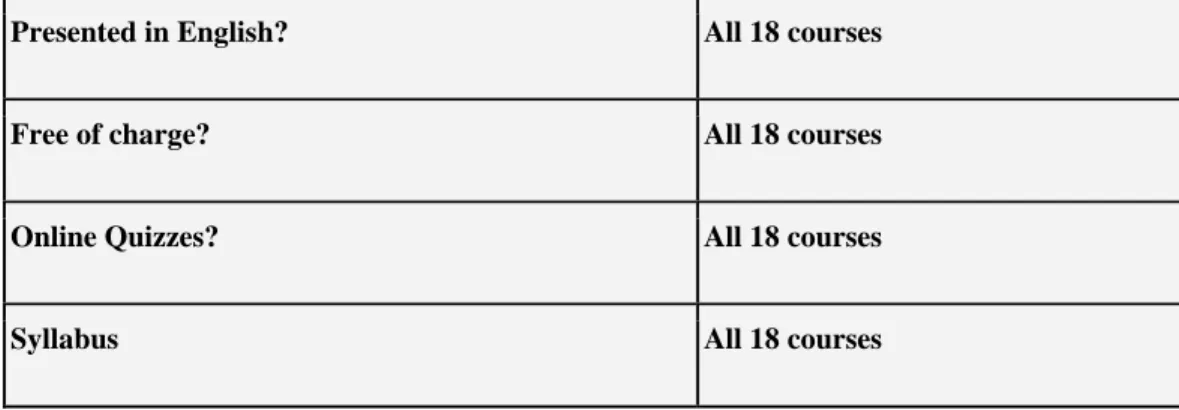
The collection of data was from the perspective of a student enrolled in a course. A user account for each of the three platforms was created and enrollment in the courses began in January, 2014. Edx had six MOOCs open for enrollment, Udacity had eight, and Coursera had 34 open for enrollment. Based on the limit of six on offer at edX at the point of time of this study, a sample size of six courses per platform was used for each platform, yielding a total sampling size of 18 courses. The six courses were selected by choosing the widest array of subject areas offered on each platform. The three platforms were chosen based on peer reviewed academic articles that declared them to be the leading three MOOC platforms (Pappano, 2012).
Survey Development
The survey questions were descriptive and generated by browsing the course content. For example, when a new course element presented itself, a new question was
Content analysis of Coursera, edX, and Udacity course platforms
2014
created to account for that element across all eighteen MOOCs. The survey questions reflected the content of the courses by encountering and listing the elements as each course was traversed. The first section of survey questions, numbered one to fourteen, was comprised of descriptive questions related to course name, duration in days, and other course attributes. This included whether prerequisites were indicated, the estimated workload stated in the course outline, and if a paid option was offered.
Survey questions 15 to 25 were related to the video content, number of videos, duration of each video, and if interactive elements such as quizzes were used with the video content. This section included a question rating the production values and quality of the video on a scale from one to five, followed by an open-ended question asking for examples of the quality. The intent of this section was to discover if the results, when analyzed, would show if platform related themes emerged in the way video was presented.
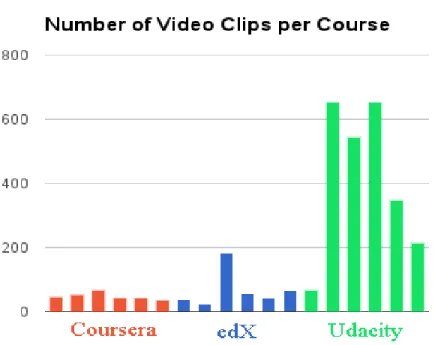
The researcher did not closely watch the 1492 hours of video, but did watch the first hour of each course. In order to record video durations for the 3175 video clips, each clip was loaded into the web page to reveal the playing time. As a result, the first seconds of each clip were also viewed during the survey of the video content. The final section of survey questions, 26 to 69, consisted of more course description questions, including discussion forum and social media participation numbers, certification options, and other descriptive observations of elements of each course.
Data Collection
The survey questions were developed after enrolling in the 18 MOOC offerings and exploring the course descriptions of each one. The student accounts were created on
Content analysis of Coursera, edX, and Udacity course platforms
2014
Coursera.org, edX, and Udacity using [email protected] as the user ID. The questions reflected the available information presented in the course outlines. Next, the video from several of the courses was observed and additional questions were generated based on the attributes discovered within the video content. A third section of questions focused on the course materials contained in each course.
A Google Docs Spreadsheet was created and one question per line was entered with columns for each of the 18 courses responses. A second worksheet was used to record the video clip durations, and to calculate the total clip counts per course, as well as averages. Graphs were generated based on the survey question spreadsheet data; and were included in the analysis. Many of the questions had a yes/no response, a specific quantity, or, in a few cases, a descriptive response. The questions were applied to the first course, Introduction to Astronomy on Coursera, and that iteration resulted in the
generation of new survey questions to better fit the course elements as they appeared when traversing thorough the course content. Subsequent questions were generated throughout the survey of the courses, and then applied back to the other courses to create an inventory.
The researcher took great care to accurately record the duration of each video, and in the collection of all the survey data, in order to support the integrity of the data and the research project. When duplicate video durations were recorded in sequence, a
verification check was made to ensure repeat viewing of the same video did not occur. When rating the production quality of the videos, details were recorded to justify the rating. The rating, on a scale of one to five, was by default scored at three unless a notably positive or negative element was used in the video. Each positive or negative
Content analysis of Coursera, edX, and Udacity course platforms
2014
aspect was noted and used to increment or decrement the rating. Care was taken to record the date when data collection occurred, and the survey was conducted online. Finally the researcher reviewed and completed all surveys within a thirty day period, in order to support consistency in the responses that were entered manually for each question. Data Analysis
The survey design and data collected from the 18 massive open online courses was intended to address the research questions posed in this paper. An overview of the analysis phases and the relevance to each of the three research questions is outlined below. To enumerate the course elements a list of questions was generated by first
traversing the course materials and creating questions as elements were discovered. These questions were then applied to each course as an inventory of individual course elements. Analysis of the data collected resulted in ranking each content element from those found to be present in all 18 courses, to those elements unique to only a particular course. Research Question 1
The first part of the analysis looked at the course elements present in the courses. This gave information to answer the first research question. The specific question asked, What pedagogical/media elements are utilized within the Coursera, edX, Udacity MOOC platforms in January/February 2014?
Questions were added to include an exhaustive list of course content items and any quantitative values associated with them, for example a syllabus was found in each course and the number of modules in each course syllabus was recorded as well. Many of the questions were yes/no as to the presence of a course element. The information
Content analysis of Coursera, edX, and Udacity course platforms
2014
and then summed for each platform. In some cases, an element was unique to a specific platform in six out of six courses sampled and not present in the other platforms. For example, Coursera displayed a Twitter re-tweet count for each course, while neither edX nor Udacity provided that information. The social media counts provided a particular measurement indicating the popularity of a course on each social media site.
Research Question 2
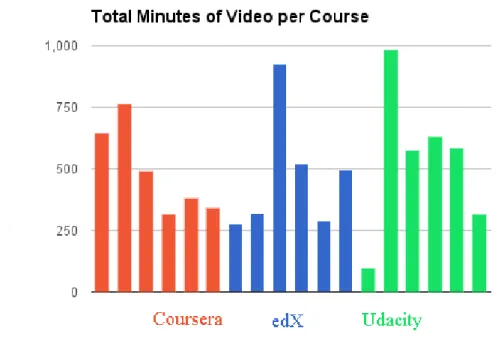
The second research question, How is video content used in MOOCs? was approached by collecting the duration of each video presented in each course. The analysis included commentary on the video usage, observing if the video was used to deliver a lecture or used in a more granular fashion with video clips to introduce a concept, pose a question, and then answer the question. Other aspects of the video were noted, such as the integration of interactive quiz questions into the video content and also if the videos were downloadable for offline viewing.
A subjective question about the production quality of the video scored from one (worst) to five (best) and defaulted to score of three. A second question noted the
exceptional aspects of the video behind the scoring. For example, one video was shot on location in a way relevant to the course and this incremented the score of that video’s quality by one. In another video, a poor quality of audio reduced the score by one from a three to a two.
Research Question 3
The third and final research question was: What uniquely online elements are found in MOOCs? This was examined by noting any course items found that were in a digital format and were not typically part of a face-to-face classroom. The items noted
Content analysis of Coursera, edX, and Udacity course platforms
2014
included: a set of interactive puzzles to assemble dinosaur bones in the correct anatomical order, an online poetry annotation tool, and a virtual computer preconfigured with course tools among others. Word clouds were another unique element used. This was a
discovery question, to document uniquely online course elements in the interest of future studies.
The research questions will provide a view at one point in time of the evolution of MOOCs that may be used as a reference in the future - as a benchmark. The study results will be made available to stakeholders for consideration when planning for the
development of a MOOC, how they might be integrated into current education strategy, or for other studies in this subject area.
Content analysis of Coursera, edX, and Udacity course platforms
2014
RESULTS
The purpose of this study is to provide deeper understanding of the types of courses being offered by MOOCs, and the course presentation used on each platform as found during the period of study. The process of identifying the course content and how they compare among platforms, especially the use of video content, will contribute to the research that has already been done. The results may also give online course producers, universities, and other stakeholders some useful insights when considering future instructional design, and could provide a reference point to future studies in this area.
To address the research questions, a survey was developed using a Google Docs Spreadsheet to collect the data. Data was collected between January 2, 2014 and February 28, 2014. The survey was used to collect data from six courses on each of the three platforms for a total of eighteen courses, including logging 2,969 video clip durations.
The results section of this paper is divided into three sections; each section addresses the following three research questions:
1. What are the pedagogical/media elements utilized within the Coursera, edX, Udacity MOOC platforms in January/February 2014?
2. How is video content used in MOOCs?
3. What uniquely online elements are found in MOOCs? Research Question 1
The first research question was aimed at describing the course content found in eighteen MOOCs during the time period from January, 2014 to February, 2014. The first six survey questions described general information about each course including the
Content analysis of Coursera, edX, and Udacity course platforms
2014
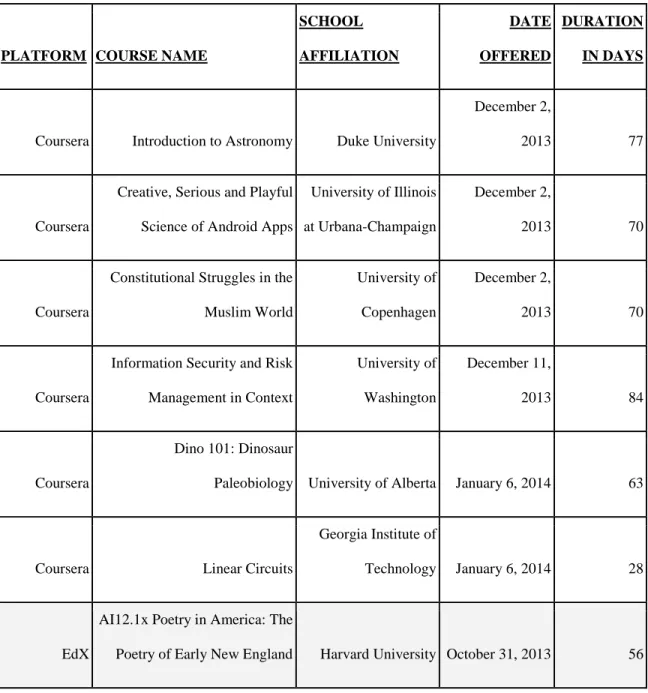
course title, date offered, platform name, professor name, and if the course identified as being associated with a university. Other initial survey questions included the date the course was offered, how many days duration, and other general information about each course. This general information provided the basis for all analysis and is shown in Figure 6.
Figure 6. List of 18 Massive Open Online Courses in this study
PLATFORM COURSE NAME
SCHOOL AFFILIATION DATE OFFERED DURATION IN DAYS
Coursera Introduction to Astronomy Duke University
December 2,
2013 77
Coursera
Creative, Serious and Playful
Science of Android Apps
University of Illinois
at Urbana-Champaign
December 2,
2013 70
Coursera
Constitutional Struggles in the
Muslim World University of Copenhagen December 2, 2013 70 Coursera
Information Security and Risk
Management in Context University of Washington December 11, 2013 84 Coursera Dino 101: Dinosaur
Paleobiology University of Alberta January 6, 2014 63
Coursera Linear Circuits
Georgia Institute of
Technology January 6, 2014 28
EdX
AI12.1x Poetry in America: The
Content analysis of Coursera, edX, and Udacity course platforms
2014
EdX
AI12.2x Poetry in America:
Whitman Harvard University January 15, 2014 70
EdX
CS50x Introduction to
Computer Science Harvard University January 1, 2014 35
EdX
HDS1544.1x The Letters of the
Apostle Paul Harvard University June 1, 2014 16
EdX
MCB80.1x Fundamentals of
Neuroscience, Part 1: The
Electrical Properties of the
Neuron Harvard University
November 4,
2013 35
EdX PH201x Health and Society Harvard University
November 12,
2013 56
Udacity
Introduction to the Design of
Everyday Things NA on-demand 5
Udacity Tales from the Genome NA on-demand NA Udacity Introduction to Physics NA on-demand NA Udacity Introduction to Programming University of Virginia on-demand NA
Udacity Web Development NA on-demand 21
Udacity How to Build a Startup NA on-demand NA