Towards a client-based brand equity framework
for selected business-to-business services
Pieter Steenkamp
Dissertation presented in fulfilment
of the requirements for the degree of
Doctor of Philosophy in Business Management and Administration
At the University of Stellenbosch Business School.
Principal supervisor: Professor F. J. Herbst Co-supervisor: Dr J.C. de Villiers Co-supervisor: Professor M. Terblanche-Smit
Declaration
By submitting this research report electronically, I, Pieter Steenkamp, declare that the entirety of the work contained therein is my own, original work, that I am the owner of the copyright thereof (unless to the extent explicitly otherwise stated) and that I have not previously in its entirety or in part submitted it for obtaining any qualification.
……….….….
Pieter Steenkamp March 2016
Copyright © 2016 Stellenbosch University All rights reserved
iii
Abstract
The customer-based brand equity (CBBE) model was developed to guide brand building in a consumer product or individual brand context, but the model is proposed to be applicable to any context, including business-to-business (B2B) and service contexts. However, consumer branding strategies are not directly transferable to B2B markets and there are documented differences between the B2B and business-to-consumer (B2C) contexts. There is also doubt regarding the validity of the claim that the CBBE model is applicable, as is, to the B2B sector. In addition, research is needed to develop a tailored branding model for B2B services.
Using a qualitative interpretivist approach with a non-probability sampling design, the researcher tried to understand and make sense of the demand side clients’ (research participants’) world regarding the construction of B2B short-term insurance brands in their minds. The present research aimed to identify the brand-building blocks and sub-dimensions of the CBBE model that are confirmed, those that are not confirmed and to establish what other brand-building blocks and sub-dimensions may be relevant to a short-term business insurance context. Data were gathered by means of semi-structured interviews with participants from selected accommodation providers of demand side short-term business insurance. This allowed for sensible investigation of the drivers of brand equity in a specific B2B services context. Atlas.ti was used to assist with coding and analysing the transcribed interview data.
Based on interpretation of the data, an amended brand equity framework for short-term business insurance was developed, which is called the client-based brand equity (CL-BBE) framework. The present research contributed to the body of academic knowledge by expanding the limited existing B2B services branding theory through the proposed CL-BBE framework. This enhances and extends classical brand management. The insight that has been gained from the present research, regarding the sources of brand equity, should assist marketing practitioners and brand decision makers (brand managers and consultants) to improve the effectiveness of brand building and strategic brand management strategies for B2B services. The present empirical research contributes to three areas of brand equity research, namely 1) the offering type – by investigating service offerings rather than product offerings; 2) the brand level – by investigating organisation-level brands rather than product-level brands; and 3) context – by investigating a B2B context rather than a B2C context. The proposed CL-BBE framework should improve the effectiveness of brand building strategies for selected B2B
services (short-term business insurance) by only enhancing dimensions that have been confirmed and the dimensions that have been added.
v
Key words
Brand equity, business-to-business, corporate, industrial, manufacturer, B2B, services, branding, strategy, marketing.
Dedication
This dissertation and degree I dedicate to my parents, Piet and Petro Steenkamp, and my wife Karin. Without your support through challenging times this dream would not have materialised.
vii
Acknowledgements
I would like to express my gratitude to the following people, without whom I would not have been able to achieve this goal:
Thank you to Professor F. J. Herbst and Dr J.C. de Villiers and Professor M. Terblanche-Smit, my supervisors. Your guidance along this challenging path is much appreciated.
I wish to express my appreciation to the Cape Peninsula University of Technology and specifically the management of the Faculty of Business, for both financial support as well as time to complete this project.
I also wish to express my gratitude to Amanda Solomon for her assistance with data collection and showing me how to conduct interviews. Also, to the participants who made themselves available for lengthy interviews; thank you for your time, openness and honesty throughout the interviews.
Table of Contents
Declaration ii Abstract iii Key words v Dedication vi Acknowledgements vii Appendices xviiList of figures xviii
List of tables xxi
List of acronyms and abbreviations xxii
Clarification of key terms and concepts xxiii
CHAPTER 1 OVERVIEW 1 1.1 INTRODUCTION 1 1.2 BACKGROUND 1 1.3 PROBLEM STATEMENT 3 1.4 RESEARCH QUESTION 3 1.5 RESEARCH OBJECTIVES 4
1.5.1 Primary research objective 4
1.5.2 Secondary research objectives 4
1.6 DELINEATION, ASSUMPTIONS AND DEFINITION OF TERMS 4
1.6.1 Delineation 4
1.6.2 Assumptions 5
1.6.3 Definition of terms 5
ix
1.7.1 Branding models 6
1.7.2 Brand equity in consumer and business markets 9
1.8 CONCEPTUAL FRAMEWORK 10
1.9 IMPORTANCE/ SIGNIFICANCE OF THE STUDY 12
1.10 RESEARCH DESIGN AND METHODS 13
1.10.1 Research design 13
1.10.2 Research methods 13
1.10.2.1 Selection 13
1.10.2.2 Interview guide design 14
1.10.2.3 Data collection 14
1.10.2.4 Data analysis and interpretation 14
1.11 CHAPTER OUTLINE 14
1.12 CONCLUSION 15
CHAPTER 2 BRAND AND BRAND MANAGEMENT 16
2.1 INTRODUCTION 16
2.2 CONCEPT CLARIFICATION 16
2.2.1 Brand 16
2.2.2 Branding 17
2.2.3 Brand management 17
2.2.4 Customer, client and consumer 17
2.2.5 Organisation and entity 18
2.2.6 Product, service and offering 18
2.3 OFFERING ELABORATED 19
2.3.1 Categories of offerings 20
2.3.2 Types of offerings 21
2.3.4 Services marketing mix 22
2.3.5 Industrial offerings 22
2.4 APPLICATION TO CURRENT STUDY 23
2.5 BRAND ELABORATED 24
2.6 BRANDING HISTORY 25
2.6.1 The establishment of manufacturer brands in America:
1870 to 1914 26
2.6.2 Leadership of mass marketed brands: 1915 to 1929 28
2.6.3 Challenges of mass marketed brands: 1930 to 1945 28
2.6.4 The dominance of the brand management system: 1946 to 1985 28
2.7 BENEFITS OF BRANDS 30
2.8 BRAND MANAGEMENT 30
2.8.1 Brand architecture 31
2.8.2 Strategic brand management 33
2.9 CONCLUSION 37
CHAPTER 3 BRAND EQUITY AND BRANDING MODELS 38
3.1 INTRODUCTION 38
3.2 DEFINING BRAND EQUITY 38
3.3 THE MOST PROMINENT BRAND EQUITY MODELS 40
3.3.1 Keller’s conceptualisation of customer-based brand equity 41
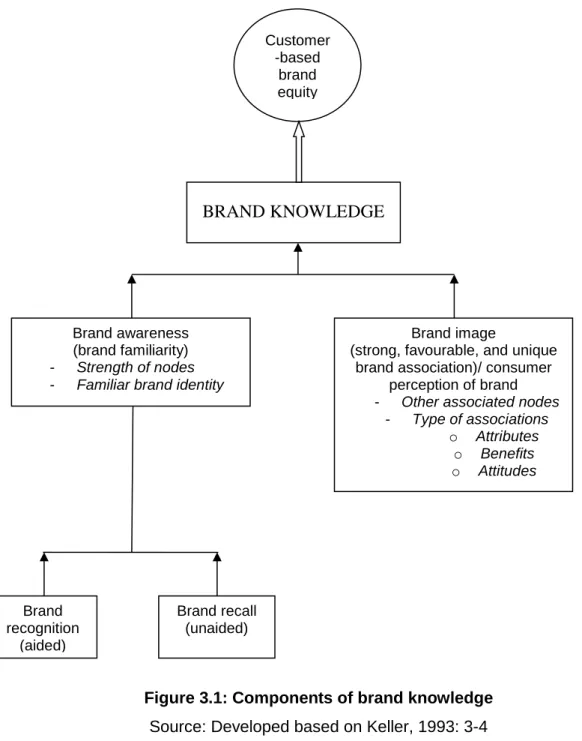
3.3.1.1 Brand knowledge 41
3.3.1.2 Brand awareness 42
3.3.1.3 Brand image 44
3.3.1.4 Keller’s customer-based brand equity model 44
3.3.2 Aaker’s brand equity model 54
xi
3.4 APPLICATION OF THE CUSTOMER-BASED BRAND
EQUITY MODEL 67
3.5 CONCLUSION 68
CHAPTER 4 BRAND EQUITY IN BUSINESS-TO-BUSINESS AND
SERVICES MARKETS 69
4.1 INTRODUCTION 69
4.2 DIFFERENCES BETWEEN PRODUCT AND
SERVICE OFFERINGS 69
4.3 BUSINESS-TO-CONSUMER AND BUSINESS-TO-BUSINESS
MARKETS 73
4.3.1 Comparison between business-to-consumer and
business-to-business markets 73
4.3.2 Business-to-business branding 79
4.3.3 Business to business research directions 82
4.4 SERVICE BRANDS 83
4.5 CONCLUSION 89
CHAPTER 5 RESEARCH STRATEGY AND METHODS 90
5.1 INTRODUCTION 90
5.2 SCIENTIFIC RESEARCH POSITION 90
5.2.1 Ontology and epistemology 90
5.2.2 Methodology 94
5.2.3 Types of reasoning 95
5.3 MARKETING RESEARCH 95
5.3.1 Marketing research process 96
5.3.1.1 Step 1 - defining the research objectives 96
5.3.1.3 Step 3 – planning a sample 98
5.3.1.4 Step 4 – collecting the data 105
5.3.1.5 Step 5 – analysing the data 108
5.3.1.6 Step 6 – formulating the conclusions and preparing the report 110
5.4 TRUSTWORTHINESS OF DATA 111
5.5 INTERVIEW GUIDE DESIGN 112
5.5.1 Section A 113
5.5.2 Section B 113
5.5.3 Section C 113
5.5.4 Section D 118
5.5.5 Amendments to interview guide 118
5.6 CODE OF CONDUCT AND ETHICS 121
5.7 CONCLUSION 121
CHAPTER 6 PRESENTATION OF FINDINGS 123
6.2 SECTION A OF THE INTERVIEW GUIDE 126
6.2.1 Insurance house insured with 126
6.2.2 Participants influence over the purchase process 130
6.2.3 Participants position in the hotel 130
6.2.4 Subconclusions 131
6.3 SECTION B OF INTERVIEW GUIDE 133
6.4 SECTION C OF THE INTERVIEW GUIDE 136
6.4.1 Insurance houses recalled – Q.1a to Q.1f of amended interview guide (Appendix 2) (incorporating: Broker influence over purchase process – Q.9a and Q.9b of amended interview
guide (Appendix 2)) 136
6.4.1.1 Subconclusions 145
6.4.2 Aided recognition – Q.2 of amended interview guide
(Appendix 2) 148
6.4.2.1 Subconclusions 151
6.4.3 Insurance house competitors insured with – Q.3 of
amended interview guide (Appendix 2) 152
6.4.3.1 Subconclusions 153
6.4.4 Word associations: insurance houses recalled
– Q.4a to Q.4e of amended interview guide (Appendix 2) 154
6.4.4.a Mutual & Federal 160
6.4.4.b Santam 161
6.4.4.c Alexander Forbes 162
6.4.4.d Outsurance 163
6.4.4.e AIG 164
6.4.4.f First for Women 165
6.4.4.g Etana 166
– Q.4 as it relates to QQ.B of amended interview guide
(Appendix 2) 168
6.4.5.1 Subconclusions 171
6.4.6 Slogan of insurance house – Q.5a and Q.5b of
amended interview guide (Appendix 2) 175
6.4.7 Point of contact – Q.6 of amended interview guide (Appendix 2) 176 6.4.8 Purchase process involvement – Q.7 of amended interview
guide (Appendix 2) 176
6.4.9 Purchase process experience – Q.8 of amended interview
guide (Appendix 2) 176
6.4.9.1 Subconclusions 179
6.4.10 Broker influence over purchase process – Q.9a and Q.9b
of amended interview guide (Appendix 2) 180
6.4.11 Brand personality – Q.10 of amended interview guide
(Appendix 2) 180
6.4.11.1 Subconclusions 181
6.4.12 History – Q.11 of amended interview guide (Appendix 2) 182
6.4.12.1 Subconclusions 184
6.4.13 Service satisfaction - Q.12 of amended interview guide
(Appendix 2) 185
6.4.13.1 Subconclusions 186
6.4.14 Service efficiency - Q.13 of amended interview guide
(Appendix 2) 188
6.4.14.1 Subconclusions 189
6.4.15 Trusting, caring and focused - Q.14 of amended interview
guide (Appendix 2) 189
6.4.15.1 Subconclusions 190
6.4.16b Price: importance - Q.16 of amended interview guide
(Appendix 2) 191
6.4.16.1 Subconclusions 184
6.4.17 Overall opinion and quality - Q.17 of amended interview
guide (Appendix 2) 195
6.4.17.1 Subconclusions 196
6.4.18 Feelings - Q.18 of amended interview guide (Appendix 2) 198
6.4.18.1 Subconclusions 199
6.4.19 Engagement - Q.19 of amended interview guide (Appendix 2) 200
6.4.19.1 Subconclusions 201
6.4.20 Attachment - Q.20 of amended interview guide (Appendix 2) 201
6.4.20.1 Subconclusions 202
6.4.21 Community - Q.21 of amended interview guide (Appendix 2) 203
6.4.21.1 Subconclusions 204
6.4.22 Relationship with brokers/ representatives
- Q.22 of amended interview guide (Appendix 2) 204
6.4.22.1 Subconclusions 206
6.4.23 Most favourable aspects of insurance house
- Q.23 of amended interview guide (Appendix 2) 207
6.4.23.1 Subconclusions 208
6.4.24 Least favourable aspects of insurance house
- Q.24 of amended interview guide (Appendix 2) 209
6.4.24.1 Subconclusions 210
6.4.25 Unique - Q.25 of amended interview guide (Appendix 2) 211
6.4.25.1 Subconclusions 212
6.4.26a Loyalty - Q.26 of amended interview guide (Appendix 2) 213 6.4.26b Loyalty - Q.27 of amended interview guide (Appendix 2) 214
6.4.26.1 Subconclusions 214
- Q.29 of amended interview guide (Appendix 2) 216 6.4.28b Any other comments - Q.30 of amended interview guide
(Appendix 2) 217
6.5 CONCLUSION 217
6.5.1 How research objectives have been met 220
CHAPTER 7 THE CLIENT-BASED BRAND EQUITY FRAMEWORK:
DISCUSSION, RECOMMENDATIONS AND CONCLUSION 224
7.1 INTRODUCTION 224
7.2 CONCEPTUAL CONTRIBUTION: THE CLIENT-BASED
BRAND EQUITY FRAMEWORK FOR SHORT-TERM
BUSINESS INSURANCE 225 7.2.1 Salience 226 7.2.2 Service Performance 226 7.2.3 People 228 7.2.4 Judgments 229 7.2.5 Relationships 231 7.3 MANAGERIAL CONTRIBUTION 233 7.3.1 Recommendations 233
7.3.1.1 Recommendations to management of broker organisation 233
7.3.1.2 Recommendations for further research 234
7.4 Limitations of present study 235
Appendices
Appendix 1: Initial interview guide 250
Appendix 2: Amended interview guide 265
Appendix 3: Questions-objectives matrix 279
Appendix 4: Code book 284
Appendix 5: Clarification of key terms and concepts 294
Appendix 6: Consent form 307
Appendix 7: Ethics documents USB 309
Appendix 8: Coded primary document 317
List of figures
Figure 1.1: Conceptual framework 11
Figure 1.2: Theoretical positioning of study 12
Figure 2.1: Product-service spectrum 20
Figure 2.2: Branding timeline 27
Figure 2.3: Porter’s generic strategy model 34
Figure 2.4: Strategic brand management process 36
Figure 3.1: Components of brand knowledge 42
Figure 3.2: Customer-based brand equity (brand resonance model) pyramid 45
Figure 3.3: Sub-dimensions of customer-based brand equity building blocks 46
Figure 3.4: Sub-dimensions of CBBE elaborated 51
Figure 3.5: Sub-dimensions of CBBE elaborated and related to extended marketing mix 52
Figure 3.6: Aaker’s brand equity model 54
Figure 3.7: Parity between Aaker and Keller’s models 63
Figure 3.8: Four-dimension consumer-based brand equity model 64
Figure 3.9: Brand identity prism 66
Figure 4.1: Strategic marketing management 74
Figure 4.2: A service-branding model 85
Figure 4.3: A model of sales force impact on business-to-business brands 87
Figure 4.4: Client’s experience with a service brand 88
Figure 5.1: Unit of analysis, participants and actual sample size of the study 103
Figure 5.2: Summary of selection process 104
Figure 5.3: Coded textual data 110
Figure 5.4: Interview guide questions linked to sub-dimensions 115
Figure 6.1: Building blocks and sub-dimensions of CBBE model linked to interview guide
questions 125
Figure 6.2: Sub-dimensions of broker brand equity confirmed by Section A of
Interviews 133
Figure 6.3: Sub-dimensions of brokers’ brand equity confirmed by Section C: Q.1
of interviews 147
Figure 6.4: Brand-building block of insurer brand equity confirmed by
Section C: Q.2 of interviews 152
Figure 6.5: Brand-building blocks for Mutual & Federal 160
xix
Figure 6.7: Brand-building blocks for Santam 161
Figure 6.8: Sub-dimensions for Santam 161
Figure 6.9: Brand-building blocks for Alexander Forbes 162
Figure 6.10: Sub-dimensions for Alexander Forbes 162
Figure 6.11: Brand-building blocks for Outsurance 163
Figure 6.12: Sub-dimensions for Outsurance 163
Figure 6.13: Brand-building blocks for AIG 164
Figure 6.14: Sub-dimensions for AIG 164
Figure 6.15: Brand-building blocks for First for Women 165
Figure 6.16: Sub-dimensions for First for Women 165
Figure 6.17: Brand-building blocks for Etana 166
Figure 6.18: Sub-dimensions for Etana 166
Figure 6.19: Combined: all brand-building blocks of insurers’ brand equity
confirmed by Section C: Q4 of interviews (based on recall) 167
Figure 6.20: Combined: all sub-dimensions of insurers’ brand equity
confirmed by Section C: Q4 of interviews (based on recall) 167
Figure 6.21: Combined: all brand-building blocks of insurers’ brand equity
confirmed by Section C: Q4f of interviews 171
Figure 6.22: Combined: all sub-dimensions of insurers’ brand equity
confirmed by Section B: Q4f of interviews 172
Figure 6.23: Combined sub-dimensions based on recall 173
Figure 6.24: Combined sub-dimensions based on insurance houses insured with 174
Figure 6.25: Insurance houses’ slogans 175
Figure 6.26: Sub-dimensions of broker brand equity confirmed by
Section C: Q.8 of interviews 179
Figure 6.27: Sub-dimensions of broker-insurer interaction confirmed by
Section C: Q.11 of interviews 185
Figure 6.28: Sub-dimensions of broker-insurer interaction confirmed by
Section C: Q.12 of interviews 187
Figure 6.29: Sub-dimensions of broker and insurer brand equity confirmed by
Section C: Q.15 and Q.16 of interviews 195
Figure 6.30: Sub-dimensions of insurer brand equity confirmed by
Section C: Q.17 of interviews 197
Figure 6.31: Sub-dimensions of insurer brand equity confirmed by
Section C: Q.18 of interviews 200
Figure 6.33: Sub-dimensions of broker brand equity confirmed by
Section C: Q.22 of interviews 206
Figure 6.34: Sub-dimensions of insurance brand equity confirmed by
Section C: Q.23 of interviews 209
Figure 6.35: Sub-dimensions of insurer brand equity confirmed by
Section C: Q.24 of interviews 211
Figure 6.36: Sub-dimensions of insurer brand equity confirmed by
Section C: Q.25 of interviews 213
Figure 6.37: Combined: all confirmed sub-dimensions of insurer brand equity 219
Figure 6.38: Combined: all confirmed sub-dimensions of broker brand equity 220
Figure 6.39: Combined: all confirmed sub-dimensions of broker brand equity only 223 Figure 7.1: Client-based brand equity framework for short-term business insurance 225
xxi
List of tables
Table 3.1: A comparison of Aaker and Keller’s brand equity models 60
Table 4.1: A comparison between B2C and B2B markets and branding 76
Table 4.2: B2B branding: future research directions 82
Table 5.1: Conceptualising research designs/ strategies 92
Table 5.2: Accommodation providers registered with Cape Town Tourism 102
Table 5.3: Research strategy and methods 111
Table 5.4: Question numbering changes 118
Table 6.1a: Insurance house insured with 129
Table 6.1b: Insurance house insured with 129
Table 6.2: Position occupied 131
Table 6.3: Hotel classification 135
Table 6.4: Insurance houses mentioned 137
Table 6.5: Insurance houses: aided recognition 149
Table 6.6: Insurance houses competitors are insured with 153
Table 6.7: Word associations: insurance houses/ brands recalled 155
Table 6.8: Word associations: insurance houses insured with 169
B2B Business-to-business
B2C Business-to-consumer
CBBE model Customer-based brand equity model
CL-BBE model Client-based brand equity model
FSB Financial Services Board
PhD Doctor of philosophy
xxiii
Clarification of key terms and concepts
This section includes the most important terms and concepts used in the present study. A more comprehensive list of terms and concepts are attached as Appendix 5.
Brand A brand resides in a consumer’s mind. It is a consumer’s perception
(brand image) and attitude, which comprise the tangible and intangible (attributes, benefits and psychological/emotional) associations that are used to identify and differentiate an offering (adapted, Keller, 2013: 30-33). For a consumer a brand contains a promise of performance and value, which allow consumers to project their self-image (Keller, 2013: 34; Chiaravalle & Schenck, 2007: 34-35).
Branding The strategic process and creative practice of developing a brand (Interbrand, 2007: 20). The process of endowing offerings with the power of brand equity. The aim of the branding process is to create brand equity (Keller, 2013: 57).
Brand association An attribute (feature or characteristic) and/ or benefit (value) (Keller, 2013: 77-79) or, more broadly, anything linked in memory to a brand, which includes; offering attributes, intangibles, benefits, relative price, use/application, consumer, celebrity/person, life style/personality, offering category, competition, and geographical area (Aaker, 1991: 115). The “positive and negative feelings, beliefs, or knowledge that consumers have about a brand” (Interbrand, 2007: 9).
Brand awareness
Also called brand familiarity (Keller, 2013: 73).
Refers to the degree of consumer knowledge of a brand (Interbrand, 2007: 14).
also called reputational capital (Interbrand, 2007: 15), goodwill (Ambler, 1995: 389; McDonald, de
Chernatony & Harris, 2001: 337) or brand power (Berry, 2000: 128)
view, as opposed to customer-based brand equity, which refers to brand equity from the consumer’s point of view.
“Is a marketing derived asset that has financial value in terms of future profit and cash flow” (Ambler, 1995: 388) and “a set of brand assets and liabilities linked to a brand’s name and symbol that add to or subtract from the value provided by a product or service to a firm and / or that firm’s customers” (Aaker, 1996: 216). “The sum of a brand’s distinguishing qualities” (Interbrand, 2007: 15).
Brand loyalty When a consumer truly owns the brand, he/ she is brand loyal, and may well repeat a purchase. Loyalty is earned by delivering unique and meaningful benefits to consumers (Interbrand, 2007: 75).
Brand management The process of managing an organisation as a brand and an organisation’s brand(s) in order to preserve and enhance brand equity (Interbrand, 2007: 17).
Brand value The financial worth of the brand as an intangible asset (Interbrand, 2007: 9).
Business-to-business (B2B) branding
also called industrial branding (Kuhn, Alpert & Pope, 2008: 41), commercial, trade, organisational or institutional (Collins Dictionary of Marketing, 2005: 204)
It is concerned with branding in the business market. Business-to-business (B2B) branding refers to branding on an inter-Business-to-business (between businesses) level rather than B2C. B2B purchases are made for further processing, for added value or for incorporation into the final offering.
xxv
Business-to-consumer(B2C) branding
also called consumer branding (Kuhn et al., 2008: 41)
Business-to-consumer (B2C) branding is branding in the consumer market. It is concerned with branding on an organisation to consumer level.
Customer-based brand equity
Customer-based brand equity refers to brand equity from a consumer’s point of view, as opposed to brand equity, which refers to brand equity from an organisation’s point of view. “The differential effect that brand knowledge has on consumer response to marketing of that brand” (Keller, 2013: 69).
STUDY
If a product is not a brand, it is a commodity. This is where brand equity demonstrates its value by translating into revenue – through increased sales driven by branding, as well as the willingness of
consumers to pay a premium
– Michael Lieberman, founder and president, Multivariate Solutions
1.1 INTRODUCTION
This study contributes to the literature discussion regarding whether or not the customer-based brand equity (CBBE) model is applicable to all contexts by applying the CBBE model to a selected business-to-business (B2B) services context. This involves ascertaining which of the brand-building blocks and sub-dimensions of the CBBE model are confirmed for this context and which are not, and to identify additional blocks and sub-dimensions that may be applicable. As a consequence, this continues the amendment of a prominent brand equity model into a client-based brand equity (CL-BBE) framework for short-term business insurance.
This chapter introduces the key elements of the study and offers structure for the dissertation. First, a background is provided, followed by the research problem, research question and objectives. The study is delineated, assumptions are clarified and a list of the most important terms is provided. A brief literature review is presented, which leads to the conceptual framework. The importance of the study is advanced, followed by an overview of the research design and methods, while sampling and participant selection follow. The chapter concludes with an outline of each chapter, which is presented in the dissertation.
1.2 BACKGROUND
Strong brands, in general, can reduce risk, indicate quality, differentiate, generate profit, create competitive advantage (Keller, 2013: 34), and provide advantages that may result from brand extensions (Martinez and de Chernatony, 2013: 68). A brand is an increasingly important instrument to mitigate risk, especially in B2B contexts where risks may be considerable (Aaker, 1991: 7, 8; Keller, 2013: 37-38). B2B brands, specifically, can provide re-assurance to consumers (Baumgarth, 2010: 666), allow premium pricing, shield against competition (Ryan & Silvanto, 2013: 47, 49), and create a link between producers and sellers (Gupta, 2010: 397).
The extant brand management knowledge has been derived from research predominantly in business-to-consumer (B2C) markets, and more specifically fast moving consumer goods. The “academic inquiry on the subject [of B2B branding] is limited, dispersed and inconclusive” and while in the B2C context branding has been accepted as multi-dimensional, in the B2B context
branding is still constrained to a narrow and myopic view of the brand (Leek & Christodoulides, 2011: 230). Geigenmuller and Bettis-Outland (2012: 432) reiterate the point that most branding research is conducted within consumer markets, and that B2B services branding research is still in its early stages. O’Cass and Grace (2004: 267) support this and suggest that more consumer research is needed for services branding. This is the case in spite of major brands such as Caterpillar being B2B brands and, more specifically, B2B service brands such as Yahoo and Google (Kalafatis, Remizova, Riley & Singh, 2012: 623).
Various models have been developed to guide the brand management process of which the most prominent models are by Aaker (1991: 270; 1996: 318–338) and Keller (1993 (conceptualised), 2001: 7; 2003: 76–77; 2008: 60–61; 2013: 108). The literature shows that Aaker and Keller’s models are referred to more than any other model. Kuhn, Alpert and Pope (2008: 41) recognise Keller’s customer-based brand equity model (CBBE) model as the most comprehensive model for guiding the brand management process.
The applicability of the CBBE model to a B2B context has not been comprehensively assessed (Kuhn et al., 2008: 41) and even though Kotler and Keller (2012: 205–207) mention differences between consumer (customer) and business markets, Keller maintains that the CBBE model is applicable to a B2B context (cited in Kuhn et al., 2008: 41; O’Cass & Grace, 2004: 257). Christodoulides, Cadogan and Veloutsou (2015: 320) are concerned with the indiscriminate application of the CBBE model in different contexts. Equally, Christodoulides and de Chernatony (2010: 60) are convinced that brand equity measures are market sector specific. Keller (2001: 25) mentions that the CBBE model should be refined, edited and embellished to suit the needs of its users. The claimed (unadapted) applicability the CBBE model to both B2C and B2B contexts was brought into questioned by the finding of research conducted by Kuhn et al. (2008: 40-58).
In summary, even though some of the most valuable brands are B2B brands, for example, IBM, Cisco and SAP (Interbrand, 2011; Glynn, 2012: 666), the majority of branding research is located within B2C markets with limited B2B research. The CBBE model is one of the most prominent branding models available in the literature, and the intention is for the CBBE model to be applicable to any and all contexts (Keller, 2001: 3; cited in Kuhn et al., 2008: 41; O’Cass & Grace, 2004: 257), but its appropriateness and applicability are questioned (Christodoulides et al., 2015: 320). There is thus a gap (disagreement) in the literature regarding whether the CBBE model is applicable to B2B. Leek and Christodoulides (2011: 8) suggest unresolved B2B research directions that need attention. These include:
What are the components of industrial brand equity?
Are existing measures of brand equity applicable to B2B markets? How can industrial brand equity be measured?
applicability of the CBBE model and towards advancing the research direction stated above. For purposes of the present study, the CBBE model is applied to a selected B2B service context, namely short-term business insurance in Cape Town, South Africa.
1.3 PROBLEM STATEMENT
The research problem is that there is no comprehensive, accepted and adapted brand equity model for B2B services specifically (McDonald et al., 2001: 350). As mentioned, the CBBE model is suggested to be applicable to a B2B context (O’Cass & Grace, 2004: 257), but when tested the applicability of the CBBE model to a B2B setting a number of issues were raised including that (Kuhn et al. 2008: 40-58):
the brand equity of the organisation brand seemed more important than that of the individual brand, which is the focus of the CBBE model;
the CBBE model’s brand-building block “imagery” should be replaced with “corporate reputation”;
the CBBE model’s brand-building block “feelings” should be replaced with “sales force relationship”;
The CBBE model’s brand-building block “resonance” should be replaced with “partnership solutions”.
The unadapted use of the CBBE model for B2B services (for the present study: short-term business insurance industry in South Africa) may lead to ineffective or suboptimum brand building strategies. Sub-dimensions (or sources of brand equity) may be enhanced that are not applicable and/ or sub-dimensions that may be important may not be enhanced at all. The phenomenon investigated was brand equity, specifically for B2B services. The present study assessed the applicability of the existing CBBE model to B2B services. This process identified the brand-building blocks and sub-dimensions that are confirmed, those that are not confirmed and additional brand-building blocks and sub-dimensions that may be relevant. From this an adapted framework was suggested, which is called the client-based brand equity (CL-BBE) framework for short-term business insurance.
1.4 RESEARCH QUESTION
Research questions were formulated instead of hypotheses. The primary research question that was formulated to address the problem statement was: what would constitute a brand equity framework, as strategic brand management instrument, for short-term business insurance?
1.5 RESEARCH OBJECTIVES
To answer the research question, primary and secondary research objectives were developed.
1.5.1 Primary research objective
The primary research objective was to develop a brand equity framework that guides the strategic brand management process for short-term business insurance.
1.5.2 Secondary research objectives
The secondary research objectives were:
To identify the brand-building blocks and sub-dimensions of the CBBE model that are confirmed for short-term business insurance;
To identify the brand-building blocks and sub-dimensions of the CBBE model that are not confirmed for short-term business insurance; and
To establish what other brand-building blocks and sub-dimensions may be relevant to short-term business insurance.
1.6 DELINEATION, ASSUMPTIONS AND DEFINITION OF TERMS 1.6.1 Delineation
The present research focused on:
Short-term business insurance services offerings;
Hotels - B2B service demand-side client organisations of short-term insurance service providers, which were
Located in Cape Town, South Africa
Due to time and financial resource limitations, the study was limited to the Cape Town metropole within the Western Cape, which is where the researcher is based.
The reasons for selecting short-term insurance service offerings included: Short-term insurance represents a service offering;
There is well established competition in the short-term insurance industry so branding is important as a means of differentiation;
The short-term insurance industry is a focused, well-defined sector within the broader financial services sector;
Within general short-term insurance, B2B or commercial short-term insurance offerings are well defined and major insurance houses have separate divisions that deal with B2B insurance offerings specifically;
B2B short-term insurance is a sizeable industry – R101 million turnover for the first three months of 2009, which increasing from 74 million in the first three months of 2008 (Financial Services Board, 2009); and
One of Cape Town’s comparative advantages is its “scenic beauty and natural sights”, which attract international visitors. The tourism industry can thus contribute to Cape Town’s economic growth (City of Cape Town, 2013). The largest portion of tourist spend at a destination is spent on accommodation. Therefore, accommodation demand is a useful indicator of the performance of the tourism industry as a whole. With regard to paid accommodation during 2013, most visitors stayed at hotels (35.37%) (City of Cape Town, 2014b: 31). The sector’s wholesale and retail trade, catering and accommodation is among the top three economic sectors in the City of Cape Town (Wesgro, 2012a: 1-11; Wesgro, 2012b: 1-12). It was, therefore, decided to focus on hotels as the B2B service demand-side client organisations of short-term insurance service providers.
1.6.2 Assumptions
The trustworthiness of the results is dependent on the following assumptions:
That there are no major differences between hotels included in the present study and That the participants gave honest and reliable feedback.
The present study was limited to a specific sector of accommodation providers (hotels), which should reduce the negative influence of the first assumption. The B2B short-term insurance needs of hotels should be more similar than for different accommodation providers like hotels, guesthouses and B&B’s. Similarly, to try to negate the possible negative impact of the second assumption, interviews were conducted with people who had some influence on which insurance brand was selected for the hotels.
1.6.3 Definition of terms
The most important terms are clarified in Chapter 2 to aid clarity and consistency throughout the dissertation. A secondary contribution of the present study is the clarification of basic terms and concepts attached as Appendix 5. A list of acronyms and abbreviations are included in the preliminary page of the dissertation. Next a brief literature review is presented.
1.7 LITERATURE REVIEW
“A product is something that is made in a factory; a brand is something that is bought by a customer. A product can be copied by a competitor; a brand is unique. A product can be quickly
outdated; a successful brand is timeless" (Stephen King, as cited in Aaker, 1991: 1).
The present research resides within the general field of study or academic discipline of business management and, more specifically, marketing and the subject of branding.
According to Aaker (1991: x), there are several reasons for the importance of managing brand equity. These include premiums that are paid for strong brand names, the commoditisation of products, and the possible advantage of unlocking value through brand extensions. Aaker further states that organisations allocate substantial resources to brand-building activities in order to create a sustainable competitive advantage. Aaker continues by mentioning certain potential problems with these brand-building activities, which include the difficulty inherent in calculating brand equity worth, while there are often limited benefits as far as sales growth is concerned in the short-term (in contrast to sales promotions (Aaker, 1991: 10)) and that over-extending a brand through brand extension can devalue brand equity.
For these reasons, brands should be managed effectively and the main function of brand management is to create a brand image, which comprises positive perceptions in the minds of consumers. With regard to the present marketplace Keller (2013: 35, 52-56) states that “brand management may be more difficult than ever”. Some of the reasons for this difficulty include changes in consumer attitudes and behaviour, competitive forces, marketing efficiency and effectiveness, and internal company dynamics, which complicate brand management decisions. A brand is an increasingly important “risk-handling device”, particularly in B2B contexts where risks may be substantial.
1.7.1 Branding models
The two most prominent models are by Aaker (1991: 270; 1996: 318–338) and Keller (1993 (conceptualised); 2001: 7; 2003: 76–77; 2008: 60–61; 2013: 108), who have both developed comprehensive models to guide the brand management process. Kuhn et al. (2008: 41), nevertheless, consider Keller’s CBBE model to be the most comprehensive model for guiding the brand management process. The literature showed that Aaker’s and Keller’s models are referred to more than any other model. The two models are introduced next, which form the theoretical foundation for this study. A detailed analysis can be found in Chapter 3.
Aaker (1996: 13, 15-16) states that brand equity comprises the assets or liabilities that are associated with the brand, which will either add to or subtract from the utility (usefulness) to the consumer. “Brand equity has the potential to add value to the firm by generating marginal cash flow”. From this perspective there is a difference between an asset and a skill: an asset is something that an organisation owns, such as a brand or a factory, which is better than that of its competitors. Conversely, a skill is something that an organisation does better than its competitors such as research and development and marketing. An organisation should build its sustainable competitive advantage on its key assets and skills. The author states that:
a brand is a distinguishing name and/or symbol (such as a logo, trademark or package design) intended to identify the goods or services of either one seller or group of sellers, and to differentiate those goods or services from those of competitors. A brand thus signals
1991: 7).
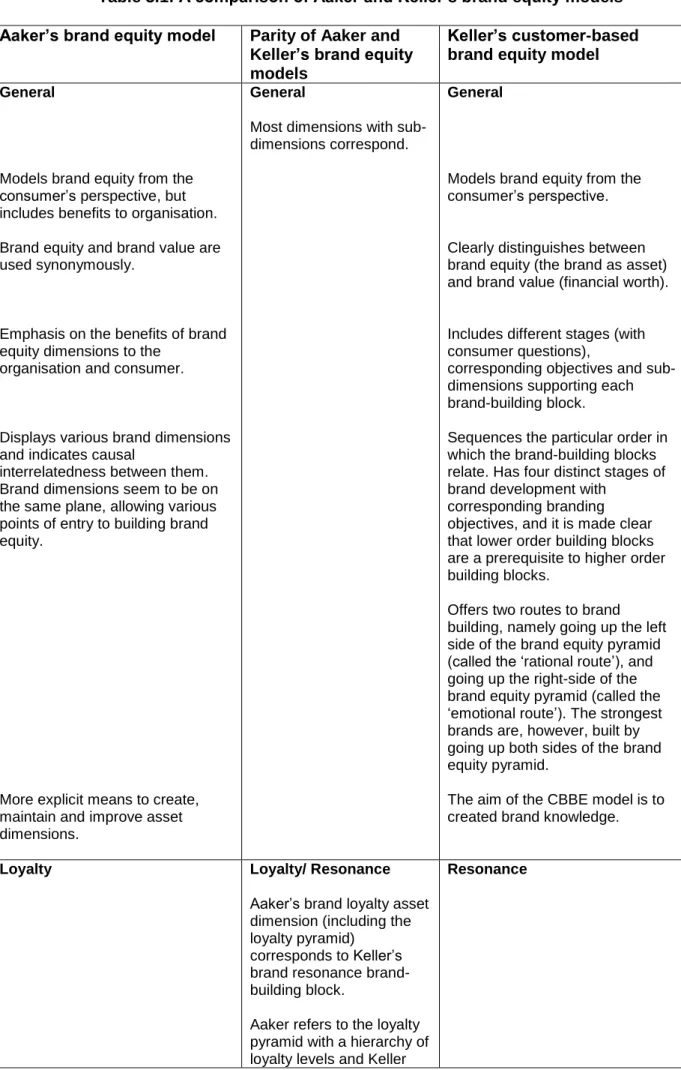
Aaker (1991: 16) developed a model (Figure 3.7) comprising a framework for creating, maintaining and protecting brand equity. The author mentions that brand equity can provide value to both the organisation and the consumer. Aaker’s model groups brand equity into five “asset dimensions”, namely “(1) brand loyalty; (2) brand name awareness; (3) perceived quality; (4) brand associations in addition to perceived quality; and (5) other proprietary brand assets – patents, trademarks and channel relationships”. According to the author these “five categories of assets underlie brand equity”, and these assets are linked to the name and/or symbol of the brand. The model illustrates ways in which value may be created by each asset dimension. The value that is created by the asset dimensions is then distilled into the two groups, namely value to customers and value to the firm. Furthermore, Aaker (1991: xi) posits that his treatment of brand equity applies equally to both consumer and industrial markets.
Supporting his view that brand differentiation is a distinguishing characteristic of modern marketing (Aaker, 1991: 7), Aaker in a later book (1996: 318-338) expands on the model in Figure 3.7 and calls the expanded model the “brand identity planning model”. This model comprises the “brand identity system” and the “brand identity implementation system”. The basic premise of this model is to help the brand strategist to consider different perspectives that differentiate the brand identity. These elements include the “brand as a product”, “brand as organization”, “brand as person”, and “brand as symbol”. These perspectives are fundamental to Aaker’s brand-equity model. In addition to the brand equity model and the brand identity system, Aaker (1996: 318–338) proposes the brand equity ten. The brand equity ten was compiled by drawing on insight from Young and Rubicam (Y&R), Total Research, Interbrand, and others, and proposes, as the name suggests, ten measures of brand equity. These measures are: “(1) price premium; (2) satisfaction/ loyalty; (3) perceived quality; (4) leadership/ popularity; (5) perceived value; (6) brand personality; (7) organizational associations; (8) brand awareness; (9) market share; and (10) market price and distribution coverage.”
Keller (2013: 69) defines customer-based brand equity, but as “the differential effect that brand knowledge has on consumer response to marketing of that brand”. Keller explains that this response can either be positive or negative. If positive, the consumer may be less price sensitive and accepting of extensions; however, if negative, the brand is regarded as a commodity. The author further states that customer-based brand equity is a result of strong brand awareness and associations, and mentions that the power of a brand and its value ultimately resides with the customer and in the customer’s mind. It is evident from the literature that Keller uses the term
“customer” to include those who purchase and/or consume products and services, since Keller states that the CBBE model was developed to be “versatile and applicable to all possible kinds of brands and industry settings”, “can apply to any product or service category” and should have “far-ranging relevance”.
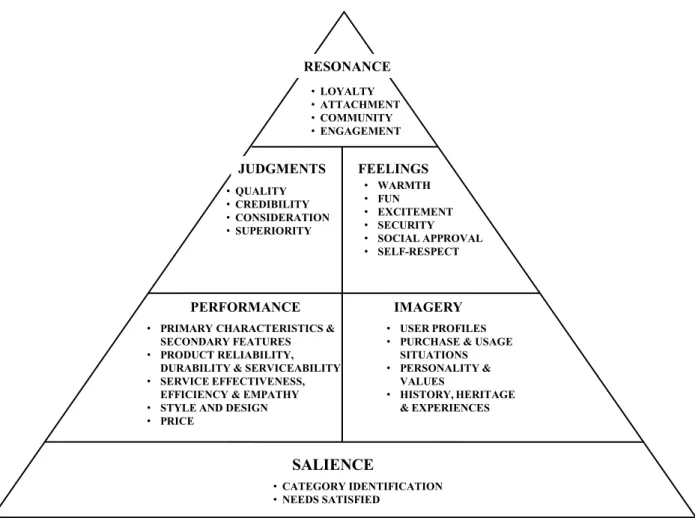
Keller’s CBBE model is arguably the most comprehensive, accepted and used model, which builds, measures and manages brand equity. Keller’s model (Figures 3.3 and 3.4) comprises of the following four sequential steps: (1) brand identity; (2) brand meaning; (3) brand response; and (4) brand relationship. Each step is dependent on the successful completion of the previous step. The sequential steps are also referred to as the “branding ladder”. These steps correlate with six brand-building blocks (brand salience, brand performance, brand imagery, brand judgments, brand feelings and brand resonance), which are also collectively called the brand equity pyramid. Each of the blocks has sub-dimensions and corresponding brand objectives. Brand equity is created by reaching the pinnacle of the brand equity pyramid by establishing different brand-building blocks. Accordingly, the pinnacle relates to reaching the top of the branding ladder. The strongest brands excel in all six brand-building blocks, therefore implementing all four steps of the branding ladder. The most valuable brand-building block is brand resonance, which only occurs once all other brand-building blocks have been established. Brand resonance is present when consumers express a high degree of brand loyalty, which should allow organisations greater price premiums and more effective and efficient marketing programmes (Keller, 2001: 5, 7, 17).
The purpose of Keller’s CBBE model is to act as a benchmark for brand building by providing strategic direction for brand-building processes and decisions – namely to be applied in planning, implementing, and interpreting brand strategies. In addition, the model serves as a guide for marketing research. The author relates the CBBE model to three other well-known industry models of brand equity. These models are Young and Rubicam’s BrandAsset Valuator model, Millward Brown’s BrandDynamics model and Research International’s Equity Engine. The CBBE model includes concepts of all three of these models (Keller, 2001: iv, 25; Keller, 2013: 351-358).
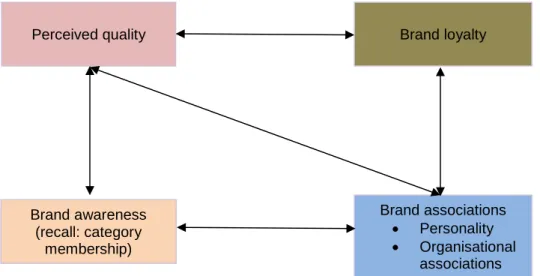
Pappu et al. (2005: 144-145) confirm the four dimensions of customer-based brand equity, namely brand awareness, brand associations, perceived quality and brand loyalty. Martinez and de Chernatony (2013: 69) found a causal order in the creation of brand equity, namely that brand awareness improves perceived quality and builds positive brand associations, while brand associations also influence brand loyalty. The brand equity dimensions are supported by other authors: Hakala, Svensson and Vincze (2012: 447); Im, Kim, Elliot and Han (2012: 399); Sasmita and Suki (2015: 286); and Christodoulides et al. (2015: 320).
the physical evidence, and how people deliver the service (knowledgeable and caring), affect service satisfaction (Lakshmi and Santhi, 2015: 79). Ha, Janda and Muthaly (2010: 923-924) found that brand associations, perceived quality, satisfaction and loyalty impact on B2B service brand equity. The authors extend the brand equity theory with what they term the “perceived quality satisfaction brand equity” chain for services brand equity. They also suggest that improved efficiency will elevate client satisfaction, which will enhance service brand equity.
1.7.2 Brand equity in consumer and business markets
The B2B sector (or market) is often referred to as the industrial or business sector (or market). Aaker (1991: ix) mentions that “the power of brand names is not restricted to consumer markets”. Aaker continues that “in fact, brand equity may be more important in industrial goods markets than in consumer marketing.” Aaker also states that the greater importance is because “brand-name awareness” is fundamental for an industrial buyer to consider a brand and that “what a brand means to a buyer” can be a deciding factor in purchasing one brand over another.
From the literature it is evident that Aaker and Keller’s models have been developed primarily for B2C markets. Keller’s CBBE model is a summative model of best practice for branding in consumer markets, however, according to the literature, the applicability of the CBBE model to a B2B context has not been comprehensively assessed (Kuhn et al., 2008: 41). Kotler and Keller (2012: 205–207) also mention differences between consumer and business markets; however, Kuhn et al. (2008: 40–58) note thatKeller maintains that the CBBE model is applicable to a B2B context. In one of a few studies that apply the CBBE model to a B2B (government) context, Kuhn et al. (2008: 40-58) confirmed two of the CBBE model’s building blocks, namely performance and judgment, but found that emphasis on some of the other building blocks differed. Kuhn et al.’s empirical research was conducted in a single B2B setting; therefore the results should be verified in an alternative setting. Christodoulides et al. (2015: 31) report that across countries, consumers of goods view brand equity more similar than consumers of services. As is evident from the literature, limited brand equity research has been undertaken in the South African market. There is a bias in the literature towards brand equity dimensions that were developed and validated in the United States (Christodoulides & de Chernatony, 2010: 60), and brand equity may be culture specific (Christodoulides et al., 2015: 320). This study analysed the applicability of the CBBE model to a short-term business insurance context in Cape Town, South Africa. Application of the dimensions in a different context assesses the conceptual equivalence of the CBBE dimensions across cultures.
In summary, Keller introduced a “conceptual model of brand equity from the perspective of the individual consumer”, which was later developed into “a comprehensive new approach, the customer-based brand equity (CBBE) model”. The CBBE model was developed from theory (based on advances in research), industry models and own insight into managerial practices. The author also provides “candidate measures of brand-building blocks” (Keller, 2001: 27-30; Keller, 2013: 123-124). These candidate measures, among others, were used in the present study to test the generic CBBE model by means of its empirical application to short-term business insurance, which highlighted issues with the unmodified application. The present study also addressed these limitations and an amended CL-BBE framework was presented. Client-based brand equity is brand equity specifically from the client’s perspective (a consumer of service-dominant offerings, like insurance) and not from the perspective of the customer (a consumer of product-dominant offerings, like a can of cool drink) or from the inclusive perspective of the consumer (including consumers of service and product offerings).
1.8 CONCEPTUAL FRAMEWORK
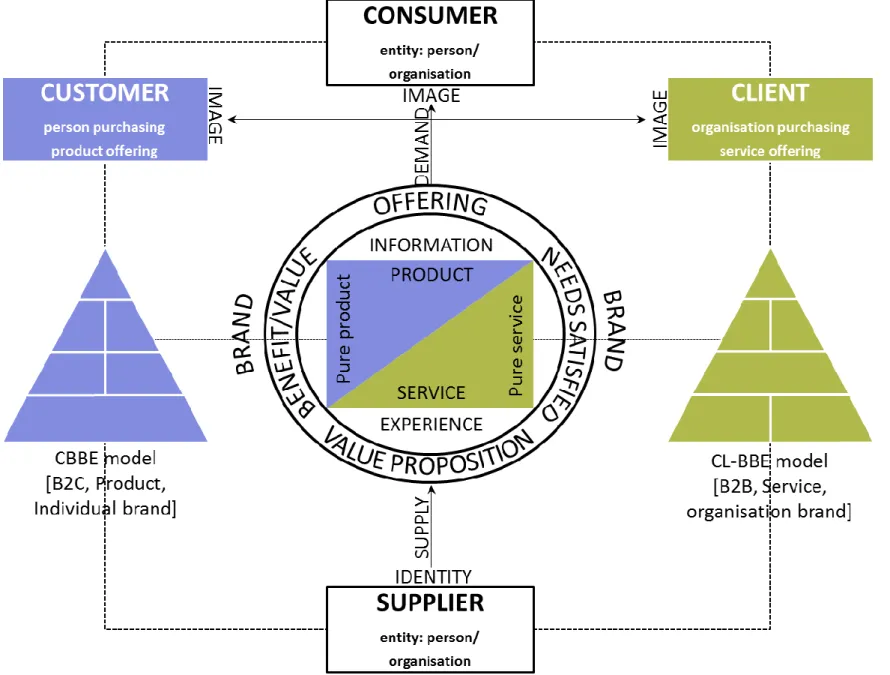
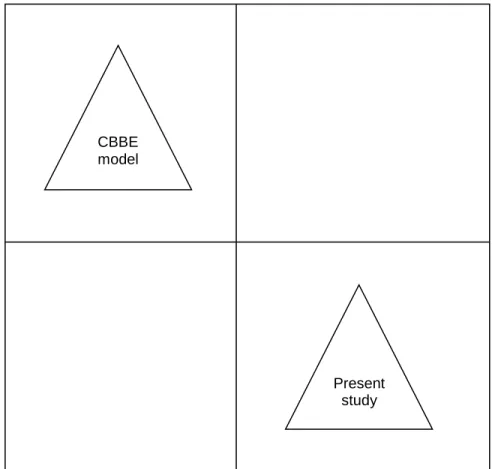
As depicted in Figure 1.1, the differences between a product and a service and the product-service spectrum, are at the centre of the present study. A pure product, pure service or product-service combination, together with information and experience, constitute the offering, which is supplied by a supplier and demanded by a consumer. Perceptions about a brand are influenced by a consumer’s experience (engagement) with the brand, which interprets the brand’s identity and forms the consumer’s brand image (Hanna & Rowley, 2013: 1791). Client experience influences brand awareness, brand associations, perceived quality, and brand loyalty (Biedenbach & Marell, 2012: 455). The offering contains a value proposition, which provides a benefit or value to the consumer that satisfies a need. The brand enhances the offering with meaning that differentiates it from other brands. Represented to the left-hand side of the conceptual framework, the CBBE model originated from an individual B2C product brand equity perspective; from the supplier-customer perspective - predominantly a person who purchases a product offering. The study’s contribution is depicted to the right-hand side of the conceptual framework. The present study had, as primary research objective, the development of a B2B service brand equity model. This was achieved by testing the applicability of the existing CBBE model in a selected B2B services context (short-term business insurance). The present study, therefore, contributes to three areas, namely 1) the offering type – by investigating service rather than product; 2) brand architecture – organisation-level brand architecture rather than product-level architecture; and 3) context – B2B context rather than a B2C context. The components of the CBBE model that are confirmed, those that are not confirmed and those other components that may be relevant were identified and combined to develop the B2B service CL-BBE framework. Figures 1.1 and 1.2 show the theoretical positioning of the present study.
11
Figure 1.1: Conceptual framework
12
Figure 1.2: Theoretical positioning of study
1.9 IMPORTANCE/ SIGNIFICANCE OF THE STUDY
From the literature review it is evident that B2B brand equity research is limited and in an early stage of development (Baumgarth, 2010: 665; Geigenmuller, 2012: 432). As mentioned previously, the literature proposes the CBBE model as a brand management instrument to guide the creation of brand equity across many industries (Keller, 2001: 3, O’Cass & Grace, 2004: 257), but the applicability of the CBBE model to a B2B context has been questioned and there is currently no comprehensive and accepted brand equity model available specifically for B2B services (Kuhn et al., 2004; 2008: 40–58). The development of a framework or adaptation of a model to the B2B industry is a substantial undertaking. The present research contributed to the body of academic knowledge by expanding the limited existing B2B services branding theory through the proposed CL-BBE framework. This enhances and extends classical brand management. The insight gained from the present research, as to the sources of brand equity, should assist marketing practitioners and brand decision makers (brand managers and consultants) to improve the effectiveness of brand building and strategic brand
S
E
RVI
CE
P
RODU
CT
B2B
B2C
Present study CBBE modeldeveloped and managed the long-term success should improve (O’Cass & Grace, 2004: 265). The present empirical research contributes to three areas of brand equity research, namely 1) the offering type – by investigating service offerings rather than product offerings; 2) the brand level – by investigating organisation-level brands rather than product-level brands; and 3) context – by investigating a B2B context rather than a B2C context.
The proposed B2B CL-BBE framework should improve the effectiveness of brand building strategies for the selected B2B services (short-term business insurance) by only enhancing the confirmed and added dimensions of the CL-BBE framework.
1.10 RESEARCH DESIGN AND METHODS 1.10.1 Research design
The research problem dictates which type of research design is required. The research design is guided by the type of evidence that is necessary to adequately address the primary research question (Mouton, 2001: 57). An exploratory empirical research design was required to address the research problem.
As far as the philosophy of science is concerned, the study of branding resides in marketing, which resides in the business and management sciences. The research paradigm was interpretivism, the research discourse included induction and deduction and the research design comprised exploratory (qualitative) research. This approach is supported by O’Cass and Grace (2004: 267) who motivate the use of qualitative research to investigate services branding.
1.10.2 Research methods 1.10.2.1 Selection
The insurance market is segmented into B2B and B2C. The B2C market is the personal insurance market, whereas the B2B market includes commercial and/ or corporate insurance. The commercial offering is mostly targeted at entrepreneurs and businesses (like guesthouses and dentists), whereas the corporate offering specifically addresses the needs of larger corporate organisations. The research population, from which the sample was selected, comprised of hotels in Cape Town, South Africa registered with Cape Town Tourism and/ or www.booking.com. For the study non-probability judgemental selection was done. The selection frame used was the accommodation providers, arranged alphabetically by name of organisation.
14
The participant (sample element) was the person in the demand-side client organisation who has some influence on the B2B short-term insurance purchase decision. Therefore the sample element was a senior member of management.
1.10.2.2 Interview guide design
An interview guide was developed from the literature. The questions were open-ended. Section A of the interview guide included qualifying questions and Section B comprised of classification questions. Section C included questions to test the applicability of the existing CBBE model to a selected B2B service context and measured the sub-dimensions of the sequential brand-building blocks to assess the building of short-term insurance brands. This was done to identify which of the brand-building blocks and sub-dimensions of the CBBE model are confirmed for short-term business insurance, which of the brand-building blocks and sub-dimensions of the CBBE model are not confirmed for short-term business insurance and which additional brand-building blocks and sub-dimensions may be relevant to short-term business insurance. The questions either confirmed or did not confirm the sub-dimensions as well as what other additional sub-dimensions may be relevant. Section D of the interview guide elicited participants’ feedback as to the content of the interview guide and its appropriateness.
1.10.2.3 Data collection
Semi-structured individual face-to-face interviews were conducted with participants.
1.10.2.4 Data analysis and interpretation
Content analysis was done with the aid of the software programme Atlas.ti7. The results were interpreted and used to adapt the CBBE model to the CL-BBE framework and to draw conclusions and suggest guidelines for improved strategic brand management for short-term business insurance.
1.11 CHAPTER OUTLINE
The current chapter deals with the problem statement, research question, research objectives and literature as it relates to brand equity. The importance of the study and research design and methods are also discussed. The remainder of the dissertation is divided into the following chapters:
Chapter 2: Brands, branding and brand management
In this chapter the emphasis is on brand equity and a distinction is made between brand equity and brand value. The most prominent models that guide the strategic brand building process are discussed and compared. The chapter concludes by presenting the present study’s conceptual framework.
Chapter 4: Brand equity in business-to-business and services markets
The differences between product and service and the B2B and B2C sectors are investigated and related to the present study’s conceptual framework.
Chapter 5: Research design and methods
This chapter begins by contextualising the researcher’s ontological and epistemological position. This is followed by an explanation of the methodology and the steps in the research process followed. This includes stating the research problem and research objectives as they relate to the research question, research design, selection planning, data collection, data analysis, data reporting and interpretation.
Next the initial and amended interview guides design is discussed. A statement regarding the code of conduct concludes the chapter.
Chapter 6: Presentation of findings
The findings of the present empirical research are presented and analysed in this chapter. The major findings of the study are summarised, conclusions drawn, the CL-BBE framework presented and recommendations made for future research.
1.12 CONCLUSION
The contemporary market environment is increasingly competitive and differentiation is important to organisational success. To this extent brand management aids differentiation through the creation of brand equity. However, too little is known about branding in a B2B context. Although research have been conducted focusing on brand equity practices in the consumer market, research that applies these practices to B2B services remains limited. The rest of the study focuses on addressing the research problem, which is that there is no comprehensive and accepted brand equity model for B2B services. This is achieved by developing an adapted CBBE model, the B2B client-based brand equity (CL-BBE) framework, to guide strategic brand management for short-term business insurance.
Next, in Chapter 2, the foundation is laid for the literature review by considering the importance of brands, branding and brand management.
16
CHAPTER 2
BRAND AND BRAND MANAGEMENT
2.1 INTRODUCTION
Chapters 2, 3 and 4 form the literature review. These chapters contextualise the study and identify where a contribution can be made. This chapter clarifies additional basic terms that are used interchangeably in the literature for the sake of consistency, clarity and context, as these terms are used in this study. Brands and brand management have emerged as important research areas within the academic marketing literature (de Chernatony, 2009: 101-105), therefore, the concepts of brand and brand management, and its importance, are also explored.
2.2 CONCEPT CLARIFICATION
Brand, branding, brand management and some of the terms that are important to the conceptual framework (Figure 1.1) are discussed in this section. A more comprehensive list of terms and concepts is attached as Appendix 5.
2.2.1 Brand
If this business were to be split up, I would be glad to take the brands, trademarks and goodwill and you could have all the bricks and mortar – and I would fare better than you.
- John Stuart
The term brand is prevalent in academic literature, but its meaning is not agreed upon (de Chernatony, 2009: 101-105). A recent attempt at defining what a brand is, based on an analysis of various explanations of the term, is: “an identifiable kind of good and/or service commodity comprised of differentiated characteristics” (Pike, 2013: 334). A similar definition is that a brand is a “name, sign, symbol or design which identifies the goods and services of one seller and differentiates them from those of competitors” (Kotler & Armstrong, 2010: 255). For a consumer a brand contains a promise of performance and value which allow consumers to project their self-image (Chiaravalle & Schenck, 2007: 34-35). Kapferer (2008: 12) speaks of “brands as living systems made up of three poles: products or services, name and concept. The author contests that a brand cannot exist without an offering. This offering is identified through a name and proprietary signs and differentiated based on a set of tangible and intangible associations, which constitutes the value proposition of the brand. It is the intangible aspect that gives brands value, without which a brand is worthless (Taylor, Celuch & Goodwin, 2004: 227). De Chernatony (2009: 104) considered the evolution of the definition of the term brand, and concluded that at a basic level a brand could be defined as “a cluster of values that
functionally oriented, but are enhanced with emotionally oriented values, adding to the promise that adds value to all stakeholders.
Based on these definitions, the researcher understands brand to mean: a consumer’s perception (brand image) and attitude, which comprise the tangible and intangible (attributes, benefits and psychological/emotional) associations that are used to identify and differentiate an offering (adapted, Keller, 1993: 2-5).
2.2.2 Branding
The strategic process and creative practice of developing a brand (Interbrand, 2007: 20). The process of endowing offerings with the power of brand equity. The aim of the branding process is to create brand equity (Keller, 2013: 57).
2.2.3 Brand management
The process of managing an organisation as a brand and an organisation’s brand(s) in order to preserve and enhance brand equity (Interbrand, 2007: 17).
2.2.4 Customer, client and consumer
A customer is the purchaser (buyer) of a product or service and can be a person or organisation (American Marketing Association, 2015; Pride & Ferrell, 2010: G-3). A client is the purchaser of a service offering, but conventionally also referred to as a customer. It is a person or organisation using the services of an individual or company (Oxford Dictionaries, 2015). A consumer is the end user of a product or service, but may also refer to the buyer who may or may not be the end user (American Marketing Association, 2015).
The terms customer, client and consumer are used interchangeably in the literature, therefore, the following classification and adopted use of the terms are clarified. To differentiate a purchaser of a product from a purchaser of a service, for the purpose of this research, the term ‘customer’ will have a narrower meaning to refer to a purchaser or consumer of a primarily product offering and the term ‘client’ will refer to a purchaser or consumer of a primarily service offering only. Furthermore, a customer and client can be any entity including a person and an organisation. The researcher adopts the view that the concept ‘consumer’ is used to include the terms “customer” (a purchaser of a product offering) and “client” (a purchaser of a service offering). The term consumer is used to refer inclusively to any entity (a person and an organisation) that consumes offerings. In most instances the term consumer is used because most offerings include a combination of products and services together
18
with information and experience (depicted in Figurer 1.1). When the term customer is used it will denote the purchaser or consumer of a pure product offering, and when the term client is used it will denote the purchaser or consumer of a primarily service offering. If the terms customer, client and/or consumer is used as it is presented in the literature, the link will be made to consumer, if necessary, to indicate this study’s conceptual framework. Mindful of the explained use of the word consumer, the term consumer is used to refer inclusively to any entity (a person and an organisation, for example, a franchise, museum, tourism bureau or cinema) that consumes offerings. These concepts, as mentioned, are included in the ‘conceptual framework’ (Figure 1.1).
Because most branding discussions are conducted within a consumer product (customer) context (Interbrand, 2011), and because the CBBE model (explained in detail in Chapter 3) was developed mostly from an individual (fast-moving) consumer product (customer) perspective (Kuhn et al., 2008:41; Kimpakorn & Tocquer 2010: 378) the present study focuses on an organisational client perspective (as the consumer of a service offering). The organisational client perspective represents the opposite extreme of the customer product context, as depicted in Figure 2.1. It is proposed that the CBBE model should be applicable to any context (Keller, 2001: 3).
2.2.5 Organisation and entity
Branding is not limited to any one type of entity; however in the literature the terms business, firm and organisation are used interchangeably (Mani & Barua, 2015: 9-38). To deal with this issue some authors mostly use the term 'organisation' (Bruton, Peng, Ahlstrom, Stan & Xu: 2015: 95-114; Pride & Ferrell, 2010: G-3). Hence, to aid consistency, and to show the scope of branding application the term organisation is used in the present study to refer to, in its broadest interpretation, an organisation of people or ideas that share a common goal. An organisation, therefore, includes a commercial business organisation (listed or private, large or small), a non-profit organisation, a public enterprise, the government, an institution, a geographical area, a political party or a sports club. A person is an individual consumer, as opposed to an organisation, and an entity refers to both person and organisation that supplies or demands an offering.