AUTOMATIC CHANGE DETECTION FOR VALIDATION OF DIGITAL MAP DATABASES
Brian Pilemann Olsen National Survey and Cadastre, Denmark 8 Rentemestervej, DK–2400 Copenhagen NV, Denmark
[email protected] Working Group IC WG II/IV
KEY WORDS: Photogrammetry, Remote Sensing, Change Detection, Classification, Automation, High Resolution, Infra-red, DEM/DTM
ABSTRACT
In almost all areas of our society there is an increasing need for up to date digital map databases. Traditionally, different manual, labour intensive and hence costly methods have been used for map updating, with the change detection for the updating being by far the most complex and expensive part. In this paper an automatic change detection method is presented and evaluated. The method only considers changes in the buildings theme, but it can be extended to other object classes. The aim is the development of an efficient change detection procedure for database maintenance in a production environment. The method is based on classification principles and combines an unsupervised and a supervised classification in order to determine the spectral response of the building class and thus locate potential buildings. The result is filtered by a height filter to refine the result. The method is evaluated on building registrations from the Danish TOP10DK map database. The test case presented in the paper is from a residential suburban area. The method detects almost all changes due to demolished buildings whereas only a smaller part of the new buildings are detected. This is primarily due to the use of a very special roofing material. The method leads to a number of false alarms, which to a large degree can be eliminated by refinements of the algorithm or by introduction of additional information e.g. infra-red images or texture measures.
1 INTRODUCTION
The digital topographic map database TOP10DK is the primary topographic product of the National Survey and Cadastre—Den-mark (Kort & Matrikelstyrelsen, KMS).The development and up-date of TOP10DK is based on aerial photogrammetry: one fifth of Denmark is photographed each spring before foliation, resulting in approx. 1200 photos (about 400 GB of image data).
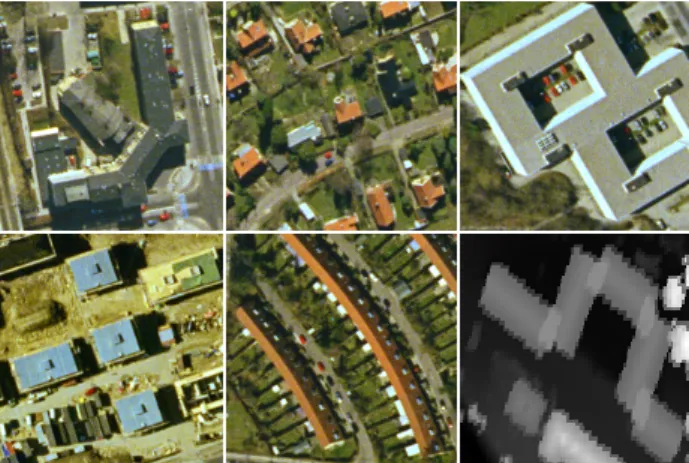
Map updating can be carried out by a complete remapping of the area for each revision cycle, but much work can be saved by detecting changes from the previous version of the map database and concentrating on these areas of change. Change detection for topographical mapping is on the other hand not a simple task: Although the intention is always to carry out the photo flights at approximately the same time of year, the natural, inter annual variations of the vegetation coverage is of a magnitude that hides the (primarily human generated) changes sought for. Furthermore it is almost impossible to take the photos at the same geographical position and with the same attitude as within the previous photo campaign. This means that the change detection must be carried out by comparing a new image directly with the existing map database, rather than by a simpler image-to-image comparison. In this paper an automatic procedure for change detection con-centrating on buildings, which are important mapping objects, is presented. The next step in the update process: the actual 3D ob-ject registration, is not considered here. This subob-ject has recently been treated extensively by Nieder¨ost (2003) and S¨uweg (2003). As can be seen from figure 1 buildings are often highly diverse both when it comes to size, form and spectral signature. They are therefore hard to describe by spectral information only. Adding height information to the process, e.g in the form of digital sur-face models, may improve the distinguishing of buildings from other objects having a similar spectral response.
When introducing automatic change detection procedures, the aim is to detect at least the same percentage of factual changes as
Figure 1: Buildings are typically highly diverse and spectrally ill-defined, when considered as a single group. The last image (Lower Right) is a building as it is represented in a DSM. a manual operator is capable of. It is, on the other hand, accept-able if the change detection procedure introduces false alarms, as long as they are few, since they can easily be rejected during the actual 3D object registration.
1.1 Related work
Other European countries e.g. Germany, Switzerland, and the Netherlands have also established and completed digital map data-bases with national coverage in the past few years. The National Mapping agencies in these countries therefore face the same prob-lem as the KMS and projects with similar aims considering auto-matic or semi-autoauto-matic map updating have been established. In Germany the project for updating the ATKIS database focuses on registration of more generic surface types (settlement, grass-land, street, water etc.) (Petzold and Walter, 1999, Walter and Fritsch, 2000). The method for change detection uses super-vised classification, with training areas automatically generated
using the existing registrations in the ATKIS map data base (Wal-ter, 2000). Experiments combining multi-spectral images (RGB, colour infra red – CIR) with height information and reduction of the information to generic surface types, have shown that it is possible to perform automatic change detection with a satisfac-tory accuracy (Petzold and Walter, 1999, Petzold, 2000) (note, however, that the accuracy requirements for ATKIS are some-what lower than for TOP10DK (Kort & Matrikelstyrelsen, 2001, AVLBD, 1988)). The change detection leads to a “change map” where the generic objects are divided in three classes: no change, possible change and change.
In the Swiss ATOMI project, aerial colour photos, a high res-olution Digital Elevation Model (DEM) and a Digital Surface Model (DSM) are used aiming at the enhancement of the plani-metric accuracy for the 2D VECTOR25 database (Eidenbenz et al., 2000, Nieder¨ost, 2003). The surface model is generated by auto-correlation in aerial photographs in the scale of 1:10.000 and is used as the primary data source. Image information (RGB/CIR) is primarily used to discern man made objects from natural ob-jects (buildings vs. vegetation).
Data from the digital multi spectral camera High Resolution Stereo Camera—Airborne, HRSC-A (Neukum, 1999) is evaluated and used within the Dutch project (Asperen, 1996, Hoffmann et al., 2000). The HRSC-A data set includes high-resolution (15 cm) spectral data (RGB and CIR) and an automatically generated high resolution surface model from stereo matching.
A new change detection project within the framework of Eu-roSDR is about to start up later this year. The emphasis is on de-velopment of methods for localising changes in land cover from very high resolution imagery, the integration of change maps in the updating process and finally comparison of different methods for change detection (EuroSDR, 2004).
2 DATA
The change detection procedure presented in section 3 below, is evaluated using datasets mainly associated with the development and updating of the Danish TOP10DK topographical map data base.
2.1 RGB images
For the establishment and update of TOP10DK traditional RGB aerial photographs have been used. All images are taken from an altitude of approximately 3800 m leading to a scale of 1:25.000. Each image covers an area of 6 km by 6 km and has a forward lap of 60 percent and a side lap of 20 percent. As part of the production work-flow the photos are scanned at a resolution of 21 µm, leading to 350 MB of data, and a spatial pixel resolution of 0.5 m at ground level. The photos were taken as part of a flight campaign in April 2000.
2.2 Digital Surface Model (DSM)
As was described by Knudsen and Olsen (2003) it is very dif-ficult to locate changes in the building layer using single aerial images and hence only using spectral information in combina-tion with size and form consideracombina-tions. Therefore a high reso-lution digital surface model (DSM) with a grid size of 1 meter covering a test area in Lyngby, north of Copenhagen, has been generated to facilitate the building detection. The dataset was collected and made available for these studies by the Danish en-gineering and mapping company COWI. Data were collected in
May-June 2001 using the TOPOSYS1 system (Toposys, 2004, Baltsavias, 1999) which only record first responses of the pulse. The expected height accuracy is approximately 0.15 m.
2.3 Digital Map Database
The building theme from TOP10DK has been selected as target for the update procedure. TOP10DK is a fully 3D map database, including 51 object types (building, lake, highway . . . ) organised in 8 classes (traffic, water . . . ). The precision of the database is better than 1 meter both horizontally and vertically. For change detection in the building layer, only new buildings larger than 25 m2and changes of building size larger than 10 m2are considered.
3 METHOD
The method presented is a revision of a method described by Olsen et al. (2002) and Knudsen and Olsen (2003). It is based on classification principles, using existing object registrations in the map database as training areas in order to determine the charac-teristics of the different classes used to search for and build the object model. As it is very difficult to generate an unambiguous object model for buildings using only spectral information, the revised method also incorporates height information in the form of high resolution DSM data e.g. from LIDAR or photogrammet-ric auto-correlation to distinguish between objects in terrain from objects above terrain.
3.1 The method step by step
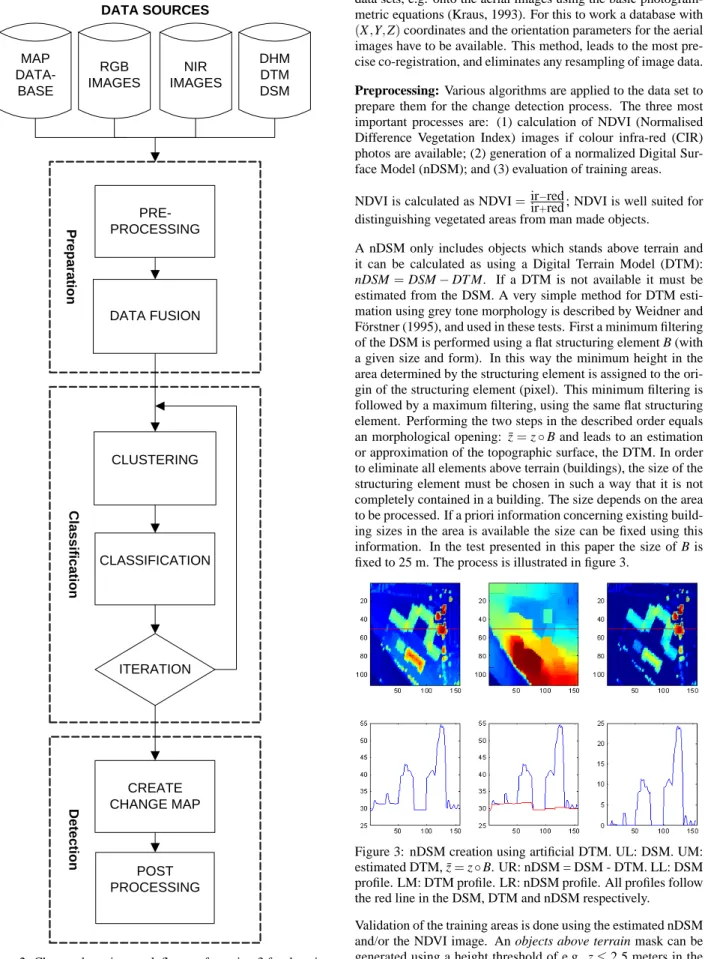
The method which consists of three steps, preparation, classifi-cation, and detection is outlined in figure 2.
Two major assumptions have to be fulfilled for the change detec-tion procedure to be successful:
(1) The number of changes in a given class (e.g. building) must be much smaller than the number of objects used to describe the class. This is valid for most urban areas.
(2) New objects must share the same spectral characteristics as the existing objects used to generate the object model. This is often the case as only a small number of roofing materials is in common use.
3.1.1 Preparation: The preparation consists of a data fusion step to bring the data sets into a common reference frame and a preprocessing step where various enhancement methods are ap-plied to the data data to prepare them for the change detection procedure.
Data fusion: as objects from the existing digital map database is to be used as training areas for the determination of the class characteristics, image data (raster) and the map database (vector) must be co-registered. Generally co-registration can be done ei-ther by registration of the image data to the map database or by registration of the map database to the image data.
The most used method is registration of image data to the map database. However the method has the disadvantage that most image data types (aerial photos) have to be re-sampled as rectified images or orthophotos. For the data sets to fit completely to each other a high precision elevation model, including description of man made objects (buildings, bridges etc.) must be available (i.e. a Digital Surface Model, DSM).
CLUSTERING CLASSIFICATION ITERATION CREATE CHANGE MAP POST PROCESSING PRE-PROCESSING DATA FUSION Preparation Classification Detection RGB IMAGES NIR IMAGES DHM DTM DSM DATA SOURCES MAP DATA-BASE
Figure 2: Change detection work flow—cf. section 3 for descrip-tion
Another way is to project the map database directly to the other data sets, e.g. onto the aerial images using the basic photogram-metric equations (Kraus, 1993). For this to work a database with (X,Y,Z)coordinates and the orientation parameters for the aerial images have to be available. This method, leads to the most pre-cise co-registration, and eliminates any resampling of image data. Preprocessing: Various algorithms are applied to the data set to prepare them for the change detection process. The three most important processes are: (1) calculation of NDVI (Normalised Difference Vegetation Index) images if colour infra-red (CIR) photos are available; (2) generation of a normalized Digital Sur-face Model (nDSM); and (3) evaluation of training areas. NDVI is calculated as NDVI= ir−red
ir+red; NDVI is well suited for distinguishing vegetated areas from man made objects.
A nDSM only includes objects which stands above terrain and it can be calculated as using a Digital Terrain Model (DTM): nDSM=DSM−DT M. If a DTM is not available it must be estimated from the DSM. A very simple method for DTM esti-mation using grey tone morphology is described by Weidner and F¨orstner (1995), and used in these tests. First a minimum filtering of the DSM is performed using a flat structuring element B (with a given size and form). In this way the minimum height in the area determined by the structuring element is assigned to the ori-gin of the structuring element (pixel). This minimum filtering is followed by a maximum filtering, using the same flat structuring element. Performing the two steps in the described order equals an morphological opening: ¯z=z◦B and leads to an estimation or approximation of the topographic surface, the DTM. In order to eliminate all elements above terrain (buildings), the size of the structuring element must be chosen in such a way that it is not completely contained in a building. The size depends on the area to be processed. If a priori information concerning existing build-ing sizes in the area is available the size can be fixed usbuild-ing this information. In the test presented in this paper the size of B is fixed to 25 m. The process is illustrated in figure 3.
Figure 3: nDSM creation using artificial DTM. UL: DSM. UM: estimated DTM, ¯z=z◦B. UR: nDSM = DSM - DTM. LL: DSM profile. LM: DTM profile. LR: nDSM profile. All profiles follow the red line in the DSM, DTM and nDSM respectively.
Validation of the training areas is done using the estimated nDSM and/or the NDVI image. An objects above terrain mask can be generated using a height threshold of e.g. z≤2.5 meters in the nDSM. With this mask, areas registered as buildings in the ex-isting map database, which no longer stand above terrain are fil-tered out. Objects covered by vegetation can be eliminated using the NDVI mask (if available), as they can be detected as areas
with NDVI≥0.1. The result of the validation is a refined build-ing mask, holdbuild-ing only the buildbuild-ings which are most likely still buildings.
3.1.2 Classification: The first step in the classification part is to perform a clustering process. As stated by e.g Kressler and Steinnocher (1996) some classes, (e.g. buildings) have to be sub-divided into more unique subclasses as they are spectrally highly diverse. This task is handled by splitting up the group of pix-els registered as buildings by the building mask into smaller and more unique sub-classes using a simple migrating means cluster-ing process. The algorithm is based on the ISODATA algorithm (Ball and Hall, 1965), and the number of sub-classes is automat-ically determined by the algorithm in order to make a best fit to the input dataset.
The clustering process is followed by an actual classification. The sub-classes, which are spectrally more uniform than the base building class, are used (either alone or in combination with other class descriptions (e.g. water, roads, forest, grassland etc.) to perform a Mahalanobis classification of the entire image. This causes all pixels in the image to be assigned to the class hav-ing the smallest Mahalanobis distance from the pixel value to the class (Richards and Jia, 1999). Threshold values all being depen-dent on the class characteristics, are used to assign pixels with a distance too far from the closest class to a garbage class. The two successive steps are run a number of times as part of an iteration process. This is done mainly due to the fact that the result of the ISODATA algorithm is strongly dependent on the po-sition of the initial cluster centres. After this iteration process it is possible to accept pixels identified as buildings a specific number of times. In the case study presented below all pixels which are classified as a building one or more times are considered to be a “building”, leading to an image holding pixels with values of either zero or one: zero indicates no building and one indicates a potential building pixel.
Using the nDSM, the image holding potential buildings are fil-tered in order to extract only objects (pixels) which stands above terrain.
3.1.3 Change detection: First a change map is computed by a pixel by pixel comparison of the existing map database (in a raster version) to the classification result. Since the change map includes all potential changes in the building layer it includes noise in the form of single pixels, and some false alarms due to misclassification. The single pixels are removed using mor-phological opening. The remaining change pixels are segmented, and pixel clusters smaller than the detection requirement (e.g. 25 m2 = 25 pixels in the TOP10DK case) and/or not fulfilling the size and shape specifications for buildings are removed from the dataset, leading to a reduction of the false alarms and the final change map.
4 CASE STUDY
The procedure is tested on the data described in section 2. The latest update of the TOP10DK database was carried out five years before the photos were taken.
4.1 Test area
The test area used for evaluation is situated in Kgs. Lyngby, a suburb 15 km north of Copenhagen. The area contains many dif-ferent types of buildings and houses since it includes a small in-dustrial area; a cemetery; a church; a small train station; large
strip buildings; and a gasoline station. The looks and shapes of the buildings as well as the heights differ a lot. Vegetated areas take up a large part of the area, and since the area also includes a highway, two bridges (one for pedestrians and one for cars) and a rail road, this causes a very special terrain structure. The area is also characterized by the fact that many changes have taken place since the establishment of the TOP10DK database.
Area: Approximately 700m×500m. Lower left corner (E, N)= (718450,6187050). Upper right corner (E, N)= (719150,6187550). (E, N) coordinates are given in UTM zone 32. All images (RGB, TOP10DK and DSM) are 500 rows by 700 columns and approx-imately 70 buildings are included in the area. 72 registrations are included in the existing map data base. 12 new houses have been build since the last revision and 14 have been demolished.
4.2 Test data
All datasets are subsamples from larger datasets and they are brought into the same geographical reference by orthorectifica-tion of the aerial photographs using an existing digital terrain model (DTM) with a grid spacing of 20 m.
4.3 Results
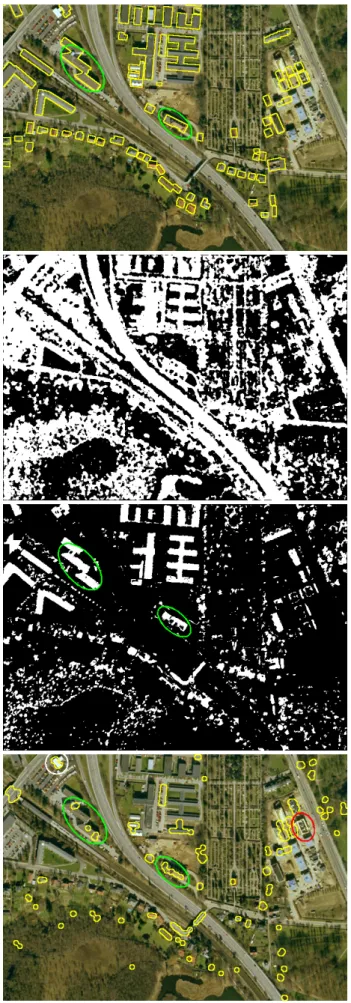
The results are visualised in figure 4. The first image shows the RGB image with the existing map database superimposed in yel-low colour. It can be seen that a lot of development has taken place since the last revision of the map database. This is most pronounced in the right part of the image where 7 buildings have been demolished and 10 new buildings with blue roofing material have been built.
The second image from the top shows the result after the classi-fication step. White pixels indicate potential buildings, and as it can be seen large areas are misclassified as vegetation and roads are classified as potential buildings.
The third image shows the result after the height filtering. It can be seen that all roads are now removed. Some vegetated areas still remain as potential buildings, though.
The last image shows the RGB image with the changes found by the automatic change detection algorithm superimposed in yel-low. The results are summarised in table 1.
Factual Detected Demolished Buildings 14 12
New Buildings 12 2
Changes 26 14
False alarms 45
Table 1: Statistical results
Approximately 50 percent of the factual changes in the test area have been detected by the algorithm.
5 DISCUSSION
Most success is experienced in the group of demolished buildings where only two demolished buildings have not been detected. This is caused by the method used for change detection where the detected buildings are compared directly to the existing reg-istrations on a pixel wise basis. The two demolished buildings which are not detected are positioned the upper right area of the
Figure 4: Results from the change detection algorithm.
test area (marked by a red circle). And as can be seen a new build-ing has been built exactly at the same position as where the two old buildings were positioned. Due to the comparison method neither the new nor the demolished buildings are “highlighted” by the algorithm. Only two new buildings have been detected by the algorithm. The reason for the poor result is that 9 out of the twelve new buildings have completely different spectral re-sponses than the existing buildings in the area, as they are either blue (6 buildings) or still not finished (3). As one of the two hypotheses regarding the change detection procedure are not ful-filled, the algorithm is expected to fail.
45 false alarms (3 times the factual changes found) are generated. Of those, 26 are located in vegetated areas, 3 are bridges (above terrain), and 16 caused by existing buildings which apparently have not be re-detected by the algorithm. If infra-red images are available, the majority of the false alarms can be eliminated using the NDVI or by calculation of textural figures using the DSM, as it can be expected that the texture for forrested areas differs from buildings. The 3 false alarms caused by bridges can only be elim-inated by the use of a more “clever” algorithm for nDSM genera-tion. Looking more into the false alarms caused by buildings not re-detected, it can be seen that a large proportion of those build-ings are actually detected (figure 4, examples marked by green circles), but these detections are eliminated in a later stage of the change detection algorithm, as part of noise reduction. Refining the noise reduction method may lead to more existing buildings being “re-detected”. One of the false alarms (shown by a white circle in the upper right corner of the area), is a factual difference but not a change, since it is a roof covering a gasoline station, and such roofs are not to be registered in the TOP10DK database, according to the map specification. Such false alarms can only be verified by a human operator.
6 CONCLUSION
The method presented shows reasonable performance when de-tecting demolished buildings (12 out of 14 are detected), whereas the number of new buildings detected is poor (only 2 out of 12). A reason for this exists, as the new buildings do not share the spectral response of the existing buildings in the area. One of the hypothesis for the algorithm is not fulfilled. The algorithm in-troduces a fairly large number of false alarms (3 times the num-ber of factual changes detected). Most of these false alarms can be eliminated by refining some of the processing steps in the al-gorithm (noise reduction, DSM generation) or by introduction of additional information e.g. infra-red images or textural measures. Acknowledgements:
I would like to thank the Danish engineering and mapping com-pany, COWI, for letting me use their Digital Surface Model. I would also like to thank my colleague Thomas Knudsen, who contributed valuable comments and suggestions.
REFERENCES
Asperen, P. V., 1996. Digital updates of the Dutch topographic service. In: International Archives of Photogrammetry and Re-mote Sensing 31(B4), ISPRS, pp. 891–900.
AVLBD, 1988. Amtliches topographisch-kartographiches in-formationssystem (ATKIS). http://www.adv.online.de/ english/products/atkis.htm.
Ball, G. H. and Hall, D. J., 1965. A novel method of data analysis and pattern classification. Technical report, Stanford Research Insitute, Menlo Park, CA.
Baltsavias, E. P., 1999. Airborne laser scanner : existing systems and firms and other resources. ISPRS Journal of Photogrammetry and Remote Sensing 54(2-3), pp. 164–198.
Eidenbenz, C., Kaeser, C. and Baltsavias, E., 2000. ATOMI - au-tomated reconstruction of topographic objects from aerial images using vectorized map information. In: International Archives of Photogrammetry and Remote Sensing, Vol. XXXIII (B3), ISPRS, pp. 462–471.
EuroSDR, 2004. EuroSDR – Change detection project for consideration. http://www.eurosdr.org/2002/research/ ResPoss.asp?ResPosID=27&#pos.
Hoffmann, A., van der Vegt, J. W. and Lehmann, F., 2000. To-wards automated map updating: is it feasible with new data aqui-sition and processing techniques? In: International Archives of Photogrammetry and Remote Sensing, Vol. XXXIII (B2), ISPRS, pp. 295–302.
Knudsen, T. and Olsen, B. P., 2003. Automated change detection for updates of digital map databases. Photogrammetric Engineer-ing & Remote SensEngineer-ing 69(11), pp. 1289–1296.
Kort & Matrikelstyrelsen, 2001. TOP10DK. Geometrisk reg-istrering. Technical report, National Survey and Cadastre— Denmark, Rentemestervej 8, 2400 København NV, Denmark. Kraus, K., 1993. Photogrammetry. Vol. 1, 4 edn, D¨ummler, Bonn, Germany.
Kressler, F. and Steinnocher, K., 1996. Change detection in urban areas using satellite images and spectral mixture analysis. In: International Archives of Remote Sensing and Photogrammetry, Vol. 31number B7, ISPRS, pp. 379–383.
Neukum, G., 1999. The airborne HRSC–A: Performance results and application potential. Photogrammerische Woche pp. 83–88. Nieder¨ost, M., 2003. Detection and Reconstruction of Buildings for Automated Map Updating. PhD thesis, ETH Zurich, Institut fur Geodasie and Phtotgrammetrie, Eidgen¨ossische Technische Hochschule, 8093 Zurich.
Olsen, B. P., Knudsen, T. and Frederiksen, P., 2002. Digi-tal change detection for map database update. In: J. Chen and J. Jiang (eds), Integrated Systems for Spatial Data Produc-tion, Custodian and Decision Support, Vol. XXXIV (2), ISPRS, pp. 357–363.
Petzold, B., 2000. Revision of topographic databases by satel-lite images – experiences and expectations. In: T. Knudsen (ed.), Proceedings of the seminar on remote sensing and image anal-ysis techniques for revision of topographic databases, Technical Report, National Survey and Cadastre – Denmark, Copenhagen, Denmark, pp. 15–23.
Petzold, B. and Walter, V., 1999. Revision of topographic databases by satellite images. In: M. Schroeder, K. Jacobsen, G. Konechy and C. Heipke (eds), Sensors and mapping from space 1999, ISPRS, Hanover, Germany, p. 9.
Richards, J. A. and Jia, X., 1999. Remote Sensing and Digital Image Analysis: an introduction. 3 edn, Springer, Berlin, Ger-many.
S¨uweg, I., 2003. Reconstruction of 3D Building Models from Aerial Images and Maps. Publications on Geodesy, Netherlands Geodetic Commision, Delft, the Netherlands.
Toposys, 2004. Toposys1 specification.http://www.toposys. de/.
Walter, V., 2000. Automatic change detection in gis databases based on classification of multispectral data. In: International Archives of Photogrammetry and Remote Sensing, Vol. XXXIII (B4), ISPRS, pp. 1138–1145.
Walter, V. and Fritsch, D., 2000. Automated revision of gis databases. In: L. K.-J. et. al. (ed.), Proceedings of the Eight ACM Symposium on Advances in Geographic Information Sys-tems, ACM, pp. 129–134.
Weidner, U. and F¨orstner, W., 1995. Towards automatic building extraction from high resolution digital elevation models. ISPRS Journal of Photogrammety & Remote Sensing 50(4), pp. 38–49.