Lead authors
Karen A D’Andrea, PSR ME Executive Director Norman T Anderson, MSPH Lani F Graham, MD, MPH Daniel S Oppenheim, PhD, MD Paul F Perkins, MD Peter D Wilk, MD Acknowledgements Doug A Dransfield, MD Faye E Luppi, JD Mark R Hyland, MS James H Maier, MD Sydney R Sewall, MD
There is little doubt that the global climate is changing rapidly. While there may be some lingering uncertainty about the pre-cise mechanisms driving these observed climate changes, there is broad consensus in the scientific community that the release of heat trapping gasses into the atmosphere primarily as a result of the combustion of fossil fuels is largely responsible.
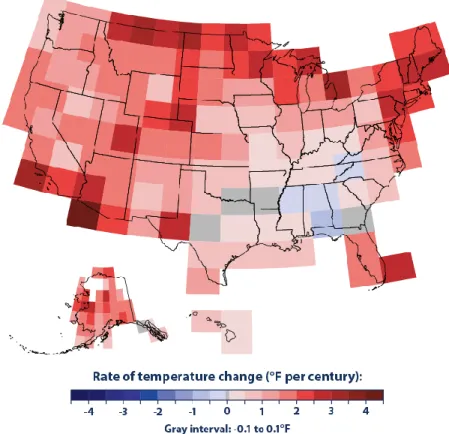
Maine has experienced a number of signif-icant climatic changes over the past 100 years, including mean temperature rise (see figure 1), mean sea level rise (see figure 2) and an increase in severe weather events.1 Since the PSR Maine’s original Death by Degrees report published in February 2000, there has been a wealth of accumu-lated data further confirming the impacts of climate change on human health. This report summarizes some of the major
threats to the health of Maine citizens resulting from the observed changes in Maine’s climate.
INTRODUCTION
Figure 1—”Climate Change Indicators in the United States,” U.S. EPA, http://www.epa.gov/climatechange/science/indicators/weather-climate/ temperature.html
Figure 2 - “How warm is warm? Or, how to know when is warm not so surprising… “ By Dr. George L. Jacobson, Maine State Climatologist, Maine Climate News, Fall 2010, http://extension.umaine.edu/maineclimatenews/ archives/fall2010.htm
HEALTH THREATS
“Climate change is the biggest global health threat of the 21st century.”
Lancet,May 16, 2009
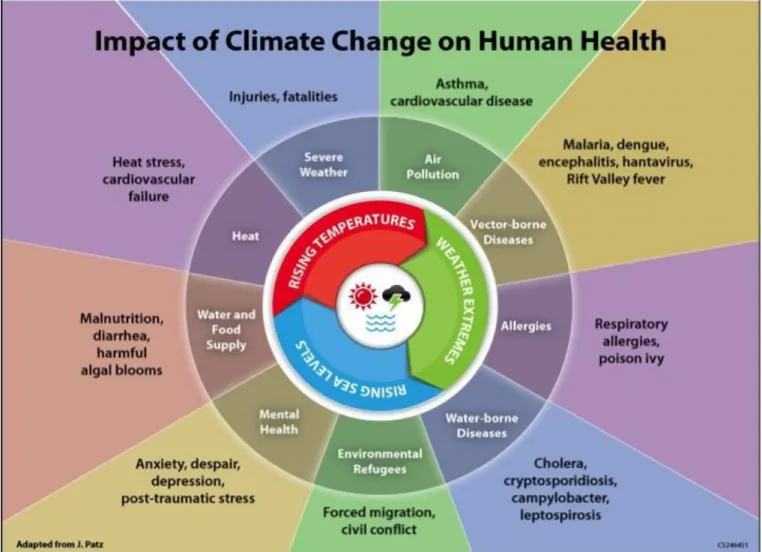
Figure 3 - U.S. Climate Resilience Toolkit, http://toolkit.climate.gov/image/505
In the 2014 collaborative study from Yale and George Mason Universities entitled “Public Percep-tions of the Health Consequences if Global Warming”, the authors demonstrate that most Americans have given very little consideration to the connection between health and climate change.2 Yet from numerous excellent studies, it is clear that there is a direct relationship between the changes ob-served in key health indicators and climate change.
Human health in Maine is threatened in complex ways by the three major manifestations of shifts in climate – rising temperatures, weather extremes and rising sea levels (see figure 3). Key public health indicators such as Lyme disease are on the rise and present Maine with a number of signifi-cant challenges.
Air pollution and allergens
Numerous studies link worsening ozone levels, the major component of smog, with exacerbations of asthma, im-paired immune function and greater susceptibility to res-piratory infections. While Maine’s overall ozone levels have declined over the past 20 years as a result of strengthened federal clean air standards3, the concentra-tion of ozone is highest on the hottest days of the year, and the numbers of hot days are likely to increase with rising global temperatures.
Exposure to elevated ozone can cause:
Impaired respiratory function including shortness of breath, decreased work and exercise capacity, persistent cough, increased susceptibility to respiratory infections
Persistent eye irritation
More frequent emergency room visits and hospitalizations
Elevated mortality rates in vulnerable populations
Pollen counts in Maine are also expected to rise with the warming and lengthening of the pollen season4, increasing the rate of allergic disorders and further ex-acerbating respiratory problems. Hay fever sufferers are likely to experience more frequent and more se-vere attacks, over a more prolonged allergy season, resulting in worsening sleeplessness and lower productivity.
During the past several decades, Maine has seen a rapid increase in the rates of tick and mosquito vector-borne diseases (diseases transmitted to humans by an intermediary host). Considered by some to be the “poster child” for climate change in Maine, Lyme disease is a bacterial infection transmitted by one of the 14 tick species in Maine, the deer tick. It is the most commonly reported vector borne-disease in the United States and the second most commonly reported infectious ease in Maine. As the environment warms and the tick population increases, the rate of Lyme dis-ease is increasing in Maine (see figure 4).
Figure 4 - “Report to Maine Legislature, Lyme Disease”, Maine CDC, February 1, 2013, http://www.maine.gov/dhhs/mecdc/infectious-disease/epi/vector-borne/lyme/documents/2013-lyme-legislature.pdf
Vector-borne disease threats
Lyme disease is on the rise in Maine.
In 1998 reported Lyme disease cases in Maine totaled 76.5
In 2013 the number had increased to 1,376 cases for a rate of increase of over 1800% in 14 years.6
The rise in Lyme disease cases closely follows the increase in the deer tick population as well as Maine’s tempera-tures over this time frame.
Figure 5 - Tick-borne disease cases, 2009-2013, Maine CDC, Infectious Dis-ease Epidemiology Report, http://www.maine.gov/dhhs/mecdc/infectious -disease/epi/publications/TBD-report-2013.pdf
Babesiosis – a malaria-like parasitic disease
Anaplasmosis – a bacterial illness
Ehrlichiosis – similar to anaplasmosis
Powassan – a tick-borne viral infec-tion
Rocky Mountain spotted fever – caused by a bacteria-like organism called rickettsia
Other tick-borne diseases in Maine (see figure 5):
Mosquito-borne illnesses
West Nile virus - newly found in south-ern Maine in 2013
Eastern equine encephalitis virus - now found in 21 test pools by the Maine CDC
Chikungunya - a potential emerging threat
Photo: Jacobson, G.L., et al
Weather extremes
Disrupting energy supplies to homes, businesses, hospitals and health facilities
Compromising access to public health and emer-gency response services
Contaminating water supplies
Affecting sanitation and food storage
Causing large-scale population displacement
Increasing the risk of traumatic injury
Photo credit: Sam Webster
Depending on the severity of the event, ex-treme weather has the potential to overwhelm emergency care systems. For example, during the ice storm of 1998, there was a reported 47% increase in the number of patients treated in Maine emergency rooms.7
Extreme weather conditions such as hurricanes, floods, “super-storms”, droughts, and blizzards, which have all been linked to global climate change, can have wide-ranging impacts on human heath by:
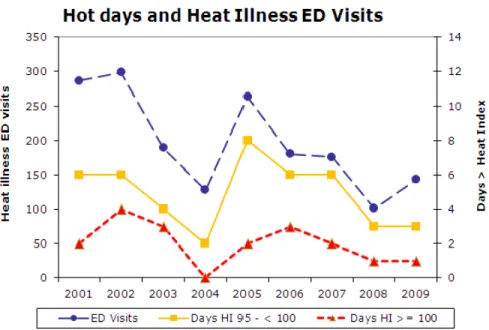
The Maine CDC projects that by the year 2060, Portland will experience more than 25 days per year of heat indices (a measure that combines both temperature and humidity) greater than 94.8 Thus the potential for a significant increase in heat-related illnesses is a looming reality. Figure 6 shows the well-documented association between high heat index and emergency room visits. As high ambient temperature in Maine is usually associated with high humidity, there is often decreased evaporative cooling capacity from perspiration. This is especially true for vulnerable populations including the elderly, infants, chronically ill children and adults and the poor.
Heat impacts
Health risks of high heat index include:
Heat exhaustion
Heat stroke
Heat cramps
Exertional heat injury
Dehydration
Exacerbation of underlying medical conditions
Figure 6 Update on Maine CDC Climate and Health Program presentation to Maine Medical Association, Norman Anderson, https://www.mainemed.com/ sites/default/files/content/committees/MeCDC%20Climate%20%26%20Health% 20MMA%20Presentation%2012-11-2013.pdf
Risk factors for heat related illness include:
advanced age
lack of air conditioning
use of certain medications
vulnerable populations, (elderly, children, infants, and the infirm)
cardiovascular diseases
Mental health
The aftermath of Hurricane Katrina has been described as a “disruption of normalcy”. Entire communities, neighborhoods and individual lives
were forever changed in ways most could never im-agine.
Loss of homes, jobs, food supplies and a stable, pre-dictable day-to-day life following such severe weather episodes all play a significant role in the ability of individuals and communities to recover from such life-altering events.
Multiple ER visits, hospitalizations and acute and chronic illnesses related to climate change as noted above, also take a toll on mental health.
Many studies have documented these relationships:
A 2007 study from Princeton University found that Katrina survivors were on average not back to their baseline mental health even 5 years later and that they continued to show high levels of post-traumatic stress symptoms.9
Another study showed that nearly 30% of Katrina survivors suffered from PTSD.10
Other studies have documented clear relationships between mood and weather. In particular, ex-tremes of heat have been correlated with aggression, violent behavior, and depression.
Hurricane Katrina survivors, photo credit: Tidewater Muse Photo credit: Evelyn Lang
“We have absolutely no surge capacity left in our (health) system. We are going to get this per-fect storm of reduced capacity to deal with sudden large bad events, and we are going to get
sudden, bad events at a much greater likelihood and frequency than we do now.”
-Dr. Alfred Sommer, professor of Epidemiology, Ophthalmology and International Health, and Dean Emeritus of the Johns Hopkins Bloomberg School of Public Health
Abrupt climate change
All of the health effects discussed so far are related to the well-documented steady increases in temperature and extreme weather events expected if global climate change continues to progress at its current pace. There are those in the climate science community who are also concerned that our global climate may be becoming so destabilized that sudden, accelerating and consequently devastating change in the global climate could occur. While we cannot be certain of the rate at which these changes will happen, there are strong indications that they will magnify unless sub-stantial measures are taken to reduce carbon emissions now. Therefore, we must both prepare for and work to prevent the known and projected heath effects of climate change here in Maine.
The 10 Essential Services of Public Health
These services are the guiding principles of our public health system. Each has a role to play in addressing the health impacts of cli-mate change (examples in italics).11
1. Monitor health status to identify and solve community health problems - Track disease trends related to climate change and support an agile and robust surveillance system to inform appropriate responses
2. Diagnose and investigate health problems and health hazards in the community - In-vestigate disease outbreaks related to climate change
3. Inform, educate and empower people about health issues - Inform the public and policymakers about the health impacts of climate change
4. Mobilize community partnerships and action to identify and solve health problems - Create public-, private- and non-profit-sector partnerships to address the impacts of climate change
5. Develop policies and plans that support individual and community health efforts - Create mu-nicipal heat-wave and severe weather preparedness plans
6. Enforce laws and regulations that protect health and ensure safety - Support federal and state government Clean Power Plans
7. Link people to needed personal health services and ensure the provision of health care when oth-erwise unavailable - Connect people to services following extreme weather events
8. Ensure competent public and personal health care workforce - Train health professionals to re-spond to health impacts of climate change and support public health funding
9. Evaluate effectiveness, accessibility and quality of personal and population-based health services - Assess extreme weather event preparedness pro-grams
10. Research for new insights and innovative solu-tions to health problems - Support research on both how to slow climate change and how to better prepare for it’s inevitable health impacts
Lindy Boggs Medical Center, New Orleans, post Hurricane Katrina Photo credit: Jasper Fields
“Continued emissions of greenhouse gases will cause further warming and changes in all components of the climate system. Limiting climate change will require
substantial and sustained reductions of greenhouse gas emissions.”
- Intergovernmental Panel on Climate Change (IPCC, 2014)
At home
Reduce energy and water usage – use less
Reduce waste first, buy less; reuse next and then Recycle
Eat local foods, reduce or give up meat consumption
Weather proof windows and doors
Insulate attic spaces and walls
Use energy efficient appliances and lighting
Use green landscaping and architecture design for heating and cooling
Install solar panels and/or small wind systems where suitable
We can engage and empower ourselves in many ways to work toward slowing the process of climate change to protect human health. Whether we work indi-vidually or through an organization, each step we take makes a difference, from something as simple as changing a light bulb to taking more involved steps to advocate for change through state and federal laws and policies. And as an added benefit, many of these ac-tions also involve cost-saving measures which improve our personal, state and national financial bottom line.
Protecting human health together
Photo credit: Rob Baxter
In the neighborhood
Drive cars that provide high gas mileage (keep ve-hicles tuned up and tires properly inflated)
Bundle trips and drive less (walk, bike, utilize pub-lic transportation where available)
Purchase items made from recycled products with less packaging
Buy locally and organic when possible
Support local zoning for high density housing and efforts to keep housing near work and accessible to public transportation
Our elected officials and policy makers, both state and federal, must hear our position about any decisions they are planning to make on our behalf that af-fect the prevention and slowing of climate change as well as preparedness for its impact. Our approach is to base our advocacy solidly on established scien-tific data from which to draw sound policy conclusions.
Policy and legislative options:
Strengthening federal authority to regulate greenhouse gas emissions to protect human health
Development of a Maine Clean Power Plan emphasizing renewable ener-gy sources and increased enerener-gy efficiency
Legislation to put a price on carbon emissions
Institutional and personal divestment from fossil fuel companies
A change in the tax code to incentivize the development of renewables and disincentivize further development of fossil fuels
ADVOCACY AND POLICY
"The relationship between climate change and global health is unmistakable. This is a critical time for public health advocates to demand that political leaders safeguard the health of the world's
population, with particular attention to the survival needs of the most disadvantaged."
- The International Response to Climate Change, An Agenda for Global Health Lindsay F. Wiley, JD, MPH; Lawrence O. Gostin, JD , JAMA. 2009;302(11):1218-1220
Photo credit: The B’s
PSR Maine, Dr Paul Perkins
Options for personal action:
Join an organization like PSR Maine working on climate change - sign up to take action, volunteer, make a gift, get involved
Email, call or send messages to legislators and/or policy decision makers (organizations make this very easy to do)
Sign a petition
Vote
Write a letter to the editor or an op-ed piece for your local newspaper.
Meet with your elected officials in person
Give in-person testimony or submit testimony for a legis-lative bill
Endnotes
1 “Extreme Weather Map 2012”, Natural Resources Defense Council, http://www.nrdc.org/health/
extremeweather/.
2 Anthony Leiserowitz, PhD Yale Project on Climate Change Communication School of Forestry &
Environ-mental Studies Yale University, et al, “Public Perceptions of the Health Consequences of Global Warming”, Yale University and George Mason University, October 2014, http://environment.yale.edu/climate-communication/files/ Global-Warming-Public-Health-October_2014_FINAL.pdf
3 Air Quality Trends, Maine Department of Environmental Protection, http://www.maine.gov/dep/air/ozone/
aqtrends.html.
4 “Confronting Climate Change in the U.S.”, Union of Concerned Scientists, http://www.ucsusa.org/sites/
default/files/legacy/assets/documents/global_warming/pdf/confronting-climate-change-in-the-u-s-northeast.pdf
5 DHS EPI, Summary of Trends in Select Reportable Diseases Annual Frequency and Five Year Mean/
Me-dian, Maine 1994-1998, based on MMWR year.
6 “Maine CDC Report to the Maine Legislature - Lyme Disease”, February 1, 2013, Maine Center for
Dis-ease Control, p 13 http://www.maine.gov/dhhs/mecdc/infectious-disease/epi/vector-borne/lyme/documents/2013-lyme-legislature.pdf.
7 Centers for Disease Control and Prevention (CDC), Community needs assessment and morbidity
surveil-lance following an ice storm-Maine, January 1998. MMWR, 47(171:J5t-354 (May 8, l9e8).
8 “Update on Maine CDC Climate and Health Program”, Norman Anderson, December 11,2013, https://
www.mainemed.com/sites/default/files/content/committees/MeCDC%20Climate%20%26%20Health%20MMA% 20Presentation%2012-11-2013.pdf.
9 “Hurricane Katrina survivors struggle with mental health years later, study says”, Ushma Patel, January 24,
2012, https://www.princeton.edu/main/news/archive/S32/74/14C15/index.xml?section=topstories.
10 “Recovery from PTSD following Hurricane Katrina”, Kate A Mclaughlin, PhD et al, National Center for
Biotechnology Information, http://www.ncbi.nlm.nih.gov/pmc/articles/PMC3138333/.
11 “Climate Change: The Public Health Response”, Howard Frumkin, MD, DrPH et al, National Center for
Biotechnology Information, http://www.ncbi.nlm.nih.gov/pmc/articles/PMC2253589/.
Nina G, Asthma, https://www.flickr.com/photos/nicasaurusrex/4410815851/in/photolist-7HLzTa-5mh6r6-5ptoyy-8cnHhs-5CCLL3 Jacobson, G.L., I.J. Fernandez, P.A. Mayewski, and C.V. Schmitt (editors). 2009. Maine’s Climate Future: An Initial Assessment. Orono, ME: University of Maine, http://www.climatechange.umaine.edu/mainesclimatefuture/
Evelyn Lang, Amanda using CPAP, https://www.flickr.com/photos/eviglione/3096984136/in/set-72157610977268704
Tidewater Muse, Rescue swimmer prepping survivors, https://www.flickr.com/photos/tidewatermuse/41217885/in/photolist-4DfDc-4DfDe-4rnoM-4EPTb-4rGsR-4tbq9-4tbqb-4rCgg-4DfDb-4DfDd-4uxab-4Siu1-4BK8Xg
Jasper Fields, This is standing water at Lindy Bogg's Mercy Hospital, https://www.flickr.com/photos/jasperfields/2545605387/in/ photolist-
Michael Fleshman, Doctors and nurses demonstrated in front of New York City Hall, http://bit.ly/1A6D8C5 The B’s, Old School Voting. The way it should be., http://bit.ly/1FmESY8
Physicians for Social Responsibility Maine Chapter (PSR Maine) is comprised of hundreds of healthcare providers, professionals, and advocates throughout Maine. Our public health work is
based in science and medicine and focused on preventing the health effects of climate change, toxic chemicals in products we use every day, and nuclear weapons.