R E S E A R C H
Open Access
Physical activity in US Blacks: a systematic review
and critical examination of self-report instruments
Kathleen Y Wolin
1*, Casey Fagin
1, Nneka Ufere
1, Hallie Tuchman
1, Gary G Bennett
2Abstract
Background:Physical activity self-report instruments in the US have largely been developed for and validated in White samples. Despite calls to validate existing instruments in more diverse samples, relatively few instruments have been validated in US Blacks. Emerging evidence suggests that these instruments may have differential validity in Black populations.
Purpose:This report reviews and evaluates the validity and reliability of self-reported measures of physical activity in Blacks and makes recommendations for future directions.
Methods:A systematic literature review was conducted to identify published reports with construct or criterion validity evaluated in samples that included Blacks. Studies that reported results separately for Blacks were examined.
Results:The review identified 10 instruments validated in nine manuscripts. Criterion validity correlations tended to be low to moderate. No study has compared the validity of multiple instruments in a single sample of Blacks. Conclusion:There is a need for efforts validating self-report physical activity instruments in Blacks, particularly those evaluating the relative validity of instruments in a single sample.
Background
Most self-report measures of physical activity in the US have be developed and validated in exclusively or largely White samples [1]. There has been limited uptake of recent calls for physical activity instruments to be vali-dated in more racially/ethnically diverse samples [1]. There are several reasons to believe that physical activity measures may perform differently among some US Black populations.
There is some evidence that preferred recreational physical activities differ by race/ethnicity [2,3]. It is unclear whether the existing body of self-report mea-sures, which weren’t necessarily designed with diverse populations in mind, includes example physical activ-ities that are relevant or salient for Blacks. Thus, there is reason to expect that the validity of these instru-ments may be lower in Blacks because the sample activities (e.g. golf, tennis) don’t match the most preva-lent activities (e.g. dancing [4], household activities
[5]). However, this question remains largely unexa-mined in the empirical literature.
Barriers to physical activity and cultural perceptions of the meaning of physical activity may also vary by race/ ethnicity. Qualitative research on perceptions of and barriers to physical activity suggest Blacks may concep-tualize the meaning of physical activity differently from researchers [6-9]. For example, Airhehenbuwa and col-leagues report most Blacks in their study believed work and daily activities to be a form of“exercise” [6]. Thus, conceptions of what constitutes physical activity may vary by race/ethnicity and may shape both how people respond and what they believe is a socially desirable response on self report.
There is clear, but unexplained discordance in physical activity measured by different assessment modes. Self report instruments from national surveys have indicated a disparity in physical activity levels between Whites and Blacks that is not apparent when objective measures are used. For example, using the National Health and Nutrition Examination Survey (NHANES) accelerometer data, Troiano et al found Black adult women accumu-lated 20.0 min/day of moderate or vigorous intensity * Correspondence: [email protected]
1Washington University School of Medicine, St. Louis, MO 63110 USA Full list of author information is available at the end of the article
physical activity, while White adult women accumulated 19.7 min/day of moderate or vigorous intensity physical activity [10]. Black and White men recorded higher levels than women that were similar to each other (37.9 and 34.6 min/day respectively). In contrast, in earlier self report NHANES data over 40% of Black women reported no recreational physical activity as compared to approximately 20% of White women [11]. Similarly, in self report data from the Behavioral Risk Factor Sur-veillance System (BRFSS), 46% of Black men and 53% of White men reported engaging in moderate intensity activity at least 30 minutes/day, 5 days/week or vigorous activity 20 minutes/day, 3 days/week, a difference that was statistically significant [12]. In the BRFSS, 50% of White women reported being active, but only 36% of Black women did [12]. The BRFSS data is used for the national Morbidity and Mortality Weekly Reports, which reports on the state of public health in the United States and thus, may shape professional and public per-ceptions of health disparities. Further, and perhaps more concerning, many measures in the literature have a psy-chometric structure similar to the BRFFS and NHANES instruments, which suggests a greater need for the validation of measures in Black samples. One additional possible interpretation of the disconnect between the self-reported and accelerometer measured data is the need to measure all domains of physical activity in self-report instruments. Objective measures, like accel-erometry measure movement across all domains, while self-report instruments may implicitly or explicitly focus on only some types or domains of physical activity.
Physical activity instruments that focus solely on recreational or leisure physical activity may miss impor-tant domains in total physical activity, which could have significant impact on health outcomes. Many self-report instruments fail to capture occupational and household physical activity, which may represent a larger propor-tion of total physical activity in some sub-populapropor-tions. Evenson and colleagues found that occupational activity reports were highest among Blacks and recreational activity highest among Whites, concluding studies rely-ing solely on recreational activity may miss important data [13]. Similarly, He and Baker reported that Black men and women reported more strenuous household and occupational physical activity than White men and women [14]. In sum, there are several compelling rea-sons why physical activity self-report instruments may perform differently in Blacks. Given that the validity of self-report instruments generally ranges from low to moderate[15] with indications that most substantially overestimate physical activity,[1] the possibility of impaired validity among Blacks raises concerns. This report reviews and evaluates the validity and reliability
of self-reported measures of physical activity in Blacks. The review also examines whether assessing multiple domains of physical activity improves validity and whether differential validity exists for Black vs. White populations.
Methods
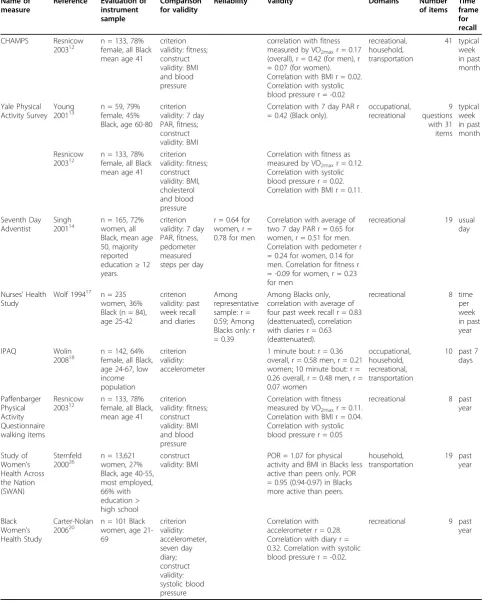
We conducted a systematic literature review to identify publications reporting on the validity of self-report physi-cal activity instruments in samples of Blacks/African Americans. We searched PubMed, PsychInfo, Google Scholar, and CINAHL for reports on the validity of physi-cal activity questionnaires published through February 2010 using the following search terms: physical activity, exercise, questionnaire, survey, self-report, validation stu-dies, validity, socioeconomic status, and reliability. We also gathered manuscripts from the reference lists of searched reports. We then limited the review to self-report instru-ments that had been validated in an adult sample (age 18 and older) with at least 20% representation of self identi-fied Blacks or African Americans. This search yielded 14 manuscripts validating 15 different instruments. We limited the final sample to studies that were all Black or reported results separately for Blacks if more than one racial/ethnic group was included. This resulted in the inclusion of 10 instruments from nine manuscripts (Table 1). In studies where the reliability of the instrument was also evaluated, we also include that information. We reviewed the reports for validity, sample size and content, and comparison measure. We included both criterion validity against a second instrument considered to be of superior quality (i.e., a gold standard) and construct valid-ity against a related construct (e.g., blood pressure). We reviewed instrument item content as pertaining to recreational (including leisure, sport or purposeful physical activity), occupational (i.e. work), transportation, and household (including yardwork, caretaking and domestic cleaning and maintenance activities) domains.
Results
Criterion validity was available for eight instruments (Community Healthy Activities Model Program for Seniors (CHAMPS)[16], Yale Physical Activity Survey
[16,17], Seventh Day Adventist [18], Nurses’ Health
Table 1 Reliability and Validity of Self-Report Physical Activity Instruments in Blacks
Name of measure
Reference Evaluation of instrument sample
Comparison for validity
Reliability Validity Domains Number of items Time frame for recall CHAMPS Resnicow
200312 n = 133, 78%female, all Black mean age 41
criterion validity: fitness; construct validity: BMI and blood pressure
correlation with fitness measured by VO2maxr = 0.17 (overall), r = 0.42 (for men), r = 0.07 (for women). Correlation with BMI r = 0.02. Correlation with systolic blood pressure r = -0.02
recreational, household, transportation 41 typical week in past month Yale Physical Activity Survey Young 200113
n = 59, 79% female, 45% Black, age 60-80
criterion validity: 7 day PAR, fitness; construct validity: BMI
Correlation with 7 day PAR r = 0.42 (Black only).
occupational, recreational 9 questions with 31 items typical week in past month Resnicow
200312 n = 133, 78%female, all Black mean age 41
criterion validity: fitness; construct validity: BMI, cholesterol and blood pressure
Correlation with fitness as measured by VO2maxr = 0.12. Correlation with systolic blood pressure r = 0.02. Correlation with BMI r = 0.11.
Seventh Day Adventist
Singh
200114 n = 165, 72%women, all Black, mean age 50, majority reported education≥12 years.
criterion validity: 7 day PAR, fitness, pedometer measured steps per day
r = 0.64 for women, r = 0.78 for men
Correlation with average of two 7 day PAR r = 0.65 for women, r = 0.51 for men. Correlation with pedometer r = 0.24 for women, 0.14 for men. Correlation for fitness r = -0.09 for women, r = 0.23 for men
recreational 19 usual day
Nurses’Health Study
Wolf 199417 n = 235 women, 36% Black (n = 84), age 25-42 criterion validity: past week recall and diaries Among representative sample: r = 0.59; Among Blacks only: r = 0.39
Among Blacks only, correlation with average of four past week recall r = 0.83 (deattenuated), correlation with diaries r = 0.63 (deattenuated).
recreational 8 time per week in past year
IPAQ Wolin
200818 n = 142, 64%female, all Black, age 24-67, low income population
criterion validity: accelerometer
1 minute bout: r = 0.36 overall, r = 0.58 men, r = 0.21 women; 10 minute bout: r = 0.26 overall, r = 0.48 men, r = 0.07 women
occupational, household, recreational, transportation
10 past 7 days Paffenbarger Physical Activity Questionnaire walking items Resnicow
200312 n = 133, 78%female, all Black, mean age 41
criterion validity: fitness; construct validity: BMI and blood pressure
Correlation with fitness measured by VO2maxr = 0.11. Correlation with BMI r = 0.04. Correlation with systolic blood pressure r = 0.05
recreational 8 past year
Study of Women’s Health Across the Nation (SWAN)
Sternfeld
200026 n = 13,621women, 27% Black, age 40-55, most employed, 66% with education > high school construct validity: BMI
POR = 1.07 for physical activity and BMI in Blacks less active than peers only. POR = 0.95 (0.94-0.97) in Blacks more active than peers.
household, transportation
19 past year
Black Women’s Health Study
Carter-Nolan 200620
n = 101 Black women, age 21-69 criterion validity: accelerometer, seven day diary; construct validity: systolic blood pressure Correlation with accelerometer r = 0.28. Correlation with diary r = 0.32. Correlation with systolic blood pressure r = -0.02.
Samples varied in size from 59 to 404. Only four studies included information on the socioeconomic status of the study sample [18,20,22,24].
In general, criterion validity correlations tended to be low to moderate, ranging from 0.12 to 0.83. The highest corre-lations were reported between the Nurses’Health Study instrument and the average of four weekly recalls (r = 0.83) [19], the Seventh Day Adventist instrument and the aver-age of two physical activity recalls (r = 0.65 in women, r = 0.51 in men) [18], the Health Professionals Follow Up Study [21] and Nurses’Health Study [19] instruments cor-relating with physical activity diaries (r for both = 0.63) and the Yale Physical Activity Survey correlating with a seven-day physical activity recall (r = 0.42) [17]. With the excep-tion of the Yale instrument, which measures occupaexcep-tional, recreational and household activities, these instruments measure only recreational physical activity.
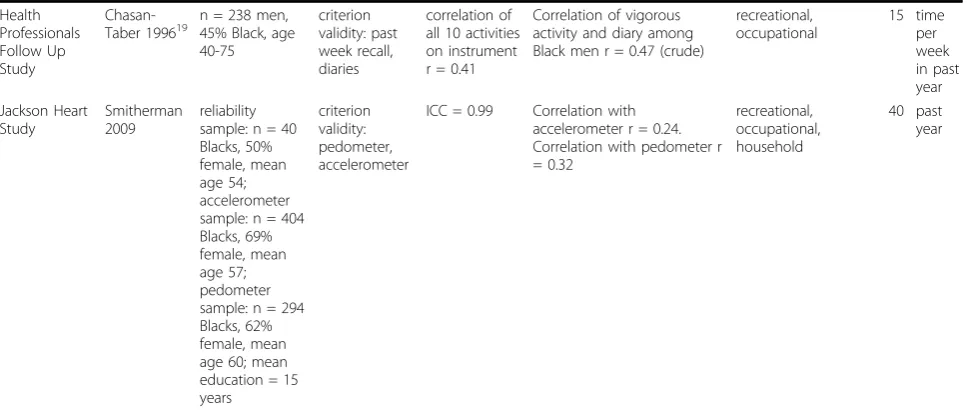
For self-report instruments correlated against fitness, the highest correlation was for the CHAMPS (r = 0.17) against VO2max [16]. The highest correlations against an objective device were the IPAQ [20], which was moder-ately correlated with accelerometer using a one-minute bout (r = 0.36), the Jackson Heart Study instrument [22], which was moderately correlated with pedometer-measured steps (r = 0.32) and accelerometer (r = 0.24) and the Black Women’s Health Study [23], which had a moderate correlation with accelerometry (r = 0.28). The correlation with accelerometry was lower when the IPAQ was evaluated using a 10-minute bout length and among women [20].
Construct validity data was available for one instru-ment that did not also have criterion validity data.
Construct validity measures we considered include phy-sical function (i.e. activities of daily living), body mass index (BMI), and blood pressure. The Study of Women’s Health Across the Nation (SWAN) used BMI for con-struct validity [24]. Correlations with physical activity were high.
Reliability was assessed for four instruments and cor-relations were generally moderate ranging from 0.39 for
the Nurses’Health Study instrument [19] assessed two
years apart to 0.78 among men for the Seventh Day Adventist instrument [18] delivered six weeks apart. The Jackson Heart Study had an ICC of 0.99 for administra-tions two weeks apart [22].
Three instruments (Yale Physical Activity Survey [17], Nurses’Health Study[19] and Health Professionals Fol-low-up Study[21]) included both Blacks and Whites in the same sample and reported the validity of the instru-ment separately for each. Correlations were higher for Black women (r = 0.63) than White women (r = 0.56) for the Nurses’Health Study instrument [19], but were lower among Black men (r = 0.47) than White men (r = 0.58) for the Health Professional’s Follow-Up study [21]. In the largely female Yale Physical Activity Survey sample, the correlation was stronger among Blacks (r = 0.42) than among non Blacks (r = 0.30) [17]. No study directly com-pared the validity of multiple instruments in a Black sam-ple as has been done for high socioeconomic status Whites [25] and older adults [26].
Discussion
Few studies have evaluated the validity of physical activ-ity instruments among Blacks. Of the 25 self-report Table 1: Reliability and Validity of Self-Report Physical Activity Instruments in Blacks(Continued)
Health Professionals Follow Up Study
Chasan-Taber 199619 n = 238 men,45% Black, age 40-75
criterion validity: past week recall, diaries
correlation of all 10 activities on instrument r = 0.41
Correlation of vigorous activity and diary among Black men r = 0.47 (crude)
recreational, occupational
15 time per week in past year Jackson Heart
Study
Smitherman 2009
reliability sample: n = 40 Blacks, 50% female, mean age 54; accelerometer sample: n = 404 Blacks, 69% female, mean age 57; pedometer sample: n = 294 Blacks, 62% female, mean age 60; mean education = 15 years
criterion validity: pedometer, accelerometer
ICC = 0.99 Correlation with accelerometer r = 0.24. Correlation with pedometer r = 0.32
recreational, occupational, household
40 past year
instruments for adults included in a 1997 review[27], only two[16,17] have been validated in Blacks. While several instruments that have been validated since this review have been validated in Blacks (9 total instru-ments have now been validated in Blacks), a substantial gap remains with numerous instruments lacking valida-tion in samples of Black adults. As a result, there is little evidence either supporting or negating the validity of self-report instruments for Black populations.
Three of the instruments (Black Women’s Health
Study, Jackson Heart Study, IPAQ) reported moderate correlations with accelerometer-measured physical activ-ity. None of these has been validated in a single sample that included Blacks and Whites for direct comparison, though both the IPAQ and the Black Women’s Health Study instrument (which, as noted, is nearly identical to
that used in the Nurses’Health Study) have been
vali-dated in Whites in other studies. Only the IPAQ has been validated in a lower socioeconomic status, predomi-nately Black population. Thus, given the available data, there is good evidence for recommending semi-quantita-tive questionnaires like those used in the Black Women’s Health Study (which was an adaptation of that used in
the Nurses’ Health Study and Health Professionals
Follow-up Study), particularly when a shorter assessment format is desired. While also relatively brief at 10 items, the IPAQ performed well and can only be recommended among men, but not women. The more detailed and lengthy Jackson Heart Study instrument also performed well. The extent to which these measures can reliably assess change in physical activity among Black samples remains largely unexplored.
We hypothesized that instruments may perform differ-ently in Blacks because the sample activities may not be salient or the instruments may not capture the relevant domains. In fact the data suggested including multiple domains did not improve validity, the instruments with
the highest criterion validity (Nurses’ Health Study,
Seventh Day Adventist) measure only recreational physi-cal activity. More detailed interviewer administered instruments like the IPAQ and Jackson Heart Study measure across domains with similar moderate criterion validity scores. Thus, the presence of more items or examples and domains did not result in higher validity scores.
The lack of brief instruments to validly measure physi-cal activity in Blacks constitutes a significant gap. The Black Women’s Health Study instrument contains nine items, but the Jackson Heart Study includes 40. None of the studies evaluated the ability of the self-report instru-ment to validly measure change in physical activity, as would be needed in an intervention setting, marking another major gap in the literature. Few studies evalu-ated the reliability of the self-report instruments,
highlighting another area for future research. In addi-tion, to evaluate the ability of self-report instruments to accurately measure physical activity in Blacks on a population level, validation sample populations need to also be diverse across socioeconomic status - something that has not been well demonstrated (or well documen-ted) in many samples to date. Wolin et al specifically recruited low socioeconomic status Blacks and found moderate correlation between the IPAQ using a one minute bout length and accelerometry, though correla-tions were lower among women and when using a
longer bout length [20]. The samples in the Nurses’
Health Study and Health Professionals Follow-up Study are of a high socioeconomic status [19,21]. Thus, the example activities listed may have been more salient, independent of race, than they would be for a lower socioeconomic Black sample. These two instruments both identified the salient activities based on those that explained the most variation in a separate sample of high socioeconomic status individuals, the College Alumni Study[28]. In contrast, Rundle et al found low construct validity for an instrument derived from the Harvard Alumni Survey, which also builds on the same source information, in a low socioeconomic status mul-tiethnic urban population [29]. This further highlights the need to consider both race/ethnicity and socioeco-nomic status when evaluating the appropriateness of a self-report instrument. It also suggests that the validity of existing measures may be enhanced by tailoring the example behaviors to better match the target popula-tion, as has been done for some instruments when tai-loring for international populations [30].
An additional gap in the literature on self-report instru-ment validity worth noting is the limited number of vali-dations against objective measures of energy expenditure. The highest validation correlations among Blacks were for instruments validated against more detailed self-report instruments, like diaries. Given that errors between two self-report instruments may be correlated, it is not surprising that correlations are lower when com-paring instruments to non self report measures such as fitness or accelerometer measured physical activity. How-ever, despite this, moderate correlations were found for the IPAQ[20], Black Women’s Health Study [23] and Jackson Heart Study[22] instruments with objective mon-itoring devices such as accelerometers.
to distribute, collect, process, and analyze these data. In longitudinal studies with repeated measures, these costs are often much higher. Many studies for which physical activity is not the primary endpoint will likely contain these costs by relying on self report. Furthermore, self report instruments allow physical activity recommenda-tion messages to be issued in terms that are understand-able to the public, unlike those that may be based on step-counts or metabolic equivalents derived from objective devices. Thus, self-report measures of physical activity are likely to remain an important research tool for the foreseeable future.
As this review makes clear, greater attention needs to be paid to the population specific validity of self-report instruments. This point as it applies to Hispanic popula-tions was well detailed in a recent review by Martinez et al. [31]. As we detailed above, the wide-scale use of objective devices to measure physical activity is not feasi-ble in many investigations. However, the marginal increased cost associated with including a small validation study of a self-report instrument in samples that include a larger percentage of Blacks is certainly supported by our findings.
Conclusion
A number of well-known physical activity self-report instruments have been validated in Black samples. How-ever, similar to validations in whites, the validity of these instruments as compared to objective or more detailed self-reports remains modest. Contrary to hypothesis, the validity of instruments was generally similar in Blacks and Whites in the same sample. Yet, many well-known and commonly used self-report instruments that were included in a previous review remain unvalidated in Blacks further research is needed to validate physical activity measures used in intervention and epidemiologic studies.
Author details
1Washington University School of Medicine, St. Louis, MO 63110 USA.2Duke University, Durham, NC USA.
Authors’contributions
All authors read and approved the final manuscript. KYW conceived of the study, contributed to the literature review, led the writing of the manuscript. CF conducted the literature review and led the abstraction of study data. NU and HT contributed to the literature review and data abstraction. GGB contributed to the study conceptualization and manuscript preparation and provided critical editorial input to the interpretation of the data.
Competing interests
The authors declare that they have no competing interests.
Received: 16 June 2010 Accepted: 8 October 2010 Published: 8 October 2010
References
1. Sallis JF, Saelens BE:Assessment of physical activity by self-report: status, limitations, and future directions.Res Q Exerc Sport2000,71:S1-14.
2. Floyd MF, Shinew KJ, McGuire FA, Noe FP:Race, Class, and Leisure Activity Preferences: Marginality and Ethnicity Revisited.J Leisure Research1994,
26:158-173.
3. Heesch KC, Masse LC:Lack of time for physical activity:perception or reality for African American and Hispanic women?Women Health2004,
39:45-62.
4. Young DR, Miller KW, Wilder LB, Yanek LR, Becker DM:Physical activity patterns of urban African Americans.J Community Health1998,23:99-112. 5. Ainsworth BE, Irwin ML, Addy CL, Whitt MC, Stolarczyk LM:Moderate
physical activity patterns of minority women: the Cross-Cultural Activity Participation Study.J Womens Health Gend Based Med1999,8:805-813. 6. Airhihenbuwa CO, Kumanyika S, Agurs TD, Lowe A:Perceptions and
beliefs about exercise, rest, and health among African-Americans.Am J Health Promot1995,9:426-429.
7. Henderson KA, Ainsworth BE:Sociocultural perspectives on physical activity in the lives of older African American and American Indian women: a cross cultural activity participation study.Women Health2000,
31:1-20.
8. Henderson KA, Ainsworth BE:Researching leisure and physical activity with women of color: issues and emerging questions.Leisure Sci2001,
23:21-34.
9. Heesch KC, Brown DR, Blanton CJ:Perceived barriers to exercise and stage of exercise adoption in older women of different racial/ethnic groups.Women Health2000,30:61-76.
10. Troiano RP, Berrigan D, Dodd KW, Masse LC, Tilert T, McDowell M:Physical activity in the United States measured by accelerometer.Med Sci Sports Exerc2008,40:181-188.
11. Crespo CJ, Smit E, Andersen RE, Carter-Pokras O, Ainsworth BE:Race/ ethnicity, social class and their relation to physical inactivity during leisure time: results from the Third National Health and Nutrition Examination Survey, 1988-1994.Am J Prev Med2000,18:46-53. 12. Prevalence of fruit and vegetable consumption and physical activity by
race/ethnicity–United States, 2005. MMWR Morb Mortal Wkly Rep2007,
56:301-304.
13. Evenson KR, Rosamond WD, Cai J, Pereira MA, Ainsworth BE:Occupational physical activity in the atherosclerosis risk in communities study.Ann Epidemiol2003,13:351-357.
14. He XZ, Baker DW:Differences in leisure-time, household, and work-related physical activity by race, ethnicity, and education.J Gen Intern Med2005,20:259-266.
15. Prince SA, Adamo KB, Hamel ME, Hardt J, Gorber SC, Tremblay M:A comparison of direct versus self-report measures for assessing physical activity in adults: a systematic review.Int J Behav Nutr Phys Act2008,5:56. 16. Resnicow K, McCarty F, Blissett D, Wang T, Heitzler C, Lee RE:Validity of a
modified CHAMPS physical activity questionnaire among African-Americans.Med Sci Sports Exerc2003,35:1537-1545.
17. Young DR, Jee SH, Appel LJ:A comparison of the Yale Physical Activity Survey with other physical activity measures.Med Sci Sports Exerc2001,
33:955-961.
18. Singh PN, Fraser GE, Knutsen SF, Lindsted KD, Bennett HW:Validity of a physical activity questionnaire among African-American Seventh-day Adventists.Med Sci Sports Exerc2001,33:468-475.
19. Wolf AM, Hunter DJ, Colditz GA, Manson JE, Stampfer MJ, Corsano KA, Rosner B, Kriska A, Willett WC:Reproducibility and validity of a self-administered physical activity questionnaire.Int J Epidemiol1994,
23:991-999.
20. Wolin KY, Heil DP, Askew S, Matthews CE, Bennett GG:Validation of the International Physical Activity Questionnaire-Short among Blacks.J Phys Act Health2008,5:746-760.
21. Chasan-Taber S, Rimm EB, Stampfer MJ, Spiegelman D, Colditz GA, Giovannucci E, Ascherio A, Willett WC:Reproducibility and validity of a self-administered physical activity questionnaire for male health professionals.Epidemiology1996,7:81-86.
22. Smitherman TA, Dubbert PM, Grothe KB, Sung JH, Kendzor DE, Reis JP, Ainsworth BE, Newton RL Jr, Lesniak KT, Taylor HA Jr:Validation of the Jackson Heart Study Physical Activity Survey in African Americans.J Phys Act Health2009,6(Suppl 1):S124-132.
24. Sternfeld B, Cauley J, Harlow S, Liu G, Lee M:Assessment of physical activity with a single global question in a large, multiethnic sample of midlife women.Am J Epidemiol2000,152:678-687.
25. Jacobs DR, Ainsworth BE, Hartman TJ, Leon AS:A simultaneous evaluation of 10 commonly used physical activity questionnaires.Med Sci Sports Exerc1993,25:81-91.
26. Bonnefoy M, Normand S, Pachiaudi C, Lacour JR, Laville M, Kostka T:
Simultaneous validation of ten physical activity questionnaires in older men: a doubly labeled water study.J Am Geriatr Soc2001,49:28-35. 27. Kriska AM, Caspersen CJ:Introduction to a Collection of Physical Activity
Questionnaires.Med Sci Sports Exerc1997,28:5-9.
28. Pereira MA, FitzerGerald SJ, Gregg EW, Joswiak ML, Ryan WJ, Suminski RR, Utter AC, Zmuda JM:A collection of Physical Activity Questionnaires for health-related research.Med Sci Sports Exerc1997,29:S1-205.
29. Rundle A, Hagins M, Orjuela M, Mooney L, Kim M, Perera F:Traditional physical activity indexes derived from the Harvard alumni activity survey have low construct validity in a lower income, urban population.J Urban Health2007,84:722-732.
30. Martinez-Gonzalez MA, Lopez-Fontana C, Varo JJ, Sanchez-Villegas A, Martinez JA:Validation of the Spanish version of the physical activity questionnaire used in the Nurses’Health Study and the Health Professionals’Follow-up Study.Public Health Nutr2005,8:920-927. 31. Martinez SM, Ainsworth BE, Elder JP:A review of physical activity
measures used among US Latinos: guidelines for developing culturally appropriate measures.Ann Behav Med2008,36:195-207.
doi:10.1186/1479-5868-7-73
Cite this article as:Wolinet al.:Physical activity in US Blacks: a systematic review and critical examination of self-report instruments.
International Journal of Behavioral Nutrition and Physical Activity20107:73.
Submit your next manuscript to BioMed Central and take full advantage of:
• Convenient online submission
• Thorough peer review
• No space constraints or color figure charges
• Immediate publication on acceptance
• Inclusion in PubMed, CAS, Scopus and Google Scholar • Research which is freely available for redistribution