Shi, M., Zhu, W., Yang, H. and Li, C. (2016) 'Applying semantic
web and big data techniques to construct a balance model
referring to stakeholders of tourism intangible cultural
heritage’,
International Journal of Computer Applications in
Technology
, 54 (3), pp. 192-200.
Official URL:
http://dx.doi.org/10.1504/IJCAT.2016.10000522ResearchSPAce
http://researchspace.bathspa.ac.uk/
This pre-published version is made available in accordance with
publisher policies.
Please cite the final version using the reference above.
Your access and use of this document is based on your acceptance of the
ResearchSPAce Metadata and Data Policies, as well as applicable
law:-https://researchspace.bathspa.ac.uk/policies.html
Unless you accept the terms of these Policies in full, you do not have permission
to download this document.
This cover sheet may not be removed from the document.
Please scroll down to view the document.
Applying Semantic Web and Big Data techniques to construct a
balance model referring to stakeholders of
tourism intangible cultural heritage
Meiyu Shi1, Wei Zhu2, Hongji Yang3 and Chen Li4
1,2 Tourism Institute, Beijing Union University, Beijing 100101, China 3,4Centre for Creative Computing, Bath Spa University, UK
Email: {shimeiyu72, wzhu83}@163.com, {h.yang, c.li2}@bathspa.ac.uk
Abstract: Currently, intangible cultural heritage is a popular topic in the field of tourism research. The development of tourism intangible cultural heritage, by its very nature, is the process of society construction by stakeholders through their transaction, coordination, interest alienation and sharing the responsibility. Coordinating and balancing the interest conflict within every stakeholder to achieve the "Pareto Optimality" is a major difficulty in the tourism intangible cultural heritage development. In another side, Semantic web is a computer term that is known of its efficiency in knowledge representation of concepts. In this paper, we applied semantic web into modeling the balance model of stakeholders of tourism intangible heritage in the data collecting process including data acquisition from entire network combining with structural equation method and path analysis based on a big data platform and questionnaire design, which is the innovative attempt to integrate these two typical computer technologies into social scientific research. Further analysis of the final constructed model demonstrates the effectiveness of the proposed application.
Keywords: Semantic web, big data, stakeholders, tourism intangible cultural heritage
Biographical notes: Meiyu Shi received her B. Sc. and M. Sc. degrees in economic from the Jilin University, China, in 1990 and 1997, respectively, and the Ph.D. degree in economic from Graduate School of Chinese Academy of Social Sciences, China in 2003. Currently, she is the Professor at the Tourism Institute of Beijing Union University, China. She has published about 40 refereed journal and conference papers. Her research interest covers Intangible Cultural Heritage Tourism Development, Tourism Shopping and Tourism Products Development, Convention and Exhibition Tourism, Tourism Destination Marketing, etc.
Wei Zhu is currently a Lecturer of Tourism Institute, Beijing Union University. He received his Ph.D in Computer Science and Computer Engineering from La Trobe University in Australia in 2013. His current research interests include artificial intelligent and data mining in tourism.
Hongji Yang received his B. Sc. and M. Sc. degrees in Computer Science from Jilin University, China, in 1982 and 1985, respectively, and Ph. D. degree in computing from Durham University, UK in 1994. Currently, he is a professor at Centre for Creative Computing, Bath Spa University, UK. He has published well over 300 refereed journal and conference papers. His research interest covers Software Engineering, Creative Computing, Web and Distributed Computing. Prof. Yang became IEEE Computer Society Golden Core Member in 2010. He is the Editor in Chief of International Journal of Creative Computing, InderScience.
Chen Li received his B. Sc. degree in Computer Science and Technology from University of Science and Technology of China, China, in 2003, M. Sc. degree in Computer Applications Technology from the University of Shanghai for Science and Technology, China, in 2010, and Ph. D. degree in Computer Science and Technology from Shanghai Jiao Tong University, China in 2015. Currently, he is a postdoctoral research assistant in School of Humanities And Cultural Industries at Bath Spa University, UK. He has published about 28 refereed journal and conference papers. His research interest covers
software architecture, software reliability and formal methods.
1. Introduction
1.1 Introduction to big data and semantic web Rigorous academic work needs the support of high quality data, however, different from natural scientific researchers who could obtain data from
laboratories, social scientific researchers
encounter the problems to collect high quality data since the investigating samples are always dispersed and not easy to collect. Fortunately, the new developed technology of computer science provides an alternative way to solve the problem, i.e., Big Data. Currently, there is not a uniform definition for big data, to our opinion; big data is a kind of spirit that collecting and exploring all the data produced from any fields to support making smarter decisions and predictions. Undoubtedly, big data technology will bring tremendous innovation in scientific research, which can be seen not only from the report from Computing Community Consortium in 2008:
“Data computing: Creating revolutionary
breakthroughs in commerce, sciences and society” [1], but also from the special issues of Nature and Science, titled by “Big Data” and “Dealing with data”, in 2008 and 2011 respectively.
Regarding of tourism filed, big data has brought great opportunities to tourism industry with the arising of large amounts of data each year [2, 3]. First of all, big data provides a comprehensive insight based on big data spread, while tourism data has been looked at and analysed in an isolated way before big data appears. Secondly, through collecting integrated information from various resources, such as the Internet, tourism industries and organisations could learn a lot about customer preferences from individual travelers and thus make efficient and right decisions on tourism marketing and advertisements. However, despite such advantages can be delivered from the use of big data, this new technology is still not widely used in tourism industry because of certain technical challenges. Regarding this issue, Amadeus identified the challenges that need to be addressed on applying big data to tourism industry on The Big Data Report, which are “Fragment of data, Technology complexity, Data accuracy, Right of use, Business and technology alignment and need for data
specialists”. Therefore, how to reasonably apply big data technology into tourism research, e.g., intangible cultural heritage study is a problem, which should be addressed. Due to the difference between scientific research and social scientific research, integrating resources collected from both of the two kinds of research approaches can be an alternative way to improve the effectiveness of data, such as integrating the data fetching from big data platform and data from questionnaires, which are the resources used in the following analysis in this paper.
Semantic web is a computer term that is known of its efficiency in knowledge representation of concepts. A typical semantic web consists of interconnected arcs and nodes that can be organised as a taxonomic hierarchy. Previous papers have shown significant applications of semantic web on analysing words in texts by developing various algorithms, which mainly includes analyses of meaning of networks and social networks [4-6]. With the development of semantic web, the theory is not only applied in information retrieval tasks in computer sciences and linguistics [7-9], but also wildly implemented on social scientific research, i.e., Friederike [10] explores cultural variations in managers’ interpretations of worker participation process. Schultz et al [11] uses a semantic web approach to analyse the interplay of public relations and news in crisis situations. Semantic web is becoming popular in tourism research during these years, i.e. Pan and Fesenmaier [12] apply semantic web to explore the tourist behavior in micro level based on analysing travel blogs. Dimitris and Alkiviadis [13] proposes a metadata model encoding semantic tourism destination information in a RDF-based P2P network architecture. Ángel et al develops a hotel recommendation expert system based on semantic analysing customer experience.
Thus, the key challenges of this paper can be summarised as follows: 1) how to collect, abstract and integrate the information from the data fragment to provide a comprehensive insight for intangible cultural heritage study, 2) how to combine the semantic web to obtain the interaction information according to the relationship among the stakeholders and the tourism intangible heritage, and 3) how to
implement a big data platform and questionnaire design to construct stakeholder balance model. Comparing to former research, our work first integrates semantic web and big data theory and introduces them into tourism intangible cultural heritage study. To be specific, we leverage semantic web techniques and big data techniques to help collect data, and model a balance model of referring to stakeholders of tourism intangible cultural heritage. Then, we further analyse the relationships between stakeholders to demonstrate the effectiveness of the constructed model.
1.2 Introduction to intangible cultural heritage Intangible cultural heritage, as important cultural resources, which has the natural advantage of coupling with the tourism, is becoming one of the most important attractions of travel destination because of its special regional characteristics, strong cultural connotation and colorful entertainment function. However, the intangible cultural heritage relates to many stakeholders including inheritors, community, government, corporation, tourists, specialist, media, civil society and so on during its access to the tourism market. These stakeholders have their own complicated benefit appeals that make up the multi-benefit balance and gaming network.
Efforts have been made by the previous publications on stakeholders from different aspects of tourism management scale [14-17]. In 1980s, Freeman [18] defines the “stakeholder” as “Any group or individual who can affect or be affected by the organisation goal”; he claims that the stakeholder theory should refer to the activity of corporation management the emergence of which is to balance the interest requirement of every interest-related person. Since different interest-related person owns different resources, they will cause different effect to the corporation. The definition and classification by Freeman enriches the content of stakeholder theory, which provides a sound theory basis for the later tourism research based on this theory. Sautter [14] continues the studies based on Freeman’s
stakeholder pedigree, claimed that the
stakeholders around the tourism planner are: community residents, staff, local operator, tourist, government, competitor, national management chain and social community. In 1999, World
Tourism Organisation passed the《The Global
Code of Ethics for Tourism》, officially introduce the concept of “stakeholder”, which made a framework of reference to regulate and inhibit the behaviour of stakeholders and greatly promote the sustainable development of the tourism industry in 21st century, and the “tourism stakeholder” term was derived correspondingly afterward [19], which is a new milestone of the stakeholder theory development in the tourism research field. Specially in tourism intangible cultural heritage research, all the stakeholders in the development of intangible cultural heritage tourism, the inheritor is the core of the stakeholder circle and other stakeholders have multiple relationships around the inheritor [20]. In the development of tourism intangible cultural heritage, the inheritors are individual or community who participate in intangible cultural heritage inheritance directly and make sure the intangible cultural heritage can inherit. Also, inheritors are the central point in the whole stakeholder circle, since other stakeholders have multiple relationships around the inheritors. Government is a special stakeholder, who offers important regulation environment such as law and politics [21], and has the capability to adjust the benefits between other stakeholders. Developers are the major investors in the development of tourism intangible cultural heritage; they pay attention to the excavation of the tourism value and the economic value of intangible cultural
heritage tourism and have complicated
commodity economic relationship with the inheritors. Tourists are the demand of the intangible cultural heritage products [22]; whether satisfy their demand or not determines the lifeblood of the intangible cultural heritage products. What is more important, intangible cultural heritage can get publicity and be promoted through the spread effect of tourists. The popular audience can guide more people to join the protection and inheritance of the intangible cultural heritage. Social community, as the “ground” of the intangible cultural heritage inheritance; their interest appeal is based on improving the life quality to obtain the sense of pride and approval to own culture [23]. Besides, in the process of intangible cultural heritage development, there exist stakeholders such as experts, media and civil society. They have strong
social responsibility in common; their participation can be the backbone of the social supervision and contains the excessive business development possibilities, and this also inevitably brings the appearance of the Vulgarisation phenomenon [24].
The development of tourism intangible cultural heritage is the process of resource allocation and benefit balance [25], as well as the process of society construction by stakeholders through their transaction, coordination, interest alienation and sharing the responsibility. Regarding to the precious tourism intangible cultural heritage resources, how to coordinate and balance the interest conflict among every stakeholder on the basis of protection and to achieve the "Pareto Optimality" is a major obstacle.
2. Methods
2.1 Initialising semantic web for stakeholders of tourism intangible cultural heritage
To prepare for the data collection and modelling, we firstly initialise the semantic web for stakeholders of tourism intangible cultural heritage. As shown in Figure 1, the five groups of stakeholders have direct relationships with tourism intangible cultural heritage (TICH), e.g.
Tourism-visit-TICH, Corporation-invest-TICH,
Inheritor-own-TICH, Expert-support-TICH, and Government-manage-TICH. The relationships determine the directions of the data collection step, that is, the data acquisition process will only collect the online reviews of these five kinds of relationships, and the questionnaire is designed to adjust to collect the information of these five kinds of relationships as well.
[Insert] Figure 1
2.2 Data Collection
As described in Step 2.1, the statistical respondents of questionnaire are classified into different stakeholders such as tourists, inheritors, corporation, government and experts by literature review and interview. The interest appeal of stakeholders of tourism intangible cultural heritage can be recognised, and the questionnaire was designed according to the five kinds of relationships. After Cronbach's Alpha test and Bartlett test, the questionnaire has high level of reliability and validity. From May to November in
2012, 310 questionnaires are distributed to five categories of stakeholders of tourism intangible
[Insert] Table 1
cultural heritage to the aim of tourism intangible cultural heritage products in Beijing, China. 300 questionnaires are returned and the recycling rate is 96.8%.
During the same period, the same collecting process is conducted through a big data platform to capture the comments, news and blogs from tourists and mass media, the snatching rule is set according to the relationships of stakeholders, e.g., only the reviews with the relationships of five objects can be recorded. In this process, we did not apply sentiment analysis because in this paper, we only count the relationships between the five stakeholders, the detailed relationships reflected from User Generated Content (UGC) and public sentiment will be explored in future work. Finally, the amount of online reviews achieves 25,327 after data filtering and cleaning. The integrated of two resources are used on the following analysis.
2.3 Structural equation model
This paper applies the structural equation method and verifies the interest model of stakeholders. The structural equation method belongs to a high level statistical category of multi-variate statistics, reallocates the factorial analysis and path analysis, tests the relationship of dominant variate, latent variable, interfere or errors included in the model at the same time, and obtain the direct, indirect or total effect of independent variables to induced variables.
Structural model is a method to verify, which use the theory to lead and construct the assumption model on this basis. As for the sample size, bigger sample size is better for the structural equation model analysis, which is same as the principle of general inferential statistics. But in the model fitting test, sample size has a large effect on the 2 , the absolute adaption index, when the researcher uses more test samples, the value of 2 is easily to reach the significance level (p<0.05), which shows that the probability for the model to be rejected is increasing, the same as probability of the assumption model not
fitting to the data. From the calculation of factorial variance contribution, we summarised the six main factors for those five stakeholders of tourism intangible cultural heritage, which are the base of path analysis algorithm.
2.4 Path analysis algorithm
Path analysis is a multi-variate statistical technology proposed by the quantitative geneticist, Sewall Wright, which can resolve the effect of independent variables to induced variables to the direct effect and multiple indirect effects, by path diagram, path coefficient and path coefficient of concerns, which can analyse complicated relationship in the multi-variate construction, and provide reliable basis for statistic decision. Path analysis is a structural equation model, which is precise and intuitive. This article uses the path coefficient to study the interest requirement of stakeholders, and verify the hierarchical structural relationship model of stakeholders and the conceptual structure model of the interest requirement of each stakeholders of intangible cultural heritage in Beijing.
In Equation 1 and Equation 2, p0i (i=1,2…m), p0e are the path coefficient of reason and remainder term e to the result y; d0i (i=1,2…m) and d0e are the related path coefficient of
concerns; bi (i=1,2…m) is the regression
coefficient; and S is the standardised deviation. The survey uses the Likert scale and the formula is given below:
[Insert] Table 2, Table 3, Table 4
0 0 0 0 , s s p s s b p e e i i i (1) 2 0 0 2 0 2 0 0 ( ) , ( ) s s d s s b p d e e i i i i (2) In Equation 3, Fn is the sum of quantity amount of choosing n, M the sum of the sample for stakeholder and n (n=1,2,3,4,5) the score. 7 1 ( n / ) n F M n
(3) The programming language of computingprocess is using R based on Agricolae software package. The package Agricolae offers extensive functionality on experimental design and it is designed originally for agricultural and plant breeding experiments, and then is extended to use on other fields. The package provides various analysis facilities for experimental data, e.g., treatment comparison procedures and several non-parametric tests comparison, biodiversity indexes and consensus cluster. Path analysis is one of the functions of this package. The following code shows a sample code of a path analysis procedure. In this study, we needed to determinate the relationship between the six types of stakeholders around six factors, which has described in the above content, e.g., public value, awareness, economic value, environmental value and cultural value.
> mydata <- read.table (file path) # read external file pathanalysis.csv.
> x <- mydata[,-1] # extract independent
variable x1、x2、x3 and x4 from mydata
and assign to x.
> y <- mydata[,1] # extract dependent variable y from mydata and assign to y.
> cor.y <- correlation(y,x)$correlation # compute coefficient of association between vector y and x. Correlation Analysis Method : pearson Alternative: two.sided > cor.x <- correlation(x)$correlation Correlation Analysis Method : pearson Alternative: two.sided
> path.analysis (cor.x,cor.y) #path analysis
3. Results
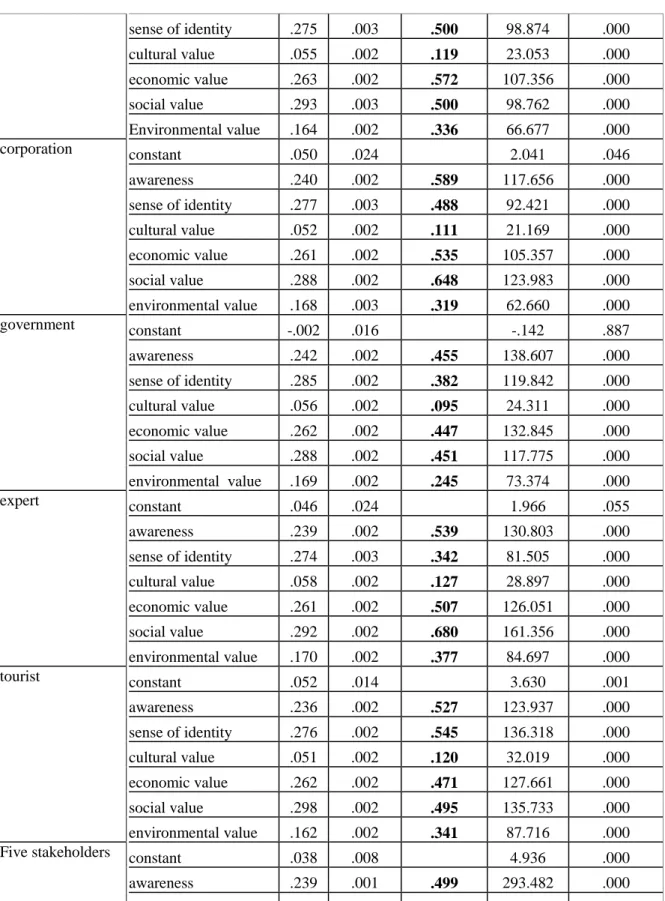
According to the processing results of path analysis algorism, the score of each stakeholder on hierarchical structure model of tourism intangible cultural heritage in Beijing can be obtained. The conceptual structure model can be verified according to the collected data and the obtained score. Considering the recognition and the sense of identity, the path coefficient can be calculated according to five kinds of stakeholders respectively, which is shown in Table 2.
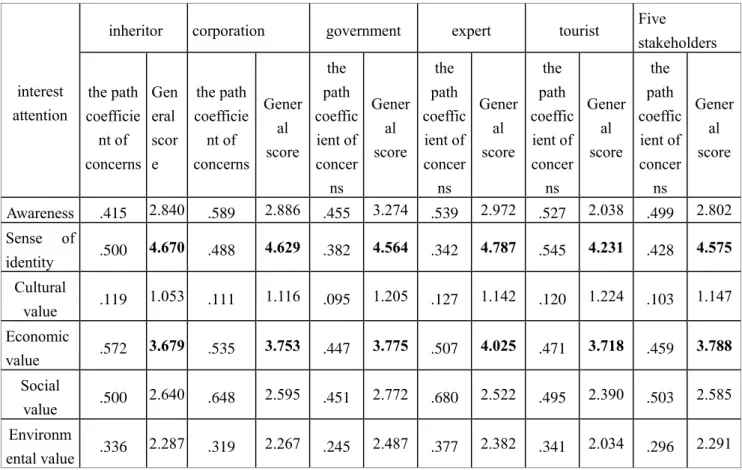
coefficient of concerns of each stakeholder in hierarchical structure model of tourism intangible cultural heritage in Beijing. As shown in Tables 3 and 4, the 6 interest factors, recognition, sense of identity, cultural value, economic value, social value and environmental value, have positive influence on promoting the harmonious development of tourism intangible cultural heritage and the effect of all these requirements can achieve the harmonious tourism development of intangible cultural heritage.
General score, path coefficient of concerns of each stakeholder and path coefficient of concerns between different stakeholders are three main factors to calculate the final path coefficient between stakeholders, which can be used as standard criteria to construct semantic web models for tourism intangible cultural heritage. The final path coefficients of concerns are demonstrated in Table 4. The obtained path coefficient of concerns can be classified into 3 categories: 1-2 is the intimate relationship; 0-1 is the intermediate relationship; -2-0 is the weak relationship.
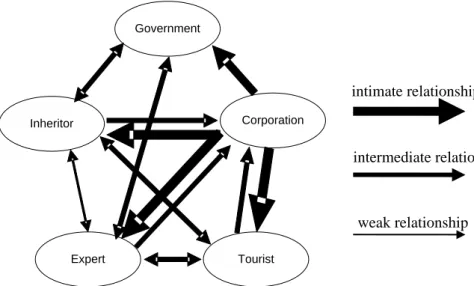
From the process of calculate path coefficient, it can be deducted that the recognition of different stakeholders to the intangible cultural heritage has direct effect on the harmonious development of tourism intangible cultural heritage. As a result, the final semantic web model is constructed finally, which is illustrated in Figure 2.
The above results show that the interest appeal of different stakeholders to cultural, economic, social and environmental value has direct effect on the harmonious development of tourism intangible cultural heritage, while the cultural interest appeal of tourist has the largest effect on the market development and the harmonious development of tourism intangible cultural heritage; the economic interest appeal of expert has the largest effect on the market development and the harmonious development of tourism intangible cultural heritage; and the social and environmental interest appeal of government has the largest effect on the market development and the harmonious development of tourism intangible cultural heritage. When focusing on the semantic web, the degree of interest appeal between each stakeholder has direct effect on
tourism intangible cultural heritage, it
demonstrates that corporation has the tightest appealing relationship with other stakeholders and the appealing relationship between inheritor and expert are the weakest.
4. Implications and Discussions
4.1 Results and analysis of interest appeal of different stakeholders in the tourism intangible cultural heritage
Through the analysis of interest appeal, 5 classes of stakeholders of intangible cultural heritage have strongest recognition to the tourism intangible cultural heritage (the general score is 4.575). Between the interest appeal of all aspects, stakeholders pay more attention to economic value (the general score is 3.788), then social value (the general score is 2.585). In the usage and the development of tourism intangible cultural heritage, the market behavior and representation form indicate that stakeholders pay more attention to economic value of tourism intangible cultural heritage. Besides, stakeholders also pay much attention to the social values, which result may be due to that all stakeholders expect to promote the substantial development of tourism intangible cultural heritage. Despite different stakeholders have a similar profit attention and the degree of attention, but to view specifically, the interest appeals of each stakeholder are different.
4.1.1 Analysis for profit attention of inheritors From the result of interest conceptual test model, an inheritor has a stronger appeal of recognition of the intangible cultural heritage, only next to the appeal of government. From the interest expression factor analytical layer, the inheritor has strong recognition to the intangible cultural heritage, they want to protect the intangible cultural heritage and consider intangible cultural heritage to be the cultural treasure of China and the pride of Chinese, which reflect the high level of recognition and pride of inheritors.
Even though the economic value achieves the most attention of inheritors, compared with other four types of stakeholders, inheritors pay the least attention to the economic value. Since life of many inheritors of intangible cultural heritage is
in or at the edge of a difficult situation, then under the pressure of life, inheritors pays more attention to whether the development of tourism intangible cultural heritage can help them to get rid of the difficult economical situation than the cultural value of intangible cultural heritage. These data reflect that their difficulty and focus. Therefore, admitting the cultural value of intangible cultural heritage and promising the economical situation and the life quality of the inheritor is the most important problem in the protection and usage of tourism intangible cultural heritage culture.
4.1.2 Analysis for profit attention of corporation According to the model data, the recognition of corporation to the intangible cultural heritage is very strong (the general score is 4.629). This result related to the corporation respondents in the data collection. The profit model of these corporations is based on the knowing, using and developing the intangible cultural heritage in Beijing or Chinese traditional culture, During the development and the market sale of the tourism intangible cultural heritage, the corporation can strengthen the recognition to the intangible cultural heritage to push the sale of tourism intangible cultural heritage products.
Besides the economic value is the profit that corporation purchase which coincide with the common judgment. From the profit expression factor analysis, even the social value is not the focus of the corporation, the corporation respondent make donation to improve the social value of intangible cultural heritage; they believe that the protection of original ecology and reality of intangible cultural heritage is necessary. So during the purchase of the economic value, corporations have good social responsibility and show the recognition of keeping original ecology and reality of intangible cultural heritage. Therefore, giving necessary guide and helping to the corporation and representing the original ecology of intangible cultural heritage on the basis of ensuring the economical profit of corporation will receive the approval and support of the corporation.
4.1.3 Analysis for profit attention of government The model data shows that the recognition of government to the intangible cultural heritage has
the highest score among the 5 stakeholders (the general score is 3.274), and this is related to the choice of respondent in this article since here we
select the intangible cultural heritage
administration department of Beijing government as respondent.
Among the four interest values, economical, social and environmental values are the focus of government. In particular, government pays most attention to the social and economic value comparing to other stakeholders. As the leader and regulator of the development of tourism intangible cultural heritage, government approves the social and economic value of intangible cultural heritage such as establishing atmosphere of harmonious social development, strengthening national sense of honor and disgrace, protecting cultural ecological environment, promoting the coordinated development of all aspects and so on, The attention to those value paid by government is important to digging the culture, publicising the national identity and protecting the heritage 4.1.4 Analysis for profit attention of heritage experts
From the identity to the intangible cultural heritage, expert is ranked next to the government on the identity of intangible cultural heritage, and takes the second place of five stakeholders, next to the government on the attention to the environmental value.
The experts focus on the social value and the identity, where they have comprehensive and scientific understanding to the intangible cultural heritage, receive professional training, focus on the practice and hope the social value of intangible cultural heritage can receive deep protection, development and usage, and concern about the harmonious, sustainable development of the society and the heritage of knowledge. 4.1.5 Analysis for profit attention of tourists
Tourists have the strongest interest appeal to the identity of intangible cultural heritage (the general score is 4.231), followed by the economic value (the general score is 3.718). From the profit expression factor analysis, almost all tourists consider that it is necessary for the country or local government to protect and develop the intangible cultural heritage, to respect the cultural
characteristic and to promote multi-culture, and want to help to protect the intangible cultural heritage.
4.2 Result and analysis of interest relationship of different stakeholders in the tourism intangible cultural heritage
According to the path analysis result, the
interest relationship between different
stakeholders can be classified into three categories, and they have close relationships, intermediate relationships and weak relationships. Now the close relationship and weak relationship are given in above tables (the relationship after the effect of other stakeholders are intermediate relationship).
4.2.1 Stakeholders having close relationship The effect of stakeholders who have close relationships all started with corporation, the relationship between corporation and other four stakeholders are close. Motivated by the economical profit, corporations are positive stakeholders in the usage and development of
intangible cultural heritage. During the
development of intangible cultural heritage, corporations use their own advantages to advise inheritors, give constructive suggestions to the product development of intangible cultural
heritage, scientific planning and market
exploitation. During the sale process of tourism intangible cultural heritage products, corporation will focus on the need and preference of tourists and do targeted publicity and sale promotion; the interaction between corporation and tourists is most common and continuously; corporations provide first-hand data and information to the expert for the research use; government plays the role of guiding, which represents that they guide the protection, publicity and supervision of
intangible cultural heritage, and control
corporation by policy and regulations. 4.2.2 Stakeholders having weak relationships
From the analysis of stakeholders who have a weak relationship, i.e., the relationship between the expert and the inheritor, the same as that between the government and the tourist. The reason for this relationship is that there exists little
relevance between the interest appeal of them in the tourism intangible cultural heritage, and little interaction because of the effect of profit attention and the work content.
Even though the inheritor provides experience of practice to make the proposed model more practical during the study of the expert, due to the limitation of communication, the interaction seems less than other relationships, and there is no direct profit relevance between the inheritor and the expert.
Regarding to the relationships of tourists and government, there are two reasons for this weak interaction. Firstly, the policy made by government is not serving to tourists directly. Secondly, tourists rely little on the development of tourism intangible cultural heritage, and thus lack of inner motivation of tourism intangible cultural heritage.
5. Conclusions
This paper constructs a balance model referring to stakeholders of tourism intangible cultural heritage by applying semantic web and big data theory. This is the first try to integrating these two typical computer techniques into social scientific research. Obviously, initialising semantic web of stakeholders of tourism intangible cultural heritage has enormous limited the data collection scale when we conducted data acquisition process in mapping entire network. In questionnaire process, semantic web provides the intrinsic relationship for questionnaire design, which improves the reasonability of analysed results. In the future work, we will further explore the relationships of stakeholders of tourism intangible cultural heritage by proposing sentiment analysis in the process based on the big data platform, which would improve the effectiveness of the modeling of stakeholders of tourism intangible cultural heritage.
Acknowledgment
This work was supported in part by Natural Science Foundation of China (Grant no. 71473018).
References
1. Bryant, R., Katz, R.H. and Lazowska, E.
D. (2008) ‘Big-Data Computing: Creating
Revolutionary Breakthroughs in
Commerce’, Science and Society, pp:1-15.
2. Xiang, Z. and Gretzel, U. (2010) ‘Role of
social media in online travel information
search’, Tourism management, Vol. 31,
No. 2, pp: 179-188.
3. Leung, D., et al. (2013) ‘Social media in tourism and hospitality: A literature review’, Journal of Travel & Tourism
Marketing, Vol. 30, No. 1-2, pp: 3-22.
4. Doerfel, M.L. (1998), ‘What constitutes
semantic network analysis? A comparison
of research and methodologies’
Connections, Vol. 21, No. 2, pp: 16-26.
5. Utigliano, L.(2007) ‘Mergent
communication networks as civic
journalism’, Blogging, citizenship, and the
future of media, pp: 225-237.
6. Doerfel, M. L. and Barnett, G. A. (1999) ‘A semantic network analysis of the
International Communication
Association’, Human Communication
Research, Vol. 25, No. 4, pp: 589-603.
7. Laallam, F. Z., Kherf, M. L. and
Benslimane, S. M. (2014) ‘A survey on the complementarity between database and ontologies: principles and research areas’,
International Journal of Computer
Applications in Technology, Vol. 49, No. 2, pp: 166-187.
8. Godfrey Winster, S. and Swamynathan, S. (2014) ‘Ontology-based blog collection and profile-based personalised
ranking’, International Journal of
Computer Applications in Technology,
Vol. 49, No. 1, pp: 69-79.
9. Maheswari, S. and Karpagam, G. R. (2015) ‘Enhancing Fuzzy Topsis for web service selection’, International Journal of
Computer Applications in Technology,
Vol. 51, No.4, pp: 344-351.
10. Stohl, C.(1993) ‘European managers’
interpretations of participation’, Human
Communication Research, Vol. 20, No. 1,
pp: 97-117.
11. Schultz, F., et al. (2012) ‘Strategic framing
in the BP crisis: A semantic network
analysis of associative frames’, Public
Relations Review, Vol. 38, No. 1, pp: 97-107.
12. Pan, B., MacLaurin, T. and Crotts, J. C. (2007) ‘Travel blogs and the implications
for destination marketing’, Journal of
Travel Research, Vol. 46, No. 1, pp: 35-45.
13. Kanellopoulos, D.N. and Panagopoulos,
A. A. (2008) ‘Exploiting tourism destinations’ knowledge in an RDF-based
P2P network’, Journal of Network and
Computer Applications, Vol. 31, No. 2, pp:
179-200.
14. Sautter, E.T. and Leisen, B. (1999)
‘Managing stakeholders a tourism
planning model’, Annals of tourism
research, Vol. 26, No. 2, pp: 312-328.
15. Choi, H.C. and Sirakaya, E. (2006)
‘Sustainability indicators for managing
community tourism’, Tourism
management, Vol. 27, No. 6, pp:
1274-1289.
16. McKercher, B., Ho, P.S. and du Cros,
H.(2005) ‘Relationship between tourism
and cultural heritage management:
evidence from Hong Kong’, Tourism
Management, Vol. 26, No. 4, pp: 539-548.
17. Du Cros, H. (2001) ‘A new model to assist
in planning for sustainable cultural heritage tourism’, International Journal of Tourism Research, Vol.3, No. 2, pp: 165-170.
18. Freeman, R. E.(1983) ‘Strategic
management: A stakeholder approach. Advances in strategic management’, Vol. 1, No. 1, pp: 31-60.
19. Holden, A.(2003) ‘In need of new
environmental ethics for tourism?’, Annals
of Tourism Research, Vol. 30, No. 1, pp: 94-108.
20. Shi, M.Y. and Sun, M. (2010) ‘Discussion
about Three Key Components in the Utilization of Intangible Cultural Heritage Tourism——Based on An Empirical Study of Beijing’, Tourism Tribune, Vol. 25,
No. 6, pp: 50-56.
21. Bingham, L. B., Nabatchi, T. and O'Leary,
and processes for stakeholder and citizen participation in the work of government’,
Public administration review, Vol. 65, No.
5, pp: 547-558.
22. Vidal González, M. (2008) ‘Intangible
heritage tourism and identity’, Tourism
Management, Vol. 29, No. 4, pp: 807-810.
23. Kurin, R.(2003) ‘Safeguarding intangible
cultural heritage in the 2003 UNESCO Convention: a critical appraisal’, Museum international, Vol. 56, No. 1‐2, pp: 66-77.
24. Quan, Q. and Zeng, Y. (2012) ‘Research
on Digital Protection of the Intangible Cultural Heritage in Three Gorges Area’,
Proc. International Symposium on
Computational Intelligence and Design,
pp:515-518.
25. Rizzo, I. and Throsby, D.(2006) ‘Cultural heritage: economic analysis and public
policy’, Handbook of the Economics of Art
tourism intangible cultural heritage Tourists Inheritor Government Corporation Expert visit invest manage own support
Figure 1 The stakeholders of tourism intangible cultural heritage
Government Expert Corporation Inheritor Tourist intermediate relationship intimate relationship weak relationship
Figure 2 Semantic network of stakeholders of tourism intangible cultural heritage Table 1 Factorial variance contribution of stakeholders
factor
Factorial variance contribution
characteristic value variance contribution rate% cumulative variance contribution rate % Public value 5.842 14.250 14.250 Awareness 5.037 12.286 26.536 Economic value 4.593 11.203 37.738 Sense of identity 4.216 10.283 48.021 Environmental value 2.436 5.942 53.963 Cultural value 1.632 3.979 57.942
Table 2 Standard path coefficient of five kinds of stakeholders
stakeholders Factors Non-standard error Standard coefficient T Sig. B standard error Beta inheritor constant s .044 .021 2.083 .042 awareness .240 .003 .415 85.732 .000
sense of identity .275 .003 .500 98.874 .000 cultural value .055 .002 .119 23.053 .000 economic value .263 .002 .572 107.356 .000 social value .293 .003 .500 98.762 .000 Environmental value .164 .002 .336 66.677 .000 corporation constant .050 .024 2.041 .046 awareness .240 .002 .589 117.656 .000 sense of identity .277 .003 .488 92.421 .000 cultural value .052 .002 .111 21.169 .000 economic value .261 .002 .535 105.357 .000 social value .288 .002 .648 123.983 .000 environmental value .168 .003 .319 62.660 .000 government constant -.002 .016 -.142 .887 awareness .242 .002 .455 138.607 .000 sense of identity .285 .002 .382 119.842 .000 cultural value .056 .002 .095 24.311 .000 economic value .262 .002 .447 132.845 .000 social value .288 .002 .451 117.775 .000 environmental value .169 .002 .245 73.374 .000 expert constant .046 .024 1.966 .055 awareness .239 .002 .539 130.803 .000 sense of identity .274 .003 .342 81.505 .000 cultural value .058 .002 .127 28.897 .000 economic value .261 .002 .507 126.051 .000 social value .292 .002 .680 161.356 .000 environmental value .170 .002 .377 84.697 .000 tourist constant .052 .014 3.630 .001 awareness .236 .002 .527 123.937 .000 sense of identity .276 .002 .545 136.318 .000 cultural value .051 .002 .120 32.019 .000 economic value .262 .002 .471 127.661 .000 social value .298 .002 .495 135.733 .000 environmental value .162 .002 .341 87.716 .000
Five stakeholders constant .038 .008 4.936 .000
awareness .239 .001 .499 293.482 .000 sense of identity .278 .001 .428 252.829 .000 cultural value .054 .001 .103 59.665 .000 economic value .262 .001 .459 272.209 .000 social value .292 .001 .503 294.227 .000 environmental value .167 .001 .296 174.992 .000
interest attention
inheritor corporation government expert tourist Five
stakeholders the path coefficie nt of concerns Gen eral scor e the path coefficie nt of concerns Gener al score the path coeffic ient of concer ns Gener al score the path coeffic ient of concer ns Gener al score the path coeffic ient of concer ns Gener al score the path coeffic ient of concer ns Gener al score Awareness .415 2.840 .589 2.886 .455 3.274 .539 2.972 .527 2.038 .499 2.802 Sense of identity .500 4.670 .488 4.629 .382 4.564 .342 4.787 .545 4.231 .428 4.575 Cultural value .119 1.053 .111 1.116 .095 1.205 .127 1.142 .120 1.224 .103 1.147 Economic value .572 3.679 .535 3.753 .447 3.775 .507 4.025 .471 3.718 .459 3.788 Social value .500 2.640 .648 2.595 .451 2.772 .680 2.522 .495 2.390 .503 2.585 Environm ental value .336 2.287 .319 2.267 .245 2.487 .377 2.382 .341 2.034 .296 2.291
Table 4 Final path coefficient of concerns of stakeholders
stakeholders The final path
coefficient of concerns
stakeholders The final path
coefficient of concerns
left right left right
inheritor corporation 1.414 government inheritor 0.053 government 0.016 corporation 1.163 expert -0.447 expert 0.187 tourist 0.029 tourist -0.427 corporation inheritor 0.545 expert inheritor -0.068 government 0.138 corporation 1.929 expert 0.279 government 0.150 tourist 0.004 tourist 0.127 tourist inheritor 0.440 cooperation 1.713 government -1.910 expert 0.706