Designing a Self-Optimization System for Cognitive
Wireless Home Networks
Elena Meshkova, Zhou Wang, Krisakorn Rerkrai, Junaid Ansari, Jad Nasreddine, Member, IEEE,
Daniel Denkovski, Tim Farnham, Member, IEEE, Janne Riihijärvi , Member, IEEE,
Liljana Gavrilovska, Senior Member, IEEE, and Petri Mähönen
Abstract—In this paper, we describe the design and implementation of an extensible and flexible self-optimization framework for cognitive home networks that employs cogni-tive wireless networking and agent-based design principles. We provide a “first-principles” derivation of its architecture based on a careful analysis of user requirements on wireless home networks (WHNs), state the related design objectives and con-straints, and address those in the context of present-day and emerging radio platforms. We utilize the cognitive resource manager as an architecture of the individual agents. This archi-tecture serves as a “constraint that de-constrains,” i.e., it allows achieving high system flexibility, while providing structural con-straints to ensure robustness. We show that the designed system is capable of solving complex utility maximization problems constrained with user, operator, and regulatory policies in the crowded ISM bands. The system successfully operates on an extensible parameter configuration space across multiple protocol layers. For example, the prototype employs diverse optimiza-tion algorithms, and can also benefit from radio environment map information on primary transmitters propagated through the integrated policy mechanism. The proposed system deliv-ers both efficient and robust radio resource management, and enables comfortable WHN experimentation by providing exten-sibility of sensory inputs, actuation parameters, and optimization algorithms.
Index Terms—Wireless home networks, self-optimization, cog-nitive radio, cogcog-nitive resource management, radio environment map.
I. INTRODUCTION
T
HE POPULARITY of wireless communications systems for home networking is rapidly growing along with theManuscript received December 29, 2016; revised May 26, 2017 and September 3, 2017; accepted September 11, 2017. Date of publication September 21, 2017; date of current version December 22, 2017. This research was benefiting from German Research Foundation (DFG) funding through the UMIC research center of RWTH Aachen University. We also acknowledge partial funding from EU ACROPOLIS project. The associate editor coordi-nating the review of this paper and approving it for publication was A. B. MacKenzie. (Corresponding author: Janne Riihijärvi.)
E. Meshkova, K. Rerkrai, J. Ansari, J. Riihijärvi, and P. Mähönen are with the Institute for Networked Systems, RWTH Aachen University, 52072 Aachen, Germany (e-mail: [email protected]).
Z. Wang is with European Microsoft Innovation Centre, 80538 Munich, Germany.
J. Nasreddine is with the Institute for Networked Systems, RWTH Aachen University, 52072 Aachen, Germany, and also with Department of Electrical and Computer Engineering, Rafik Hariri University, Mechref 2010, Lebanon. D. Denkovski and L. Gavrilovska are with the Faculty of Electrical Engineering, Ss. Cyril and Methodius University of Skopje, Skopje 1000, Macedonia.
T. Farnham is with the Telecommunications Research Laboratory, Toshiba Research Europe Ltd., Bristol BS1 4ND, U.K.
Digital Object Identifier 10.1109/TCCN.2017.2755010
user demand for diverse high quality telecommunications services. In 2020, the number of devices for home usage equipped with Wi-Fi interfaces is expected to exceed 1.5 billion units in terms of PCs and tablets alone, with more than half of mobile traffic being offloaded over Wi-Fi as well [1]. The increasing adoption of wireless interfaces cre-ates new usage models, like wireless content sharing and streaming between home media appliances. This also results in dense and poorly predictable wireless home environments. Wireless interference is already becoming an increasingly serious problem, and the utilization of especially ISM spec-trum bands is constantly increasing [2]. However, current network management solutions do not sufficiently assist non-professional users to efficiently setup and maintain wireless home networks. For example, Wi-Fi networks are often con-figured to operate on a single fixed channel that is selected at system startup or at periodic intervals, and route all the traffic through an Access Point (AP). These are clearly sub-optimal solutions in a dynamic environment. The emergence of small cells and 5G system deployments and alternative wireless access technologies such as mm-Wave solutions will further complicate the management and optimization of home networks.
The increasing complexity of future wireless networks makes self-organization an important networking require-ment. Self-organization can be achieved through a system that autonomously manages wireless home networks
fulfill-ing changfulfill-ing user needs in dynamic operational conditions.
Preferably, this system should be minimally complex and pro-vide high levels of flexibility and evolvability to incorporate the likely short- and long-term changes in user demands, opera-tional environment, and list of desired services or applications. In this article we derive from first principles a design of a self-optimizing framework for wireless home networks, called Home Cognitive Resource Manager (HCRM), and evaluate the resulting prototype implementation. The framework pri-marily focuses on radio-resource management aspects of the network control, also employing cross-layer adaptation, utility-based reasoning, and complying to policy regulations that, among others, are also derived using radio environment maps (REMs) [3], [4]. The HCRM design aims to serve as “con-straint that de-constrains” [5] the self-optimization process, allowing for both robust and efficient stakeholders service, as well as easy system extensibility and upgrade possibili-ties. We apply the HCRM in this paper specifically on Wi-Fi networks due to their dominance in present-day deployments,
2332-7731 c2017 IEEE. Personal use is permitted, but republication/redistribution requires IEEE permission. See http://www.ieee.org/publications_standards/publications/rights/index.html for more information.
availability of mature platforms for prototyping, and since ISM bands due to their complex usage patterns and several coexisting wireless technologies provide the most challenging environment for testing any self-optimizing systems. However, we strongly emphasize that our framework is generic and other wireless technologies can be incorporated with ease. In partic-ular, any new wireless technology needs to simply implement an instance of a generic interface (the Unified Link-Layer API, or ULLA, described in more detail in the following section) while the rest of the HCRM design and implementation is entirely generic.
We demonstrate that exploitation of the chosen architectural principles leads to an efficient, robust, and flexible system. The HCRM is comfortable to the end users, accommodates for operator demands through policy constraints, and addresses the network complexity and the evolvability issues. The lat-ter aspect is approached through the modular and extensible design that enables consideration for alternative optimization algorithms, as well as flexible definition of sensory inputs and actuation state spaces defined over multiple protocol stack lay-ers utilizing various degrees of cooperation between nodes. It should be noted that this article integrates and signifi-cantly extends our earlier results on self-organization for home networks presented in [6]–[8], especially in the domains of architecture and design, as well as model based radio-resource management.
There have been a number of interesting self-management approaches for wireless environments [9], [10] and, specifi-cally, for wireless home networks [11], [12]. However, these either have a different focus, do not consider the dynamic spec-trum allocation aspects, or just present a certain resource allo-cation scheme, e.g., [13], without addressing the system-wise aspect of the problem. The work on virtualization of wireless interfaces, e.g., presented in [14] and [15], has not been incor-porated as part of a complex self-management system until recently within the same context as our present work [16]. The relevant focus of the cognitive wireless networking is the consideration for flexible radio resource management architec-tures, e.g., [17]–[20]. However, this research rarely considers the wireless home domain explicitly with its specific require-ments. In particular, unlike for cellular and corporate wireless deployments, in home deployments no expertise is usually available from users, the boundaries between “administrative domains” of users are very strict, solutions should be of very low complexity due to cost reasons, and nevertheless pro-vide full automation. From this field we adopted the Cognitive Resource Manager architecture [17] as a starting point for our work.
This article is further organized as follows. In Section II
we describe the design of the HCRM, discuss the high level requirements for the system together with their mapping to the lower-level system-specific objectives, and derive the HCRM design based on agent-based approaches and cogni-tive resource manager architectural principles [17]. SectionIII
provides detailed description of the arising system design. In Section IV we discuss selected evaluation results. Finally, SectionsVandVIdraw some conclusions with explicit sum-mary of the lessons learned from working on the HCRM, and
discuss applications of the developed technologies to other wireless systems as well.
II. DERIVINGDESIGN
We begin by stating the main requirements and constraints imposed on a WHN self-optimizing system. Then using two foundational architectural constructs, which we argue to be applicable to our application area, we derive the final system design.
A. Challenges and Constraints
We proceed by stating the main requirements and constraints imposed on such systems as the HCRM, both summarized in Table I. Wireless home networks are deployed in indi-vidual apartments, and consist of a home gateway (that can be incorporated into an access point), and multiple clients that might require either Internet and/or ad-hoc connectiv-ity (Fig. 1). Typically the same spectrum is shared not only between multiple users of one network, but also between dif-ferent WHNs and other technologies. This applies especially to ISM bands, but also other emerging shared frequency bands such as the 3.5 GHz band in the USA. In this context, the suboptimality of the strictly layered TCP/IP stack without cross-layer optimization capabilities, the imperfectness of soft-ware and hardsoft-ware, and non-professional users with the lack of expert support contribute to the WHN challenges.
Typical stakeholders of a home network deployment are users, network and service providers. In shared frequency bands further licensed or license-exempt users might also need to be considered. In this work we focus only on their techni-cal goals, without explicit consideration for socio-economitechni-cal aspects. The objectives of a network provider can be approx-imated as a trade-off between efficient usage of wireless resources, e.g., spectrum, and provision of high quality of ser-vice to users to guarantee their satisfaction. Individual users aim to maximize performance provided by a network that can be perceived through Quality-of-Experience (QoE) met-rics, while complying to external (operator) constraints. These stakeholders operate on dynamically changing objectives, that should be accurately conveyed to the system to achieve the best performance provided that the imposed overhead and complexity are tolerable [21]. We chose to lower the corre-sponding complexity by the decomposition of objectives into two classes: global, slow varying, goals expressed using
poli-cies, and local, more rapidly evolving aims captured by utility functions stated on the per flow basis. Policies represent a
set of rules, constraints and preferences imposed by different network stakeholders, including regulatory bodies and con-tractual partners in spectrum sharing agreements. Utilities on the per flow basis reflect stakeholders satisfaction from the network performance as a function of such Key Performance Indicators (KPIs) such as transport or MAC layer throughput, delay, packet delivery ratio, jitter, or wireless driver (buffer) load. It is important to highlight that global goals affect local objectives. For example, explicit prioritization between util-ities imposed by the policies decreases network complexity, and therefore, increase its robustness.
TABLE I
SUMMARY OF THEHIGH-LEVELSYSTEMREQUIREMENTS
Fig. 1. A wireless home network scenario (from [7]).
The overall system utility can be seen as a result of a trade-off between its efficiency, which can be seen as abso-lute displayed performance for a given set of resources, and
robustness. Robustness is a measure of performance variability
as a result of changes in the system or its operational envi-ronment [5], including the considerations for critical system failures as a result of a software or hardware malfunctioning. Networks that directly provide services to users, in contrary to many machine-to-machine networks, need to be consistent in displayed performance trends over long periods of time. Robustness can often be improved by duplication of function-alities at different parts of the system at a price of additional overhead, e.g., via the re-transmission mechanisms both with the 802.11 MAC and the TCP transport protocols.
Any system design needs to deal with the challenge of choosing the type and the amount of input information that can be efficiently utilized by its algorithms. This leads to performance maximization at the price of acceptable overhead and minimal increase of complexity (to lower the emergent risks). For flexibility we exposed the HCRM to a wide vari-ety of inputs through a set of unified interfaces. However, the amount and rate of querying is decided by the particu-lar HCRM self-optimization algorithms. The HCRM gathers information on the performance of a WHN in terms of KPIs. It also can observe the spectrum conditions. The inner state of
a node also requires monitoring as it might be altered by man-agement entities external to the HCRM. For instance, it can be affected by hardware or software updates, the rate adaptation mechanisms of IEEE 802.11 or LTE wireless interfaces, and so on. The HCRM nodes may exchange information and take cooperative actions. Furthermore, the goals and constraints are another category of inputs.
The HCRM software should be evolvable to support changes in the specification of the optimization task of the system. This includes, among others, support for changes in available hardware or software. Therefore, the HCRM is addition-ally required to support new sources of information on the radio environment (such as various types of spectrum sens-ing devices), as well as increassens-ing the range of configuration options available on the wireless platforms.1 We also pro-vide support for expansion of the protocol parameters and their value ranges considered by the system. As an exam-ple, we choose two promising non-standard inputs. First, we experiment with application layer re-configuration. Second, we consider the effect of an adjustable transmission bandwidth as enabled by recent Wi-Fi and 3GPP standards. Additionally, we show how the HCRM can benefit through policy mechanisms from the models and data derived from a radio environment map updated at runtime.
The requirements for evolvability and adaptability imply that the HCRM should also be able to vary its optimiza-tion logic. This effectively means that the system has to solve a meta-optimization task. Meta-optimization implies that the optimization process can be decomposed and orga-nized hierarchically to be performed by simpler optimiza-tion modules, while still achieving satisfactory performance. Alternative ways to optimization are also accessed in meta-optimization. In networking, meta-optimization is almost inevitable if both control and data planes are being optimized and these processes affect each other. Many of the well-known networking architectural concepts, such as cognitive wireless networking, require meta-optimization especially if one con-siders not only the stage of network exploitation, but also its design and planning.
1In our experimental work reported later in this article we use software defined radio boards as examples of such new technologies, but in future home deployments these would be replaced, for example, by upcoming IEEE 802.11 extensions for improved measurement and configuration fidelity, or similar extensions provided by future 5G based home networking solutions.
Fig. 2. Sample control loops for self-management: (a) Generalized representation of an (intelligent) reflex agent, (b) a learning agent, (a,b) are extended from [22], (c) Cognitive Radio Cycle, adapted from [23], (d) an autonomic element, after [24]. An agent as a whole or its internal modules can incorporate learning functionalities to adapt their behavior. The figure shows that the different control loops have a lot in common, and, therefore, they can be adopted in common, e.g., agent-based, design practices.
Finally, we note that radio resource management systems that aim at flexibility of their operational logic typically oper-ate on a hybrid solution stoper-ate space, with actions on networks being primarily parameter-based, and the composition of opti-mization logic being component-based. The first analysis for the need of a hybrid solution state space for wireless TCP/IP networks was to the best of our knowledge suggested by Mähönen et al. [17] (though not explicitly formulated in these terms). The HCRM belongs to the class of such systems and, therefore, should be effective on the hybrid state space.
B. Finding an Appropriate Architecture
In this section we argue that agent-based design prin-ciples provide the most natural foundation for the HCRM
architecture. We begin by providing a concise overview of agent-based system design, and then show how the CRM archi-tecture [17] from the area of cognitive wireless networking can be used as the basis for the core HCRM agent that resides on any WHN node.
1) Agent-Based Approach: Feedback loops lie at the core
of many proposals for self-management, such as knowledge plane [25], cognitive wireless networking [20], [23], auto-nomic [24], and self-organized networking, Fig. 2c-d. The concept of agents that basically implement feedback loops was independently introduced in multiple research fields, e.g., arti-ficial intelligence (Fig.2a-b), software engineering, and game theory.
In cognitive wireless networking the role of learning is widely discussed and compared to traditional decision-making
techniques that rely on pre-determined (trained) models. This discussion maps to the field of artificial intelligence, where distinction is usually made between learning agents that, as the name implies, adapt and learn the optimum behavioral strategy, and reflex agents that act according to pre-defined models, Fig. 2a-b (see [22] for further discussion). Learning agents are typically more complex and provide increased fragility/robustness risks, as compared to the traditional reflex agents. Reflex agents can be built upon the results obtained by the learning agents codified in models of different types. In networking one of the downsides of learning agents is that if they rely on active probing, they can considerably lower the quality of experience of active users during probing periods. Therefore in our work we implement as part of the prototype both the learning and the reflex optimizing agents.
The concept of an agent from artificial intelligence maps well to its notion in software engineering. Generally, a soft-ware agent is a module or a program that acts on behalf of a user or another agent. Software agents are reactive, autonomous, persistent (i.e., can self-execute if a set of conditions are reached), and capable of coordination and com-munication with other agents. These characteristics distinguish agents from other software constructs, such as services, com-ponents, and objects [26]. In our work we realize major functionalities of the HCRM as agents.
In general we argue that it is beneficial to take an agent-based goal-oriented view [26] when designing self-optimizing systems. As we show below this approach allows mapping of initial requirements to desired system behaviors, understanding their interfacing, and deciding which of those functionali-ties can be enclosed as agents, thus enabling autonomous system behavior. It is important to note that although agents may potentially add to the system’s flexibility and enable it to react on external events more efficiently, their poor structuring might increase, rather then decrease, system’s com-plexity leading to undesired behavior, such as deadlocks or oscillations.
We emphasize that we consider a multi-scale modular agent design, where simple agents can be parts of more complex ones, performing for them specified functionalities. The main element of our system is a HCRM agent that runs on each node of a network. It is further decomposed into a num-ber of interacting agents and supporting components, which depending on the active decision strategy take semi-distributed or centralized solutions. Before deriving the design of these agents, we briefly discuss the CRM architecture that is in the core of the HCRM agent.
2) The CRM Architecture: Self-management and especially
self-optimization on lower protocol layers for wireless network is often studied as part of cognitive radio (or cognitive wireless networks) research. Cognitive Resource Manager (CRM) [17] is one of the suggested alternatives [18], [27] to classical resource management architectures for flexible realization of self-optimization. The CRM architecture implements Mitola’s cognitive cycle [23]. It achieves a good balance between being generic in component structure and accommodating for wireless field specifics, such as explicitly considering the interactions with layered protocol stacks or the external policy
Fig. 3. Overview of the Cognitive Resource Manager (adapted from [17]) and mapping of this architecture to the main variables constituting the HCRM design task.
entities. Fig.3displays a slightly adapted version of the CRM architecture, and shows relations between major parameters of the HCRM design task (operational conditions, constraints, solution state space, goals) and the CRM. As we see, the main components that should be considered in the HCRM design map quite directly to the elements of the CRM archi-tecture, which indicates appropriateness of this architecture. Additionally, the CRM is already structured as an autonomous entity. It is split into a number of interacting components, and defines a set of unified interfaces for communication with its environment. Therefore, it is straightforward to do an agent-based decomposition of the CRM.
The original CRM architecture distinguishes three interfaces, CAPRI, ULLA and GENI [16], for interaction with the protocol stack and user space applications. It also foresees the existence of external policy entity that contain regulatory constraints to the system. The CRM also defines a block for cooperation with other nodes, and a sensory block to obtain spectrum information from the environment. Internally, the architecture is split into three modules. The core coordinates all the activities, obtains sensory data, and decides on actions to be taken. The knowledge base is a col-lection of data and models required for decision making. The toolbox and libraries module contains algorithms required for the perception and the modeling of the operational environ-ment, and establishing causal relations between an actuation state space and sensory inputs. It also can accommodate for optimization/decision making algorithms. Therefore, the CRM is designed to have a hybrid actuation state space which fits to one of our key requirements. The architecture can be also represented as a set of core coordinating agents, interface-providing agents, agents for cooperation between nodes, and, finally, learning agents that employ particular toolbox algorithms. This maps well to the classification of software agents suggested by Nwana [28].
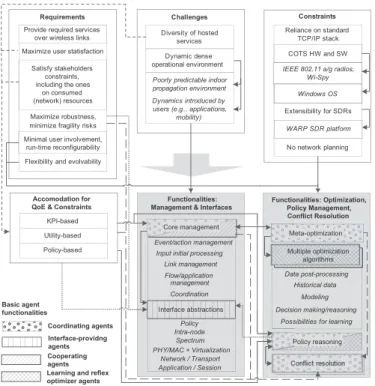
Fig. 4. Illustration how major requirements to the WHN self-optimizing system are used to derive the HCRM functionalities. The functionalities that are viable to realization as particular types of agents are pattern-coded. The intuition for developing separate control loops for them, is the necessity to independently interact with the environment and other system modules.
We conclude that the CRM can be adopted as the functional architecture for the HCRM agents residing on network nodes. Its structure and interface definition may serve as an archi-tectural constraint that defines the backbone for autonomous resource management in WHN environment, thus, in the end de-constraining and opening possibilities for efficient and flexible self-optimization.
C. Functionalities and Architectural Decomposition
There exist multiple architectural approaches for decom-posing a system. One could apply, for example, the RCS (Real-time Control System) architectural approach [29] or goal-oriented requirements engineering [30]. We utilize the general principles common to these approaches such as mini-mal component interdependency, clear goal statement, straight-forward information flow, and simplicity of interfaces. Based on the requirements to the HCRM formulated above we con-tinue the design by defining the major system functionalities and, if appropriate, mapping those to agents, as summarized in Fig.4. To enable rapid software implementation we define the major relations between the HCRM functionalities, as well as their hierarchy. The major functionalities (core manage-ment, interfacing, optimization, conflict resolution, and policy reasoning) can be realized as agents, as they all encapsulate well-defined functions, and it is beneficial for them to act asynchronously at different time-scales. Moreover, the first two functionalities directly correspond to the core and the interfacing blocks of the CRM, and the others jointly map to the toolbox and the knowledge base.
We address the goal of performance maximization by expressing concretely the objectives of network stakeholders. For assessing network performance in terms of QoE we choose to use KPI-dependent utility functions. We also directly use selected KPIs to improve the response time of the system and avoid critical system failures. For example, in our imple-mentation in the case of a sudden strong interference on a channel its traffic is immediately moved to the interference-free control channel. Simultaneous use of both utilities and selected KPIs adds redundancy into the HCRM improving its robustness, without increasing overhead as these inputs have to be reported to the system anyway. We use policies to express rules imposed on the system by various stakeholders. Generally network policies tend to have a hierarchical structure that depends on relations between network stakeholders. For example, FCC regulations apply to all wireless networks oper-ating in the USA, while operator policies apply to only their networks. Further spectrum sharing contracts might impose constraints that apply to two or more networks. In our system policies can be defined either centrally or locally. A policy framework is a centralized entity that, for example, can restrict usage of a certain bandwidth. Applications and user priorities are examples of policies that locally affect utility functions.
The HCRM supports both cooperative and non-cooperative node behavior (for centralized decision on channel usage), as though all nodes are sharing the control channel and therefore can exchange information, global data exchange can create considerable overhead in large networks. For instance, it is often better to centrally decide on employed transmission frequencies, and determine how to share this capacity locally between the involved nodes.
The support for multiple radio-access technologies, cross-layer optimization, and additional spectrum sensing enables the reconfigurability of the network, thus contributing to the goals of performance improvement and efficient resource usage. This flexibility can be realized through definition of unified protocol interfaces and virtualization of network adapters. These functionalities are also required to ensure
min-imal user involvement and enable evolvability of the HCRM.
The meta-optimizer functionality that enables execution of diverse optimization algorithms also contributes to the above goals.
The core manager addresses the robustness of the system by incorporating key functionalities realizing fail-safe system performance. For instance, it bootstraps and maintains data flows and links, and ensures temporary movement of the flows to the control channel during reconfiguration actions. We decided to introduce a control channel on which an access point operates as part of our solution, as that is an effective way to improve the robustness of CSMA/CA-based wireless networks. The control channel also serves as a backup for the data traffic and ensure continuous, though not quality-wise optimal, user connectivity. The assumption of a control channel availability is valid as at homes almost all the nodes have both full time AP connectivity, and can be equipped with multiple radio interfaces for simultaneous maintenance of both infrastructure and ad-hoc point-to-point links. In future appli-cations of HCRM Wi-Fi based control channel can further
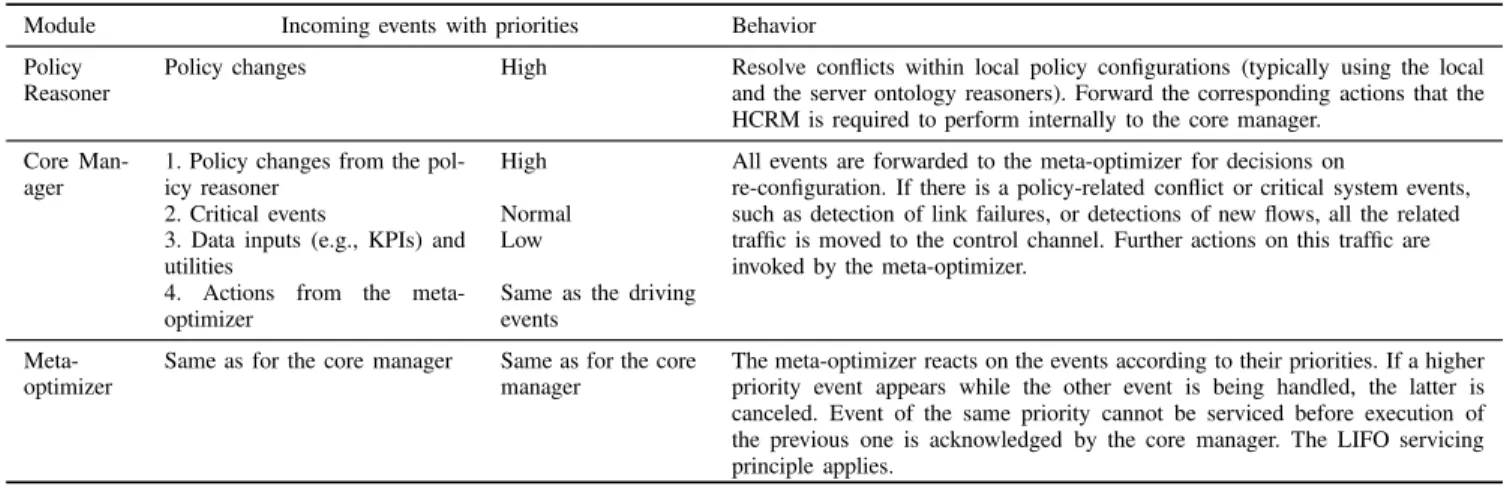
TABLE II
SUMMARY ONCONFLICTRESOLUTION IN THEHCRM
be supplemented with 4G/5G-based one on most foreseen hardware platforms.
Both the meta-optimizer and the core manager are complex agents that perform multitude of functionalities, and incor-porate other agents in their designs. For example, the core manager requires separate threads to effectively interact with the TCP/IP stack, the control channel, the meta-optimizer, the policy server, and perform critical event handling and utility assessment. The meta-optimizer incorporates components for data storage, and hosts individual modeling and optimization modules, some of which are instantiated as agents.
The robustness of the HCRM can be further improved through conflict resolution. Conflicts can occur due to, e.g., statement of competing goals or race conditions arising due to contradictory decisions reached within the network. Our system handles conflicts at the policy reasoner, the core man-ager, and the meta-optimizer (TableII). Conflicts in the HCRM are solved based on the priorities of the events incoming into the system and its modules.
There is an obvious trade-off between efficiency, flexibil-ity and robustness offered by the HCRM. We address it by allowing developers/users of the HCRM to decide on the
size of the state space, the complexity of the optimization algorithms, and the alignment of objectives and information sharing between nodes within the same home network or even
separate networks. The latter decision defines the amount of cooperation required and centralization between nodes. For our system this is done using a common control channel. For data transfer it is done primarily using the point-to-point links, as those typically provide higher performance, until their inter-node distances are too large, or the interference levels are high. The HCRM establishes ad-hoc links and redirects traf-fic between ad-hoc and a control channel links as part of the optimization.
III. IMPLEMENTATIONARCHITECTURE
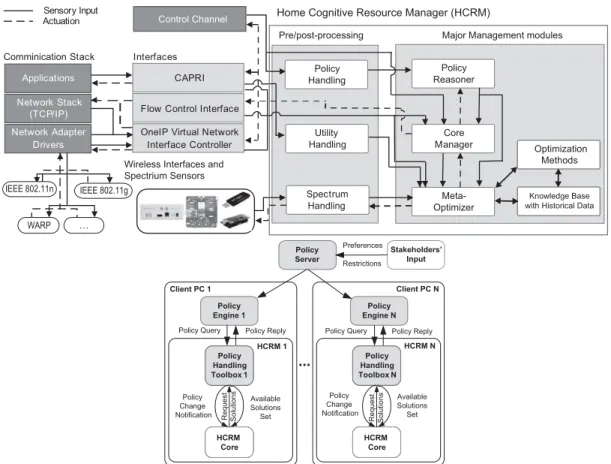
Based on the analysis from the previous section, we derived the component-wise design of the HCRM which is depicted in Fig. 5a. We designed HCRM interfaces to abstract away differences between protocols of the same families enabling
homogeneous interaction format with other protocols, exter-nal devices and nodes [16]. Their sensory inputs are the KPIs, and actuators are protocol settings and overall man-agement of data flows and ad-hoc wireless links. Monitoring of both low and high layer KPIs allows for adequate and rapid reaction by the HCRM to performance changes. For example, low-layer KPIs, such as the link load, allow quick detection of unfavorable channel conditions. However, if the high-layer utility-based metrics indicate user satisfaction with current performance then no actions are taken, especially if their costs are high. The example in our implementation is channel switching that can take up to few seconds. Two of the HCRM interfaces are of particular interest. The virtual
driver wrapper, called OneIP, minimizes user involvement in
network interface configuration, as it abstracts them through a single IP address and enables automatic adjustment of the cor-responding MAC/PHY parameters. The Common Application
Requirement Interface (CAPRI) [31] allows expressing the Quality-of-Experience requirements provided by the applica-tions and their data flows, using dynamically updatable utility functions that are expressed as combinations of KPIs. CAPRI is logically placed on the session layer, as this layer can be perceived as another hourglass waist besides the IP layer of the TCP/IP stack. The CAPRI interface is also used to adjust the setting of individual applications, if the latter supports this option. The spectrum sensing functionality is accessed through another interface that provides data in a unified for-mat from a number of external devices, such as commercially available from MetaGeek low-cost Wi-Spy spectrum analyz-ers [32] or SDR platforms, for instance USRP series of boards from National Instruments and Ettus Research. Combination of the spectrum sensing interface and the virtual driver wrap-per wrap-perform the role of the ULLA interface of the CRM architecture [16].
Policy-based reasoning is introduced on examples of
spec-trum and preferential policies, which allow setting user and application priorities, and regulate usage of frequency bands up to the per-device, user, application and time-of-the-day granularity [33]. Policy constraints impose restrictions on cer-tain optimization states, e.g., that involve channels forbidden to transmission. Policy preferences that set user/application
Fig. 5. Illustration of the HCRM design aspects. Panel at the top shows the HCRM agent design, which displays major internal agents and their interactions via specially developed interfaces. Panel at the bottom overviews the HCRM policy framework that includes the central server, the locally residing engines and toolboxes.
priorities are used to modify application utility functions to accurately express objectives of the stakeholders. Policy rea-soning is realized using three main building blocks shown in Fig. 5b. These are (a) the centralized server that is the repository of all policies updatable by both local and external stakeholders, (b) the ontology-based policy reasoner, based on a HCRM agent, analyzes incoming policy updates for integrity, and (c) the related module that forwards policy updates to the core manager of the HCRM so that it can take the correspond-ing actions, e.g., move the traffic from the forbidden bands to the control channel. We use CoRaL as an ontological basis for policy reasoning [34]. In our implementation we demon-strate both the effect of the manually set policies, but also of the automatically derived ones, see Section IV-C. The latter are the result of the work of the REM system that is continu-ously updated with realtime sensory readings from a channel utilized by a primary (high-priority) transmitter. This data is then processed to derive the policy on usability of a primary channel that depends on the activity of the primary nodes and their distance from the HCRM agents.
The core manager is one of the main agents of the HCRM. This complex agent ensures the robustness of HCRM against critical failures and provides its skeletal functionalities. The agent detects new application flows, and establishes and man-ages ad-hoc point-to-point links. It handles both periodic and asynchronous commands between the protocol stack, other HCRM nodes, spectrum analyzers, the policy framework and
the meta-optimizer. For example, it detects new applications and initializes the configuration of their data flows, monitors status of available wireless interfaces, and performs seamless channel handovers. This is done by either moving data flows directly between ad-hoc links, or through the control channel if a new point-to-point link is to be built, which requires some time. The ad-hoc links are handled using a sub-module, the link manager, that performs handshakes and probes for stable links. The core manager also filters out the control traffic on which the optimization actions are not viable. It can detect critical events related to ad-hoc links and data, e.g., breaking of a link (no data received) or data flow cancellation, react on them, and signal to other agents. Actions and events triggered by this agent are assigned a high priority, the next after policy-based decisions, as they influence not only the performance, but the very network connectivity.
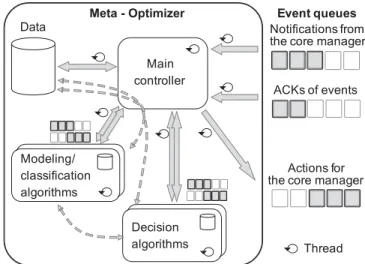
The meta-optimizer agent is an event-driven component that enables hybrid optimization. It is modular in design and is capable of dynamically invoking different algorithms to change its functionality. It also stores historical data, and main-tains queues and corresponding support modules to address conflicts that might arise while deriving optimization deci-sions. The overview of the meta-optimizer is given in Fig.6. Additionally, this agent supports dynamic adjustment of the configuration options of the protocol parameters that might change, for example, due to executed optimizers and opera-tional conditions. The corresponding class hierarchy allows not
Fig. 6. Overview of the meta-optimization agent.
only to restrict a certain parameter state from being used, e.g., due to changes in a spectrum policy, but also to update the number of states that certain parameters can take at runtime.
The optimization-related functionality is split into two parts:
modeling/classification and decision-making. The
classifica-tion or modeling modules establish the “model of the world” that the decision making algorithm utilizes to determine opti-mization actions. The results of modeling and classification of sensory inputs are also used to invoke optimization algorithms. For example, clustering of the utility values to determine is the utility is low or high is done by the modeling enti-ties. This classification is required to, for example, determine worsening of the network performance that directly lead to execution of an optimizer. From our experience we noticed that the logical division of an optimizer into modeling and decision making should not always be followed too liter-ally, as many algorithms integrate modeling, classification and decision-making functionalities as they are designed to work with only certain models or information representations. Therefore, we also support a possibility for designing dedi-cated optimization algorithms that integrate combinations of the above functionalities, and directly operate on raw data inputs.
The meta-optimizer is notified with three classes of events:
new data, policy adjustments, and critical system changes.
New data is forwarded to the selected optimization algorithm, which then either suggests some re-configuration actions, or updates models, or does nothing. Policy changes affect the actuation state space. Policy and critical changes events, such as a detection of a new data flow, or an update on spectrum availability, force the meta-optimizer to invoke the fastest and most robust algorithms, such as simple decision trees, to arrive to the optimization solutions as fast as possible.
Software-wise classes realizing optimization algorithms are inherited from a common class, which is also a parent to the meta-optimization entity. This allows the meta-optimizer to invoke optimization algorithms in a unified manner, and for them in turn to access (but not modify) the required data though the interface provided by the meta-optimizer. This class structure allows separate optimizers to serve as agents that
are initialized using a thread pool of the meta-optimizer, or being incorporated into this module as part of its reason-ing routine. (The latter option is especially useful for fast robust decision-tree/reflex algorithms.) Such approach ensures minimal duplication of information, enables component reuse, while avoiding data management conflicts. For example, if any optimizing agent suggests new data for the meta-optimizer, it generates an event, and it is the latter that accesses it and stores information in the database.
The meta-optimizer went through multiple re-design cycles. It started from the state of being a simple large decision tree with multiple flags to switch between different options that, for e.g., enable inter-node collaboration or restrict the option of the transmission bandwidth adaptation. This implementation allowed to test and partially enhance the rest of the HCRM modules. In parallel we developed the more complex agent which is described below that complies to the main princi-ples of the CRM architecture and satisfies the requirements to the HCRM state above. We believe that the current design is sufficiently good for most applications. However, it lacks the support of reacting to incoming events at very high rates and can give no hard realtime guarantees, as this module is real-ized in the user space on non real-time OS. It also has only limited support of the decision-making directly on the radio hardware, and requires exploitation of flexible SDR frame-works, such as TRUMP [35], with related experiments are reported in SectionIV-A.
A. Selected Subcomponent Designs
In this section we further discuss the algorithmic design of selected HCRM modules that we believe to be of inde-pendent interest. The first of these is the Radio Environment
Map (REM) module, that constructs spatial predictions of
quantities such as signal strengths or SINR values based on measurements conducted by the network nodes. The second is a time-domain prediction module that utilises Hidden
Semi-Markov Models to estimate the activity patterns of several
transmitters based on power measurements alone. The outputs of these modules are used by our policy reasoning framework as illustrated in the following section, as well as other opti-mization components (such as enhanced MAC modules in the case of time-domain predictions).
1) Radio Environment Map Construction: An important
development in the area of cognitive wireless networking has been the introduction of Radio Environment Maps (REMs) [3] — which can be thought of as knowledge bases that store and processes spectrum and protocol data. Gathered information and resulting models can be utilized by both human operators as well as autonomous radio resource management systems. Two examples of popular REM applications are identification of coverage holes in wireless networks, as well as capturing and characterization of network activity conducted by primary nodes.
In the context of wireless home networks information provided by REMs in conjunction with policy-based adminis-tration allows for light inter-network adminisadminis-tration of WHNs that may even belong to different operators. One option is
to enforce prioritized coexistence, primary-secondary sharing scheme, or licensed share access, where individual networks have prioritized, but not exclusive, access to a particular frequency band [36]. Such approaches enable both deployment of optimal primary channel allocation schemes, and accom-modation for peak loads though exploitation of neighboring (secondary) spectrum. In this section we briefly outline the design of our REM module, which solves diverse spatial esti-mation problems based on data obtained from other modules. The REM module itself is entirely general, and can be used on any spatially indexed measurement data obtained by the HCRM. For more details and performance evaluation results on the REM design used here we refer the reader to [37]. Further information on the theoretical foundations of the estimation problems involved can be found from [38] and [39]. We begin by formally expressing the coverage estimation problem our REM module needs to solve. Let D denote the region over which we seek to estimate the coverage area of a wireless system through measurements. This coverage area for a random field or spatial stochastic process Y(x)(x∈D)
of received signal strength or SINR is the excursion set [38]
DCA≡ {x∈D|Y(x)≥θS}, (1)
where θS is a technology or policy specific threshold. When
using the REM module to optimize network coverageθSwould
typically be the receiver sensitivity with the given modulation and coding scheme, or the target SINR for the given quality of service, whereas for policy applicationsθS would typically
be selected to be the signal strength threshold defining the
protected zone of a primary transmitter or licensed user. As DCA is completely determined by Y(x), coverage estimation
can be done by estimating the value of Y(x) for all x ∈ D
based on some possibly noisy and unreliable measurements related to Y.
Assume now that the HCRM has obtained a vector of mea-surements Z ≡Z(x1), . . . ,Z(xn)
, which are related to the underlying true signal strength or SINR Y(x)by the inclusion of an additive error of the form Z(x) ≡ Y(x)+ε(x). Here
ε(x) includes both location independent as well as location dependent terms, including receiver noise, effects of antenna directionality, multipath fading, and so on. We further assume that Y(x)has the form
Y(x)=t(x)α+ν(x), (2) where t are covariates,αare coefficients to be estimated, and ν is assumed to be a random field with zero mean and spatial covariance function
C(x,y)=Cov(ν(x), ν(y)). (3)
Covariates can be used to encode further information on transmitters and the propagation environment available to the HCRM, such as number of walls between the transmitter and the measurement location or the distance between them. Then the coefficients α correspond to wall losses, path loss expo-nents, and so on. The covariance function must be estimated
from the data. We do this by fitting the exponential covariance
model C(τ;β)=β0+β1exp −τ β2 , (4)
where τ =x−y,β0accounts for variance arising from
mea-surement inaccuracies, short-range variations, or superimposed noise, β1 controls the variance of Z, and β2 is the range parameter, determining the correlation distance of the model.
Combining these assumptions we obtain the model Z = Tα+δ, where T consists of known covariates at different measurement locations (if any), andδ=ν+is a zero-mean random process. Denoting (C)ij ≡ C(xi,xj), the covariance
matrixofδcan be written as=C+V, where V is a diago-nal matrix. The coverage estimation problem is now equivalent to finding an estimateY(x0)at every location x0∈D for which
measurements are not directly available. The “best” such esti-mate in the sense of being both unbiased and having the minimal estimation variance is given by the conditional expec-tationY(x0)=E{Y(x0)|Z}. In general conditional expectation
is unfortunately intractable, but if the underlying random fields are assumed to be Gaussian the resulting predictor has simple form given by
Y(x0)=t(x0)α+c(x0)−1(Z−Tα), (5)
where the estimatorα for the coefficients is given by
α=T−1T −1 T−1Z, (6) and c(x0)≡ C(x0,x1), . . . ,C(x0,xn)
. Further, even if the assumption of Gaussianity does not hold, the resulting predic-tor is the best possible linear one. This is exactly the kriging
estimator of spatial statistics (see [39] for detailed derivation and discussion).
We use the above estimating equations whenever sufficient number of measurements are available to robustly estimate the covariance function. In the bootstrapping phase this might not be the case, in which case we provide the users of the REM data options of either not obtaining any predictions at all unless they can be robustly made, or provide predictions with an a priori covariance function that can be configured as part of the system settings.
2) Time-Domain Estimation of Transmitter Activity Patterns: The HCRM needs to perform optimization
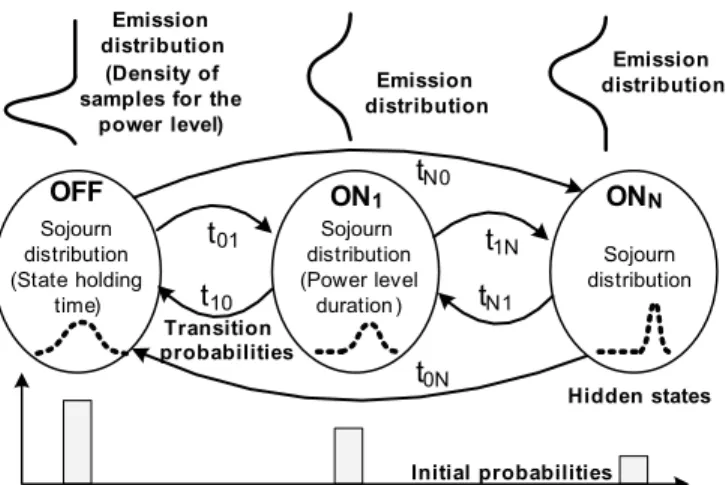
deci-sions based on, for example, signal strength measurements that represent aggregate power in a given frequency band. In order to enable more fine-grained decision making based on such measurements we have designed a temporal prediction module that attempts to further disaggregate such data to estimate the activity patterns of individual transmitters. This module utilizes Semi-Markov ON/OFF process as the foundation of its estimation framework as described in [40] and references therein. It uses the following transmission model. Each transmitter at any given time is either active (ON state) or inactive (OFF state). If active, the transmitter is assumed to send signals (almost) continuously at constant power. The durations of these ON/OFF periods are presumed to follow general distributions that are independent of each other.
Fig. 7. An example Hidden Semi-Markov model. The figure shows three states of the HSMM corresponding to the OFF activity state of the network and two ON states that are characterized by different power levels.
If the states of the different transmitters were directly observable, the estimation of the ON and OFF distributions would easily be solved using standard statistical techniques, and the state of the individual transmitters would be directly available to us. In practice this occurs only if there is a single or one dominant transmitter that can be reliably distinguished from ambient interference and noise [41]. However, especially in indoor scenarios, fast fading and complex propagation envi-ronment often cause the measured received power from an active transmitter to fluctuate heavily, signals can often disap-pear into the noise and interference for short periods of time, and there might be several transmitters of comparable contri-butions to the received aggregate power present. We overcome these challenges by considering Hidden Semi-Markov Models (HSMMs) [42].2The true state of the system is still assumed to follow a Semi-Markov ON/OFF process (or in the case of multiple transmitters, a product of such processes), but instead of making observations on the underlying process directly, we assume that we observe at given times a received sum power that is random with distribution depending on the actual state. The general structure of the employed HSMM is illustrated in Fig. 7. The model requires specification of a) number of
states in the HSMM graph, b) initial probabilities of states,
c) transition probabilities between states, d) sojourn times spent in each of the states (corresponding to the ON/OFF state durations for a single transmitter case), and e) the emission
dis-tributions of the received power conditional on the state of the
system [43].
For the initial classification of the power levels we use a simple density-based threshold detection algorithm (described in [40]). The number of states of the HSMM is set to be equal to the number of resulting power classes. The statis-tics of these power classes are used to initialize the emission distributions. Initial state probabilities and transition probabil-ities between all HSMM states are initially set to be equal.
2This method was first applied on the empirical data for the offline activ-ity patter estimation in [41]. However, there the reported difference between the spectrum power samples corresponding to ON/OFF levels was high and, therefore, the challenge for the states estimation was minimal.
The first zero of the autocorrelation function of the received power was used to determine initial values for the param-eters of the sojourn distributions. We applied the gamma distribution as main parametric model for the sojourn time distributions due to its flexibility. For estimating the parame-ter values of both emission and sojourn distributions as well as the state transition probabilities Expectation Maximization
(EM) is used by the module [42]. In particular, we use the implementation of [44] specifically developed for estimating hidden Semi-Markov models.
As the output of the module other HCRM components obtain the distributions of expected power levels (in particular expected interference power per transmitter), ON/OFF period durations, and the estimated states of the individual transmit-ters obtained from a Viterbi algorithm as described in [43]. This data is especially useful for optimizing medium access control protocols as discussed in our performance evaluation section below.
IV. PERFORMANCEEVALUATION
In this section we describe example results obtained from the HCRM implementation. We focus on the experimental setup shown in Fig. 8. We provide results from three sce-narios. The first one is running reflex agents based on the pre-determined decision tree (reflex) algorithms. The other demonstrates integration with a radio-environment map back-end through the policy mechanism. The third, providing an example of Hidden Semi-Markov Model (HSMM) based learning agents, shows how the HCRM can successfully operate on complex optimizers and non-COTS hardware.
The last two scenarios aim at demonstrating the extensibility and the flexibility of the HCRM. They are both concerned with the primary nodes that do not belong to the HCRM network and impose strict non-interference demands on the other lower priority networks, to which our system belongs. In contrary to the first four-node deployment, the last scenarios involve only two nodes and the external primary interference. For clarity we also chose to experiment only on channel settings (including both bandwidth and central frequency) for these scenarios.
A. Implementation Details
The HCRM prototype provides wireless connectivity in an optimized way with enhanced capability to withstand interference and contention. The system dynamically estab-lishes adaptive point-to-point connections between HCRM nodes while maintaining connectivity to the AP. We use the AP-based communication as the control channel, which is enabled by the installation of a second wireless interface card on each node or connection to a WARP board via an Ethernet interface. The continuous performance of the network during re-configuration phases is ensured by using the control channel as the relay point.
We implemented the HCRM on a Windows platform using low cost COTS hardware such as basic Wi-Fi adapters and Metageek Wi-Spy spectrum analyzers [32]. In order to per-form MAC parameter and channel width adaptation on COTS hardware, we use NETGEAR WAG511 32-bit PCMCIA NICs
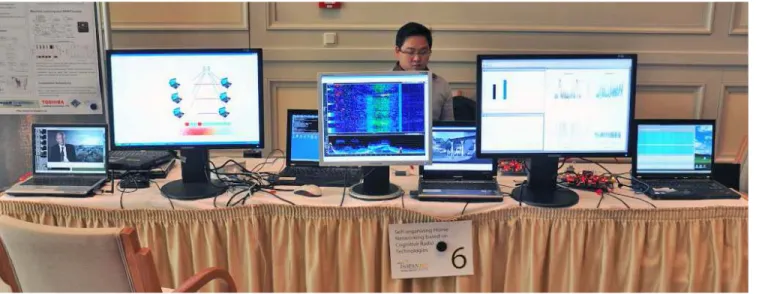
Fig. 8. Example deployment of the HCRM running at the IEEE DySPAN conference.
(Atheros chipsets 5211 and 5212) [45] and a customized device driver, allowing significant flexibility. Each node is equipped with two wireless interfaces and, typically, an exter-nal spectrum sensor.
Some of the modules we experiment with are realized in R in contrary to the main HCRM code that is based on C++. Therefore, we developed additional TCP socket-based interfaces between the HCRM meta-optimizer and these com-ponents. Additionally the second HSMM-based algorithm uses WARP boards for building ad-hoc links. In order to use WARPs we have extended the core manager and the virtual driver to support Ethernet as secondary interface for point-to-point link establishment. This improvement allows the HCRM to interact with any SDR platform that can communicate to the host PC via Ethernet, ensuring high data rate, and low delay communication.
The parameters adapted during the autonomous resource management process are the central channel frequency and channel width (realized as suggested in [46]), traffic redirec-tion and traffic shaping using Class-Based Queueing (CBQ), and data rate adaptation for selected applications. When WARP platforms are used as secondary interfaces on the MAC/PHY layer we perform high rate dynamic channel switching. The influential KPIs are throughput, link load, packet error rate, spectrum power for a certain frequency range (RSSI samples), and the resulting utilities. Additionally, nodes exchange their configuration data in a limited manner for more efficient decision making, e.g., to find a common transmission channel.
B. Scenario With Reflex Agents on the COTS Hardware
First to test the overall HCRM system we set a test network consisting of four nodes organized into pairs that transmit vari-able multimedia and download data in the same radio range, see Fig. 9. Operating on the 2.4 GHz ISM band the network is prone to external interference. In this scenario we use IEEE 802.11g cards and commercial Wi-Spy spectrum analyzers.
Fig. 9. Scenario with COTS hardware (Wi-Fi and WiSpy spectrum sensors) running the reflex agents.
The scenario aims to show that the HCRM can indeed per-form the declared functionalities of ad-hoc point-to-point link setups, seamless handovers, inter-node communication, effec-tive interference avoidance and parameter-based protocol stack optimization.
First we tested the HCRM acting on the set of configuration parameters that by default are supported by the Windows OS and the COTS Wi-Fi drivers and interface cards, even with-out presence of the sensing devices. The HCRM performed as we expected, executing all of the above actions according to the defined algorithms, and gaining significant performance advantage over standard home Wi-Fi deployments. We skip reporting of these results as this scenario has a lot in com-mon with the more interesting setup discussed below, which allows the HCRM to benefit from spectrum sensing, chan-nel bandwidth flexility, reconfigurability of applications and utility-based reasoning.
The HCRM executes two simple decision tree algo-rithms, realized as agents, that run in parallel threads at the meta-optimizer. They utilize pre-defined thresholds that were obtained as results of extensive measurements. These agents perform optimization based on utility metrics or low-level KPIs. First, utility-based optimization operates the moving
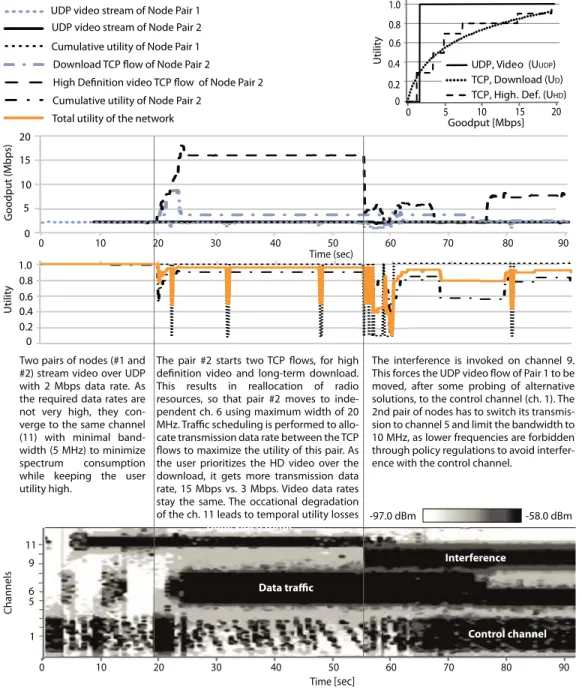
Fig. 10. Performance of four node network in the dynamic environment with changing number of applications. The figure displays (from top) the goodput achieved by the data flows, the overall network utility and the individual utility functions of the nodes, and the waterfall spectrogram of power distribution in the 2.4 GHz band1,2. Utilities as functions of throughput for applications executed in the reflex agents scenario are shown in the top right corner of the figure.
averages of the utilities of separate data flows and combines them in a weighted way according to user preferences as indi-cated through policies. Performance changes are indiindi-cated by significant drops in the observed utility or timeouts in probes if operational conditions have improved and, for example, higher data rates are feasible for an application [31]. The purpose of the second agent is to react fast to critical levels of observed KPIs, primarily the link load. This algorithm aims to take actions based on momentary (very few) readings. It can, for example, avoid data losses by moving traffic to the control channel from the point-to-point link in cases of very high sud-den interference, which cannot be done rapidly using utility based estimates as those rely on averages over several samples. This algorithm operates on very conservative thresholds in
order not to overreact and cause too frequent reconfigurations, as well as not to interfere with the utility-based decisions.
Fig. 10 illustrates this scenario and explains the HCRM’s actions by showing the annotated graphs of goodput and the waterfall spectrogram of energy distribution over 2.4 GHz ISM band. The overall normalized network utility, due to the policy-based application priorities, is
UN =Upair1+Upair2
=(UHD+6UD+3UUDP) 10+UUDP 2,
where UHDis the utility function of high definition video over
TCP in form of the step function, UUDP is the utility of the
and UD is the logarithmic utility function of the download
application.3Channel 1 is used as the control channel, and it is forbidden (through policies) to establish ad-hoc links on the involved frequencies. We use VLC video streaming application running over UDP [47], and TCP-based data traffic generated using iperf [48].
On the right side of spectral diagram of Fig.10we observe that the first pair of nodes starts the video transmission, which is moved after intermediate probing from the control channel to the Channel 11, as the one that has the least amount of interference. The channel width is assigned to be 5 MHz, as it is enough to accommodate the 2 Mbps data rate required by the video. Later the second pair of nodes also starts a low quality video transmission. According to the secondary goal pursued by the network regarding efficient utilization of network resources, the second pair of nodes co-locates its transmission with the first pair on Channel 11. At the time slot 2 the second pair of nodes is introduced with two addi-tional TCP transmissions, one with higher priority than the other. The HCRM of the transmitting node detects that more bandwidth is required due to degradation in utility, and decides to move transmission to non-overlapping Channel 6 and allo-cate it a wider bandwidth. First the bandwidth of 10 MHz instead of 5 MHz is probed, which is subsequently increased further to 20 MHz. This HCRM also adapts the application data rate of the low priority TCP-based traffic via the CAPRI interface. In the time slot 3 we introduce interference created by a noise generator [49] on Channel 9. All the HCRMs detect the interference by evaluating the link load and the packet error rates. As the result, the first pair of nodes decides to move, after some unsuccessful probing, to the control Channel 1. The second pair of nodes switch to Channel 5, shrink their bandwidth due to the policy regulations (not to overlap with the control channel) and further reduce the allowable data rate for low priority TCP traffic this time executing CBQ option as no further data rate reduction option are supported by the application.
It should be noted that both channel expansion/shrinking and channel switching are made automatically by HCRM with-out user intervention and kept transparent for upper layer applications as well. The optimization performed by HCRM does not break any connection at the application level. Short-term reductions in utility for the first pair of nodes are the result of wireless channel variations, and these interruptions are too short to invoke such optimization actions as channel switching. The slow performance of the system is explained by hardware constraints of the utilized wireless cards on estab-lishing the ad-hoc connections specially in poor environmental conditions, and not by the additional delay introduced during HCRM decisions. More modern wireless cards can switch ad-hoc channels with much higher speeds thus overcoming this deficiency in our prototype.
Our experiments show that the HCRM is successful in autonomously handling dynamic variations in external
3We emphasize that the HCRM performs optimization on arbitrary utility functions specified by the applications and users through the CAPRI interface. The specific utility functions and coefficients in their combination used in this section are specific examples used to illustrate the HCRM operation.
interference patterns and changes in the mixture of applica-tions executed by the nodes, without breaking any data flow connections and maintaining high network utility.
C. Radio-Environment Map Based Spectrum Management
In this subsection we demonstrate how prioritized coexis-tence can be incorporated in the HCRM resource management through the integration of REM data with the policy engine. To obtain real spatial spectrum occupancy data on the 2.4 GHz ISM band we utilize the indoor spectrum sensing testbed [50] with the sensory information obtained online from 58 geo-located TelosB nodes, the physical layer of which complies to the IEEE 802.15.4 standard. This data goes into the REM system, which uses stochastic interpolation techniques to establish the spectrum coverage map of the indoor envi-ronment. Further, the interpolated data is clustered and the distance map is constructed to establish the distance to the primary coverage area, when power is above a predefined threshold (see Figure11a). This information is then propagated through the policy framework to the HCRM, which based on the location information of its own nodes, determines if trans-mission is allowed at this channel. In other words, the REM information allows to determine if a HCRM node is at the safe distance from the primary network to avoid interference. As REM information is updated periodically HCRM nodes can also detect the inactive periods of the primary nodes and uti-lize the respective frequencies even if they are in the inference range when the primaries are active. We have implemented the entire REM/policy/HCRM processing chain and successfully tested it also in the demonstration setup as shown in Fig.11. Here the REM system takes inputs from sensors deployed under the tables (with only one being shown in the figure), and based on these values as well as power and distance threshold controlled by the GUI restricts the transmission of the two HCRM nodes on the Wi-Fi channel 1 of the 2.4 GHz ISM band.
The REM-oriented case study allowed us to demonstrate that the HCRM is flexible and easily extensible system for which, due to the carefully interface and policy language design, new parts can be integrated in just few hours (as was in our case). Moreover, experimentation with the REM interpolation techniques, especially kriging [51], one more time demonstrated pros and cons of different learning tech-niques. On one hand the ability to learn online the model guiding the interpolation (the spatial correlation model known as the semivariogram) allows the REM/HCRM system to oper-ate flawlessly in different deployment sites (the demonstration location and our office). On the other hand, these calculations caused observable computational delays which were consid-erably reduced once the spatial correlation model was fixed after the initial training phase.
D. Estimating and Exploiting Network Activity Patterns With HSMMs and WARPs
In this subsection we discuss the design and implementa-tion of an optimizaimplementa-tion learning agent based on informaimplementa-tion on
Fig. 11. Figure (a) displays a sample REM in a scenario with a single primary beaconing access point being deployed on the Wi-Fi channel 2 of the 2.4 GHz ISM band in the indoor office deployment of 12×20 m. Kriging interpolation results on the geo-located sensor measurements, and the following distance mapping from the interpolated power spectrum that is cut on the propagated signal level of -85 dBm are shown. The distance from the restricted zone does not exceed 7 m. Therefore, the secondary HCRM nodes can transmit only in the lower part of the deployment if the policy distance value is above 7 m. The right figure shows the REM/CRM setup at the demonstration venue.
Fig. 12. The estimated PDFs of the sojourn distributions of sample durations as estimated by the proposed HSMM algorithm for fixed and variable duty cycles.
network activity patterns. It uses the temporal prediction mod-ule based on Hidden Semi-Markov Models discussed above as the source of this information, and provides long-term guid-ance for the decentralized spectrum-agile MAC protocol [52] which runs on WARP SDR boards [53] that serve as alternative secondary wireless interface in our implementation. In this sce-nario we do not use additional sensing devices. All estimations of spectrum conditions is done by the WARP boards.
The original spectrum agile MAC protocol [52] already shows efficient run-time self-optimization behavior based on short-term temporal dynamics of the spectrum. Performance of this MAC protocol can be further improved by providing a long-term guidance on the likely behavior of the channels. The models derived by the temporal prediction framework or the extracted duty cycle information is forwarded to the MAC protocol. Based on this data and the estimated ON/OFF states, the protocol adjusts its sensing and transmission patterns.
Our experimentation with HSMM-based techniques have demonstrated that direct utilization of information on the
distribution of ON/OFF period lengths is useful when one can reason on them with a high level of certainty (Fig. 12a for the extreme case of such behavior). Otherwise exploita-tion of informaexploita-tion on duty cycles is enough to provide good performance, as it still allows on a coarse level to determine less busy channels with longer average OFF-period, while avoiding uncertainties connected with direct exploitation of ON/OFF distributions (Fig. 12b). In both cases training of the HSMMs is useful as it allows with higher degree of cer-tainty to cluster signals levels into the ON/OFF states than simple threshold-based methods, as HSMMs are capable to take the historical information into account [40]. Overall, as successfully demonstrated at [8], and shown in Fig. 13, the proposed algorithm can be employed online to enhance MAC performance for a selected set of scenarios. As we see even if primary, not to be interfered, transmissions are almost simul-taneous on Channels 1 and 11, still both of these channels are utilized to minimize the times when the data has to be forwarded through the control channel at 5 GHz ISM band. The algorithm takes advantage of the small differences in the transmission schedules of the primary transmitters. For exam-ple, the top panel shows that the transmission from Channel 1 is preemptively moved to Channel 11 before the primary interfere becomes active. Channel 6 is almost never used due to high duty cycle of the encountered interference there. The downside of the proposed optimization algorithm is its com-putational intensity primarily caused by the online training of the HSMMs. To a large extend this load can be reduced if the primary nodes show stable behaviors that can be studied and modeled in the pre-exploitation, training phase, of the HCRM, which includes training of the proposed optimization algorithm as well.
![Fig. 1. A wireless home network scenario (from [7]).](https://thumb-us.123doks.com/thumbv2/123dok_us/9314146.2412570/3.918.77.447.192.597/fig-a-wireless-home-network-scenario-from.webp)
![Fig. 2. Sample control loops for self-management: (a) Generalized representation of an (intelligent) reflex agent, (b) a learning agent, (a,b) are extended from [22], (c) Cognitive Radio Cycle, adapted from [23], (d) an autonomic element, after [24]](https://thumb-us.123doks.com/thumbv2/123dok_us/9314146.2412570/4.918.224.694.77.772/management-generalized-representation-intelligent-learning-extended-cognitive-autonomic.webp)
![Fig. 3. Overview of the Cognitive Resource Manager (adapted from [17]) and mapping of this architecture to the main variables constituting the HCRM design task.](https://thumb-us.123doks.com/thumbv2/123dok_us/9314146.2412570/5.918.474.845.85.391/overview-cognitive-resource-manager-adapted-architecture-variables-constituting.webp)