ADBI Working Paper Series
Strengthening Financial
Infrastructure
Peter J. Morgan and Mario
Lamberte
No. 345
February 2012
The Working Paper series is a continuation of the formerly named Discussion Paper series; the numbering of the papers continued without interruption or change. ADBI’s working papers reflect initial ideas on a topic and are posted online for discussion. ADBI encourages readers to post their comments on the main page for each working paper (given in the citation below). Some working papers may develop into other forms of publication.
Suggested citation:
Morgan, P. J. and M. Lamberte. 2012. Strengthening Financial Infrastructure. ADBI Working Paper 345. Tokyo: Asian Development Bank Institute. Available: http://www.adbi.org/working-paper/2012/02/17/5003.strengthening.financial.infrastructure/
Please contact the author(s) for information about this paper. Email:
Peter J. Morgan is senior consultant for research, Research Department, Asian Development Bank Institute (ADBI). Mario Lamberte is director, Research Department, ADBI.
This paper is a revised version of the paper presented at the ADBI/ADB and CASS Joint Technical Workshop on Role of Key Emerging Economies—ASEAN, PRC, and India— for a Balanced, Sustainable, and Resilient Asia in Beijing on May 30–31. We thank the discussant, Jie Sun, China Academy of Social Sciences, and other workshop participants for valuable suggestions and comments.
The views expressed in this paper are the views of the authors and do not necessarily reflect the views or policies of ADBI, the Asian Development Bank (ADB), its Board of Directors, or the governments they represent. ADBI does not guarantee the accuracy of the data included in this paper and accepts no responsibility for any consequences of their use. Terminology used may not necessarily be consistent with ADB official terms.
Asian Development Bank Institute Kasumigaseki Building 8F 3-2-5 Kasumigaseki, Chiyoda-ku Tokyo 100-6008, Japan Tel: +81-3-3593-5500 Fax: +81-3-3593-5571 URL: www.adbi.org E-mail: [email protected]
Abstract
By 2030, many Association of Southeast Asian Nations (ASEAN)1
This study provides comparative perspectives on the current and prospective situation of financial market development in ASEAN, the PRC, and India, identifies key priorities for strengthening financial infrastructure to promote financial development and regional integration, and produces policy recommendations at the national, sub-regional and regional levels. The four priority areas covered by the study are: market development, opening, and efficiency; financial inclusion; achievement of financial stability; and financial integration.
, People's Republic of China (PRC), and India (ACI) economies are expected to achieve developed economy status, and this will require a substantial contribution from the financial sector. The financial sector plays a number of key roles in the process of economic development and growth, including facilitating the trading of goods and services; evaluating investment projects; mobilizing and pooling savings to fund projects; transferring funds to where they are needed; monitoring the activities of capital users; distributing and monitoring risk; and providing investors with diverse savings products. However, in contrast to the high levels of manufacturing productivity in the region, development of the financial sector generally has lagged in Asia, largely due to heavy regulation, and, in some cases, insufficient scale. Of course, the process of innovation must be carefully managed, as experience shows that financial innovation can increase risks as well. Financial inclusion needs to be broadened, and financial stability strengthened. Finally, in view of the fragmented state of Asian financial markets, many of which lack economies of scale, financial integration can contribute to promoting economic development by reducing costs to borrowers and investors and increasing competition.
JEL Classification: E52, F32, G21, G22, G24, G28
1
ASEAN includes Brunei Darussalam, Cambodia, Indonesia, the Lao Democratic Republic, Malaysia, Myanmar, the Philippines, Singapore, Thailand, and Viet Nam.
Contents
1. Introduction ... 3
2. Overall Vision for Financial Development ... 4
3. Promoting Financial Deepening, Opening, and Efficiency ... 6
3.1 Current situation of financial development, openness, and efficiency ... 6
3.2 Ways to promote financial deepening and opening ...13
3.3 Relation to government development policy ...17
4. Expanding Financial Inclusion ...17
4.1 Increasing access ...17
4.2 Strengthening credit and other databases ...19
4.3 Legal and regulatory infrastructure...19
5. Enhancing Financial Stability ...19
5.1 Microprudential policy ...20
5.2 Macroprudential policy ...20
6. Deepening Financial Integration ...26
6.1 Role of financial integration and cooperation ...26
6.2 Current state of regional financial integration ...26
6.3 Measures to deepen integration ...28
6.4 Mobilizing regional savings ...37
6.5 Measures to improve regional financial stability ...38
7. Policy Recommendations ...42
1. INTRODUCTION
By 2030, many ACI2The financial sector must grow and adapt with the changing needs of Asian economies as they develop. In particular, as many ACI economies move toward developed economy status by 2030, higher levels of economic activity and increased financial wealth will call for increasing sophistication of the financial system in terms of products and services provided. Massive investment requirements to support growth will require innovations in financing. However, in contrast to the high levels manufacturing productivity in the region, development of the financial sector generally has lagged in Asia, largely due to heavy regulation, and, in some cases, insufficient scale. Of course, the process of innovation must be carefully managed, as experience shows that financial innovation can increase risks as well. Finally, in view of the fragmented state of Asian financial markets, many of which lack economies of scale, financial integration can contribute to promoting economic development by reducing costs to borrowers and investors and increasing competition.
economies are expected to achieve developed economy status, and this will require a substantial contribution from the financial sector. The financial sector plays a number of key roles in the process of economic development and growth, including facilitating the trading of goods and services; evaluating investment projects; mobilizing and pooling savings to fund projects; transferring funds to where they are needed; monitoring the activities of capital users; distributing and monitoring risk; and providing investors with diverse savings products. It is no exaggeration to say that the financial sector is the lifeblood of the economic system, and that developing a financial infrastructure capable of supporting sustainable long-term growth in the region is a critical requirement. Moreover, a malfunctioning financial system can have negative consequences for the real economy, so safeguarding financial stability from both external and internal risks is a key policy responsibility. This lesson has been repeatedly brought home as a result of recent major financial crises.
The financial sector in Asia has generally performed well in supporting the growth process, as shown by Asia’s unmatched growth record. Nonetheless, maintaining a strong growth path and meeting the needs of savers and investors in the next two decades will provide many new challenges to Asia’s financial sector. These include the need to promote financial inclusion, to accommodate the aging of Asian populations, and to support green growth. The study aims to provide comparative perspectives on the current and prospective situation of financial market development in ASEAN, the PRC, and India, identify the key priorities for strengthening financial infrastructure to promote financial development and regional integration, and produce policy recommendations at the national, sub-regional and regional levels. The four priority areas covered by the study are: market development, opening and efficiency; financial inclusion; financial stability; and financial integration. Regarding financial integration, the process envisaged for the ASEAN Economic Community (AEC) by 2015 can provide a model for wider regional integration by 2030. Measures and issues covered in this report include:
1. evaluating the current situation of broad indicators of financial market development, openness, and efficiency in ASEAN, the PRC and India;
2. deepening financial markets, including: development of infrastructure for derivatives, foreign exchange and swap transactions; harmonization of regulatory and tax frameworks; strengthening of government debt management; development of mechanisms for promoting public and private sector financing for infrastructure and other needs; and financial integration;
2
3. improving the efficiency of the financial sector, including: payments, clearing and settlement; competition policy; and sectoral development issues;
4. expanding access to financial services for individuals and micro-, small, and medium-sized enterprises;
5. improving microprudential surveillance and regulation of the financial sector;
6. strengthening frameworks for macroprudential policy for financial stability, both at the national and regional levels, including: domestic regulatory structures and management of capital flows;
7. improving exchange rate coordination, including increased regional cooperation; and 8. coordinating regional financial institutions with the global financial and monetary system. Section 2 describes the overall vision for financial development. Section 3 examines ways to promote deepening, opening and increased efficiency of financial markets; Section 4 analyzes ways to promote financial inclusion; Section 5 analyzes ways to enhance financial stability; Section 6 examines ways to deepen financial integration and Section 7 provides policy recommendations at the national, sub-regional and regional levels.
2. OVERALL VISION FOR FINANCIAL DEVELOPMENT
We need a vision for financial development in ASEAN-PRC-India that has to be set within the overall vision for economic, social, and environmental development for the region. The Asian Development Bank’s recent book on Institutions for Regional Integration sets out the following vision for an Asian economic community:
• “an integrated market free of restrictions on flows of goods and services;
• deeper and more liquid financial markets open to cross-border financial flows, with high standards of oversight and strong protection for national and foreign investors;
• effective frameworks for coordinating macroeconomic and exchange-rate policies, taking into account global challenges and differing national circumstances;
• regional forums and dialogues to address vital social issues, such as poverty, exclusion, income insecurity, migration, aging, health, and environmental threats; and
• a consistent voice to project regional concerns in global policy forums and enhance responsible global governance.” (ADB 2011a: 201)
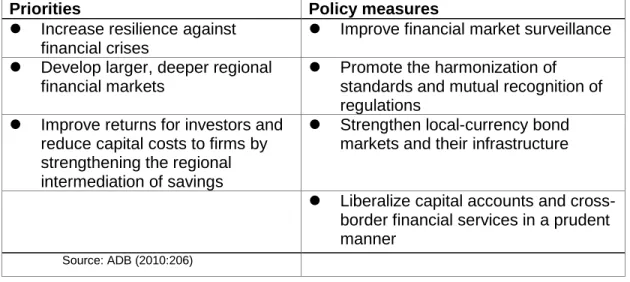
Notably, four out of the five points touch on financial sector aspects, including liberalization of trade in financial services, financial reform and regulation, regulation of capital flows, and reform of the international monetary system, including the governance of international financial institutions. Table 1 lays out some suggested priorities and policy measures from the report for the financial sector.
Table 1: Priorities and Policy Measures for the Financial Sector
Priorities Policy measures
Increase resilience against financial crises
Improve financial market surveillance Develop larger, deeper regional
financial markets
Promote the harmonization of standards and mutual recognition of regulations
Improve returns for investors and reduce capital costs to firms by strengthening the regional intermediation of savings
Strengthen local-currency bond markets and their infrastructure
Liberalize capital accounts and cross-border financial services in a prudent manner
Source: ADB (2010:206)
For ACI, the overall vision for financial development should include the following four main points:
i. deepening, opening, and increased efficiency of financial markets; ii. expansion of access to financial services, i.e., financial inclusion; iii. enhanced financial stability; and
iv. deeper financial integration.
If these factors are promoted effectively, this should result in a sharply expanded share of the ACI financial sector in the global financial market. Table 2 shows our projections of the share of ACI in the world total in 2030 for four asset classes: bank deposits; credit to the private sector by banks; stocks; and private sector local currency bonds. For all categories, the global shares are expected to grow dramatically by 2030, with those for bank deposits reaching over 40% of the world total, and those for private credit by deposit money banks and stocks to reach about one-third of the global total. The share of private bonds starts from a much lower base, but is expected to increase over three-fold by 2030 as a result of measures aimed at promoting the development of local currency bond markets in the region. The rise of the ACI share reflects both the expected increase of the ACI share in global gross domestic product (GDP) and projected increases in the ratio of financial assets to GDP in some countries, especially India, Indonesia, the Philippines, Thailand, and Viet Nam. By far the biggest contribution to the rise in the overall ACI share comes from the PRC, followed by India.
Table 2: Development of ACI Financial Assets 2010 2030 2010 2030 Bank deposits ACI 13,390 53,768 23.7 44.1 ASEAN 1,339 4,194 2.4 3.4 PRC 10,945 42,332 19.4 34.7 India 1,106 7,243 2.0 5.9
Private credit by deposit money banks
ACI 8,278 32,998 16.7 32.9
ASEAN 966 3,023 1.9 3.0
PRC 6,679 25,831 13.4 25.8
India 633 4,144 1.3 4.1
Stock market capitalization
ACI 10,686 42,442 19.4 34.4
ASEAN 1,596 5,071 2.9 4.1
PRC 7,474 28,907 13.6 23.4
India 1,616 8,464 2.9 6.9
Private bond market capitalization
ACI 2,162 17,203 4.1 13.7
ASEAN 348 1,704 0.7 1.4
PRC 1,663 12,866 3.2 10.2
India 151 2,632 0.3 2.1
Source: CEIC Database Company, IMF IFS database, BIS Quarterly Review,
World Federation of Exchanges, available at: http://www.world-exchanges.org/statistics/annual/ 2011/equity-markets/domestic-market-capitalization (accessed 8 August 2011),
authors' estimates.
2010 US$ bn Share of world total, %
3. PROMOTING FINANCIAL DEEPENING, OPENING, AND
EFFICIENCY
This section describes the current situation of financial development in the ACI region, and measures to promote further financial deepening, opening, and increased efficiency.
3.1
Current situation of financial development, openness, and
efficiency
The nature and progress of Asian financial market deepening in the past decade can be analyzed using a methodology similar to that of the World Bank’s Financial Development and Structure Database (Lee 2008; Capannelli, Lee, and Petri 2009). Asia's progress in financial deepening can be compared with other countries' using the indicators provided in Beck and Demirguc-Kunt (2009) for four income levels: high, upper middle, lower middle, and low. Indicators of financial size, efficiency, and internationalization present a clear picture of progress in Asia.
Financial Size
Available indicators of financial size all suggest steady progress in ACI economies (Table 3). These indicators are central bank assets, bank deposits, deposit money bank assets, liquid liabilities (cash plus demand deposits and interest-bearing liabilities of banks and other financial institutions), private credit by deposit money banks, stock market capitalization, and private
bond market capitalization (all computed as a ratio to nominal GDP). Typically, the ratio of central bank assets to GDP falls as income rises, while the all other measures rise. Private bond market capitalization is used because it is highly correlated with income levels, while public bond market capitalization shows almost no correlation with income levels.
Table 3: Measures of Financial Sector Size
Median ratio by income class 2007 ASEAN PRC India ACI
Upper Lower
Ratio to GDP High Middle Middle Low 2000 2009 2000 2009 2000 2009 2000 2009 Central bank assets 0.01 0.01 0.04 0.02 0.08 0.03 0.02 0.05 0.08 0.02 0.07 0.03 Bank deposits 0.87 0.43 0.39 0.20 0.73 0.83 1.04 1.47 0.42 0.64 0.73 0.89 Deposit money bank assets 1.14 0.55 0.31 0.15 0.85 0.78 1.13 1.07 0.41 0.65 0.83 0.80 Liquid liabilities 0.90 0.45 0.43 0.27 N.A. 1.05 N.A. 1.57 N.A. 0.75 N.A. 1.08 Private credit by deposit money banks 1.01 0.47 0.31 0.14 0.70 0.77 1.06 1.10 0.26 0.47 0.69 0.77 Stock market capitalization 1.05 0.42 0.30 0.26 0.87 0.77 0.38 1.00 0.36 0.90 0.73 0.82 Private bond market capitalization 0.36 0.16 0.03 0.00 0.13 0.17 0.07 0.19 0.00 0.05 0.10 0.15 *Simple average
GDP= Gross Domestic Product
Sources: Beck and Demirguc-Kunt (2009) and authors’ estimates.
Table 3 compares the values for ASEAN, the PRC, India and all of ACI in 2000 and 2009 with the median values by income group of the worldwide sample for 2007 (Beck and Demirguc-Kunt 2009). Data for ACI are simple averages of the ratios for the PRC; India; Indonesia; Malaysia; the Philippines; Singapore; Thailand; and Viet Nam. Except for central bank assets, all of the indicators rise significantly and monotonically with regard to GDP level.
Table 2 shows that ACI countries on average are, if anything, over-endowed relative to the average of high income countries in terms of liquidity and banking sector size, and somewhat lower than high income countries in terms of deposit money bank assets, private credit by deposit money banks, and stock market capitalization. The PRC tends to score highest on these measures, with ASEAN in the middle and India lowest, with India ranging between the medians for high income and upper middle income countries. However, they are still lagging in terms of private bond market capitalization. Although central bank asset ratios have fallen as expected, they are still consistent with the level of lower middle income countries. In contrast, bank deposits, deposit money bank assets, and liquid liabilities rose significantly over the period. This is rather remarkable, given the diversity of financial conditions in Asia. Private credit extended by deposit money banks is somewhat lower than the high income median, mainly due to low values for India, Indonesia, and the Philippines.
Data on financial markets are mixed. For ACI as a whole, stock market capitalization rose from .73 times GDP in 2000 to 0.82 in 2009. This reflected big increases in this ratio in the PRC and India, which offset declines in ASEAN as a result of the global financial crisis. On the other hand, private bond market capitalization clearly lags behind with a ratio of only 0.15 times GDP,
in line with the median for upper middle income countries. In summary, ACI has large banking sectors and stock markets, but bond markets, especially private sector bonds, are less developed by comparison.
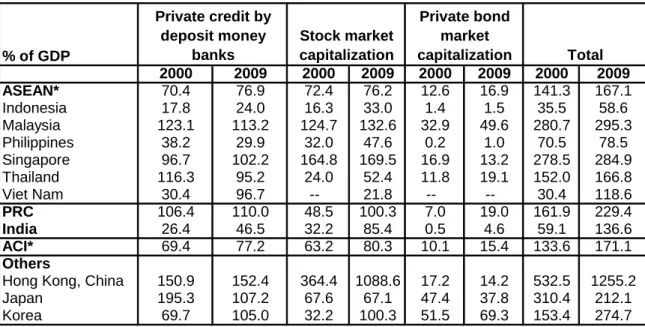
Table 4 shows, as percent of GDP, the three main categories of private sector liabilities and total private liabilities for individual countries in 2000 and 2009. All ACI countries showed substantial increases in total private liabilities relative to GDP, especially in the PRC, India, and Viet Nam. Patterns by liability category were mixed. Private bank credit fell in Malaysia, the Philippines, and Thailand in the aftermath of the Asian financial crisis of 1997–1998. Stock market capitalization rose in all ACI countries, while private bond market capitalization fell only in Singapore. However, among ACI countries, private bond market capitalization is high only in Malaysia, which underlines the scope for further development of this sector.
Table 4: Sources of Private Sector Funding as % of GDP
% of GDP 2000 2009 2000 2009 2000 2009 2000 2009 ASEAN* 70.4 76.9 72.4 76.2 12.6 16.9 141.3 167.1 Indonesia 17.8 24.0 16.3 33.0 1.4 1.5 35.5 58.6 Malaysia 123.1 113.2 124.7 132.6 32.9 49.6 280.7 295.3 Philippines 38.2 29.9 32.0 47.6 0.2 1.0 70.5 78.5 Singapore 96.7 102.2 164.8 169.5 16.9 13.2 278.5 284.9 Thailand 116.3 95.2 24.0 52.4 11.8 19.1 152.0 166.8 Viet Nam 30.4 96.7 -- 21.8 -- -- 30.4 118.6 PRC 106.4 110.0 48.5 100.3 7.0 19.0 161.9 229.4 India 26.4 46.5 32.2 85.4 0.5 4.6 59.1 136.6 ACI* 69.4 77.2 63.2 80.3 10.1 15.4 133.6 171.1 Others
Hong Kong, China 150.9 152.4 364.4 1088.6 17.2 14.2 532.5 1255.2
Japan 195.3 107.2 67.6 67.1 47.4 37.8 310.4 212.1 Korea 69.7 105.0 32.2 100.3 51.5 69.3 153.4 274.7 Private credit by deposit money banks Total Stock market capitalization Private bond market capitalization Notes: GDP= Gross Domestic Product; PRC= People’s Republic of China; —= data not available;
* Unweighted averages; data for other ASEAN countries not available.
Sources: IFS Feb 2011 CD, CEIC Data Company, available at: http://www.ceicdata.com, (accessed 12 April 2011), BIS Quarterly Review Jul 2012, WDI.
Life insurance premiums as a percentage of GDP tend to grow with per capital income. (Premiums are shown, as data on assets are not available for most economies.) Table 5 shows very high levels for Hong Kong, China; and Singapore, as befits their status as international financial centers. Malaysia’s level is relatively high at 6.3% of GDP. If one takes the Republic of Korea’s (henceforth, Korea) level of 4.5% of GDP as a longer-term benchmark for development, then countries such as the PRC and Thailand are relatively close, while India, Indonesia, the Philippines, and Viet Nam have further to go.
Table 5: Insurance and mutual fund industry development % of GDP 2000 2010 2000 2010 ASEAN* 4.7 4.8 47.5 106.8 Indonesia** 1.0 1.6 0.4 2.3 Malaysia -- 6.3 12.2 49.3 Philippines** 1.3 1.0 -- 1.1 Singapore 14.1 14.2 169.8 461.1 Thailand 2.5 4.2 7.7 20.1 Viet Nam+ -- 1.4 -- -- PRC 1.6 3.7 0.9 6.2 India -- 2.3 6.4 8.5 ACI* 4.2 4.4 35.0 81.9 Others
Hong Kong, China** 32.9 88.2 184.1 442.9
Korea 5.5 4.5 17.7 20.9
Total Insurance Premiums Mutual Fund Assets
Notes: *Unweighted averages. Instead of 2010 data, ** denotes 2009 and + denotes 2008; -- denotes not available; data for other ASEAN countries not available.
Source: CEIC database, available at: http://www.ceicdata.com, (accessed 1 August 2011).
The asset management industry is expected to grow rapidly as a result of rising incomes, high savings rates, and the ageing of populations in most economies. Table 4 shows that the share of assets under management in GDP tends to rise with per capita income, although the spread is relatively wide. Hong Kong, China; and Singapore have very high shares of assets under management in GDP, befitting their roles as international financial centers. Aside from these, Malaysia has the highest share in the region by far, followed by Thailand and Korea, which have shares of around 20% of GDP. This suggests that this ratio will rise toward at least 20% of GDP in countries such as the PRC and India as they develop further.
Financial Openness
Along with economic and financial development, financial systems tend to become more open as well, i.e., restrictions on capital accounts tend to be eased. However, capital account regimes can become more restrictive as well, particularly if countries experience shocks from episodes of rapid capital inflows or outflows. A certain level of capital market openness is a prerequisite for regional financial integration, which is discussed in Section 6 below.
Financial openness is not easy to measure, and there are two broad approaches to doing so— de jure and de facto. De jure measures assess the restrictiveness of published laws and regulations regarding foreign exchange and capital account transactions. These are typically based on the International Monetary Fund (IMF)’s Annual Report on Exchange Arrangements and Exchange Restrictions (AREAER) (IMF 2008). Examples of this approach include Quinn (2003) and the Chinn-Ito Index (Chinn and Ito 2008). The Chinn-Ito Index is compiled by evaluating four major categories of restrictions on external accounts: (i) the presence of a multiple exchange rate regime, (ii) the presence of restrictions on current account transactions, (iii) the presence of restrictions on capital account transactions, and (iv) the presence of a requirement of the surrender of export proceeds. The index score ranges from -2.5 (fully closed) to +2.5 (fully open).
Figure 1 shows the values for the Chinn-Ito Index for major ACI economies plus Hong Kong, China in 1996 and 2009. The data show both a wide range and substantial changes over the period in both directions. Hong Kong, China; and Singapore are rated as fully open, consistent
with their status as regional financial centers, while both the PRC and India have maintained relatively low ratings of -1.15, i.e., relatively closed. Indonesia and Viet Nam have become significantly more open, while Malaysia and Thailand have become less open, primarily as a result of their experiences during the Asian financial crisis of 1997–1998. This scoring suggests three broad categories: open; moderately open; and relatively closed.
Figure 1: Chinn-Ito Indices for Major ACI Economies
- 1.5 - 1 - 0.5 0 0.5 1 1.5 2 2.5 PRC India Thailand Malaysia Viet Nam Philippines Indonesia Hong Kong, China Singapore
1996 2009
Source: Chinn-Ito (2008).
However, it is widely recognized that de jure measures may not reliably capture the effective degree of capital market openness, since application and enforcement of rules may vary widely, and details of regulations not captured in the index may have significant implications for market openness. For example, as is discussed below, both the PRC and India regulate inflows by foreign institutional investors, but the PRC has established strict quotas, while India has no quotas.
The alternative approach is to measure the de facto capital market openness based on estimates of actual capital flows. One of the main sources in this regard is Lane and Milesi-Ferretti (2006), who estimated ratios to GDP of gross external assets and liabilities for 145 countries for 1970–2004. The essential idea was that a higher level of external assets and liabilities (relative to GDP or some other measure) indicated the effective openness of capital markets. However, there are many difficulties with this approach. First, their data included official reserves, which reflect official currency policy, and hence do not necessarily say much about capital market openness. Second, being a stock, the measure tends to rise over time, even though the actual degree of openness may not have changed. Third, the appropriate normalizing variable is unclear, since using either nominal GDP or total trade can introduce various biases and distortions depending on the openness of the economy to trade and other factors. Finally, the series has not been updated beyond 2004.
Beck and Demirguc-Kunt (2009) examined a number of globalization indicators, including, the ratio to GDP of: international debt securities outstanding; net issuance of international debt
securities, loans from non-resident banks, and remittances; and the ratio of offshore deposits to bank deposits. However, only the level of outstanding international debt securities showed a clear and consistent correlation with income levels. Figure 2 shows the ratio of international debt securities to GDP for the major ACI countries.
Figure 2: Ratio of International Debt Securities to GDP
Ratio to GDP, % 0 5 10 15 20 25 30 35 40 PRC Viet Nam Thailand India Indonesia Malaysia Philippines Singapore Hong Kong, China
2000 2010
Source: BIS Quarterly Review, June 2011, CEIC Database Co. Availabl
The distribution of values is similar to that of the Chinn-Ito de jure index, with Hong Kong, China; and Singapore being the most open and India, Thailand, and the PRC being relatively closed. Thailand clearly became more closed since the Asian financial crisis of 1997–1998, and the Philippines and Malaysia showed a similar tendency, although more muted. Viet Nam scores as less open on this measure than the de jure measure, suggesting that the de jure measures may not adequately capture the effective restrictions on issuance activity.
Financial Efficiency
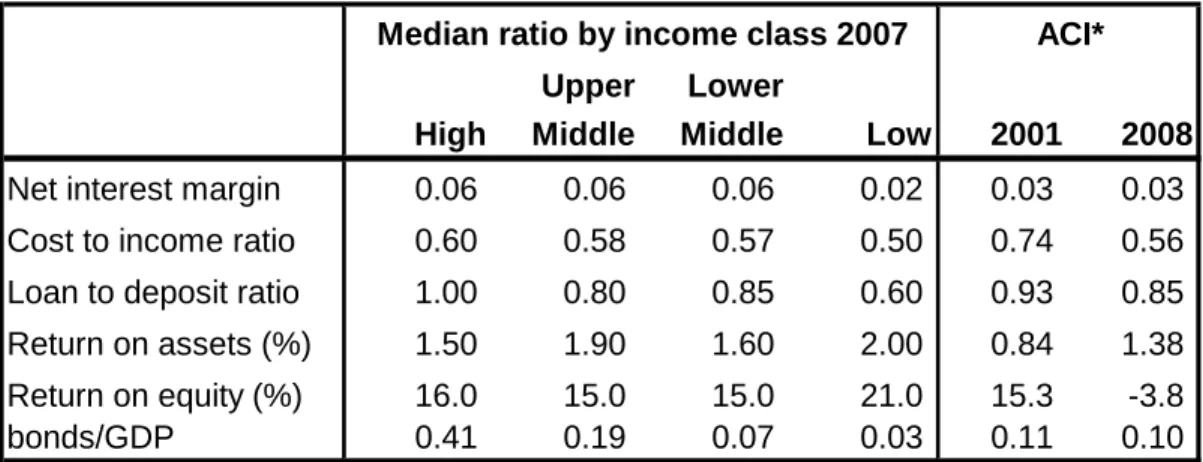
The measures of financial sector efficiency shown in Table 6 (net interest margin, cost to income ratio, loan to deposit ratio, return on assets, and return on equity) are not as closely correlated with income levels as the size measures in Table 3. As in Table 3, Table 6 shows the median values for the four income groups in 2007, and the comparable average data for the three subregions of ACI and the total in 2001 and 2008.3
3
Data for 2000 are not available.
While the first three measures generally rise with income, there is little or no change in the net interest margin or cost-to-income ratios. The ratios for returns on assets and equity are actually highest in low cost-to-income countries; the increased competition and capital deepening that accompany higher income levels presumably helps to drive them down.
Table 6: Measures of Financial Sector Efficiency and Integration
Upper Lower
High Middle Middle Low 2001 2008
Net interest margin 0.06 0.06 0.06 0.02 0.03 0.03
Cost to income ratio 0.60 0.58 0.57 0.50 0.74 0.56
Loan to deposit ratio 1.00 0.80 0.85 0.60 0.93 0.85
Return on assets (%) 1.50 1.90 1.60 2.00 0.84 1.38
Return on equity (%) 16.0 15.0 15.0 21.0 15.3 -3.8
bonds/GDP 0.41 0.19 0.07 0.03 0.11 0.10
Median ratio by income class 2007 ACI*
GDP= Gross Domestic Product Note: *
Source: Beck and Demirguc-Kunt (2009) and Bankscope database, available at Simple average.
March 2010).
Asian performance in this category is decidedly mixed. In all three subregions, the net interest margin changed little over the period, and is still close to that of the low income level. The cost-to-income and loan-to-deposit ratios mostly fell in 2008, especially in the PRC, close to or in some cases lower than the low income level. Of course, the latter proved to be a good thing during the financial crisis, as it meant minimal dependence on wholesale sources of funding in most countries. Returns on assets and equity improved markedly between 2001 and 2008 in the PRC and India, but are still quite low compared with global levels, while that for ASEAN was negative in 2008. The generally low level of financial efficiency in 2008 points to the need for further financial reform, despite improvements between 2001 and 2008.
Financial Soundness and Governance Measures
Great strides have been made in improving financial soundness since the 1997–1998 Asian crisis. Capital adequacy ratios actually fell on average somewhat between 2000 and 2009, but were at high levels. On the other hand, nonperforming loans (NPLs) in the region fell dramatically from an unweighted average of 14.1% of total loans in 2000 to only 3.4% in 2009 (Table 7), with all countries showing marked improvement. Especially dramatic improvements were seen in Indonesia, Malaysia, the Philippines, and Thailand. While much of this improvement could be attributed to sustained economic expansion since 2000, structural improvements played a role as well.
Table 7: Measures of Financial Stability and Governance Country 2000 2009 2000 2009 2000 2009 2000 2009 ASEAN* 16.4 15.6 14.4 4.0 0.3 0.3 0.1 0.1 Indonesia 21.6 17.5 18.8 3.8 -0.3 -0.3 -0.8 -0.6 Malaysia 12.5 14.6 15.4 3.8 0.4 0.3 0.4 0.5 Philippines 16.2 15.8 16.6 4.6 0.1 0.0 -0.5 -0.5 Singapore 19.6 16.5 3.4 2.3 2.0 1.8 1.4 1.6 Thailand** 11.9 13.8 17.7 5.7 0.5 0.3 0.5 0.0 Viet Nam -- -- -- -- -0.7 -0.6 -0.4 -0.4 PRC 13.5 10.0 -- 1.6 -0.3 -0.2 -0.4 -0.3 India 11.1 13.2 12.7 2.4 -0.1 -0.3 0.2 0.0 ACI* 15.3 14.6 14.1 3.5 0.2 0.2 0.0 0.0 Others
Hong Kong, China 17.8 16.6 6.1 1.5 1.7 1.8 0.9 1.5
Korea 10.5 14.2 6.6 1.5 0.6 0.0 1.4 0.0
Taipei,China** -- 11.4 -- 1.2 -- 1.1 -- 0.8
Capital adequacy
ratio, % Rule of Law+
p g Loans, % of Total Regulatory quality+ Note: * Unweighted average; ** 2008 data instead of 2009; +Scale from -2.5 to +2.5.
Sources: IMF Global Financial Stability Report, Apr 2010; The Worldwide Governance Indicators (WGI) project website
http://info.worldbank.org/governance/wgi/index.asp (accessed 15 April 2011).
Qualitative measures of governance and regulatory efficiency have shown much less evidence of progress. For example, for ACI as a whole, the World Bank’s indices for Regulatory Quality and Rule of Law (from its survey of World Governance Indicators) were both stable between 2000 and 2009. Improvements in some countries were partly offset by deterioration in Thailand and India.
3.2
Ways to promote financial deepening and opening
Banks have been the workhorse of the Asian economic growth model, partly because they could be influenced by policymakers to lend in line with development policy objectives, and partly because they could develop long-term relationships with borrowers and thereby exercise effective oversight. However, the Asian financial crisis of 1997–1998 highlighted problems of inadequate bank governance and regulation. This led both to an overhaul of banking sectors and to a recognition of the need to develop bond markets as a “spare tire” for financing during times of crisis. Numerous initiatives have been undertaken to promote bond market development, including the Asian Bond Fund Initiative (ABMI) and Asian Bond Funds (ABF), but further work needs to be done in this area for Asian bond markets to achieve their potential, particularly with regard to corporate bonds. Progress in this area can be achieved in a number of dimensions, including improving the infrastructure related to securities and foreign exchange (FX) markets; promoting coverage by credit rating agencies; developing mechanisms to support infrastructure financing, etc.; strengthening government debt management; enhancing the ABMI and ABF programs; improving financial operating efficiency, including payment systems, clearing and settlement; and addressing sectoral competition issues.
Infrastructure related to securities and fx markets
Batten, Hogan, and Szilagyi (2009) and Spiegel (2009) provide good summaries of steps that can be taken to deepen regional bond markets. Globally, the great majority of bonds (88.2%) are fixed rate with simple pricing features. Issuers of such bonds will normally require the means to hedge the currency risk associated with local currency bond issuance. The long-term viability of this segment is thus closely linked to the presence of: (1) highly liquid foreign exchange and derivatives markets that facilitate risk management and transformation; (2) regulations that facilitate cooperation with market participants; and (3) benchmark issues and competitive pricing between markets (Batten, Hogan, and Szilagyi 2009). Governments can improve their debt management. Risk-free benchmarks are an integral and necessary requirement for pricing and hedging in the corporate bond market. Ultimately, the risk-free government bond provides the benchmark for credit spreads. Thus, it is critical to recognize that adequate liquidity must be maintained, irrespective of fiscal requirements.
It is crucial to expand credit rating agencies' coverage of private issues by encouraging regional national rating agencies and promoting activities by global rating agencies (Spiegel 2010). Global and regional rating agencies have their strengths and weaknesses, but the best strategy is likely to be one that encourages additional coverage by both. However, the conflicts of interest that have compromised the independence and impartiality of ratings must be addressed. Fortunately, Asia already has a large number of national credit rating agencies, as shown in Table 8.
Table 8: National Credit Rating Agencies in Asia
Country Number of
local CRAs Names
PRC 9 Centrus Credit Rating Co., Ltd., Chengxin International Credit Rating Co., Ltd., China Lianhe Credit Rating, Co. Ltd., Dagong Global Credit Rating Co., Ltd., Shanghai Brilliant Credit Rating Co., Ltd., Shanghai Credit Information Services Co., Ltd., Shang
India 5 Credit Analysis & Research Ltd (CARE), CRISIL, Ltd., Investment Information and Credit Rating Agency (ICRA), ONICRA Credit Rating Agency of India, Ltd., SME Rating Agency of India Limited (SMERA)
Indonesia 2 P.T. Kasnic Credit Rating Indonesia – Indonesia, P.T. PEFINDO Credit Rating Korea, Rep. of 4 Korea Investors Service, Inc. (KIS), Korea Ratings Corporation, National Information
& Credit Evaluation, Inc. (NICE), Seoul Credit Rating & Information, Inc.
Malaysia 2 Malaysian Rating Corporation Berhad (MARC), RAM Rating Services Berhad (RAM) Philippines 2 Credit Information Bureau, Inc., Philippine Rating Services, Corp. (PhilRatings) Thailand 1 Thai Rating and Information Services (TRIS)
Source: defaultrisk.com (accessed 15 April 2011)
Financial regulatory and tax systems can be considered as part of market infrastructure. Many market imperfections in Asian markets are self-induced. For example, withholding taxes and legal constraints combine to segment markets from global capital (Jiang and McCauley 2004) and appear to be a major deterrent to investors. Reluctance by some currency authorities to permit overseas transactions in their currency is another barrier. Of course, financial deregulation entails risks, and needs to be implemented judiciously. A recent ADB study (ADB 2010) surveyed institutional investors regarding their perceptions of barriers to bond market access in Asian economies. The results are summarized in Table 9.
Table 9: Distribution of Perceived Bond-Market-Related Barriers by Country Number of survey respondents reporting problems
Problem PRC HKG IND INO MAL PHI SIN THA VIE Total
Lack of derivative instruments 0
Lack of repo operations 1 1 1 1 4 8
Lack of securities lending 2 2
Settlement of FX trades 3 1 4
Local currency borrowing 1 1 2 3 2 2 1 12
FX cash repatriation restrictions 1 1 6 2 3 8 3 24
FX exchange restrictons 2 1 8 4 5 10 4 34
Income payments 1 1
Legal jurisdiction 1 1 2
Taxes 2 6 5 2 2 17
Investor registration 5 3 1 1 1 4 15
Legal system differences 1 1 2
Direct access to local settlement 2 1 1 1 5
Note: HKG = Hong Kong, China: IND = India; INO = Indonesia; MAL = Malaysia; PHI = Philippines; SIN = Singapore; THA = Thailand; and VIE = Viet Nam.
Source: ADB (2010), author estimates.
Withholding taxes and restrictions on FX convertibility and repatriation were among the barriers most frequently mentioned. It is important to note that some of these barriers fall more in the province of the public sector (regulations and taxes), while others fall in the province of the private sector (settlement procedures, etc.). Therefore, efforts to reduce such barriers must be directed to both sectors. Indonesia has the largest number of perceived barriers, followed by Thailand, the PRC, and the Philippines. In contrast, Hong Kong, China; Malaysia; and Singapore have very low numbers of perceived barriers.
Mechanisms to support infrastructure financing, etc.
Asia’s infrastructure investment needs are massive—estimated by ADB/ADBI at US$8 trillion between 2010 and 2010 (ADB/ADBI 2009). However, some economies in the region face significant fiscal constraints that would not allow them to provide sufficient finance for such projects. Fiscal constraints can be relaxed in several ways: increases in overseas development assistance (ODA); public funding from regional institutions; and introduction of private capital, e.g., via public-private partnerships (PPP). Since large increases in ODA probably cannot be expected over current levels, the burden will have to fall on regional public funding and PPPs. Regional public funding is discussed below in Section 6.3.
The core task of structuring a PPP project is to reconcile the interests of various parties from the private and public sectors. These parties include investors, lenders, and contractors on the private sector side and the government and other entities on the public sector side. One of the potential benefits of PPPs is encouraging the public sector to identify project risks and consider risk transfer in a way that helps to avoid substantial cost overruns. On the other hand, private-sector investors and lenders involved in a PPP project have capital at risk, and therefore a greater financial incentive to ensure that the service is provided as required in the contract. Moreover, lenders may provide benefits through independent due diligence and control of the project, because they want to ensure that the project is viable, and that all obligations in a contract can be safely fulfilled.
PPPs, while sounding promising, are complex and costly. (See Nishizawa [2011] for a good discussion.) Risk allocations are challenging because of the public nature of infrastructure services provision and inherent uncertainties over the long term. There is a perception of PPPs
being in favor of “private profit at the public’s expense” . Difficulties also arise from the different attitudes of investors, the government and lenders, as well as the general public. PPPs are equipped with very commercial and contractual structures and operational modalities, but at the same time are extremely political, especially in the implementation stage.
Strengthen government debt management
Governments need to improve their debt management to support the liquidity of their bond markets. Risk-free benchmarks are an integral and necessary requirement for pricing and hedging in the corporate bond market. Ultimately, the risk-free government bond provides the benchmark for credit spreads. Thus, it is critical to recognize that adequate liquidity must be maintained across a range of maturities, irrespective of fiscal requirements (Batten, Hogan, and Szilagyi 2009).
Improving efficiency: payments, settlement and clearing systems
Financial systems—either banking or securities markets—cannot function without efficient systems for payments, settlement and clearing, as these form the essential “plumbing” of the system. These systems generally held up well in Asia during the global financial crisis. However, there are many ways that they can be strengthened further. For example, although all major ACI countries except Viet Nam have real-time gross settlement (RTGS) payments systems, they still need to be substantially upgraded to handle smaller transactions and various kinds of risks.
Competition issues by sector
Barriers to entry in various financial sectors remain high, both within countries and across borders. This leads to higher costs and inefficiencies. In view of the key role of the financial sector in allocating savings and investment, this represents a significant constraint on growth prospects in Asia.
Banking: Competition in many banking sectors remains limited by regulations that restrict entry of foreign financial institutions into domestic markets. This is evidenced by the low level of entry of regional banks in each other’s home markets. Table 10 shows the penetration of foreign banks into a number of ACI markets. It shows that the number of ACI-owned foreign banks is particularly low in the PRC, Malaysia, the Philippines, and Thailand. This needs to be addressed as part of the general financial integration measures discussed below.
Table 10: Entry of Foreign Banks in ACI Markets (number of banks) Country Total Banksin Study LocallyOwned ForeignOwned
Non-Asian Foreign Owned Asian Foreign Owned Non-ACI
Owned ACI Owned
ASEAN 335 94 241 121 120 52 68 Indonesia 36 10 26 7 19 6 13 Malaysia 23 9 14 8 6 1 5 Philippines 38 19 19 10 9 4 5 Singapore 119 6 113 69 44 18 26 Thailand 32 12 20 9 11 4 7 Viet Nam 87 38 49 18 31 19 12 PRC 38 37 1 1 0 0 0 India 75 48 27 14 13 8 5 ACI 448 179 269 136 133 60 73 *Excluding thrifts.
In some cases, barriers among subcategories of banks can also contribute to inefficiencies. For example, the status of state-owned banks in countries such as the PRC and India, which enjoy implicit or explicit government guarantees, can make financing conditions of private banks more difficult. Since state-owned banks tend to lend disproportionately to priority sectors targeted by the government, this can starve the rest of the economy of adequate funds.
Insurance: The situation of insurance companies in ACI economies is similar to that of banking, i.e., industry entry, especially by foreign insurance companies, is limited, leading to economic inefficiency and high costs.
Asset management: With the exceptions of Hong Kong, China; the PRC; Malaysia; and Singapore, the development of the private asset management sector in ACI economies is still limited. In view of the rapid ageing of populations in many ACI countries over the next two decades, demand for asset management services is expected to expand rapidly. Cross-border competition for such services is even scarcer, due to existing restrictions on capital flows.
3.3
Relation to government development policy
Most ACI governments have taken an active approach to economic development policy. In view of the key role of the financial sector in allocating resources for investment, this took various forms, including direct guidance of bank lending to preferred sectors (often with implicit guarantees of such lending), financial repression in order to lower costs of funding for preferred sectors, and limits on cross-border capital flows. Since the general tendency of financial development has been to increase the autonomous functioning of markets to raise the efficiency of resource allocation, this inevitably raises tensions with the aim of the government to influence resource allocation. This raises the question of how to minimize these potential conflicts between market functioning and government economic development policy, or, alternatively, how to identify ways to achieve a given set of development policies with a maximum degree of allocative efficiency.
There are no easy solutions to this dilemma. The most obvious approach is to eliminate factor market distortions to the extent possible, including price subsidies and barriers to entry. Such an approach will tend to reduce the collateral economic damage associated with economic development policies. This suggests that targeted sectors should be promoted via subsidies for entry to specific industries or activities, but that entry itself should not be restricted. However, this is a subject beyond the aims of this paper.
4. EXPANDING FINANCIAL INCLUSION
4.1
Increasing access
Access to financial services remains limited for micro-, small, and medium-sized enterprises (MSMEs) and households in many ACI economies. This limits the contribution that these sectors can make to growth and may have other undesirable side-effects, such as unnecessarily high levels of savings, higher income inequality, and volatility of consumption and investment. Expanding access to financial services is thus an important aspect securing more equitable and sustainable growth.
Consumer Finance
Consumer finance is still relatively undeveloped in most ACI economies. Use of credit cards is expanding rapidly, but in some cases from a small base. Access to credit for purchase of durables such as automobiles and electrical appliances remains limited. Development of consumer data bases can support the expansion of this sector.
Small and medium-sized enterprise finance
Small and medium-sized enterprises (SMEs) have been rather neglected because Asian banks have focused more on consumer lending, which is less complicated than the SME business. Policy measures should be directed at creating an enabling environment for SMEs, by (i) developing a corporate credit information database and credit guarantee system at both the national and regional levels; and (ii) nurturing entrepreneurship and technological and human resource development. Governments need to conceptualize a broader and longer-term blueprint for financial sector reform, and align current policy measures to this long-term plan. A better balance between enhancing SME lending and ensuring stability (prudential) can be achieved through a holistic approach that strengthens supervision and capabilities.
The rationale for the government's role in facilitating SMEs' access to credit is generally drawn from research showing SMEs’ contribution to economic performance and the link between credit flow and economic performance. It is widely believed that SMEs play a crucial role in developing countries, by helping to alleviate poverty and being an important contributor to innovation and sustainable growth. Empirical studies have also shown that credit to the private sector plays a key role in economic growth (Beck, Levine, and Loayza 2000; Khan and Senhadji 2000). This growth may be due to SME performance, as suggested by studies that explore the link between credit flow and SME performance. Utilizing cross-industry and cross-country data, Beck, Levine, and Loayza (2000) found that improvements in financial development (as measured by the ratio of private credit to GDP) help accelerate the growth of SMEs. It is therefore not surprising that many governments have intervened in the financial sector to boost credit flow to SMEs.
While market failures present a compelling rationale for governments to intervene in finance, governments should work with market forces to correct, rather than exacerbate, existing market failures. The most important role of government is not to provide finance, but to strengthen the institutional underpinnings of financial transactions (ADB 2009). This requires improvements in legal, regulatory, and information infrastructure that underpins the efficient operation of financial systems.
For example, governments should consider reforming their subsidy programs to differentiate between the financing needs of SMEs due to structural market failure and the normal economic cycle. Loan guarantees also need to be reconsidered, and designed in a way that minimizes moral hazard and avoids market distortions. A clear exit strategy would also be needed to allow authorities to withdraw their support systematically.
Other measures to improve SME financing include building banks’ capacity in transaction technologies, and encouraging innovation so that banks can identify technologies that have a comparative advantage in SME environments. The entry of foreign-owned banks could be encouraged, as they are more able to effectively use transaction technologies suited to SMEs. Trade finance, both for domestic and international trade, is very important for SMEs, but they still tend to face obstacles in financing because of lack of data, collateral, etc. To the extent that policies can ease these obstacles, this could make an important contribution to economic growth potential by expanding the number of firms able to export and import. They key is to find innovative ways to cut transaction costs.
Micro Finance
Micro-finance—the extension of small amounts of credit to a large number of poor households and enterprises—has been growing rapidly in a number of countries, although most recently the sector has suffered growing pains in India and some other countries. Controversy has focused on issues such as whether or not rates charged are usurious and whether overly aggressive lending led to increased bankruptcies and, in some cases, suicides. On the other hand, micro-finance has in many cases been a leader in technological innovation, including use of cellphones for bank transactions.
In most cases, the regulatory frameworks for micro-finance are not well developed, including consumer protection and bankruptcy laws, and these need to be addressed. Creation and/or improvement of consumer credit databases can also contribute to the healthy development of this sector.
Green finance
Financing for green growth encompasses a variety of areas, including traditional pollution control, investments in alternative energy sources, investments in energy conservation, and investments in projects that reduce greenhouse gas emissions. These can be considered as contributing to inclusive finance in the sense that, due to various externalities, traditional financing mechanisms do not provide sufficient incentives to lead to socially efficient levels of investment in these areas.
The control of greenhouse gases is particularly complex because the relevant “commons” area is the entire planet. Use of institutions such as the Clean Development Mechanism (CDM) has been an important development in this area to find cost-effective solutions to greenhouse gas reductions. This framework allows advanced economies to finance lower-cost greenhouse gas reduction projects in developing economies, and thereby gain emission credits, but the process still has many limitations. Although these are best addressed in global fora, there may be scope for regional agreements for cost-sharing as well. Water pollution and water management are often regional issues, as in the case of the Mekong Delta, so international financial transfer mechanisms may prove useful in this area as well.
4.2
Strengthening credit and other databases
As mentioned above, policies to expand SME finance should aim to increase the availability of credit information rather than simply providing subsidies. This can help to ease the problems of identifying suitable collateral for lending to SMEs. Consistent and accessible SME financial databases should be established.
4.3
Legal and regulatory infrastructure
The development of specialized lending institutions for consumers and SMEs may require regulatory innovations to cover these institutions and minimize potential financial systemic risk. In the case of consumer finance, strengthening of consumer protection laws may be required as well, such as improvements in disclosure and prevention of collection abuses.
5. ENHANCING FINANCIAL STABILITY
The Asian financial crisis of 1997–1998 and the global financial crisis of 2007–2009 underlined the high costs of financial crises in terms of lost output and financial disruption, and highlighted
the importance of improving institutions to prevent crises and manage them if they do arise. Such an institutional framework provides a key support for sustainable growth. Asian financial systems generally performed well during the global financial crisis, partly because they avoided large exposures to sophisticated but ultimately toxic financial products. Nevertheless, there are still lessons to be learned. At the traditional microprudential level of supervision, the emphasis should be on improving regulatory capacity and closing regulatory gaps. The crisis also showed the need to identify and manage systemic risks not necessarily observable at the level of the individual financial institution, i.e., to implement macroprudential supervision and regulation. Again, Asian regulators have in many cases been ahead of the game in this area relative to advanced economies, but important further steps can be taken in this area as well.
5.1
Microprudential policy
The primary concerns regarding microprudential regulation following the global financial crisis have been: (1) banks should hold more capital, as previous buffers have proved inadequate to allow banks to recover; (2) banks should also have liquidity buffers so that they can withstand the drying up of money markets for a significant period; and (3) banks should not become too leveraged in order to lessen the need for drastic asset sales when prices are artificially depressed in a crisis. These have all been reflected in the new Basel 3 recommendations (Basel Committee on Banking Supervision 2010). Clearly, central banks will always be there as lenders of last resort to ensure that confidence is maintained in the system as a whole in the event of market problems, but the rationale for buffers is to reduce the fragility of the system and buy time for solutions to be worked out in the event of difficulty.
The previous Basel rules encouraged banks to shift problems off their balance sheets, but in practice there was still exposure to risk, especially to their reputations if their off-balance-sheet vehicles failed, and, hence, one can expect that authorities will be keen to make sure that this misleading shifting does not occur in the future. It is important to ensure that the development of shadow banking does not obscure overall supervision and regulation of individual institutions. Development of regulatory capacity remains an important issue for many Asian economies, as regulators struggle to keep up with increasingly liberalized and sophisticated financial sectors. This applies both to banks and other financial institutions.
5.2
Macroprudential policy
Macroprudential policy aims to reduce financial systemic risk. For emerging economies, such risk tends to emanate from three areas: procyclicality, i.e., the tendency for optimism and risk-taking to build up cumulatively during an expansion and unwind during a downturn; interconnectedness of markets and institutions; and external shocks that typically result in capital flow reversals. Two major areas need to be addressed. The first is to strengthen the financial system so that it can withstand major shocks, both by eliminating having institutions whose failure could disrupt the system, and by compelling institutions to put in place plans for handling the failure of core service suppliers in a manner that does not disrupt the system. The second is to make available discretionary tools that can be used to supplement the automatic countercyclical stabilizers mentioned above and standard monetary policy tools to both limit the buildup of systemic risk and to reduce the potential for financial sector losses resulting from crises. Such tools can take the form of loan-to-value ratios for lending or reserve requirements (Kawai 2011).
The institutional framework for macroprudential management is very important. Adams (2010) and Kawai (2011) advocate the establishment of a systemic risk council or systemic stability
regulator. Such a council would be of a very high level and would not only be responsible for monitoring and coordinating, but also for ensuring that both preemptive and corrective macroprudential measures are undertaken by the responsible agencies. While such a council could be driven by one of the main agencies, such as the central bank, there are advantages in it being independent so that conflicts of interest are reduced. Cho (2010) makes a similar proposal, and identifies one of the main tasks of a crisis management team as being “triage”— there needs to be a common diagnosis and an agreed response, especially regarding communication, across all agencies. One advantage of having such a council, rather than simply assigning responsibility to the central bank, is that it leaves the central bank free to continue to run an independent monetary policy.
Ways of reducing procyclicality
Capital adequacy regulations, particularly under Basel 2, can contribute considerably to increasing the amplitude of the financial and economic cycle. In rising markets, capital values increase and little effort is required to meet capital requirements that are constant through the cycle. However, in downturns, not only do losses mean that new capital is required, but capital values themselves fall and the cost of raising capital increases. This means that banks may have to contract lending in order to preserve adequate capital, thereby adding to the difficulties for the real economy at a time when it is already under pressure. In addition, under Basel 2, credit ratings, whether internally or externally generated, played an enhanced role in determining capital requirements. However, ratings also tend to follow a cyclical path, in part because the track record of the rated institution plays an important part in the determination of its rating. Taken together, these factors can amplify the cycle. This was clearly an unintended consequence of Basel 2, yet one that had been pointed out for some time before it came into effect (Peura and Jokivuolle 2003).
There are also more basic reasons why the financial system tends to exacerbate cycles in the real economy. “Good times“ are likely to lead to a more relaxed attitude to risk (as memories fade the longer it has been since people were exposed to a downturn), while herd behavior exacerbates swings and encourages overlending. Bonus systems may encourage risk taking in the up phase as people make provision for the possibility that they will lose their jobs in the contraction.
Monetary policy already tends to lean against the economic cycle. The simplest response is to introduce a countercyclical element into the determination of capital ratios, raising them when growth picks up and allowing them to diminish as growth eases. Given that this involves increasing capital when it is cheap but not having to do so when it is scarce, this conveys an immediate benefit. Such changes can probably be made without the need for new legislation in many countries. Basel 3 includes provisions for such buffers, but they do not have an explicit form for general implementation at present. Fernández de Lis and Garcia-Herrero (2010) describe a different approach, currently employed in Spain and more recently introduced in Peru and Colombia, whereby provisioning for bad loans is procyclical. In Spain, whenever lending increases more rapidly than normal, provisioning needs to increase more than proportionately on the grounds that rapid increases are likely to be accompanied by a decrease in the quality of lending. In a downturn, such provisions can then be used as defaults increase, without the need to increase capital in such difficult times. Thus, the provisions reflect the behavior of the individual banks. In Peru, the process is related to cyclical fluctuations in GDP and, therefore, constitutes a part of macroprudential stability.
Asian countries have made some use of similar countercyclical provisions in the past. Hong Kong, China, for example, has used loan-to-value ratios that become more cautious the faster the asset price underpinning the loan increases. Andritzky et al. (2009) suggest a wide range of
countercyclical measures that could be applied, in particular taking into account the asymmetric problems of liquidity that occur when the economy turns down and doubts about loan quality lead to a withdrawal from markets and the freezing out of marginal participants. Such liquidity issues can most readily be addressed simply by ensuring a substantial liquidity cushion and matching funding sources to cash flow needs. This approach has already been introduced in New Zealand (Reserve Bank of New Zealand 2009). More realistic stress tests that take account of the freezing of markets will help in determining the necessary level of preparedness. Leverage ratios will also tend to limit procyclicality.
A further concern relates to accounting methods. The use of fair value accounting can be highly procyclical if values are derived from impaired markets when the economy turns down. Not only does there tend to be overvaluation in the more euphoric phase, but also artificially low valuation in the downturn. It would be highly retrograde to return to the use of historical values or other systems that ignore market realities, and valuation methods that operate through the cycle (e.g., those using models) make far more sense. However, accounting rules themselves tend to make it more difficult to introduce provisioning in excess of what is known based on historical values (incurred losses) (Fernández de Lis and Garcia-Herrero 2010).
Regulation of systemically important financial institutions (SIFIs)
The global financial crisis showed that the collapse of systemically important financial institutions can have major ripple effects throughout the entire financial system, both as a result of their size and their interconnectedness via their transactions with other firms. Moreover, the inability to resolve such institutions required very costly bail-outs, which exacerbated the moral hazard issue resulting from such institutions being perceived as “too-big-too-fail.” The Basel 3 reform process has taken a multi-pronged approach to this issue, including: higher capital requirements; suggestions for bail-ins via debt that is convertible to equity; a “capital charge” assessed on assets; and the establishment of credible resolution schemes for SIFIs, including global SIFIs (GSIFIs) (Basel Committee on Banking Supervision 2010).
Regulation of innovative financial products and specific investor groups
The Asian region has not rushed to adopt the sorts of derivative instruments, such as CDOs and credit default swaps, that caused such difficulties in the US when there was doubt about the value of the underlying loans (Fujii 2010). There are, therefore, few immediate concerns over how they should be handled as the later stages of the crisis unfold (Morgan 2009). However, many of these instruments are valuable means of hedging and spreading risk, and their adoption in the region, once the present crisis is over, will help in the deepening of markets and the management of risk. Therefore, the need for such products and the implications for their regulation, along with other potentially destabilizing market actions that help to hedge and spread risks, needs to be considered.
For example, mortgage-backed securities have formed a stable source of housing finance in Australia for nearly thirty years. Loan portfolios are all of a high quality and have not strayed into the subprime area or moved off balance sheet. Other countries that have stayed with the less exotic and more transparent asset-backed securities have also enjoyed stable markets. In reaction to the crisis, there has been a rethink to ensure that, in future, the aspects of securitization that have led to instability are offset. In the first place, the concern is that all of those involved should retain proportionate exposure until the principal underlying the security has been paid back. In the past, many of those involved have collected their fees up front and have had no exposure to any subsequent deterioration in quality. Thus, agents, originators and rating agencies, for example, should receive their remuneration according to the performance of their portfolios (Joint Shadow Financial Regulatory Committees 2009). This will help all parties to ensure the quality of the assets. In 2009 the US proposed that originators and sponsors be
required to retain an economic interest in a “material” portion of the credit risk of securitized credit exposures’ and that ‘compensation of market participants’ should be aligned ‘with longer term performance of underlying loans’ (US Treasury 2009: 13). This would go a long way to achieving the required outcome, especially in combination with the standardization of many products. Asian countries could, for example, agree on common features for mortgage-backed securities (Fujii 2010).
The anomalous treatment of asset-backed securities under the Basel regime and associated accounting procedures that encouraged banks to move such assets off their balance sheets should be ended. While some agents were able to collect their remuneration up front, many banks discovered that reputation risk meant that they were exposed to losses in the special investment vehicles they had set up to take mortgage-backed securities off their balance sheets. A concentration by financial markets on standardized products would make these products more transparent and easier to price. Indeed, they could become more readily traded on exchanges and gain stability from the existence of central counterparties. Hence, if these straightforward measures are taken, mortgage-backed securities could be developed to advantage across the region, assisting in the financing of standardized loans and reducing borrowers’ dependence on banks without introducing any unwelcome instability into financial markets.
Authorities around the world have had concerns about the potentially destabilizing effects of the speculative activities of investor groups such as hedge funds. Their concerns have stemmed from two issues: first, that such organizations are largely unregulated and little is known about them, and second, that they might present significant risks to financial stability. However, as the crisis has developed, it has become clear that hedge funds have presented few systemic problems and, indeed, insofar as they have been holding some of the impaired assets that have shown major losses, they have in fact had a stabilizing influence as they have been able to absorb their losses and have not proven to be a source of contagion to the market as a whole. Private equity funds have also been lumped together with hedge funds in this debate, but their activities have little or nothing to do with factors that led to the global financial crisis.
Credit rating agencies have seen their reputations become severely diminished during the crisis. Confidence could be increased by greater transparency, but also by the income of rating agencies being linked to the performance of the assets they rate. The main rating agencies have been somewhat less active in Asia than might have been expected from the level of financial development in Asian countries, and regional rating agencies have only been emerging slowly. While this may have resulted in Asia having been less caught up in the misrating of securities that has been demonstrated in the present crisis, it also means that Asian financial assets have been more difficult to value. Hence, moving forward, Asian countries will want to see rating agencies develop, albeit within a new framework of confidence and without the conflicts of interest that have arisen from agencies acting both as advisers and raters (Plummer 2010).
Management of capital flows
The inflow of capital played an important role in the continuing development of the Asian region. However, open economies are vulnerable to sudden stops and reversals, and need to be able to cope with rapid fluctuations in such flows. Such fluctuations can be reflected in prices as well as in quantities in an open environment, putting pressure on competitiveness in an upturn and leading to rapid depreciations and credit squeezes when the flows reverse. For example, in the Asian financial crisis of 1997–1998, there was a double mismatch problem in that not only was the currency mismatched, but the inflow of funds was mainly short term, despite the fact that it