Machine Learning Approach for an Advanced
Agent-based Intelligent Tutoring System
Roya Aminikia
A Thesis in
The Department of
Concordia Institute for Information Systems Engineering
Presented in Partial Fulfillment of the Requirements for the Degree of
Master of Applied Science (Quality System Engineering) at Concordia University
Montr´eal, Qu´ebec, Canada
May 2018
c
C
ONCORDIAU
NIVERSITY School of Graduate StudiesThis is to certify that the thesis prepared
By: Roya Aminikia
Entitled: Machine Learning Approach for an Advanced Agent-based Intelligent Tutoring System
and submitted in partial fulfillment of the requirements for the degree of Master of Applied Science (Quality System Engineering)
complies with the regulations of this University and meets the accepted standards with respect to originality and quality.
Signed by the Final Examining Committee:
Chair Dr. Rachida Dssouli External Examiner Dr. M. Zahangir Kabir Examiner Dr. Babak Khosravifar Supervisor Dr. Jamal Bentahar Approved by
Rachida Dssouli, Chair
Department of Concordia Institute for Information Systems Engi-neering
2018
Amir Asif, Dean
Abstract
Machine Learning Approach for an Advanced Agent-based Intelligent Tutoring System Roya Aminikia
Learning Management Systems (LMSs) are digital frameworks that provide curriculum, train-ing materials, and correspondtrain-ing assessments to guarantee an effective learntrain-ing process. Although these systems are capable of distributing the learning content, they do not support dynamic learning processes and do not have the capability to communicate with human learners who are required to interact in a dynamic environment during the learning process. To create this process and support the interaction feature, LMSs are equipped with Intelligent Tutoring Systems (ITSs). The main objective of an ITS is to facilitate students’ movement towards their learning goals through virtual tutoring. When equipped with ITSs, LMSs operate as dynamic systems to provide students with access to a tutor who is available anytime during the learning session. The crucial issues we address in this thesis are how to set up a dynamic LMS, and how to design the logical structure behind an ITS. Artificial intelligence, multi-agent technology and machine learning provide powerful theories and foundations that we leverage to tackle these issues.
We designed and implemented the new concept of Pedagogical Agent (PA) as the main part of our ITS. This agent uses an evaluation procedure to compare each particular student, in terms of performance, with their peers to develop a worthwhile guidance. The agent captures global knowl-edge of students’ feature measurements during students’ guiding process. Therefore, the PA retains an updated status, called image, of each specific student at any moment. The agent uses this image for the purpose of diagnosing students’ skills to implement a specific correct instruction. To develop the infrastructure of the agent decision making algorithm, we laid out a protocol (decision tree) to select the best individual direction. The significant capability of the agent is the ability to update
its functionality by looking at a student’s image at run time. We also applied two supervised ma-chine learning methods to improve the decision making protocol performance in order to maximize the effect of the collaborating mechanism between students and the ITS. Through these methods, we made the necessary modifications to the decision making structure to promote students’ perfor-mance by offering prompts during the learning sessions. The conducted experiments showed that the proposed system is able to efficiently classify students into learners with high versus low perfor-mance. Deployment of such a model enabled the PA to use different decision trees while interacting with students of different learning skills. The performance of the system has been shown by ROC curves and details regarding combination of different attributes used in the two machine learning algorithms are discussed, along with the correlation of key attributes that contribute to the accuracy and performance of the decision maker components.
Acknowledgments
First and foremost, I would like to express my gratitude to my supervisor, Prof. Jamal Bentahar, from the Concordia Institute of Information Systems Engineering at Concordia University, for the patient guidance, useful comments and advice he has provided during my master program. I have been very lucky to have a supervisor who cared so much about my work and his office was always open whenever I had a question about my research.
I would like to thank my husband, who has supported me throughout entire process. I have continually enjoyed his willingness to proof read countless pages of my thesis.
I want to thank Concordia University not only for giving me the opportunity to do my master, but also for providing the wonderful and knowledgeable time I have spent in university. Last but not least, I would like to thank God for giving me the strength, knowledge, and opportunity to undertake this research study and to complete it successfully.
Contents
List of Figures viii
List of Tables x
1 Introduction 1
1.1 Problem Statement . . . 3
1.2 Objectives and Contribution . . . 4
1.3 Assumptions . . . 6
1.4 Thesis Overview . . . 7
2 Background and Related Work 8 2.1 Background . . . 8
2.2 Related Work . . . 11
2.2.1 Learning Management System (LMS) . . . 11
2.2.2 Intelligent Tutoring System (ITS) . . . 12
2.2.3 Agent . . . 14
2.2.4 Pedagogical Agent . . . 16
3 MDP-based Intelligent Tutoring System 19 3.1 The Model . . . 21
3.1.1 Preliminaries . . . 22
3.1.2 The Workflow . . . 25
3.2.1 Mathematical Foundation . . . 29
3.3 Relavant Related Work . . . 36
4 Experimental Results 42 4.1 Data Set . . . 42
4.2 Experimental Protocol . . . 46
4.3 Steps for Deployment of Machine Learning Methodologies . . . 50
4.3.1 Logistic Regression . . . 50
4.3.2 K Nearest Neighbors . . . 51
4.4 Discussions . . . 53
4.4.1 Logistic Regression . . . 53
4.4.2 k-Nearest Neighbor Method . . . 54
List of Figures
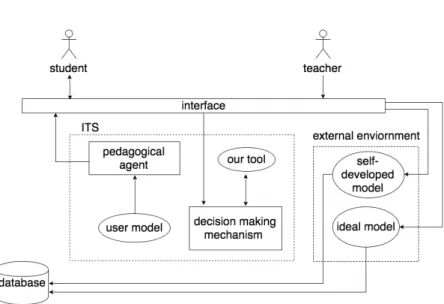
Figure 3.1 System general framework with relative components . . . 21
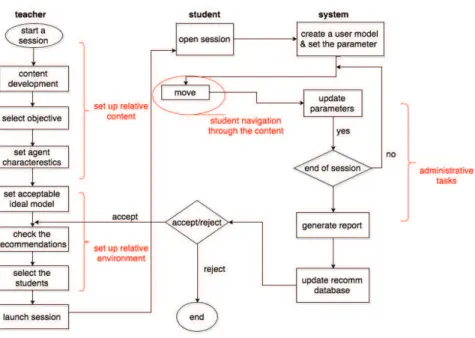
Figure 3.2 The proposed system framework . . . 25
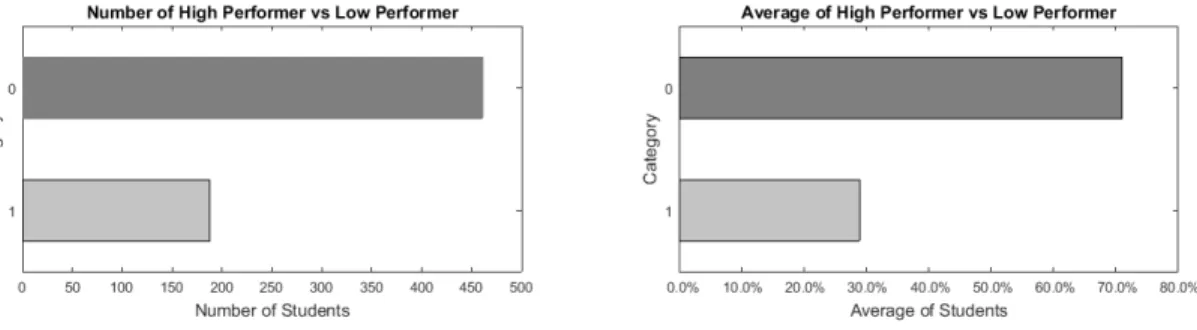
Figure 4.1 Distribution of number of high versus low performer learners as well as their average final grade . . . 44
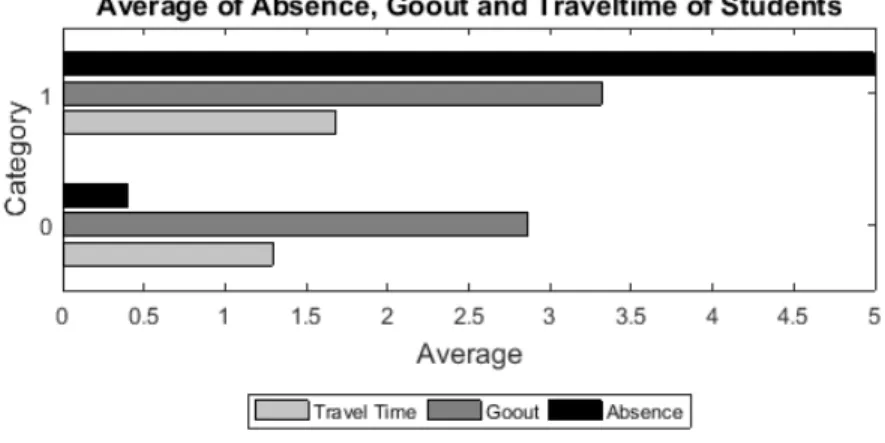
Figure 4.2 Distribution of dataset parameters to compare high performers versus low performers . . . 45
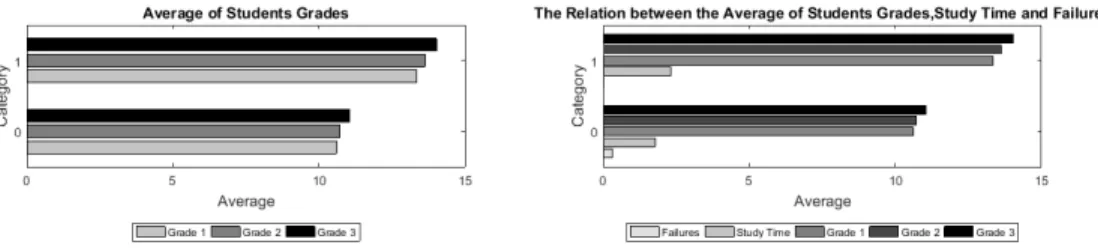
Figure 4.3 Comparison between corelation of parameters of the dataset in high per-former and low perper-former groups . . . 45
Figure 4.4 Continued comparison between corelation of parameters of the dataset in high performer and low performer groups . . . 46
Figure 4.5 ROC Curve forGroup1using Logistic Regression with learning rate of 0.01 and iteration of 100 rounds . . . 54
Figure 4.6 ROC Curve forGroup2using Logistic Regression with learning rate of 0.01 and iteration of 100 rounds . . . 54
Figure 4.7 ROC Curve for using Logistic Regression with learning rate of 0.1 and iter-ation of 100 rounds . . . 55
Figure 4.8 ROC Curve for using Logistic Regression with learning rate of 0.01 and iteration of 100 rounds . . . 55
Figure 4.9 ROC Curve forGroup4using 5-NN . . . 56
Figure 4.10 ROC Curve forGroup4using 10-NN . . . 56
Figure 4.12 ROC Curve forGroup4using 30-NN . . . 57 Figure 4.13 Six 5-NN ROC Curves three fromGroup4and three fromGroup5classified
with labeling functions . . . 57 Figure 4.14 Six 10-NN ROC Curves three fromGroup4and three fromGroup5
classi-fied with labeling functions . . . 58 Figure 4.15 Four kNN ROC Curves associated toGroup2 . . . 59 Figure 4.16 Four Logistic Regression ROC Curves associated toGroup2 . . . 59
List of Tables
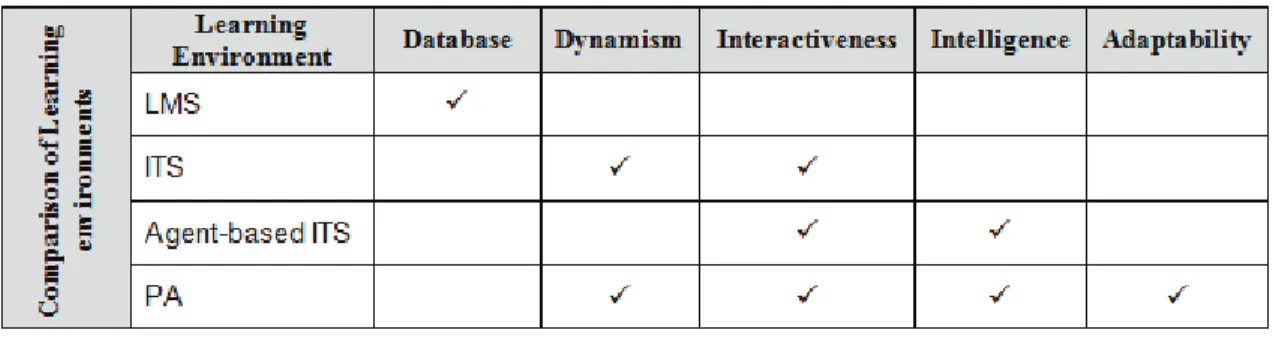
Table 2.1 Comparison of LMS, ITS, Agent-based ITS, and PA . . . 17
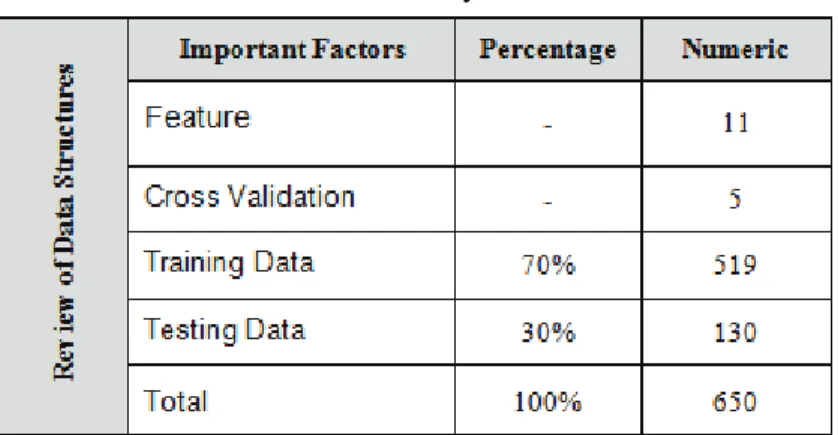
Table 4.1 Summary of data set . . . 43
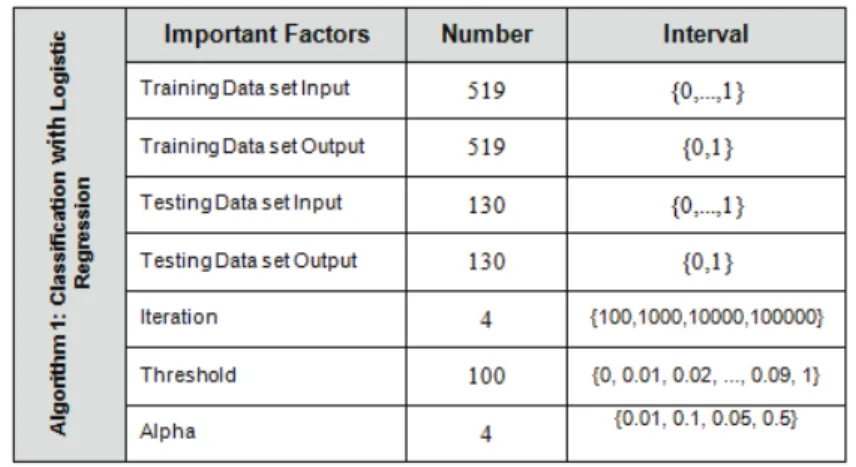
Table 4.2 Algorithm 1, Logistic Regression Data Breakdown . . . 48
Chapter 1
Introduction
In the past years, technology has shaped the education from the earliest stages of primary school to the advanced stages of graduate school. Thanks to the considerable advances of online learning management systems, noticeably students, teachers, employees, managers, and others showed an unprecedented desire to enhance their skills and promote their knowledge for future professional advancement using modern styles rather than the traditional education system.
For the growth of the eLearning era, Learning Management Systems (LMSs) [3, 53, 17] have been enhanced to serve electronic coursework for distance learners. A LMS is a system frame-work for designing, organizing, classifying and presenting courses accessible through a distributed system. Primary LMSs have been used only in academic organizations to afford lessons and train-ing programs in schools. However, durtrain-ing recent years, it has become fashionable among many corporations to deliver training to internal clerks and clients using LMSs.
A typical LMS yields the following capabilities to the teacher: (a) uploading the contents using different appropriate tools; (b) setting up and categorizing the materials as lessons; (c) designing well-structured self assessments; (d) determining due dates to complete assignments; and (e) coop-erating with students to maintain high quality lesson engagement during the learning period. The system also generates a wide-range of charts corresponding to students’ grades and performance by evaluating their progress in a learning activity. Likewise, a classic LMS provides the following abilities to students: (a) accessing the lectures; (b) performing quizzes and assignments; and (c) communicating with their teachers throughout the semester.
Nowadays, there is a diverse range of LMSs available with different features to accommodate users’ different requirements. For example, Canvas [12] is one of those LMSs, which is used by educational and non-educational organizations. Moodle [28, 33] is another well-known LMS used world-wide [48]. Dokeos [12] is a popular LMS in French and Spanish-speaking countries. Sakai [12, 2] is an academic LMS that was built by universities of Massachusetts Institute of Technology (MIT), Stanford and Berkeley for handling students’ group projects. Lately, some modern LMSs [4, 5] have been developed based on cloud, which provides modern features such as mobile accessibility and analysis.
Intelligent Tutoring Systems (ITSs) [61, 9, 10, 41, 58, 59, 69] are software systems that have been developed to improve the operation of LMSs. The main intention of a typical ITS is to give the perception to students that a virtual tutor is available during the whole learning process. For in-stance, during a quiz, if the student solves some questions incorrectly, the ITS steps in and elaborates on why the answers are wrong and provides guidance towards the correct solutions. Therefore, the ITS has been constructed to play a passive tutor role which facilitates student monitoring in order to set up convenient directions by generating customized and personalized advice to every individual student. Because ITSs have originally been developed to serve as intelligent virtual tutors, feedback from such systems depend on students’ learning skills. Similarly, it was expected that a classic ITS could modify its functionality when interacting with students of various abilities such as knowledge and performance. However, this objective is better achieved using agent-based ITSs, where agent is an intelligent component that is able to make a decision about what action it needs to take in a given moment. In agent-based systems, agents are generally organized specifically to complete the assigned goal by considering the current situation and previous experiences [22].
The implementation of a powerful ITS component was an ambitious goal for many years, and conducted efforts led to the creation of a static complex structure. ITSs were operating without any intelligent decision making procedure. In other words, legacy ITSs are composed of different algorithms that execute simultaneously and do not generate the dynamic feature for a decision-making mechanism. To address this problem of original ITSs, an additional module to operate as a dynamic component that is able to make decisions was needed.
To overcome the lack of intelligence in ITSs, agent technology has been used in the struc-ture of the system to apply artificial intelligence techniques and improve the feedback mechanism. Improving such a mechanism is conducted by modulating the decision-making algorithms and ap-plying changes caused by the external environment, in addition to tracking the collected information whilst interacting with students. The purpose of using agent-based ITSs is to simulate a human tu-tor. In other words, an agent-based ITS operates such as a human tutor in guiding students. It can also distinguish students in terms of a variety of features. By considering the information collected from a student monitoring system, an agent-based ITS modulates an individualized guidance and prepares the new topics to provide a comprehensive learning process.
A key feature of agent-based ITSs is their ability to self-adapt and change functionality de-pending on students’ needs, ability that is lacking in the original ITSs. Consequently, a basic ITS lacks the capability of modifying its decisions according to the external factors captured from the environment. It then only follows a static and regid algorithm and applies it whilst interacting with students regardless of their skills in an identical manner. Thus, attention to external factors is a core element when developing modern ITSs.
1.1
Problem Statement
The use of eLearning education brings time and location flexibility, which attracts several types of learners. However, in spite of its flexibility, many learners face new challenges for the lack of human guidance, which prevents them from successfully completing their courses. In fact, one of the main issues in online education is students’ engagement [2, 3]. Students often start online courses with enthusiasm. However, this deteriorates over time, as they begin to feel isolated and loose motivation. In fact, when starting distance learning courses, all students are passionate to learn new materials and are dedicated to achieving high scores. However, at the mid-point of the course, students fall behind schedule, have difficulty with time management, may become demotivated and encounter difficulties during learning, finding themselves incapable of overcoming these issues. Therefore, self-motivation and time management are two essential requirements, which a distance learner should consider to benefit the most from eLearning systems.
Thus, the critical challenge for an eLearning system is to build an interactive presence to avoid loss of concentration. As a solution, there should be a virtual tutor that is perceived as an actual human teacher who engages in the students learning progress. Engaging a tutor in this process, pro-viding individualized appropriate guidance, monitoring progress and performance, and essentially leading the students as an interactive environment are the first research problems to be discussed in this thesis. The aim is to design a dynamic system which assists students easily overcome learning challenges and improve their knowledge.
Machine learning provides powerful theoretical and practical foundations that, in the domain of interest for this thesis, allow the design of automatic education systems which are able to rec-ommend new topics according to students preferences. That is, machine learning methods can be effectively used to modulate the intelligent Pedagogical Agent (PA), which forms the main part of our ITS, to act as a virtual human tutor. The idea is to empower the virtual tutor with a classifier to help predict students needs based on their updated status, called image, captured from the data collected during previous interactions. The use of machine learning improves the quality of tutors understanding in order to better guide the student towards the ultimate goal. The more information the pedagogical agent has of the users characteristics, the better it can predict their requirements and thus adapt to their reading and comprehension style.
Another challenging issue we aim to address in this thesis is to enable the PA to automatically adapt to the user’s profile. Such an approach is not fully practiced or achieved by actual teachers in real classrooms as they do not have substantial resources and flexibility to modify their lessons to accommodate a large number of students with various learning skills. A machine learning-based methodology can, for this issue as well, effectively contribute in adding this crucial feature to the PA to offer personalized guidance. Having a private tutor and individualized guidance throughout the specified lessons and assessments makes the learning experience more attractive for students so that they can maintain their concentration.
1.2
Objectives and Contribution
The main objective of this thesis is to contribute in designing an intelligent PA to guide learners. Correct recognition of students categories plays a notable role in the decisions made by the PA in order to choose the applicable direction to guide those students. Therefore, the machine learning algorithms to be used by the PA should be carefully selected. Nowadays, there are a collection of patterns in the machine learning field where different algorithms could be used to manage and assist students towards their unique learning objectives. Selecting suitable algorithms depends on many factors such as size, quality and nature of data. It is difficult to predict which methods are most appropriate without trying them. Hence, different methods should be tested by considering the data characteristics to choose the most suitable for students prediction and classification process. The aim is to have a PA that can select the desirable teaching technique according to the student’ group, which reflects his needs and skills. Technically speaking, each teaching method which is selected by the PA is an individual decision tree, making the learning process attractive for students to maximize their learning outcome.
Contribution
This thesis is mainly about introducing a dynamic decision maker component that works as a main part of the PA. The agents used in intelligent tutoring systems are programmable and rational. They are also empowered with intelligent modules that let them process external data and rationally react to the environment. However, this mechanism does not necessarily make them adaptive to the environmental changes, unless the predictions are made and necessary adjustments have been hard-coded in the agent’s code. In this thesis, we propose an intelligent PA that can learn from the environment and foster a descent knowledge to formulate a system adapting to the external factors derived from the environment. The dynamic decision maker component helps the PA adapt to the student’s learning skills by considering the uncertainty factors when engaged in an interaction with human learners. Deploying such a framework would enhance the performance of the ITS to a certain level as the system is agile to uncertain acts that a student could perform while using agent’s guidance prompts. Therefore, the deployment of such a system has a dramatic influence on the accuracy of the learning skills classification and therefore, the overall performance while interacting with students. The results provided in the experimental chapter provides evidence of the fact supported by strong foundations of the framework.
1.3
Assumptions
In this research, to run a system based on the intelligent PA, several assumptions are considered. These assumptions are categorized into three groups: general assumptions, technical assumptions and domain-specific assumptions.
General assumptions: The calculation of some factors is crucial to classify students into related categories and compare these groups by pre-defined evaluations. Based on these measurements, ITS offers adequate teaching methods to various students. Therefore, to be able to measure these factors (such as the average of a class knowledge in a learning progress), it has been assumed that all students are in the same grade. By considering this assumption, we do not need to consider the differences between age groups. Another assumption in this category is applying the Blooms Taxonomy approach [1] for categorizing educational goals. This is a famous framework that has been applied by teachers and college instructors in their teaching structures.
Technical assumptions: This system is developed to run in a mid-sized classroom and cannot facilitate a countless classroom (such as five hundred students) simultaneously. Whereas in a class-room consisting of an enrollment size of two hundred or less, students can benefit from online learning services through this system at the same time. This means the software structure, network infrastructure and programming strategies of this framework are assumed to assist a limited number of learners. As another technical assumption, it is considered that machine learning will provide the appropriate support for the PA. Consequently, substantial research is conducted to find the most suitable machine learning methods for this research, according to our data specifications.
Domain-Specific assumptions: In this thesis, models have been developed to support the inter-action between the ITS and students. The user model depicts students status in a learning activity, whilst the ideal model depicts the best movement on the learning activity. The best movement is computed based on the teachers idea and the self-development model, which indicates the students self-measured status whilst being occupied in a learning session. Moreover, we considered a com-prehensive decision tree as a core of the ITS to guide students to become closer to the ideal model. Using such an inclusive decision tree enables the ITS to make dynamic decisions based on past ex-periences. As a result, the flexibility of adjusting existing decision trees supports the ITS in acting
smoothly to guide the students in an accurate and dynamic manner. As final assumption, we process the collected data partly in this study. This allows us to decide in a momentum way which data will be processed. The data processing will then commence by receiving data without considering any previously stored data.
1.4
Thesis Overview
The organization of this thesis is as follows. In Chapter 2, we present the related work, which is categorized into different subsections based on the relevant topics to what we proposed in this thesis. We also explain in details the concepts needed to understand the rest of the thesis. Finally, a discussion of different learning environments ends the chapter. In Chapter 3, we introduce the proposed framework with its relevant components in details. We provide a case study to show how the teacher and student engage in an interactive learning environment. In this chapter, we provide a theoretical mechanism, which is an extension of Markov Decision Processes (MDPs) to improve the PA’s decision making in order to guide learners in an effective way. In Chapter 4, we discuss an experiment for collecting data. We focus mainly on the raw data structure and data collection steps in details. Then, we propose the suitable machine learning techniques: Logistic Regression and K-Nearest Neighbor (KNN) to practice by considering the nature of the collected data. Steps for the implementation of the selected machine learning algorithms and obtained results are part of this chapter. In Chapter 5, conclusions and future work are presented and the contributions of the thesis are summarized.
Chapter 2
Background and Related Work
2.1
Background
In this section, we elaborate more in details about the preliminaries and the subjects/concepts that a reader should be aware of before reading the rest of the thesis. The preliminaries are followed by a discussion of related work that shed light on the state-of-the-art about eLearning.
Interactive Learning Management System (ILMS)
The Interactive Learning Management System (I-LMS) is a LMS, which interacts with human learner through a series of relevant advices. In other words, it is not only a schema for content sharing, but also it dynamically interacts with users to improve their learning experience. The basic LMSs [31, 2, 3] were a kind of digital frameworks that suggested curriculum, training materials, and corresponding assessments, whereas the modern version of LMSs [42] have further to offer.
Some I-LMSs use an evaluation mechanism to compare each students with their classmates to develop worthwhile guidelines to guarantee an effective learning process. For example, an ordinary I-LMS enables a feature that warns the student about the assignments’ due dates and upcoming quizzes to avoid any missing deadlines. On the other hand, the more prominent feature of I-LMS is student following/monitoring feature. Through students’ monitoring phase, the LMS captures a global knowledge of students’ feature measurements for diagnosing their skills to implement specific correct instructions.
The more dynamic the LMS is, the simpler students communicate with it. This is the reason for the success of I-LMS in contrast to early LMSs, which had been carried out simply for file distribution. In fact, LMS is accepted as a content and assessment delivery environment, however, the I-LMS is more advanced solution that collaborates with students through informing them of mistakes and limitations with more details and directions. Moreover, I-LMS provides immediate help to influence students by giving prompts during learning sessions.
Intelligent Tutoring System (ITS)
The ITS records students’ attributes such as pre-existing knowledge level, time management and students’ score in the quizzes to build a background corresponding to each student. ITS frequently updates the background information in order to offer personalized hints to guide the students. As ITS usually comes with a LMS, there is an interface for interaction between the student and system that helps the ITS to monitor students’ progress and get more information as they operate. As a significant feature of ITS it can be referred to its simulation in a way that it provides the benefits of one on one learner without paying attention to distance in a large scale of students.
Another objective of using the ITS is establishing adaptive learning module. In more details ITS is able to diagnose the weaknesses of students, hints when mistakes are made, then presents the new topics to help them strengthen their weaknesses. Most ITSs start the instructional process by considering the learners’ pre-existing knowledge level, which is estimated typically through a pre-assessment mechanism. The status of learner will be updated automatically based on different triggers depending on the structure of the ITS. In fact, a typical ITS compares what specific student needs to know with what is already known, then provides suitable individualized instructions that is needed to improve the learners status. Therefore, these instructions are the system’s reflection to the students’ current knowledge. Some of the ITSs [61, 9, 10, 41] are designed to develop and present the useful graphic reports, which is a significant source for instructors to diagnose the extent to which their teaching methods are useful.
As explained above, the ITS originally has been developed to serve as an intelligent virtual tutor. Therefore, feedback of such system depends on students’ learning skills. In other words, it was expected that ITS could modify its functionality when interacting with students with various
abilities such as knowledge and performance.
Agent
There are some specific factors to clarify the agents with arbitrary programs such as reaction to the environment, autonomy, goal-orientation and persistence. As explained before, an agent is a piece of a software that perceives its environment and acts upon that. Therefore, by changing the environment, the agent’s behavior would accordingly change. One of the agent’s essential factors is rationality. A rational agent is the one that chooses the right action which makes the agent more successful. An agent’s success evaluation depends on the defined criteria that determines how successful an agent is. One other agent’s attribute is autonomy that would lead to its independency. An autonomous intelligent agent is capable of choosing between different actions. In other words, an autonomous agent is the one that determines the appropriate operation by its own experience and understanding of environment rather than following of a statistic predefined structure.
Multi agent System
A multi agent system follows an intricate decision making mechanism since there is a compli-cated accurate link between perceptions, representations, and actions of whole available agents. A precise decision making algorithm is required for the environment that several agents exist at the same time to share common resource and communicate with each other. However, the hierarchic connection of agents is vital to synchronize them to choose the best action in order to achieve the highest success in a multi agent system. In addition, as there are multiple agents which commu-nicate together, choosing the protocol for their communication play a principal role in decision making mechanism. Therefore a protocol which is chosen for type of messages that they can send to each other and also the syntax of these messages, is one of the challenging parts of design and development a multi agent system.
Pedagogical Agent
The potential of emotional interaction between human and computer has been interested by re-searchers in computer science, artificial intelligence, and education domains. The integration of
intelligent tutoring systems, autonomous agents, and educational theory has been built the pedagog-ical agent. In other words pedagogpedagog-ical agent has been developed to overcome some constraints of distance learning. As explained before, the intelligent tutoring systems were used to support indi-vidualized learning to meet individual student’s needs, and assist each learner in the achievement of proficiency learning. Using a pedagogical agent-based system as a part of the ITS, provide the conditions that the students perceive the learning process as a social and winsome environment. Providing a social interaction between agent and student makes PA distinctive, as an intelligent tu-tor that teaches the lessons to the students not only in a static course framework but also through an interactive learning environment. Moreover, PA produces encouragement, information, guidance, or any other collaboration to communicate with students.
The intelligent pedagogical agent systems are developed to infer the students’ emotional through online learning when they may participate in virtual classroom from far distance. PA is capable of collecting students’ data while they are reading the contents or performing any assigned assessment. It also act based on it’s knowledge which is gotten from each specific student up to the moment. Moreover, it supports individualized guidance, content rephrasing, content suggestion and chart creation to aware the students of their strengths and weaknesses to improve.
2.2
Related Work
In this section, we carry on the discussion with respect to the related work that are categorized in different subsections.
2.2.1 Learning Management System (LMS)
Because of the eLearning benefits, it may be supreme revolution in modern online education frameworks. Nowadays, many educatioal institutes have started to use LMS, since they found it as one of the easiest and cheapest way to study that is available for everyone even in far distances. So in response to this demand, the LMS market is growing every day by a great leaps. Finally, these mutations has created various LMSs such as Moodle [28, 33], Canvas [12], Schoology [46, 6], Edmodo [8, 51] and Blackboard [37, 17]. These are some of the most popular LMS software that
have been used by well-known schools and universities for online courses worldwide.
As there are many training platforms available, it is very important to understand the role of the learning management systems in the learning environment to select the one that provides the highest attention to concerns. However, all of these frameworks are essentially a digital learning environment to handle the students’ learning process, which a human tutor usually performs in a real world. In all LMSs the instructor has the option of organizing learning time-line and assignments with deadlines. Therefore the main feature of LMS is giving the ability to deliver learning contents straight to the students as well as allowing them to create assessments for evaluating purposes. Despite all the similarities, different LMSs have various characteristics to meet specific needs.
In spite of all the LMS advantages, they have some limitations that sometimes prevent the students from continuing the learning sessions. The students often start online courses with a great excitement, however, many of them especially those with poor study habits, lose their motivation and fall behind their schedule in long run of the session. Some of them prefer traditional learning system since they want to have communication with their teacher in order to ask questions, whereas there is no social interaction in basic LMSs to connect the students to teacher and other classmates. Moreover, competition between students can be very encouraging for them in order to work harder, while there is no environment for competition, communication or discussion. One another issue in basic LMSs is that students need to be informed of their learning progress as it is necessary to know what they learned and what they are about to learn. If students are not aware of their progress, they become confused and may feel isolated and loose their passion continuing the learning process. In addition, they need someone to track them during the learning session and guide them when they made mistakes. So lack of such a valuable guideline is an considerable cause that learners are bored while doing a learning activity. By considering the aforementioned points, it is clear that the know how of the merits and demerits of the LMS improves its characteristics in order to raise students’ interest in such learning framework.
2.2.2 Intelligent Tutoring System (ITS)
Originally, learning management system was developed to provide personalized training as-sistant for each student instead of an environment that is just used for file sharing. Alternatively,
once can use many other easier ways to share files such as email and google docs. But that is not the objective. Nowadays, everyone is aware of the benefits of individualized instructions, so, the ITS emerged as add on to the LMS to produce the purposeful interaction with students during the learning session. Therefore, lack of social human communication is the crucial cause to deploy intelligent tutoring systems to support dynamic interactions while students are studying as a dis-tance learner. In fact, the ITS plays a passive assistant role when students are reading the uploaded lessons or performing assignments through the LMS. Virtual training tutor is the most important feature of ITS that supports the benefits of one-on-one instructions. To meet the users’ (students’, teachers’) expectations many investigations have been done and as a result a variety of ITSs have been developed that include unique characteristics. For instances Sophie [47], Meta-Tutor [55], CANVAS [12], Simself [14], Atutor [7], and SmartTutor [10, 41] are among intelligent tutors that aim to provide immediate and customized feedback to students.
Although the various ITSs consist of different components and strategies, however, all of them have a common ultimate objective that is producing individualized and immediate instructions to students in a practical format. ITS enables students to better learn by practicing their skills within highly interactive learning environment. It assess the students’ actions within those interactive en-vironments as well as builds a model of students’ knowledge, performance, time management and other cognitive and non-cognitive skills. In other words, ITS monitors students in terms of skills, then records the information taken as characteristics. ITS is also able to update the collected infor-mation to perform an accurate evaluation of each student. Based on knowledge that ITS receives from students and its evaluation, ITS adjust the instructions and presents relative explanations, hints, quizzes and new topics as needed. Therefore, it is a critical feature for ITS that modify its func-tionality while interacting with various students and provide accurate and customized directions corresponding to each specific student automatically.
According to the previous explanations, two inseparable properties of the ITS are intelligence and tutoring. The lack of each of those features produces two conceptual problems for ITS. The first problem happens when intelligence is ignored in the architecture of the ITS. It is expected from the ITS to operate as an intelligent component that acts upon the students’ instantaneous acts, then automatically adapts to better improve students’ skills. The ITS is able to adapt to by
analyzing students’ strengths and weaknesses. Accordingly, it selects the appropriate action from other available actions for guiding students to become closer to the ultimate goal through shortest path. In the mean time, the intelligence feature is missing in many of the proposed frameworks as ITS. The notable reason for the lack of success of these kind of ITSs is that they follow a predefined structure (decision tree) to feedback upon the students’ actions in a static way. Sometimes these structures developed by complex algorithms, but even with these algorithms the system is incapable of choosing the action autonomously. Some of the ITSs which are introduced above such as Simself, Meta-Tutor, Atutor are categorized in this group.
In the first category the ITSs focus on efficient interaction between students and system follow-ing the objective to act as a smooth mentor. The problem in this kind of systems is that, they act poor as an intelligent component. Whereas in the second group, the focus is on intelligence of the ITS. So, in this category the problem occurs when the concept of tutoring is missed in the architec-ture of the ITS. These ITSs incorporate some algorithms in order to monitor the students and try to personalize instructions on the basis of adaptation to students’ skills to provide appropriate teaching strategies. In other words, this group of ITSs are able to select the relevant and customized action autonomously to interact with various students. Therefore, the second group use a powerful intel-ligent structure for decision making mechanism to adapt themselves with variety of learners with different skills. However, they are poor in tutoring students toward the best learning path, during the distance learning. Some of the ITSs which are introduced above such as Canvas classifies in this group. As explained before, the ITS has been developed to act as an intelligent system, as well as tutors the students smoothly such as a human tutor. In order to this emphasis, the ITSs should be built in a way that supports an artificial intelligence to operate dynamically and autonomously, as well as guides students smoothly in order to achieve their objectives.
2.2.3 Agent
An agent can be of many types such as machine, person or a software program. In computer science domain, an agent is a piece of a computer program that acts in a software environment. In more details, a software agent is a goal-oriented computer program that reacts to its environment without direct human intervention. It is important to note that a software agent possesses some
necessary properties such as autonomy, interactivity, rationality, and adaptability. In this thesis, we narrow down the types to pedagogical agents that are programmed specifically for the purpose of serving as a virtual human tutor.
Prior to discussing the pedagogical in depth, it is worth to elaborate on different types of agents in further details. There are different types of agents that are categorized into collaborative agents, interface agents, mobile agents, and reactive agents. Collaborative agents are a network of intelli-gent autonomous aintelli-gents that communicate with one another to decide about their functional opera-tions. This operation should be selected in order to build an effective interaction between users and system for achieving a defined ultimate goal [67, 19, 15, 41]. The global companies use this type of agents to respond to rapid changes in customer needs and increase the efficiency of the whole sup-ply chain. [19] introduces production-distribution planning system to intercede the planning gaps between two planning functions: production and distribution by using collaborative agents.
Interface agents are those agents that apply artificial intelligence techniques to the system’s architecture, in order to provide a human like assistant for students [67]. It acts as a personal assistant who collaborates with learners during a learning activity. Intelligent Tutoring Systems [40, 9], Meeting Scheduling systems [13], and also News Filtering systems [67, 29] are among the interface agents. For instances, in [67], authors attempted to address the problem of managing the big amount of news feeds in media. They introduced Fido, as an interface agent in order to solve the news feeds overload problem. Fido filters news by considering user preferences and feedback to display personalized news to the users.
A Mobile Agent is an executing program that is launched by a user to migrate from one node to another autonomously in a network. In each machine, each agent interacts with other agents to continue its operation in order to accomplish its defined tasks in the destination. This kind of agent is generally attractive to use in distributed information retrieval applications [18, 21] as they are able to migrate to the location of an information resource and locally search the information. In [18], authors developed a system to manage the distributed information retrieval processing in order to search for the required technical papers from distributed database through a network. In this system, mobile agent can travel from a host machine to different destinations, perform data processing, then send the related information back to the host.
2.2.4 Pedagogical Agent
The aforementioned types were a general classification of agents used in industry. In the follow-ing, we carry on the discussion with deeper details regarding our specific type of interest: Pedagog-ical Agents [52, 23, 66, 44, 45]. This kind of agents are all used in intelligent tutoring systems for the purpose of interaction with human learners to provide the information that is gathered to convey a piece of information as knowledge representation. Interactive Narrative Tacit Adaptive Leader Experience (IN-TALE) [34, 35, 36] is a practice environment that authors applied the experience management framework for educating cognitive skills such as leadership, and decision-making un-der pressure. In this framework, learners play a leaun-dership role in a simulation of a military exercise to achieve a specified effect. Authors also have developed narrative mediation, which is a technique where a story is defined by a linear plot progression to support related learning situations.
FearNot! [16, 50] is another pedagogical environment, which is a generative experience man-agement framework to give students helpful roles to learn strategies for coping with bullying. In this framework, VICTEC FearNot! is a virtual learning environment to help the students to tackle the problems and allow them to explore ways of dealing with problems. They use believable synthetic characters and narrative structure to create a close relationship between characters and students. In each episode of bullying, students interact with one of the characters on each occasion by offering the appropriate advice.
In [43], authors have developed a system that is called Thespian. Their approach provides the benefits of speeding up the development of Interactive Pedagogical Dramas (IPDs) [24], support-ing open-ended interaction, achievsupport-ing pedagogical and dramatic objectives as well as supportsupport-ing quantitative metrics for evaluating the learners’ achievement. The architecture of thespian uses autonomous software agents to control each character with their personality and the defined motiva-tions as defined for the agent as goals. The ability of goal-driven agents that can autonomously select the appropriate actions by considering the current state of the world help them to act responsively to open-ended user interactions.
In [26], Bradford W. Mottauthors have developed a narrative centered, an inquiry-based system to promote exploratory learning in the field of microbiology. This system is designed for the students
who desire to discover the origin of an unidentified infectious disease at the research station. In this approach they use of U-DIRECTOR architecture, which has been implemented in a narrative planner for Crystal Island [26, 27] to cope the uncertainty enforce by student actions.
In Teatrix [25], children gain the opportunity to create their storyboards of existing fairy tales. To prepare their story, they should choose three items: (a) scenes whereas they choose their desir-able scenes and connect them just with a line; (b) props whereas the characters can perform more complex actions in the story world using the props; and (c) cast as the characters that are going to play it in the story world. The pedagogical agent acts as an implicit agent that is developed as a story director, which is responsible for the narrative guidance of the story as an intelligent module in this system.
Table 2.1: Comparison of LMS, ITS, Agent-based ITS, and PA
Table 2.1 investigates the various learning environments that are discussed in this thesis in terms of dynamism, interactive-ness, intelligence, and adaptability. The LMS as one of the basic platforms in online learning is the learning environment to provide students’ registration and learning content management through the web. As it is explained in Table 2.1, there is no dynamic relationship between students and system in LMS. However, many students need the effective communication mechanism in order to use of an active tutor in their educational path. Online tutoring via the LMS can be successful by incorporating with an ITS. In ITS there is a method for delivering customized instructions to the students based on their abilities. At first, ITS promise of a adaptive learning experience, but in spite of promising they support the students’ learning process only by a number of static algorithms. Therefore, artificial intelligence has used in the architecture of ITS, to design the intelligent system. This type of ITS, not only are independent from static decision making mechanism, but also are able to act autonomously. But despite of these advantages, this type of
ITS is unable to adapt itself with different students with different characteristic. As a solution, the pedagogical agents has been developed to play the role of a learning partner or a human-like tutor in a learning environment. The feature that distinguishes a PA from other agents is its adaptive functionalities but as it is clear from Table 2.1, it also does not satisfy all the criteria of students needs. Perhaps the most important hurdle to overcome is the difficulty to develop a system with whole the features that each of mentioned learning environments provides. In this thesis, we got helped from machine learning technology to construct a system to satisfy the students’ needs when they are studying online regardless of where they are located.
Chapter 3
MDP-based Intelligent Tutoring System
In this Chapter, we briefly explain the essential parts of an advanced eLearning system including Learning Management System (LMS), Intelligent Tutoring System (ITS), AI-based ITS and Peda-gogical Agent (PA). Then we introduce the proposed framework, which includes both LMS and ITS that closely cooperate. In this approach, we consider PA deploying a decision making mechanism to develop a user model. The proposed model serves as the main part of the proposed ITS. More-over, this chapter consists of the model explanation and system workflow demonstration. Also, we introduce the Markov Decision Processes (MDPs) as a mathematical foundation. We continue the chapter with the relative experimental section to present the extracted outcomes from the collected data. We also explain the data set and the machine learning algorithms, which are used in this ex-periment as well as the discussion over the findings. A detailed comparison between the outcomes of different algorithms will conclude the section.In recent years, students, parents, and governments have become increasingly excited about the online learning by decreasing costs and improving performance. LMSs are among the most productive methods in deployment of the elearning courses. LMSs are considered as web-based frameworks with the role to integrate with the academic community and manage student-related activities like content management, course administration, course registration and reporting. Using LMSs, teachers take a practical approach to address students’ needs regardless of time and place by sharing files and providing guidelines. ITS, the core part of LMS, is a computer system which enables student monitoring in order to develop appropriate instructions by generating customized
and personalized guidance to every individual student. There can be an effective interaction between human learner and ITS. The guidance provided by ITS and given to the students as a prompt makes it easier for them to focus on their weak points and improve their underprivileged skills in an effective way. It can also provide real-time data to instructors and developers looking to refine teaching methods.
Because of the educational concerns worldwide, there exist many significant studies about ITSs. Some studies defined ITS as a system that is capable of diagnosing and adapting to student’s knowl-edge and skills. According to these studies, ITS is able to provide precise feedback when mistakes are made and able to present new topics when the student is ready to learn. There have been also frameworks developed to interact between ITS and the student using some models (i.e. User model, Ideal model, etc.). Some recent investigations propose AI-based ITS. The common belief is that the overall aim of developing AI is to enable the computer to be effective and act as a knowledgeable agent in the teaching and learning process. Nowadays Agent-based systems play a fundamental role in the development of pedagogical systems. Using agents in intelligent pedagogical systems provides a more efficient system. Therefore, some studies are done in this topic. In such studies, the aim is to infer the learner’s emotional state in distant learning. The main functionality of the system is to collect data and interact with the learner while the learner’s data acquisition component col-lects learner’s data. Following similar objectives, some other research works use machine learning to recognize the learner’s emotional behaviors (i.e. sadness, happiness, fear, etc.).
In this research, we provide a system which establishes an effective interaction between the ITS and human learners. A typical student registers in a course and participates in a learning session through the LMS. The ITS part of the system monitors the student in terms of knowledge, per-formance, time and other characteristics predefined in advance and stores them in an appropriate database. The decision making mechanism (the most crucial part of the ITS) needs the data to judge the student in a specific time interval and provide an appropriate guidance as a prompt. To accomplish more effective communication, the system should distinguish the unique characteristics of each human learner, generate a customized guidance for that specific person, and suggest an ap-propriate topic. To attain this objective, we have developed a PA empowered by machine learning capabilities for instituting smooth and practical interactions.
Our main goal in this study is to provide a more productive learning and understanding expe-rience for students. To achieve this goal, we have introduced a system including both LMS and ITS, closely cooperating with each other. The ITS consists of four main parts: Pedagogical Agent, Decision Making Mechanism, User Model and our Markov Decision Process (MDP)-based tool for decision making. The LMS also incorporates four main parts: GUI, Self-Developed Model, Ideal Model, and a Database to store and retrieve data. The human learner can communicate with the system through the GUI. In the ITS part, we present The MDP-based component to form the PA’s decision making mechanism aiming to make the user model closer to the ideal model. We propose the reward function as an artificial intelligence concept computed in the form of score relative to the target point (the goal). So the closer user model gets to the ideal model, the higher expected reward would be. We also carried out an experiment to collect data to apply appropriate machine learning algorithms in order to predict the performance level of the learners. The logistic regression and KNN methods are selected in this experiment due to the nature of the data. Considering the results obtained from these two supervised learning algorithms, we can calculate the performance and accuracy to select the most appropriate one.
3.1
The Model
3.1.1 Preliminaries
In this section, we introduce the proposed model and explain its components. There are differ-ent relevant pieces that are referenced in the framework illustrated in Figure 3.1 The model is an advanced LMS [3] empowered by an ITS deployed to provide real-time data to instructors and con-tent developers looking to refine teaching methods. The guidance is provided given that the overall learning objective is already predefined. To efficiently maintain high quality guidance, there is a data processing center that closely cooperates with a decision-making mechanism to select best actions to be taken in any specific situation. The combination is therefore responsible to generate mean-ingful information to interact with students using an appropriate interface. The combined methods, alongside the effective content of the prompts, create an ITS that provides customized feedback to learners in order to improve their learning skills based on their input into the system. Some ITSs use intelligent agents to better perform artificial intelligence-based feedback and modulate the decision-making process to effectively apply changes and track the collected information while interacting with human learners. These agents are programmable and called Pedagogical Agents (PAs).
PAs provide practical solutions for ITS’s objectives. They facilitate monitoring students, track information changes, customize and order information according to individual needs to help stu-dents reduce work overload and stress. They are helpful in teaching stustu-dents to become effective and benefit from the offered content. With regard to the functionality of a PA, it receives (or seeks) input data from the environment, processes the data to find out the updates from the environment, and reacts to the environment with the appropriate action. The updates are recognized by compar-ing the environment status to the virtual environment (i.e. image in the form of user model) that the agent has created at the beginning of its life cycle, and by continuously updating the image to be synchronized with the outside world. In this domain of research, the input data is in the form of human-related activities, which defines the environment where the human is actively doing a work that involves the agent.
A typical PA is a rational intelligent agent that cooperates with the rest of the system com-ponents (i.e. database, interface, communication mechanism, LMS configuration system, etc.),
processes the collected data, and provides guidance to human learners with respect to the prede-fined learning objective under which the agent has been programmed. The guidance is usually done through interactive communication with human learner. The communication is usually part of an ITS. The pedagogical agent is intended to acquire knowledge about the surrounding environment by receiving data from users in the form of students’ activities while doing a learning activity. The agent then compares the latest environment status changes to update its image (virtual internal saved environment), from the outside environment. This comparison is of great importance since it indi-cates how good is the student’s status at a specific moment with regard to time, knowledge level, order, reading status, and performance.
The core of the tutoring system is the decision-making mechanism, which is rather a widespread process. There are three sources of information that tutor’s decision-making mechanism uses: (a) teacher’s estimation of the ultimate goal; (b) system assessed user model that depicts student’s status in learning activity; and (c) student declaration of self-assessed status in learning activity. Decision-making mechanism considers this data as an input which leverages the communication between the PA and the student. The communication is managed based on user model that the system assessed and the difference between the student’s status and system-generic ideal status. Agents follow ratio-nal aptitude in dynamic decision-making, which involves algorithmic infrastructure and theoretical framework that will be explained in Section 3.2.
The theoretical foundation of this mechanism helps a pedagogical agent effectively communi-cate with human learners based on the processed input data via decision-making protocol as a part of ITS. Agents then effectively identify the moves that treat the best reaction towards the students with various learning characteristics. The parametric break down of user model elaborates details in deep level of granularity, which highlights the weaknesses and the approach to fix them. Agents then act confidently, however with certain level of uncertainty, and guide the students towards the predefined learning objective. This cycle is carried on till the end of the session. The session may consist of some reading materials, few quizzes and break. Finalizing each iterative interaction with student, the system-generic user model will be updated. Depending on PA decision, the learner will be either prompted according to the approach taken towards learning objective or it will tend to provide more time and not to interfere with improving students self-planning skills.
In agent’s decision-making mechanism, we assume that the external environment is composed of two models: Ideal Model and Self-Developed Model. These models follow the same template and contain a list of certain parameters with defined range and assessment/update formulation. Us-ing these parameters, the agent assesses learner’s knowledge, time management, performance, and learning skills in the form of associative score. Ideal model is the imaginary student that depicts the best movement on the learning activity based on teacher’s opinion. Therefore, before learning session launches, the teacher creates and updates the ideal model in order to define the target point using which learner is guided towards the learning objective. In the proposed model, the teacher influences the special user model known as ideal model. This ideal model represents the best user model, which as subject expert could experience the learning material given the predefined learning objective.
Outside the agent goal-identification mechanism, this ideal model is set with the teacher and the agent configures this special model to its internal system and becomes ready to guide students using this target point as benchmark. Therefore, all students are going to be guided using the same benchmark. As a result, our advanced LMS can compare students’ performance and highlights their strengths and weaknesses in various pedagogical aspects.The teacher can also modify or customize the learning sessions according to new emerging needs before launching a new learning session following a new learning objective.
The Self-Developed Model is initially created by ITS and continuously updated by learner who indicates self-measured status of learning status while being engaged in a learning session. The Learner can always input new values for self-measured report set. However, the system prompts the student encouraging to report self-measure learning status based on some pre-defined points that the agent recognizes. The agent always compares the status of the user model with the one indicated in self-developed model. The rationale behind this comparison is the fact that the agent needs to identify substantial differences between these two models, which normally indicates student’s confusion and promotes the importance of guiding prompts to be triggered. In some cases, such big different is indicative of agent’s miscalculation of student-related user. In these cases, usually the agent increases its uncertainty level and the guiding mechanism acts more cautiously while interacting with a student with rare aptitude of learning.
3.1.2 The Workflow
Figure 3.2: The proposed system framework
In this section, we explain a case study which demonstrates the work flow of a day-of-a-life sce-nario for a teacher-type user designing a learning session and engaging students into an interactive agent-based intelligent tutoring experience. The interactive learning environment is developed by deploying the rational pedagogical agents programmed and planned to follow pre-defined goals we explained in the previous section. The work flow elaborates on the relative data collected which represents the learning skills of the human learners. As shown in Figure 3.2, the teacher begins by creating the content (or modifying the previously developed content) to structure a base that is used for agent-based guidance.
To create a new learning session, the teacher selects a learning objective, which identifies the learning target the teacher is following. The learning objectives are inspired from Bloom’s Taxon-omy [70] and are in the form of improving students’ learning, memorizing, problem-solving, and analyzing skills. In addition to these predefined and widely used learning objectives, the teacher can customize a new objective by setting new parameters or modifying existing structure of the parameter cube. Once the learning objective is set, the teacher can upload learning materials in the form of reading text blocks (that could contain a number of pages), quizzes in the form of pre-test,
post-test, pop up questions, complete questions, and breaks to group learning materials into a learn-ing modules. Obviously, there is no limit in terms of the number of text blocks or quizzes, but the teacher is aware of the overall learning activity time and fits to the learning objective already set at the beginning of the learning session design process.
By selecting each learning objective, the system associates a list of parameters that form peda-gogical agents’ aptitude in guiding human learners. However, the teacher can modify the parameters to promote a parameter for a specific reason. For example, in improving memorizing skill objec-tive, the time management score is used to a certain extent when the agent guides the student. If the teacher promotes this parameter, the agent acts more cautiously regarding the time-related activities such as the time spent on reading a text block or taking a quiz. The extent to which the teacher is restrictive in any aspect (i.e. time, performance or planning) directly influences the relative param-eter in a sense that the pedagogical agent can convey the guiding aptitude to students. Using the associative parameters and additive ones set by the teacher helps the agent to create the ideal model that is used as benchmark to guide the students doing learning activities at best performance. The ideal model is set once and remains static during the learning session.
The teacher can preview the session from the student standpoint and experience the pedagogical guidance the agent provides to apply necessary changes if needed. After providing appropriate corrections and necessary changes, the ideal model is shaped representing the idealistic manner, which the agent can adopt in order to guide the students towards learning objective. After launching the learning session, the student is notified through the user interface in the form of notification. The student become acquainted with the principal information about the learning session, such as the due date, session duration as the whole learning activity, number of breaks, learning objective, and the teacher note that highlights the important issues. Moreover, the student is informed about some statistics that represent the other students who are invited to take the same session. The statistics provide details regarding the percentage of the class who accomplished the session and the one who has started the learning activity but yet to be finished. The student then starts the session with complete information regarding the learning objectives, as well as the status of its classmates.
Once the student engages in the learning session, the pedagogical agent initiates a user model that depicts student’s progress throughout the session. The user model is continuously updated as
the system collects more information while the student is navigating through the reading text blocks and taking pre-tests, post-tests, completing quizzes as well as pop up questions. The aforementioned parameters in subsection 3.1.1 are updated according to the data collected through the user interface interacting with human learner. The updates in these parameters cause a new user model version that is recorded in the form of the numeric vector and represents the instantaneous status of the user in terms of learning progress. Holding the user model and recording continuous updates is a great resource for the agent to compare the instantaneous status of the user with the ideal model defined (or verified) by the teacher. However, in addition to what the system depicts for the student, there is another model that is generated by the student directly in the form of self-developed model. This model could be updated whenever the student inputs self-measured data that are indicative of student’s progress in the learning activity. The agent does not have any control on this model expect that the student is encouraged to fill in such information on an occasional basis.
At the end, the agent also has access to what the student inputs as self-measured learning progress, and the comparison of the three models in a triangular shape is the core of the agent’s decision-making before triggering prompts to the student to form effective guidance service. The details of such decision-making are explained in the following section as our main contribution. The process of guiding the student throughout the learning activity is done by our intelligent tutor-ing system protocol, which involves a lot of data processtutor-ing features used by the pedagogical agent to perform effective guidance under specific learning objective. When the student is navigating be-tween text-blocks and quizzes or taking breaks, the user model parameters such as reading status, knowledge level, order score, performance, and time score are updated accordingly. This process is carried on till the learner reaches the end of the session.
The ITS has different parts including pedagogical agent, decision-making mechanism, and our proposed model. The aim of PA is guiding learner to get closer to the ideal model as much as possible, by considering the self-developed model. The ultimate goal is to maintain a situation where the user model is at closest possible distance to the ideal model, which indicates the successful guidance done by PA. The ITS uses our proposed model and decision making mechanism to improve guiding student in a useful and accurate manner. Our framework receives data that is collected by the system as an input, applies some predefined mathematical functions to optimize the output, and then
send it to the decision-making mechanism. By receiving this input Decision-making mechanism uses a comprehensive decision tree to choose the best and shortest way to guide the human learner to get closer to the ideal, by prompting timely and accurate.
When the session reached the due date, the system classifies the collected data to generate progress reports with extensive information about students’ cognitive and non-cognitive skills. This information helps the teacher to make prudent decisions and make productive adjustment in upcom-ing sessions. Moreover, the system generates recommendations in the form of tips to students to take into account and become better learners by improving specific skills that the system has rec-ognized in a customized and personalized manner. Upon teacher acceptance, the recommendations are sent to students to consider a relative session following the one the recommendation was based on.
Connecting the sessions would let the agent to retrieve the data from past session to use in dy-namic decision-making mechanism explained in the following session. Once the recommendation is sent to the student, there are two options that the student can choose: accepting and rejecting the recommendation. By accepting recommendation, the student’s name will be added to the recom-mended students’ list automatically, that system offers to the teacher for the next session. However, it is still optional for teacher to add/ remove this particular student to the next session. By rejecting recommendation by student, there is no update in the recommended students’ list, but teacher can see which recommendation has been rejected by student. The sequence of sessions followed by rec-ommendations that encourage the student to take another session is called adaptive learning feature that we support in our proposed platform. However, without loss of generality, we skip details of this feature to move into the dynamic decision making protocol as our main module in the proposed system. In further details, we highly concentrate on our model, which configures agent’s dynamic decision making core.
3.2
Theoretical ITS Mechanism
3.2.1 Mathematical Foundation
As described in previous sections, the primary objective of the ITS is to shrink the gap between the user model and ideal model. It is also important to evaluate the self-measured model and check out how close it is to both other models. Therefore, a successful ITS is the one that minimizes the (euclidean) distance between the two described models as much as possible. To reach this goal, the ITS decision making mechanism requires a deep and complete methodology to deal with this critical issue via the accurate mathematical mechanism. The deployed mechanism serves as an appropriate pre-programmed procedure to manage the decision making part by employing the precise parameter in a pre-defined path.
In this section, we propose a natural extension of general Markov Decision Processes (MDPs) to organize pedagogical agent’s decision making mechanism on guiding human learners by taking into account the ideal model compared with instantaneous user model. This mechanism is managed through the extended MDP with partial access to the environment, given that interacting with human learners would generate irrational data which could influence agent’s expectation on user model supported by self-measured model. The mechanism is defined by a tuple< I, S, A, P, R, yi >.
As a matter of fact, the tuple contains the snapshot of students’ status evolving over time. It also provides the action which each particular student selects to move to the next state. In more details, each snapshot contains each particular student’s user models, list of possible states, list of reasonable actions, the probability of each selected action at any time/state, the pre-defined reward, which is associated to each action, and list of the possible updates once the action is selected and the state transmission took place. The proposed ITS decision making mechanism uses the aforementioned tuple to process the status of the human learner with respect to ideal, user, and self-measure models. Using a proper classification tool (a machine learning method), the system is able to guide the students towards the best and shortest path to achieve the ideal result during a learning session. The details of the proposed framework used by the decision making module of the ITS is described in the following.