Dealing with unpredictable risk - The influence of
external factors on information systems
development and implementations.
By
Ettiene Esterhuizen
300282198
Supervisor: Tony Hooper
18 October 2014
A case study presented to the
School of Information Management
Victoria University of Wellington
in partial fulfillment of the requirements for the degree of
Ettiene Esterhuizen 300282198 Page 2 of 43
Preface.
I would like to dedicate this Case Study to my family who supported me throughout my studies. Without their love and support my success would not be possible.
I would like to thank my supervisor Tony Hooper for all his support, guidance and encouragement which contributed tremendously to my learning’s and career.
I would also like to take this opportunity thank each and every lecturer from Victoria University for their guidance and support. I’m also grateful for the support and confidence that was expressed by my manager, CIO and participants.
I certify that this Case Study is my own work and that all references are accurately reported.
Ettiene Esterhuizen 300282198 Page 3 of 43
Abstract.
Organisations and especially Government departments develop information systems for their own specific needs, due to this Government departments invests a great deal in information systems development and implementation projects. The intention is to save on cost and develop information systems according to their needs and requirements. Unfortunately such projects are vulnerable and subject to a range of risks.
This case study identifies the risk factors involved in information systems
development and implementation projects and the risk processes that are in place to mitigate against those risk factors. Furthermore the case study investigates an information systems development and implementation project where four legacy systems were to be merged into one newly developed system. The project was interrupted when an organisational merger resulted in the loss of key members of the governance board and the project team, either through redundancy or being
allocated other responsibilities within the organisation. This exposed the project to unpredictable risk which caused the project to head down the path of possible failure.
The case study outlines the project plan, what actually happened and what
according to the interviewed participants happened during the project. It is clear that the risk management processes wasn't followed and that wrongful decisions were made during the organisational merger. Unpredictable risks as a result of the merger and the decision to continue the project required a strong governance board, proper project management, proper risk management and the execution of the risk
management processes. The lack of governance and project management had a huge impact on the project while the loss of expertise and knowledge added to the risk profile which resulted in further complications to the project. It’s during these situation that a strong governance board and proper project management is needed to make those critical decisions and steer the project towards success.
Ettiene Esterhuizen 300282198 Page 4 of 43
Contents.
Acknowledgements. ... 2 Abstract. ... 3 Introduction. ... 6 Literature Review. ... 7 Risk factors. ... 8Risk Management Processes. ... 9
Plan Risk Management. ... 9
Risk assessment. ... 10
Risk Identification. ... 10
Risk Analysis. ... 11
Risk Prioritisation. ... 12
Risk Response Plan. ... 13
Monitor and Control risk. ... 13
Case Study on the Department of Electronics. ... 15
Project History for the department of Electronics. ... 15
What Actually Happened. ... 17
Research Methodology. ... 18
Participants Interviewed. ... 19
Project Discussion. ... 21
The goal of the project (Question 1). ... 21
Measurement of project success (Question 2)... 22
Issues the project would resolve (Question 3). ... 23
Risk management processes (Question 4). ... 24
When the merger occurred (Question 5). ... 25
Active involvement of governance (Question 6). ... 27
Ettiene Esterhuizen 300282198 Page 5 of 43
Conclusion. ... 29
Bibliography. ... 30
Appendices. ... 35
Appendix A – Project Risk Factors. ... 35
Appendix B – Detailed Project History. ... 37
Appendix C - Participant Information Sheet. ... 40
Appendix D - Participant Consent Form. ... 42
Ettiene Esterhuizen 300282198 Page 6 of 43
Introduction.
For many years organisations have been developing and implementing their own information systems especially within Government. The intention has been to save on costs, develop systems for their specific needs and maintain those systems internally. Unfortunately such projects are vulnerable and subject to a range of risks. This case study investigates a critical information system development and
implementation project to merge four legacy systems into one newly developed system. The project was interrupted when an organisational merger resulted in the loss of key members of the governance board and the project team, either through redundancy or being allocated other responsibilities within the organisation. This exposed the project to unpredictable risk which caused the project to head down the path of possible failure. The case study investigation will focus on the following considerations:
what strategic options were available;
what strategic decision was made;
what effect did the merger have on the risk management processes; and
what effect did the loss of key personnel have on the project.
The literature on risk factors and the risk management processes will be researched to identify what those factors and processes are and if the project successfully managed risk in terms of the risk management processes. It is expected to find detailed risk factors that influence information systems development and
implementation projects and the risk management processes in place to mitigate against risk. How the project dealt with risk and the strategic decisions made is key to the case study. In this specific case study participants will be interviewed to understand how the decisions influenced the project from their perspective. It is anticipated that the investigation will provide an external view of the strategic decision process. The purpose will be to explore ways of optimising project decisions that are driven by unpredictable risk factors. Such decisions are often made under pressure and often without additional external input, although they may not
Ettiene Esterhuizen 300282198 Page 7 of 43
Literature Review.
Within most organisations information technology plays a key role in the
organisations strategies and operating processes especially within Government. Therefore if organisations are to be successful information technology has to be integrated into all aspects of the organisation (Wilbanks, 2008).
Due to the fact that Government departments require information systems for their own specific needs one could expect a great deal of investment on information systems development and implementations projects. Information systems
development and implementations contributes to organisational transformation. It is with these newly developed and implemented systems that organisations are able to create more productive operations (Wastell, 1999). What is more information
systems development and implementation benefits the organisation by saving on costs. It also allows for information systems to be developed specifically for the organisations needs (Xu & Brinkkemper, 2007). Furthermore for information systems development projects to be successful the needs of the user's have to be fulfilled and the requirements of the organisation (Wastell, 1999).
Although there are various benefits to information systems development and implementations projects the success rate is not very high. These projects are renowned to end up in failure as they are difficult to manage (Keil, Cule, Lyytinen & Schmidt, 1998). Information systems development and implementation project failures are due to projects running over budget or running over schedule or not delivering on its benefits (Whittaker, 1999).
Unfortunately there are a lot of factors that influence the success of information systems development and implementation projects. Regardless of research studies, lessons learned and supporting tools such projects fail too often (Wastell, 1999). Every project has risks that has the ability to cause a project to fail (Allen & Hardin, 2008), it is therefore important to identify the risk factors that could potentially have an impact on information systems development and implementation projects.
Ettiene Esterhuizen 300282198 Page 8 of 43
Risk factors.
Most failed information systems development projects started off with a "bang" and full of promise but ended up in failure due to risk factors not being managed properly (Chua, 2009). In a similar conclusion it was claimed that many failed projects could have been successful had risk factors been properly calculated and mitigated (Fairley, 1994).
A risk factor has been defined as "a condition that can present a serious threat to the successful completion of a software development project" (Schmidt, Lyytinen, Keil & Cule, 2001, p. 7), it's a combination of the likelihood and severity of damages that a failure may produce" (Cortellessa, Goseva-Popstojanova, Appukkutty, Guedem, Hassan, Elnaggar & Ammar, 2005, p. 3). Due to this fact it is critical to identify and list the risk factors at the start of the project and as the project progresses.
A list of risk factor groups have been identified as follows:
corporate environment (Schmidt, Lyytinen, Keil & Cule, 2001);
project management (Schmidt, Lyytinen, Keil & Cule, 2001);
"sponsorship/ownership;
funding and scheduling;
personnel and staffing;
scope;
requirements; and
relationship management" (Tesch, Kloppenborg & Frolick, 2007). For further information on risk factor groups refer to Appendix A – Project Risk Factors.
Due to the fact that there are multiple risk factors that have the potential to influence any information systems development and implementation project in a negative way it is critical to have risk management processes in place to actively and effectively manage risk.
Ettiene Esterhuizen 300282198 Page 9 of 43
Risk Management Processes.
To be able to manage risk actively and effectively risk management processes needs to be in place and be part of the project processes. The risk management processes are detailed as follows:
"plan risk management" (Project Management Institute, 2009, p. 16);
"risk assessment;
risk identification;
risk analysis;
risk prioritisation" (Boehm, 1991, p. 34);
"risk response plan ; and
monitor and control risks" (Project Management Institute, 2009, p. 16).
Plan Risk Management.
"The objectives of the Plan Risk Management process are to develop the overall risk management strategy for the project, to decide how the risk management processes will be executed, and to integrate Project Risk Management with all other project management activities" (Project Management Institute, 2009, p. 19).
For risk management to be effective a risk management plan needs to be created (Project Management Institute, 2009). The risk management plan guides and explains how the processes of risk management should be executed (Project Management Institute, 2009), it prepares managers to deal with risk items (Boehm, 1991) and defines the "risk-reduction tasks, responsibilities, activities and budget" (Li, Conradi, Slyngstad, Torchiano, Morisio & Bunse, 2008, p. 272). It is critical that the risk management plan be executed at the initial stages of the project plan and that the plan be updated as the needs of the project changes (Project Management Institute, 2009).
"The principal for a valid risk management plan are acceptance by the stakeholders, alignment with the internal and external constraints of the project, balance between cost or effort and benefit, and completeness with respect to the needs of the Project Risk Management process" (Project Management Institute, 2009, p. 21).
Ettiene Esterhuizen 300282198 Page 10 of 43
Risk assessment.
The primary step in risk management is risk assessment (Boehm, 1991) which consists of identifying risk, analysing risk and prioritising risk (Durković & Raković, 2009). Furthermore assessing project risk will enable the organisation to decide on the needed strategic actions (Kutsch, Denyer, Hall & Lee-Kelley, 2013). It is critical that the stakeholders be the centre point of the risk assessment strategies
(Woolridge, McManus & Hale, 2007) and that risk assessment needs to be included in the project planning processes (Donaldson & Siegel, 2007).
To be able to manage risk effectively risk assessment is critical. It is therefore important to explore the three actions that risk assessment consists of.
Risk Identification.
Unless risks are identified one cannot mange risks, therefore to be able to effectively manage risk the first step is to identify all known risks to the project (Project
Management Institute, 2009). The Project Management Institute (2009) also stated that during the life cycle of projects it is critical to identify risk as early as possible as early identification of risk allows for critical decisions to be made and may evolve into project strategy changes. It is important to recognise that each project have risk factors that's unique to the project and that it is critical to be proactive regarding risk identification rather than being reactive (Conrow & Shishido, 1997). Identifying and analysing risk is of great importance but a typical issue to this task is that project managers have no valid list to assist them in identifying and understanding the threats involved with systems development projects (Schmidt, Lyytinen, Keil & Cule, 2001).
To be successful in managing risk, risks needs to be written down so that it can be visible to all and that it's almost impossible to be ignored when risk is written down (Williams, Walker & Dorofee, 1997). A possible solution is to build a lessons learned repository (Liebowitz, 1999). Due to possible project changes it is important that an updated risk and knowledge repository is maintained (Tesch, Kloppenborg & Frolick, 2007).
Ettiene Esterhuizen 300282198 Page 11 of 43 A checklist, decision driver analysis and examination of speculations are typical risk identification techniques (Boehm, 1991). In addition the creation of risk factor groups allows for a complete list of risk factors and that such risk factor groups can be labelled as:
corporate environment (Schmidt, Lyytinen, Keil & Cule, 2001);
project management (Schmidt, Lyytinen, Keil & Cule, 2001);
"sponsorship/ownership;
funding and scheduling;
personnel and staffing;
scope;
requirements; and
relationship management" (Tesch, Kloppenborg & Frolick, 2007).
In the early stages of a project the Project Management Institute (2009) claims that identification of all risk are somewhat impossible and that during the duration of the project risk becomes more apparent due to decisions, actions, internal change and external change, therefore the reason why risk identifications should be a continuous process. Furthermore risk identification should not be limited to the project team only but should receive input from the project stakeholders to allow for multiple
perspectives (Project Management Institute, 2009). Continuous informed decisions regarding risk should be made and the necessary actions should be taken to completely abolish or diminish the effects of the identified risk (Carr, 1997). Once project risks have been identified the next step in the process is to analyse the identified risk.
Risk Analysis.
Risk analysis assesses the probability of risks identified and the impact or loss that will occur, with this in mind typical risk analysis techniques include:
"performance models;
cost models;
network analysis;
Ettiene Esterhuizen 300282198 Page 12 of 43
quality-factor (like reliability, availability, and security) analysis" (Boehm, 1991, p. 34).
The Project Management Institute (2009) claims that risk analysis are based on the list of risks identified and suggests that qualitative and quantitative risk analysis should be performed through the project.
Qualitative Risk Analysis.
Qualitative risk analysis assesses individual risks while evaluating the probability of each individual risk and the effect that it will have on the project (Díaz, Pérès & Márquez, 2011). It requires risks to be categorized according to source and cause and thereby establishing a root cause which will allow for more effective responses when focusing on the root cause (Project Management Institute, 2009).
Quantitative Risk Analysis.
"Quantitative risk analysis process provides a numerical estimate of the overall effect of risk on the objectives of the project, based on current plans and information, when considering risks simultaneously" (Project Management Institute, 2009, p. 37).
Quantitative risk analysis also allows the project to determine when to stop testing and implement the system (Huang & Boehm, 2006).
As with risk identification the Project Management Institute (2009) states that it's critical to have stakeholders involved and to agree upon an approach to perform risk analysis. Once risk have been analysed based upon probability and impact one can continue with the risk prioritisation process.
Risk Prioritisation.
Risk prioritisation allows for identified and analysed risk to be ranked in order of priority, "typical techniques include risk-exposure analysis, risk-reduction leverage analysis (particularly involving cost-benefit analysis) and Delphi or group-consensus techniques" (Boehm, 1991, p. 34). According to the Project Management Institute (2009) another benefit of risk prioritisation is the ability to better and easier
communicate risks to management and stakeholders. To be able to get managers focused and their attention drawn to risk there's nothing more effective than a large list of analysed risks which is ordered in priority (Williams, Walker & Dorofee, 1997).
Ettiene Esterhuizen 300282198 Page 13 of 43
Risk Response Plan.
The risk response plan process "determines effective response actions that are appropriate to the priority of the individual risks and the overall project risk. It takes into account the stakeholders risk attitudes and the conventions specified in the risk management plan, in addition to any constraints and assumptions that were
determined when the risks were identified and analysed" (Project Management Institute, 2009, p. 43).
After risks have been identified, analysed and prioritised the next phase in the risk management process is to create a plan to address all the risks that have the potential to pose a threat to the successful completion of the project (Project
Management Institute, 2009). "The planning entails agreeing upon the actions to be taken and the potential changes to budget, schedule, resources, and scope which these actions might cause" (Project Management Institute, 2009, p. 43).
Due to new risks being identified and changes made to risks already identified it is critical that the risk response plan be reviewed and kept up to date (Kwan & Leung, 2011). Once the responses to risks have been planned the last step in the process is to monitor and control the risks.
Monitor and Control risk.
" The primary objectives of risk monitoring and controlling are to track identified risks, monitor residual risks, identify new risks, ensure that risk response plans are
executed at the appropriate time, and evaluate their effectiveness throughout the project life cycle" (Project Management Institute, 2009, p. 51).
Risk monitoring is a continues process throughout the live of the project and "thresholds are assessed to check potential execution of a contingency plan" (Carnegie Mellon Software Engineering Instituted, 2006, p. 432).
Risk control is a continues process throughout the live of the project and requires the monitored risks to be reassessed with potential actions of a backup response plan (Carnegie Mellon Software Engineering Instituted, 2006). (Kwan & Leung, 2011).
Ettiene Esterhuizen 300282198 Page 14 of 43 "Critical success factors for the monitor and control risk process relate to maintaining risk awareness throughout the project" (Project Management Institute, 2009, p. 53), therefore it is critical that reports regarding risk management be one of the main topics at every project meeting to increase risk awareness (Project Management Institute, 2009).
This literature review on the risk management processes have been created and will be used as part of this case study to help identify the risks and root cause that led to the project that is being researched to experience major delays and run well over budget.
Ettiene Esterhuizen 300282198 Page 15 of 43
Case Study on the Department of Electronics.
This case study is based on a project that was tasked to consolidate four legacy systems into one newly developed system. To understand where the project issues originated from and escalated to such an extent that major delays occurred and caused the project to run over budget we need to review the project history.
Reviewing the project history gives an indication of the expected project processes and outcome, and what actually happened.
Project History for the department of Electronics.
As part of the department for Electronics Information Services Strategic Plan (ISSP) it was recommended that the issues identified regarding the departments four legacy systems be addressed to meet the department’s requirements and standards. The information system development and implementation project "set out to replace four key applications supporting" the department of Electronics strategies and operating processes and "enhance the end user interaction with the system and supporting information with mobility enablement". The project goal was to consolidate four legacy systems into a single system and "provide access to better quality, more integrated information that assists decision making, reduces staff administration time, eliminates duplicated effort and reduces support and administration costs for the department of Electronics".
The department of Electronics four legacy systems were old ("some over 10 years") and "required significant enhancement" to meet standards. Much of the data entered into the four systems were entered multiple times "due to a lack of integration
between the systems".
To get an idea of the perceived project processes and outcome we need to list the project stages, milestones, significant products and indicative time frames followed by the actual events. The project planned stages, milestones, significant products and indicative time frames are outlined in the Table 1- Stages, milestones and significant products.
Ettiene Esterhuizen 300282198 Page 16 of 43 Table 1- Stages, milestones and significant products.
Stage / Milestone Significant products Indicative Timeframe
Planning and Background Terms of Reference document
Request for Proposal Document
Business Case sign off Preferred vendor/systems
chosen
August 2010 - June 2011
Analysis and Design Detailed project plan Detailed business
requirements document Technical design document Integration/Data Migration
specifications document
July 2011 - December 2011
Development Code for systems customisations Initial system build
Developing data migration scripts
August 2011 - March 2012
Build and Test Developing Test Plans Environment/hardware/Test
data setup System and User
Acceptance Tests
Release notes, installation and migration scripts
January 2012 - April 2012
Rollout and Training Development of user and administrator manuals Rollout plan
Train the trainer course
February 2012 - May 2012
Project Closure Review project and lessons learned
Project sign off
Ettiene Esterhuizen 300282198 Page 17 of 43
What Actually Happened.
In March 2010 the department of Electronics Information Services Strategic Plan (ISSP) proposed that a "consolidation and enhancement" of its four legacy systems would address the identified issues and meet the department of Electronics
standards.
In March 2011an unexpected announcement was made, the announcement was that the department of Electronics would merge with the department of Networking and become one department know as the department of Technology. The decision to merge the department of Electronics and the department of Networking was a
political decision made by Government for financial gain. Important details regarding the merger and project are outlined as follows:
1. March 2011 - Merger announcement; 2. 20 June 2011 - Project initiation;
3. 20 June 2011 - Project Executive Board established;
4. 01 July 2011 - The department of Electronics and the department of
Networking merged to function as one entity (the department of Technology); and
5. 07 July 2011 - An off shore vender was identified as the best suited vendor to deliver a system of such complexity and selected as the preferred supplier.
As the merger was perceived to be a potential threat to the success of the project the project was tasked to "determine whether the merger will have any impact on the future direction" of the project. After the assessment of the merger as a likely threat three options were made available:
1. continue the project as originally planned; 2. stop the project; or
3. make use of the department of Networking existing systems.
It was decided that "the project should continue in its current form" and that the other two options were not seen as acceptable.
Due to the merger and during the project there was numerous changes in
Ettiene Esterhuizen 300282198 Page 18 of 43 were assigned different roles and responsibilities within the newly merged
organisation. Furthermore the users of what would be the newly enhanced and consolidated system had changes to their roles and key resources haven't had the time to commit to the project due to new responsibilities. As a result the project experienced a number of challenges from the start which includes "completeness and quality issues in the requirement specification and a heavily underestimation of the complexity of the required data migration".
Due to the challenges faced the delivery of the system in June 2012 was delayed and ran well over budget. In an attempt to deliver a system to the users it was decided to deliver the system in two phases of which the go live date for phase one was April 2013 but the goal was never accomplished. As a result the project is still continuing and never progressed past user testing.
For details on the historical time lines refer to Appendix B – Detailed Project History.
Research Methodology.
Information systems development and implementation projects play a key role in Government departments strategy and operational processes but the failure thereof have had a substantial effect on such departments both from a operational and financial perspective. Although research has identified risk management as one of the primary culprits such project failure rates still exceeds the success rate. Risk management processes prepare such projects against the obvious and provide confidence in risk management. However un-predictable risk clearly seems to be catching risk management off guard and influence risk management processes in such a negative way that the risk management processes seems to be forgotten.
Comparing the literature with the project plan, what actually happened and the project participant’s views is critical to identifying the points of failure on such projects and the effect that un-predictable risks have on risk management and the risk management processes.
Ettiene Esterhuizen 300282198 Page 19 of 43 The overall case study is conducted in four phases to reveal the project events
therefore allowing the researcher to compare the events to understand where the issues originated from and escalated into additional consequences.
The four phases are as follows:
1. Literature Review to help identify risk factors and the risk management processes;
2. review of the project plan to identify how the project events was anticipated; 3. review the events of the project to identify what actual happened; and 4. interview the participants that were part of the project to gain their
perspectives on the events of the project.
Participants Interviewed.
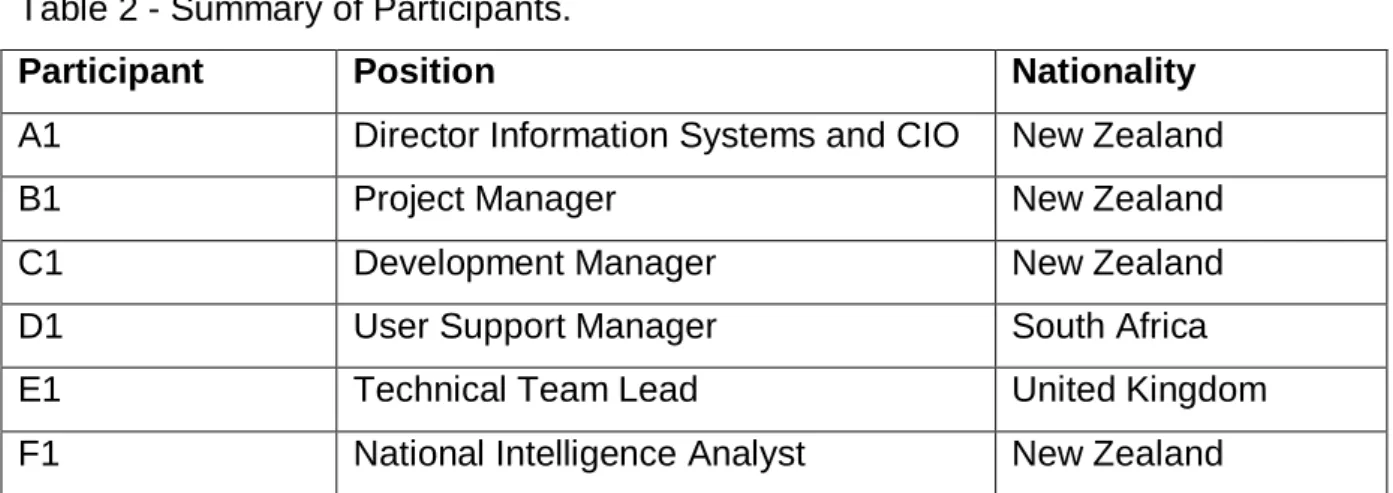
As for Phase 4 of the case study 6 participants were carefully selected and interviewed individually in September 2014. All participants interviewed were significantly involved in the project and has many years experience in information systems development and implementation projects. Some of the participants originate from different countries or have worked in other countries and therefore have different opinions and experiences regarding information systems development and implementation projects. The participant’s summary is described in Table 2 - Summary of Participants.
Table 2 - Summary of Participants.
Participant Position Nationality
A1 Director Information Systems and CIO New Zealand B1 Project Manager New Zealand C1 Development Manager New Zealand D1 User Support Manager South Africa E1 Technical Team Lead United Kingdom F1 National Intelligence Analyst New Zealand
All participants were supplied with an information sheet (refer to Appendix C - Participant Information Sheet) regarding the case study and explaining the
Ettiene Esterhuizen 300282198 Page 20 of 43 significance of the case study. All participants were also supplied with a participant consent form (refer to Appendix D - Participant Consent Form) and was signed by the participant thereby giving the researcher permission to interview the participants and use the data as part of the case study. All participant interviews were semi structured and were governed by a predetermined set of questions which were handed to the participants beforehand. The participants were asked 7 questions in which they could give their personal opinion on the project events, what to their knowledge and understanding went wrong and how the merger influenced the project. The questions were structured specifically so that participants could comment on the project allowing for a possible new prospective to the issues experienced. The interview questions are outlined in Appendix E – Interview Questions.
The participants were audio recorded and the recordings were transcribed for analysis by the researcher. The participants were supplied with the transcriptions to confirm that all data were correct and outlined according to their views. All questions and participant answers where outlined in an analysis matrix to be able to identify similarities and differences. Analysed findings are discussed in the next section.
Ettiene Esterhuizen 300282198 Page 21 of 43
Project Discussion.
The goal of the project (Question 1).
The goal of the project was to consolidate four legacy systems into a single system and "provide access to better quality, more integrated information that assists decision making, reduces staff administration time, eliminates duplicated effort and reduces support and administration costs while enabling mobility. The legacy systems were old and out dated and became unmanageable due to the systems being out dated and not meeting industry standards.
All participants agreed that the consolidation of the four systems into one system was one of the primary drivers of the information systems development and
implementation project. Having one source of the truth will allow for greater efficiency and less effort as data only needs to be entered into one system and not four
systems.
All of the participants concluded that the four legacy systems reached an end of live and needed to be replaced with a new modern and updated system which met technology and business standards. There was a lot of administration overhead due to the systems being old and unsupported.
Although most of the participants agreed that the mobile functionality was one of the issues that the project would resolve only three of the six participants (A1, D1 and E1) saw the enablement of mobile functionality as a goal of the project. One of the participants, participant D1concluded that one of the primary goals of the project wasn't just about consolidating the four legacy systems, but enabling mobility via tablets, enabling web based interaction for the operational staff via the mobile devices. Not delivering on the mobile functionality would mean a definite failure of the project.
Although the goals of the project seemed quite simple, straightforward and
achievable the project heavily underestimated how difficult it would be in achieving the goals. It would be a huge task in consolidating the four systems into one system
Ettiene Esterhuizen 300282198 Page 22 of 43 and migrating the data of the four systems into one system which is build on a
different database platform. Not only was a huge amount of issues experienced and still being experienced with data migration and the sensitivity around the data, but the project were having issues around mobility. Which device would suite and meet security requirements, what if the device got lost or stolen. As the project started experiencing these difficulties the goals became one goal, to consolidate the four legacy systems into one system, and released into the production environment. To successfully progress towards an end goal it is key to put success measures in place which helps to guide and steer the project towards its goal.
Measurement of project success (Question 2).
Measuring the success of the information and systems development andimplementation project would make for an interesting discussion. All the participants came to the same conclusion that the measurement of the success of the project came down to a successful deployment of the system to the production environment. Participant B1 and D1 added that the success of the project would be measured on the delivery of the benefits of the new system while participant D1, E1 and F1 leaned more towards the removal of the four legacy systems. Although all participants
mentioned some success criteria four of the participants, participant A1, C1, E1 and F1stated that there were no success measurements outlined. Participant E1 said that he did not see any documentation regarding success measurements for the project.
One would certainly think that some kind of success factor, success criteria or
success measurement would be defined as part of the projects progression. With no success measurements in place one would come to the conclusion that the project was somewhat steering blind while not having any success points to confirm that the project is on the right path to reach its ultimate goal. It would seem that the project would try to reach its goal by whatever means. This argument highlights the issues around the data migration and what the data would look like in the consolidated system. Without being able to meet the success criteria of correct and reliable data in the consolidated system the goal of the project would seem somewhat
Ettiene Esterhuizen 300282198 Page 23 of 43
Issues the project would resolve (Question 3).
The issues that the project would resolve is multiple data entry across the four systems, having "one source of the truth", a reduce in administration, support and costs and not limiting frontline staff data entry to the office.
All of the participants concluded that there was no user efficiency regarding the four systems. Data entry would need to occur on all four systems causing data
duplication. Sometimes data would be entered into one system and not the other systems causing the systems not to be aligned. In terms of data entry and data investigation user administration would result in huge administration overhead and require a lot of time and effort.
All participants said due to frontline staff work requirements meant being out of the office the staff had to revert to paper work, meaning that once back at the office the data needed to be entered into the four systems. The enablement of mobility would resolve this issue by allowing frontline staff to enter data anywhere at any time. This functionality would mean less or no paperwork and eliminate multiple data entries. Participant D1 and E1 added that frontline staff would enter the data (paperwork) into the four systems while other frontline staff wouldn't, admin staff duties would be to enter the data (paperwork) on behalf of those frontline staff. In terms of
administration overhead those admin staff would not be required with the enablement of mobile devices.
The project would resolve multiple issues that would not only benefit the staff using the system but the organisation by reducing administration, support and costs. One would have to think that by resolving so many issues project failure was just not an option. This could put tremendous pressure on the project including governance which could mean pushing forward at all cost. Focusing on the benefits and having to succeed at all cost is a potential risk that could cause one to lose visibility of the entire process resulting in critical steps to be missed which would lead to certain failure.
Ettiene Esterhuizen 300282198 Page 24 of 43
Risk management processes (Question 4).
Participant B1 was confident that the risk management processes were followed and highlighted that the project started with the department of Electronics. The risk
management processes was based on the department of Electronics methodology. The project team was responsible for risk identification and weekly meetings were held to review the risk register, identify any new risks and discuss mitigation
strategies. On a monthly basis the risk plan would be discussed with the governance board and the actions needed regarding key risks. Participant B1 also highlighted that the risk management processes never got fully integrated into the newly merged organisation (department of Technology) risk management processes but that the processes was very similar.
Participant A1, C1, D1 and E1 concluded that risk management was very poor. Participant C1 added that:
risks had been down played and minimized;
there were more risk than people anticipated;
a lot of risks wasn't on the risk register;
risks wasn't being raised properly;
risks wasn't being assessed properly;
risks wasn't given the right level of criticality; and
there was no urgency; if things weren't resolved it was left till the next meeting.
Participant E1's view was that there was a lack of formal risk management processes and the processes wasn't robust enough while there was no external review of the risks. Furthermore participant F1 concluded that risk management wasn't planned and wasn't formal enough while adding that risks was written down but was uncertain if anything came from it.
The risk management process is a critical process to information systems development and implementation projects yet it is a process that's either not
executed at all or only certain parts of the processes are executed. One has to come to the conclusion that it is the case with this specific project. Some risks might have
Ettiene Esterhuizen 300282198 Page 25 of 43 been identified, captured and listed but the end to end risk management processes doesn't seem to be followed and got forgotten as is the case with most information systems development and implementation projects.
When the merger occurred (Question 5).
When the merger occurred the project would have been exposed to a lot of uncertainty and some critical decisions would have had to be made. Before any decisions could be made the project would have had to look at what strategic options were available to the project which according to the project was either to stop the project, merge the four legacy systems into the department of Networking's systems or continue the project in its current form. Although the uncertainty and the possibility of unpredictable risks regarding the impact of the merger on staff and influences on the project processes like the risk management processes the decision was to continue the project in its current form.
Participant C1 concluded that there would have been a lot of strategic decisions available to the project but that none was taken. When reminded participant B1 agreed that three strategic options were available but that the assessment on the strategic decisions were very short and rushed. Participant B1 also added that the assessment of the strategic options wasn't in-depth enough and could have been done better. Furthermore participant F1 said that it was very messy as the
communication was unclear while participant D1felt that there were no strategic directions from governance and as a result decisions were made by individuals that was part of the project.
According to participant B1there was a vested interest from governance in the project and the decisions was to push forward with the project and continue the project in its current form. All participants informed that the decision was made to continue the project. Participant C1 added that the decision to continue the project would caused a lot of issues and that the right decisions at the time would have been to stop the project and reassess the project to confirm if the scope or requirements have changed. Furthermore participant C1 continued by saying the project carried on as if the merger never occurred and that the merger was completely ignored.
Ettiene Esterhuizen 300282198 Page 26 of 43 According to participant B1 the merger had very little impact on the risk management processes while participant C1 was adamant that the merger had no impact on the risk management processes as there was a lack of risk management from the start. Participant A1 concluded that there was no intervention or plan regarding risk
management while participant D1 said that risk wasn't managed or analysed and that the merger itself wasn't perceived as a risk. According to participant F1the project just did not know how huge the effect of the merger would be on the project and that the risks increased greatly as a result of the merger. Furthermore participant E1said that there would have been some diversion of attentions and that there would have been an effect on the processes as a result of the merger.
According to participant B1 there were a lot of personnel changes to the project and that key members of the governance board and project were either lost due to redundancies or moving into different roles, the loss of the resources had a huge impact on the project as a huge amount of knowledge was lost. Furthermore
participant B1 added that the business analyst who knew the four legacy systems in its entirety were lost due to the merger. Due to the lack of documentation and relying on those lost resources the project risk profile increased heavily according to
participant C1. All participants concluded that the loss of key personnel had a huge effect on the project as a result of the merger. According to participant E1 the project is still trying to capture the knowledge that was lost especially around the data
migration, the individuals lost knew the systems and knew the data. Furthermore participant E1 added that the data migration would have been a lot easier if there was proper documentation from the vendor, but as participant A1 stated, you can have all the documentation but still need those resources with the systems expertise. From a governance perspective participant B1 added that the needed representation to get the organisation to commit to the project just wasn't there and things just weren't happening. Furthermore participant D1claims that due to the loss of
governance board members individuals from the project decided on the direction of the project causing the project to go in a direction which wasn't the prescribed
direction, that would lead to a lot of time and effort spend later on to bring the project back to the prescribed direction.
Ettiene Esterhuizen 300282198 Page 27 of 43 One has to conclude that the governance board had to look at the strategic options and decide to either stop the project or proceed with the project. Clearly the decision to proceed with the project wasn't the right decision and it was probably the cause of focusing too much on the benefits and end goal, loosing that visibility, not following the processes and pushing forward at all costs. The merger may or may not have been perceived as a risk and could be classified as unpredictable risk which caused further unpredictable risk. Unfortunately the risk management processes wasn't followed end to end and the effect of the merger could have caused the risk management processes not to be executed at all. The follow-on effect of
unpredictable risk in loosing key personnel had a huge impact on the project and the direction of the project, yet it was decided to continue with the project.
Active involvement of governance (Question 6).
The active involvement of governance in information systems development and implementation projects is key to the success of such projects. Participant A1 stated that this is where such projects fails and that these projects are business projects with an Information and Communication Technology (ICT) component rather than ICT projects. Participant D1 concluded that prior to the merger the project was governed correctly by the governance board and participant B1 stated that the project would have had a better chance of success had key members of the governance board not been lost. Furthermore participant B1 added that the
governance board during the merger were hands off and were more like a reporting board. From participant C1's point of view the governance board at the time of the merger wasn't strong enough and weren't held accountable while participant A1 added that the governance board only existed of three members in which the project manager was one of the members. Participant E1claimed that the governance board focus was to narrow, the project manager and the vendor was making decisions on behalf of the governance board according to participant A1 and participant F1
highlighted the fact that the governance board should have been actively involved to understand the issues that the project experienced and the impact that those issues would have. In conclusion participant C1 stated that the governance board wasn't good at all and that the project was slack because of it.
Ettiene Esterhuizen 300282198 Page 28 of 43 Participant A1 is correct in saying that this is where information systems
development and implementation projects fail. The governance board is key to the success of such projects and needs to be actively involved to steer and direct the project. The governance board is also responsible for decisions regarding risks identified and the strategies involved to mitigate against risk. Even if the project had successfully executed the risk management processes the lack of governance would have left the project vulnerable and without direction. It was also stated by participant D1 that the project and vendor steered the project down the wrong path due to the lack of involvement by the governance board.
Additional unexpected consequences (Question 7).
The amount of knowledge lost due to the loss of key people was an unexpected consequence according to participant A1 and due to those individuals not being there it was difficult to understand why certain decisions were made according to participant E1. Furthermore participant C1 highlighted that there wasn't a clear understanding of ownership and delivery and as a result according to participant D1 the vendor decided what was required by the project. Participant B1 felt that an unexpected consequence was the delay in delivery that the merger caused and according to participant F1 the longer the project continued the more momentum was lost and the bigger the risk became of losing more resources. In conclusion by participant A1 the consequences due to the merger was not having a effective governance board, no ownership, the loss of key people, no buy-in form the organisation, no documentation and no knowledge.Due to the merger there was a large amount unexpected consequences which seem to have been unmanageable. It is to be expected that the merger would cause unexpected consequences but due to a lack of governance and wrongful decisions it had a huge impact on the project and the more the project got pushed on the more unexpected consequences arose and the harder it became to deliver a successful product. It is anticipated that the project just did not understand the severity of the merger and the impact that the merger would have, the consequences that would follow and loss of confidence in the project.
Ettiene Esterhuizen 300282198 Page 29 of 43
Conclusion.
The influence of external factors on information systems development and
implementation projects can cause unpredictable risk which any organisation be it private or public just cannot prepare for or predict in advance. The effect that unpredictable risks have on such projects can be disastrous as proven in this case study.
Risk management and the risk management processes is critical to the success of any information systems development and implementation project and even more so when external factors that Government departments have no control over influences such projects causing such project to deal with unpredictable risk.
Unfortunately in some cases Government departments find them self in a position where they have to invest in such projects as systems are outdated and
unsupportable. The success of these information systems development and
implementation projects under these circumstances becomes so critical that failure is not an option. The requirements and success factors becomes un-realistic and the risk factors involved becomes un-manageable, therefore causing risk management to be poor or none existed. Risk management becomes a road block for such projects and gets excluded from such projects rather than being part of the project processes and guiding such projects to the successes being desired.
Due to external factors being unpredictable the decisions made in this example by Government should take those decisions into consideration and the impact that it has on Government departments. These decisions can't always be avoided and its during these times that effective governance should take control and ensure that the right decisions get made for the right reasons and that processes in place like the risk management processes be followed as it's intended to be.
Ettiene Esterhuizen 300282198 Page 30 of 43
Bibliography.
Allen, S., & Hardin, P. C. (2008). Developing instructional technology products using effective project management practices. Journal of Computing in Higher Education, 19(2), 72-97. doi:http://dx.doi.org/10.1007/BF03033427
Barki, H., Rivard, S., & Talbot, J. (1993). Toward an assessment of software development risk. Journal of Management Information Systems, 10(2), 203. Retrieved from http://search.proquest.com/docview/218964505?accountid=14782
Baskerville, R. L., & Stage, J. (1996). Controlling prototype development through risk analysis. MIS Quarterly, 20(4), 481-504. Retrieved from
http://search.proquest.com/docview/218130802?accountid=14782
Benaroch, M., & Appari, A. (2010). Financial pricing of software development risk factors. IEEE Software, 27(5), 65-73. doi:http://dx.doi.org/10.1109/MS.2010.28
Boehm, B. W., & Ross, R. (1989). Theory-W software project management: Principles and examples. IEEE Transactions on Software Engineering, 15(7), 902-916. doi:http://dx.doi.org/10.1109/32.29489
Boehm, B. W. (1991). Software risk management: Principles and practices. IEEE Software, 8(1), 32-41. doi:http://dx.doi.org/10.1109/52.62930
Boehm, B. W., & DeMarco, T. (1997). Software risk management. IEEE Software, 14(3), 17-19. doi:http://dx.doi.org/10.1109/MS.1997.589225
Carnegie Mellon Software Engineering Instituted. (2006). CCMI for Development, V1.2. Improving processes for better products. Pittsburgh, PA. Retrieved from http://www.sei.cmu.edu/reports/06tr008.pdf
Carr, M. J. (1997). Risk management may not be for everyone. IEEE Software, 14(3), 21-21,24. doi:http://dx.doi.org/10.1109/MS.1997.589227
Chua, A. Y. K. (2009). Exhuming IT projects from their graves: An analysis of eight failure cases and their risk factors. The Journal of Computer Information Systems, 49(3), 31-39. Retrieved from
Ettiene Esterhuizen 300282198 Page 31 of 43 Cortellessa, V., Goseva-Popstojanova, K., Appukkutty, K., Guedem, A. R., Hassan, A., Elnaggar, R., & Ammar, H. H. (2005). Model-based performance risk analysis. IEEE Transactions on Software Engineering, 31(1), 3-20.
doi:http://dx.doi.org/10.1109/TSE.2005.12
Conrow, E. H., & Shishido, P. S. (1997). Implementing risk management on software intensive projects. IEEE Software, 14(3), 83-89.
doi:http://dx.doi.org/10.1109/52.589242
Díaz, V. G., Pérès, F., & Márquez, A. C. (2011). On the risks and costs
methodologies applied for the improvement of the warranty management. Journal of Service Science and Management, 4(2), 191-202. Retrieved from
http://search.proquest.com/docview/892604135?accountid=14782
Donaldson, S. E., & Siegel, S. G. (2007). Enriching your project planning: Tying risk assessment to resource estimation. IT Professional Magazine, 9(5), 20-27.
doi:http://dx.doi.org/10.1109/MITP.2007.84
Durković, O., & Raković, L. (2009). Risks in information systems development projects. Management Information Systems, 4(1), 013-019. Retrieved from http://www.ef.uns.ac.rs/mis/archive-pdf/2009%20-%No1/MIS2009_1_3.pdf
Fairley, R. (1994). Risk management for software projects. IEEE Software, 11(3), 57-67. doi:http://dx.doi.org/10.1109/52.281716
Grover, V., Jeong, S. R., Kettinger, W. J., & Teng, J. T. C. (1995). The implementation of business process reengineering. Journal of Management Information Systems, 12(1), 109. Retrieved from
http://search.proquest.com/docview/218973852?accountid=14782
Huang, L., & Boehm, B. (2006). How much software quality investment is enough: A value-based approach. IEEE Software, 23(5), 88-95.
Ettiene Esterhuizen 300282198 Page 32 of 43 Keil, M., Cule, P. E., Lyytinen, K., & Schmidt, R. C. (1998). A framework for
identifying software project risks. Association for Computing
Machinery.Communications of the ACM, 41(11), 76-83. Retrieved from
http://delivery.acm.org/10.1145/290000/287843/p76-keil.pdf?ip=130.195.86.35&id=287843&acc=ACTIVE%20SERVICE&key=65D80644 F295BC0D%2EF6524D9D8BB8931B%2E4D4702B0C3E38B35%2E4D4702B0C3E 38B35&CFID=525998564&CFTOKEN=13997920&__acm__=1407395482_2856cf44 3218feea261d33078b021145
Kemerer, C. F., & Sosa, G. I. (1991). Systems Development Risks In Strategic Information Systems. Information and Software Technology, (33)3, pp. 212-223. Retrieved from
http://dspace.mit.edu/bitstream/handle/1721.1/49007/systemsdevelopme00keme.pdf
Kutsch, E., Denyer, D., Hall, M., & Lee-Kelley, E. (2013). Does risk matter? Disengagement from risk management practices in information systems projects. European Journal of Information Systems, 22(6), 637-649. Retrieved from http://www.palgrave-journals.com/ejis/journal/v22/n6/abs/ejis20126a.html
Kwan, T. W., & Leung, H. K. N. (2011). A risk management methodology for project risk dependencies. IEEE Transactions on Software Engineering, 37(5), 635-648. doi:http://dx.doi.org/10.1109/TSE.2010.108
Li, J., Conradi, R., Slyngstad, O. P., Torchiano, M., Morisio, M., & Bunse, C. (2008). A state-of-the-practice survey of risk management in development with off-the-shelf software components. IEEE Transactions on Software Engineering, 34(2), 271-286. doi:http://dx.doi.org/10.1109/TSE.2008.14
Liebowitz, J. (1999). Information systems: Success of failure? The Journal of Computer Information Systems, 40(1), 17-26. Retrieved from
http://search.proquest.com/docview/232578762?accountid=14782
Lin, E., & Hsieh, C. (1995). The seven deadly risk factors. Journal of Systems Management, 46(6), 48. Retrieved from
Ettiene Esterhuizen 300282198 Page 33 of 43 Moynihan, T. (1997). How experienced project managers assess risk. IEEE
Software, 14(3), 35-41. doi:http://dx.doi.org/10.1109/52.589229
Mursu, A., Lyytinen, K., Soriyan, H. A., & Korpela, M. (2003). Identifying software project risks in Nigeria: An international comparative study. European Journal of Information Systems, 12(3), 182. Retrieved from
http://search.proquest.com/docview/218776129?accountid=14782
Peterson, D. K., & Chung, K. (2003). Perceptions on IS risks and failure types: A comparison of designers from the United States, Japan and Korea. Journal of Global Information Management, 11(3), 19-38. Retrieved from
http://search.proquest.com/docview/195152446?accountid=14782
Project Management Institute, Inc. (2009). Practice standard for project risk management. Newtown Square, PA. Retrieved from http://www.pmi.org
Ropponen, J., & Lyytinen, K. (2000). Components of software development risk: How to address them? A project manager survey. IEEE Transactions on Software Engineering, 26(2), 98-112. doi:http://dx.doi.org/10.1109/32.841112
Schmidt, R., Lyytinen, K., Keil, M., & Cule, P. (2001). Identifying software project risks: An international delphi study. Journal of Management Information Systems, 17(4), 5-36. Retrieved from
http://search.proquest.com/docview/218924388?accountid=14782
Sherer, A. S., & Alter, S. (2004). Information system risks and risk factors: Are they mostly about information systems? Communications of the Association for
Information Systems, 14, 29-64. Retrieved from
http://202.154.59.182/ejournal/files/INFORMATION%20SYSTEM%20RISKS%20AN D%20RISK%20FACTORS.pdf
Taylor, H. (2006). Critical risks in outsourced IT projects. Association for Computing Machinery. Communications of the ACM, 49(11), 74.
Ettiene Esterhuizen 300282198 Page 34 of 43 Tesch, D., Kloppenborg, T. J., & Frolick, M. N. (2007). IT project risk factors: the project management professionals perspective. The Journal of Computer Information Systems, 47(4), 61-69. Retrieved from
http://search.proquest.com/docview/232575798?accountid=14782
Verner, J. M., & Evanco, W. M. (2005). In-house software development: What project management practices lead to success? IEEE Software, 22(1), 86-93.
doi:http://dx.doi.org/10.1109/MS.2005.12
Wan, J., & Hou, J. (2012). Research on SAP business one implementation risk factors with interpretive structural model. Journal of Software Engineering and Applications, 5(3), 147-155. Retrieved from
http://search.proquest.com/docview/1001308380?accountid=14782
Wastell, D. G. (1999). Learning dysfunctions in information systems development: Overcoming the social defenses with transitional objects. MIS Quarterly, 23(4), 581-600. Retrieved from
http://search.proquest.com/docview/218128482?accountid=14782
Wilbanks, L. (2008). IT management and governance in equal parts. IT Professional Magazine, 10(1), 60-61. doi:http://dx.doi.org/10.1109/MITP.2008.11
Williams, R. C., Walker, J. A., & Dorofee, A. J. (1997). Putting risk management into practice. IEEE Software, 14(3), 75-82. doi:http://dx.doi.org/10.1109/52.589240
Whittaker, B. (1999). What went wrong? Unsuccessful IT projects. Information Management and Computer Security 7(1), 23-29. Retrieved from
http://www.academia.edu/1972892/What_went_wrong_Unsuccessful_information_te chnology_projects
Woolridge, R. W., McManus, D. J., & Hale, J. E. (2007). Stakeholder risk assessment: An outcome-based approach. IEEE Software, 24(2), 36-45. doi:http://dx.doi.org/10.1109/MS.2007.54
Xu, L., & Brinkkemper, S. (2007). Concepts of product software. European Journal of Information Systems, 16(5), 531-541.
Ettiene Esterhuizen 300282198 Page 35 of 43
Appendices.
Appendix A – Project Risk Factors.
Corporate Environment.
Risk factors in the corporate environment group include:
"unstable corporate environment;
change of ownership or senior management;
mismatch between the corporate culture and the changes required by the new system" (Schmidt, Lyytinen, Keil & Cule, 2001, p.15);
"lack of organisational flexibility" (Kemerer & Sosa, 1991, p.23); and
measuring performance difficulties (Grover, Jeong, Kettinger & Teng, 1995).
Project Management.
Risk factors in the project management group include:
"lack of effective project management skills/involvement" (Chua, 2009, p. 32);
"not managing change properly;
lack of effective project management methodology;
poor or nonexistent control;
poor risk management; and
choosing the wrong development strategy" (Schmidt, Lyytinen, Keil & Cule, 2001, p. 16).
Sponsorship/Ownership.
Risk factors in the sponsorship/ownership group include:
a lack of commitment from top management (Mursu, Lyytinen, Soriyan & Korpela, 2003);
"the project has a weak/lacking champion;
lack of corporate leadership;
an un-stable corporate environment;
failure of corporate management to make decisions at critical junctions;
Ettiene Esterhuizen 300282198 Page 36 of 43
unethical behaviour" (Tesch, Kloppenborg & Frolick, 2007, p. 64).
Funding and Scheduling.
Risk factors in the funding and scheduling group include:
"overoptimistic schedules and budgets" (Taylor, 2006, p. 76);
"lack of effective control of the project schedule changes" (Wan & Hou, 2012, p. 149);
"requires budgeting the entire project at the outset leading to underfunding in later years;
underfunding of development;
use of artificial deadlines;
under funding of maintenance, and
deviation from budget" (Tesch, Kloppenborg & Frolick, 2007, p. 64).
Personnel and Staffing.
Risk factors in the personnel and staffing group include:
a lack of experience (Baskerville & Stage, 1996);
lack of skills and knowledge (Schmidt, Lyytinen, Keil & Cule, 2001);
personnel turnover (Boehm & DeMarco, 1997);
lacking general expertise (Barki, Rivard & Talbot, 1993);
lack of user involvement (Keil, Cule, Lyytinen & Schmidt, 1998); and
"excessive use of outside consultants" (Tesch, Kloppenborg & Frolick, 2007, p. 65).
Scope.
Risk factors in the scope group include:
"application size and complexity (for instance, scope creep or requirements volatility)" (Benaroch & Appari, 2010, p.66);
continuous changes (Boehm & Ross, 1989);
"project may not be based on a sound business case; and
objectives are unclear or misunderstood" (Tesch, Kloppenborg & Frolick, 2007, p. 65);
Ettiene Esterhuizen 300282198 Page 37 of 43
Requirements.
Risk factors in the requirements group include:
disagreement concerning the requirements (Sherer & Alter, 2004);
uncertainty about requirements (Moynihan, 1997);
"continuous and uncontrolled changes in requirements" (Ropponen & Lyytinen, 2000, p. 102).
"obtaining inaccurate or incomplete system requirements" (Lin & Hsieh, 1995, p 51); and
requirements and requirement gathering not being managed (Verner & Evanco, 2005).
Relationship Management.
Risk factors in the relationship management group include:
absence of user involvement (Peterson & Chung, 2003);
"failure to manage end-user expectations;
lack of adequate user involvement;
lack of cooperation from users;
failure to identify all stakeholders; and
lack of appropriate experience of the user representatives" (Schmidt, Lyytinen, Keil & Cule, 2001, p. 15).
Appendix B – Detailed Project History.
March 2010.
The organisations Information Services Strategic Plan (ISSP) proposed that a "consolidation and enhancement" of the organisations four legacy systems would address the identified issues and meet the organisational standards.
August 2010
The "Terms of Reference approved work to begin in writing a Request for Proposal (RFP)" which included the "business and technical requirements for the system and was released to market in December 2010".
Ettiene Esterhuizen 300282198 Page 38 of 43
March 2011.
Announcement of a merger with another organisation was made.
Project Initiation 20/06/2014 - 02/11/2011 (100% Complete). A project executive board was established.
"Advisory group establishment".
"Organisation impact assessment"
A "plan the project checklist", project schedule, risk register, "issue and change register" and "lessons learned log" was established.
"Vendor contract signed"
Project Initiation Document approval.
"Stakeholder management plan".
"Communications plan".
Project Executive Board 11/07/2011 - 20/06/2013 (96% Complete). "Inaugural meeting - July"
Monthly Executive Board meeting.
Advisory Group 02/09/2011 - 21/02/2013 (98% Complete). Weekly Advisory Group meetings
Planning and Analysis 14/07/2011 - 08/02/2012 (100% Complete) "Requirements gathering workshops".
"Systems requirements specification".
Data extract of 4 legacy systems.
Vendor Deliverables 29/07/2011 - 19/03/2013 (96% Complete) "Formal deliverables" (0%)
"Informal deliverables"
"Data migration strategy"
"Installation guide" (71%)
Ettiene Esterhuizen 300282198 Page 39 of 43
"Software customisation"
"Software configuration"
"Software testing"
"Software deployment"
Base Application Module 13/12/2011 - 08/04/2013 (94% Complete) Software customisation.
Software configuration.
Software testing (88%).
Software release (97%).
Software deployment (0%).
Mobile Device Trial 30/01/2012 - 20/05/2013 (66% Complete). Software customisation.
Software configuration.
Software testing (52%).
Security risk assessment (42%)
System Test Testing Phases 01/08/2011 - 24/07/2014 (50% Complete). Test Manager to be appointed.
Test analyst to be scheduled.
Test strategy.
Test preparation including scripts A.
Test preparation including scripts B (0%).
Infrastructure Build 29/08/2011 - 12/03/2013 (100% Complete) Design infrastructure.
Application and Database available (System Test).
Application and Database available (User Acceptance Testing)
Application and Database available (Production)
Ettiene Esterhuizen 300282198 Page 40 of 43
Deployment Phase 08/08/2011 - 24/07/2014 (40% Complete). Two legacy system replacement (75%).
Two legacy system replacement (0%).
Mobile system (32%).
Handover support (51%).
Project quality assurance reviews.
Change management activities (37%).
Training (63%). System support (24%). Policies. Processes. Mobile devices (49%). Handover activities (38%). Post-Implementation (0%).
Decommissioning of legacy systems (0%).
Appendix C - Participant Information Sheet.
Research Project Title: Dealing with unpredictable risk - the influence of external factors on information systems development and implementations.
Researcher: Ettiene Esterhuizen,School of Information Management, Victoria
University of Wellington.
As part of the completion of my Masters in Information Management, this study is designed to investigate unpredictable risks and the influences of external factors on information systems development and implementations.
For many years organisations have been developing and implementing their own information systems especially within Government, unfortunately such information systems development and implementation projects are vulnerable and subject to a range of risks.