Fast-Track Session Establishment for TLS
Hovav Shacham
Dan Boneh
[email protected]
[email protected]
Abstract
We propose a new, “fast-track” handshake mechanism for TLS. A fast-track client caches a server’s public pa-rameters and negotiated papa-rameters in the course of an initial, enabling handshake. These parameters need not be resent on subsequent handshakes. The new mecha-nism reduces both network traffic and the number of round trips, and requires no additional server state. These sav-ings are most useful in high latency environments such as wireless networks. We include a rollback mechanism to al-low a server to gracefully revert to an ordinary TLS hand-shake when needed. Our design is fully backwards com-patible: fast-track clients can interoperate with servers unaware of fast-track and vise versa. We have imple-mented our proposal to demonstrate the savings in net-work traffic and round trips.
1. Introduction
TLS is a widely deployed protocol for securing network traffic. It is commonly used for protecting web traffic and
some e-mail protocols such as IMAP andPOP. Variants
of TLS, such as WTLS [6], are used for securing wire-less communication. In this paper we consider a modi-fication to the TLS (and WTLS) handshake protocol that makes the protocol more efficient in terms of bandwidth and number of round trips. Improving the handshake pro-tocol is especially relevant in bandwidth-constrained en-vironments, such as wireless communications, where la-tency is high and small payload transfers are common. We hope that these extensions will promote the use of TLS in high latency networks and discourage the development of ad-hoc security protocols for such networks.
Recall that the TLS protocol [3] incorporates two types of handshake mechanisms: a full handshake, and a resume handshake protocol. The resume handshake protocol is used to reinstate a previously negotiated TLS session be-tween a client and a server. Compared to a full handshake, the resume mechanism significantly reduces handshake network traffic and computation on both ends. However, a
session can only be resumed if the old session is present in the server’s session cache. Unfortunately, heavily loaded servers can only store a session for a relatively short time before the session is evicted from the cache. As a result, a full handshake is often needed even though the client may be willing to resume an old session.
In contrast, clients rarely connect to numerous TLS servers, and could cache information about servers for a longer time. We propose a new, “fast-track” handshake mechanism for TLS that exploits this situation. The fast-track mechanism improves the full TLS handshake pro-tocol. Fast-track clients maintain a cache of long-lived server information, such as the server certificate, and long-lived negotiated information, such as the preferred cipher suite. The long-lived cached information allows a reduc-tion in handshake bandwidth: the handshake messages by which a server communicates this information to the client are obviated by the cache, and omitted from the fast-track handshake. Moreover, the remaining messages are re-ordered, so a fast-track handshake has three flows rather than four. Hence, our fast-track mechanism reduces both network traffic and round trips in the TLS handshake pro-tocol.
By aflow we mean an uninterrupted sequence of mes-sages from one participant in a connection to the other. An ordinary TLS handshake has fourflows; our fast-track handshake has three. Because of the design of the TLS protocol, multiple consecutive handshake messages can be coalesced into a single TLS transport-layer message.
Thus, when network latency is high, a savings in flows
can translate into a savings in time.
The use of fast-track, along with the particular fast-track parameters, is negotiated between clients and servers by means of TLS extensions [1]. Care is taken to ensure inter-operability with non-fast-track clients and servers, and to allow graceful fallback to ordinary TLS handshakes when required.
The use of fast-track session establishment gives sav-ings in handshake bandwidth andflows, but does not pro-vide a significant computational speedup relative to ordi-nary TLS handshakes. It is most useful for bandwidth-constrained, high-latency situations, and those in which application message payloads are small. Thus fast-track,
ClientHello ServerHello Certificate ServerKeyExchange CertificateRequest ServerHelloDone Certificate ClientKeyExchange CertificateVerify [ChangeCipherSpec] Finished [ChangeCipherSpec] Finished
Figure 1. TLS Handshake Message Diagram
via a relatively simple, and fully backwards-compatible change to the TLS protocol, improves performance and makes TLS more usable in wireless environments. Client-side caching could be applied to other mainstream security protocols to yield similar results.
We enumerate the long-lived, cacheable items and de-scribe the manner in which they are used in Section 3. We discuss some design criteria in Section 4. We describe the fast-track handshake protocol in Section 5. We then dis-cuss performance, implementation, and security consider-ation in Sections 6, 7, and 8. Finally, we briefly consider other client-side caching strategies for TLS in Section 9.
2. TLS handshake overview
A TLS handshake has three objectives: (1) to negotiate certain session parameters; (2) to authenticate the server to the client, and optionally the client to the server; and (3) to establish a shared cryptographic secret. The ses-sion parameters include the protocol verses-sion, the cipher suite, and the compression method. Authentication makes use of a certificate-based public key infrastructure (PKI): servers and clients identify themselves through certificate chains terminating in well-known Certification Authority (CA) certificates.
The standard TLS handshake is summarized in Fig-ure 1. Messages sent by the client are on the left; by the server, the right. Messages appearing in slanted type are only sent in certain configurations; messages in brack-ets are sent out-of-band. The handshake proceeds, in four flows, as follows.
A client initiates a handshake by sending aClientHello message. This message includes a suggested protocol ver-sion, a list of acceptable cipher suites and compression methods, a client random value used in establishing the shared secret, and (when TLS extensions [1] are used) other extension-specific parameters.
The server replies with aServerHellomessage, which
ClientHello ServerHello [ChangeCipherSpec] Finished [ChangeCipherSpec] Finished
Figure 2. Message Diagram for a TLS Ses-sion Resume
selects a protocol version, cipher suite, and compression method, and includes the server random, and extension-specific parameters. The server then sends its certificate chain in theCertificatemessage. In certain cases, it sends aServerKeyExchangemessage with additional informa-tion required for establishing the shared secret. (For ex-ample, the 512-bit export-grade RSA key for RSA export key-exchange.) If the server wishes that the client authen-ticate itself, it sends aCertificateRequestmessage listing acceptable certificate types and CA names for the client’s certificate chain. Finally, it sends aServerHelloDone mes-sage to signal the end of theflow.
If the server requests client authentication, the client be-gins its response with aCertificatemessage that includes its certificate chain, and after theClientKeyExchange mes-sage, a CertificateVerifymessage that includes its signa-ture on a digest of the handshake messages to that point. TheClientKeyExchangemessage includes the information necessary to determine the shared secret. (For example, in RSA key exchange, it includes the encryption of a “pre-master secret” that is used to calculate the secret.)
Finally, the client sends aChangeCipherSpecmessage
(which is not a handshake message), signaling its switch to the newly-negotiated parameters and secret key, and
sends an encrypted and compressedFinishedmessage that
includes a digest of the handshake messages.
The server, in its turn, also sends aChangeCipherSpec message and aFinishedmessage that includes a digest of the handshake messages (up to the client’sFinished mes-sage). After this, the client and server can exchange appli-cation data over the encrypted, authenticated, and possibly compressed link that has been established.
A server can identify a particular connection by a
“ses-sion ID,” a field in theServerHellomessage. By mutual
consent, a client and server can resume a connection. The client includes the ID of the session it wishes to resume in its hello message, and the server accepts by including the same ID in its hello. The client and server proceed
directly to theChangeCipherSpecandFinishedmessages
(with the previously-agreed-upon parameters and secrets). This exchange is summarized in Figure 2.
Relative to establishing a new session, resuming a previously-negotiated session saves bandwidth,flows, and
computation (since the handshake’s expensive crypto-graphic operations are avoided). However, heavily loaded servers typically keep session IDs in their session cache for only a relatively short while.
We note that our fast-track optimization only applies to the full handshake protocol (not the session resume hand-shake). Hence, fast-track is most effective in environ-ments where short lived TLS sessions are common so that frequent handshakes are not resumes.
3. Cacheable handshake parameters
The savings we achieve through fast-track depend on a client’s caching certain long-lived handshake parameters. “Long-lived,” in this context, means, first, that they do not change between handshakes (as does, e.g., the server-random), and, second, that they are expected not to change except when either the server or client is reconfigured. A client collects these parameters in the course of an ordi-nary TLS handshake. In the course of a fast-track hand-shake, it uses these parameters to craft its messages.
The particular values which a client uses in a fast-track handshake are called the determining parameters for that connection. A server uses information in the client hello message and its own configuration to come up with its own version of the determining parameters for the con-nection. The two versions must match for the handshake to be successful. Therefore, a fast-track-initiating hello message includes a hash of the determining parameters to allow the server to check this, as described in Section 5.2. The long-lived parameters fall into two general cate-gories: (1) those that are features of the server’s config-uration alone, and (2) those that properly depend on the interaction of the server’s configuration with the client’s. In thefirst category, we include:
The server’s certificate chain;
The server’s Diffie-Hellman group, if any; and Whether client authentication is required; if so,
– Acceptable client certificate types; and – Acceptable certificate authorities.
These features of a TLS server’s configuration are as-sumed to change infrequently and thus to be capable of being cached on the client.
In the second category, we include parameters such as: The preferred client-server cipher suite; and The preferred client-server compression method. (The cipher suite comprises a key-exchange algorithm, a bulk encryption algorithm, and a MAC algorithm.) These
are a function of both the server and client configurations, and are negotiated in a TLS handshake: the client pro-poses a list for each, and the server chooses.
A client in possession of the above information knows enough to be able to compute a key-exchange message, without any additional input from the server (with one ex-ception discussed below). It is this fact that allows the reordering of the handshake messages.
To participate in ephemeral Diffie-Hellman (EDH) key exchange, a client needs to know the group modulus and generator relative to which the Diffie-Hellman exchange will operate. The description of this group is part of the ServerKeyExchangemessage when EDH is used. It is as-sumed that the server will not often change its EDH group, so a fast-track client can cache the group parameters and
use them to send a ClientKeyExchangemessage during
a fast-track handshake. By contrast, a server employing temporary RSA keys for key exchange, in the RSA “ex-port” cipher suites, will typically change its export RSA key quite often. The temporary RSA key, which a client would need for its fast-track key exchange, can be cached only briefly. Accordingly, fast-track explicitly does not support RSA export authentication. Since the RSA export mechanism is being phased out, this does not seem like a serious constraint.
4. Design considerations
With significant deployment of legacy TLS clients, in-compatible changes to the protocol are unlikely to be accepted. Accordingly, fast-track’s design emphasizes interoperability and backwards-compatibility. Fast-track clients and servers must be able to interoperate with TLS servers and clients not capable of using fast-track; they must be able to discover which peers are capable of fast-track; and they must recover gracefully when configu-rations have changed, falling back on the ordinary TLS handshake protocol.
Through the use of TLS extensions [1], a client and server can, in an ordinary TLS handshake, negotiate the future use of fast-track. A subsequent fast-track con-nection uses another extension to allow the client and server to ascertain their both using the same unsent, client-cached parameters. Since a client must suggest, and a server must assent to the use of fast-track, the likelihood of a client’s attempting to initiate a fast-track connection with a non-fast-track server is minimal.
If a client does attempt to initiate a fast-track connec-tion with a non-fast-track server, it is important that it be alerted of its mistake quickly. A fast-track handshake is initiated through a message that TLS servers not imple-menting fast-track would reject as invalid. This minimizes confusion resulting from such a mismatch. For servers aware of fast-track, but not wishing to use it, we include
a rollback mechanism to allow a server to gracefully re-vert to an ordinary TLS handshake if its configuration has changed.
5. The fast-track handshake
In this section, we describe the actual fast-track hand-shake protocol. There are two distinct phases. First, in the course of an ordinary TLS handshake, a client and server negotiate and agree on the future use of fast-track, and the client collects the parameters that will allow it to make that future handshake. Next, the client initiates a fast-track handshake with the server, using the determining parame-ters from earlier.
Fast-track also defines a mechanism whereby the server can deny the fast-track; it would do so, for example, when its configuration has changed, rendering the client’s deter-mining parameters obsolete. This mechanism is also used for session resumes.
5.1. Negotiation of fast-track
A client wishing to engage in a fast-track handshake with a server mustfirst determine whether that server is capable of (and willing to use) fast-track. This is not a problem, since the client must also have completed an or-dinary handshake with the server to have obtained the in-formation it needs for the new, fast-track handshake.
The TLS Extensions mechanism [1] provides the ma-chinery for the negotiation. A client proposing the pro-spective use of fast-track includes the fasttrack-capable extension in its hello; a server assenting to the prospec-tive use includes the same extension in its hello. Such a handshake is referred to as “enabling.”
Servers might be reconfigured to disable fast-track, and clients should be alerted of the configuration change as soon as possible; preferably, before they undertake the computationally-heavy early steps of the fast-track hand-shake.
Accordingly, a client is expected to include in each of its handshakes thefasttrack-capableextension, and attempt a fast-track handshake with a server only if their most recent successful handshake was an enabling one. (Per the spec-ification, the extensions governing a resumed session are those negotiated in the original handshake for that session; a successful resume is therefore not considered a hand-shake for this purpose.)
5.2. Fast-track
To engage in a fast-track handshake, the client and server must agree on certain determining parameters (see Section 3). The client obtains these from a previous, en-abling handshake. But it and the server must make sure that they expect to use the same parameters. Fast-track
ClientHelloFT fasttrack-hash Certificate ClientKeyExchange ServerHelloFT ServerKeyExchange [ChangeCipherSpec] Finished CertificateVerify [ChangeCipherSpec] Finished
Figure 3. Message Diagram for an Accepted Fast-Track Handshake
ensures this as follows. As part of its fast-track hello mes-sage, a client must include, in thefasttrack-hashextension, the SHA-1 hash of the determining parameters. The server builds its own version of the parameters, and ensures that the hashes match.
Suppose a client initiates a fast-track handshake, and in-cludes in its hello message both thefasttrack-capable
ex-tension and the fasttrack-hashextension, accompanying
the latter with a hash of what it thinks are the determining parameters for the handshake. If the server’s configura-tion has changed, but it still wishes to engage in fast-track in the future (with the new, correct parameters), it ought to deny the fast-track, but include the fasttrack-capable extension in its (ordinary) hello message. If, instead, the server’s configuration has changed, and it no longer wishes to engage in fast-track in the future, it ought to deny the fast-track, and ought not to include the fasttrack-capableextension in its hello.
The fast-track handshake is summarized in Figure 3. The notation is that employed in Figures 1 and 2, above.
Note that the ClientHelloFT message must include the
fasttrack-hash extension with a hash of the determining parameters; this requirement is indicated in thefirst line of thefigure.
The exchange omits the server Certificate, Certifi -cateRequest, and ServerHelloDone messages, and
re-quires threeflows rather than four. In an ordinary TLS
handshake, the server has the last handshakeflow; here, the client does. If the client sends the first application data — the typical situation — the savings inflows is mag-nified, since the client’sfirst application-dataflow can be coalesced with its last handshakeflow.
The fast-track handshake calls for a nontrivial reorder-ing of the TLS handshake messages. If a client were accidentally to attempt it with a server entirely unaware of fast-track, the client and server might entirely befud-dle one another. In keeping with the design goal that the client and server should discover as expeditiously as pos-sible whether fast-track is appropriate, the fast-track client
ClientHelloFT fasttrack-hash Certificate ClientKeyExchange ServerHello Certificate ServerKeyExchange CertificateRequest ServerHelloDone Certificate ClientKeyExchange CertificateVerify [ChangeCipherSpec] Finished [ChangeCipherSpec] Finished
Figure 4. Message Diagram for a Denied Fast-Track Handshake
hello is made a different message type —ClientHelloFT
rather thanClientHello— although the two message types have an identical format. A TLS server that is not aware of fast-track will alert the client immediately to the unex-pected message type.
The client has enough information to create its key-exchange message without any additional server input, so this message can be sent in thefirstflow. Once the server has sent its server-random (in its hello) and potentially its key-exchange message, both sides have enough infor-mation to calculate the master secret and change cipher suites. The client must wait until it has seen a message from the server before sending itsCertificateVerify mes-sage, to avoid replay attacks.
5.3. Denying fast-track
A server need not agree to engage in a fast-track hand-shake, even if it had previously assented to one through the fasttrack-capableextension. Fast-track includes a mecha-nism whereby the server denies an in-progress fast-track handshake, and the client and server revert to an ordinary handshake negotiation.
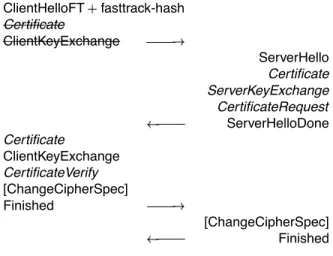
A server denies fast-track by responding to the client’s firstflow with aServerHellomessage rather than a Server-HelloFT. Its response should be as though the client had
initiated the connection through a ClientHello message
with the same body as that of theClientHelloFTmessage it actually had sent (except without thefasttrack-hash exten-sion). From that point on, the parties carry on an ordinary TLS handshake, conforming to the rules given in the TLS specification. The other messages sent by the client as part of itsfirstflow are ignored by both parties, and are not included in any handshake message digests.
Figure 4 presents the messages exchanged when
fast-ClientHelloFT fasttrack-hash Certificate ClientKeyExchange ServerHello [ChangeCipherSpec] Finished [ChangeCipherSpec] Finished
Figure 5. Message Diagram for a Session Resume, with Fast-Track Denied
track is denied. The notation is the same as employed in Figure 3, with the additional convention that messages printed with strike-through are not included in any hand-shake digests.
Finally, a server can deny fast-track but proceed with a session-resume if it wishes, and if the client sent a nonempty session-id in its fast-track hello message.
Fig-ure 5 gives the message flow in this case, using the
same notational conventions as the previousfigures. Ses-sion resumption provides less of a performance gain to fast-track clients, since they will have already engaged
in the time-consuming ClientKeyExchange calculations
when the server accepts the resume.
6. Performance considerations
The fast-track handshake mechanism reduces the proto-col’s communication requirements and round trips but has little effect on CPU load. We briefly discuss fast-track’s effect on CPU load for both servers and clients A more extensive analysis of the performance of standard TLS in the Web environment is available [2].
The performance of servers employing fast-track is comparable to that of ordinary servers. Servers avoid sending as many as three messages (Certificate, Certifi -cateRequest, andServerHelloDone), but none of these in-volves any computationally-intensive operation; contrari-wise, fast-track servers must verify the SHA-1 hash of the determining parameters.
Performance of fast-track clients is slightly improved, with a proper implementation. For example, once a client has validated a server’s certificate chain, it need not reval-idate it in the course of a fast-track handshake. Indeed, once it has computed the determining parameters hash which will later be sent to the server, the client may choose to discard the chain, maintaining only the server’s public key. Thus, in a fast-track handshake, a client avoids the signature verifications of an ordinary handshake, with a long-term space overhead of only a few hundred bytes for the server key.
RFC 2246 Fast-Track Savings
TLS RSA WITH 3DES EDE CBC SHA
Client 322 291 10%
Server 1187 130 89%
Total 1509 421 72%
TLS DHE RSA WITH 3DES EDE CBC SHA
Client 285 245 14%
Server 1461 404 72%
Total 1746 649 63%
Table 1. Handshake Bytes Sent for TLS Key Exchange Methods; No Client Authentica-tion
7. Implementation
We have modified OpenSSL 0.9.6a to negotiate and perform fast-track handshakes. Since OpenSSL does not currently support TLS extensions, our implementation in-stead used TLS’ version negotiation scheme: fast-track-capable clients and servers speak thefictitious TLS “Ver-sion 1.1.”
We summarize our observed savings in bandwidth be-low. Aside from the bytes-sent measurements, our im-plementation also maintains the savings inflows that fast-track provides over ordinary TLS handshakes: threeflows, rather than four.
Table 1 presents the number of bytes written across the wire by the client and by the server in both a standard (RFC 2246) TLS handshake [3], and a
fast-track handshake. The first cipher suite, called
“TLS RSA WITH 3DES EDE CBC SHA” in RFC 2246
(and called “DES-CBC3-SHA” in OpenSSL), uses RSA
for key exchange. It does not require a
ServerKeyEx-change message to be sent. The second cipher suite, “TLS DHE RSA WITH 3DES EDE CBC SHA” (called “EDH-RSA-DES-CBC3-SHA” in OpenSSL), employs Ephemeral Diffie-Hellman (EDH) for key exchange, with RSA authentication. A handshake using this cipher
suite requires the server to send a ServerKeyExchange
message. At present, EDH-based key exchange is not widely deployed in TLS environments, though support for it has been added in some recent browsers; accordingly, thefirst of the two settings in Table 1 is by far the more common.
The data in Table 1 show quite clearly that, in typical situations, the bandwidth cost of a TLS handshake is dom-inated by the server certificate chain. The server’s key exchange message, when sent, is also a significant com-ponent. Note that the server here sends only its own cer-tificate. Since the client must already have a copy of the self-signed CA certificate to assess the server’s
creden-RFC 2246 Fast-Track Savings
TLS RSA WITH 3DES EDE CBC SHA, client auth
Client 2519 2488 1%
Server 1196 130 89%
Total 3715 2618 30%
TLS DHE RSA WITH 3DES SHA, client auth
Client 2482 2442 2%
Server 1472 404 73%
Total 3954 2846 28%
Table 2. Handshake Bytes Sent for TLS Key Exchange Methods; Client Authentication Required
tials, the CA certificate need not be transmitted. (This is permitted by the TLS specification [3, 7.4.2].)
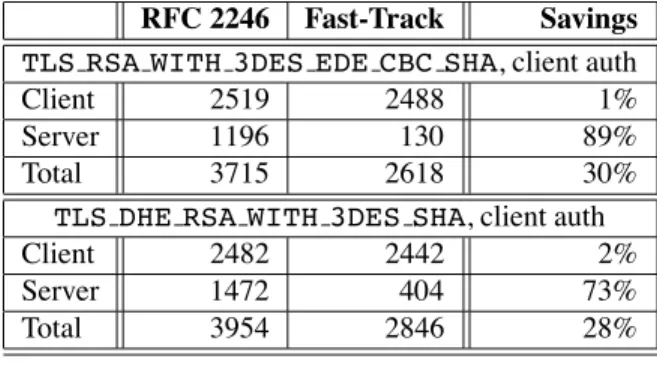
Although the savings in bandwidth generated by the server is substantial, the savings in client bandwidth is quite modest. In fact, our implemented client does not (yet) send the determining-parameters hash to the server. These additional 22 bytes of extension to the client hello (required in a fully-conforming fast-track implementa-tion) would largely negate the savings in client bytes-sent evident in Tables 1 and 2. The savings in server bytes-sent is unaffected. This underscores that, since fast-track does not assume a server-side cache, it can do little to reduce the information that a client must supply during a hand-shake. (The client bytes-sent savings are largely at the
TLS transport layer, where the reduced number offlows
allows greater consolidation of messages.)
Table 2 presents data in the same format as in Table 1, but in which the server requires that the client authenti-cate itself. Here, the dominant component is the client’s certificate chain. Unlike the server, the client does send the CA certificate along with its own.
The limited gains in bytes-sent seen in Table 2 again re-flect fast-track’s inability to do away with the sending of client information to the server. The specific problem of client certificates can be alleviated via a different mech-anism, complementary to fast-track: the TLS Extensions document defines aclient-certificate-urlextension [1, 3.3]. With this extension, a client sends the URL where its cer-tificate may be found, along with a hash of the cercer-tificate, rather than the certificate itself.
The number of bytes which a server writes depends on its certificate chain; similarly for a client when client au-thentication is required. Since certificates vary in length, a limit is placed on the accuracy of bytes-sent measure-ments. This limit is made more severe by the presence at several points in the TLS handshake of arbitrary-length lists: the client’s supported cipher suites; the client’s
sup-ported compression methods; and the server’s acceptable certificate types and acceptable CA names (for client au-thentication).
8. Security analysis
In this section we argue that fast-track is no less secure than the ordinary TLS handshake protocol. Unfortunately, a formal argument about the security of fast-track as a handshake protocol is extremely difficult, especially in the absence of a comprehensive formal analysis of TLS [4]. Nor is a rigorous reduction of fast-track security to TLS security feasible – the message order is changed between the two protocols, so an attacker on one would not nec-essarily be able to create messages for the other without breaking the hash functions used in thefinished-message digests. In light of these limitations, we present common arguments about the security of fast-track.
Fast-track is negotiated in the course of an ordinary TLS
handshake, using the fasttrack-capable extension
(Sec-tion 5.1). The extension itself contains no sensitive data, and the negotiation is protected by the same mechanisms that protect other negotiated extensions.
A client should store determining parameters for use in a future fast-track handshake only after verifying that the server has a valid certificate, and the parameters come from an ordinary handshake, so these parameters should not be open to tampering. Furthermore, if the client and server determining parameters differ, the mismatch will be detected in the course of the handshake, since some mes-sages will be incomprehensible. Thus, determining pa-rameter mismatch is not a security problem, and the SHA-1 hash should be sufficient to provide collision-resistance for robustness. (The exception is if the client has obtained an adversary’s certificate for the server’s distinguished name, a situation that could allow for a man-in-the-middle attack. But this would require a compromise of the public key infrastructure.)
All the same information exchanged in a standard hand-shake is exchanged in a fast-track handhand-shake, except for the determining parameters, for which a cryptographic hash is exchanged. The handshake digest hashes in the Finishedmessages should thus provide the same security as in ordinary TLS.
The ordering of the server and clientFinishedmessages is opposite of that in ordinary TLS handshakes, but TLS session resumes also use this reversed ordering.
The server response message (ServerHello or
Server-HelloFT) is included in the final hashes regardless of
whether fast-track is denied, so rollback attacks should be impossible.
The only message not verified by both the client and serverfinished-message hashes is the clientCertifi cateV-erifymessage. It is included in the clientfinished-message
hash, so the server should be able to detect its having been modified and abort the connection.
In any case, the client certificate itself is included in bothfinished-message hashes, and is presumably no more open to tampering than in an ordinary TLS handshake. The clientCertificateVerifymessage contains only a sig-nature with the certificate’s key, so opportunities for mis-chief through its modification are limited.
9. Other client cache strategies
It was noted earlier that fast-track is a strategy for ex-ploiting client-side caching to reduce handshake over-head. There are other possible strategies.
One can keep actual session information on the client side, encrypted — perhaps with a secret server symmetric key — to defeat tampering. A client could later send the encrypted information to the server, initiating what might be termed a client-side session resume.
There are limitations to this approach. TLS servers usually agree to resume only sessions that satisfy certain properties. For example, OpenSSL refuses to resume ses-sions that were not properly shut down. A client-side re-sume scheme would have to be designed so the client does not obtain a session ticket until the server is convinced that it is willing for that session to be resumed. (The TLS specification also recommends that sessions persist for no longer than twenty-four hours, to limit the damage from a compromise of the session’s master secret.)
It should be possible, however, for a TLS server to maintain a cache of resumable session IDs, while obli-gating the client to hold on to an opaque ticket that con-tains the remainder of the information the server maincon-tains about sessions.
If the initial handshake were unsatisfactory, the server could drop the session ID from its cache, and refuse a subsequent client-side resume even though the client had a supposedly valid ticket.
This approach essentially uses the client as secondary storage for the server’s session cache, which is made to take less storage.
10. Conclusions
We proposed an improvement to the TLS handshake protocol that makes TLS easier to use in bandwidth-constrained environments. Our improvement is based on a fast-track handshake mechanism that exploits a small session-cache on the client. In a fast-track handshake there is no need to transmit server parameters such as the server certificate and preferred cipher suite. This en-ables us to reorder the messages in a fast-track handshake and effectively save two round trips. Hence, the fast-track handshake saves both network traffic and round trips over
the standard full TLS handshake protocol. The reduction in number of round trips speeds up TLS session estab-lishment in high latency networks. Overall, fast-track is a simple addition to TLS that makes it more friendly to use in constrained environments.
We implemented our proposal in a backwards compati-ble design. If either the client or the server does not sup-port fast-track or do not wish to use fast-track they can re-vert to the standard full TLS handshake. Our experiments show that fast-track can save up to 72% of the handshake traffic. Our prototype implementation of fast-track and In-ternet draft are available for download [5].
Acknowledgments
We thanks Dan Simon and Dan Wallach for helpful con-versations about this paper. This work was partially
sup-ported by anNSF CAREERgrant.
References
[1] S. Blake-Wilson, M. Nystrom, D. H. J. Mikkelsen, and T. Wright. TLS Extensions. Internet-Draft:
draft-ietf-tls-extensions-01.txt, Sept. 2001. Work
in progress.
[2] C. Coarfa, P. Druschel, and D. Wallach. Performance Anal-ysis of TLS Web Servers. In Proceedings of NDSS ’02, 2002.
[3] T. Dierks and C. Allen. RFC 2246: The TLS Protocol, Ver-sion 1, Jan. 1999.
[4] J. Mitchell, V. Shmatikov, and U. Stern. Finite-State Anal-ysis of SSL 3.0. In Seventh USENIX Security Symposium, pages 201–216, 1998.
[5] H. Shacham and D. Boneh. TLS Fast-Track Session Establishment. Internet Draft:
draft-shacham-tls-fasttrack-00.txt, Aug. 2001. Work in progress.
[6] Wireless Application Forum. Wireless Transport Layer Security Specification. http://www.wapforum.org, 2000.