i
Internet Banking Fraud Detection Using Prudent Analysis
Oarabile Omaru Maruatona
This thesis is submitted in total fulfilment of the requirements for the degree of
Doctor of Philosophy
School of Science, Information Technology and Engineering (SITE)
University of Ballarat
P O Box 663
University Drive, Mt Helen
Ballarat, VIC 3353, Australia
Supervisors
Dr. Peter Vamplew
Dr. Richard Dazeley
ii
Abstract
The threat posed by cybercrime to individuals, banks and other online financial
service providers is real and serious. Through phishing, unsuspecting victims’
Internet banking usernames and passwords are stolen and their accounts robbed. In
addressing this issue, commercial banks and other financial institutions use a
generically similar approach in their Internet banking fraud detection systems. This
common approach involves the use of a rule-based system combined with an
Artificial Neural Network (ANN).
The approach used by commercial banks has limitations that affect their efficiency
in curbing new fraudulent transactions. Firstly, the banks’ security systems are
focused on preventing unauthorized entry and have no way of conclusively
detecting an imposter using stolen credentials. Also, updating these systems is slow
and their maintenance is labour-intensive and ultimately costly to the business. A
major limitation of these rule-bases is brittleness; an inability to recognise the limits
of their knowledge.
To address the limitations highlighted above, this thesis proposes, develops and
evaluates a new system for use in Internet banking fraud detection using Prudence
Analysis, a technique through which a system can detect when its knowledge is
insufficient for a given case. Specifically, the thesis proposes the following
contributions:
Conduct comprehensive comparisons of two successful prudence methods:
Rated MCRDR (RM) and Ripple Down Models (RDM).
Redevelopment of Multiple Classifications RDM from Single Classification RDM.
Development of a new prudence method
Integrated Prudence Analysis(IPA) by
combining RM and RDM.
Introduction and application of RDR prudence to Internet banking fraud
detection.
iii
Statement of Authorship
Except where explicit reference is made in the text of the thesis, this thesis contains
no material published elsewhere or extracted in whole or in part from a thesis by
which I have qualified for or been awarded another degree or diploma. No other
person’s work has been relied upon or used without due acknowledgment in the
main text and bibliography of the thesis.
Oarabile Omaru Maruatona
SIGNED:
iv
Publications by Author
The following is a list of academic, peer reviewed publications produced in the
course of this project.
Maruatona, O.O, Vamplew, P; Dazeley, R. RM and RDM, a Preliminary Evaluation
of two Prudent RDR Techniques. The 6
thPacific Knowledge Acquisition Workshop
(PKAW 2012). Kuching, Malaysia.
The preliminary results published at the PKAW conference were the first phase of
comparisons between RM and RDM. Complete evaluation results are presented in
chapter six.
Maruatona, O.O, Vamplew, P; Dazeley, R. Prudent Fraud Detection in Internet
Banking. Cybercrime and Trustworthy Computing Workshop (CTC 2012). Ballarat,
Australia.
The CTC publication discussed the viability of prudence in fraud detection
components of Internet banking systems. The paper presented some early test
results using the IPA system.
v
Acknowledgements
Kwalo ya thesis e, ke karolo ya bobedi mo mosepeleng wa me wa PhD. Thesis e e simolotse dikgwedinyana morago ga ke sena go digela thoto e nngwe ya mmereko wa Programming e mo go one go dirisiwang compitara go dira tiro nngwe e neng e ka se kgonege ka diatla kgotsa e le bonya ga e dirwa ke motho. Tshwetso ya me go dira PhD ga e a tsalwa fela ke gore ne ke batla go nna le yone PhD. Ke tshwetso e e akareditseng dilo tse dintsi e bile ke e rerisitse ba lwapa la me. Ke itumelela gore botlhe ba ke ba rerisitseng ba mphile tletla ya go dira se pelo ya me e neng e se eleditse. Ka bokhutswhane nka re mosepele wame wa PhD e nnile nngwe ya dikgwetlho tse di tona tse ke di ineileng ebile ke motlotlo go bo ke ithutile tse ke di ithutileng, go bo ke bone mafelo a ke a boneng, go bo ke kopane le be ke kopnaneng nabo, le tse di ngwe tse di molemo tse ke di jeleng ka mokgwa mongwe ke di lebogela fela thata. Ke leboga thata Thembi Omaru, mme yo ke fudugetseng mo toropong ya Ballarat le ene ga ke tla go simolola mosepele o. Re ithutile thata, tota re amogane gole go ntsi nna le Thembi. Ke nnile lesego thata go thulana le ene ka nako e rotlhe re boneng mosola wa go simolola botsala jwa rona. Ke rata go leboga go menagane botlhe ba ba tsereng karolo mo ponagatsong ya phenyo e. Ke leboga mogolwane wa me wa tsa patisiso, Dr Peter Vamplew, mogolwane wa bobedi wa tsa patisio, Dr Richard Dazeley. Malebo gape go moeteledi was lefelo la patisiso la Internet Commerce Security Laboratory, Associate Professor Paul Watters. Malebo a magolo go dikompone tse di thusang ICSL ka tsa madi le go fa tiro ya rona boleng jwa tsa kgwebo, Westpac Bank Ltd, IBM Australia le Australian Federal Police.
This thesis is a result of a collective effort of a number of people. It was Mary Imam who suggested that I apply for a PhD when I was looking for jobs and Masters Scholarships in Australia. Thanks Mary for your steady support throughout the years.
I would like to acknowledge my supervisors Dr Peter Vamplew and Dr Richard Dazeley, who were pivotal in getting this project to where it is now. I have realised how fortunate I was to have the two of them as supervisors and am grateful for the collegial working relationship we had over the last three years.
I would also like to thank the Internet Commerce Security Laboratory (ICSL) and its partners Westpac Bank Ltd, IBM Australia and the Australia Federal Police for the generous support
vi
and for the opportunity to have undertaken my PhD under their auspices. It was through them that my PhD earned the practical and commercial relevance it now possesses. Special thanks to colleagues at the ICSL and our industry contributors from Westpac, IBM and the AFP. Your insightful feedback was much appreciated.
To the University of Ballarat; thanks for the opportunity. Every day was worth it. And to all members of staff at the Research Services Office; thank you for everything.
Lastly, I would like to extend my heartfelt thanks to my family for standing by me in all I do and my wife Thembi, who was always there when I needed her. Your support inspires me and this PhD was accomplished with your unwavering support.
vii
Contents
1. Introduction ... 1
1.1 The State of Affairs ... 1
1.2 Current Approaches to Internet Banking Fraud Detection ... 1
1.3 Limitations of Current Fraud Detection Methods ... 2
1.4 Prudent Ripple Down Rules: a viable Solution to Fraud Detection ... 3
1.5 Project Plan and Contributions ... 4
1.6 Thesis overview ... 5
2. Literature Review: Fraud Detection ... 9
2.1 Introduction ... 9
2.2 Internet Fraud ... 9
2.3 Online Banking, a Victim of Internet Fraud ... 11
2.4 Detecting Fraud with Outlier Detection ... 13
2.5 Applying Outlier Detection in Intrusion Detection ... 15
2.6 Outlier Detection in Fraud Detection ... 19
2.7 Remarks and Observations ... 24
2.8 Chapter Summary ... 24
3. Literature Review: Knowledge Based Systems and Ripple Down Rules ... 26
3.1 Introduction ... 26
3.2 Knowledge-based Systems ... 26
3.3 Rule-Based Systems ... 28
3.4 Ripple Down Rules ... 31
3.5 RDR Learning ... 33
3.6 Multiple Classifications RDR ... 35
3.7 MCRDR Learning ... 37
3.8 Prudence in Knowledge Bases ... 41
viii
4. Prudent RDR methods ... 45
4.1 Introduction ... 45
4.2 Rated MCRDR ... 45
4.3 Ripple Down Models ... 55
4.4 MCRDR based RDM ... 63
4.5 Integrated Prudence Analysis ... 64
4.6 Chapter Summary ... 67
5. Methodology ... 68
5.1 Introduction ... 68
5.2 The Need for KBS evaluation ... 68
5.3 Evaluation Metrics for KBS ... 69
5.4 Evaluation in RDR KBS ... 76
5.5 Creating a Simulated Expert ... 80
5.6 Evaluation Metrics ... 82
5.7 Datasets ... 87
5.8 Chapter Summary ... 89
6. Results on Public Datasets ... 90
6.1 Introduction ... 90
6.2 Single and Multiple Classifications RDM ... 90
6.3 Simple Accuracy: RM versus RDM ... 92
6.4 Prudence Accuracy: RM versus RDM ... 93
6.5 Simple Accuracy Before and After Prudence ... 97
6.6 IPA Prudence Accuracy ... 99
6.7 Integrating Two Prudent Methods: Does It Work? ... 102
6.8 Chapter Summary ... 105
7. IPA Results on Internet Banking Data ... 106
7.1 Introduction ... 106
7.2 Internet Banking Fraud ... 106
7.3 Internet Banking Transactions ... 108
ix
7.5 IPA versus Commercial System ... 113
7.6 Internet Banking Fraud Detection Framework ... 115
7.7 Chapter Summary ... 116 8. Conclusion ... 118 8.1 Introduction ... 118 8.2 The Situation ... 118 8.3 The Project ... 120 8.4 The Results ... 120 8.5 Contributions ... 121 8.6 Conclusion ... 122 9. Bibliography ... 123 Appendix A: Acronyms ... 132
x
List of Figures
Figure 2-1. Some of the Falcon s main components (FICO, 2011) ... 21
Figure 3-1. Basic schematic of a KBS (Giarratano & Riley, 2005) ... 27
Figure 3-2. Components of a simple rule ... 29
Figure 3-3. Change in complexity of a rule over 3 years. ... 31
Figure 3-4. The RDR tree structure. ... 33
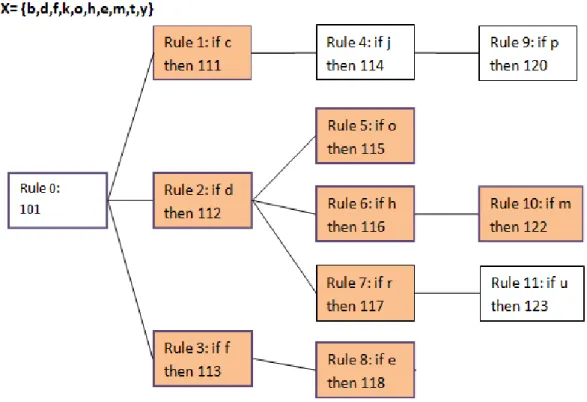
Figure 3-5. An MCRDR for X= {b, d, f, k, o, h, e, m, t, y}.. ... 37
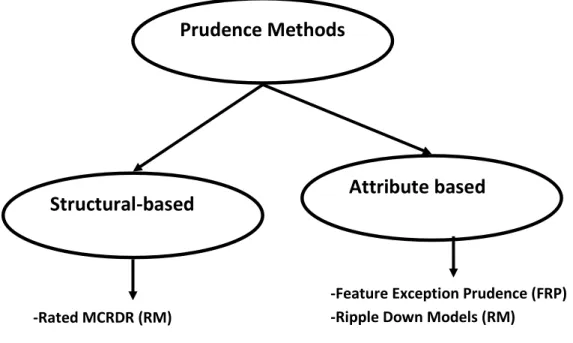
Figure 3-6. The two types of Prudence and their examples ... 43
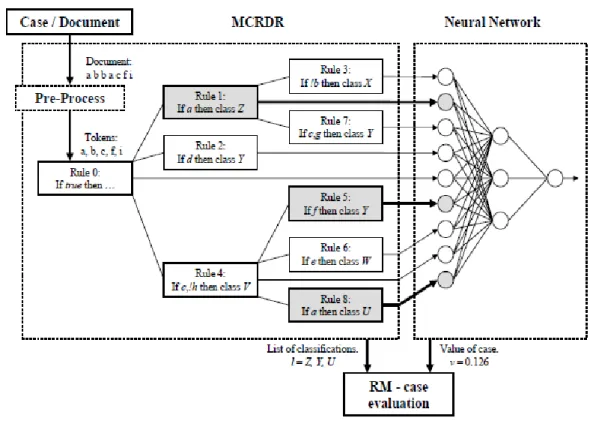
Figure 4-1. An overview of RM’s main components. ... 46
Figure 4-2. A simple three layered ANN with input, hidden and output layers. ... 49
Figure 4-3. Dynamic addition of a new input node to an ANN. ... 53
Figure 4-4. Adding a new input and hidden node to an ANN ... 53
Figure 4-5. Main components of RDM.. ... 56
Figure 4-6. Output of RDR RDM inference engines ... 57
Figure 4-7. The IPAOR /IPAAND system. ... 65
Figure 4-8. A generic overview of the IPAANN system.. ... 66
Figure 5-1. FPA questions ... 70
Figure 5-2. ROC curves for 4 systems. ... 74
xi
List of Tables
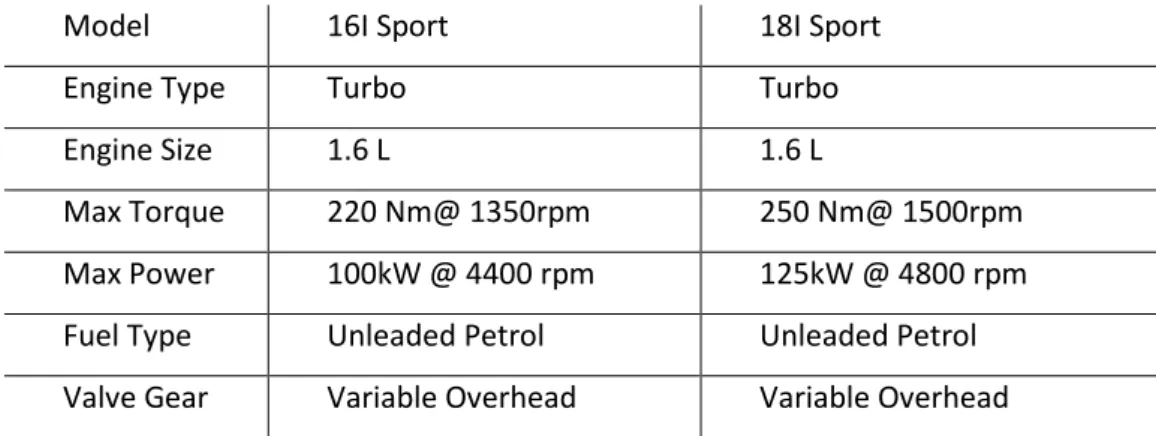
Table 3-1. Attributes of two models of sports cars, the 16I and the 18I ... 34
Table 3-2. A sample difference list of two different editions of sports cars ... 34
Table 3-3. Early prudence system's performance statistics ... 42
Table 5-1. FPA assessment matrix ... 71
Table 5-2. MCRDR accuracy after learning from a See5 and induction rules SE. ... 82
Table 5-3. Description of used public datasets and SEs. ... 88
Table 5-4. Labwizard statistics for 3 knowledge bases... 89
Table 6-1. Comparison of two SC-RDM and MC-RDM on prudence accuracy ... 91
Table 6-2. MCRDR’s Simple accuracy in numerical datasets ... 92
Table 6-3. MCRDR’s simple accuracy on categorical datasets ... 93
Table 6-4. Specificity, Sensitivity and BA of RM and RDM in numerical datasets ... 94
Table 6-5. RM and RDM‘s Specificity, Sensitivity and BA in categorical datasets ... 95
Table 6-6. Comparison of simple accuracy before and after prudence ... 98
Table 6-7. IPA prudence accuracy on numerical datasets ... 100
Table 6-8. IPA prudence accuracy statistics on the categorical datasets ... 101
Table 6-9. IPA, RM and RDM's BA in numerical datasets. ... 102
Table 6-10. RM, RDM and IPA Acc and BA on categorical data ... 103
Table 6-11. IPA’s simple accuracy before and after prudence ... 104
Table 7-1. Description of online banking transaction attributes ... 109
Table 7-2. Demonstration of three obfuscation types ... 110
xii
Table 7-4. IPA prudence accuracy on online banking data ... 112 Table 7-5. IPA vs. Commercial system detection rates ... 114
- 1 -
1.
Introduction
1.1
The State of Affairs
Cybercrime in general continues to be a serious problem for individuals and businesses using or offering online services. According to published statistics, the financial and banking industry especially bears most of the effects of these crimes through Internet banking fraud, since the ultimate motive is usually financial gain (APWG, 2010). One of the most prevalent methods of Internet banking fraud is Phishing, which involves the use of technology and deceit to illicitly acquire an unsuspecting victim’s credentials (APWG, 2011). These credentials (including personal details, online banking usernames and passwords) are then used by fraudsters to access a victim’s emails, social security benefits and bank account, eventually resulting in the removal of funds from a victim’s account. In 2008, phishing related Internet banking fraud was said to have cost banks around the world more than US$3 billion (McCombie, 2008). It has been reported also that beyond 2010, there would be a rise in sophisticated and more effective phishing techniques, ultimately resulting in more losses of funds through Internet banking fraud (RSA, 2010). This situation necessitates the development and wide deployment of more efficient and rapid Internet banking fraud detection systems.
1.2
Current Approaches to Internet Banking Fraud Detection
Online banking fraud detection systems which rely purely on user account and password authentication have no way of differentiating an account’s legitimate user and a fraudster as long as the correct login credentials have been used to log in. This is one of the features enabling the prevalence of phishing, and also an area that security in Internet banking needs to focus on. The approach used by commercial banks to detect frauds in online transactions is generically similar. Reports and white papers of four commercially applied online payment fraud detection systems have shown that the common approach is the use of a Rule-base system combined with an Artificial Neural Network (ANN). The Falcon Fraud Manager, the Proactive Risk Manager (PRM) and the SAS Fraud Management system are examples of fraud detection systems used in commercial Internet banking systems (FICO, 2011; ACI Worldwide,
- 2 -
2011; SAS, 2007). These systems are extensively used around the world including in more than 40 countries, at 43000 sites and by half of the world’s top 20 banks. Each of these fraud detection systems’ architectures involves the use of a neural network to profile user behaviours and a conventional rule-base to create and maintain rules that define normal and anomalous behaviour (FICO, 2011; ACI Worldwide, 2011; SAS, 2007).
1.3
Limitations of Current Internet Banking Fraud Detection Methods
Most online banking fraud detection systems have no immediate way of realising when a fraudster logs in with correct but stolen details. Many of these systems will actually accept the correct username and password for a registered customer even if the user at the time is a fraudster using stolen credentials. Although two way authentications reduce the extent of damage posed by this flaw, there still remains the threat of mobile phone hackings, interceptions and viruses through which the fraudsters can evade dual authentications (Weber & Darbellay, 2010; Androulidakis & Papapetros, 2008). Instead of just preventing unauthorised entry, Internet banking fraud detection systems have to be able to detect a fraud immediately within a compromised account. The systems need to have some capability of conclusively determining whether a given user is the legitimate account holder or an impersonator.
Slow approach to Knowledge Acquisition
Conventional rule-bases used by commercial Internet banking systems have been criticised for a number of performance limiting inadequacies. Their approach to Knowledge Acquisition (KA) has been faulted for being too slow, labour intensive and costly for business (Richards, 2003). Also, maintenance in RDR is integrated with KA and not an additional task as in conventional rule-bases.
Brittle Rule-bases
These rule bases have also been labelled brittle; a phenomenon when Expert Systems attempt to use current knowledge to cover a case beyond this knowledge (Prayote & Compton, 2006). Such systems do not have a way of knowing when a new case cannot be processed using existing knowledge. They always attempt to give an answer even if it may be inaccurate.
- 3 -
Slow to adapt to new frauds
Consequently, a brittle Internet banking fraud detection system is less accurate since it always depends on its current knowledge even for novel cases where this knowledge is insufficient. It has also been consistently reported that modern fraud screening systems need capabilities for more accurate, automated and most importantly rapid detection of anomalous patterns (SAS, 2007; IBM, 2008). Rapid detection will enable fraud teams to respond to threats and potential threats in real time and will help save resources expended whenever a fraud has occurred.
1.4
Prudent Ripple Down Rules: a viable Solution to Internet Banking
Fraud Detection
The Ripple Down Rules (RDR) approach to KA has been shown to have notable advantages over conventional rule-bases. RDR methods have been shown to have a better, faster and less costly rule addition and maintenance than conventional rule-bases (Kang, Compton, & Preston, 1995; Richards, 2003; Prayote, 2007).
No need for knowledge engineer
Conventional rule-bases typically require a knowledge engineer and a domain expert to build. Conversely, RDR knowledge bases only require a domain engineer. One of the earliest RDR systems, PIERS was described as user maintained and not requiring knowledge engineering expertise (Edwards, Compton, Malor, Srinivasan, & Lazarus, 1993). Similar RDR systems have since been successfully used in other applications including in web browsers, help desk systems, online shopping, email management systems and Network traffic classification (Kang, Compton, & Preston, 1995; Richards, 2003; Prayote, 2007).
Ability to realise limits
To address the issue of brittleness, RDR methods have an added feature called Prudence. Prudence allows the knowledge engine to realise when a current case is beyond the system’s expertise. In such situations, the prudent system would issue a warning for the case to be investigated by the expert, resulting in the addition of knowledge to cover the case. In contrast, a brittle system would attempt to give a conclusion based on insufficient knowledge. The conclusion will most probably be erroneous and it would take some time for the system’s administrators/experts to correct the error. For Internet banking, prudent fraud
- 4 -
detection systems mean accurate and rapid detection of new fraud patterns, saving time, human resources and money for both the financial institutions and their customers. Some of the theoretically and domain successful prudent RDR methods include Rated Multiple Classification Ripple Down Rules (RM) and Ripple Down Models (RDM) (Dazeley, 2007; Prayote, 2007). RM uses patterns in the MCRDR engine’s inferencing paths to train an ANN to contribute to the system’s understanding of a domain. RDM applies an outlier detection method to homogenized profiles from an RDR engine.
Impressive classification accuracy
Both RM and RDM have shown impressive classification and prediction ability in a number of public and proprietary datasets and have been commended for their performance (Dazeley, Park, & Kang, 2011; Prayote & Compton, 2006; Dazeley & Kang, 2008). The two systems’ fundamental difference is that RM is structural and uses the inferencing engine’s structure to deduce additional context about the domain. RDM is attribute-based and exploits the accuracy of outlier detection methods in homogenous profiles. To date, there have not been focused and direct comparisons of the two methods and to establish which domain each method is better in.
1.5
Project Plan and Contributions
This research project intends to apply the successful methods of RDR prudence to Internet banking fraud detection. Theoretically, RDR prudence seems to be precisely what fraud detection in Internet banking systems requires given the need to identify new fraud patterns instantly in this domain. This project will therefore investigate the performance (in terms of classification accuracy and prudence accuracy) of RDR prudence in online banking. Specifically, this will be achieved through the following stages:
1. Extend Single Classification RDM to Multiple Classifications RDM. The current RDM method (Prayote, 2007) uses a single class RDR engine. This project will redevelop the method to handle multiple classifications domains. Having a multiple classifications RDM system would enable comparisons between RDM and RM.
2. Evaluate and compare RM and RDM. There are currently no known direct comparisons of RM and RDM. This research will conduct focused comparisons of the two methods and give informed analysis of the particular strengths and weaknesses of each of the
- 5 -
methods. The evaluations will be done using simulated experts which will also be developed in this project.
3. Develop an integrated prudence method by combining RM and RDM. The combination of a structural and an attribute-based prudence method will provide some insight on whether the integrated method has better performance than the individual methods. 4. Evaluate and apply the best prudence method to Internet banking fraud detection. The
practical and commercial contribution of this project will be in using a chosen prudence method on an Internet banking transaction dataset. The chosen method will be whichever has recorded best results from the evaluations mentioned in the second and third points.
1.6
Thesis overview
Chapter 2: Fraud Detection
Chapter 2 sets the scope of the research and provides a summarised review of the literature starting with Internet fraud, its effects and latest statistics and the industry most affected by this crime (financial sector). The chapter then analyses common trends in detecting frauds especially in Internet banking. Outlier Detection is then introduced as the fundamental aspect of all security mechanisms used to detect frauds in computer systems. Two applications of Outlier Detection namely Intrusion Detection and Fraud Detection are surveyed. The two are the basis of all commercial Fraud Detection and Intrusion Detection solutions. A profiling of three commercial Internet payment fraud detection systems reveals a common generic architecture. The majority of online banking fraud detection systems use a Rule-Base and an ANN. The profiled systems represent eight of the world’s top 20 banks, are used in over 40 countries and in 430000 Internet banking systems. The chapter concludes with a cautionary note from an industry report warning that modern fraud detection systems will need to adopt intelligent programming techniques in order to improve their Knowledge-Based Systems (KBS) and algorithms for rapid detection of novel patterns.
Chapter 3: Knowledge-based Systems and Ripple Down Rules
Given that Rule-based systems are the main components of most fraud/intrusion detection systems, this chapter will give an overview of Knowledge-based or Expert Systems. The chapter also explains some of the main limitations of KBS including lack of causal knowledge,
- 6 -
slow knowledge acquisition process and lengthy and costly maintenance. RDR is then introduced as using a more efficient knowledge acquisition process, having an integrated rule addition and maintenance approach and essentially providing an alternative to the conventional KBS’ limitations. A structured discussion of RDR is followed by the introduction of Prudence as a solution to KBS brittleness providing the ability to notify an expert or system administrator each time a new case or potentially wrong conclusion was produced. The chapter concludes with a review of two early attempts at prudence.
Chapter 4: Prudent RDR Methods
Building on the introduction and definition of Prudence in the previous chapter, chapter 4 analyses two of the newest and most successful prudence methods; RM and RDM. The chapter describes the structure, components and configurations of each method. RDM is originally a single classification method and this project extends the method to a multiple classifications version (MC-RDM). An explanation and the reasons for this extension are detailed in this chapter. The last part of chapter 4 introduces the Integrated Prudence Analysis (IPA) as a methodical combination of RM and RDM proposed by this reseacrh. IPA is a novel, experimental prudence method to improve RM and RDM’s individual performances by combining an attribute based prudence method (MC-RDM) and a structural based prudence method (RM). Combining the two approaches has not been done before and is anticipated to take advantage of both the supplementary rule path context extraction of RM and partition based outlier detection of MC-RDM. As with RM and RDM in earlier sections, a detailed description of IPA’s structure, components and configurations is given.
Chapter 5: Methodology
Chapter 5 explores different metrics and methods used to evaluate knowledge-based systems. The chapter reviews four KBS evaluation approaches focusing on different areas of the KBS. One method measures the accuracy of a KBS, another detects internal inconsistencies in the Knowledge Base and verifies if the system’s actual behaviour is as specified in the design. Yet another method analyses differences between the KBS’ false alarms and detection rates and the last method evaluates the Data Mining algorithms used in the KBS. Each of these methods is ultimately used to decide the degree of usefulness of a KBS by those who apply them. The chapter also presents the evaluation approach used in RDR based knowledge-based systems. The chapter describes the process of building a simulated expert and using the expert to evaluate a KBS under construction. A description of
- 7 -
the datasets and the metrics used specifically in this project is also given. The metrics, simple accuracy or classifier accuracy ( ), Sensitivity (Se), Specificity (Sp) and prudence accuracy or Balanced Accuracy (BA) are used to determine a prudent system’s precision in predicting correct domain cases and effectiveness of the system’s warning mechanism.
Chapter 6: Results on Public Datasets
This chapter presents results and comparisons between RM and RDM on categorical and numerical public datasets based on the metrics discussed in chapter 5. The chapter analyses RM and RDM’s classifier and prudence accuracy on the numerical and categorical datasets. Since the comparisons are meant to be a basis for selecting the better of the two methods, the chapter discusses a criterion for such a decision. The chapter also presents results from three Integrated Prudence Analysis (IPA) versions and evaluates the best IPA configuration against the two methods it was built from (RM and IPA). These evaluations between IPA, RM and RDM will determine if indeed a combined system has a better classifier and prudence accuracy than either of the constituent systems.
Chapter 7: IPA Results on Internet Banking Data
Results from IPA’s evaluations on Internet banking transactions are presented in this chapter. A description of the depersonalised, online banking transactions are given including descriptions of the data’s attributes. The chapter also presents statistics from a commercial online banking fraud detection system and for use as a benchmark in evaluating the IPA system. Chapter 7 concludes with a discussion on some of the deterrents to effective research-based fraud detection solutions and some generic recommendations to improving Internet banking fraud detection including a possible adaptation of the Integrated Prudence Analysis fraud detection system.
Chapter 8: Conclusion
Chapter 8 is a summary of the whole project and starts with a quantitative overview of the latest losses from Internet fraud and what industry is affected the most. An outline of the current approaches to curbing Internet banking fraud is also given, including the limitations of these approaches given the dynamic and sophisticated nature of Internet banking fraud today. The RDR technology is listed as a possible solution to these limitations, although hitherto unused in Internet banking. Towards the end, the chapter specifies a list of project
- 8 -
contributions and concludes with a note on the results, lessons learnt and future work in this domain.
- 9 -
2.
Literature Review: Fraud Detection
2.1
Introduction
This Chapter introduces the foundational elements of this research. The chapter begins with an introductory overview of Internet fraud, elements of Internet fraud, statistical comparisons and trends of some of the persistent threats over the last five years. The financial sector, especially online banking is revealed as one of the industries most affected by Internet scams. To better understand Internet banking, a brief analysis of online banking is given, including main components of a generic online banking system and the general approach to fraud detection and security in these systems. Outlier detection is then introduced as the fundamental aspect of all security mechanisms used to detect fraud in computer systems. Two applications of outlier detection namely; intrusion detection and fraud detection are surveyed. The two are the basis of the majority of commercial fraud detection and intrusion detection software. The chapter concludes with a brief, informative overview of three commercial fraud detection systems and some insight from other researchers on merging fraud detection and intrusion detection ideas into a single, robust fraud and intrusion screening solution. Each concept in this chapter has been carefully explained to a level of detail appropriate for understanding the rest of the material covered in latter chapters. This was done to set a relevant depth of comprehension of all concepts and ideas discussed henceforth in the dissertation.
2.2
Internet Fraud
Internet fraud, online fraud and cybercrime are broad terms used to group various illegal activities committed through the Internet. A 2011 report commissioned by the British Cabinet Office defines cybercrime as illegal activities exploiting the Internet to illicitly access or attack information and services (Detica, 2011). The Australian Institute of Criminology (AIC) describes Internet fraud as any dishonest activity using the Internet as a target or means of obtaining some financial reward (Smith, 2001). Finally, online fraud is described by the Australian Federal Police as any type of fraud scheme using the Internet to conduct fraudulent transactions or transmit the proceeds of fraud (Australian Federal Police, 2012). The terms Internet fraud, online fraud and cybercrime are therefore often used interchangeably to describe various crimes, frauds and scams committed online. The list of
- 10 -
online fraud examples is ever growing and comprises phishing, hacking, malware dispensation, denial of service attacks, spoofing, identity theft, spamming and many more. One or more of these scams are used to achieve different fraudulent motives including financial gain.
The AFP website defines Internet banking fraud as theft committed using online technology to illegally remove money from a bank account, or transfer it to a different bank account (Australian Federal Police, 2012). One of the most prominent examples of Internet fraud is Phishing (RSA, 2010). Phishing involves the use of technology and deceit to illicitly acquire an unsuspecting victim’s credentials (APWG, 2011). The sought after credentials include personal details, online banking usernames and passwords and other confidential credentials and details. With these credentials, fraudsters can easily gain access to their victim’s email, social security benefits and bank account.
Phishing usually targets Internet users’ online banking details and was responsible for losses of up to US$3.2 billion in the US alone in 2007 (McCall, 2012). In 2008, phishing was said to have cost banks more than US$3 billion globally (McCombie, 2008). A year later in 2009, the Australian Bureau of Statistics estimated that approximately 3.5% of the nation’s population aged 15 years and over had been victims of some form of identity fraud or phishing (ABS, 2010). Although not all identity theft attempts and phishing campaigns are successful, the sheer volumes of the attempts alone indicate how relentless the fraudsters have become. Despite vigilant campaigns on safe Internet use by banks and other groups, a 2010 report by RSA, a renowned security company cautioned that fraudsters were equally at work, improving the technology and sophistication of their attacks (RSA, 2010). The report further forecasted that beyond 2010, there would be a rise in the effectiveness of phishing attacks resulting from new techniques.
The Anti-Phishing Working Group (APWG) received 315517 unique phishing emails reported by consumers in 2010 (APWG, 2010). In the same year the APWG detected up to 365628 unique phishing web sites. The most targeted industry in this period was the financial sector, receiving an average of 41.23% of all phishing attacks. The rest of the phishing targets included the retail industry, online classifieds, social networking, online auctions and the gaming industry (APWG, 2010). The following year (2011) saw a small decline in the number of phishing emails with 284445 reported to APWG. However, the number of phishing sites rose to 427314, an increase of 17% from the previous year. The financial sector remained the phishing campaign’s most targeted industry sector, receiving on average, 44.75% of all
- 11 -
phishing attacks (APWG, 2011) . The increasing number of phishing sites and the growing proportion of attacks on the financial sector affirm the primary motive of most phishing campaigns, financial gain.
A number of conclusions could be drawn from the given results but the certain fact however is that phishing does not seem to be slowing down. In fact a variety of new phishing techniques are being invented and unleashed on unsuspecting and ignorant web users every day. The RSA fraud reports revealed that more diverse phishing attacks were deployed in 2011 (RSA, 2012), and that in the first half of 2012, the number of phishing attacks had increased by 19% (RSA, 2012). The report also adds that throughout the year 2011, financial institutions were the target of at least half of all phishing attacks.
2.3
Online Banking, a Victim of Internet Fraud
Online banking or Internet banking includes all traditional banking transactions conducted over the Internet through the user’s banking institution’s website. Through online banking, banks have been able to provide banking facilities to their clients over the Internet. However, this capability has not been easy nor cheap to maintain (Datamonitor, 2009). It is therefore unsurprising that the first reported phishing attack in Australia was against a bank in March 2003 (McCombie, 2008). Earlier in 2001, a group of bank executives and IT managers had advised a quantitative survey that one of the biggest challenges to online banking would be security (Aladwani, 2001). A typical online banking system will have the following subsystems with different access levels (RBI, 2001):
Information only subsystem
Electronic Information Transfer subsystems
Fully Transactional subsystems
Information only subsystems provide non-sensitive information such as interest rates, branch locations, membership application forms and other general information. No identification of users is required with Information only subsystems. The Electronic Information Transfer subsystems provide read only, customer specific information including account balances, transaction records and account statements. Customers need to be identified and authenticated to access this part of the online banking system. Fully Transactional subsystems interact with the customer to update customer accounts such as
- 12 -
when funds are transferred to a different account or when a payment is made. The Fully Transactional subsystem requires customer identification details such as account number, login ID and password to access the right account and for authenticating a customer (RBI, 2001).
The Electronic Information Transfer and Fully Transactional subsystems form an important part of Online banking systems that are also commonly known as Electronic Payment Systems (EPS). EPS enable the electronic transfer of monetary value between a payer and payee (Sadeghi & Schneider, 2003). EPS have also been described as key tools for electronic commerce over the internet (Putland & Hill, 1997). Commerce, in this context, involves the exchange of money between a payer and a payee through a financial institution (Asokan, Janson, Steiner, & Waidner, 1996). A number of EPS are in use commercially including PayPal, BPay, EFTPOS, SecurePay and many more. These systems are used by banks and other financial institutions to effect transactions between trading parties.
Different research papers have provided a range of classifications for EPS. Some of these categorisations include pre-paid and pay-later classification, the digital currency and credit-debit classification and the cash-like and credit-debit order categorisation (Asokan, Janson, Steiner, & Waidner, 1996; Sadeghi & Schneider, 2003; Havinga, Gerard, & Smit, 1996; Abrazhevich, 2001). Although the underlying details are almost the same in these classifications, the naming conventions are not uniform. This is affirmed by (Sadeghi & Schneider, 2003) that the various classification schemes are based on a number of aspects including: whether the payments are processed online or offline; whether a payment is pre-paid or pay-later and whether the payment system involves the use of some hardware token or not. This research will not delve into detail about specific EPS or what differentiates one from the other. A principle that is almost unanimous in the publications reviewed in the previous section is the security requirements for EPS. Some of the most cited requirements include usability, confidentiality and availability (Sadeghi & Schneider, 2003; Asokan, Janson, Steiner, & Waidner, 1996; Putland & Hill, 1997). Usability is meant to ensure that paying or accepting payment through an electronic payment system is not a complex task for either the payer or the payee. Confidentiality requires that the details of the transaction should be exclusively restricted to the parties involved in the transaction. Availability ensures that the system (EPS) is available whenever required by the users.
- 13 -
The items discussed earlier are only a subset of the longer list of security requirements for EPS. (Asokan, Janson, Steiner, & Waidner, 1996; Putland & Hill, 1997) advise that not all EPS satisfy all these requirements and that it is not always essential to do so. It is also warned that the requirements may not be able to detect the legitimated user from a thief using legitimated login details (Putland & Hill, 1997). A user with a stolen username and password will have access to a particular account and can conduct a transaction from the compromised account. Despite the security features of electronic payment systems, a smarter, consistent and invulnerable layer of security is still essential to allow exclusive access to legitimate users and to detect illegitimate users in case of a breach.
2.4
Detecting Fraud with Outlier Detection
A variety of techniques are employed to identify fraudulent transactions and sense new trends in credit card systems, marketing systems, telecommunications systems and many other systems. Most of these techniques apply a concept usually referred to as Outlier Detection (OD). One of the earliest formal definitions of an outlier is that it is an observation that differs so much from other observations that it seems to have been generated by a different mechanism (Hawkins, 1980). Other definitions of outlier add that an outlier is a value that is very far from the middle of the distribution (Mendenhall, Reinmuth, & Beaver, 1993), or a value whose occurrence frequency is very low and further located from the rest of the values (Pyle, 1999), or simply an inconsistent observation relative to the bulk of other observations (Barnett & Lewis, 1995).
Aggarwal & Yu (2001) note that many OD definitions and algorithms overly depend on proximity between values to detect outliers, and that this is not sustainable for high dimensional data as it is sparse. The sparseness of the data therefore means some cases will be further away from others but they are not anomalous in any way. (Aggarwal & Yu, 2001) adds that increasing dimensionality of data makes it increasingly difficult to detect outliers. Consequently, finding outliers in such data using the proximity oriented methods becomes complex. To circumvent this issue in high dimensional data, (Aggarwal & Yu, 2001) recommends transforming the data into lower dimensional projections. A lower dimensional projection in this context is one where the density of the data is sufficiently lower than the average density. Data density is the proportion of elements (cases) to their covering space in a defined cluster (Breunig, Kriegel, Ng, & Sander, 2000; Kriegel, 2012). Outlier Detection for this scenario would then involve observing density distributions of the data projections
- 14 -
where an outlier would be a point in the lower dimensional projection existing in a local region of very low density (Aggarwal & Yu, 2001). According to (Aggarwal & Yu, 2001), this perception of OD is relevant and viable as most commercial applications of OD involve high dimensional data. It is for this reason that (Ben-Gal, 2005) advises that although some definitions of outlier are generic enough to be relevant in many applications, the exact definition depends on the structure of the data and the assumptions made by the detection methods.
Outliers occur for a range of reasons; these include human error, system faults, data entry/conversion error, deliberate fraudulent behaviour, instrument errors and in some cases, naturally occurring deviations (Hodge & Austin, 2004; Last & Kandel, 2001). The occurrence of outliers in data may be accidental or a deliberate attempt to contaminate the data or defraud the system. In some cases, outliers are not accidents or fraud attempts but correct information, however strange or exceptional (Last & Kandel, 2001). The importance of identifying outliers differs for different domains. In cases where outliers are accidental and caused by machine or human error, the outliers have to be isolated to avoid contaminating the data and misspecification of the data model. In some cases, the outliers represent fraudulent activity and will need to be identified at the earliest opportunity to enable preventative measures. In cases where the outlier is a correct representation of the information, it may be important to identify the outlier to inform system custodians of a new trend, new pattern or new limit. Other reasons for identifying and isolating outliers include avoiding biased estimations and improving the data quality (Ben-Gal, 2005; Last & Kandel, 2001).
There are two main approaches to OD: Univariate methods and multivariate methods (Ben-Gal, 2005; Last & Kandel, 2001). Univariate outlier detection methods evaluate each variable in isolation and do not consider the correlations between variables. Multivariate OD methods take into account the interactions and dependencies between variables and use these associations to identify outlying observations (Last & Kandel, 2001).
A separate taxonomy of OD techniques involves categorisation into parametric and non-parametric methods (Ben-Gal, 2005). Parametric methods often either assume that the data distribution is known or use statistical parameters to build a model. Any observations that deviate from this model are flagged as outliers (Ben-Gal, 2005; Hodge & Austin, 2004). Parametric methods are suitable for data with a known distribution but are not applicable for high dimensional data sets whose distribution may be complex to compute.
Non-- 15 Non--
parametric methods are model free and do not depend on a pre-determined data distribution.
The two taxonomies briefly introduced above are not the only classifications of OD methods. Other categorizations are given by Barnett & Lewis (1995) and Prayote (2007).
There are numerous OD techniques applied in different domains which will be explored later. A seemingly popular view in OD research is that no single OD method or technique can be applicable for all situations (Hodge & Austin, 2004; Aggarwal & Yu, 2001; Ben-Gal, 2005). Some of the main considerations for selecting a particular OD technique recommended by (Hodge & Austin, 2004) include selecting a technique that suits the data at hand (data attribute types for instance), distribution of the data and whether the data is labelled or not. The application domain also matters in terms of what kinds of outliers are expected and how they are dealt with once identified.
OD techniques are applied in a range of domains such as fault diagnosis in pipelines and space instruments; credit card fraud detection; computer network intrusion detection; marketing forecasts and loan applications fraud detection (Aggarwal & Yu, 2001; Ben-Gal, 2005; Hodge & Austin, 2004). The next section explores the applications of outlier detection in intrusion detection and fraud detection.
2.5
Applying Outlier Detection in Intrusion Detection
One of the notable applications of OD is in Intrusion Detection (ID) (Ben-Gal, 2005). ID is the process of monitoring attempted access, file modification or entry to a network or computer system (Patel, Qassim, & Wills, 2010; Jones & Sielken, 2000). The advances in technology and increasing popularity of network dependent devices and systems have caused an emergence of a range of exploitations on networks and computers systems. The dependence of business systems, health systems, defence, banking and all other systems on networks necessitates implementation of thorough, precise network monitoring systems to guard against detrimental exploitations. Detecting these exploitations or intrusions involves monitoring all unauthorised activity and detecting the use of illegally obtained log in credentials in a computer system or network. Intrusion Detection systems are the applications used to automate the ID process (Patel, Qassim, & Wills, 2010).
- 16 -
ID systems are usually grouped into two main categories: Network based and Host based systems (Patel, Qassim, & Wills, 2010; Kabiri & Ghorbani, 2005). Host based ID systems exclusively monitor the host (or server) for intrusions (Kabiri & Ghorbani, 2005). These systems will not detect nor attempt to observe intrusions beyond the host computer. Host based ID systems monitor such activities as local data requests, network connection attempts, login activity and read/write attempts and usually reside on the host computer (Kazienko & Dorosz, 2004; Patel, Qassim, & Wills, 2010). Although their dedication to a single host could be beneficial, (Patel, Qassim, & Wills, 2010) advises that Host based ID systems’ tight integration to the host’s operating system could prove problematic after operating system upgrades. The Network based ID systems are distributed along the network and monitor intrusions to all systems connected to the network (Kabiri & Ghorbani, 2005; Patel, Qassim, & Wills, 2010). Network based ID systems may be employed to monitor network firewalls, routers and client machines (Kabiri & Ghorbani, 2005; Kazienko & Dorosz, 2004). A mixture of Host based and network based ID systems can also be applied on the same network as suggested by Kazienko & Dorosz (2004). In this approach, a blend of Host based and Network based ID systems may be considered to form a separate class of ID systems called Network Node Intrusion Detection Systems (NNIDS) or Hybrid per host ID systems. The arrangement is such that a Network based ID system monitors the whole network and each NNID agent is deployed on every host to process only the network traffic directed to that host. The choice of which ID approach to implement will therefore be dictated by the security needs, the size of network, the type of network and how the ID system is deployed. ID systems usually apply one of two detection methods: Signature Detection or Anomaly Detection (AD) (Patel, Qassim, & Wills, 2010; Kabiri & Ghorbani, 2005). AD defines a model of normal (or acceptable) behaviour and detects as abnormal anything that does not conform to this model. AD is designed to detect patterns that deviate from what has been defined as normal behaviour (Patel, Qassim, & Wills, 2010). An ID system that uses an AD method would first define the normal, acceptable region or range. Any observations classified beyond this region will be treated as anomalous. Defining a distinctive region is not a trivial task in real applications. Some of the main difficulties according to Gonzalez & Dasgupta, (2003) include the imprecision of the boundary between normal and anomalous behaviour. Drawing a definite boundary that separates the two is therefore harder. Furthermore, in many domains, behaviour is dynamic, the normal and abnormal behaviours are regularly changing; a current normal may not necessarily be a normal forever. This means that regular
- 17 -
redefinitions of either behaviour are required (Gonzalez & Dasgupta, 2003). The other AD complicating factor is that the notion and degree of anomaly differs for different domains and may not be uniform for a single domain. For example, in online banking, a single transaction of $10000 may be anomalous in one account but normal in another. For these reasons, most AD techniques are heavily influenced by the application domain, availability of training and testing data and types of anomalies to be detected (Gonzalez & Dasgupta, 2003). Another cited problem with AD methods is their susceptibility to high False Positive rates because of their innate inability to define anomalous behaviour (Patel, Qassim, & Wills, 2010). False Positives in this context include all normal cases (behaviour) incorrectly classified as anomalous or abnormal.
An example of an anomaly based ID system is FlowMatrix (AKMA, 2011). FlowMatrix is a network AD system and monitors the records from routers and other devices to identify anomalous security incidents. The system processes and learns records from these devices for a period of 14 days and builds a behavioural model of the network. This is the normal region definition phase in an AD system. Incoming records are then compared to the defined (normal) models and anomalous events that deviate from these models are identified. FlowMatrix performs a continuous, automatic analysis of the network and detected anomalies are classified according to the type of breach (Denial of Service, malicious scans, Alpha Flows, and others) and logged to the user.
The alternative to AD is Signature Detection, also known as Misuse Detection (MD) (Patel, Qassim, & Wills, 2010). MD involves categorising known anomalies and exploitation patterns and comparing observed behaviour to the pre-defined patterns. In MD, attacks are represented in signatures such that known exploitations will always be detected (Patel, Qassim, & Wills, 2010). Exploitations in this context could be a bit string (e.g. virus bit string) or may describe a set or sequence of actions. The detection system monitors incoming observations and carefully compares them against these known patterns such that even variations of the known patterns should be detected (Patel, Qassim, & Wills, 2010). The main disadvantage with MD is that it will only detect the defined signatures or those that fit the generalised function(s). Effectively, unknown attacks cannot be detected if a function has not been defined for them. As new attacks are discovered, (Patel, Qassim, & Wills, 2010) remarks that signature databases should be constantly updated and the ID system should be able to keep up with the growing collection of signatures and also be able to conduct matches in a timely manner.
- 18 -
SNORT is a signature based ID system and highly regarded in many security forums. It is an open source, lightweight ID system and is reportedly the most widely used ID technology worldwide (SNORT, 2011). The system performs traffic analysis and packet logging on networks and detects worms, vulnerability exploit attempts, port scans, and many other suspicious incidents on the network (SECTOOLS, 2011). SNORT has three main components: the packet decoder, the detection engine and the logging and alerting subsystem. The packet decoder sets pointers into the packet for access and analysis by the detection. The detection engine maintains detection rules and uses them to decide whether a packet is suspicious or not. The first rule that matches a decoded packet triggers the specified action. The logging and alerting system logs decoded packet to a directory and sends alerts to a text file or as popup messages (Ditcheva & Fowler, 2005).
MD and AD have their strengths and weaknesses and selecting one of them depends on the domain and security needs of the organisation. The main thing to note according to (Patel, Qassim, & Wills, 2010) is that AD tries to detect the complement of good behaviour, whereas MD tries to detect known bad behaviour. In many cases, anomalous behaviour is often much smaller than normal behaviour, so it may be easier to list all known attacks and use a MD approach. However, if there is a clear, steady distinction between normal and anomalous regions, then it may be wiser to define the normal region and implement an AD approach. To get the best of both MD and AD techniques, the two may be used together in a single system or in a complementary manner (Jones & Sielken, 2000).
The Haystack is one of the early ID systems that combines both AD and MD approaches. Haystack utilises users’ log profiles to detect intrusions. The system employs both AD and MD and detects a number of intrusions including Denial of Service attacks, attempted break-ins and information leakage (Smaha, 1988). The MD component part of the system has a set of predefined suspicious behaviour patterns. The system also has a suspicion quotient used to determine the level of abnormality of a detected attack. If a pattern matches the predefined “bad” behaviour patterns and has a suspicion quotient higher than the defined threshold, then it is detected as an anomaly. The AD part of the system monitors 24 features of a user’s session and uses past statistics to detect significant deviations from the recorded statistics (Smaha, 1988).
Intrusion Detection undoubtedly has immense value and importance in the security of networks and computer systems. As the networks grow and the technologies that support them advance, so do the exploits and their sophistication. A number of challenges facing ID
- 19 -
systems have been given. A technical report published in 2000 advised that newer ID systems had to be able to manage and process large volumes of data in acceptable times (Jones & Sielken, 2000). The report further advised that new ID systems should be able to detect as much anomalous behaviour as possible and have real time detection capabilities (Jones & Sielken, 2000). Five years later in 2005, a journal article by Kabiri & Ghorbani (2005) added that ID systems were not fully reliable yet and that the ability to detect novel patterns had to be immediately addressed. A more recent journal article by(Patel, Qassim, & Wills (2010) maintains that ID systems need to adapt intelligent programming techniques and knowledge based systems to improve detection rates, handle significant amounts of data and boost computational power to be able to detect intrusions in real time. The article further recommends that the human effort needed to build and run these systems should also be reduced.
2.6
Outlier Detection in Fraud Detection
Another significant application of Outlier Detection is in Fraud Detection (FD) (Ben-Gal, 2005). A fraud, in a computer systems context includes any deliberate abuse or misuse of a system (Kou Y. , Lu, Sirwongwattana, & Huang, 2004; Phua, Lee, Smith, & Gayler, 2005). Fraud Detection is the monitoring of users’ interaction with the system to estimate and detect undesirable behaviour (Kou Y. , Lu, Sirwongwattana, & Huang, 2004) or in simpler terms, the automation of a fraud screening process (Phua, Lee, Smith, & Gayler, 2005). FD systems are used in different domains to detect different frauds including credit card fraud, online banking fraud, telecommunications fraud and online insurance fraud (Bolton & Hand, 2002; Kou Y. , Lu, Sirwongwattana, & Huang, 2004).
Fraud Detection systems is a generic term given to systems used to detect fraudulent behaviour. A number of approaches and technologies for FD systems have been suggested and reported in different research and technical publications. Different taxonomies for these technologies have also been suggested by researchers in this area. For example, Phua, Lee, Smith, & Gayler (2005) categorises approaches to FD in terms of supervised methods, semi-supervised methods, unsemi-supervised methods and hybrid methods. The organization employed by Kou, Lu, Sirwongwattana, & Huang (2004) involves first categorising the different frauds namely credit card fraud, computer systems intrusion and telecommunications fraud and then detailing the techniques used to detect fraud in each of the categories. The techniques surveyed under each category include Neural Networks,
- 20 -
Expert Systems and Data mining (Kou Y. , Lu, Sirwongwattana, & Huang, 2004). In Bolton & Hand (2002)‘s review paper, a range of statistical based FD techniques are analysed under five categories of fraud. These categories are money laundering, computer intrusion, medical and scientific fraud, telecommunications fraud, computer intrusion and credit card fraud (Bolton & Hand, 2002). The large variety of available FD systems and techniques enables different researchers to choose a taxonomy and categorisation of their choice when reviewing one or a group of these methodologies. Some of the commercial FD systems used in banking systems include the Falcon Fraud Manager, the ACI Proactive Risk Manager (PRM) and the SAS Fraud Manager. A brief review of each of these systems follows. It must be noted that the listed systems are proprietary and in commercial use. Consequently, the amount of public detailed and technical information about these systems is therefore limited.
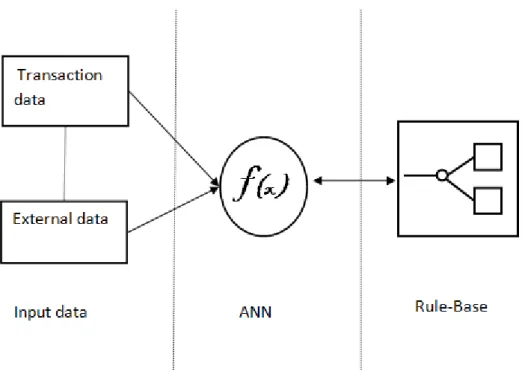
The Falcon Fraud Manager is one of the most widely used and most accurate fraud detection systems by banks worldwide according to a report released by its developers (FICO, 2011). Falcon is mainly used for payment card fraud detection and has real time detection capabilities (FICO, 2011). Falcon uses an anomaly detection technique by profiling cardholders’ transaction behaviours to spot uncharacteristic behaviour. A diagram of the Falcon’s architecture shows that the system has a Rule Base and a Neural Network as some of its main components (FICO, 2011). Figure 2-1 shows an abstracted version of the Falcon system showing the interaction between the neural network and the Rule-base.
- 21 -
Figure 2-1. Some of the Falcon s main components (FICO, 2011)
Like Falcon, the PRM is reported to be commercially successful and is used in over 40 countries including eight of the top 20 banks in the world (ACI Worldwide, 2011). PRM is a debit card, internet banking and credit card FD solution and is also reported to have real time transaction monitoring, helping to prevent loss of funds (ACI Worldwide, 2011). PRM employs both anomaly detection and signature detection methods; each transaction is compared with the custom fraud model and also with recorded behaviour patterns of account holders. In terms of architecture, neither of the two PRM white papers provide detail on the specific structure of the system, except that it combines an expert Rule Base with a Neural network (ACI Worldwide, 2011; IBM, 2008).
Reportedly used at 43000 sites, the SAS Fraud Management system is another commercial FD solution (SAS, 2007). A debit and credit card FD solution, the SAS Fraud management system also boasts real time detection capabilities. The SAS system uses an anomaly detection method. Users’ transaction patterns are profiled into unique ‘signatures’ and unexpected deviations from these signatures are reported to the system administrator (SAS, 2007). The system’s architecture includes a Rule Base and an ensemble of Self Organising Neural Networks (SONNA) (SAS, 2007).
The consistent use of Rule Bases and Neural Networks in all of these FD systems is unsurprising. One of the earliest FD systems used at the Mellon Bank in New York used a Neural Network (Ghosh & Reilly, 1994). Cardwatch, another of the early FD systems also
- 22 -
used a Neural Network to process current transaction patterns and detect possible frauds (Aleskerov, Freisleben, & Rao, 1997). A steady advocacy and report of widespread use of Rule Bases and Neural networks is also given by (Bolton & Hand, 2002; Kou Y. , Lu, Sirongwatana, & Huang, 2004; Phua, Lee, Smith, & Gayler, 2005; Weatherford, 2002). The next Chapter will take a closer look at Rule Bases and Neural Networks and analyse their strengths and weaknesses and when it is ideal to use each.
Other approaches suggested for use in Internet banking fraud detection and reported in academic forums include the use of a Hidden Markov Model (HMM), a hybrid model comprising One Class Classification (OCC) and a Rule-Base and ContrastMiner, another hybrid system consisting of neural networks, a contrast pattern mining module and a decision forest (wei, Li, & Cao, 2012; Mhamane & Lobo, 2012; Krivko, 2010). Although the publication on using HMM cites the success of a similar approach in a separate study, the publication provides no results and is more of a proposal and justification for using HMM (Mhamane & Lobo, 2012). Krivko (2010)’s hybrid approach is meant to bridge the individual limitations of supervised and unsupervised methods. The approach has two fraud detections levels; the OCC component sits on the first level and monitors changes in user behaviour and assigns a score based on the level of deviation to normal behaviour. In the second level is the rule-base filter which processes cases that have been passed from the first level. Cases that violate any of the rules are marked as suspicious. Wei et al (2012)’s approach also features a hybrid system including a contrast pattern miner, a neural network and a decision forest. Typical of hybrid systems, the system’s strength lies in leveraging a host of data mining models and is reportedly impressive in the skewed Internet banking data (Wei, Li, & Cao, 2012). The two hybrid systems Krivko (2010) and ContrastMiner were able to detect around 57% and 66% respectively of all frauds.
Traditionally, Intrusion Detection and Fraud Detection have been separate fields, addressing separate security needs. Most ID research has originally focused on preventing illicit use at network level and Operating System level (Patel, Qassim, & Wills, 2010; Kabiri & Ghorbani, 2005; Jones & Sielken, 2000). Conversely, FD research has also focused on detecting frauds at an application level (Bolton & Hand, 2002), (Kou, Lu, Sirwongwattana, & Huang, 2004). For example, some of the particular FD applications reviewed earlier sought to detect fraudulent behaviour in credit card systems, telecommunications systems and other specific applications (Kou, Lu, Sirwongwattana, & Huang, 2004; Phua, Lee, Smith, & Gayler, 2005). It is therefore fair to posit that there has not been much crossover between these two fields
- 23 -
although they rely on and apply the same principles. This is a view also held by (Kvarnstrom, Lundin, & Jonsson, 2000), who also suggest that merging FD and ID techniques may be a viable solution to protecting both networks and applications.
Other perspectives on Intrusion Detection and Fraud Detection are that most forms of intrusions are actually instances of fraud (Fawcett & Provost, 1997). In addition, Fawcett & Provost (1997) add their proposed FD framework can also be justifiably applied to ID. The Java Agents for Meta-Learning (JAM) project is a valuable substantiation of how FD techniques can be used and still be as efficient in ID applications (Stolfo S. , Fan, Lee, Prodromidi, & Chan, 2000). A possible hindrance to the escalation of FD-ID combinatory systems such as JAM is that the commercial market has established brands in each of these two fields so crossing into unfamiliar territory may not be justifiable in business terms. However, it is hoped that research will continue to inform on the methods, strategies and benefits of incorporating ID in FD systems or vice versa.
A host of varying mechanisms have been suggested to prevent fraud in online banking. One of the pivotal aspects of security in online banking according to Nilsson, Adams & Herd (2005) is trust. Nilsson, Adams & Herd (2005) assert that users’ perceived trust of an online banking system is of vital importance given the persistent threats of phishing and other risks. A recommendation by Nilsson, Adams & Herd (2005) is that a balance should be struck between the user’s trust of an online banking system, the actual security of the system and its usability.
An alternative perspective is that online banking websites should invest in browser security (Sood & Enbody, 2011). According to Sood & Enbody (2011), declarative security in Hyper Text Transfer Protocol (HTTP) response headers would be an additional defence mechanism and has been shown to reduce security flaws in online banking website. A 2007 paper by Mannan & Oorschot (2007) argued that the real issue in online banking is security and usability. It was reported that the security requirements for safe online banking were too difficult and unrealistic for average users and that there was a substantial difference between the banks’ expectation of their online customers and what the customers were actually doing in regards to online banking precautions (Mannan & Oorschot, 2007).