AUTOMATIC AGE ESTIMATION FROM
REAL-WORLD AND WILD FACE IMAGES BY USING DEEP
NEURAL NETWORKS
Zakariya Qawaqneh
Under the Supervision of Dr. Buket D. Barkana
DISSERTATION
SUBMITTED IN PARTIAL FULFILMENT OF THE REQUIREMENTS FOR THE DEGREE OF DOCTOR OF PHILOSOPHY IN COMPUTER SCIENCE
AND ENGINEERING THE SCHOOL OF ENGINEERING
UNIVERSITY OF BRIDGEPORT CONNECTICUT
iii
AUTOMATIC AGE ESTIMATION FROM REAL-WORLD
AND WILD FACE IMAGES BY USING DEEP NEURAL
NETWORKS
iv
AUTOMATIC AGE ESTIMATION FROM REAL-WORLD
AND WILD FACE IMAGES BY USING DEEP NEURAL
NETWORKS
ABSTRACT
Automatic age estimation from real-world and wild face images is a challenging task and has an increasing importance due to its wide range of applications in current and future lifestyles. As a result of increasing age specific human-computer interactions, it is expected that computerized systems should be capable of estimating the age from face images and respond accordingly. Over the past decade, many research studies have been conducted on automatic age estimation from face images.
In this research, new approaches for enhancing age classification of a person from face images based on deep neural networks (DNNs) are proposed. The work shows that pre-trained CNNs which were trained on large benchmarks for different purposes can be retrained and fine-tuned for age estimation from unconstrained face images. Furthermore, an algorithm to reduce the dimension of the output of the last convolutional layer in pre-trained CNNs to improve the performance is developed. Moreover, two new jointly fine-tuned DNNs frameworks are proposed. The first framework fine-tunes tow DNNs with two different feature sets based on the element-wise summation of their last hidden layer outputs. While the second framework fine-tunes two DNNs based on a new cost function.
v
For both frameworks, each has two DNNs, the first DNN is trained by using facial appearance features that are extracted by a well-trained model on face recognition, while the second DNN is trained on features that are based on the superpixels depth and their relationships.
Furthermore, a new method for selecting robust features based on the power of DNN and 21-norm is proposed. This method is mainly based on a new cost function
relating the DNN and the L21 norm in one unified framework. To learn and train this unified framework, the analysis and the proof for the convergence of the new objective function to solve minimization problem are studied. Finally, the performance of the proposed jointly fine-tuned networks and the proposed robust features are used to improve the age estimation from the facial images. The facial features concatenated with their corresponding robust features are fed to the first part of both networks and the superpixels features concatenated with their robust features are fed to the second part of the network.
Experimental results on a public database show the effectiveness of the proposed methods and achieved the state-of-art performance on a public database.
vi
ACKNOWLEDGEMENTS
Completion of this doctoral dissertation was possible with the support of several people. I would like to express my sincere gratitude to all of them. I would like to express my special appreciation and thanks to my advisorDr. Buket D. Barkana, she has been a tremendous mentor for me. I would like to thank her for encouraging my research and for allowing me to grow as a research scientist.
I would also like to thank my committee members, Dr. Navarun Gupta, Dr. Xingguo Xiong, Dr. Miad Faezipour, and Dr. Amalia Rusu for serving as my committee members even at hardship. I also want to thank you for letting my defense be an enjoyable moment, and for your brilliant comments and suggestions, thanks to you. I am grateful for Dr. Khaled Elleithy, the director of the Ph.D. program, for the academic support and the facilities provided to carry out the research work at the Institute.
Nobody has been more important to me in the pursuit of my Ph.D. degree than the members of my family. I owe everything good in my life to my parents, Mohammad and Aysheh, and for all of the sacrifices that they have made on my behalf. Your prayer for me was what sustained me thus far, your love and guidance are with me in whatever I pursue. Most importantly, I wish to thank my loving and supportive wife, Nayruz, and my two wonderful children, Raya, and Kenan, who provided unending inspiration. Words cannot express how grateful I am to my brothers and sisters, especially my brother Kamel, who has supported me more than I could ever give him credit for here.
A great warm word for my dear friend and fellow researcher Arafat Abu Mallouh, Arafat’s continuous support, deep discussions, and persuasive analytical thinking have
vii
enriched our research and always pushed our goals to maximum limits. Arafat was always there during the happy and hard times. For all these reasons and many, many more, I am eternally grateful. Thank you Arafat for making the long journey of pursuing our Ph.D. degrees bearable.
I would like to thank all the staff of the School of Engineering for their support that made my study in the University of Bridgeport a wonderful and exciting experience.
Above all, I owe it all to Almighty God for granting me the wisdom, health and strength to undertake this research task and enabling me to its completion.
viii
TABLE
OF
CONTENTS
ABSTRACT ... iv
ACKNOWLEDGEMENTS ... vi
TABLE OF CONTENTS ... viii
LIST OF TABLES ... x
LIST OF FIGURES ... xiii
ABBREVIATIONS ... xv
CHAPTER 1: INTRODUCTION ... 1
1.1 Main Facial Image Related Fields ... 2
1.1.1 Face recognition ... 3
1.1.1.1 Appearance-based Models: ... 4
1.1.1.2 Model-based: ... 4
1.1.2 Facial expression recognition... 5
1.1.3 Emotion recognition ... 5
1.1.4 Head pose and gaze recognition ... 6
1.1.5 Gender recognition ... 6
1.2 Motivation behind the Research ... 7
1.3 Main Contributions of the Proposed Research ... 9
CHAPTER 2: LITERATURE SURVEY ... 11
CHAPTER 3: PROPOSED FEATURE SET AND METHODS BASED ON DNN ... 21
3.1 Utilizing Pre-trained CNN Models for Feature Extraction and Classification ... 21
3.1.1 Efficient feature sets extraction and classification ... 21
3.1.1.1 Architecture for feature extraction and age classification ... 22
3.1.1.2 Training for age classification ... 25
3.1.1.3 Prediction for age classification ... 26
3.1.2 Improving the extracted feature sets by dimensionality reduction ... 27
3.2 Jointly Fine-Tuning DNNs Using Different Feature Sets for Age Classification ... 29
3.2.1 Jointly fine-tuning DNNs based on amplified feature sets ... 29
3.2.1.1 Pre-trained CNN Model-I ... 30
3.2.1.2 Pre-trained CNN Model-II ... 31
ix
3.2.2 A New proposed cost function for jointly fine-tuning two different DNNs for age
classification ... 34
3.2.2.1 Architecture of jointly fine-tuning two DNNs and the proposed loss function ... 35
3.2.2.2 Score level fusion ... 38
3.3 DNNs and 2,1 Norm Regularization for Robust Age Features Selection ... 39
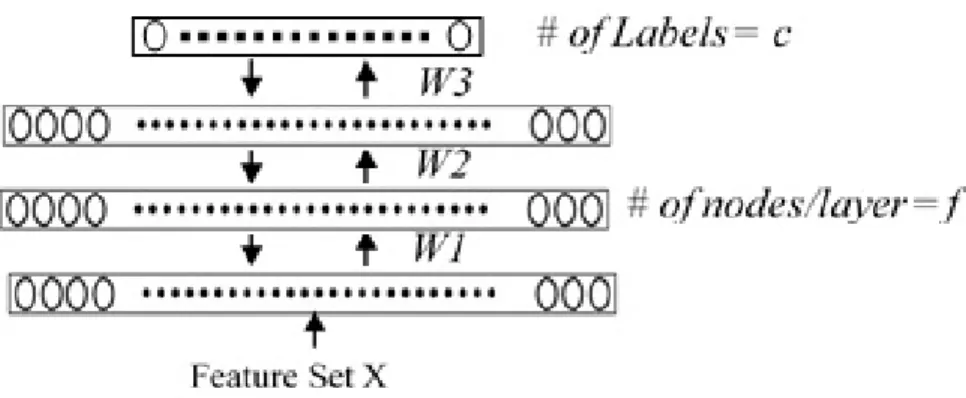
3.3.1 Learning ... 40
CHAPTER 4: EXPERIMENTAL SETTINGS AND DNNs CONFIGURATIONS ... 43
4.1 Benchmark ... 43
4.2 Settings for Jointly Fine-Tuning DNNs Based on Amplified Feature Sets ... 44
4.3 Settings and Configurations for Jointly Fine-Tuning DNNs Using the Proposed Cost Function ... 45
4.4 Robust Feature Selection Training Settings ... 45
CHAPTER 5: DISCUSSION AND EXPERIMENTAL RESULTS ... 47
5.1 Pre-trained CNN Models Feature Sets Classification Results ... 47
5.2 The Proposed Amplified Feature Sets Results and Discussion ... 51
5.3 The Classification Results of the Proposed Cost Function ... 54
5.4 Robust Features Selection Method Classification Results ... 56
5.5 Utilizing the New Cost Function and the Jointly Fine-Tuned Amplified Network Using the Proposed Robust Features ... 58
5.6 Comparisons with Previous Works ... 63
CHAPTER 6: CONCLUSIONS AND FUTURE WORK ... 66
x
LIST
OF
TABLES
Table 1 Network Architecture and Configuration 24
Table 2 Different CNNs Architectures 26
Table 3 The Adience Benchmark 44
Table 4 Network Settings for CNN-F and CNN-S 45
Table 5 Proposed Network Architectures and Settings 45 Table 6 Training Settings for Different DNN Networks 46 Table 7 Overall Accuracies of Different CNN Architectures (%) 47 Table 8 Confusion Matrix for The Fine-Tuning VGG-Face for
Age Estimation
48
Table 9 Overall Accuracies of Different CNN Models with Dimensionality Reduction
50
Table 10 Confusion Matrix for the Highest Accuracy Combined Models with Dimensionality Reduction
51
Table 11 Overall Classification Accuracies of the CNN-F, CNN-S, CNN-FS (%)
52
Table 12 Confusion Matrix for the CNN-F 53
Table 13 Confusion Matrix for the CNN-S 53
xi
Table 15 Overall Classification Accuracies for the Proposed Cost Function on Adience Database
55
Table 16 Confusion Matrix for DNN1 with Facial Features as Input
55
Table 17 Confusion Matrix for DNN2 with Depth Features Based on Superpixels and Their Relations as Input
55
Table 18 Confusion Matrix for Jointly Fine-Tuned Network with Facial and Depth Features as Input, by Using the New Proposed Cost Function
56
Table 19 Overall Classification Accuracies for Facial Robust Features on Adience Database
57
Table 20 Confusion Matrix for the Facial Robust Features 57 Table 21 Confusion Matrix for the Facial Features Concatenated
with their Robust Features
58
Table 22 Overall Classification Accuracies for Superpixels Robust Features on Adience Database
59
Table 23 Confusion Matrix for the Superpixels Robust Features 59 Table 24 Confusion Matrix for the Superpixels Features
Concatenated with their Robust Features
60
Table 25 Confusion Matrix for the Facial and Superpixels Features Concatenated with their Robust Features Using the Jointly Fine-Tuned Amplified Network
xii
Table 26 Confusion Matrix for the Facial and Superpixels Features Concatenated with their Robust Features Using the Proposed Cost Function
62
Table 27 Overall Classification Accuracies for Facial and Superpixels Robust Features Using the Proposed Cost Function and the Jointly Fine-Tuned Amplified Network on Adience Database
63
xiii
LIST
OF
FIGURES
Figure 1 Fine-Tuning Domain Specific Pre-Trained Model for Age Classification
24
Figure 2 Features Dimensionality Reduction 28
Figure 3 Extraction facial features by using a pre-trained model for face recognition
31
Figure 4 Extraction of superpixels and their relations by using a pre-trained model for depth
32
Figure 5 Jointly fine-tuning of two DNNs. CNN-FS uses facial and superpixels related features, the outputs of the last hidden layers of CNN-F and CNN-S, which are summed by element-wise
33
Figure 6 DNN1 and DNN2 architectures. (a) DNN1 with the first extracted feature set as input and with Softmax as output layer. (b) DNN2 with Second extracted feature set as input, and with Sigmoid as output layer
35
Figure 7 Architecture of the proposed Joint Fine-Tuned DNN1 and DNN2 with the proposed cost function
38
Figure 8 DNN Architecture for Finding the Projection Matrix W 40 Figure 9 Some of the challenging images classified correctly by
this work
xiv
Figure 10 Challenging images in the Adience database. Images in the top row were classified correctly by the proposed networks. Images in the bottom row were classified incorrectly by the proposed networks
54
Figure 11 Jointly Fine-Tuned Amplified Network with Facial and Superpixels with their Robust Features as Input
61
Figure 12 The Proposed Cost Function with Facial and Superpixels with their Robust Features as Input
xv
ABBREVIATIONS
AAM Active Appearance Model
AGES Aging Pattern Subspace
ANN Artificial Neural Network
BIF Bio-Inspired Features
CNN Convolutional Neural Network
CS Cumulative Score
DNN Deep Neural Network
HCI Human-Computer Interaction
ICA Independent Component Analysis
LBP Local Binary Patterns
LDA Linear Discriminant Analysis
LLE Local Linear Embedding
MAE Mean Absolute Error
MSE Mean Squared Error
PCA Principle Component Analysis
1
CHAPTER
1:
INTRODUCTION
The human face contains various information such as age, gender, emotional state, pose, and ethnic background. Such information could be extracted and used in entertainment, cosmetology, biometrics, human-computer interaction (HCI), security control, and surveillance monitoring applications. Recent developments in computer technology have a direct impact on the growth of the image processing techniques while enriching the applications in computer vision and graphics fields further. One of the most popular research fields which have gained attention over the years is the automatic estimation of age information from facial images. Age estimation is defined as determining the exact age or the age range of a person using 2D facial images [1, 2]. Age classification from facial image consists of two main parts. The first part is the prepossessing and the feature extraction. While the second part is the classification process. In the first part, some techniques are applied for processing the image from many challenges such as low-resolutions, various expressions, and occlusions. Then features are extracted from the images. These extracted features are fed for a classifier and it is trained to find a pattern for each age class to distinguish the classes from each other. The global spreading of the internet, smart phones, and social media application created a relatively new market of online services that depends on facial biometrics for performing a wide variety of services. The later imposed an urgent need for accurate and trust worthy applications that can extract and classify the required biometric. Currently, most of the captured facial images are described as unconstrained, there are no prior conditions on the place, illumination, background, or the pose. The challenge here is to find a distinguished feature set and an
2
efficient classifier that both can perform a recognition task from such variant and unconstrained images. Age classification based on facial images has several applications in different domains and it is also expected to involve more applications in the near future. The importance of having reliable age classification systems is related to the type of application attached to the task. For example, determining the type and dose of a medicine depends on the age of the patient, as a result, if the age of the patient is to be estimated using a computerized system then an accurate and reliable age classification system is a must.
In this research, in order to enhance the age classification from the facial images, it is planned to extract several distinctive feature sets that contains more age-related information. A DNN classifier is used since it is nowadays one of the most successful that achieved the state of the art of several classification and estimation fields. It is aimed to enhance the classification processes by introducing different architectures and ways.
1.1 Main Facial Image Related Fields
Recently finding a semantic information from images has increased and has gained the attention of the research studies due to the huge number of images which are added daily on the internet or being stored on personal phones and computers. To extract such semantic information efficiently and automatically, these images should be analyzed and indexed in very organized method using different machine learning techniques. Especially facial images contain various valuable semantic information about the human being. This information might be used in different fields such as face recognition, facial expression
3
recognition, emotion recognition, head pose and gaze recognition, and age and gender recognition.
1.1.1 Face recognition
Over the last decade face recognition has received substantial attention in diverse image analyses fields such as in biometrics [3-4], computer vision [5], pattern recognition [6-8], and computer graphics [9-10]. As well as, nowadays face recognition technique is used in several of forensic, security and commercial real applications. Face recognition consists of two main subfields: Face verification and face identification.
• Face verification: verification system tries to verify the identity of the claimed
person or the claimed biometric of the person. In other words, the system tries to answer the question "Am I who I say I am?" for Several algorithms and techniques have been proposed. Several studied have been conducted for face verification as in [11-13].
• Face identification: In face identification, the system tries to identify unknown
person or unknown biometric. Therefore, the system tries to answer the question "Who am I?". Several studied have been conducted for face identification as in [14-16].
Several methods have been developed and introduced for face recognition these methods can be categorized into appearance based models and model based model.
4
1.1.1.1 Appearance-based Models:
In appearance model the face image is recognized as high dimensional vectors of features. These vectors are used to drive and efficient and effective representation for the image in the vector space. In testing phase, the similarity between the stored model for each face and the test face image is found in the feature space. Appearance models proposed to represent the face image are classified into two main categories:
• Linear models: Typically, all these models statically try to represent each image
vectors with several coefficients by projecting these vectors to the basis vectors. Several techniques have been proposed for linearly analyses the face images such as PCA [17], ICA [18], and LDA [19-20].
• Non-Linear (manifold) models: Linear models are considered as a simple
approximation of the non-linear models; therefore, the manifold models are more complicated than the linear models. In non-linear models, a nonlinear mapping from the input space is derived to find the most significant feature into the feature space. In the past, several methods have been proposed such as kernel-PCA [21], ISOMAP [22], and LLE [23]. Recently deep learning is widely used as non-linear model for face recognition. Several algorithms based on deep learning have been proposed such as in [24-29].
1.1.1.2 Model-based:
This model tries to construct a model for each face that capture the facial variations from the available facial images for each person. Model based proposed to represent the face image are classified into two main categories:
5
• 2D models: One of the most famous model 2D model is active appearance model
(AAM). AAM model combined a representation of a statistical model of the face shape and the gray level appearance of the face.
• 3D models: In 3D space, the model is built with care of different facial variations
such as pose and illumination, therefore, representing the facial image based on the 3D technique is more efficient and better than representing the face as 2D model. For face recognition, a 3D model that represent the shape and the texture in terms of model parameters is used and separated from the extrinsic model parameters of the face such as pose and illumination.
1.1.2 Facial expression recognition
This field studies the changes in facial expressions that results from different factors such as intentions, communication, and emotional state [30-31]. Facial images are the main source for recognizing the changes in the facial expressions by using an automated. Facial expression recognition has a wide range of possible applications, for example, clinical psychology, lie detection, HCI, and pain assessment. In the literature, different studies have been carried out for developing new techniques for better facial expression recognition as in [32-37].
1.1.3 Emotion recognition
Emotion recognition needs higher level of information than facial expression recognition and it plays a major role in human-human and human-machine communication [38]. An efficient emotion recognition system should be able to differentiate between different facial expressions to classify them into different categories of emotions. The
6
emotion categories vary from simple ones like happy and sad to complicated ones such as guilty, worried, and bored. This field have many challenges resulted from the quality of the input facial images and the cultural background of the subjects [39]. HCI is one of the major applications that depends on a successful facial emotion recognition system. Many studies explored this field with different degrees of success as in [40-45].
1.1.4 Head pose and gaze recognition
This part is a major field used in HCI where both information about the pose of the head and the eye gaze are used to determine the subject's point of attention accurately [46-48]. Being able to estimate the head pose is considered to be an important step before performing other tasks such as face detection and recognition. Another important application where head pose and eye gaze are considered as a necessary pre-step is the 3D modeling of facial pictures. The accurate estimation of the head pose and eye gaze has a major effect on the resulted 3D model. Currently, new methods for recognizing the head pose and eyes are being utilized for new trends in HCI and in the widely used smart phones market [49-53].
1.1.5 Gender recognition
Recognizing the gender of a human from a 2D image has different applications. It has been studied earlier in the last two decades and continued to be the focus of many research groups due to the rapid development and spread of communication devices such as smart phones and smart TVs. The new smart phones are equipped with accurate cameras which allowed the users to capture images almost everywhere and on any time. There are several applications for automatic gender recognition such as visual surveillance, smart
7
marketing systems, and security control [54-55]. In the literature, two types of images were used for gender recognition, constrained images and unconstrained images. Constrained images are captured under controlled environments where the pose and the illumination are controlled before capturing the image. While unconstrained images are captured in variant and uncontrolled environments. Clearly, unconstrained images are more challenging for gender recognition. Different features were used for performing successful gender recognition, for example, raw pixels, Haar-like features, LBP features, and fragment-based filter banks [56-59]. Many methods were used for achieving reliable and accurate gender recognition such as Anthropometric Models and appearance models, and recently, deep neural networks methods have shown remarkable results [60-63].
1.2 Motivation behind the Research
The classification of age from 2D images gains importance in many present and future applications including education, criminal cases, advertisement, phone ads, merchandise, controlled media access, statistics of population, electronic health applications, information forensics and security [64] and more. At present, age appropriate education, ads, and merchandises can be offered to users [65]. Media content can be made available based on the user’s age [66]. Research in artificial intelligence is rapidly developing. In near future, a computerized system called robot doctors may determine the correct dose of medicine for a patient depending on his/her age. Smart robots may select the right age appropriate attitude and language while socializing with humans. There are several challenges in age estimation. One of the main challenges is that people do age at variable rates that are affected by factors such as, genetic factors, social conditions, and
8
life style. Some people can look years younger than their chronological age while some can look years older. Another challenge is the dissimilarity between aging rates of men and women. Wearing makeup and accessories either to look younger or to hide aging marks is another challenge [67]. Age classification from facial images is still an open research area. Although, there are some researches have been conducted to enhance the age and gender from facial images, they did not achieve good accuracy results especially for the age from unconstrained facial images.
With these challenges are in mind, in this research it is aimed to find and extract more distinctive features that contains information related for the person age from unconstrained 2D images based on CNNs and DNNs while utilizing different DNNs architecture for improving the classification processes for age classification from facial images problem. Recently, CNNs and CNNS have shown remarkable performance in various computer vision fields, such as object recognition, face detection, and human pose estimation.
Existing benchmarks for age classifications are relatively small compared to the benchmarks used in face recognition. Training a deep neural architecture using a small benchmark is problematic since training a very deep CNN architecture on a relatively small benchmark is liable to a critical overfitting. Therefore, deep CNN architectures that are trained for other classification tasks such as image classification, semantic segmentation, and face recognition on large benchmarks are employed. Then the experimental results are analyzed about how these pre-trained models can be used to find more representative features and how they can be adapted and fine-tuned to estimate the age of a subject from an unconstrained 2D image.
9
1.3 Main Contributions of the Proposed Research
The focus of this research is to enhance age classification based on unconstrained 2D images. To achieve this goal, this research addresses the problem from different angels as follows:
• Finding a distinctive feature set that contains specific and accurate information
about the subject’s age depending only on the available 2D images of the subject. It is proposed to use pre-trained CNNs for different task on large benchmarks to extract facial features that will perform well for age estimation successfully and it is shown show that features extracted from pre-trained models for domain specific tasks can be successfully used to improve the age classification task.
• We find a new feature set based on the superpixels depth and their relation. The
image will be divided into a number of small regions called superpixels where each superpixel represents a group of pixels. It is assumed that the depth contains age-related information.
• To enhance the classification process, it is proposed to jointly fine-tune two DNNs
with different feature sets. The first DNN is trained by using the first feature set. The second DNN is trained by the second feature set. Then, their last hidden layer outputs are element-wise summed to be trained and fine-tuned jointly.
• Developing a new cost function that can calculates the error during the training
process for a big number of examples, on condition that, the learning process will be optimized and converge with lesser overfitting effect.
10
• Introducing a new architecture for the classification process that jointly fine-tuned
two different DNN architectures based on the new proposed cost function and feature sets.
• Selecting robust feature set for age classification based on the power of l2,1-norm
11
CHAPTER
2:
LITERATURE
SURVEY
Over the last ten years, many studies have been carried out on the age estimation from real-world and wild facial images. In this section, existing benchmarks are presented and a brief review of the most significant and milestone works is given with regard to feature extraction and classification methods.
Kwon and da Vitoria Lobo [68] carried out one of the earliest works in age estimation by using facial images. Cranio- facial changes in feature-position ratios and skin wrinkles were used as features for three age groups (baby, young adult, and senior adult). Facial features were detected and their ratios were computed. Skin wrinkle analysis was performed. This early work in 1994 has shown that computing ratios and detecting the presence of wrinkles can yield the age from facial images. The same year, Farkas [69] presented a mathematical model to estimate the growth of a person's head from infancy to adulthood. This model was used to estimate the age of a person from a facial image. The drawback of this model is that the performance of the age estimation degrades for adults by using models which are built by using 2D images. One of the earliest research works in age estimation is based on face anthropometry. Face anthropometry is a science that deals with measuring sizes and proportions on human face. In general, the estimation of age from facial images using anthropometry model is limited to young ages. The shape of the human head does not change significantly in the adult years. Moreover, the ratio of distances for face geometry is calculated using 2D images but 2D images are sensitive to head pose. As a result, frontal face images are the only images that can be used to measure geometry of
12
the face. Therefore, anthropometry is not suitable for age estimation by using real-world and wild facial images.
Other approaches have been proposed based on the facial features (appearance model or face descriptor). Local and global facial features were extracted [70-71]. Texture and shape features were calculated by using a semantic-level description of the face to describe facial features. They also built a classification system to estimate different age groups with five year intervals. Their system was tested on a Japanese database of 500 subjects aging from 15 to 64 years old. Moreover, gender estimation was done to improve the performance of the age estimation. Since women and men have different aging rates, the inclusion of gender estimation enhanced the age estimation.
Ramanthan and Chellappa [72] worked on age progression in young face images and computed eight ratios of distance measures for modeling age progression. They proposed a craniofacial growth model by illustrating how the age-based anthropometric constraints on facial proportions translate into linear and non-linear constraints on facial growth parameters and proposed methods to compute the optimal growth parameters. The purpose of their work was to predict one’s appearance across the years and to perform face recognition. Anthropometrical changes of human face and its size, shape, and textural patterns may adequate to estimate an individual’s age up to the adult years.
Lanitis et al. [73] studied the aging effects on face images and described how the effects of aging on facial appearance can be explained. They built a statistical-based face model. By the proposed shape intensity face model and automatic age simulation,
13
statistically significant improvement in the performance of the age classification system was reported.
Geng et al. [74-75] modeled the aging pattern as the sequence of an individual’s face images sorted in time order by constructing a representative subspace. The AGES model built an aging pattern for different age stages. In case, the images of some ages were not available, they were synthesized by using EM-like iterative learning algorithm. The AGES was evaluated on the FG-NET database with a mean absolute error of 6.77 years. They reported that the performance of the model was significantly better than the existing age estimation methods in 2007 and was comparable to that of the human observers. One of the limitations of AGES approach is that it assumes the availability of images representing the different ages of an individual. If images for different ages are not available, AGES assumes that there is an age pattern similar to the input image. AGES approach utilizes the AAM to calculate the face representation to encode the wrinkles of the face. AAM only encodes the image intensities which cannot describe the local texture information. Local texture information is important to represent the wrinkles of elderly people.
Manifold analysis is used and proved to be promising in age estimation from face images by several studies [76-78]. An age estimation framework was proposed by Fu et al. [76] using manifold analysis and learning methods to find a sufficient low-dimensional embedding space. Manifold data points were modeled with a multiple linear regression function. Age manifold model is more flexible than AGES, since images could be built using different person’s images for unavailable images of some ages. Age manifold built the common aging pattern using the manifold embedding technique to learn the low
14
dimensional aging trend from a group of face images for each age. Scherbaum et al. [77] also proposed a statistical age estimation method using manifold learning over a 3D morphable model.
Gunay and Nabiyev [79] used effective texture descriptor for appearance feature extraction and utilized LBP in automatic age estimation system. Using the nearest neighbor classification, their system achieved 80% accuracy on the FERET database. By using AdaBoost, they achieved 80-90% of accuracy on the FERET and PIE databases. Gao and Ai [80] used the Gabor feature with fuzzy-LDA for age estimation. Their work showed that Gabor feature is more effective than LBP. Yan et al. [81-82] employed SFP to be the feature descriptor in order to handle images with small undesirable defects such as occlusions and head pose. They achieved MAE accuracy of 4.94 years on the FG-NET database. Sparse feature design, graphical facial features topology, geometry, and configuration, were proposed and age estimated based on the multiresolution hierarchical face model by ANN [83]. This system achieved MAE of 5.974 years on the FG-NET database. In [84], Mu et al. proposed BIF for age estimation. The bio-inspired features have the ability to handle small rotations and scale changes effectively. By using the BIF with an SVM classifier, their work achieved MAE of 4.77 years on the FG-NET database. In [85], two feature sets, BIF and the age manifold were used. By using an SVM classifier, the system achieved MAEs of 2.61 and 2.58 years for female and male on the YGA database, respectively.
Literature has developed over time to enhance the performance of age estimation from face images. Naturally, each method tried to overcome the limitations of the previous methods by widening the range of domains. All the previously mentioned methods showed
15
conditional significant performance where the used databases were either small on size or constrained to specific kind of images such as frontal and aligned pose images. On the other hand, the proposed work is applied on a larger database with unconstraint face images.
In [86], age estimation on real-life faces acquired in unconstrained conditions was studied. The LBP and Gabor features were exploited as face representation. Adaboost was used to learn the discriminative LBP-Histogram bins for age estimation. They achieved 55.9% of accuracy on the Group Photos benchmark by an SVM classifier. Alnajar et al. [87] adopted a learning-based encoding method for age estimation under unconstrained imaging conditions. Multiple codebooks for individual face patches were extracted and learnt. The orientation histogram of local gradients as the feature vector for code learning was used. An unconstrained database Group Photos benchmark which contains 2744 images was used and they achieved an absolute improvement of 3.6% over the study in [86] on the same database.
In [88] they proposed a framework for estimating the age, gender, and ethnicity jointly. They investigated different techniques for achieving better results. They utilized the linear and nonlinear canonical correlation analysis and the partial least squares models using their joint framework. Their analysis was conducted based on the rank theory. They showed that the bio inspired features could be used to represent the face image for the three labels, age, gender, and ethnicity. They evaluated their work on the MORPH database, for age estimation they achieved 3.98 MAE using regularized kernel canonical correlation analysis. When the support vector machine or support vector regression are used for
16
classification with the features extracted by canonical correlation analysis and partial least squares the MAE on MORPH dataset is decreased to 3.92.
In [89] they proposed a cost sensitive local binary feature learning for age estimation using facial images. They reported that their method represents the face from image pixels using discriminative local features. In their work, from the face patches they extracted low-dimensional binary codes from the raw pixels using several hashing functions. Also, real valued histogram features were calculated from the binary codes to represent the face. In addition, to learn the hashing functions jointly they proposed a cost sensitive local binary multi feature learning. For evaluation, they tested their work on FG-NET, MORPH, LifeSpan, and FACES datasets. They achieved 4.36 MAE on FG-FG-NET, 4.37 MAE on MORPH, 5.26 MAE on LIFESPAN neutral faces, and 4.84 MAE on FACES neutral faces. The advantage of their work is the ability to learn the features directly from the raw data, also they stated that using the binary information is better because it is not affected with local variations.
Recently, new benchmarks have been designed for the task of age estimation from face images. These new benchmarks are more challenging than the previous benchmarks in terms of quantity and quality. The size of the new benchmarks is much larger and most importantly the quality of the included images is categorized as unconstrained. The unconstrained images reflect the real world wild environments and are collected from online image repositories. The Group Photos [66] and the Adience benchmarks [64] are examples of these new benchmarks. Currently, the Adience benchmark is considered to be the newest and the most challenging benchmark for age and gender estimation from face images.
17
Recently CNNs and DNNs have been started to use for age estimation from face images. In [67], a simple CNN architecture was used as a feature extractor and a classifier to avoid overfitting problem. They evaluated their work on the Adience benchmark and achieved 50.7% overall accuracy. [90-91] proposed new systems for age regression based on facial identification features by using a relatively small deep CNN model. Both works used the same face identification model in [92] for feature extraction. In [90], a cascaded classification and regression system based on a coarse age classifier has been proposed. They introduced an age regressor for each age group based on the features extracted from the coarse age classifier. Then they used an error correcting method for correcting the regression error for subjects. [91] proposed a system that the features were extracted from a pre-trained CNN for face identification. The extracted features were fed to a small neural network to regress the age of the subject.
[93] proposed two approaches for age estimation, the first approach is the fusion of descriptors based on texture and local appearance. In this approach, they combined well-known local descriptors that can capture texture and contour cues, they reported that using texture and contour cues together enhanced the performance of age estimation better than using each feature alone. They used the histograms of oriented gradients, the local binary patterns, and the speed-up robust features as descriptors. For classification, they used and modified the canonical correlation analysis to find the optimal weights between the data and their labels. The second approach is a deep learning scheme for accurate age estimation. They used convolutional and pooling layers followed by fully connected layers to globally interrelate features. To evaluate their ideas, they tested their work on the MORPH and FRGC databases, where the mean average error and the CS metrics were used
18
for measuring the performance. Using their first approach, the best results for the MORPH database was 4.25 MAE and 71.2% CS. For the FRGC database, the best results were 4.17 MAE and 76.2% CS. They achieved 3.88 MAE on the MORPH database and 3.31 MAE on the FRGC by using their second approach.
[94] proposed a generic deep network model for automatic age estimation. Their model extracts facial features using a convolutional scattering network, then the dimension of these features is reduced using PCA. They reported that the scattering features are discriminative and invariant translations. The last step is to estimate the age using three fully connected layers that act as category-wise rankers. They used the rank value to investigate the relation between the age labels, also the category rankers estimate age within the class. For evaluation, they tested their work on the MORPH, Lifespan, and FACES datasets. The results were 3.49, 5.19, and 7.04 MAEs respectively.
In [95] a CNN is used to estimate the age from the image. In this work, local aligned patches were extracted using several facial landmarks and each patch feed to different CNN. For each face image, 21 facial landmarks were extracted. Then the landmarks are grouped to 13 pairs. 48 x 48 patches were cropped in 4 scales. In total 23 paths pairs were extracted. Then for age estimation, each patch of the 23 patches was trained in separate DNN to learn each patch features. After training the 23 DNNs, their final fully connected layer outputs were fused to estimate the age of the person. For evaluation of the proposed work MORPH Album 2 was used. And they reported an average of 3.63 MAE.
[96] proposed two methods for age estimation. In the first methods, a distribution-base loss function using CNN was introduced. They stated that the usage of distributions
19
as labels is better than age labels for training since the distributions can utilize the uncertainty of the manual labeling. They used two CNN architectures where the first CNN was the VGG-16 and it was fine-tuned three times using different datasets, and the second CNN was trained using different types of input data. After that, the two CNNs are fused using the ChaLearn database. The KL divergence loss function was used as a distribution-based function to exploit the uncertainty, also they used the softmax loss function. For fusion, they used the distance-based voting ensemble method to predict the age from concatenated feature resulted from tuning and training over different datasets. In the second method, they proposed a new CNN to be trained on a different type of inputs such as: 1) RGB color-space of the aligned face image, 2) Image gradient magnitude and orientation using the gray-level, 3) The HSV color-space images, and then fine-tuned on the Chalearn data set. For training and testing, they used the ChaLearn data set and a collection of images from different data sources such as MORPH, Google image search, FG-NET, and Adience. They achieved 0.305 MAE over the ChaLearn test set.
In [97] AgeNet was proposed to estimate the age apparent for the ChaLearn 2015 Apparent Age database. Two different CNN models were trained and fused to estimate the apparent age. The first kind models are based on real-value regression models, while the second kind models are classification models based on a Gaussian label distribution. Both models used features extracted from pre-trained models for face identification. To reduce the risk of over-fitting, the AgeNet is pre-trained on large database for face identification, since the age is estimated from face images it is expected that the feature extracted for face identification is correlated to the age estimation problem. The CASIAWebFace is used to train the AgenNet for face identification. After that the AgeNet was pre-trained to estimate
20
a real age from a face images using 3 different databases, including CACS, Morph-II and WebFaceAge. Then the AgeNet was fine-tuned to be trained on the training set of the ChaLearn 2015 Apparent Age database for evaluation and test. The AgeNet was achieved 3.3345 MAE for the apparent age on the Chalearn 2015 database.
[98] Introduced the IMDB-WIKI dataset which is one of the largest datasets with labeled age and gender images. Also, they proposed to solve the real and apparent age estimation problem based on deep learned models from large data, robust face alignment, and expected value refinement after formulation of age regression value. For the face alignment, they proposed a new technique that depends on the rotating the image over different angels and then running the face detector on the original and rotated images to select the image with the highest detection score. The pre-trained CNN was trained for age classification for the training data set, where the age values are distributed into ranges of age. Each range covered continuous values of ages. In the test phase, the expected value over the softmax-normalized output probabilities of the age ranges was computed to represent the estimated age for the input image. For evaluation, they tested their work on different datasets such as, ChaLearn, MORPH, FG-NET. The best result achieved for testing over ChaLearn dataset for apparent age was 3.252. For real age estimation, the proposed work was tested over MORPH and FG-NET datasets. The results were 2.68 MAE on the MORH and 3.09 on the FG-NET.
21
CHAPTER
3:
PROPOSED
FEATURE
SET
AND
METHODS
BASED
ON
DNN
This section describes our strategies and methods which are proposed to enhance the age classification problem. Several approaches have been proposed and analyzed. The potential problems for each method have been discussed and alternative strategies for solving the problems have been introduced. The rest of this chapter is organized as following: Section 5.1 explains our proposed method for utilizing pre-trained CNN models for feature extraction and classification. Section 5.2 introduces the proposed Jointly Fine-Tuning DNNs using different feature sets for age classification.
3.1 Utilizing Pre-trained CNN Models for Feature Extraction and
Classification
3.1.1 Efficient feature sets extraction and classification
Motivated by the success of CNNs architectures in different fields, CNNs are used as feature extractors for automatic age estimation. Existing benchmarks for age classifications are relatively small compared to the benchmarks used for other classification tasks such as image classification, semantic segmentation, and face recognition on large benchmarks. Training a deep neural architecture using a small benchmark is problematic since training a very deep CNN architecture on a relatively small benchmark is liable to a critical overfitting. To overcome this problem, deep CNN architectures that are trained for other classification tasks are employed. Then, these architectures are adapted and
fine-22
tuned to estimate the age of a subject from an unconstrained 2D image. The idea here is to take advantage of a large database and the deep architecture of the network, which is designed on a large database. Deep network architectures trained on large databases are capable to extract distinctive and robust features and they are less prone to overfitting. Building deep network architecture for age estimation on small databases is expected to have poor performance.
3.1.1.1 Architecture for feature extraction and age classification
In this section, our proposed architecture for fine-tuning pre-trained models for age classification will be explained by using a model trained for face recognition task as an example. Using an efficient facial feature extractor is expected to perform well for age estimation. However, a trained face recognition model that was trained on a large database may extract facial features more efficiently than training a new model on a small database. The idea here is to train a deep network to study facial features from image and then retrain and fine-tune this network to estimate the age information.
In this work, the CNN architecture proposed by [99] is considered. It achieved comparable results to the state-of-the-art for face recognition task (VGG-Face). In [99], three CNN architectures named A, B, and C were used. The architecture A is used. Details of the large database and the configuration of the architecture A can be found in [99]. The architecture A consists of eight convolutional layers and three fully connected layers. A rectification operator is used after each convolutional operator. A max pool operator is added at the end of each convolutional layer. 4096-dimensional output is used for the first two fully connected layers. Dropout with p= 0.5 and rectification operator are applied to
23
the first two layers. N-way class prediction is used for optimizing the network parameters. Therefore, the output size of the last layer is chosen to be 2622, which represents the number of subjects in the large database.
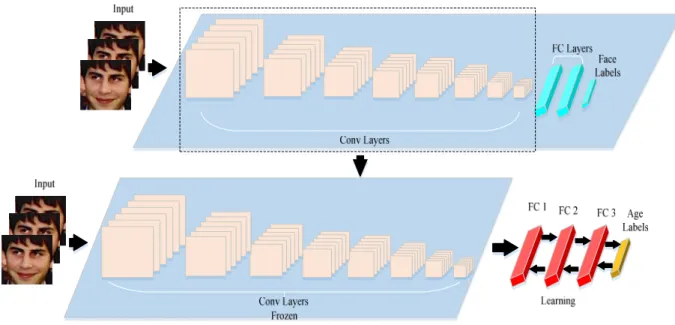
Here, the convolutional layers of the CNN VGG-Face are reused, while the fully connected layers are replaced with new layers. The modification of the CNN is performed by removing the fully connected layers and replacing them with four new fully connected layers of different sizes as shown in Figure 1. The sizes of the first three fully connected layers are chosen as 4096, 5000, and 5000, respectively. Each of which is followed by two manipulation layers, one dropout layer, and one normalization layer. The last fully connected layer is a softmax layer with a size of 8, which represents the number of labels in the Adience database. Each label represents an age range. The probability of each label is used to estimate the age of corresponding face image. The eight convolutional layers which were used during the training for face recognition task are reused in the modified CNN as shown in Figure 1.
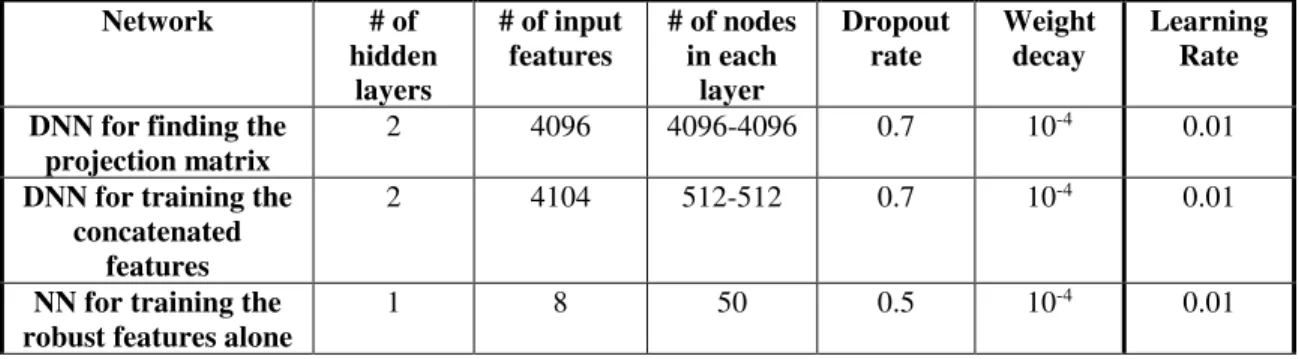
The details of the proposed network architecture and configuration are given in Table 1. The weights between the new layers are initialized by a Gaussian distribution with zero mean and 10-2 standard deviation. The new network is trained only for the newly added fully connected layers while keeping the original convolutional layers frozen during the training. This approach appears to be very fast since only the newly added fully connected layers are trained.
24
Figure 1. Fine-tuning domain specific pre-trained model for age classification.
Table 1. Network architecture and configuration. For each convolutional layer, number of filters, the filter size, their receptive field convolution stride, and spatial padding are indicated.
layer 0 1 2 3 4 5 6 7 8 9 10 11 12 13 14
type Input Conv Relu norm mpool conv Relu norm mpool conv Relu Conv relu conv Relu
name n/a conv1 relu1 norm1 pool1 conv2 relu2 norm2 pool2 conv 3
relu3 conv4 relu4 conv5 relu3_2
suppor t
n/a 3 1 3 1 2 3 1 3 1 2 3 1 3 1
filt dim
n/a 3 n/a 64 n/a n/a 64 n/a 128 n/a n/a 128 n/a 256 n/a
num filts
n/a 64 n/a 64 n/a n/a 128 n/a 128 n/a n/a 256 n/a 256 n/a
stride n/a 1 1 1 1 2 1 1 1 1 2 1 1 1 1
pad n/a 1 0 1 0 0 1 0 1 0 0 1 0 1 0
layer 15 16 17 18 19 20 21 22 23 24 25 26 27 28 29
type conv Relu Mpoo l
conv relu conv Relu conv relu mpoo l
Conv Relu conv relu Conv
name conv3_ 3 relu3_ 3 pool3 conv4_ 1 relu4_ 1 conv4_ 2 relu4_ 2 conv4_ 3 relu4_ 3 pool4 conv5_ 1 relu5_ 1 conv5_ 2 relu5_ 2 conv5_ 3 suppor t 3 1 2 3 1 3 1 3 1 2 3 1 3 1 3 filt dim
256 n/a n/a 256 n/a 512 n/a 512 n/a n/a 512 n/a 512 n/a 512
num filts
256 n/a n/a 512 n/a 512 n/a 512 n/a n/a 512 n/a 512 n/a 512
stride 1 1 2 1 1 1 1 1 1 2 1 1 1 1 1
pad 1 0 0 1 0 1 0 1 0 0 1 0 1 0 1
layer 30 31 32 33 34 35 36 37 38 39 40 41 42
type relu Mpool Conv relu dropou t
conv Relu dropout conv relu Dropou t
Conv softmx
name relu5_3 pool5 fc6 relu6 drop6 fc7 relu7 drop7 fc8 relu8 drop8 fc8 prob
suppor t
1 2 7 1 1 1 1 1 1 1 1 1 1
filt dim
n/a n/a 512 n/a n/a 4096 n/a n/a 5000 n/a n/a 5000 n/a
num filts
n/a n/a 4096 n/a n/a 5000 n/a n/a 5000 n/a n/a 8 n/a
stride 1 2 1 1 1 1 1 1 1 1 1 1 1
25
3.1.1.2 Training for age classification
The stochastic gradient descent algorithm is used to train the modified CNN in order to find the optimal parameters which will enable the network to achieve better classification accuracies. 224x224 pixel scaled images are used. The output of each layer is forwarded to the next layer as an input until the softmax layer calculates the probability of each label. The learning is performed only on the fully connected layers. It means that the parameters of the convolutional layers are frozen, while the parameters of the fully connected layers are allowed to be changed. It is shown in Figure 1. Freezing the training on the convolutional layers ensures that the process of extracting facial features is unchanged. The learning rate is set initially to 0.1 and then decreased by a factor of 10 if there is no improvement in the validation set learning. The dropout value is chosen as 0.6. It is observed that using a weight decay together with dropout technique have a positive effect on the classification accuracies [100]. The weight decay is normally set to 10-4 or 10 -5. The later value has worked fine for the modified network but increasing the value to 10 -3 has provided a higher overall accuracy. It is being said, deploying dropout technique together with the weight decay as regularizers has no negative effects on the training of the fully connected layers. On the contrary, increasing the value of the weight decay to 10-3 enhances the learning process and the accuracies. Since the convolutional layers are trained previously and training occurs only on the newly added fully connected layers, the weight decay value is increased with an increased network performance. The modified network has faster convergence as it only trains the fully connected layers as oppose to train all layers in the original CNN.
26
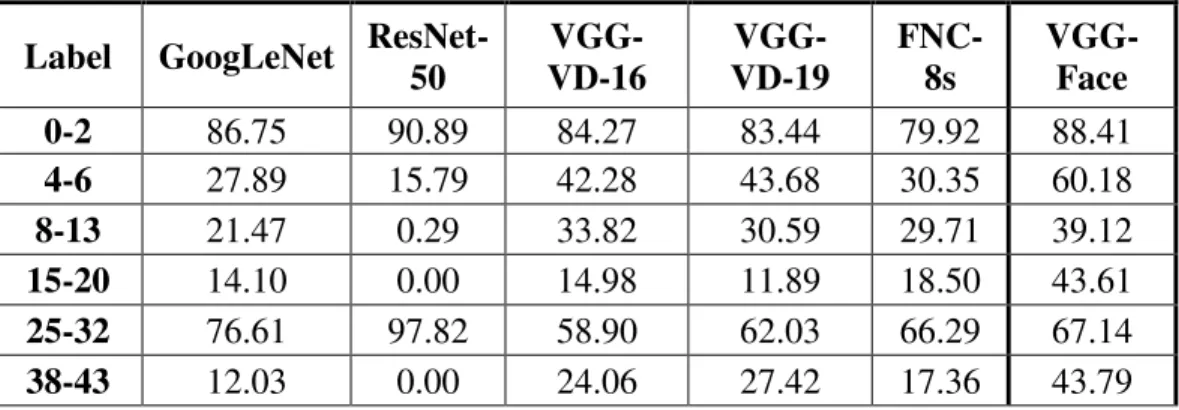
We will utilize five more pre-trained models to extract face-related features. Same training and fine-tuning procedure that were applied on the VGG-Face model will be applied on the five models. These models are retrained, fine-tuned and tested for age classification. The architecture of the fully connected layers used for each CNN is summarized in Table 2. CNNs are architected and fine-tuned to predict the age by changing the fully connected layers and their number nodes. Then, each network is trained and fine-tuned while the convolutional layers are kept frozen during the training as explained earlier.
Table 2. Different CNNs architectures.
Network # of fully connected layers # of nodes/layer
GoogLeNet 4 1024, 2048, 2048, 8
ResNet-50 4 2048, 5000, 5000, 8
VGG-VD-16 4 4096, 6000, 6000, 8
VGG-VD-19 4 4096, 6000, 6000, 8
FNC-8s 4 4096, 5000, 5000, 8
The five models are: GoogLeNet [101] and ResNet-50 [102] architectures which performed exceptionally well in ImageNet ILSVRC14; the VGG-VD [103] models with 16 and 19 layers, trained on ImageNet ILSVRC for image classification; and FNC-8s [104] trained for semantic segmentation.
3.1.1.3 Prediction for age classification
A given test image is rescaled to 256 x 256, and then three images of 224 x 224 pixels are extracted. The first image is extracted from the center of the original image. The
27
second and the third images are cropped from the upper-right and the bottom-left corners of the original image, respectively. Then, the trained network is applied densely on the three images. The softmax probability score vectors of the three images are averaged to obtain a final vector of class scores for the original test image from the three images. This method reduces the impact of the challenges such as low-resolutions, various expressions, and occlusions in the database.
3.1.2 Improving the extracted feature sets by dimensionality
reduction
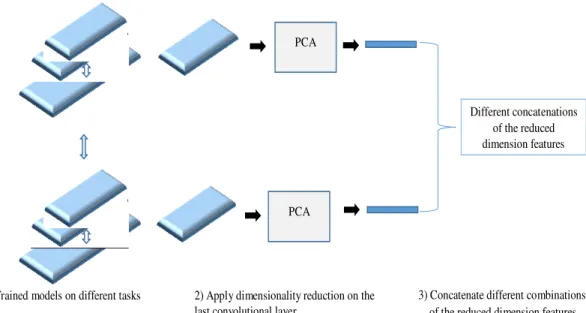
There are many cases where the measured or the observed data vectors are described as a high dimensional data. Normally, a significant portion of the high dimensional data is redundant and has low variance, undesired, or resulted from linear operations over other desired data. The goal of dimensionality reduction is to reduce the dimension of the high dimensional data to a smaller one while preserving the same useful or desired information. There are many benefits of dimensionality reduction, for example, it reduces the space needed to store the data during training, it decreases the time needed to process the data, and it increases the performance of the data in many classification tasks [105-106]. In age and face recognition tasks, the number and the size of the input images are considerably large and require careful processing in order to extract and select the distinctive features. As shown in Figure 2, different deep convolutional models that were trained for different tasks other than age estimation are used. PCA is applied to the last convolutional layer output of these models for dimensionality reduction.
28
The input images are fed to each deep trained model until the output features of the last convolutional layer are calculated. These features are stacked together for the entire training data set. This results in a high dimensional feature vector.
Figure 2. Features dimensionality reduction.
The size of the last convolutional layer differs between the trained models and it is large for all models. As a result, dimensionality reduction is required to fine tune the feature vectors. Since each trained model was trained for a different task, it is expected to have different feature vectors with a different level of performance in age estimation. In this work, the dimensionally reduced features from each trained model and their combination are examined. PCA technique is used for dimensionality reduction. PCA transforms the large space into a smaller subspace using linear transformation.
1) Trained models on different tasks 2) Apply dimensionality reduction on the last convolutional layer
3) Concatenate different combinations of the reduced dimension features PCA
PCA
Different concatenations of the reduced dimension features
29
3.2 Jointly Fine-Tuning DNNs Using Different Feature Sets for Age
Classification
In this section, two types of joint fine-tuning architectures are introduced for age classification based on facial images. Each type has different advantages than the other type. It is shown how each type can improve age classification even if used with different feature sets. Section 3.2.1 will introduce the first type which is based on joint fine-tuning based on amplified features, while section 3.2.2 explains the joint fine-tuning of two DNNs based on a new proposed cost function.
3.2.1 Jointly fine-tuning DNNs based on amplified feature sets
In this section, different DNNs are jointly fine-tuned with different feature sets for age classification. The feature sets should be extracted for the training and testing images examples. Any combination of feature sets related to the age classification can be utilized in this method. Two distinctive feature sets are chosen to show the effectiveness of the proposed method in age classification. However, the proposed method can be applied on more than two feature sets. The first feature set is extracted using deep pre-trained model for face recognition. While for the second feature set, the depth features of the facial image based on image superpixels and their relation as new feature set for age classification are proposed. The depth of the image superpixels will reveal aging remarks on different parts of the face and this will help to estimate the age interval of the subject. In addition, the superpixels depth and their relation will add more information to reveal hidden aging remarks.
30
3.2.1.1 Pre-trained CNN Model-I
The pre-trained CNN model-I extracts and captures features that are used for face recognition. The reason of using a pre-trained model for face recognition is that age estimation from face images and face recognition tasks rely on features extracted from face images. The VGG-Face [99] model is used as the pre-trained CNN model-I. The VGG-Face model has recently been proven to be one of the state-of-the-art in face recognition. The effectiveness of the VGG-Face model comes from the very deep architecture of the model that comprises a big number of convolutional layers. In addition, the VGG-Face model is trained on a very large database consisting of millions of unconstrained images.
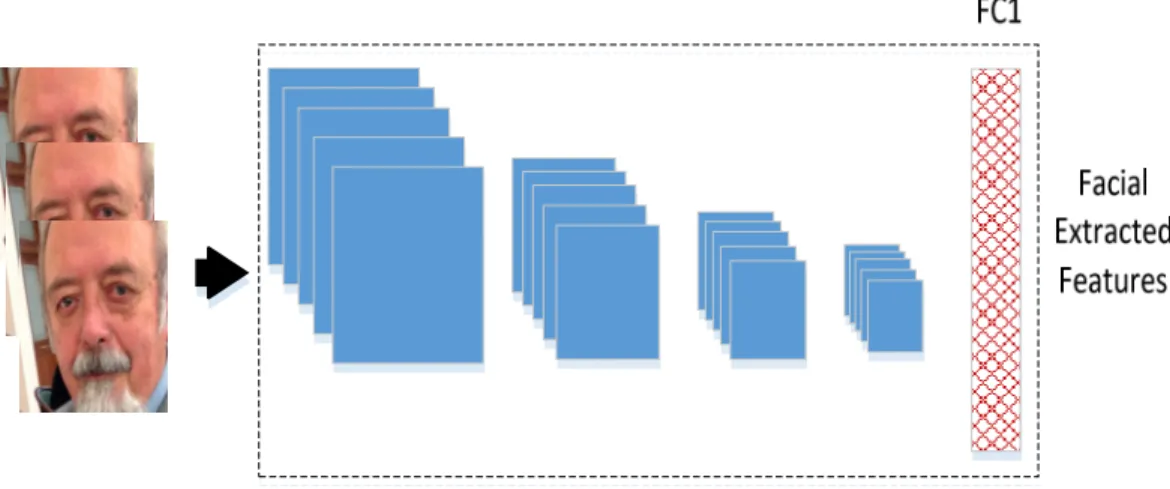
As shown in Figure 3, the training data is fed to the VGG-Face model until the values of the first fully connected layer of the VGG-Face model for each example in the training data are calculated. The calculated values of the first fully connected layer represent the facial features that will be used as training data of a new network that has the age labels. This new network consists of four layers. The fourth layer contains the labels. The sizes of the first three layers are 4096, 5000, and 5000 nodes, respectively.
31
Figure 3. Extraction facial features by using a pre-trained model for face recognition.
3.2.1.2 Pre-trained CNN Model-II
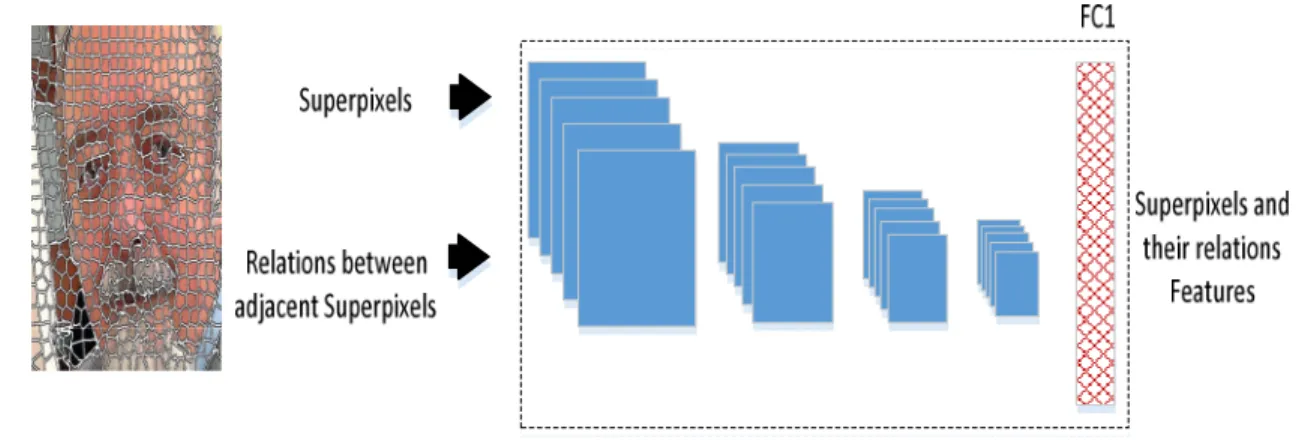
This model aims to find new different features from the face images. Face images are divided into several small regions called superpixels where each superpixel represents a group of pixels as shown in Figure 4. It is assumed that each superpixel is homogeneous in terms of depth, color, and texture meaning all the pixels in a superpixel have near identical depth, color, and texture values. In this model, our main focus is to find information from the superpixels and a relationship between a superpixel and its neighboring superpixels based on their depth. It is assumed that the depth contains age-related information and the depth of the centroid pixel of a superpixel is used to represent the depth of the superpixel. Moreover, variations between the superpixels assist a classifier to find patterns of similarities each age label. This pattern is formed by finding superpixels that have similar depth values.
Three types of similarity measures [107] are used between the superpixel and its neighboring superpixels: the color difference, color histogram, and texture disparity in terms of LBP. In this work, a trained model [108] that finds the features depending on the depth
32
information is used. The pre-trained model [108] is run on each image example and extracted the last convolutional layer output of this model as new feature set.
Figure 4. Extraction of superpixels and their relations by using a pre-trained model for depth.
3.2.1.3 Jointly fine-tuned CNN model
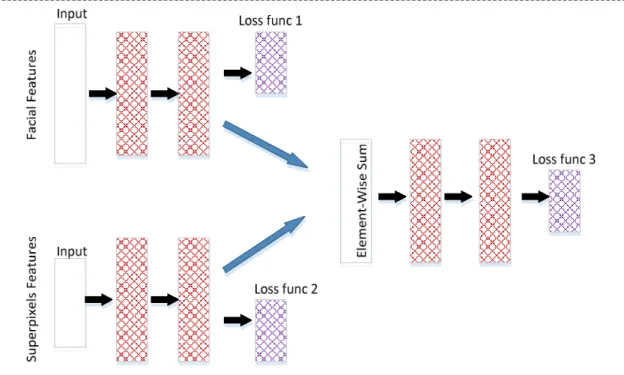
The new feature sets extracted from the previous trained models are trained by two new supervised deep neural networks as shown in Figure 5. The first supervised NN, called CNN-F, uses the features extracted by pre-trained CNN Model-I. The second supervised NN, called CNN-S, uses the features extracted by pre-trained CNN Model-II. CNN-F and CNN-S have two hidden layers and one output layer. The third NN, called CNN-FS, jointly fine-tunes CNN-F and CNN-S. CNN-FS is composed of one input layer, one hidden layer, and one output layer. There are 8 labels in the output layer. The input of CNN-FS is the element-wise summation of the last hidden layers of CNN-F and CNN-S. The last hidden layer of CNN-S has 147968 features. Because of the large number of features, dimensionality reduction is used to reduce 25,088 features to 512 features.
33
Figure 5.Jointly fine-tuning of two DNNs. CNN-FS uses facial and superpixels related features, the outputs of the last hidden layers of CNN-F and CNN-S, which are summed by element-wise.
The learning process of the three networks is explained as follows.
• Three loss functions are used to train the three networks. All three loss
functions are the softmax cross entropy function as in Equation (1).
= − ∑ log , (1)
Li is the loss function of network i, yj is the jth value of the label, and , is the jth output value of network i.
• CNN-F and CNN-S are trained using their corresponding first batch of
features. Then, the output of the last hidden layer of both networks is element-wise summed to form the input of the CNN-FS as in Equation (2).
34
x3,j is the input of the CNN-FS, l1,j and l2,j are the outputs of the last hidden layer of the CNN-F and CNN-S, and Relu is the rectified activation function.
• Feedforwarding, error calculation, and backpropagation are performed on the
CNN-FS.
• The steps from 1 to 3 are repeated for the rest of the training batches.
After the training is completed, the softmax output of the CNN-FS, ̅, is obtained as the final decision as in Equation (3).
̅ = arg , (3)
3.2.2 A New proposed cost function for jointly fine-tuning two
different DNNs for age classification
In this section, the proposed new cost function for fine-tuning two DNNs jointly to improve the age and gender classification is explained. The proposed method consists of two DNNs which have two feature sets. These feature sets are extracted for the same data input and each set represents the same input in different way. The first network, DNN1, is trained using the first feature set. The cross-entropy is used as the loss function. The Softmax function is used at the output layer. While the second network, DNN2, is trained on the second feature set. The sigmoid function is used to calculate the output layer probabilities, and the mean squared error loss function is used to calculate the DNN2 error. Then both networks are fine-tuned using the proposed cost function.
35
3.2.2.1 Architecture of jointly fine-tuning two DNNs and the
proposed loss function
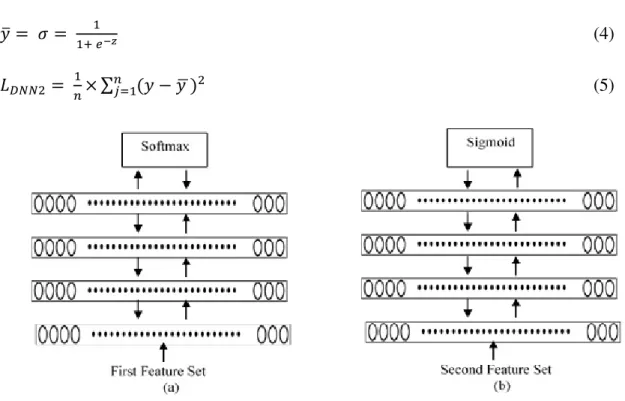
In this paper, the proposed integration approach is based on fine-tuning two DNN networks. The first network (DNN1) is a DNN with the first extracted feature set of the input sample, while the input features for the second DNN (DNN2) is the second extracted feature set from the input sample. It is illustrated in Figure 6. Both networks are trained simultaneously and their output functions interact with each other. DNN2 is trained with a sigmoid output function (!) and the loss mean squared error function ( "## ) as given by Equations (4) and (5).
= ! = $ %&' (4)
"## = (× ∑ ( − +)( (5)
Figure 6. DNN1 and DNN2 architectures. (a) DNN1 with the first extracted feature set as input and with softmax as output layer. (b) DNN2 with Second extracted feature set as input, and with sigmoid as output
layer.
z is the input vector for the output layer, n is the number of labels, y is the output vector values of the true label, and + is the output vector values of the sigmoid function.
36
The derivative (d) of the loss function is defined in Equation (6), where ⨀ represents the element-wise product.
.( "## ) = −( − )⨀ ⨀(1 − ) (6)
DNN1 is trained with the softmax output function and its cross-entropy error function is given by Equations (7) and (8).
= 0123 = ∑ %%'4'4 (7)
"## = − ∑ log (8)
is the output vector of values of the true label and is the output vector values of the softmax function. The derivative (d) of the loss function is defined in Equation (9).
.( "## ) = −( − ) (9)
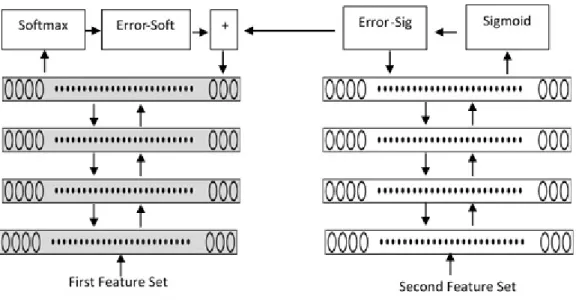
DNN2 is trained and jointly fine-tuned with the DNN1 as shown in Figure 7. The jointly fine-tuned network is trained with the loss function defined in Equation (10).
5 (6 = "## + "## (10)
The Softmax and the Sigmoid are the two parts of our proposed joint fine-tuned loss function. The error on the output layer for the jointly fine-tuned netwo