THESIS FOR THE DEGREE OF LICENTIATE OF ENGINEERING
Venture capital as a tool for regional development
Exit patterns and long-term consequences
PER HULTHÉN
Department of Technology Management and Economics CHALMERS UNIVERSITY OF TECHNOLOGY
Venture capital as a tool for regional development Exit patterns and long-term consequences
PER HULTHÉN
© PER HULTHÉN, 2019
Technical report No L2019-117
Department of Technology Management and Economics CHALMERS UNIVERSITY OF TECHNOLOGY SE-412 96 Gothenburg
Sweden
Telephone +46 (0)31-772 1000
Printed by Chalmers Reproservice Gothenburg, Sweden 2019
I
Abstract
Venture capital (VC) funded high-tech startups are often cited drivers of economic impact and catalysts of regional growth. Public support of high-tech startups and investments into venture capital has thus been a popular focus for public policy globally in the past decades. This is despite that the long-term, and post-exit, impact of most venture capital funded startups is little known, especially for regional development. To the degree startups have been tracked after exit, there is evidence of startups both growing and disappearing post-exit, with exit route often suggested as an influence of post-exit growth as well as relocation. The purpose of this thesis is thus to investigate the suitability of venture capital for regional development, by studying the long-term and post-exit outcome for venture capital funded startups.
This licentiate dissertation builds on four studies on startup exits. The first study, ‘Migration patterns of venture capital funded startups’, explores quantitatively startups exits in five innovative regions: San Francisco Bay Area encompassing Silicon Valley, Colorado, North Carolina, Israel and Sweden. Conclusions are that regional exit patterns are dominated by acquisitions, with ownership of the most valuable startups concentrated to Silicon Valley. In the other four regions, only a small portion of the value of the startups remain owned in their regions. The second study, ‘Growth of Swedish venture capital financed startups after IPO
and acquisition - the case for exit-centric policy?’, quantitatively tracks the post-exit growth of venture capital funded startups in Sweden 1992-2010. Conclusions are that post-exit growth is dependent on exit route. Startups which exit by IPO grow faster than acquired startups, and half of the acquired startups are consolidated within a couple of years after exit. The third study, 'Venture capitalist's exit choice: Deciding the fate of successful startups', examines how venture capitalists make exit choices for startups. Conclusions are that venture capitalists alone decide on exit, overriding entrepreneurs if required, with a preference for acquisition exits and a reluctance to take firms public. The final fourth study,
‘Startup exits and the evolution of entrepreneurial ecosystems: Exploring divergent paths’, maps qualitatively the post-exit behavior of entrepreneurs, business angels, venture capitalists and key employees in startups dependent on the financial exit success. Conclusions are that growing entrepreneurial ecosystems require a minimum of profitable exits, and without which entrepreneurial ecosystems will stagnate and depopulate.
This thesis increases our understanding the long-term regional economic consequences of using venture capital to accelerate startups. Venture capital accelerate startups in the time period following their initial investment until the exit. At exit, the venture capitalists have a preference of exiting by acquisition, rather than going public, with the most valuable startups acquired by firms in Silicon Valley. Acquired startups have lower post-exit growth than startups going public, and many acquired startups are consolidated post-exit. For regions other than Silicon Valley, the likely outcome is that their most valuable startups will not remain long-term in their ecosystems. Regions using venture capital as a policy tool for regional growth, should consider modifying their policies to account for the startup migration effects and consider supporting alternative funding mechanisms in their entrepreneurial ecosystems.
II
List of appended papers
This thesis is based on the work contained in the following papers:
Paper 1:
Hulthén, P. and Graff, G. (2019). Migration patterns of venture capital funded startups.
The paper was co-authored with Gregory Graff of Colorado State University. I conceived the idea and research design for the paper. Myself and Gregory conducted the data collection and clean-up, with some assistance by research assistant Ivan Velinov. Literature review, method, analysis and discussion was done jointly by me and Gregory. From start to finish, the process took three years.
Paper 2:
Hulthén, P., Glücksman, S., Lundqvist, M. and Isaksson, A. (2019). Growth of Swedish venture capital financed startups after IPO and acquisition - the case for exit-centric policy? The paper was presented at the annual Entrepreneurial Finance conference in Trier, in July of 2019, and is presently under review in the Entrepreneurship and Regional Development journal. The paper was co-authored with Sarah Glücksman, Mats Lundqvist and Anders Isaksson. I conceived the idea and the research design was co-developed with Sarah. Myself and Sarah conducted the data collection and clean-up with assistance by research assistant Marcus Silkisberg. Literature review, method, analysis and discussion was done jointly by all four co-authors. From start to finish, the process took two years.
Paper 3:
Hulthén, P. (2019). Venture capitalist’s exit choice: Deciding the fate of successful startups. The paper was presented in an early version as poster at the annual RENT conference in Toledo in November of 2018. A later version was presented at the annual Entrepreneurial Finance conference in Trier in July of 2019. I am sole author of this paper and conducted all parts of the research process by myself. From start to finish, the process took two years.
Paper 4:
Hulthén, P. and Dimov, D. (2019). Startup exits and the evolution of entrepreneurial ecosystems: Exploring divergent paths.
The paper was presented at the annual ACERE conference in February of 2019. The paper was co-authored with Dimo Dimov of Bath University. I conceived the idea, research design and method for the paper. Literature review, analysis and discussion was done jointly by me and Dimo. From start to finish, the process took two years.
All four papers were conducted within the Exit Value Study (EVS) research project financed by VINNOVA and Västra Götalands Regionen (VGR). I was co-initiator of the EVS project together with Mats Lundqvist, and acted as project manager as the research was conducted in collaboration between Chalmers University of Technology and IMIT Foundation.
III
Acknowledgements
First of all, I would like to thank my committee and especially my main supervisor, Mats Lundqvist, without whom this research project and thesis would never have become reality. Gregory Graff was instrumental in shaping the research focus and support my efforts from an early stage. Anders Isaksson, after stepping in to replace Henrik Berglund, provided valuable discussions and insights. Martin Wallin, as examiner, provided a critical eye for details. Furthermore, I am grateful for my co-authors, and especially Dimo Dimov and Sarah Glücksman, who were excellent collaborators I found tremendous joy in working with. My research assistants, Marcus Silkisberg and Ivan Velinov, were instrumental is collecting, documenting, and cleaning the significant amount of data used in the quantitative studies. My fellow PhD candidates, colleagues and faculty at TME were important in providing support, inspiration and shared laughter. All the dedicated professionals, whom shared their valuable time with me in interviews and insightful discussions, were of course essential in my research. I further wish to thank Kjell Håkan Närfelt and his colleagues at Vinnova, Sophia Litsne and colleagues at Region of Western Sweden (VGR) and Marie Wall and her colleagues at the Swedish Government Offices (Regeringskansliet), without whom the EVS research project and this thesis would not have been possible. Mats Lundqvist and Maria Elmqvist from Chalmers, and Martin Sköld from IMIT Foundation, were also crucial supporters in enabling that the EVS research project could be conducted.
Finally, I want to thank my wife, family, relatives and friends, who make me cherish life and keep me grounded.
Per Hulthén
IV
Table of Contents
1 Introduction ... 1 2 Literature Review ... 4 2.1 Chosen definitions ... 4 2.1.1 Definition of startup ... 42.1.2 Definition of equity funded startup ... 4
2.1.3 Definition of venture capital funded startup ... 5
2.1.4 Definition of a startup exit ... 5
2.2 Venture capital literature related to startup exits ... 6
2.3 Entrepreneurship and regional development literature related to startup exits ... 8
3 Methodology ... 11
3.1 Research design ... 11
3.2 Quantitative methods in Migration and Growth studies ... 11
3.2.1 Data sources, sample and collection ... 11
3.2.2 Data analysis and limitations ... 12
3.3 Qualitative methods in VC Choice and Ecosystem studies... 13
3.3.1 Data sources, sample and collection ... 13
3.3.2 Data analysis and limitations ... 16
4 Summarized Papers ... 17
4.1 Paper 1: Migration patterns of venture capital funded startups ... 17
4.2 Paper 2: Growth of Swedish venture capital financed startups after IPO and acquisition - the case for exit-centric policy? ... 18
4.3 Paper 3: Venture capitalist's exit choice: Deciding the fate of successful startups 19 4.4 Paper 4: Startup exits and the evolution of entrepreneurial ecosystems: Exploring divergent paths ... 20
V
5.1 What are exit patterns for venture capital funded startups on a regional level? ... 22
5.2 What is a likely causal chain of events that lead to, and occur as a consequence of, exits of venture capital funded startups? ... 23
5.3 What are key consequences of exits of venture capital funded startups for regional development? ... 26
6 Conclusions ... 28
6.1 Implications for scholars... 28
6.2 Implications for practitioners ... 28
6.3 Future research ... 29
1
1 Introduction
Venture capital (VC) funded high-tech startups are often cited drivers of economic impact and catalysts of regional growth, based on evidence from Silicon Valley with examples such as Apple, Facebook and Google (Florida & Kenney, 1988; Gompers et al, 2010; Lerner et al, 2012; OECD, 2010a). Studies in the U.S., and globally, reinforce that the most successful startups contribute a disproportionately large turnover and employment, and by extension, economic growth (Shane, 2008, 2009; WEF, 2011). Venture capitalism has spread almost worldwide with the expectation that VCs will be a generalized driver of economic growth and innovation (Kortum & Lerner, 2001). This thesis systematically questions this widely held expectation.
Public support for using venture capital, as a mechanism for identifying and accelerating the most promising startups, has hence formed the basis for innovation and entrepreneurship policy, as regions have attempted to replicate the success of Silicon Valley (Storey & Tether, 1998; Lerner, 2009; Lerner et al, 2012; OECD, 2001, 2010b; World Economic Forum, 2009, 2011). As an example, approximately 35 percent of the €4bn annually raised by private European venture capital funds stem frommed European taxpayers through their national and regional governments or the European Investment Fund (Höppner, 2015). Government agencies contributed over €2bn to European venture capital funds raised in 2018 (Invest Europe, 2019).
The popularity of venture capital as a policy tool for regional development is widespread, despite that the long-term, and post-exit, impact of most venture capital funded startups and policies to support them remains unknown (Nightingale & Coad, 2013) and that most regions fail at replicating Silicon Valley’s success (Rosenberg, 2002). The largest studies on venture capital funded startups have only followed the startups until exit, when startups usually are acquired or go public (Cumming & MacIntosh, 2003; Lerner et al, 2012). What happens to startups after exit is outside the scope of most studies, often due to the difficulty of tracking firms post-exit (Duruflé et al, 2017).
To the limited extent post-exit growth of startups has been studied, indications are that different exit routes, such as going public or being acquired, lead to divergent post-exit growth trajectories for startups (Mason & Harrison, 2006; Mason & Brown, 2013; Brown et al, 2017; Carpentier & Suret, 2014; Hogan et al,2018; Xiao, 2015). The long-term impact of startups is to a large extent dependent on the subsequent performance of the startups following their exit events. Whether startups remain long-term in their regions of origin, and grow post-exit, are important policy concerns (Wennberg & Mason, 2018). There is an extensive research gap regarding what happens to startups long-term and post-exit, and specifically to venture capital funded startups, whom are the focus for considerable policies. As we are unsure about the long-term effects of using venture capital for accelerating startups, the question arises whether venture capital is a suitable tool for regional development.
Based upon the identified research gap, the overall purpose of the thesis is to investigate the suitability of venture capital for regional development, by studying the long-term and
post-2
exit outcome for venture capital funded startups. In approaching this purpose, we first need to map what happens to venture capital funded startups long-term and post-exit on a regional basis. Next, we need to understand the connection between exit route, such as foreign acquisition or local IPO, and post-exit development of startups on a regional level. Furthermore, we need to understand what drives exit decisions for venture capital funded startups. Finally, we need to understand the chain of events that lead to exits, the events that occur as a results of exits, and what these events mean for regional development.
The purpose of this thesis is approached by answering three sequential research questions: RQ1: What are exit patterns for venture capital funded startups on a regional level?
RQ2: What is a likely causal chain of events that lead to, and occur as a consequence of, exits of venture capital funded startups?
RQ3: What are key consequences of exits of venture capital funded startups for regional development?
To answer the three research questions, I conducted four studies on startup exits. The first study, ‘Migration patterns of venture capital funded startups’, explored quantitatively startups
exits in five regions: San Francisco Bay Area encompassing Silicon Valley, Colorado, North Carolina, Israel and Sweden. The purpose was to investigate how exit patterns for VC-funded startups across the five regions, the extent to which regions retain startups in their region and which factors are associated with ownership transitions to other regions. Exit patterns examined included survival ratios, exit routes, exit transactions amounts and ownership transitions within and to other regions.
The second study, ‘Growth of Swedish venture capital financed startups after IPO and
acquisition - the case for exit-centric policy?’, quantitatively tracked the pre- and post-exit growth of venture capital funded startups founded 1992 – 2010 in Sweden. The sample in this second study was smaller and limited to one region compared to the first study, while covering a longer time period post-exit. The purpose was to investigate the relationship between pre-exit performance, exit route and post-exit performance in terms of turnover, employment, growth, intellectual property and finally post-exit continuation or discontinuation for venture capital funded startups.
The third study, 'Venture capitalist's exit choice: Deciding the fate of successful startups', examined qualitatively how venture capitalists make exit choices for startups. Assuming that exit route matters for the long-term post-exit development of startups, it is important to understand how venture capitalists make exit decisions. Aspect of decision making investigated included if venture capitalists were sole decision makers, which factors they consider, these factors relative importance in the decision and any observable biases that influenced the decision making.
The final fourth study, ‘Startup exits and the evolution of entrepreneurial ecosystems:
Exploring divergent paths’, mapped qualitatively the post-exit behavior of entrepreneurs, business angels, venture capitalists and key employees in startups dependent on the financial exit success. The purpose was to explore systemic recycling mechanisms caused by startup
3
exits, through tracking the role transitions of the four participatory agents, entrepreneurs, business angels, venture capitalists and key employees. As startup exits may be catalysts of reorganization and relocation for startups, one way to understand the dynamics is through the participating people leaving the startup for new engagements.
The remainder of the thesis is structured as follows. First, I will review the relevant literature for the thesis, including chosen definitions and terminology. Next, I will go over the methodologies used in the two quantitative and two qualitative studies. The studies and appended papers for each of the four studies will then be summarized with conclusions. Following this, the results of the studies will be discussed in relation to theory and the three research questions of this thesis. Finally, I conclude by revisiting the purpose, with implications for scholars and practitioners, and outline a continued research agenda.
4
2 Literature Review
Firstly, I begin the literature review section by explaining chosen definitions and terminology, to be clear about the meaning of the terms I use, and also serve as an introduction to the literature review. Secondly, I review literature in the intersection between venture capital, entrepreneurship and regional development research streams, due to the cross-disciplinary nature of startup exit research.
2.1 Chosen definitions
2.1.1 Definition of startup
Startup has become a common term for an entrepreneurial venture in anything from business press to popular TV shows, due to practitioners globally using the term every day. The term startup is increasingly used by academics, however often in referring to the startup phase of a new entrepreneurial firm’s development which carries a slightly different meaning. Since this research studies a practitioner phenomenon, I elect to use the practitioner term startup, as it carries a specific meaning. The most commonly used definition of a startup is stated below, as popularized by Blank & Dorf in the Startup Owner’s Manual (2012):
'A startup is a temporary organization in search of a scalable, repeatable, profitable business model. At the outset, the startup business model is a canvas covered with ideas and guesses, but it has not customers and minimal customer knowledge'. (Blank & Dorf, 2012).
A startup differentiates itself from a generic new firm in being specifically explorative and growth oriented, starting with a limited resource base. A generic new firm does not have these requirements; it can use a proven business model for offering a generic product or service, be satisfied with not growing and start with a considerable resource base if it is a spin-off or joint venture originating from an established firm. Startups thereby constitute a subset of new firms with specific characteristics, compared to most other firms studied within entrepreneurship.
2.1.2 Definition of equity funded startup
Leibenstein (1968) distinguishes between entrepreneurship as a type of management working with established conditions and defined markets, and high impact entrepreneurship working with Knightian (1921) uncertainty and resulting in Schumpeterian (1934) impact. Acs (2008) elaborates that high impact entrepreneurs found and manage leveraged startups which make use of external assets, such as investors, to allow their firms to grow faster and go after larger business opportunities that ordinary small businesses cannot due to lack of resources. Among these external resources leveraged, external equity funding is the most common external resource both used and prescribed for faster growth. In short, it means bringing in funding from private and institutional investors in return for equity in the firm. The additional capital allows the startup to evolve and grow faster than cash flow generated organically from sales
5
and operations would allow. Examples of equity investors are business angels, crowdfunding, family offices, venture capitalist funds, corporate venture capitalists and private equity funds (Block et al, 2018).
Equity investors’ capital, however, come with obligations and limitations for entrepreneurs. With an extended ownership group including multiple stakeholders, agency changes and priorities may diverge. It is therefore common practice in equity funded startups, that bring in professional investors, to have a shareholder's agreement, which aligns interests among the shareholders and puts procedures in place to control shareholders, board and management. Common procedures include restrictions and regulations for trading of shares in the startup, so called drag-along and tag-along clauses, designed to facilitate that all shareholders sell their shares at the same time. One example of how these clauses are used, is to force minority shareholders to sell their shares, in the event that a majority of shareholders wish to sell the firm, and the acquiring firm makes the purchase of all outstanding shares a condition for completing the transaction (Cumming, 2008).
2.1.3 Definition of venture capital funded startup
A venture capital funded startup is a startup that has received investment(s) from a formal venture capital fund. The formal distinction is important, as the definition of what is venture capital has, and still is, debated with different definitions historically used in Europe and the USA (Lerner et al, 2009). This thesis uses the more narrow USA definition of formal venture capital, as a traditional limited lifetime fund operated by general partners with financing from limited partners. This definition excludes for instance family offices, which may call themselves venture capitalists, but as they lack limited partners and a limited time fund structure do not fit the definition. The distinction matters, as the financial structure of the venture capitalist influences their working methods, such as investment and divestment processes. A family office is likely to have different investment criteria, process, horizon and priorities than a formal venture capital fund. Studies have shown that exit patterns of venture capitalists are distinctly different from other private equity investors, for example private equity investors are considerably more likely to exit by IPO than venture capitalists are (Lerner et al, 2012).
Venture capital funding is often prescribed as the most effective form of equity funding in accelerating startups’ growth (Kortum & Lerner, 2001). The popularity of prescribing venture capital may however in part be due to it being the most researched form of equity financing, as we have more data and studies on venture capital than alternative equity funding sources, and we know in comparison much less about the alternatives (Cumming & Johan, 2017).
2.1.4 Definition of a startup exit
Scholars refer to several different types of exits in the context of new firms, so next it is important to explain the different types of exits, their meaning and interrelation.
6
Terminology: Subject: Meaning:
Financial exit Investor An owner of equity sells their equity stake Entrepreneurial exit Entrepreneur Entrepreneur leaves the firm they founded Firm exit Firm Firm is liquidated or goes bankrupt
Regional exit Firm Firm relocates their operations to another region Startup exit Firm Firm is sold or taken public providing a joint
financial exit opportunity for all shareholders
Startup exit is not a new term. When practitioners globally talk about exits, they most commonly refer to a startup exit that facilitate financial exits for all shareholders. However, in academia the term startup exit is not commonly used, in comparison to the more generic financial exit and entrepreneurial exit and firm exit. Startup exit however constitutes a specific key mechanisms by itself. The motivation for a startup exit is often the requirement for a financial exit by equity investors in the firm. Individual equity investors may attain a financial exit by selling their individual shares to another investor. However, equity funded startups often restrict the trading of shares by individual investors through the shareholders agreement, aligning the interest of the shareholders for all of them to sell their shares jointly. The startup exit is the event where all shareholders have the opportunity for a joint financial exit, usually through the sale of the entire firm, referred to as Merger & Acquisition (M&A), or an Initial Public Offering (IPO) when the firm is listed on a stock exchange.
Startup exits may act as a catalyst for the other types of exits. An acquisition of a startup is the most common startup exit route, facilitating a financial exit for all shareholders. Founders may leave their firm in the years following an acquisition, facilitating an entrepreneurial exit. Furthermore, is it not unheard of for the acquiring parent firm to relocate and consolidate the operations of their new subsidiary to existing business units, for economies of scale, synergies and reducing cost. The relocation of operations of the subsidiary to another region would then facilitate a regional exit of the subsidiary or even a firm exit if the subsidiary is closed down.
2.2 Venture capital literature related to startup exits
Venture capital helps fill the early stage equity gap for small firms with high growth potential, thereby enabling the startup to grow (Florida & Kenney, 1988). In the last two decades, the role of the venture capitalist (VC) has been emphasized as the enabler and accelerator of entrepreneurial economic growth (Gompers et al., 2010: Lerner, 2009; Lerner et al., 2012). Venture capitalism has spread worldwide with the expectation that VCs will be a generalized driver of economic growth and innovation (Kortum & Lerner, 2001). The ability to make a
7
profitable exit lies at the heart of venture capital investing (Sahlman, 1990; Gompers, 1995; Gompers & Lerner, 1999).
The venture capital exit is more than realizing investment value; it is the process by which the efforts of VCs and entrepreneurs are transformed into a new entity (Bygrave et al, 1994). The exit timing for the VCs should optimally be ‘when the projected marginal value added as a result of the VC’s efforts, at any given measurement interval, is less than the projected cost of these efforts’ (Cumming & MacIntosh, 2003, p. 6). Several studies show that the average holding period for a VC to own an equity stake in a startup before exiting is five years (Sahlman, 1990; Cochrane, 2005).
There are five types of venture capital exits, listed here in argued order of preference for the VC (MacIntosh, 1997): (a) an IPO, in which a significant portion of the firm is sold into the public market; (b) an acquisition exit; that is, through M&A, in which a third party buys the entire firm; (c) a secondary sale, in which only the VC sells its shares to a third party, which is usually less desirable and profitable; (d) a buyback, or a management buyout (MBO), in which the managers of the entrepreneurial firm repurchases the VC’s shares, which is also less desirable and profitable; and (e) a write-off, in which the VC walks away from the investment, usually due to bankruptcy or the firm closing down.
The most profitable exits are IPOs and M&As (Cumming & MacIntosh, 2003; Lerner et al., 2012; Bienz & Leite, 2008). A study of venture capital exits during 1995-2005 in North America and Western Europe showed that M&As dominate, with 78.3 percent compared to only 3.5 percent as IPOs (Lerner et al, 2009). This is despite the fact that IPOs historically provided a 22 percent price valuation premium over M&As (Brau et al, 2003). Although trade M&As may result in a lower value, they do provide immediate, full liquidity to investors, which is usually not the case in an IPO, in which major shareholders are blocked from selling shares during a lock-in period following a listing (De Clerq et al, 2006).
Firm-specific and macroeconomic factors are linked to exit choice. Larger, dominant, and high-tech-based firms are more inclined towards IPOs, while service firms, firms with high debt, and firms in leveraged industries and industries with few actors are more M&A inclined. In addition, a positive stock exchange trend and lower rates favor IPOs, while the opposite favors M&As (Brau et al, 2003, Poulsen & Stegemoller, 2008, Bayar & Chemmanur, 2011). Institutional factors enable exits, as countries with stable financial and legal systems are more favorable for IPOs (Cumming et al, 2006).
Management and ownership also influence exits. Companies that need less oversight and have a stronger track record are predisposed to IPOs, while companies that require more controls are predisposed to M&As (Bienz & Leite, 2008). Established VC firms prefer M&As, while younger VC firms are more open to IPOs, especially if an IPO coincides with their fund raising (Gompers, 1996). Entrepreneurs are generally biased towards IPOs (Schwienbacher, 2008), which is one reason VCs often ensure contractual control of the exit choice (Cumming, 2008; Kaplan & Strömberg, 2003). Thus, the VC normally pre-plans the exit route at the time of the initial investment (Cumming & Johan, 2008).
8
Although we can expect VCs’ overall exit preferences to be similar internationally, prior studies show that specific exit patterns differ between countries and regions due to legal and institutional factors (Cumming & MacIntosh, 2003), availability of alternative exit routes such as small-cap stock exchanges (Rindermann, 2003), and the possibly divergent exit preferences of the owners (Schwienbacher, 2008). The importance of exit routes for the development of venture capital markets is well known (Mason & Harrison, 1999). The creation of stock markets for smaller growth companies are an important mechanism for a well-functioning venture capital market and something that policy makers have tried to stimulate (Isaksson, 2006).
As accounted for, venture capital theory focuses on profits for investors and therefore venture capital scholars’ interest tends to end with the financial exit. Thus, we know little about post-exit developments of venture capital funded startups, and whether the type of post-exit affects a venture’s growth and staying-power in the region. From a regional development and public investor perspective, these are important questions to ask. There is need for a systematic understanding of how venture capital and the type of exits affects pre- and post-exit development of startups, with an empirical grounding in more regions than Silicon Valley.
2.3 Entrepreneurship and regional development literature
related to startup exits
While venture capital research has been concerned mostly with value creation for investors, the intersection of entrepreneurship and regional development research has focused on economic impact generated by new firms, primarily in terms of growth and employment (Leibenstein, 1968; Baumol, 1996; Audretsch et al, 2006; Shane 2008, 2009). As entrepreneurship and regional development theory tend to intertwine on the subject of economic impact, and especially so on the subject of startup exits, the literature review of entrepreneurship and regional development theory will be done combined.
Entrepreneurs, and the startups they create, play the economic role of transformational agents (Schumpeter, 1934), vehicles of knowledge dissipation and innovation (Acs et al, 2013), and net job providers (Birch, 1979, 1987; Kane, 2010). In the last decades, research has increasingly focused on leveraged startups, which leverage external assets to accelerate growth, and especially leveraging through venture capital (Acs, 2008).
Venture capital has been portrayed as the engine behind the fast growth of startups (Gompers et al., 2010; Lerner et al., 2012). Studies show that venture capital funded startups grow faster (Puri & Zarutskie, 2012) and are more innovative (Kortum & Lerner, 2001; Hellmann & Puri, 2002) than non-venture capital funded startups. However, it is unclear to what degree the leveraging effect is due to VCs’ selection bias (Sørensen, 2007), the invested capital itself (Wiltbank et al, 2015), the VC’s networking effect (Hochberg et al, 2007) or the VC’s
9
Boulevard of Broken Dreams by Lerner (2009) popularized the notion of public investments into private venture capital for driving innovation and growth, while warning against the potential disruptive interference of government and such policies should thus be with no strings attached. High-tech startups, and new technology-based firms (NTBFs), accelerated by venture capital funding, became recurring for public policy aiming to drive economic growth and innovation in the last decades (Storey & Tether, 1998; OECD, 2001, 2010a, 2010b, 2010c; World Economic Forum, 2009, 2011).
However, the success of startups is highly skewed, with a small number of firms, such as Apple, Google, and Facebook, mostly tied to Silicon Valley, that generate a disproportionate amount of the economic impact in the U.S. (Saxenian, 1996; Shane, 2008). This is also the case internationally, as a World Economic Forum (WEF) report states that the top one percent of early-stage firms contributed 44 percent of the total revenues and 40 percent of total jobs, while the top five percent contributed 72 percent of total revenues and 67 percent of total jobs (WEF, 2011). The crucial importance of the ‘best’ firms has motivated a focus on High Growth Firms (HGFs) in economic growth policy (Delmar et al, 2003; Davidsson & Henrekson, 2002; Mason & Brown, 2013; Brown et al., 2014). The most common definition of an HGF is ‘Enterprises with average annualized growth in employees or turnover greater than 20% per annum, over a three-year period, and with more than 10 employees in the beginning of the observation period, should be considered as high growth enterprises’ (OECD, 2010a, p. 16).
Since most of the famous success cases in Silicon Valley exited through IPOs (Shane, 2009), the question of the importance of the exit route arises, as most startups exit by acquisition (Cuming & MacIntosh, 2003; Lerner, 2009; Lerner et al., 2012). Do acquisitions lead to growth and an economic impact, as IPOs seem to do, and to what extent do acquired firms grow outside of Silicon Valley? Startups that go public in their region of origin may generate more economic growth and other positive regional externalities, implying that IPOs should be preferable to acquisitions from a regional development perspective (Mason & Brown, 2013). Venture migration is a topic gaining interest (Anokhin, 2013). A case study in the U.K. observed a ‘sell-out mentality’ among HGFs, which, coupled with foreign acquisitions, lead to startups disappearing abroad (Brown et al., 2017). A recent study of software startups in Ireland came to similar conclusions, as foreign acquisitions on average led to a loss of firms, employment, and growth for the region of origin (Hogan et al., 2018). If the acquired firms are linked to local businesses, then the economic loss for the region of origin may increase further (Stam, 2007).
Case studies in Canada (Carpentier & Suret, 2014) and Israel (Rosenberg, 2002) observe patterns of foreign-acquired high-tech firms stagnating as R&D and production satellites, as the acquirer transfers the management, finance, and sales functions to head offices elsewhere. An Economist article reported similar observations, with Israeli entrepreneurs deciding to ‘cash in with early exits’ rather than grow their startups into large companies (Ryder, 2014). Large corporations often use acquisitions as a primary source for new technology and
10
products, and the associated IP and talent to defend and develop these assets further (Granstrand & Sjölander, 1990).
Acquisitions may lead to the relocation of intellectual assets and human capital, as utilizing IP often requires the presence of the engineers who are familiar with the technology, and consolidating these assets in one location for synergy makes sense (Makinen et al, 2012; Chatterji & Patro, 2014; Sawicki, 2014). Acquisitions often historically led to a transfer of employment and growth from peripheral regions to central regions (Leigh & North, 1978; Bhagat et al, 1990; Turok & Richardson, 2010; Ashcroft et al, 1994).
However, it is an oversimplification to say that foreign acquisitions are always detrimental to regional development. A post-exit study of Scottish startups included examples of both accelerated growth and closures of acquired startups (Mason & Harrison, 2006), so the circumstances of the acquisition and acquired firm arguably determine the long-term outcomes of these individual cases. Foreign ownership may be beneficial if the parent organization helps the startup to overcome barriers to growth and to prosper (Davenport, 2009; Hopkins & Richmond, 2014, Dahlstrand, 2017). Furthermore, exits may allow the entrepreneurs and investors of the original startup to explore new opportunities (Stuart & Sorenson, 2003), as they found and fund new startups, referred to as ‘entrepreneurial recycling’ (Mason & Harrison, 2006).
In summary, venture capital theory primarily focuses on value creation for investors, with economic impact for the surrounding environment as a secondary or even neglected effect of the value creation. Exit routes are thereby financial decisions based on assessments of profit maximization. From a regional development perspective, IPOs is often argued to generate more long-term economic impact and positive externalities for the surrounding region than acquisitions. However, IPOs have traditionally only been realistic for a few top-performing startups, so the most common profitable exit for venture capitalists has always been the M&A. In this context of IPOs being unrealistic for most startups, policy options on exits have been limited to considering the comparative benefits and risks of domestic versus foreign acquisitions.
Due to the lack of understanding of what happens post-exit to startups, and Lerner’s (2009) warning against government interference, most governments have elected to be exit agnostic in their policies. However, before exit-centric policy could be considered we need for systematic knowledge about how startups perform post-exit, and how this relates to their exit route.
11
3 Methodology
3.1 Research design
For the first study, Migration patterns of venture capital funded startups, and second study,
Growth of Swedish venture capital financed startups after IPO and acquisition - the case for exit-centric policy?, the methodological approach needed to be quantitative, as our interest is in generalizable trends in populations and correlations to measurable variables. The third study, Venture capitalist’s exit choice: Deciding the fate of successful startups, and fourth study, Startup exits and the evolution of entrepreneurial ecosystems: Exploring divergent paths, could be approached both a qualitatively and quantitatively. However, due to the limited amount of prior studies on these topics and limited data access, qualitative methodology were chosen to first understand the subject matter through interviews. Based on these results, hypotheses can be formulated and tested in future quantitative studies. From here onwards, for the sake of brevity, we will refer to the four studies as the Migration (first study), Growth (second study), VC Choice (third study) and Ecosystem (fourth study) studies.
3.2 Quantitative methods in Migration and Growth studies
3.2.1 Data sources, sample and collection
The Migration study required extensive longitudinal data on venture capital funded startups in several countries. Despite the growth of online information and commercial databases, the limited reporting requirements for small firms make it a challenging task for researchers in most countries to track privately-held firms (Cumming & Johan, 2017). After conducting a search of available databases, it became clear that VentureSource offered the best international cross-region comparable dataset on venture capital funded startups and exits. Other databases I evaluated, such as Crunchbase, PitchBook and CB Insights, had good coverage for the USA but not as good international coverage for the 1990-2000s. ¨
The five regions were selected to be comparable in population and GDP, have a reputation for commercializing research and host established startup and venture capital communities, while representing variety in terms of geography, culture and local industry clusters. The five selected regions were Colorado, North Carolina, Israel, Sweden and San Francisco Bay Area encompassing Silicon Valley.
Although VentureSource was the best alternative, it contained far from complete and comparable records. VentureSource aggregates data from several sources, with limited coherent terminology and flaws in reporting. Over a period of two years, we conducted considerable data cleanup and repairs filling in the holes in primarily classification of exits, acquiring firms and location of acquiring firms. The end result was our own custom built relational database, searchable by either firm name or investment round, comprising 10.593 firms. This custom database was the data source for the Migration and Growth studies.
12
The Growth study required additional financial data on the firms, not contained in VentureSource, such as turnover, number of employers, profits and R&D expenditure. For this reason, I decided to limit the Growth study to Sweden. In Sweden, all limited companies are required by law to submit an annual report, which is available in a public database. A second custom database was thereby created and filled over a period of a year with additional financials for all Swedish startups from annual reports. As the annual reports contained additional written information for the startup related to exits, such as if patents were sold or exclusive licensed, this additional information was collected. When the information in the annual reports had gaps or was hard to interpret, we collected additional data from the Swedish Tax Agency and Swedish Companies Registration Office to substantiate our records. The Growth study used both custom databases, to track Swedish venture capital funded startups from founding until exit and after exit for as long as the firms was traceable.
3.2.2 Data analysis and limitations
From the databases, we excluded startups that were not funded by formal venture capital funds and firms that did not meet the startup definition. Not all investors in a venture capital database meet the criteria for being a formal venture capital fund, as they are business angels, family offices and general private equity firms that may co-invest with venture capital funds or may just have the wrong label in the database. Furthermore, as venture capitalists are opportunists, they may invest in spin-offs and mature companies that do not meet our startup definition (Gompers et al, 2019; Berglund, 2011; Harrison, Mason and Smith, 2015).
In the Migration study, we began with descriptive statistics to map out the commonalities and differences in the exit patterns for the five regions. After illustrating generalizable patterns across the regions, we used regression test to show correlations between exits and region, industry and valuation with varying degree of statistical significance.
In the Growth study, we analyzed the data in five steps. In the first step, we established the pre-exit performance of all startups one year before exit and ranked exit routes based on the pre-exit performance. In the second step, we mapped the degree to which the exited startups continued operations post-exit, either in their existing format or a new one. In the third step, we established the post-exit performance of startups still in operation three years post-exit, and ranked post-exit performance of the startups related to exit route. In the fourth step, we examined the startups which met the HGF definition pre- and post-exit. In the final fifth step, we investigated if the startups that discontinued operations post-exit were the best or worst performing startups. Due to the skewed, non-Gaussian distribution of performance in the sample, we use an omnibus Wilcoxon one-way median analysis to test the differences in the medians between several groups. If the null hypothesis was rejected, we also conducted statistical multiple comparison analysis using the Wilcoxon test for each pair. For the HGF comparison, we use a Chi-Square Cramer’s V test.
The methodology used for both studies should have a sufficient degree of construct validity. The samples represent our best effort to in achieving as complete as possible coverage for the
13
venture capital funded startups in the regions during the selected time periods, and constitute several years of work in validating and complementing the data by hand. It is possible we missed some startups despite our best efforts, however the statistical significance in many of our tests would suggest our coverage was sufficient for statistical testing purposes. As we use data collected directly from the firms, there should also be a sufficient degree of internal validity and objectivity. The methodology used in the Migration study would further be highly repeatable and transferable for future studies in other geographies. The methodology used in the Growth study would practically be less transferable for practical reasons, as access to annual reports is usually more restricted in other countries than Sweden.
The most important limitation in the Migration study is the study the assumption that transfer of ownership leads to long-term relocation of startup operations. However, the Growth study in part addresses this limitation, by substantiating this assumption as real in the context of Sweden. The most important limitation in the Growth study is that we do not know what happened with the discontinued acquired startups that are consolidated and integrated into the parent firm. Since the consolidated startups are intermingled with the parent firm after integration, we cannot know what actual growth and impact the former startup had post-exit. Thus, we can only base our conclusions and what we see and not what we cannot see. Tracking the acquired startups post-consolidation would require a different research design and methodology.
3.3 Qualitative methods in VC Choice and Ecosystem
studies
3.3.1 Data sources, sample and collection
Due to the lack of prior studies on the VC Choice and Ecosystem studies, regarding venture capitalists’ decision making on startup exits and the influence of startup exits on the career paths of participatory agents in an entrepreneurial ecosystem, I decided to use qualitative methods to build an understanding of the subject matters. As I expected heterogeneity within the sample, and it was unclear what variables would be important in the studies, it would have been presumptuous and premature to go for a quantitative method with hypothesis testing. I further decided to limit both studies to the Swedish entrepreneurial ecosystem. As local conditions could be an influence in both studies, I thought it prudent to conduct the qualitative studies within the confines of one ecosystem.
There is ambiguity as to ‘where an ecosystem starts and where it ends’ (Ahokangas et al, 2018). It may be therefore be contentious to refer to the Swedish entrepreneurial ecosystem, as Sweden is a national level rather than regional or metropolitan where entrepreneurial ecosystems are often expected to operate (Audretsch & Belitski, 2017). However, I adopt the
socio-cultural perspective that the shared community marks the boundaries of the ecosystem (O’Connor et al, 2018; Acs et al, 2017). In the case of Sweden, the community of startup professionals refers to itself as the ‘Swedish’ startup community. Business angels and venture
14
capitalists invest across all hubs, while entrepreneurs and employees may transfer between the hubs when engaging in new ventures, with a transit time between the major startup hubs in the ecosystem of two to four hours (Eriksson & Rataj, 2019).
The Swedish entrepreneurial ecosystem is one of the older established ecosystems outside of the USA. The first Swedish venture capital firm was established in 1973 and the entrepreneurial ecosystem has since evolved through four decades of startup activity to become relatively stable and mature (Lerner & Tåg, 2013; Karaomerlioglu & Jacobsson, 2000; Isaksson, 1998). Startups with well-known brands which originate from Sweden are for example Skype, Klarna, Spotify, Mojang with MineCraft and King with Candy Crush. Sweden provides a European baseline for future comparisons to other ecosystems, being successful enough to merit investigation while smaller in scale and thereby easier to relate to than Silicon Valley.
For the VC Exit Choice study, the sample was limited to twelve Swedish venture capitalists.
Previous qualitative studies have yielded interesting findings with interviews with only twelve venture capitalists (Berglund, 2011). The sampling criteria were that they (a) were traditional venture capitalists, in the sense that they invested other peoples’ money and had limited partners they were responsible to, (b) had experience from multiple exits and were familiar with the exit choice decision-making context and (c) were Swedish. Within these criteria, I sampled for variety in experience, from less than two to more than twenty-five years as venture capitalists, and variety in industry focus, from generalist to healthcare and ICT.
For the Ecosystem study, the sampling criteria was that they were veterans of the ecosystem, with at least fifteen years actively working in the ecosystem with insight into how participants in startups continued their careers post-exit. Respondents were sampled through snowball networking (Noy, 2008), starting with the people who had spent the longest time in the ecosystem and ensuring diversity in background among respondents in terms of distribution geographically across all the three largest hubs as well as variety in present role and background. Final sample consisted of seventeen respondents, comprised of nine venture capitalists, four executives from incubators and four business angels. Three of the seventeen respondents were women. No entrepreneurs were among the final respondents. Entrepreneurs interviewed within the study expressed that they had primarily experienced their own journeys and had limited insight into the transition patterns for the other participatory agents, and were therefore excluded from the sample.
Data collection in both studies was through recorded structure interviews, as differences in framing of questions could affect outcome (Tversky & Kahneman, 1992). Deviation from the protocol was only to ask follow-up questions, if an interviewee answer was vague or unusual and warranted further explanation (Brinkmann, 2014). The role of the interviewer was to ask questions, guide the interviewee through the protocol and make observations. Interviewees are offered anonymity to facilitate their honest participation (Opdenakker, 2006). In terms of interview questions, both studies had a somewhat novel approach tailored to their purposes.
15
In the case of the venture capitalist study, the interviewer guided the interviewees through the steps of the structured decision making process. We need to go beyond heuristics, which constitute black box solutions simplifying a more complex set of assessments and incorporating several biases specific for certain context, and thereby make generalization and comparisons over a larger population problematic (Bingham & Eisenhardt, 2011). Instead, we need to deconstruct the decision making process into steps, to isolate the individual factors considered, ascertain their relative importance and identify the influence of underlying biases in deciding on startup exit.
Furthermore, by conducting the decision making in steps, we can vary the context to consider in each step and thereby see which factors are context dependent. By refraining from providing the interviewee with which factors to consider, we minimizing the risk of confirmation bias of the interviewer influencing the interview. This approach is similar to talk-aloud protocol, a version of think-aloud protocol (Van Someren et al, 1994), in that we ask respondents to make decisions and explain their reasoning, with the relaxed requirement that we do not require respondents to speak continuously and they are allowed breaks to think.
In the case of the ecosystem study, the interviewer asked interviewees to individually map the expected post-exit behavior of four participatory actors, based on five different levels of financial exit success. The four participatory actors were nascent entrepreneurs, business angels, venture capitalists and startup employees. The five levels of financial exit success were formulated as industry practice Cash-on-Cash Multiples (Gompers et al, 2019). This would enables us to aggregate and quantify the veterans’ expectations of “how things usually go”, based on having seen dozens of startups from founding to exit and the continued post-exit career of the agents.
Respondents were asked to distribute hundred percent probability between their choices for each agent in each scenario. The percentages were not used for statistical analysis, as the sample was too small to allow for this, but rather as a method for assigning level of importance, clarifying contrast and establishing trends in answers across respondents. If the respondents irrespective of each other mapped approximately the same post-exit behavior of the agents, the pattern should be representative of their shared view of the ecosystem mechanics. The purpose was to unveil the perceived relation between increasing level of returns and agent role transitions, to investigate the cyclical recycling mechanics of an entrepreneurial ecosystem.
In both studies, white boards were used to facilitate data collection more effectively by writing down respondents’ answers using visualization to capture the systemic patterns (Eppler & Platts, 2009). Visualizing for the respondents what they answered in the sequential questions allowed the respondents to consider and compare their answers and adjust their answers until their believed their final coherent answers were correct. The white board answers were always photographed at the conclusion of the interviews and was additional input into the data analysis. Finally, body language and pauses were observed and recorded as input in the venture capitalist interview study.
16
3.3.2 Data analysis and limitations
Data collected in the interviews was compared across the interviewees, to understand the degree of convergence or divergence in the data. Answers with a high degree of convergence form a baseline for proposed descriptive models and hypotheses for future quantitative testing. Diverging answers need to be analyzed with the background of interviewee and context that the questions were asked in mind, to understand why the answers diverge. In the VC Exit Choice study, the result should be a proposed descriptive decision-making model that may be tested in a future quantitative study. In the Ecosystem study, the results should be a post-exit career model and ecosystem dynamics model, which may be tested in a future quantitative studies.
Both studies should have a sufficient degree of construct validity, as attention was given to prior theory in constructing the research questions and interview protocol. The interviewees were representative for their populations and with a high degree of convergence in their answers the results should hold a sufficient degree of validity for qualitative findings. Future studies should be able to reproduce comparable results using the same methodologies, making the studies repeatable and transferable. The protocols were designed to minimize risks for the interviewer to influence the findings and ensure a sufficient degree of objectivity, and are publicized with the articles for use in future studies.
The most important limitation of the VC Exit Choice study is the limited sample and that the findings are presently specific for Swedish venture capitalists. Future studies will need to test if the model is generalizable for an international population of venture capitalists. The same limitations are relevant for the Ecosystem study. However, the Ecosystem study has the additional limitation that it maps expected behavior rather than actual behavior. A quantitative testing of the ecosystem models should take test against actual behavior, although this is likely to be an extensive and prolonged process requiring tracking of thousands of individuals of at least a decade. Simulations may prove a more accessible research path forward.
17
4 Summarized Papers
4.1 Paper 1: Migration patterns of venture capital funded
startups
The purpose of this first paper is to study migration of VC-funded startups across five regions, the extent to which regions retain startups in their region and which factors are associated with ownership transitions to other regions. The premise for the study is the realization that how venture capital (VC) investors in a startup choose to exit their investment, such as by a merger and acquisition (M&A) or initial public listing (IPO), may determine the long-term growth trajectory and even the regional outmigration of startups. Another part of the premise is investigate if exit patterns may explain part of Silicon Valley’s success and why other regions find it so difficult to replicate.
The five region investigated were San Francisco encompassing Silicon Valley, Colorado, North Carolina, Israel and Sweden. 10.593 startups, founded 1992-2011, were analyzed through descriptive statistics and regression tests. Exit patterns examined included survival ratios, exit routes, exit transactions amounts and ownership transitions to other regions. Results were discussed by contrasting venture capital with regional development theory, to
understand the startup exit phenomenon from the perspectives of different stakeholders.
We found that exit patterns were generalizable on a region level for venture capital funded startups, with M&As as the dominant exit route. To the degree IPOs occur, they were rare and most often occur in life science related industries. Differences between regions were mainly in founding rates, exit transaction amounts and ownership migration. We found that in Silicon Valley over 50 percent of successful startups, representing almost 60 percent of the exit value, are likely to stay within the region when VCs exit. In contrast, across the other four, smaller but still representative innovative regions, less than a third of successful startups, representing only 15 percent of the total reported values, were likely to remain owned within the regions they originated after the VCs exit.
Conclusions were that exit patterns are important and may in part explain Silicon Valley’s success. The most valuable startups are founded and exit locally in Silicon Valley or are acquired by Silicon Valley incumbents from other regions. In the other regions, the most valuable startups exit to other regions and only a small portion of the value of the startups remains owned in the region of origin for the startup. This concentration to Silicon Valley is the strongest within the traditional Silicon Valley industries, however the trend of ownership concentration is evident across all industries, effectively forming an advantage which begets further advantage resembling self-reinforcing Matthew effect. It will be close to impossible for other regions to replicate the success of Silicon Valley, if their most valuable startups consistently relocate from their region and specifically to Silicon Valley.
Main theoretical contributions to venture capital theory is that our results of M&As dominating exit returns, contradict the often cited belief in venture capital theory of IPOs as
18
‘the gold standard of exits’ (Lerner et al, 2012, p.201). Furthermore, this dominance of M&As motivates a reinterpretation of the role venture capitalists play in the global economy. Venture capitalists play a more important role as sourcing agents for incumbents, revitalizing existing industry clusters, than as midwives of new public companies and new industry clusters. Contributions to regional development theory is that the interdependence between regions and entrepreneurial ecosystems, as evident in our results of exit patterns, are underestimated in present theory. We propose that Silicon Valley, and the other regions studied, could be seen as a network of nodes organized as a supply chain. The specialization of Silicon Valley has expanded from industry clustering, to a specialization of financing and commercializing future technologies. Other regions effectively serve as supply hubs, incubating and cultivating promising startups, from which their best startups are later sourced for integrating into the technology commercialization machinery comprised of Silicon Valley incumbents.
4.2 Paper 2: Growth of Swedish venture capital financed
startups after IPO and acquisition - the case for
exit-centric policy?
The first paper on startup migration in five regions, revealed the dominance of acquisitions as an exit route and the concentration of ownership of the most valuable startups to the technology clusters in Silicon Valley. However, the economic impact is dependent on the key assumption that ownership matters to the long-term spatial organization of operations for former startups. Are acquired startups in particular consolidated over time to the region where the parent corporation is located, effectively migrating the value they represent and generate away from the region of origin of the startup?
The purpose of this second paper is to investigate if and how exit routes of venture capital financed startups matter from a regional development perspective, i.e. to what extent firms stay and grow post-exit dependent upon exit. The practical intent is to better understand the consequences of existing venture capital policy and substantiate arguments for policy to become more exit-centric. The empirical research question was: How do venture capital funded startups perform post-exit related to exit route?
To answer the question, we used annual reports to conduct a nation-wide exploration of the post-exit performance of venture capital funded startups. Our sample consists of 273 venture capital funded startups founded in Sweden 1992-2010 and exited by Initial Public Offering (IPO) and Mergers and Acquisitions (M&As) in 2002-2017. In exit routes, we distinguished between IPOs on larger regulated stock exchanges and smaller Multilateral Trading Facilities (MTFs) and between domestic and foreign acquisitions. Performance variables measured were absolute and relative growth of turnover and employees, with indicators for high-growth firm (HGF), inorganic growth (IG) and intellectual property (IP) to provide explanatory input.
19
We found that the pre-exit performance of the startups directly related to exit route. The top three percent startups exit by IPO on large stock exchanges. Among the remaining startups, the best performers go first to foreign acquirers, then domestic acquirers and last list themselves on small stock exchanges (MTFs). However, the different exit routes lead to divergent post-exit growth trajectories. IPOs, both on large and small stock exchanges, resulted in the strongest post-exit performance. Foreign and domestic acquired startups experienced a reduction in relative growth as subsidiaries post-exit, a reduction in employees and as well as a reduction in development and ownership of intellectual property (IP). Finally, approximately half of the acquired startups, both domestic and foreign, were closed down post-exit. This finding supports the assumption in the first study, that acquired startups are consolidated over time to the region where the parent corporation is located.
Main theoretical contribution was evidence that exit route directly influenced long-term economic impact. Regional economic policy for startups thereby should be exit cognizant and exit-centric. MTFs offers a promising lower threshold exit route for startups going public, while the startups that exit by IPO on MTF had the largest relative growth post-exit. This makes MTFs relevant to consider for future exit-centric policy.
4.3 Paper 3: Venture capitalist's exit choice: Deciding the
fate of successful startups
As the previous two papers revealed the importance of exit route for long-term economic impact, the question rose of who decides on exit route for a startup and on what basis. Previous studies have indicated that venture capitalists often decide on exit, plan for the exit from the initial investment and usually ensure contractual control over the exit decision (Cummings, 2008).However, it remains unclear on what basis the exit decision is made. Therefore, the third paper examined how venture capitalists (VCs) choose exit route for startups, which factors they consider and these factors relative importance. Qualitative structured interviews were conducted with VCs, stepping through their preferences in deciding between Initial Public Offerings (IPO) and mergers and acquisitions (M&As), as well as domestic and foreign exits. The VCs identified the risks and uncertainties they associated with each exit route and the rewards required to compensate for these risks and uncertainties. Biases in decision making were observed and inquired about. Findings were that the factors considered by the VCs are uniform, but the perceived importance of these factors strongly diverged.
The VCs perceived themselves to be sole deciders of exit route, overriding entrepreneurs if required. VCs had preference for exit by M&A and aversion to IPOs, due to the uncertainty associated with the IPO’s lockup period. The magnitude of the IPO aversion was dependent on individual VCs familiarity with IPOs, loss of control issues and loss aversion. An empirically derived descriptive model was proposed for how VCs make exit choice, which could be validated in the future with statistical testing.
20
Results offer an explanation to the over-representation of M&As as exit route. Furthermore, the relatively low threshold to foreign acquisitions offer an explanation for the high number of foreign acquisitions in Sweden and that bulk of the most valuable startups exit by foreign acquisition. Implications for policy was that the VC’s sole deciding power, strong M&A preference, low threshold to foreign M&As and aversion to IPOs may be counterproductive to policies for regional growth. Implications for practitioners was that VC’s IPO aversion may be limiting earnings for all startup shareholders.
4.4 Paper
4:
Startup
exits
and
the
evolution
of
entrepreneurial ecosystems: Exploring divergent paths
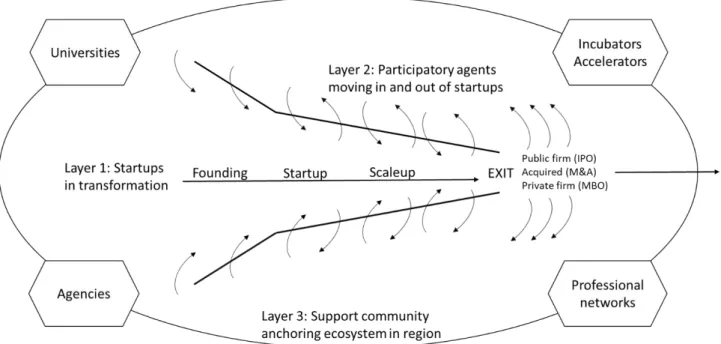
The previous three papers have found that regions other than Silicon Valley (San Francisco Bay Area) should be prepared for the likely outcome that the most valuable startups in their entrepreneurial ecosystems will be acquired and migrate from their regions long-term. This realization highlights the crucial importance of post-exit recycling of capital and talent within the ecosystem. An entrepreneurial ecosystem may thrive even though the majority of their successful startups leave, provided that the majority of the profits and experience startup professionals return to the ecosystem to found, finance and support new startups.
Figure 1: Entrepreneurial Ecosystem (EE) as a circular three layer system
The fourth paper conceptualizes entrepreneurial ecosystems (EEs) as a circular three layer system with startup exits driving its evolution, as seen above in Figure 1. The core of the ecosystem are startup firms (layer 1). Surrounding them is a community of four active types of agents who participate in developing the startups: entrepreneurs, business